

Search is evolving faster than ever. For over two decades, Search Engine Optimization (SEO) has been the cornerstone of digital visibility. Businesses optimized websites to rank on search engines like Google and Bing, driving organic traffic through targeted keywords and strong content.
However, the rise of AI-powered search engines has introduced a new concept called Generative Engine Optimization (GEO). Platforms like ChatGPT, Google AI Overviews, Perplexity AI, and Gemini now generate answers instead of simply showing links.
This shift is changing how users discover information online. Instead of scrolling through pages of results, users can ask complex questions and receive synthesized answers generated by artificial intelligence.
As a result, businesses must understand the difference between SEO vs GEO, how both strategies work, and how to optimize for the next generation of search.
The Evolution of Search: From SEO to AI-Driven Discovery
Traditional search engines operate on a structured model. When a user enters a query, search engines crawl billions of pages, analyze ranking signals, and display a list of relevant links.
Users then click on one of those results to access information.
AI-powered search works differently.
Instead of presenting a list of links, AI models analyze information from multiple sources and generate a summarized response. These responses often include citations or references from trusted websites.
For example:
A Google search for “What is SEO?” returns multiple website links.
But asking ChatGPT the same question produces a direct answer synthesized from various sources.
This new search experience means businesses must optimize for both traditional ranking systems and AI-driven answer engines.
What Is SEO (Search Engine Optimization)?
Search Engine Optimization is the process of improving a website’s visibility in organic search results.
The goal is to rank higher in search engines when users search for relevant queries.
SEO focuses on several key components.
First, search engines must crawl and index web pages. Crawlers, such as Googlebot, analyze content and store it in search engine databases.
Next, ranking algorithms evaluate various signals to determine which pages should appear at the top of the results.
Some of the most important SEO ranking factors include:
- Keyword relevance
- Content quality
- Backlinks from authoritative websites
- Page experience and loading speed
- Website structure and technical optimization
Businesses typically implement SEO strategies such as:
- Keyword research
- On-page optimization
- Technical SEO improvements
- Content marketing
- Link-building campaigns
When done correctly, SEO generates sustainable organic traffic and long-term visibility.
However, SEO primarily focuses on ranking web pages, not generating direct answers.
What Is GEO (Generative Engine Optimization)?
Generative Engine Optimization (GEO) refers to optimizing content so it appears in AI-generated answers produced by large language models (LLMs).
These answers are generated by AI search systems such as:
- ChatGPT
- Google AI Overviews
- Perplexity AI
- Gemini
Instead of returning links, these platforms generate responses using information gathered from trusted sources across the web.
GEO focuses on structuring content so AI models can easily interpret, summarize, and cite it.
In simple terms:
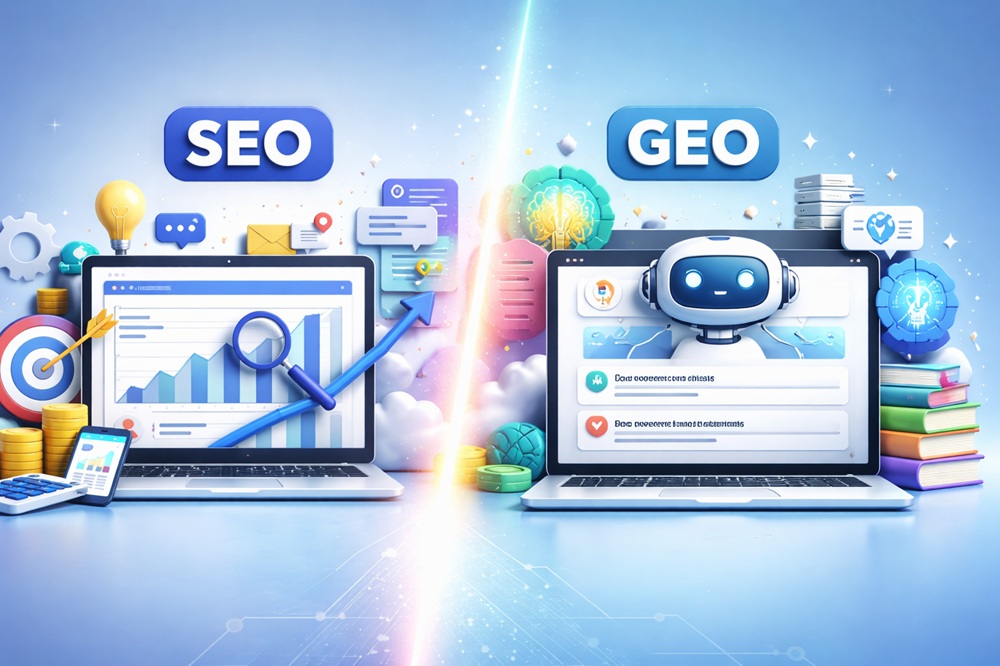
SEO helps websites rank on search engines.
GEO helps content appear inside AI-generated answers.
As AI search adoption increases, GEO is becoming a critical component of digital marketing strategy.
GEO vs SEO: Key Differences Explained
Although both strategies aim to improve visibility, they function in different environments.
| Factor | SEO | GEO |
| Platform | Search engines | AI answer engines |
| Results | Website rankings | Generated answers |
| Focus | Keywords and backlinks | Context and semantic meaning |
| Traffic | Click-based | Citation-based |
| Optimization | On-page SEO | Structured content |
Traditional SEO focuses on attracting clicks from search engine results pages.
GEO focuses on ensuring your content becomes a trusted reference source for AI systems.
Businesses that combine both approaches will have a stronger presence across modern search ecosystems.
How Content Optimization Differs Between SEO and GEO
Content optimization techniques vary depending on whether you are targeting search engines or AI answer engines.
SEO Content Optimization
SEO content typically includes:
- Targeted keywords
- optimized title tags and meta descriptions
- internal linking
- long-form articles with topical authority
Search engines analyze these signals to determine relevance and ranking potential.
GEO Content Optimization
GEO content must be structured for AI interpretation.
This includes:
- question-based headings
- structured explanations
- semantic relationships between concepts
- authoritative references
AI models prioritize clear structure, context, and trustworthy information sources.
This means formatting content in a logical hierarchy improves both SEO and GEO performance.
Do Web Crawlers and AI Crawlers Work the Same Way?
Search engines rely on automated bots to crawl websites.
Examples include:
- Googlebot
- Bingbot
These crawlers scan pages and index them within search databases.
AI search systems work differently.
Large language models rely on training data, knowledge graphs, and real-time retrieval systems to generate responses.
Instead of indexing pages in a traditional sense, AI engines analyze content contextually.
This means structured content with clear explanations increases the chances of being cited in AI answers.
SEO vs GEO: User Intent Fulfillment
Another major difference between SEO and GEO lies in how each approach fulfills user intent.
Search engines present multiple results, allowing users to choose which source to explore.
AI engines aim to deliver the answer immediately.
For example:
A user searching “How does SEO work?” on Google sees links to multiple guides.
A user asking the same question in an AI assistant receives a summarized explanation.
This shift means businesses must optimize content to become a trusted knowledge source rather than simply a ranking page.
GEO Optimization Elements Marketers Must Understand
To succeed in AI-driven search environments, several key optimization principles are important.
Question-Based Headings
AI models frequently respond to conversational queries.
Using headings like:
- What is GEO?
- How does AI search work?
helps content align with these queries.
Semantic Relationships
AI models rely heavily on contextual relationships.
Content should connect related topics such as SEO, AI search, generative engines, and search optimization strategies.
This helps AI systems understand topic relationships.
Structured Content Hierarchy
Proper heading structure improves readability for both humans and machines.
Content should follow:
H1 → H2 → H3
This allows AI crawlers to interpret information more effectively.
Structured Data and Schema
Schema markup helps search engines and AI systems understand page context.
Useful schema types include:
- Article schema
- FAQ schema
- organization schema
Structured data increases visibility in both search results and AI summaries.
SEO vs GEO vs AEO: Understanding the New Search Landscape
As search evolves, several related concepts have emerged.
Answer Engine Optimization (AEO)
AEO focuses on optimizing content for platforms that provide direct answers, such as voice assistants and featured snippets.
This includes:
- voice search optimization
- featured snippet targeting
- concise answer formatting
GEO (Generative Engine Optimization)
GEO expands this concept by optimizing for AI-generated responses rather than just featured snippets.
SEO (Search Engine Optimization)
SEO remains the foundation of organic traffic.
Together, these strategies create a multi-layered search optimization approach.
Can SEO and GEO Work Together?
Yes. In fact, combining SEO and GEO is the most effective strategy for modern search visibility.
SEO ensures your website ranks in traditional search engines.
GEO ensures your content becomes a trusted source cited by AI systems.
Businesses that implement both strategies gain visibility across multiple discovery channels.
For example:
A blog optimized for SEO may rank on Google.
The same content, if structured properly, can also appear in AI-generated answers.
This dual visibility significantly expands reach.
Real-World Example: SEO vs AI Search
Consider a business searching for “best SEO strategy.”
On Google, the user sees a list of ranking articles.
On an AI platform, the user receives a summarized strategy that cites several websites.
If your content appears in those citations, you gain brand visibility even if the user never clicks.
This is the power of GEO.
How Businesses Should Adapt to GEO
To prepare for the future of search, businesses should adopt several key strategies.
First, create high-authority content that explains topics in depth.
AI models prefer sources that demonstrate expertise.
Second, focus on topical authority by publishing multiple articles covering related subjects.
Third, structure content clearly with headings, FAQs, and logical explanations.
This makes it easier for AI systems to extract useful information.
Finally, maintain traditional SEO best practices, including backlinks and technical optimization.
The Future of Search: SEO + GEO Strategy
Search is moving toward a hybrid model.
Traditional search engines will continue to exist, but AI-powered results will play an increasingly important role.
Businesses that rely solely on traditional SEO risk losing visibility in AI search environments.
However, organizations that integrate SEO, GEO, and AEO strategies will gain a significant competitive advantage.
The future of digital discovery belongs to companies that optimize for both search engines and AI answer engines.
Key Takeaways
SEO focuses on ranking web pages in search engines.
GEO focuses on appearing in AI-generated responses.
Both strategies are essential for modern digital visibility.
Businesses that combine SEO and GEO will benefit from traffic, brand authority, and AI citations across multiple platforms.
FAQs
Is GEO replacing SEO?
No. GEO complements SEO rather than replacing it. Traditional search engines continue to drive significant traffic, while GEO expands visibility in AI-generated answers.
What is the biggest difference between SEO and GEO?
SEO focuses on ranking pages, while GEO focuses on appearing in AI-generated responses.
How can businesses optimize for AI search?
Businesses should create structured content, use question-based headings, build topical authority, and implement schema markup to improve visibility in AI-generated answers.
Is SEO still relevant in the age of AI search?
Yes. AI models rely heavily on trusted web sources, which makes strong SEO even more important for digital visibility.
What is the difference between SEO, AEO, and GEO?
SEO focuses on rankings, AEO focuses on answer engines and featured snippets, and GEO focuses on appearing in AI-generated responses.


