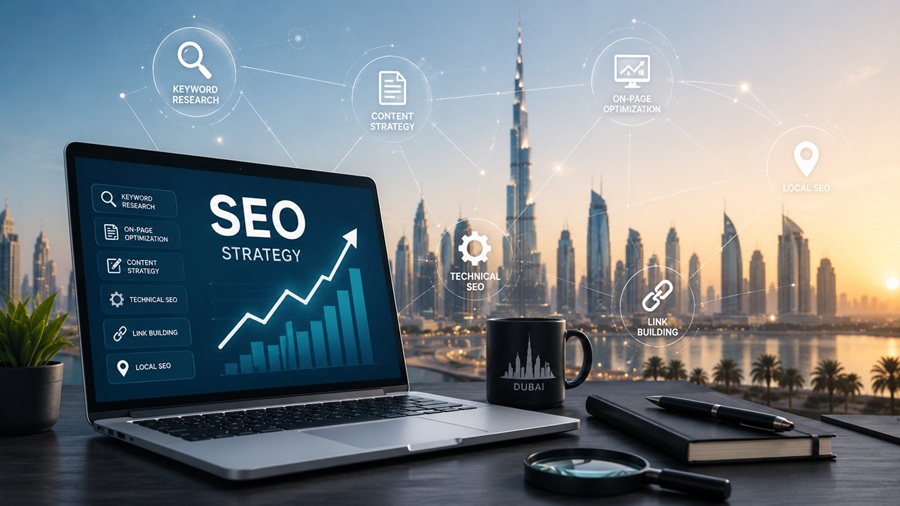
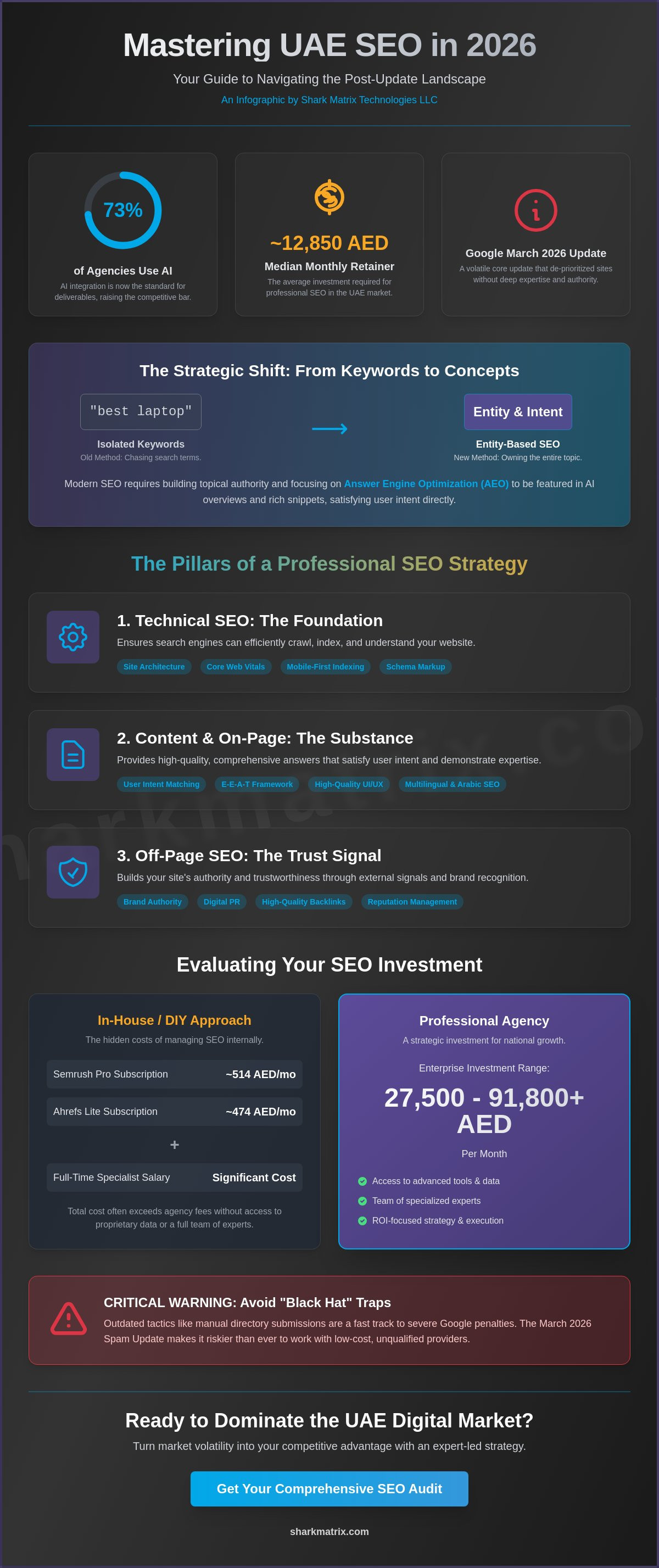
Did you know that 73% of agencies have now integrated AI into their standard deliverables? Despite this technological leap, many businesses in the UAE still find themselves buried on page two after the volatile Google March 2026 Core Update. You’re likely frustrated by how quickly the rules change. It’s exhausting to watch your rankings dip while trying to track the actual ROI of your organic traffic in a market where the median monthly retainer has reached approximately 12,850 AED.
This guide from Shark Matrix Technologies LLC will show you how professional search engine optimization (SEO) services turn that volatility into a clear competitive advantage. You’ll discover how to master the complexities of AI-enhanced intent matching and build a strategy that drives sustainable national growth. We’ll provide a framework for evaluating providers and explain how to integrate Arabic digital marketing with multilingual search strategies to dominate the Emirates’ digital landscape. From technical resilience to entity-based authority, you’re about to learn what it takes to win in 2026.
Key Takeaways
- Learn why shifting from isolated keywords to entity-based strategies is the only way to maintain authority in the 2026 search landscape.
- Understand how professional search engine optimization seo services balance technical, on-page, and off-page pillars to ensure your growth remains sustainable.
- Discover how to leverage AI automation and Arabic digital marketing to capture high-intent traffic across the UAE while maintaining human-led quality.
- Gain a clear framework for evaluating the total cost of ownership when choosing between agencies, in-house teams, or DIY software tools.
- Explore how a unified approach to SEO and lead generation can scale your brand’s national presence in a hyper-competitive digital market.
Defining Modern SEO Services: More Than Just Keywords
Modern search engine optimization seo services are far removed from the simple meta-tagging of the early 2000s. Today, it’s a multi-layered growth strategy that integrates technical architecture, user experience, and semantic relevance. Instead of chasing isolated keywords, sophisticated brands focus on “Entity-based SEO.” This approach helps search engines understand the relationship between your brand, your products, and the specific needs of the UAE market. For a detailed look at the foundational principles, you can refer to Wikipedia’s overview of SEO, which outlines the core methodologies that have evolved into the complex systems we use today.
Scaling visibility across the UAE requires a distinct shift from local to national thinking. While a local strategy might target a specific neighborhood, national growth demands authority across all seven emirates. You aren’t just competing for “plumber near me”; you’re competing for high-intent industry terms that define your niche throughout the UAE. This requires a robust content infrastructure and a deep understanding of regional search behavior, ensuring your brand appears wherever your customers are looking.
The Evolution of Search in 2026
By May 2026, the search landscape has shifted heavily toward Answer Engine Optimization (AEO). The Google March 2026 Core Update proved that ranking for a term isn’t enough. You must provide the most comprehensive, factual, and structured answer to be cited by AI overviews. Technical health is the non-negotiable foundation. If your site speed or mobile-friendliness lags, your organic visibility will vanish. Successful brands now focus on “owning the topic” rather than just ranking for a handful of strings.
Why Businesses Must Outsource to Specialists
Managing over 200 ranking factors in-house is a logistical nightmare for most UAE enterprises. Professional agencies use proprietary data and specialized tools to gain an edge. For instance, top-tier SEO suites like Semrush Pro now start at approximately 514 AED per month, while Ahrefs Lite begins at 474 AED. These costs add up quickly before you even hire a specialist.
Outsourcing also protects your brand from dangerous “black hat” traps. Some low-cost providers still claim that manual directory submission is the key to ranking, but this is a fast track to a permanent penalty. Following the Google March 2026 Spam Update, search engines are more aggressive than ever in de-indexing manipulative sites. Expert search engine optimization seo services focus on high-level strategy and ROI, turning organic traffic into measurable lead generation and long-term revenue growth.
The Three Pillars of a Professional SEO Strategy
A high-performing strategy for search engine optimization seo services relies on three interconnected pillars. If one pillar is weak, the entire structure fails to produce a return on investment. Search engines like Google evaluate your site based on E-E-A-T (Experience, Expertise, Authoritativeness, and Trustworthiness). This framework ensures that users in the UAE receive reliable, high-quality information. Before a single word of content is written, businesses should secure a comprehensive SEO audit report to identify existing gaps in their digital presence.
As noted by Forbes on the importance of SEO, this discipline is a vital marketing investment that builds long-term brand equity. For enterprise-level organizations in the UAE, these campaigns often require investments ranging from 27,500 AED to over 91,800 AED per month to maintain dominance in high-competition sectors. Treating these pillars as separate tasks is a mistake; they must work in unison to satisfy both human users and search algorithms.
Technical SEO: The Digital Foundation
Technical SEO is the process of making a site crawlable and indexable by search bots. Without this foundation, even the best content remains invisible. We prioritize site architecture, Core Web Vitals, and mobile-first responsiveness, especially since a vast majority of UAE search traffic originates from mobile devices. Implementing schema markup is also crucial in 2026. It allows AI-powered answer engines to pull your data into rich snippets, increasing your visibility in the “zero-click” search environment where users get answers directly on the results page.
Content and On-Page Optimization
Modern on-page strategy has moved past simple keyword density. It now focuses on satisfying specific user intent. Whether a user is looking for “e-commerce development” or “Arabic digital marketing,” the page must answer their query immediately and comprehensively. High-quality UI/UX design plays a massive role here. It reduces bounce rates and increases dwell time, which are critical signals for ranking. Using a standardized on page seo checklist ensures every page on your site maintains the same high level of optimization and relevance.
Authority Building (Off-Page SEO)
Off-page SEO is about building national trust through strategic link acquisition and digital PR. Generic, low-quality backlinks are no longer effective and can trigger penalties under the Google March 2026 Spam Update. Instead, the focus is on earning brand mentions from reputable UAE news outlets and industry-specific sites. These signals, combined with social media engagement, prove to search engines that your business is a leader in its field. To see how these pillars can transform your traffic, consider requesting a professional SEO audit to benchmark your current standing.
AI Automation and Multilingual SEO: The 2026 Edge
AI integration has become the defining feature of high-performance search engine optimization seo services in 2026. While the foundational pillars remain critical, the competitive edge now comes from predictive analytics and machine learning. Shark Matrix Technologies LLC utilizes custom AI models to identify “hidden” conversion opportunities that standard industry tools often overlook. This strategy isn’t about replacing human creativity; it’s about augmenting our experts to handle the massive data volatility that followed the Google March 2026 Core Update.
The “human-in-the-loop” model is our specific response to the industry’s biggest concern: the fear of AI-driven ranking penalties. By ensuring every automated insight and content brief is vetted against Google’s SEO Starter Guide, we maintain the E-E-A-T standards required for long-term growth. This approach allows us to scale content production and technical monitoring without sacrificing the quality or factual accuracy that search engines now demand.
The Power of Arabic Digital Marketing
True national coverage in the UAE is impossible without sophisticated Arabic digital marketing. Direct translation is no longer a viable strategy because search intent and conversational queries differ significantly between English and Arabic users in the GCC. For instance, a user in Riyadh or Abu Dhabi might use specific regional terminologies that generic translation software fails to capture. Shark Matrix Technologies LLC bridges this gap by localizing content to match these cultural nuances, ensuring your brand builds genuine authority with the high-value national demographic.
Predictive SEO and AI Automation
Predictive SEO allows us to forecast market shifts before they impact your organic traffic. By automating technical monitoring, we catch site errors and crawl issues the moment they occur, preventing the ranking decay that often follows unmanaged site changes. Custom AI automation and development can create proprietary SEO advantages by building tools that analyze competitor behavior and keyword shifts in real-time. This proactive stance ensures your brand isn’t just reacting to the market but actively shaping its position within it, turning search engine optimization seo services into a reliable engine for lead generation.
Evaluating SEO Providers: Agency vs. In-House vs. Tools
Deciding how to manage your digital growth is a financial and strategic crossroads. Each path has a different total cost of ownership. Hiring a full-time SEO specialist in Dubai often costs upwards of 20,000 AED per month when you include benefits and overhead. Relying solely on DIY software like Semrush (starting at 514 AED monthly) or Ahrefs (starting at 474 AED monthly) creates a massive expertise gap. You might have the data, but you won’t have the strategic insight to interpret it. Professional search engine optimization seo services bridge this gap by providing a full team of specialists for less than the cost of a single high-level internal hire.
Agencies offer a level of scalability that in-house models simply can’t match. When you need to pivot from local visibility to national dominance, an agency can instantly deploy more resources toward technical seo services uae. This flexibility is essential during major industry shifts. Following the Google March 2026 Core Update, many businesses with stagnant in-house teams saw their rankings plummet because they couldn’t adapt fast enough. An agency’s collective experience across multiple accounts serves as an early warning system for your brand.
What to Look for in a Performance-Driven Agency
Don’t settle for agencies that only talk about “rankings.” A true partner aligns their KPIs with your business goals. You need transparency in reporting and a proven track record in the UAE market. Look for an integrated approach where SEO works alongside PPC management, web development, and Arabic digital marketing. If an agency operates in a silo, they’ll miss the cross-channel data that drives the most efficient growth. Businesses serious about maximizing their total digital investment should also understand how to select a ppc agency dubai specialists trust to complement organic strategies with high-performance paid campaigns. For a comprehensive breakdown of what separates top-tier providers from the rest, the best SEO services in Dubai buying guide offers an in-depth framework for evaluating agencies against the AI-driven demands of the 2026 search landscape.
Measuring ROI: Beyond Rankings
Vanity metrics lie. While raw traffic numbers might look impressive on a monthly report, they don’t always translate into actual revenue if the visitors aren’t high-intent leads. High-quality search engine optimization seo services focus on tracking conversions, lead quality, and customer acquisition cost (CAC). Organic search offers a compounding value that paid ads can’t replicate. While PPC stops delivering the moment you stop spending, a robust organic presence continues to generate leads for years. Online retailers and digital storefronts in particular can benefit from specialized ecommerce SEO services Dubai brands rely on to build sustainable revenue beyond paid channels. If you’re ready to move beyond basic metrics and start driving real revenue, request a performance-focused consultation today.
Shark Matrix Technologies LLC: Scaling Your National Presence
Establishing a dominant digital footprint across the seven emirates requires a partner who understands that search engine optimization seo services are a component of a much larger business ecosystem. Shark Matrix Technologies LLC positions itself as more than a service provider; we act as a strategic extension of your marketing department. Our mission is to transform your organic visibility into a defensible asset that drives consistent lead generation and revenue. By aligning technical precision with the cultural expectations of the UAE market, we ensure your brand remains resilient against the constant shifts in search technology.
Our approach integrates the full spectrum of our client offerings, from UI/UX design to advanced lead generation strategies. Shark Matrix Technologies LLC recognizes that a high ranking is useless if the landing page fails to convert or if the mobile experience is sluggish. We synchronize your organic efforts with Arabic digital marketing and AI automation to create a seamless journey for your customers. This holistic view is what allows our partners to outpace competitors who rely on fragmented strategies or outdated manual processes.
The Shark Matrix Technologies LLC Methodology
Our execution begins with a deep-dive audit that moves beyond surface-level errors to analyze your site’s semantic architecture and entity relationships. We develop a customized roadmap that accounts for the specific national market dynamics of your industry. Whether your goal is to dominate the real estate sector in Dubai or the industrial landscape of Sharjah, we tailor our deployment to meet those specific search behaviors. Our methodology emphasizes continuous optimization, where we use real-time data to refine your strategy, ensuring your rankings translate into measurable business growth through transparent, KPI-driven reporting.
Getting Started with Professional SEO
The path to national visibility starts with a performance-focused consultation to define your specific growth targets. During the first 90 days of a campaign, our team focuses on aggressive technical stabilization and the alignment of content with modern intent signals. We clear away the legacy issues that hinder your crawlability and replace them with a robust framework built for the AI-driven search era. This initial phase sets the stage for long-term authority and sustainable traffic. If you are ready to secure your brand’s future in the Emirates, now is the time to Scale your business with expert SEO services and take command of your digital landscape.
Secure Your Digital Authority in the UAE
The digital landscape of 2026 demands more than just basic visibility. Success now hinges on your ability to adapt to entity-based search and AI-driven engines. We’ve explored how technical resilience, cultural localization, and the right partnership turn algorithm volatility into a predictable revenue stream. Investing in professional search engine optimization seo services isn’t just about rankings; it’s about building a defensible brand that dominates the national market while future-proofing your assets against shifting search behaviors.
Founded in 2010, Shark Matrix Technologies LLC brings over 15 years of national market experience to every campaign. We specialize in the unique intersection of Arabic digital marketing and AI automation, ensuring your brand speaks the language of your customers and search engines alike. By integrating UI/UX design and lead generation into a holistic framework, we help you scale with confidence. Don’t let your competitors own the conversation on page one. Request Your Comprehensive National SEO Audit Today and start your journey toward sustainable organic growth. Your brand’s future in the Emirates starts now.
Frequently Asked Questions
How long does it take to see results from professional SEO services?
It typically takes 4 to 12 months to see significant results from professional search engine optimization seo services. This timeline depends on your domain’s starting authority and the intensity of the competition for your target terms. While technical fixes can show impact in weeks, building the authority required for national rankings is a long-term commitment that compounds over time.
Can SEO services guarantee a #1 ranking on Google?
No reputable agency can guarantee a #1 ranking on Google. Google’s own documentation explicitly warns against any company that promises specific positions. Search algorithms change frequently, such as the Google March 2026 Core Update, making it impossible to control every variable. Focus on providers that promise measurable growth in high-intent traffic and conversions instead.
What is the difference between SEO and SEM/PPC?
SEO focuses on earning organic visibility through content and technical authority, while PPC involves paying for every click your website receives. SEO provides a long-term return on investment without a recurring cost per visitor. PPC offers immediate traffic but stops the moment you stop spending. Both are essential parts of a balanced digital marketing strategy for UAE businesses.
How much do SEO services cost for a national business?
National or e-commerce campaigns in the UAE typically start at 14,700 AED per month and can exceed 55,100 AED for highly competitive industries. For enterprise-level organizations, the monthly investment often ranges between 27,550 AED and 91,800 AED. These rates reflect the complexity of managing large-scale technical requirements and high-volume content production across the seven emirates.
Is AI-generated content safe for my website’s SEO?
AI-generated content is safe as long as it follows a human-in-the-loop model. The Google March 2026 Spam Update specifically targeted scaled, thin content that provides no value to users. To protect your rankings, every AI-assisted draft must be reviewed, fact-checked, and enhanced by a human expert to ensure it meets the highest standards of experience and trust.
What happens if we stop investing in SEO services?
If you stop investing in search engine optimization seo services, your rankings will eventually decay as competitors continue to optimize. SEO is not a one-time setup but an ongoing process of maintaining technical health and authority. Over time, your site will fall behind newer algorithm updates and lose its place to brands that are actively publishing fresh, relevant content.
How does Arabic SEO differ from standard English optimization?
Arabic SEO involves more than just translation; it requires deep cultural localization and technical adjustments for right-to-left layouts. Searchers in the UAE often use different dialects and conversational phrases than English users. A successful strategy must account for these linguistic nuances to capture the high-value national audience that prefers searching in their native language.
Do I need to redesign my website for better SEO results?
You don’t always need a full redesign, but technical audits often reveal structural issues that require significant web development. If your current site fails Core Web Vitals or isn’t mobile-friendly, a refresh of the UI/UX design might be necessary. Improving these foundational elements is often the fastest way to see an uplift in your organic search performance and user engagement.