

The UAE government has committed over $100 billion to AI investments, signaling a massive shift in how digital products are built. In 2026, your app development cost uae is no longer determined solely by front-end design, but by AI-readiness and backend scalability. You’ve probably felt the frustration of unpredictable hidden costs or the anxiety of choosing between Native and Cross-platform builds without knowing which drives better ROI. It’s a common fear to worry about overpaying for features that don’t actually help you grow.
We’re here to give you total clarity. This guide provides a detailed AED-based budget framework, ranging from basic AED 18,000 MVPs to enterprise solutions exceeding AED 735,000. You’ll learn exactly how factors like PDPL compliance and Arabic language support impact your bottom line. We’ll also provide a clear roadmap for launching an MVP that balances cost with high-quality performance, ensuring your investment aligns with the UAE’s rapidly evolving tech standards.
Key Takeaways
- Identify the specific AED-based budget tiers for 2026 to align your project scope with current market realities.
- Analyze how Arabic localization and UAE security standards influence the total app development cost uae.
- Evaluate the long-term financial trade-offs between Native, Cross-platform, and AI-driven development frameworks.
- Factor in the “iceberg effect” of maintenance and hidden fees to calculate a realistic two-year total cost of ownership.
- Implement a phased development strategy to protect your cash flow while prioritizing features that drive immediate ROI.
UAE App Development Cost Tiers in 2026
The digital landscape in Dubai and Abu Dhabi has matured rapidly. By 2026, the baseline for app development cost uae has shifted upward to reflect a market that no longer accepts “basic” solutions. Users in the Emirates are among the most tech-savvy globally. They expect apps to integrate seamlessly with national services like UAE Pass and provide flawless right-to-left (RTL) support. Understanding your budget requires looking past simple hourly rates and focusing on these localized complexities.
Apps have evolved from standalone tools into integrated ecosystem platforms. A modern app acts as a bridge between your business, third-party payment gateways, and advanced AI automation. Because the process of mobile app development now involves high-level security protocols and strict data compliance, the entry-level price point has risen. This ensures your product remains viable in a competitive national market. Most projects now fall into three distinct financial categories based on their technical depth.
Tier 1: The MVP and Single-Purpose Apps
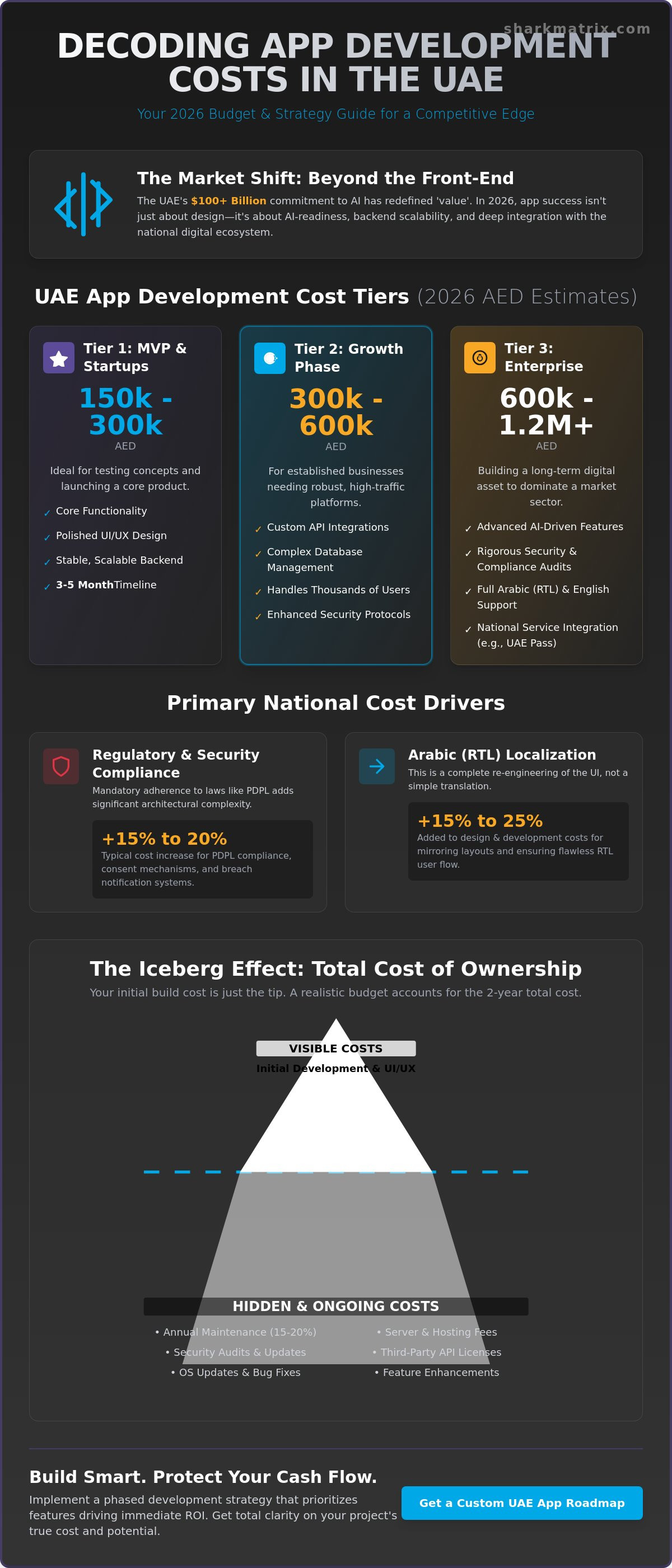
For startups testing a new concept, a Minimum Viable Product (MVP) remains the most strategic entry point. Budgeting between AED 150,000 and AED 300,000 allows for a polished product with core functionality. This tier focuses on solving one primary user problem without the distraction of “feature creep.” You can expect a timeline of 3 to 5 months for a national launch. This budget covers essential UI/UX design and a stable backend, providing a foundation you can scale as your user base grows.
Tier 2 & 3: Standard Production to Enterprise Platforms
The jump to Tier 2, ranging from AED 300,000 to AED 600,000, usually happens when you require custom API integrations or complex database management. At this level, you’re paying for the architectural integrity needed to handle thousands of concurrent users. It’s about stability and performance under pressure.
Enterprise-grade platforms starting at AED 600,000 and often exceeding AED 1,200,000 represent the peak of the market. These projects include advanced AI-driven features and rigorous security audits. A major cost driver here is full multi-language support. Implementing a high-quality Arabic and English interface adds significant complexity to the design phase. It’s not a simple translation; it’s a complete re-engineering of the user flow to accommodate RTL layouts. This ensures your platform resonates with the entire national demographic, from local citizens to the international expat community. Investing in this tier is about building a long-term digital asset that can dominate its sector.
Primary Cost Drivers for National App Projects
Calculating your total app development cost uae requires looking far beyond the initial lines of code. In 2026, the budget is heavily influenced by the rigorous regulatory environment and the high expectations of the local market. Compliance with the UAE Personal Data Protection Law (PDPL), or Federal Decree-Law No. 45 of 2021, is a mandatory requirement that typically adds 15% to 20% to your total build cost. This isn’t just a checkbox; it involves implementing clear consent mechanisms and ensuring your data architecture allows for breach notifications within the 72-hour legal window.
Digital platforms must also now account for Federal Decree-Law No. 26 of 2025 on Child Digital Safety. This law imposes strict obligations for age verification and parental controls for users under 18. These security protocols require senior developers with specialized skill sets, which naturally impacts the hourly rate compared to generic, template-based builds. While a template might save money upfront, it often fails to meet the UAE’s Digital Economy Strategy standards for security and scalability. If you want a product that lasts, investing in custom architecture is the only way to avoid expensive technical debt later. If you’re unsure how these drivers apply to your specific project, consulting with experts in mobile app development can clarify your roadmap.
Feature Complexity and AI Integration
AI is no longer a luxury in the Emirates. With the government committing over $100 billion to AI investments, businesses are integrating predictive analytics and intelligent chatbots to stay competitive. Adding these features can push a mid-level budget from AED 92,000 toward the AED 294,000 range quickly. Real-time data processing and complex third-party API integrations for logistics or fintech also inflate the quote. AI-readiness is a 2026 budget priority for UAE firms to ensure long-term scalability and market relevance.
UI/UX Design and Arabic Localization
Localization in this market is a sophisticated engineering task. Integrating Arabic Right-to-Left (RTL) language support adds 15% to 25% to your design costs because it requires a complete mirroring of the user interface. It’s not a simple translation; it involves re-adjusting every icon, button, and navigation flow to feel natural to native speakers. High-quality UI/UX design also relies on local user research. Investing in custom animations and tailored interfaces ensures your app achieves high adoption rates in a market that values premium digital experiences.
Technology Choices: Native vs. Cross-Platform vs. AI-Driven
Choosing the right framework is the most significant decision you’ll make for your three-year growth plan. By 2026, the performance gap between various stacks has narrowed significantly, but the impact on your initial app development cost uae remains substantial. You aren’t just paying for code; you’re paying for long-term scalability and the ability to pivot as the market changes. A mistake here can lead to massive technical debt, requiring a complete rebuild just as your business starts to gain traction.
Your technology stack should reflect your specific business goals. If you’re a startup aiming for rapid market entry, your priorities differ from a government entity requiring maximum security. In the UAE’s competitive digital environment, the “hidden” factor in scaling is how easily your app can adopt new features, such as the AI-driven tools that are currently transforming the national economy. Aligning your tech choices with your budget from day one prevents mid-project surprises.
Native Development for iOS and Android
Native development involves writing separate codebases for Apple and Google platforms using Swift or Kotlin. While this ensures peak performance and full access to device-specific features, it typically requires a 40% higher budget than other methods. High-performance industries in the Emirates, such as fintech and advanced gaming, still prioritize this approach. For instance, a fintech or digital wallet app in the UAE often ranges from AED 150,000 to over AED 400,000 because it requires the absolute security and low-latency performance that only native code provides. The downside is clear; you must maintain two distinct teams and two sets of updates, which can strain resources over time.
Cross-Platform Efficiency (Flutter and React Native)
Frameworks like Flutter and React Native have become the standard for national enterprises looking to optimize their spend. By using a single codebase to power both iOS and Android versions, you can save up to 30% of your initial development budget. This efficiency is why a mid-level cross-platform app typically costs between AED 92,000 and AED 294,000 in 2026. Maintenance becomes much simpler since one team handles updates for all national users simultaneously. Modern cross-platform tools are now fully ready for complex AI integrations, allowing you to deploy intelligent features across all devices without doubling your engineering hours. This makes it an ideal choice for service-based platforms and e-commerce apps that need to scale quickly across the region.
Total Cost of Ownership: Hidden Fees and Maintenance
Many business owners focus solely on the initial quote, but the launch of your product is only the tip of the iceberg. In reality, the first day your app goes live represents roughly 50% of the total app development cost uae over a two-year period. This “iceberg effect” catches many founders off guard, leading to budget shortfalls just as the app begins to gain traction. To build a sustainable digital asset, you must account for cloud infrastructure, third-party licensing, and the transactional fees charged by app stores.
Cloud infrastructure and server hosting are critical for national platforms that require high availability. While you won’t buy physical hardware, you’ll need a monthly budget for services like AWS or Azure to handle user data and backend processing. Additionally, remember that Apple and Google take a 30% commission on in-app purchases, which drops to 15% for subscriptions after the first year. You also need to factor in the annual $99 Apple Developer Program fee and the one-time $25 Google Play fee. These small costs add up, but they’re essential for maintaining a professional presence in the market.
Ongoing Maintenance and Security Updates
Once your app is live, it requires constant attention to remain functional. Annual maintenance costs typically range from 15% to 20% of the initial build price. This budget covers bug fixes, performance optimizations, and the necessary updates to keep your app compatible with the latest iOS and Android versions. In a market as regulated as the UAE, you must also schedule regular security audits to protect user data. Data security is a non-negotiable ongoing expense to ensure compliance with the UAE’s evolving digital regulations. Neglecting these updates can lead to app crashes or, worse, legal penalties under the PDPL.
Marketing, Launch, and User Acquisition
A high-quality app is worthless if your target audience can’t find it. We recommend budgeting at least 50% of your total development costs for your national launch and initial marketing push. This includes App Store Optimization (ASO), which is vital for reducing your long-term user acquisition costs by improving organic visibility. Many successful firms in Dubai and Abu Dhabi integrate their app launch with robust Lead Generation strategies to ensure a steady stream of new users from day one. Without a clear plan for marketing, even the most expensive app will struggle to generate a return on investment.
If you’re ready to build a sustainable digital asset with a clear financial roadmap, get a detailed cost assessment today to avoid the hidden fees that sink most projects.
Optimizing Your App Budget for Maximum ROI
Your investment should be a growth engine, not a sunk cost. To maximize your app development cost uae, you need a strategy that prioritizes business results over technical vanity. Many firms make the mistake of building every possible feature at once, which drains capital before the app can prove its worth. Instead, adopting a “phased development” model allows you to manage cash flow effectively. You launch with essential features, gather user feedback, and reinvest profits into the next stage of growth. This approach minimizes risk and ensures every dirham spent contributes to your bottom line.
Choosing a full-service partner also eliminates the “fragmentation tax.” When you hire separate vendors for design, development, and marketing, communication gaps often lead to expensive reworks. A single agency that understands both the technical build and the digital growth strategy ensures your app is designed for visibility from day one. This holistic view prevents the common pitfall of building a beautiful app that nobody can find. By aligning your development with a clear commercial roadmap, you turn a technical expense into a strategic asset.
The MVP Strategy for UAE Startups
A Minimum Viable Product (MVP) is the smartest way to enter the Emirates’ market. Focus on features that solve immediate pain points for local users, such as seamless payment integration or localized Arabic support. By reducing your time-to-market, you start generating revenue and collecting real-world data sooner. This data is invaluable. It helps you justify moving into Tier 2 or Tier 3 development because you aren’t guessing what users want; you’re responding to their actual behavior. It’s a data-driven path to scalability that protects your initial capital.
Why Shark Matrix is the Strategic Choice
Shark Matrix doesn’t just write code. We build digital ecosystems. By combining high-performance mobile development with advanced SEO and AI automation, we ensure your app is both functional and discoverable. Our transparent pricing model means you won’t face the “iceberg” fees mentioned earlier without prior warning. We focus on national scalability, helping your brand grow from a local startup to a regional leader. Ready to start? Get a detailed 2026 app development quote from Shark Matrix and let’s build something that drives real ROI.
Launch Your Digital Future in the UAE
Building a successful mobile product in 2026 requires more than just a functional interface. It demands a deep understanding of the app development cost uae, including the technical debt of maintenance and the necessity of AI-readiness. You’ve seen how factors like Arabic localization and PDPL compliance shape your budget. Success comes from choosing the right technology stack today to avoid a costly rebuild tomorrow. Whether you start with a lean MVP or a full-scale enterprise platform, your focus must remain on scalability and user trust.
Shark Matrix has been a cornerstone of the Emirates’ tech landscape since 2010. With over 15 years of market experience, we specialize in everything from UI/UX design to AI automation and Arabic digital marketing. We aren’t just developers; we’re a full-service agency dedicated to your long-term ROI and lead generation. We understand the local regulatory environment and the high expectations of UAE users.
Don’t leave your project’s financial success to chance. Request a Custom App Development Consultation today to get a transparent, data-driven roadmap for your next venture. We look forward to helping you scale your business in this vibrant digital economy.
Frequently Asked Questions
What is the average app development cost in the UAE for 2026?
The app development cost uae depends heavily on the complexity of the features you require. A basic Minimum Viable Product (MVP) typically ranges from AED 18,000 to AED 92,000. Mid-level apps featuring cross-platform functionality often fall between AED 92,000 and AED 294,000, while complex platforms with AI or fintech integrations can exceed AED 735,000. These figures reflect the 2026 market demand for high-security and localized digital solutions.
How long does it take to build a mobile app for the UAE market?
A standard MVP takes approximately 3 to 5 months to reach a national launch. More complex projects, such as enterprise platforms or those requiring extensive third-party integrations, usually take 6 to 12 months. This timeline includes essential phases like UI/UX design, backend development, and rigorous testing for Arabic language support. Rushing this process often leads to technical debt that increases your long-term maintenance expenses.
Why is app development in the UAE more expensive than offshore options?
Local development ensures compliance with strict national regulations like the UAE Personal Data Protection Law (PDPL) and the Child Digital Safety Law. Offshore teams often overlook these requirements, which can lead to legal penalties and expensive reworks. Additionally, high-quality Arabic localization requires native design expertise to handle right-to-left (RTL) layouts correctly. Investing in a local partner ensures your product meets the specific cultural and legal standards of the Emirates.
Should I build a Native or Cross-platform app for my UAE business?
Cross-platform development is the most cost-effective choice for most businesses, potentially saving 30% of your initial budget. It’s ideal for e-commerce and service apps that need to reach both iOS and Android users quickly. However, you should choose Native development for high-performance needs like complex fintech wallets or gaming. Native builds offer the best security and hardware access but require a 40% higher investment to maintain two separate codebases.
What are the hidden costs of app development I should budget for?
You must budget for annual maintenance, which typically costs 15% to 20% of your initial build. Other “hidden” expenses include the $99 annual Apple Developer fee, the $25 one-time Google Play fee, and cloud infrastructure costs. Regulatory compliance can also increase your total build price by up to 20%. Don’t forget that app stores take a 30% commission on in-app purchases, which is a significant factor in your revenue model.
How much does it cost to add AI features to a mobile app?
Integrating AI features like predictive analytics or intelligent chatbots generally moves your project into the complex tier, starting at AED 294,000. The final price depends on whether you’re using existing APIs or building custom machine learning models. Because the UAE government has committed over $100 billion to AI investments, these features are becoming a standard requirement for staying competitive. AI-readiness ensures your app remains relevant as the national digital economy evolves.
Does the cost include publishing the app on the App Store and Play Store?
Most professional agencies include the technical submission process in their quote, but the platform fees are paid directly by the business owner. You’ll need to pay $99 annually for the Apple Developer Program and a one-time $25 fee for a Google Play Developer account. Your developer will handle the configuration, metadata, and compliance checks required for approval. This ensures your app meets the latest store policies regarding data privacy and user safety.
How can I reduce my app development costs without sacrificing quality?
The most effective way to reduce your app development cost uae is to start with a Minimum Viable Product (MVP). By focusing on core features first, you avoid overpaying for complex tools that your users might not need. Using cross-platform frameworks like Flutter or React Native also cuts expenses by allowing one team to build for both iOS and Android. A phased development approach lets you use early revenue to fund future feature updates.


