


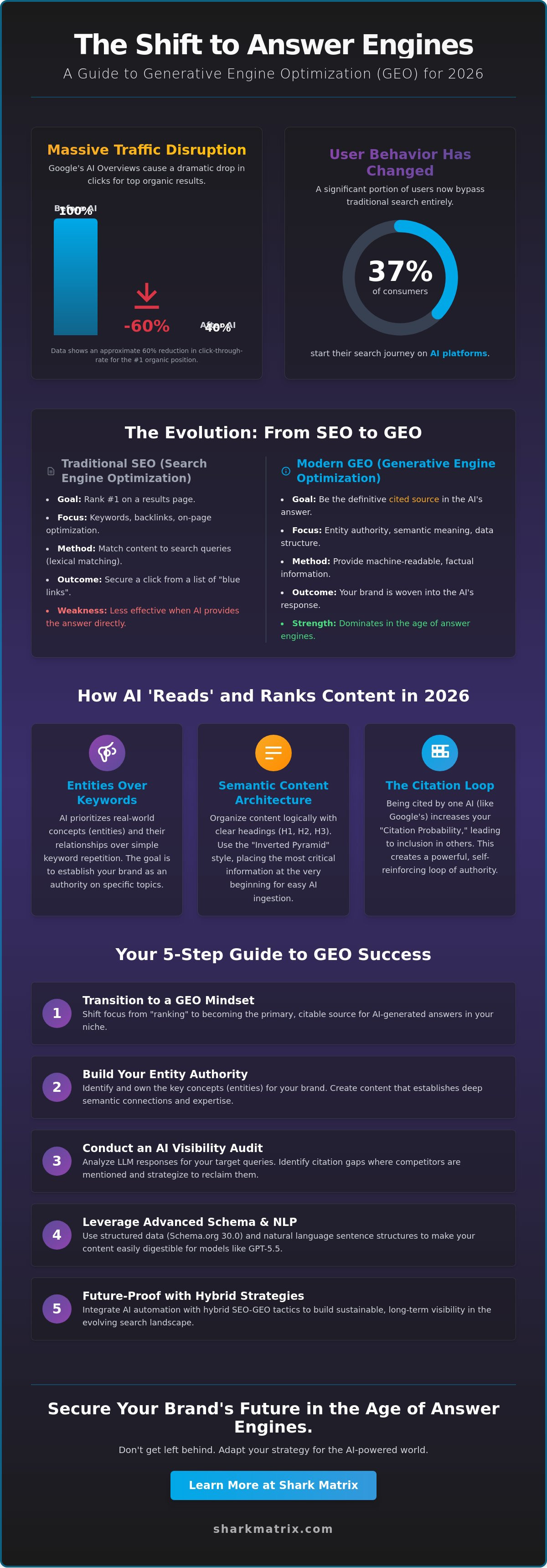
Did you know that the presence of a Google AI Overview now reduces the click-through rate of the top organic result by approximately 60%? With 37% of consumers now starting their searches on AI platforms, the traditional search landscape has fundamentally shifted. Learning how to optimize content for ai search is the only way to ensure your brand remains visible as Gemini 3.5 Flash and GPT-5.5 become the primary tools for discovery.
You’re likely worried about your content being summarized without receiving the traffic you deserve. It’s a common fear in this era of Generative Engine Optimization (GEO), but you don’t have to be left behind. This guide promises to teach you how to become the definitive source that AI models cite and recommend. We’ll preview the essential tactics for 2026, including leveraging Schema.org 30.0 and navigating the latest Google Core Updates to secure your brand’s future in the age of answer engines.
Key Takeaways
- Transition from traditional ranking to Generative Engine Optimization (GEO) to ensure your brand is the primary source for answer engines.
- Discover how to optimize content for ai search by focusing on semantic meaning and building entity authority within your niche.
- Conduct an AI visibility audit to find citation gaps and reclaim mentions from competitors in LLM responses.
- Use advanced Schema.org 30.0 markup and natural language structures to make your data easily digestible for models like GPT-5.5 and Gemini 3.5 Flash.
- Future-proof your marketing by integrating AI automation and hybrid SEO-GEO strategies for long-term national visibility.
The Shift from Search Engines to Answer Engines: Why GEO is the New SEO
For decades, the goal of digital marketing was simple: rank on page one. By June 2026, that goal has become obsolete. We’ve moved into the era of the “Answer Engine,” where platforms like Perplexity, with its 100 million monthly active users, provide direct answers instead of a list of websites. This shift marks the rise of Generative Engine Optimization (GEO). Unlike traditional SEO, GEO focuses on making your brand the primary source for the AI’s synthesized response. The era of the “blue link” is ending. In its place, we have synthesized summaries that pull from the most authoritative nodes in the digital landscape.
AI models don’t just scan for keywords; they analyze context and authority. If you’re still using old-school keyword stuffing, you’re likely hurting your visibility. Modern LLMs like GPT-5.5 and Gemini 3.5 Flash prioritize content that is modular and machine-readable. Understanding how to optimize content for ai search requires a move away from lexical matching toward semantic depth. You aren’t just trying to “rank” anymore. You’re trying to be the “source” that the AI trusts enough to cite.
Understanding the Mechanics of Generative Engine Optimization (GEO)
Large Language Models process content through retrieval-augmented generation. They don’t just “find” your page. They extract specific facts to build a response. To win here, your content must have high “Citation Probability.” This is the likelihood that an AI will credit your site as the source of its information. While AEO (Answer Engine Optimization) focuses on providing a single direct answer, GEO is a broader strategy. It ensures your brand’s expertise is woven into the AI’s entire reasoning process. It’s about being the most helpful, cited expert in the room.
Why 2026 is the Tipping Point for AI Search Adoption
User behavior has changed. As of early 2026, AI Overviews appear in 57% of long-tail, high-intent queries. This has led to a massive 60% drop in click-through rates for the top organic results. National brands can’t afford to ignore this. You must pivot your search engine optimization seo services to include generative strategies. Learning how to optimize content for ai search is no longer an optional upgrade. It’s the foundation of market dominance in a world where the traditional search result is fading into the background.
How AI Search Engines ‘Read’ and Rank Content in 2026
In 2026, search algorithms have evolved beyond simple keyword matching. They now utilize advanced semantic analysis to understand the intent behind a query. This shift means that how to optimize content for ai search is no longer about repeating phrases. Instead, it’s about providing clear, accurate information that matches the meaning of a user’s question. AI models look for “entities,” which are specific people, places, things, or concepts, and how they relate to one another. Understanding these relationships allows LLMs to synthesize answers that are both relevant and factually sound.
Once an AI model identifies your content as a reliable source, you enter a “Citation Loop.” Being cited in a Google AI Overview often leads to inclusion in other LLM responses as these systems cross-reference data. Focusing on optimizing for AI content ranking ensures your brand remains a trusted node in the knowledge graph. If you’re looking to refine your digital presence for these new systems, our content marketing experts can help align your brand with these evolving ranking signals.
Entities over Keywords: Building Your Digital Identity
Entities are the building blocks of the global knowledge graph. They represent real-world concepts that AI models use to map information. To dominate your niche, you must identify which entities your brand should own. For example, a fintech company should be inextricably linked to “secure digital payments” and “blockchain transparency.” Entity Authority is the primary ranking signal for 2026, representing the strength of the connection between your brand and a specific topic in the eyes of an LLM.
Semantic Content Architecture: Organizing for LLM Ingestion
Structure is now more critical than word count. AI crawlers use hierarchical heading structures to parse topical relevance quickly. When learning how to optimize content for ai search, you’ll find that the “Inverted Pyramid” style is essential. Place the most important facts at the beginning of each section. This makes it easier for models like Gemini 3.5 Flash to summarize your work. Use clear, declarative statements. Instead of saying “Our services might help you grow,” say “Our services increase revenue by 20%.” This directness makes your content highly “quotable” for AI-generated answers.
Auditing Your Content for AI Discoverability and Citation Gaps
Traditional SEO audits often stop at technical health and keyword rankings. In 2026, these metrics only tell half the story. You need a comprehensive AI Visibility Audit to understand how LLMs perceive your brand. This audit identifies where you’re being cited and, more importantly, where you’re being left out of the conversation. If you want to master how to optimize content for ai search, you have to find the “Citation Gaps” where competitors are mentioned as the primary authority while your brand remains invisible. It’s about moving from “ranking” to “being the source.”
A critical part of this process is evaluating your content for “Extraction Readiness.” AI models don’t read like humans; they extract. If your Unique Selling Proposition (USP) is buried in flowery prose or complex metaphors, models like GPT-5.5 might skip it entirely. You should also analyze the sentiment of current AI mentions. Since LLMs can mirror the sentiment of their training data, managing how these models describe your brand is vital for long-term reputation. If a model consistently summarizes your service with a neutral or negative tone, it’s a signal that your underlying content needs a strategic pivot.
Tools and Techniques for AI Visibility Analysis
You don’t need complex software to start your audit. Use direct prompts in GPT-5.5 or Gemini 3.5 Flash to ask specific industry questions. Analyze which sites the models use as grounding data. If you aren’t appearing in the citations for your core topics, your content likely lacks the structured clarity required for modern LLM ingestion. Monitoring your presence in major training sets is now a standard part of generative engine optimization, ensuring your brand is part of the model’s foundational knowledge rather than just a real-time retrieval afterthought.
Closing the Gap: Turning Missing Mentions into Citations
Once you’ve identified the gaps, you must fill them with high-value, declarative content. Address the specific, unanswered user questions your audit revealed. Improving your internal linking is also essential; it builds a semantic web that helps AI bots understand the relationship between different pages on your site. For national brands, leveraging seo for brand reputation management dubai can help improve the trust signals that AI models prioritize. Learning how to optimize content for ai search means constantly refining these signals to ensure your brand remains the most cited expert in your field.
How to Optimize Content for AI Search: A Practical 5-Step Guide
Turning theoretical knowledge into a functional strategy requires a systematic approach. If you want to master how to optimize content for ai search, you must move beyond traditional metadata. The following five steps provide a roadmap for ensuring your brand is the primary answer in AI-driven search results. By focusing on how machines ingest data, you can secure a permanent spot in the knowledge graphs of the future.
Step 1 & 2: Technical Foundations and Language Processing
Start with the technical architecture of your data. Implementing “SameAs” schema allows you to link your website to verified entity databases like Wikidata or official industry registries. This provides the “Entity Clarity” that models like GPT-5.5 require to distinguish your brand from competitors. While 2024 schema focused on basic categorization, the 2026 requirements under Schema.org version 30.0 demand deep relational mapping that connects your content to the global knowledge graph. Once your technical foundation is set, focus on your phrasing. Writing in a “Question-Answer” format that mirrors common conversational prompts helps LLMs identify your text as the direct solution to a user’s query.
Step 3 & 4: Extraction and External Validation
AI models prefer modular data. You should create “Fact-Dense” content blocks by using bulleted lists and tables. These structures provide the organized data that RAG (Retrieval-Augmented Generation) systems can easily extract and summarize. If you’re researching how to optimize content for ai search, you’ll find that external validation is just as important. In the AI era, high-authority PR and third-party mentions have replaced traditional backlinks as the primary trust signal. When reputable news sites or industry journals cite your brand, AI models view you as a verified authority. Our website design and development services ensure your site remains technically optimized for these AI crawlers, maintaining the speed and structure they need to index your data efficiently.
Step 5: Maintaining Freshness for RAG Systems
The final step is consistency. AI systems reward content that is recently published or updated. This signals to the models that your information is current and relevant for real-time retrieval. If your data is outdated, models like Gemini 3.5 Flash will likely deprioritize it in favor of fresher sources. Content that was accurate six months ago might be ignored by a model looking for the latest industry trends. To keep your brand at the forefront of this evolution, you can explore our generative engine optimization services to automate these updates and ensure your brand remains the definitive answer in 2026.
Navigating the Future: Integrating AI Search into Your National Strategy
National market dominance in 2026 requires a sophisticated hybrid strategy. You can’t simply choose between traditional SEO and Generative Engine Optimization (GEO); you must master both. While Google still maintains a global search market share of nearly 90%, the way users interact with those results has changed. With AI search adoption reaching 37% of consumers by early 2026, your brand’s visibility depends on being both a top organic result and the primary cited source in an AI summary. This dual approach ensures you capture traffic from users who still click links and those who rely on synthesized answers.
The next wave of digital discovery is already here: multimodal AI and voice search. Users are no longer just typing keywords; they’re uploading images and asking complex, conversational questions via wearable AI devices. Learning how to optimize content for ai search now includes preparing your assets for these non-textual queries. Your strategy must evolve to include “Entity Authority” across all formats, ensuring that whether a user speaks a question or points a camera at a product, your brand is the definitive answer provided by the underlying model.
Scaling with AI Automation and Development
Managing GEO across thousands of pages is impossible without high-level technical support. Large enterprises are now using custom LLMs to predict which content pieces are most likely to be featured in AI Overviews before they even go live. At Shark Matrix, we utilize ai automation services to implement complex Schema.org 30.0 markup at scale, ensuring every piece of data is machine-readable and ready for ingestion by GPT-5.5 or Gemini 3.5 Flash. Additionally, as search moves into proprietary platforms, our mobile app development services help brands integrate custom AI search interfaces directly into their own ecosystems, bypassing the “blue link” entirely.
Future-Proofing Your Brand with Shark Matrix
The AI search landscape shifts weekly. With Google’s March 2026 Core Update and the rapid retirement of older models like GPT-4o, staying relevant requires continuous monitoring. We don’t just “set and forget” your content. Our team uses generative ai development services to track your citation frequency and the sentiment of brand mentions within LLM responses. This data-driven approach allows us to pivot your strategy in real time, closing citation gaps before competitors can claim your space in the knowledge graph. If you’re ready to secure your brand’s position as the primary answer in 2026, contact Shark Matrix to optimize your AI search strategy today. We’ll help you master how to optimize content for ai search and ensure your digital presence is built for the era of the answer engine.
Dominating the Answer Engine Era
The search landscape is no longer just about ranking; it’s about becoming the definitive source for the world’s most powerful AI models. By prioritizing entity authority over simple keywords and utilizing advanced schema, you can ensure your brand isn’t just indexed, but cited. We’ve explored how a proactive visibility audit and a technical roadmap can turn potential traffic losses into citation wins. Mastering how to optimize content for ai search is the single most important move your brand can make to stay relevant in 2026.
Since 2010, Shark Matrix has been at the forefront of digital innovation. We combine over a decade of experience with cutting-edge expertise in AI automation and development to deliver leading SEO and GEO strategies for national brands. Don’t let your content get lost in the shuffle of synthesized summaries. Secure Your Brand’s Future in AI Search with Shark Matrix and lead the transition to the answer engine era. The future of search is conversational, and your brand deserves to be the primary answer.
Frequently Asked Questions
What is the difference between SEO and Generative Engine Optimization (GEO)?
SEO focuses on ranking in traditional search result lists, while GEO focuses on being cited within AI-generated summaries. While SEO prioritizes keywords and backlinks to drive clicks, GEO emphasizes entity authority and extraction readiness. You want your brand to be the primary source that LLMs use to build their synthesized answers.
How do I know if my content is being used by AI search engines?
You can monitor citation links in Google AI Overviews or platforms like Perplexity and SearchGPT. Another method is prompting models like GPT-5.5 directly with industry questions to see if they credit your site. Tracking referral traffic from these AI platforms in your analytics also provides concrete evidence of your visibility in these systems.
Will optimizing for AI search hurt my traditional Google rankings?
It won’t hurt your rankings; instead, it often improves them. The techniques used in how to optimize content for ai search, such as implementing Schema.org 30.0 and improving content clarity, align perfectly with Google’s E-E-A-T standards. Both systems reward authoritative, well-structured information that provides genuine value to the user.
What is the most important schema type for AI search in 2026?
The “SameAs” and “About” properties are critical for establishing your brand as a verified entity. These tags link your website to authoritative databases like Wikidata, helping AI models understand exactly who you are and what you expert in. Using these properties correctly ensures you’re a recognized node in the global knowledge graph.
How can I increase the chances of my brand being cited in ChatGPT or Perplexity?
Focus on creating fact-dense content blocks that are easy for models to extract. When you learn how to optimize content for ai search, you’ll see that third-party validation from reputable news sites is also vital. LLMs look for consensus across multiple authoritative sources before they decide to cite a specific brand in their responses.
Does content length still matter for AI search optimization?
Structure is now more important than raw word count. While long-form content provides more data for an AI to learn from, the model needs that information to be modular. Use clear headings and bulleted lists so the AI can quickly find and summarize the specific facts it needs to answer a user query.
How often should I update my content to stay relevant for AI crawlers?
You should aim for regular updates, at least quarterly, to maintain content freshness. AI models prioritize recent information to ensure their answers aren’t outdated. If your data is old, models like Gemini 3.5 Flash may skip your site in favor of a competitor who provides more current industry insights or statistics.
Can AI search optimization help with brand reputation management?
Yes, it’s a powerful tool for managing how your brand is perceived. By providing clear, authoritative content, you influence the data LLMs use to summarize your business. This helps ensure that AI-generated responses reflect your brand values and maintain a positive sentiment when users ask about your services or reputation.


