
Categories
Uncategorized

Measuring Generative Engine Optimization Success: A 2026 Framework

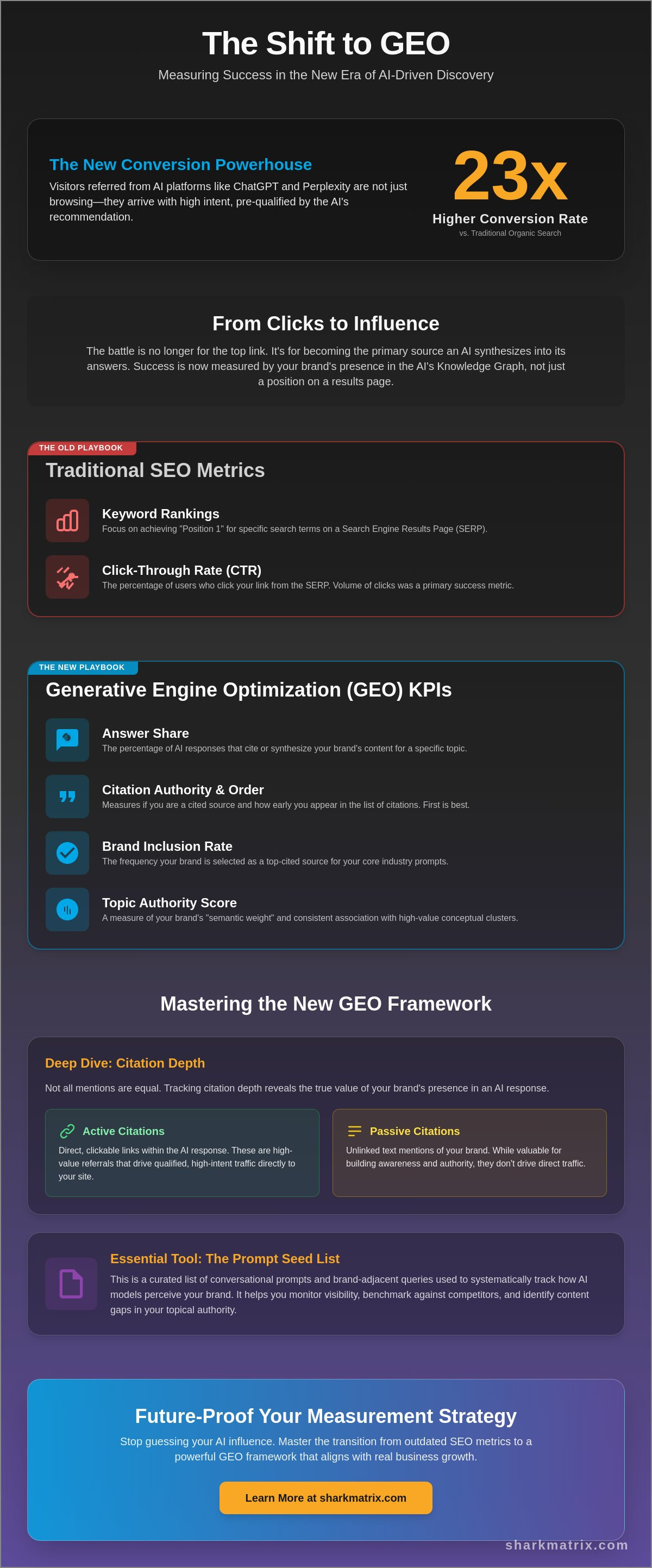
Did you know that visitors referred from AI platforms now convert at 23 times the rate of those arriving via traditional organic search? According to March 2026 data from Discovered Labs, the shift toward AI-driven discovery isn’t just a trend; it’s a fundamental change in how high-intent buyers research products and services. As ChatGPT and Perplexity become the new gatekeepers, traditional metrics like click-through rates are plummeting. You’re likely finding that measuring generative engine optimization success requires a completely different playbook than the one you used for Google’s old blue links.

It’s frustrating to see your brand mentioned in a ChatGPT response or a Perplexity citation without any clear way to quantify that value to your C-suite. You’re right to feel that the lack of native analytics in these LLMs makes reporting feel like guesswork. We’ll help you master the transition from tracking simple clicks to measuring true AI influence with our comprehensive 2026 GEO KPI framework. In this guide, you’ll discover a repeatable reporting model for AI visibility, explore specialized tools like Peec AI for tracking mentions, and learn how to align your generative engine optimization strategy with actual business growth.

Key Takeaways

  • Learn why “Answer Share” and “Citation Authority” are replacing traditional rankings as the gold standard for digital visibility.
  • Identify the specific metrics needed for measuring generative engine optimization success, including brand inclusion rates and citation depth within LLM responses.
  • Discover how to build a “Prompt Seed List” to track how AI models like ChatGPT and Perplexity perceive your brand’s expertise.
  • Understand the evolution of CTR and why high-intent AI citations often lead to better business outcomes than traditional search clicks.
  • Explore how to move beyond static reporting toward real-time visibility monitoring to stay ahead of rapid AI model updates.

Beyond the Click: Why Measuring Generative Engine Optimization Success is Different

Measuring generative engine optimization success isn’t about counting how many people landed on your homepage last month. It’s about understanding how often an AI model chooses your brand as the definitive answer to a complex query. In traditional search, you fought for a spot on page one. In the world of Generative Engine Optimization (GEO), you’re fighting to be the primary source that Large Language Models (LLMs) synthesize into their responses. This is the science of tracking brand inclusion, where visibility is measured by conceptual association rather than just a ranking number.

We’ve entered a “Zero-Click” reality where a user might get everything they need directly from a search generative experience or a tool like Perplexity. While this might look like a decline in traffic in your legacy analytics dashboard, the users who do click through are arriving with much higher intent. They’ve already been “pre-sold” by the AI’s recommendation. Success is now measured by your brand’s presence within the Knowledge Graph. This shift requires a solid foundation built through professional search engine optimization seo services, ensuring your data is structured specifically for AI extraction and entity recognition.

Ranking vs. Answer Share

In the past, being “Position 1” was the ultimate goal. Today, that concept is being replaced by Answer Share. LLMs don’t just list websites; they synthesize multiple sources to create a single, authoritative voice. If your content is the primary source for that synthesis, you gain more authority than a simple link ever provided. Measuring generative engine optimization success also involves looking at “Citation Order.” Being the first link cited in an AI summary carries significantly more weight than being buried in a “read more” dropdown or a footnote.

The Shift in User Intent Tracking

Tracking user intent has moved from simple transactional keywords to conversational prompt analysis. You need to identify “Brand-Adjacent” queries where AI currently references your competitors instead of you. This analysis helps you understand the gaps in your topical authority and where your content fails to meet the LLM’s criteria for helpfulness. Answer Share is the percentage of AI responses that cite your brand for a specific topic. By focusing on these metrics, you can ensure your brand remains relevant as search evolves into a dialogue between users and machines.

The Core KPI Stack for Generative Engine Optimization

Traditional SEO relied on a handful of clear metrics like keyword volume and domain authority. To master measuring generative engine optimization success in 2026, you need a stack that accounts for both conceptual visibility and linguistic nuance. It’s no longer enough to just appear in a list. You need to know your Inclusion Rate: the percentage of times your brand is selected as a top-cited source for specific industry prompts. This is paired with your Topic Authority Score, which measures your “semantic weight.” If an AI model consistently associates your brand with a cluster of high-value terms, you’ve successfully claimed that cognitive territory within the LLM.

Citation Depth is another pillar of this new framework. It tracks whether the generative engine provides a direct, clickable link or merely a text mention. While both contribute to brand awareness, direct citations are the primary drivers of the high-intent traffic discussed earlier. If you find your brand is mentioned but not linked, it often indicates a gap in your technical data structure. Integrating ai automation and development into your content pipeline can help ensure your site’s data is formatted for easy AI extraction.

Visibility Metrics: Inclusion and Citations

Visibility in the age of Perplexity and Gemini is often found in the footnotes. You must track “Footnote Presence” to see how often you are used to verify the AI’s claims. There’s a vital difference between “Active Citations,” which include outbound links, and “Passive Citations,” which are unlinked mentions. While passive mentions build brand recognition, active links are what move the needle for your bottom line. Maintaining these metrics requires proactive seo for brand reputation management dubai to ensure the AI sources clean, accurate, and authoritative data about your business.

Qualitative Metrics: Sentiment and Accuracy

Most frameworks fail because they ignore how an AI actually describes you. The Core KPI Stack for Generative Engine Optimization must include a Brand Sentiment Score. Using Natural Language Processing (NLP) tools, you can audit whether an LLM positions your services as “premium,” “affordable,” or “market-leading.” This qualitative data tells you if your content marketing is actually shaping your brand’s AI persona.

Accuracy is equally important. You must track your “Hallucination Rate,” which measures how often an AI provides incorrect facts about your products or services. If an AI tells a potential customer you don’t offer specific machine learning development services when you do, it’s a direct threat to your revenue. Finally, monitor your “Comparison Dominance.” When users ask an AI to compare you against your three biggest competitors, you need to know who the engine recommends and why.
Measuring Generative Engine Optimization Success: A 2026 Framework

GEO Metrics vs. Traditional SEO: A Comparative Analysis

Reporting on search performance has historically relied on raw impressions. However, measuring generative engine optimization success requires a pivot toward “Brand Prominence.” In a traditional SERP, an impression meant a user saw your link. In 2026, an impression in a generative engine might mean your brand was synthesized into a paragraph alongside three competitors. If you aren’t the primary entity mentioned, that impression carries little value. You’re now tracking how often the AI chooses you as the lead authority for a specific concept.

The classic Click-Through Rate (CTR) is also evolving into what we call the “Citation-Through Rate.” As users rely on AI to summarize information, they only click when they need deep-dive verification or a specific transaction. This doesn’t mean your strategy is failing. It means the user’s journey is changing. To capture these high-intent clicks, your technical foundation must be flawless. High-quality website design and development services are essential here, as they ensure your site’s data structure is easily crawlable and interpretable by LLM bots.

Justifying the ROI of GEO can be challenging when direct sessions from search engines appear to decline. You must shift the conversation from traffic volume to conversion quality. Visitors referred from AI platforms convert at 23 times the rate of traditional organic search, meaning a single AI citation can be worth dozens of standard clicks. Measuring generative engine optimization success is about proving that your brand is the “trusted advisor” within the AI’s logic, which creates a shorter path to purchase.

The Legacy vs. Generative Metric Map

Legacy SEO focused on Keyword Rank, but GEO prioritizes Entity Prominence. Instead of counting backlinks, we now evaluate Citation Quality and LLM Trust. Does the model trust your data enough to quote it? Similarly, “Time on Page” is losing relevance to “Prompt Resolution Success.” If a user finds your information within an AI response and their query is resolved, your brand has provided value, even if they didn’t visit your site immediately. Success is defined by being the final answer in the user’s discovery process.

Attribution Challenges in 2026

The “Dark Social” problem has migrated to search. Users often get their answers from an LLM and then navigate directly to your site later or mention you in a separate channel. This makes direct attribution difficult. Measuring “Assisted Conversions” from AI engines in GA4 is the best way to track this indirect impact. You need to look for patterns where AI visibility correlates with direct traffic spikes. GEO success is often found in the “Referral” traffic segment of analytics platforms.

Practical Tools and Frameworks for Tracking GEO Performance

Moving from theory to execution requires a structured technical workflow. To build a repeatable model for measuring generative engine optimization success, you must first move beyond manual spot-checking. Start by curating a “Prompt Seed List” based on your highest-value customer questions. This list should reflect the actual conversational queries your audience uses when interacting with AI assistants. Once you have your seeds, implement automated monitoring tools to scrape LLM responses. This allows you to track brand mentions at scale rather than relying on anecdotal evidence.

Isolation is the next step in your measurement framework. Set up custom GA4 channels to specifically isolate traffic coming from domains like chatgpt.com, perplexity.ai, and gemini.google.com. By segmenting these sources, you can see how AI-driven discovery translates into site behavior. Finally, utilize sentiment analysis APIs to categorize the “tone” of these AI responses. This helps you determine if the engine is positioning you as a market leader or merely a secondary option. If you want to accelerate this technical setup, our team at Shark Matrix Technologies LLC provides generative ai development services to build custom monitoring solutions tailored to your brand.

Building a Prompt Dashboard

A successful dashboard groups prompts by intent: Informational, Commercial, and Comparison. This structure reveals where your content is strongest and where competitors might be stealing your “Answer Share.” You should also track the “First-Mover Advantage” whenever a new AI engine update rolls out. In the UAE market, linguistic diversity is a critical factor that many global frameworks overlook. Testing prompts in both English and Arabic is essential for national brands. AI models often interpret brand authority differently across languages, so your measurement strategy must account for these regional nuances to be truly accurate.

Connecting GEO to Revenue

The ultimate goal is tying AI visibility to your bottom line. Look for correlations between your AI citation frequency and increases in “Branded Search” volume. When an AI recommends your brand, users often head to traditional search engines to find your specific website. You can also use insights from a ppc agency dubai to fuel your GEO prompt strategy. Paid search data highlights the exact phrases that drive conversions, which you can then use to optimize your organic AI presence. Measuring the link between citation frequency and lead quality ensures your GEO efforts are driving business growth, not just vanity metrics.

Future-Proofing Your Measurement Strategy with Shark Matrix Technologies LLC

Static reporting is no longer sufficient in an environment where LLMs update their training data and model weights almost weekly. Moving toward real-time AI visibility monitoring is the only way to stay competitive. At Shark Matrix Technologies LLC, we’ve developed an approach that bridges the gap between custom AI development and advanced SEO analytics. Our goal is to provide a dynamic view of your digital footprint, ensuring that your brand doesn’t just appear in responses but remains the dominant authority for your core topics.

Our “Entity-First” strategy focuses on how your brand is perceived across the entire Knowledge Graph. By treating your business as a structured entity rather than a collection of keywords, we make it easier for generative engines to extract and cite your data accurately. This method is essential for measuring generative engine optimization success over the long term. We close the loop by transforming these high-intent AI citations into national brand dominance, ensuring that your visibility translates directly into market leadership.

Custom AI Solutions for Measurement

We utilize our specialized ai automation services to build bespoke tracking dashboards that go far beyond standard search tools. These proprietary systems audit LLM responses at scale, allowing us to protect your online reputation by identifying and correcting AI hallucinations or competitor biases in real time. By integrating machine learning development services, Shark Matrix Technologies LLC can help you predict which content formats will secure the highest “Answer Share” in future model iterations, giving you a significant head start on the competition.

Your Next Steps in the AI Search Era

Waiting for official analytics from LLM providers like OpenAI or Google puts your brand at a major disadvantage. The companies leading their industries in 2026 are those that have already built their own measurement frameworks. You don’t need to guess how your brand is performing when you can have a clear, data-driven audit. Start your journey today by identifying the gaps in your topical authority and refining your AI persona. Ready to dominate the AI search landscape? Consult with Shark Matrix Technologies LLC today.

Claim Your Authority in the AI Search Era

The transition from tracking simple clicks to analyzing complex AI citations is the most significant evolution in digital discovery. Embracing metrics like Answer Share and Citation Depth provides a much clearer picture of your brand’s true influence than traditional rankings ever could. By moving beyond legacy dashboards and prioritizing real-time monitoring, you turn the “Zero-Click” reality into a distinct competitive advantage. You’re no longer just hoping for a link; you’re ensuring your brand remains the most trusted entity in the engine’s knowledge graph.

Successfully measuring generative engine optimization success requires a proactive approach that balances technical precision with deep linguistic expertise. Shark Matrix Technologies LLC is a pioneer in UAE AI-driven SEO, offering custom AI automation for real-time reporting and unmatched expertise in both English and Arabic digital markets. Master your AI visibility with Shark Matrix Technologies LLC SEO services and secure your place as a market leader. The search landscape is evolving fast, but with the right framework, your brand’s growth is just a prompt away.

Frequently Asked Questions

What is the most important KPI for measuring GEO success?

Answer Share is the most critical KPI because it tracks the percentage of AI responses that cite your brand for specific industry topics. Unlike traditional rankings, this metric measures your brand’s authority as a primary source for LLM synthesis. You should also monitor Citation Depth to determine if the engine provides a direct, clickable link or just a text mention. This data tells you if the AI perceives you as a primary authority or a secondary reference.

Can I track AI engine traffic in Google Analytics 4?

You can track AI engine traffic by setting up custom referral channels in GA4 to isolate visitors from domains like chatgpt.com, perplexity.ai, and gemini.google.com. While these sessions might appear lower in volume than traditional search, they often represent much higher intent. According to March 2026 data from Discovered Labs, visitors referred from AI platforms convert at 23 times the rate of organic search, making this segment extremely valuable for ROI analysis.

How does GEO measurement differ from traditional SEO rank tracking?

GEO measurement focuses on how LLMs categorize your brand within a Knowledge Graph instead of just assigning a numerical rank. Traditional SEO tracks where your URL appears on a page, while measuring generative engine optimization success involves auditing the “semantic weight” of your brand across various prompts. You’re looking for inclusion in synthesized answers and “Citation Order” rather than a spot in a list of blue links.

Is it possible to influence the sentiment of AI-generated answers?

You can influence AI sentiment by consistently publishing authoritative content that uses the specific terminology you want associated with your brand. AI models pick up on linguistic patterns; if your site and third-party citations describe your services as “premium” or “innovative,” the LLM is more likely to adopt that tone. Professional SEO for brand reputation management ensures the data feeding these models remains accurate, positive, and aligned with your unique value proposition.

How often should I audit my brand presence in LLMs like ChatGPT?

You should audit your brand presence at least once a month to account for regular model updates and data refreshes. In fast-moving industries, real-time monitoring is preferable because AI citations can shift within weeks of a major update. Regular audits help you identify “hallucinations” or factual errors the AI might be spreading about your services before they impact lead quality or brand trust.

What tools are available for measuring generative engine optimization in 2026?

Measuring generative engine optimization success in 2026 involves specialized tools like Peec AI, which tracks visibility and share of voice across different models. You can also use automated monitoring tools and sentiment analysis APIs to scrape LLM responses and categorize the tone of mentions. For many enterprises, building a custom dashboard via AI automation services is the most effective way to scale this tracking across multiple languages and regions.

Does Answer Engine Optimization (AEO) use the same metrics as GEO?

AEO and GEO share metrics like Answer Share, but AEO focuses more heavily on direct response accuracy for specific, isolated questions. GEO is a broader framework that includes brand sentiment and entity prominence across a wider range of conversational discovery. Both strategies rely on a foundation of structured data and high-quality content marketing to ensure your brand is the preferred source for synthesized answers.

How do I explain declining website clicks to stakeholders while showing GEO success?

You should explain that while raw clicks are declining due to the “Zero-Click” reality of AI summaries, the quality of referred traffic is significantly higher. Focus on metrics like Citation-Through Rate and the 23x conversion multiplier for AI-referred visitors. Showing stakeholders your brand’s dominance in AI answers proves you’re capturing the user’s trust at the point of discovery, which creates a much shorter path to purchase than traditional search.

Categories
Uncategorized

Mastering AEO Marketing Strategy: The 2026 Guide to Answer Engine Optimization

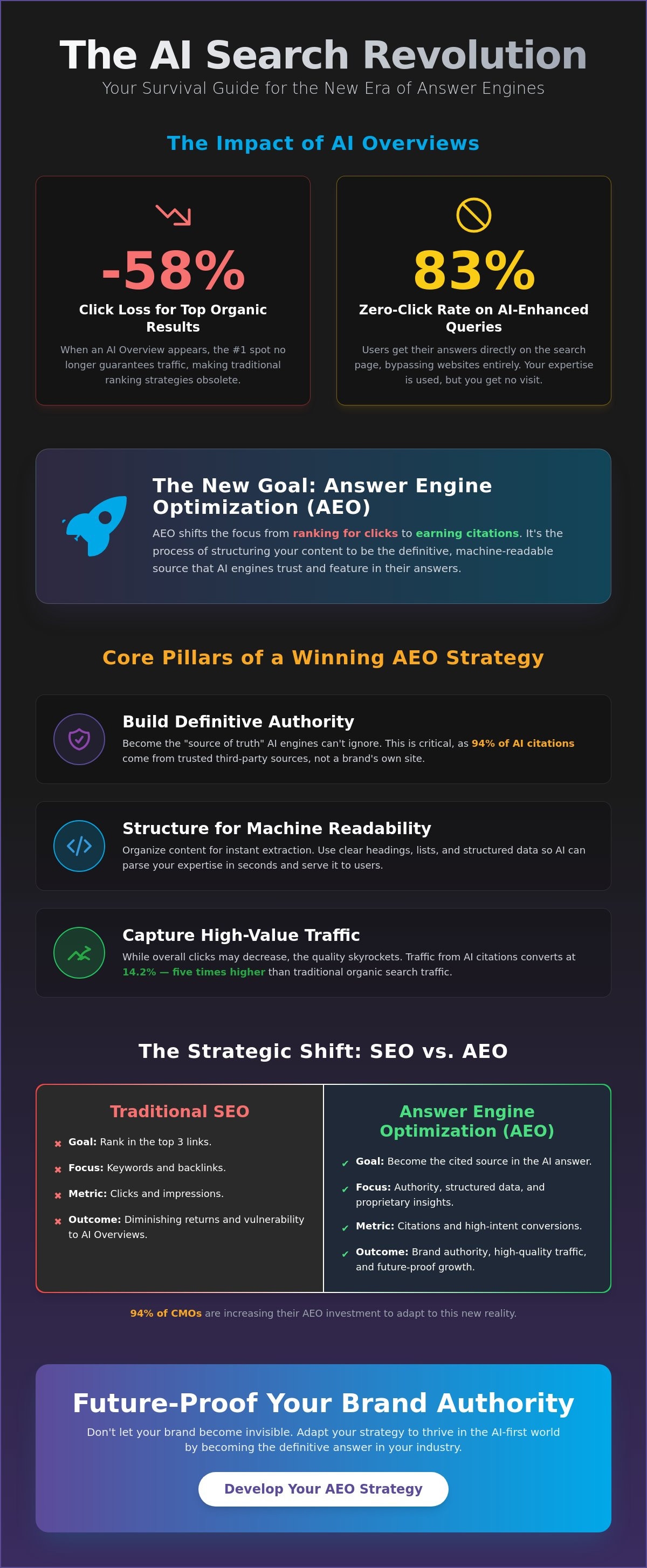
When a Google AI Overview appears, the top-ranking organic result doesn’t just lose a few visitors; it loses an estimated 58% of its clicks. With zero-click rates for these searches hitting 83% as of June 2026, a traditional search approach is no longer enough. You need a robust aeo marketing strategy to sustain your brand’s growth. You’ve likely noticed your organic click-through rates dipping despite maintaining your rankings. It’s frustrating to see AI engines summarize your hard-earned expertise while keeping users on the search page, making it harder than ever to measure the ROI of your content.

This guide will show you how to reclaim your visibility and become the definitive source for AI-driven answers. You’ll learn how to transition from traditional search rankings to becoming a trusted citation in generative engine responses. We’ll explore the specific requirements for answer engine optimization, from leveraging proprietary data to securing the high-converting traffic that now flows through AI platforms. By the end, you’ll have a future-proof plan to maintain your brand authority in an AI-first world.

Key Takeaways

  • Understand why the rise of zero-click searches makes transitioning from traditional SEO to citation-based optimization essential for 2026.
  • Learn to build a high-impact aeo marketing strategy by structuring your content for clarity and machine extraction to establish definitive brand authority.
  • Identify high-value question queries and audit your existing content to secure prominent placements in Google AI Overviews and other generative engines.
  • Discover how to convert AI-driven visibility into tangible business results by leveraging the “halo effect” of being a cited expert.
  • Explore how leveraging professional generative AI development services can help you create the proprietary data sources needed to dominate future search landscapes.

The Evolution of Search: Why AEO Marketing Strategy is Essential in 2026

Search behavior has undergone a radical transformation. For decades, the goal was simple: rank in the top three results to capture clicks. In 2026, the landscape looks different. When Google triggers an AI Overview, the top organic result loses an estimated 58% of its clicks. This shift has turned the “zero-click” search from a minor concern into a dominant reality. Zero-click rates now reach approximately 83% for AI-enhanced queries, fundamentally altering national organic traffic patterns. To survive this, businesses must adopt an aeo marketing strategy that prioritizes becoming the definitive answer rather than just another link in the list.

AEO is the process of structuring and refining content so it is easily “digestible” for artificial intelligence. Unlike traditional SEO, which focuses on ranking for website visits, AEO focuses on earning citations. The Evolution of Search shows us that as algorithms become more sophisticated, they rely less on keyword matches and more on verified, authoritative data. If an AI engine uses your data to answer a user, your brand gains a level of authority that a standard click can’t replicate. It’s why 94% of CMOs and digital leaders plan to increase their AEO investment this year. They recognize that being the answer is now more valuable than being the third link on a page.

From Keywords to Conversational Intent

Natural Language Processing (NLP) has fundamentally changed how we interact with search engines. Users no longer type fragmented phrases; they ask complex, multi-step questions. This transition from short-tail keywords to conversational intent means your content structure must change. It’s no longer about how many times you mention a term. It’s about how clearly you answer the specific problem. Intent now dictates content structure more than keyword density ever did. This requires content that provides immediate, extractable value for both the machine and the human reader. If the AI can’t parse your solution in seconds, it won’t cite you.

The Rise of Generative Engines

The discovery journey now frequently starts and ends within platforms like ChatGPT, Perplexity, and Claude. These generative engines form a new ecosystem encompassing search, voice assistants, and chat interfaces. They prioritize factual, authoritative citations because their reputation depends on accuracy. Since 94% of AI citations come from third-party sources rather than a brand’s own site, your aeo marketing strategy must focus on building a reputation that these engines can’t ignore. Whether through voice search or a desktop chat, being the “source of truth” is the new gold standard for digital marketing. These engines are looking for expert answers and proprietary data that they cannot generate on their own.

The Core Pillars of a High-Impact AEO Marketing Strategy

A successful aeo marketing strategy rests on the foundation of perceived expertise. Large Language Models (LLMs) don’t just pick random snippets; they prioritize sources that demonstrate deep authority. Since 94% of AI citations come from third-party sources rather than your own site, your brand must exist as a verified entity across the web. This shift represents The Evolution of Search, where the goal isn’t just a high rank, but becoming the “source of truth” that an AI can’t ignore. For companies operating nationally, this authority must be maintained across both English and Arabic content to capture the full scope of conversational queries. When you secure these citations, the rewards are high; website traffic from AI search converts at 14.2%, which is five times higher than traditional organic search.

Technical readiness acts as the “API” for these engines. You’re no longer just building pages for humans; you’re providing a structured data feed that AI can parse instantly. This technical layer ensures that your expert insights aren’t buried under layers of fluff. If you want to see how these elements combine, partnering with an expert in answer engine optimization can help bridge the gap between traditional content and AI-native delivery. By treating your website as a data source, you make it easier for machines to extract facts, definitions, and unique perspectives that LLMs can’t generate on their own.

Content Structuring for Machine Readability

To win, adopt the Inverted Pyramid style by leading with the core answer immediately. AI engines value efficiency, so using Q&A blocks and “TL;DR” summaries provides the exact “extractable” facts they need. Answer-First Content, defined as the practice of delivering a direct, factual solution to a user’s query within the first 100 words of a page, serves as the primary requirement for AEO success. This format allows machines to identify your site as the primary source for a specific answer without wading through unnecessary context.

Advanced Schema and Structured Data

Structured data is the primary bridge to the global Knowledge Graph. You should implement specific markups to clearly define your information for AI scrapers, such as:

  • Dataset Markup: To highlight proprietary research and unique data points.
  • FAQ Markup: To provide direct answers to common industry questions.
  • Speakable Markup: To optimize for voice-activated answer engines and assistants.

These technical signals tell the engine exactly what your content is and why it’s a verifiable fact. Integrating these elements with professional technical SEO services ensures your site’s architecture is ready for the demands of generative engines and the future of search discovery.

Mastering AEO Marketing Strategy: The 2026 Guide to Answer Engine Optimization

Optimizing for AI Overviews and Generative Engine Optimization (GEO)

AI Overviews appear in approximately 25% to 60% of Google searches. This high prevalence means your aeo marketing strategy must prioritize visibility within these generative summaries. Winning a citation isn’t just about traditional rankings. Only 17% to 38% of pages cited in AI Overviews actually rank in the top 10 organic results. This proves that Optimizing for AI Overviews requires a different set of tactics than standard SEO. You should start by auditing your existing high-performing pages to identify facts and definitions that an AI can easily extract.

A key component of GEO is the implementation of “Nugget” content. These are small, highly factual blocks of text designed for machine consumption. Instead of burying a key definition in the middle of a narrative, you place it in a standalone, clear sentence. This makes it easier for LLMs to cite your brand as the primary source of truth. You’ll need to monitor your citation frequency using modern AI-tracking tools to see which “nuggets” are gaining traction and which need refinement. If your data isn’t being picked up, it’s likely not structured clearly enough for the engine’s scraper.

Winning the AI Citation: A Step-by-Step Approach

Securing a spot in a generative response requires a disciplined editorial workflow. Follow these steps to improve your chances:

  • Step 1: Identify the “Seed Question” behind the user intent. What specific problem is the user trying to solve?
  • Step 2: Provide a concise, 40 to 60 word answer at the top of the page. This is the prime real estate for AI extraction.
  • Step 3: Support the answer with data, expert quotes, and unique insights that a machine cannot invent.
  • Step 4: Use clear H3 headings to break down complex sub-topics, allowing the AI to parse the hierarchy of your information.

The Role of Digital Reputation in AEO

LLMs don’t just look at your website; they look at what the rest of the web says about you. Since 94% of AI citations come from third-party sources, your digital reputation is a primary ranking factor for AEO. This makes brand reputation management a critical part of your optimization workflow. If third-party reviews or industry mentions are negative or inconsistent, an AI is less likely to trust your content as a factual source. You must manage the sentiment of the data sources that LLMs use to train their responses to ensure your brand is perceived as an authority.

Converting AEO Visibility into Business Results

Gaining visibility in an AI Overview is only half the battle. The real challenge lies in turning that citation into revenue. While the high zero-click rate might seem discouraging, 97% of digital leaders reported a positive impact from AEO on their marketing funnel in 2025. This success stems from the “Halo Effect,” where being cited as an authoritative source builds top-of-mind awareness that transcends a single search session. A comprehensive aeo marketing strategy ensures that when a user is ready to buy, your name is the first they recall, even if they didn’t visit your site during the initial research phase.

In the B2B buyer journey, research often happens within generative engines long before a lead ever lands on your website. By dominating these answers, you position your brand as the industry standard. Success here isn’t just measured by clicks; it’s measured by “Share of Model.” This metric tracks how often an LLM suggests your brand versus your competitors. Tracking brand sentiment within these AI responses is equally vital. If the AI describes your solution as “reliable” or “industry-leading,” you’ve already won the trust battle before the first sales conversation even begins. This early authority makes your aeo marketing strategy a powerful tool for lead generation.

Capturing the “Invisible” Lead

An “invisible” lead is a user who learns about your brand through an AI answer but doesn’t click through immediately. To capture these users, your brand name must be optimized for easy recall and distinct identity. Consistent messaging across web, social, and AI platforms ensures that your value proposition remains clear regardless of the discovery channel. A smart way to close this loop is by linking your AEO efforts with professional PPC management. By running targeted ads for the specific questions you answer in AI results, you create a second touchpoint that captures high-intent users who are ready to move from the research phase to a conversion.

AEO for E-commerce and Lead Gen

For e-commerce, answer engines are becoming the primary tool for product comparisons and “Best of” queries. To compete, your web development must prioritize fast, crawlable, and highly structured product data. If your site architecture doesn’t allow an AI to instantly extract prices, features, and reviews, you’ll be left out of the comparison entirely. We’re moving toward a future of “Action Engines,” where AI agents will book meetings or complete purchases directly for the user. Preparing your technical foundation now is the only way to stay relevant in this automated landscape. These systems rely on high-quality data feeds to make decisions on behalf of the consumer. If you’re ready to modernize your funnel, our team can help you maximize your visibility in AI search results today.

Future-Proofing Your Strategy with Shark Matrix AI Solutions

Adopting a forward-thinking aeo marketing strategy requires more than just high-quality writing. It demands a technical foundation that aligns with how Large Language Models (LLMs) process information. Shark Matrix takes an AI-native approach to digital marketing, moving beyond traditional content silos to build a 360-degree presence. As 93% of business leaders choose to build their AEO and GEO capabilities in-house or through specialized partners, the need for a technical-first agency has never been greater. We focus on transforming your brand from a participant in search to a primary data source for the next generation of discovery engines.

A critical gap in many global strategies is the lack of bilingual optimization. For national markets like the UAE, your aeo marketing strategy must be effective in both English and Arabic. LLMs use different tokenization patterns and training sets for these languages, meaning a citation in one doesn’t guarantee visibility in the other. Shark Matrix specializes in bridging this linguistic divide, ensuring your brand authority remains consistent across regional generative responses. We combine our deep understanding of natural language processing services with local market expertise to protect your share of voice in every relevant language.

Proprietary data is the ultimate currency in an AI-first world. AI models prioritize verified, unique information that they cannot synthesize on their own. Our team provides generative ai development services to help you build and structure these data sources, making your brand indispensable to answer engines. By creating original research and structured datasets, you move from competing for keywords to owning the facts that define your industry. This technical excellence, paired with strategic content marketing, ensures your brand is ready for the next decade of search evolution.

Beyond Search: AI Automation and Custom Solutions

The future of brand discovery extends into private AI environments. Leveraging our ai automation services allows you to streamline content production while maintaining the strict data structures required for AEO. We help national enterprises build “Brand-Owned” GPTs and custom assistants that serve as internal and external answer engines. These custom solutions ensure that when users interact with AI, they receive accurate, brand-aligned information directly from your proprietary knowledge base.

Your National Partner for Digital Growth

The Shark Matrix advantage lies in the intersection of technical mastery and marketing strategy. We don’t just optimize for today’s algorithms; we build the infrastructure for tomorrow’s AI agents. Whether you need machine learning development services to analyze search patterns or a complete overhaul of your structured data, our team provides the expertise needed to stay ahead. The transition to an AI-first search landscape is happening now. Contact our experts to audit your AEO readiness and secure your brand’s place as a definitive source of truth in the generative era.

The shift from organic clicks to AI-driven citations represents a permanent evolution in digital discovery. To maintain authority, you must transition from traditional keyword targeting to a structured, data-first approach that prioritizes machine readability. Success in 2026 requires a flawless digital reputation and the technical infrastructure to serve as an authoritative source for both search engines and generative models. Embracing these changes now allows your brand to capture high-intent users who are moving away from traditional list-based results.

Integrating a comprehensive aeo marketing strategy is the most effective way to secure your brand’s visibility in a zero-click world. Shark Matrix has been at the forefront of technical marketing since 2010, helping high-growth brands scale through deep expertise in AI automation and generative engine optimization. We provide the national digital marketing solutions necessary to thrive in an increasingly automated landscape. Our team’s technical focus ensures that your content isn’t just seen, but cited as the primary source of truth.

Partner with Shark Matrix for a future-proof AEO and SEO strategy today. Your brand’s journey toward becoming the definitive answer starts here. We’re ready to help you lead the way.

Frequently Asked Questions

What is the main difference between SEO and AEO?

SEO focuses on ranking web pages to drive traffic, while AEO focuses on providing clear, extractable answers to earn citations in AI-driven responses. While traditional SEO aims for the click, AEO aims to be the “source of truth” that a machine summarizes. It’s a fundamental shift from positioning your website as a final destination to positioning your content as a reliable data provider for AI models.

How do I measure the success of an AEO strategy if clicks are decreasing?

You should measure success through “Share of Model” and citation frequency rather than relying solely on organic click-through rates. Track how often your brand appears in AI Overviews and the sentiment of those responses. High-quality citations build brand authority that leads to direct searches later, even if the initial query doesn’t result in an immediate website visit.

Does AEO replace traditional SEO in 2026?

No, AEO complements traditional SEO by addressing the rise of zero-click searches and generative summaries. Traditional SEO still handles transactional and navigational queries where users need to interact with a full website. An effective aeo marketing strategy works alongside SEO to ensure you capture users at every stage of the discovery journey, whether they need a quick fact or a deep-dive page.

How can I get my brand cited in ChatGPT or Google AI Overviews?

You get cited by providing clear, factual blocks of information that AI scrapers can easily parse and verify. Use the Inverted Pyramid style to lead with direct answers and support them with unique, proprietary data. Since 94% of citations come from third-party sources, building a strong presence on industry-relevant sites and review platforms is also essential for earning trust from Large Language Models.

Is structured data really necessary for AEO?

Yes, structured data acts as the technical bridge for answer engines, making your content instantly readable for machine scrapers. Using Schema markups like FAQ, Dataset, and Speakable helps AI understand the context and reliability of your information. Without these technical signals, engines may struggle to verify your data, which significantly reduces your chances of becoming a primary citation in generative responses.

How does voice search fit into an AEO marketing strategy?

Voice search is a primary delivery method for answer engines, as digital assistants rely on AEO to provide verbal responses. Integrating an aeo marketing strategy ensures your content is optimized for the conversational, long-tail questions typical of voice queries. By structuring your data for machine extraction, you increase the likelihood that assistants will read your brand’s answer aloud to the user.

Can AEO help with my brand’s online reputation?

AEO directly impacts your reputation by influencing the narrative that AI engines summarize for users. When an AI cites your brand as an expert source, it reinforces your authority and builds trust with the audience. Managing the data sources LLMs use to train their responses ensures that the sentiment surrounding your brand remains positive and professional across all AI platforms.

What is Generative Engine Optimization (GEO)?

GEO is a specialized subset of AEO that focuses on optimizing content specifically for generative AI platforms like ChatGPT, Claude, and Perplexity. It involves refining content so it’s not just factual, but also formatted to be the most “helpful” response for an LLM to synthesize. GEO emphasizes the use of authoritative citations and unique perspectives that distinguish your brand from generic, AI-generated filler.

Categories
Uncategorized

How to Get Cited by ChatGPT: The 2026 Guide to Generative Engine Optimization (GEO)

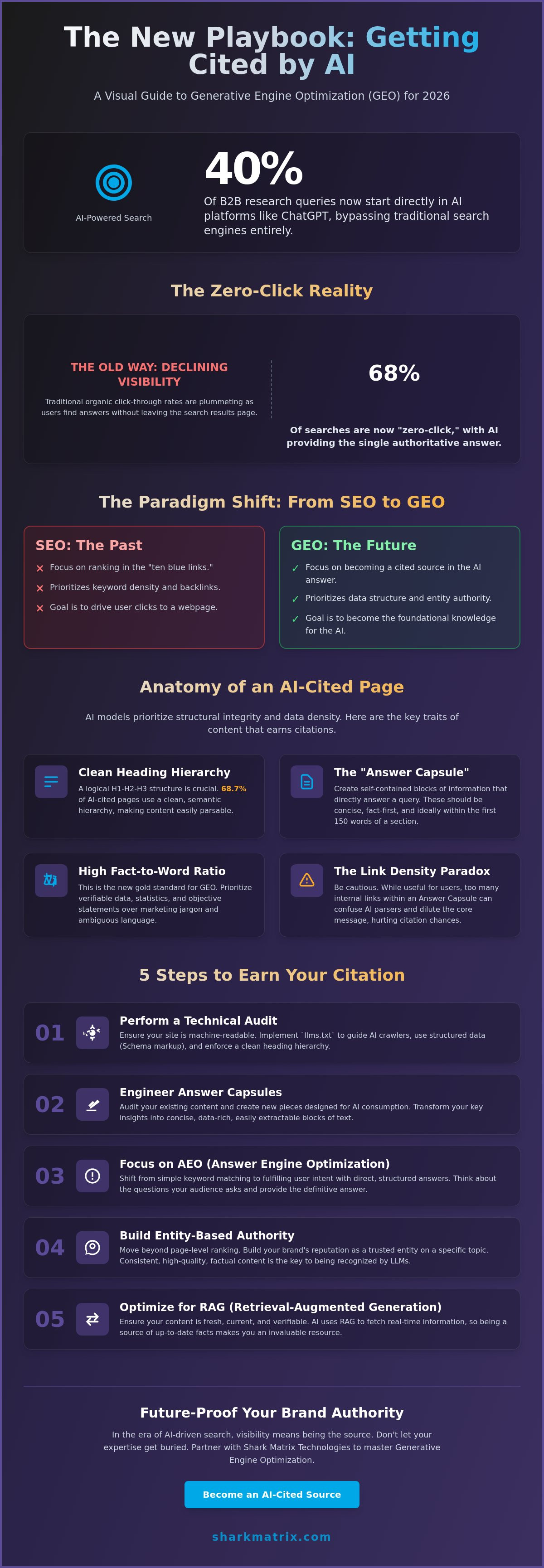
Did you know that 40% of B2B research queries that used to start on Google now begin directly in ChatGPT, Claude, or Perplexity? If your brand isn’t appearing in these AI-generated answers, you’re effectively invisible to a huge segment of high-intent buyers. Learning how to get cited by ChatGPT is no longer an experimental tactic; it’s the core of survival for modern digital marketing in 2026.

It’s frustrating to watch your traditional organic click-through rates decline while the “black box” of Large Language Models decides which sources to trust. You’ve likely felt the uncertainty of not knowing why a competitor gets the mention while your expert content stays buried. We’re here to fix that. This article provides the precise technical frameworks and content traits needed to earn those coveted brand mentions and citations.

We’ll explore how to optimize your site using tools like llms.txt files and specific Schema markup to ensure AI crawlers prioritize your data. You’ll discover why a high fact-to-word ratio is the new gold standard for Generative Engine Optimization (GEO) and how to structure content that AI answer engines can’t help but quote.

Key Takeaways

  • Understand why Generative Engine Optimization (GEO) is the essential evolution of search marketing for maintaining visibility in a zero-click environment.
  • Learn how to engineer “Answer Capsules” that transform your brand’s unique insights into easily extractable data for AI models.
  • Master the technical frameworks and content traits that explain how to get cited by ChatGPT to drive high-intent referral traffic.
  • Shift your focus from keyword-centric ranking to entity-based authority to ensure your brand is recognized as a trusted source by LLMs.
  • Explore how leveraging AEO and AI automation services can future-proof your digital presence and protect your brand reputation.

From SEO to GEO: Why ChatGPT Citations Matter in 2026

The search landscape has fundamentally shifted. For years, digital marketing focused on ranking in the top three results of a Google search page. Now, Generative Engine Optimization (GEO) has emerged as the essential evolution of that strategy. It’s no longer enough to just appear on a list. You need to be the source the AI trusts and references to maintain visibility.

By early 2026, zero-click searches reached a staggering 68%. This means the majority of users get their information directly from the AI response without ever clicking through to a website. For national brands, this shift is catastrophic if you aren’t the one providing the data. The “ten blue links” model is dying, replaced by a “single authoritative answer” model where the AI synthesizes information from a few select sources. If you want to know how to get cited by chatgpt, you have to accept that the AI is now the primary gatekeeper of information.

Being cited by ChatGPT is the new Position Zero. It’s the ultimate validation of your brand’s authority in a crowded digital space. The goal isn’t just traffic; it’s becoming the foundational knowledge for the AI’s response. When an AI cites your brand, it transfers its perceived neutrality and intelligence to your business, creating a high-trust connection with the user before they even visit your site.

The Rise of Answer Engine Optimization (AEO)

AEO is a specialized discipline within the GEO framework that focuses on providing direct, structured answers to complex queries. It moves beyond simple keyword matching and prioritizes intent-based semantic fulfillment. While comprehensive search engine optimization seo services provide the technical foundation, AEO refines your content to be instantly digestible by large language models (LLMs). It’s about making your data so clear and structured that the AI can’t ignore it.

How LLMs Choose Their Sources

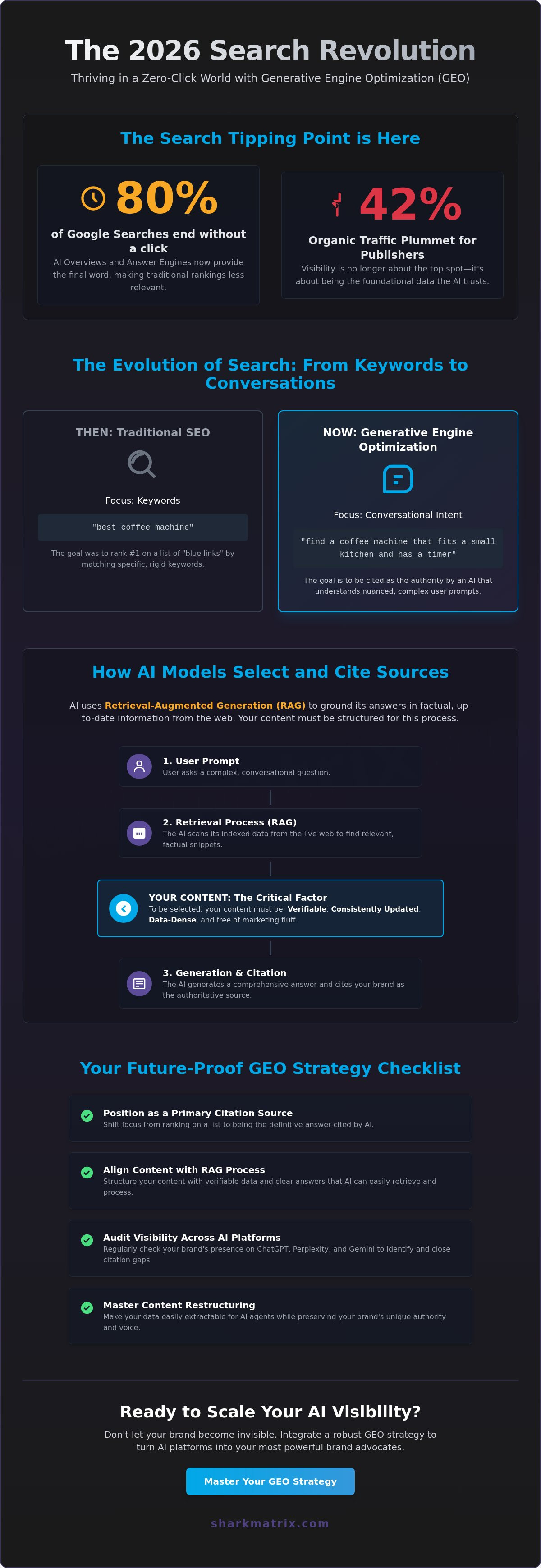
ChatGPT uses a process called Retrieval-Augmented Generation (RAG) to find information. It doesn’t just rely on its original training data; it crawls the live web to find the most relevant, trustworthy sources in real time. In the 2026 ecosystem, source trust is built on technical signals like GPTBot permissions and content traits like high fact density. Understanding how to get cited by chatgpt requires a deep dive into how these models differentiate between static training data and the high-value, real-time citations that drive modern high-intent referral traffic.

The Anatomy of a ChatGPT Citation: Key Content Traits

Learning how to get cited by ChatGPT requires looking past the surface of your website. AI models don’t care about your brand’s color palette or high-resolution imagery. They prioritize the structural integrity of your HTML and the density of verifiable facts within your paragraphs. Research from the 2026 State of AI Search shows that 68.7% of pages cited by ChatGPT use a clean H1-H2-H3 heading hierarchy. If your technical foundation is messy, the AI’s retrieval layer will simply skip over your content in favor of a more readable source.

The concept of the “Answer Capsule” is central to this shift. These are self-contained blocks of information that provide immediate value without requiring additional context. While traditional SEO often encourages long-form content to keep users on the page, GEO requires you to be concise. Understanding how to optimize for generative engines involves stripping away the fluff and focusing on data accessibility. If you’re looking to improve your visibility, our generative engine optimization services can help you audit your current content structure.

While internal linking is a staple of traditional search strategy, it presents a unique paradox for AI citations. If a potential citation block is cluttered with too many links, the AI might struggle to parse the primary facts. This “Link Density” paradox means that over-optimizing for user navigation can actually hurt your citation chances. Keeping your core answer blocks clean and text-heavy is a critical step in mastering how to get cited by ChatGPT.

Structuring the Perfect Answer Capsule

An Answer Capsule should ideally appear within the first 150 words of a section to ensure the AI crawler identifies it early. Clarity is your most important metric here. Avoid marketing jargon or ambiguous language that could lead to model hallucinations. An answer capsule is a 40-60 word block of factual, non-promotional text. By placing these blocks strategically under clear H3 headings, you make it significantly easier for ChatGPT to extract and attribute your insights.

The Value of Proprietary Data and Insights

Proprietary data is the ultimate moat in the AI era. AI engines prioritize unique statistics and original research over repurposed “how-to” content that exists in thousands of other places. Data from Fuel Online in 2026 found that pages with a fact-to-word ratio higher than 1:80 are 4.2 times more likely to be cited in results. Using case studies and internal reports triggers the “Expertise, Authoritativeness, and Trustworthiness” (E-A-T) signals that LLMs use to verify sources. When you provide a specific number or a documented result, you become an irreplaceable source that the AI cannot simply synthesize from general knowledge.

How to Get Cited by ChatGPT: The 2026 Guide to Generative Engine Optimization (GEO)

AEO vs. Traditional SEO: Comparing the Strategies

Traditional SEO focuses on matching strings of text to specific search queries. Generative Engine Optimization (GEO) focuses on establishing your brand as a recognized entity. This is a seismic shift. Instead of just ranking for a term, you’re aiming to be cited as an authority. When you master how to get cited by chatgpt, you move from competing for a list of links to owning the narrative within a synthesized answer.

Backlink quantity, once the gold standard of digital marketing, is losing ground to citation quality and co-occurrence. AI models look for “consensus filters” to verify information. If your brand name consistently appears alongside specific facts on authoritative third-party sites like Reddit or Wikipedia, the model builds a stronger semantic association. User intent mapping also changes because you’re now optimizing for an AI bot that needs to parse your data in milliseconds to fulfill a user’s request.

The “user” in 2026 is often a retrieval agent. These agents don’t browse; they extract. This means your content strategy must pivot from engagement-first to extraction-first. If a bot can’t quickly identify the core facts of your page, it won’t include you in its response. Understanding how to get cited by chatgpt requires a deep commitment to entity-centric optimization where your brand is inextricably linked to the topics you want to own.

Technical Requirements for Generative Engines

Schema.org in 2026 is about more than just earning a few stars in a search result. It’s the primary language for defining entity relationships for LLMs. Using `FAQPage`, `Article`, and `Organization` markup helps models understand exactly who you are and what expertise you provide. Site speed and bot crawlability are non-negotiable. If GPTBot or OAI-SearchBot can’t access your content instantly, you won’t be part of the real-time synthesis. This is why modern website design and development services must prioritize technical AEO over mere visual aesthetics.

Measuring Success in the AI Era

Success in the age of AI requires new KPIs. Moving from “Position” tracking to “Share of Model” (SoM) allows you to see how often your brand is mentioned across various AI platforms. You can’t rely on traditional search consoles alone to see the full picture. You must identify referral traffic coming from ChatGPT, Claude, and Gemini by analyzing your server logs and specific referral strings. Brand sentiment within these responses is equally vital. If an AI cites you but frames your service incorrectly, your GEO strategy needs adjustment to refine the data the models are consuming.

5 Steps to Get Your Content Cited by ChatGPT

Execution is where many brands fail in the AI era. While understanding the theory of GEO is helpful, you need a repeatable process to secure your place in ChatGPT’s responses. This five-step framework transforms your existing expertise into a format that AI models can easily retrieve and attribute. If you’re wondering how to get cited by chatgpt, the answer lies in decreasing the “cognitive load” for the model. You must make it easier for the bot to find, verify, and quote your information than it is to synthesize a generic answer from other sources.

  • Step 1: Identify High-Probability Citation Queries in your niche.
  • Step 2: Engineer Answer Capsules with minimal internal link friction.
  • Step 3: Implement Advanced Schema for LLM Contextualisation.
  • Step 4: Publish Original Research or Data-Driven Insights.
  • Step 5: Monitor and Optimise based on AI Referral Data.

Step 1 & 2: Identifying and Engineering Content

Begin by identifying citation gaps in your niche. Use “People Also Ask” sections in search engines and direct AI prompts like “What are the most common misconceptions about [Topic]?” to find areas where current AI answers are vague or outdated. Once you’ve identified a query, you must engineer an Answer Capsule. Craft a citation-ready summary of 40-60 words at the very top of every pillar page to serve as the primary extraction target for LLM crawlers. This block should use an objective, neutral tone. AI models are programmed to avoid bias; therefore, promotional language or superlative claims will often disqualify your content from being used as a source.

Step 3 & 4: Technical and Data Foundations

In 2026, basic Schema is the bare minimum. To stand out, implement advanced types like FactCheck and Dataset. These signals tell the LLM exactly what kind of data you’re providing and why it should be trusted. If you’re publishing original research, format your data into clean HTML tables rather than images or complex PDFs. LLMs ingest structured tables with much higher accuracy than unstructured text. Partnering with a specialized content marketing agency uae can help ensure your research is both high-quality and technically optimized for these engines. Original data remains the most powerful trigger for citations because it provides a unique fact that the AI cannot find elsewhere.

Finally, monitor your AI referral data. Despite the importance of GEO, only 16% of brands systematically track their performance in AI search according to 2026 Erlin data. Use your server logs to track hits from GPTBot and analyze the specific queries driving traffic from AI interfaces. This allows you to refine your Answer Capsules based on what is actually working. If you’re ready to future-proof your digital presence, explore our generative ai development services to start building your own data moat today. Mastering how to get cited by chatgpt is a continuous process of testing, measuring, and refining your brand’s digital footprint.

Future-Proofing Your Brand Authority with Shark Matrix Technologies LLC

In 2026, brand authority isn’t just about what you say; it’s about what the AI says about you. As organic traffic continues to shift toward AI-synthesized answers, national brands must pivot to an AI-first digital strategy. Integrating seo for brand reputation management dubai into your GEO efforts ensures that when an AI cites your brand, it does so in a way that protects and enhances your reputation. This intersection is where long-term visibility is won or lost in an increasingly automated world. Shark Matrix Technologies LLC serves as a strategic partner in this transition, moving beyond simple ranking to total brand protection.

Advanced AI Development and SEO Integration

Custom AI automation tools are no longer optional. They’re necessary to audit your digital footprint for citation readiness at scale. In the regional landscape, the importance of Arabic digital marketing cannot be overstated. AI models are increasingly sophisticated in processing regional languages, and brands that optimize for both English and Arabic will see a significant advantage in the Middle East. By leveraging ai automation and development, Shark Matrix Technologies LLC helps you scale your AEO efforts across multiple channels and languages without sacrificing precision or technical compliance.

Getting Started with GEO

Your journey toward AI authority begins with a comprehensive SEO audit. This isn’t just about finding broken links; it’s about evaluating how an LLM perceives your entity. Technical baselines like robots.txt updates and llms.txt implementation can often be completed within a month. However, the content work required to build consistent citations is a longer effort, typically taking half a year to a full year to show significant results. Mastering how to get cited by chatgpt now creates a foundation that will withstand the next wave of model updates scheduled for late 2026. Shark Matrix Technologies LLC is ready to guide your enterprise through this evolution.

The search landscape has fundamentally changed. We’ve moved from competing for clicks to competing for citations. To win, brands must shift from keyword density to fact density and implement technical frameworks like llms.txt and advanced Schema. Mastering how to get cited by chatgpt is the only way to ensure your brand remains visible in a world of synthesized answers. By engineering Answer Capsules and prioritizing original data, you secure a position that traditional SEO can no longer reach.

Shark Matrix Technologies LLC is a pioneering AI automation agency with deep expertise in Answer Engine Optimization and technical SEO specifically for the UAE market. We help you navigate these complex shifts to ensure your brand’s voice is the one the AI chooses to amplify. Master AEO and GEO with Shark Matrix Technologies LLC today to future-proof your digital presence. The era of AI search is here. Don’t let your brand get left behind in the archives of the old web; start building your data moat now.

Frequently Asked Questions

What is Generative Engine Optimization (GEO)?

GEO is the process of optimizing web content to be retrieved, synthesized, and cited by AI models like ChatGPT or Claude. It shifts the focus from traditional ranking to becoming a trusted source for generative AI responses. This involves technical signals like llms.txt and content strategies that prioritize factual density and clear semantic structure. By making your data more accessible, you ensure that AI agents can accurately parse your brand’s unique insights.

Does ChatGPT use my current SEO keywords to find citations?

ChatGPT uses semantic relevance and entity recognition rather than simple keyword matching to select its sources. While keywords help define the topic, the AI prioritizes content that provides a direct answer to the user’s intent. Traditional keyword stuffing can actually hinder your chances by lowering the fact density the model looks for when deciding how to get cited by chatgpt. Instead, focus on providing high-value information that fulfills specific user needs.

How long does it take to see citations from ChatGPT after optimizing?

Technical updates like robots.txt or llms.txt changes can be crawled within days, but earning consistent citations usually takes 6 to 12 months. This timeline reflects the time needed for the AI to verify your brand’s authority through third-party consensus and updated retrieval cycles. It’s a long-term strategy focused on building a durable data moat. You should monitor your server logs to track how frequently AI bots are accessing your updated content.

Can I pay to get cited by ChatGPT or other AI engines?

No, there is no “pay-to-play” model for organic citations within ChatGPT’s main chat interface as of mid-2026. Citations are earned based on the quality, relevance, and technical accessibility of your content. While you can use PPC management for traditional search visibility, AI engine citations remain purely merit-based and tied to your brand’s established authority. This ensures that the AI provides the most accurate and helpful information to its users without commercial bias.

Why is my brand mentioned by ChatGPT but not linked to?

Mentions without links often occur when the AI synthesizes your brand name from its internal training data rather than a real-time web search. To turn a mention into a citation with a link, you must ensure your content is accessible to GPTBot and structured for live retrieval. This is a key part of learning how to get cited by chatgpt through active web browsing. Technical signals help the AI bridge the gap between its training memory and the live web.

Do I need special Schema markup to get cited by LLMs?

Yes, specific Schema types like Organization, FAQPage, and Dataset are essential for helping LLMs parse your site’s structure. These tags act as a translation layer that defines your data for the AI’s retrieval system. Without this structured data, the model might struggle to identify your brand as the definitive source for a specific fact or dataset. Proper implementation ensures your content is categorized correctly during the retrieval-augmented generation process.

Categories
Uncategorized

Preparing Your Website for AI Overviews: The 2026 SEO Checklist

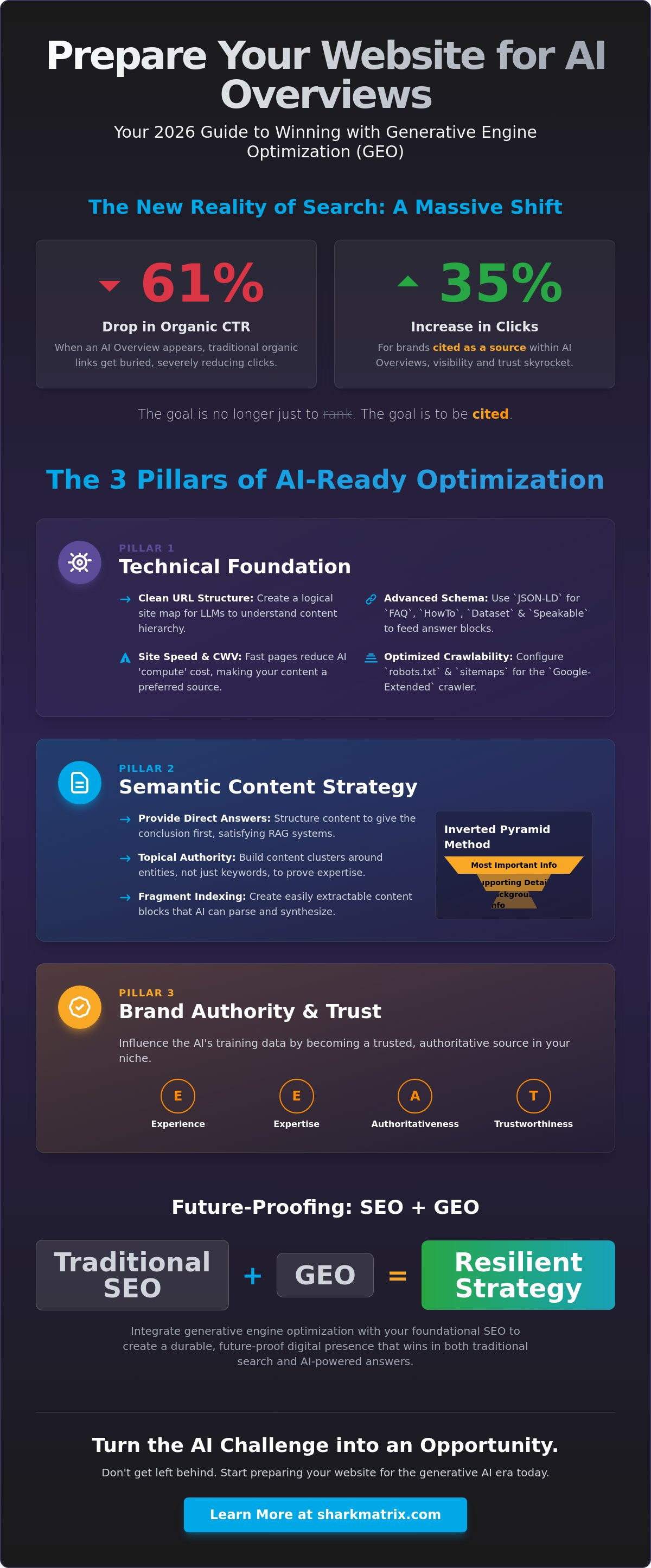
Did you know that organic click-through rates drop by as much as 61% when an AI Overview appears at the top of the search results? It’s a sobering reality for digital marketers who see their traditional rankings buried under synthesized answers. If you feel like you’re losing the battle against zero-click searches, you aren’t alone. That’s why preparing website for ai overviews has become the most critical task for any brand wanting to stay visible in 2026.

We’ll help you turn this challenge into an opportunity by showing you how to become a cited, primary source within Gemini-powered summaries. You’ll learn the exact technical and content adjustments needed to satisfy Retrieval-Augmented Generation (RAG) systems and ensure your data is parsed correctly. This article provides a clear roadmap through the confusion of Generative Engine Optimization (GEO) to help you clear technical debt and future-proof your site against the next wave of algorithm shifts.

Key Takeaways

  • Learn why optimizing your technical infrastructure with advanced schema and rapid site speed is essential for AI bot processing.
  • Discover how to structure your content using the “Inverted Pyramid” method to provide the direct answers LLMs look for.
  • Understand the process of preparing website for ai overviews by building semantic depth and topical authority through clustering.
  • Strengthen your brand’s credibility by leveraging E-E-A-T and digital PR to influence the training data of generative models.
  • Explore how integrating traditional SEO with generative engine optimization (GEO) creates a resilient, future-proof digital strategy.

Understanding the Shift from Search Engines to Answer Engines

Google search isn’t what it used to be. For decades, the goal was to secure a spot in the “ten blue links” that dominated the first page. Today, that layout is being replaced by synthesized summaries that provide immediate answers. This evolution turns Google from a directory into an answer engine. Because of this, preparing website for ai overviews is now the most important part of a modern digital strategy. Users no longer need to click through to multiple sites when the answer is presented right at the top of their screen.

This shift has a massive impact on click-through rates. In 2026, research shows that organic CTR can drop by as much as 58% when an AI Overview is present. However, there’s a silver lining for those who adapt. Brands cited within these AI summaries often see a 35% increase in clicks compared to those that aren’t. The game has changed from fighting for a rank to fighting for a citation. You’re no longer just trying to be the first link; you’re trying to be the source that the AI trusts most.

The Mechanism of AI Citations

How does Gemini decide which websites to cite? It uses a process called Retrieval-Augmented Generation (RAG). Instead of just relying on its pre-trained data, the AI “fans out” a query to its search index to find the most relevant, up-to-date information. AI Overviews are a synthesis of top-tier authoritative data nodes. To get noticed, your site needs to be one of those nodes. This requires moving beyond traditional keyword density. AI crawlers now look for semantic relevance and clear entity relationships within a knowledge graph to determine which content is truly authoritative.

SEO vs. GEO: What Has Changed?

Traditional Search engine optimization (SEO) is still the foundation, but it’s evolving into Generative Engine Optimization (GEO). While SEO focuses on visibility in a list, GEO focuses on visibility within a generated response. For many national brands, this also includes Answer Engine Optimization (AEO), which specifically targets direct-response queries. You need a strategy that balances both worlds. By leveraging comprehensive search engine optimization seo services, you can ensure your technical foundation is strong enough to support these advanced AI requirements while maintaining your traditional search presence. It’s about being visible where the users are looking, whether that’s a blue link or a Gemini summary.

Technical Optimization: The AI-Ready Infrastructure Checklist

Many site owners make the mistake of treating AI visibility as a content-only problem. In reality, your technical foundation determines whether an AI crawler can even understand your data. If your site is bogged down by technical debt, Gemini or other LLMs might skip your content entirely. Preparing website for ai overviews requires a shift toward “fragment indexing.” This means structuring your site so AI can easily extract specific answers without needing to parse through irrelevant code blocks or messy scripts.

A clean, hierarchical URL structure is the first step in this process. It acts as a map for LLMs, helping them understand the relationship between different topics and subtopics. When your URLs follow a logical path, you’re essentially building a knowledge graph for the search engine. This clarity allows AI to identify your brand as an authority in specific niches much faster than a disorganized structure. It also reduces the risk where AI might misattribute information due to poor site architecture.

Advanced Schema and Structured Data

Schema markup has evolved from a “nice-to-have” feature into a mandatory requirement for AI visibility. By using advanced JSON-LD, you provide the entity recognition that AI models crave. Focus on Speakable, FAQ, and How-To schema to feed directly into AI response blocks. If you publish research or data, implementing Dataset schema is vital for becoming a primary source for statistical queries. You can verify these implementations using the updated 2026 Google Search Console tools to ensure your entities are correctly identified and ready for synthesis.

Backend Readiness for AI Crawlers

AI bots don’t crawl the web like traditional spiders. They are looking for high-quality data nodes they can synthesize quickly. This makes site speed and Core Web Vitals more important than ever. Slow pages consume more “compute” for the AI, making them less attractive as sources for real-time summaries. Your robots.txt and sitemaps must also be optimized for the Google-Extended crawler to ensure your most valuable assets are prioritized. Professional website design and development services play a key role here by creating clean, AI-parsable code. If you want to stay ahead of the curve, it might be time to review your technical SEO performance with an expert team.

Preparing Your Website for AI Overviews: The 2026 SEO Checklist

Semantic Content Strategy: Optimizing for LLM Extraction

Writing for search engines used to mean repeating keywords in strategic places. In 2026, the priority is semantic clarity. AI models like Gemini don’t just scan for words; they parse meaning. This makes preparing website for ai overviews a task of information architecture as much as writing. To succeed, you must adopt the ‘Inverted Pyramid’ of AI writing. This means placing the most important information at the very beginning of your sections. Give the AI the answer it needs immediately, then expand on the details for the human reader who chooses to click through.

Topic clustering is your primary tool for proving niche authority. Instead of writing isolated blog posts, create a web of interconnected content that covers a subject from every angle. This builds semantic depth, signaling to AI crawlers that your site is a definitive source. Use headers and lists that are friendly to Natural Language Processing (NLP). Clear, descriptive headings help the AI map your content more effectively. Most importantly, eliminate fluff. Conversational filler and vague introductory sentences are ignored by AI Overviews. If a sentence doesn’t add factual value, it shouldn’t be there.

Crafting the “Perfect Answer” Block

The key to winning a citation is the “Perfect Answer” block. These are concise 40-60 word summaries placed directly under H2 or H3 headers. Use factual, declarative sentences to increase your citation probability. AI models prioritize content that provides immediate, verifiable utility. By providing a clear, high-level summary at the start of each section, you make it easy for the LLM to extract your data without needing to synthesize it from scratch.

Visual and Multimedia Integration

AI is increasingly multimodal, meaning it processes images and videos alongside text. Optimizing your image alt-text and providing detailed video transcripts is essential. Tables and infographics are particularly valuable because they provide structured data that AI can easily parse into summaries. These elements should be responsive and optimized for cross-platform visibility. For businesses focusing on mobile users, integrating these assets with mobile app development services ensures your content remains accessible and citation-ready across all devices.

Building Brand Authority: The Trust and Citation Checklist

In 2026, E-E-A-T (Experience, Expertise, Authoritativeness, and Trustworthiness) is the primary filter AI uses to separate high-quality sources from mass-produced clutter. Google’s official documentation stresses the importance of content that demonstrates real-world experience. Preparing website for ai overviews means you must prove your brand isn’t just another generic voice. AI models look for “non-commodity” content. These are unique insights and expert-led data that can’t be easily generated by a machine. If your content provides common knowledge, the AI will summarize it without citing you. To win the citation, you must offer something the model can’t replicate on its own.

Your brand’s presence in the Knowledge Graph is crucial for long-term visibility. This is how AI identifies entities and their relationships. If your brand is mentioned across authoritative sources, social media, and third-party review sites, the AI’s trust score for your domain increases. Social proof acts as a validation layer for generative models. Since 70% of consumers report having some level of trust in Google’s generative AI results, you must ensure those results reflect a trustworthy brand image. This requires auditing your digital footprint across national industry databases to ensure consistency and authority.

Digital PR and External Mentions

Digital PR is no longer just about building backlinks for rankings. In the AI era, non-linked brand mentions are equally powerful. LLMs use industry-specific “seed sites” as trusted foundations for their training data. If your brand is mentioned frequently on these platforms, you become part of the AI’s core knowledge base. Leveraging seo for brand reputation management dubai helps you control these narratives and protect your reputation across influential databases. This ensures that when an AI generates a summary, your brand is the one it recommends as a trusted authority.

Author Verification and Transparency

Transparency is the ultimate trust signal for 2026 search. You should implement robust author bios that link to external credentials, LinkedIn profiles, and professional certifications. This provides a “human-in-the-loop” signal. It proves that your content is guided by human expertise rather than being 100% AI-generated. AI crawlers check these signals to verify that the information comes from a reliable source. If you want to strengthen your brand’s authority and secure your place in AI summaries, consult with our SEO experts today to build a custom citation and authority strategy.

Future-Proofing with Generative Engine Optimization (GEO)

Success in the AI era isn’t a one-time achievement. As Google recalibrates its systems, the strategies that work today will need to evolve. Preparing website for ai overviews is a continuous process of monitoring, testing, and refining. At Shark Matrix, we treat Generative Engine Optimization (GEO) as a distinct discipline that goes beyond traditional search. We integrate AI automation with our core SEO workflows to ensure your brand remains the preferred source for Gemini-powered summaries. This proactive approach allows us to stay ahead of algorithm shifts that might otherwise lead to sudden traffic drops.

In a zero-click environment, your metrics for success must shift. If 60% of searches don’t result in a click, you need to find value in the citation itself. This is where data-driven lead generation becomes vital. Even if a user doesn’t visit your site immediately, appearing as the primary authority in an AI Overview builds brand recall and trust. We track citation rates and AI visibility with the same rigor we apply to traditional rankings. By understanding which queries trigger these summaries, you can prioritize content that captures the highest-value citations in your industry.

Shark Matrix’s GEO Framework

Our framework relies on sophisticated technology to keep your brand at the forefront of search. We use our internal ai development services to build custom tools that monitor how AI models perceive your site’s data. These tools use predictive analytics to anticipate which long-tail queries are most likely to trigger an AI response. This allows us to optimize your content before the competition even notices the shift. To bridge the traffic gap caused by zero-click results, we often recommend consulting with a ppc agency dubai to maintain a dominant presence through paid search while your organic AI authority grows.

Next Steps for Your Business

The first step in securing your digital future is conducting a comprehensive AI-Readiness Audit. This audit evaluates your technical infrastructure, semantic depth, and E-E-A-T signals to identify gaps in your current strategy. From there, you can build a multi-channel digital roadmap that survives search disruption. Don’t wait for your organic traffic to decline before you start preparing website for ai overviews. Contact Shark Matrix today to develop a specialized Generative Engine strategy that protects your visibility and ensures your brand is the voice Google trusts most in 2026.

The transition from blue links to synthesized summaries is no longer a distant possibility; it’s the current standard. You’ve seen how a combination of technical precision, semantic content strategy, and robust E-E-A-T signals can turn the threat of zero-click searches into a powerful citation opportunity. By preparing website for ai overviews now, you position your brand as a trusted authority that Google’s Gemini-powered systems will prioritize. Success in this landscape requires moving beyond simple rankings to focus on becoming a primary source for AI synthesis.

Shark Matrix is the leading AI automation and development agency in the UAE, specializing in Generative Engine Optimization (GEO). We provide data-driven SEO strategies designed for national brand protection and long-term growth in a volatile market. Don’t let your traffic disappear as search behavior shifts toward answer engines. It’s time to Book your 2026 AI-Readiness Audit with Shark Matrix and ensure your site is ready for what comes next. The future of search belongs to those who adapt today. Your brand has a story that deserves to be told, and we have the tools to make sure the AI engines tell it correctly.

Frequently Asked Questions

What is the difference between SEO and GEO?

Traditional SEO focuses on optimizing your site to rank in a list of links, while Generative Engine Optimization (GEO) focuses on being cited within an AI-generated answer. SEO builds the technical and content foundation. GEO layers on strategies like semantic depth and entity recognition to ensure LLMs like Gemini retrieve your data during synthesis. Both are necessary to maintain visibility in 2026.

Will AI Overviews stop people from clicking on my website?

AI Overviews do increase zero-click searches, which now account for approximately 60% of Google queries. However, being cited as a source can actually help. Research shows that brands cited within an AI Overview see a 35% increase in clicks compared to those that aren’t. While overall CTR might drop for top links, the citation becomes the new “position zero” for traffic.

How do I know if my website is being cited by Google Gemini?

You can monitor your citations through the updated performance reports in Google Search Console. These reports now distinguish between traditional organic clicks and those originating from generative features. You can also use specialized third-party monitoring tools that track your brand’s appearance and citation rate within AI-generated summaries across different industries and query types.

Is structured data still important for AI Overviews in 2026?

Structured data is more critical than ever because it provides the explicit context that AI models need to identify entities. Preparing website for ai overviews requires advanced JSON-LD to act as a bridge between your content and the AI’s knowledge graph. Without clear schema, an LLM might struggle to verify your data, making it less likely to use your site as a primary source.

Can small businesses compete with national brands in AI summaries?

Small businesses have a unique advantage because AI Overviews pull from a much wider source pool than traditional search results. You don’t always have to be in the top 10 blue links to get cited. By focusing on “non-commodity” content and hyper-local expertise, smaller sites can win citations that national brands might lose by being too general or broad.

How often does Google update the sources for its AI Overviews?

Google updates these sources in real-time or near real-time through its search index. Because the system uses Retrieval-Augmented Generation (RAG), the AI “fans out” to the index to find the most current and authoritative information available at the moment of the search. This means your latest expert insights can be cited almost as soon as they are indexed.

Should I block AI crawlers from my website to protect my content?

Blocking crawlers like Google-Extended prevents your data from being used to train models, but it also removes you from AI Overviews. If you block these bots, your brand will not be cited in the summaries that now appear in up to 60% of searches. For most businesses, the loss of visibility and citations outweighs the benefits of content protection.

What are the most important schema types for AI visibility?

The most effective types are FAQ, How-To, and Speakable schema, as they directly match the answer-based intent of AI queries. Additionally, Dataset schema is vital if you publish original research or statistics. These structured formats help AI crawlers quickly identify your content as a high-value data node, which is essential when preparing website for ai overviews and securing citations.

Categories
Uncategorized

Generative Engine Optimization Strategy 2026: The Complete Guide to AI Search Visibility

Did you know that over 80% of Google searches in 2026 now end without a single click to a website? This zero-click reality, fueled by the dominance of AI Overviews and models like GPT-5.5 Pro, has left many brands feeling invisible. It’s frustrating to watch your organic traffic dip while global search volume actually grows by 26%. To survive, your brand must evolve beyond traditional rankings. Implementing a robust generative engine optimization strategy 2026 is no longer optional. It’s the only way to ensure your expertise is the one ChatGPT, Gemini, and Claude Fable 5 cite as the ultimate authority.

You probably feel the pressure to adapt but aren’t sure which AI engines deserve your limited resources. We understand that uncertainty. This guide promises to clear the fog by helping you master the transition from traditional search to generative AI discovery. You’ll gain a clear framework for increasing your AI citations and understand the specific ROI of GEO compared to traditional SEO. We’re breaking down the practical tactics you need to turn AI platforms into your most powerful brand advocates.

Key Takeaways

  • Learn why the “Answer Engine” is replacing traditional blue links and how to position your brand as a primary citation source.
  • Understand the Retrieval-Augmented Generation (RAG) process to align your content with how frontier AI models select authoritative data.
  • Develop a comprehensive generative engine optimization strategy 2026 that balances traditional SEO foundations with the specific requirements of AI discovery.
  • Discover how to audit your brand’s visibility across ChatGPT, Perplexity, and Gemini to identify and close citation gaps.
  • Master content restructuring techniques that make your data easily extractable for AI agents while preserving your brand’s unique authority.

The 2026 Search Tipping Point: Why Traditional SEO is No Longer Enough

The search landscape has reached a definitive tipping point. By June 2026, the traditional list of blue links has started to feel like a digital relic. Users no longer “search” through pages of results; they “ask” for immediate solutions. This behavioral shift has transformed Google from a directory into a sophisticated “Answer Engine,” where AI Overviews provide the final word. To remain visible, brands are rapidly shifting toward Generative engine optimization (GEO). This practice focuses on ensuring your brand is the primary source cited by AI models when they generate these answers.

The impact of this shift is measurable and stark. Recent data indicates that over 80% of Google searches now end without a single click to an external website. For many professional publishers, organic traffic has plummeted by 42% since the full integration of generative AI into search results. A modern generative engine optimization strategy 2026 acknowledges that visibility is no longer about occupying the top spot on a list. It’s about being the foundational data that the AI trusts enough to repeat to the user.

From Keywords to Conversational Intent

User queries have evolved from rigid keywords into complex, multi-step prompts. In 2026, a consumer doesn’t just type “best coffee machine.” Instead, they enter a detailed prompt like “find me a coffee machine that fits a small kitchen and has a timer.” Traditional keyword density is irrelevant for Large Language Models (LLMs). These engines prioritize semantic depth and the ability of your content to resolve a specific, nuanced intent. If your content doesn’t mirror this conversational complexity, the AI will simply look elsewhere for its citations. Success now requires understanding the logic behind the prompt rather than just the words within it.

The Economic Reality of Zero-Click Search

The rise of zero-click search has forced a total redefinition of marketing success. When clicks are no longer the primary driver of top-of-funnel awareness, the value of a brand citation becomes paramount. Being the named authority in a ChatGPT or Gemini response carries immense weight. It builds brand provenance within the AI’s knowledge graph. Your generative engine optimization strategy 2026 should treat a high-quality citation as equal to, or even more valuable than, a traditional website visit. It’s about securing your brand’s place in the digital ecosystem where the actual conversation is happening, ensuring you aren’t left behind as the “blue link” era fades.

Decoding the Generative Engine: How AI Models Select and Cite Sources

Understanding the internal logic of Large Language Models (LLMs) is the foundation of any successful generative engine optimization strategy 2026. Modern engines like GPT-5.5 and Gemini 3.1 don’t simply “search” for your website; they utilize a process called Retrieval-Augmented Generation (RAG). This system allows the AI to pull specific, factual snippets from a curated index of the live web to ground its answers in reality. If your content isn’t structured to be easily “retrievable,” it effectively doesn’t exist to the AI, regardless of your traditional search rankings.

AI models prioritize content based on a strict hierarchy of trust and data density. They favor information that is verifiable, consistently updated, and free from excessive marketing fluff. By following established best practices for GEO, you move away from trying to “game” an algorithm and toward building “Brand Provenance.” This involves creating a digital footprint so authoritative that the LLM views your brand as the primary source of truth for your niche. Content that provides direct answers supported by raw data or unique insights will always outperform vague, adjective-heavy prose.

The Third-Party Validation Loop

LLMs don’t operate in a vacuum. They cross-reference your website’s claims against community platforms like Reddit, Quora, and specialized industry forums. If your brand is cited as an authority on these third-party sites, the AI is much more likely to include you in its generated responses. This makes online reputation management dubai a vital pillar of your search visibility. The AI looks for a consensus across the web; it wants to see that other humans and platforms trust your expertise before it risks citing you to a user.

Technical Signals: Crawlability and LLM Accessibility

Technical SEO in 2026 requires optimizing specifically for AI agents like GPTBot and OAI-SearchBot. Your robots.txt must be configured to allow these agents full access to your most data-dense pages. Furthermore, the use of Schema.org has become essential for building a “knowledge graph” that AI can digest instantly. Server-side rendering (SSR) is also critical. While traditional search bots have improved at rendering JavaScript, many AI crawlers still prefer flat HTML for faster data extraction. If your site’s technical foundation is weak, your generative engine optimization strategy 2026 will fail before it even begins. If you’re unsure if your current infrastructure is AI-ready, our team provides comprehensive ai development services to ensure your data is always accessible to frontier models.

Generative Engine Optimization Strategy 2026: The Complete Guide to AI Search Visibility

SEO vs. GEO vs. AEO: Navigating the 2026 Alphabet Soup

By mid-2026, marketing leaders face a complex alphabet soup of optimization disciplines. While these terms often overlap in casual conversation, the tactical execution for each has diverged. Traditional Search Engine Optimization (SEO) still focuses on the “destination,” aiming to drive users to your website for deep-funnel conversions. In contrast, your generative engine optimization strategy 2026 focuses on the “citation.” It prioritizes becoming the foundational data that AI models use to construct their answers. Understanding how GEO differs from traditional SEO is essential for capturing “Share of Model” in an environment where 80% of searches don’t result in a click.

The Strategic Comparison Framework

To allocate your resources effectively, you must distinguish between the three primary pillars of modern visibility. SEO remains the engine for long-form engagement, tracking metrics like session duration and bounce rates. Answer Engine Optimization (AEO) is a specialized subset that targets immediate, factual resolutions, often delivered through voice search or smart assistants. Generative Engine Optimization (GEO) is the broadest and most influential layer. It manages how Large Language Models (LLMs) perceive and mention your brand. While SEO asks “how do we rank?”, GEO asks “how do we become the cited authority?” and AEO asks “how do we provide the quickest answer?”

When to Prioritize GEO Over Traditional SEO

The decision to shift focus depends heavily on the user’s intent. For broad informational research, GEO is now the primary battlefield. Because AI Overviews dominate the top of the search results page, traditional organic links for these queries have seen a 42% decrease in traffic. In these “winner takes all” scenarios, appearing in the AI’s cited sources is your only path to visibility. Conversely, for high-intent commercial queries where a user needs to interact with a specific tool or checkout process, traditional SEO and Web Development remain the priority.

Industry data shows that 20% to 30% of traditional SEO budgets have already shifted toward AI search optimization. This isn’t about abandoning your website; it’s about diversifying your presence. You’re no longer just building a site for humans. You’re building a knowledge base for machines. A balanced generative engine optimization strategy 2026 ensures you’re visible in the AI-generated summary while maintaining a high-performing site for those users who still choose to click through for the full experience.

Building a Future-Proof Generative Engine Optimization Strategy

Transitioning from theory to execution requires a tactical roadmap. You can’t just hope an LLM finds your site; you have to build a path for it. A successful generative engine optimization strategy 2026 begins with a comprehensive audit of your current visibility across frontier models like GPT-5.5 Pro, Gemini 3.1, and Perplexity. By querying these models directly about your brand and industry, you’ll identify exactly where the AI lacks data or provides outdated information. This audit forms the basis for restructuring your site into “snippetable” content that AI agents can digest and cite with high confidence.

Beyond your own domain, you must build an off-site authority footprint. AI models don’t just trust what you say about yourself; they look for third-party validation. This involves a deliberate citation strategy where your expertise is mentioned on high-authority industry platforms and community forums. When multiple trusted sources point to the same factual claim on your site, the AI’s “confidence score” in your brand increases. This creates a virtuous cycle of citations that keeps your brand at the center of the generative response.

This is especially true for niche industries where topical authority is highly concentrated. If you operate in the maritime sector, you can explore Digital Marketing for Marine Contractors to learn how to align your industry expertise with the technical requirements of generative search.

Content Engineering for 2026

The era of the 2,000-word wall of text is over. Modern AI engines prefer “Modular Content Blocks” designed for easy extraction. Each block should follow a strict “Claim-Evidence-Citation” structure. You make a specific claim, provide the supporting data, and cite the primary source. This format mirrors how Retrieval-Augmented Generation (RAG) systems retrieve information. When you integrate our search engine optimization seo services with this modular approach, you ensure your site serves both human readers and machine crawlers. This dual-purpose engineering is what separates temporary traffic spikes from long-term brand authority.

Bilingual GEO: Dominating the National Market

For brands operating in the UAE, a bilingual approach is the ultimate competitive advantage. AI engines in 2026 are incredibly adept at cross-referencing data between English and Arabic. If your English website claims one thing, but regional Arabic forums or news outlets suggest another, the AI’s trust in your brand provenance drops. To win national citations, your data must be consistent across both languages. This involves localized technical data and ensuring your Arabic content is as “snippetable” as your English version. By aligning your regional nuances with global LLM requirements, you secure a dominant share of the national AI search market.

Success in this new landscape requires a blend of technical expertise and strategic foresight. If you’re ready to secure your brand’s future, our team can help you build a custom generative engine optimization strategy 2026 that keeps you at the top of every AI response. Explore our AI development services today and start your transition to a citation-first digital presence.

Scaling AI Visibility with Shark Matrix Technologies LLC: Integrating GEO into Your Growth Engine

Implementing a generative engine optimization strategy 2026 at scale requires moving beyond manual workflows. While earlier stages of the process focus on auditing and restructuring, the final phase is about industrializing your authority. Shark Matrix Technologies LLC provides the technical framework necessary to maintain high citation rates across thousands of enterprise pages. We don’t just optimize for current models; we build systems that adapt as GPT-5.5 or Gemini 3.1 refine their retrieval logic. By treating your digital presence as a live data feed rather than a static site, you ensure that AI agents always have access to your latest insights.

Our approach moves beyond basic monitoring to utilize machine learning for real-time citation tracking. Traditional rank tracking is binary, but GEO is nuanced. Shark Matrix Technologies LLC uses proprietary AI automation services to analyze the sentiment and accuracy of how Large Language Models (LLMs) represent your brand. If an engine begins to hallucinate about your services or omits your key data points, our systems identify the source of the friction. This allows for rapid content adjustments that realign the AI’s understanding with your actual brand provenance, ensuring your reputation remains untarnished in zero-click environments.

AI-Driven Content and Development

We integrate website design and development services to build architectures designed specifically for machine consumption. This involves more than just page speed; it’s about creating a “Knowledge Vault” within your site structure. Shark Matrix Technologies LLC automates the deployment of complex JSON-LD Schema across enterprise-level domains, ensuring every product, service, and expert bio is properly indexed in the global AI knowledge graph. This technical precision makes your data the path of least resistance for AI agents looking for a verified source to cite.

The Future of National Brand Discovery

The shift from a “Search Strategy” to a “Discovery Strategy” means being present wherever the user’s AI assistant lives. Shark Matrix Technologies LLC bridges the gap between your web presence and user-facing tools through mobile app development services. By embedding AI-ready data layers within your mobile ecosystem, we ensure in-app assistants provide the same high-authority citations as global search engines. This creates a unified front for your brand across the UAE digital landscape, regardless of which device or platform the consumer chooses.

Ready to dominate the AI era? Partner with Shark Matrix Technologies LLC for your 2026 GEO strategy and secure your brand’s role as the top-cited authority in the age of generative discovery. We’re here to help you navigate this transition with confidence and technical excellence, ensuring your brand remains visible as the “blue link” era fades.

Seize Your Place in the Future of AI-First Discovery

The search landscape has fundamentally shifted from a list of links to a network of verified answers. Throughout this guide, we’ve explored how prioritizing RAG-friendly content and ensuring your technical architecture supports machine-first discovery are the new prerequisites for digital survival. By implementing a robust generative engine optimization strategy 2026, you move beyond chasing clicks and start building deep brand provenance within the global knowledge graph.

As pioneers in AI automation and development, Shark Matrix Technologies LLC is uniquely positioned to handle the complexities of national-scale technical SEO and bilingual growth. We help you transition from being a bystander in the AI revolution to becoming the primary source that frontier models trust and cite. Your brand’s authority in 2026 depends on the actions you take today to align your data with the logic of machine intelligence.

Future-proof your brand visibility with Shark Matrix Technologies LLC’s 2026 GEO Strategy. While the era of the traditional blue link is ending, the era of the cited authority is just beginning. Stay proactive, stay authoritative, and lead the conversation in the age of generative discovery.

Frequently Asked Questions

What is the main difference between SEO and GEO in 2026?

The primary difference lies in the end goal: SEO focuses on ranking pages to drive website clicks, while GEO focuses on securing citations within AI-generated responses. Traditional SEO optimizes for a search engine’s results page. GEO optimizes for the Large Language Model’s internal knowledge base and its ability to retrieve your data as a primary source of truth.

How do I track my brand’s performance in AI search engines like ChatGPT?

You track performance by measuring “Share of Model” through direct prompt testing and specialized visibility software. Instead of tracking keyword rankings, you analyze how often your brand is cited as a primary authority. This involves manual auditing of frontier models like GPT-5.5 and using automated tools that simulate user queries across different AI platforms to identify citation gaps.

Is traditional SEO dead because of Generative Engine Optimization?

No, traditional SEO is not dead, but it has evolved to support high-intent transactional queries rather than broad informational ones. While informational traffic has moved to AI Overviews, users still click through to websites for complex tools, purchases, and deep research. A modern generative engine optimization strategy 2026 incorporates traditional SEO as the technical foundation for these deeper, conversion-focused interactions.

How does structured data (Schema) help with GEO?

Schema provides a clear, machine-readable map that helps AI agents identify specific facts, prices, and entities on your site instantly. It removes the guesswork for the LLM during the retrieval phase. By using JSON-LD structured data, you ensure that AI crawlers can verify your brand’s claims and include them in their knowledge graphs with a high confidence score.

Which AI search engines should national brands prioritize first?

National brands should prioritize ChatGPT, Gemini, and Perplexity because they hold the largest share of the AI search market. ChatGPT remains a dominant force, holding nearly 90% of global AI sessions as of 2026. However, Gemini is critical for visibility within the Google ecosystem, making it a mandatory focus for any brand seeking to capture reach through AI Overviews.

Can I block AI engines from using my content while still ranking in Google?

You can block specific AI agents like GPTBot via your robots.txt file, but this will prevent your brand from being cited in generative answers. While your site might still appear in the traditional index, you’ll be invisible in the AI Overviews that occupy the top of the search results. This is usually a strategic mistake for brands seeking maximum digital visibility.

How does bilingual content affect AI citations in the UAE?

Bilingual content strengthens your brand’s authority because AI models cross-reference data across English and Arabic to verify facts. If your information is consistent in both languages, the model’s trust in your brand increases. This consistency is vital in the UAE market, where generative engines frequently pull from both linguistic sources to provide a comprehensive answer to local users.

What are the most common GEO mistakes brands make?

The most common mistake is prioritizing marketing fluff over factual, data-dense content that LLMs can easily extract and use. Brands often fail to structure their information in a modular format, making it difficult for AI agents to identify clear answers. Another error is neglecting off-site reputation, which serves as a critical validation signal for your generative engine optimization strategy 2026.

Categories
Uncategorized

How to Optimize Content for AI Search: The 2026 Strategy Guide

Did you know that the presence of a Google AI Overview now reduces the click-through rate of the top organic result by approximately 60%? With 37% of consumers now starting their searches on AI platforms, the traditional search landscape has fundamentally shifted. Learning how to optimize content for ai search is the only way to ensure your brand remains visible as Gemini 3.5 Flash and GPT-5.5 become the primary tools for discovery.

You’re likely worried about your content being summarized without receiving the traffic you deserve. It’s a common fear in this era of Generative Engine Optimization (GEO), but you don’t have to be left behind. This guide promises to teach you how to become the definitive source that AI models cite and recommend. We’ll preview the essential tactics for 2026, including leveraging Schema.org 30.0 and navigating the latest Google Core Updates to secure your brand’s future in the age of answer engines.

Key Takeaways

  • Transition from traditional ranking to Generative Engine Optimization (GEO) to ensure your brand is the primary source for answer engines.
  • Discover how to optimize content for ai search by focusing on semantic meaning and building entity authority within your niche.
  • Conduct an AI visibility audit to find citation gaps and reclaim mentions from competitors in LLM responses.
  • Use advanced Schema.org 30.0 markup and natural language structures to make your data easily digestible for models like GPT-5.5 and Gemini 3.5 Flash.
  • Future-proof your marketing by integrating AI automation and hybrid SEO-GEO strategies for long-term national visibility.

The Shift from Search Engines to Answer Engines: Why GEO is the New SEO

For decades, the goal of digital marketing was simple: rank on page one. By June 2026, that goal has become obsolete. We’ve moved into the era of the “Answer Engine,” where platforms like Perplexity, with its 100 million monthly active users, provide direct answers instead of a list of websites. This shift marks the rise of Generative Engine Optimization (GEO). Unlike traditional SEO, GEO focuses on making your brand the primary source for the AI’s synthesized response. The era of the “blue link” is ending. In its place, we have synthesized summaries that pull from the most authoritative nodes in the digital landscape.

AI models don’t just scan for keywords; they analyze context and authority. If you’re still using old-school keyword stuffing, you’re likely hurting your visibility. Modern LLMs like GPT-5.5 and Gemini 3.5 Flash prioritize content that is modular and machine-readable. Understanding how to optimize content for ai search requires a move away from lexical matching toward semantic depth. You aren’t just trying to “rank” anymore. You’re trying to be the “source” that the AI trusts enough to cite.

Understanding the Mechanics of Generative Engine Optimization (GEO)

Large Language Models process content through retrieval-augmented generation. They don’t just “find” your page. They extract specific facts to build a response. To win here, your content must have high “Citation Probability.” This is the likelihood that an AI will credit your site as the source of its information. While AEO (Answer Engine Optimization) focuses on providing a single direct answer, GEO is a broader strategy. It ensures your brand’s expertise is woven into the AI’s entire reasoning process. It’s about being the most helpful, cited expert in the room.

Why 2026 is the Tipping Point for AI Search Adoption

User behavior has changed. As of early 2026, AI Overviews appear in 57% of long-tail, high-intent queries. This has led to a massive 60% drop in click-through rates for the top organic results. National brands can’t afford to ignore this. You must pivot your search engine optimization seo services to include generative strategies. Learning how to optimize content for ai search is no longer an optional upgrade. It’s the foundation of market dominance in a world where the traditional search result is fading into the background.

How AI Search Engines ‘Read’ and Rank Content in 2026

In 2026, search algorithms have evolved beyond simple keyword matching. They now utilize advanced semantic analysis to understand the intent behind a query. This shift means that how to optimize content for ai search is no longer about repeating phrases. Instead, it’s about providing clear, accurate information that matches the meaning of a user’s question. AI models look for “entities,” which are specific people, places, things, or concepts, and how they relate to one another. Understanding these relationships allows LLMs to synthesize answers that are both relevant and factually sound.

Once an AI model identifies your content as a reliable source, you enter a “Citation Loop.” Being cited in a Google AI Overview often leads to inclusion in other LLM responses as these systems cross-reference data. Focusing on optimizing for AI content ranking ensures your brand remains a trusted node in the knowledge graph. If you’re looking to refine your digital presence for these new systems, our content marketing experts can help align your brand with these evolving ranking signals.

Entities over Keywords: Building Your Digital Identity

Entities are the building blocks of the global knowledge graph. They represent real-world concepts that AI models use to map information. To dominate your niche, you must identify which entities your brand should own. For example, a fintech company should be inextricably linked to “secure digital payments” and “blockchain transparency.” Entity Authority is the primary ranking signal for 2026, representing the strength of the connection between your brand and a specific topic in the eyes of an LLM.

Semantic Content Architecture: Organizing for LLM Ingestion

Structure is now more critical than word count. AI crawlers use hierarchical heading structures to parse topical relevance quickly. When learning how to optimize content for ai search, you’ll find that the “Inverted Pyramid” style is essential. Place the most important facts at the beginning of each section. This makes it easier for models like Gemini 3.5 Flash to summarize your work. Use clear, declarative statements. Instead of saying “Our services might help you grow,” say “Our services increase revenue by 20%.” This directness makes your content highly “quotable” for AI-generated answers.

How to Optimize Content for AI Search: The 2026 Strategy Guide

Auditing Your Content for AI Discoverability and Citation Gaps

Traditional SEO audits often stop at technical health and keyword rankings. In 2026, these metrics only tell half the story. You need a comprehensive AI Visibility Audit to understand how LLMs perceive your brand. This audit identifies where you’re being cited and, more importantly, where you’re being left out of the conversation. If you want to master how to optimize content for ai search, you have to find the “Citation Gaps” where competitors are mentioned as the primary authority while your brand remains invisible. It’s about moving from “ranking” to “being the source.”

A critical part of this process is evaluating your content for “Extraction Readiness.” AI models don’t read like humans; they extract. If your Unique Selling Proposition (USP) is buried in flowery prose or complex metaphors, models like GPT-5.5 might skip it entirely. You should also analyze the sentiment of current AI mentions. Since LLMs can mirror the sentiment of their training data, managing how these models describe your brand is vital for long-term reputation. If a model consistently summarizes your service with a neutral or negative tone, it’s a signal that your underlying content needs a strategic pivot.

Tools and Techniques for AI Visibility Analysis

You don’t need complex software to start your audit. Use direct prompts in GPT-5.5 or Gemini 3.5 Flash to ask specific industry questions. Analyze which sites the models use as grounding data. If you aren’t appearing in the citations for your core topics, your content likely lacks the structured clarity required for modern LLM ingestion. Monitoring your presence in major training sets is now a standard part of generative engine optimization, ensuring your brand is part of the model’s foundational knowledge rather than just a real-time retrieval afterthought.

Closing the Gap: Turning Missing Mentions into Citations

Once you’ve identified the gaps, you must fill them with high-value, declarative content. Address the specific, unanswered user questions your audit revealed. Improving your internal linking is also essential; it builds a semantic web that helps AI bots understand the relationship between different pages on your site. For national brands, leveraging seo for brand reputation management dubai can help improve the trust signals that AI models prioritize. Learning how to optimize content for ai search means constantly refining these signals to ensure your brand remains the most cited expert in your field.

How to Optimize Content for AI Search: A Practical 5-Step Guide

Turning theoretical knowledge into a functional strategy requires a systematic approach. If you want to master how to optimize content for ai search, you must move beyond traditional metadata. The following five steps provide a roadmap for ensuring your brand is the primary answer in AI-driven search results. By focusing on how machines ingest data, you can secure a permanent spot in the knowledge graphs of the future.

Step 1 & 2: Technical Foundations and Language Processing

Start with the technical architecture of your data. Implementing “SameAs” schema allows you to link your website to verified entity databases like Wikidata or official industry registries. This provides the “Entity Clarity” that models like GPT-5.5 require to distinguish your brand from competitors. While 2024 schema focused on basic categorization, the 2026 requirements under Schema.org version 30.0 demand deep relational mapping that connects your content to the global knowledge graph. Once your technical foundation is set, focus on your phrasing. Writing in a “Question-Answer” format that mirrors common conversational prompts helps LLMs identify your text as the direct solution to a user’s query.

Step 3 & 4: Extraction and External Validation

AI models prefer modular data. You should create “Fact-Dense” content blocks by using bulleted lists and tables. These structures provide the organized data that RAG (Retrieval-Augmented Generation) systems can easily extract and summarize. If you’re researching how to optimize content for ai search, you’ll find that external validation is just as important. In the AI era, high-authority PR and third-party mentions have replaced traditional backlinks as the primary trust signal. When reputable news sites or industry journals cite your brand, AI models view you as a verified authority. Our website design and development services ensure your site remains technically optimized for these AI crawlers, maintaining the speed and structure they need to index your data efficiently.

Step 5: Maintaining Freshness for RAG Systems

The final step is consistency. AI systems reward content that is recently published or updated. This signals to the models that your information is current and relevant for real-time retrieval. If your data is outdated, models like Gemini 3.5 Flash will likely deprioritize it in favor of fresher sources. Content that was accurate six months ago might be ignored by a model looking for the latest industry trends. To keep your brand at the forefront of this evolution, you can explore our generative engine optimization services to automate these updates and ensure your brand remains the definitive answer in 2026.

National market dominance in 2026 requires a sophisticated hybrid strategy. You can’t simply choose between traditional SEO and Generative Engine Optimization (GEO); you must master both. While Google still maintains a global search market share of nearly 90%, the way users interact with those results has changed. With AI search adoption reaching 37% of consumers by early 2026, your brand’s visibility depends on being both a top organic result and the primary cited source in an AI summary. This dual approach ensures you capture traffic from users who still click links and those who rely on synthesized answers.

The next wave of digital discovery is already here: multimodal AI and voice search. Users are no longer just typing keywords; they’re uploading images and asking complex, conversational questions via wearable AI devices. Learning how to optimize content for ai search now includes preparing your assets for these non-textual queries. Your strategy must evolve to include “Entity Authority” across all formats, ensuring that whether a user speaks a question or points a camera at a product, your brand is the definitive answer provided by the underlying model.

Scaling with AI Automation and Development

Managing GEO across thousands of pages is impossible without high-level technical support. Large enterprises are now using custom LLMs to predict which content pieces are most likely to be featured in AI Overviews before they even go live. At Shark Matrix, we utilize ai automation services to implement complex Schema.org 30.0 markup at scale, ensuring every piece of data is machine-readable and ready for ingestion by GPT-5.5 or Gemini 3.5 Flash. Additionally, as search moves into proprietary platforms, our mobile app development services help brands integrate custom AI search interfaces directly into their own ecosystems, bypassing the “blue link” entirely.

Future-Proofing Your Brand with Shark Matrix

The AI search landscape shifts weekly. With Google’s March 2026 Core Update and the rapid retirement of older models like GPT-4o, staying relevant requires continuous monitoring. We don’t just “set and forget” your content. Our team uses generative ai development services to track your citation frequency and the sentiment of brand mentions within LLM responses. This data-driven approach allows us to pivot your strategy in real time, closing citation gaps before competitors can claim your space in the knowledge graph. If you’re ready to secure your brand’s position as the primary answer in 2026, contact Shark Matrix to optimize your AI search strategy today. We’ll help you master how to optimize content for ai search and ensure your digital presence is built for the era of the answer engine.

Dominating the Answer Engine Era

The search landscape is no longer just about ranking; it’s about becoming the definitive source for the world’s most powerful AI models. By prioritizing entity authority over simple keywords and utilizing advanced schema, you can ensure your brand isn’t just indexed, but cited. We’ve explored how a proactive visibility audit and a technical roadmap can turn potential traffic losses into citation wins. Mastering how to optimize content for ai search is the single most important move your brand can make to stay relevant in 2026.

Since 2010, Shark Matrix has been at the forefront of digital innovation. We combine over a decade of experience with cutting-edge expertise in AI automation and development to deliver leading SEO and GEO strategies for national brands. Don’t let your content get lost in the shuffle of synthesized summaries. Secure Your Brand’s Future in AI Search with Shark Matrix and lead the transition to the answer engine era. The future of search is conversational, and your brand deserves to be the primary answer.

Frequently Asked Questions

What is the difference between SEO and Generative Engine Optimization (GEO)?

SEO focuses on ranking in traditional search result lists, while GEO focuses on being cited within AI-generated summaries. While SEO prioritizes keywords and backlinks to drive clicks, GEO emphasizes entity authority and extraction readiness. You want your brand to be the primary source that LLMs use to build their synthesized answers.

How do I know if my content is being used by AI search engines?

You can monitor citation links in Google AI Overviews or platforms like Perplexity and SearchGPT. Another method is prompting models like GPT-5.5 directly with industry questions to see if they credit your site. Tracking referral traffic from these AI platforms in your analytics also provides concrete evidence of your visibility in these systems.

Will optimizing for AI search hurt my traditional Google rankings?

It won’t hurt your rankings; instead, it often improves them. The techniques used in how to optimize content for ai search, such as implementing Schema.org 30.0 and improving content clarity, align perfectly with Google’s E-E-A-T standards. Both systems reward authoritative, well-structured information that provides genuine value to the user.

What is the most important schema type for AI search in 2026?

The “SameAs” and “About” properties are critical for establishing your brand as a verified entity. These tags link your website to authoritative databases like Wikidata, helping AI models understand exactly who you are and what you expert in. Using these properties correctly ensures you’re a recognized node in the global knowledge graph.

How can I increase the chances of my brand being cited in ChatGPT or Perplexity?

Focus on creating fact-dense content blocks that are easy for models to extract. When you learn how to optimize content for ai search, you’ll see that third-party validation from reputable news sites is also vital. LLMs look for consensus across multiple authoritative sources before they decide to cite a specific brand in their responses.

Does content length still matter for AI search optimization?

Structure is now more important than raw word count. While long-form content provides more data for an AI to learn from, the model needs that information to be modular. Use clear headings and bulleted lists so the AI can quickly find and summarize the specific facts it needs to answer a user query.

How often should I update my content to stay relevant for AI crawlers?

You should aim for regular updates, at least quarterly, to maintain content freshness. AI models prioritize recent information to ensure their answers aren’t outdated. If your data is old, models like Gemini 3.5 Flash may skip your site in favor of a competitor who provides more current industry insights or statistics.

Can AI search optimization help with brand reputation management?

Yes, it’s a powerful tool for managing how your brand is perceived. By providing clear, authoritative content, you influence the data LLMs use to summarize your business. This helps ensure that AI-generated responses reflect your brand values and maintain a positive sentiment when users ask about your services or reputation.

Categories
GEO

How Generative Engine Optimization (GEO) Is Changing SEO in Dubai (2026 Guide)

Search is evolving rapidly, and businesses in Dubai are already experiencing the shift. Instead of browsing multiple websites, users now rely on AI-powered platforms like ChatGPT and Google SGE to get direct answers.

This transformation has introduced a new discipline called Generative Engine Optimization (GEO). It goes beyond traditional SEO by focusing on how AI understands and recommends your business.

If your brand is not part of AI-generated answers, you are no longer just ranking lower—you are becoming invisible. This guide explains how GEO is changing SEO in Dubai and what your business should do to stay ahead.

What Is GEO?

Generative Engine Optimization (GEO) is the process of optimizing your content so that AI-powered search engines can understand, trust, and include it in their generated responses.

Unlike traditional SEO, which focuses on rankings, GEO focuses on being selected as the answer.

Why GEO Is Important for Dubai Businesses

Dubai is one of the fastest-growing digital markets in the world. Businesses are investing heavily in SEO, paid ads, and social media marketing. However, AI search is now changing how users discover brands.

AI platforms analyze:

  • Content clarity
  • Brand authority
  • Real expertise
  • Structured information

This means only high-quality content gets visibility. Businesses that adapt early to GEO will gain a strong competitive advantage.

SEO vs GEO: Key Differences

Traditional SEO is still relevant, but it now works alongside GEO.

  • SEO focuses on rankings and keywords
  • GEO focuses on context and answers
  • SEO drives traffic
  • GEO drives visibility inside AI responses

The most successful businesses in Dubai are combining both strategies to maximize reach.

How GEO Is Changing SEO in Dubai

1. Search Is Becoming Conversational

Users are no longer typing short keywords. They ask detailed questions such as:

  • “Which digital marketing agency in Dubai gives the best ROI?”
  • “How can I generate leads through SEO in the UAE?”

Your content must answer these questions clearly and naturally.

2. Content Quality Matters More Than Ever

AI systems prioritize content that demonstrates real expertise. Generic or keyword-heavy content is often ignored.

High-performing content includes:

  • Practical insights
  • Clear explanations
  • Real-world examples

3. Authority Drives Visibility

AI tools recommend brands they trust. Building authority through consistent, high-quality content is essential.

This includes:

  • Publishing in-depth blogs
  • Sharing case studies
  • Covering niche topics

4. Structured Content Wins

Content that is easy to read performs better. Use:

  • Clear headings
  • Logical flow
  • Short but meaningful paragraphs

This improves both user experience and AI understanding.

How to Optimize for GEO (Actionable Strategy)

Focus on Answer-Based Content

Create content that solves real problems. Instead of targeting only keywords, address user intent.

Use Natural, Conversational Language

Write the way your audience speaks. This improves engagement and aligns with AI search behavior.

Build Topical Authority

Create multiple blogs around key areas such as:

This strengthens your domain authority.

Add FAQs and Structured Sections

Well-structured content increases your chances of appearing in AI-generated answers and featured snippets.

GEO Strategy for Dubai Businesses

Businesses in Dubai can leverage GEO differently depending on their industry.

  • Real estate companies should focus on location-specific content
  • B2B companies should combine LinkedIn marketing with authoritative content
  • eCommerce brands should optimize product content for AI recommendations

Understanding your audience and aligning your strategy accordingly is critical.

Common Mistakes to Avoid

  • Focusing only on keywords instead of user intent
  • Publishing low-quality or repetitive content
  • Ignoring AI search platforms
  • Not updating existing content
  • Weak internal linking strategy

Future of SEO in Dubai

AI-driven search will continue to grow. Businesses will need to focus more on authority, trust, and user experience.

GEO will become a standard part of digital marketing strategies, especially in competitive markets like Dubai.

How to Rank in AI Search

To rank in AI search results, focus on:

  • High-quality, expert-level content
  • Clear and structured formatting
  • Answer-based writing
  • Strong brand authority
  • Regular content updates

Why Work with a Digital Marketing Agency in Dubai

Implementing GEO requires a combination of strategy, content expertise, and technical understanding.

A professional digital marketing agency in Dubai can help you:

  • Build GEO-optimized content
  • Improve SEO performance
  • Increase qualified leads
  • Stay ahead of AI search trends

If your business is not appearing in AI-generated results, you are already losing potential customers.

At Shark Matrix, we help businesses in Dubai:

  • Rank on Google
  • Appear in AI search answers
  • Generate consistent, high-quality leads

👉 Let’s build your GEO strategy and position your brand for the future of search.

FAQs

What is Generative Engine Optimization in simple terms?

Generative Engine Optimization is the process of optimizing content so AI search engines can understand and recommend your business in their answers.

Is GEO replacing SEO?

No, GEO is not replacing SEO. It is an evolution of SEO that focuses on AI-driven search visibility alongside traditional rankings.

How can businesses in Dubai benefit from GEO?

Businesses can gain higher visibility, better lead quality, and improved authority by appearing in AI-generated results.

How long does it take to see results from GEO?

Results depend on content quality and competition, but businesses typically start seeing improvements within a few months of consistent optimization.