


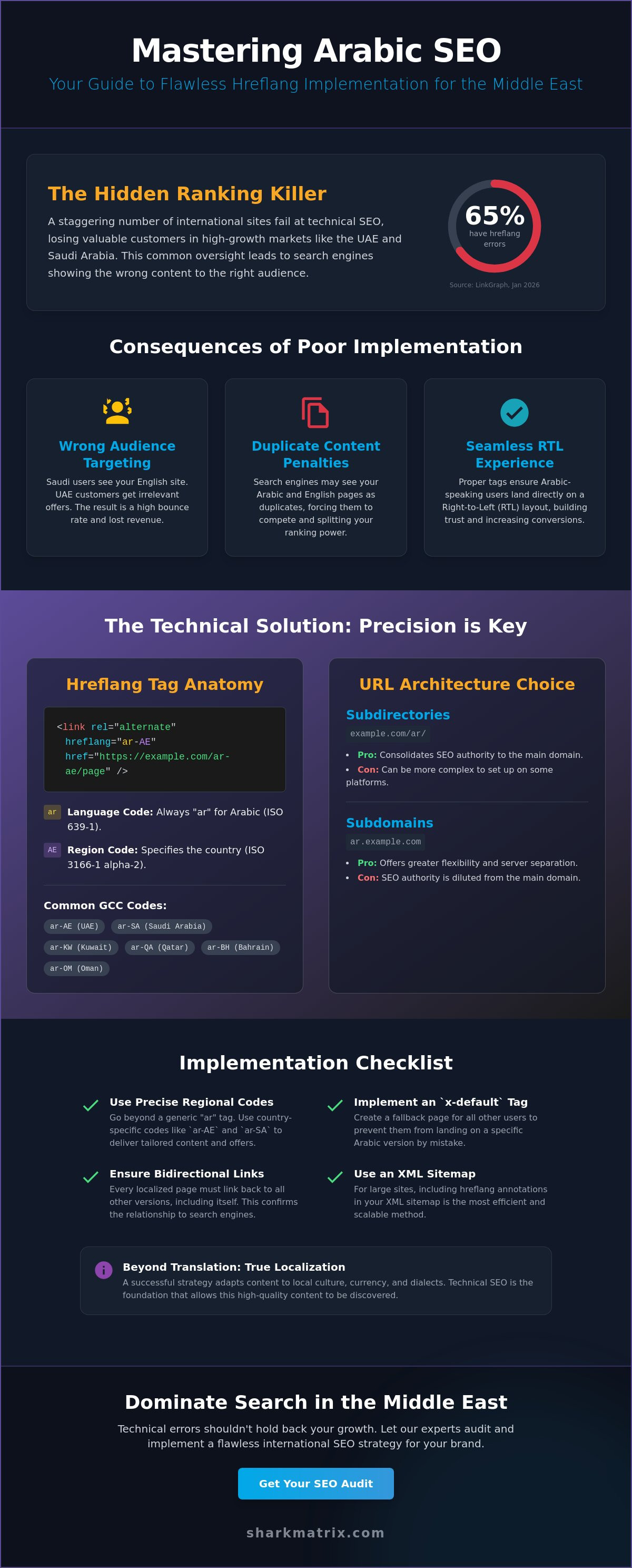
Over 65% of international websites currently struggle with significant errors in their hreflang tags according to January 2026 data from LinkGraph. For businesses targeting the Middle East, a flawed hreflang implementation for arabic sites often means your high-value Saudi audience sees English content while your UAE landing pages fail to rank entirely. It’s frustrating to invest in quality content only to have search engines serve the wrong version. Between the complexities of Right-to-Left (RTL) architecture and the confusion of ISO codes like ar-AE versus ar-SA, the technical barriers can feel overwhelming.
We’re here to help you master these technical nuances so you can dominate search results across the Middle East. You’ll gain a clear roadmap for implementation that ensures your regional targeting is precise and your site avoids duplicate content penalties. We’ll walk through the essential steps for mapping regional codes, managing bidirectional links, and leveraging XML sitemaps to ensure your localized versions perform exactly as intended.
Key Takeaways
- Identify the correct ISO 639-1 “ar” language codes and regional modifiers to build precise tags that signal your target market to search engines.
- Evaluate the SEO authority of subdirectories against the flexibility of subdomains to find the ideal URL architecture for your localized Arabic pages.
- Discover how a proper hreflang implementation for arabic sites protects your brand from duplicate content penalties while supporting Right-to-Left (RTL) layout stability.
- Understand the impact of Arabic site architecture on Core Web Vitals to ensure your technical SEO supports a seamless mobile experience.
- Prepare for the future of search by aligning your technical signals with emerging AI and Generative Engine Optimization (GEO) trends in the MENA region.
Why Arabic Hreflang Implementation is Critical for UAE Brands
The hreflang attribute serves as a technical signal that tells search engines exactly which language and geographic region a page is designed for. In a market like the UAE, where internet penetration reached 99.0% by June 2026 according to DataReportal, the stakes for technical precision are incredibly high. Without a robust hreflang implementation for arabic sites, your content might exist, but it won’t be visible to the right people. It’s the difference between a user in Riyadh seeing your Saudi-specific pricing and a user in Dubai seeing your UAE-specific offers.
Localization offers a massive return on investment, yet many brands stop at simple translation. Digital advertising spend in the MENA region reached $8.18 billion in 2025, making it the fastest-growing digital ad region in the world. To capture this growth, you need more than just translated text. You need technical signals that consolidate your ranking power. Hreflang tags help search engines understand that your Arabic and English pages are versions of the same content rather than duplicate pages. This prevents your different regional versions from competing against each other in search results.
User experience is equally vital. When an Arabic-speaking user clicks a link from a search engine, they expect a seamless Right-to-Left (RTL) experience. If they land on an English page or a poorly formatted Arabic version because your technical signals were crossed, they’ll likely leave immediately. Proper implementation ensures they land on the correct version the first time, boosting your conversion rates and building trust with your audience.
The Difference Between Translation and Localisation
Modern search engines prioritize pages that offer a truly localized experience. Translation just changes the words; localization adapts the entire context, including currency, regional dialects, and cultural nuances. Technical SEO provides the foundation for this high-quality content to succeed. At Shark Matrix Technologies LLC, we integrate these signals into our search engine optimization seo services to ensure your brand doesn’t just speak Arabic, but speaks the right version of Arabic for every target market. An “Arabic-first” strategy supported by technical tags consistently outperforms generic translated sites.
Preventing Common Ranking Errors
It’s a common frustration for Middle Eastern brands when their English pages outrank their Arabic versions in local search results. This happens because search engines lack the technical “hint” to prefer the Arabic page for local queries. Data from LinkGraph in early 2026 showed that 65% of international websites have significant implementation errors, often leading to the wrong page appearing in SERPs. A correct hreflang implementation for arabic sites solves this problem. By mapping your pages correctly, you’ll see a significant drop in bounce rates as users are automatically directed to the RTL layout they expect.
Mastering Hreflang Syntax for the Middle Eastern Market
Precision in your code is the difference between a successful expansion and a technical mess. The basic anatomy of an hreflang tag follows a strict pattern: rel="alternate" hreflang="language-country". For any hreflang implementation for arabic sites, the language component always uses the ISO 639-1 code “ar”. While this tells Google the content is in Arabic, it doesn’t specify which version of your site a user in Dubai should see compared to a user in Riyadh. To solve this, you must append the ISO 3166-1 alpha-2 country code to the language tag.
Adhering to W3C internationalization standards ensures your site handles these regional variations correctly. Beyond regional tags, you must include an “x-default” attribute. This acts as a fallback for users whose language or location doesn’t match any of your specific targets. If a user in London searches for your brand, the x-default tag directs them to your global English page or a neutral landing page, preventing them from landing on a regional Arabic version by mistake.
If you’re unsure if your current site architecture supports these complex technical requirements, Shark Matrix Technologies LLC can help through professional SEO services that audit and refine your international targeting.
Regional Code Combinations for the GCC
The Gulf Cooperation Council (GCC) represents some of the most digitally active markets in the world. To target them effectively, you need specific combinations. Use “ar-AE” for the United Arab Emirates, where internet penetration is nearly 100%. For Saudi Arabia, use “ar-SA”, and for Qatar, “ar-QA”. Other essential codes include “ar-KW” (Kuwait) and “ar-BH” (Bahrain). Use a generic “ar” tag only when the content is universal and not tied to specific regional pricing or local laws. This specificity ensures Google serves the most relevant content to users in each distinct market.
The Reciprocal Link Rule
Google requires a bidirectional handshake for hreflang to work. If your UAE page (ar-AE) points to your Saudi page (ar-SA), the Saudi page must point back to the UAE page. If this link is broken or one-way, Google will likely ignore the signal entirely. This rule applies to every single localized version on your site. Every page must also include a self-referencing tag that points to itself. To verify your implementation, use a technical SEO audit tool to identify “return tag” errors where a localized page fails to point back to its source.
Choosing Your Arabic URL Architecture
Selecting the right URL structure is a foundational step in your hreflang implementation for arabic sites. The way you organize your localized content dictates how search engines distribute authority and how easily your site can scale across the Middle East. Most businesses choose between subdirectories, subdomains, or country-code top-level domains (ccTLDs). Each approach has distinct technical implications for your SEO performance and long-term maintenance.
Subdirectories, such as example.com/ar/, are often the most effective choice for growing brands. They allow your Arabic pages to inherit the domain authority of your main site, which can lead to faster rankings for new content. However, for large-scale operations with localized logistics or separate server requirements, subdomains like ar.example.com might be necessary. While ccTLDs like .ae or .sa provide the strongest possible geographic signal to search engines, they require significant resources to manage. We often address these complexities within our website design and development services to ensure that technical debt doesn’t hinder your regional growth.
Subdirectory vs. Subdomain: The SEO Debate
The choice between a subdirectory and a subdomain often comes down to authority versus independence. Subdirectories consolidate your backlink profile, making it easier for your Arabic pages to benefit from your global marketing efforts. Subdomains, on the other hand, are treated as semi-independent entities by Google. This can lead to a fragmented crawl budget, where search engine bots spend more time jumping between domains rather than indexing your content efficiently. For most UAE-based enterprises, the subdirectory model offers a more streamlined path to ranking in a competitive market.
Implementing Hreflang via XML Sitemaps
While many sites place hreflang tags directly in the HTML <head>, this can lead to bloated code and slower page load speeds, especially when you’re targeting ten or more regions. Moving your hreflang implementation for arabic sites into an XML sitemap is a cleaner, more professional alternative. This method keeps your front-end code lean while providing a centralized map for search engines to follow.
An internationalized XML sitemap lists every URL and its corresponding localized versions in a structured format. According to Google’s official hreflang guidelines, this is a highly effective way to manage large-scale deployments without impacting the user-facing performance of your site. It simplifies the auditing process, as your technical team can verify all regional handshakes in one file rather than scanning thousands of individual pages. This approach is particularly beneficial for e-commerce platforms where page speed is a critical factor in conversion rates.
Technical Challenges: RTL Layouts and Hreflang
Implementing Right-to-Left (RTL) layouts is often viewed as a simple design choice, but it carries significant technical weight for search performance. Success in hreflang implementation for arabic sites requires more than just translating strings; you must align your site’s physical structure with the signals you’re sending to Google. If your CSS causes layout shifts when switching from LTR to RTL, your Core Web Vitals will suffer. In a region where mobile connections are equivalent to 202% of the population, performance is non-negotiable. Technical SEO for Arabic pages must account for how mirrored layouts impact Cumulative Layout Shift (CLS) and Largest Contentful Paint (LCP).
This technical synergy extends to how your web presence interacts with your mobile platforms. Our mobile app development services often rely on these web-based technical signals to ensure deep-linking and user transitions feel native and localized. When your web hreflang tags are correctly mapped, it creates a predictable environment for mobile crawlers and app indexing bots to understand regional content variations.
Canonical Tags vs. Hreflang
The most frequent error we see is the “master version” trap. Many developers incorrectly set the canonical tag of an Arabic page to point back to the English version, thinking it consolidates authority. This actually tells Google to ignore the Arabic page entirely. On localized sites, each regional page must have a self-referencing canonical tag. A canonical tag tells search engines which single URL is the authoritative master version, while a hreflang tag specifies which localized version of that page should be shown to a user based on their language and region. Using them together correctly ensures that your hreflang implementation for arabic sites doesn’t lead to your localized pages being dropped from the index.
RTL Technical Audit Checklist
Auditing an Arabic site requires a specific lens that standard SEO tools often miss. You need to validate that the bot’s view of the RTL structure matches what the user sees. Use this checklist to ensure your technical foundation is solid:
- Layout Shift Validation: Test that your mirrored CSS doesn’t cause elements to jump during loading, which can trigger CLS penalties.
- Font Optimization: Ensure that heavy Arabic web fonts are optimized for fast rendering to maintain high page speed scores.
- Bot Rendering: Use Google Search Central to “Inspect URL” and verify that the RTL layout renders correctly for mobile crawlers.
- Bidirectional Integrity: Double-check that every RTL page points back to its LTR counterpart and vice versa.
If your RTL site is experiencing indexing issues or poor ranking, our team can provide a technical deep-dive through our SEO and web development services to fix your regional targeting.
Scaling Your National Brand with Professional Technical SEO
Scaling a brand across the Middle East requires more than just launching new pages. It demands a rigorous commitment to technical excellence. While automated translation plugins might seem like a quick fix, they often create a mess of broken signals and cultural inaccuracies that damage your national reputation. A successful hreflang implementation for arabic sites isn’t a “set and forget” task. It’s a strategic asset that needs continuous monitoring to ensure your Saudi, Emirati, and Qatari audiences always see the content designed specifically for them. In a region where digital competition is intensifying, you can’t afford to let technical errors drain your marketing budget.
Success in this competitive landscape often comes down to choosing the right digital partner who understands both the code and the culture. At Shark Matrix Technologies LLC, we integrate technical SEO with your broader growth strategy to ensure your site remains healthy as you expand. We move beyond basic tags to help you navigate the complexities of regional authority and user intent across the GCC.
Generative Engine Optimization (GEO) for Arabic
AI-driven search is fundamentally changing how users find information in the Middle East. With 88% of UAE organizations now using AI in at least one business function as of June 2026, search engines are becoming more sophisticated in how they verify regional authority. AI search engines don’t just look at keywords; they analyze technical signals like hreflang and structured data to confirm your site is a legitimate local source. Preparing your Arabic site for this shift means ensuring your technical foundation is beyond reproach. High-quality hreflang implementation for arabic sites provides the trust signal that generative engines need to cite your brand as an authority in the region.
Custom Technical SEO Solutions
Off-the-shelf SEO solutions often fail when faced with the unique requirements of the Arabic language and Middle Eastern site architecture. Whether it’s managing complex RTL layout shifts or coordinating content across multiple regions, a custom approach is essential. Working with a national agency provides you with a team that understands the local tech stack and the specific browsing habits of users from Dubai to Riyadh. Generic tools can’t replace the nuanced auditing required to catch the technical errors that typically plague international sites. Your next step should be a comprehensive technical audit to identify where your regional targeting might be leaking authority and to build a roadmap for long-term search dominance.
Securing Your Future in the Arabic Digital Landscape
Dominating the Middle Eastern search market in 2026 requires more than just high-quality content. It demands a flawless technical foundation where your site architecture, RTL layouts, and regional signals work in perfect harmony. By correctly mapping your ISO codes and prioritizing bidirectional links, you ensure that every user from Cairo to Kuwait City lands exactly where they should.
Mastering your hreflang implementation for arabic sites isn’t just about avoiding errors. It’s about building authority in an AI-driven search era. Moving your tags to XML sitemaps and aligning your canonical strategy with your regional goals will protect your site from duplicate content penalties while improving page load speeds.
Shark Matrix has been helping brands navigate the MENA market since 2010. Our team combines deep expertise in Arabic digital marketing with custom software and AI automation capabilities to solve your most complex technical challenges. Ready to ensure your regional targeting is precise? Contact Shark Matrix for a Technical SEO Audit and let’s secure your brand’s place at the top of the search results. Your growth across the Middle East starts with a site that search engines can trust.
Frequently Asked Questions
What is the most common mistake in Arabic hreflang implementation?
The most frequent error is the missing “return tag,” where one page links to a localized version that fails to link back. This breaks the bidirectional handshake Google requires to validate the relationship. Another widespread issue in hreflang implementation for arabic sites is using incorrect regional codes, such as “uae” instead of the standardized “AE,” which causes search engines to ignore the signal entirely.
Do I need hreflang if I only have one version of my site in Arabic?
You don’t need hreflang if your site is only available in a single Arabic version without any other language counterparts. Hreflang is specifically designed to help search engines choose between multiple localized versions of the same content. If no other versions exist, Google will simply use its standard language detection algorithms to index and serve the page correctly for Arabic speakers.
Can I use hreflang for different Arabic dialects like Emirati vs. Egyptian?
Yes, you can and should use hreflang to target specific dialects like Emirati (ar-AE) and Egyptian (ar-EG). This is particularly useful for e-commerce sites where pricing, currency, and local terminology differ significantly between markets. Using these specific regional codes ensures that users in Cairo see your Egyptian offers while users in Dubai see your UAE-specific landing pages and Gulf Arabic content.
How long does it take for Google to recognize hreflang changes?
Google typically takes anywhere from a few days to several weeks to process hreflang changes. The exact timing depends on your site’s crawl frequency and how often Googlebot visits your pages. You can monitor the progress through Google Search Central to ensure the signals are being picked up without errors after your initial hreflang implementation for arabic sites is live.
Is it better to put hreflang in the HTML head or the XML sitemap?
Using an XML sitemap is generally better for large-scale enterprise sites with many language and regional variations. It prevents the HTML head from becoming bloated, which helps maintain faster page load speeds for your users. For smaller sites with only two or three versions, placing the tags directly in the HTML head is often easier to manage and remains highly effective.
How does hreflang affect my SEO for brand reputation management in the UAE?
Hreflang protects your brand reputation in the UAE by ensuring users don’t land on irrelevant regional pages with different pricing or legal terms. If a customer in Dubai lands on a page meant for the North African market, it can lead to confusion and a loss of trust. Correct targeting ensures a professional, localized experience that aligns perfectly with your regional brand identity.
What happens if my Arabic and English pages have different content structures?
Your Arabic and English pages don’t need to be identical in structure, but they must serve the same purpose and offer essentially the same information. While you might adapt the layout for RTL requirements or cultural preferences, the core message should remain consistent. If the content is too different, Google may decide the pages aren’t true alternates and ignore the hreflang signal altogether.
Do I need to implement hreflang for my mobile app as well?
While traditional hreflang tags are for web pages, you should implement similar logic for your mobile app using deep linking and app indexing. This ensures that users searching on mobile are directed to the correct localized version of your app content. Aligning your web signals with your mobile app architecture provides a consistent, professional experience across all digital touchpoints in the MENA region.


