
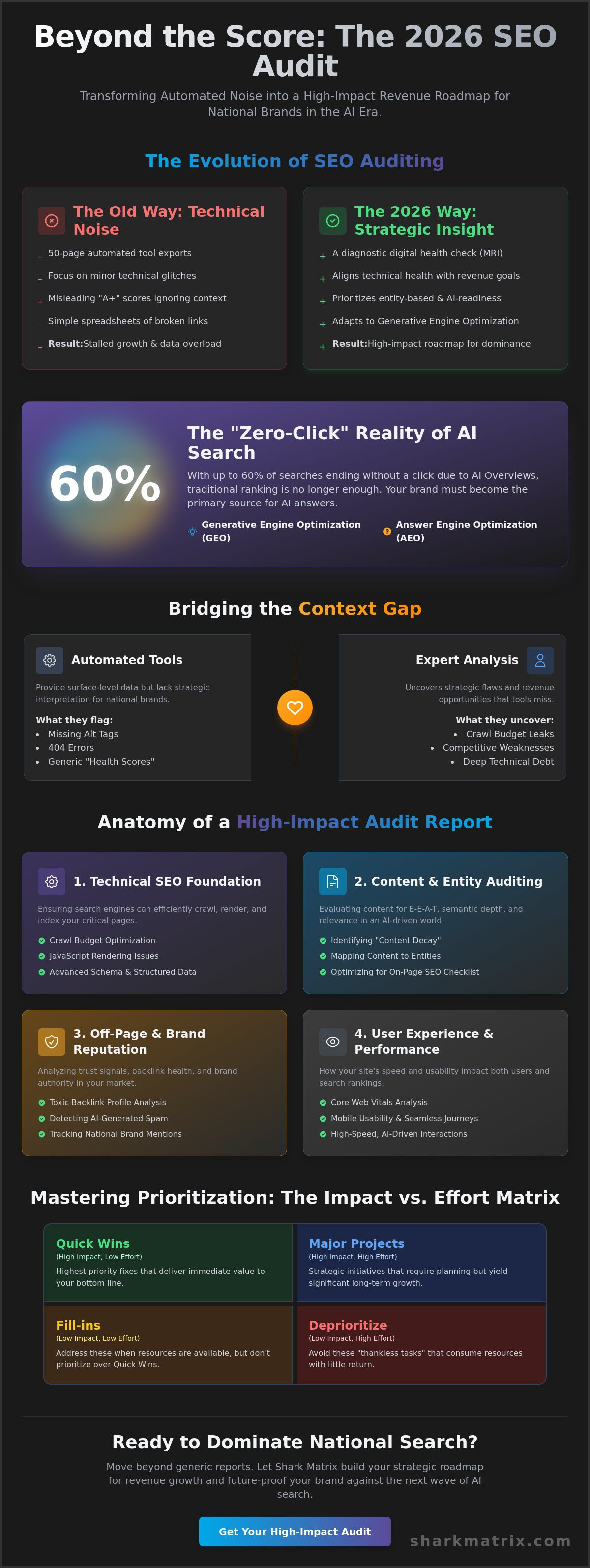
What if your 50-page seo audit report is actually the reason your national brand is stalling? It’s a common frustration for marketing leaders who feel buried under a mountain of automated tool exports that flag every minor technical glitch but ignore the bottom line. You aren’t alone if you find it difficult to justify search spend to the C-suite when 60% of searches may end without a click due to the latest AI Overviews.
We’ll show you how to filter out the technical noise and transform that data into a high-impact roadmap for national search dominance. This guide provides a clear framework to prioritize the fixes that actually drive revenue while adapting to Google’s May 2026 Core Update. You’ll learn how to align your site’s technical health with your business goals, ensuring your strategy survives the shift toward generative engine optimization and AI-powered search.
Key Takeaways
- Learn why a comprehensive seo audit report serves as a diagnostic health check for your digital infrastructure instead of just a list of tool-generated errors.
- Balance technical foundation fixes with advanced on-page strategies like entity optimization to satisfy modern search algorithms.
- Identify the “Context Gap” where automated tools fail and how expert analysis uncovers strategic flaws that hinder national growth.
- Master the Impact vs. Effort matrix to prioritize critical blockers and high-value fixes that directly influence your brand’s revenue.
- Explore how integrating AI automation and generative engine optimization can streamline your performance while future-proofing your search presence.
Beyond the Score: What a 2026 SEO Audit Report Really Reveals
Think of a modern seo audit report as a high-resolution MRI for your brand’s digital health. It’s no longer just a spreadsheet of broken links or missing meta descriptions. In an era where Google releases core updates every few months, like the significant rollout on May 21, 2026, a diagnostic health check must look deeper into your site’s infrastructure. It needs to evaluate how your code, content, and connectivity align with business revenue goals rather than just search engine checkboxes.
While Search engine optimization (SEO) has always required technical precision, the 2026 ecosystem demands more than just checking boxes. Many automated tools hand out “A+” grades like participation trophies. These scores are often misleading for national brands because they don’t account for competitive market dynamics or the nuance of the latest algorithm shifts. A site can have a perfect technical score and still fail to rank if its content lacks the entity depth required to satisfy Gemini-powered search results. Strategic interpretation is what transforms raw data into a roadmap for growth.
We’ve moved beyond keyword-only audits. Today, an effective seo audit report prioritizes entity-based optimization and AI-readiness. It’s about ensuring your brand is recognized as an authority by both human users and machine learning models. This involves analyzing how your site handles structured data and whether your technical foundation can support high-speed, AI-driven interactions.
The Evolution of SEO Auditing in the AI Era
With 60% of searches now ending without a click due to AI Overviews, your audit must address Generative Engine Optimization (GEO). It’s not just about traditional rankings anymore; it’s about being the primary source for Gemini 3.5 Flash. Your report needs to include Answer Engine Optimization (AEO) metrics to track how well your brand answers conversational queries. AI now helps us identify complex patterns in crawl data that human auditors might miss, allowing for faster fixes to deep-seated technical issues.
Why National Brands Cannot Rely on Generic Automated Reports
Generic tools often miss the technical debt that accumulates on enterprise-level sites with thousands of pages. They might flag a missing alt tag but ignore a crawl budget leak that’s costing your company thousands in organic revenue. National competition requires benchmarking against specific industry giants, not a generic checklist. A one-size-fits-all tool cannot tell you how to outmaneuver a specific competitor who is dominating the “zero-click” space in your niche.
The Anatomy of a High-Impact SEO Audit Report
A high-impact seo audit report serves as the structural blueprint for your brand’s digital growth. It breaks down into four essential pillars: technical foundation, on-page architecture, off-page authority, and user experience. This document isn’t just a list of errors. It’s a strategic analysis of how your site’s “plumbing” handles the demands of modern search engines while providing a seamless journey for national customers. By examining these components, you can ensure your digital infrastructure supports the high-speed, AI-driven interactions that define search in 2026.
Technical SEO: The Indexability Pillar
Large national websites often struggle with crawl budget efficiency. If Google’s bots spend too much time on low-value pages, your critical, revenue-driving content remains invisible. This is where technical seo consultant expertise becomes vital. They identify complex JavaScript rendering issues that standard crawlers often miss. Understanding How to Perform a Technical SEO Audit helps your team grasp why deep-level fixes, such as advanced schema markup and structured data, are necessary to stand out in Gemini-powered results.
Content and Entity Auditing
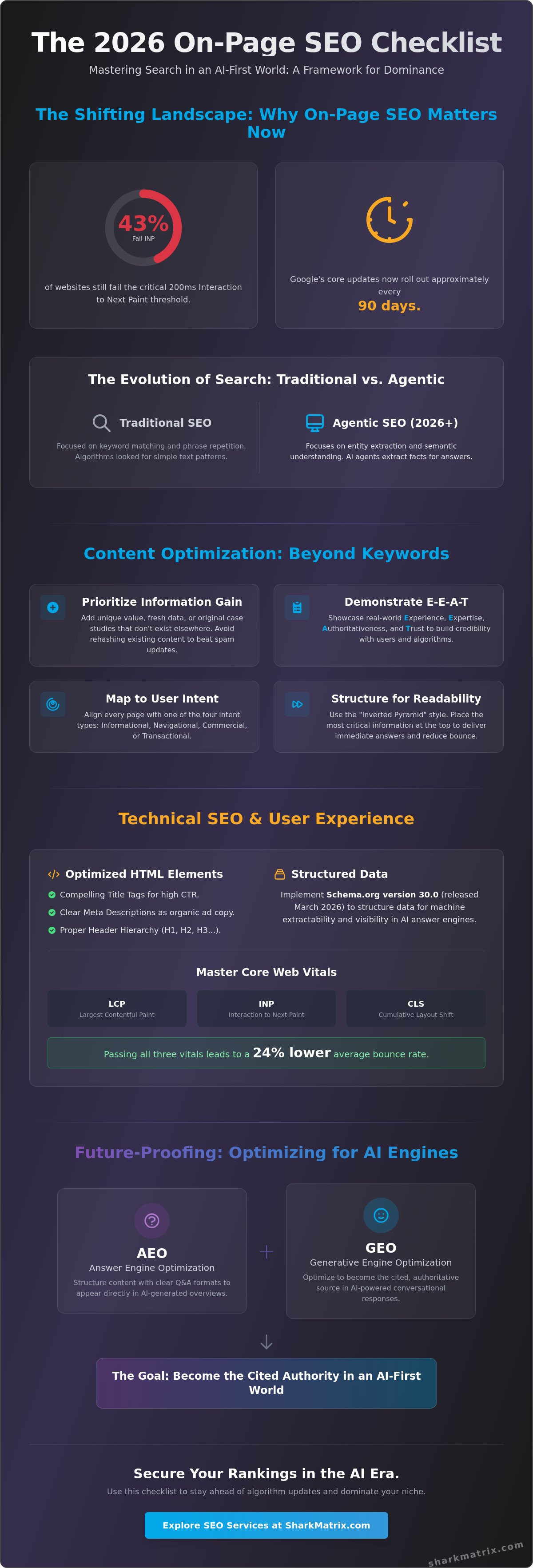
Content auditing in 2026 focuses on E-E-A-T and semantic depth. It’s no longer enough to have high word counts or keyword density. You need to identify “content decay,” where older pages lose relevance and dilute your overall domain authority. By mapping your site against a comprehensive on page seo checklist, you can ensure every piece of content serves a specific entity-based purpose. This process helps your brand maintain relevance even as AI-generated content accounts for over 17% of top search results.
Off-Page and Brand Reputation Analysis
Trust signals are more important than ever in a crowded market. Your comprehensive seo audit report should analyze your backlink profile for toxic patterns or low-quality AI-generated spam that could trigger a penalty. Tracking national brand mentions and sentiment helps gauge your online reputation, which directly influences your search authority. If you need a partner to bridge these technical and strategic gaps, our team at Shark Matrix can help align your SEO goals with high-performance web development and content marketing.
Finally, User Experience (UX) bridges the gap between technical health and business goals. Core Web Vitals and interactivity are no longer optional extras for ranking. If your site is slow or difficult to navigate, you’ll lose traffic regardless of your search positions. A modern audit evaluates how these UX signals influence your national presence and conversion rates.
Automated Tools vs. Expert Analysis: Addressing the Value Gap
Automated tools like Semrush or AIOSEO are essential for modern data gathering. They process millions of data points faster than any human ever could. But a raw data export isn’t a strategic seo audit report. It’s just a list of observations. The “Context Gap” emerges when these tools flag thousands of technical non-issues, like missing alt text on decorative icons, while missing a critical strategic flaw that’s tanking your national brand’s visibility.
Human strategists act as a filter. They separate the noise from the signal. While a tool might give you a high score for having “correct” title tags, it won’t notice if those titles fail to capture the intent of your national audience. AI-only audits also struggle to understand the nuances of a competitive market. They can’t tell you how your brand’s unique value proposition compares to a rival who’s dominating the AI Overviews or how your site should adapt to the May 2026 Core Update.
When Automated Reports Fail National Brands
We’ve seen cases where a national brand maintained a 95% SEO score while their organic revenue plummeted. The tool saw technical perfection, but it didn’t see that the site architecture had become a labyrinth that blocked search bots from reaching new product launches. The danger of “fixing everything” is real. Without a prioritization framework, your development team could spend weeks on low-impact tasks while your site’s core revenue drivers remain broken. Tools simply can’t audit your brand’s specific business logic or how your site interacts with your internal CRM.
The ROI of Human-Led Strategic Audits
Expert analysis correlates technical findings with your bottom line. A strategist knows that fixing a JavaScript rendering issue on a top-tier landing page is worth more than updating 500 meta descriptions on archived blog posts. This human touch allows you to pivot quickly when Google rolls out updates. By aligning these insights with comprehensive search engine optimization seo services, your brand gains a roadmap that focuses on growth rather than just maintenance. You’ll spend your budget on the 20% of changes that drive 80% of your results.
Expert analysis also ensures your technical health supports your conversion goals. It’s one thing to have a fast site; it’s another to have a site that guides a national user from an AI-generated answer to a completed purchase. Human-led audits bridge that gap, ensuring your seo audit report translates into a roadmap for building a sustainable digital asset.
How to Execute and Prioritize Your SEO Audit Findings
Receiving your seo audit report is only the beginning. The real challenge lies in turning hundreds of data points into a manageable execution plan. Most automated tools just list errors by technical severity, but technical severity doesn’t always equal business impact. You need a strategy that weighs the potential for growth against the resources required to implement a fix. This prevents your team from getting bogged down in minor details while major revenue opportunities slip through the cracks.
Start by categorizing every finding using an Impact vs. Effort matrix. Your first priority must be “Critical Blockers.” These are issues that completely prevent search engines from indexing your site or cause frequent server crashes. Once these are resolved, align your remaining technical fixes with your most profitable pages. For example, ensuring your ecommerce seo services dubai strategy is supported by high-speed product pages will yield a better return than fixing a blog archive from three years ago.
A sustainable approach requires a 90-day implementation roadmap. This prevents developer burnout and allows for consistent progress. Finally, establish a clear baseline. You can’t measure progress if you don’t know where you started. Regular re-auditing ensures that new updates don’t accidentally break previous fixes. If you’re ready to turn your audit data into a high-performance growth plan, partner with Shark Matrix to streamline your implementation.
The “Quick Wins” vs. Long-Term Structural Fixes
Quick wins are the prioritization of fixes that require less than two hours but impact site-wide visibility. These might include optimizing title tags for high-traffic pages or cleaning up simple redirect loops. In contrast, long-term structural fixes, like a full site migration or restructuring your URL hierarchy, require careful planning and significant developer hours. Balancing these two categories ensures you see immediate momentum while building a stronger foundation for the future.
Translating Technical Data for Stakeholders
Presenting an seo audit report to the C-suite requires a shift in language. Executives don’t care about 404 errors; they care about how those errors impact the bottom line. Link your SEO health metrics directly to business KPIs like Customer Acquisition Cost (CAC) and conversion rates. Use data visualization to highlight the “Cost of Inaction,” showing exactly how much potential revenue is lost every month your site remains unoptimized. This helps justify the necessary investment in technical health.
Scaling Your National Brand with Shark Matrix Strategic Audits
A comprehensive seo audit report is more than a list of technical flaws. It’s the starting point for a long-term partnership aimed at achieving market leadership. At Shark Matrix, we take an end-to-end approach to digital marketing, ensuring that your search strategy isn’t siloed from your web development or content marketing efforts. We don’t just hand you a document and walk away. We provide the technical expertise and strategic vision needed to turn those findings into a dominant national presence.
Our integration of ai automation services allows us to solve inefficiencies that traditional audits often overlook. By utilizing machine learning development services, we can process massive datasets to identify patterns in user behavior and search engine shifts. This data-driven approach ensures your brand stays ahead of the competition, especially as search engines move toward generative engine optimization. Our focus on the UAE market gives us a unique edge. We understand the regional nuances that generic global agencies often miss, allowing us to tailor your strategy for maximum local and national impact.
Technical Excellence Meets Custom Software Engineering
One of the biggest hurdles in SEO is the “implementation gap.” You have the audit, but your developers don’t have the time or specialized knowledge to execute the fixes. Shark Matrix bridges this gap by leveraging our in-house web design and development team. Whether it involves fixing complex JavaScript rendering issues or optimizing your site architecture for rapid scaling, our engineers work alongside our SEO strategists. We even deploy custom ai development services to handle automated content auditing and entity mapping, ensuring your site remains perfectly aligned with E-E-A-T guidelines.
Your Next Steps Toward National Dominance
The search landscape of 2026 demands more than basic checklists. If you want to secure the best seo services in dubai, you need a partner who understands the intersection of technical health, AI readiness, and business growth. A generic audit won’t cut it when 60% of searches are ending without a click. You need a strategic roadmap that considers your specific revenue goals and competitive environment. Don’t let technical debt hold your brand back. Schedule your comprehensive 2026 SEO audit with Shark Matrix today. We’ll help you transform your seo audit report into a blueprint for sustained national dominance.
Future-Proof Your National Search Strategy
A 2026 seo audit report is no longer just a technical checklist. It’s a strategic roadmap that bridges the gap between complex digital infrastructure and tangible business growth. By moving beyond vanity scores and prioritizing high-impact technical fixes, you can ensure your brand remains visible in a search landscape increasingly defined by AI Overviews and entity-based relevance. Success in this era requires a balance between technical precision and business logic.
Shark Matrix has been a leader in the industry since 2010, bringing over a decade of national SEO experience to every project. We specialize in AI-driven SEO and custom technical implementations tailored for the unique Middle Eastern market. Our approach ensures your website doesn’t just function but excels in a competitive digital economy. We combine deep market expertise with the latest in machine learning to keep your brand ahead of algorithm shifts.
Ready to turn your data into a blueprint for success? Get Your Strategic SEO Audit Report from Shark Matrix and start your journey toward national dominance. Your brand’s future in search starts with the right insights and an expert partner.
Frequently Asked Questions
What is the most important part of an SEO audit report?
The most critical part is the prioritization matrix that connects technical findings to business revenue. While crawlability is foundational, a report that doesn’t rank issues by effort versus impact is just a list of data. It must highlight critical blockers that stop search engines from reaching your top-performing pages. This ensures your development team spends time on fixes that actually move the needle for your national brand.
How often should a national brand conduct a full SEO audit?
National brands should conduct a comprehensive audit at least twice a year, though quarterly reviews are better for competitive markets. With Google releasing core updates every three to four months in 2026, consistent monitoring is essential. Any major site migration or large-scale content launch should also trigger a deep-dive audit to catch technical debt before it impacts your rankings.
Can I perform an SEO audit myself without professional help?
You can use automated tools for basic data gathering, but they often miss strategic flaws. A professional seo audit report provides the “Context Gap” analysis that a plugin or tool can’t offer. Complex issues like JavaScript rendering or entity mapping usually require specialized technical expertise to identify and resolve correctly. Relying only on automated scores can lead to fixing non-issues while ignoring revenue-draining errors.
How long does it take to see results after implementing audit fixes?
You might see technical improvements in crawl rates within days, but ranking shifts usually take four to twelve weeks. The timeline depends on how quickly search engines re-index your pages and the competitive nature of your industry. Strategic changes, such as restructuring site architecture, often yield the most significant growth after three months of consistent performance. Patience is key as search engines validate your site’s improved health.
Will an SEO audit report help with my AI search visibility?
Yes, modern audits specifically evaluate your site for Generative Engine Optimization (GEO). Your seo audit report will analyze structured data, entity depth, and conversational content relevance. These factors are critical for appearing in AI Overviews and Gemini-powered results. Since a high percentage of searches now end without a traditional click, optimizing for these AI features is essential for maintaining national visibility.
What is the difference between a technical audit and a content audit?
A technical audit focuses on the “plumbing” of your site, like page speed, indexing, and security. A content audit evaluates the quality, relevance, and semantic depth of your messaging. While technical audits ensure search engines can read your site, content audits ensure humans and AI models find your information authoritative. Both are necessary to satisfy Google’s E-E-A-T guidelines and maintain a competitive edge.
How much does a professional SEO audit report cost for a national brand?
Costs vary based on site complexity and the depth of the analysis required. Comprehensive strategic audits for growing enterprises often range from $2,500 to $7,500. Large-scale eCommerce or national sites with thousands of pages can see costs exceeding $20,000 for a deep-dive review. You should check with specific service providers to get a quote that reflects your site’s specific infrastructure and business goals.
Does an SEO audit cover mobile app visibility as well?
Standard SEO audits focus on web visibility, but they often include mobile-friendliness and deep-linking to apps. If your brand needs to improve visibility within app stores, you should look for App Store Optimization (ASO) specifically. While we offer mobile app development and can ensure your web and app ecosystems work together, a web audit primarily targets search engine rankings. It’s important to check that your web and app strategies are aligned for national growth.