

Categories
Uncategorized

How to Conduct a Professional Social Media Audit: The 2026 Guide for UAE Brands

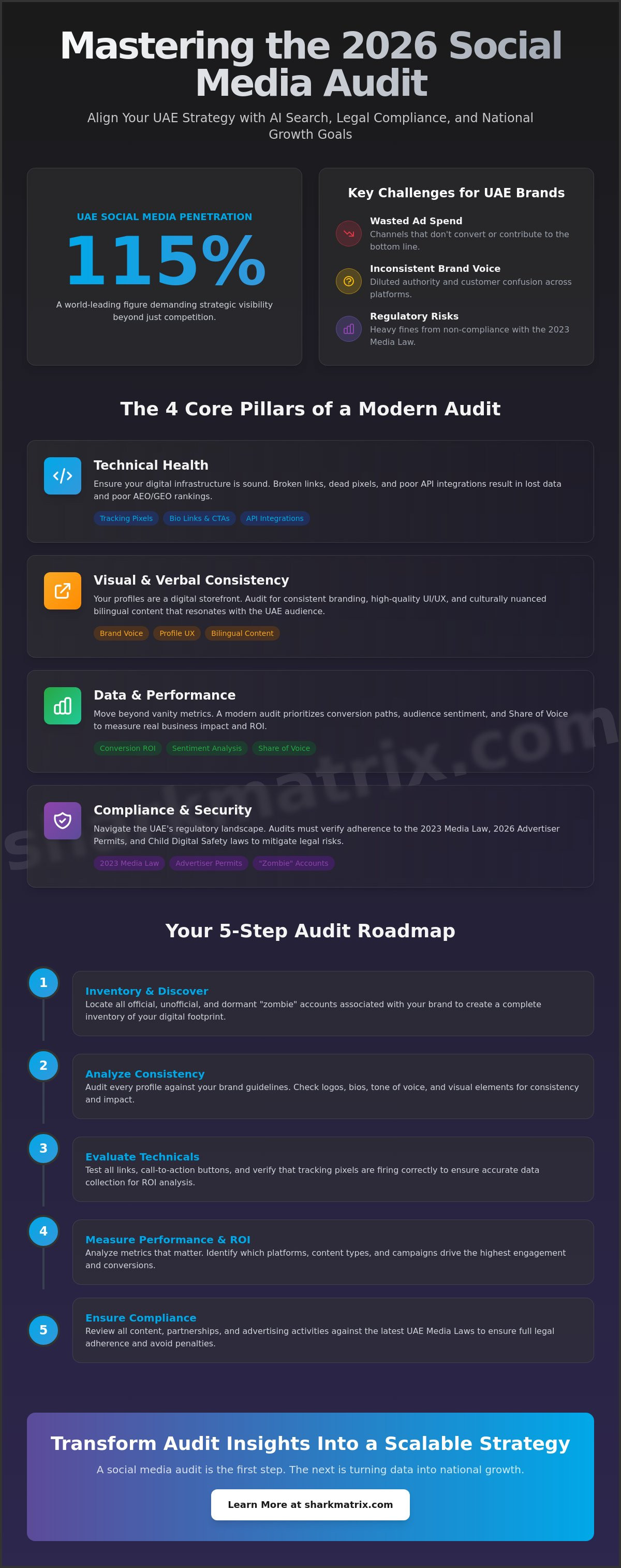
With the UAE reaching a world-leading social media penetration of 115%, your brand isn’t just competing with rivals; it’s fighting for visibility in a space now strictly governed by the 2023 Media Law and mandatory 2026 advertiser permits. You’ve likely felt the frustration of wasted ad spend on channels that don’t convert or the difficulty of maintaining a consistent brand voice across platforms. It’s a common challenge to wonder if your social efforts are actually contributing to your bottom line, which is why performing a comprehensive social media audit has become a non-negotiable part of your annual strategy.

This guide will show you how to master the auditing process to ensure your strategy is AI-ready and fully compliant with the latest UAE regulations, including the Child Digital Safety Law. We’ll provide a step-by-step roadmap to align your social presence with generative engine optimization (GEO) and turn your profiles into high-performing lead generation machines that support your national growth goals. By the end of this article, you’ll have a clear framework for measuring ROI and optimizing content for the search-first social era.

Key Takeaways

  • Learn how your social signals directly impact your visibility in Answer Engine Optimization (AEO) and AI-driven search results.
  • Master a five-step process for conducting a professional social media audit to inventory accounts and standardize your brand authority.
  • Identify which platforms drive the highest ROI for your specific national growth goals and when it’s time to exit underperforming channels.
  • Move beyond basic demographics to uncover deep audience intent and sentiment for better content resonance across the UAE.
  • Discover how to use AI automation services to turn your audit data into a scalable and consistent content strategy.

What is a Social Media Audit and Why Does it Matter in 2026?

A social media audit is a comprehensive evaluation of your brand’s digital footprint across every social platform where you maintain a presence. It isn’t just about counting likes or followers. In 2026, it’s a diagnostic tool that examines your compliance with UAE media laws, your engagement quality, and your alignment with broader business objectives. By conducting this review, you ensure that every profile reflects your current brand identity while adhering to the latest regulatory frameworks.

The biggest shift this year involves how social signals feed into social media measurement and Answer Engine Optimization (AEO). AI models now prioritize real-time social data to provide answers to user queries. If your profiles are outdated, you aren’t just losing social followers; you’re losing visibility on AI-driven search results. Effective auditing distinguishes between vanity metrics and actual growth indicators that feed these generative engines.

You might have “zombie accounts” lingering on your books. These are dormant profiles on platforms like X or Facebook that dilute your brand authority. These accounts often host outdated contact information or old logos, which confuses both customers and search algorithms. In the UAE’s competitive market, these gaps can lead to serious reputation risks. With the 2023 Media Law and the mandatory 2026 Advertiser Permit for influencers now in full effect, a lack of oversight can also lead to heavy fines. An audit ensures every post and partnership meets these legal standards.

The Strategic Benefits of Regular Auditing

Performing a regular social media audit helps you stop wasting money. By aligning your social spend with lead generation data, you can pivot away from low-performing channels and focus on what actually converts. It ensures your brand voice remains consistent for the UAE’s diverse audience, whether they’re looking at your LinkedIn page or your TikTok feed. You’ll also spot untapped opportunities, such as emerging niche communities or new platform features, before your competitors realize they exist.

Social Media as a Search Engine

In 2026, users often bypass traditional engines entirely. They use TikTok to find restaurant reviews or LinkedIn to research B2B solutions. Your audit must evaluate “discoverability,” which is how easily people find your content through platform-specific search bars. This directly links your social activity to your overall SEO and content marketing success. Social searchability is the new benchmark for 2026 audits.

The Core Pillars of a Modern Social Media Audit

A professional social media audit rests on four foundational pillars that bridge the gap between creative expression and technical precision. In the past, brands could focus solely on aesthetics. In 2026, your audit must account for data integrity and AI alignment. If your social data is fragmented, your business won’t just lose followers; it’ll lose visibility in an increasingly automated search environment.

One critical pillar is technical health. This involves a deep dive into your bio links, tracking pixels, and API integrations. You need to ensure your tracking pixels are firing correctly across all platforms to feed accurate data into your CRM. Without this technical foundation, you can’t measure the true ROI of your social efforts or provide the clean data sets required for generative engine optimization (GEO) and AEO. AI search models use your social frequency and sentiment to gauge your brand’s authority. If your technical setup is broken, your AEO rankings will suffer.

Visual and Verbal Brand Consistency

Your social profiles are often the first touchpoint for potential leads. Auditing for high quality UI/UX principles ensures that your profile layouts, highlights, and pinned posts guide users toward a conversion. In the UAE market, you must evaluate the effectiveness of your bilingual content. It’s not enough to simply translate English to Arabic; the tone and cultural nuance must remain consistent. Aligning these visual and verbal elements ensures your social presence supports your broader strategic content marketing agency uae goals for national growth.

The Data Pillar: Beyond Vanity Metrics

Stop looking at likes as a primary success metric. A modern social media audit prioritizes conversion paths and “Share of Voice” against your local competitors. You should use AI tools to scrape and interpret sentiment from comments, moving beyond simple demographics to understand the “why” behind user behavior. Here are the key data points to review:

  • Click-Through Rates (CTR): Are users actually moving from your social content to your e-commerce or lead generation pages?
  • Sentiment Analysis: Is the conversation around your brand positive, neutral, or negative?
  • Conversion Attribution: Which specific posts led to a measurable business outcome?

If you’re unsure where to start with your data collection, researching how to perform a social media audit can provide a structured framework for your first review. Once you have this data, you can better allocate your budget toward high-performing channels. Aligning these pillars is the first step toward a high-performing digital ecosystem, ensuring your social presence supports your long-term growth.
How to Conduct a Professional Social Media Audit: The 2026 Guide for UAE Brands

Evaluating Channel Performance for National Growth

A successful social media audit doesn’t treat every platform equally. Your performance on LinkedIn serves a different purpose than your presence on TikTok or Instagram. In 2026, UAE brands must evaluate each channel based on its contribution to specific national growth goals. This means looking past surface-level engagement to see how each platform drives actual business value. You shouldn’t stay on a platform just because it’s popular; if the data shows it doesn’t reach your target audience or convert leads, it’s time to exit.

Benchmarking is essential here. You need to know how you stack up against others in your industry within the local market. Using social media data for competitive analysis allows you to see where competitors are winning and where they’re leaving gaps. For instance, if your rivals are ignoring WhatsApp as a commercial tool despite its high usage in the UAE, your audit might reveal a massive opportunity for your brand to dominate that space. This data driven approach ensures your budget is allocated to the channels with the highest potential ROI.

Instagram and Visual Storytelling

Instagram remains a powerhouse for visual brands, but success in 2026 is measured by the impact of Reels and Stories rather than static posts. Your audit should examine whether your video content effectively captures attention within the first three seconds. It’s also the time to review your influencer partnerships. Ensure all collaborators hold the mandatory 2026 Advertiser Permit to avoid legal risks. If you’re struggling to hit your engagement targets, consulting an instagram marketing agency in dubai can provide the specific benchmarks needed to refine your visual strategy.

Professional Platforms and B2B Lead Gen

LinkedIn is where your executive branding and thought leadership live. During your social media audit, focus on the quality of leads generated rather than just the number of connections. Are you reaching decision-makers in Abu Dhabi and Dubai? Professional networking channels are vital for establishing the authority that AI search engines look for. By integrating these social insights into your search engine optimization seo services, you create a feedback loop that boosts your visibility across both social feeds and search results. This synergy ensures that your B2B efforts aren’t siloed but contribute to a unified digital ecosystem.

How to Perform a Social Media Audit in 5 Steps

Moving from theory to practice requires a structured approach. A social media audit isn’t a one-time task but a repeatable process that ensures your brand remains competitive in the UAE’s fast-moving digital market. By following these five steps, you’ll transform raw data into a clear strategy for the coming quarter.

  • Step 1: Inventory all active and dormant accounts across the national digital landscape.
  • Step 2: Standardize branding, bios, and verification status for trust and authority.
  • Step 3: Analyze content performance using the 80/20 rule to identify the 20% of posts driving 80% of your engagement.
  • Step 4: Audit for searchability and AI-readiness by reviewing keywords and metadata.
  • Step 5: Define actionable goals and KPIs for the next quarter based on your findings.

Step 1 & 2: The Foundation

Start by listing every account associated with your brand. You’ll likely find “impersonator” profiles or forgotten accounts from old campaigns that harm your online reputation. These must be reclaimed or closed to prevent customer confusion. Ensure all profiles use current branding and high-resolution assets that reflect your modern identity. Securing official account verification acts as a digital seal of authenticity that builds immediate trust for national enterprises operating in the UAE.

Step 3 & 4: The Deep Dive

Next, look at your content ROI. Identify which specific formats, like short-form video or carousel posts, lead to the most website visits. This is where you integrate social signals with Answer Engine Optimization (AEO). AI models look for consistent, authoritative data across your social bios and captions. You should optimize these elements for generative engine optimization (geo) to ensure your brand appears in AI-generated summaries. Don’t forget to check the technical health of your tracking tags and conversion pixels. If your pixels aren’t firing, you can’t accurately measure lead generation from your social channels.

Finally, use your audit insights to set realistic KPIs. If you discovered that LinkedIn drives higher quality B2B leads than Instagram, shift your resources accordingly. Success in 2026 depends on your ability to pivot based on hard data rather than following generic trends. Once your goals are set, you can begin building a content calendar that addresses the specific gaps you’ve identified, ensuring every post serves a measurable purpose.

Transforming Audit Insights into a Scalable Strategy

A completed social media audit shouldn’t sit in a digital folder. It serves as the blueprint for a content calendar that addresses the specific gaps you’ve identified. If your audit revealed that your video content lacks engagement in the Abu Dhabi market, your new strategy must prioritize localized, high-impact storytelling. Scalability isn’t just about posting more often; it’s about building a system where every piece of content serves a measurable purpose in your sales funnel. By mapping your findings to a dynamic schedule, you ensure that your team stops guessing and starts executing based on hard data.

Your audit data should also flow directly into your broader digital ecosystem. Social signals provide a wealth of information that can refine your Search Engine Optimization (SEO) and content marketing efforts. When you identify high-performing keywords on social platforms, you can immediately integrate them into your web copy or blog strategy. This cross-channel synergy ensures that your brand remains visible and authoritative across all touchpoints, from social feeds to AI-driven search results.

AI and Automation in Social Strategy

Modern scalability requires more than manual effort. You can use ai automation services to monitor your social performance in real-time, turning your audit into a living document that updates as trends shift. Custom machine learning models can scrape sentiment from thousands of comments, providing a deeper understanding of audience intent than any manual review could offer. Integrating these insights into your ppc agency dubai strategy allows for more precise ad targeting and lower acquisition costs. Automation doesn’t replace the human touch; it frees your team to focus on high-level creative strategy while the tech handles the repetitive data processing.

The Shark Matrix Technologies LLC Advantage

At Shark Matrix Technologies LLC, we specialize in end-to-end digital transformation tailored for national growth. We understand the unique challenges of the UAE market, from navigating the latest media regulations to mastering the bilingual English and Arabic digital landscape. Our expertise spans generative engine optimization (GEO), mobile app development, and advanced AI solutions, ensuring your brand stays ahead of the curve. We don’t just provide reports; we build scalable engines for lead generation and brand authority. Contact Shark Matrix Technologies LLC today for a professional social media audit that drives measurable results and aligns your digital presence with your long-term business goals.

Future-Proof Your Brand with Data-Driven Insights

The UAE’s digital landscape moves at a relentless pace. Between the 2026 advertiser permit requirements and the rise of AI-driven search, your online presence requires more than just regular posting. It demands a rigorous social media audit to ensure every channel contributes to your bottom line. By standardizing your branding and optimizing for generative engine optimization (GEO), you turn social platforms into powerful tools for national growth rather than just expense centers. It’s no longer enough to look good; you have to be discoverable by the algorithms that define the modern search experience.

Since 2010, Shark Matrix Technologies LLC has helped brands navigate the complexities of both Arabic and English digital marketing. Our expertise in AI automation and lead generation ensures your social strategy isn’t just compliant but highly competitive. We bridge the gap between social engagement and technical SEO to drive measurable results. Ready to transform your digital footprint? Book a Professional Social Media Audit with Shark Matrix Technologies LLC today to secure your brand’s authority in the 2026 search-first landscape. Your journey toward a more efficient, high-performing social presence starts with one clear, data-backed roadmap.

Frequently Asked Questions

How often should a business conduct a social media audit?

A business should conduct a social media audit at least once every quarter to stay aligned with the fast-moving UAE market. While a monthly report tracks short-term wins, a quarterly audit allows you to spot broader trends and adjust your budget before resources are wasted. High-growth brands often perform a deeper review every six months to ensure full compliance with evolving media laws.

What are the most important KPIs to track during an audit in 2026?

The most critical KPIs in 2026 focus on conversion attribution and sentiment analysis rather than vanity metrics like likes. You should track your brand’s Share of Voice against national competitors and monitor click-through rates to your lead generation pages. Additionally, measuring your search visibility within social platforms is now essential for understanding how well your content feeds into AI-driven search models.

Do I need professional tools to perform a social media audit?

You don’t strictly need expensive software for a basic review, but professional tools are necessary for advanced sentiment analysis and competitive benchmarking. Manual data collection is prone to errors and often misses the technical nuances of API integrations or pixel health. Using ai automation services can streamline the data scraping process, making your audit more accurate and easier to scale across multiple platforms.

How does a social media audit help with SEO and AEO?

A social media audit helps by ensuring your profiles and content are optimized for discoverability. AI search engines use social signals to verify your brand’s authority and expertise. By standardizing your keywords and metadata across all platforms, you make it easier for generative engines to pull your content into their answers. This alignment directly supports your broader SEO and Answer Engine Optimization (AEO) efforts.

What is the difference between a social media audit and a monthly report?

A monthly report is a snapshot of performance that tracks whether you hit specific targets like follower growth or reach. In contrast, an audit is a strategic health check that examines your entire digital footprint for consistency, legal compliance, and long-term ROI. While reports tell you what happened, an audit explains why it happened and provides a roadmap for structural improvements.

Can a social media audit help in identifying fake followers or bots?

Yes, identifying bots is a core component of a professional audit. By analyzing the ratio of engagement to follower count, you can spot suspicious patterns that suggest non-human activity. Auditing your audience quality is vital in the UAE, especially when verifying influencer partnerships. This process protects your ad spend and ensures your content reaches real potential customers who can actually convert.

How long does a comprehensive social media audit typically take?

A comprehensive audit typically takes between two and four weeks to complete. This timeframe allows for thorough data collection, sentiment analysis, and a technical review of your tracking pixels and API connections. The exact duration depends on the number of active channels you manage and the complexity of your competitive landscape. Taking this time ensures the final strategy is based on verified data rather than assumptions.

Categories
Uncategorized

The 2026 On-Page SEO Checklist: Optimizing for Humans and AI Search

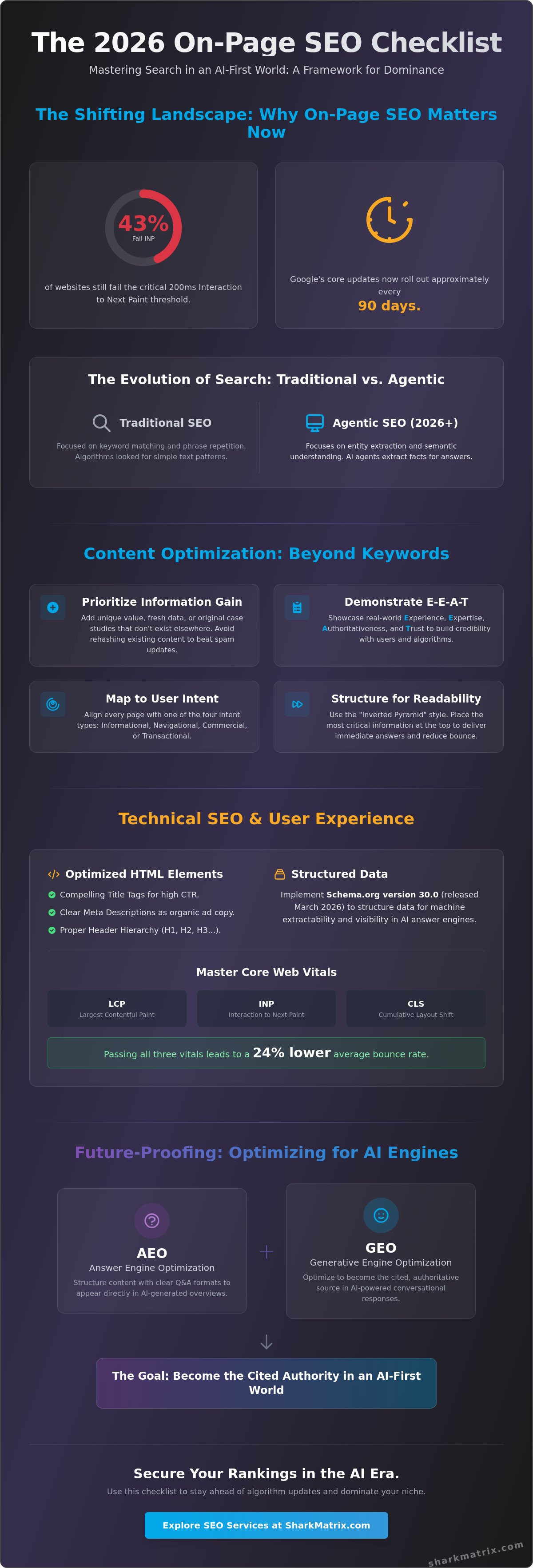
Did you know that 43% of websites still fail the 200ms threshold for Interaction to Next Paint (INP) in 2026? It’s frustrating to produce high-quality content only to see it buried because the technical goalposts moved again. With Google now rolling out core updates approximately every 90 days, staying visible requires more than just good writing. You’re likely looking for a way to maintain consistency across your site while ensuring you aren’t left behind by AI search. This comprehensive on page seo checklist provides the exact framework you need to satisfy both traditional algorithms and the latest generative engines.

We’ll show you how to master the essential factors that drive rankings today, from implementing Schema 30.0 to meeting the strict March 2026 spam update requirements. You’ll discover how to optimize for Answer Engine Optimization (AEO) and Generative Engine Optimization (GEO) so your brand becomes the cited authority in AI-generated responses. This guide previews the technical and creative shifts necessary to secure higher organic visibility and long-term search dominance in an AI-first world.

Key Takeaways

  • Learn why shifting from keyword matching to entity-based optimization is essential for ranking in 2026.
  • Use a modern on page seo checklist to verify that your HTML elements are fully optimized for humans and bots.
  • Master the latest image SEO techniques and performance standards to keep users engaged and reduce bounce rates.
  • Discover how Answer Engine Optimization (AEO) helps your content appear in AI-generated overviews.
  • Prioritize Information Gain to ensure your content provides unique value that machines cannot easily replicate.

What is On-Page SEO and Why It Matters in 2026

On-page SEO involves the precise optimization of individual web pages to rank higher and earn more relevant traffic in search engines. By 2026, the definition has expanded. It’s no longer just about where you place a keyword; it’s about how well your content satisfies user intent and maps to specific entities. Following a modern on page seo checklist ensures your site communicates clearly with both human readers and sophisticated AI search agents.

This foundation is critical for national digital marketing strategies, especially in competitive markets like the UAE. High-quality on-page signals act as a trust signal for brand authority. With Google’s March 2026 Core Algorithm Update placing a heavier emphasis on genuine expertise, your on-page elements must prove you aren’t just another generic voice. They must show you’re a leader in your field. This is why optimizing for humans and AI search simultaneously has become the standard for any brand looking to maintain its market share.

The Evolution of On-Page SEO: Traditional vs. Agentic

Search algorithms have evolved from simple pattern matching to deep semantic understanding. Today, AI agents crawl your site to extract facts, not just phrases. This agentic search environment means your content must be structured for machine extractability. If your data isn’t organized using the latest standards, like Schema.org version 30.0 released on March 25, 2026, you risk being invisible to AI answer engines. Static strategies fail because the average time between Google updates has dropped to just 90 days. You need an agile on page seo checklist to stay relevant in this fast-paced environment.

Key Benefits of a Rigorous On-Page Strategy

A disciplined approach to on-page factors delivers measurable business results. When you align your content perfectly with what a user is looking for, your click-through rates (CTR) naturally climb. You’re giving people exactly what they asked for. Beyond just getting the click, a solid strategy improves the actual experience on the page. Research shows that websites passing all three Core Web Vitals thresholds see a 24% lower bounce rate on average. This better alignment between intent and content doesn’t just help rankings; it drives the conversions that grow your business. Key benefits include:

  • Higher CTR: Compelling titles and meta descriptions act as organic ad copy.
  • Enhanced UX: Proper header hierarchy and fast loading times keep users engaged.
  • Better Alignment: Content that answers the user’s specific question reduces immediate exits.

Content Optimization: Beyond Basic Keyword Placement

Ranking in 2026 requires more than just sprinkling terms throughout a blog post. Your on page seo checklist must prioritize “Information Gain.” This concept involves adding unique value that doesn’t exist elsewhere on the web. Since Google’s March 2026 Spam Update specifically targets thin, low-value content, simply rehashing what’s already on page one is a recipe for invisibility. You need to provide fresh data, original case studies, or a unique expert perspective to satisfy both users and modern algorithms.

Identifying keywords still matters, but the focus has shifted toward national search volume and intent mapping. Every piece of content should align with one of the four intent types: Informational, Navigational, Commercial, or Transactional. For instance, if you’re looking to scale a brand, your page must answer the specific commercial or transactional questions a business owner has. This alignment is reinforced by E-E-A-T, where you demonstrate real-world experience and expertise to build trust with your audience. If you need assistance with these complex strategies, our ecommerce seo services provide a tailored approach for national growth.

Writing for Semantic Search and Entities

Modern search engines think in terms of topics and entities, not just strings of text. Instead of repeating a keyword, focus on the “Who, What, Where, and Why” of your subject. Natural language processing allows search engines to understand the relationships between different concepts on your page. By incorporating Latent Semantic Indexing (LSI) keywords naturally, you help search agents categorize your content accurately. If you need a reference for these technical requirements, checking a comprehensive on-page SEO checklist can help ensure you’ve covered all semantic bases.

Structuring Content for Maximum Readability

Engagement is a key ranking signal. Use the “Inverted Pyramid” style by placing your most critical information at the very beginning. This ensures that even if a reader only stays for ten seconds, they get the answer they came for. Keep your paragraphs short and use an active voice to maintain momentum. If you find this level of optimization daunting, our content marketing experts can help you craft high-performing assets. By using clear headings and internal links to related resources, you guide the reader through a logical journey that search engines can easily map and reward.

The 2026 On-Page SEO Checklist: Optimizing for Humans and AI Search

HTML and Structural Elements Checklist

While content is the heart of your page, the HTML structure is the skeleton that holds everything together. Search engines use these structural signals to understand the hierarchy and relevance of your information. A high-performance on page seo checklist must prioritize these elements to ensure that crawlers can easily parse your data and users can navigate your content without friction. In 2026, clarity in your HTML is more important than ever as AI agents look for specific data points to cite in their answers.

Your URL structure is the first thing both a user and a bot see. Keep your slugs short, descriptive, and keyword-rich. Avoid using random strings of numbers or dates that add unnecessary length. A clean URL like “example.com/on-page-seo-checklist” is far more effective than a convoluted path. While many focus on backlinks, a comprehensive SEO checklist reinforces that your on-page structure is the actual foundation of your organic visibility. If your site’s architecture is messy, even the best content will struggle to rank. Working with a technical seo consultant can help you identify and resolve the hidden structural issues that prevent search engines from crawling your site efficiently.

The Anatomy of a Perfect Title and Meta Tag

Title tags remain one of the strongest on-page ranking signals. You should place your primary keyword near the start of the title to give it maximum weight. However, don’t just write for bots. Use power words or numbers to create a compelling hook that improves your click-through rate. Your meta description should act as “ad copy” for your organic listing. While it isn’t a direct ranking factor, a well-crafted description encourages users to choose your link over a competitor’s. To avoid “keyword cannibalization,” ensure every page on your site has a unique title and meta tag tailored to its specific topic.

Header Tag Best Practices

Organization is key to readability. Use a logical H1-H6 hierarchy to guide the reader through your subtopics. The H1 tag serves as the singular core theme of your page, signaling to both readers and crawlers exactly what the content is about. You should only have one H1 per page. From there, use H2 tags for your main sections and H3 tags for supporting details within those sections. This structure doesn’t just help humans skim; it helps search engines understand the relationship between your primary topic and its supporting points. If you’re struggling to implement these structures at scale, our Web Design and Development services can help you build a site that is optimized by default.

Visual Asset SEO and User Experience Factors

Visual content is no longer just a decorative element; it’s a critical component of your on page seo checklist. In 2026, search engines and AI models aren’t just looking at your text. They’re analyzing your images and videos to understand the full context of your page. High-quality visual assets that load quickly are essential for keeping users on your site. When you provide a seamless visual experience, you reduce friction and encourage longer dwell times. This is especially vital as over 60% of web traffic now comes from mobile devices, where visual performance is often the deciding factor between a conversion and an exit.

User experience is now mathematically tied to your rankings through Core Web Vitals. As of May 2026, Google uses a composite score for these metrics. If you fail even one of the three core metrics, your visibility can suffer. Currently, 43% of websites fail the 200ms threshold for Interaction to Next Paint (INP). To stay competitive, your pages must hit the “good” thresholds: Largest Contentful Paint (LCP) under 2.5 seconds, INP under 200 milliseconds, and Cumulative Layout Shift (CLS) under 0.1. Passing these benchmarks isn’t just about technical vanity; websites that meet all three thresholds see a 24% lower bounce rate on average. If your site feels sluggish, our Web Design and Development services can help you build a high-performance platform that satisfies both users and search engines.

Optimizing Images for Search and AI

Every image on your site should be optimized for machine extractability. This starts with descriptive filenames and modern formats like WebP to ensure fast loading. Your alt text should be descriptive and functional, providing clear context for both accessibility and AI search bots. Additionally, using Image Schema helps search engines identify the specific subject matter of your visuals, increasing the chances of your content appearing in rich snippets or AI-generated answers. Always compress your files to maintain high visual quality without bloating your page weight.

Engagement Signals and On-Page UX

A well-optimized page guides the user toward their goal. Clear site navigation allows visitors to find relevant information quickly, which signals to search engines that your site is helpful. Avoid using intrusive pop-ups, particularly on mobile, as they disrupt the user journey and can lead to penalties under the latest spam updates. Instead, use multimedia like infographics or short videos to break up long blocks of text and increase engagement. Finally, integrate clear calls-to-action (CTAs) that lead the user to the next stage of the funnel. This ensures that your SEO efforts translate into actual business results.

Future-Proofing: Optimizing for AI and Answer Engines

The final pillar of a modern on page seo checklist involves preparing for a search environment where AI agents, not just humans, are the primary “readers” of your site. Answer Engine Optimization (AEO) is the practice of structuring your content so these agents can easily extract and cite your information in AI-generated overviews. While traditional rankings still drive significant traffic, appearing as a primary source in a generative answer is the new gold standard for national authority. This requires a shift from writing broad articles to creating precise, data-rich segments that machines can parse with high confidence.

To capture these opportunities, you must integrate “Snippet-Bait” into your layout. These are concise Q&A blocks or summary tables designed specifically for AI extraction. By providing a direct answer to a complex query within the first 50 words of a section, you increase the likelihood of being featured in rich snippets. Our search engine optimization seo services bridge the gap between these human and AI needs, ensuring your content remains readable while serving as a high-quality data source for generative engines.

Schema Markup: The Language of Search Engines

Explicit context is everything in 2026. Implementing JSON-LD structured data is no longer optional; it’s the primary way you tell search engines exactly what your content represents. Whether you’re using FAQ, Article, or Product Schema, you should always align with the latest standards, such as Schema.org version 30.0 released on March 25, 2026. This technical layer acts as a translator for AI agents, converting your creative prose into a structured format that machines can verify and display. Dominating SERP real estate today often depends on how well your FAQ schema answers long-tail conversational queries.

The Shark Matrix Approach to Modern SEO

National brands face the unique challenge of maintaining consistency across thousands of pages. We solve this by integrating ai automation services to audit and update on-page factors at scale, ensuring no page falls behind the 90-day algorithm update cycle. A bespoke on-page framework is necessary to balance brand voice with the technical rigors of generative engine optimization (geo). To ensure your audits translate into actionable growth strategies rather than overwhelming technical reports, review our seo audit report guide for national brand growth before your next site review. If you’re ready to ensure your site is fully optimized for the next generation of search, it’s time to take action. Audit your on-page SEO with the experts at Shark Matrix to secure your rankings and AI visibility.

Securing Your Search Presence in an AI-Driven Future

Success in the modern search landscape requires a dual focus on human engagement and machine readability. You’ve learned that mastering your on page seo checklist means more than just placing keywords; it’s about providing unique Information Gain and ensuring your site meets the strict Core Web Vitals thresholds. By aligning your content with Schema 30.0 and optimizing for Answer Engine Optimization (AEO), you position your brand as a primary source for both Google and generative AI agents.

Shark Matrix has been at the forefront of digital transformation since 2010. With 15+ years of regional expertise, we specialize in helping national UAE enterprises navigate complex algorithm shifts through AI-driven SEO and generative engine optimization. Don’t let your high-quality content go unnoticed by failing to adapt to these technical requirements. Download Our Full 2026 SEO Strategy Guide to stay ahead of the competition. The future of search is here, and with the right strategy, your brand can lead the way.

Frequently Asked Questions

What is the most important on-page SEO factor in 2026?

The most critical factor is satisfying user intent through original “Information Gain.” Search engines now prioritize content that adds unique value or fresh data to the conversation rather than simply rehashing existing information. While technical elements are vital, your ability to demonstrate genuine expertise and provide a clear answer to the user’s specific query is what ultimately drives rankings in a competitive landscape.

How long does it take for on-page SEO changes to reflect in rankings?

Most on-page changes begin to reflect in search results within a few days to several weeks. This timeline depends on your site’s crawl budget and how frequently search engines index your pages. High-authority sites with frequent updates often see changes faster. If you’ve implemented a comprehensive on page seo checklist, you can monitor your progress through search console tools to see how quickly bots pick up your structural improvements.

Can I do on-page SEO without technical knowledge?

You can certainly manage content-level optimizations, such as keyword placement and header organization, without deep technical skills. However, more advanced tasks like implementing JSON-LD Schema or optimizing for Core Web Vitals usually require professional assistance. For these structural elements, our web design and development team can ensure your site’s backend is as optimized as your front-end content.

How does on-page SEO differ for ecommerce websites?

Ecommerce SEO focuses heavily on product-specific data, faceted navigation, and transactional intent. You must ensure that every product page includes unique descriptions, high-quality images with descriptive alt text, and structured data for pricing and availability. This differs from informational content because the goal is to guide the user toward a purchase while helping AI shopping agents identify your inventory as the best match for a buyer’s needs.

Do I need to update my on-page SEO for AI search engines like Perplexity or ChatGPT?

Yes, you should adapt your strategy to include Answer Engine Optimization (AEO) and Generative Engine Optimization (GEO). These platforms look for highly structured, fact-dense content that they can easily extract and summarize. By following a modern on page seo checklist that includes Q&A blocks and clear data tables, you increase the chances of your brand being cited as a primary source in AI-generated answers.

What are the most common on-page SEO mistakes to avoid?

Common errors include keyword stuffing, using duplicate title tags, and neglecting the mobile user experience. Many businesses also forget to optimize their images or fail to use a logical heading hierarchy. These mistakes make it difficult for search engines to understand your page’s purpose and often lead to poor engagement from human visitors, which can negatively impact your long-term organic visibility. A thorough seo audit report can help you systematically identify and prioritize these issues before they compound into larger ranking problems.