
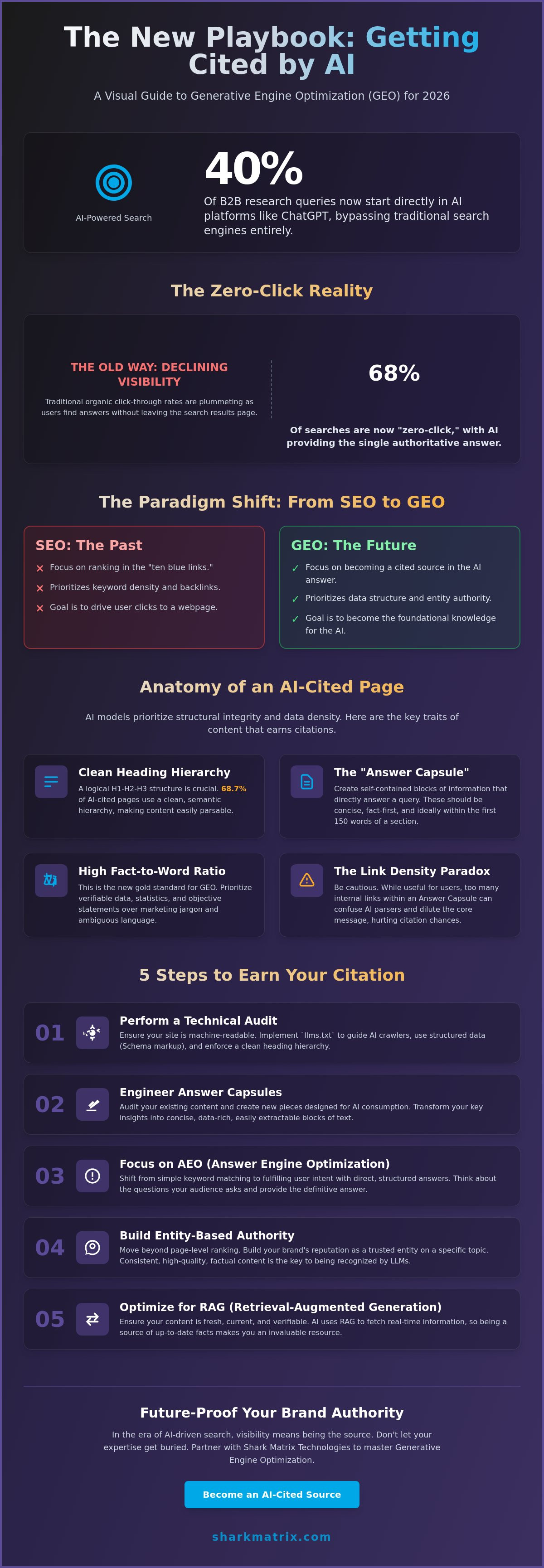
Did you know that 40% of B2B research queries that used to start on Google now begin directly in ChatGPT, Claude, or Perplexity? If your brand isn’t appearing in these AI-generated answers, you’re effectively invisible to a huge segment of high-intent buyers. Learning how to get cited by ChatGPT is no longer an experimental tactic; it’s the core of survival for modern digital marketing in 2026.
It’s frustrating to watch your traditional organic click-through rates decline while the “black box” of Large Language Models decides which sources to trust. You’ve likely felt the uncertainty of not knowing why a competitor gets the mention while your expert content stays buried. We’re here to fix that. This article provides the precise technical frameworks and content traits needed to earn those coveted brand mentions and citations.
We’ll explore how to optimize your site using tools like llms.txt files and specific Schema markup to ensure AI crawlers prioritize your data. You’ll discover why a high fact-to-word ratio is the new gold standard for Generative Engine Optimization (GEO) and how to structure content that AI answer engines can’t help but quote.
Key Takeaways
- Understand why Generative Engine Optimization (GEO) is the essential evolution of search marketing for maintaining visibility in a zero-click environment.
- Learn how to engineer “Answer Capsules” that transform your brand’s unique insights into easily extractable data for AI models.
- Master the technical frameworks and content traits that explain how to get cited by ChatGPT to drive high-intent referral traffic.
- Shift your focus from keyword-centric ranking to entity-based authority to ensure your brand is recognized as a trusted source by LLMs.
- Explore how leveraging AEO and AI automation services can future-proof your digital presence and protect your brand reputation.
From SEO to GEO: Why ChatGPT Citations Matter in 2026
The search landscape has fundamentally shifted. For years, digital marketing focused on ranking in the top three results of a Google search page. Now, Generative Engine Optimization (GEO) has emerged as the essential evolution of that strategy. It’s no longer enough to just appear on a list. You need to be the source the AI trusts and references to maintain visibility.
By early 2026, zero-click searches reached a staggering 68%. This means the majority of users get their information directly from the AI response without ever clicking through to a website. For national brands, this shift is catastrophic if you aren’t the one providing the data. The “ten blue links” model is dying, replaced by a “single authoritative answer” model where the AI synthesizes information from a few select sources. If you want to know how to get cited by chatgpt, you have to accept that the AI is now the primary gatekeeper of information.
Being cited by ChatGPT is the new Position Zero. It’s the ultimate validation of your brand’s authority in a crowded digital space. The goal isn’t just traffic; it’s becoming the foundational knowledge for the AI’s response. When an AI cites your brand, it transfers its perceived neutrality and intelligence to your business, creating a high-trust connection with the user before they even visit your site.
The Rise of Answer Engine Optimization (AEO)
AEO is a specialized discipline within the GEO framework that focuses on providing direct, structured answers to complex queries. It moves beyond simple keyword matching and prioritizes intent-based semantic fulfillment. While comprehensive search engine optimization seo services provide the technical foundation, AEO refines your content to be instantly digestible by large language models (LLMs). It’s about making your data so clear and structured that the AI can’t ignore it.
How LLMs Choose Their Sources
ChatGPT uses a process called Retrieval-Augmented Generation (RAG) to find information. It doesn’t just rely on its original training data; it crawls the live web to find the most relevant, trustworthy sources in real time. In the 2026 ecosystem, source trust is built on technical signals like GPTBot permissions and content traits like high fact density. Understanding how to get cited by chatgpt requires a deep dive into how these models differentiate between static training data and the high-value, real-time citations that drive modern high-intent referral traffic.
The Anatomy of a ChatGPT Citation: Key Content Traits
Learning how to get cited by ChatGPT requires looking past the surface of your website. AI models don’t care about your brand’s color palette or high-resolution imagery. They prioritize the structural integrity of your HTML and the density of verifiable facts within your paragraphs. Research from the 2026 State of AI Search shows that 68.7% of pages cited by ChatGPT use a clean H1-H2-H3 heading hierarchy. If your technical foundation is messy, the AI’s retrieval layer will simply skip over your content in favor of a more readable source.
The concept of the “Answer Capsule” is central to this shift. These are self-contained blocks of information that provide immediate value without requiring additional context. While traditional SEO often encourages long-form content to keep users on the page, GEO requires you to be concise. Understanding how to optimize for generative engines involves stripping away the fluff and focusing on data accessibility. If you’re looking to improve your visibility, our generative engine optimization services can help you audit your current content structure.
While internal linking is a staple of traditional search strategy, it presents a unique paradox for AI citations. If a potential citation block is cluttered with too many links, the AI might struggle to parse the primary facts. This “Link Density” paradox means that over-optimizing for user navigation can actually hurt your citation chances. Keeping your core answer blocks clean and text-heavy is a critical step in mastering how to get cited by ChatGPT.
Structuring the Perfect Answer Capsule
An Answer Capsule should ideally appear within the first 150 words of a section to ensure the AI crawler identifies it early. Clarity is your most important metric here. Avoid marketing jargon or ambiguous language that could lead to model hallucinations. An answer capsule is a 40-60 word block of factual, non-promotional text. By placing these blocks strategically under clear H3 headings, you make it significantly easier for ChatGPT to extract and attribute your insights.
The Value of Proprietary Data and Insights
Proprietary data is the ultimate moat in the AI era. AI engines prioritize unique statistics and original research over repurposed “how-to” content that exists in thousands of other places. Data from Fuel Online in 2026 found that pages with a fact-to-word ratio higher than 1:80 are 4.2 times more likely to be cited in results. Using case studies and internal reports triggers the “Expertise, Authoritativeness, and Trustworthiness” (E-A-T) signals that LLMs use to verify sources. When you provide a specific number or a documented result, you become an irreplaceable source that the AI cannot simply synthesize from general knowledge.
AEO vs. Traditional SEO: Comparing the Strategies
Traditional SEO focuses on matching strings of text to specific search queries. Generative Engine Optimization (GEO) focuses on establishing your brand as a recognized entity. This is a seismic shift. Instead of just ranking for a term, you’re aiming to be cited as an authority. When you master how to get cited by chatgpt, you move from competing for a list of links to owning the narrative within a synthesized answer.
Backlink quantity, once the gold standard of digital marketing, is losing ground to citation quality and co-occurrence. AI models look for “consensus filters” to verify information. If your brand name consistently appears alongside specific facts on authoritative third-party sites like Reddit or Wikipedia, the model builds a stronger semantic association. User intent mapping also changes because you’re now optimizing for an AI bot that needs to parse your data in milliseconds to fulfill a user’s request.
The “user” in 2026 is often a retrieval agent. These agents don’t browse; they extract. This means your content strategy must pivot from engagement-first to extraction-first. If a bot can’t quickly identify the core facts of your page, it won’t include you in its response. Understanding how to get cited by chatgpt requires a deep commitment to entity-centric optimization where your brand is inextricably linked to the topics you want to own.
Technical Requirements for Generative Engines
Schema.org in 2026 is about more than just earning a few stars in a search result. It’s the primary language for defining entity relationships for LLMs. Using `FAQPage`, `Article`, and `Organization` markup helps models understand exactly who you are and what expertise you provide. Site speed and bot crawlability are non-negotiable. If GPTBot or OAI-SearchBot can’t access your content instantly, you won’t be part of the real-time synthesis. This is why modern website design and development services must prioritize technical AEO over mere visual aesthetics.
Measuring Success in the AI Era
Success in the age of AI requires new KPIs. Moving from “Position” tracking to “Share of Model” (SoM) allows you to see how often your brand is mentioned across various AI platforms. You can’t rely on traditional search consoles alone to see the full picture. You must identify referral traffic coming from ChatGPT, Claude, and Gemini by analyzing your server logs and specific referral strings. Brand sentiment within these responses is equally vital. If an AI cites you but frames your service incorrectly, your GEO strategy needs adjustment to refine the data the models are consuming.
5 Steps to Get Your Content Cited by ChatGPT
Execution is where many brands fail in the AI era. While understanding the theory of GEO is helpful, you need a repeatable process to secure your place in ChatGPT’s responses. This five-step framework transforms your existing expertise into a format that AI models can easily retrieve and attribute. If you’re wondering how to get cited by chatgpt, the answer lies in decreasing the “cognitive load” for the model. You must make it easier for the bot to find, verify, and quote your information than it is to synthesize a generic answer from other sources.
- Step 1: Identify High-Probability Citation Queries in your niche.
- Step 2: Engineer Answer Capsules with minimal internal link friction.
- Step 3: Implement Advanced Schema for LLM Contextualisation.
- Step 4: Publish Original Research or Data-Driven Insights.
- Step 5: Monitor and Optimise based on AI Referral Data.
Step 1 & 2: Identifying and Engineering Content
Begin by identifying citation gaps in your niche. Use “People Also Ask” sections in search engines and direct AI prompts like “What are the most common misconceptions about [Topic]?” to find areas where current AI answers are vague or outdated. Once you’ve identified a query, you must engineer an Answer Capsule. Craft a citation-ready summary of 40-60 words at the very top of every pillar page to serve as the primary extraction target for LLM crawlers. This block should use an objective, neutral tone. AI models are programmed to avoid bias; therefore, promotional language or superlative claims will often disqualify your content from being used as a source.
Step 3 & 4: Technical and Data Foundations
In 2026, basic Schema is the bare minimum. To stand out, implement advanced types like FactCheck and Dataset. These signals tell the LLM exactly what kind of data you’re providing and why it should be trusted. If you’re publishing original research, format your data into clean HTML tables rather than images or complex PDFs. LLMs ingest structured tables with much higher accuracy than unstructured text. Partnering with a specialized content marketing agency uae can help ensure your research is both high-quality and technically optimized for these engines. Original data remains the most powerful trigger for citations because it provides a unique fact that the AI cannot find elsewhere.
Finally, monitor your AI referral data. Despite the importance of GEO, only 16% of brands systematically track their performance in AI search according to 2026 Erlin data. Use your server logs to track hits from GPTBot and analyze the specific queries driving traffic from AI interfaces. This allows you to refine your Answer Capsules based on what is actually working. If you’re ready to future-proof your digital presence, explore our generative ai development services to start building your own data moat today. Mastering how to get cited by chatgpt is a continuous process of testing, measuring, and refining your brand’s digital footprint.
Future-Proofing Your Brand Authority with Shark Matrix Technologies LLC
In 2026, brand authority isn’t just about what you say; it’s about what the AI says about you. As organic traffic continues to shift toward AI-synthesized answers, national brands must pivot to an AI-first digital strategy. Integrating seo for brand reputation management dubai into your GEO efforts ensures that when an AI cites your brand, it does so in a way that protects and enhances your reputation. This intersection is where long-term visibility is won or lost in an increasingly automated world. Shark Matrix Technologies LLC serves as a strategic partner in this transition, moving beyond simple ranking to total brand protection.
Advanced AI Development and SEO Integration
Custom AI automation tools are no longer optional. They’re necessary to audit your digital footprint for citation readiness at scale. In the regional landscape, the importance of Arabic digital marketing cannot be overstated. AI models are increasingly sophisticated in processing regional languages, and brands that optimize for both English and Arabic will see a significant advantage in the Middle East. By leveraging ai automation and development, Shark Matrix Technologies LLC helps you scale your AEO efforts across multiple channels and languages without sacrificing precision or technical compliance.
Getting Started with GEO
Your journey toward AI authority begins with a comprehensive SEO audit. This isn’t just about finding broken links; it’s about evaluating how an LLM perceives your entity. Technical baselines like robots.txt updates and llms.txt implementation can often be completed within a month. However, the content work required to build consistent citations is a longer effort, typically taking half a year to a full year to show significant results. Mastering how to get cited by chatgpt now creates a foundation that will withstand the next wave of model updates scheduled for late 2026. Shark Matrix Technologies LLC is ready to guide your enterprise through this evolution.
Owning the Future of AI Search
The search landscape has fundamentally changed. We’ve moved from competing for clicks to competing for citations. To win, brands must shift from keyword density to fact density and implement technical frameworks like llms.txt and advanced Schema. Mastering how to get cited by chatgpt is the only way to ensure your brand remains visible in a world of synthesized answers. By engineering Answer Capsules and prioritizing original data, you secure a position that traditional SEO can no longer reach.
Shark Matrix Technologies LLC is a pioneering AI automation agency with deep expertise in Answer Engine Optimization and technical SEO specifically for the UAE market. We help you navigate these complex shifts to ensure your brand’s voice is the one the AI chooses to amplify. Master AEO and GEO with Shark Matrix Technologies LLC today to future-proof your digital presence. The era of AI search is here. Don’t let your brand get left behind in the archives of the old web; start building your data moat now.
Frequently Asked Questions
What is Generative Engine Optimization (GEO)?
GEO is the process of optimizing web content to be retrieved, synthesized, and cited by AI models like ChatGPT or Claude. It shifts the focus from traditional ranking to becoming a trusted source for generative AI responses. This involves technical signals like llms.txt and content strategies that prioritize factual density and clear semantic structure. By making your data more accessible, you ensure that AI agents can accurately parse your brand’s unique insights.
Does ChatGPT use my current SEO keywords to find citations?
ChatGPT uses semantic relevance and entity recognition rather than simple keyword matching to select its sources. While keywords help define the topic, the AI prioritizes content that provides a direct answer to the user’s intent. Traditional keyword stuffing can actually hinder your chances by lowering the fact density the model looks for when deciding how to get cited by chatgpt. Instead, focus on providing high-value information that fulfills specific user needs.
How long does it take to see citations from ChatGPT after optimizing?
Technical updates like robots.txt or llms.txt changes can be crawled within days, but earning consistent citations usually takes 6 to 12 months. This timeline reflects the time needed for the AI to verify your brand’s authority through third-party consensus and updated retrieval cycles. It’s a long-term strategy focused on building a durable data moat. You should monitor your server logs to track how frequently AI bots are accessing your updated content.
Can I pay to get cited by ChatGPT or other AI engines?
No, there is no “pay-to-play” model for organic citations within ChatGPT’s main chat interface as of mid-2026. Citations are earned based on the quality, relevance, and technical accessibility of your content. While you can use PPC management for traditional search visibility, AI engine citations remain purely merit-based and tied to your brand’s established authority. This ensures that the AI provides the most accurate and helpful information to its users without commercial bias.
Why is my brand mentioned by ChatGPT but not linked to?
Mentions without links often occur when the AI synthesizes your brand name from its internal training data rather than a real-time web search. To turn a mention into a citation with a link, you must ensure your content is accessible to GPTBot and structured for live retrieval. This is a key part of learning how to get cited by chatgpt through active web browsing. Technical signals help the AI bridge the gap between its training memory and the live web.
Do I need special Schema markup to get cited by LLMs?
Yes, specific Schema types like Organization, FAQPage, and Dataset are essential for helping LLMs parse your site’s structure. These tags act as a translation layer that defines your data for the AI’s retrieval system. Without this structured data, the model might struggle to identify your brand as the definitive source for a specific fact or dataset. Proper implementation ensures your content is categorized correctly during the retrieval-augmented generation process.