
Did you know that organic click-through rates drop by as much as 61% when an AI Overview appears at the top of the search results? It’s a sobering reality for digital marketers who see their traditional rankings buried under synthesized answers. If you feel like you’re losing the battle against zero-click searches, you aren’t alone. That’s why preparing website for ai overviews has become the most critical task for any brand wanting to stay visible in 2026.
We’ll help you turn this challenge into an opportunity by showing you how to become a cited, primary source within Gemini-powered summaries. You’ll learn the exact technical and content adjustments needed to satisfy Retrieval-Augmented Generation (RAG) systems and ensure your data is parsed correctly. This article provides a clear roadmap through the confusion of Generative Engine Optimization (GEO) to help you clear technical debt and future-proof your site against the next wave of algorithm shifts.
Key Takeaways
- Learn why optimizing your technical infrastructure with advanced schema and rapid site speed is essential for AI bot processing.
- Discover how to structure your content using the “Inverted Pyramid” method to provide the direct answers LLMs look for.
- Understand the process of preparing website for ai overviews by building semantic depth and topical authority through clustering.
- Strengthen your brand’s credibility by leveraging E-E-A-T and digital PR to influence the training data of generative models.
- Explore how integrating traditional SEO with generative engine optimization (GEO) creates a resilient, future-proof digital strategy.
Understanding the Shift from Search Engines to Answer Engines
Google search isn’t what it used to be. For decades, the goal was to secure a spot in the “ten blue links” that dominated the first page. Today, that layout is being replaced by synthesized summaries that provide immediate answers. This evolution turns Google from a directory into an answer engine. Because of this, preparing website for ai overviews is now the most important part of a modern digital strategy. Users no longer need to click through to multiple sites when the answer is presented right at the top of their screen.
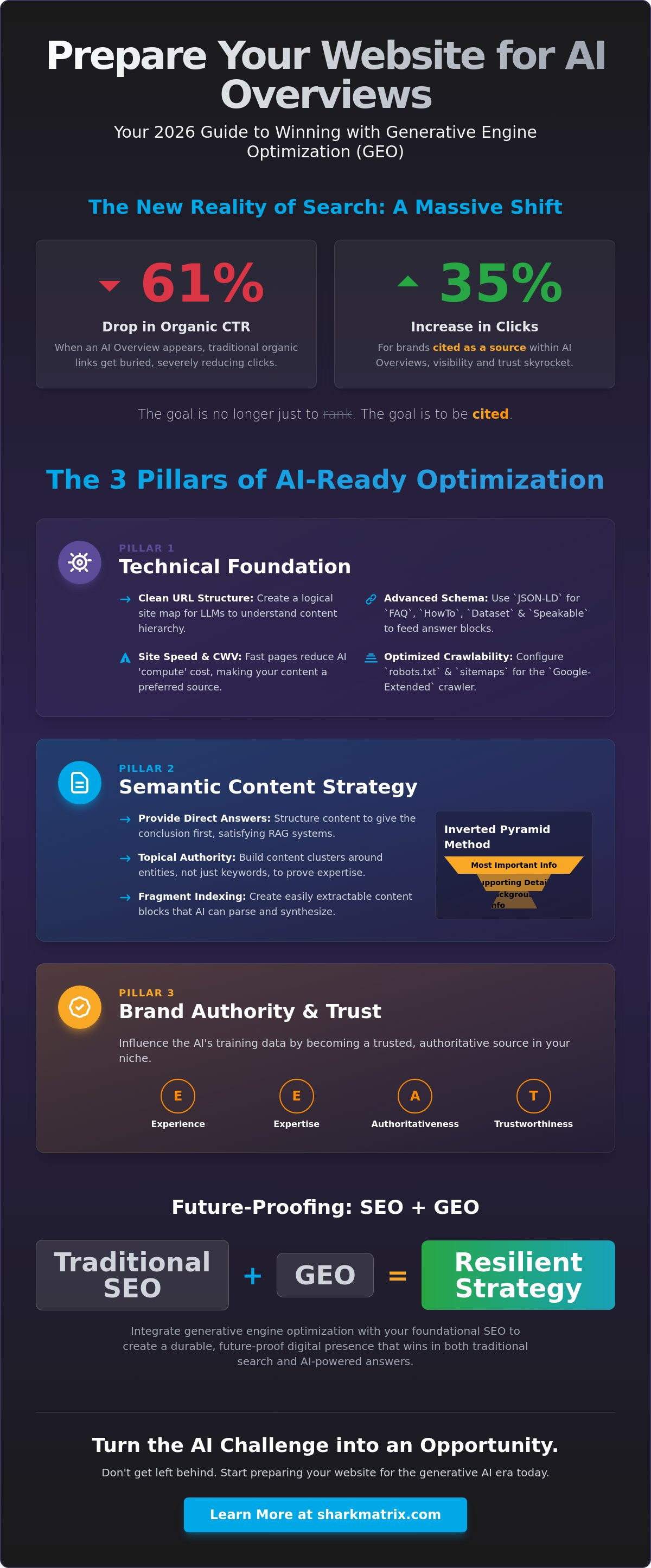
This shift has a massive impact on click-through rates. In 2026, research shows that organic CTR can drop by as much as 58% when an AI Overview is present. However, there’s a silver lining for those who adapt. Brands cited within these AI summaries often see a 35% increase in clicks compared to those that aren’t. The game has changed from fighting for a rank to fighting for a citation. You’re no longer just trying to be the first link; you’re trying to be the source that the AI trusts most.
The Mechanism of AI Citations
How does Gemini decide which websites to cite? It uses a process called Retrieval-Augmented Generation (RAG). Instead of just relying on its pre-trained data, the AI “fans out” a query to its search index to find the most relevant, up-to-date information. AI Overviews are a synthesis of top-tier authoritative data nodes. To get noticed, your site needs to be one of those nodes. This requires moving beyond traditional keyword density. AI crawlers now look for semantic relevance and clear entity relationships within a knowledge graph to determine which content is truly authoritative.
SEO vs. GEO: What Has Changed?
Traditional Search engine optimization (SEO) is still the foundation, but it’s evolving into Generative Engine Optimization (GEO). While SEO focuses on visibility in a list, GEO focuses on visibility within a generated response. For many national brands, this also includes Answer Engine Optimization (AEO), which specifically targets direct-response queries. You need a strategy that balances both worlds. By leveraging comprehensive search engine optimization seo services, you can ensure your technical foundation is strong enough to support these advanced AI requirements while maintaining your traditional search presence. It’s about being visible where the users are looking, whether that’s a blue link or a Gemini summary.
Technical Optimization: The AI-Ready Infrastructure Checklist
Many site owners make the mistake of treating AI visibility as a content-only problem. In reality, your technical foundation determines whether an AI crawler can even understand your data. If your site is bogged down by technical debt, Gemini or other LLMs might skip your content entirely. Preparing website for ai overviews requires a shift toward “fragment indexing.” This means structuring your site so AI can easily extract specific answers without needing to parse through irrelevant code blocks or messy scripts.
A clean, hierarchical URL structure is the first step in this process. It acts as a map for LLMs, helping them understand the relationship between different topics and subtopics. When your URLs follow a logical path, you’re essentially building a knowledge graph for the search engine. This clarity allows AI to identify your brand as an authority in specific niches much faster than a disorganized structure. It also reduces the risk where AI might misattribute information due to poor site architecture.
Advanced Schema and Structured Data
Schema markup has evolved from a “nice-to-have” feature into a mandatory requirement for AI visibility. By using advanced JSON-LD, you provide the entity recognition that AI models crave. Focus on Speakable, FAQ, and How-To schema to feed directly into AI response blocks. If you publish research or data, implementing Dataset schema is vital for becoming a primary source for statistical queries. You can verify these implementations using the updated 2026 Google Search Console tools to ensure your entities are correctly identified and ready for synthesis.
Backend Readiness for AI Crawlers
AI bots don’t crawl the web like traditional spiders. They are looking for high-quality data nodes they can synthesize quickly. This makes site speed and Core Web Vitals more important than ever. Slow pages consume more “compute” for the AI, making them less attractive as sources for real-time summaries. Your robots.txt and sitemaps must also be optimized for the Google-Extended crawler to ensure your most valuable assets are prioritized. Professional website design and development services play a key role here by creating clean, AI-parsable code. If you want to stay ahead of the curve, it might be time to review your technical SEO performance with an expert team.
Semantic Content Strategy: Optimizing for LLM Extraction
Writing for search engines used to mean repeating keywords in strategic places. In 2026, the priority is semantic clarity. AI models like Gemini don’t just scan for words; they parse meaning. This makes preparing website for ai overviews a task of information architecture as much as writing. To succeed, you must adopt the ‘Inverted Pyramid’ of AI writing. This means placing the most important information at the very beginning of your sections. Give the AI the answer it needs immediately, then expand on the details for the human reader who chooses to click through.
Topic clustering is your primary tool for proving niche authority. Instead of writing isolated blog posts, create a web of interconnected content that covers a subject from every angle. This builds semantic depth, signaling to AI crawlers that your site is a definitive source. Use headers and lists that are friendly to Natural Language Processing (NLP). Clear, descriptive headings help the AI map your content more effectively. Most importantly, eliminate fluff. Conversational filler and vague introductory sentences are ignored by AI Overviews. If a sentence doesn’t add factual value, it shouldn’t be there.
Crafting the “Perfect Answer” Block
The key to winning a citation is the “Perfect Answer” block. These are concise 40-60 word summaries placed directly under H2 or H3 headers. Use factual, declarative sentences to increase your citation probability. AI models prioritize content that provides immediate, verifiable utility. By providing a clear, high-level summary at the start of each section, you make it easy for the LLM to extract your data without needing to synthesize it from scratch.
Visual and Multimedia Integration
AI is increasingly multimodal, meaning it processes images and videos alongside text. Optimizing your image alt-text and providing detailed video transcripts is essential. Tables and infographics are particularly valuable because they provide structured data that AI can easily parse into summaries. These elements should be responsive and optimized for cross-platform visibility. For businesses focusing on mobile users, integrating these assets with mobile app development services ensures your content remains accessible and citation-ready across all devices.
Building Brand Authority: The Trust and Citation Checklist
In 2026, E-E-A-T (Experience, Expertise, Authoritativeness, and Trustworthiness) is the primary filter AI uses to separate high-quality sources from mass-produced clutter. Google’s official documentation stresses the importance of content that demonstrates real-world experience. Preparing website for ai overviews means you must prove your brand isn’t just another generic voice. AI models look for “non-commodity” content. These are unique insights and expert-led data that can’t be easily generated by a machine. If your content provides common knowledge, the AI will summarize it without citing you. To win the citation, you must offer something the model can’t replicate on its own.
Your brand’s presence in the Knowledge Graph is crucial for long-term visibility. This is how AI identifies entities and their relationships. If your brand is mentioned across authoritative sources, social media, and third-party review sites, the AI’s trust score for your domain increases. Social proof acts as a validation layer for generative models. Since 70% of consumers report having some level of trust in Google’s generative AI results, you must ensure those results reflect a trustworthy brand image. This requires auditing your digital footprint across national industry databases to ensure consistency and authority.
Digital PR and External Mentions
Digital PR is no longer just about building backlinks for rankings. In the AI era, non-linked brand mentions are equally powerful. LLMs use industry-specific “seed sites” as trusted foundations for their training data. If your brand is mentioned frequently on these platforms, you become part of the AI’s core knowledge base. Leveraging seo for brand reputation management dubai helps you control these narratives and protect your reputation across influential databases. This ensures that when an AI generates a summary, your brand is the one it recommends as a trusted authority.
Author Verification and Transparency
Transparency is the ultimate trust signal for 2026 search. You should implement robust author bios that link to external credentials, LinkedIn profiles, and professional certifications. This provides a “human-in-the-loop” signal. It proves that your content is guided by human expertise rather than being 100% AI-generated. AI crawlers check these signals to verify that the information comes from a reliable source. If you want to strengthen your brand’s authority and secure your place in AI summaries, consult with our SEO experts today to build a custom citation and authority strategy.
Future-Proofing with Generative Engine Optimization (GEO)
Success in the AI era isn’t a one-time achievement. As Google recalibrates its systems, the strategies that work today will need to evolve. Preparing website for ai overviews is a continuous process of monitoring, testing, and refining. At Shark Matrix, we treat Generative Engine Optimization (GEO) as a distinct discipline that goes beyond traditional search. We integrate AI automation with our core SEO workflows to ensure your brand remains the preferred source for Gemini-powered summaries. This proactive approach allows us to stay ahead of algorithm shifts that might otherwise lead to sudden traffic drops.
In a zero-click environment, your metrics for success must shift. If 60% of searches don’t result in a click, you need to find value in the citation itself. This is where data-driven lead generation becomes vital. Even if a user doesn’t visit your site immediately, appearing as the primary authority in an AI Overview builds brand recall and trust. We track citation rates and AI visibility with the same rigor we apply to traditional rankings. By understanding which queries trigger these summaries, you can prioritize content that captures the highest-value citations in your industry.
Shark Matrix’s GEO Framework
Our framework relies on sophisticated technology to keep your brand at the forefront of search. We use our internal ai development services to build custom tools that monitor how AI models perceive your site’s data. These tools use predictive analytics to anticipate which long-tail queries are most likely to trigger an AI response. This allows us to optimize your content before the competition even notices the shift. To bridge the traffic gap caused by zero-click results, we often recommend consulting with a ppc agency dubai to maintain a dominant presence through paid search while your organic AI authority grows.
Next Steps for Your Business
The first step in securing your digital future is conducting a comprehensive AI-Readiness Audit. This audit evaluates your technical infrastructure, semantic depth, and E-E-A-T signals to identify gaps in your current strategy. From there, you can build a multi-channel digital roadmap that survives search disruption. Don’t wait for your organic traffic to decline before you start preparing website for ai overviews. Contact Shark Matrix today to develop a specialized Generative Engine strategy that protects your visibility and ensures your brand is the voice Google trusts most in 2026.
Secure Your Brand’s Voice in the Age of Generative Search
The transition from blue links to synthesized summaries is no longer a distant possibility; it’s the current standard. You’ve seen how a combination of technical precision, semantic content strategy, and robust E-E-A-T signals can turn the threat of zero-click searches into a powerful citation opportunity. By preparing website for ai overviews now, you position your brand as a trusted authority that Google’s Gemini-powered systems will prioritize. Success in this landscape requires moving beyond simple rankings to focus on becoming a primary source for AI synthesis.
Shark Matrix is the leading AI automation and development agency in the UAE, specializing in Generative Engine Optimization (GEO). We provide data-driven SEO strategies designed for national brand protection and long-term growth in a volatile market. Don’t let your traffic disappear as search behavior shifts toward answer engines. It’s time to Book your 2026 AI-Readiness Audit with Shark Matrix and ensure your site is ready for what comes next. The future of search belongs to those who adapt today. Your brand has a story that deserves to be told, and we have the tools to make sure the AI engines tell it correctly.
Frequently Asked Questions
What is the difference between SEO and GEO?
Traditional SEO focuses on optimizing your site to rank in a list of links, while Generative Engine Optimization (GEO) focuses on being cited within an AI-generated answer. SEO builds the technical and content foundation. GEO layers on strategies like semantic depth and entity recognition to ensure LLMs like Gemini retrieve your data during synthesis. Both are necessary to maintain visibility in 2026.
Will AI Overviews stop people from clicking on my website?
AI Overviews do increase zero-click searches, which now account for approximately 60% of Google queries. However, being cited as a source can actually help. Research shows that brands cited within an AI Overview see a 35% increase in clicks compared to those that aren’t. While overall CTR might drop for top links, the citation becomes the new “position zero” for traffic.
How do I know if my website is being cited by Google Gemini?
You can monitor your citations through the updated performance reports in Google Search Console. These reports now distinguish between traditional organic clicks and those originating from generative features. You can also use specialized third-party monitoring tools that track your brand’s appearance and citation rate within AI-generated summaries across different industries and query types.
Is structured data still important for AI Overviews in 2026?
Structured data is more critical than ever because it provides the explicit context that AI models need to identify entities. Preparing website for ai overviews requires advanced JSON-LD to act as a bridge between your content and the AI’s knowledge graph. Without clear schema, an LLM might struggle to verify your data, making it less likely to use your site as a primary source.
Can small businesses compete with national brands in AI summaries?
Small businesses have a unique advantage because AI Overviews pull from a much wider source pool than traditional search results. You don’t always have to be in the top 10 blue links to get cited. By focusing on “non-commodity” content and hyper-local expertise, smaller sites can win citations that national brands might lose by being too general or broad.
How often does Google update the sources for its AI Overviews?
Google updates these sources in real-time or near real-time through its search index. Because the system uses Retrieval-Augmented Generation (RAG), the AI “fans out” to the index to find the most current and authoritative information available at the moment of the search. This means your latest expert insights can be cited almost as soon as they are indexed.
Should I block AI crawlers from my website to protect my content?
Blocking crawlers like Google-Extended prevents your data from being used to train models, but it also removes you from AI Overviews. If you block these bots, your brand will not be cited in the summaries that now appear in up to 60% of searches. For most businesses, the loss of visibility and citations outweighs the benefits of content protection.
What are the most important schema types for AI visibility?
The most effective types are FAQ, How-To, and Speakable schema, as they directly match the answer-based intent of AI queries. Additionally, Dataset schema is vital if you publish original research or statistics. These structured formats help AI crawlers quickly identify your content as a high-value data node, which is essential when preparing website for ai overviews and securing citations.