


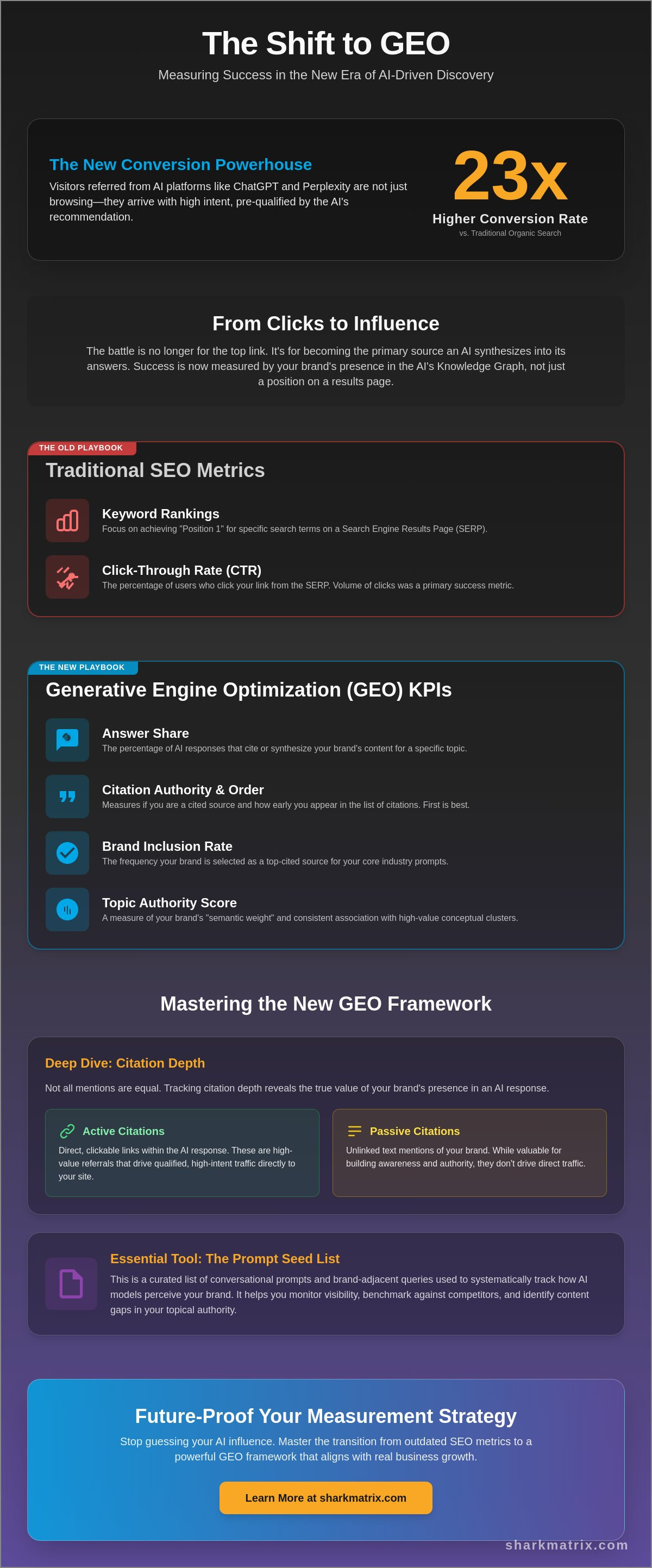
Did you know that visitors referred from AI platforms now convert at 23 times the rate of those arriving via traditional organic search? According to March 2026 data from Discovered Labs, the shift toward AI-driven discovery isn’t just a trend; it’s a fundamental change in how high-intent buyers research products and services. As ChatGPT and Perplexity become the new gatekeepers, traditional metrics like click-through rates are plummeting. You’re likely finding that measuring generative engine optimization success requires a completely different playbook than the one you used for Google’s old blue links.
It’s frustrating to see your brand mentioned in a ChatGPT response or a Perplexity citation without any clear way to quantify that value to your C-suite. You’re right to feel that the lack of native analytics in these LLMs makes reporting feel like guesswork. We’ll help you master the transition from tracking simple clicks to measuring true AI influence with our comprehensive 2026 GEO KPI framework. In this guide, you’ll discover a repeatable reporting model for AI visibility, explore specialized tools like Peec AI for tracking mentions, and learn how to align your generative engine optimization strategy with actual business growth.
Key Takeaways
- Learn why “Answer Share” and “Citation Authority” are replacing traditional rankings as the gold standard for digital visibility.
- Identify the specific metrics needed for measuring generative engine optimization success, including brand inclusion rates and citation depth within LLM responses.
- Discover how to build a “Prompt Seed List” to track how AI models like ChatGPT and Perplexity perceive your brand’s expertise.
- Understand the evolution of CTR and why high-intent AI citations often lead to better business outcomes than traditional search clicks.
- Explore how to move beyond static reporting toward real-time visibility monitoring to stay ahead of rapid AI model updates.
Beyond the Click: Why Measuring Generative Engine Optimization Success is Different
Measuring generative engine optimization success isn’t about counting how many people landed on your homepage last month. It’s about understanding how often an AI model chooses your brand as the definitive answer to a complex query. In traditional search, you fought for a spot on page one. In the world of Generative Engine Optimization (GEO), you’re fighting to be the primary source that Large Language Models (LLMs) synthesize into their responses. This is the science of tracking brand inclusion, where visibility is measured by conceptual association rather than just a ranking number.
We’ve entered a “Zero-Click” reality where a user might get everything they need directly from a search generative experience or a tool like Perplexity. While this might look like a decline in traffic in your legacy analytics dashboard, the users who do click through are arriving with much higher intent. They’ve already been “pre-sold” by the AI’s recommendation. Success is now measured by your brand’s presence within the Knowledge Graph. This shift requires a solid foundation built through professional search engine optimization seo services, ensuring your data is structured specifically for AI extraction and entity recognition.
Ranking vs. Answer Share
In the past, being “Position 1” was the ultimate goal. Today, that concept is being replaced by Answer Share. LLMs don’t just list websites; they synthesize multiple sources to create a single, authoritative voice. If your content is the primary source for that synthesis, you gain more authority than a simple link ever provided. Measuring generative engine optimization success also involves looking at “Citation Order.” Being the first link cited in an AI summary carries significantly more weight than being buried in a “read more” dropdown or a footnote.
The Shift in User Intent Tracking
Tracking user intent has moved from simple transactional keywords to conversational prompt analysis. You need to identify “Brand-Adjacent” queries where AI currently references your competitors instead of you. This analysis helps you understand the gaps in your topical authority and where your content fails to meet the LLM’s criteria for helpfulness. Answer Share is the percentage of AI responses that cite your brand for a specific topic. By focusing on these metrics, you can ensure your brand remains relevant as search evolves into a dialogue between users and machines.
The Core KPI Stack for Generative Engine Optimization
Traditional SEO relied on a handful of clear metrics like keyword volume and domain authority. To master measuring generative engine optimization success in 2026, you need a stack that accounts for both conceptual visibility and linguistic nuance. It’s no longer enough to just appear in a list. You need to know your Inclusion Rate: the percentage of times your brand is selected as a top-cited source for specific industry prompts. This is paired with your Topic Authority Score, which measures your “semantic weight.” If an AI model consistently associates your brand with a cluster of high-value terms, you’ve successfully claimed that cognitive territory within the LLM.
Citation Depth is another pillar of this new framework. It tracks whether the generative engine provides a direct, clickable link or merely a text mention. While both contribute to brand awareness, direct citations are the primary drivers of the high-intent traffic discussed earlier. If you find your brand is mentioned but not linked, it often indicates a gap in your technical data structure. Integrating ai automation and development into your content pipeline can help ensure your site’s data is formatted for easy AI extraction.
Visibility Metrics: Inclusion and Citations
Visibility in the age of Perplexity and Gemini is often found in the footnotes. You must track “Footnote Presence” to see how often you are used to verify the AI’s claims. There’s a vital difference between “Active Citations,” which include outbound links, and “Passive Citations,” which are unlinked mentions. While passive mentions build brand recognition, active links are what move the needle for your bottom line. Maintaining these metrics requires proactive seo for brand reputation management dubai to ensure the AI sources clean, accurate, and authoritative data about your business.
Qualitative Metrics: Sentiment and Accuracy
Most frameworks fail because they ignore how an AI actually describes you. The Core KPI Stack for Generative Engine Optimization must include a Brand Sentiment Score. Using Natural Language Processing (NLP) tools, you can audit whether an LLM positions your services as “premium,” “affordable,” or “market-leading.” This qualitative data tells you if your content marketing is actually shaping your brand’s AI persona.
Accuracy is equally important. You must track your “Hallucination Rate,” which measures how often an AI provides incorrect facts about your products or services. If an AI tells a potential customer you don’t offer specific machine learning development services when you do, it’s a direct threat to your revenue. Finally, monitor your “Comparison Dominance.” When users ask an AI to compare you against your three biggest competitors, you need to know who the engine recommends and why.
GEO Metrics vs. Traditional SEO: A Comparative Analysis
Reporting on search performance has historically relied on raw impressions. However, measuring generative engine optimization success requires a pivot toward “Brand Prominence.” In a traditional SERP, an impression meant a user saw your link. In 2026, an impression in a generative engine might mean your brand was synthesized into a paragraph alongside three competitors. If you aren’t the primary entity mentioned, that impression carries little value. You’re now tracking how often the AI chooses you as the lead authority for a specific concept.
The classic Click-Through Rate (CTR) is also evolving into what we call the “Citation-Through Rate.” As users rely on AI to summarize information, they only click when they need deep-dive verification or a specific transaction. This doesn’t mean your strategy is failing. It means the user’s journey is changing. To capture these high-intent clicks, your technical foundation must be flawless. High-quality website design and development services are essential here, as they ensure your site’s data structure is easily crawlable and interpretable by LLM bots.
Justifying the ROI of GEO can be challenging when direct sessions from search engines appear to decline. You must shift the conversation from traffic volume to conversion quality. Visitors referred from AI platforms convert at 23 times the rate of traditional organic search, meaning a single AI citation can be worth dozens of standard clicks. Measuring generative engine optimization success is about proving that your brand is the “trusted advisor” within the AI’s logic, which creates a shorter path to purchase.
The Legacy vs. Generative Metric Map
Legacy SEO focused on Keyword Rank, but GEO prioritizes Entity Prominence. Instead of counting backlinks, we now evaluate Citation Quality and LLM Trust. Does the model trust your data enough to quote it? Similarly, “Time on Page” is losing relevance to “Prompt Resolution Success.” If a user finds your information within an AI response and their query is resolved, your brand has provided value, even if they didn’t visit your site immediately. Success is defined by being the final answer in the user’s discovery process.
Attribution Challenges in 2026
The “Dark Social” problem has migrated to search. Users often get their answers from an LLM and then navigate directly to your site later or mention you in a separate channel. This makes direct attribution difficult. Measuring “Assisted Conversions” from AI engines in GA4 is the best way to track this indirect impact. You need to look for patterns where AI visibility correlates with direct traffic spikes. GEO success is often found in the “Referral” traffic segment of analytics platforms.
Practical Tools and Frameworks for Tracking GEO Performance
Moving from theory to execution requires a structured technical workflow. To build a repeatable model for measuring generative engine optimization success, you must first move beyond manual spot-checking. Start by curating a “Prompt Seed List” based on your highest-value customer questions. This list should reflect the actual conversational queries your audience uses when interacting with AI assistants. Once you have your seeds, implement automated monitoring tools to scrape LLM responses. This allows you to track brand mentions at scale rather than relying on anecdotal evidence.
Isolation is the next step in your measurement framework. Set up custom GA4 channels to specifically isolate traffic coming from domains like chatgpt.com, perplexity.ai, and gemini.google.com. By segmenting these sources, you can see how AI-driven discovery translates into site behavior. Finally, utilize sentiment analysis APIs to categorize the “tone” of these AI responses. This helps you determine if the engine is positioning you as a market leader or merely a secondary option. If you want to accelerate this technical setup, our team at Shark Matrix Technologies LLC provides generative ai development services to build custom monitoring solutions tailored to your brand.
Building a Prompt Dashboard
A successful dashboard groups prompts by intent: Informational, Commercial, and Comparison. This structure reveals where your content is strongest and where competitors might be stealing your “Answer Share.” You should also track the “First-Mover Advantage” whenever a new AI engine update rolls out. In the UAE market, linguistic diversity is a critical factor that many global frameworks overlook. Testing prompts in both English and Arabic is essential for national brands. AI models often interpret brand authority differently across languages, so your measurement strategy must account for these regional nuances to be truly accurate.
Connecting GEO to Revenue
The ultimate goal is tying AI visibility to your bottom line. Look for correlations between your AI citation frequency and increases in “Branded Search” volume. When an AI recommends your brand, users often head to traditional search engines to find your specific website. You can also use insights from a ppc agency dubai to fuel your GEO prompt strategy. Paid search data highlights the exact phrases that drive conversions, which you can then use to optimize your organic AI presence. Measuring the link between citation frequency and lead quality ensures your GEO efforts are driving business growth, not just vanity metrics.
Future-Proofing Your Measurement Strategy with Shark Matrix Technologies LLC
Static reporting is no longer sufficient in an environment where LLMs update their training data and model weights almost weekly. Moving toward real-time AI visibility monitoring is the only way to stay competitive. At Shark Matrix Technologies LLC, we’ve developed an approach that bridges the gap between custom AI development and advanced SEO analytics. Our goal is to provide a dynamic view of your digital footprint, ensuring that your brand doesn’t just appear in responses but remains the dominant authority for your core topics.
Our “Entity-First” strategy focuses on how your brand is perceived across the entire Knowledge Graph. By treating your business as a structured entity rather than a collection of keywords, we make it easier for generative engines to extract and cite your data accurately. This method is essential for measuring generative engine optimization success over the long term. We close the loop by transforming these high-intent AI citations into national brand dominance, ensuring that your visibility translates directly into market leadership.
Custom AI Solutions for Measurement
We utilize our specialized ai automation services to build bespoke tracking dashboards that go far beyond standard search tools. These proprietary systems audit LLM responses at scale, allowing us to protect your online reputation by identifying and correcting AI hallucinations or competitor biases in real time. By integrating machine learning development services, Shark Matrix Technologies LLC can help you predict which content formats will secure the highest “Answer Share” in future model iterations, giving you a significant head start on the competition.
Your Next Steps in the AI Search Era
Waiting for official analytics from LLM providers like OpenAI or Google puts your brand at a major disadvantage. The companies leading their industries in 2026 are those that have already built their own measurement frameworks. You don’t need to guess how your brand is performing when you can have a clear, data-driven audit. Start your journey today by identifying the gaps in your topical authority and refining your AI persona. Ready to dominate the AI search landscape? Consult with Shark Matrix Technologies LLC today.
Claim Your Authority in the AI Search Era
The transition from tracking simple clicks to analyzing complex AI citations is the most significant evolution in digital discovery. Embracing metrics like Answer Share and Citation Depth provides a much clearer picture of your brand’s true influence than traditional rankings ever could. By moving beyond legacy dashboards and prioritizing real-time monitoring, you turn the “Zero-Click” reality into a distinct competitive advantage. You’re no longer just hoping for a link; you’re ensuring your brand remains the most trusted entity in the engine’s knowledge graph.
Successfully measuring generative engine optimization success requires a proactive approach that balances technical precision with deep linguistic expertise. Shark Matrix Technologies LLC is a pioneer in UAE AI-driven SEO, offering custom AI automation for real-time reporting and unmatched expertise in both English and Arabic digital markets. Master your AI visibility with Shark Matrix Technologies LLC SEO services and secure your place as a market leader. The search landscape is evolving fast, but with the right framework, your brand’s growth is just a prompt away.
Frequently Asked Questions
What is the most important KPI for measuring GEO success?
Answer Share is the most critical KPI because it tracks the percentage of AI responses that cite your brand for specific industry topics. Unlike traditional rankings, this metric measures your brand’s authority as a primary source for LLM synthesis. You should also monitor Citation Depth to determine if the engine provides a direct, clickable link or just a text mention. This data tells you if the AI perceives you as a primary authority or a secondary reference.
Can I track AI engine traffic in Google Analytics 4?
You can track AI engine traffic by setting up custom referral channels in GA4 to isolate visitors from domains like chatgpt.com, perplexity.ai, and gemini.google.com. While these sessions might appear lower in volume than traditional search, they often represent much higher intent. According to March 2026 data from Discovered Labs, visitors referred from AI platforms convert at 23 times the rate of organic search, making this segment extremely valuable for ROI analysis.
How does GEO measurement differ from traditional SEO rank tracking?
GEO measurement focuses on how LLMs categorize your brand within a Knowledge Graph instead of just assigning a numerical rank. Traditional SEO tracks where your URL appears on a page, while measuring generative engine optimization success involves auditing the “semantic weight” of your brand across various prompts. You’re looking for inclusion in synthesized answers and “Citation Order” rather than a spot in a list of blue links.
Is it possible to influence the sentiment of AI-generated answers?
You can influence AI sentiment by consistently publishing authoritative content that uses the specific terminology you want associated with your brand. AI models pick up on linguistic patterns; if your site and third-party citations describe your services as “premium” or “innovative,” the LLM is more likely to adopt that tone. Professional SEO for brand reputation management ensures the data feeding these models remains accurate, positive, and aligned with your unique value proposition.
How often should I audit my brand presence in LLMs like ChatGPT?
You should audit your brand presence at least once a month to account for regular model updates and data refreshes. In fast-moving industries, real-time monitoring is preferable because AI citations can shift within weeks of a major update. Regular audits help you identify “hallucinations” or factual errors the AI might be spreading about your services before they impact lead quality or brand trust.
What tools are available for measuring generative engine optimization in 2026?
Measuring generative engine optimization success in 2026 involves specialized tools like Peec AI, which tracks visibility and share of voice across different models. You can also use automated monitoring tools and sentiment analysis APIs to scrape LLM responses and categorize the tone of mentions. For many enterprises, building a custom dashboard via AI automation services is the most effective way to scale this tracking across multiple languages and regions.
Does Answer Engine Optimization (AEO) use the same metrics as GEO?
AEO and GEO share metrics like Answer Share, but AEO focuses more heavily on direct response accuracy for specific, isolated questions. GEO is a broader framework that includes brand sentiment and entity prominence across a wider range of conversational discovery. Both strategies rely on a foundation of structured data and high-quality content marketing to ensure your brand is the preferred source for synthesized answers.
How do I explain declining website clicks to stakeholders while showing GEO success?
You should explain that while raw clicks are declining due to the “Zero-Click” reality of AI summaries, the quality of referred traffic is significantly higher. Focus on metrics like Citation-Through Rate and the 23x conversion multiplier for AI-referred visitors. Showing stakeholders your brand’s dominance in AI answers proves you’re capturing the user’s trust at the point of discovery, which creates a much shorter path to purchase than traditional search.


