
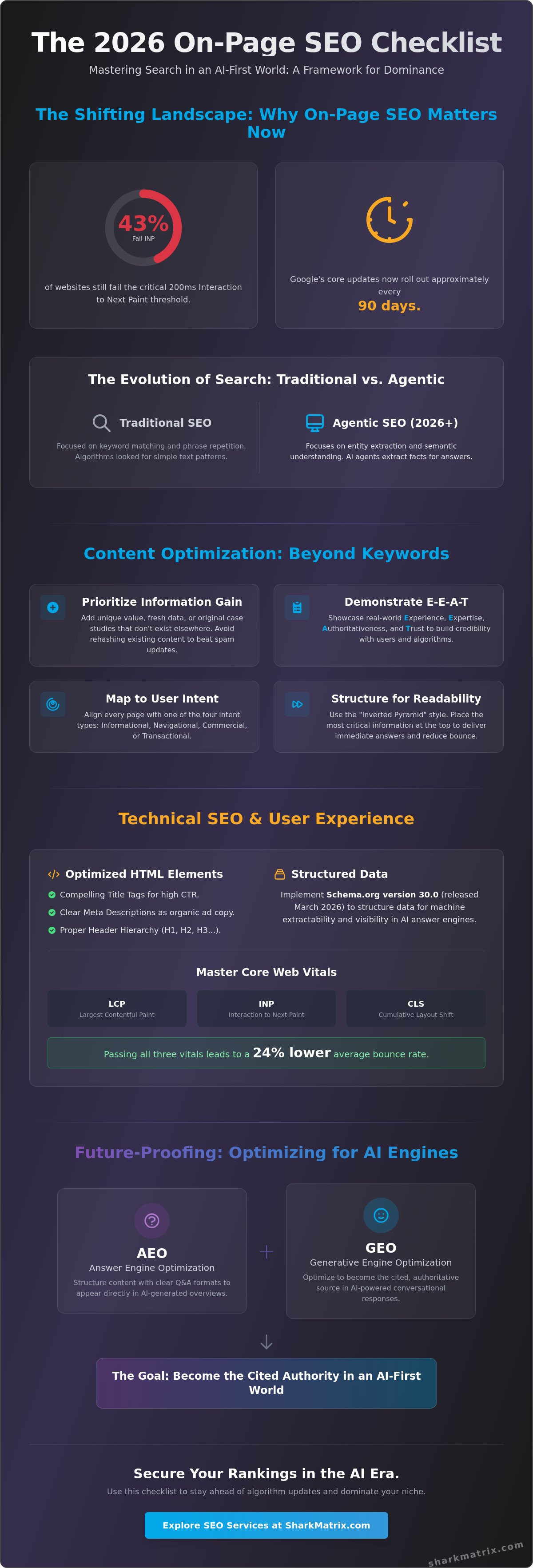
Did you know that 43% of websites still fail the 200ms threshold for Interaction to Next Paint (INP) in 2026? It’s frustrating to produce high-quality content only to see it buried because the technical goalposts moved again. With Google now rolling out core updates approximately every 90 days, staying visible requires more than just good writing. You’re likely looking for a way to maintain consistency across your site while ensuring you aren’t left behind by AI search. This comprehensive on page seo checklist provides the exact framework you need to satisfy both traditional algorithms and the latest generative engines.
We’ll show you how to master the essential factors that drive rankings today, from implementing Schema 30.0 to meeting the strict March 2026 spam update requirements. You’ll discover how to optimize for Answer Engine Optimization (AEO) and Generative Engine Optimization (GEO) so your brand becomes the cited authority in AI-generated responses. This guide previews the technical and creative shifts necessary to secure higher organic visibility and long-term search dominance in an AI-first world.
Key Takeaways
- Learn why shifting from keyword matching to entity-based optimization is essential for ranking in 2026.
- Use a modern on page seo checklist to verify that your HTML elements are fully optimized for humans and bots.
- Master the latest image SEO techniques and performance standards to keep users engaged and reduce bounce rates.
- Discover how Answer Engine Optimization (AEO) helps your content appear in AI-generated overviews.
- Prioritize Information Gain to ensure your content provides unique value that machines cannot easily replicate.
What is On-Page SEO and Why It Matters in 2026
On-page SEO involves the precise optimization of individual web pages to rank higher and earn more relevant traffic in search engines. By 2026, the definition has expanded. It’s no longer just about where you place a keyword; it’s about how well your content satisfies user intent and maps to specific entities. Following a modern on page seo checklist ensures your site communicates clearly with both human readers and sophisticated AI search agents.
This foundation is critical for national digital marketing strategies, especially in competitive markets like the UAE. High-quality on-page signals act as a trust signal for brand authority. With Google’s March 2026 Core Algorithm Update placing a heavier emphasis on genuine expertise, your on-page elements must prove you aren’t just another generic voice. They must show you’re a leader in your field. This is why optimizing for humans and AI search simultaneously has become the standard for any brand looking to maintain its market share.
The Evolution of On-Page SEO: Traditional vs. Agentic
Search algorithms have evolved from simple pattern matching to deep semantic understanding. Today, AI agents crawl your site to extract facts, not just phrases. This agentic search environment means your content must be structured for machine extractability. If your data isn’t organized using the latest standards, like Schema.org version 30.0 released on March 25, 2026, you risk being invisible to AI answer engines. Static strategies fail because the average time between Google updates has dropped to just 90 days. You need an agile on page seo checklist to stay relevant in this fast-paced environment.
Key Benefits of a Rigorous On-Page Strategy
A disciplined approach to on-page factors delivers measurable business results. When you align your content perfectly with what a user is looking for, your click-through rates (CTR) naturally climb. You’re giving people exactly what they asked for. Beyond just getting the click, a solid strategy improves the actual experience on the page. Research shows that websites passing all three Core Web Vitals thresholds see a 24% lower bounce rate on average. This better alignment between intent and content doesn’t just help rankings; it drives the conversions that grow your business. Key benefits include:
- Higher CTR: Compelling titles and meta descriptions act as organic ad copy.
- Enhanced UX: Proper header hierarchy and fast loading times keep users engaged.
- Better Alignment: Content that answers the user’s specific question reduces immediate exits.
Content Optimization: Beyond Basic Keyword Placement
Ranking in 2026 requires more than just sprinkling terms throughout a blog post. Your on page seo checklist must prioritize “Information Gain.” This concept involves adding unique value that doesn’t exist elsewhere on the web. Since Google’s March 2026 Spam Update specifically targets thin, low-value content, simply rehashing what’s already on page one is a recipe for invisibility. You need to provide fresh data, original case studies, or a unique expert perspective to satisfy both users and modern algorithms.
Identifying keywords still matters, but the focus has shifted toward national search volume and intent mapping. Every piece of content should align with one of the four intent types: Informational, Navigational, Commercial, or Transactional. For instance, if you’re looking to scale a brand, your page must answer the specific commercial or transactional questions a business owner has. This alignment is reinforced by E-E-A-T, where you demonstrate real-world experience and expertise to build trust with your audience. If you need assistance with these complex strategies, our ecommerce seo services provide a tailored approach for national growth.
Writing for Semantic Search and Entities
Modern search engines think in terms of topics and entities, not just strings of text. Instead of repeating a keyword, focus on the “Who, What, Where, and Why” of your subject. Natural language processing allows search engines to understand the relationships between different concepts on your page. By incorporating Latent Semantic Indexing (LSI) keywords naturally, you help search agents categorize your content accurately. If you need a reference for these technical requirements, checking a comprehensive on-page SEO checklist can help ensure you’ve covered all semantic bases.
Structuring Content for Maximum Readability
Engagement is a key ranking signal. Use the “Inverted Pyramid” style by placing your most critical information at the very beginning. This ensures that even if a reader only stays for ten seconds, they get the answer they came for. Keep your paragraphs short and use an active voice to maintain momentum. If you find this level of optimization daunting, our content marketing experts can help you craft high-performing assets. By using clear headings and internal links to related resources, you guide the reader through a logical journey that search engines can easily map and reward.
HTML and Structural Elements Checklist
While content is the heart of your page, the HTML structure is the skeleton that holds everything together. Search engines use these structural signals to understand the hierarchy and relevance of your information. A high-performance on page seo checklist must prioritize these elements to ensure that crawlers can easily parse your data and users can navigate your content without friction. In 2026, clarity in your HTML is more important than ever as AI agents look for specific data points to cite in their answers.
Your URL structure is the first thing both a user and a bot see. Keep your slugs short, descriptive, and keyword-rich. Avoid using random strings of numbers or dates that add unnecessary length. A clean URL like “example.com/on-page-seo-checklist” is far more effective than a convoluted path. While many focus on backlinks, a comprehensive SEO checklist reinforces that your on-page structure is the actual foundation of your organic visibility. If your site’s architecture is messy, even the best content will struggle to rank. Working with a technical seo consultant can help you identify and resolve the hidden structural issues that prevent search engines from crawling your site efficiently.
The Anatomy of a Perfect Title and Meta Tag
Title tags remain one of the strongest on-page ranking signals. You should place your primary keyword near the start of the title to give it maximum weight. However, don’t just write for bots. Use power words or numbers to create a compelling hook that improves your click-through rate. Your meta description should act as “ad copy” for your organic listing. While it isn’t a direct ranking factor, a well-crafted description encourages users to choose your link over a competitor’s. To avoid “keyword cannibalization,” ensure every page on your site has a unique title and meta tag tailored to its specific topic.
Header Tag Best Practices
Organization is key to readability. Use a logical H1-H6 hierarchy to guide the reader through your subtopics. The H1 tag serves as the singular core theme of your page, signaling to both readers and crawlers exactly what the content is about. You should only have one H1 per page. From there, use H2 tags for your main sections and H3 tags for supporting details within those sections. This structure doesn’t just help humans skim; it helps search engines understand the relationship between your primary topic and its supporting points. If you’re struggling to implement these structures at scale, our Web Design and Development services can help you build a site that is optimized by default.
Visual Asset SEO and User Experience Factors
Visual content is no longer just a decorative element; it’s a critical component of your on page seo checklist. In 2026, search engines and AI models aren’t just looking at your text. They’re analyzing your images and videos to understand the full context of your page. High-quality visual assets that load quickly are essential for keeping users on your site. When you provide a seamless visual experience, you reduce friction and encourage longer dwell times. This is especially vital as over 60% of web traffic now comes from mobile devices, where visual performance is often the deciding factor between a conversion and an exit.
User experience is now mathematically tied to your rankings through Core Web Vitals. As of May 2026, Google uses a composite score for these metrics. If you fail even one of the three core metrics, your visibility can suffer. Currently, 43% of websites fail the 200ms threshold for Interaction to Next Paint (INP). To stay competitive, your pages must hit the “good” thresholds: Largest Contentful Paint (LCP) under 2.5 seconds, INP under 200 milliseconds, and Cumulative Layout Shift (CLS) under 0.1. Passing these benchmarks isn’t just about technical vanity; websites that meet all three thresholds see a 24% lower bounce rate on average. If your site feels sluggish, our Web Design and Development services can help you build a high-performance platform that satisfies both users and search engines.
Optimizing Images for Search and AI
Every image on your site should be optimized for machine extractability. This starts with descriptive filenames and modern formats like WebP to ensure fast loading. Your alt text should be descriptive and functional, providing clear context for both accessibility and AI search bots. Additionally, using Image Schema helps search engines identify the specific subject matter of your visuals, increasing the chances of your content appearing in rich snippets or AI-generated answers. Always compress your files to maintain high visual quality without bloating your page weight.
Engagement Signals and On-Page UX
A well-optimized page guides the user toward their goal. Clear site navigation allows visitors to find relevant information quickly, which signals to search engines that your site is helpful. Avoid using intrusive pop-ups, particularly on mobile, as they disrupt the user journey and can lead to penalties under the latest spam updates. Instead, use multimedia like infographics or short videos to break up long blocks of text and increase engagement. Finally, integrate clear calls-to-action (CTAs) that lead the user to the next stage of the funnel. This ensures that your SEO efforts translate into actual business results.
Future-Proofing: Optimizing for AI and Answer Engines
The final pillar of a modern on page seo checklist involves preparing for a search environment where AI agents, not just humans, are the primary “readers” of your site. Answer Engine Optimization (AEO) is the practice of structuring your content so these agents can easily extract and cite your information in AI-generated overviews. While traditional rankings still drive significant traffic, appearing as a primary source in a generative answer is the new gold standard for national authority. This requires a shift from writing broad articles to creating precise, data-rich segments that machines can parse with high confidence.
To capture these opportunities, you must integrate “Snippet-Bait” into your layout. These are concise Q&A blocks or summary tables designed specifically for AI extraction. By providing a direct answer to a complex query within the first 50 words of a section, you increase the likelihood of being featured in rich snippets. Our search engine optimization seo services bridge the gap between these human and AI needs, ensuring your content remains readable while serving as a high-quality data source for generative engines.
Schema Markup: The Language of Search Engines
Explicit context is everything in 2026. Implementing JSON-LD structured data is no longer optional; it’s the primary way you tell search engines exactly what your content represents. Whether you’re using FAQ, Article, or Product Schema, you should always align with the latest standards, such as Schema.org version 30.0 released on March 25, 2026. This technical layer acts as a translator for AI agents, converting your creative prose into a structured format that machines can verify and display. Dominating SERP real estate today often depends on how well your FAQ schema answers long-tail conversational queries.
The Shark Matrix Approach to Modern SEO
National brands face the unique challenge of maintaining consistency across thousands of pages. We solve this by integrating ai automation services to audit and update on-page factors at scale, ensuring no page falls behind the 90-day algorithm update cycle. A bespoke on-page framework is necessary to balance brand voice with the technical rigors of generative engine optimization (geo). To ensure your audits translate into actionable growth strategies rather than overwhelming technical reports, review our seo audit report guide for national brand growth before your next site review. If you’re ready to ensure your site is fully optimized for the next generation of search, it’s time to take action. Audit your on-page SEO with the experts at Shark Matrix to secure your rankings and AI visibility.
Securing Your Search Presence in an AI-Driven Future
Success in the modern search landscape requires a dual focus on human engagement and machine readability. You’ve learned that mastering your on page seo checklist means more than just placing keywords; it’s about providing unique Information Gain and ensuring your site meets the strict Core Web Vitals thresholds. By aligning your content with Schema 30.0 and optimizing for Answer Engine Optimization (AEO), you position your brand as a primary source for both Google and generative AI agents.
Shark Matrix has been at the forefront of digital transformation since 2010. With 15+ years of regional expertise, we specialize in helping national UAE enterprises navigate complex algorithm shifts through AI-driven SEO and generative engine optimization. Don’t let your high-quality content go unnoticed by failing to adapt to these technical requirements. Download Our Full 2026 SEO Strategy Guide to stay ahead of the competition. The future of search is here, and with the right strategy, your brand can lead the way.
Frequently Asked Questions
What is the most important on-page SEO factor in 2026?
The most critical factor is satisfying user intent through original “Information Gain.” Search engines now prioritize content that adds unique value or fresh data to the conversation rather than simply rehashing existing information. While technical elements are vital, your ability to demonstrate genuine expertise and provide a clear answer to the user’s specific query is what ultimately drives rankings in a competitive landscape.
How long does it take for on-page SEO changes to reflect in rankings?
Most on-page changes begin to reflect in search results within a few days to several weeks. This timeline depends on your site’s crawl budget and how frequently search engines index your pages. High-authority sites with frequent updates often see changes faster. If you’ve implemented a comprehensive on page seo checklist, you can monitor your progress through search console tools to see how quickly bots pick up your structural improvements.
Can I do on-page SEO without technical knowledge?
You can certainly manage content-level optimizations, such as keyword placement and header organization, without deep technical skills. However, more advanced tasks like implementing JSON-LD Schema or optimizing for Core Web Vitals usually require professional assistance. For these structural elements, our web design and development team can ensure your site’s backend is as optimized as your front-end content.
How does on-page SEO differ for ecommerce websites?
Ecommerce SEO focuses heavily on product-specific data, faceted navigation, and transactional intent. You must ensure that every product page includes unique descriptions, high-quality images with descriptive alt text, and structured data for pricing and availability. This differs from informational content because the goal is to guide the user toward a purchase while helping AI shopping agents identify your inventory as the best match for a buyer’s needs.
Do I need to update my on-page SEO for AI search engines like Perplexity or ChatGPT?
Yes, you should adapt your strategy to include Answer Engine Optimization (AEO) and Generative Engine Optimization (GEO). These platforms look for highly structured, fact-dense content that they can easily extract and summarize. By following a modern on page seo checklist that includes Q&A blocks and clear data tables, you increase the chances of your brand being cited as a primary source in AI-generated answers.
What are the most common on-page SEO mistakes to avoid?
Common errors include keyword stuffing, using duplicate title tags, and neglecting the mobile user experience. Many businesses also forget to optimize their images or fail to use a logical heading hierarchy. These mistakes make it difficult for search engines to understand your page’s purpose and often lead to poor engagement from human visitors, which can negatively impact your long-term organic visibility. A thorough seo audit report can help you systematically identify and prioritize these issues before they compound into larger ranking problems.