
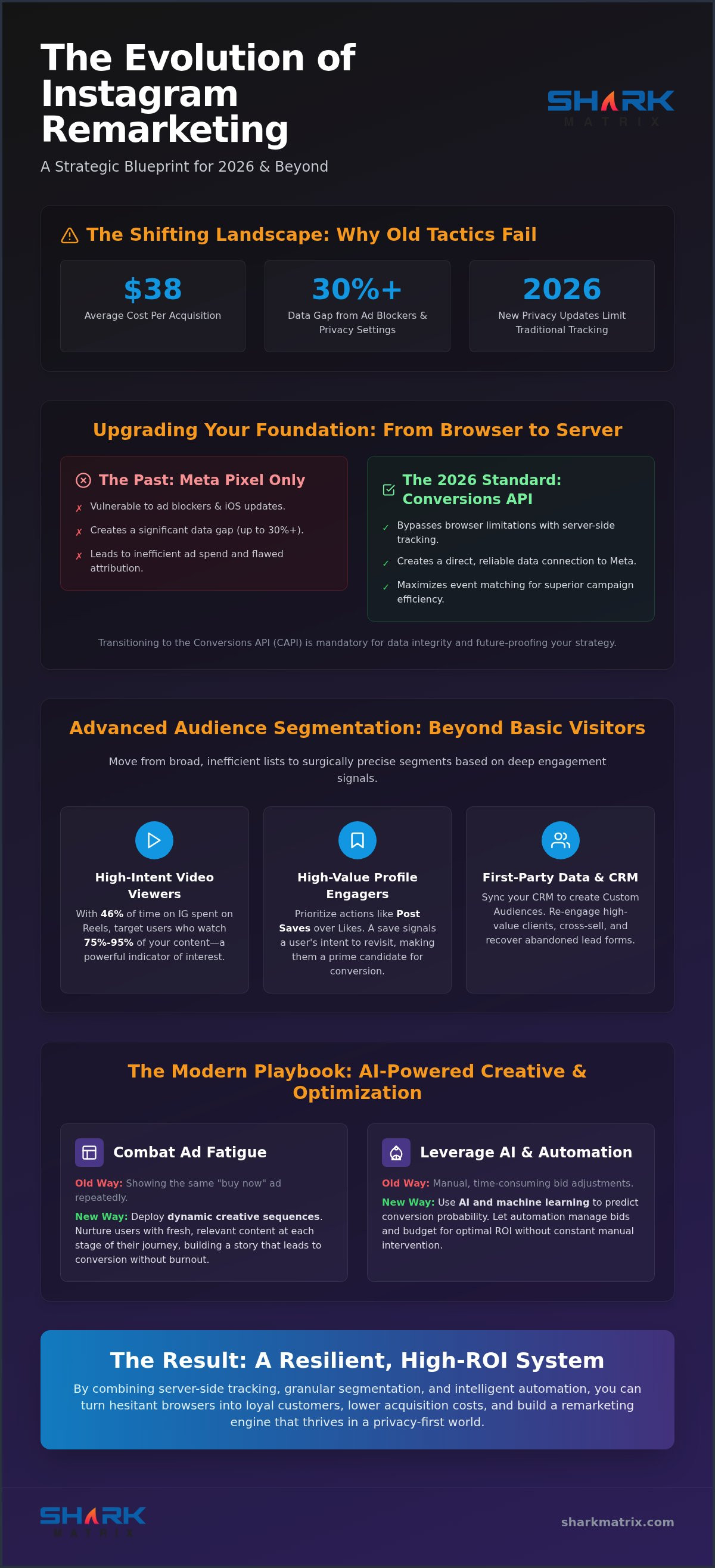
With nearly half of all U.S. social buyers expected to shop directly on the platform this year, your brand can’t afford to let a single visitor slip away. The average cost per acquisition across all industries has climbed to approximately $38, which means every wasted impression hurts your bottom line. If you’re still treating your instagram remarketing strategy as a simple reminder to buy, you’re likely battling audience fatigue and the latest 2026 privacy updates that limit traditional tracking.
We know it’s exhausting to see your customer acquisition costs rise while ad performance dips due to data loss. This guide promises to turn those hesitant browsers into loyal customers by mastering both the technical and creative sides of modern retargeting. We’ll explore how to use the Conversions API for better signal quality and how AI automation can deliver personalized sequences based on real user behavior. You’ll walk away with a blueprint for a seamless multi-touch journey that lowers costs and builds genuine brand loyalty.
Key Takeaways
- Transition from the Meta Pixel to the Conversions API (CAPI) to maintain data integrity and bypass 2026 privacy-related tracking limitations.
- Build a more granular instagram remarketing strategy by segmenting audiences based on deep engagement signals like Reel completion rates and profile interactions.
- Combat ad fatigue and rising costs by deploying dynamic creative sequences that offer fresh, relevant content at every stage of the customer journey.
- Leverage AI automation and machine learning to predict conversion probability and manage bid adjustments without manual intervention.
- Improve your campaign ROI by moving beyond flawed last-click attribution models and finding the optimal frequency sweet spot for your audience.
Building Your Instagram Remarketing Infrastructure for 2026
Instagram remarketing is the strategic process of serving targeted ads to users who’ve already interacted with your brand’s digital touchpoints. In a saturated social feed, a single visit rarely results in a sale. The “Marketing Rule of Seven” suggests that prospects need to see your message multiple times before taking action. For a national instagram remarketing strategy to succeed in 2026, you need a robust technical foundation that captures these touchpoints accurately across every device and platform.
The fundamentals of behavioral retargeting have shifted significantly over the last two years. We’ve moved beyond simple browser cookies. For national-scale enterprises, first-party data is now the most valuable asset in the marketing stack. Relying solely on third-party signals is a recipe for high costs and low visibility. By owning your data, you create a resilient ecosystem that survives platform changes and privacy updates.
The Core Components of Remarketing Tracking
Your infrastructure must prioritize data integrity to combat signal loss. While the Meta Pixel remains useful for tracking standard events like “Add to Cart” or “View Content,” it’s no longer enough on its own. Browser-side tracking is frequently blocked by privacy settings and ad blockers, which can lead to a 30% or higher gap in reported conversions.
- Conversions API (CAPI): Implementing server-side tracking is mandatory for 2026. It creates a direct connection between your server and Meta, ensuring your events are recorded even when browsers fail.
- Privacy Compliance: With new state-level laws in Indiana, Kentucky, and Rhode Island as of January 2026, your setup must include robust opt-out mechanisms and transparent data handling.
- Event Matching: High match quality scores are essential. The better your data matches Meta’s user profiles, the more efficient your ad delivery becomes.
Professional technical integration, often involving ai automation services, ensures these systems communicate without manual errors, allowing your campaigns to scale without constant oversight.
Warm vs. Cold Audiences: Knowing the Difference
Treating every website visitor the same is a fast way to waste your ad budget. A user who accidentally clicked a link isn’t the same as someone who spent five minutes on a product page. You must define clear thresholds for your remarketing segments based on behavior and intent. For instance, you might trigger specific ads only after a user has viewed at least three pages or spent 60 seconds on your site.
A “Warm Audience” is a segment that has moved past the awareness phase into active consideration. These users have demonstrated clear intent, making them the primary targets for your instagram remarketing strategy. By focusing your spend on these high-intent groups rather than broad “all visitors” lists, you lower your cost-per-acquisition and improve the overall efficiency of your sales funnel.
Advanced Audience Segmentation: Moving Beyond Basic Website Visitors
Effective remarketing in 2026 requires a shift from broad buckets to surgical precision. If your instagram remarketing strategy relies solely on a generic “all website visitors” list, you’re likely overspending on low-intent traffic. With the average cost per acquisition across industries sitting around $38, every dollar must target users who have shown genuine interest. Modern segmentation leverages platform-native signals that go far deeper than a simple page view.
Reels now account for 46% of the time spent on Instagram. This provides a massive opportunity for video view remarketing. Instead of targeting anyone who saw your ad, focus on those who watched at least 75% or 95% of your content. High completion rates are a powerful indicator of intent. Similarly, profile engagements like “saves” are more valuable than “likes” in 2026. A user who saves a post is signaling a desire to revisit your brand later, making them a prime candidate for a conversion-focused follow-up.
First-party data has become even more critical following Meta’s July 2026 update to off-platform data policies. Syncing your CRM to create Custom Audiences allows you to reach existing high-value clients for retention or cross-selling. You can also re-engage users who abandoned lead forms. Since these users already started providing their information, a gentle nudge can often push them across the finish line.
Behavioral Triggers for National Brands
Cart abandoners remain the low-hanging fruit of any campaign, but sophisticated brands look further. Segmenting visitors by the “top 25% time spent on site” identifies your most engaged researchers. These individuals might not have added an item to a cart yet, but their dwell time suggests they’re deep in the consideration phase. For existing customers, cross-sell segments can promote complementary products, increasing lifetime value without the high cost of acquiring a new lead.
Instagram Engagement Custom Audiences
Direct Messages (DMs) are one of the highest-intent signals available. When a user sends a DM, they’ve moved from passive consumption to active conversation. Retargeting these users keeps your brand top-of-mind during their decision-making process. Additionally, you should track users who interact with your Instagram Shopping catalog. If you’re looking to refine these segments for a national campaign, consulting with a specialized social media agency dubai can help bridge the gap between technical setup and creative execution.
Building these complex audience hierarchies ensures that your ads feel like a natural continuation of the user’s journey rather than a repetitive interruption. By aligning your segments with specific behaviors, you create a more efficient and profitable funnel.
The Creative Roadmap: Crafting High-Conversion Remarketing Sequences
A technical foundation is vital, but your instagram remarketing strategy will fail if your creative approach is stale. Ad fatigue is a silent budget killer. When a user sees the same static image ten times in a week, they don’t just ignore it; they develop a negative association with your brand. High-performing campaigns in 2026 rely on narrative variety and creative pivots that keep the conversation fresh and engaging.
You have two main paths: Dynamic Product Ads (DPA) and manual creative sequences. DPAs are excellent for e-commerce brands with large catalogs, as they automatically show users the exact items they viewed. However, manual sequences allow for deeper storytelling. By mixing these approaches, you can combine the efficiency of automation with the emotional resonance of curated content. Integrating social proof is non-negotiable here. Testimonials and user-generated content (UGC) help bridge the skepticism gap, showing hesitant buyers that real people trust your solution.
For brands seeking to enhance their creative storytelling and technical performance, you can check out Mediaco Agency for a fresh perspective on digital marketing excellence.
The journey doesn’t end with a click. Your landing page experience must be a seamless extension of the ad. If a user clicks a Reel showcasing a specific product feature, they should land on a page that immediately reinforces that specific benefit. Poor UI/UX at the destination will lead to high bounce rates, wasting the premium you paid for the retargeted click.
The 3-Step Remarketing Creative Funnel
Structure your sequence to mirror the buyer’s psychological state. Start with a “Reminder” ad that addresses their initial interest from a new angle. If they don’t convert, move to an “Education” ad. This phase should answer common objections or demonstrate the product in a real-world scenario. Finally, use an “Incentive” ad to close the deal. A limited-time offer or an exclusive benefit creates the urgency needed to turn a browser into a buyer.
Format Selection: Reels, Stories, and Carousels
Each placement serves a distinct purpose. Instagram Stories remain a powerhouse for remarketing because they feel personal and immediate. Carousels are ideal for showing multiple features or a step-by-step process. Research shows carousels can achieve a 2.5% click-through rate, significantly higher than the 1.9% average for single images.
Reels are your best tool for building brand personality. With Reels being shared over 4.5 billion times a day in 2026, they offer massive reach. Keep your remarketing Reels under 30 seconds to maximize impact. Data indicates that shorter videos retain 81% of viewers until the end, providing a much higher chance of delivering your full message than longer formats. By varying these formats, you keep your audience engaged and move them closer to the final conversion.
Leveraging AI and Conversions API for Privacy-First Retargeting
In 2026, a successful instagram remarketing strategy depends on how well your systems interpret fragmented signals. Traditional browser-based tracking is no longer reliable. Machine learning models now play a central role in predicting which users are most likely to convert after their first interaction. By implementing AI automation services, brands can manage bid adjustments in real-time. This ensures you don’t overpay for low-intent traffic while staying aggressive on high-value prospects who show immediate intent to purchase.
There is also a powerful synergy between generative AI development and creative testing at scale. Instead of manually designing dozens of variations to fight the ad fatigue mentioned earlier, AI can generate and test multiple creative pivots simultaneously. This allows you to find the winning combination of hooks and visuals faster. Predictive Audience Modeling then takes this a step further by finding “Lookalikes” of your best remarketing converters, expanding your reach to users who share the same behavioral patterns as your most loyal customers.
The Technical Bridge: Conversions API (CAPI)
The shift from browser cookies to server-side tracking is the single most important technical update for this year. While many marketers still rely on the standard pixel, the high-performance standard is the Conversions API (CAPI). This server-to-server communication is the gold standard because it bypasses browser limitations and ad blockers. It recovers vital data from mobile users on privacy-restricted devices, which is crucial since Meta’s AI-driven ad systems are highly dependent on the quality of conversion signals. By reducing the signal-to-noise ratio in your ad account, you provide cleaner data for machine learning models to optimize your delivery.
Predictive Lead Scoring with ML
Advanced national campaigns are now using ML development services to rank their retargeting prospects. Instead of treating every visitor equally, machine learning algorithms assign a “Propensity to Buy” score to every user. This allows you to allocate higher budgets to prospects with a high score while automating the exclusion of users who are unlikely to ever convert. This precision protects your ROI and ensures your budget is always focused on the individuals closest to a transaction.
If you want to maximize your conversion rates with a technical edge, consider how our AI automation services can streamline your entire remarketing infrastructure.
Optimizing for ROI: Scaling Your National Remarketing Campaigns
Scaling a national instagram remarketing strategy requires more than just increasing your daily spend. If you move too fast, you risk resetting the Meta algorithm’s “Learning Phase,” which can lead to volatile performance and higher costs. The goal is to expand your reach while maintaining the efficiency established in your initial phases. In 2026, with an all-industry average CPA of approximately $38, optimization isn’t just a preference; it’s a necessity for survival.
Monitoring your ad frequency is the first step in protecting your ROI. While you need multiple touchpoints to convert a hesitant buyer, there’s a thin line between being visible and being annoying. If your frequency climbs too high without a corresponding lift in conversions, it’s a clear signal to refresh your creative or expand your audience pool. True success comes from integrating these efforts with your broader search engine optimization seo services. When your organic search presence and paid remarketing work in tandem, you capture users at every possible entry point, creating a unified brand experience that feels natural rather than forced.
Attribution models also need a 2026 reality check. “Last Click” attribution often lies to you about your remarketing ROI because it ignores the multi-touch journey that led to the final sale. A user might discover you through a Reel, research you on Google, and finally convert after seeing a Stories ad. If you only credit the last click, you’ll undervalue the top-of-funnel touchpoints that made the conversion possible.
Key Performance Indicators (KPIs) to Track
Move beyond vanity metrics and focus on incremental lift. This measures whether the remarketing ad actually caused the conversion or if the user would have bought anyway. You should also weigh your Return on Ad Spend (ROAS) against the Lifetime Value (LTV) of the customer. A retargeted customer often has a higher LTV because they’ve already moved past the initial skepticism phase. Tracking the Cost Per Incremental Conversion provides the most accurate picture of your campaign’s health.
Scaling to a National Audience
When scaling to a national level, managing audience overlap becomes a significant challenge. You don’t want your different ad sets competing for the same user’s attention. For accounts that achieve over 100 weekly conversions, moving toward Advantage+ Shopping Campaigns can allow Meta’s AI to handle much of the heavy lifting. However, for smaller segments, manual bidding often provides better control. To ensure your brand remains protected during this expansion, partnering with a specialized social media advertising agency dubai can provide the framework needed to manage large-scale lists without compromising on precision.
Future-Proof Your Social Media Growth
The shift toward server-side data and AI-driven creative pivots isn’t just a trend; it’s the new standard for digital survival. By moving beyond the Meta Pixel and adopting the Conversions API, you’ve secured the data integrity needed to navigate the 2026 privacy landscape. You now have the tools to build a narrative-driven instagram remarketing strategy that respects your audience’s attention while systematically lowering your cost-per-acquisition across the UAE.
Success in this space requires a delicate balance between technical precision and creative agility. Whether you’re implementing predictive lead scoring or scaling budgets across a national audience, the focus must remain on providing a seamless customer journey. Shark Matrix Technologies LLC specializes in the expert technical implementation of Meta CAPI and AI-driven marketing automation. We bring a proven track record for national brand growth to every campaign we manage, ensuring your infrastructure is built for scale.
Ready to turn your hesitant browsers into loyal customers? Scale your ROI with a custom Instagram remarketing strategy from Shark Matrix Technologies LLC. Your path to sustainable conversion growth starts with a smarter, more automated approach to the social funnel.
Frequently Asked Questions
Is Instagram remarketing still effective after the iOS 14 privacy updates?
Yes, remarketing remains highly effective when you move beyond browser-based tracking. By implementing the Conversions API (CAPI), you establish a server-to-server connection that bypasses the limitations of iOS 14 and traditional ad blockers. This technical setup ensures your instagram remarketing strategy continues to receive high-quality signals for better ad optimization even as browser cookies disappear.
What is the ideal audience size for an Instagram remarketing campaign?
There is no universal minimum, but Meta’s AI systems perform best with larger data sets. For Advantage+ Shopping Campaigns to reach peak efficiency, your account should ideally see over 100 weekly conversions. If you have fewer than 50 weekly conversions, stick to manual campaigns with tightly defined audiences. This prevents the algorithm from spending your budget too broadly before it has enough data to optimize.
How long should I keep a visitor in my remarketing loop?
A standard window is 7 to 30 days, but this depends entirely on your specific sales cycle. If you sell high-ticket services, you might extend this to 90 days to stay top-of-mind during a long research phase. For lower-cost e-commerce items, a shorter 7-day window prevents you from paying for impressions on users who have already moved on to a competitor or lost interest.
What is the difference between Instagram retargeting and remarketing?
Retargeting specifically refers to using paid ads to reach people based on their previous digital behavior. Remarketing is a broader term that encompasses those ads plus other follow-up methods like email or CRM-based sequences. In 2026, a comprehensive instagram remarketing strategy usually integrates both paid social ads and automated messaging to maximize conversion rates across the entire customer lifecycle.
How many times should a user see my remarketing ad per day?
Aim for a frequency of 1 to 2 impressions per day to stay visible without becoming a nuisance. If your frequency climbs above 4 or 5 within a single week for the same creative, you’ll likely see a sharp drop in ROI and an increase in negative feedback. Use creative rotations to keep the content fresh if you need to maintain a higher frequency for short-term promotions.
Can I remarket to people who only engaged with my Instagram profile but never visited my site?
Yes, you can build Custom Audiences based on on-platform interactions like likes, saves, or Direct Messages. These signals are incredibly valuable because they aren’t affected by external privacy updates or browser limitations. Users who save your Reels or visit your profile are often high-intent prospects. They are frequently just one nudge away from visiting your website and completing a purchase.
Why is my remarketing campaign showing a high frequency but zero conversions?
High frequency without conversions usually points to either ad fatigue or a friction-filled landing page. If your click-through rate is low, your audience is tired of the creative and you need to swap it for a fresh angle. If the click-through rate is high but sales are zero, check your mobile site speed and checkout process. A poor destination experience will kill your ROI regardless of how good the ad is.
Do I need a separate budget for remarketing versus cold prospecting?
Yes, maintaining a dedicated remarketing budget ensures you aren’t neglecting the users who are most likely to convert. Most successful national campaigns allocate about 20% to 30% of their total ad spend to retargeting efforts. This balance allows you to continuously reach new people while protecting the investment you’ve already made in your initial brand awareness and traffic-driving campaigns.
 OpenAI
 Codex
Codex
 Vertex AI
 Cloud Vision
 OpenCV
 TensorFlow
 IBM Watson
 Cloud Natural Language
 Cognitive Services
 Bot Framework
 Mistral
 LLama
LLama
 Gemini
 Anthropic
 N8N
N8N