
Categories
Uncategorized

When to Switch Digital Marketing Agencies: The 2026 Strategic Guide

What if the agency that helped your business reach its first 5 million AED in revenue is the exact reason you can’t hit 20 million AED? It’s a common realization for UAE brands that find themselves stuck in a cycle of stagnant lead generation despite increasing their monthly spend. You might feel like a small fish in a big pond, relegated to junior account managers while your competitors leverage advanced AI automation to dominate the search results.

It’s natural to feel hesitant about walking away from a long-term partnership, but loyalty shouldn’t come at the cost of your growth. Knowing when to switch digital marketing agencies is about recognizing the gap between “good enough” and the technical innovation required in 2026. If your current partner lacks deep AI integration or struggles with the nuances of the Arabic-speaking market, you’re leaving money on the table every month.

This strategic guide identifies the critical red flags in your current relationship and provides a risk-free framework to transition to a high-performance partner. You’ll learn how to audit your technical SEO, evaluate AI-driven lead generation, and switch providers without losing your hard-earned digital momentum in the competitive Emirates landscape.

Key Takeaways

  • Identify why meeting KPIs isn’t enough if your business growth has stalled. Learn to spot the difference between maintenance mode and proactive strategy.
  • Discover how to evaluate your agency’s technical depth, specifically regarding AI automation and Generative Engine Optimization (GEO).
  • Master the criteria for when to switch digital marketing agencies to ensure you don’t fall behind more innovative competitors in the UAE market.
  • Follow a proven 30-day “Safe Switch” protocol to protect your SEO rankings and data during an agency transition.
  • Move beyond raw data dumping by demanding real-time dashboards that provide actionable insights instead of static PDF reports.

Recognizing the Red Flags: Why Stagnation is Your First Warning Sign

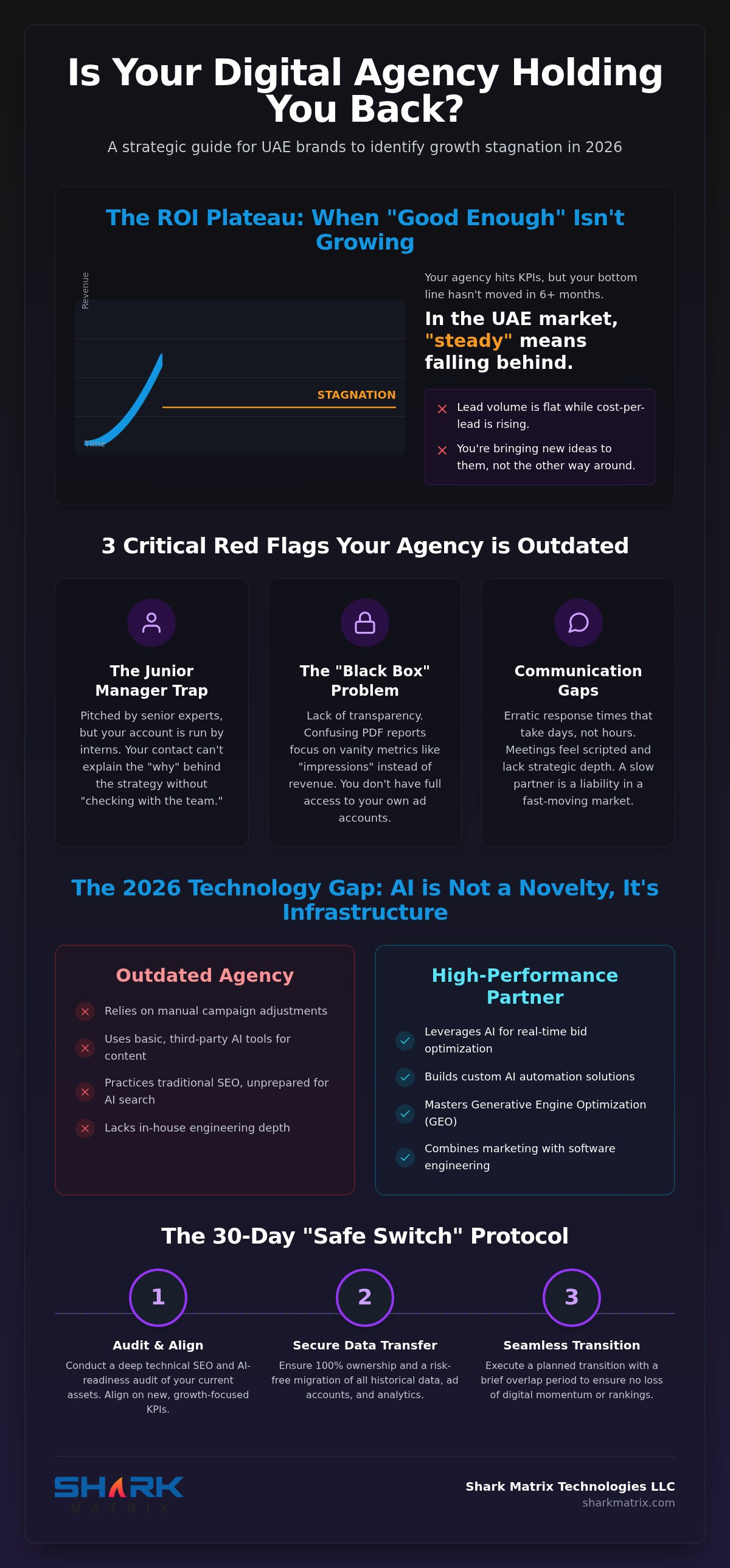
Your monthly report might look perfect, but your bank account tells a different story. Many UAE business owners feel a sense of unease even when their dashboard shows green arrows. If your agency hits its specific KPIs but your bottom line hasn’t moved in six months, you’re experiencing a growth disconnect. In the high-speed Dubai market, “steady” is just another word for falling behind. The most dangerous red flag isn’t a sudden drop in traffic; it’s the slow, quiet stagnation of your ROI.

A major red flag is the absence of proactive strategy. If you’re the one bringing new ideas, trends, or AI automation services to the table, the relationship is already inverted. You’re paying for leadership, not just a pair of hands to execute tasks. When your agency stops asking “what’s next?” and starts coasting on what worked in 2024, they’ve developed agency fatigue. This lack of innovation is a clear signal for when to switch digital marketing agencies to a more technical partner.

You might also be stuck in the Junior Account Manager trap. Many agencies pitch with their senior directors but hand the actual work to interns or entry-level staff once the contract is signed. These juniors often lack the deep understanding of regional nuances or the technical depth required for complex campaigns. If your contact person can’t explain the “why” behind a strategy without “checking with the team,” you’re paying expert rates for amateur execution.

The ROI Plateau: When Results Stop Scaling

Analyzing year-on-year growth is far more revealing than looking at month-on-month fluctuations. If your lead volume is flat while your cost per lead is rising, your agency’s tactics have likely hit a ceiling. In 2026, ad costs across the Emirates are climbing. Agencies that rely on old-school PPC management without integrating machine learning or SEO company Dubai strategies that adapt to generative search will see your margins shrink. High-performance partners should be finding efficiencies to offset these rising costs, not just asking for more budget.

Communication Gaps and Lack of Transparency

Transparency isn’t just about showing where the money went; it’s about explaining the methodology. The “Black Box” problem occurs when an agency hides its process, making it impossible for you to audit their work. This often goes hand-in-hand with confusing reports that focus on vanity metrics like “impressions” or “reach” rather than actual revenue.

Common communication red flags include:

  • Erratic response times that take days instead of hours.
  • Meetings that feel like a rehearsed script rather than a strategic discussion.
  • A lack of access to your own ad accounts or data ownership.

In a market where opportunities move at light speed, a slow or secretive partner is a liability. Deciding when to switch digital marketing agencies often comes down to this fundamental trust. If you don’t have full visibility into your data or a partner who communicates with agility, your business cannot pivot when the market demands it.

The Technical Gap: Has Your Agency Fallen Behind the AI Revolution?

In 2026, the line between a marketing agency and a software engineering firm has blurred. If your current partner still treats AI as a novelty rather than core infrastructure, they’re likely falling behind. Many agencies use third-party AI tools for basic content, but few have the in-house engineering depth to build custom solutions. This is a primary indicator for when to switch digital marketing agencies. Without technical depth, your brand cannot compete in an era where Generative Engine Optimization (GEO) determines visibility. GEO is no longer optional; it’s how you ensure your brand is the primary “cited source” in AI-driven search results across the UAE.

Leveraging AI for Marketing Automation

Efficiency in 2026 is driven by AI automation services that eliminate manual bottlenecks. Traditional agencies often struggle with human error in data entry or slow campaign adjustments. By contrast, automated systems can process vast amounts of data to optimize bids or personalize content in real-time. For businesses in Dubai or Abu Dhabi, AI chatbot development is a crucial tool for 24/7 lead capture. These aren’t simple “if-then” bots. They use Natural Language Processing to understand customer intent, answer complex queries in Arabic or English, and qualify leads while your team sleeps. If your agency isn’t deploying these technologies, your customer acquisition costs will remain unnecessarily high.

Technical SEO and Scalability Requirements

Basic keyword optimization is a relic of the past. National-level competition in the Emirates requires a deep integration of web development and marketing strategy. Your site’s architecture must be built specifically to support AI-driven search crawlers that prioritize schema markup and lightning-fast performance. If your agency doesn’t understand how to optimize for Answer Engine Optimization (AEO), your rankings will suffer as search engines evolve. Technical scalability means your website can handle sudden traffic spikes during major regional events while maintaining the performance metrics that AI search engines demand.

Marketing is now a technical race. When you realize your current partner can’t bridge the gap between creative copy and machine learning, it’s time to find an agency with a dedicated software engineering department. You might want to explore how generative AI development can transform your specific industry workflows to stay ahead of the competition.

When to Switch Digital Marketing Agencies: The 2026 Strategic Guide

Transparency and Reporting: Are You Getting Insights or Just Data?

A common frustration for UAE marketing managers is receiving a monthly data dump that requires a translator to understand. If your agency sends a 40-page PDF filled with charts but fails to explain how those numbers translate into AED, they aren’t providing insights. They’re hiding behind noise. Real-time dashboards have replaced static reports in 2026. You shouldn’t have to wait until the 5th of the month to see how your campaigns performed yesterday. If you’re still getting manual reports that feel like homework, it’s a strong indicator for when to switch digital marketing agencies.

Transparency also means having full administrative access to your own ad accounts and analytics. Some agencies in the region still try to hold data hostage by running ads through their own master accounts. This is a massive risk. You should own your data, your pixel history, and your audience lists. If your partner refuses to grant you primary ownership, they’re creating a lock-in effect that makes it harder for you to leave. True partners don’t fear their clients having access; they welcome the accountability.

The Attribution Challenge

Modern buyer journeys in the Emirates are rarely linear. A customer might see a social media ad while in Dubai Mall, search for your brand on a mobile device, and finally convert on a desktop at home. Your agency must be able to prove revenue impact across these touchpoints. If they’re only reporting on last-click conversions or simple click counts, they’re missing the bigger picture. High-performance partners use data-driven lead generation models to show exactly how much revenue every dirham spent is generating across the entire funnel.

Ownership of Digital Assets

Beyond ad accounts, you must secure your domain, hosting, and website code. Beware of agencies that insist on using proprietary platforms that only they can manage. These are often traps designed to make switching impossible. When you transition, you should be able to take your content, your web development assets, and your historical data with you without paying exit fees. A transparent partner will ensure your digital assets are portable and secure from day one. If you don’t own the keys to your digital kingdom, you don’t truly own your business growth.

The Transition Roadmap: How to Switch Without Losing Your Momentum

Switching agencies in the middle of a fiscal year can feel like changing an engine while the car is moving at 120 km/h on Sheikh Zayed Road. You don’t want to lose speed, and you certainly don’t want to crash. A 30-day “Safe Switch” protocol is the gold standard for UAE brands. This overlap period allows your new partner to perform a deep-tissue audit of your existing campaigns while the outgoing team handles daily maintenance. It’s the only way to ensure your lead volume doesn’t drop off a cliff during the handover.

Before you cut ties, conduct a final performance audit. This document acts as your baseline, recording exactly where your metrics stood at the moment of departure. It helps you identify when to switch digital marketing agencies by highlighting the missed opportunities your previous partner failed to capture. Clear communication with your internal stakeholders is also vital; they need to know that while there’s a change in the cockpit, the flight path remains stable and focused on hitting those year-end revenue targets.

Asset and Data Migration

Securing your digital property is the most critical step of the offboarding process. You must have a rigid checklist for password and access handover to prevent any service interruptions. Don’t just settle for a casual email with login details; you need full administrative ownership of every platform.

  • Revoke old access only after the new team confirms full functionality and security.
  • Export all historical data from PPC and SEO tools to preserve your machine learning history.
  • Maintain continuity for your online reputation management efforts across regional directories.
  • Verify that all web development documentation and source codes are handed over in full.

The Onboarding Phase

The first 90 days with your new partner represent a critical “trust-building” window. This is when your new digital marketing strategy is stress-tested against the reality of the Emirates market. Focus on technical alignment and business goals rather than just vanity metrics like impressions or clicks. Establish a reporting cadence that works for your team from day one. Whether you prefer a real-time dashboard or a weekly video sync, ensure the new agency understands that you expect technical insights, not just data dumps. This phase is your chance to reset the culture of the partnership and demand the technical depth your business deserves.

If you’re tired of stagnant growth and ready for a technical-first approach, explore how our SEO company Dubai experts can manage your transition without losing a single lead.

Finding a Partner for 2026: Scaling with Shark Matrix

Deciding when to switch digital marketing agencies is a strategic move to upgrade your business infrastructure. Shark Matrix isn’t just a marketing firm; we’re a technical-first partner that has spent over a decade mastering the intersection of software engineering and digital growth. Founded in 2010, we bridge the gap between creative execution and technical engineering. This depth is vital for UAE brands that have outgrown standard agencies and need a partner capable of managing complex, data-heavy environments. Our team doesn’t just manage your spend; we build the machine learning models that optimize it.

National Strategy with Local Precision

Most agencies in the Emirates treat Arabic content as a simple translation task. We treat it as a technical and cultural necessity. Our specialists in Arabic digital marketing ensure your brand resonates across the region while maintaining a national reach. We protect your authority through advanced brand reputation management, navigating the unique nuances of the UAE market. We understand the regulatory environment in Dubai and Abu Dhabi, ensuring your campaigns remain compliant while pushing the boundaries of digital outreach. This localized precision ensures your search presence is authoritative in both English and Arabic, which is essential for dominating regional search results in 2026.

Custom Solutions for Complex Growth

Off-the-shelf strategies often fail because they ignore the specific technical requirements of your business funnel. We don’t believe in one-size-fits-all packages. Our in-house AI and software engineering department allows us to integrate custom mobile app development directly into your marketing ecosystem. By future-proofing your brand with generative AI development, we ensure you stay ahead of the technical curve. This integrated approach turns your digital assets into high-performance revenue drivers rather than just cost centers.

A technical-first approach is the only way to maintain a competitive edge when every competitor has access to basic AI tools. Knowing when to switch digital marketing agencies is the difference between following the market and leading it. Request a comprehensive digital audit from Shark Matrix today to see how we can close your innovation gap and scale your revenue.

Future-Proof Your Growth in the UAE Market

The digital landscape in 2026 demands more than just basic ad management or standard SEO. It requires a partner that understands the technical nuances of AI automation and the cultural specifics of the Arabic market. Deciding when to switch digital marketing agencies is often the catalyst for moving from a growth plateau to a market-leading position. By prioritizing transparency, demanding real-time insights, and following a structured transition roadmap, you can protect your digital assets while accelerating your ROI.

Shark Matrix brings over 15 years of digital excellence to the table, supported by a specialized in-house AI and software engineering team. We don’t just provide marketing; we build technical solutions that scale national brands. As a leader in Arabic digital marketing, we ensure your message resonates across every emirate with precision. You won’t just be meeting KPIs; you’ll be redefining them for your entire industry.

Upgrade your strategy with a technical-first agency; contact Shark Matrix today. Your next phase of growth is just one strategic decision away.

Frequently Asked Questions

How long does it take to see results after switching marketing agencies?

You’ll typically see shifts in PPC performance within the first 30 days as a new team optimizes your ad spend. However, technical SEO and organic growth usually require 3 to 6 months to stabilize. This timeframe allows your new partner to audit existing technical debt and implement fresh strategies. Rushing this process often leads to missed optimization opportunities in the competitive UAE market.

Will my SEO rankings drop if I change my digital marketing partner?

Your rankings shouldn’t drop if you follow a rigorous technical handover protocol. A temporary plateau is possible while search engines crawl new site architectures or content updates. By using a 30-day overlap period, your new agency can ensure all tracking pixels and schema markups remain intact. This prevents the data blackout that often triggers ranking fluctuations during a partner change.

What is the average notice period for terminating an agency contract?

Notice periods in the Emirates digital sector usually range from 30 to 90 days. Most standard contracts require written notice sent one full month in advance. It’s vital to review your specific terms to avoid exit fees. Use this notice period to secure your administrative logins and export historical campaign data before the final offboarding date arrives.

Should I switch agencies if I am happy with the relationship but not the results?

Yes. A positive relationship doesn’t pay the bills if your ROI has plateaued for several months. Knowing when to switch digital marketing agencies is a decision that must be driven by data rather than personal rapport. If your current partner is friendly but lacks the technical depth to integrate AI or scale your lead generation, they’re hindering your business growth.

How do I know if a new agency is actually using AI or just using it as a buzzword?

Ask for a live demonstration of their in-house AI workflows or custom-built scripts. Agencies merely using buzzwords will rely on generic third-party prompts that anyone can access. A technical partner should show you how they use machine learning to automate bid adjustments or personalize content. If they can’t explain the specific logic behind their tech, it’s likely just a sales pitch.

What are the most common mistakes businesses make when switching agencies?

The biggest mistake is failing to conduct a baseline performance audit before leaving. Without this data, you can’t hold your new agency accountable for measurable improvements. Other errors include not revoking old access permissions and ignoring the importance of Arabic localization for the regional market. Rushing the transition without a clear 90-day onboarding plan often leads to wasted ad spend.

How do I ensure I maintain ownership of all my marketing data during a move?

You must hold primary administrative ownership of all accounts, including Google Ads and Meta Business Suite. Never let an agency run your ads through their own master account. Before terminating your current contract, verify that you have full access to your GA4 property and all historical tracking data. This ensures you aren’t starting from scratch with a new partner.

Is it better to have one agency for everything or multiple specialized partners?

In 2026, a single technical-first agency is often superior to multiple specialized partners. Managing several agencies creates data silos and communication bottlenecks that slow your growth. One partner with an in-house software engineering department can ensure your web development, AI automation, and SEO work in perfect sync. This unified approach provides better data attribution and a higher overall ROI.

Categories
Digital Marketing

Cost of Hiring a Marketing Agency in the UAE: 2026 Pricing Guide

Why are you still receiving marketing proposals that look like they were written for the 2022 market? If you’re frustrated by opaque pricing and “black box” strategies, you aren’t alone. Most business leaders in Dubai and Abu Dhabi feel the same pressure to justify every dirham spent on digital growth. The cost of hiring a marketing agency in uae has shifted dramatically as AI integration and deep Arabic localization move from being optional extras to essential requirements for national success.

It’s time to move past the confusion of hidden MarTech fees and difficult ROI calculations. This 2026 guide provides a transparent framework to help you evaluate agency value and understand what your budget should actually deliver. We’ll explore current pricing benchmarks, the long-term cost benefits of AI automation, and why technical expertise is now just as important as creative flair when choosing a strategic partner for the Middle Eastern market.

Key Takeaways

  • Identify current market benchmarks for monthly retainers to ensure your marketing budget aligns with 2026 industry standards in Dubai and Abu Dhabi.
  • Understand how the cost of hiring a marketing agency in uae is now heavily influenced by AI-driven automation and technical performance rather than just creative execution.
  • Learn why professional Arabic localization and SEO are essential investments for reaching the full breadth of the national market effectively.
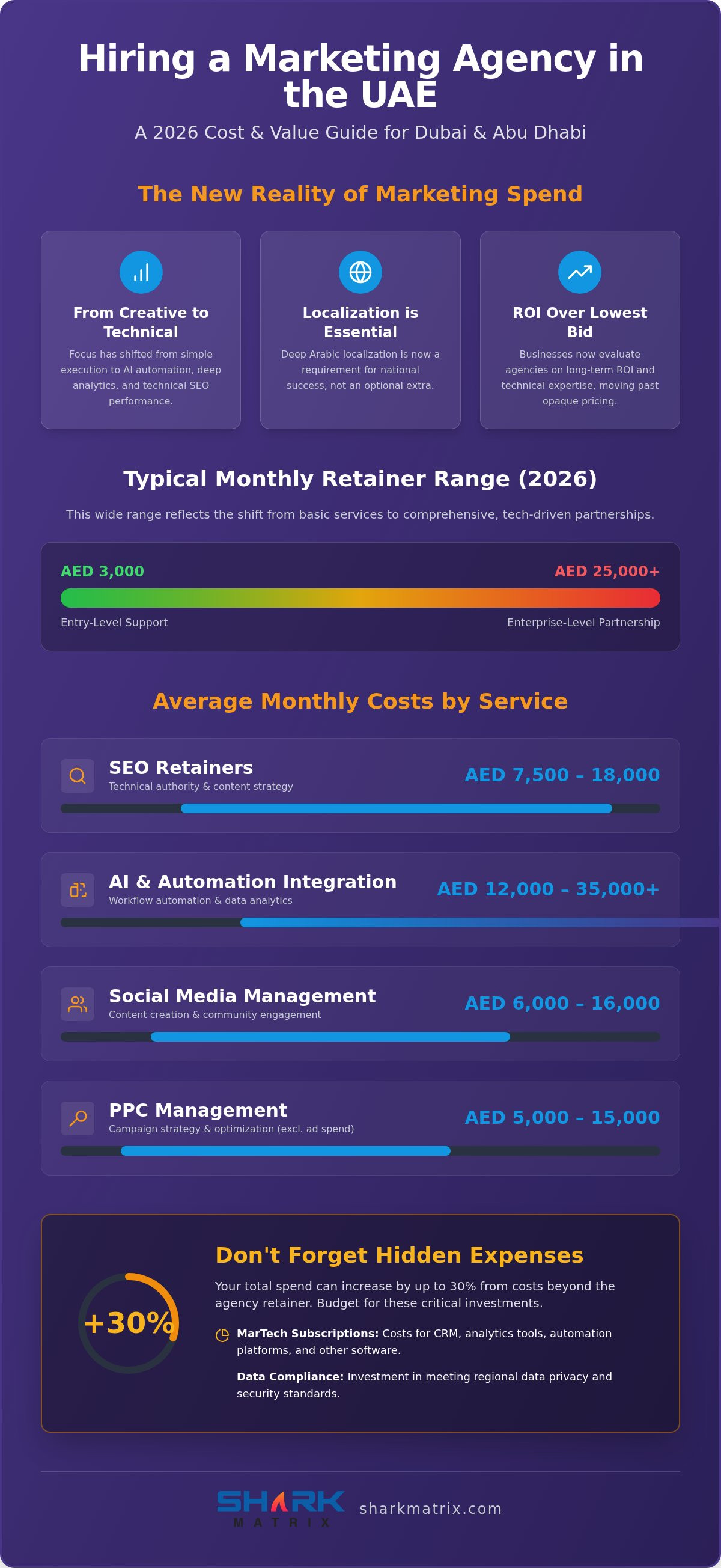
  • Uncover hidden expenses such as MarTech subscriptions and data compliance requirements that often increase total spend by up to 30%.
  • Use a strategic framework to evaluate agency proposals based on long-term ROI and technical expertise instead of simply choosing the lowest bidder.

Cost of Hiring a Marketing Agency in the UAE: 2026 Market Overview

The UAE’s digital landscape has matured into a sophisticated, high-tech ecosystem. When you look at the UAE’s economic overview, it’s clear why marketing strategies have become more complex and data-driven. In 2026, the average cost of hiring a marketing agency in uae typically spans from AED 3,000 for basic, entry-level support to over AED 25,000 per month for enterprise-level partnerships. This wide range reflects a fundamental shift from traditional execution to technology-first marketing, where agencies act as technical partners rather than simple vendors.

Today, your marketing budget does more than just buy creative assets. It funds a technical infrastructure designed to survive in a competitive market. Several factors drive these costs:

  • Agency Expertise: Specialized knowledge in the Middle Eastern market dynamics commands a premium.
  • Service Scope: Comprehensive packages including SEO company Dubai services and multi-channel PPC require more billable hours.
  • Technological Requirements: Integrating AI automation services and advanced data analytics into your workflow.

Smart businesses now look at the Total Cost of Ownership (TCO) in digital marketing. This concept goes beyond the monthly agency fee. It encompasses the cost of MarTech subscriptions, CRM integrations, and the necessary investment in bilingual content that resonates with the local culture. It’s a holistic view of what it actually takes to maintain a competitive edge.

Retainer vs. Project-Based Pricing Models

Monthly retainers remain the gold standard for businesses seeking consistent growth. They provide the stability needed for long-term search engine visibility and national brand presence. However, project-based fees are often more cost-effective for specific milestones, such as a website launch or the initial setup of AI chatbot development. Many firms now favor hybrid models. These structures combine a fixed retainer for essential maintenance with performance-based incentives. It aligns the agency’s goals with your revenue, ensuring they’re as invested in your ROI as you are.

National Market Dynamics and Regional Expertise

The UAE’s diverse population creates a marketing challenge you won’t find elsewhere. You’re often targeting dozens of nationalities simultaneously. This complexity naturally impacts the cost of hiring a marketing agency in uae. While offshore options might seem cheaper, they often miss the cultural nuances of the Arabic language and local consumer behavior. Regional expertise justifies a higher price point because it prevents wasted ad spend on culturally tone-deaf campaigns. A local agency understands the difference between simple translation and true localization, which is the key to winning trust in the GCC region.

Breaking Down Costs by Service Type: SEO, PPC, and AI

Understanding the specific components of your marketing budget is the only way to avoid overspending while ensuring growth. The digital competitiveness in the UAE has reached a peak where simple “catch-all” packages no longer work. Instead, businesses must look at specialized services that address technical performance and cultural resonance. Bundling these services often reduces the overall cost of hiring a marketing agency in uae by up to 20% compared to sourcing individual vendors for each channel.

Average Monthly Cost Benchmarks (2026)

  • SEO Retainers: AED 7,500 – AED 18,000
  • PPC Management: AED 5,000 – AED 15,000 (excluding ad spend)
  • Social Media Management: AED 6,000 – AED 16,000
  • AI & Automation Integration: AED 12,000 – AED 35,000+

Industry-specific dynamics also dictate your Cost Per Lead (CPL). In high-competition sectors like UAE real estate or finance, CPL can range from AED 300 to over AED 1,500. Lower competition retail sectors might see leads as low as AED 50. In 2026, a standard SEO retainer in the UAE typically falls between AED 8,000 and AED 17,000 per month for most mid-market brands.

Search Engine Optimization (SEO) and Content Pricing

SEO isn’t just about keywords anymore; it’s about technical authority. While basic on-page work is standard, high-level professional SEO services in the UAE now include Generative Engine Optimization (GEO) to ensure your brand appears in AI search results. High-quality content in both English and Arabic is a significant investment, but it’s essential for national reach. You can explore more in our comprehensive SEO guide.

PPC Management and Ad Spend Realities

Most agencies charge a management fee between 15% and 25% of your total ad spend, though flat fees are common for smaller budgets. High-competition keywords in Dubai, particularly for legal or financial services, can reach a Cost Per Click (CPC) of AED 30 or more. This makes choosing a PPC agency with local bidding expertise vital to prevent budget bleed.

Custom AI and Web Development Costs

The biggest shift in the 2026 cost of hiring a marketing agency in uae is the inclusion of AI automation services. Integrating custom chatbots and generative AI development into your workflow can reduce long-term content costs by automating routine tasks. For those building a foundation, web development services for high-performance e-commerce sites generally start at AED 25,000 for custom builds. If you’re looking to streamline your operations, consider how AI automation can replace manual data entry and lead qualifying tasks.

Cost of Hiring a Marketing Agency in the UAE: 2026 Pricing Guide

The Strategic Value of Arabic Digital Marketing and Localization

Targeting the full UAE demographic requires more than just a translated website. In a market where local identity is deeply tied to the Arabic language, localization is a non-negotiable strategic pillar. This necessity adds a layer of complexity to the cost of hiring a marketing agency in uae. Agencies that offer true localization rather than simple translation provide a higher return on investment by speaking directly to the Emirati and broader GCC audience. While English is widely used in business, Arabic remains the language of trust and cultural connection.

Arabic SEO plays a critical role in capturing national search volume. Many users search in their native tongue for high-intent services. If your content isn’t optimized for these specific queries, you’re handing market share to competitors. This specialized work requires linguistic expertise and technical knowledge of how search engines handle Arabic script. Investing in professional SEO company Dubai services ensures your brand is visible to all segments of the population, not just the expat community.

Why Arabic Content Commands a Premium

High-quality Arabic digital marketing talent is relatively scarce in the region. This scarcity naturally drives up the price for premium copywriting. Unlike simple translation, professional copywriting involves adapting the message to fit local idioms and cultural expectations. Technical implementation also adds to the bill. Right-to-left (RTL) web design requires specific adjustments in web development services to ensure layouts remain functional and aesthetically pleasing. These technical hurdles make the development and maintenance of bilingual platforms more labor-intensive than English-only sites.

Cultural Nuance and National Brand Authority

Localizing your strategy is the best defense against costly reputation blunders. A message that works in London or New York might fall flat or even cause offense in Riyadh or Abu Dhabi. Agencies with deep Middle Eastern roots understand these nuances. They help maintain a culturally relevant voice through expert social media agency Dubai management. This proactive approach is a core part of brand reputation management. It protects your national brand authority by ensuring every post and ad respects local traditions. In the long run, the premium paid for this expertise prevents the massive costs associated with crisis management and brand rebuilding.

Hidden Costs and Long-Term Budgeting for UAE Businesses

The cost of hiring a marketing agency in uae often includes several “unseen” expenses that can catch businesses off guard. These aren’t just hidden fees; they’re essential investments in the technical infrastructure required for modern growth. Common expenses include premium MarTech subscriptions, CRM platform seats, and high-quality stock assets for bilingual campaigns. Industry reports suggest these hidden layers can add 15% to 30% to your total marketing spend. While these tools empower your strategy, they also add to the total budget beyond the agency’s management fee.

Data security and compliance have become major budget items. The UAE has strict national privacy regulations that require sophisticated data handling. Investing in these protocols is non-negotiable for brands operating in Dubai or Abu Dhabi. While AI integration carries higher upfront costs, it often leads to significant operational savings. By automating repetitive tasks, you reduce the long-term billable hours required for manual execution. The investment for a custom AI chatbot in the UAE scales based on the complexity of natural language processing and backend database integrations required for your specific industry.

MarTech Stacks and AI Integration Fees

Agencies often pass through the costs of specialized tools for SEO, email automation, and social listening. These AI technologies require specific setup and maintenance fees to ensure they sync correctly with your existing systems. You should also budget for API usage and third-party data access. These technical layers are what separate a basic campaign from a high-performance, data-driven strategy. If you’re looking to optimize your technical stack, our AI automation services can help identify where technology can replace manual overhead.

Reporting, Analytics, and Data Security

There’s a clear price difference between basic automated reports and expert-led strategic analysis. Advanced attribution modeling helps you understand exactly where your leads come from, but it increases the agency service fee due to the technical expertise involved. Aligning with UAE national standards for data privacy is another vital investment. It protects your brand from legal risks and builds trust with your local audience. High-level reporting should provide actionable insights, not just a list of metrics, which justifies the premium for senior consultant time.

Maximizing Your ROI: Selecting the Right Agency for Your Budget

Choosing a partner based solely on the lowest bid is a gamble that rarely pays off in the Middle Eastern market. While the initial cost of hiring a marketing agency in uae might seem like the most important factor, the qualitative value of the partnership determines your actual return on investment. A high-performing agency acts as a technical extension of your team. They don’t just execute tasks; they provide the strategic foresight needed to navigate a competitive national landscape. Focusing on value rather than just the bottom line prevents the “Cheap Agency Trap,” where low fees often lead to poor lead quality or technical debt that costs more to fix later.

Poorly executed SEO or low-quality content can cause long-term damage to your search engine rankings and brand authority. In 2026, search engines are sophisticated enough to penalize brands that use low-quality AI spam or inaccurate Arabic translations. Fixing these issues usually requires a larger investment than it would’ve cost to hire a professional SEO company Dubai from the start. Aligning your agency’s KPIs with your specific business goals, such as market share growth in Abu Dhabi or lead generation in the Northern Emirates, ensures every dirham spent contributes to measurable national growth.

Evaluating Proposals Beyond the Price Tag

When you review proposals, look for evidence of success with national UAE brands. Case studies should show a clear link between marketing activity and revenue growth. It’s also vital to assess the technical depth of the firm. Does the agency have in-house developers for ai development services, or do they outsource critical technical work? In-house expertise usually leads to better communication and faster implementation. You should also demand transparency regarding reporting frequency and the specific tools they use to track your performance.

  • Technical Depth: Verify if they handle web development services and AI integrations internally.
  • Proven ROI: Look for data-backed success stories within the GCC region.
  • Communication: Ensure they provide expert-led strategic analysis rather than just automated data dumps.

Creating a High-Impact RFQ (Request for Proposal)

A well-structured RFQ helps you get more accurate and valuable responses. Ask specific questions about their experience with Arabic localization and their current AI capabilities. For example, inquire how they use generative ai development to streamline content workflows without sacrificing quality. Being transparent about your budget range allows agencies to propose the most effective mix of services for your needs. Finally, always insist on meeting the core team who’ll actually manage your account. The chemistry and technical competence of the people doing the work are just as important as the company’s reputation.

Ready to build a data-driven presence in the Emirates? Get a custom quote for your national marketing strategy and discover how a technical partnership can transform your growth trajectory.

Building a Future-Proof Marketing Strategy in the UAE

Succeeding in the Emirates requires a shift from viewing marketing as a monthly expense to seeing it as a long-term technical investment. We’ve explored how the cost of hiring a marketing agency in uae is shaped by advanced AI automation, technical SEO, and the non-negotiable need for deep Arabic localization. By looking beyond the sticker price and focusing on the total cost of ownership, you can avoid the “cheap agency trap” and secure a partnership that drives real revenue growth.

Shark Matrix Technologies LLC brings over 15 years of UAE market experience to your brand. With dedicated departments for AI development and Arabic localization, our focus remains on data-driven lead generation that resonates with the local culture. It’s time to move past opaque pricing and adopt a strategy built for the 2026 digital landscape.

Partner with a leading national marketing agency for your 2026 growth strategy. Taking the time to select a technical partner today ensures your brand remains competitive and authoritative for years to come.

Frequently Asked Questions

What is the average monthly retainer for a marketing agency in the UAE in 2026?

The average monthly retainer for a marketing agency in the UAE typically ranges from AED 7,500 for basic foundational services to over AED 37,000 for enterprise-level growth plans. Most mid-market businesses find that a budget between AED 18,000 and AED 33,000 provides the best balance of multi-channel strategy and technical execution. These figures reflect the 2026 market demand for integrated technology and expert human oversight across the Emirates.

Are there hidden costs when hiring a digital marketing agency in the UAE?

Yes, businesses should budget for several common hidden costs that aren’t always included in the base management fee. These typically include MarTech software subscriptions, CRM integration fees, and premium stock assets for bilingual campaigns. Additionally, industry-specific compliance and the technical requirements of Arabic localization can add 15% to 30% to your total spend. It’s vital to clarify which third-party tools are covered in your initial quote to avoid surprises.

How much does SEO cost for a national business in the UAE?

For a national business, SEO costs generally fall between AED 8,000 and AED 17,000 per month depending on technical complexity and competition levels. This investment covers on-page optimization, high-quality content creation, and technical authority building. The cost of hiring a marketing agency in uae for SEO now also includes generative engine optimization to ensure your brand remains visible in AI-driven search results across Dubai and Abu Dhabi.

Does the cost of a marketing agency include the ad spend for PPC?

No, agency management fees are almost always separate from the actual ad spend paid directly to platforms like Google or Meta. Most agencies charge either a flat monthly management fee or a percentage of the total ad spend, usually ranging from 15% to 25%. You’ll pay the advertising platform for clicks and impressions while paying the agency for their strategic management, technical optimization, and creative expertise.

Is it cheaper to hire a freelancer or a marketing agency in the UAE?

Hiring a freelancer is often cheaper in terms of hourly rates, but it frequently lacks the technical depth and scalability provided by a full-service agency. While a freelancer might handle specific tasks, an agency offers a team of specialists in SEO, PPC, and AI automation. For businesses aiming for national growth, the comprehensive resources and accountability of an agency often provide better long-term value despite the higher initial management cost.

How long does it take to see an ROI from a marketing agency investment?

The timeline for seeing a return on investment varies by channel and the specific competitiveness of your industry. Paid advertising campaigns can generate leads within the first month, while organic SEO and content strategies typically require six to twelve months to show significant impact. Most agencies recommend a minimum commitment of six months to allow for the data collection and optimization needed to achieve sustainable ROI in the UAE.

Why do marketing agencies in the UAE charge more for Arabic content?

Arabic content commands a higher price because it requires specialized linguistic talent and cultural expertise that goes beyond simple translation. Professional Arabic copywriting involves adapting brand messaging to resonate with local Emirati and GCC audiences while managing the technical complexities of right-to-left web design. This cultural localization is essential for building trust and authority, making it a premium service that involves more billable hours than English-only content.

What should be included in a standard digital marketing contract in the UAE?

A standard digital marketing contract should clearly define the scope of work, specific KPIs, and the frequency of strategic reporting. It’s also crucial to include clauses regarding data privacy compliance with national standards and intellectual property ownership of all creative assets. The cost of hiring a marketing agency in uae should be transparently broken down in the contract to avoid disputes over out-of-scope tasks or technical maintenance fees.

Categories
Digital Marketing

How to Calculate Digital Marketing ROI: The 2026 Guide to Measuring Performance

Your current ROI reports might be lying to you. In an era of fragmented touchpoints and AI-driven search, relying on last-click attribution is like trying to navigate a city with a decade-old map. You’ve likely felt the frustration of seeing high engagement numbers that don’t seem to translate to the bottom line, leaving you wondering how to calculate digital marketing roi with actual precision. It’s a common pain point for even the most seasoned marketing teams when stakeholders demand proof of profitability for every dollar spent.

We’re here to bridge that gap by providing a masterclass on measuring performance for the 2026 landscape. You’ll master the precise formulas needed to track success across SEO, PPC, and generative engine optimization. We’ll also dive into the critical differences between ROAS and ROI while providing a technical framework to help you use AI automation to track every conversion accurately. By the end of this guide, you’ll have a clear strategy to turn your historical data into a predictive tool for future growth.

Key Takeaways

  • Adapt to the 2026 landscape by shifting your focus from traditional search metrics to the emerging value of Answer Engine Optimization (AEO).
  • Master how to calculate digital marketing roi using comprehensive formulas that accurately isolate organic growth from your paid campaign efforts.
  • Build a robust technical infrastructure using GA4 and closed-loop reporting to ensure every marketing lead is tracked through to the final sale.
  • Learn how strategic investments in mobile app development and landing page A/B testing can lower your acquisition costs while boosting retention.
  • Move beyond basic historical reporting by implementing AI-driven strategies that turn your data into a predictive tool for future profitability.

What is Digital Marketing ROI and Why is it Changing in 2026?

Digital marketing ROI is the percentage of profit gained relative to the total investment across your digital channels. It’s the ultimate metric that tells you if your marketing spend is actually growing your business or just keeping it afloat. Understanding Return on marketing investment (ROMI) is essential for any modern brand. As we look toward 2026, the complexity of this calculation is increasing because the digital ecosystem is no longer just about clicks and sessions. It’s about the entire ecosystem of influence.

The shift from traditional search engines to Answer Engine Optimization (AEO) has fundamentally changed how we track success. Instead of users clicking through to a website, they often get their answers directly from an AI interface. This means traditional traffic metrics are losing their weight. To understand how to calculate digital marketing roi in this new environment, you have to account for brand mentions and “share of model” alongside standard lead generation. Measuring performance now requires looking at how often your brand is cited as the preferred solution by generative engines.

Privacy regulations and the death of third-party cookies have also forced a change in how we collect data. We’re moving away from granular individual tracking toward modeled conversions. Additionally, consumer behavior has shifted. People are taking longer to decide, interacting with brands across more touchpoints before converting. This expands the conversion window, making it harder to attribute a sale to a single campaign without sophisticated tracking. National consumer behavior now reflects a deeper skepticism, requiring more trust-building interactions before the final purchase happens.

ROI vs. ROAS: Knowing the Difference

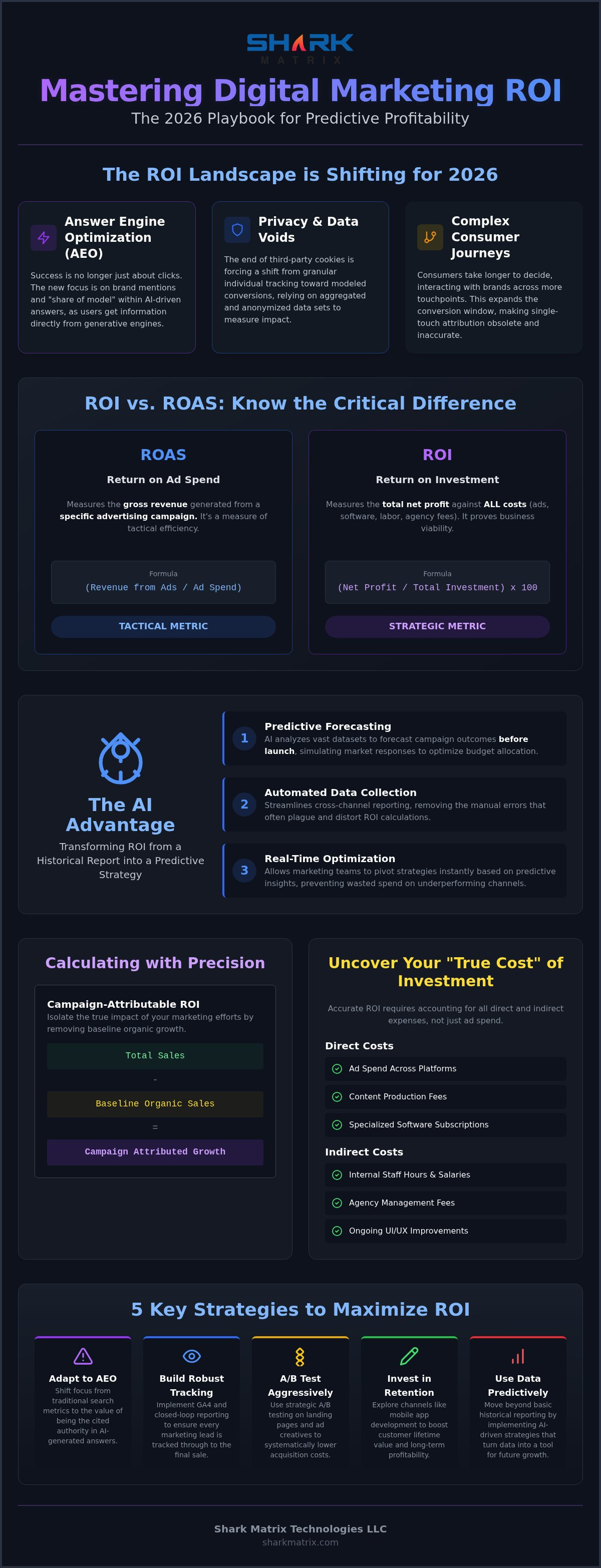
Return on Ad Spend (ROAS) is often confused with ROI, but they serve different purposes. ROAS measures the gross revenue generated from a specific advertising spend; it’s a great metric for campaign-level efficiency. However, it doesn’t account for your total overhead. Genuine ROI factors in everything: software costs, agency fees, and internal labor. When reporting to national stakeholders, use ROAS for tactical adjustments and ROI to prove long-term business viability and overall profitability.

The Impact of AI on ROI Forecasting

Machine learning is transforming ROI from a historical report into a forward-looking strategy. By analyzing vast datasets, AI can now predict the potential outcome of a campaign before you even launch it. Our ai automation services streamline this data collection, removing the manual errors that often plague cross-channel reporting. Predictive ROI in 2026 utilizes real-time generative engine data to simulate market responses and optimize budget allocation instantly. This allows marketing teams to pivot strategies before a single dollar is wasted on underperforming channels.

The Essential Formulas: Calculating Simple vs. Comprehensive ROI

To move from guesswork to precision, you need a solid mathematical foundation. The most basic way to understand how to calculate digital marketing roi is the simple formula: (Net Profit / Total Investment) x 100. While this provides a quick snapshot, it often paints an incomplete picture. For a truly realistic view of how to calculate digital marketing roi, you must use your Gross Profit Margin rather than total revenue. If you’re calculating ROI based on top-line sales without accounting for the cost of goods sold, you’re overestimating your success.

Campaign-attributable ROI takes this further by isolating the impact of specific marketing efforts. To do this, you subtract your baseline organic growth from the total sales generated during a campaign period. This helps you see what your paid efforts actually contributed versus what would have happened anyway. It’s a vital step for brands that already have a strong organic presence. If you need assistance setting up these complex tracking parameters, our team at Shark Matrix can help you build a technical framework that captures every nuance of your data.

Defining Your “True Cost” Checklist

Most marketers forget that “Total Investment” includes much more than just your monthly ad spend. You need to account for both direct and indirect costs to get an honest figure. Your checklist should include:

  • Direct costs: Ad spend across all platforms, content production fees, and specialized software subscriptions.
  • Indirect costs: Internal staff hours, agency management fees, and ongoing UI/UX improvements.

You should also integrate the initial costs from your web development agency into your ROI model. The performance and speed of your site directly dictate your conversion rate, meaning your technical infrastructure is a core part of your marketing investment.

The CLV-Based ROI Model

Measuring success based on a single transaction is a short-sighted approach that often devalues your marketing efforts. The CLV-based model looks at the long-term value of a customer rather than just the initial acquisition. To calculate this, use the formula: (Average Purchase Value x Purchase Frequency) x Customer Lifespan. By adjusting your ROI based on retention rates and brand loyalty, you gain a clearer understanding of how much you can afford to spend on acquiring a new customer today. This perspective shifts marketing from a simple cost center to a long-term strategy for sustainable growth.

How to Calculate Digital Marketing ROI: The 2026 Guide to Measuring Performance

Measuring ROI Across Diverse Digital Channels

Each digital channel requires a unique lens to determine its true contribution to your profit margins. While the core formulas remain the same, the way you gather data changes depending on whether you’re looking at a long-term asset or an immediate lead generator. Understanding these nuances is the only way to master how to calculate digital marketing roi with accuracy across a multi-channel strategy. Without this granular view, you risk over-investing in high-volume, low-margin channels that don’t support your long-term growth.

Organic Search and SEO ROI

SEO isn’t a one-off expense; it’s a compounding asset that builds equity over time. When tracking ROI for search engine optimization seo services, you must look beyond keyword rankings. In 2026, Answer Engine visibility is paramount. If your content is the source for a generative AI’s response, that visibility carries high conversion intent. Calculate this by comparing content costs against the lifetime value of organic leads, using a rolling 6 to 12-month window to capture the full impact of your investment.

Social Media and Engagement ROI

Vanity metrics like likes and shares are misleading. To find the real value of a social media agency campaign, track users through the entire funnel using UTM parameters. This attributes revenue directly to social interactions. In the UAE market, localized Arabic digital marketing acts as a unique ROI booster, building deeper cultural trust and significantly improving engagement rates compared to generic English campaigns. This cultural alignment turns your social presence into a measurable profit driver.

Pay Per Click (PPC) offers the most direct path to real-time tracking. When you’re refining how to calculate digital marketing roi for paid campaigns, monitoring conversion efficiency and lead generation costs daily is essential. This allows for rapid budget reallocation to the highest-performing ad sets. However, the real innovation in 2026 comes from ai chatbot development. These tools don’t just provide 24/7 support; they act as high-performance sales agents that qualify leads before they ever reach your CRM. You calculate the ROI of an AI chatbot based on:

  • Cost Reduction: Decreased reliance on human support for repetitive, top-of-funnel queries.
  • Conversion Lift: Higher lead capture rates through instant, personalized engagement that prevents bounce.
  • Data Accuracy: Automated tracking of user intent and interaction history for better attribution.

This dual impact on both cost-savings and revenue makes AI integration one of the most measurable ROI boosters available today. By connecting these technical tools to your broader marketing strategy, you ensure that every interaction is accounted for in your final profitability reports.

Practical Steps to Implementing a Robust Tracking System

Precision in measurement requires a technical foundation that captures data at every stage of the funnel. You can’t master how to calculate digital marketing roi if your data is siloed or incomplete. The first step is a comprehensive GA4 setup that prioritizes cross-platform event tracking. This allows you to see how a user moves from a mobile app interaction to a desktop conversion. When combined with consistent UTM tagging across every campaign, you create a transparent trail that links specific marketing dollars to individual user actions.

Implementing closed-loop reporting is what truly separates high-performance teams from the rest. This process involves connecting your marketing platforms directly to your CRM to track a lead until the final sale is closed. Without this connection, you’re only measuring potential, not actual profit. To identify where ROI is being lost, utilize heatmaps and UI/UX data. These tools reveal friction points in your funnel, such as a confusing checkout process or a slow-loading landing page, that might be killing your conversion rates despite high-quality traffic.

Attribution Modeling: Who Gets the Credit?

Choosing the right attribution model is critical for national campaigns where customer journeys are often complex. While first-touch and last-touch models offer simplicity, they’re often too narrow for the 2026 landscape. Data-driven attribution has become the gold standard because it uses machine learning to distribute credit based on how each touchpoint actually influenced the conversion. This model helps account for dark social and offline conversions by analyzing patterns that traditional tracking might miss. If your current tracking feels fragmented, Shark Matrix can implement the technical infrastructure needed to unify your data streams.

Leveraging AI for Data Accuracy

AI doesn’t just predict outcomes; it cleans and analyzes the data you already have. By using natural language processing, you can analyze customer feedback and sentiment as a qualitative ROI metric, giving you insight into brand health that numbers alone can’t provide. Automating your report generation also removes the risk of human error in cost tracking, ensuring your stakeholders see the most accurate figures possible. By integrating these tools, AI significantly reduces the time-to-insight for marketing teams, allowing you to make budget adjustments in hours rather than weeks. This agility is essential when you’re refining how to calculate digital marketing roi for fast-moving markets.

Maximizing ROI with Strategic Growth and Optimization

Calculating your returns is only half the battle. Once you understand how to calculate digital marketing roi, your focus must shift toward protecting and expanding those margins. Strategic optimization ensures that you aren’t just measuring performance but actively improving it through data-driven decisions. This involves identifying your highest-performing segments and doubling down on what works while trimming the fat from underperforming channels. It’s about moving from a reactive stance to a proactive growth strategy.

A/B testing your landing pages is a fundamental step in this process. By testing different headlines, layouts, or calls-to-action, you can systematically improve your conversion rate, which directly lowers your Cost Per Acquisition (CPA). Additionally, investing in mobile app development can significantly increase customer retention and Lifetime Value (CLV). An app provides a direct, high-engagement channel that keeps your brand top-of-mind, turning one-time buyers into loyal advocates through personalized push notifications and seamless user experiences.

Scaling your efforts requires real-time data. When you see a campaign delivering exceptional returns, you need the agility to reallocate your budget instantly. In the UAE market, localized Arabic digital marketing acts as a unique ROI booster, allowing you to capture specific search intent that generic campaigns often miss. However, even the best campaigns can suffer from ROI leakage caused by a poor online reputation. Negative reviews or unresolved customer complaints can act as a silent killer for your conversion rates, making Online Reputation Management essential for protecting your investment.

Technical Optimization for Higher Returns

Technical excellence is the bedrock of marketing profitability. Every second of delay in site speed or a lack of mobile responsiveness can chip away at the ROI of every dirham you spend. There’s also a powerful synergy between generative ai development and content scaling. Using AI to produce high-quality, intent-focused content allows you to cover more ground without a proportional increase in costs. When you align your UI/UX design with specific user intent, you shorten the sales cycle and maximize the efficiency of your funnel.

Next Steps: From Calculation to Execution

Turning data into action requires a structured approach. Conduct a quarterly ROI audit to review your performance and reallocate budgets based on the latest market trends and internal data. When pitching budget increases to executive leadership, focus on the predictive models you’ve built rather than just historical wins. Show them how to calculate digital marketing roi for future scenarios to prove that marketing is a revenue engine, not a cost center. To further support high-level financial oversight, you can discover Swiss Alpha Matrix for specialized due diligence on complex investment programs. Partnering with a full-service agency like Shark Matrix allows you to manage both the technical infrastructure and the strategic execution needed to maintain long-term growth.

Future-Proof Your Marketing Profitability

Mastering the shift toward Answer Engine Optimization and predictive analytics is no longer optional for brands aiming to lead. You now have the technical foundation to move beyond basic reporting by integrating hidden costs and long-term customer value into your financial models. Understanding how to calculate digital marketing roi with this level of precision allows you to stop guessing and start scaling your budget with absolute confidence. By combining technical excellence in web development with advanced AI automation, you can finally close the loop between initial clicks and final sales across every channel.

Ready to transform your data into a high-performance growth engine? Get a Data-Driven Strategy to Boost Your ROI with Shark Matrix. Our specialists provide 2026-ready AI and SEO strategies backed by deep national expertise in UAE brand growth. We offer end-to-end technical and marketing integration to ensure your measurement systems are as sophisticated as your execution. It’s time to take control of your margins and build a more profitable future for your business.

Frequently Asked Questions

What is a good ROI for digital marketing in 2026?

A 5:1 ratio is generally considered a strong benchmark for most industries, meaning you earn five dollars for every one dollar spent. An exceptional ROI would be 10:1 or higher. However, these figures vary depending on your business stage and industry. In 2026, you should also consider your brand’s visibility in generative search results as a key indicator of long-term value alongside immediate revenue.

How do I calculate the ROI of a brand awareness campaign?

Track “brand lift” metrics such as branded search volume, direct website traffic, and social media mentions. You can assign a monetary value to these by comparing the cost of acquiring that same traffic through paid search. While awareness doesn’t always result in an instant sale, it significantly shortens future conversion windows and improves the efficiency of your direct-response campaigns over time.

Which digital marketing channel typically has the highest ROI?

SEO and email marketing consistently deliver the highest long-term returns. SEO is especially powerful because it’s a compounding asset that drives traffic long after the initial investment is made. In the current landscape, Answer Engine Optimization (AEO) is a vital part of this success. While PPC offers faster results, its ROI is always limited by your ongoing ad spend and rising bid costs.

How long does it take to see a positive ROI from SEO?

It usually takes four to nine months to see a positive ROI from SEO efforts. This timeline depends on your website’s current authority, the level of competition in your niche, and your technical health. You might notice early improvements in rankings within two months, but the compounding nature of organic growth means the most significant financial returns typically happen after the first year of consistent optimization.

Can AI help in improving my marketing ROI?

Yes, AI improves ROI by automating data analysis and optimizing budget allocation in real-time. Our ai automation services help identify high-performing audience segments much faster than manual processes. By using machine learning to predict customer behavior, you can shift your budget toward the channels and creatives most likely to convert, which reduces wasted spend and boosts your overall profitability.

What are the most common mistakes when calculating marketing ROI?

The most frequent error when learning how to calculate digital marketing roi is failing to include all costs, such as internal staff hours and software subscriptions. Many marketers also rely too heavily on last-click attribution, which ignores early touchpoints that influenced the buyer. Another mistake is treating ROAS and ROI as the same metric, which leads to a skewed understanding of actual business profit.

How do I account for agency fees in my ROI formula?

Include all agency fees as part of your “Total Investment” in the formula. When you’re determining how to calculate digital marketing roi for a specific project, divide the agency’s retainer by the number of campaigns they manage. This ensures your profit figures reflect the true cost of outsourcing your marketing and technical development, providing a more honest view of your campaign’s success. For instance, when evaluating costs from an AI digital marketing agency NYC, ensure you factor in the specific tiers of their maintenance packages to see the full impact on your bottom line.

Is ROAS more important than ROI for e-commerce businesses?

ROAS is useful for daily tactical adjustments, but ROI is the ultimate measure of your business’s health. E-commerce brands often focus on ROAS because it’s easy to track within ad platforms. However, if your margins are thin, a high ROAS could still result in a net loss after you factor in shipping, returns, and management fees. Always use ROI for long-term strategic planning.

Categories
Digital Marketing

Proven Instagram Remarketing Strategy: A 2026 Guide to Boosting Conversions

With nearly half of all U.S. social buyers expected to shop directly on the platform this year, your brand can’t afford to let a single visitor slip away. The average cost per acquisition across all industries has climbed to approximately $38, which means every wasted impression hurts your bottom line. If you’re still treating your instagram remarketing strategy as a simple reminder to buy, you’re likely battling audience fatigue and the latest 2026 privacy updates that limit traditional tracking.

We know it’s exhausting to see your customer acquisition costs rise while ad performance dips due to data loss. This guide promises to turn those hesitant browsers into loyal customers by mastering both the technical and creative sides of modern retargeting. We’ll explore how to use the Conversions API for better signal quality and how AI automation can deliver personalized sequences based on real user behavior. You’ll walk away with a blueprint for a seamless multi-touch journey that lowers costs and builds genuine brand loyalty.

Key Takeaways

  • Transition from the Meta Pixel to the Conversions API (CAPI) to maintain data integrity and bypass 2026 privacy-related tracking limitations.
  • Build a more granular instagram remarketing strategy by segmenting audiences based on deep engagement signals like Reel completion rates and profile interactions.
  • Combat ad fatigue and rising costs by deploying dynamic creative sequences that offer fresh, relevant content at every stage of the customer journey.
  • Leverage AI automation and machine learning to predict conversion probability and manage bid adjustments without manual intervention.
  • Improve your campaign ROI by moving beyond flawed last-click attribution models and finding the optimal frequency sweet spot for your audience.

Building Your Instagram Remarketing Infrastructure for 2026

Instagram remarketing is the strategic process of serving targeted ads to users who’ve already interacted with your brand’s digital touchpoints. In a saturated social feed, a single visit rarely results in a sale. The “Marketing Rule of Seven” suggests that prospects need to see your message multiple times before taking action. For a national instagram remarketing strategy to succeed in 2026, you need a robust technical foundation that captures these touchpoints accurately across every device and platform.

The fundamentals of behavioral retargeting have shifted significantly over the last two years. We’ve moved beyond simple browser cookies. For national-scale enterprises, first-party data is now the most valuable asset in the marketing stack. Relying solely on third-party signals is a recipe for high costs and low visibility. By owning your data, you create a resilient ecosystem that survives platform changes and privacy updates.

The Core Components of Remarketing Tracking

Your infrastructure must prioritize data integrity to combat signal loss. While the Meta Pixel remains useful for tracking standard events like “Add to Cart” or “View Content,” it’s no longer enough on its own. Browser-side tracking is frequently blocked by privacy settings and ad blockers, which can lead to a 30% or higher gap in reported conversions.

  • Conversions API (CAPI): Implementing server-side tracking is mandatory for 2026. It creates a direct connection between your server and Meta, ensuring your events are recorded even when browsers fail.
  • Privacy Compliance: With new state-level laws in Indiana, Kentucky, and Rhode Island as of January 2026, your setup must include robust opt-out mechanisms and transparent data handling.
  • Event Matching: High match quality scores are essential. The better your data matches Meta’s user profiles, the more efficient your ad delivery becomes.

Professional technical integration, often involving ai automation services, ensures these systems communicate without manual errors, allowing your campaigns to scale without constant oversight.

Warm vs. Cold Audiences: Knowing the Difference

Treating every website visitor the same is a fast way to waste your ad budget. A user who accidentally clicked a link isn’t the same as someone who spent five minutes on a product page. You must define clear thresholds for your remarketing segments based on behavior and intent. For instance, you might trigger specific ads only after a user has viewed at least three pages or spent 60 seconds on your site.

A “Warm Audience” is a segment that has moved past the awareness phase into active consideration. These users have demonstrated clear intent, making them the primary targets for your instagram remarketing strategy. By focusing your spend on these high-intent groups rather than broad “all visitors” lists, you lower your cost-per-acquisition and improve the overall efficiency of your sales funnel.

Advanced Audience Segmentation: Moving Beyond Basic Website Visitors

Effective remarketing in 2026 requires a shift from broad buckets to surgical precision. If your instagram remarketing strategy relies solely on a generic “all website visitors” list, you’re likely overspending on low-intent traffic. With the average cost per acquisition across industries sitting around $38, every dollar must target users who have shown genuine interest. Modern segmentation leverages platform-native signals that go far deeper than a simple page view.

Reels now account for 46% of the time spent on Instagram. This provides a massive opportunity for video view remarketing. Instead of targeting anyone who saw your ad, focus on those who watched at least 75% or 95% of your content. High completion rates are a powerful indicator of intent. Similarly, profile engagements like “saves” are more valuable than “likes” in 2026. A user who saves a post is signaling a desire to revisit your brand later, making them a prime candidate for a conversion-focused follow-up.

First-party data has become even more critical following Meta’s July 2026 update to off-platform data policies. Syncing your CRM to create Custom Audiences allows you to reach existing high-value clients for retention or cross-selling. You can also re-engage users who abandoned lead forms. Since these users already started providing their information, a gentle nudge can often push them across the finish line.

Behavioral Triggers for National Brands

Cart abandoners remain the low-hanging fruit of any campaign, but sophisticated brands look further. Segmenting visitors by the “top 25% time spent on site” identifies your most engaged researchers. These individuals might not have added an item to a cart yet, but their dwell time suggests they’re deep in the consideration phase. For existing customers, cross-sell segments can promote complementary products, increasing lifetime value without the high cost of acquiring a new lead.

Instagram Engagement Custom Audiences

Direct Messages (DMs) are one of the highest-intent signals available. When a user sends a DM, they’ve moved from passive consumption to active conversation. Retargeting these users keeps your brand top-of-mind during their decision-making process. Additionally, you should track users who interact with your Instagram Shopping catalog. If you’re looking to refine these segments for a national campaign, consulting with a specialized social media agency dubai can help bridge the gap between technical setup and creative execution.

Building these complex audience hierarchies ensures that your ads feel like a natural continuation of the user’s journey rather than a repetitive interruption. By aligning your segments with specific behaviors, you create a more efficient and profitable funnel.

Proven Instagram Remarketing Strategy: A 2026 Guide to Boosting Conversions

The Creative Roadmap: Crafting High-Conversion Remarketing Sequences

A technical foundation is vital, but your instagram remarketing strategy will fail if your creative approach is stale. Ad fatigue is a silent budget killer. When a user sees the same static image ten times in a week, they don’t just ignore it; they develop a negative association with your brand. High-performing campaigns in 2026 rely on narrative variety and creative pivots that keep the conversation fresh and engaging.

You have two main paths: Dynamic Product Ads (DPA) and manual creative sequences. DPAs are excellent for e-commerce brands with large catalogs, as they automatically show users the exact items they viewed. However, manual sequences allow for deeper storytelling. By mixing these approaches, you can combine the efficiency of automation with the emotional resonance of curated content. Integrating social proof is non-negotiable here. Testimonials and user-generated content (UGC) help bridge the skepticism gap, showing hesitant buyers that real people trust your solution.

For brands seeking to enhance their creative storytelling and technical performance, you can check out Mediaco Agency for a fresh perspective on digital marketing excellence.

The journey doesn’t end with a click. Your landing page experience must be a seamless extension of the ad. If a user clicks a Reel showcasing a specific product feature, they should land on a page that immediately reinforces that specific benefit. Poor UI/UX at the destination will lead to high bounce rates, wasting the premium you paid for the retargeted click.

The 3-Step Remarketing Creative Funnel

Structure your sequence to mirror the buyer’s psychological state. Start with a “Reminder” ad that addresses their initial interest from a new angle. If they don’t convert, move to an “Education” ad. This phase should answer common objections or demonstrate the product in a real-world scenario. Finally, use an “Incentive” ad to close the deal. A limited-time offer or an exclusive benefit creates the urgency needed to turn a browser into a buyer.

Format Selection: Reels, Stories, and Carousels

Each placement serves a distinct purpose. Instagram Stories remain a powerhouse for remarketing because they feel personal and immediate. Carousels are ideal for showing multiple features or a step-by-step process. Research shows carousels can achieve a 2.5% click-through rate, significantly higher than the 1.9% average for single images.

Reels are your best tool for building brand personality. With Reels being shared over 4.5 billion times a day in 2026, they offer massive reach. Keep your remarketing Reels under 30 seconds to maximize impact. Data indicates that shorter videos retain 81% of viewers until the end, providing a much higher chance of delivering your full message than longer formats. By varying these formats, you keep your audience engaged and move them closer to the final conversion.

Leveraging AI and Conversions API for Privacy-First Retargeting

In 2026, a successful instagram remarketing strategy depends on how well your systems interpret fragmented signals. Traditional browser-based tracking is no longer reliable. Machine learning models now play a central role in predicting which users are most likely to convert after their first interaction. By implementing AI automation services, brands can manage bid adjustments in real-time. This ensures you don’t overpay for low-intent traffic while staying aggressive on high-value prospects who show immediate intent to purchase.

There is also a powerful synergy between generative AI development and creative testing at scale. Instead of manually designing dozens of variations to fight the ad fatigue mentioned earlier, AI can generate and test multiple creative pivots simultaneously. This allows you to find the winning combination of hooks and visuals faster. Predictive Audience Modeling then takes this a step further by finding “Lookalikes” of your best remarketing converters, expanding your reach to users who share the same behavioral patterns as your most loyal customers.

The Technical Bridge: Conversions API (CAPI)

The shift from browser cookies to server-side tracking is the single most important technical update for this year. While many marketers still rely on the standard pixel, the high-performance standard is the Conversions API (CAPI). This server-to-server communication is the gold standard because it bypasses browser limitations and ad blockers. It recovers vital data from mobile users on privacy-restricted devices, which is crucial since Meta’s AI-driven ad systems are highly dependent on the quality of conversion signals. By reducing the signal-to-noise ratio in your ad account, you provide cleaner data for machine learning models to optimize your delivery.

Predictive Lead Scoring with ML

Advanced national campaigns are now using ML development services to rank their retargeting prospects. Instead of treating every visitor equally, machine learning algorithms assign a “Propensity to Buy” score to every user. This allows you to allocate higher budgets to prospects with a high score while automating the exclusion of users who are unlikely to ever convert. This precision protects your ROI and ensures your budget is always focused on the individuals closest to a transaction.

If you want to maximize your conversion rates with a technical edge, consider how our AI automation services can streamline your entire remarketing infrastructure.

Optimizing for ROI: Scaling Your National Remarketing Campaigns

Scaling a national instagram remarketing strategy requires more than just increasing your daily spend. If you move too fast, you risk resetting the Meta algorithm’s “Learning Phase,” which can lead to volatile performance and higher costs. The goal is to expand your reach while maintaining the efficiency established in your initial phases. In 2026, with an all-industry average CPA of approximately $38, optimization isn’t just a preference; it’s a necessity for survival.

Monitoring your ad frequency is the first step in protecting your ROI. While you need multiple touchpoints to convert a hesitant buyer, there’s a thin line between being visible and being annoying. If your frequency climbs too high without a corresponding lift in conversions, it’s a clear signal to refresh your creative or expand your audience pool. True success comes from integrating these efforts with your broader search engine optimization seo services. When your organic search presence and paid remarketing work in tandem, you capture users at every possible entry point, creating a unified brand experience that feels natural rather than forced.

Attribution models also need a 2026 reality check. “Last Click” attribution often lies to you about your remarketing ROI because it ignores the multi-touch journey that led to the final sale. A user might discover you through a Reel, research you on Google, and finally convert after seeing a Stories ad. If you only credit the last click, you’ll undervalue the top-of-funnel touchpoints that made the conversion possible.

Key Performance Indicators (KPIs) to Track

Move beyond vanity metrics and focus on incremental lift. This measures whether the remarketing ad actually caused the conversion or if the user would have bought anyway. You should also weigh your Return on Ad Spend (ROAS) against the Lifetime Value (LTV) of the customer. A retargeted customer often has a higher LTV because they’ve already moved past the initial skepticism phase. Tracking the Cost Per Incremental Conversion provides the most accurate picture of your campaign’s health.

Scaling to a National Audience

When scaling to a national level, managing audience overlap becomes a significant challenge. You don’t want your different ad sets competing for the same user’s attention. For accounts that achieve over 100 weekly conversions, moving toward Advantage+ Shopping Campaigns can allow Meta’s AI to handle much of the heavy lifting. However, for smaller segments, manual bidding often provides better control. To ensure your brand remains protected during this expansion, partnering with a specialized social media advertising agency dubai can provide the framework needed to manage large-scale lists without compromising on precision.

Future-Proof Your Social Media Growth

The shift toward server-side data and AI-driven creative pivots isn’t just a trend; it’s the new standard for digital survival. By moving beyond the Meta Pixel and adopting the Conversions API, you’ve secured the data integrity needed to navigate the 2026 privacy landscape. You now have the tools to build a narrative-driven instagram remarketing strategy that respects your audience’s attention while systematically lowering your cost-per-acquisition across the UAE.

Success in this space requires a delicate balance between technical precision and creative agility. Whether you’re implementing predictive lead scoring or scaling budgets across a national audience, the focus must remain on providing a seamless customer journey. Shark Matrix Technologies LLC specializes in the expert technical implementation of Meta CAPI and AI-driven marketing automation. We bring a proven track record for national brand growth to every campaign we manage, ensuring your infrastructure is built for scale.

Ready to turn your hesitant browsers into loyal customers? Scale your ROI with a custom Instagram remarketing strategy from Shark Matrix Technologies LLC. Your path to sustainable conversion growth starts with a smarter, more automated approach to the social funnel.

Frequently Asked Questions

Is Instagram remarketing still effective after the iOS 14 privacy updates?

Yes, remarketing remains highly effective when you move beyond browser-based tracking. By implementing the Conversions API (CAPI), you establish a server-to-server connection that bypasses the limitations of iOS 14 and traditional ad blockers. This technical setup ensures your instagram remarketing strategy continues to receive high-quality signals for better ad optimization even as browser cookies disappear.

What is the ideal audience size for an Instagram remarketing campaign?

There is no universal minimum, but Meta’s AI systems perform best with larger data sets. For Advantage+ Shopping Campaigns to reach peak efficiency, your account should ideally see over 100 weekly conversions. If you have fewer than 50 weekly conversions, stick to manual campaigns with tightly defined audiences. This prevents the algorithm from spending your budget too broadly before it has enough data to optimize.

How long should I keep a visitor in my remarketing loop?

A standard window is 7 to 30 days, but this depends entirely on your specific sales cycle. If you sell high-ticket services, you might extend this to 90 days to stay top-of-mind during a long research phase. For lower-cost e-commerce items, a shorter 7-day window prevents you from paying for impressions on users who have already moved on to a competitor or lost interest.

What is the difference between Instagram retargeting and remarketing?

Retargeting specifically refers to using paid ads to reach people based on their previous digital behavior. Remarketing is a broader term that encompasses those ads plus other follow-up methods like email or CRM-based sequences. In 2026, a comprehensive instagram remarketing strategy usually integrates both paid social ads and automated messaging to maximize conversion rates across the entire customer lifecycle.

How many times should a user see my remarketing ad per day?

Aim for a frequency of 1 to 2 impressions per day to stay visible without becoming a nuisance. If your frequency climbs above 4 or 5 within a single week for the same creative, you’ll likely see a sharp drop in ROI and an increase in negative feedback. Use creative rotations to keep the content fresh if you need to maintain a higher frequency for short-term promotions.

Can I remarket to people who only engaged with my Instagram profile but never visited my site?

Yes, you can build Custom Audiences based on on-platform interactions like likes, saves, or Direct Messages. These signals are incredibly valuable because they aren’t affected by external privacy updates or browser limitations. Users who save your Reels or visit your profile are often high-intent prospects. They are frequently just one nudge away from visiting your website and completing a purchase.

Why is my remarketing campaign showing a high frequency but zero conversions?

High frequency without conversions usually points to either ad fatigue or a friction-filled landing page. If your click-through rate is low, your audience is tired of the creative and you need to swap it for a fresh angle. If the click-through rate is high but sales are zero, check your mobile site speed and checkout process. A poor destination experience will kill your ROI regardless of how good the ad is.

Do I need a separate budget for remarketing versus cold prospecting?

Yes, maintaining a dedicated remarketing budget ensures you aren’t neglecting the users who are most likely to convert. Most successful national campaigns allocate about 20% to 30% of their total ad spend to retargeting efforts. This balance allows you to continuously reach new people while protecting the investment you’ve already made in your initial brand awareness and traffic-driving campaigns.

Categories
Digital Marketing

B2B Lead Generation Services in Dubai: The 2026 Strategy for UAE Market Growth

With over 1.4 million companies competing for visibility in the Emirates, the traditional approach to b2b lead generation services dubai has reached a breaking point. Currently, 79% of B2B buyers use AI tools to research solutions, while buying committees have expanded to include 16 decision-makers on average. If your strategy doesn’t account for these shifts, you’re likely facing high costs per acquisition and a frustrating disconnect between your marketing data and actual sales results.

It’s exhausting to manage generic campaigns that fail to penetrate the local Arabic-speaking business segment or resonate with high-intent prospects. This guide will show you how to master a technical framework for high-quality lead generation using AI, Arabic localization, and data-driven marketing. We’ll preview the 2026 strategy for UAE market growth, including how to use AI automation to lower lead costs, integrate your sales data, and ensure compliance with the latest UAE Media Council advertiser permit requirements to build lasting brand authority.

Key Takeaways

  • Transition from outdated outreach tactics to a strategic framework designed specifically for the saturated 2026 UAE digital economy.
  • Master the synergy between SEO and performance marketing to build a high-converting pipeline using specialized b2b lead generation services dubai.
  • Implement AI automation and predictive analytics to score leads accurately and lower your overall cost per acquisition.
  • Bridge the cultural gap with Arabic-first marketing strategies to penetrate the local B2B segment and build lasting trust with GCC decision-makers.
  • Align your technical infrastructure with sales data through a unified framework that turns brand authority into a predictable stream of SQLs.

The Evolution of B2B Lead Generation Services in Dubai for 2026

The digital landscape in the UAE has transformed from a simple directory-based market into a sophisticated ecosystem where data privacy and relevance are paramount. Modern lead generation is no longer about gathering names; it’s about identifying the exact moment a business decision-maker is ready to engage. In a market where 1.4 million companies compete for attention, generic “spray and pray” tactics like bulk cold emails or broad social blasts are failing. These methods ignore the complex cultural nuances and high-intent signals that define the Emirates’ business environment.

Moving into 2026, the focus has shifted entirely to intent-based leads. Professional b2b lead generation services dubai now prioritize prospects who show active interest through search behavior or AI-driven research tools. It’s a hybrid world where human strategy sets the direction, but AI execution handles the heavy lifting of data analysis and real-time response. This ensures your sales team spends time on conversations that actually lead to revenue rather than chasing dead-end contacts.

The Distinction Between MQLs and SQLs in UAE Enterprise

The UAE buyer journey is uniquely non-linear. A Marketing Qualified Lead (MQL) in the context of high-ticket UAE services is a prospect who has engaged with localized, authoritative content and fits the specific firmographic profile of a regional enterprise. Because buying committees have expanded to an average of 16 decision-makers, lead scoring is essential. Sales teams can’t afford to waste time on low-intent contacts. By distinguishing between an MQL and a Sales Qualified Lead (SQL), businesses ensure that their sales force only engages when the prospect is ready for a serious contract discussion.

Why National Brands are Investing in Integrated Lead Systems

Isolated PPC campaigns are a short-term fix. National brands are now moving toward full-funnel systems where search engine optimization seo services act as the permanent foundation. This organic visibility builds the trust necessary for B2B conversions. Additionally, the rise of Answer Engine Optimization (AEO) is changing lead discovery. As buyers increasingly use AI to find solutions, your brand must be the definitive answer provided by these engines. Relying on specialized b2b lead generation services dubai ensures your technical infrastructure is ready for this shift, turning search engines and AI agents into a predictable pipeline of high-value opportunities.

Core Pillars of a High-Converting B2B Lead Generation Strategy

Success in the Emirates requires more than just showing up; it demands a technical orchestration of four core pillars. These pillars work together to capture and convert high-intent prospects who are navigating the rapid growth of the Digital Economy in the UAE. To build a sustainable pipeline, your approach must move beyond isolated tactics and toward an integrated system.

  • Search Engine Visibility: This captures “solution seekers” at the exact moment of intent. By appearing for specific industry queries, you position your brand as the primary answer to their business challenges.
  • Performance Marketing: While organic growth takes time, partnering with a specialized ppc agency dubai allows for immediate pipeline filling through targeted ad spend.
  • Content Authority: High-quality, data-driven content educates your audience. It moves them from awareness to trust, which is vital when dealing with complex B2B buying committees.
  • Social Proof: Friction is the enemy of conversion. Utilizing seo for brand reputation management dubai ensures that when prospects research your company, they find a consistent, authoritative, and trustworthy brand image.

The Synergy of Multi-Channel Lead Acquisition

A fragmented strategy leads to wasted budget. In the UAE’s competitive landscape, your PPC data should directly inform your SEO strategy. For instance, if specific keywords convert well in paid search, they should become immediate priorities for organic content. Because the B2B sales cycle here is often long and involves multiple stakeholders, retargeting is non-negotiable. Using platforms like LinkedIn and Meta for precision targeting allows you to stay top-of-mind with C-suite executives who have already engaged with your brand. Effective b2b lead generation services dubai rely on this constant loop of data between channels to refine targeting and reduce cost per lead.

High-Performance Landing Pages and UI/UX

Your landing page is often the “leaky bucket” where expensive traffic goes to waste. If the user experience is clunky or the message is generic, prospects will bounce instantly. The impact of professional website design and development services on conversion rates can’t be overstated. In 2026, mobile-first design is a strict requirement for the UAE’s mobile-centric business workforce. Every form, button, and load speed must be optimized to capture information quickly and securely. If you’re looking to plug these leaks, you might consider how Shark Matrix builds high-performance lead systems that prioritize conversion over simple aesthetics.

B2B Lead Generation Services in Dubai: The 2026 Strategy for UAE Market Growth

Leveraging AI and Data Automation for Precise B2B Targeting

AI has fundamentally changed the efficiency of b2b lead generation services dubai. It’s no longer about manual list-building; it’s about technical orchestration that identifies prospects before they even realize they’re ready to buy. With 79% of global B2B buyers already using AI-driven tools like ChatGPT and Perplexity to research solutions, your business must meet them with equally sophisticated technology. This shift requires a four-step integration process that turns raw data into a predictable stream of high-intent prospects.

  • Step 1: Predictive Analytics. We use historical data to identify “ready-to-buy” prospects by analyzing patterns in search behavior and engagement.
  • Step 2: Automated Qualification. Implementing sophisticated AI chatbots ensures that every visitor is greeted and qualified instantly. This prevents high-value leads from slipping through the cracks while your team is offline.
  • Step 3: Hyper-Personalized Outreach. Generative AI allows for the creation of tailored messages at scale. Instead of generic templates, prospects receive content that addresses their specific industry pain points.
  • Step 4: CRM Automation. Integrating these tools directly into your CRM ensures zero lead leakage. Every interaction is logged, providing a clear path from the first touchpoint to the final sale.

Custom AI Development for Enterprise Lead Nurturing

Shark Matrix takes a tech-first approach by building lead systems rather than just running isolated campaigns. Our in-house software engineering team develops custom ai automation services that streamline the entire sales funnel. We use machine learning development services to optimize PPC bids for B2B keywords in real time, ensuring your budget is always focused on the most profitable opportunities. By automating the identification of high-intent signals, AI significantly reduces the cost per lead in the UAE market by ensuring ad spend is never wasted on low-probability prospects.

Data-Driven Decision Making and Lead Scoring

Moving beyond basic demographics is vital for success in 2026. Modern b2b lead generation services dubai rely on behavioral lead scoring, which tracks how a prospect interacts with your website, content, and emails. If a decision-maker downloads a technical whitepaper and visits your pricing page three times, they receive a higher score than someone who just follows your social media. This data-driven approach allows you to track the ROI of every channel with precision. Maintaining strict data hygiene in your national B2B databases is equally important to avoid wasting resources on outdated or incorrect contact information.

Localizing for the GCC: The Power of Arabic Digital Marketing

Treating the UAE as a purely English-speaking market is a common strategic error that limits your growth potential. While English is the lingua franca of many corporate offices, failing to provide Arabic content means you’re missing out on a massive segment of the local business opportunity. Industry observations suggest that English-only campaigns can overlook nearly half of the potential B2B market, particularly when you’re trying to engage with government entities or long-standing local enterprises. Trust is the primary currency of business in the Middle East, and nothing builds trust faster than speaking a prospect’s native language.

Using b2b lead generation services dubai that incorporate Arabic localization creates a “blue ocean” for your brand. Most global competitors are fighting over the same English keywords, which drives up the cost per click and saturates the audience. By targeting Arabic search terms and social content, you face significantly less competition. This allows you to reach regional decision-makers who prefer conducting high-stakes business in Arabic. It’s not about changing your brand identity; it’s about adapting your delivery to meet the cultural expectations of the GCC business landscape.

Arabic SEO: Capturing Local Search Intent

Technical Arabic SEO involves more than just translating your existing web pages. You have to account for right-to-left (RTL) formatting and the specific Khaleeji dialects used in professional UAE contexts. Keyword research for the GCC must be nuanced. A term that works in other Arabic-speaking regions might not resonate with a procurement officer in Abu Dhabi or Dubai. When your technical content appears in high-quality, professional Arabic, it builds immediate credibility. It signals that your brand is deeply invested in the region and understands the local regulatory and business environment.

Cultural Sensitivity in B2B Ad Copy and Creative

Visual storytelling must reflect UAE national values and professional etiquette to be effective. High-ticket B2B conversions in the Middle East rely heavily on personal rapport and perceived stability. Using professional Arabic copywriting rather than automated translation is vital for maintaining this image. Automated tools often miss the formal tone required for enterprise-level communication, which can make a brand look amateur. Data shows that localized ads consistently outperform translated ones in engagement and conversion rates because they feel authentic to the user. If you’re ready to penetrate the local market effectively, partner with Shark Matrix for specialized Arabic digital marketing that bridges the cultural gap and delivers high-intent leads.

Scaling Your Pipeline with Shark Matrix’s Integrated Framework

Choosing the right partner for b2b lead generation services dubai is the difference between a stagnant pipeline and a scalable engine for national growth. Shark Matrix Technologies LLC isn’t a traditional marketing agency; we’re a tech-first firm that builds integrated lead systems designed for the high-stakes UAE market. Our end-to-end framework moves beyond simple campaign management to deliver a technical orchestration of AI-driven targeting and localized authority. We don’t just run ads. We build the technical infrastructure that ensures those ads reach the right decision-makers at the right time.

The Shark Matrix Advantage: Tech-First Lead Generation

With over 15 years of regional expertise since our founding in 2010, we’ve witnessed the evolution of the GCC digital economy firsthand. We don’t operate in silos. Instead, we leverage the synergy between our SEO, PPC, and AI development departments to create a unified lead-gen funnel. This means your search visibility informs your ad spend, and our custom machine learning tools ensure your leads are qualified before they ever reach your sales team. Because we have in-house software engineering capabilities, we can build custom lead tools and integrate them directly into your existing CRM. We’re committed to transparent reporting where ROI isn’t a vague promise but a measurable metric tracked through every stage of the pipeline. You’ll have a clear view of how your SEO efforts and performance marketing campaigns are working together to lower your overall cost per acquisition.

Getting Started with Your National Lead Generation Strategy

Scaling doesn’t happen by accident. It begins with a deep-dive consultation and a full infrastructure audit to identify any technical gaps in your current funnel. We look at everything from your mobile responsiveness to your data tracking accuracy. During the first 90 days, we focus on setting realistic KPIs that align with your specific industry benchmarks, ensuring your strategy is grounded in data rather than guesswork. This roadmap is designed to move you toward your first 100 high-intent leads while simultaneously building your brand’s authority in the national UAE business landscape.

As your business scales and requires more physical space to accommodate new growth, you can check out Choose and Move for professional office relocation services across the UAE.

  • Month 1: Technical audit, infrastructure setup, and initial keyword research for Arabic and English segments.
  • Month 2: Launch of integrated SEO and PPC campaigns with active AI lead scoring.
  • Month 3: Optimization based on performance data and scaling of high-converting channels.

This systematic approach ensures that your brand authority grows alongside your revenue. If you’re ready to move past disconnected marketing data and start building a predictable pipeline of MQLs and SQLs, it’s time to Transform your B2B lead generation with Shark Matrix.

Future-Proof Your National B2B Growth

The shift toward technical, AI-driven, and culturally localized marketing is the only way to maintain a competitive edge in the 2026 Emirates market. Succeeding requires moving beyond surface-level outreach to embrace a unified system where data flows seamlessly between your SEO foundation and performance marketing campaigns. By choosing specialized b2b lead generation services dubai, you ensure that your brand isn’t just visible but authoritative and trusted by local decision-makers.

Shark Matrix has served as a leading digital agency since 2010, combining our role as specialists in Arabic digital marketing with our expertise as custom AI and automation experts. We help you build a lead system that turns market complexity into a predictable revenue stream. It’s time to stop reacting to market changes and start leading them with a technical framework built specifically for the UAE business landscape. Your journey toward a more efficient and scalable sales pipeline starts with a single strategic shift.

Book a Strategic B2B Lead Generation Consultation with Shark Matrix and start scaling your national pipeline today.

Frequently Asked Questions

What are the best channels for B2B lead generation in the UAE?

The best channels for B2B lead generation in the UAE currently include Search Engine Optimization (SEO), LinkedIn advertising, and Answer Engine Optimization (AEO). These platforms allow you to capture high-intent buyers who are actively researching solutions. While LinkedIn excels at job-title targeting, SEO builds long-term authority that reduces your dependence on paid ad spend. Using a multi-channel approach ensures you reach decision-makers across different stages of their buying journey.

How much does B2B lead generation cost in Dubai?

Costs for b2b lead generation services dubai are determined by your industry’s competition level and the specific quality of leads you require. Factors such as your advertising budget, the complexity of your AI automation setup, and the depth of Arabic localization all influence the final investment. Most businesses find that a performance-based approach provides the clearest path to a positive return on investment without wasting resources on unqualified traffic.

How long does it take to see results from a B2B lead generation campaign?

You can expect to see immediate traffic from PPC campaigns within the first week, while organic lead generation typically requires three to six months to gain momentum. Performance marketing fills your pipeline quickly during the initial phase. Meanwhile, SEO and content marketing work in the background to build a sustainable, lower-cost stream of high-quality prospects for the long term. Patience with organic channels pays off in higher margins later.

Is LinkedIn better than Google Ads for B2B leads in the Middle East?

LinkedIn is often better for precise targeting of C-suite executives, but Google Ads is superior for capturing prospects in the active “buying” phase. LinkedIn allows you to filter by specific company sizes and job functions, which is vital for complex UAE buying committees. Google Ads captures the immediate intent of those searching for specific services. A hybrid strategy that uses both platforms is usually the most effective choice for regional growth.

Why is Arabic localization important for B2B lead generation?

Arabic localization is critical because it builds immediate trust with regional decision-makers and government entities. Many local enterprises prefer conducting high-stakes business in their native language. By offering localized landing pages and ad copy, you can penetrate segments of the market that English-only competitors often ignore. This creates a significant competitive advantage in the GCC region and signals that your brand is deeply committed to the local business community.

What is the role of AI in modern lead generation services?

AI automates the most time-consuming parts of the funnel, including lead scoring, predictive targeting, and initial qualification. Sophisticated AI agents and chatbots engage visitors 24/7, ensuring you never miss a high-value prospect due to time zone differences. This technology allows your sales team to focus their energy only on prospects who have already demonstrated a high intent to purchase, which significantly lowers your overall cost per acquisition. To learn how specialized digital agents can transform your sales funnel, visit Global AI Reps.

How do you ensure the quality of the leads generated?

We ensure lead quality by implementing strict behavioral scoring and technical qualification filters. Instead of just gathering contact details, we track how a prospect interacts with your technical content and pricing pages. This data-driven approach filters out low-intent inquiries, ensuring that your sales team receives a consistent stream of Sales Qualified Leads (SQLs) rather than generic, cold contacts. This focus on quality over quantity prevents your sales pipeline from becoming cluttered.

Can Shark Matrix integrate lead generation with my existing CRM?

Shark Matrix specializes in integrating b2b lead generation services dubai with existing enterprise CRM systems. Our in-house software engineering team builds custom pipelines that sync your marketing data directly with platforms like Salesforce or HubSpot. This ensures that every lead is tracked from the first touchpoint to the final contract. This technical integration provides total transparency into your campaign’s performance and allows for more accurate ROI tracking across all your digital channels.

Categories
SEO

SEO vs PPC for UAE Businesses: The 2026 Strategic Growth Guide

By the end of 2026, digital advertising spend in the UAE will hit $2.64 billion, yet many brands will still burn through their budgets without seeing a single qualified lead. The debate of seo vs ppc for uae businesses isn’t just about clicks anymore; it’s about survival in a hyper-competitive, AI-driven market. You’ve likely felt the sting of rising customer acquisition costs or the frustration of waiting months for traditional SEO to move the needle. It’s exhausting to watch your competitors dominate search results while your own strategy feels like guesswork.

We understand that every dirham needs to work harder in a landscape where mobile speeds are the fastest in the world and consumer expectations are even higher. This guide provides the definitive framework you need to choose between these two powerhouses to maximize your growth across the Emirates. We’ll explore a roadmap for smart budget allocation, the impact of the mandatory 2026 Advertiser Permit regulations, and how to integrate AI to dominate both organic and paid search results.

Key Takeaways

  • Learn how to balance the immediate lead generation of paid ads with the long-term, sustainable brand equity built through organic search.
  • Discover the definitive decision matrix for seo vs ppc for uae businesses to determine which channel best suits your current growth stage and budget.
  • Understand why professional Arabic digital marketing and cultural localization are critical for capturing the full national demographic in 2026.
  • Explore how emerging technologies like Answer Engine Optimization (AEO) and generative AI are shifting search behaviors across the Emirates.
  • Identify how a unified search strategy, supported by high-performance web and mobile assets, can significantly lower your overall customer acquisition costs.

The Core Debate: Defining SEO and PPC in the Modern UAE Landscape

Deciding on the right mix of seo vs ppc for uae businesses isn’t just about choosing between organic growth and paid ads. It’s a strategic calculation within the broader framework of Search Engine Marketing (SEM). In a region where internet penetration has hit 99%, how you appear on a search results page determines your brand’s authority. By 2026, the debate over seo vs ppc for uae businesses has shifted; it’s no longer a question of one or the other, but rather how to balance both for total market dominance. AI-driven results and “zero-click” searches mean that being visible is only half the battle; being the most relevant answer is what wins the lead.

For UAE enterprises, viewing these channels as mere expenses is a mistake. They’re investments in digital real estate. While one builds equity over time, the other buys immediate access to a crowded marketplace. Shark Matrix Technologies LLC emphasizes that success in the Emirates requires understanding how these two pillars support each other in a mobile-first economy. This isn’t just about traffic; it’s about owning the search landscape across every national touchpoint.

Search Engine Optimization (SEO) Explained

SEO is the art of earning your place at the top of search results through technical health, content authority, and superior user experience. When you invest in search engine optimization seo services, you’re playing the long game. You’re telling search engines that your business is the most trusted source for a specific query. In the Middle East, this trust is vital. Organic visibility acts as a digital seal of approval. It signals to local customers that your brand is established and reliable, rather than just a temporary advertiser passing through their feed. It’s the foundation of long-term brand equity.

Pay-Per-Click (PPC) Advertising Explained

PPC offers a shortcut to the front of the line. By bidding on high-intent keywords, you gain instant traffic and visibility. This is particularly effective for new product launches or seasonal promotions where time is of the essence. Working with an experienced ppc agency dubai ensures that your ad spend isn’t wasted on irrelevant clicks. The beauty of PPC lies in its precision. You can track every single dirham spent against the leads generated, allowing for real-time adjustments. It’s a high-speed engine for growth that provides the data needed to refine your broader marketing strategy. Shark Matrix Technologies LLC uses this data to identify which keywords deserve a heavier long-term SEO investment.

By 2026, the UAE market has become hyper-competitive. With digital ad spend projected to reach $2.64 billion, simply “doing” SEO or PPC isn’t enough. You need a strategy that recognizes how they overlap. Organic rankings now influence ad quality scores, and paid data reveals which keywords are worth the long-term SEO effort. They’re two halves of a single, unified search strategy designed for national dominance.

Performance Comparison: Speed, Cost, and Sustainability

Speed is the most immediate differentiator when evaluating seo vs ppc for uae businesses. If you launch a Google Ads campaign today, you can expect traffic to hit your site by sunset. SEO is a slower burn. It’s a strategic marathon that usually requires three to six months to achieve meaningful national traction, especially in competitive UAE sectors like real estate or professional services. However, this speed comes with a trade-off in control. PPC offers granular targeting that lets you reach users on specific devices at precise times. This is crucial in a market where mobile connections represent 202% of the population. SEO, while powerful, remains subject to the unpredictable shifts of search engine algorithms.

As highlighted in Google’s guide to SEO vs. PPC, both channels are vital components of a modern digital strategy. They shouldn’t be viewed in isolation, as the data from one often fuels the success of the other.

Calculating the Real Cost of Acquisition

Many business owners view PPC as the more expensive option due to the direct, daily ad spend. In reality, SEO carries significant fixed costs related to strategy, content creation, and technical optimization. You can’t expect to rank for high-value terms without a flawless digital foundation, which is why investing in website design and development services is an essential precursor to organic success. Customer Acquisition Cost (CAC) in the UAE market is the total monetary investment in marketing and sales efforts required to convert a single prospect into a paying customer. Smart brands use PPC to validate their assumptions. By bidding on specific keywords, you can see which terms actually drive conversions before you commit to a long-term SEO roadmap for those same phrases.

Sustainability and Brand Equity

PPC traffic is essentially a lease. Once you stop paying for clicks, your visibility vanishes. SEO traffic is a compounding asset that builds equity over time. As your organic authority grows, your cost per lead often drops because you aren’t paying for every individual visitor. UAE consumers are increasingly discerning. They often skip past “Sponsored” labels to find organic results, which they treat as a “trust signal.” They assume that if a brand ranks at the top naturally, it has earned its place through relevance and quality.

This organic presence helps you bypass “ad blindness,” a common phenomenon where users ignore paid placements entirely. Utilizing seo for brand reputation management dubai allows you to own the search results for your brand name and key industry terms. It ensures you’re controlling the narrative rather than leaving it to chance. If you’re unsure how to balance these two investments, discussing your goals with a growth strategist can help you find the right equilibrium.

SEO vs PPC for UAE Businesses: The 2026 Strategic Growth Guide

The 2026 “UAE Factor”: Arabic Localization and AEO

Success in the Emirates depends on more than just high bids or keyword density. By 2026, the specific “UAE Factor” has become the deciding factor in the seo vs ppc for uae businesses debate. It’s no longer enough to translate an English campaign and hope for the best. The market has matured. Users expect a digital experience that feels culturally and linguistically native. According to a recent UAE digital advertising market report, the region’s growth is increasingly driven by localized, high-intent queries that generic strategies simply cannot capture.

The rise of AI search has also shifted the goalposts. Whether you’re running paid ads or building organic authority, your content must now satisfy both human readers and AI algorithms. This dual requirement means that simple translation is a relic of the past; sophisticated localization and technical optimization are the new standards for national dominance.

The Power of Professional Arabic SEO

Professional Arabic digital marketing goes far beyond swapping English words for Arabic ones. It involves understanding the unique search intent of the local population. For example, an English-speaking expatriate might search for “luxury villas with high ROI,” while a local Emirati might prioritize “villas with traditional privacy features.” If your SEO or PPC strategy doesn’t account for these cultural nuances, you’re invisible to a massive segment of the market. Some industry professionals report that national brands lose up to 40% of their potential reach by neglecting dedicated Arabic SEO. Localization ensures your brand resonates with the values and expectations of the UAE’s diverse demographic.

AEO and GEO: The New SEO Frontier

Search Generative Experience (SGE) has fundamentally changed how users interact with search engines. Instead of a list of links, users now receive AI-generated summaries that provide direct answers. This has birthed Answer Engine Optimization (AEO) and Generative Engine Optimization (GEO). To win in 2026, your content must be structured to serve as the “source of truth” for these AI models. This requires a technical approach that integrates AI automation to identify and capitalize on emerging search trends across the UAE in real-time. By positioning your brand as the primary reference for AI chatbots, you secure a level of authority that traditional search methods can’t match. This integration of AI into your search strategy is what separates national leaders from the rest of the pack.

Strategic Decision Matrix: When to Invest in SEO, PPC, or Both

Choosing the right balance of seo vs ppc for uae businesses requires a clear understanding of your current growth stage. There’s no single formula that works for every enterprise. Instead, your allocation should shift based on your immediate goals, whether that’s capturing quick market share or building a sustainable digital asset. By aligning your search strategy with your business lifecycle, you ensure that every dirham spent contributes to a measurable return. We see three primary scenarios that dictate this split.

  • Scenario A: New Product Launch. When speed is the priority, weight your budget heavily toward PPC. You need immediate traffic to test your value proposition and gather data on user behavior.
  • Scenario B: Established Brand Building. For market leaders, the focus shifts to SEO. This protects your brand reputation and reduces reliance on increasingly expensive ad auctions.
  • Scenario C: Highly Competitive Niches. In sectors like legal or finance, you need the “Double-Dip” effect. Occupying both the top ad slot and the first organic position increases trust and significantly boosts your total click-through rate.

Industry-Specific Recommendations

The nature of your industry often dictates the most effective path. In Real Estate and Tourism, lead velocity is everything. Aggressive PPC campaigns are essential to capture travelers and investors the moment they express interest. Conversely, B2B services and custom software development rely on professional authority. These buyers perform deep research, making long-form SEO content and technical whitepapers the primary drivers of high-value leads. E-commerce brands should use a split approach: PPC for individual product sales and SEO for dominating broad category terms. If you’re ready to refine your approach, consult with our growth strategists to build a tailored plan.

The Hybrid Growth Framework

The most successful national brands don’t treat these as separate silos. They use a hybrid framework where PPC data informs the SEO content calendar. If a specific keyword shows a high conversion rate in your paid campaigns, it becomes a priority for your organic strategy. This eliminates the guesswork from content creation. You can also increase your overall conversion rates by retargeting visitors who first found you through organic search with specific PPC ads. For national market leaders, a 70/30 split, favoring long-term SEO while maintaining a tactical PPC presence, often provides the best balance of sustainability and agility. This integrated approach ensures you aren’t just buying traffic; you’re building a dominant market presence.

Executing a Unified Search Strategy with Shark Matrix Technologies LLC

Navigating the complexities of seo vs ppc for uae businesses requires more than just a marketing agency; it requires a technical partner. Since our founding in 2010, Shark Matrix Technologies LLC has evolved alongside the UAE’s digital landscape, moving beyond simple keyword management to engineer search dominance. We integrate technical SEO with high-performance PPC management to ensure your brand isn’t just visible but authoritative across all search touchpoints. This unified approach eliminates the silos that often lead to budget wastage and missed opportunities.

In a mobile-first nation where internet penetration is nearly universal, your search strategy is only as strong as your mobile experience. Our mobile app development services play a critical role in this ecosystem. By bridging the gap between a search query and a seamless app interface, Shark Matrix Technologies LLC helps businesses convert high-intent traffic into loyal customers through deep linking and optimized user journeys. This technical synergy ensures that the traffic you buy or earn actually results in measurable revenue growth.

Why a Technical Partner Matters

Success in the 2026 market demands a deep understanding of the synergy between web development and search visibility. Shark Matrix Technologies LLC uses AI automation to streamline campaign optimization, allowing us to react to market shifts in real-time. Whether it’s adjusting bids based on the latest CPC trends or updating site architecture for better crawlability, our technical focus gives you a competitive edge. Our commitment to national brand growth is reflected in our end-to-end digital engineering. We don’t just look at search engines; we look at the entire digital footprint to ensure every piece of code supports your visibility goals.

Ready to Scale Nationally?

Your growth in the UAE shouldn’t be left to chance or outdated strategies. As new regulations like the mandatory Advertiser Permit take full effect in 2026, having a compliant and professional partner is more important than ever. We invite you to take the next step toward search dominance by requesting a comprehensive audit of your current SEO and PPC performance. Shark Matrix Technologies LLC will identify the gaps in your current strategy and customize a roadmap that aligns with your specific 2026 revenue goals. Contact Shark Matrix Technologies LLC today for a consultation and discover how a unified, AI-driven search strategy can transform your business trajectory across the Emirates.

Dominate the UAE Search Landscape in 2026

Winning in the UAE’s digital arena requires a departure from siloed marketing. The most successful brands bridge the gap between immediate results and long-term authority. By embracing a hybrid approach, you’ll leverage the speed of paid ads to fuel the data-driven growth of your organic rankings. This strategy ensures you stay ahead of the curve as Answer Engine Optimization and generative search continue to redefine how consumers find solutions across the Emirates.

Deciding on the perfect balance of seo vs ppc for uae businesses is a high-stakes choice. You need a partner who understands the cultural nuances of the local market and the technical demands of modern AI automation. Since 2010, Shark Matrix Technologies LLC has helped enterprises navigate these shifts through professional Arabic digital marketing and leading-edge technology integration. We’re ready to help you turn these search insights into a sustainable competitive advantage.

Scale Your National Reach with a Tailored SEO & PPC Strategy

The opportunity to dominate your niche is waiting. Take the first step toward a more integrated, high-impact digital presence today.

Frequently Asked Questions

Is SEO or PPC better for generating leads in the UAE?

Both channels are effective, but PPC generates leads faster while SEO provides a lower cost-per-lead over time. When evaluating seo vs ppc for uae businesses, consider your urgency. PPC captures high-intent users instantly. SEO builds a steady stream of inquiries that doesn’t disappear when your daily budget runs out. Most national leaders use a combination to ensure both immediate sales and long-term market presence.

How much should a UAE business spend on PPC monthly?

Monthly ad spend typically ranges from AED 5,000 for small businesses to over AED 75,000 for large enterprises. These figures represent the direct payment to platforms like Google Ads. Medium-sized companies often allocate between AED 25,000 and AED 75,000 to remain competitive in high-traffic sectors. Your specific budget should align with your industry’s average cost-per-click and your target revenue goals.

Can I do SEO for my UAE business without an agency?

You can manage basic SEO internally, but the technical demands of the 2026 landscape often require professional expertise. Competitive search results now require advanced knowledge of AI automation, schema markup, and localized content strategies. Small businesses might handle initial on-page updates. However, scaling nationally usually requires a specialized team to manage algorithm shifts and complex technical health audits.

How does Arabic SEO impact my rankings in the national market?

Arabic SEO allows you to rank for queries that English-only strategies miss entirely. Since a significant portion of the UAE population searches in their native language, cultural localization is a major competitive advantage. It improves your visibility among local consumers and signals to search engines that your brand is a relevant authority for the entire national demographic, not just the expatriate community.

What is the difference between SEO and SEM for UAE companies?

SEM is the total category of search marketing, while SEO is just one component. Think of SEM as the parent strategy that uses both organic SEO and paid PPC to drive traffic. For UAE companies, a complete SEM plan ensures you occupy as much digital real estate as possible on the search results page, rather than limiting your visibility to just one method.

How long does it take to see ROI from PPC in the UAE?

You can often measure ROI from PPC within the first month of launching a campaign. Because paid ads provide instant data, you can quickly identify which keywords convert and which are wasting your budget. This fast feedback loop allows for rapid optimization. While initial weeks involve testing, most businesses see positive returns once the campaign reaches a steady state of performance.

Does having a mobile app help with my SEO strategy?

A mobile app supports your search strategy by increasing brand engagement and appearing in mobile-specific search results. Through app indexing, search engines can display content from your app directly in results. Since the UAE has the fastest mobile internet speeds globally, providing a high-performance app experience improves your overall digital authority and can indirectly boost your organic rankings.

What is Answer Engine Optimization (AEO) and do I need it?

Answer Engine Optimization is the process of structuring content so AI models can use it to provide direct answers. You definitely need it in 2026 because more users are getting information from AI summaries rather than clicking on traditional links. By optimizing for AEO, you ensure your brand is cited as the primary source of truth in generative search results across the Emirates.

Categories
Digital Marketing

Building a Marketing Tech Stack 2026: The Strategic Ecosystem Guide

Did you know that while the number of available marketing tools has finally plateaued at 15,505 products, 61% of marketers still believe AI is causing the biggest industry disruption in 20 years? It’s a confusing time to be an architect of growth. You’re likely feeling the weight of data silos that prevent a true 360-degree customer view, all while paying for software seats that your team doesn’t even touch. Building a marketing tech stack 2026 isn’t about adding the newest shiny object anymore. It’s about creating a unified, strategic ecosystem that can handle complex data governance across 20 different state privacy laws and the rapid rise of AI agents.

We understand that integrating AI into your existing workflows feels like trying to change a tire while the car is moving at sixty miles per hour. This article will help you move past the friction. You’ll learn how to architect a high-performance ecosystem that leverages AI automation to improve lead generation and ensures compliance with new regulations like the California Delete Act. We’ll provide a streamlined list of essential 2026 tools and a clear roadmap for AI implementation so you can stop managing software and start driving national growth.

Key Takeaways

  • Understand the shift from passive software to “Agentic AI” that executes marketing workflows autonomously and efficiently.
  • Evaluate the pros and cons of monolithic suites versus composable architectures to ensure your ecosystem remains flexible as technology evolves.
  • Master the step-by-step process of building a marketing tech stack 2026 by auditing underutilized licenses and defining your data “North Star.”
  • Establish a robust data foundation with centralized CRM and governance to eliminate silos and power unified brand messaging across all channels.
  • Discover why custom AI development is essential for a competitive advantage and how to integrate industry-specific automation into your ecosystem.

What is a Marketing Tech Stack in 2026?

A marketing tech stack in 2026 is no longer just a collection of disconnected software subscriptions. It has matured into a unified, integrated ecosystem where software and AI agents work in tandem to execute complex marketing strategies. In previous years, stacks were often bloated with redundant tools. Today, the focus has shifted toward consolidation and high-performance orchestration. With the global landscape reaching over 15,505 products, the challenge isn’t finding a tool; it’s ensuring those tools talk to each other to create a single source of truth.

The most significant shift we see in 2026 is the transition from passive tools to “Agentic AI.” While older software required constant human input to move data from point A to point B, modern stacks use autonomous agents to execute workflows. For businesses targeting growth in the UAE market, this consolidation is vital. It reduces the high costs of unused software seats and ensures data accuracy across every customer touchpoint. Central to this is the “Control Plane,” a specialized AI layer that acts as the brain of your ecosystem, coordinating actions across your CRM, ad platforms, and email systems without manual intervention.

The Evolution from Integrated to Agentic Stacks

Modern stacks bridge the gap between your data and your execution. This shift moves beyond traditional Marketing automation where tools simply follow “if-then” rules. Instead, AI-coordinated workflows now predict customer needs and adjust campaigns in real-time. This sophisticated level of operation requires a solid foundation. High-quality website design and development services are the bedrock of this infrastructure, as your site must be capable of feeding clean, structured data into your AI agents. When building a marketing tech stack 2026, you’re moving away from managing individual tools and toward supervising an intelligent, self-optimizing system.

Core Benefits of a Modernized Tech Infrastructure

Upgrading your stack provides immediate competitive advantages for national and international campaigns. You’ll see a dramatic improvement in lead scoring and predictive analytics, allowing your team to focus only on high-value prospects. By implementing custom AI automation, you can virtually eliminate manual data entry, which reduces human error and frees up your creative talent. Perhaps most importantly, a modernized stack gives you the agility to pivot. When you have real-time data insights flowing through a unified ecosystem, you can adjust your strategy in minutes rather than weeks. Building a marketing tech stack 2026 ensures your business remains resilient in a fast-paced digital economy.

The 5 Core Pillars of a 2026 Marketing Tech Stack

Building a marketing tech stack 2026 involves more than selecting the most popular software subscriptions. It requires a structural blueprint that balances data integrity with rapid, automated execution. A strategic framework, similar to the concepts found in the CMO’s guide to marketing tech stacks, focuses on five core pillars: a centralized data foundation, robust asset management, intelligent automation, precision execution, and real-time analytics. Each pillar must be interconnected to ensure data flows freely without manual exports.

Your data foundation is the most critical layer. Without a centralized CRM and strict data governance, your AI will struggle with inaccurate insights. Content and asset management systems (DAM and PIM) follow closely, ensuring your brand messaging remains consistent across every digital touchpoint. For the automation layer, businesses are increasingly relying on specialized ai automation services to orchestrate complex workflows that human teams can’t manage at scale. Finally, your execution tools for SEO and PPC must feed directly into an analytics engine that tracks national ROI in real-time; partnering with experts like Tools N Tactics | Local SEO & Digital Marketing Solutions can help ensure these components are perfectly tuned for search engine dominance.

Data Governance and the Unified Customer Profile

In 2026, data governance is the prerequisite for effective AI scaling. With 144 countries now enforcing national data privacy laws, your stack must handle complex compliance rules automatically. Without “shared semantics,” where every tool in your stack defines a “customer” or “lead” the same way, your AI agents will inevitably suffer from hallucinations. Identity resolution has also become vital in our cookieless environment. You need systems that can stitch together fragmented data points into a single, unified customer profile while respecting the latest privacy regulations.

Localized Execution: Arabic Digital Marketing Integration

Many global platforms still struggle with the specific nuances of the Middle Eastern market. When building a marketing tech stack 2026, you must prioritize tools that offer native right-to-left (RTL) support and sophisticated Arabic sentiment analysis. This isn’t just about simple translation. It’s about integrating search engine optimization seo services with content engines that understand regional dialects and cultural context. If you’re looking to refine your regional digital presence, the specialists at Shark Matrix can help you integrate these localized tools effectively.

Reputation and Trust Layers

Trust is the primary currency of the digital economy. Your stack should include dedicated layers for seo for brand reputation management dubai to monitor brand health across the country. These tools use AI to detect subtle shifts in public sentiment before they escalate into larger issues. By automating social proof and monitoring mentions in real-time, you protect your brand’s integrity while streamlining the buyer journey for your customers.

Building a Marketing Tech Stack 2026: The Strategic Ecosystem Guide

Composable vs. Monolithic: Choosing Your Architecture

Deciding between a monolithic and a composable architecture is the most consequential choice you’ll make when building a marketing tech stack 2026. Monolithic stacks, such as all-in-one suites from Salesforce or Adobe, offer a unified interface and lower initial integration complexity. They’re often the preferred choice for teams with limited technical resources who need a reliable solution that works out of the box. However, these suites can sometimes feel like a walled garden, limiting your ability to adopt specialized AI tools that emerge mid-year.

Composable stacks, on the other hand, represent a best-of-breed approach. This architecture allows you to swap individual tools as AI technology evolves throughout 2026 without tearing down your entire infrastructure. While this provides maximum flexibility, it demands high-level technical expertise to maintain clean data flows. In the UAE market, we’re seeing a hybrid reality emerge. Most businesses choose a core monolith for their CRM and email while plugging in composable AI add-ons for specific tasks like predictive lead scoring or generative content creation.

Evaluating the Total Cost of Ownership (TCO)

Don’t let a low sticker price fool you. Many cheap tools carry significant hidden costs because they require expensive custom integration to function within your ecosystem. When you calculate ROI, you must look beyond license fees to the cost of manual data management and potential downtime. A well-integrated stack ensures that your external partnerships, such as those with a ppc agency dubai, are optimized. When your agency can access real-time data without friction, your ad spend works harder, and your reporting becomes more accurate.

Scalability for National Growth

As your business expands nationally, your tech stack must handle exponential increases in data volume without performance lag. Choosing tools with an API-first architecture is non-negotiable for future-proofing your operations. This ensures that as new data sources or AI agents are introduced, they can connect seamlessly to your existing pillars. API connectivity is the nervous system of the 2026 stack. Without robust integration points, your data becomes stagnant, and your AI agents will fail to deliver the real-time personalization that modern consumers expect. Building a marketing tech stack 2026 requires this focus on connectivity to ensure every new tool adds value rather than friction.

Step-by-Step: Building and Integrating Your Stack

Execution begins with a ruthless audit of your existing infrastructure. You can’t build a high-performance ecosystem on a foundation of redundant subscriptions and siloed data. When building a marketing tech stack 2026, the first goal is to identify overlapping tools and underutilized licenses that drain your budget without adding value. Once the waste is cleared, you can define your “North Star” metric. This is the single most important data point that guides your growth. Every tool you select from that point forward must contribute directly to tracking or improving that specific metric.

The selection process in 2026 requires a more rigorous RFP than in previous years. You must prioritize AI compatibility and native Arabic support to ensure your stack can handle the nuances of the regional market. After selection, focus on integration. Map your data flows meticulously and don’t settle for “good enough” native connectors. If a standard integration fails to move data accurately, build custom APIs to bridge the gap. Finally, prioritize enablement. Your team needs specific training to work alongside autonomous AI agents, shifting their focus from manual execution to strategic supervision.

Conducting a Technical Marketing Audit

Successful audits reveal “shadow IT,” which are those unauthorized software subscriptions purchased by individual teams without central oversight. These hidden tools often create security vulnerabilities and fragmented customer data. You should map your entire “Lead-to-Revenue” journey to see exactly where data drops off or becomes corrupted between platforms. This phase is also the time to evaluate your regional compliance. Ensure every tool in your stack meets the data handling requirements for the 20 states in the US with active privacy laws, as well as local regulations in the UAE.

Building the Integration Map

Your integration map defines your “Sources of Truth” for customer, product, and content data. In a modern ecosystem, you’ll likely use middleware or an Integration Platform as a Service (iPaaS) to connect these pillars. This middle layer ensures that data captured from your mobile app development services feeds directly into your central CRM without delay. When your mobile interactions, web behavior, and ad responses all flow into one place, your AI agents can make better decisions. If you need help architecting these complex data flows, contact Shark Matrix to speak with an integration specialist today.

Effective integration isn’t just about moving data; it’s about maintaining its integrity. You need to establish clear rules for which system “wins” if there is a data conflict. For example, your CRM should typically be the master for customer contact info, while your e-commerce platform remains the master for purchase history. By establishing these rules early, you prevent the data corruption that leads to AI hallucinations and poor customer experiences. Building a marketing tech stack 2026 is a technical challenge that requires a disciplined, step-by-step approach to ensure long-term scalability.

Future-Proofing with Shark Matrix: Custom AI and Integration

Buying the same software as your competitors won’t give you a market advantage. With the global martech landscape growing by a mere 0.79% to 15,505 products in 2026, the industry has reached a plateau of “off-the-shelf” capabilities. True differentiation in the UAE and beyond now comes from how you customize and connect these tools. Building a marketing tech stack 2026 requires moving past generic plugins and toward proprietary systems that reflect your unique business logic. Shark Matrix bridges the gap between high-level marketing strategy and the deep technical execution needed to turn a collection of apps into a high-performance ecosystem.

Generic tools often struggle with the specific data governance needs of national brands, especially when navigating the 144 countries that now have national data privacy laws. We focus on end-to-end digital transformation that prioritizes data integrity and autonomous execution. By building a custom “Control Plane” for your stack, we ensure your tools don’t just sit in silos but actually work together to drive growth. This strategic approach transforms your technology from a cost center into a scalable asset that adapts as fast as the market does.

Custom AI Development for National Brands

Proprietary AI models are the secret weapon for brands that have outgrown standard automation. While generic AI can draft basic copy, our custom AI development services focus on automating lead generation and high-context Arabic content that resonates with regional audiences. These bespoke models outperform generic plugins because they’re trained on your specific customer data and brand voice. For example, streamlining operations through AI-driven UI/UX ensures that your customer journey is frictionless, leading to a higher long-term ROI than any “one-size-fits-all” software could provide.

Strategic Partnership for Stack Management

The work doesn’t end once your tools are connected. Ongoing stack optimization is just as critical as the initial build to prevent “software rot” and ensure you aren’t paying for unused seats. Shark Matrix provides the technical backbone for national marketing teams, offering the expertise needed to manage complex integrations and API connections. We help you stay ahead of the curve, ensuring your infrastructure is always ready for the next shift in machine learning or data regulation. To ensure your business isn’t left behind by the rapid pace of change, partner with Shark Matrix to build your 2026 AI-ready tech stack and secure your competitive edge.

Mastering Your Marketing Architecture

We’ve explored how the martech landscape is shifting from fragmented tools to intelligent, integrated ecosystems. You now know that a solid data foundation and localized Arabic integration are non-negotiable for national growth in the coming years. Success in building a marketing tech stack 2026 requires balancing this technical precision with a clear strategy for AI orchestration and autonomous workflows. It’s about moving beyond simple software subscriptions to create a self-optimizing engine that drives measurable ROI.

Shark Matrix has been helping brands bridge the gap between high-level strategy and software engineering since 2010. Our deep technical expertise in Arabic digital marketing and AI automation ensures your infrastructure is built for regional dominance. We provide the end-to-end capabilities needed to transform complex data into actionable customer insights and streamlined operations. Architect your future-ready marketing stack with Shark Matrix. Your technology should empower your team rather than complicating their daily workflows. With a unified, future-proof architecture, you’re ready to lead your industry into a more automated and data-driven future.

Frequently Asked Questions

What is the most important tool in a marketing tech stack for 2026?

The Customer Relationship Management (CRM) platform remains the most critical tool in your ecosystem. It serves as the central source of truth for all customer interactions and provides the essential data that fuels your AI agents. Without a robust CRM, your automation efforts will lack the context needed to deliver personalized experiences across different digital touchpoints.

How much should a company spend on its MarTech stack?

Marketing technology spending typically fits within your broader marketing budget, which the U.S. Small Business Administration suggests should be 7% to 8% of gross revenue for businesses earning under $5 million annually. When building a marketing tech stack 2026, you must also factor in the rising costs of enterprise software. For example, some top-tier sales platforms now cost between $330 and $350 per user each month.

Can AI completely replace human marketing managers in 2026?

AI isn’t replacing managers, but it’s fundamentally shifting their roles from manual execution to strategic supervision. While 80% of marketers currently use AI for content creation, human oversight is still necessary to manage ethical data handling and brand voice. Managers now spend more time training AI agents and interpreting complex data insights rather than performing repetitive administrative tasks.

How do I integrate my tech stack with Arabic language requirements?

Integration requires choosing software that offers native right-to-left (RTL) support and specialized natural language processing services. It’s vital to use tools that can handle regional dialects and cultural nuances rather than relying on simple machine translation. Custom API connectors are often needed to ensure that localized data flows correctly between your global CRM and regional execution platforms.

What is a composable marketing tech stack?

A composable stack is a modular architecture where you select “best-of-breed” tools for specific functions instead of using one all-in-one suite. This approach allows you to swap individual components as technology evolves without disrupting your entire system. It’s an ideal strategy for businesses that want to integrate specialized AI automation services that monolithic platforms might not yet support.

How does data governance impact my marketing ROI?

Data governance directly impacts ROI by reducing the waste caused by inaccurate analytics and AI hallucinations. With 144 countries now enforcing national data privacy laws, strict governance also protects you from the heavy fines associated with non-compliance. Clean, well-governed data ensures that your lead scoring and predictive models are based on facts, leading to much higher conversion rates.

Is it better to use an all-in-one marketing suite or individual tools?

All-in-one suites are better for teams with limited technical resources who need a simplified, unified interface. However, when building a marketing tech stack 2026 for a larger organization, individual tools often provide a competitive edge through specialized features. The right choice depends on your internal technical expertise and the specific complexity of your data integration needs.

How often should I audit my marketing technology stack?

You should conduct a comprehensive technical audit at least every six months. Regular audits help you identify “shadow IT” and redundant software seats that drain your budget without providing value. Because 61% of marketers believe AI is the biggest industry disruption in 20 years, frequent reviews are necessary to ensure your stack remains compatible with the latest automation standards.

Categories
Digital Marketing

Automating Lead Generation for SMBs in the UAE: The 2026 Growth Blueprint

Did you know that 72% of UAE small businesses using AI-driven marketing tools have already seen a 35% surge in qualified leads while slashing their sales cycles by 28%? In the high-stakes market of 2026, automating lead generation for smbs uae is no longer a futuristic concept. It’s a survival strategy. If you’re currently drowning in low-quality social media inquiries or losing potential clients because your response time is too slow, you aren’t alone. It’s exhausting to manage bilingual inquiries in Arabic and English while trying to keep your cost-per-acquisition under control.

You deserve a marketing system that works as hard as you do. We’re going to show you how to transform your current strategy into a high-velocity revenue engine by mastering AI automation tailored specifically for the UAE’s unique digital landscape. We’ll cover everything from building a self-sustaining pipeline of qualified prospects to ensuring your systems comply with the latest PDPL regulations and the July 2026 e-invoicing mandates. It’s time to stop chasing leads and start closing them.

Key Takeaways

  • Learn how to close the “Automation Gap” by shifting from simple lead capture to a real-time, automated qualification pipeline.
  • Discover the technical framework for automating lead generation for smbs uae, including the use of Natural Language Processing to manage bilingual inquiries in Arabic and English.
  • Understand the critical data residency requirements under the UAE Personal Data Protection Law (PDPL) to keep your automated lead data secure and compliant.
  • Master a 5-step integration strategy that syncs multi-channel capture from Google and Meta directly into your CRM to eliminate manual data entry.
  • Explore how custom AI engines can transform your marketing department from a cost center into a high-velocity revenue engine.

The Shift from Lead Capture to Automated Pipeline Management

Traditional lead generation is no longer about just getting a name and an email. In 2026, the UAE market is so saturated that simply “capturing” a lead is the easy part. The real challenge is what happens next. Most local businesses suffer from the “Automation Gap,” which is that awkward, silent period between a prospect filling out a form and a sales rep finally picking up the phone. When you’re automating lead generation for smbs uae, you’re closing this gap to ensure no prospect is left waiting in the digital void.

Speed isn’t just a luxury; it’s a mathematical necessity for survival. Industry data suggests that responding to a lead in under five minutes can increase your conversion rates by a staggering 391%. In the fast-paced UAE economy, a ten-minute delay often means your potential client has already moved on to a competitor who was faster to the draw. Moving from descriptive marketing, which tells you what happened yesterday, to predictive lead scoring allows your team to focus only on high-intent targets that are ready to buy today.

The 2026 UAE Lead Generation Landscape

UAE consumers have reached a point where instant gratification is the baseline expectation. Whether they are looking for B2B services or retail solutions anywhere across the Emirates, they want answers now. This is where comprehensive search engine optimization seo services play a vital role. SEO isn’t just about rankings anymore; it’s about feeding a high-intent stream of data into your automation funnel. If your team is still stuck with manual data entry, you’re effectively killing your growth. Manual processes are slow, prone to error, and simply can’t keep up with the 2026 pace of business.

From Clicks to Qualified Conversations

There’s a massive difference between a “contact” and a “qualified lead.” Automated systems use AI to bridge this divide instantly. By automating lead generation for smbs uae, you can implement filters that separate window shoppers from serious buyers before they even reach your CRM. This level of precision enhances professional PPC management by ensuring your ad spend isn’t wasted on junk traffic or “bot” leads from social media forms. Your “North Star” metric should shift from “total leads” to “automated qualified appointments.” This ensures your sales engine is fueled by high-octane opportunities rather than low-quality noise.

The 5-Step Framework for Automating UAE Lead Flows

Implementing a successful strategy for automating lead generation for smbs uae requires more than just a basic CRM setup. It involves a sophisticated, five-step loop that turns cold traffic into warm appointments without manual intervention. This shift is a key part of the broader Digital Transformation In The Middle East, where operational efficiency has become the primary competitive advantage. The framework begins with Step 1: Multi-Channel Capture. By using direct API integrations with Google, Meta, and LinkedIn, your system pulls data instantly into a centralized hub, preventing the lead decay that happens when data sits in disparate ad managers.

Step 2 moves into AI-Powered Qualification, where Natural Language Processing (NLP) filters intent to ensure your sales team only sees high-value prospects. Step 3 focuses on Instant Nurture, triggering automated WhatsApp and email sequences the moment a lead is captured. Step 4 introduces Dynamic Lead Routing, which assigns these qualified leads to the right sales person based on their current capacity and expertise. Finally, Step 5 completes the cycle with Closed-Loop Analytics. This sends conversion data back to your ad platforms, training the algorithms to find more people just like your best customers.

Integrating AI for Real-Time Qualification

The biggest mistake UAE businesses make is treating every lead as equal. By utilizing ai chatbot-development services, you can deploy intelligent agents that ask qualifying questions in real time. These bots identify “whale” leads by comparing prospect data against your historical winners. Lead scoring in UAE B2B cycles is a numerical value assigned to prospects based on their engagement level and budget authority to prioritize sales efforts. Businesses looking to scale rapidly often find that ai automation services are the missing link in their qualification process.

Automating the Nurture Sequence

In the UAE, where smartphone penetration exceeds 96%, WhatsApp is the undisputed king of communication. Your nurture sequence must be WhatsApp-first to reflect local business culture. Using generative AI, you can create personalized follow-up messages that feel human and relevant rather than generic. This creates a “safety net” for leads that don’t convert immediately, keeping your brand top-of-mind through automated, value-driven touchpoints. Instead of a one-size-fits-all email blast, your system sends tailored content based on the specific services the prospect viewed on your site.

Automating Lead Generation for SMBs in the UAE: The 2026 Growth Blueprint

The Bilingual Advantage: Automating Arabic and English Leads

The UAE is a unique commercial hub where global business meets deep-rooted local tradition. If your strategy for automating lead generation for smbs uae only accounts for English speakers, you’re effectively ignoring a massive segment of the high-intent local market. Successful 2026 growth strategies are redefining modern marketing by treating bilingualism as a core technical requirement rather than a secondary feature. This means your AI agents shouldn’t just translate words; they must understand the cultural nuances of the Gulf region. Natural Language Processing (NLP) has advanced to a point where it can distinguish between formal Modern Standard Arabic and the various dialects used in daily business conversations across Dubai and Abu Dhabi.

Avoiding the “Translation Trap” is critical for maintaining professional credibility. A lead who interacts with a poorly translated bot will likely bounce, perceiving your brand as disconnected from the local culture. By leveraging Arabic digital marketing, you can capture high-intent traffic from users searching in their native tongue and guide them into an automated pipeline that feels natural and respectful. This localized approach ensures that your automated qualification process doesn’t alienate the very prospects you’re trying to attract.

Automated Arabic Chat and Email Flows

Setting up logic-based triggers for Arabic-speaking prospects requires more than just changing the language toggle. You must consider the impact of right-to-left (RTL) design in custom web development for your lead forms and landing pages. If the user interface feels clunky or the text alignment is off, conversion rates will plummet. Your AI agents must also be programmed to maintain a professional tone that aligns with UAE business etiquette, ensuring that automated emails and WhatsApp messages resonate with the recipient’s expectations of courtesy and formality.

Multi-Platform Consistency

Your automation engine is only as good as the data feeding it. To maximize results, you should sync bilingual ads with corresponding bilingual landing pages to create a seamless user journey. Many businesses use social media advertising agency dubai tactics to drive traffic from platforms like Instagram and TikTok directly into their automated qualification funnels. By tracking language-based ROI, you can see exactly which linguistic segments are driving the most revenue, allowing you to optimize your ad spend and focus your resources on the most profitable lead sources.

UAE PDPL Compliance: Securing Your Automated Data

The UAE Personal Data Protection Law (PDPL), formally known as Federal Decree-Law No. 45 of 2021, has fundamentally changed the rules for digital marketing. When you’re automating lead generation for smbs uae, you aren’t just moving data; you’re managing the private information of UAE residents under strict federal oversight. Compliance must be a foundational element of your technical stack. A major pillar of this law is data residency. The PDPL restricts transferring personal data outside of the UAE unless the destination provides an adequate level of protection or you have secured explicit consent from the individual. This means the servers hosting your automated pipeline must be carefully selected to avoid regulatory friction.

Ethical data handling is a powerful trust signal in the local market. While you might use seo for brand reputation management dubai to build your public image, a single compliance failure in your automation chain can cause lasting damage. Automating your consent management allows you to track opt-ins and opt-outs across every channel simultaneously. Whether a lead interacts with you on WhatsApp or via a landing page, your system must respect their privacy preferences in real time to maintain both legal standing and brand integrity.

The Compliance Checklist for Automation

Your automation framework needs specific technical safeguards to stay on the right side of the law. You must implement end-to-end encryption for all lead data, protecting it both while it’s in transit between apps and while it’s at rest in your CRM. A critical gap in many systems is the “Right to Erasure.” In a truly sophisticated approach to automating lead generation for smbs uae, your system should be able to automatically scrub a prospect’s data from all nurture sequences and databases if they request it. Additionally, maintaining detailed audit logs is essential. These logs provide a clear paper trail for every automated interaction, which is vital if you ever need to demonstrate compliance to the UAE Data Office.

Privacy-First Lead Capture

Designing lead capture forms in 2026 requires a balance between user experience and transparency. Your forms should include clear “Privacy Notices” that explain how data is processed, which actually builds trust with high-value national prospects rather than scaring them away. You also need to be cautious with third-party data integrations. Ensure that any tool you plug into your funnel adheres to the same PDPL standards you do. If you’re worried that your current lead flow might be exposing you to legal risks, our ai automation services can help you build a secure, compliant pipeline that scales without compromise.

Scaling Growth with Shark Matrix AI Automation

Shark Matrix Technologies LLC specializes in building custom AI engines that bridge the gap between marketing spend and actual revenue. While off-the-shelf CRM plugins might offer basic functions, they often struggle with the complex bilingual requirements and local regulatory nuances we’ve explored. For enterprise-level SMBs, a generic solution isn’t enough to maintain a competitive edge. We focus on end-to-end integration, ensuring that your user-facing platforms, including mobile app development services, connect seamlessly to sophisticated backend automation. This holistic approach is why our partners have seen a 60% reduction in cost-per-lead (CPL) by implementing automated lead qualification that filters out low-intent traffic before it ever reaches a human agent.

Custom software beats “ready-made” tools because it adapts to your specific business logic. In the UAE, where business cycles can be rapid and multi-faceted, your automation needs to be as flexible as your sales team. By automating lead generation for smbs uae through a tailored engine, you eliminate the technical debt associated with trying to force global tools to fit local needs. Your data remains secure, your workflows remain efficient, and your team stays focused on high-value closing activities rather than administrative data cleanup.

Our Approach to AI and Machine Learning

Our team utilizes proprietary algorithms designed for the specific behavioral patterns of the Gulf market. We don’t just set up a bot; we deploy machine learning development services that perform deep behavioral analysis on every incoming prospect. By integrating generative ai development services, we enable personalized outbound sales at a scale that was previously impossible for smaller teams. These systems are built to learn. Every interaction feeds back into the engine, allowing it to refine its lead scoring and improve its predictive accuracy over time.

Getting Started with Automation

The journey toward automating lead generation for smbs uae begins with the Shark Matrix Technologies LLC Audit. We dive into your existing workflows to identify the exact points where leads are dropping off or where manual entry is slowing you down. Most businesses can move from a purely manual process to a fully automated pipeline within a 30-day implementation window. This rapid transition ensures you can start capturing the ROI of speed without long-term operational disruption. Transform your lead generation with Shark Matrix Technologies LLC’s custom AI automation services.

Build Your Future-Ready Sales Machine

We’ve explored how closing the “Automation Gap” with real-time qualification and bilingual NLP turns a stagnant CRM into a high-velocity revenue engine. By aligning your strategy with PDPL standards and local business culture, you protect your brand while scaling your reach across the Emirates. Mastering the art of automating lead generation for smbs uae ensures your sales team spends their time closing deals instead of chasing ghosts.

Since 2010, Shark Matrix has specialized in custom AI automation and proprietary software engineering tailored specifically for the Middle Eastern landscape. Our proven track record of reducing acquisition costs for national enterprises makes us the ideal partner for your digital transformation. We’re ready to help you move from manual bottlenecks to a self-sustaining pipeline that fuels long-term growth.

Partner with Shark Matrix to automate your national brand growth today.

The digital shift in the UAE is accelerating. Don’t let your business get left behind in the manual era. Your high-velocity growth starts now.

Frequently Asked Questions

What is the most effective lead generation platform for UAE SMBs in 2026?

Google Search and Meta platforms, particularly Instagram and WhatsApp, remain the most powerful tools for local growth. Because the UAE has a smartphone penetration rate of over 96%, ads that click directly to a WhatsApp chat often yield the highest conversion rates. These platforms allow you to meet prospects where they already spend their time, making the transition to an automated chat funnel seamless.

How does the UAE PDPL law affect automated lead generation?

The PDPL mandates that you must have clear consent and secure data residency for every lead you capture. When automating lead generation for smbs uae, your system needs to include automated opt-in mechanisms and ensure that personal data is processed according to federal security standards. You must also be prepared to handle “Right to Erasure” requests automatically within your database to remain compliant.

Can I automate lead generation for high-ticket B2B services?

Yes, automation is actually more critical for high-ticket B2B because it allows you to filter for high-intent “whale” leads. Instead of having your expensive sales directors chase every inquiry, AI can score prospects based on their company size, industry, and budget authority. This ensures your team only spends their time on complex negotiations that have a high probability of closing.

Do I need a large budget to start automating my marketing?

You don’t need a massive upfront budget, but you should view automation as a strategic investment rather than a cost. While custom AI development involves implementation fees, the long-term reduction in cost-per-acquisition and manual labor usually offsets the initial spend. Many SMBs start by automating their most active channel and then expand their pipeline as they see measurable ROI.

How do I ensure my automated messages don’t sound like a bot?

You can avoid the “robotic” feel by using generative AI models trained on your specific brand voice and historical customer interactions. By incorporating local cultural nuances and professional Arabic or English greetings, your automated sequences feel like a natural extension of your team. The goal is to provide helpful, instant responses that move the conversation forward without sounding scripted.

What is the difference between lead capture and lead qualification?

Lead capture is the basic act of collecting a name and contact detail from a website or ad. Lead qualification is the much more important step of determining if that person is actually ready and able to buy your product. Automation bridges this gap by instantly asking the right questions to separate serious buyers from casual browsers before they reach your sales team.

How long does it take to see results from an automated lead system?

Most businesses see an immediate improvement in response times within the first 48 hours of automating lead generation for smbs uae. However, significant improvements in lead quality and sales conversion typically take about 30 to 60 days. This period allows the machine learning algorithms to gather enough data to optimize your qualification filters and nurture sequences for maximum impact.

Should I use a different automation strategy for Arabic-speaking leads?

Yes, your strategy must account for both linguistic and cultural differences. Arabic-speaking prospects often prefer a more formal professional tone and may use regional dialects that standard translation tools miss. Your automated funnel must also support right-to-left (RTL) text layouts on landing pages and forms to ensure a smooth user experience that respects the local language.

Categories
SEO

SEO for Tourism Companies in Dubai: The 2026 National Growth Strategy

Did you know that failing to secure a mandatory Advertiser Permit could cost your Dubai tourism business up to 1 million AED in fines? With the UAE Media Council’s 2026 regulations now in full effect, the stakes for digital visibility have never been higher. You’ve likely felt the immense pressure of competing against massive global aggregators that dominate high-intent search results. It’s frustrating to watch potential guests bypass your site for third-party platforms when your local expertise offers far more value. Mastering seo for tourism companies in dubai is no longer just about keywords; it’s about managing a complex regulatory and technological environment to protect your brand.

This article will help you dominate the UAE market by implementing the latest AI-driven strategies and the 2026 National Growth Strategy to drive consistent direct bookings. We’ll examine how to leverage the growth of the 175 million Arabic internet users, optimize for generative engine results, and ensure your mobile conversion rates finally match your ambition. You’ll gain a clear roadmap to build authority and outpace the competition in the $1.2 billion UAE search market.

Key Takeaways

  • Discover how the shift from traditional search to multi-channel discovery requires a new approach to targeting high-intent keywords in the UAE tourism sector.
  • Learn to optimize your digital presence for AI-powered travel recommendations through Generative Engine Optimization (GEO) and technical site speed improvements.
  • Understand why authentic Arabic localization is the non-negotiable key to mastering seo for tourism companies in dubai and capturing the regional market.
  • Identify the specific experience-driven content strategies and UX design elements that transform organic traffic into confirmed direct bookings.
  • Explore how integrating AI automation and data-driven growth strategies can streamline your lead generation and scale your brand authority across the Emirates.

The Competitive Landscape of SEO for Tourism Companies in Dubai

The digital arena for travel in the UAE has transformed into a multi-layered ecosystem. Traditional search engines are no longer the sole gatekeepers of discovery. Today’s travelers often begin their journey on visual discovery platforms or through conversational AI before ever typing a query into a search bar. For businesses, this means seo for tourism companies in dubai must evolve beyond simple keyword targeting. You’re no longer just competing with the tour operator down the street; you’re competing with global platforms and sophisticated algorithms that prioritize instant, relevant answers.

Success in this environment requires a deep understanding of the 2026 traveler. These users are mobile-first and heavily reliant on AI assistants to filter through the noise. They don’t just want a list of options; they want a curated experience that matches their specific lifestyle. Generic strategies often fail here because they don’t account for the unique cultural and economic nuances of Dubai’s tourism economy. To stand out, your brand must demonstrate authority across multiple touchpoints while maintaining a technical edge that caters to modern search behaviors.

The Shift to Intent-Based Search

Why National Brands Need a Specialized Approach

Global travel aggregators have massive budgets and high domain authority, making it difficult for local firms to rank for broad terms. However, local brands have an advantage: authentic, on-the-ground expertise. By focusing on niche authority and localized search signals, you can bypass the aggregator wall. It’s about highlighting what makes your service unique rather than trying to outspend the giants. For those looking to build a solid foundation, reviewing a comprehensive SEO services guide can provide the necessary context for scaling a national tourism brand. Specialized SEO ensures your unique value proposition doesn’t get lost in a sea of generic listings.

Technical Excellence and Generative Engine Optimization (GEO)

The technical foundation of your digital presence determines whether search engines, and now AI models, can actually process your offerings. While traditional ranking factors still matter, 2026 has introduced Generative Engine Optimization (GEO) as a critical pillar for success. For seo for tourism companies in dubai, this means your site must act as a structured data source that AI travel assistants can rely on for real-time recommendations. Without a clean, machine-readable architecture, your brand remains invisible to the very tools travelers use to plan their itineraries.

Core Web Vitals remain the heartbeat of user experience. Speed isn’t just a ranking signal; it’s a direct conversion factor. Travelers planning trips often switch between multiple tabs and apps. If your itinerary page takes more than two seconds to load, you’ve likely lost that booking to a faster competitor. Implementing advanced caching and image optimization is essential for national scalability, ensuring your site performs flawlessly regardless of the user’s location or device.

Structured data via Schema.org is your secret weapon in 2026. By explicitly tagging your tour itineraries, pricing, and availability, you provide search engines with a clear map of your services. This increases the likelihood of appearing in rich snippets and AI-generated travel plans. Consider these essential technical elements:

  • Schema Markup: Use specific tags for events, local businesses, and product offers to highlight live pricing.
  • Dynamic Rendering: Ensure that heavy JavaScript elements in your booking engine don’t block search bots from indexing your content.
  • Internal Linking: Build a logical hierarchy that guides both bots and users from high-level destination pages to specific booking forms.

Winning the AI Search Result

AI travel assistants don’t browse websites like humans; they extract entities and facts. To win these results, your content must be fact-dense. Use clear, declarative sentences that state exactly what your tour includes. Instead of saying “We offer great desert safaris,” use “Our 6-hour Dubai desert safari includes dune bashing, camel riding, and a traditional BBQ dinner.” This precision allows LLMs to categorize your service accurately. If you want to stay ahead, exploring specialized generative engine optimization services can ensure your brand is the first choice for AI-driven queries.

Mobile-First Technical SEO

Most travelers in Dubai are searching on the go, often on mobile networks that may vary in speed. Your site must be optimized for these high-latency environments. This is where the synergy between website design and development services and SEO becomes apparent. A robust technical audit should focus on streamlining complex booking engine integrations. If your checkout process is clunky on a smartphone, your organic traffic won’t translate into revenue. Prioritize lightweight code and responsive layouts to maintain a competitive edge.

SEO for Tourism Companies in Dubai: The 2026 National Growth Strategy

The Power of Arabic Digital Marketing in the National Tourism Sector

Many digital agencies overlook a critical segment of the market. With over 175 million Arabic internet users globally, focusing solely on English content leaves a massive revenue gap. For seo for tourism companies in dubai, localizing your presence isn’t just about translating text. It’s about capturing the cultural nuances of the Middle Eastern traveler. High-value visitors from the GCC often search in their native language, expecting a seamless experience that respects their linguistic preferences. If your site doesn’t speak their language, you’re essentially invisible to some of the most affluent travelers in the region.

Translating intent is far more valuable than translating words. A direct translation of an English keyword often misses the mark because search habits vary across cultures. For instance, while an English speaker might look for “adventure tours,” an Arabic speaker might use terms that emphasize family-friendly luxury or specific cultural heritage sites. This is why a comprehensive approach to seo for tourism companies in dubai must prioritize Arabic content that resonates with regional search patterns. Understanding these subtle shifts in intent allows you to build stronger brand authority. You aren’t just a service provider; you’re a local expert who understands the traveler’s specific needs and values.

Arabic Keyword Research Strategies

Identifying high-volume regional terms requires more than just a software tool. Most English-centric platforms miss the specific phrasing used by travelers in Saudi Arabia or Kuwait. You have to balance Modern Standard Arabic for broad reach with regional dialects to build a personal connection. This strategy ensures you’re visible for the specific experience-based queries that drive high-intent traffic. It’s about being where the conversation is already happening in the local tongue, capturing interest that competitors simply ignore.

Localization and Brand Authority

Localized content does more than just help you rank; it builds deep trust. When a traveler sees testimonials and social proof in their own language, their confidence in your brand increases significantly. This approach should be a core part of your brand reputation management strategy. By addressing potential concerns and highlighting regional successes in Arabic, you create a protective layer for your brand. It’s a proactive way to ensure your reputation remains spotless across all linguistic segments of the UAE market.

Strategy for High-Conversion Tourism Content and UX

The synergy between UI/UX design and organic rankings is undeniable. Search engines analyze behavioral signals like dwell time and click-through rates. A cluttered interface or a confusing navigation menu signals to Google that your site isn’t providing value. By streamlining the user journey, you improve both your SEO and your bottom line. Visual storytelling, particularly through high-quality video, is a powerful tool to keep users engaged. It allows them to visualize the experience before they arrive, which helps keep them on your page longer and improves your authority in the eyes of search algorithms.

The 5-Step Content Conversion Framework

To turn readers into customers, follow a structured approach that prioritizes the user’s needs. First, identify the traveler’s primary pain point, such as “is this desert safari suitable for young children?” Second, provide a detailed, authoritative solution in the form of a guide. Third, integrate social proof and real-time availability directly within the text to build trust. Fourth, ensure your Call-to-Action (CTA) is optimized for mobile users who want to book instantly. Finally, align your content calendar with peak travel seasons to capture demand when it’s highest. If your current site isn’t turning visitors into guests, our content marketing services can help you build a strategy that converts.

Visual SEO for Travel Brands

In the tourism sector, an image is often the deciding factor for a booking. Optimizing high-quality imagery for Google Image search by using descriptive alt text and specific Dubai landmark names can drive significant traffic. Implementing video Schema is also vital; it ensures your promotional clips appear in video carousels, giving you more real estate on the search results page. However, you must balance these high-resolution visuals with technical performance. Visual load speeds are a major factor in user retention. If your beautiful video gallery takes too long to load, your potential customer will find another provider with a faster site.

Scaling Your Tourism Brand with Shark Matrix Technologies LLC

Implementing a high-level strategy requires more than just a list of keywords. It demands a technical infrastructure that supports rapid growth and the ability to adapt to changing search algorithms. Shark Matrix Technologies LLC provides a data-driven framework specifically designed for the UAE’s competitive search landscape. Our team doesn’t just focus on visibility; we focus on the entire conversion funnel. By integrating ai automation services and industry specific ai solutions, we help tourism firms streamline their lead generation and respond to potential guests in real-time. This approach ensures your business remains agile as traveler behaviors evolve.

Our methodology for seo for tourism companies in dubai centers on measurable outcomes. High rankings are a means to an end, but the real goal is increasing direct bookings through your website. Shark Matrix Technologies LLC provides custom reporting that tracks these conversions across every touchpoint, from the initial AI discovery to the final payment. This transparency ensures you always know the exact ROI of your marketing spend. You won’t have to guess which strategies are working; the data will show you exactly where your growth is coming from.

Choosing a full-service partner means your technical development and marketing efforts work in perfect harmony. When your generative engine optimization (geo) strategy is backed by a robust web architecture, the results are amplified. We bridge the gap between complex backend systems and high-impact content marketing. This synergy is what allows national brands to scale effectively without losing the personal touch that travelers value.

Why Shark Matrix Technologies LLC for Tourism SEO?

Our expertise spans both technical development and high-impact marketing. We maintain a dedicated focus on the UAE national market, understanding the specific regulatory requirements like the 2026 Advertiser Permit. Our proven track record in driving measurable ROI for travel firms comes from our deep understanding of regional dynamics. We don’t offer cookie-cutter solutions; we build custom strategies that highlight your brand’s unique value proposition in a crowded marketplace.

Ready to Dominate the National Market?

The first step toward market leadership is a comprehensive SEO audit. This identifies the technical gaps and content opportunities that your competitors are likely missing. A strategic SEO partnership is a long-term investment in your brand’s digital real estate. By securing top rankings and building authority now, you protect your business against future market shifts. Contact our experts at Shark Matrix Technologies LLC today for a tailored tourism growth roadmap and start your journey toward consistent, direct bookings.

Leading the Next Era of UAE Tourism Growth

The shift toward AI-powered travel discovery and localized Arabic content is no longer a luxury. It’s a fundamental requirement for survival. By integrating technical excellence with experience-driven content, your brand can bypass the dominance of global aggregators. Implementing a robust strategy for seo for tourism companies in dubai ensures you capture high-intent travelers at the exact moment they’re ready to book. Success in this landscape requires a blend of cultural nuance and technical precision that resonates with the modern traveler.

Since 2010, we’ve helped firms navigate the unique complexities of the UAE market. Our team combines end-to-end digital marketing with deep software engineering expertise to deliver results that matter. We specialize in Arabic digital marketing and AI automation to give your business a decisive edge. Partner with Shark Matrix Technologies LLC for Expert Tourism SEO Services and start building your custom growth roadmap today. The future of Dubai’s tourism is digital, and your brand deserves to be at the forefront of that journey.

Frequently Asked Questions

How long does it take to see results from SEO for a tourism company?

Most tourism businesses begin seeing measurable organic growth within four to nine months of starting a dedicated campaign. While technical fixes can provide quick wins in site speed and indexability, building authority for competitive keywords takes time. Consistency is key because search engines need to verify your brand’s reliability before moving you past established global aggregators.

What is the difference between SEO and PPC for the travel industry?

PPC offers immediate visibility through paid ads, which is perfect for seasonal promotions or last-minute bookings. SEO builds a sustainable foundation that lowers your long-term cost per acquisition. In the travel industry, a balanced approach often works best, using PPC for instant results while seo for tourism companies in dubai secures your brand’s future organic dominance.

Do I really need Arabic SEO if my website is already in English?

English content only reaches a portion of your potential audience in the UAE and wider Middle East. Arabic SEO allows you to tap into a market of over 175 million users who prefer searching in their native language. It builds trust with local and GCC travelers who are often looking for specific cultural experiences that English-only sites might fail to convey accurately.

How does AI search change the way tourists find my business?

AI search, or Generative Engine Optimization (GEO), changes discovery by providing direct, conversational answers instead of a list of blue links. Tourists now use AI assistants to plan entire itineraries in seconds. If your data isn’t structured for these engines to extract, your tours won’t appear in the curated recommendations generated by these modern search tools.

Can SEO help reduce my dependency on third-party booking platforms?

SEO is the most effective way to reclaim your profit margins from global booking platforms. By ranking for high-intent queries, you guide travelers directly to your own website where they can book without you paying high commission fees. This direct relationship also gives you more control over the customer experience and long-term brand loyalty.

What are the most important SEO factors for a new travel website in 2026?

In 2026, the most critical factors are mobile performance, structured data, and user intent alignment. Your site must load instantly on mobile networks to prevent bounces. Additionally, using Schema markup for itineraries and pricing helps search engines understand your specific offerings, making you more likely to appear in rich snippets and AI-driven travel recommendations.

How much should a tourism company invest in SEO monthly?

Investment levels vary based on whether you are targeting a local Dubai audience or an international market. Factors that influence your monthly budget include the number of languages you support, the competitiveness of your niche, and the technical complexity of your booking engine. A strategic investment should cover both technical maintenance and high-quality content production to ensure growth.

Is technical SEO more important than content for travel agencies?

One isn’t more important than the other; they must work together for success. Technical SEO ensures search engines can crawl and index your site, while content provides the value that keeps users engaged. For travel agencies, a technically perfect site with poor content won’t convert, and great content on a slow, broken site will never be found.

Categories
GEO

Generative Engine Optimization Strategy 2026: The Complete Guide to AI Search Visibility

Did you know that over 80% of Google searches in 2026 now end without a single click to a website? This zero-click reality, fueled by the dominance of AI Overviews and models like GPT-5.5 Pro, has left many brands feeling invisible. It’s frustrating to watch your organic traffic dip while global search volume actually grows by 26%. To survive, your brand must evolve beyond traditional rankings. Implementing a robust generative engine optimization strategy 2026 is no longer optional. It’s the only way to ensure your expertise is the one ChatGPT, Gemini, and Claude Fable 5 cite as the ultimate authority.

You probably feel the pressure to adapt but aren’t sure which AI engines deserve your limited resources. We understand that uncertainty. This guide promises to clear the fog by helping you master the transition from traditional search to generative AI discovery. You’ll gain a clear framework for increasing your AI citations and understand the specific ROI of GEO compared to traditional SEO. We’re breaking down the practical tactics you need to turn AI platforms into your most powerful brand advocates.

Key Takeaways

  • Learn why the “Answer Engine” is replacing traditional blue links and how to position your brand as a primary citation source.
  • Understand the Retrieval-Augmented Generation (RAG) process to align your content with how frontier AI models select authoritative data.
  • Develop a comprehensive generative engine optimization strategy 2026 that balances traditional SEO foundations with the specific requirements of AI discovery.
  • Discover how to audit your brand’s visibility across ChatGPT, Perplexity, and Gemini to identify and close citation gaps.
  • Master content restructuring techniques that make your data easily extractable for AI agents while preserving your brand’s unique authority.

The 2026 Search Tipping Point: Why Traditional SEO is No Longer Enough

The search landscape has reached a definitive tipping point. By June 2026, the traditional list of blue links has started to feel like a digital relic. Users no longer “search” through pages of results; they “ask” for immediate solutions. This behavioral shift has transformed Google from a directory into a sophisticated “Answer Engine,” where AI Overviews provide the final word. To remain visible, brands are rapidly shifting toward Generative engine optimization (GEO). This practice focuses on ensuring your brand is the primary source cited by AI models when they generate these answers.

The impact of this shift is measurable and stark. Recent data indicates that over 80% of Google searches now end without a single click to an external website. For many professional publishers, organic traffic has plummeted by 42% since the full integration of generative AI into search results. A modern generative engine optimization strategy 2026 acknowledges that visibility is no longer about occupying the top spot on a list. It’s about being the foundational data that the AI trusts enough to repeat to the user.

From Keywords to Conversational Intent

User queries have evolved from rigid keywords into complex, multi-step prompts. In 2026, a consumer doesn’t just type “best coffee machine.” Instead, they enter a detailed prompt like “find me a coffee machine that fits a small kitchen and has a timer.” Traditional keyword density is irrelevant for Large Language Models (LLMs). These engines prioritize semantic depth and the ability of your content to resolve a specific, nuanced intent. If your content doesn’t mirror this conversational complexity, the AI will simply look elsewhere for its citations. Success now requires understanding the logic behind the prompt rather than just the words within it.

The Economic Reality of Zero-Click Search

The rise of zero-click search has forced a total redefinition of marketing success. When clicks are no longer the primary driver of top-of-funnel awareness, the value of a brand citation becomes paramount. Being the named authority in a ChatGPT or Gemini response carries immense weight. It builds brand provenance within the AI’s knowledge graph. Your generative engine optimization strategy 2026 should treat a high-quality citation as equal to, or even more valuable than, a traditional website visit. It’s about securing your brand’s place in the digital ecosystem where the actual conversation is happening, ensuring you aren’t left behind as the “blue link” era fades.

Decoding the Generative Engine: How AI Models Select and Cite Sources

Understanding the internal logic of Large Language Models (LLMs) is the foundation of any successful generative engine optimization strategy 2026. Modern engines like GPT-5.5 and Gemini 3.1 don’t simply “search” for your website; they utilize a process called Retrieval-Augmented Generation (RAG). This system allows the AI to pull specific, factual snippets from a curated index of the live web to ground its answers in reality. If your content isn’t structured to be easily “retrievable,” it effectively doesn’t exist to the AI, regardless of your traditional search rankings.

AI models prioritize content based on a strict hierarchy of trust and data density. They favor information that is verifiable, consistently updated, and free from excessive marketing fluff. By following established best practices for GEO, you move away from trying to “game” an algorithm and toward building “Brand Provenance.” This involves creating a digital footprint so authoritative that the LLM views your brand as the primary source of truth for your niche. Content that provides direct answers supported by raw data or unique insights will always outperform vague, adjective-heavy prose.

The Third-Party Validation Loop

LLMs don’t operate in a vacuum. They cross-reference your website’s claims against community platforms like Reddit, Quora, and specialized industry forums. If your brand is cited as an authority on these third-party sites, the AI is much more likely to include you in its generated responses. This makes online reputation management dubai a vital pillar of your search visibility. The AI looks for a consensus across the web; it wants to see that other humans and platforms trust your expertise before it risks citing you to a user.

Technical Signals: Crawlability and LLM Accessibility

Technical SEO in 2026 requires optimizing specifically for AI agents like GPTBot and OAI-SearchBot. Your robots.txt must be configured to allow these agents full access to your most data-dense pages. Furthermore, the use of Schema.org has become essential for building a “knowledge graph” that AI can digest instantly. Server-side rendering (SSR) is also critical. While traditional search bots have improved at rendering JavaScript, many AI crawlers still prefer flat HTML for faster data extraction. If your site’s technical foundation is weak, your generative engine optimization strategy 2026 will fail before it even begins. If you’re unsure if your current infrastructure is AI-ready, our team provides comprehensive ai development services to ensure your data is always accessible to frontier models.

Generative Engine Optimization Strategy 2026: The Complete Guide to AI Search Visibility

SEO vs. GEO vs. AEO: Navigating the 2026 Alphabet Soup

By mid-2026, marketing leaders face a complex alphabet soup of optimization disciplines. While these terms often overlap in casual conversation, the tactical execution for each has diverged. Traditional Search Engine Optimization (SEO) still focuses on the “destination,” aiming to drive users to your website for deep-funnel conversions. In contrast, your generative engine optimization strategy 2026 focuses on the “citation.” It prioritizes becoming the foundational data that AI models use to construct their answers. Understanding how GEO differs from traditional SEO is essential for capturing “Share of Model” in an environment where 80% of searches don’t result in a click.

The Strategic Comparison Framework

To allocate your resources effectively, you must distinguish between the three primary pillars of modern visibility. SEO remains the engine for long-form engagement, tracking metrics like session duration and bounce rates. Answer Engine Optimization (AEO) is a specialized subset that targets immediate, factual resolutions, often delivered through voice search or smart assistants. Generative Engine Optimization (GEO) is the broadest and most influential layer. It manages how Large Language Models (LLMs) perceive and mention your brand. While SEO asks “how do we rank?”, GEO asks “how do we become the cited authority?” and AEO asks “how do we provide the quickest answer?”

When to Prioritize GEO Over Traditional SEO

The decision to shift focus depends heavily on the user’s intent. For broad informational research, GEO is now the primary battlefield. Because AI Overviews dominate the top of the search results page, traditional organic links for these queries have seen a 42% decrease in traffic. In these “winner takes all” scenarios, appearing in the AI’s cited sources is your only path to visibility. Conversely, for high-intent commercial queries where a user needs to interact with a specific tool or checkout process, traditional SEO and Web Development remain the priority.

Industry data shows that 20% to 30% of traditional SEO budgets have already shifted toward AI search optimization. This isn’t about abandoning your website; it’s about diversifying your presence. You’re no longer just building a site for humans. You’re building a knowledge base for machines. A balanced generative engine optimization strategy 2026 ensures you’re visible in the AI-generated summary while maintaining a high-performing site for those users who still choose to click through for the full experience.

Building a Future-Proof Generative Engine Optimization Strategy

Transitioning from theory to execution requires a tactical roadmap. You can’t just hope an LLM finds your site; you have to build a path for it. A successful generative engine optimization strategy 2026 begins with a comprehensive audit of your current visibility across frontier models like GPT-5.5 Pro, Gemini 3.1, and Perplexity. By querying these models directly about your brand and industry, you’ll identify exactly where the AI lacks data or provides outdated information. This audit forms the basis for restructuring your site into “snippetable” content that AI agents can digest and cite with high confidence.

Beyond your own domain, you must build an off-site authority footprint. AI models don’t just trust what you say about yourself; they look for third-party validation. This involves a deliberate citation strategy where your expertise is mentioned on high-authority industry platforms and community forums. When multiple trusted sources point to the same factual claim on your site, the AI’s “confidence score” in your brand increases. This creates a virtuous cycle of citations that keeps your brand at the center of the generative response.

This is especially true for niche industries where topical authority is highly concentrated. If you operate in the maritime sector, you can explore Digital Marketing for Marine Contractors to learn how to align your industry expertise with the technical requirements of generative search.

Content Engineering for 2026

The era of the 2,000-word wall of text is over. Modern AI engines prefer “Modular Content Blocks” designed for easy extraction. Each block should follow a strict “Claim-Evidence-Citation” structure. You make a specific claim, provide the supporting data, and cite the primary source. This format mirrors how Retrieval-Augmented Generation (RAG) systems retrieve information. When you integrate our search engine optimization seo services with this modular approach, you ensure your site serves both human readers and machine crawlers. This dual-purpose engineering is what separates temporary traffic spikes from long-term brand authority.

Bilingual GEO: Dominating the National Market

For brands operating in the UAE, a bilingual approach is the ultimate competitive advantage. AI engines in 2026 are incredibly adept at cross-referencing data between English and Arabic. If your English website claims one thing, but regional Arabic forums or news outlets suggest another, the AI’s trust in your brand provenance drops. To win national citations, your data must be consistent across both languages. This involves localized technical data and ensuring your Arabic content is as “snippetable” as your English version. By aligning your regional nuances with global LLM requirements, you secure a dominant share of the national AI search market.

Success in this new landscape requires a blend of technical expertise and strategic foresight. If you’re ready to secure your brand’s future, our team can help you build a custom generative engine optimization strategy 2026 that keeps you at the top of every AI response. Explore our AI development services today and start your transition to a citation-first digital presence.

Scaling AI Visibility with Shark Matrix Technologies LLC: Integrating GEO into Your Growth Engine

Implementing a generative engine optimization strategy 2026 at scale requires moving beyond manual workflows. While earlier stages of the process focus on auditing and restructuring, the final phase is about industrializing your authority. Shark Matrix Technologies LLC provides the technical framework necessary to maintain high citation rates across thousands of enterprise pages. We don’t just optimize for current models; we build systems that adapt as GPT-5.5 or Gemini 3.1 refine their retrieval logic. By treating your digital presence as a live data feed rather than a static site, you ensure that AI agents always have access to your latest insights.

Our approach moves beyond basic monitoring to utilize machine learning for real-time citation tracking. Traditional rank tracking is binary, but GEO is nuanced. Shark Matrix Technologies LLC uses proprietary AI automation services to analyze the sentiment and accuracy of how Large Language Models (LLMs) represent your brand. If an engine begins to hallucinate about your services or omits your key data points, our systems identify the source of the friction. This allows for rapid content adjustments that realign the AI’s understanding with your actual brand provenance, ensuring your reputation remains untarnished in zero-click environments.

AI-Driven Content and Development

We integrate website design and development services to build architectures designed specifically for machine consumption. This involves more than just page speed; it’s about creating a “Knowledge Vault” within your site structure. Shark Matrix Technologies LLC automates the deployment of complex JSON-LD Schema across enterprise-level domains, ensuring every product, service, and expert bio is properly indexed in the global AI knowledge graph. This technical precision makes your data the path of least resistance for AI agents looking for a verified source to cite.

The Future of National Brand Discovery

The shift from a “Search Strategy” to a “Discovery Strategy” means being present wherever the user’s AI assistant lives. Shark Matrix Technologies LLC bridges the gap between your web presence and user-facing tools through mobile app development services. By embedding AI-ready data layers within your mobile ecosystem, we ensure in-app assistants provide the same high-authority citations as global search engines. This creates a unified front for your brand across the UAE digital landscape, regardless of which device or platform the consumer chooses.

Ready to dominate the AI era? Partner with Shark Matrix Technologies LLC for your 2026 GEO strategy and secure your brand’s role as the top-cited authority in the age of generative discovery. We’re here to help you navigate this transition with confidence and technical excellence, ensuring your brand remains visible as the “blue link” era fades.

Seize Your Place in the Future of AI-First Discovery

The search landscape has fundamentally shifted from a list of links to a network of verified answers. Throughout this guide, we’ve explored how prioritizing RAG-friendly content and ensuring your technical architecture supports machine-first discovery are the new prerequisites for digital survival. By implementing a robust generative engine optimization strategy 2026, you move beyond chasing clicks and start building deep brand provenance within the global knowledge graph.

As pioneers in AI automation and development, Shark Matrix Technologies LLC is uniquely positioned to handle the complexities of national-scale technical SEO and bilingual growth. We help you transition from being a bystander in the AI revolution to becoming the primary source that frontier models trust and cite. Your brand’s authority in 2026 depends on the actions you take today to align your data with the logic of machine intelligence.

Future-proof your brand visibility with Shark Matrix Technologies LLC’s 2026 GEO Strategy. While the era of the traditional blue link is ending, the era of the cited authority is just beginning. Stay proactive, stay authoritative, and lead the conversation in the age of generative discovery.

Frequently Asked Questions

What is the main difference between SEO and GEO in 2026?

The primary difference lies in the end goal: SEO focuses on ranking pages to drive website clicks, while GEO focuses on securing citations within AI-generated responses. Traditional SEO optimizes for a search engine’s results page. GEO optimizes for the Large Language Model’s internal knowledge base and its ability to retrieve your data as a primary source of truth.

How do I track my brand’s performance in AI search engines like ChatGPT?

You track performance by measuring “Share of Model” through direct prompt testing and specialized visibility software. Instead of tracking keyword rankings, you analyze how often your brand is cited as a primary authority. This involves manual auditing of frontier models like GPT-5.5 and using automated tools that simulate user queries across different AI platforms to identify citation gaps.

Is traditional SEO dead because of Generative Engine Optimization?

No, traditional SEO is not dead, but it has evolved to support high-intent transactional queries rather than broad informational ones. While informational traffic has moved to AI Overviews, users still click through to websites for complex tools, purchases, and deep research. A modern generative engine optimization strategy 2026 incorporates traditional SEO as the technical foundation for these deeper, conversion-focused interactions.

How does structured data (Schema) help with GEO?

Schema provides a clear, machine-readable map that helps AI agents identify specific facts, prices, and entities on your site instantly. It removes the guesswork for the LLM during the retrieval phase. By using JSON-LD structured data, you ensure that AI crawlers can verify your brand’s claims and include them in their knowledge graphs with a high confidence score.

Which AI search engines should national brands prioritize first?

National brands should prioritize ChatGPT, Gemini, and Perplexity because they hold the largest share of the AI search market. ChatGPT remains a dominant force, holding nearly 90% of global AI sessions as of 2026. However, Gemini is critical for visibility within the Google ecosystem, making it a mandatory focus for any brand seeking to capture reach through AI Overviews.

Can I block AI engines from using my content while still ranking in Google?

You can block specific AI agents like GPTBot via your robots.txt file, but this will prevent your brand from being cited in generative answers. While your site might still appear in the traditional index, you’ll be invisible in the AI Overviews that occupy the top of the search results. This is usually a strategic mistake for brands seeking maximum digital visibility.

How does bilingual content affect AI citations in the UAE?

Bilingual content strengthens your brand’s authority because AI models cross-reference data across English and Arabic to verify facts. If your information is consistent in both languages, the model’s trust in your brand increases. This consistency is vital in the UAE market, where generative engines frequently pull from both linguistic sources to provide a comprehensive answer to local users.

What are the most common GEO mistakes brands make?

The most common mistake is prioritizing marketing fluff over factual, data-dense content that LLMs can easily extract and use. Brands often fail to structure their information in a modular format, making it difficult for AI agents to identify clear answers. Another error is neglecting off-site reputation, which serves as a critical validation signal for your generative engine optimization strategy 2026.