
Categories
Uncategorized

Ecommerce Development Company in the UAE for Custom Online Stores

A UAE online store needs more than an attractive design: its product browsing, payment options, and checkout must work smoothly for the customers it serves. An ecommerce development company in the UAE can build custom storefronts and shopping carts, integrate payment gateways, and support multi-currency requirements. The right approach connects these elements to the store’s products, operations, and customer needs.

If you’re looking for an ecommerce development company in the UAE, consider how your store will serve customers across the country, not just how it will look on launch day. A well-planned build brings together clear navigation, mobile-friendly design, and a checkout flow suited to your business.

This guide explains what custom ecommerce development can include, how design, payments, carts, and currencies fit together, and what shapes project timelines and costs. You’ll also learn how regional needs can influence the build and what to expect from the development process.

Key Takeaways

  • Match your platform to your store’s complexity and the integrations it needs, rather than choosing by name alone.
  • See how custom design and development can shape product discovery, checkout and the overall shopping experience.
  • Learn which shopping cart and multi-currency decisions affect how customers browse and pay.
  • Consider how development needs can vary across Dubai, Abu Dhabi and Sharjah, and what to look for when assessing a provider.
  • Find out how Shark Matrix Technologies’ web design and development, SEO, PPC management and mobile app development can support your digital plans.

Custom e-commerce website design and development

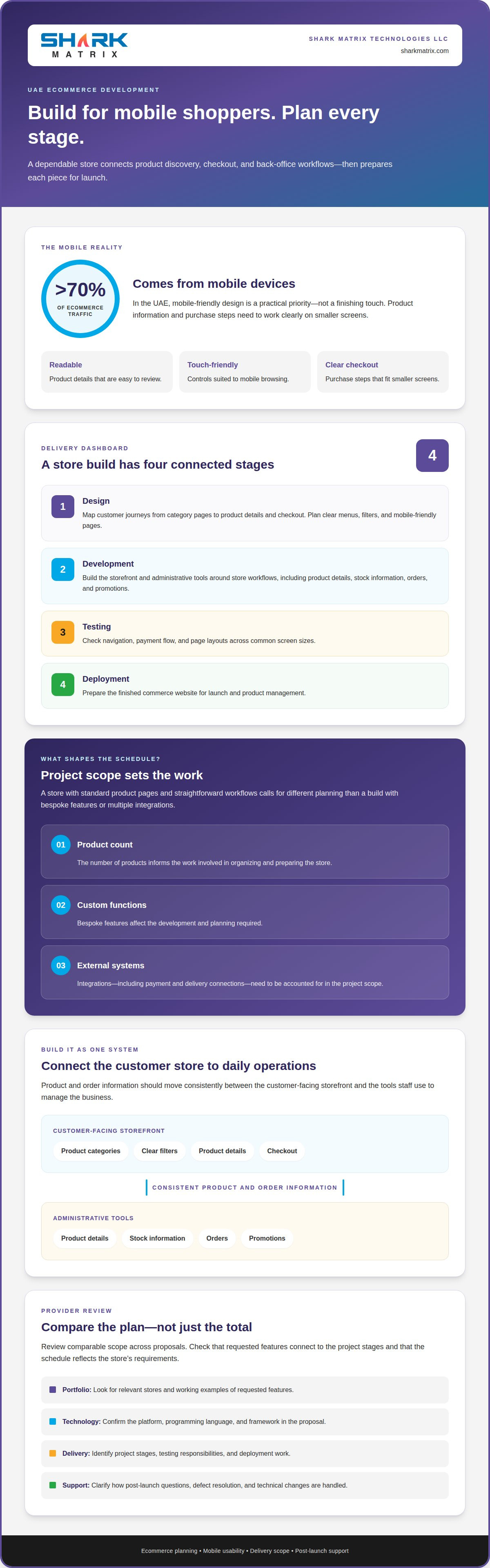
Custom ecommerce website development shapes the storefront around products, customers, and fulfilment needs. A UAE commerce website may need distinct product categories, clear filters, mobile-friendly pages, and a checkout that keeps purchase steps easy to follow. Development also covers the back end, where staff manage product details, stock information, orders, and promotions. These elements should work as one system, with product and order information moving consistently between the customer-facing store and its management tools.

To compare UAE ecommerce development agencies by portfolio, pricing, and support, review examples for navigation, mobile usability, and checkout clarity. Compare quotations by their stated features, integrations, delivery stages, and support arrangements, rather than by the total alone.

Project scope shapes the delivery schedule. A store with standard product pages and straightforward workflows requires different work from one with bespoke features or multiple integrations. Product count, custom functions, and external systems all affect planning. A useful project schedule accounts for design, development, content entry, testing, and deployment, so launch preparation is included rather than left until the end.

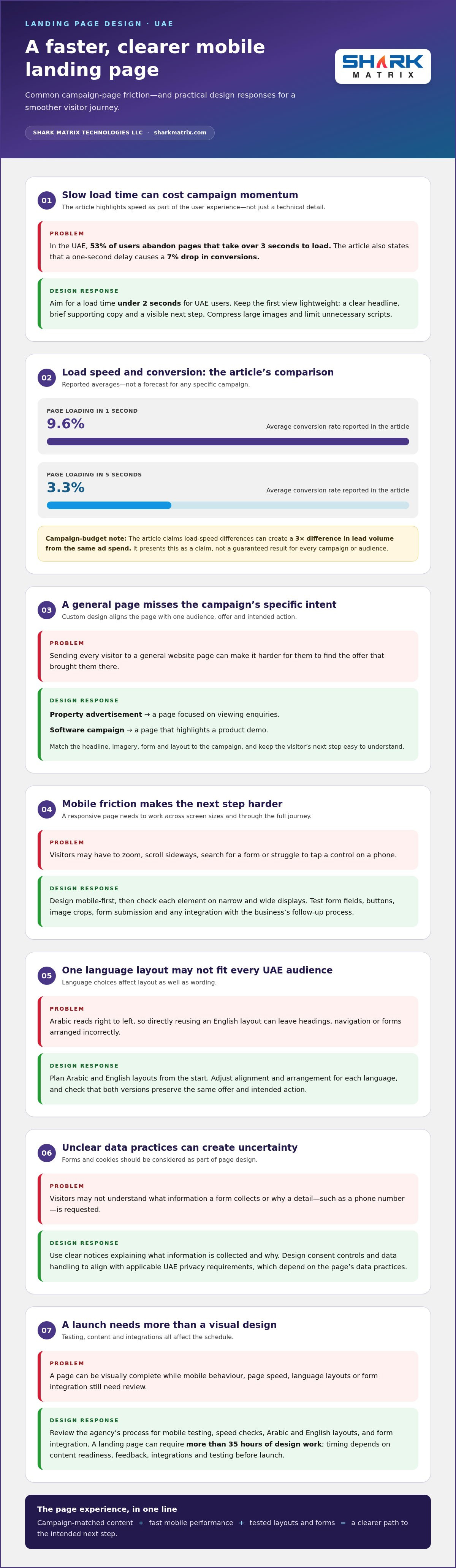
Mobile design deserves particular attention in the UAE: more than 70% of ecommerce traffic comes from mobile devices. That makes readable product details, touch-friendly controls, and a checkout that fits smaller screens practical priorities. Clear menus and filters also help customers reach relevant products without working through unrelated categories.

  • Design: Map customer journeys from category pages to product details and checkout.
  • Development: Build the storefront and administrative tools around the store’s workflows.
  • Testing: Check navigation, payment flow, and page layouts across common screen sizes.
  • Deployment: Prepare the finished commerce website for launch and product management.

An in-house development team can coordinate design, coding, and technical decisions within one delivery process. That can make it easier to resolve issues such as a product option not appearing correctly in the cart. Customer support is a separate part of the relationship: it may cover technical questions, defect resolution, or future changes. Clear responsibilities and response processes help your team understand how support works after deployment.

Scalability starts with decisions about the store’s structure. A business adding product categories, integrations, or app features needs a foundation that can accommodate those changes without rebuilding every page. Custom ecommerce website and app development can connect shopping experiences across web and mobile, with features planned around the business’s workflows. For product questions during browsing, AI chatbot development can be considered as a related digital capability.

Looking for an in-house eCommerce development company?

Before hiring, review relevant portfolio examples, platform experience, quotation scope, and post-launch support. Ask how the team will handle your store’s integrations, requested changes, and ongoing technical needs.

E-Commerce Platform Development

Shopify, WooCommerce, Magento, and OpenCart are distinct commerce platforms, so development should match your store’s requirements. Ask how the team will configure product categories, checkout steps, and administrative workflows on your chosen platform. Review portfolio examples for comparable store features, not just visual style. A clear project plan should identify custom development, platform configuration, testing, and deployment responsibilities.

Platform and Technology Options

Platform choices can include Shopify, WooCommerce, Magento, Adobe Commerce, and BigCommerce. Python and PHP are programming languages, while Laravel is a PHP framework used for custom ecommerce builds. These options aren’t interchangeable labels. Ask the development team to explain which platform and technologies fit your integrations, workflows, and planned changes. The proposal should name the intended stack and describe its role in the project.

Checks Before Hiring an Agency

Check who handles design, development, testing, deployment, and customer support. Clarify whether the people presenting the project will also deliver it, and how the in-house team manages questions or change requests. Ask for a schedule based on your store’s scope. The timeline depends on store size, complexity, and integrations, so confirm that the schedule accounts for those requirements.

Then review the quotation line by line. It should connect requested features to project stages, including payment gateway, delivery, and other integrations. The price depends on the platform and required features, with the project cost set out after a quote request. Compare proposals on equivalent scope, rather than treating a lower total as the only deciding factor.

  • Portfolio: Look for relevant stores and working examples of requested features.
  • Technology: Confirm the platform, programming language, and framework in the proposal.
  • Delivery: Identify project stages, testing responsibilities, and deployment work.
  • Support: Clarify how post-launch questions and technical changes are handled.

For an in-house team, understand how ecommerce website development decisions move between design, engineering, and support. A defined process can keep platform configuration, custom features, and testing aligned. Ask how the team documents decisions and communicates project progress. This gives your business a clearer view of who owns each deliverable and how planned changes fit the agreed scope. For stores combining commerce pages with other web features, web development support can be part of the wider project conversation.

Shopping carts and multi-currency support

A shopping cart connects product selection to order completion. In ecommerce website development, its flow should account for product options, quantities, delivery details, payment selection, and order confirmation. For example, a customer adding a size or colour should see that selection reflected in the cart and final order. A clear flow also makes it easier to identify where customers encounter friction.

Currency handling needs deliberate planning for an online store serving regional customers. The UAE dirham (AED) can be the store’s main display currency, while GCC-focused commerce may require prices in currencies such as the Saudi riyal, Qatari riyal, or Omani rial. The chosen platforms and payment setup shape how prices are displayed and processed. The project should define which currencies appear, how customers select them, and what currency appears at checkout.

Display and payment are separate considerations. A store might show a product price in a shopper’s selected currency, while the payment process uses the currency supported by its gateway configuration. The checkout should make the amount and selected currency easy to understand before the customer confirms an order. Clear currency rules help keep product pages, carts, and order records consistent.

Scalable cart design also considers what happens as an online store grows. More products, customer account features, promotions, or enterprise integrations can affect cart workflows. Development planning should map these requirements before implementation. That gives the team a basis for testing key paths, such as changing quantities, removing an item, applying a promotion, and returning to checkout.

  • Cart flow: Test product selection, quantity changes, delivery details, and order confirmation.
  • Currency display: Define where AED and any selected GCC currencies appear.
  • Payment: Align checkout currency presentation with the configured gateway.
  • Monitoring: Track cart errors, payment failures, and checkout completion.

After launch, performance monitoring can help identify issues that affect transactions. For example, repeated payment failures or cart errors may point to a problem in checkout configuration. Maintenance can cover planned updates, defect handling, and changes to integrations. These tasks should be distinguished from a warranty, which concerns the terms for correcting defects in delivered work. A project scope can state the applicable support process, coverage, and responsibilities without treating ongoing maintenance and warranty as the same service.

For stores planning regional growth, ecommerce development should treat currency selection, cart behavior, and order records as connected requirements. Defining those details early helps create a more consistent shopping experience across platforms and gives the development team clear scenarios to test before deployment.
Ecommerce Development Company in the UAE for Custom Online Stores

Ecommerce development across Dubai, Abu Dhabi and Sharjah

A store serving customers in different locations needs a clear operating plan, not separate websites by default. The useful questions are where customers are, what the business sells, and how it fulfils orders. One ecommerce website can serve customers across multiple locations, with delivery details, product availability, or customer communications tailored to the business’s operations.

Start by mapping the customer journey for each location. Customers may use the same product pages, while the business handles delivery timing or service coverage differently. Those details should be reflected in checkout and order confirmation. A WooCommerce store, for example, can be planned around the business’s product catalogue and the delivery choices it actually provides.

Payment setup also needs a defined role. The development team can connect the selected payment gateway and test the path from cart to confirmation. The business should decide how prices appear in AED, which payment methods it intends to offer, and what customers see when a transaction succeeds or fails. Testing these scenarios helps make the payment experience consistent across the three emirates.

  • Dubai: Map the main product categories, checkout steps, and order information.
  • Abu Dhabi: Define how delivery options and availability appear to customers.
  • Sharjah: Plan the same storefront experience while reflecting actual fulfilment choices.
  • All locations: Test payment, order confirmation, and customer notifications as one flow.

These are planning prompts, not assumptions about how businesses operate in different locations. The store’s own inventory, delivery coverage, and customer service process should determine what changes by location. A development partner documents those rules before building them into product pages, checkout, and order management. That prevents location labels from appearing without a clear purpose in the customer journey.

For a business expanding from Dubai into Abu Dhabi and Sharjah, the build should account for growth without creating duplicate administration. One product catalogue and a consistent checkout can simplify management, while location-specific options can appear where they matter. The project team can define which settings are shared and which vary, then test sample orders for each location before deployment.

Regional development also involves coordination. The business supplies its product information, service areas, and payment preferences; the development team translates those decisions into store behavior. Whether the platform is WooCommerce or another option, the project should document who updates products, handles order changes, and manages technical issues. This gives teams across Dubai, Abu Dhabi, and Sharjah a shared process and gives customers a coherent route from browsing to purchase.

Which ecommerce development companies in the UAE are highly rated?

A rating alone can’t show whether a development team fits your store. Look for detailed, relevant client feedback alongside examples of completed ecommerce work. A review describing a payment integration or product catalogue is more useful than a brief rating without project context. Also consider whether the feedback discusses delivery, communication, and support after launch.

Review evidence in context. On Google Business Profile or Clutch, read the written comments, their dates, and the services they describe. A collection of reviews for unrelated marketing work doesn’t necessarily demonstrate ecommerce capability. Look for repeated, specific feedback about website development, platform implementation, project communication, and resolving technical issues. Ratings can help narrow your options, but they shouldn’t replace a review of the work itself.

Portfolio examples offer another way to assess fit. Open the stores and examine how customers browse categories, view product details, and reach checkout. If your project needs WooCommerce, for example, seek examples that show relevant store features, not just attractive landing pages. Ask how the team handled the project’s requirements and what responsibilities its developers held. These details help connect portfolio evidence to the work you need.

Compare quotations using the same scope. One proposal may include custom features, payment gateway integration, testing, deployment, and post-launch support; another may cover only the storefront build. Review each deliverable, its assumptions, and the support process. The project price depends on the platform and required features, including integrations and delivery options; the cost is provided after a quote request. Don’t compare totals without understanding what each covers.

  • Client feedback: Look for detailed comments about ecommerce projects and delivery.
  • Portfolio: Review working stores and features similar to your requirements.
  • Scope: Match proposal deliverables, integrations, testing, and support.
  • Communication: Understand how project updates, questions, and changes are handled.

A useful final step is to discuss your project with the team responsible for delivery. Share your platform preference, store workflows, and required integrations, then assess whether the proposed scope addresses them clearly. A practical conversation should connect your needs with defined deliverables, rather than rely on broad promises or ratings alone. For a tailored store project, discuss your website development requirements.

Shark Matrix Technologies

Shark Matrix Technologies LLC can help businesses planning an online store bring its website and related digital needs into focus. Turn to the team when you’re mapping a custom build, considering how a mobile app could support the shopping experience, or planning how customers will find the store. Web Design and Development and Mobile App Development address the digital product, while Search Engine Optimization (SEO) and Pay Per Click (PPC) Management support visibility and promotion.

Share your platform preferences, essential store features, and growth plans to start a focused conversation about the project’s needs. The next step is to align the store’s requirements with a practical development plan.

Contact Shark Matrix Technologies to discuss your ecommerce project.

Turn your store plans into a clear next step

Your next move is to turn business priorities into a focused project brief. Define what the store must help customers accomplish, which internal workflows it should support, and how you’ll judge a successful launch. With those priorities in view, conversations with an ecommerce development company in the UAE can focus on practical decisions rather than broad promises.

Shark Matrix Technologies LLC brings together Web Design and Development with Search Engine Optimization (SEO) and Pay Per Click (PPC) Management, connecting the online store with ways to attract and reach customers. That combination can be relevant when you’re planning both the storefront and its digital visibility. The project discussion can begin with your goals, platform preferences, and the features your business needs, then shape a suitable direction for development.

A well-planned store gives your team a foundation to refine as customer needs and business priorities evolve. Take the next step by sharing what you want your online experience to achieve. Discuss your ecommerce plans with Shark Matrix Technologies, and move forward with a clearer direction for your store.

Frequently Asked Questions

How much does an e-commerce website design cost in the UAE?

The cost depends on the store’s design scope and required functionality, so there isn’t one price that fits every project. A tailored quotation can account for page layouts, product catalogue needs, checkout design, and any connections with payment or delivery services. These factors shape the work involved. To compare proposals fairly, look at the design deliverables and included features alongside the quoted amount.

How much does ecommerce website development cost in the UAE?

Ecommerce development costs depend on the chosen platform and required features, including payment gateways, delivery options, and integrations. A store with standard workflows has a different scope from one requiring custom functions or enterprise connections. The price depends on the case and is given after a quote request from Shark Matrix Technologies LLC. Compare quotations by checking which features, development stages, testing, and deployment work each one includes.

What features should a successful ecommerce website in the UAE include?

A practical store should make products easy to find and buying steps easy to follow. Consider mobile-friendly pages, clear categories, useful product filters, a shopping cart, and a checkout that presents payment details clearly. If the business serves customers using different currencies, plan how currency appears across product pages and checkout. Product images, transparent store policies, and customer reviews can also help shoppers assess items and make informed decisions.

What services do ecommerce development companies in the UAE offer?

Services can include custom storefront design and development, product management tools, shopping cart setup, and payment gateway integration. A project may also cover deployment, testing, and connections with delivery or other business systems. Scope varies with the store’s needs, so clarify which stages are included in the proposal. For example, a business adding a mobile shopping experience may also need app development alongside its ecommerce website.

How long does it take to build an ecommerce website in the UAE?

A standard ecommerce website project in the UAE can take 6 to 10 weeks. An enterprise or custom-integrated project can take 3 to 6 months. The schedule depends on the store’s size and complexity, including its required features and integrations. Work can involve design, development, product setup, testing, and deployment. A project timeline should show how these stages fit together and what the business needs to provide.

Which ecommerce platforms do UAE development companies specialize in?

Platform experience commonly includes Shopify, WooCommerce, Magento, and OpenCart; some projects also use Adobe Commerce or BigCommerce. The suitable option depends on the store’s workflows, preferred management experience, and integrations. Ask how the proposed platform supports your specific requirements, such as product variations or custom checkout steps. If a bespoke build is needed, discuss the development technologies and how they fit the project’s intended functionality.

Categories
Uncategorized

Marketing Attribution Models for Measuring ROI and CAC

The last click isn’t always the reason a customer converts. Marketing attribution models help businesses understand which interactions contributed to an outcome by assigning credit across the customer journey. A first-touch model gives all credit to the first marketing interaction, while a last-touch model gives it to the final interaction before conversion.

It makes sense to want a clear answer about which campaigns work. The challenge is that customers may encounter several channels before taking action, so crediting just one touchpoint can overlook part of the journey. Marketing attribution helps assess those contributions, but each model tells a different story.

This guide explains what marketing attribution is, how common models distribute credit, and how to choose an approach that fits your goals, sales cycle and available data. It also covers the role of attribution in measuring conversion rate, customer acquisition cost (CAC) and return on investment (ROI), including why those measures matter when evaluating marketing activity in the UAE.

Key Takeaways

  • Single-touch approaches credit one interaction, while multi-touch models spread credit across the customer journey; each highlights a different part of how conversions happen.
  • First-party data collected with user consent can help connect marketing interactions to conversions while supporting privacy-conscious measurement.
  • Choose a model based on your goals, sales cycle and available data, and reassess it when your strategy or customer journey changes.
  • Use conversion rate, customer acquisition cost and return on investment together to understand performance across channels.
  • Attribution shows patterns in observed journeys, but it doesn’t prove that a touchpoint caused a conversion; experiments can help assess causal impact.

What is marketing attribution?

Marketing attribution connects customer actions with outcomes, then assigns credit to the touchpoints along the way. The main marketing attribution models include first-touch, last-touch, last non-direct, and multi-touch approaches; each answers a different question about how marketing channels contribute to a conversion.

Single-Touch Attribution Models

Single-touch attribution assigns 100% of conversion credit to one interaction, making it straightforward to see which point in a journey receives recognition. First-touch credits the first marketing interaction, while last-touch credits the final interaction before conversion. Last non-direct attribution instead credits the last channel interaction that wasn’t direct, so a later direct visit doesn’t replace an earlier trackable source.

Imagine someone discovers a service through a Google ad, returns through email, then visits directly and converts. First-touch credits Google, last-touch credits the direct visit, and last non-direct credits email. The difference matters: relying on one model can lead teams to optimize for the first or final interaction while overlooking other contributions.

Offline Touchpoints and Attribution Windows

Offline touchpoints are interactions outside digital channels, such as a conversation at an event or a phone call. An attribution window is the period during which earlier interactions can receive credit for a conversion. Including a recorded event conversation alongside a later online enquiry can give a more complete view of the customer journey than digital tracking alone.

The attribution window affects which interactions count. If someone sees an ad, speaks with a team member at an event, then converts later, a window that excludes the earlier ad won’t credit it. Choose a period that reflects how customers move from discovery to action, rather than assuming every conversion happens immediately.

Multi-Touch Attribution

Multi-touch attribution shares conversion credit across several interactions. Single-touch models assign all credit to one. For a journey involving a social post, search ad, and email, multi-touch attribution can recognize each interaction instead of letting one channel stand for the entire path.

This broader view can help teams assess how channels work together and decide what to optimize. It depends, however, on recorded touchpoints: if an interaction isn’t captured, the model can’t allocate credit to it. Compare model outputs using the same conversion definition and attribution window to understand why channel credit changes.

U-Shaped Attribution

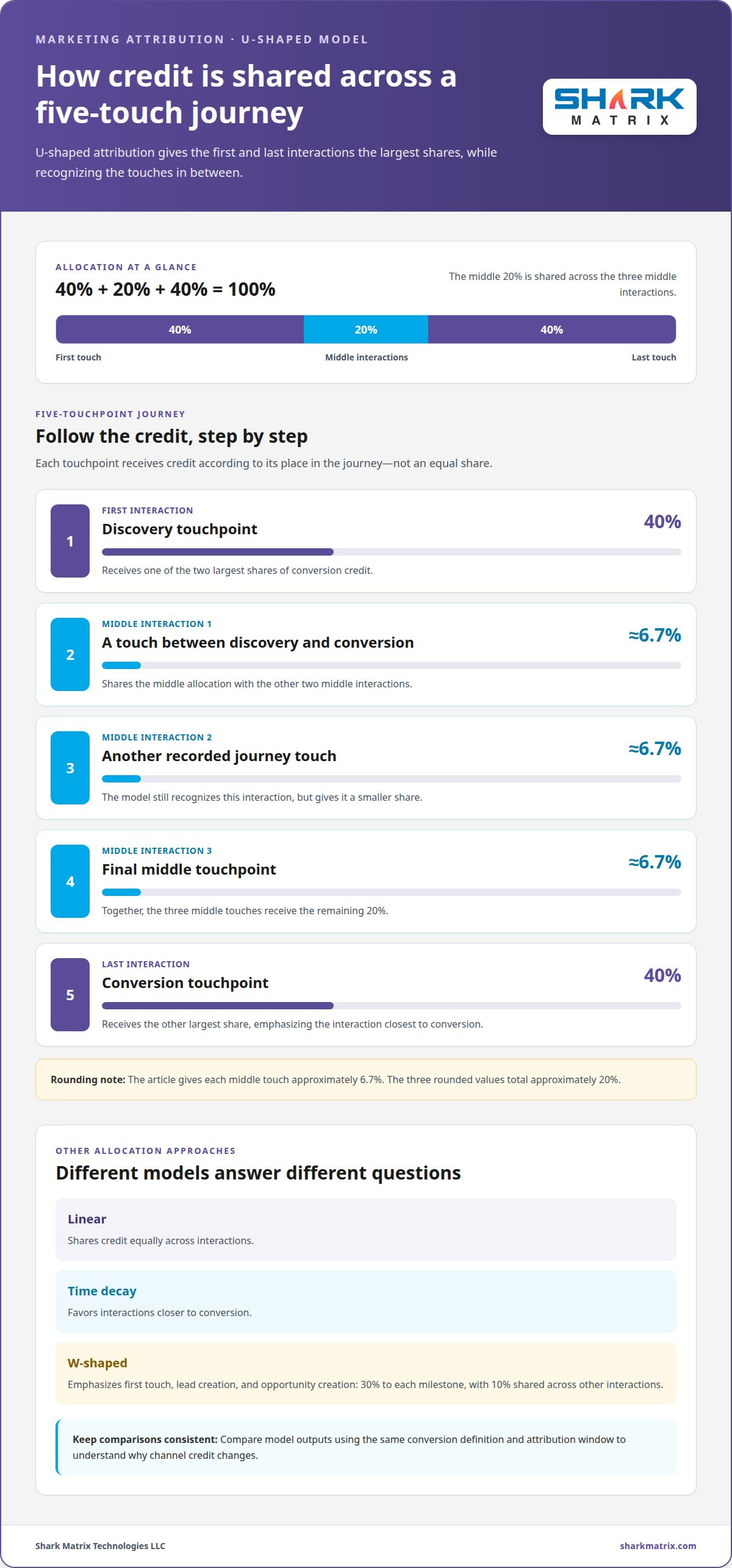
U-shaped attribution gives 40% of credit to the first touchpoint and 40% to the last, then divides the remaining 20% among middle interactions. In a five-touchpoint journey, each of the three middle interactions receives approximately 6.7%. This model emphasizes discovery and conversion while still recognizing interactions between them.

Other approaches answer different questions: linear attribution shares credit equally, time decay favors interactions closer to conversion, and W-shaped attribution emphasizes first touch, lead creation, and opportunity creation. A W-shaped model assigns 30% to each milestone and shares 10% across other interactions. Compare these allocations to see which view best supports the decision you need to make.

What is an attribution model?

A data-driven attribution model analyzes customer paths that convert and those that don’t, then estimates how recorded interactions relate to conversions. Statistical models or machine learning assign credit based on these paths rather than applying the same fixed allocation to every journey. Comparing converting and non-converting paths helps identify patterns associated with outcomes, but the result is an estimate, not proof of cause.

These estimates depend on the records being analyzed. If a customer sees an online ad, attends an event, then calls, disconnected systems may treat these interactions as separate people or journeys. Bringing campaign, website, customer relationship management, and offline records into a shared view can help reveal which interactions appear in converting paths. Consistent interpretation of sources makes the reporting more useful.

Data quality affects what a model can learn. Inconsistent campaign names can split one source into several report entries, while missing timestamps can scramble the order of interactions. Shared naming conventions and a clear conversion definition help teams determine whether records describe comparable activity. These practices improve analysis, but they don’t prove that a recorded touchpoint caused a conversion.

For example, people already likely to purchase may also be more likely to click a particular ad. An observational model can associate that click with conversions even if the ad had little influence on the decision. Incrementality testing addresses causation differently: it compares a group exposed to marketing with an unexposed control group to estimate marketing’s effect.

First-party data collected with user consent can support audience targeting and conversion tracking. Identity stitching connects records that appear to belong to the same customer, such as a website visit and a later enquiry. Consistent identifiers and documented matching rules help teams understand how records were joined, while governance clarifies how the data informs reporting.

Measurement plans should account for consent choices and the information available from each channel. A person may decline tracking or use a platform that provides limited reporting, leaving gaps in the recorded path. Build analysis around appropriately collected data, and don’t assume every visit can be identified or every conversion path is complete.

Offline interactions can add useful context. A sales conversation or event visit may shape a decision even when web analytics can’t record it. Connecting such activity with online records can provide a fuller view of the sales cycle when matching is reliable and handled appropriately. A unified approach to marketing measurement can help organize fragmented campaign and customer data.

Choosing an attribution model

Choose a model by matching the decision you need to make with your goals, customer journey, sales cycle, and available data. There’s no universally best method, and different stakeholders may need different views.

Aligning Models With Business Goals

Choose a model that reflects whether you’re evaluating awareness, lead generation, or completed sales. First-touch can help assess which channels introduce people to a brand, while last-touch focuses on the interaction closest to conversion. Multi-touch can show how digital channels work together across a longer journey.

Start with the outcome you want to understand, then select a model that fits the question. A team focused on discovery, for example, may examine first-touch credit, while a team reviewing conversions may look at the final interaction. If stakeholders need different answers, compare model views instead of forcing one method to serve every decision.

The customer journey matters as much as the goal. A short path from a search ad to a purchase may be easier to interpret with a simple model. A journey involving content, email, paid campaigns, and several return visits needs a view that recognizes more than one interaction. Check whether your data captures those steps before relying on the results.

Consider what the model leaves out. First-touch can understate later interactions, while last-touch can overlook earlier awareness activity. A position-based model emphasizes the opening and closing interactions; equal-weight attribution gives each recorded touchpoint the same share. Comparing these views can show how the chosen method shapes reported channel performance.

Accounting for Sales-Cycle Length

Sales-cycle length indicates how much time and how many interactions may separate initial awareness from a decision. A short journey may suit a simpler model, while a longer one may benefit from an approach that recognizes meaningful steps over time. The choice affects which channels appear influential and how teams interpret campaign contribution.

For example, B2B SaaS with a 6-month sales cycle and multiple decision-makers may gain useful insights from time-decay or W-shaped attribution. Time decay gives more credit to interactions closer to conversion; W-shaped attribution emphasizes first touch, lead creation, and opportunity creation. The suitable view depends on which milestones matter to the sales process.

Review model fit when your strategy, campaigns, or customer journey changes. Reassess at least quarterly, or when these changes occur, so the method continues to reflect how customers convert. A model selected six months ago may no longer describe today’s journey. Keep the conversion definition and measurement window consistent when comparing results across periods.

Treat the model as a decision aid, not a permanent verdict on a channel’s value. Use its findings to identify questions, such as whether awareness campaigns assist later conversions. Then compare your interpretation with other evidence, including controlled experiments, when you need to assess marketing’s causal effect.

Marketing Attribution Models for Measuring ROI and CAC

Attribution KPIs including conversion rate, CAC, and ROI

Attribution KPIs connect recorded customer actions with business outcomes, helping you assess campaign performance across sources. For cross-channel measurement, conversion rate, customer acquisition cost (CAC), and return on investment (ROI) are useful indicators, but each answers a different question.

Set up tracking by defining the conversion event first, such as a completed purchase or submitted enquiry. Configure analytics to record that event and its relevant campaign sources, using consistent names for channels and campaigns. Test the event with a sample journey to confirm that the recorded interaction matches the outcome you intend to measure.

Conversion rate measures how often eligible interactions result in the defined conversion. Keep the denominator consistent: a rate based on website sessions answers a different question from one based on ad clicks. CAC compares acquisition costs with the number of new customers attributed to those efforts. ROI compares the return associated with marketing against its cost.

Use conversion paths to interpret these figures. An analytics report, for example, might show someone discovering a business through organic search, returning through a paid ad, then submitting an enquiry. The model assigns credit to those recorded sources, while conversion rate shows the share of eligible interactions that led to enquiries. CAC and ROI connect attributed outcomes with acquisition spending and returns.

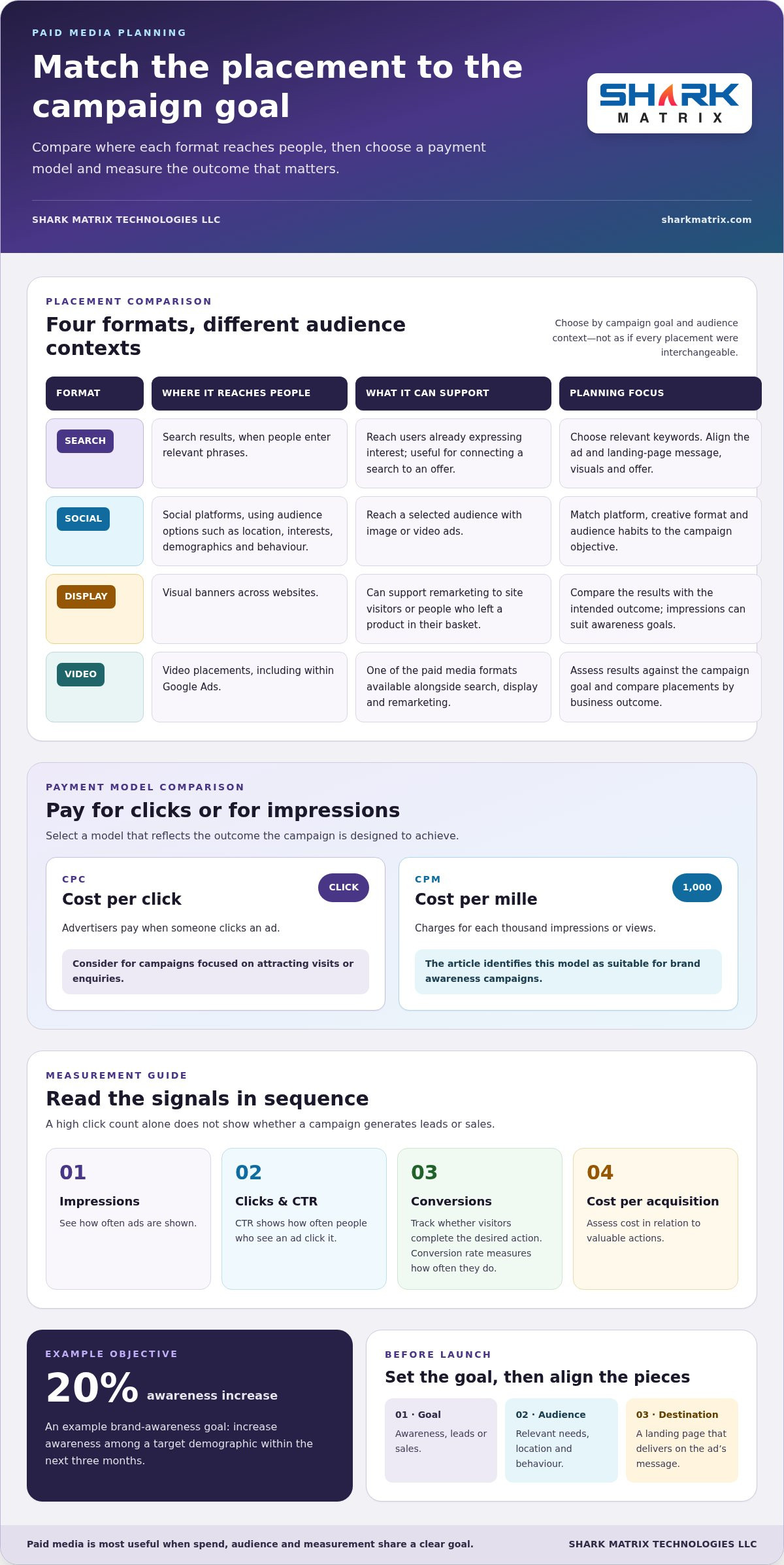
Compare channels using the same conversion definition, reporting period, and attribution method. Otherwise, a paid campaign measured by completed purchases may look different from an organic campaign measured by enquiries. Return on ad spend and cost per lead can also help assess media placement costs and performance, but they don’t replace broader ROI or CAC analysis.

Read the KPIs together rather than treating any one as a verdict. A channel with a strong conversion rate may still have a high CAC, while a channel with fewer immediate conversions may appear in paths that later produce sales. Break results down by campaign and source, then look for consistent movement across conversion rate, CAC, and ROI.

Attribution makes comparisons more structured, but its credit reflects recorded interactions and the selected model. It doesn’t establish, by itself, that an interaction caused a conversion. If a report shows a sudden shift in ROI, examine campaign changes, conversion-event tracking, and channel mix before changing investment decisions.

Purpose of marketing attribution modeling

Attribution helps teams connect marketing activity with customer actions and business outcomes. Its purpose is not simply to assign credit, but to inform decisions about campaigns, channel roles, and measurement. Used carefully, it can show how paid and organic search, email, affiliate marketing, display advertising, and social media appear across converting journeys.

This view supports channel comparisons. A customer might discover a brand through organic search, return after seeing a display ad, then respond to an email. A model can show how each recorded source receives credit under its rules. Comparing that result with last-touch reporting may reveal whether a campaign mainly introduces customers or assists later decisions.

These insights can guide campaign planning and budget discussions. If a channel often appears early in converting paths, its value may be missed by reports focused only on final interactions. Conversely, a channel receiving substantial credit may be capturing demand created elsewhere. Attribution gives teams a structured way to investigate these patterns, not an automatic instruction to increase or cut spending.

It can also align marketing and sales around shared outcomes. Teams can agree on what counts as a lead, opportunity, or completed sale, then use consistent campaign tracking to connect activity with those milestones. In a B2B journey, for instance, reports can compare the channels associated with lead creation and opportunity creation. Clear definitions reduce confusion when teams interpret campaign performance.

Attribution supports learning when teams treat it as a working measurement method. Reassess the model at least quarterly, or when strategy, campaigns, or the customer journey changes. Keep objectives and assumptions visible across teams; transparent governance helps identify attribution bias, such as giving too much credit to interactions that correlate with conversion.

For a stronger causal answer, pair observational attribution with incrementality testing. Compare a group exposed to marketing with an unexposed control group to estimate marketing’s effect. Randomized controlled trials, geo-experiments, and holdout testing are methods for this purpose. Attribution describes observed paths; experiments help determine whether exposure contributed to a change in outcomes.

Use these findings to set campaign goals and create content tied to measurable customer actions. Plan content marketing around clear campaign objectives, then assess its role alongside other channels.

Shark Matrix Technologies: Content Marketing

Shark Matrix Technologies can connect attribution insights with practical campaign work. Its Content Marketing, Search Engine Optimization (SEO), and Pay Per Click (PPC) Management offerings support campaigns across organic and paid channels. Web Design and Development can also shape the pages customers reach from those campaigns.

Consider this next step when your reporting shows a gap between campaign activity and the actions your business wants customers to take. Insights about which sources introduce visitors, for example, can inform content priorities, while conversion-path findings can guide landing-page improvements and paid campaign decisions. Aligning these activities around defined goals gives teams a clearer basis for evaluating performance.

To discuss how these services could support your marketing goals, contact Shark Matrix Technologies.

Turn measurement into your next decision

Let your measurement approach evolve alongside your campaigns. As priorities shift, use attribution to frame the next question: which customer action should your team encourage, and what evidence would show that the change helped? This keeps reporting connected to decisions instead of treating a dashboard as the final answer.

Make the next review practical. Choose a business outcome, agree on how to recognize it, and note which assumptions shape your interpretation. Then use marketing attribution models to guide what you investigate, not as a substitute for judgment. When a result is unclear, a focused test can help distinguish a useful signal from a pattern that merely appears alongside conversions.

Shark Matrix Technologies can help translate measurement priorities into digital marketing and website work. If you’re ready to discuss your goals and the next steps for your campaigns, contact Shark Matrix Technologies.

Clearer questions support better-informed decisions. Take the next step with a measurement plan your team can continue learning from.

Frequently Asked Questions

How to measure attribution results?

Measure results by comparing attributed conversions with the business outcomes they represent. Calculate conversion rate by dividing conversions by eligible visits or interactions; calculate CAC by dividing acquisition spend by new customers. ROI compares the return attributed to marketing with its cost. Keep the conversion definition and reporting period consistent, then assess whether changes in attributed performance align with actual customer and sales outcomes.

What is cross-channel attribution?

Cross-channel attribution evaluates how interactions across different marketing channels appear in customer paths leading to an outcome. It can bring together digital sources, such as search and email, with offline interactions, such as an event conversation. A report might show, for example, that a customer encountered a social campaign before visiting through search. Consistent channel labels help teams interpret the combined view without confusing similar campaigns.

Where does attribution data come from?

Attribution data comes from records of marketing interactions and conversion events. Common inputs include website analytics, advertising platforms, campaign links, customer relationship management records, and transaction systems. Offline sources, such as recorded sales enquiries, can add context when connected appropriately. Timestamps, campaign identifiers, and consistent customer or event records help analysts assemble a usable path instead of treating each data source as a separate story.

What is marketing attribution and how does it work?

Marketing attribution associates customer interactions with an outcome and distributes credit according to a chosen method. A prospective customer might read an article, return through a search result, and later complete an enquiry form. The attribution approach determines how those recorded actions appear in reporting. Teams use the resulting view to investigate campaign contribution, not as automatic proof that an interaction caused the enquiry.

How do first-touch, last-touch, and linear attribution compare?

First-touch highlights the interaction that introduced a customer, while last-touch emphasizes the interaction nearest the conversion. Linear attribution gives equal credit to every recorded touchpoint in the path. Imagine a customer who discovers a service through search, reads an email, and later converts through a direct visit. Each approach presents a different account of that journey, so the useful comparison depends on whether you’re assessing discovery, closing activity, or the full path.

How do you choose the right attribution model for a business?

Choose a model by identifying the decision it needs to support, then consider the sales process and available data. A team evaluating discovery may prioritize how customers first encounter the brand; a team assessing the closing process may focus on later interactions. If sales and marketing need different perspectives, compare reports using clearly defined outcomes. Revisit the choice when campaigns or customer behaviour changes.

How do attribution windows and lookback periods affect results?

An attribution window determines how far back interactions can be considered when crediting a conversion. A shorter window may exclude an earlier campaign interaction, while a longer one can include more of the journey. Someone who first encounters a campaign and converts after an extended decision process, for example, may appear differently across windows. Keep the selected period consistent when comparing campaigns, and choose one that reflects how customers typically decide.

How do privacy rules and cookie restrictions impact marketing attribution in the UAE?

Privacy requirements, consent choices, and browser or platform cookie settings can limit which interactions are recorded or connected. That can leave gaps in a customer path, making channel reports less complete. In the UAE, build measurement around data collected and used appropriately, and avoid assuming every visit can be linked to a person. Consent-based first-party data and clear event definitions can help make available reporting more useful.

Categories
Uncategorized

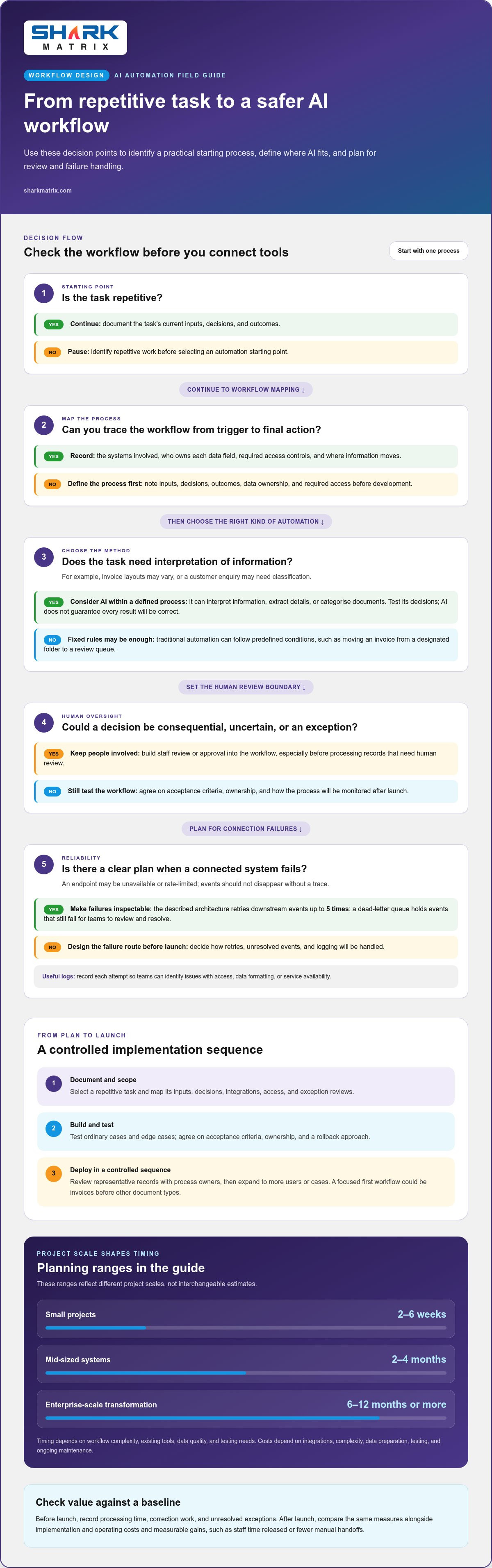
How to Implement AI in a Small Business in the UAE

Small businesses can benefit from AI, but the best starting point is not necessarily the most advanced tool. When implementing AI in a small business in the UAE, match the approach to the task: machine learning can analyse historical data and make predictions, deep learning can process complex data such as images or text, and generative AI can create new content.

It is understandable to feel unsure where to begin. AI is most useful when it addresses a real business need, fits the data and systems you already use, and supports staff without adding unnecessary complexity. A tool that works well for one task may be the wrong choice for another.

This guide explains how to assess your business needs, choose between ready-made tools and custom development, and plan a practical implementation. You will also learn how to prepare and train staff, protect business and customer information, and validate AI-generated insights before using them to make important decisions.

Key Takeaways

  • Start with a measurable business problem, then assess whether your workflows and data are ready for AI.
  • Choose between ready-made tools and custom development based on how well each fits the task and your existing systems.
  • Plan a focused rollout, prepare staff to use AI responsibly, and keep human oversight where it matters.
  • Validate AI-generated insights against reliable data and customer feedback before relying on them for important decisions.
  • Learn how machine learning, deep learning and generative AI suit different business needs.

Data reliability and validation of AI-generated insights

  1. Check the source data before trusting an output. Review where records came from, how recently they were updated, and whether key fields are missing. For sales analytics, compare product names, transaction dates, refunds, and customer records across the source systems. In accounting, confirm that calculations use the correct tax settings. The Federal Tax Authority identifies the UAE VAT rate as 5%. Incorrect inputs can make a confident AI result misleading.
  2. Test each insight against real evidence. Compare AI-generated predictions with reliable business records and customer feedback before making financial commitments. For example, if a forecasting tool predicts higher demand, compare that estimate with historical orders, current enquiries, and actual sales. Record where its result differs from the evidence. Use a small, reversible decision to test the insight before applying it to a larger budget or business change.
  3. Protect personal data throughout processing. UAE businesses must comply with the UAE Data Protection Law when implementing AI. Businesses operating in the DIFC must consider the DIFC Data Protection Law; businesses operating in ADGM must consider the ADGM Data Protection Regulation. Limit the information shared with an AI tool to what the task requires. Remove unnecessary personal details, control access, and document which systems process customer data.
  4. Build security and human review into daily use. AI companies handling personal or sensitive data need strong safeguards. Assess risks of data leaks, cyberattacks, and unauthorized access before connecting tools to business systems. Use reliable security practices, restrict permissions, and monitor unusual access. AI cannot entirely replace human security experts in cybersecurity. Assign a trained person to review sensitive outputs, flag unexpected behaviour, and pause automated processing when results could expose customers or business information.
  5. Measure results and plan funding realistically. Track a baseline, then monitor response times, qualified leads, processing costs, error rates, or customer satisfaction, depending on the workflow. Compare those measures after deployment to understand whether the tool is improving business performance. For grants or other support, look for SME or innovation programs relevant to your emirate or sector; eligibility and eligible spending shape their usefulness. Don’t include funding in your budget until it’s approved. Include subscriptions, staff training, and ongoing monitoring when assessing total costs.

Custom AI development versus plug-and-play tools

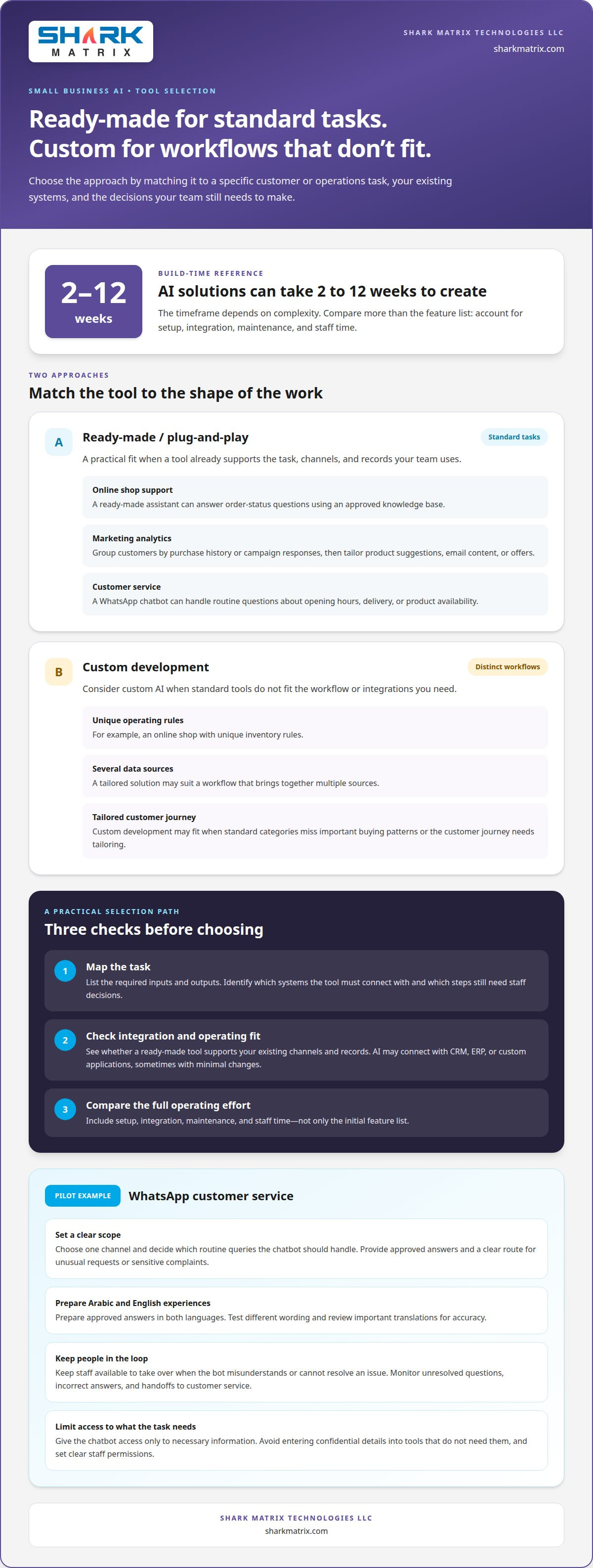
Suitable tools for UAE small businesses include ready-made chatbots, marketing analytics platforms, and custom AI connected to existing systems. Choose a tool by matching it to a specific customer or operations task.

Compare Custom and Plug-and-Play Tools

  1. Map the task before choosing a tool. For an online shop, a ready-made assistant may answer order-status questions using an approved knowledge base. Custom development can suit workflows involving unique inventory rules, several data sources, or a tailored customer journey. List the required inputs and outputs first. Then identify which systems the tool must connect with and which steps still need staff decisions.
  2. Test integration and operating fit. AI can connect with existing CRM, ERP, or custom applications, sometimes with minimal changes. Check whether a plug-and-play tool supports the channels and records your team already uses. AI solutions can take 2 to 12 weeks to create, depending on complexity. Include setup, integration, maintenance, and staff time in your comparison, not just the initial feature list.
  3. Match marketing automation to a clear purpose. A ready-made platform can group customers by purchase history or campaign responses. Use those segments to tailor product suggestions, email content, or offers, then track engagement and qualified leads. Custom models may fit when standard categories miss important buying patterns. Avoid collecting extra personal details simply to make personalization feel more precise.

Choose AI Customer Service Tools

  1. Choose one customer-service channel to pilot. An AI-powered WhatsApp chatbot can answer routine questions about opening hours, delivery, or product availability. Decide which queries it should handle, then provide approved answers and a clear route for unusual requests or sensitive complaints. Keep staff available to take over when the bot misunderstands a question or cannot resolve a customer’s issue.
  2. Design clear Arabic and English experiences. Prepare approved answers in both languages, including common product names and delivery terms. Test customer questions with different wording, and review important translations for accuracy. If the chatbot misunderstands a query, offer a simple path to a person. This keeps automation useful without forcing customers through repeated prompts.
  3. Protect information and review performance. Give the chatbot access only to information required for its task. Avoid entering confidential details into tools that don’t need them, and set clear permissions for staff. Monitor unresolved questions, incorrect answers, and handoffs to customer service. A custom AI development approach can help when off-the-shelf tools don’t fit your workflow or integrations.

AI implementation planning and staff training

Turn the chosen AI use case into a staged rollout with clear owners, staff training, and review points. A written plan connects the technology to daily work, from inventory forecasting to finance or healthcare workflows.

Plan AI Implementation

  1. Set a clear operational objective. Describe the task, who performs it, and what a useful result looks like. For example, a retailer might use AI to flag inventory records needing review, while a finance team could classify incoming invoices. Keep the first rollout focused on one well-defined workflow, rather than introducing disconnected technologies at once.
  2. Map the process before configuring tools. Document where information enters, who handles exceptions, and which systems the AI must work with. Identify data preparation, infrastructure, privacy, and ethical considerations alongside the implementation plan. Decide who owns setup, staff questions, and ongoing monitoring. Avoid a proof of concept that has no route into the real workflow.

Train Employees and Build Skills

  1. Choose staff who understand the workflow. During week 4, train 2-3 staff members to use and monitor the AI tools. Include people who handle routine tasks and exceptions, such as an inventory coordinator reviewing suggested stock actions. They can spot when an output doesn’t match actual operations and explain the correct escalation path.
  2. Teach practical skills through real examples. Show employees how to enter clear instructions, review outputs, and protect confidential information. Use sample finance documents or healthcare enquiries that reflect the work, without using unnecessary sensitive details. Staff should know which tasks AI supports, which decisions remain theirs, and how to report repeated errors. Keep short process notes available during daily use.

Establish Human Oversight and AI Auditing

  1. Assign a human reviewer to consequential decisions. Set approval points for outputs that could affect finances, customers, or healthcare services. For instance, an employee can review an AI-generated finance summary before it informs a payment decision. AI supports the workflow, but it doesn’t replace qualified judgement or human security expertise.
  2. Audit performance as the workflow runs. Schedule reviews of sample outputs, exceptions, and staff feedback. Record the type of error, its impact, and the corrective action, then adjust instructions or data handling. In inventory, compare suggested actions with confirmed records and note recurring mismatches. Use audit findings to refresh staff training and keep monitoring tied to the original business objective.

How to Implement AI in a Small Business in the UAE

Assessing business needs before choosing AI

  1. Start with the business outcome, not a platform. When implementing AI in a small business in the UAE, define what should improve, such as fewer missed retail enquiries or more accurate inventory forecasts. The available figures report that 34% of UAE companies have a formal AI strategy, while 30% are developing one. Use that context to make a written priority list, not to assume AI suits every task. Choose a goal tied to revenue, service, or operating effort, then describe how the current process performs.
  2. Map the workflow and its friction points. Follow a task from its first input to its final decision. For a retail business, trace an order from customer enquiry through stock checks and fulfilment. Mark delays, repeated data entry, and decisions staff make using incomplete information. Then identify where predictive or AI-powered support could help. Avoid automating a process that changes constantly or lacks a clear owner; first clarify the steps people actually follow.
  3. Assess data and integration readiness. List the records the task depends on, where they live, who maintains them, and how often they change. A sales forecast, for example, needs usable order and stock records, not scattered spreadsheets with inconsistent product names. Identify the platforms involved and how information could move between them. If teams must manually reconcile conflicting records, data preparation may matter more than selecting an AI tool.
  4. Rate maturity and set a measurable baseline. Describe your current capability as a practical assessment: are records accessible, processes documented, and staff able to review outputs? Note gaps before planning deployment. Choose measures that match the goal, such as response time for enquiry handling, error rates for data processing, or qualified leads for sales. Record the current result and name who will track changes. This creates a basis for assessing ROI without treating tool adoption as the outcome.
  5. Rank use cases by value and readiness. Compare each candidate against business impact, data quality, integration effort, and the consequences of a wrong result. A retail stock alert based on consistent sales records may be a clearer starting point than a predictive model using incomplete data. Prioritise one workflow where staff can judge the output and the result can be measured. For implementing AI in a small business in the UAE, keep the next use case on the list, but avoid launching several disconnected platforms before the first proves useful.

Machine learning, deep learning, and generative AI

Artificial intelligence is an umbrella term, not a single tool. Choose an approach by matching the task, available data, and required output.

  1. Use machine learning for patterns and predictions. Machine learning uses algorithms trained on historical data to analyse information, make predictions, or automate processes. A UAE retailer could use past orders to estimate which products may need replenishing. This approach depends on relevant, consistent records. It’s a poor fit if the business can’t explain what the model should predict or lacks useful historical data.
  2. Choose deep learning for complex inputs. Deep learning is a subset of machine learning that uses neural networks to process complex data, including images, video, audio, and text. For example, a business could use it to classify product images or analyse spoken customer feedback. These applications may require more data and technical planning than a simple prediction task. Start with the input itself, then decide whether simpler processing can solve the need.
  3. Apply generative AI to create drafts and responses. Generative AI uses models that learn patterns from existing data to create new content. A small business might draft product descriptions, summarise customer messages, or prepare a first version of a marketing email. Treat the output as a draft, not an approved business statement. Staff should review facts, tone, and customer details before publishing or sending it.
  4. Match the approach to the business outcome. Use machine learning when the goal is forecasting or classification. Choose deep learning when complex images, audio, or text are central. Use generative AI when the task involves producing or reshaping content. A local e-commerce example reported a 35% increase in average order value after integrating AI-driven recommendations. That result illustrates a possible application, not a forecast for every business.
  5. Decide whether existing models or development fit. Pre-trained models can help when a business has limited data, while custom machine learning may suit a distinctive prediction task. Define the required inputs, review process, and business metric before selecting AI tools. For a tailored model built around historical records, consider machine learning development services. Keep the choice tied to a specific workflow, rather than adopting a technology for its own sake.

Shark Matrix Technologies LLC

Shark Matrix Technologies LLC can help when your AI plan needs a stronger digital foundation for customer-facing experiences. If an initiative involves improving how customers find information or use your digital services, its Web Design and Development and Mobile App Development services can support those parts of the project. Search Engine Optimization (SEO) and Pay Per Click (PPC) Management can also support customer acquisition as part of your broader digital strategy. Turn to the team when planning a website or mobile app that must fit into a carefully considered AI implementation. Share your business goals and the digital experience you want to improve. Contact Shark Matrix Technologies LLC to discuss the next step.

Take the Next Step Toward Practical AI

AI adoption works best as an ongoing business capability, not a one-off technology purchase. As your operations and customer expectations change, revisit which tasks need support and whether your current systems still serve them. For a UAE small business implementing AI, steady progress comes from connecting each next decision to a real business need.

Consider how AI fits alongside the digital experience customers already use. Shark Matrix Technologies also offers Search Engine Optimization (SEO), Pay Per Click (PPC) Management, and Web Design and Development. These services can support a broader digital strategy as you plan how technology should serve your business.

Bring your goals, the workflow you want to improve, and the challenges you’re working through into the conversation. Contact Shark Matrix Technologies to discuss a suitable next step. With a clear direction and a willingness to learn from each stage, your business can approach AI with purpose and build from there.

Frequently Asked Questions

Can small businesses benefit from AI?

Yes, small businesses can use AI to speed up routine work and give teams more time for customer needs. A service business might classify incoming enquiries by topic, while an online seller could identify products frequently viewed together. Start with a task that has a clear owner and an observable outcome. AI is less useful when it adds steps without helping staff or customers.

What Is an AI Business in the UAE?

An AI business develops or provides AI products and services; a business that uses AI applies those tools to its own operations. The distinction matters when describing a company’s actual activities for registration or licensing. Using AI for customer support, for example, does not by itself define the business activity. A company building AI software has a different core activity from a retailer using it to assist shoppers.

What is AI Integration in Business?

AI integration means connecting AI capabilities with the systems and workflows a business already uses. For example, an AI tool could classify a customer enquiry and pass it into a customer relationship management system for staff follow-up. Good integration defines what information moves between systems, who can access it, and what happens when AI cannot handle a request.

Why Is AI Becoming Important for Startups in the UAE?

AI gives startups ways to analyse information, support customers, and automate selected tasks without building every process manually. The UAE National AI Strategy aims to position the country as a global leader in AI by 2031. For a startup, the practical opportunity is to apply AI to a defined business need, then expand only when the workflow, data, and team can support it.

What are the best AI use cases for small businesses in the UAE?

Useful applications depend on the business, but common candidates include sorting customer enquiries, drafting product content, summarising feedback, and spotting unusual transactions. A retailer could use product and sales patterns to decide which items deserve closer attention. A professional services firm might organise incoming requests by subject, while growing companies can look to providers like BlueBridge Group Placement Corp to streamline their recruitment and hiring workflows. Choose a use case where staff can assess whether the output is helpful and correct.

How much does it cost for a UAE small business to implement AI?

There is no fixed cost for AI implementation; the total depends on the tools chosen and the work needed to make them useful. Account for subscription or usage charges, data preparation, integration, staff training, security measures, and ongoing maintenance. A ready-made tool and a system built around specialised workflows have different cost drivers. Estimate the full operating cost, not just the initial setup.

What are the steps to implement AI in a small business?

Start by selecting a business problem, then document the current process and the result you want to improve. Check whether the necessary data is usable and whether the tool fits your existing systems. Run a limited pilot with a staff owner, set clear review procedures, and record performance against a baseline. Use the findings to decide whether to adjust, expand, or stop the implementation.

What UAE data protection laws apply when using AI in a business?

UAE businesses must comply with the UAE Data Protection Law when implementing AI. Businesses operating in the DIFC must consider the DIFC Data Protection Law, while those operating in ADGM must consider the ADGM Data Protection Regulation. In practice, limit the personal information shared with AI tools, control access, and review how information is processed. The relevant framework depends partly on where the business operates.

Categories
Uncategorized

AI for Customer Experience Personalization Through Recommendations

The best recommendation isn’t the one that uses the most customer data; it’s the one that helps someone take a useful next step. AI for personalizing customer experience uses relevant signals, such as current activity and past interactions, to tailor recommendations, offers, or service guidance to a customer’s needs. The aim is to make each interaction more helpful, not simply more targeted.

That distinction matters: a recommendation can feel relevant when it reflects what a customer is trying to do, but intrusive or frustrating when it misses the mark. This article explains AI personalization, how recommendation systems use customer context to suggest products or actions, and what businesses should consider when applying it. It also covers how to measure its impact on customer experience, from task completion and conversion to customer effort and retention. The focus is on practical ways to make personalization useful, accurate, and respectful of customer preferences.

Key Takeaways

  • Use customer data that’s relevant to the interaction and permitted by applicable policies, consent and regulation.
  • Recommendations work best when they reflect a customer’s interests, behavior and current journey stage, not just popular items.
  • Measure personalization against a meaningful baseline using outcomes such as task completion, conversion, customer effort or retention.
  • Monitor accuracy and outcomes across customer groups so a more engaging experience doesn’t come at the cost of relevance or fairness.
  • Connect AI recommendations with governed data, approved content and clear customer preferences to make interactions more useful.

What is AI-driven customer experience?

AI-driven customer experience uses customer data and machine-learning models to tailor recommendations, offers, and service guidance. For example, a shopping site can use a visitor’s recent product views to suggest relevant items.

Customer Data Collection and Unified Profiles

A unified customer profile brings permitted information from sources such as CRM records, website activity, and previous interactions into one usable view. This helps analytics connect a customer’s preferences with their current goal instead of treating each visit as unrelated. For example, a returning visitor’s browsing history can inform a recommendation, while their latest activity shows what they need now.

Data Readiness for Personalization Models

Data readiness means information is accurate, relevant, accessible, and governed for the model’s intended task. A recommendation model needs signals about products and interactions, while a service model needs approved answers and customer intent. Teams should map each model to its data inputs, remove irrelevant fields, and check that records are current before using them.

AI personalization can draw on customer identity, preferences, behavior, interaction history, and journey stage. Real-time intent and interaction signals can distinguish someone comparing options from someone seeking support. A platform also needs permission-aware access to CRM and journey data, plus governed content for customer-facing answers. AI for personalizing customer experience should help people complete a goal, not display how much information a business has collected.

How do AI personalization tools compare? Assess the data sources they can access, the models and channels they support, and their controls for permissions and content. A recommendation engine using recent product activity serves a different purpose from a service tool that retrieves approved guidance.

How much do AI personalization platforms cost? Costs depend on factors such as platform capabilities, data integrations, implementation scope, and ongoing support needs. Project pricing depends on the specific requirements and is provided after a quote request.

Risks include inaccurate suggestions, irrelevant data use, and outcomes that disadvantage some customer groups. A more engaging experience is not better if recommendations are inaccurate. Businesses should use only data relevant to the service goal and permitted by policy, consent, and regulation. They should also make it easy for customers to opt out of data sharing and monitor whether personalization improves the intended outcome.

Trust is part of the experience: only 51% of customers trust organizations to keep personal data secure and use it responsibly. Clear preferences, careful data access, and useful recommendations can make personalization more understandable. For example, a customer who can adjust communication preferences has more control over how interactions are tailored.

Personalized product recommendations

AI-powered recommendations match products, content, or useful next actions to a customer’s context. Their value depends on relevance: a suggestion should fit what someone is exploring, not merely promote what sells most.

Product and Content Recommendations

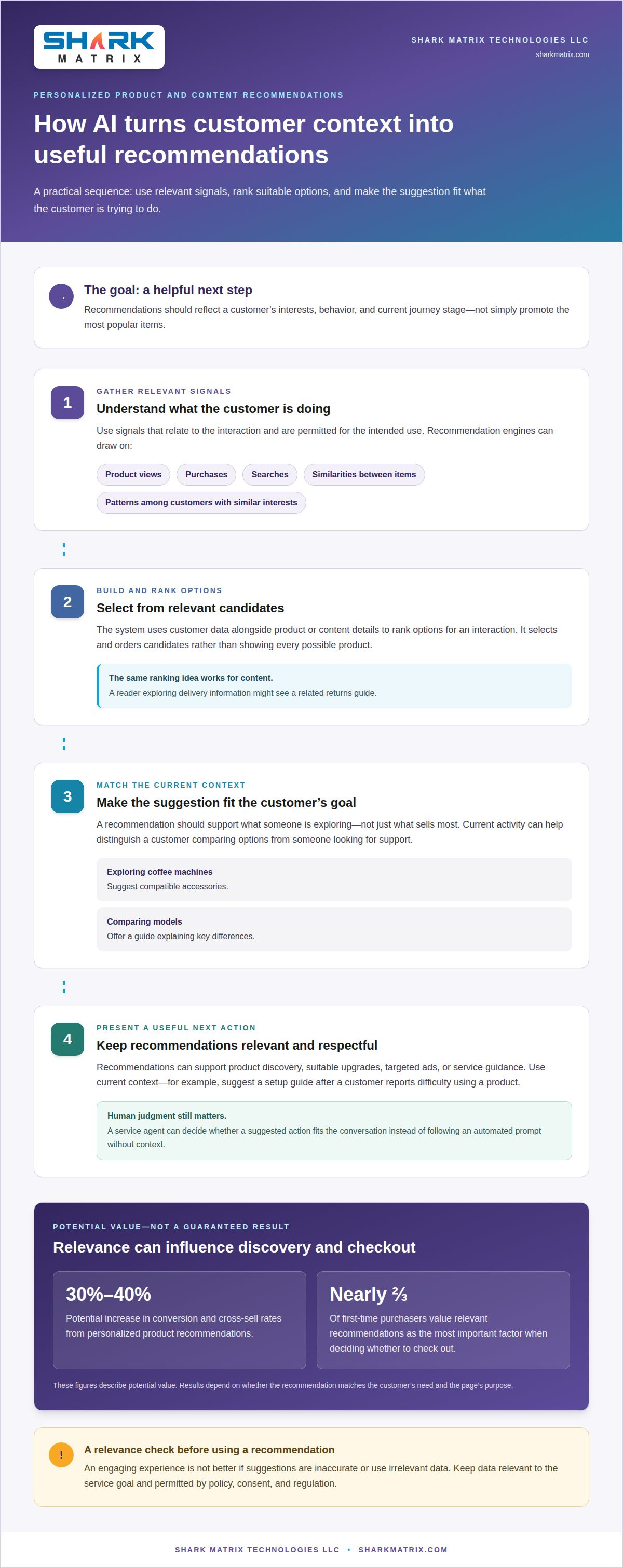
Personalized recommendations use customer data and product or content details to rank options for each interaction. They matter because a relevant suggestion can help shoppers find a suitable item or discover information that supports a decision. A visitor viewing coffee machines, for example, might see compatible accessories, while someone comparing models could receive a guide explaining key differences.

Recommendation engines can use signals such as product views, purchases, searches, and similarities between items. They may also learn from patterns among customers with similar interests. The system selects and orders candidates rather than showing every possible product. Content can be ranked in the same way: a reader exploring delivery information might see a related returns guide.

Personalized product recommendations can increase conversion and cross-sell rates by 30% to 40%. Nearly two-thirds of first-time purchasers value relevant recommendations as the most important factor when deciding whether to check out. These figures describe potential value, not a result every business will achieve. Relevance depends on matching the recommendation to the customer’s need and the page’s purpose.

Upselling and Ad Targeting

Upselling recommendations present a higher-value option that fits a customer’s stated needs, while ad targeting uses relevant signals to choose which products or messages to show. Both are more useful when they help people compare suitable choices instead of repeating the same promotion across every channel.

For example, a customer comparing entry-level and premium headphones could see a premium model when its added features relate to their browsing. An ad campaign could prioritize products viewed but not purchased, while suppressing irrelevant items after an order is completed. Clear frequency limits and attention to current context help keep these actions useful.

Recommendations can also support customer-service agents. A next-best-action prompt might suggest sharing a setup guide after a customer reports difficulty using a product. The agent can judge whether that action fits the conversation instead of following an automated suggestion without context. This lets AI assist service decisions without replacing human judgment.

Twilio Segment reports that 92% of surveyed companies use AI-driven personalization to drive growth. That adoption alone doesn’t show whether recommendations are helpful. Teams need to assess relevance, customer response, and business outcomes together, including whether an offer leads to a completed purchase or simply adds friction.

For text-heavy catalogues, natural language processing can help interpret product descriptions and customer queries. Explore natural language processing services when language understanding is central to recommendation relevance.

Measuring AI’s impact on customer experience

Measure personalization by the customer outcome it is meant to improve, not by how many recommendations the system serves. For a product suggestion, that might mean completed purchases; for a service interaction, it could mean faster resolution or less effort. Define the intended outcome first, then compare results with a meaningful baseline from the same journey.

Testing helps separate personalization’s effect from other changes, such as pricing, promotions, or seasonal demand. Compare a personalized experience with a suitable non-personalized version, keeping the audience and measurement period consistent. For example, an online retailer could test whether tailored category suggestions increase completed purchases without increasing abandoned carts. Track both outcomes so a short-term conversion lift doesn’t hide added customer friction.

Choose performance measures that match the feature’s purpose. A dashboard for a recommendation on a product page might include:

  • Engagement: clicks or interactions with the recommendation.
  • Conversion: completed purchases after exposure.
  • Customer effort: whether people can find an appropriate option more easily.
  • Loyalty: repeat visits or purchases over time.
  • Accuracy: whether suggested products or guidance fit the customer’s need.

These measures work together. A click shows interest, but a completed task provides stronger evidence of usefulness. For a support journey, record whether the recommendation resolved the issue or led to escalation.

Customer satisfaction adds a direct view of the experience. Ask customers whether a recommendation matched their preferences or whether the information helped them complete their task. Companies integrating AI into customer experience strategies have seen a 40% improvement in customer satisfaction. Treat that as a reported outcome, not a forecast for every implementation.

Use journey-specific measures to identify where personalization helps or harms. Businesses using AI to enhance customer journey mapping see a 20% improvement in customer satisfaction. Voice-of-customer programs can also help teams respond to feedback: companies integrating AI into these programs see a 30% improvement in their ability to respond. These findings make feedback handling and journey analysis useful measures alongside sales.

Review results across customer groups, channels, and journey stages. A strong average can conceal systematically worse outcomes for a particular group. If recommendations increase engagement but reduce accuracy, the experience has not improved. Combine quantitative analytics with customer feedback, then refine the model, content, or placement to address the gap. Recheck performance after each change using the same baseline and outcome definitions.

AI for Customer Experience Personalization Through Recommendations

AI-powered personalization and customer experience

AI can use customer behavior and interaction signals to tailor experiences across channels. Its value depends on matching each suggestion to a customer’s current goal, not simply making every message feel personal.

AI-Powered Customer Segmentation

AI-powered segmentation groups customers by relevant patterns in their behavior, preferences, or journey stage. A useful message for a first-time visitor may not suit a returning customer seeking support. For example, an online retailer can tailor product content for browsing customers and provide order guidance to people checking delivery information.

Segments can update as new activity changes a customer’s likely intent. This lets teams adapt communications across email, websites, and service channels. Still, a segment is a signal, not a complete picture of a person. Combining it with the immediate interaction helps prevent a past purchase from driving irrelevant recommendations.

Personalized Commerce Experiences

AI-powered personalized commerce adapts product discovery and shopping content to a customer’s interests and actions. This is useful when a large catalogue makes it difficult to find a suitable item. For example, a visitor comparing outdoor equipment could see related products and buying guidance, while a returning shopper might see recommendations informed by recent browsing.

Personalization can also shape the path between channels. A customer who saves an item in a mobile app could receive relevant content during a later website visit. Each touchpoint should support the same shopping goal instead of restarting discovery or showing conflicting offers. Useful personalization takes context into account, including the customer’s current actions.

Personalization Across Industries

Examples span retail, travel, financial services, and customer support. A retailer can surface products based on browsing, while a travel service can tailor destination content to a customer’s stated interests. A financial service can present relevant guidance, and a support team can suggest approved help content based on the issue described.

Across industries, AI personalization uses relevant context to make the next interaction more useful. The signals and appropriate actions vary by customer goal, so a travel recommendation should not be treated like financial guidance. In every case, the information shown should fit the service and its purpose.

Customer expectations underline the opportunity and the execution gap. A reported 76% of consumers become frustrated without personalized interactions, and 71% expect companies to offer them. Yet only 24% of customer experience practitioners rate their efforts as highly personalized, while 26% of consumers rate their last company interaction that way.

Those figures point to a practical challenge: personalization must feel relevant within the interaction itself. For example, an email that reflects a customer’s recent interest may still disappoint if its link leads to unrelated content. Teams can use customer insights to align the message, destination, and next step across channels. This makes tailored experiences more coherent without treating every customer as identical.

AI and machine learning for customer experience personalization

Machine learning identifies patterns in customer interactions and uses them to shape relevant experiences. The key is connecting each prediction to a useful action, such as a product recommendation or timely service guidance.

AI Tools for Customer Experience

Common tools include recommendation engines, customer analytics, natural language processing, and AI-assisted service systems. They matter because each supports a different task, from ranking products to interpreting a support request. For example, a recommendation engine can rank products from browsing behavior, while language processing can identify whether a customer needs help with delivery or product setup.

These tools work best as connected parts of a decision process. Analytics can identify patterns, a model can predict a likely need, and a website or agent interface can present the next action. A service tool might use interaction context to suggest approved guidance or route a complex issue to a specialist.

Common AI tools for personalization include recommendation engines, predictive analytics, and natural language processing systems. They turn customer signals into product recommendations, tailored content, or context-aware service actions.

Implementing Personalized Customer Experiences

Implementation connects a defined customer goal, suitable data, a model, and the channel where its output appears. A useful prediction has little value if it arrives too late or in the wrong interaction. For example, a retailer can begin with product discovery, then show relevant recommendations on category pages.

A practical implementation sequence is:

  1. Choose a use case: Define a goal, such as helping shoppers find relevant products.
  2. Map the inputs: Identify the interaction signals and approved content needed for that task.
  3. Connect the output: Place recommendations in the website, app, or service workflow.
  4. Review results: Compare outcomes with a baseline and refine the model or experience.

Businesses can implement personalized experiences by starting with one journey, connecting relevant data, and testing the model’s output. They can expand to other channels after assessing accuracy, customer response, and operational fit.

Machine-learning models should reflect the decision they support. A product-ranking model learns from product interactions, while a service model needs customer intent and governed knowledge. Combining unrelated signals can obscure useful patterns, so teams should match each input to a specific task. For example, a model recommending accessories needs product relationships as well as customer activity.

Operational design matters too. Teams need a way to update product details, review recommendations, and handle cases where the model lacks enough context. A customer asking about a complicated account issue should reach suitable human support rather than receive an unrelated automated offer. This helps keep AI-driven interactions useful without treating every situation alike.

Organizations taking a strategic approach to AI implementation and addressing challenges upfront see a 25% higher success rate in their AI-driven customer experience initiatives. To develop models for tailored customer interactions, explore machine learning development services.

Shark Matrix Technologies

Shark Matrix Technologies LLC can help businesses improve the digital touchpoints where personalized experiences appear. When recommendations need a clearer place in the customer journey, Web Design and Development can shape how website content and shopping paths are presented. Mobile App Development can support a more coherent experience for customers using an app.

Turn to Shark Matrix Technologies LLC when your website or mobile app needs to make customer journeys easier to navigate. The next step may be refining page structure, improving the shopping experience, or aligning digital content with customer needs. These foundations help customers act on relevant recommendations without unnecessary friction.

Contact Shark Matrix Technologies LLC to discuss your website or mobile app needs.

Turn Personalization Into a Better Digital Journey

Start by choosing one customer journey where a more relevant experience could make progress easier. Define what customers should be able to do, then connect recommendations to that purpose. This keeps AI for personalizing customer experience grounded in real customer needs rather than technology for its own sake.

Shark Matrix Technologies LLC can support the wider digital journey through Search Engine Optimization (SEO), Pay Per Click (PPC) Management, and Web Design and Development. These services can help align how customers discover a business, arrive at its digital channels, and interact with its pages. A considered approach connects those touchpoints instead of treating each as a separate campaign.

If you’re ready to explore how your digital experience can better support customer journeys, start a conversation with Shark Matrix Technologies LLC. A clear use case gives the discussion a practical starting point and helps shape a useful next step.

Frequently Asked Questions

What Is AI Personalization?

AI personalization uses algorithms to adapt digital content or interactions to an individual’s context. For example, a learning platform could suggest a lesson based on topics a learner has completed instead of showing every user the same course list. The system identifies patterns in available information and selects a relevant response. Its usefulness depends on whether the tailored experience helps the person make progress.

What’s the best way to balance automation and human input when personalizing CX with AI?

Automate predictable, low-risk tasks and keep people involved when a situation requires judgment or empathy. For instance, AI can help classify a routine delivery question, while a support agent handles a complaint involving several unresolved issues. Give agents a way to correct unsuitable suggestions and record why they changed them. Those corrections can reveal where workflows or model decisions need refinement.

How does AI personalize the customer experience?

AI uses patterns in available customer signals to choose what content, recommendation, or interaction appears next. For example, a travel booking service might show a saved itinerary when a returning customer resumes planning instead of starting with generic destination pages. The system can adjust its response as the customer takes new actions, making the experience more relevant to the current task.

What data is needed for AI-powered personalization?

The data required depends on the intended experience. Product suggestions may use a structured catalogue, item attributes, and customer interactions such as searches or purchases. A support assistant needs the customer’s question and accurate, approved help content. Data quality matters: inconsistent product names or outdated instructions can lead to poor matches. Avoid collecting fields that do not contribute to the specific personalization task.

What are the benefits and measurable results of AI personalization?

AI personalization can make discovery easier, reduce repeated steps, and help customers find relevant information. Measure these benefits against the goal: for a product finder, track completed selections and abandoned searches; for a help experience, track whether customers resolve their issue without restarting. Compare results with the experience before the change, and review customer feedback to see whether the measured improvement also feels useful.

Categories
Uncategorized

How to Use AI for Lead Generation to Find Prospects

AI can do more than fill a prospect list: it can help determine which leads deserve attention next. Learning how to use AI for lead generation means combining prospect research, data enrichment, personalized outreach, buying-signal analysis, lead scoring, and workflow automation to turn scattered data into focused follow-up.

It’s reasonable to ask whether AI can genuinely help find prospects. It can, when you provide useful customer and sales data, set clear qualification criteria, and connect its recommendations to your team’s workflow. AI can’t replace a sound offer or make every lead a good fit, but it can help your team spot patterns and spend less time on repetitive tasks.

This guide explains how to build and enrich targeted lead lists, personalize marketing, identify buying signals, score prospects, and automate next steps. You’ll also see how these elements work together, so AI supports a practical lead-generation process instead of adding another disconnected tool.

Key Takeaways

  • Shape prospect lists around your ideal customer profile, using company attributes and buyer roles to focus research.
  • Choose AI tools based on your team’s sales process, data needs, and existing CRM workflows.
  • Use customer segments to tailor messages to relevant needs instead of sending the same outreach to everyone.
  • Combine CRM history with account activity to spot meaningful buying signals and prioritize follow-up.
  • Set clear scoring rules and automate next steps, so promising leads reach the right people at the right time.

1. Building targeted lead lists and enriching records

Start with a clear ideal customer profile, then use AI to find matching prospects. Define the fields that matter, such as industry, company size, location within the UAE, technology use, and decision-maker job title. For example, a software firm could prioritize companies across the Emirates in a chosen sector, then identify relevant operations leaders. Clear criteria keep the list focused instead of filling it with loosely related company names.

AI-powered list building can search company databases, public websites, CRM records, and professional-network information, including LinkedIn. The system can compare records with your profile and flag missing details. When a CRM entry contains only a company name, enrichment tools may add contact details, technology information, employee count, and revenue. Treat these additions as leads to review, not unquestioned facts.

Multiple sources can add context to a prospect record. A company website may clarify its services, while CRM history can show previous conversations or inquiries. A professional profile can help identify a relevant role. Combine details only when each source is appropriate for your purpose, and record where important fields came from. That source trail helps sales teams assess each record and resolve conflicting information.

  • Set the profile: Specify target industries, UAE locations, company attributes, and buyer roles.
  • Enrich the records: Use AI to fill relevant gaps from appropriate data sources.
  • Review the matches: Remove duplicates and flag incomplete or conflicting information.

Automated enrichment can reduce repetitive entry; AI data enrichment can cut manual data entry by up to 60%. For example, a workflow can add a company’s website and industry when a new lead enters the CRM. Automation saves effort only when incoming data is useful, so define required fields and route uncertain matches for human review.

In the UAE, handle personal details with a defined business purpose. Limit collection to information needed for that purpose, restrict access, keep records accurate, and respect opt-out requests. Before using a data source, document its origin and how the information will support outreach. These steps help teams manage prospect information responsibly without treating every available detail as suitable for marketing.

Make verification part of enrichment, not an afterthought. Check whether a company still operates, whether a contact’s role matches your buyer profile, and whether duplicate records refer to the same person. Set CRM rules to flag missing fields or conflicting entries automatically. Review a sample of enriched records regularly, then adjust source priorities when errors appear. Accurate records give the sales process a stronger starting point.

2. Can I use AI for lead generation?

Yes. AI can support prospect research, outreach, lead qualification, and handoffs between marketing and sales. Learning how to use AI for lead generation starts with a specific sales need, not a long feature list. A small sales team might begin with automated lead summaries, while a larger team may need account intelligence, CRM connections, and routing rules. Choose a tool that fits your existing sales process and gives the team a clear next step.

Tool pricing depends on the case and is given after a quote request; cost factors include user seats, data access, usage, integrations, and support. Before comparing plans, write down the work the tool must do. For example, decide whether it should find accounts in a B2B database, summarize sales calls, draft outreach, or update CRM records. A focused requirement helps compare tools on practical fit rather than impressive demonstrations.

AI can analyze company and contact data, suggest prospects, draft tailored messages, and flag accounts showing buying interest. Connect it to the CRM and sales engagement tools your team already uses. That connection can create a feedback loop: recommendations inform sales activity, while outcomes help refine future recommendations. Keep a person responsible for reviewing sensitive customer-facing messages and correcting inaccurate intelligence.

Agree on routing rules before automating handoffs. Marketing-qualified leads can go to sales development representatives, while sales-qualified leads can go to account executives. Set clear qualification criteria, assign an owner, and define what information must accompany each handoff. For example, include the lead’s source, relevant activity, and reason for the score. This gives sales teams context for follow-up instead of another unexplained CRM alert.

Use AI to prepare for sales demos and pitches, not to replace the conversation. It can organize account research, surface likely questions, and adapt a presentation to a prospect’s stated needs. During negotiation, a salesperson should verify claims, handle objections, and agree on next steps. Agentic chatbots can drive an increase of up to 67% in sales-qualified leads, but teams still need a process for passing qualified conversations to a person.

Risks include inaccurate records, generic outreach, poor recommendations, and exposing information to tools without suitable controls. Limit access to relevant data, review outputs before sending them, and track whether recommendations lead to qualified opportunities. Start with one workflow, such as lead routing, then assess its accuracy and effect on the sales process before expanding. AI works best as decision support, with clear ownership of the final sales judgment.

3. Personalized marketing and customer segmentation

Personalization starts with knowing which accounts fit and what matters to each group. A third of teams, 33.3%, say weak audience understanding is their biggest lead-generation challenge. AI can help reveal patterns in customer and sales data, but teams must define the audience first. Otherwise, automation may deliver a polished message to the wrong people.

Build an ideal customer profile from closed-won deals, not assumptions. Analyze the last 50-100 wins and look for recurring characteristics, such as industry, company size, location, technologies, and decision-maker job titles. For example, an ERP provider might find that its strongest customers are regional distributors with complex inventory needs. Turn those patterns into clear inclusion and exclusion criteria.

Use those criteria to filter prospects into useful segments. A company’s industry and size can indicate likely needs, while a buyer’s role can shape the message. An operations director may care about workflow efficiency; a finance leader may focus on reporting. Keep filters tied to evidence from customer records, and revisit them when new deals reveal a different pattern.

AI can adapt emails to each segment using relevant details, such as a prospect’s stated priorities or challenges associated with their role. For example, an invitation to a product demonstration could emphasize inventory visibility for distributors, but reporting controls for finance teams. Keep the core offer consistent, and personalize the opening, supporting evidence, and next step. That makes each message specific without inventing claims about the recipient.

AI-personalized emails have been shown to increase open rates by up to 41% and click-through rates by 14%. Use those figures as potential outcomes, not a substitute for measuring your own campaign. Track engagement by segment, including replies and qualified inquiries, then compare results with the campaign’s original audience and message. A high open rate alone doesn’t show whether the right prospects are buying.

For B2B accounts, personalization may need to address several stakeholders. Buying decisions can involve 5-11 people across departments, so one contact’s interests may not represent the whole account. Create role-specific versions of a message, then coordinate them around the same business case. For instance, connect operational benefits with financial impact rather than sending disconnected pitches to each person.

Protect accuracy with a practical review loop. Before sending, check whether each segment has a clear definition, whether the message fits that group, and whether its supporting facts come from reliable records. Review replies and conversions after each campaign, then adjust one filter or message element at a time. This helps teams see what drives engagement and keeps personalization grounded in actual customer behavior.

How to Use AI for Lead Generation to Find Prospects

4. AI lead discovery from CRM data and buyer signals

AI can surface accounts that deserve attention by combining CRM history with current buying signals. A useful account profile may draw on a company database, website tracking, CRM records, and third-party intent data. For example, a target account with repeated visits to product pages and relevant sales history may merit closer review. The model can organize those clues, but your team still defines what counts as meaningful intent.

Prepare CRM data before adding an AI workflow. Check that company and contact records are accurate, conversion outcomes use consistent labels, and duplicate accounts don’t distort patterns. Include the stages that matter, such as inquiry, qualified opportunity, and closed deal. If one team marks a lead as qualified while another uses the same label differently, models learn inconsistent signals and may recommend the wrong accounts.

Next, decide which signals the system should evaluate. Company attributes describe account fit; behavioral signals show recent activity. An assistant might flag a company that matches your target profile and has researched a relevant service. Keep the signal’s source and timing visible, so sales staff can distinguish recent account activity from older CRM notes. This context makes recommendations easier to assess during follow-up.

Build a feedback loop between AI recommendations, sales activity, and results. When a representative accepts, rejects, or reclassifies a suggested lead, record the reason in the CRM. Then compare those decisions with later opportunity outcomes. For example, if accounts from one industry repeatedly progress to qualified opportunities, the model can learn that pattern. If recommendations don’t convert, review the data and criteria before changing the workflow.

Measure return on investment by comparing AI-assisted leads with the outcomes your sales process values. Track qualified opportunities, conversion through each stage, time spent on manual research, and resulting pipeline contribution. Use the same definitions and reporting period across teams; otherwise, comparisons can mislead. Review both the quality of recommendations and the resources required to operate the workflow.

Data-driven optimization works best through controlled changes. First, establish a baseline using existing CRM conversion history. Then adjust one signal, such as website activity or account fit, and monitor how recommendations change. Record each change and its effect on sales acceptance and opportunity progression. This makes it easier to identify workflows that improve discovery rather than simply increasing the number of flagged prospects.

Finally, make the handoff useful. When an account crosses your qualification threshold, send sales the reason it surfaced, relevant activity, and recommended next action. A notification without that context creates extra manual investigation. Review the workflow with sales regularly, and update its signals when product priorities or target accounts change. This keeps AI discovery connected to real buying intent and business outcomes.

5. AI lead scoring and workflow automation

Lead scoring turns customer fit and buying activity into a shared priority system. AI tools can weigh company attributes against engagement signals, helping sales teams decide which prospect needs attention first. Start by defining your ideal customer, then choose signals linked to actual sales outcomes. A score should explain why a lead ranks highly, not simply produce a number without context.

Use a sample scoring framework as a starting point, then adjust it to your sales process. For example, assign points for buyer fit and recent actions:

  • A job title matches the buyer persona: +20 points.
  • Company size fits the target range: +15 points.
  • Industry matches target verticals: +15 points.
  • A pricing-page visit: +25 points.
  • A case-study download: +15 points.
  • Three or more email opens: +10 points.
  • Webinar attendance: +20 points.
  • Activity within the last 7 days: +10 points.

In this sample, scores of 80 or higher indicate sales readiness, while 50-79 indicate marketing qualification. These are example thresholds, not universal rules. Review accepted leads and closed opportunities to see whether the assigned weights reflect buyer behavior. If webinar attendees rarely progress, reduce that signal’s influence instead of treating attendance as purchase intent.

Automation makes the score useful. Set rules to alert a sales representative, add a qualified contact to an email sequence, or update a CRM stage when a threshold is reached. For example, a high-fit account that visits pricing can trigger prompt sales follow-up, while a lower-scoring contact receives relevant nurturing content. Assign an owner and define the action for each threshold, so alerts lead to consistent next steps.

Keep separate signals for account fit and buying intent. A large enterprise can match your ideal customer profile without showing active interest; a smaller company can show strong engagement but fall outside your target. AI scoring can combine both factors, allowing teams to distinguish a promising account from a currently engaged one. Predictive analytics can increase sales opportunities by up to 20% through lead nurturing and retargeting.

Begin with one workflow, such as scoring or automated routing. Most teams can implement a single AI workflow within 2-4 weeks. During rollout, compare scores with sales acceptance and opportunity progression, then refine rules when the results conflict. This feedback keeps the model aligned with actual outcomes and limits automation that creates noise.

For tailored scoring and handoff workflows, explore AI automation services to connect automation with your lead-management process.

Shark Matrix Technologies: Search Engine Optimization (SEO)

Shark Matrix Technologies can connect your lead-generation strategy with the channels that bring prospects to your business. Its Search Engine Optimization (SEO) work can support discoverability when potential customers research relevant products or services. Pay Per Click (PPC) Management can structure paid campaigns around defined audiences, while Web Design and Development can support a clear journey from landing page to inquiry.

Consider these services when your AI workflows are ready but your website or marketing channels need to support the next step. Clear landing pages and relevant content give interested prospects a practical way to learn and enquire.

Contact Shark Matrix Technologies to discuss your marketing needs, or visit sharkmatrix.com.

Make Your Next Lead-Generation Move

Choose one part of your sales process where better decisions would make a difference. Set a clear objective, such as improving the relevance of incoming inquiries or helping your team prioritize follow-up. Then decide what success looks like and who will review the results. A focused starting point helps you use AI for lead generation in a way that supports your business, rather than adding technology without a clear purpose.

AI works best when it fits the wider path from discovery to inquiry. Shark Matrix Technologies can help businesses consider how search visibility, paid campaigns, and website experience support that path. The right emphasis depends on your current marketing goals and where prospects need a clearer next step.

Ready to explore a practical direction for your business? Contact Shark Matrix Technologies to discuss what you’re aiming to improve. A thoughtful first step can set your team up to build with purpose.

Frequently Asked Questions

Can I use AI for lead generation?

Yes, AI can support lead generation by helping teams identify, organize, and engage potential customers. For example, a business selling accounting software could use it to group inquiry forms by company type and requested feature, then prepare relevant follow-up for review. Start with one defined task and a clear measure of success. Keep a person responsible for checking customer-facing material and deciding which opportunities deserve sales attention.

How does AI determine which leads are qualified?

AI estimates qualification by comparing a prospect’s characteristics and actions with patterns linked to suitable opportunities. A training company, for example, could assess whether an inquiry comes from a relevant organization and asks about a service it provides. Qualification criteria should reflect actual sales outcomes, not assumptions. Review why each lead received its assessment, and let sales staff correct cases where the model overlooks important context.

What are the steps to build an AI lead generation workflow?

Build the workflow in a clear sequence: choose a business goal, map the data and tools involved, define what AI should produce, and assign someone to review its output. Next, test the process with a limited group of records. For example, have AI classify website inquiries before changing how the full sales team handles them. Check the results, refine the instructions, and expand only when each handoff works.

Which AI tools are best for lead generation, and how do they compare?

The best tool depends on the task and the team’s existing systems. Prospect-research tools focus on finding or organizing account information; writing assistants help draft outreach; analytics tools identify patterns; automation platforms connect actions across systems. Compare tools by data inputs, output controls, integration options, and ease of review. A team that needs faster inquiry triage may value CRM connectivity more than extensive prospect-discovery features.

How can AI identify and qualify leads using customer data?

AI can compare customer records, inquiry details, and interaction history to identify people or accounts resembling successful customers. For example, a training provider could examine which course pages an inquiry viewed and what type of program it requested. Use only data relevant to the intended assessment, and keep records structured consistently. Then have staff review unusual cases, such as a strong prospect with a short or incomplete interaction history.

How can businesses use AI to personalize lead outreach and follow-ups?

Businesses can use AI to tailor a message to a prospect’s stated needs, role, or earlier inquiry. If someone asks about implementation, a follow-up might address onboarding questions rather than repeat a general product introduction. Give the tool approved information and a defined tone, then check each draft for accuracy and relevance. Set follow-up triggers around meaningful actions, such as a direct request for details, rather than sending messages without context.

How can AI lead generation integrate with CRM and marketing automation platforms?

Integration connects AI outputs with the systems teams already use to manage contacts and campaigns. For example, a website inquiry could enter the CRM, receive a category, and trigger a relevant nurture sequence after review. Map fields between platforms, decide which system owns each record, and test how updates and duplicate contacts are handled. Clear access controls and error notifications help teams identify broken handoffs before they disrupt follow-up.

Categories
Uncategorized

Improving PPC Conversion Rates Through Stronger Campaign Structure

More clicks won’t fix a form that visitors abandon. Improving PPC conversion rates starts with matching each ad to a focused landing page, the right audience and a simple form; the conversion rate is calculated by dividing conversions by ad clicks and multiplying by 100. For example, 25 conversions from 500 clicks equals a 5% conversion rate.

It’s frustrating to pay for traffic that doesn’t turn into enquiries, especially when the problem may be what happens after the click. This guide explains how to improve PPC conversion rates by reducing form abandonment, making landing pages more relevant and usable, refining audience targeting, and organising campaigns around clear goals. You’ll also learn how to read conversion data and choose tests based on visitor behaviour rather than guesswork. From matching ads to landing pages to structuring campaigns, each improvement can make the next step clearer for potential customers across the UAE.

Key Takeaways

  • Make each landing page reflect the ad’s promise, keep its form focused, and make the next step clear on mobile.
  • Separate audiences by intent and tailor ad messages and landing pages to what each group needs.
  • Organise campaigns around distinct goals and relevant keywords so performance data can guide specific changes.
  • Track completed conversions alongside clicks to identify where visitors drop off and which adjustments improve results.
  • Use industry and platform benchmarks as context, then judge performance against your own campaign goals and lead quality.

1. Landing page improvements

A landing page should deliver on the promise made in its ad. If a Google ad promotes an accounting consultation, the page should lead with that service, explain who it helps, and present a clear enquiry form. Sending visitors to a broad homepage makes them search again, adding effort that can interrupt the path from interest to action.

Start by aligning the message. Match the ad’s main benefit, service, and wording to the landing page headline and opening copy. Then check that the content fits the intended audience: a page for business owners seeking support shouldn’t lead with information for job seekers. For Facebook campaigns, make sure the page reflects the specific offer or creative that brought visitors there. Keep supporting details relevant and remove competing links that distract from the intended action.

Use a focused form and a visible call to action (CTA). Ask only for the details needed to respond to an enquiry, and label each field clearly. Describe the next step in the CTA, for example, “Request a consultation,” rather than using a vague “Submit.” Repeat the CTA near the offer and after essential supporting information, so mobile visitors don’t have to scroll back to find it. Check that buttons are easy to tap and forms work smoothly on phones.

Test one meaningful change at a time. Compare two versions of a headline, CTA or form, while keeping the audience and campaign conditions consistent. Define the conversion before the test begins, such as a completed enquiry form, and assess completed conversions rather than clicks alone. Allow new landing pages 30-60 days to gather statistically significant data. For a quicker diagnostic, check whether the ad and page make the same promise, then fix that mismatch first.

Page speed and useful content also shape the experience. Aim for a load time of two seconds or less; a one-second delay can reduce conversions by 7%. Venngage reports that people are 85% more likely to buy a product after watching a video, and 80% more likely to read content with colourful visuals. Use video or visuals only when they clarify the offer, and keep them from slowing the page. A practical route to improving PPC conversion rates is to make every element support the same action, from the ad’s first claim to the form’s final button.

2. Audience targeting

Relevant targeting starts with what a person wants to do, not just who they are. Separate searches for “buy office chairs” from “office chair repair,” because they signal different needs. Match each keyword group to its own ad and conversion goal. Review search terms regularly, then exclude irrelevant queries that use budget without attracting suitable visitors.

Keyword targeting and search intent can improve conversions by connecting each query to an ad that addresses its underlying need. Someone comparing providers needs different information from someone ready to request a quote. Use search-term reports and conversion analytics to group queries by intent, refine ad messages, and direct each group to a relevant next step.

Build audience segments around meaningful differences, such as past enquiries, existing customers, or first-time visitors. Tailor retargeting for existing customers to their purchase history, product lifecycle, and needs between purchases. PPC retargeting of existing customers typically generates conversion rates three to five times higher than cold traffic. Keep each offer relevant to its segment instead of showing every visitor the same message.

Micro-moment targeting addresses a need when it arises. For example, someone searching for an urgent service on a mobile device may need a direct way to get in touch, while a researcher may need clear comparisons. Use the query, device, location targeting, and time context available in campaign analytics to shape the message. Make the ad’s next step fit the person’s immediate task to reduce friction.

Remarketing can reconnect with people who visited a key page but didn’t complete an enquiry. In a Mazda retargeting example, retargeted customers converted at a 53% higher rate and spent 98% more. Treat those figures as an example, not a forecast for every campaign. Create audience lists based on useful actions, such as viewing a service page, and exclude people who have already completed the intended conversion.

Email list targeting can help campaigns reach known customers or leads with messages suited to their relationship with the business. Segment lists by previous purchase, enquiry topic, or lifecycle stage, then tailor the ad and landing-page offer accordingly. Keep the goal consistent across channels: an existing customer may need a related service, while an unconverted lead may need a clear answer to a previous concern.

Audit conversion tracking by testing a real form submission and confirming that the intended conversion records once in campaign analytics. Compare ad-platform totals with website records, check that tags fire on the correct completion event, and review attribution settings for duplicate or missing credit. These checks help reveal whether a targeting change attracts qualified leads or simply shifts reported conversions. For stronger keyword planning across paid and organic search, explore SEO and keyword strategy.

3. Account structure and campaign strategy

Organise Google Ads campaigns around distinct business goals rather than using a catch-all account structure. A UAE firm could separate campaigns for service enquiries, branded searches, and competitor comparisons. Within each campaign, group closely related keywords so the ad clearly answers the search. This structure makes it easier to see which intent, message, or audience brings useful leads, then adjust that area without changing unrelated campaigns.

Keep each ad group focused. If a campaign targets “commercial cleaning” and “office cleaning,” separate the themes when their search intent or landing pages differ. Align keywords, ad messaging, and destination pages. Google’s Quality Score considers click-through rate, ad relevance, the landing page, and overall AdWords performance. Improving these connected elements gives account reviews a practical focus instead of treating each metric in isolation.

Kevin Brkal reported an 81% lift in conversion rate for a client after optimizing its advertising account. That result illustrates why structure deserves attention, but it isn’t a forecast for every account. Review campaign and ad-group performance together: a high-click ad with few qualified enquiries may need tighter targeting, while a relevant ad with low traffic may need broader keyword coverage or revised messaging.

Bidding strategies and campaign budgets affect conversions by shaping which auctions an account can enter and how consistently its ads appear. Choose a bidding approach that fits the measured goal, such as completed enquiries, and make sure conversion tracking reflects that action. Prioritise budgets according to campaign value and lead quality, then review spend alongside completed conversions. Increasing the budget alone won’t fix a weak match between searches, ads, and offers.

Separate campaigns when they need different goals, audiences, or budget decisions. For example, campaigns targeting distinct customer groups may need different settings and locally relevant messaging across the UAE. Keep campaigns together when their keywords, conversion goals, and landing-page experiences genuinely match. This balance gives account managers enough control without scattering similar data across numerous small campaigns.

Review performance regularly and make changes to answer a specific question. Compare search terms, conversion actions, device performance, and campaign results before changing bids or budgets. For LinkedIn campaigns, assess whether professional audience criteria fit the offer; for Google Ads, examine query intent and keyword relevance. Record each change and its result so the next strategy decision builds on evidence rather than guesswork.

Improving PPC Conversion Rates Through Stronger Campaign Structure

4. Reasons to optimize PPC conversion rates

Clicks measure attention, but completed actions show whether paid traffic supports a business goal. A campaign can attract visitors who leave without calling, enquiring, booking, or downloading a guide. Reviewing the conversion rate helps distinguish useful traffic from visits that use budget without producing the intended result. That distinction matters when deciding whether to change targeting, messaging, or the offer.

Optimization can also reveal friction between the ad and the next step. For example, a visitor who clicks an offer for a service may abandon a form that asks for unnecessary details. Review the journey from ad click to completed action and find where people stop. Addressing that specific barrier makes campaign decisions more practical than simply trying to generate more clicks.

Common PPC tracking mistakes include counting button clicks as completed leads, firing a conversion tag more than once, or overlooking broken tracking after a website change. These errors can distort bidding decisions and make weak traffic appear successful. Test the full action, such as submitting a form, and confirm that the recorded event represents a genuine completion.

Conversion data can also help prioritise campaigns. Compare lead quality alongside recorded actions: a campaign producing many low-value enquiries may matter less than one generating fewer suitable prospects. In Google’s cited data, the average advertiser doubles their return. Treat return as a business measure, not a substitute for checking whether leads progress to meaningful outcomes.

For context, a typical PPC conversion rate is between 2% and 5%, while exceptionally strong campaigns can exceed 10%. These are broad benchmarks, not a UAE-specific target or a promise for an individual account. In the UAE, compare campaigns with similar goals, platforms, audiences, and conversion definitions. A search campaign for urgent services should not be judged against a social campaign promoting a guide download.

Best practice starts with a reliable baseline. Define the conversion clearly, confirm the tracking event, and review results by campaign and device. Then change one factor at a time, such as the bid strategy, keyword focus, or form requirements. Record what changed and whether qualified conversions shifted. This makes each optimization easier to assess and prevents simultaneous edits from obscuring the cause.

Running PPC without reviewing completed actions can hide wasted spend and missed opportunities. Use conversion evidence to decide whether to refine the audience, improve the offer, or shift campaign priorities. If clicks rise while qualified conversions remain flat, investigate relevance and tracking before increasing traffic. A measured approach keeps optimization tied to business outcomes rather than surface-level activity.

5. What is a good PPC conversion rate by industry and platform?

A useful benchmark depends on the campaign’s industry, platform, audience, and conversion definition. For context, WordStream reported an average PPC conversion rate of 7.52% in its November 2025 update, while Ruler Analytics reported 5.4% in May 2026. These figures differ, so treat them as reference points, not interchangeable targets for UAE campaigns.

Industry differences matter, too. The reported median paid search conversion rate for ecommerce is about 3.5%, while SaaS averages about 2%. Agencies have a 2.4% benchmark, and business services have a 3.5% benchmark. These distinctions show why a UAE retailer should compare like with like, rather than judging its campaign against an unrelated service business.

Legal figures also vary by source and date. WordStream’s 2025 benchmark reports 5.09% for Attorneys & Legal Services, while Ruler Analytics reported 7.8% for Legal in May 2026. The gap underlines the importance of matching geography, campaign type, and conversion measurement before using a benchmark to set expectations.

Platform averages offer another reference, but they don’t remove the need for context. Reported averages are 2.85% for Google Ads and 2.94% for Bing across sectors. Facebook Ads range from 9% to 10%, LinkedIn Ads from 5% to 15%, and Instagram averages 1.08%. Compare the same objective and conversion action, since platforms can attract visitors at different stages of decision-making.

Some platform figures also shift by industry. Facebook Ads conversion rates are reported at 14.29% for fitness products and services, compared with 2.31% for technology. A UAE fitness campaign and a technology lead campaign therefore need different comparison sets. Look for benchmarks that resemble the campaign’s offer and audience, then use internal results to assess whether leads are relevant.

For a practical evaluation, calculate conversions using the same action and reporting period across campaigns. Separate enquiry submissions from calls, purchases, or downloads, then compare each category with its closest benchmark. Review the source, date, industry, and platform behind every reference. If definitions differ, treat the figure as broad context rather than a direct performance comparison.

A “good” rate is one that supports the campaign’s commercial goal and attracts suitable prospects. A higher percentage can still mislead if it counts low-quality actions, while a lower rate may bring more valuable enquiries. In the UAE, assess lead quality and campaign outcomes alongside the conversion rate, then use relevant benchmarks to guide, not replace, decisions. For a broader search visibility strategy, explore SEO strategy.

Shark Matrix Technologies: Search Engine Optimization (SEO)

Shark Matrix Technologies LLC can help when paid campaigns attract clicks but campaign management, organic visibility, or website experience needs attention. Its Pay Per Click (PPC) Management supports campaign planning and optimization, while Search Engine Optimization (SEO) helps strengthen visibility beyond paid ads. If the landing page creates friction, Web Design and Development can improve the site experience that contributes to conversion.

These services can work together to support the same business goals: relevant traffic, clear messaging, and meaningful actions. Consider this next step when your campaign data points to issues across targeting, search visibility, or the website rather than one isolated ad. To discuss your marketing needs, contact Shark Matrix Technologies LLC or visit sharkmatrix.com.

Build Your Next Campaign Around What You Learn

Make the next campaign decision deliberately. Choose a clear business outcome, then use incoming results to decide what needs attention. This keeps improving PPC conversion rates focused on meaningful progress, not change for its own sake. A useful review asks whether the campaign attracts the right prospects and whether the website supports their next step.

When paid campaigns, search visibility, and website experience need to work together, Shark Matrix Technologies offers Pay Per Click (PPC) Management, Search Engine Optimization (SEO), and Web Design and Development. These services can address connected parts of the visitor journey, from campaign traffic to the pages where prospects take action.

Bring your campaign goals and priorities into the next planning conversation. Contact Shark Matrix Technologies to discuss a practical next step for your digital marketing. Clear goals make it easier to keep learning, refine your approach, and move forward with confidence.

Frequently Asked Questions

How can I reduce form abandonment in PPC campaigns?

Reduce abandonment by making the form easy to complete and fixing errors that interrupt submission. On a UAE service enquiry form, label required fields clearly and show an understandable message beside any field needing correction. If the form has several steps, explain what comes next and show visitors their progress. Review analytics for the last completed field to find where people stop, then test a focused adjustment.

Should I create separate PPC campaigns for existing customers?

Create a separate campaign when existing customers need a different message, offer, or conversion goal from new prospects. For example, a business could separate a campaign encouraging repeat purchases from one focused on first-time enquiries. This makes each group’s results easier to interpret and helps avoid showing acquisition ads to people who have already converted. Keep campaigns together if their goals and audience treatment are genuinely the same.

What is a PPC conversion rate?

A PPC conversion rate is the percentage of ad clicks that result in a defined conversion. Depending on the campaign’s goal, a conversion might be a completed purchase, a submitted enquiry, or a completed download. Define the action before comparing campaigns: a rate based on form submissions cannot be compared directly with one based on purchases. Consistent definitions make performance reporting more meaningful.

What is the fastest way to improve PPC conversion rates?

Fix the clearest disconnect between a search, its ad, and the action visitors are asked to take. A message-match correction can show results in 7-14 days. For example, if an ad promotes a specific service but the destination discusses several services, make the relevant offer prominent. Then monitor completed conversions and lead quality to see whether the change improved the campaign’s outcome.

Why is call-to-action placement important for PPC conversions?

CTA placement matters because visitors need a clear next step when they’re ready to act. Place an action near the main offer, then consider another after supporting details for readers who need more information first. Keep the page’s primary action consistent, so a consultation button and a download button don’t compete. Track each CTA separately to learn which placement leads to completed conversions.

How do you calculate PPC conversion rate and conversion value?

Calculate conversion rate by dividing conversions by ad clicks and multiplying by 100. Conversion value is the total value assigned to the recorded conversions, such as transaction revenue for purchases. For lead campaigns, use a consistent internal valuation method rather than treating every form submission as equal. Keep conversion value distinct from conversion count, so reporting shows both how often people act and the business value attributed to those actions.

Which PPC landing page changes improve conversion rates?

Prioritise changes that remove uncertainty or help visitors assess the offer. Make service eligibility, included details, and the next step easy to find. Add relevant proof, such as customer reviews, where it supports the decision, and answer common objections near the enquiry form. For a UAE campaign, make sure the service wording on the page matches the audience and offer in the ad instead of relying on generic copy.

What A/B tests should you run to improve PPC conversion rates?

Test a specific decision point, such as whether a short form or one with an additional qualifying question produces more suitable leads. Other useful tests include different offer framing, the order of supporting information, or customer proof near the CTA. Keep the audience, campaign goal, and measurement consistent when comparing versions. Judge the winner by completed conversions and lead relevance, not clicks alone.

Categories
Uncategorized

AI Automation Services in Dubai for Tool Integration and Business Efficiency

Yes, AI workflows can connect with the tools your business already uses, so you may not need to replace them. As a trusted provider of AI automation services in Dubai and across the UAE, Shark Matrix Technologies LLC can link compatible systems and move information between tasks, while keeping people involved wherever decisions need review. The key is to design the workflow around your existing processes, data, and access controls.

It’s reasonable to be cautious: automation should reduce friction, not add a disconnected system or make errors harder to spot. A sound setup starts by identifying repetitive work, mapping how information moves between tools, and deciding where staff review is needed. That groundwork keeps implementation practical and risks manageable.

This guide explains how integrations work, what implementation involves, and which factors shape costs and productivity gains. You’ll also learn how to approach privacy and oversight, and how to assess whether a workflow is a good candidate for automation.

Key Takeaways

  • Map each workflow from its starting trigger to its final action, including what should happen when a connected system is unavailable.
  • Use project scope to set realistic timing: small projects may take 2-6 weeks, mid-sized systems 2-4 months, and enterprise transformations 6-12 months or more.
  • Build privacy controls and staff approval points into workflows, especially for records that need human review before processing.
  • Choose a starting point that fits your business, such as automating repetitive invoice tasks before expanding to broader workflows.
  • Compare productivity and operating costs against a clear baseline so you can assess whether automation is delivering practical value.

What is AI Workflow Automation?

AI workflow automation connects business applications and uses AI to interpret information or determine what happens next. For example, a customer enquiry can be classified, routed to the right team, and logged in a customer management system. The workflow links these steps, while AI handles tasks that require interpretation rather than fixed rules alone.

Traditional automation follows predefined conditions: if an invoice arrives in a designated folder, it moves to a review queue. AI-driven automation can extract invoice details from different layouts, categorise the document, and send exceptions for human review. The difference is that AI can interpret information within a defined process, but that does not guarantee every decision will be correct.

An AI agent can manage a bounded task, such as reading a service request and assigning a category. Intelligent orchestration coordinates that agent with other steps, including updating records and requesting staff approval. Predictive workflows use available patterns to anticipate a next action, such as flagging an order that may need attention. People should retain oversight of consequential or uncertain decisions.

Reliable design also plans for failed connections. If an endpoint is unavailable or rate-limited, the described architecture retries downstream events up to 5 times. A dead-letter queue provides a separate holding place for events that still fail, so teams can inspect and resolve them rather than silently losing work. Logging each attempt helps identify whether the issue came from access, data formatting, or service availability.

For a practical assessment, map one process from trigger to outcome. Record which system owns each data field, what the AI needs to interpret, and where staff approval belongs. Then define how failures will be handled and test ordinary cases alongside exceptions. This gives providers a concrete basis for choosing platforms and connecting them to existing tools, rather than proposing automation before understanding the workflow.

Automation implementation timelines

Implementation time depends on workflow complexity, existing tools, data quality, and testing needs. A staged plan makes dependencies visible before teams deploy process automation.

Implementation Stages

Start by selecting repetitive tasks and documenting their current inputs, decisions, and outcomes. Then map the required integrations, assign data access, and define how staff will review exceptions. These steps clarify what the system must do before development begins.

Next, build and test the workflow against ordinary cases and edge cases. A deployment framework can span 4 to 6 weeks, with integration work in weeks 2-3 and human-gate implementation and review in weeks 4-5. Treat those stages as a planning example, not a fixed schedule for every project.

Before launch, agree on acceptance criteria, ownership, and a rollback approach. This gives the implementation team a clear way to assess whether the workflow behaves as intended.

Timeline and Cost Planning

For planning, small AI automation projects may take 2-6 weeks, while mid-sized AI workflow systems may take 2-4 months. Enterprise-scale AI transformation may take 6-12 months or more, especially when the scope spans systems, departments, and complex decisions. These ranges reflect different project scales, not interchangeable estimates.

Costs depend on the number of integrations, workflow complexity, data preparation, testing, and ongoing maintenance needs. Pricing is based on the project scope and provided after a quote request. To keep scope manageable, identify the process, systems, users, and expected outcome before planning implementation. Clear requirements help distinguish essential work from later enhancements.

Deployment and Expected ROI

Deploy in a controlled sequence: test with representative records, review results with process owners, then expand to more users or cases. For example, a team could begin with one invoice workflow before extending automation to other document types. Compare processing time, correction work, and unresolved exceptions with a baseline recorded before launch.

Estimate expected return by comparing implementation and operating costs with measurable gains, such as staff time released or fewer manual handoffs. Set a review point after launch and use the same measures over time. A scoped workflow automation plan can help connect the project scope to deployment needs.

Keep the first release focused. Changes to data formats, permissions, or connected platforms can affect integration and testing, so record dependencies early. A written deployment plan should identify who approves the release, who monitors performance, and how teams will handle issues after the workflow goes live.

Security, governance, and compliance considerations

Businesses in the UAE should weigh privacy exposure, inaccurate outputs, misuse of access, and integration failures before automating decisions. The United Nations Statistics Division identifies data privacy, ethical AI practices, and cross-domain integration as critical challenges in AI adoption. For example, an automation that copies customer details between platforms needs clear access limits and an accountable owner.

Start with a data map: list what each workflow collects, where information moves, and who can view it. Use encryption as a security measure and restrict permissions to the systems and tasks each role needs. For example, an HR workflow should separate employee records from general requests instead of exposing all files to every connected tool.

Align data governance with the UAE Personal Data Protection Law (PDPL) as part of the automation design. Document the purpose of each data flow, its access rules, retention handling, and escalation owner. Enterprises can also assign a business owner to review changes when a workflow adds a platform or begins using a different data category.

AI adds decision risk because a model can misread documents or classify unusual cases incorrectly. Automated invoice processing offers a clear example: a confidence score below 90% can trigger staff approval. Keep that review step for exceptions, and record corrections so teams can identify recurring errors before expanding the workflow.

Ethical oversight matters when automation affects customers, employees, or access to services. Define which decisions the system may recommend and which require human approval. For a customer-support classifier, staff can review sensitive complaints rather than letting an automated category determine the final response without oversight.

UAE invoicing and VAT-related workflows need careful accounting review. Configure invoice fields, tax information, approval routing, and record transfers to match your business’s accounting process. Reconcile automated entries against the accounting system, then route missing or inconsistent fields to a person. This operational control helps prevent a repetitive data-entry error from spreading across records.

Complex connections between platforms can also create security gaps. Before launch, test each connection with realistic cases, including revoked access, incomplete records, and unavailable services. Confirm that failed tasks are logged and assigned for review rather than silently skipped. Testing helps reveal whether an error stems from permissions, data mapping, or the connected platform.

For a practical governance review, document the workflow’s purpose, data sources, access roles, human decision points, and incident owner. Then test changes in a controlled environment before deployment. These steps help teams judge whether the workflow’s benefits outweigh its privacy, accuracy, and operational risks.

AI Automation Services in Dubai for Tool Integration and Business Efficiency

Enterprise, mid-market, and SME automation solutions

The best workflow to start with depends on team size, process complexity, and existing platforms. A small business might automate lead follow-up, while an enterprise may coordinate campaign data across departments. In either case, define the task, owner, and outcome before choosing a workflow.

For SMEs, focus on one manual task with a clear trigger and result. For example, a new website enquiry can enter a customer relationship management (CRM) system, receive a tailored acknowledgement, and create a follow-up task. This reduces repeated data entry while keeping a person responsible for sales conversations.

Mid-market teams often need connected marketing and sales workflows. A CRM can record an enquiry’s source, assign it to a representative, and update its status after a meeting. Set rules for duplicate records and incomplete details. This makes handoffs smoother without asking staff to maintain separate spreadsheets.

Enterprises may coordinate campaigns across business units, customer segments, and platforms. A project could standardise how campaign responses reach regional sales teams, while preserving the fields each team needs. Map data ownership and approval points first. That preparation helps teams avoid inconsistent customer records and fragmented engagement.

Email marketing automation can respond to defined customer actions. For example, a prospect who downloads a product guide could receive a relevant follow-up sequence, while a sales representative sees the activity in the CRM. Automated nurture sequences have a reported 26% increase in conversions. Treat that as a reported outcome, not a forecast for every campaign.

Personalisation should rely on information that makes each message relevant. A retailer could tailor follow-up content to a customer’s selected product category, while a service firm could send information based on enquiry type. Set clear audience rules and review message content before launch. These steps help maintain useful engagement rather than sending irrelevant messages.

Choose measures that match the workflow. A marketing team might track response time, qualified enquiries, and follow-up completion. An agency reports saving more than 18 hours per week on manual communication through automation. A local team should compare its own baseline and workload to understand whether similar process changes offer value.

A practical rollout can begin with one campaign or customer segment. Document the trigger, message, CRM update, and staff handoff, then test each path with sample records. Review errors and customer responses before expanding. This staged approach keeps an SME project focused, while mid-market and enterprise teams can plan broader adoption around workflows that have been tested.

Business productivity and operational cost benefits

Automation can improve operations by reducing repetitive handling and making business process steps easier to measure. For Dubai companies, readiness starts with a documented task, reliable inputs, and a clear owner.

Dubai businesses should assess any government support against eligibility, project scope, and measurable outcomes. Build the case around operational value, rather than treating a grant or incentive as assured funding.

Productivity Benefits

Start by identifying where staff spend time copying data, sorting requests, or preparing routine updates. An AI agent can handle a defined step, while employees focus on decisions that need context. For example, a service team could route incoming requests by topic, then track how quickly each request reaches the right specialist.

An illustrative scoping model estimates about 292 hours per month of addressable operational capacity. That figure describes potential capacity in the model, not a result every business should expect. Measure the current process first, including handling time, correction work, and backlogs, then compare the same measures after deployment.

Automation can also streamline handoffs between sales, finance, and customer support. A completed order could trigger an account update and an internal notification, reducing manual follow-up. The useful question is whether staff gain time for customer work or analysis, not simply whether AI performs more tasks.

A reported productivity increase from automated tasks is 32%. Use it as a reference point, not a forecast: workflow design, data quality, and staff adoption affect outcomes. Set a baseline for one process and review the same productivity measure after the workflow is in use.

Operational Cost Benefits

Operational savings come from work a process no longer requires, balanced against the cost of building and maintaining automation. For invoice handling, compare the time staff spend entering and correcting records with the time spent reviewing exceptions. Include software, integration, monitoring, and support in the business case.

Readiness depends on whether a process is stable enough to automate. If teams use different definitions for the same customer field, an automated workflow can reproduce that inconsistency at scale. Document the business process, assign data ownership, and remove unnecessary steps before implementation.

Review direct costs alongside service effects. Faster request routing, for example, could reduce delays, but only if teams can handle the incoming work. Track processing time, error corrections, and service backlogs together, so a lower manual workload doesn’t hide new operational problems.

To assess where automation fits, outline one process, its inputs, and its measurable outcome. Explore AI automation services to connect that operational review with a focused project plan.

Shark Matrix Technologies: Search Engine Optimization (SEO)

Shark Matrix Technologies LLC offers Search Engine Optimization (SEO) to help businesses strengthen their online visibility. SEO is a relevant next step when customers need to find your services through search, complementing workflow improvements behind the scenes.

SEO can help create a clearer path from discovery to enquiry by improving how your website presents useful information. Shark Matrix Technologies LLC also offers Pay Per Click (PPC) Management, Web Design and Development, and Mobile App Development to support different digital growth needs. The right focus depends on your business goals and the role your website or app plays in customer engagement.

Contact Shark Matrix Technologies LLC to discuss how SEO could support your business.

Choose a Practical Next Step for Your Business

Turn your automation ideas into a focused business decision by identifying one process that creates avoidable friction. Define what a better outcome would look like for your team, then consider how connected digital systems can help achieve it. The right AI automation services in Dubai should fit your operations, customer needs, and approach to responsible oversight.

Automation works best as part of a coherent digital experience. Shark Matrix Technologies offers Search Engine Optimization (SEO), Pay Per Click (PPC) Management, and Web Design and Development to help businesses build and improve their digital presence. Consider how these capabilities relate to your customers’ journeys, from discovering your business to making an enquiry.

Your next step can be a conversation about the business process you want to improve and the outcome you need. Contact Shark Matrix Technologies to discuss your digital priorities and explore a suitable direction. A clear starting point can help your team move forward with purpose and confidence.

Frequently Asked Questions

Can AI automation integrate with my existing tools?

Yes. AI can connect with existing systems such as CRMs, ERPs, cloud platforms, mobile apps, and enterprise software. For example, a customer enquiry could move from a website form into a CRM, where an AI workflow categorises it for follow-up. The integration plan should identify which system owns each record and how updates are handled, helping teams avoid conflicting versions of customer information.

How can AI chatbots help my business?

AI chatbots can answer common customer questions, collect enquiry details, and direct people to the next step. A retail business, for instance, could use a chatbot to respond to product questions and capture a request for staff follow-up. Shark Matrix Technologies offers AI chatbot development services, including chatbot solutions for customer support and WhatsApp. A strong use case has clear information and a defined handoff when a person is needed.

What AI automation services do companies in Dubai offer?

Which Dubai AI automation agencies are highly rated, and what industries do they serve?

Ratings alone don’t show whether an agency fits your workflow. Assess relevant project experience, clear communication, and evidence tied to business outcomes. Shark Matrix Technologies serves sectors including healthcare, real estate, finance, retail, hospitality, government, education, and logistics. Compare an agency’s industry knowledge with your process and data needs, then assess how it explains implementation, oversight, and ongoing system management.

How much do AI automation services cost in Dubai?

Costs depend on project scope, complexity, required technologies, and integration needs. Separate initial development from ongoing platform, monitoring, and maintenance expenses when building a budget. Also account for data preparation and staff training. For a tailored estimate, project requirements are assessed and pricing is provided after a quote request.

How do AI automation services in Dubai compare with traditional automation and outsourcing?

Traditional automation follows set rules, making it suitable for stable, repeatable tasks with predictable inputs. AI automation can interpret varied information, such as customer messages, but needs review processes for uncertain outputs. Outsourcing assigns work to people outside the business, while automation changes how a process is performed. Compare the options by considering how often the task changes, how much judgment it needs, and who remains accountable for the results.

What are the steps to implement AI automation for a Dubai business?

First, choose a business process with a clear owner and outcome. Document its inputs, exceptions, and systems, then decide which decisions need human approval. Next, set acceptance criteria and test representative cases, including unusual records. After deployment, assign someone to monitor results and route issues. This sequence helps teams avoid automating an unclear process and provides a practical basis for improvement.

How do Dubai businesses choose a reliable AI automation provider?

Choose a provider whose technical experience matches your systems and business process. Look for a clear explanation of proposed integrations, data handling, testing, and human oversight. Review relevant case studies for the problem solved and outcome measured, rather than relying on broad claims. A useful proposal should define responsibilities, project boundaries, and how the workflow will be monitored after launch.

Categories
Uncategorized

Landing Page Design for Dubai Campaigns

A clear call to action gives a landing page its purpose: it tells visitors what to do next and connects that action to the campaign’s goal. Effective landing page design services by Shark Matrix Technologies LLC bring the message, page layout and CTA together, so visitors across the UAE can move from an ad or search result to a relevant next step.

If you’re investing in a campaign, a general website page may not give each audience the focused experience they need. A well-designed landing page should match the campaign, make its offer easy to understand and guide visitors towards one clear action, whether that’s enquiring, signing up or exploring a service.

This article explains how custom, mobile-responsive landing pages support lead generation and click-throughs. You’ll learn what to consider when shaping the content, choosing a CTA and building a campaign-specific layout, and how a well-designed page fits into a wider digital marketing effort.

Key Takeaways

  • Match the page layout and message to the campaign, and make sure the experience works smoothly on mobile.
  • Give visitors one clear next step, with CTA wording that reflects the action they’re being asked to take.
  • Focus the content on the audience’s needs and the offer’s distinct value, rather than trying to cover everything.
  • Keep the journey consistent from ad to landing page so visitors can quickly find what the campaign promised.
  • Choose a design approach that connects page development with the campaign’s wider marketing goals.

Custom, mobile-responsive landing page design

A campaign in Dubai needs a page built around its audience, offer and intended action. Custom design lets a business align its headline, imagery, form and layout with one campaign, rather than sending every visitor to a general website page. For example, a property advertisement can lead to a page focused on viewing enquiries, while a software campaign can highlight a product demo.

Start with mobile-first design. The page should fit a small screen without forcing visitors to zoom, scroll sideways or hunt for the form. In the UAE, 53% of users abandon pages that take over 3 seconds to load. A one-second delay in load time causes a 7% drop in conversions, making page speed part of the user experience, not just a technical detail.

Build a lightweight first view: a clear headline, brief supporting copy and visible next step. Compress large images, limit unnecessary scripts and test the page on mobile connections. Aim for a load time under 2 seconds for UAE users. Landing pages loading in 1 second convert at an average rate of 9.6%, compared with 3.3% for pages loading in 5 seconds. These are averages, not a forecast for a specific campaign.

Responsive design means checking how each element behaves at different screen sizes. Test form fields, buttons, Arabic text and image crops on narrow and wide displays. A button that works on desktop may be difficult to tap on a phone. Test the full journey, including form submission and any integration with the business’s follow-up process.

For UAE audiences, consider language at the layout stage. Arabic reads right to left, so headings, navigation and form alignment may need a different arrangement from an English version. Treat Arabic and English as tailored experiences, not merely translated text, and check that both versions preserve the same offer and action.

For UAE landing pages with forms or cookies, use clear notices explaining what information is collected and why. Design consent controls and data handling to align with applicable UAE privacy requirements, which depend on the page’s data practices.

How long does design and launch take in Dubai? A landing page can require more than 35 hours of design work. The schedule depends on content readiness, feedback, integrations and testing before launch.

Before hiring an agency, review its process for mobile testing, page-speed checks, Arabic and English layouts, and form integration. Ask how its design decisions connect the campaign message to the visitor’s next step. These checks help businesses compare landing page design services in Dubai against practical campaign needs.

Page speed can affect how much a campaign gets from its existing media budget: the page claims that a difference in load speed can create a 3x difference in lead volume from the same ad spend. That makes speed comparisons useful when reviewing a landing page, alongside its mobile layout and conversion path. Keep the comparison tied to the same ad spend, and treat the stated relationship as a claim rather than a guaranteed result for every campaign or audience.

Clear calls to action

A call to action should make the visitor’s next step unmistakable. For a Dubai property campaign, “Book a viewing” is more direct than “Learn more.” For a business software page, “Request a demo” sets a clearer expectation than “Submit.” Personalised calls to action generate 202% more conversions than generic ones, so match the wording to the audience and offer.

Give each landing page one primary action. A secondary link can help visitors who aren’t ready, but buttons with equal visual weight create competing choices. If the campaign seeks enquiries, make form submission the main action. Keep other options, such as browsing services, visually quieter so they don’t distract from the page’s purpose.

Write button copy around the value or action, not the interface. “Get the pricing guide” tells visitors what happens after a click; “Click here” doesn’t. Use the same promise in the headline, supporting copy and button. If an ad offers a consultation, the landing page should repeat that offer rather than introduce a different next step.

Reduce uncertainty around the action. Place a short explanation beside the CTA, such as what information the form requests or what visitors receive next. If a form asks for a phone number, explain how that detail supports the enquiry. Clear expectations help people decide whether to proceed, while unclear requests can create hesitation.

Creative choices also affect visibility. Use contrast to distinguish the primary button from surrounding content, and leave enough space around it to make the action easy to find. Check the button against the page background and nearby links. On mobile, ensure the CTA is easy to tap and doesn’t overlap other controls.

Testing helps establish which wording and placement best support the campaign. Compare versions that change one element at a time, such as “Request a quote” versus “Discuss your project.” Keep the audience, offer and traffic source consistent during the comparison. Track completed actions, not just button clicks, because clicks alone don’t show whether visitors finished the intended step.

Review results by campaign source and audience. A CTA that works for visitors arriving from a branded search may not suit people seeing an introductory social ad. Use those differences to refine the message, form and follow-up experience. For campaign teams shaping both ad copy and landing-page language, search campaign planning in Dubai can help connect visitor intent with the next action.

Focused content and unique selling points

A focused landing page serves one audience, one offer and one campaign goal. A clinic promoting dental consultations in Dubai should lead with that service, not a catalogue of unrelated treatments. Visitors can then see how the offer addresses their need and what action to take. This alignment makes the page easier to understand and supports lead generation.

Identify the unique selling point before drafting. List the offer’s practical benefits, the audience problem it solves and the reasons to choose it. For a business software page, the differentiator might be a feature that simplifies a specific workflow. Explain that benefit in everyday language, then support it with a relevant example rather than broad claims.

Audience context shapes which details deserve space. A Dubai property campaign aimed at first-time buyers may need clear information about the buying journey. A page for corporate tenants could instead foreground location, workspace suitability and enquiry options. Target each version to its intended visitor rather than squeezing both audiences into one message.

Organise the content in a deliberate order: state the offer, explain its value, address a likely concern and show the next step. For example, a training provider might open with a course outcome, describe who the course suits, explain the format and invite an enquiry. Each section should help visitors make the same decision.

  • Headline: Name the offer and its audience.
  • Benefits: Connect each feature to a practical outcome.
  • Evidence: Use accurate examples, testimonials or relevant credentials.
  • Objections: Address a real concern, such as delivery format or service scope.

Evidence should reinforce the unique selling point, not distract from it. A Dubai-based service business could explain its project process or show a representative work example. Keep statements precise and supportable. Avoid claims such as “the best” unless the page can substantiate them; specific descriptions help visitors assess whether the offer fits.

Content also needs to match the campaign’s promise. If an advertisement promotes a consultation, the landing page should explain what the consultation concerns. If it promotes a downloadable guide, describe its subject and intended reader. This consistency helps visitors connect the message they clicked with the page they reach.

Review every sentence against the target audience and campaign objective. Remove details that don’t help visitors understand the offer, assess its relevance or proceed. For bilingual UAE campaigns, adapt the message for Arabic and English readers rather than translating word for word. Preserve the same value while fitting each language’s reading flow.

Landing Page Design for Dubai Campaigns

Landing page design for digital marketing campaigns

A landing page should continue the promise made by its campaign. If a Dubai search ad promotes a particular service, its destination should explain that service, not send visitors to a general homepage. This message match helps people recognise they’ve reached the right place and understand the next step.

Plan the page around its traffic source. A visitor arriving from a branded search may already know the business, while someone seeing a social post may need more context. For a campaign promoting a property viewing, keep the ad, headline, supporting details and enquiry action focused on that viewing.

Match the layout to the campaign’s channel and audience. A mobile visitor from a social campaign may need a short explanation and an easy way to enquire. WhatsApp is a relevant contact option for UAE campaigns: 85.8% of UAE residents actively use it, and 76% of Middle East consumers prefer contacting brands through it.

Choose the page’s conversion path before launch. A campaign can invite visitors to submit a form, call, request a demo or continue a conversation. If the next step is WhatsApp, make the button’s purpose clear and ensure its message relates to the offer. If it’s a form, collect details that support the enquiry rather than adding unrelated fields.

Connect the landing page to the campaign’s follow-up process. For example, an enquiry form should deliver the right information to the people handling responses. Email marketing can also integrate with landing pages, allowing a campaign to continue with relevant follow-up content after sign-up. Keep that communication consistent with the original offer.

Before launch, review each part of the visitor journey:

  • Confirm the ad and page describe the same offer.
  • Test the main action from a mobile device.
  • Submit a test enquiry and check its delivery.
  • Review page links, form messages and follow-up content.

After launch, assess completed actions alongside traffic. If a campaign attracts visitors but few enquiries, examine whether the page addresses their intent and whether its next step feels relevant. If visitors start forms but don’t complete them, review the questions and submission experience.

Keep campaign reporting tied to the page’s goal. A lead-generation campaign should track qualified enquiries, while a campaign seeking sign-ups should measure completed registrations. Compare performance by traffic source and creative, then adjust one meaningful element at a time. This makes each change easier to evaluate and helps the page support the wider digital marketing plan.

Planning also means deciding whether a focused splash page fits the campaign or whether a fuller destination is needed. Industry insights show that splash pages can be used for both B2C and B2B markets, making them an option across audience types. When partnering with Shark Matrix Technologies LLC for professional landing page design services dubai, teams estimate that site design takes between 15 and 80 hours, so allow room for content, review and testing rather than treating the page as a last-minute add-on. Experienced marketing specialists bring valuable perspectives when shaping campaign experiences around clear goals.

Which Dubai agencies specialize in landing page design?

Dubai businesses can find landing page work through digital marketing agencies and web design agencies. Some focus on campaign strategy and conversion, while others emphasise page design, development and integrations. A directory lists 111 landing page design agencies for Dubai. That number offers a starting point, not a measure of which agency best suits a particular campaign.

Look for an agency whose work connects the page to its marketing purpose. For example, a paid search campaign for a Dubai training provider needs a landing page that carries the same course offer and audience promise. A provider should be able to explain how it approaches campaign goals, page structure, content, mobile layouts and the visitor’s next step.

Review relevant examples, not just general website designs. A landing page has a narrower job than a multi-page company site. Check whether sample pages make the offer clear, keep the main action visible and support the campaign’s intended audience. If your campaign serves Arabic and English readers, examine how the agency adapts layout and content for both languages.

Discuss the work process before choosing. Ask how the team gathers campaign requirements, plans the page, reviews content and handles testing before launch. A property campaign, for instance, may need enquiry-form testing and a clear route for those enquiries. Confirm who provides copy, who approves revisions and how page changes are handled after launch.

Compare proposals against the same practical criteria, rather than judging by design style alone:

  • Campaign fit: Does the approach reflect your offer and traffic source?
  • Mobile experience: Does the work show considered layouts for phone screens?
  • Measurement: Can the agency explain what actions the page will track?
  • Delivery: Are responsibilities, review stages and launch tasks clear?

For landing page design services in Dubai, distinguish a page build from broader campaign support. Some businesses need only a designed page; others need content, campaign planning or integration with existing systems. Define the scope around your goal and current setup, then compare how each proposal addresses those needs.

Finally, assess communication through the proposal itself. A useful plan should explain the audience, offer, page structure and intended action in plain language. If a proposed design doesn’t show how a visitor moves from the campaign message to the next step, ask for that journey to be made explicit before work begins. Clear responsibilities and a shared campaign objective make agency collaboration more focused.

Shark Matrix Technologies: Search Engine Optimization (SEO)

Shark Matrix Technologies LLC can help when your landing page needs to work alongside a wider campaign. Its Search Engine Optimization (SEO) and Pay Per Click (PPC) Management offerings connect organic and paid traffic strategies with the page visitors reach. Web Design and Development can support businesses planning a custom campaign page or refining an existing digital experience.

Consider this next step when your campaign needs a clearer connection between search intent, page content and visitor action. A focused discussion about your campaign goals can help identify where SEO, PPC or web development fits.

Contact Shark Matrix Technologies LLC to discuss your landing page needs, or visit sharkmatrix.com.

Turn your campaign plan into a clear next step

Your next move is to define what the page should help your campaign achieve. Decide which audience it serves, what action matters most and how you’ll judge whether the page is doing its job. That brief gives design and marketing decisions a shared direction from the outset.

When you’re considering landing page design services in Dubai, think about how the page connects with the rest of your digital marketing. Shark Matrix Technologies LLC offers Search Engine Optimization (SEO), Pay Per Click (PPC) Management and Web Design and Development to support those needs.

Share your campaign goals and discuss an approach that fits your business. Contact Shark Matrix Technologies LLC to take the next step and put your campaign plans into action.

Frequently Asked Questions

How important is a clear call-to-action (CTA) on a landing page?

A clear CTA helps visitors understand the specific action the page invites them to take. Use wording that describes the next step, such as “Download the guide” or “Request a product demo,” instead of a vague label like “Submit.” Make the action easy to spot, then check that the destination or confirmation message matches what the button promised.

Should a landing page have navigation menus?

Usually, keep navigation limited when the page supports one campaign goal. A full menu can send visitors to unrelated pages before they act. A campaign-specific page might retain a logo link and essential utility links while removing the main site menu. If visitors need supporting details, include only links that help them assess the offer or complete the intended action.

What elements should be included in the header of a landing page?

Include a brand mark, a concise headline that identifies the offer and a short supporting line explaining its relevance. Add a primary action near the headline if visitors can respond immediately. For example, a software demo page might name the product, clarify who the demo suits and show a “Request a demo” button. Keep promotional details accurate and consistent with the rest of the page.

What do landing page design services in Dubai include?

Landing page design services can cover page planning, wireframes, visual design, user experience and development. The scope may also include responsive layouts, campaign-focused content and connections to relevant marketing activity. Shark Matrix Technologies LLC offers Web Design and Development, alongside Search Engine Optimization (SEO) and Pay Per Click (PPC) Management. Businesses can align the page’s build with their campaign needs and broader digital strategy.

Categories
Uncategorized

Paid Media Campaign Management: Set Budgets and Plan Campaigns

Paid visibility is a choice, not a blank cheque. Paid media is promotion a business funds to reach a selected audience. Effective paid media campaign management connects that spend to a clear goal, such as awareness, leads or sales. Search ads, for example, can appear when someone searches for a relevant phrase, and advertisers often pay when a person clicks.

It’s understandable to want more control over advertising spend and a clearer sense of what it can achieve. You can set and adjust a campaign budget, while performance data shows which ads and keywords are attracting attention and which need refinement. The right approach depends on your objective, audience and platform, not on spending for its own sake.

This guide explains what paid media includes, how search advertising works and how to plan campaigns around flexible budgets. You’ll learn how to define a useful goal, choose relevant targeting, match ads with suitable landing pages and assess results using clicks, conversions and cost per acquisition.

Key Takeaways

  • Match social platforms and audience targeting to the people you want to reach, using relevant attributes such as interests, location and behaviour.
  • Choose search terms for relevance and intent, then make sure each landing page delivers on the ad’s message.
  • Compare paid placements by how they charge, such as per click or per thousand impressions, and select a format that fits your campaign goal.
  • Set a spending limit and use performance data to adjust bids, targeting and creative as the campaign runs.
  • Define the outcome you want before launch, then track meaningful measures such as conversions and cost per acquisition.

What is paid media?

Paid media is promotion a business funds to reach a selected audience through advertising placements. In the UAE, campaigns must comply with applicable advertising and privacy requirements, as well as the policies of each platform.

Audience Targeting Across Platforms

Audience targeting means choosing who sees an ad and where it appears, using platform options such as location, interests, demographics and behaviour. A retailer serving customers across the UAE, for example, needs different targeting from a business focused on one audience segment. Paid media campaign management links those choices to the campaign objective instead of treating every platform user as a potential customer.

For example, Facebook Ads can target customers using demographics and purchase history. A UAE-wide retailer could focus on people interested in its product category, while a business promoting a specialist service might target audiences based on relevant professional interests. Choose platforms that match the audience’s habits, and tailor the creative to the format, such as an image or video ad.

Reach and Brand Awareness

Paid media can increase visibility by placing promotional content in front of people who may not find a business through organic efforts. A brand awareness campaign, for example, could aim to increase awareness by 20% among a target demographic within the next three months. That specific objective gives the business a clear audience, outcome and timeframe to assess.

Reach alone doesn’t show whether an ad is relevant. A UAE business can compare audience responses across platforms and formats, then refine targeting or creative to better fit the people it wants to reach. Paid placements can also complement organic marketing: advertising amplifies a message, while SEO and useful content support visibility through unpaid channels.

Start with the desired outcome, then research the audience. Awareness, lead generation and sales each call for a different message and measurement approach. For awareness, track whether the campaign reaches the intended audience. For leads, focus on actions that show interest, such as a completed enquiry form. A clear goal makes subsequent campaign decisions more useful.

Audience research should identify the people a business wants to reach and the problem its offer addresses. A UAE business might distinguish between customers seeking a service available nationwide and decision-makers evaluating a business solution. Those groups may use different platforms and respond to different messages. Define the target audience by relevant needs, location and behaviour, not assumptions about the whole market.

Choose platforms and formats that fit audience habits. Social media ads can use images or videos, with advertisers selecting an audience and budget. A professional offer may need a different context from a consumer product, while a nationwide promotion benefits from relevant location targeting. Matching platform, format and audience keeps digital marketing focused on the campaign goal.

Search engine advertising

Search ads place paid messages on search engine results pages when people enter relevant phrases. Other formats, including display and social media ads, reach audiences in different contexts.

Search Ads and Captured Intent

Search advertising shows keyword-based ads to people searching for specific phrases, making it useful for reaching users already expressing interest. For example, a UAE customer searching for a particular service may see a related Google Ads placement. Choose relevant keywords that connect search intent with the offer, rather than pursuing unrelated traffic.

Build each ad around its selected keywords, then align the landing page’s message, visuals and offer with the ad. If an ad promises information about a service, its destination should explain that service clearly. Sitelink, call and location extensions can add useful information or options to eligible search ads. Conversion tracking shows which campaigns and keywords lead to valuable actions.

Evaluate search advertising through impressions, clicks, conversions and cost per acquisition. Click-through rate shows how often people who see an ad click it; conversion rate shows how often visitors complete the desired action. These measures answer different questions. A high click count alone doesn’t show whether a campaign is generating leads or sales.

Paid Media Advertising Formats

Paid media formats include search ads, social media ads, display banners and video placements. The format determines where people encounter the message and what action they can take. Choose based on the campaign goal and audience context, rather than treating every placement as interchangeable.

Social media advertising can use image or video ads, with advertisers selecting an audience and budget. Display advertising places visual ads across websites and can support remarketing to people who visited a site or left a product in their basket. These formats let a business reconnect with interested visitors after their original search.

Pricing varies by format and payment model. With cost per click, advertisers pay for ad clicks. Cost per mille charges for each thousand impressions or views, making it suitable for brand awareness campaigns. Choose a model that reflects the outcome the campaign is designed to achieve.

For example, a business focused on visibility may use display placements priced by impressions, while a campaign seeking enquiries may prioritize search ads and conversion tracking. Google Ads can include search, display, remarketing and video placements. Compare results by format to see which placements support the intended business outcome.

Definition and forms of paid marketing

Paid media is promotional content a business funds to reach a chosen audience. It can attract attention, generate traffic, build awareness or encourage conversions. For example, a UAE retailer might promote a seasonal offer to people interested in its product category. Payment buys an advertising placement; campaign strategy determines its audience, message and intended outcome.

Paid marketing can appear across search engines, social media, websites, newsletters and other channels. Formats include sponsored posts, banner ads, video ads, pop-ups and promoted articles. A business might use a sponsored social post to introduce a new service, then show a display banner to people who previously visited its website. Each format gives the message a different context.

Payment models also vary. With cost-per-click advertising, charges depend on how often people click an ad. Cost-per-mille pricing charges for each thousand impressions or views, making it suitable for brand awareness goals. Campaigns can also be structured around conversions. The model affects what the business pays for, so it should match the outcome being measured.

Paid media differs from owned media, which uses a company’s own channels. A business website, social media pages and email newsletter are examples of owned media. These channels give the business space to publish messages, while paid placements can extend their visibility. For instance, an ad can direct an audience to a product page on the company website.

Earned media is exposure gained through public relations or word of mouth. Online reviews, articles and search rankings can all contribute. Unlike a paid placement, a review is not an ad purchased by the business. A practical strategy can combine all three: promote an offer through paid media, explain it on an owned page, and attract attention through useful coverage or customer recommendations.

Organic marketing uses unpaid methods such as SEO, content marketing and social media engagement. Paid advertising can create immediate visibility, while organic efforts help build a lasting presence. For example, a UAE service business could publish an informative guide, then promote it to an audience likely to need that service. The paid placement attracts relevant visitors, and the guide provides useful detail.

Choose the mix by identifying the desired action and audience behaviour. Awareness may call for broad visibility and impression-based measurement; lead generation needs a clear next step and conversion tracking. If a campaign brings traffic but no enquiries, the message or destination may need improvement. Separating paid, owned and earned activity makes it easier to see how each contributes to the marketing objective.

Paid Media Campaign Management: Set Budgets and Plan Campaigns

Budget and campaign flexibility

Paid campaigns let businesses set spending limits and adjust delivery as performance data comes in. Budget decisions work best when tied to a clear goal, such as visibility, leads or sales.

In the UAE, paid media campaign management costs depend on campaign scope and are provided after a quote request. Factors include the platforms, campaign complexity, targeting and level of management required.

Campaign Budget Flexibility

A flexible campaign budget lets a business control spending and adapt campaigns to results. This matters when audience response or market conditions shift: budgets and placements can be adjusted instead of left unchanged.

Set a spending limit that reflects the campaign objective and the amount the business can allocate to advertising. Then monitor delivery and performance. For example, a UAE retailer promoting a seasonal offer can review which placements engage relevant shoppers and adjust the campaign as demand changes.

Flexibility doesn’t mean changing direction without evidence. Review the campaign objective alongside impressions, clicks and conversions. If visibility is the goal, impressions help show delivery; if enquiries matter, conversion tracking provides a more useful signal. These measures distinguish a campaign that is spending from one contributing to growth.

Bid and Budget Optimization

Bid and budget optimization means adjusting bids and spending based on campaign data to improve delivery against the chosen goal. It matters because a placement that attracts clicks without valuable outcomes may need different targeting or a lower bid.

Review audience, location and keyword performance before making adjustments. On LinkedIn, manual cost-per-click bidding is described as the cheapest way to pay for traffic 90% of the time. Advertisers using this approach can start with a lower bid, then raise it only enough to spend their daily budget by day’s end.

Across platforms such as Google, compare clicks with conversions and cost per acquisition. Remove search terms that spend without converting, and shift budget toward placements that produce meaningful actions. Regular monitoring helps businesses respond to campaign performance instead of relying on initial bid settings.

Paid Media Management Costs in the UAE

Paid media management costs in the UAE vary according to the work required, so the campaign’s scope is the key consideration. The management fee and the advertising budget are distinct parts of planning: one covers campaign work, while the other funds ad placements.

Platforms, campaign formats, targeting requirements and ongoing optimization all shape the work involved. A focused search campaign and a program spanning search, display and social placements have different management needs. Keep advertising budget separate from management costs when assessing overall spend.

Track both areas against the campaign objective. A business seeking brand visibility can assess impressions and reach, while one seeking leads can focus on conversions and acquisition costs. This makes budget reviews more useful: evaluate spending against the outcome it was intended to support, not just the number of ads shown.

Paid media campaign management includes setting objectives, selecting channels, defining audiences, allocating budgets and improving campaigns using performance data. Strong planning links each decision to a specific outcome, from brand awareness to qualified leads or sales.

Common risks include paying for irrelevant clicks, reaching the wrong audience and sending visitors to a mismatched landing page. Reduce them with relevant targeting, conversion tracking, consistent ad-to-page messaging and regular optimization.

Paid Media Management Components

Campaign management is the coordinated work of planning, launching, measuring and optimizing paid placements. Each part affects whether the budget supports the intended outcome.

Begin with a defined objective, such as lead generation, then select channels that fit the audience. LinkedIn can target professional attributes such as company, role, seniority and industry when reaching business buyers. Search ads can target relevant keywords, while social placements can support audience discovery. Conversion tracking connects campaign activity to valuable outcomes.

Planning also covers ad creative, destination pages, budget allocation and reporting. For example, an ad promising a product demonstration should lead to a page where visitors can take that action. Review clicks, conversions and cost per acquisition together, rather than treating traffic alone as success. A 90-day strategic plan can provide a framework for reviewing objectives and optimization over time.

Organic marketing can complement paid channels. SEO and useful content can build visibility beyond advertising placements, while paid promotion brings a message to selected audiences. Choose the combination according to the campaign goal and available resources, then assess each channel’s contribution separately.

Campaign Risks and Risk Reduction

Campaign risks are problems that waste spend or distort performance, such as irrelevant traffic, weak tracking or an ad that doesn’t match its landing page. Reducing these risks keeps campaign decisions tied to meaningful results.

For search campaigns, review keyword relevance and exclude terms that spend without converting. For social campaigns, refine targeting when audience response suggests the selected group is too broad. A 1% lookalike audience based on previous customers is one targeting approach described for campaign testing, but it should still be assessed against the campaign’s own conversion data.

Measurement gaps create another risk: without conversion tracking, clicks may look successful even when they produce no enquiries or sales. Track the action that matters, then compare outcomes across campaigns and keywords. Test creative in a controlled sequence: start with the image or video, then headlines, and finally the primary ad text.

Check that mobile users can read the ad and use its landing page easily. A responsive page with matching copy helps maintain continuity from placement to action. Paid media programs typically take about three months to complete their foundation phase, so build time for measurement and refinement into the plan rather than judging performance on clicks alone.

Shark Matrix Technologies: Search Engine Optimization (SEO)

Shark Matrix Technologies LLC helps businesses connect paid campaigns with longer-term visibility through Search Engine Optimization (SEO) and Pay Per Click (PPC) Management. This combination can suit businesses across the UAE that need search ads while building organic presence over time.

Campaign results also depend on what happens after someone clicks. If a landing page doesn’t support the ad’s message or next step, Web Design and Development can help improve the experience. The right focus depends on your goals, channels and website needs.

For support aligning search advertising with organic visibility or improving the pages behind your campaigns, contact Shark Matrix Technologies LLC to discuss your needs.

Make Your Next Campaign a Measured Step Forward

Give your next campaign a clear role in your wider business strategy. Decide what you want advertising to contribute, who needs to act and how the experience should continue after a click. This keeps paid media campaign management connected to customer needs, rather than treating each campaign as an isolated activity.

Shark Matrix offers Pay Per Click (PPC) Management for paid campaigns, Search Engine Optimization (SEO) to support organic visibility, and Web Design and Development for the pages visitors land on. These services address different parts of your digital presence, depending on your priorities.

If you’re ready to plan your next step, contact Shark Matrix Technologies to discuss your campaign goals and digital marketing needs. A focused conversation can help you decide where to put your attention next. Move forward with a plan that gives every campaign a clear purpose.

Frequently Asked Questions

How do you keep ad spend efficient?

Keep ad spend efficient by judging campaigns against valuable actions, not clicks alone. For example, a service business can compare which audience segments produce completed enquiry forms, then prioritize the stronger-performing segments. Review search terms and landing-page behaviour together: irrelevant searches or pages that fail to guide visitors can consume budget without supporting the campaign objective. Use those findings to refine where ads appear and what they communicate.

What is paid marketing?

Paid marketing is the use of purchased advertising placements to promote a business, product or service. A company might pay to show an ad to a selected audience, then direct interested people to a page or offer. It differs from publishing on the company’s own channels, where the business controls the content but does not buy that specific placement. The campaign may aim to build awareness, generate enquiries or drive sales.

Which platforms and campaign types do you manage?

Shark Matrix offers Pay Per Click (PPC) Management and social media campaigns. Formats can include paid search and social advertising, selected to suit the audience and business goal. Platform choice shapes targeting and placement, so campaign plans should link the channel to the intended result. For a UAE business, consider whether the audience and message fit the platform, not simply how many platforms are included.

What are the steps for managing a paid media campaign?

Managing a campaign involves setting its objective, choosing an audience and channel, preparing ads and landing pages, launching, then measuring and refining performance. Before launch, define a useful result, such as a qualified enquiry rather than any form submission. After launch, review whether the audience takes that action and whether the landing page supports it. Use those findings to guide adjustments.

What are typical paid media management fees and ad spend budgets?

Management fees and advertising budgets are separate costs, and both depend on the campaign’s scope. In the UAE, management pricing is provided after a quote request; relevant factors include platform mix, campaign complexity, targeting and ongoing optimization needs. Ad spend is the amount allocated to placements, and businesses can set spending limits. Decide that allocation according to campaign goals, audience size and the channels selected.

How do you set goals, KPIs, and budgets for paid media campaigns?

Start with the business outcome, then choose a KPI that measures it directly. For example, a lead-generation campaign can prioritize qualified enquiries, while an awareness campaign can assess reach and impressions. Set a budget around the goal and the platforms needed to reach the intended audience. Review the KPI alongside spend, so budget changes reflect progress toward the outcome rather than activity alone.

How do you choose between Google Ads, Meta Ads, LinkedIn Ads, and TikTok Ads?

Choose the platform that best fits the audience and campaign intent. Google Ads can reach people searching for specific phrases; Meta advertising can use audience attributes such as demographics and interests. LinkedIn suits campaigns where professional details, such as role or industry, matter. For TikTok, assess whether its audience and ad formats fit your campaign. Compare each option with the desired action and available performance data.

What tools are used to manage and measure paid media campaigns?

Campaign teams use advertising-platform analytics and reporting tools to review delivery and outcomes. Pair those reports with conversion tracking that records meaningful actions, such as a submitted enquiry or completed purchase. This connects campaign activity to business results instead of relying on impressions or clicks alone. A consistent reporting view also makes it easier to compare platforms, audiences and campaign periods using the same outcome definitions.

Categories
Uncategorized

Headless CMS Development Services and Project Costs

The biggest driver of a headless CMS project’s cost isn’t the platform name; it’s the work needed to shape content, build frontends, connect systems and migrate existing material. A headless CMS development company scopes these factors around your requirements, and the price depends on the project and is provided after a quote request. The approach separates content management from the frontend, delivering content through APIs to different platforms.

If your team needs to publish across a website and mobile app, a headless CMS can offer valuable flexibility. But it also requires the frontend to be planned and built separately, so it is not automatically the simpler or lower-cost option for every project.

This guide explains what affects project costs in the UAE, how a headless CMS compares with a traditional CMS, and which development services can support your team. It also covers platform selection, content migration, integrations and implementation scope to help you choose an approach that fits your needs.

Key Takeaways

  • Map where content needs to appear, then assess whether API-based delivery across those channels suits your architecture.
  • List the business tools and systems a CMS must connect to, since integration scope shapes implementation work.
  • Compare headless and traditional setups by considering how your marketing team publishes and how developers build and maintain frontends.
  • Define the project scope around content modelling, migration, integrations and frontend development before requesting a cost estimate.
  • Consider web design, development, SEO and mobile app needs together when planning how your content experience will reach users.

What are the advantages of headless Content Management Systems?

Headless architecture separates content management from presentation, allowing teams to publish across websites, apps and other connected platforms. UAE businesses should assess hosting and data residency in light of their sector, data types and applicable obligations. For Arabic audiences, right-to-left support is also an important design requirement.

API-Based Content Delivery

A headless CMS stores content separately from the frontend and delivers it through APIs. Developers can connect one content source to a website, mobile app or IoT interface without rebuilding the editorial layer for each channel. When comparing options, map each required frontend and business system, then check whether the API supports the content formats and integrations you need.

This architecture can support multi-market publishing from shared content structures. For example, Oatly launched a website across 16 markets in two months, showing how coordinated delivery can support a multi-market rollout. The practical advantage depends on planning market-specific pages, translation needs and approval steps before content reaches each frontend.

For UAE audiences, define language and direction requirements early. Arabic pages need right-to-left layouts, while English pages typically use left-to-right layouts; test both in the actual frontend. Set up fields for translated copy, market-specific calls to action and language versions, then preview each combination before publication. A content API can deliver the appropriate version to each channel.

Content Modeling and Editorial Workflows

Content modelling defines reusable types such as product pages, location details and articles. Editors can assemble pages from approved fields instead of formatting each one from scratch. Set required fields, character guidance and publishing permissions for each type. For example, a UAE location page might share contact and opening-information fields while allowing market-specific descriptions.

Reusable components help keep content consistent across channels, but the model should match real editorial work. Identify who drafts, translates, reviews and publishes each item, then configure workflow stages around those responsibilities. Education First rebuilt pages across more than 60 languages using a headless CMS, illustrating how structured content can support extensive localization. If approved content also feeds an AI chatbot, define which fields are suitable for reuse.

For a multi-market setup, separate shared elements from local variations before migration. Keep global brand details in common fields, and let regional editors manage local messaging and translations. This makes updates easier to coordinate while preserving relevant market differences. Test a representative page in every language and frontend before applying the model to the full content library.

How does a headless CMS work?

A headless CMS makes managed content available through APIs, allowing separate interfaces to request and display it. For UAE teams, map each business tool, frontend and access requirement before integration begins.

CMS API Integration with Business Tools

Define the data fields, triggers and ownership for each connection. Decide which system is the source of truth for product descriptions and what happens if an update fails. This interface map helps prevent duplicate records and mismatched content. For a mobile app, specify which screens need CMS content and how often they should refresh.

API Capabilities and Integrations

Review how the CMS API retrieves, filters and updates content. A listing page may need category filters, while an article view needs a title, body, image reference and publication status. Match API capabilities to those requirements before selecting an integration approach. This keeps frontend development aligned with the content and user journeys the business needs.

Plan how systems will handle changes, too. If a field name changes, dependent website and app interfaces may need updating. Document the API contract, test sample responses and establish versioning practices before launch. For content distributed across several channels, check that each frontend can request the correct language, market and publication state from the same structured source.

Security and Scalability

Separating the backend from the frontend can reduce exposure by limiting the risk of system attacks, but it does not remove the need for careful access controls. Assign permissions by role, protect credentials and limit each integration to the data it needs. For example, an editorial account can manage drafts without changing API settings.

Plan capacity around actual usage patterns, such as a campaign launch or busy product release. Test how the interface behaves when several frontends request content at once. Separate delivery and editing permissions, and monitor failed requests to identify integration issues. These steps make growth easier to manage without assuming every channel has identical traffic.

Plugins and Integrations

Plugins can add features, while API integrations connect the CMS to external tools. Assess each plugin against a specific need, such as search, analytics or media handling. Check its data access, maintenance requirements and compatibility with the chosen frontend. A brief inventory helps distinguish essential capabilities from optional additions.

For each connection, document its purpose, the data exchanged and the fallback process. A search integration, for instance, needs to index published pages and remove outdated results. Test this flow with draft, published and withdrawn content. Where relevant, include Arabic and English examples for UAE audiences, so search and display work across both language experiences.

Benefits for marketing and development teams

For marketing teams, structured content can make campaign updates easier to coordinate. A UAE retailer, for example, could prepare product copy, campaign messages and calls to action as separate content elements. Editors can then use them on a landing page and in a mobile app. This helps teams adapt a campaign without rewriting every asset for each channel. Clear ownership of each field also makes review responsibilities easier to assign.

Reusable content gives marketers room to build new experiences from approved material. A campaign team might combine an existing product description, customer guidance and promotional copy on a seasonal page. The same structure can support a different page layout without changing the original content. Before launch, map which elements can be reused and which need market-specific wording. This avoids treating every campaign page as a separate content project.

Development teams can choose a frontend framework to suit each experience. For example, a company could build its main website and mobile app with different interfaces while drawing on the same content source. Developers can update app navigation without asking editors to recreate product information. This separation also lets teams plan frontend changes independently from editorial updates, provided they document how each interface expects content to be structured.

For commerce, a headless setup can connect product storytelling with the shopping journey. A product page might combine editorial details, usage guidance and related content with catalogue information from another system. Teams should define which system owns each field, especially where descriptions meet transactional data. This structure can support dynamic page layouts while keeping the responsibilities of content editors and commerce systems clear.

Marketing and development teams can coordinate launches around a shared content plan. For a new service rollout, marketers can prepare copy and supporting pages while developers build the required frontend components. Agree on content requirements, review stages and launch dependencies before work begins. A release checklist can show whether copy, design, integration testing and publishing are ready together, rather than leaving a team to discover gaps late.

These benefits depend on a genuine need for channel flexibility and ongoing frontend work. An organization publishing a few stable pages may prefer a simpler setup its team can manage easily. Before choosing, compare the number of experiences you need, how often they change and who will maintain them. If developers cannot support separate frontends, the added flexibility may create operational work instead of reducing it.

Headless CMS Development Services and Project Costs

Headless CMS development services

A headless CMS project involves more than connecting a content platform to a website. A practical scope can include platform assessment, content architecture, migration, frontend development, integrations and launch support. For a UAE retailer, the work might cover an English and Arabic storefront, product content and a mobile app. Define the channels and editorial needs first, then match each project activity to them.

Platform assessment compares CMS capabilities with your publishing and technical requirements. Document who will manage content, what types they publish and which systems must receive it. For example, a publisher may need article scheduling and translation workflows, while an online retailer may prioritize product information and catalogue connections. This requirements map helps prevent choosing a platform for features the team will not use.

Content architecture and migration prepare existing material for structured publishing. Start by auditing current pages, files and duplicated fields. Then define reusable content types, such as articles, location pages or product descriptions. A migration plan maps each old field to its new structure and identifies material that needs review. Testing sample pages in the new CMS helps reveal missing information before migration expands.

Integration work connects the CMS with tools such as search, analytics, ecommerce systems or a CRM. Start with a data-flow diagram that names the sending system, receiving system and content involved. For a product page, catalogue data might provide product details while the CMS supplies editorial copy. Agree on field ownership and test updates, errors and removed content before launch.

Quality assurance checks the complete publishing journey, not just whether pages load. Test a draft, approval, publication and correction in each relevant language and frontend. Verify links, images, metadata and API responses with representative content. For ecommerce, also test how product details appear after catalogue changes. Record defects, assign owners and retest fixes before deployment.

After launch, teams may need technical maintenance, editor guidance and planned improvements. Document how to add a page, correct a translation and report a broken integration. Review publishing feedback and support requests to prioritize changes. A clear handover helps editors manage content confidently and gives developers a practical record of architecture decisions and integration behaviour.

What does a headless CMS development company do?

A headless CMS development company plans and builds the systems that connect content management with digital experiences. Its work can span discovery, platform configuration, content architecture, frontend development, integrations and testing. For a UAE business, the scope might include an Arabic and English website, a mobile app, or both. The team turns those needs into a technical plan, then delivers and tests each part.

Discovery turns business goals into a defined project scope. The team maps audiences, publishing tasks, channels and existing systems. For example, a retailer may need product stories managed separately from inventory data. The project team documents which system owns each field, who updates it and where it appears. This sets practical boundaries before development begins.

Next, developers configure the CMS and create a content model. They define types such as articles, product pages and location pages, then set fields and editorial permissions. For an Arabic service page, the model can account for translated text and right-to-left presentation. Editors can review representative content before the team applies the structure to the wider library.

Frontend work builds the website or app that presents CMS content. A team may create page templates, navigation and reusable interface elements for each channel. It also connects business systems through APIs, such as a search service or ecommerce catalogue. A clear integration map identifies the data exchanged and how teams handle errors or changes.

Testing checks technical behaviour and everyday publishing tasks. The team can test a draft moving through review and publication, then verify its display on desktop and mobile screens. For bilingual projects, check Arabic and English layouts separately. Integration tests should also confirm that updated catalogue details or removed pages appear correctly across connected experiences.

Launch work includes deployment planning, editor guidance and handover documentation. Editors need clear steps for creating, reviewing and updating content. Developers need records of the content model, API behaviour and frontend decisions. For example, a handover guide can show how to create a location page and what happens when its translation changes.

Shark Matrix Technologies LLC: Search Engine Optimization (SEO)

Shark Matrix Technologies LLC helps UAE businesses strengthen the search visibility of a headless CMS website through Search Engine Optimization (SEO). This can be valuable when a new frontend launches, pages move during migration, or Arabic and English content need clear search targeting.

SEO planning can align page structure, metadata and internal navigation with the content model. For example, a business can organize service and location pages so visitors and search engines understand their purpose. Reviewing both language versions also helps keep page titles and content relevant to each audience. Search performance depends on the site, its content and its market.

Contact Shark Matrix Technologies LLC to discuss SEO for your headless CMS website.

Make Your Next Digital Move With a Clear Goal

Before choosing a headless CMS development company, decide what your digital experience needs to do next. You might need to help customers find key pages, make a new website easier to use, or attract a more relevant audience. A clear priority helps shape decisions about design, content and promotion, rather than adding technology without a defined purpose.

Once your CMS and frontend plans are set, consider how people will discover and navigate the finished experience. Shark Matrix Technologies LLC offers Web Design and Development, Search Engine Optimization (SEO), and Pay Per Click (PPC) Management to support those goals. The right next step may be refining your website, strengthening organic visibility or planning paid campaigns around your audience.

Choose one priority to move forward, then align your website and marketing plans around it. Contact Shark Matrix Technologies LLC to discuss the next step for your digital presence. A thoughtful plan can turn your CMS decision into a more useful experience for customers.

Frequently Asked Questions

How much does a headless CMS project cost?

There is no single project cost because scope varies with the frontend, integrations and migration work. A site using an existing content model has different requirements from a multi-channel rebuild with new workflows. For a useful estimate, define the platforms, content types, required connections, languages and migration volume. Also separate initial implementation from ongoing hosting, maintenance and content operations in the project plan.

What are the benefits of a headless CMS for marketing and development teams?

Marketing teams can organize content into reusable pieces, while developers build frontend experiences around separate technical needs. For example, a campaign team can update a promotion without asking developers to change unrelated page components. Before adopting this approach, agree on who owns content fields, approvals and release decisions. The benefits are strongest when both teams have clear processes and can support their responsibilities.

Why “Headless CMS” Is Becoming So Popular?

Interest is growing because businesses want content to serve more than one digital experience. A company may publish core information to a website, app and other connected interfaces, while its teams update content centrally. This can suit organizations planning new channels or redesigns. It also introduces more frontend decisions, so popularity alone is not a reason to migrate a stable site.

How do I choose a headless CMS development agency in the UAE?

Choose an agency by matching its proposed scope to your publishing and technical needs. A headless CMS development company should explain how it will handle content architecture, frontend delivery, integrations, testing and handover. Ask for a clear project plan identifying dependencies and responsibilities. For UAE audiences, include Arabic and right-to-left requirements in the design and testing scope if your site will serve Arabic readers.

What headless CMS platforms do development companies work with?

Platform choices vary by project, but CMS technologies in the documented technical stack include Drupal, WordPress, Magento and Shopify. Their suitability depends on content structure, API needs, editorial workflows and connected systems. Start by listing what your team needs to publish and where it must appear. Then compare platform capabilities against those requirements, rather than choosing solely because a platform is familiar.

How much does headless CMS development cost in the UAE?

In the UAE, plan the budget around the defined project scope and express the estimate in AED. Cost drivers include frontend complexity, content migration, integrations, language requirements and testing. Request an itemized estimate that separates implementation from recurring platform or infrastructure expenses. This makes it easier to compare project options and decide which features belong in the initial release.

How long does a headless CMS implementation take?

Implementation timing depends on the work involved, not a universal schedule. A project with an approved content model and a single frontend has fewer dependencies than a migration involving several systems and languages. Build the schedule around discovery, architecture, development, migration, testing and launch. Delays in content approval, integration access or translation can affect later tasks, so assign owners before development starts.

What services should a headless CMS development company provide?

A project scope commonly covers requirements discovery, CMS configuration, content modelling, frontend development, migration, integrations, quality assurance and launch handover. For example, a retailer may need product data mapped from its catalogue and editorial pages migrated into reusable templates. Include editor guidance and technical documentation in the handover plan. These deliverables help teams operate the new setup after deployment and manage future changes.