

Small businesses can benefit from AI, but the best starting point is not necessarily the most advanced tool. When implementing AI in a small business in the UAE, match the approach to the task: machine learning can analyse historical data and make predictions, deep learning can process complex data such as images or text, and generative AI can create new content.
It is understandable to feel unsure where to begin. AI is most useful when it addresses a real business need, fits the data and systems you already use, and supports staff without adding unnecessary complexity. A tool that works well for one task may be the wrong choice for another.
This guide explains how to assess your business needs, choose between ready-made tools and custom development, and plan a practical implementation. You will also learn how to prepare and train staff, protect business and customer information, and validate AI-generated insights before using them to make important decisions.
Key Takeaways
- Start with a measurable business problem, then assess whether your workflows and data are ready for AI.
- Choose between ready-made tools and custom development based on how well each fits the task and your existing systems.
- Plan a focused rollout, prepare staff to use AI responsibly, and keep human oversight where it matters.
- Validate AI-generated insights against reliable data and customer feedback before relying on them for important decisions.
- Learn how machine learning, deep learning and generative AI suit different business needs.
Data reliability and validation of AI-generated insights
- Check the source data before trusting an output. Review where records came from, how recently they were updated, and whether key fields are missing. For sales analytics, compare product names, transaction dates, refunds, and customer records across the source systems. In accounting, confirm that calculations use the correct tax settings. The Federal Tax Authority identifies the UAE VAT rate as 5%. Incorrect inputs can make a confident AI result misleading.
- Test each insight against real evidence. Compare AI-generated predictions with reliable business records and customer feedback before making financial commitments. For example, if a forecasting tool predicts higher demand, compare that estimate with historical orders, current enquiries, and actual sales. Record where its result differs from the evidence. Use a small, reversible decision to test the insight before applying it to a larger budget or business change.
- Protect personal data throughout processing. UAE businesses must comply with the UAE Data Protection Law when implementing AI. Businesses operating in the DIFC must consider the DIFC Data Protection Law; businesses operating in ADGM must consider the ADGM Data Protection Regulation. Limit the information shared with an AI tool to what the task requires. Remove unnecessary personal details, control access, and document which systems process customer data.
- Build security and human review into daily use. AI companies handling personal or sensitive data need strong safeguards. Assess risks of data leaks, cyberattacks, and unauthorized access before connecting tools to business systems. Use reliable security practices, restrict permissions, and monitor unusual access. AI cannot entirely replace human security experts in cybersecurity. Assign a trained person to review sensitive outputs, flag unexpected behaviour, and pause automated processing when results could expose customers or business information.
- Measure results and plan funding realistically. Track a baseline, then monitor response times, qualified leads, processing costs, error rates, or customer satisfaction, depending on the workflow. Compare those measures after deployment to understand whether the tool is improving business performance. For grants or other support, look for SME or innovation programs relevant to your emirate or sector; eligibility and eligible spending shape their usefulness. Don’t include funding in your budget until it’s approved. Include subscriptions, staff training, and ongoing monitoring when assessing total costs.
Custom AI development versus plug-and-play tools
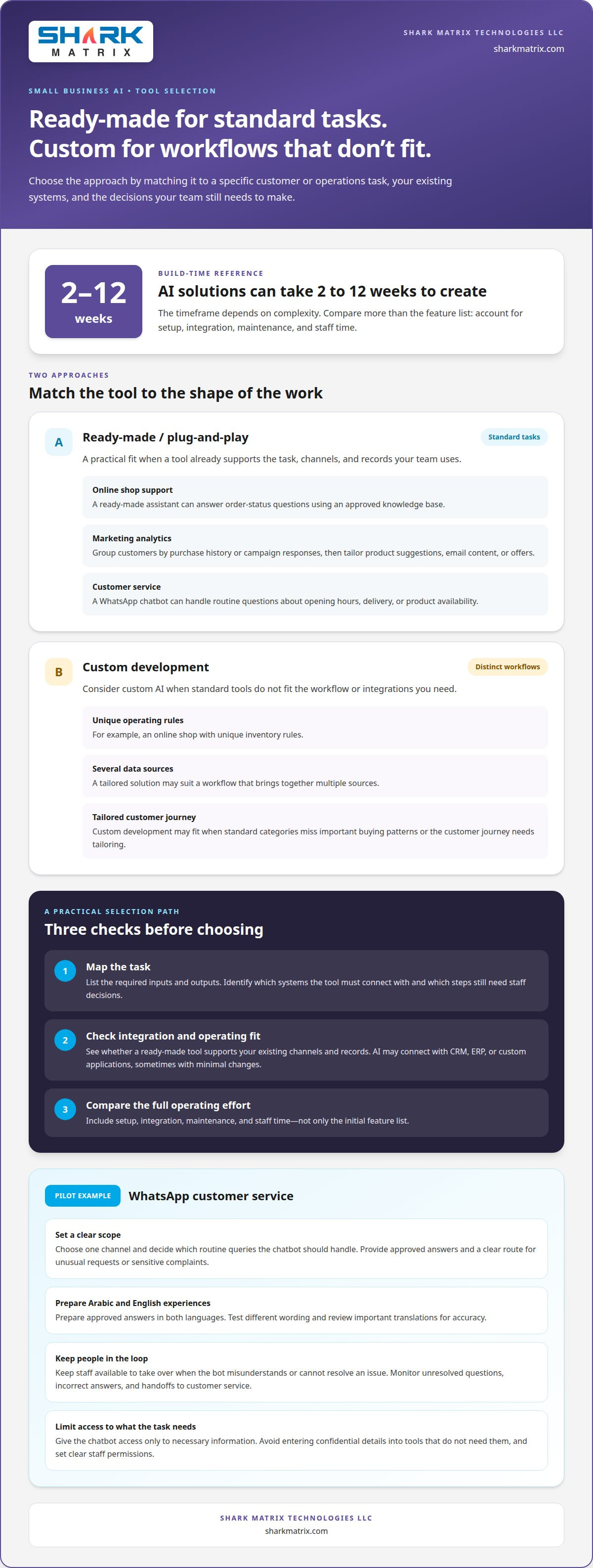
Suitable tools for UAE small businesses include ready-made chatbots, marketing analytics platforms, and custom AI connected to existing systems. Choose a tool by matching it to a specific customer or operations task.
Compare Custom and Plug-and-Play Tools
- Map the task before choosing a tool. For an online shop, a ready-made assistant may answer order-status questions using an approved knowledge base. Custom development can suit workflows involving unique inventory rules, several data sources, or a tailored customer journey. List the required inputs and outputs first. Then identify which systems the tool must connect with and which steps still need staff decisions.
- Test integration and operating fit. AI can connect with existing CRM, ERP, or custom applications, sometimes with minimal changes. Check whether a plug-and-play tool supports the channels and records your team already uses. AI solutions can take 2 to 12 weeks to create, depending on complexity. Include setup, integration, maintenance, and staff time in your comparison, not just the initial feature list.
- Match marketing automation to a clear purpose. A ready-made platform can group customers by purchase history or campaign responses. Use those segments to tailor product suggestions, email content, or offers, then track engagement and qualified leads. Custom models may fit when standard categories miss important buying patterns. Avoid collecting extra personal details simply to make personalization feel more precise.
Choose AI Customer Service Tools
- Choose one customer-service channel to pilot. An AI-powered WhatsApp chatbot can answer routine questions about opening hours, delivery, or product availability. Decide which queries it should handle, then provide approved answers and a clear route for unusual requests or sensitive complaints. Keep staff available to take over when the bot misunderstands a question or cannot resolve a customer’s issue.
- Design clear Arabic and English experiences. Prepare approved answers in both languages, including common product names and delivery terms. Test customer questions with different wording, and review important translations for accuracy. If the chatbot misunderstands a query, offer a simple path to a person. This keeps automation useful without forcing customers through repeated prompts.
- Protect information and review performance. Give the chatbot access only to information required for its task. Avoid entering confidential details into tools that don’t need them, and set clear permissions for staff. Monitor unresolved questions, incorrect answers, and handoffs to customer service. A custom AI development approach can help when off-the-shelf tools don’t fit your workflow or integrations.
AI implementation planning and staff training
Turn the chosen AI use case into a staged rollout with clear owners, staff training, and review points. A written plan connects the technology to daily work, from inventory forecasting to finance or healthcare workflows.
Plan AI Implementation
- Set a clear operational objective. Describe the task, who performs it, and what a useful result looks like. For example, a retailer might use AI to flag inventory records needing review, while a finance team could classify incoming invoices. Keep the first rollout focused on one well-defined workflow, rather than introducing disconnected technologies at once.
- Map the process before configuring tools. Document where information enters, who handles exceptions, and which systems the AI must work with. Identify data preparation, infrastructure, privacy, and ethical considerations alongside the implementation plan. Decide who owns setup, staff questions, and ongoing monitoring. Avoid a proof of concept that has no route into the real workflow.
Train Employees and Build Skills
- Choose staff who understand the workflow. During week 4, train 2-3 staff members to use and monitor the AI tools. Include people who handle routine tasks and exceptions, such as an inventory coordinator reviewing suggested stock actions. They can spot when an output doesn’t match actual operations and explain the correct escalation path.
- Teach practical skills through real examples. Show employees how to enter clear instructions, review outputs, and protect confidential information. Use sample finance documents or healthcare enquiries that reflect the work, without using unnecessary sensitive details. Staff should know which tasks AI supports, which decisions remain theirs, and how to report repeated errors. Keep short process notes available during daily use.
Establish Human Oversight and AI Auditing
- Assign a human reviewer to consequential decisions. Set approval points for outputs that could affect finances, customers, or healthcare services. For instance, an employee can review an AI-generated finance summary before it informs a payment decision. AI supports the workflow, but it doesn’t replace qualified judgement or human security expertise.
- Audit performance as the workflow runs. Schedule reviews of sample outputs, exceptions, and staff feedback. Record the type of error, its impact, and the corrective action, then adjust instructions or data handling. In inventory, compare suggested actions with confirmed records and note recurring mismatches. Use audit findings to refresh staff training and keep monitoring tied to the original business objective.
Assessing business needs before choosing AI
- Start with the business outcome, not a platform. When implementing AI in a small business in the UAE, define what should improve, such as fewer missed retail enquiries or more accurate inventory forecasts. The available figures report that 34% of UAE companies have a formal AI strategy, while 30% are developing one. Use that context to make a written priority list, not to assume AI suits every task. Choose a goal tied to revenue, service, or operating effort, then describe how the current process performs.
- Map the workflow and its friction points. Follow a task from its first input to its final decision. For a retail business, trace an order from customer enquiry through stock checks and fulfilment. Mark delays, repeated data entry, and decisions staff make using incomplete information. Then identify where predictive or AI-powered support could help. Avoid automating a process that changes constantly or lacks a clear owner; first clarify the steps people actually follow.
- Assess data and integration readiness. List the records the task depends on, where they live, who maintains them, and how often they change. A sales forecast, for example, needs usable order and stock records, not scattered spreadsheets with inconsistent product names. Identify the platforms involved and how information could move between them. If teams must manually reconcile conflicting records, data preparation may matter more than selecting an AI tool.
- Rate maturity and set a measurable baseline. Describe your current capability as a practical assessment: are records accessible, processes documented, and staff able to review outputs? Note gaps before planning deployment. Choose measures that match the goal, such as response time for enquiry handling, error rates for data processing, or qualified leads for sales. Record the current result and name who will track changes. This creates a basis for assessing ROI without treating tool adoption as the outcome.
- Rank use cases by value and readiness. Compare each candidate against business impact, data quality, integration effort, and the consequences of a wrong result. A retail stock alert based on consistent sales records may be a clearer starting point than a predictive model using incomplete data. Prioritise one workflow where staff can judge the output and the result can be measured. For implementing AI in a small business in the UAE, keep the next use case on the list, but avoid launching several disconnected platforms before the first proves useful.
Machine learning, deep learning, and generative AI
Artificial intelligence is an umbrella term, not a single tool. Choose an approach by matching the task, available data, and required output.
- Use machine learning for patterns and predictions. Machine learning uses algorithms trained on historical data to analyse information, make predictions, or automate processes. A UAE retailer could use past orders to estimate which products may need replenishing. This approach depends on relevant, consistent records. It’s a poor fit if the business can’t explain what the model should predict or lacks useful historical data.
- Choose deep learning for complex inputs. Deep learning is a subset of machine learning that uses neural networks to process complex data, including images, video, audio, and text. For example, a business could use it to classify product images or analyse spoken customer feedback. These applications may require more data and technical planning than a simple prediction task. Start with the input itself, then decide whether simpler processing can solve the need.
- Apply generative AI to create drafts and responses. Generative AI uses models that learn patterns from existing data to create new content. A small business might draft product descriptions, summarise customer messages, or prepare a first version of a marketing email. Treat the output as a draft, not an approved business statement. Staff should review facts, tone, and customer details before publishing or sending it.
- Match the approach to the business outcome. Use machine learning when the goal is forecasting or classification. Choose deep learning when complex images, audio, or text are central. Use generative AI when the task involves producing or reshaping content. A local e-commerce example reported a 35% increase in average order value after integrating AI-driven recommendations. That result illustrates a possible application, not a forecast for every business.
- Decide whether existing models or development fit. Pre-trained models can help when a business has limited data, while custom machine learning may suit a distinctive prediction task. Define the required inputs, review process, and business metric before selecting AI tools. For a tailored model built around historical records, consider machine learning development services. Keep the choice tied to a specific workflow, rather than adopting a technology for its own sake.
Shark Matrix Technologies LLC
Shark Matrix Technologies LLC can help when your AI plan needs a stronger digital foundation for customer-facing experiences. If an initiative involves improving how customers find information or use your digital services, its Web Design and Development and Mobile App Development services can support those parts of the project. Search Engine Optimization (SEO) and Pay Per Click (PPC) Management can also support customer acquisition as part of your broader digital strategy. Turn to the team when planning a website or mobile app that must fit into a carefully considered AI implementation. Share your business goals and the digital experience you want to improve. Contact Shark Matrix Technologies LLC to discuss the next step.
Take the Next Step Toward Practical AI
AI adoption works best as an ongoing business capability, not a one-off technology purchase. As your operations and customer expectations change, revisit which tasks need support and whether your current systems still serve them. For a UAE small business implementing AI, steady progress comes from connecting each next decision to a real business need.
Consider how AI fits alongside the digital experience customers already use. Shark Matrix Technologies also offers Search Engine Optimization (SEO), Pay Per Click (PPC) Management, and Web Design and Development. These services can support a broader digital strategy as you plan how technology should serve your business.
Bring your goals, the workflow you want to improve, and the challenges you’re working through into the conversation. Contact Shark Matrix Technologies to discuss a suitable next step. With a clear direction and a willingness to learn from each stage, your business can approach AI with purpose and build from there.
Frequently Asked Questions
Can small businesses benefit from AI?
Yes, small businesses can use AI to speed up routine work and give teams more time for customer needs. A service business might classify incoming enquiries by topic, while an online seller could identify products frequently viewed together. Start with a task that has a clear owner and an observable outcome. AI is less useful when it adds steps without helping staff or customers.
What Is an AI Business in the UAE?
An AI business develops or provides AI products and services; a business that uses AI applies those tools to its own operations. The distinction matters when describing a company’s actual activities for registration or licensing. Using AI for customer support, for example, does not by itself define the business activity. A company building AI software has a different core activity from a retailer using it to assist shoppers.
What is AI Integration in Business?
AI integration means connecting AI capabilities with the systems and workflows a business already uses. For example, an AI tool could classify a customer enquiry and pass it into a customer relationship management system for staff follow-up. Good integration defines what information moves between systems, who can access it, and what happens when AI cannot handle a request.
Why Is AI Becoming Important for Startups in the UAE?
AI gives startups ways to analyse information, support customers, and automate selected tasks without building every process manually. The UAE National AI Strategy aims to position the country as a global leader in AI by 2031. For a startup, the practical opportunity is to apply AI to a defined business need, then expand only when the workflow, data, and team can support it.
What are the best AI use cases for small businesses in the UAE?
Useful applications depend on the business, but common candidates include sorting customer enquiries, drafting product content, summarising feedback, and spotting unusual transactions. A retailer could use product and sales patterns to decide which items deserve closer attention. A professional services firm might organise incoming requests by subject, while growing companies can look to providers like BlueBridge Group Placement Corp to streamline their recruitment and hiring workflows. Choose a use case where staff can assess whether the output is helpful and correct.
How much does it cost for a UAE small business to implement AI?
There is no fixed cost for AI implementation; the total depends on the tools chosen and the work needed to make them useful. Account for subscription or usage charges, data preparation, integration, staff training, security measures, and ongoing maintenance. A ready-made tool and a system built around specialised workflows have different cost drivers. Estimate the full operating cost, not just the initial setup.
What are the steps to implement AI in a small business?
Start by selecting a business problem, then document the current process and the result you want to improve. Check whether the necessary data is usable and whether the tool fits your existing systems. Run a limited pilot with a staff owner, set clear review procedures, and record performance against a baseline. Use the findings to decide whether to adjust, expand, or stop the implementation.
What UAE data protection laws apply when using AI in a business?
UAE businesses must comply with the UAE Data Protection Law when implementing AI. Businesses operating in the DIFC must consider the DIFC Data Protection Law, while those operating in ADGM must consider the ADGM Data Protection Regulation. In practice, limit the personal information shared with AI tools, control access, and review how information is processed. The relevant framework depends partly on where the business operates.
 OpenAI
 Codex
 Vertex AI
 Cloud Vision
 OpenCV
 TensorFlow
 IBM Watson
 Cloud Natural Language
 Cognitive Services
 Bot Framework
 Mistral
 LLama
 Gemini
 Anthropic
 N8N