

A “green” dashboard in Google Ads doesn’t mean your business is actually growing. In 2026, relying solely on platform-reported conversions is a strategy that often leads to inflated budgets and stagnant revenue. You’ve likely felt the frustration of seeing high click-through rates while your sales team complains about poor lead quality. Learning how to measure ppc campaign success is no longer about counting clicks; it’s about technical precision. It’s a common struggle to explain to stakeholders why a significant ad spend isn’t reflecting in the company’s internal CRM data. You aren’t alone in feeling that traditional tracking has become obsolete in an AI-saturated market.
This guide will teach you how to align machine learning insights with genuine business growth. We’ll move past vanity metrics to focus on technical accuracy and lead quality. You’ll learn how to implement custom tracking solutions that bridge the gap between your ads and your bottom line. We’ll also break down the specific KPIs and attribution models that provide a clear, honest view of your marketing impact. By the end, you’ll have the framework needed to scale your spend with total confidence in your data.
Key Takeaways
- Move beyond basic reporting by adopting predictive modeling to align ad spend with long-term business growth.
- Discover how to measure ppc campaign success by separating tactical efficiency metrics from strategic effectiveness indicators like ROAS.
- Learn how machine learning development services help bridge the data gap between Google Ads and your internal CRM.
- Audit your technical tracking infrastructure to ensure your data remains accurate in an increasingly automated advertising landscape.
- Focus on lead quality rather than just volume by implementing industry-specific AI solutions that target high-value customers.
Beyond the Click: Why Measuring PPC Success is Evolving in 2026
The metric for success isn’t a static number on a spreadsheet anymore. Understanding how to measure ppc campaign success requires a fundamental shift in perspective. True success is the measurable alignment of your ad spend with specific business growth objectives, such as net profit or lifetime customer value, rather than just platform-level conversions. We’ve moved beyond the era of reactive reporting, where marketers simply looked at what happened last month. Today, performance is defined by predictive modeling that uses current data to forecast future revenue outcomes. This transition turns measurement into a technical challenge that requires sophisticated integration between your ads and your backend systems.
Traditional third-party cookies have finally been phased out, making old tracking methods unreliable for any serious brand. This shift has forced a total reliance on first-party data to establish a single source of truth for ad performance. Data doesn’t lie. Without the crutch of browser-based cookies, your internal data from CRM systems and web servers becomes the most valuable asset in your marketing stack. It’s the only way to ensure that your lead quality remains high while you scale your reach across the national market.
The Death of the Last-Click Era
Last-click attribution provides a distorted view of the customer journey because it ignores every interaction that occurred before the final purchase. In the current UAE market, users often interact with ten or more touchpoints across different devices and platforms before converting. If you only credit the final click, you’ll likely cut budgets for the very awareness campaigns that started the journey. Modern attribution in a cookieless 2026 environment relies on probabilistic modeling and data-driven weightings to assign value across the entire funnel. This approach prevents you from overvaluing branded search while undervaluing the top-of-funnel discovery phases that fuel growth. Balance is key.
Privacy-Centric Tracking Challenges
Navigating enhanced privacy regulations requires a technical approach to data integrity. Privacy is now a priority. Relying on traditional browser-based pixels often results in data loss due to ad blockers or privacy settings. Moving to server-side tracking allows for more control and accuracy by sending data directly from your server to the ad platform. When data gaps occur, AI automation services help bridge the missing points by using machine learning to fill in the blanks without compromising user privacy. This technical evolution ensures that your understanding of how to measure ppc campaign success remains rooted in reality, not guesswork. It also allows for custom web development to ensure that every tracking point is fired correctly, regardless of the user’s browser configuration.
The Metric Hierarchy: Distinguishing Efficiency from Effectiveness
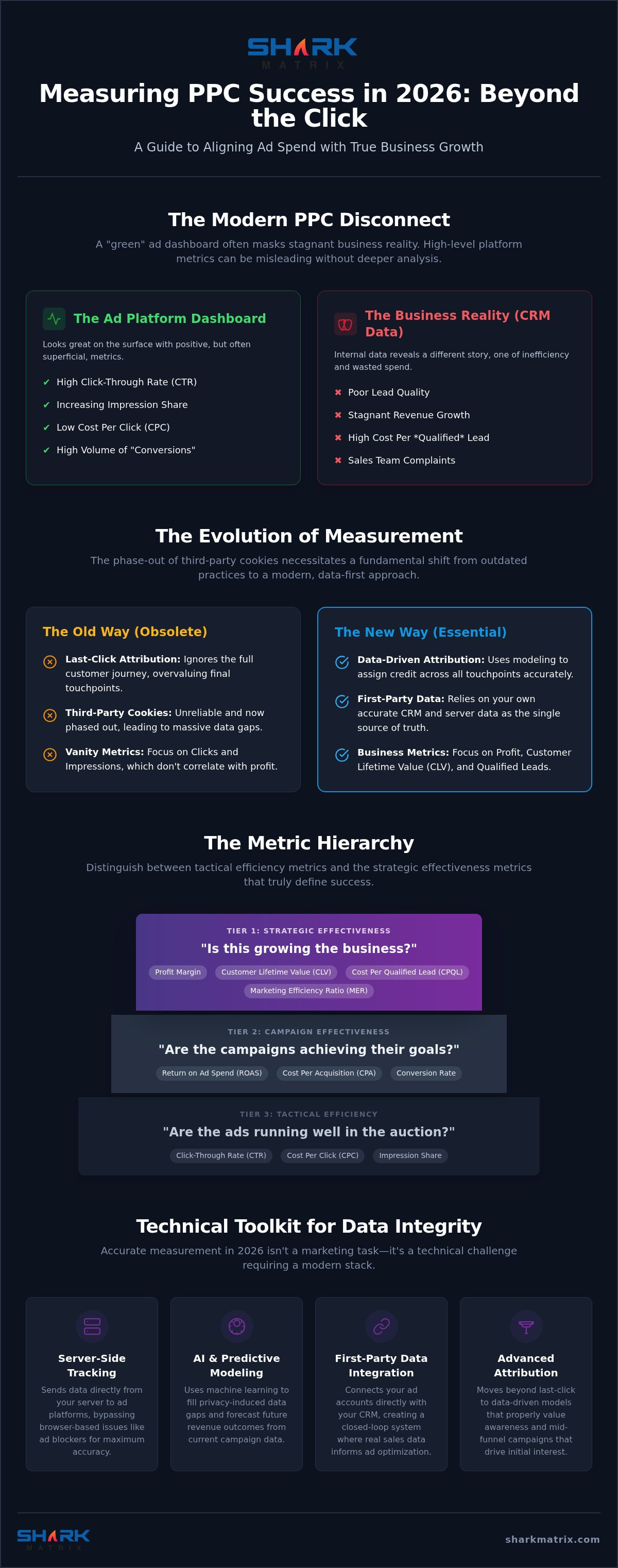
Data points aren’t created equal. When you’re determining how to measure ppc campaign success, you must distinguish between tactical efficiency and strategic effectiveness. Efficiency metrics like Click-Through Rate (CTR), Cost Per Click (CPC), and Impression Share tell you how well your ads are performing within the platform’s auction. They are diagnostic tools. Effectiveness metrics, such as Return on Ad Spend (ROAS), CPA, and Conversion Rate, reveal whether those ads are actually growing your business. Many national brands fall into the “Vanity Metric Trap,” where they celebrate a high impression share while their bottom line remains stagnant. True success requires a “North Star” metric like Customer Lifetime Value (CLV) or total pipeline contribution to ensure every dirham spent is an investment, not just an expense.
Tier 1: Business Growth Metrics
Strategic metrics focus on the financial impact of your campaigns. While ROAS is the industry standard, the Marketing Efficiency Ratio (MER) is often a more holistic indicator of health. It compares your total ad spend against total revenue across all channels. In lead generation, you should prioritize Cost Per Qualified Lead (CPQL) over a generic Cost Per Lead (CPL). High lead volume is useless if the quality is low. Tracking profit margins rather than just revenue ensures your PPC efforts are sustainable for the long term. Achieving this level of visibility often requires ai automation services to bridge the gap between your CRM and your ad accounts, ensuring only high-quality data informs your bidding strategies.
Tier 2: Platform Health Indicators
Tactical metrics serve as the engine room of your account. Quality Score remains a critical lever in 2026 because it directly influences your CPC and ad rank. A high score means you’re winning the auction at a lower cost than your competitors. CTR acts as a primary signal of creative resonance; if it’s low, your messaging isn’t connecting with the national UAE audience. Monitoring Impression Share helps you identify missed opportunities. If you’re losing share due to budget, you’re leaving potential revenue on the table. These indicators don’t prove success on their own, but they show you exactly where to optimize to improve your overall effectiveness.
Advanced Attribution and the Role of AI in Measurement
Native attribution models within Google Ads or Meta are helpful but often biased toward their own ecosystems. In 2026, understanding how to measure ppc campaign success requires a cross-channel approach that accounts for every touchpoint in the national market. AI helps identify incrementality, which is the measure of whether an ad actually caused a sale or if the customer would’ve purchased anyway. This is vital for brands that want to avoid wasting budget on customers who are already at the bottom of the funnel. Additionally, as Answer Engine Optimization (AEO) becomes a standard part of the search experience, you need to measure how often your brand is cited as the primary answer in AI-generated results. This shift moves measurement from a simple click-count to a broader view of brand authority and influence.
Integrating machine learning development services into your measurement stack allows for predictive ROI analysis. Instead of looking backward, these models analyze historical patterns to forecast which campaigns will drive the most profit in the coming quarter. This technical evolution moves PPC from a guessing game to a precise financial instrument. It’s about using data to outmaneuver competitors who are still stuck in reactive reporting modes.
Predictive Analytics for PPC
Predictive analytics goes beyond simple trend lines by identifying high-value customer segments before they even convert. This allows you to bid more aggressively on the users most likely to have a high lifetime value, ensuring your budget is always allocated to the highest potential returns. By analyzing real-time conversations, AI chatbots serve as a sophisticated tracking mechanism that identifies lead intent long before a form is ever submitted. This provides an early-warning system for campaign performance that traditional conversion tracking simply can’t match. You get a head start on optimizing your creative and targeting based on what users are actually asking for.
Bridging the Gap with Custom AI Solutions
Standard platform integrations often fail to capture the full picture of a complex national campaign. Through custom AI development, you can bridge the gap between your ad platforms and your CRM. This integration automates the deduplication of leads across multiple channels, ensuring that your data remains clean and actionable. It also allows you to feed offline conversion data back into your ad accounts, which trains the platform’s bidding algorithms on lead quality rather than just lead volume. Mastering how to measure ppc campaign success in this era requires a technical strategy that prioritizes data accuracy over platform defaults.
Building Your Success Framework: A 5-Step Measurement Roadmap
Scaling your ad spend without a roadmap is a recipe for wasted budget. Understanding how to measure ppc campaign success requires a repeatable framework that connects technical tracking with business outcomes. This process ensures that every decision is backed by data rather than intuition. By following a structured roadmap, you can identify which campaigns are driving profit and which are simply burning cash. This is especially critical in the 2026 national market where competition for high-quality leads is fiercer than ever.
- Step 1: Define clear business objectives. Distinguish between leads, direct sales, and brand awareness to set the right benchmarks.
- Step 2: Audit your technical tracking infrastructure. Ensure your pixels, GTM tags, and server-side tracking are firing correctly across all platforms.
- Step 3: Establish a baseline for key performance indicators. Use historical data to set realistic targets for CPA and ROAS.
- Step 4: Implement a multi-touch attribution model. Move beyond last-click to understand the full customer journey across multiple devices.
- Step 5: Create a real-time visualization dashboard. Use automated reporting to provide stakeholders with a clear view of marketing impact.
Defining Your PPC Goals
Success looks different depending on your campaign’s purpose. Awareness campaigns should be measured by reach, frequency, and brand lift, while direct response campaigns focus on immediate conversions and CPA. Setting SMART goals for national reach ensures your team remains focused on outcomes that matter. This clarity is essential when determining how to measure ppc campaign success for different business units. You shouldn’t treat a video discovery ad the same way you treat a high-intent search ad. Each requires a unique set of KPIs to prove its value to the C-suite.
Technical Infrastructure Requirements
Accuracy starts with a solid foundation. Partnering with a professional web development agency is often necessary to ensure your tracking infrastructure is airtight. They can help implement server-side tracking and custom event triggers that standard plugins might miss. Your UI/UX design must also support these goals; for instance, clear thank-you pages and intuitive form placements make conversion tracking much simpler. Additionally, using natural language processing services helps qualify leads by analyzing intent within ad-driven chats, ensuring your sales team only spends time on high-value prospects. If you want to refine your technical measurement, consider how ai automation services can streamline your data collection and reporting.
Driving Measurable Growth with Shark Matrix PPC Management
Managing the complexities of 2026 digital marketing requires more than just a basic ad manager. It demands a partner who understands how to measure ppc campaign success through a technical lens. Shark Matrix bridges the gap between high-performance PPC and technical Search Engine Optimization to create a unified growth engine. We don’t just look at platform data; we look at your entire business ecosystem. By leveraging industry-specific AI solutions, we’ve moved past generic reporting to provide deep, predictive insights that matter to your stakeholders. A national strategy shouldn’t rely on guesswork. We focus on lead quality and revenue correlation above all else to ensure every dirham spent drives your business forward.
Transparency is at the heart of our reporting process. We’ve replaced confusing data dumps with actionable insights that show exactly where your money is going. You’ll see which keywords are driving actual sales, not just clicks. This level of detail is essential for any business operating at a national level. We understand that your C-suite stakeholders need clear answers, not technical jargon. We provide the clarity needed to justify and scale your marketing investments.
A Technical Approach to Marketing
Our background in software engineering allows us to solve the tracking discrepancies that plague most marketing departments. We build custom dashboards that pull data directly from your CRM, giving you real-time visibility into your ROI. This technical foundation ensures that your data is clean, deduplicated, and ready for scaling. When combined with our expertise as a leading SEO Company, you get a holistic view of your entire search presence. We ensure that your paid and organic strategies work in harmony rather than in silos.
Ready to Prove Your PPC ROI?
A professional PPC audit is the first step toward identifying the measurement gaps that are draining your budget. We analyze your current infrastructure and provide a clear roadmap for improvement. Our audits provide a baseline for how to measure ppc campaign success within your specific industry. We help national brands scale by making data-driven decisions that prioritize profit over vanity metrics. If you’re ready to see the true impact of your ad spend, contact Shark Matrix for a comprehensive PPC performance analysis. Don’t let unclear data hold back your business growth in 2026.
Mastering Performance Data for National Growth
The transition from counting clicks to calculating genuine business revenue is the hallmark of a successful 2026 marketing strategy. You’ve learned that how to measure ppc campaign success requires a blend of technical tracking, AI-driven attribution, and a focus on lead quality over sheer volume. By moving away from vanity metrics and adopting a multi-touch framework, you can finally align your ad spend with your company’s bottom line. The complexity of the modern UAE market means that technical accuracy isn’t optional; it’s the foundation of every scaling decision you make.
Shark Matrix has been at the forefront of this evolution since 2010. With 15 years of digital expertise, we specialize in bridging the gap between platform data and internal CRM results through AI-driven marketing automation. Our team provides a comprehensive national strategy that ensures your campaigns thrive across the entire UAE. If you’re ready to stop guessing and start growing with precision, maximize your PPC ROI with Shark Matrix’s data-driven management. Your data holds the key to your next phase of growth; it’s time to unlock its full potential.
Frequently Asked Questions
What is the most important metric for PPC success in 2026?
Profitability and Customer Lifetime Value (CLV) are the most important metrics for PPC success in 2026. While platform-level ROAS provides a quick snapshot, true growth is measured by how much net profit a campaign generates over its entire lifecycle. This requires integrating your ad data with your internal CRM to track backend sales. Focusing on these strategic outcomes ensures that your budget is an investment in sustainable growth rather than just a tactical expense.
How long does it take to accurately measure a new PPC campaign?
You should typically allow two to four weeks to gather enough data for an accurate measurement of a new campaign. This timeframe allows the platform’s machine learning algorithms to exit the learning phase and optimize for your target audience. If your business has a longer sales cycle, you might need several months to see the full impact of your spend. Patience is essential to avoid making premature changes based on incomplete or fluctuating data sets.
Why does my Google Ads data not match my Google Analytics 4 (GA4) data?
Data discrepancies between Google Ads and GA4 often occur because they use different attribution models and tracking methods. Google Ads credits a conversion to the day of the last ad click, while GA4 may attribute it to the day the conversion actually happened. Additionally, browser privacy settings and cookie consent can block one platform while allowing the other. This technical challenge is a primary reason why learning how to measure ppc campaign success requires server-side tracking.
Can AI really predict the ROI of my future ad spend?
AI can predict the ROI of your future ad spend by analyzing historical performance patterns and current market trends. By using machine learning development services, businesses can build models that forecast revenue based on various budget scenarios. These tools identify which customer segments are likely to convert before they even click an ad. This shift from reactive reporting to predictive analytics allows you to allocate your national marketing budget with much higher precision.
What is a good ROAS for a national campaign in the UAE?
A good ROAS for a national campaign in the UAE typically starts at 4:1, meaning you earn four dirhams for every one dirham spent. However, this benchmark varies significantly depending on your industry and profit margins. High-ticket services might thrive on a 2:1 ratio if the lead value is substantial, while e-commerce brands often aim for 6:1 or higher. It’s more important to focus on your specific break-even point than on generic industry averages.
Is CTR still relevant if my conversion rate is high?
CTR remains a vital health indicator even if your conversion rate is high. A strong CTR signals to the ad platform that your creative is relevant to the audience, which helps maintain a high Quality Score. This relevance reduces your Cost Per Click and improves your ad rank over time. If your CTR drops, you might eventually see your costs rise, making it harder to sustain your high conversion rates profitably in the national market.
How do I measure the success of a PPC campaign with a long sales cycle?
Measuring success with a long sales cycle requires tracking micro-conversions and top-of-funnel engagement metrics. You should monitor indicators like whitepaper downloads, webinar registrations, or time spent on key pages to gauge lead intent. Understanding how to measure ppc campaign success in this context involves assigning a value to these early touchpoints. This approach provides a clear picture of how your ads are moving prospects through the funnel long before the final sale occurs.
What are the best tools for tracking cross-channel PPC performance?
The best tools for tracking cross-channel performance include advanced analytics platforms like GA4 and custom-built visualization dashboards. Integrating your CRM with your ad accounts is also essential for closing the loop between clicks and revenue. Many national brands use AI automation services to aggregate data from multiple platforms into a single source of truth. This technical integration provides the transparency needed to compare performance across search, social, and display channels without manual data entry.
 OpenAI
 Codex
Codex
 Vertex AI
 Cloud Vision
 OpenCV
 TensorFlow
 IBM Watson
 Cloud Natural Language
 Cognitive Services
 Bot Framework
 Mistral
 LLama
LLama
 Gemini
 Anthropic
 N8N
N8N