

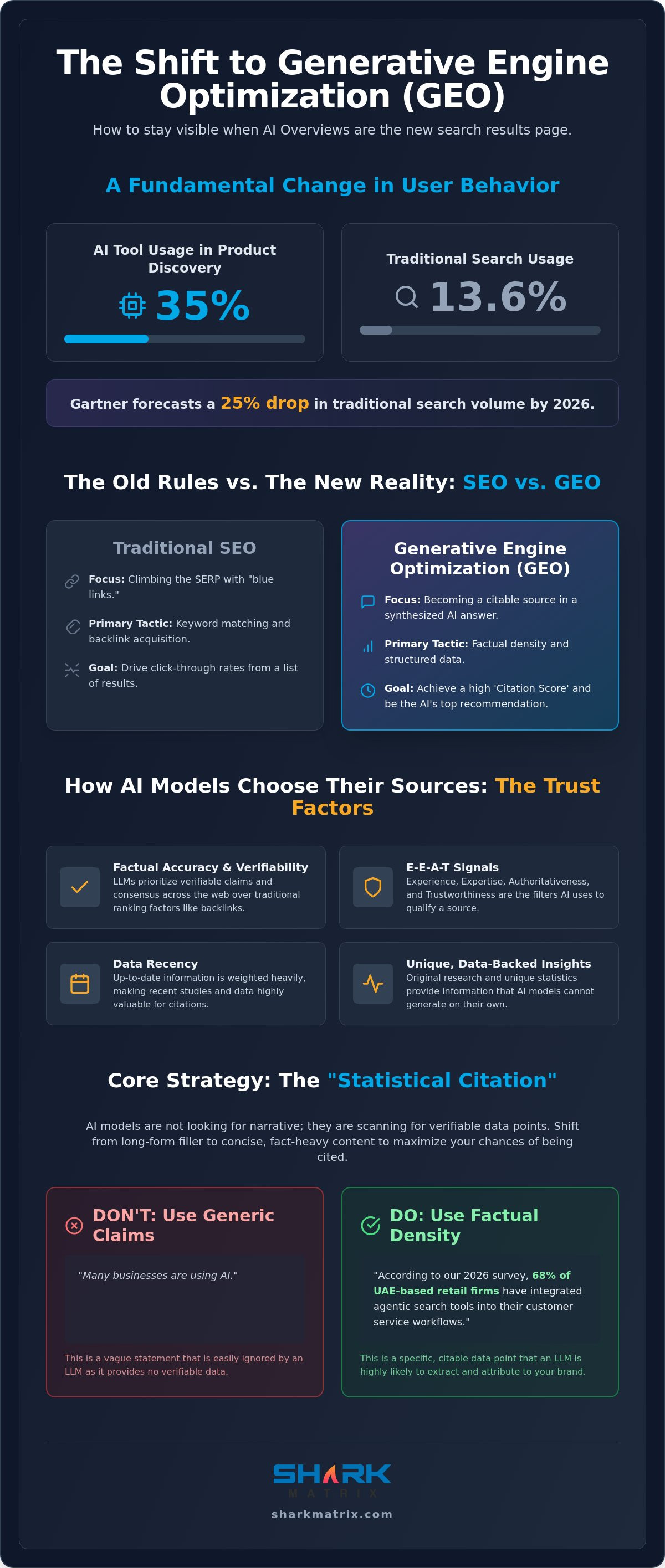
Did you know that 35% of consumers now use AI tools during product discovery, while traditional search usage has dropped to just 13.6%? This shift isn’t just a trend; it’s a fundamental change in how your customers find your brand. With Gartner forecasting a 25% drop in traditional search volume by 2026, you’re likely feeling the impact of AI overviews taking center stage. To stay visible, you must study specific generative engine optimization examples that move beyond old-school keyword stuffing and focus on becoming a citable authority for Large Language Models.
It’s frustrating to watch your hard-earned rankings disappear into a summarized AI box. You’ve spent years mastering search, only to feel like the rules changed overnight with the rise of agentic commerce. We’ve analyzed the latest 2026 data and Google’s updated spam policies to show you exactly how to ensure AI engines cite and recommend your business. This guide breaks down real-world GEO strategies, from technical schema requirements to multimodal optimization, so you can bridge the gap between traditional search and the technical infrastructure required for the future.
Key Takeaways
- Learn why ranking for citations has replaced traditional keyword positions as the primary goal for visibility in AI-powered search results.
- Discover practical generative engine optimization examples, such as leveraging original data and expert quotes to become a preferred source for LLMs.
- Understand how to tailor your content for agentic commerce to ensure your brand is the top recommendation in AI-driven product and service comparisons.
- Identify the technical schema and structured data updates required to make your website’s information easily digestible for 2026 generative engines.
- Explore how integrating AI automation and Arabic localization can help your business capture high-intent traffic across both national and regional AI search platforms.
Understanding Generative Engine Optimization (GEO) in 2026
GEO isn’t just a buzzword; it’s the technical reality of 2026. While traditional SEO focuses on climbing the Search Engine Results Page (SERP), Generative Engine Optimization (GEO) is the process of ensuring your content is selected as a primary source by Large Language Models (LLMs). Instead of fighting for a blue link, you’re fighting for a citation in a synthesized answer. Looking at successful generative engine optimization examples, we see a move away from simple keyword matching toward deep, factual density that AI models can easily parse and verify.
AI engines like Perplexity and SearchGPT operate differently than the classic Google algorithm. They prioritize information that is structured for synthesis rather than just keyword relevance. As noted by Wikipedia on Generative Engine Optimization, this discipline has emerged as a direct response to how generative AI interprets web data. In this environment, your E-E-A-T (Experience, Expertise, Authoritativeness, and Trustworthiness) isn’t just a ranking factor; it’s the filter that determines if an AI agent trusts your data enough to repeat it to a user.
From SERPs to Agentic Search
By 2026, the rise of agentic search has fundamentally changed user behavior. AI agents now perform complex research and execute tasks on behalf of users, leading to a significant increase in zero-click searches. When an agent summarizes the market for “the most reliable AI automation services,” it doesn’t present a list of links. It provides a definitive answer. Being the “source of truth” in these summaries is the new gold standard. Brands that fail to adapt see their organic click-through rates vanish, while those that master generative engine optimization examples thrive by becoming the recommended choice in agentic commerce.
For instance, as AI agents increasingly assist in B2B procurement, they allow decision-makers to explore Cleaning robots by comparing real-time performance data and technical specifications from verified sources.
The Trust Factor: How AI Models Choose Their Sources
LLMs weigh factual accuracy and the recency of data much more heavily than traditional backlink counts. They look for consensus across the web and verifiable claims that align with their training data and real-time search capabilities. This is where online reputation management becomes a critical technical pillar. If your brand’s data is inconsistent or your expertise isn’t clearly documented across multiple platforms, an LLM will likely skip your content for a more authoritative source.
To measure success in this era, professionals now track the ‘Citation Score’, which is a metric representing the frequency and prominence of your brand being cited as a factual source within AI-generated responses. AI models prioritize sources that provide unique, data-backed insights that can’t be found in generic, AI-generated filler content. By focusing on factual density, you ensure your brand isn’t just seen, but is actually used to build the AI’s final answer.
Core Generative Engine Optimization Examples by Strategy
Effective generative engine optimization examples often center on one core principle: factual density. AI models aren’t looking for narrative flow; they’re scanning for verifiable data points they can synthesize into a summary. By 2026, the most successful brands have shifted away from long-form filler toward content that prioritizes original research and expert perspectives. This shift is a key part of Generative Engine Optimization (GEO), where the goal is to provide the unique information that generic AI models can’t generate on their own. When you provide a unique statistic or a nuanced expert opinion, you give the LLM a reason to cite your brand specifically.
Factual density means every sentence provides value. AI engines like Perplexity and SearchGPT favor content that is concise and fact-heavy. Instead of using fluff to reach a word count, successful strategies focus on structured data and direct answers. This makes your content easier for AI agents to parse, increasing the likelihood that your brand becomes the primary recommendation in a synthesized search result.
Example 1: The ‘Statistical Citation’ Strategy
A generic claim like “many businesses are using AI” won’t get you cited by a modern generative engine. Instead, use a fact-dense claim: “According to our 2026 survey, 68% of UAE-based retail firms have integrated agentic search tools into their customer service workflows.” LLMs are highly likely to extract this specific data point. Structuring this information in a clear HTML table further simplifies the extraction process for crawlers. One national brand recently saw a 25% increase in AI citations by publishing quarterly industry benchmarks rather than standard blog posts. If you want to replicate this, focus on gathering original data that doesn’t exist elsewhere on the web.
Example 2: The ‘Definition-First’ Approach
The ‘Definition-First’ strategy targets “What is” queries by providing clear, non-ambiguous answers at the start of a section. This approach is essential for modern search engine optimization seo services. By creating comprehensive glossary pages, you establish your site as a primary reference for industry terminology. Semantic proximity is the mathematical measure an AI uses to determine how closely your brand is associated with a specific topic or solution based on the surrounding context of your content. When your brand is consistently linked to clear definitions, AI engines view you as a foundational authority. To see how these strategies can be tailored to your specific industry, you might explore custom AI automation solutions that align your content with these new technical requirements.
Industry-Specific GEO Examples for National Enterprises
Applying generative engine optimization examples requires a tailored approach based on your sector’s complexity and the risk level of the information provided. In 2026, AI engines don’t treat a search for “best espresso machine” the same way they treat “best corporate restructuring consultant.” High-stakes industries, particularly those in the Your Money or Your Life (YMYL) categories like healthcare and finance, must meet a higher threshold of verifiable expertise to be cited. National enterprises that successfully bridge this gap do so by providing the technical depth that LLMs require to synthesize a reliable recommendation.
In sectors like real estate and construction, providing technical data for agentic research is the new standard. AI agents often look for specific structural data, zoning information, or sustainability certifications to answer complex buyer questions. By structuring this data clearly, your brand becomes the reliable source that the AI trusts to inform high-value decisions. Whether you’re in finance or retail, these generative engine optimization examples demonstrate that the brands providing the most granular, verifiable data are the ones that survive the 25% drop in traditional search volume forecasted for 2026.
This principle is particularly relevant for specialized service providers; for example, a UAE-based restoration expert like The Solution can capture high-intent traffic by ensuring their technical expertise in damage repair is structured for AI citation, making them the preferred recommendation for property recovery queries.
Professional Services: The Authority Play
For professional services, winning the “Who is the best consultant” prompt isn’t about volume; it’s about being the most cited authority on specific, complex problems. Consider a national legal firm. Instead of generic blog posts, they optimize for queries like “How to register a business nationally” by providing comprehensive, step-by-step guides and technical whitepapers. These documents serve as high-quality training fodder for AI engines, ensuring the firm’s specific methodology is the one summarized for the user. Maintaining this status requires proactive seo for brand reputation management to ensure the AI’s consensus view of your firm remains positive and authoritative across all digital touchpoints.
E-commerce: Winning the Comparison Game
With 35% of consumers now using AI tools at the product discovery stage, e-commerce brands must optimize for conversational “Best X for Y” queries. A high-end electronics retailer, for example, can win AI comparison tables by providing hyper-detailed spec sheets that include data points generic scrapers might miss, such as specific power efficiency ratings or compatibility with niche software. According to recent generative engine optimization strategies, these brands also prioritize real-time feeds for price and availability. This ensures that when an AI agent performs research on behalf of a shopper, your product is recommended based on the most current, citable data available.
Technical GEO: Schema and Structured Data Examples
Technical SEO has evolved into a communication protocol for Large Language Models. While previous sections focused on what you say, technical GEO focuses on how you label it so an AI agent can’t possibly misinterpret your meaning. Structured data acts as the API between your website and an AI’s retrieval engine. By studying successful generative engine optimization examples at the code level, we see that the most cited brands don’t just use basic schema; they use it to define specific attributes that AI models prioritize, such as sustainability metrics or technical compatibility.
Think of structured data as the framework that turns your prose into a database. Beyond basic price and availability, 2026 product schema must include granular details like carbon footprint data or software version compatibility. AI agents often perform research tasks like “find me a CRM compatible with my existing ERP that has a high sustainability rating.” If those attributes aren’t explicitly marked up in your schema, the AI will likely skip your brand for a competitor that provides a more easily digestible data set.
Entity Linking: Connecting the Dots for AI
Entity linking is the process of helping an AI understand exactly who you are by connecting your brand to known entities in the global Knowledge Graph. You can use ‘SameAs’ properties to link your official domain to authoritative social profiles, news mentions, and third-party awards. For instance, connecting a CEO’s thought leadership articles to the company’s official domain helps the AI verify the authorship and trustworthiness of your content. This structural clarity is why website design and development services must prioritize technical metadata during the build phase; you’re not just building for humans, you’re building for the scrapers that feed the world’s most powerful LLMs.
Advanced Schema for 2026 Search
Implementing ‘Speakable’ and ‘Dataset’ schema is now essential for capturing voice search and data-hungry AI tools. ‘Speakable’ markup identifies sections of a page that are best suited for audio playback, which is a major signal for conversational AI. Similarly, properly marked-up FAQ sections allow AI engines to pull direct answers for user queries without needing to synthesize the entire page. These generative engine optimization examples show that the more you reduce the “computational cost” for an AI to understand your site, the more likely you are to be cited as the primary source of truth. To ensure your site’s architecture is ready for these requirements, you can partner with experts for a technical GEO audit to identify gaps in your structured data.
Implementing a National GEO Strategy with Shark Matrix Technologies LLC
Success in 2026 requires a technical infrastructure that bridges the gap between traditional search and AI synthesis. Shark Matrix Technologies LLC has been a national leader in this space since 2010, evolving alongside the algorithms to provide high-impact SEO and lead generation. We help enterprises transition from simply being visible to being citable. This involves a multi-channel approach where SEO signals are reinforced by PPC and social authority, creating a consistent brand narrative that AI engines can verify and trust.
Measuring success in this new era involves tracking metrics that didn’t exist five years ago. We focus on your citation rate, which is the frequency with which LLMs use your brand as a factual source. We also monitor your conversational share of voice to see how often your products are recommended in agentic commerce prompts. By integrating AI automation into your optimization workflow, we ensure your content remains fresh and factually dense, meeting the rigorous standards of modern generative engines.
AI Automation and Scalable Authority
Building authority at scale is impossible without the right tools. Shark Matrix Technologies LLC utilizes custom AI automation to identify ‘citation gaps’ within your specific industry. We analyze which topics your competitors are winning in AI summaries and develop content strategies to reclaim those positions. There is also a powerful synergy between our mobile app development services and GEO. Data generated from your own applications can serve as a proprietary source of truth that LLMs prioritize because it isn’t available elsewhere on the public web. We help you package this data into citable insights that establish your brand as a primary industry resource.
The Future of National GEO: Arabic and Beyond
For national brands, the ability to win in a bilingual environment is a major competitive advantage. Most generative engine optimization examples found online focus solely on English, but regional AI engines now process complex Arabic-English queries with high sophistication. Shark Matrix Technologies LLC specializes in localizing technical data so that it remains citable across both languages. We ensure that your structured data and factual density are preserved during translation, allowing you to dominate regional AI search intent. This localized expertise ensures your brand isn’t just understood by AI, but is actively recommended to the local market. Partner with Shark Matrix Technologies LLC to dominate the next era of search.
Dominating the Next Frontier of Digital Search
The transition from traditional search to AI-driven discovery is no longer a future prediction; it’s the current reality for national enterprises. Success in 2026 depends on your ability to provide the factual density and technical clarity that Large Language Models trust. We’ve explored diverse generative engine optimization examples, ranging from structured schema updates to the creation of citable original research. By focusing on these strategies, you ensure your brand isn’t just another link, but the primary recommendation in synthesized search results.
Shark Matrix Technologies LLC has been a national SEO leader since 2010. We specialize in custom AI automation development and high-authority B2B lead generation. This deep experience allows us to build the technical infrastructure your brand needs to thrive in an agentic search landscape. We bridge the gap between classic optimization and the modern requirements of generative engines.
Future-proof your brand with Shark Matrix Technologies LLC GEO services and secure your place as the definitive source of truth in your industry. The rules of discovery are changing, but your visibility doesn’t have to decline. It’s time to lead the conversation.
Frequently Asked Questions
What is the difference between SEO and GEO?
SEO focuses on ranking in traditional search engine results pages through keywords and backlinks to drive clicks. In contrast, GEO aims to have your content selected as a factual source or citation within AI-generated summaries. While SEO targets visibility in a list of links, GEO focuses on being the synthesized answer provided by an AI agent.
How do I know if AI is citing my website?
You can verify citations by checking the footnotes and source links provided in AI summaries from engines like Perplexity, SearchGPT, or Google Gemini. Many brands now use AI visibility tracking software to monitor their citation rate. This metric helps you understand how often your brand is recommended during the product discovery stage of the buyer journey.
Will GEO replace traditional search engine optimization?
GEO is a complementary strategy rather than a replacement for traditional SEO. While traditional search still handles navigational and transactional queries, AI search volume is growing rapidly. Integrating generative engine optimization examples into your digital strategy ensures you capture the 35% of consumers who now use AI tools for research and product discovery.
Is schema markup required for generative engine optimization?
Schema markup is essential because it provides the structured data that AI models use to verify your information. It acts as a technical bridge, allowing LLMs to parse your content without ambiguity. By using advanced schema, you reduce the computational effort required for an AI to understand your site, which significantly increases your chances of being cited as a source.
How can my small business compete with big brands in AI search?
Small businesses can compete by focusing on niche expertise and original data that larger competitors might overlook. AI engines prioritize factual density and unique perspectives over massive backlink profiles. By providing hyper-specific answers and expert-led insights, you can establish your brand as the primary authority for specialized topics within your local or national market.
What are the most common GEO mistakes to avoid?
The biggest mistake is publishing generic, long-form content that lacks original research or unique data points. AI models have no reason to cite content that merely repeats information already found in their training data. Other common errors include neglecting technical metadata and failing to provide concise, direct answers to the conversational questions users ask AI agents.
How long does it take to see results from a GEO strategy?
Results from GEO often appear faster than traditional SEO, sometimes within just a few weeks. Because AI engines are constantly scanning for the most accurate and recent data, a well-optimized page with clear schema can be picked up as a source quickly. Maintaining these citations requires consistent updates to ensure your data remains the most relevant option available.
Can AI-generated content rank well in generative engine optimization?
Purely synthetic content rarely ranks well because it often lacks the unique insights and E-E-A-T signals that LLMs prioritize for citations. Successful generative engine optimization examples usually involve human-led expertise that is enhanced by AI tools. To be citable, your content must offer original value, such as new survey results or expert commentary, that the AI cannot generate on its own.
 OpenAI
 Codex
Codex
 Vertex AI
 Cloud Vision
 OpenCV
 TensorFlow
 IBM Watson
 Cloud Natural Language
 Cognitive Services
 Bot Framework
 Mistral
 LLama
LLama
 Gemini
 Anthropic
 N8N
N8N