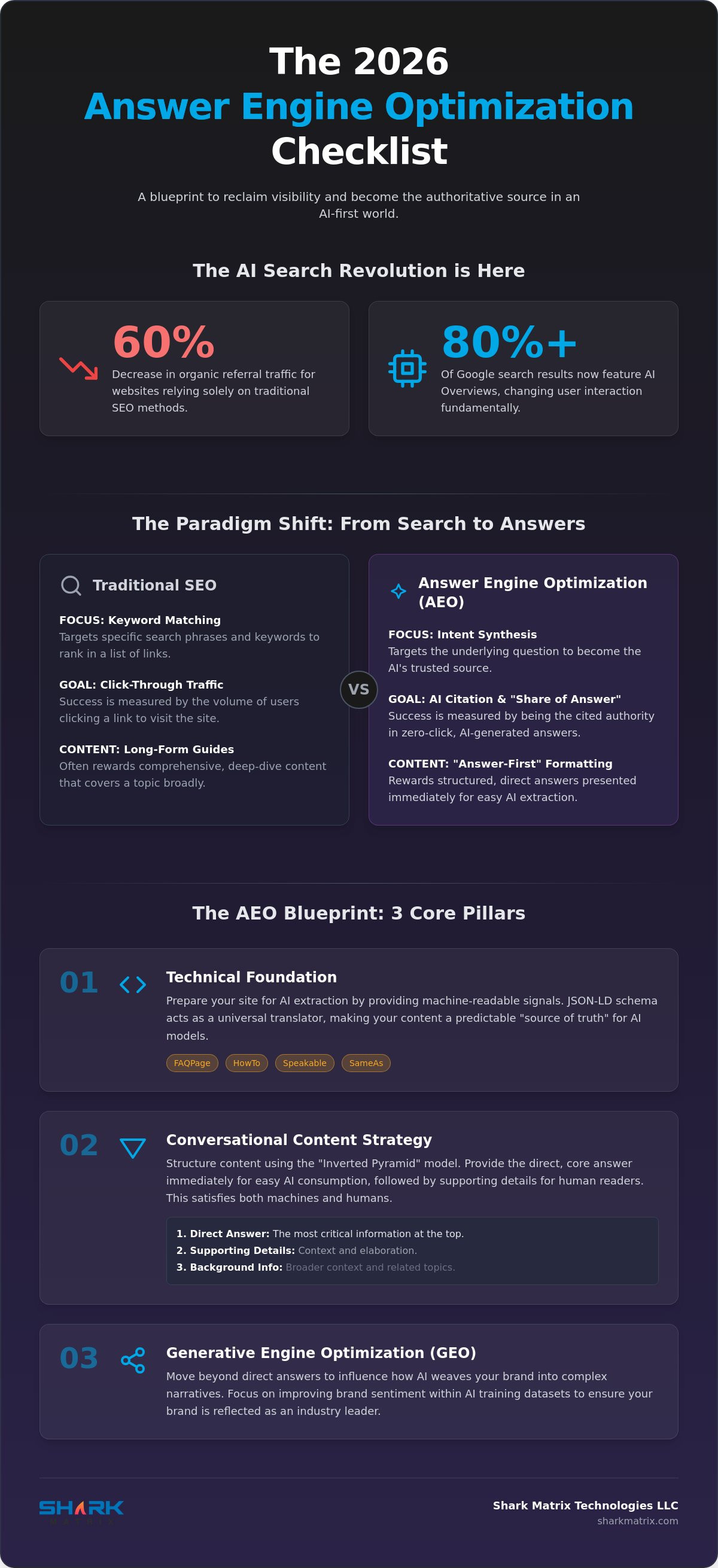
Did you know that websites relying solely on traditional SEO methods have seen a 60% decrease in organic referral traffic over the last 18 months? It’s a sobering reality for many digital marketers who are watching their hard-earned rankings yield fewer clicks. You’ve likely noticed that Google AI Overviews now appear in more than 80% of search results, fundamentally changing how users interact with the web. If you feel like the goalposts are moving, you aren’t alone.
This article provides the definitive 2026 answer engine optimization checklist to help you reclaim your visibility. You’ll get a step-by-step blueprint to optimize your brand for LLMs, Google’s AI Overviews, and conversational search engines to ensure you stay authoritative in an AI-first world. We’ll explore how to implement technical structured data, structure your content for instant answers, and future-proof your digital strategy against the next wave of generative engine updates. By the end, you’ll know exactly how to make your brand the primary source of truth for the world’s most advanced AI models.
Key Takeaways
- Learn how AEO bridges the gap between traditional keywords and conversational intent to capture visibility in AI “answer engines.”
- Discover the essential role of advanced Schema.org markup in serving as a “source of truth” for AI crawlers like ChatGPT and Gemini.
- Master the “Inverted Pyramid” content structure to ensure your brand provides the direct, extractable answers that AI models prioritize.
- Access a comprehensive answer engine optimization checklist to audit your site’s snippet potential and technical readiness for 2026 search trends.
- Understand why scaling AEO requires integrating AI automation and development to manage complex data extraction and natural language processing at scale.
What is Answer Engine Optimization (AEO) and Why Does It Matter in 2026?
By 2026, the search landscape has transitioned from a directory of links to a network of synthesized answers. While traditional Search Engine Optimization (SEO) focuses on visibility within a list, Answer Engine Optimization (AEO) aims for something more specific: becoming the definitive source cited by AI models. AEO is the process of making your content easily extractable for “answer engines” like ChatGPT, Perplexity, and Google Gemini. Simply put, AEO is the optimization of content for synthesis by large language models (LLMs).
The impact on organic traffic is undeniable. As Google AI Overviews now appear in more than 80% of search results, the traditional “blue link” click-through model is being replaced by generative responses. This shift means your answer engine optimization checklist must account for how machines read, summarize, and attribute information. Instead of just ranking for a keyword, your goal is to be the authoritative entity that the AI trusts to answer the user’s query directly. When an AI synthesizes an answer, it chooses the most structured, clear, and authoritative source. If your content isn’t built for extraction, it effectively doesn’t exist in the generative era.
The Rise of Generative Engine Optimization (GEO)
Generative Engine Optimization (GEO) takes AEO a step further by focusing on the “creative” and narrative side of AI responses. While AEO targets the direct answer, GEO is about influencing how the AI weaves your brand into complex, multi-step explanations. Brand sentiment within AI training datasets is now a critical factor; if the training data views your brand as a leader, the generative engine will reflect that. 2026 marks the tipping point where “Answer-First” search behavior is the norm, requiring brands to use specialized AI automation and development to manage their digital footprint across various LLMs.
AEO vs. Traditional SEO: A Comparative Overview
Traditional SEO is built on keyword matching, whereas AEO relies on intent synthesis. In the old model, you optimized for a click. In the AEO model, you optimize for a citation. This doesn’t mean SEO is dead, but it has evolved into a technical foundation for AEO.
- Keyword vs. Intent: SEO targets specific search phrases. AEO targets the underlying question the user is trying to solve.
- Click-Through vs. Zero-Click: SEO measures success by traffic to the site. AEO measures success by “Share of Answer” and whether your brand is the cited authority in a zero-click environment.
- Content Structure: SEO often rewards long-form, comprehensive guides. AEO rewards “answer-first” formatting where the core solution is presented immediately for easy bot consumption.
Balancing both strategies is essential for maintaining brand authority. By following a modern answer engine optimization checklist, you can ensure your content satisfies the deep-dive needs of human readers while providing the bite-sized, structured data points that AI engines crave. This dual approach prevents you from doubling your workload while maximizing your presence across all search modalities.
The Technical Foundation: Preparing Your Site for AI Extraction
AI agents are the new primary “users” of your website. While humans enjoy sleek visuals, large language models (LLMs) and autonomous agents look for machine-readable signals. This makes technical infrastructure the most critical part of your answer engine optimization checklist. If an AI agent can’t parse your data in milliseconds, it will simply move to a source that it can understand. You’re no longer just building for a browser; you’re building for a processor.
JSON-LD schema acts as a universal translator that allows AI agents to map your content directly to known entities and facts. This structured format provides a “source of truth” that reduces the risk of AI hallucinations, making your site a more reliable candidate for citations. When your data is predictable, AI models are more likely to trust and display it in generative responses.
Advanced Schema Markup for AEO
Standard SEO used to focus on basic metadata, but AEO requires a more granular approach. Implementing “FAQPage”, “HowTo”, and “Speakable” schema types is no longer optional. These tags tell AI exactly which parts of your page are the “answers.” Using “SameAs” attributes is equally vital. It connects your brand entities across the web, from LinkedIn to Wikipedia, helping AI build a comprehensive knowledge graph of your authority. Because these requirements are highly technical, professional technical seo services are the backbone of any successful strategy. They ensure your code is clean and compliant with the latest 2026 standards.
API-First Content Delivery
Speed and accessibility define the AI era. Traditional monolithic sites often struggle with slow ingestion speeds. Headless CMS architectures solve this by offering API-first content delivery, allowing AI bots to pull data directly without rendering heavy front-end elements. This efficiency directly impacts your “trust score.” AI models prioritize sources that respond quickly and reliably. As noted in HubSpot’s AEO Guide, content structure is just as important as the content itself. Your site architecture must facilitate real-time answer retrieval to stay competitive.
You must also audit your robots.txt file. In 2026, you shouldn’t just block all bots; you need to selectively allow reputable AI crawlers while protecting your proprietary data. Managing these permissions requires a delicate balance between visibility and security. If you find these technical configurations overwhelming, you might consider consulting with an expert team to streamline your AI readiness. High-speed API responses and optimized site architecture ensure you remain visible as search engines move toward instant, generative results.

Conversational Content Strategy: Writing for Machines and Humans
If technical SEO is the engine, your content strategy is the fuel that determines where the vehicle goes. In 2026, writing for visibility requires a dual-focus approach. You must satisfy the human reader’s need for depth while providing AI models with the clear, extractable data they crave. Your answer engine optimization checklist isn’t complete without a radical shift in how you draft sentences and structure your arguments. LLMs don’t “read” like people; they synthesize patterns and look for the most direct path to a solution.
The “Inverted Pyramid” of AEO is your most powerful tool. This strategy demands that you answer the core question of any section within the first 50 words. By front-loading the answer, you provide a ready-made snippet that AI agents can easily lift and cite. Natural Language Processing (NLP) friendly syntax is also vital. Use active voice and “Subject-Verb-Object” structures. This clarity improves the probability that an AI will correctly interpret your intent and attribute the information to your brand. When you write with precision, you aren’t just creating content; you’re building a reputation as a canonical source of truth.
The ‘Answer-First’ Formatting Rule
Structure your pages using H2 and H3 tags that mirror the questions users actually ask. After each header, provide a direct answer between 40 and 60 words. This specific length is the “sweet spot” for AI snippet extraction. Use bulleted lists to break down complex data or multi-step processes. Lists are highly digestible for LLM synthesis, making it much easier for a generative engine to weave your data into a larger, multi-source response. This formatting mirrors the “People Also Ask” (PAA) patterns that dominate modern search results.
Bilingual AEO: Optimizing for a National Audience
For brands operating in the UAE, a monolingual strategy is no longer sufficient. High-quality Arabic localization is essential because AI agents now handle English-to-Arabic intent translation with remarkable sophistication. However, nuances in dialect and cultural context can still trip up a machine. This is why Arabic digital marketing requires specific AEO refinements. You must ensure that your Arabic content is as structured and entity-rich as your English version. By providing clear, localized answers in both languages, you increase your “Share of Answer” across a broader demographic, ensuring your brand remains the primary authority in the regional knowledge graph.
The 2026 Answer Engine Optimization Checklist
Moving from theory to execution requires a structured approach that addresses both technical and creative content needs. This answer engine optimization checklist serves as your roadmap to visibility in an era dominated by Google AI Overviews and conversational agents. You’ve already established the technical foundation and conversational tone. Now, it’s time to audit your existing digital footprint to ensure every page is an “extractable” asset. Success in 2026 isn’t about the volume of pages you publish; it’s about the precision of the answers you provide.
- Audit Snippet Potential: Review your top 20% of traffic-driving pages. Identify sections where a direct answer can be inserted to capture featured snippets and AI citations.
- Implement Advanced Schema: Move beyond basic tags. Every service and product page must use microdata that defines specific attributes, helping AI models categorize your offerings accurately.
- Enforce the 50-Word Rule: Restructure your introductory paragraphs to lead with a concise, direct answer. This satisfies the “answer-first” requirement of modern LLMs.
- Voice Search Optimization: Adapt your long-tail keyword strategy to mirror natural speech patterns. People ask questions differently when speaking than when typing.
- Knowledge Graph Verification: Use Online Reputation Management (ORM) to ensure your brand’s facts are consistent across Wikipedia, social profiles, and industry directories.
Step 1: Entity and Authority Mapping
AI models understand the world through entities. You must clearly identify your primary business entities, including your CEO, core products, and physical locations. Consistency is vital here, especially for bilingual markets. For UAE enterprises, your Name, Address, and Phone (NAP) data must be identical across English and Arabic directories. Linking these entities via Wikidata or official social profiles helps AI engines build a reliable knowledge graph of your brand’s authority.
Step 2: Technical and Structural Alignment
Your site’s backend must be as fast as the AI models that crawl it. Mobile-first responsiveness is a baseline requirement, but lightning-fast load times are what secure a high trust score. Ensure that your custom web development supports modern SEO standards, including efficient API-first content delivery. Testing your site using AI-simulated crawlers can reveal extraction bottlenecks that traditional SEO tools might miss.
Step 3: Monitoring and Iteration
AEO is not a “set and forget” strategy. You need to track your “Citation Share” in AI Overviews and ChatGPT responses to measure real-world performance. Tools like Perplexity are excellent for testing how well your brand answers specific industry queries. As “People Also Ask” trends evolve, you must adjust your content to address emerging questions. If you want to ensure your site meets every requirement on this answer engine optimization checklist, it’s time to partner with Shark Matrix for a professional AEO audit.
Future-Proofing with AI Automation and Expert SEO
Implementing an answer engine optimization checklist across a handful of pages is a manageable task, but scaling these efforts for an enterprise-level website is a different challenge. Manual updates for thousands of product descriptions or service pages simply don’t work in a fast-moving AI environment. To maintain a competitive “Share of Answer,” you need a system that adapts in real-time. This is where automation becomes the essential bridge between a static website and a dynamic, AI-ready asset. You can’t rely on human speed when search engines are synthesizing data in milliseconds.
Shark Matrix integrates AI automation and development directly into your SEO workflow to solve the problem of scale. By leveraging custom software and machine learning, we can automate the generation of high-fidelity schema markup and “answer-first” content summaries across your entire domain. This technical-first approach ensures that every page on your site is optimized for extraction without requiring thousands of manual man-hours. It’s about working smarter by letting machines communicate with other machines effectively.
Integrating AI into Your Marketing Stack
Modern marketing stacks must include machine learning to predict shifts in search intent before they impact your referral traffic. By analyzing vast datasets, we can identify which “Question” keywords are gaining traction and automate the deployment of FAQ schema to meet that demand. This level of agility is only possible with a technical-first digital agency that understands the intersection of code and content marketing. Custom AI chatbots also play a strategic role here; they act as interactive data points that help train LLMs about your specific business logic, products, and services.
Next Steps: Your AEO Roadmap
Your journey toward search dominance in 2026 starts with a clear, actionable plan. Don’t wait for your organic traffic to decline further before taking action. The transition from “blue links” to generative answers is already happening.
- Start with a Technical Audit: Conduct a comprehensive review of your site’s crawlability by non-traditional AI agents.
- Prioritize ‘Question’ Keywords: Focus on high-intent queries that trigger AI Overviews and “People Also Ask” boxes.
- Connect Your Entities: Ensure your brand’s metadata and facts are consistent across all global and regional directories.
The search landscape has fundamentally changed, but your brand’s authority can thrive in this new environment. By combining the points in this answer engine optimization checklist with advanced machine learning, you can secure your place as the definitive answer in your industry. If you’re ready to future-proof your digital presence and lead the market, contact Shark Matrix today for a tailored AEO strategy that puts your brand at the center of the AI conversation.
Securing Your Brand’s Future in the Generative Search Era
The shift from traditional search to generative answers isn’t just a trend; it’s a fundamental change in how the world accesses information. You’ve seen how a robust technical foundation and “answer-first” content are the keys to surviving the decline in organic click-through rates. Implementing every step of this answer engine optimization checklist ensures your website doesn’t just exist but leads the conversation. Don’t let your brand become a hidden footnote in an AI-generated summary when it could be the primary citation.
Shark Matrix has delivered high-impact digital solutions since 2010. Our specialists in AI automation and machine learning are uniquely prepared to manage the complex data structures LLMs demand. Whether you’re targeting a local or national audience, our comprehensive digital marketing coverage keeps your brand authoritative. It’s time to move beyond the simple blue link and become the definitive answer that machines and humans both trust.
Future-proof your brand with Shark Matrix AEO Services and start dominating the next era of search today.
Frequently Asked Questions
Is Answer Engine Optimization different from regular SEO?
AEO is a specialized refinement of SEO that focuses on providing direct, extractable answers for AI-driven engines rather than just ranking in a list of links. While traditional SEO helps your site get indexed and ranked, AEO ensures your content is selected as the definitive answer cited by large language models. It requires a much more granular focus on technical data structures and conversational sentence patterns.
How do I show up in ChatGPT or Google AI Overviews?
You appear in these generative responses by becoming a highly authoritative and structured source for specific entities and questions. This involves implementing every item on an answer engine optimization checklist, such as leading with concise answers and using JSON-LD schema. AI models prioritize sources that are easy to parse and consistently cited across other reputable platforms like industry directories and social profiles.
Does AEO require a website redesign?
A full redesign isn’t always necessary, but your site architecture must support rapid data ingestion and mobile-first responsiveness. You might need to optimize your backend for high-speed API responses or adjust your CMS to deliver content in a more structured format. The focus is primarily on how your data is delivered to bots rather than the visual elements seen by human visitors.
Which schema types are most important for AEO in 2026?
In 2026, “FAQPage”, “HowTo”, and “Speakable” schema types are the most critical for signaling extractable answers to AI crawlers. You should also use “SameAs” attributes to link your brand’s digital entities across the web. These tags act as a universal translator, helping AI agents understand the relationships between your products, services, and leadership team without any ambiguity.
How can I track the ROI of my AEO efforts?
Tracking AEO ROI involves measuring “Share of Answer” and citation volume in generative engines instead of just traditional click-through rates. You should monitor how often your brand is cited as a source in Google AI Overviews and ChatGPT responses. While traditional organic traffic might fluctuate, the increase in brand authority and high-intent conversions from these citations provides a more accurate measure of success.
Can AI automation help with my AEO checklist implementation?
AI automation is essential for managing a comprehensive answer engine optimization checklist at scale across a large website. Automated tools can generate schema markup for thousands of pages and predict shifts in search intent using machine learning. This allows your team to focus on high-level strategy while the technical heavy lifting of data structuring and extraction optimization is handled by custom software.
What is the impact of voice search on AEO?
Voice search has pushed AEO toward more natural, conversational language patterns and long-tail query optimization. Since voice queries are typically phrased as complete questions, your content must provide complete, bite-sized answers that are easily read aloud by virtual assistants. This shift reinforces the need for clear H2 and H3 headers that mirror the way people actually speak in daily life.
Is AEO relevant for B2B companies in the UAE?
AEO is highly relevant for UAE-based B2B firms because it establishes authority in a market that values technical expertise and bilingual accessibility. Providing clear, localized answers in both English and Arabic helps you capture market share in regional AI searches. It positions your company as the canonical source for industry-specific queries, which is vital for building trust with corporate decision-makers in the region.

OpenAI
Codex
Vertex AI
Cloud Vision
OpenCV
TensorFlow
IBM Watson
Cloud Natural Language
Cognitive Services
Bot Framework
Mistral
LLama
Gemini
Anthropic
N8N