
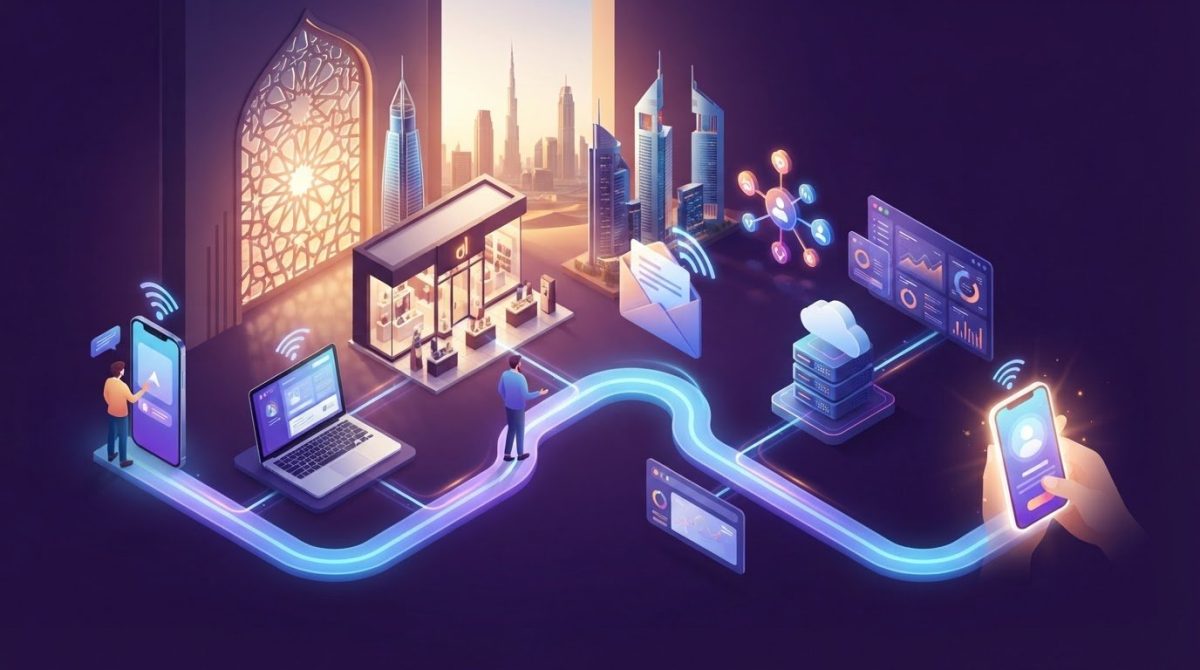
What if a customer clicked your ad, browsed your website, then visited your store, only to meet a different message at every step? That’s the gap an omnichannel marketing strategy is meant to close. The best omnichannel marketing strategy examples don’t just add channels. They connect each touchpoint so that customer context and clear next steps carry through the journey.
If your marketing channels work in silos, it can be hard to know which ones belong at each stage or whether they contribute to meaningful outcomes. Simply using search, social media, email, and a website isn’t omnichannel if each operates independently. The difference is whether the experience makes sense as customers move between those channels.
In this guide, you’ll explore five practical models for different business types and customer journeys, along with the difference between multichannel and omnichannel marketing. You’ll also find a starting framework for matching channels to customer needs, connecting experiences, and measuring results across the journey rather than relying on isolated channel metrics. Use the examples to identify where your own experience feels disconnected and what to improve first.
Key Takeaways
- See what makes an integrated customer journey different from simply using several marketing channels.
- Explore omnichannel marketing strategy examples as adaptable patterns, then match each to an audience need and a measurable outcome.
- Compare the roles of organic search, paid search, social media, email, websites, and mobile apps in guiding customers forward.
- Build a focused pilot around one audience, one journey, clear channel handoffs, and an accountable owner.
- Choose customer-focused measures that reveal whether your journey is working, beyond isolated channel activity.
What Makes an Omnichannel Marketing Strategy Different from Multichannel Marketing?
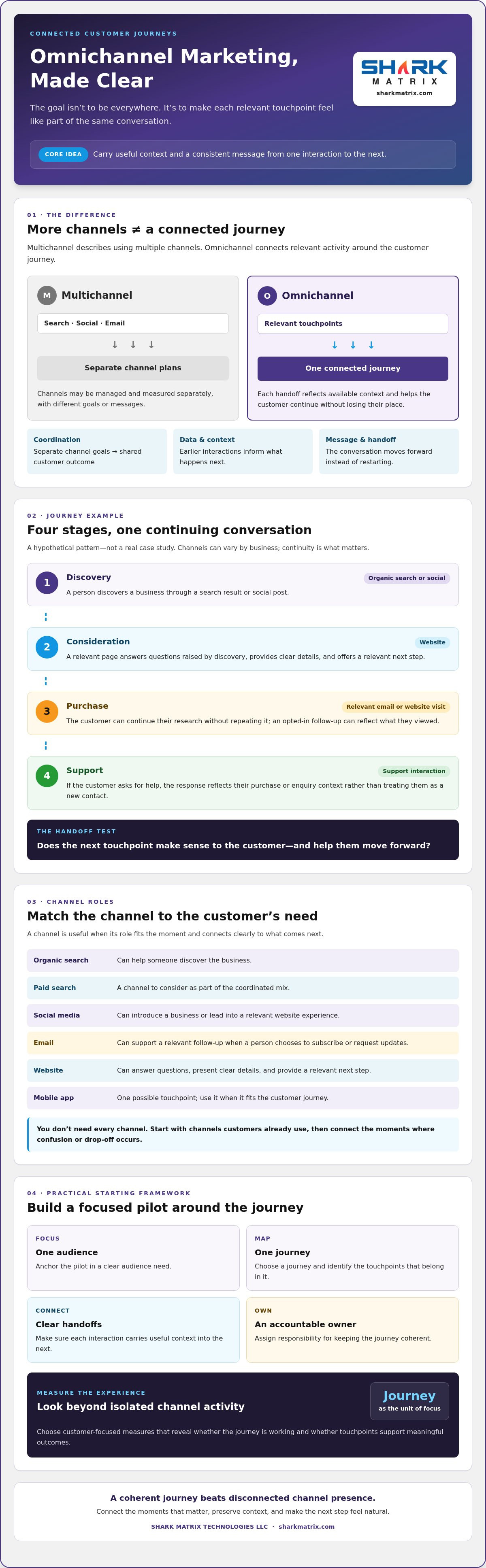
Your paid ads promise one thing, your website says another, and a customer who switches devices has to start over. That’s what fragmented channels feel like from the customer’s side. The practical distinction isn’t how many channels you use. It’s whether each channel contributes to a connected journey. The examples in this section show what coordination can look like without requiring every business to use every channel.
Definition: Omnichannel marketing coordinates customer interactions across relevant touchpoints, carrying useful context and a consistent message from one interaction to the next. Customers can change channels without losing their place in the journey.
What does omnichannel marketing mean in practice?
In practice, a customer’s needs and previous actions inform what happens next. A search, social post, website visit, email, app, or support interaction may each serve a different purpose while still feeling like part of the same relationship. This customer-centered approach is also described in the foundational overview of omnichannel marketing.
Consider this hypothetical journey, not a real case study:
- Discovery: Someone finds a business through an organic search result or social post.
- Consideration: They visit the website to compare options. The page answers the questions raised by the discovery content, with clear details and a relevant next step.
- Purchase: They return through a relevant email or direct website visit and can continue without repeating their research.
- Support: If they ask for help, the response reflects the purchase or enquiry context rather than treating them as a new contact.
The channels can vary by business. What matters is continuity: each handoff makes sense to the customer and helps them move forward.
Omnichannel vs. multichannel: what is the difference?
Multichannel marketing means using multiple channels, but those channels may be planned, managed, and measured separately. Omnichannel connects the relevant activity around the customer journey. A business can be active on search, social media, and email without coordinating its messages or handoffs.
- Coordination: Siloed campaigns pursue separate channel goals; connected campaigns support a shared customer outcome.
- Data and context: Separate channels may not reflect earlier interactions; coordinated touchpoints use available context to make the next interaction relevant.
- Message and handoff: Disconnected messages can force customers to repeat themselves; a connected handoff carries the conversation forward.
Omnichannel marketing strategy examples should demonstrate more than channel presence. Look for a clear audience need, a logical sequence, and a useful transition between touchpoints. Start with the channels your customers already use, then connect the moments where confusion or drop-off occurs. A complex technology platform isn’t the starting point; a coherent journey is.
Omnichannel Marketing Strategy Examples for Different Customer Journeys
The following omnichannel marketing strategy examples are hypothetical patterns, not verified client case studies. Each begins with a customer need, then connects touchpoints so the next interaction builds on the last. That continuity is central to an omnichannel marketing strategy: channels should work together to create a useful customer experience, not simply increase a brand’s presence.
Retail and e-commerce: from discovery to repeat purchase
Audience need: A shopper wants to compare options and decide whether a product fits. They might discover it through an organic search result or social post, then land on a relevant website page with clear details and comparisons. If they choose to subscribe or request updates, a follow-up email can reflect the product or information they viewed instead of sending a generic promotion.
Handoff: The search or social content leads to a matching page, and the opted-in follow-up helps the shopper resume their research. After a purchase, relevant updates can support another visit without assuming the customer wants repeated promotions. Measure: Track qualified product engagement, completed purchases, and repeat visits. Choose measures that match the journey’s goal, and distinguish activity from actions that show purchase intent.
B2B services: from research to a qualified conversation
Audience need: A prospective client is assessing a business challenge and wants useful information before speaking with a provider. An educational search result or paid campaign can lead to a focused service page that explains the relevant offer and next step. With permission, follow-up content can address common questions and help the prospect decide whether a conversation makes sense.
Handoff: The page and follow-up should give a sales contact enough context to continue the discussion without making the prospect repeat their enquiry. Measure: Look at qualified enquiries and their progression, not just impressions, clicks, or email engagement. For a journey that starts with search, consider how search engine optimization guidance can support discovery and guide visitors toward relevant website content.
Customer support: from self-service to human help
Audience need: A customer wants to resolve a problem quickly, first by finding an answer independently. They begin with a website resource, then use an available support channel if the information doesn’t solve the issue.
Handoff: Where practical, the support interaction should carry forward the issue and steps already taken, so the customer doesn’t have to start again. Measure: Consider resolution, repeat contact about the same issue, and customer feedback. These measures help show whether the transition worked, not merely whether the support channel received activity.
Across all three patterns, keep only the touchpoints that help customers progress. A relevant handoff is more valuable than adding another channel without a clear role. For organizations seeking strategic guidance on building customer-centric campaigns that connect sales and marketing, click here to explore agency solutions designed to drive revenue growth.
How to Choose the Right Channels for an Omnichannel Marketing Strategy
There’s no universally best channel mix. Choose channels by asking where your audience needs help, what action the business wants to support, and whether your team can keep the experience consistent. For organizations that need guidance aligning their platforms into a unified growth plan, comprehensive digital marketing support is available from Social: Managed. A smaller set of well-connected touchpoints is often more useful than a long list of channels with no clear handoff.
Match each channel to its role in the customer journey
Organic search and educational content can help people discover a business or research a question. Paid search may support visibility for specific searches, while social media can introduce useful content or bring people back to a relevant page. The website often helps customers evaluate options and act. Email can continue a conversation when someone has opted in, and a mobile app may be useful if customers have a reason to return to it. Human teams can support complex decisions or service needs.
Choose channels based on audience preference, business objective, team capacity, and the systems already in place. For audiences in the UAE, consider whether Arabic-language content would make key steps clearer, where relevant. Check that pages and messages are accessible, communication preferences are respected, and customers understand what they’re signing up to receive.
Compare channel combinations without creating disconnected campaigns
Use the table to assess a channel combination by the customer need it serves, the handoff it requires, and the outcome to measure. These are starting points, not universal rankings. Adapt them to your actual journey and available measurement.
| Audience need | Channel contribution | Continuity requirement | Possible KPI |
|---|---|---|---|
| Find an answer or solution | Organic search leads to educational content on the website | The page should answer the question raised by the search | Relevant page engagement or next-step actions |
| Compare a specific offer | Paid search leads to a focused landing page | Keep the page aligned with the ad’s promise and offer a clear next step | Qualified enquiries or completed conversions |
| Revisit information | Social content or an opted-in email points to relevant website content | Reflect the person’s stated interest and communication preference | Return visits or meaningful follow-up actions |
| Continue a task on the go | Website and mobile app support the same customer goal | Make the next step understandable and avoid unnecessary repetition | Task completion or successful return use |
Before adding a channel, name its role and the next handoff. For example, specify which page a campaign should lead to, what the visitor should be able to do there, and who is responsible for keeping the message consistent. If nobody owns the transition, or you can’t measure a customer outcome, reconsider the combination. The most useful omnichannel marketing strategy examples explain why each touchpoint belongs in the journey, not simply how many channels a brand can use.
How to Build and Measure an Omnichannel Marketing Strategy Step by Step
You don’t need to connect every channel at once. Start with one audience segment and one journey, then build a simple process your team can test, measure, and improve. These steps turn useful omnichannel marketing strategy examples into a plan grounded in your customers’ needs and your team’s capacity.
- Choose one audience and outcome. Define who the pilot serves and the main result you want, such as a qualified enquiry, completed purchase, or resolved support need. Keep the scope narrow enough to manage.
- Map the journey. Note the customer’s questions, decision points, and likely touchpoints from discovery through retention. Mark where customers hesitate, repeat information, or lose track of the next step.
- Assign each channel a role. Decide how search, paid media, social media, email, your website, or a human team will contribute. Include only channels that help the audience move forward.
- Plan messages and handoffs. For each transition, specify what the customer should see next and what relevant context should carry over. Assign an owner for each message, identify who reviews it, and agree on how to correct outdated or inconsistent information.
- Check systems, consent, and tracking. Confirm that the tools you already use can capture the necessary actions and pass relevant information between touchpoints. Review data quality, consent requirements, and tracking limitations before relying on results. Don’t assume every interaction can be connected to an individual customer.
- Set a baseline and choose measures. Record the current performance of the journey before launch. Pick one primary outcome, such as completed purchases, and a few supporting indicators, such as qualified landing-page visits or email-driven return visits. Use channel metrics to diagnose what may be helping or hindering progress.
- Review, learn, and adjust. Compare results with the baseline and check whether the handoffs made the experience clearer. Last-click attribution can show the final recorded interaction, but it shouldn’t stand in for the entire path. Improve one weak transition before expanding the pilot.
Keep measurement practical. If a customer moves from an educational search result to a service page and later submits an enquiry, consider the full sequence when reviewing performance, while noting what your tracking can and can’t confirm. For channel-specific planning, explore this guide to search engine optimization services as you shape your pilot.
How to Turn Omnichannel Examples into a Practical Marketing Plan
An example becomes useful when it fits a real customer problem, your team’s capacity, and a result you can observe. Rather than copying every touchpoint, choose one journey and adapt its sequence to your audience. A pilot helps you learn whether the handoffs make the experience clearer, without requiring you to launch every channel at once.
Start with a focused pilot before expanding channels
Choose a journey with a defined audience need and a manageable number of touchpoints, such as helping a prospective customer move from a search to a relevant service page and enquiry. Before launch, write down the current baseline, who owns each step, what information needs to pass between touchpoints, and when the team will review results.
Use this brief to keep the pilot practical:
- Customer problem and audience: What are people trying to accomplish, and who will the pilot serve?
- Journey and channel combination: Which touchpoints help them progress, and what should happen at each handoff?
- Owner and measurement: Who maintains the experience, and which customer outcome will show whether it’s useful?
Existing tools may be enough if they let your team deliver consistent messages, pass necessary context, and measure the chosen outcome. Consider integration, development, or automation only if a specific gap prevents the journey from working. Expand after the pilot has produced useful learning and the team can maintain its continuity.
Bring strategy, marketing, and technology together
A connected plan might use SEO to support discovery, a paid campaign to reach people with a relevant need, social content to reinforce useful information, and a website experience that makes the next step clear. Each channel needs a distinct role. If social media is part of the journey, review these social media marketing services for channel-specific guidance.
Check the website handoff, too. If visitors can’t find information or complete the intended action, campaigns may be sending them into a broken journey. Where the pilot requires changes to page structure or e-commerce functionality, explore web development services as a relevant technical capability.
Once you’ve defined the customer problem, channel roles, owners, and measures, you can assess what support fits your goals and existing resources. Shark Matrix Technologies LLC provides SEO, PPC management, social media campaigns, content marketing, web and e-commerce development, mobile app development, and AI automation. These capabilities may support different parts of a connected journey, depending on what the pilot needs. Discuss a strategy that fits your goals and resources, without assuming that every channel or tool is necessary.
Build a More Connected Customer Journey
The most useful omnichannel marketing strategy examples show that success isn’t about appearing everywhere. It’s about choosing touchpoints that solve a customer problem, preserving relevant context as people move between them, and making each next step clear. Start with one audience and one journey, then choose a primary outcome and a baseline so you can learn from the pilot.
Keep the plan practical. Use the tools and channels your team can manage consistently, and add integration or development only when it addresses a real gap. Shark Matrix Technologies LLC offers SEO, PPC management, social media campaigns, and content marketing, alongside web and e-commerce development, mobile app development, and AI automation. These capabilities can support different parts of a connected customer journey, depending on your needs.
Ready to shape a plan around your goals and existing resources? Discuss an omnichannel marketing strategy tailored to your goals. Start with one focused journey and build from what you learn.
Frequently Asked Questions
What is an omnichannel marketing strategy?
An omnichannel marketing strategy coordinates a business’s relevant channels around the customer journey. It aims to make transitions between touchpoints consistent and useful, while allowing each channel to serve its own purpose. For example, someone might discover a service through search, learn more on a website, then receive a relevant follow-up after opting in. The strategy is the coordination between those interactions, not simply the number of channels a business uses.
What is the difference between omnichannel and multichannel marketing?
Multichannel marketing uses more than one channel, but those channels may be planned or measured separately. Omnichannel marketing connects activity around customer needs, helping messages and handoffs remain relevant as people move between touchpoints. A business can begin with just a few channels and still take an omnichannel approach if it coordinates them deliberately. Simply adding social media, email, and search to a marketing mix doesn’t make their experiences connected.
What are some examples of omnichannel marketing?
Examples include a retailer connecting search or social discovery to a relevant product page and an opted-in follow-up, or a B2B business linking educational content to a service page and a useful sales conversation. A support journey might begin with a website resource and continue with human assistance that reflects the customer’s issue. These are adaptable patterns, not guarantees of results. Each needs a defined audience, customer need, appropriate handoff, and success measure.
How do I create an omnichannel marketing strategy?
Start by choosing one audience and a customer problem to address. Map the journey, identify the touchpoints that genuinely help, and assign each channel a clear role. Decide what context should carry from one interaction to the next, then check your tools, data, consent processes, and team ownership. Launch a focused pilot with a recorded baseline and a defined outcome. Review customer actions and improve the journey before expanding to more channels.
Do small businesses need an omnichannel marketing strategy?
Small businesses can use omnichannel principles without adopting every channel or investing in an extensive technology platform. Begin with the touchpoints customers already use, such as search, a website, email, or social media. Make the transitions between them clear, and measure whether the experience helps customers take a useful next step. Add tools or channels only when a specific customer need or operational gap justifies the extra complexity.
Which channels should an omnichannel marketing strategy include?
There’s no fixed channel list that suits every business. Choose based on where your audience looks for information, what your business needs to accomplish, and what your team can manage consistently. Organic search, paid media, social media, websites, email, mobile apps, and human support can all play a role. Prioritize the connections between selected channels, and consider accessibility, customer preferences, and consent when planning each touchpoint.
How do you measure omnichannel marketing success?
Begin with an outcome tied to the customer journey, such as qualified enquiries, completed purchases, or resolved support needs. Establish a baseline before launch, then use channel metrics to diagnose how individual touchpoints may contribute. Don’t assume one channel or a last-click report explains the entire journey. Check data quality, consent, and tracking limitations before comparing results, and review customer feedback alongside business outcomes to identify where the experience needs improvement.
 OpenAI
 Codex
Codex
 Vertex AI
 Cloud Vision
 OpenCV
 TensorFlow
 IBM Watson
 Cloud Natural Language
 Cognitive Services
 Bot Framework
 Mistral
 LLama
LLama
 Gemini
 Anthropic
 N8N
N8N