
Categories
Uncategorized

Digital Marketing Reporting Framework: Build One That Drives Better Decisions in 2026

What if your busiest marketing dashboard is hiding the one decision your team needs to make? A digital marketing reporting framework should do more than list clicks, impressions and leads. It should show whether SEO, paid media, social and content are helping the business move towards its goals, and where the team should act next.

If your reports feel busy but inconclusive, you’re facing a common challenge: channel data can’t guide decisions when teams define metrics differently, compare mismatched reporting periods or rely on unstated attribution assumptions. Add a long list of KPIs, and it becomes harder to see what matters.

This guide explains how to build a practical framework around business objectives, choose meaningful measures for each channel, and connect performance to outcomes such as qualified leads. You’ll also learn how to compare channels without treating unlike metrics as interchangeable, set shared reporting rules, and turn review meetings into clear actions with owners and follow-up measures. The result is reporting that helps marketing teams across the UAE decide what to continue, improve or investigate, rather than simply documenting what happened.

Key Takeaways

  • Build your digital marketing reporting framework around a business objective and the decision you need to make, not a long list of available metrics.
  • Separate leading indicators, such as qualified visits, from lagging outcomes, such as completed leads, to understand both progress and results.
  • Compare SEO, paid media and social against shared goals, while noting each channel’s role, data source and measurement limitations.
  • Use a consistent review flow to explain performance changes, agree on an action, assign an owner and set a follow-up date.
  • Improve reporting by addressing broken tracking, outdated KPIs and unclear ownership before adding dashboards or automated summaries.

What Is a Digital Marketing Reporting Framework, and What Should It Help You Decide?

A digital marketing reporting framework is a repeatable system that connects business goals to measures, data, interpretation and action. A dashboard displays selected data, while a one-off report captures performance for a particular period. The framework sits behind both: it defines what to track, where the information comes from, who interprets it, when it is reviewed and which decisions the evidence can inform.

That distinction matters when SEO, paid campaigns, social media and content all contribute to the same growth objective. These channels are different parts of digital marketing, but separate platform summaries won’t automatically explain their combined contribution to qualified leads. A useful framework gives channel owners enough detail to diagnose performance, while helping business leaders and client-facing teams understand progress and agree on priorities.

Start with the business decision, not the dashboard

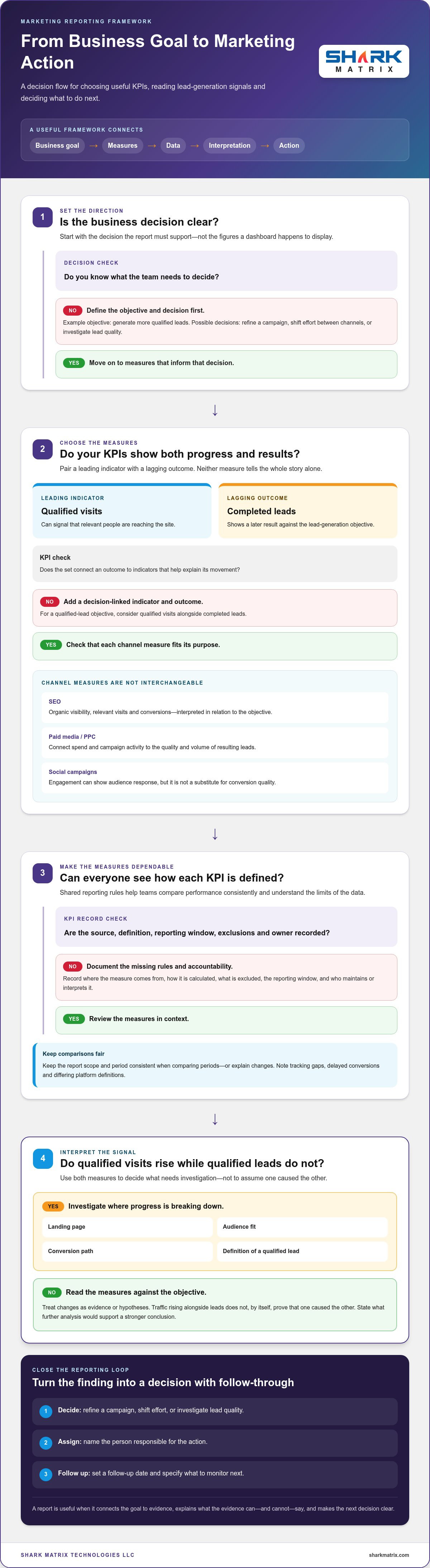
Before opening an analytics tool, name the decision the report should support. You might need to reallocate effort between channels, refine a campaign that attracts visits but few enquiries, or investigate why lead quality has changed. Connect that decision to a business objective, such as generating more qualified leads, before choosing metrics. This prevents available dashboard figures from dictating what the team pays attention to.

Separate routine optimization from strategic planning. A channel owner may use campaign-level signals to adjust targeting or content. Leadership may need to decide whether the current channel mix supports broader growth priorities. The first calls for timely diagnostic information; the second needs a wider view of outcomes and trends. Both can draw on related data without being forced into the same level of detail or decision cycle.

Set the scope and audience for each report

Define the report’s boundaries so readers know what they’re looking at. Record which channels, campaigns and objectives are included, the reporting period, and any important exclusions. For example, a report might cover SEO, paid media and social activity for lead generation over a stated period. Keep the scope consistent when comparing periods, or explain any changes that affect the comparison.

Then tailor the view to its reader. Leadership usually needs outcomes and implications; channel owners need diagnostic measures that help them locate a change. Client-facing teams need a clear explanation of what the findings mean and what happens next. One shared framework can serve these audiences without giving everyone the same crowded dashboard.

Finally, state limitations alongside conclusions. Tracking gaps, delayed conversions or differing platform definitions can affect what the data shows. A rise in traffic alongside an increase in leads does not, by itself, prove that one caused the other. Label observations as evidence or hypotheses, and state what further analysis would support a stronger conclusion. Clear limits build trust and keep the next decision grounded in what the report can actually tell you.

Digital Marketing Reporting Framework: Goals to KPIs

Once the business objective is clear, translate it into measures in a deliberate order. A useful digital marketing reporting framework prevents teams from choosing KPIs simply because a platform makes them easy to export. A KPI is useful only when it informs a defined objective or decision.

  1. Choose an objective: for example, generate more qualified leads.
  2. Define the decision: decide whether to refine a campaign, shift effort or investigate lead quality.
  3. Select KPIs: pair an outcome measure with indicators that help explain it.
  4. Assign sources and owners: record where each measure comes from and who maintains or interprets it.
  5. Review: use the findings to make a decision and specify what to monitor next.

This sequence separates leading indicators from lagging outcomes. Qualified visits may signal that relevant people are reaching the site, while completed leads show a later result. Neither tells the whole story on its own. If visits rise but qualified leads do not, investigate the landing page, audience fit, conversion path or definition of a qualified lead.

Choose a small, decision-linked set of KPIs

Pair outcomes, such as completed conversions or qualified leads, with channel measures that help diagnose movement. For SEO, a team could track organic visibility, relevant visits and conversions, using consistent definitions for each. Interpret SEO measures in relation to the objective they support, rather than treating a search metric on its own as a business result.

For PPC, connect spend and campaign activity to the quality and volume of resulting leads. For social campaigns, engagement can show how audiences respond, but it shouldn’t stand in for conversion quality. These channels play different roles and use different platform definitions. Compare each against its purpose and a shared business outcome, not as if a click, impression and engagement were interchangeable units. Commercial marketing specialists such as big-voice.co.uk take a similar approach for growing businesses, focusing on measurable commercial returns rather than vanity metrics.

Document data sources, definitions, and owners

Create a simple KPI record with the calculation, source, reporting window, exclusions and accountable owner. For example, define whether a “lead” means a form submission or a lead accepted as qualified in the CRM. Name the system of record and the person responsible for investigating differences between analytics and CRM figures. Digital.gov’s guidance on analytics strategy and reporting also connects performance goals and KPIs with data-informed decisions.

Use UTM parameters consistently to identify campaign traffic across analytics and CRM records. Agree on campaign naming conventions before launches, and document how missing or incorrectly tagged visits are handled. This makes channel comparisons more interpretable without implying that tracking captures every interaction or proves causation.

When SEO, paid media and social all contribute to lead generation, structured reporting can connect channel findings to shared priorities. Keep the KPI record accessible to everyone who contributes data or acts on the results, so definitions don’t drift as campaigns change.

How to Compare Channel Performance Without Misreading Marketing Data

Cross-channel comparison works only when everyone agrees on what the numbers mean. A click in a paid platform, an organic visit in analytics and an engagement in a social account describe different behaviours. Compare each channel with the same business objective, such as qualified lead generation, but don’t treat platform metrics as equivalent units. A digital marketing report definition and importance can provide useful context for how reporting supports performance review and strategic changes.

Platform-reported conversions may overlap, so don’t simply add them together and treat the total as unique leads. A person may interact with more than one channel before converting, and each platform may claim credit according to its own settings. Attribution is a model for assigning conversion credit across touchpoints, not definitive proof that a particular channel caused the outcome.

Separate channel contribution from channel efficiency

Read performance in layers: traffic, engagement, lead volume, lead quality and business outcomes. Each layer answers a different question. SEO may contribute relevant visits over time; PPC may capture active search demand; social activity may introduce or re-engage audiences. Compare each channel’s contribution to a shared outcome, while preserving its role and context.

Efficiency comparisons need aligned definitions, reporting periods and included costs. If one channel’s conversion count includes every form submission while another counts only qualified leads, a cost-per-conversion comparison will mislead. Where available, use CRM records to see whether leads progress beyond their initial conversion. Paid-search results also make more sense alongside campaign intent and management context, as discussed in Choosing the Right PPC Agency: A Guide to National Growth.

Use a consistent comparison view

A compact channel comparison keeps important context next to each result. Include these fields for every channel:

  • Channel and journey role: for example, SEO supporting discovery or PPC capturing active search demand.
  • Key KPI and source: name the measure and the platform, analytics system or CRM record behind it.
  • Limitation: note any tracking gap, differing definition or delayed conversion window.
  • Next decision: state whether to maintain, investigate or adjust the activity, and what evidence would guide that choice.

This view gives leadership a consistent way to discuss outcomes while letting channel owners interpret their own diagnostic measures. It also prevents a high engagement count from being mistaken for stronger lead quality.

Interpret attribution and data gaps responsibly

Observed data can be affected by consent choices, cross-device journeys and platform settings. A conversion may not be connected to an earlier interaction, or reporting systems may assign credit differently. Record those limits beside the result. If tags are missing or campaign names are inconsistent, flag the gap and investigate it rather than filling it with an assumption.

Use attribution to guide questions, not to declare a channel the sole cause of growth. Compare trends using consistent definitions, check CRM outcomes where possible, and be explicit about what the available data supports. That discipline helps a digital marketing reporting framework inform sound channel decisions without claiming more certainty than the evidence provides.
Digital Marketing Reporting Framework: Build One That Drives Better Decisions in 2026

How to Run a Reporting Cycle That Turns Findings into Action

A report creates value only when someone uses it to make a decision and follows through. Build a recurring cycle into your digital marketing reporting framework so findings don’t stop at discussion. Move from the objective to a performance variance, its possible explanation, a decision, an accountable owner and a date to review the result.

Separate evidence from interpretation. A confirmed finding might be that recorded qualified leads declined during the reporting period. A possible explanation, such as a landing-page change or weaker audience fit, is still a hypothesis until the team checks supporting data or runs a suitable test. Label the difference clearly so the team doesn’t mistake a plausible story for a proven cause.

Choose a cadence that matches the decision

Review active campaign issues often enough to act while the information is useful. Strategic outcomes may need a longer observation period before a meaningful trend emerges. Weekly or monthly reviews can work when the decision and data support that rhythm, but neither should be automatic. Don’t spend each meeting reviewing every available metric. Bring forward only the measures relevant to decisions due now, and reserve deeper analysis for questions that need it.

Make every insight testable and accountable

Start with a specific question about a variance, rather than jumping straight to a recommendation. If an SEO page is receiving relevant visits but producing fewer enquiries, ask whether the page’s message, search intent or conversion path has changed. If the cause remains uncertain, agree on what to investigate before making a wider campaign change. A deeper SEO diagnostic, such as How to Conduct a Comprehensive SEO Audit for Your Business, can help structure that investigation.

Record the decision in a simple action log. For example:

  • Finding: Relevant organic visits continue, but enquiries from a key page have declined.
  • Proposed response: Review the page’s content and conversion path before changing broader SEO priorities.
  • Accountable owner: The assigned SEO or web team member.
  • Success measure: The agreed enquiry measure, interpreted alongside relevant visits.
  • Follow-up: A specific review date after the investigation or change.

For paid campaigns, the same log might capture a lead-quality concern, the audience or search terms to investigate, the person responsible and the CRM measure to check at follow-up. Keep the expected signal observable, and note whether it would confirm the hypothesis or prompt another question. If data quality is too weak to judge the result, make improving measurement the action.

Close each review by reading back decisions, owners and follow-up dates. Shark Matrix provides SEO and broader digital marketing services that can support campaign priorities and lead generation.

How to Improve Your Digital Marketing Reporting Framework Over Time

A reporting framework should evolve as business priorities, campaigns and data systems change. Review it periodically to catch KPIs that no longer guide decisions, broken tracking, duplicate reports and measures without a clear owner. A useful audit asks more than whether each dashboard still works: does every report help someone decide what to do next?

Start by checking whether each measure still supports an active objective. Remove or replace metrics that no longer influence a decision, and investigate duplicated reporting that creates competing versions of performance. Check that campaign tracking works as intended and that responsibility for maintaining definitions and sources is clear—an area where agencies like Barlo Digital prioritise tracking and measurement audits before rolling out broader growth campaigns. Fix these foundations before adding dashboards or automated summaries. More output won’t correct inconsistent inputs.

Keep definitions and measurement governance current

Set a regular review point for metric definitions, data sources, campaign naming conventions and tracking implementation. Revisit them when a platform, analytics setup or campaign process changes. Keep a short change log: note what changed, when it took effect and which reports it affects. That context helps readers distinguish a genuine shift in performance from a change in how it was measured.

Automation can reduce repetitive collection and formatting, but it shouldn’t make decisions on the team’s behalf. Assign a person to review unusual results, check whether definitions remain consistent and interpret what the numbers mean for the objective. Treat automated summaries as a starting point for analysis, not a substitute for accountable judgment.

Get support when reporting spans channels and teams

SEO, PPC, social media and lead-generation activity often sit across different platforms and teams. Coordinated reporting can bring them into one view tied to shared business goals, while preserving each channel’s role, definitions and measurement limits. Explore SEO services as part of your search and reporting priorities.

For a practical framework audit, use a short checklist:

  • Relevance: Does every KPI still support a current objective or decision?
  • Reliability: Are tracking, sources, calculations and reporting windows consistent?
  • Ownership: Is someone accountable for each definition, data check and follow-up?
  • Use: Do reports lead to decisions, or are they repeated without changing priorities?

Shark Matrix supports SEO, PPC, social media campaigns and data-driven lead generation. If reporting across channels makes it difficult to see what should happen next, explore how Shark Matrix’s digital marketing services can support your growth priorities.

Make Your Next Reporting Review the Starting Point

Your next step doesn’t need to be a complete reporting overhaul. Pick one upcoming business decision and use it to test whether your current reporting gives the team enough evidence to act. If it doesn’t, identify the missing definition, data source or owner, then improve that piece before expanding the system.

Over time, this steady approach can turn a digital marketing reporting framework into a practical learning loop. Each review can sharpen what the team measures, how it interprets results and which questions deserve further investigation. The aim isn’t a perfect dashboard; it’s clearer, more confident decisions that support sustainable growth.

Shark Matrix brings digital marketing services across SEO, PPC management, social media campaigns and content marketing, with a focus on data-driven lead generation. Explore Shark Matrix’s digital marketing services to align your marketing activity with your growth goals.

Frequently Asked Questions

What should a digital marketing reporting framework include?

It should include the information and responsibilities needed to move from a marketing goal to a follow-up decision. For example, if the goal is to generate qualified enquiries, document how an enquiry is classified, where that information is recorded, who checks it, and how the team will assess progress. Include the reporting period and any known data limitations so readers can interpret results consistently as campaigns or systems change.

How often should a business review digital marketing reports?

Set the review rhythm according to how quickly a decision needs to be made and how soon reliable data is available. An active campaign may warrant frequent checks for issues requiring prompt attention, while a longer-term initiative needs enough time to produce a meaningful signal. If conversions usually take time to mature, reviewing them too early can prompt unnecessary changes. Choose a cadence, then adjust it when the decision cycle changes.

Which digital marketing metrics should executives see?

Executives generally need a concise view of business outcomes and progress towards agreed targets, rather than every channel’s operational detail. Depending on the organisation, that could include qualified leads, lead-to-customer progression, conversion rate or cost per qualified lead. Show the trend and explain notable changes in plain language. Include only measures with clear definitions, and flag when incomplete data limits what the figures can support.

Can a digital marketing report prove which channel caused a sale?

No. A report can show recorded interactions and how an attribution model assigns credit, but that doesn’t by itself prove what caused a sale. For stronger evidence, teams can run a controlled test, such as comparing outcomes between a group exposed to a campaign and a suitable comparison group. The test design matters, so state what was tested, what other factors may have changed and how confidently the result can be interpreted.

What is the difference between a digital marketing dashboard and a reporting framework?

A dashboard is a display for selected data; a reporting framework is the operating structure that determines what should be measured, how figures are defined, who reviews them and what actions follow. The same dashboard could serve different teams, but the framework clarifies how each audience should use it. For example, a channel specialist may inspect campaign details, while an executive view focuses on progress towards business targets.

How can a small team create a reporting framework without too many tools?

Start with tools the team already uses, such as its analytics platform, customer records and a shared spreadsheet for metric definitions and actions. Choose one business objective, record a small set of measures, name each data source and assign responsibility for checking the figures. Use consistent campaign tags and a simple review note to capture decisions. Add another tool only when a specific reporting task can’t be handled reliably with the current setup.

Categories
Digital Marketing

Omnichannel Marketing Strategy Examples: 5 Practical Models for 2026

What if a customer clicked your ad, browsed your website, then visited your store, only to meet a different message at every step? That’s the gap an omnichannel marketing strategy is meant to close. The best omnichannel marketing strategy examples don’t just add channels. They connect each touchpoint so that customer context and clear next steps carry through the journey.

If your marketing channels work in silos, it can be hard to know which ones belong at each stage or whether they contribute to meaningful outcomes. Simply using search, social media, email, and a website isn’t omnichannel if each operates independently. The difference is whether the experience makes sense as customers move between those channels.

In this guide, you’ll explore five practical models for different business types and customer journeys, along with the difference between multichannel and omnichannel marketing. You’ll also find a starting framework for matching channels to customer needs, connecting experiences, and measuring results across the journey rather than relying on isolated channel metrics. Use the examples to identify where your own experience feels disconnected and what to improve first.

Key Takeaways

  • See what makes an integrated customer journey different from simply using several marketing channels.
  • Explore omnichannel marketing strategy examples as adaptable patterns, then match each to an audience need and a measurable outcome.
  • Compare the roles of organic search, paid search, social media, email, websites, and mobile apps in guiding customers forward.
  • Build a focused pilot around one audience, one journey, clear channel handoffs, and an accountable owner.
  • Choose customer-focused measures that reveal whether your journey is working, beyond isolated channel activity.

What Makes an Omnichannel Marketing Strategy Different from Multichannel Marketing?

Your paid ads promise one thing, your website says another, and a customer who switches devices has to start over. That’s what fragmented channels feel like from the customer’s side. The practical distinction isn’t how many channels you use. It’s whether each channel contributes to a connected journey. The examples in this section show what coordination can look like without requiring every business to use every channel.

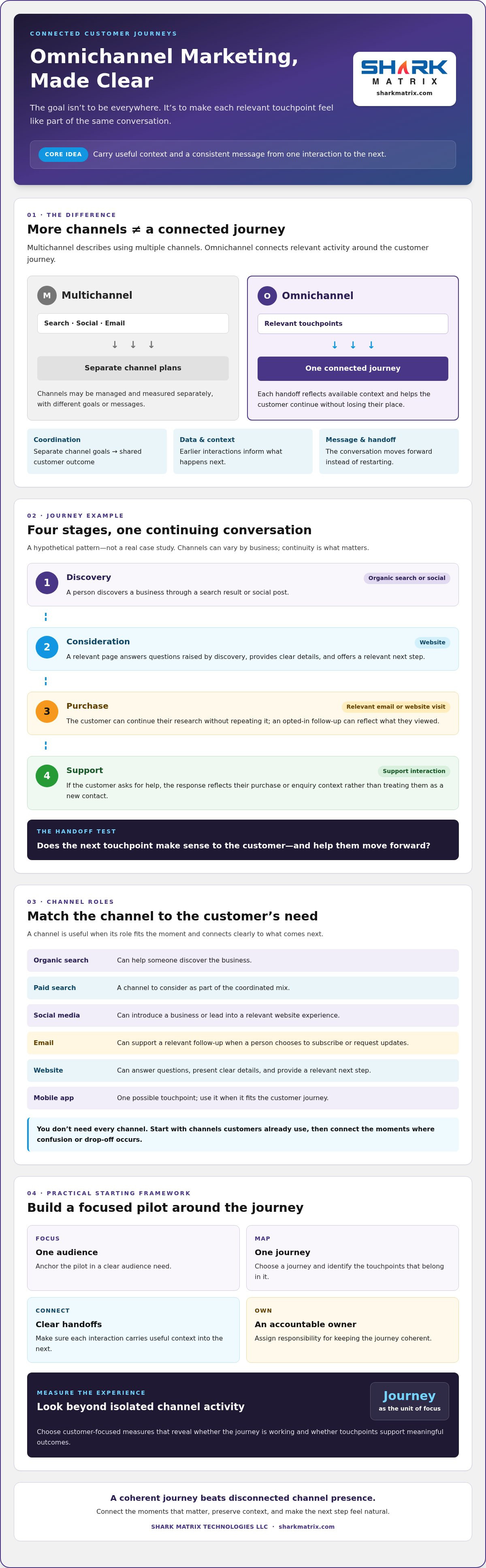
Definition: Omnichannel marketing coordinates customer interactions across relevant touchpoints, carrying useful context and a consistent message from one interaction to the next. Customers can change channels without losing their place in the journey.

What does omnichannel marketing mean in practice?

In practice, a customer’s needs and previous actions inform what happens next. A search, social post, website visit, email, app, or support interaction may each serve a different purpose while still feeling like part of the same relationship. This customer-centered approach is also described in the foundational overview of omnichannel marketing.

Consider this hypothetical journey, not a real case study:

  • Discovery: Someone finds a business through an organic search result or social post.
  • Consideration: They visit the website to compare options. The page answers the questions raised by the discovery content, with clear details and a relevant next step.
  • Purchase: They return through a relevant email or direct website visit and can continue without repeating their research.
  • Support: If they ask for help, the response reflects the purchase or enquiry context rather than treating them as a new contact.

The channels can vary by business. What matters is continuity: each handoff makes sense to the customer and helps them move forward.

Omnichannel vs. multichannel: what is the difference?

Multichannel marketing means using multiple channels, but those channels may be planned, managed, and measured separately. Omnichannel connects the relevant activity around the customer journey. A business can be active on search, social media, and email without coordinating its messages or handoffs.

  • Coordination: Siloed campaigns pursue separate channel goals; connected campaigns support a shared customer outcome.
  • Data and context: Separate channels may not reflect earlier interactions; coordinated touchpoints use available context to make the next interaction relevant.
  • Message and handoff: Disconnected messages can force customers to repeat themselves; a connected handoff carries the conversation forward.

Omnichannel marketing strategy examples should demonstrate more than channel presence. Look for a clear audience need, a logical sequence, and a useful transition between touchpoints. Start with the channels your customers already use, then connect the moments where confusion or drop-off occurs. A complex technology platform isn’t the starting point; a coherent journey is.

Omnichannel Marketing Strategy Examples for Different Customer Journeys

The following omnichannel marketing strategy examples are hypothetical patterns, not verified client case studies. Each begins with a customer need, then connects touchpoints so the next interaction builds on the last. That continuity is central to an omnichannel marketing strategy: channels should work together to create a useful customer experience, not simply increase a brand’s presence.

Retail and e-commerce: from discovery to repeat purchase

Audience need: A shopper wants to compare options and decide whether a product fits. They might discover it through an organic search result or social post, then land on a relevant website page with clear details and comparisons. If they choose to subscribe or request updates, a follow-up email can reflect the product or information they viewed instead of sending a generic promotion.

Handoff: The search or social content leads to a matching page, and the opted-in follow-up helps the shopper resume their research. After a purchase, relevant updates can support another visit without assuming the customer wants repeated promotions. Measure: Track qualified product engagement, completed purchases, and repeat visits. Choose measures that match the journey’s goal, and distinguish activity from actions that show purchase intent.

B2B services: from research to a qualified conversation

Audience need: A prospective client is assessing a business challenge and wants useful information before speaking with a provider. An educational search result or paid campaign can lead to a focused service page that explains the relevant offer and next step. With permission, follow-up content can address common questions and help the prospect decide whether a conversation makes sense.

Handoff: The page and follow-up should give a sales contact enough context to continue the discussion without making the prospect repeat their enquiry. Measure: Look at qualified enquiries and their progression, not just impressions, clicks, or email engagement. For a journey that starts with search, consider how search engine optimization guidance can support discovery and guide visitors toward relevant website content.

Customer support: from self-service to human help

Audience need: A customer wants to resolve a problem quickly, first by finding an answer independently. They begin with a website resource, then use an available support channel if the information doesn’t solve the issue.

Handoff: Where practical, the support interaction should carry forward the issue and steps already taken, so the customer doesn’t have to start again. Measure: Consider resolution, repeat contact about the same issue, and customer feedback. These measures help show whether the transition worked, not merely whether the support channel received activity.

Across all three patterns, keep only the touchpoints that help customers progress. A relevant handoff is more valuable than adding another channel without a clear role. For organizations seeking strategic guidance on building customer-centric campaigns that connect sales and marketing, click here to explore agency solutions designed to drive revenue growth.

How to Choose the Right Channels for an Omnichannel Marketing Strategy

There’s no universally best channel mix. Choose channels by asking where your audience needs help, what action the business wants to support, and whether your team can keep the experience consistent. For organizations that need guidance aligning their platforms into a unified growth plan, comprehensive digital marketing support is available from Social: Managed. A smaller set of well-connected touchpoints is often more useful than a long list of channels with no clear handoff.

Match each channel to its role in the customer journey

Organic search and educational content can help people discover a business or research a question. Paid search may support visibility for specific searches, while social media can introduce useful content or bring people back to a relevant page. The website often helps customers evaluate options and act. Email can continue a conversation when someone has opted in, and a mobile app may be useful if customers have a reason to return to it. Human teams can support complex decisions or service needs.

Choose channels based on audience preference, business objective, team capacity, and the systems already in place. For audiences in the UAE, consider whether Arabic-language content would make key steps clearer, where relevant. Check that pages and messages are accessible, communication preferences are respected, and customers understand what they’re signing up to receive.

Compare channel combinations without creating disconnected campaigns

Use the table to assess a channel combination by the customer need it serves, the handoff it requires, and the outcome to measure. These are starting points, not universal rankings. Adapt them to your actual journey and available measurement.

Audience need Channel contribution Continuity requirement Possible KPI
Find an answer or solution Organic search leads to educational content on the website The page should answer the question raised by the search Relevant page engagement or next-step actions
Compare a specific offer Paid search leads to a focused landing page Keep the page aligned with the ad’s promise and offer a clear next step Qualified enquiries or completed conversions
Revisit information Social content or an opted-in email points to relevant website content Reflect the person’s stated interest and communication preference Return visits or meaningful follow-up actions
Continue a task on the go Website and mobile app support the same customer goal Make the next step understandable and avoid unnecessary repetition Task completion or successful return use

Before adding a channel, name its role and the next handoff. For example, specify which page a campaign should lead to, what the visitor should be able to do there, and who is responsible for keeping the message consistent. If nobody owns the transition, or you can’t measure a customer outcome, reconsider the combination. The most useful omnichannel marketing strategy examples explain why each touchpoint belongs in the journey, not simply how many channels a brand can use.

Omnichannel Marketing Strategy Examples: 5 Practical Models for 2026

How to Build and Measure an Omnichannel Marketing Strategy Step by Step

You don’t need to connect every channel at once. Start with one audience segment and one journey, then build a simple process your team can test, measure, and improve. These steps turn useful omnichannel marketing strategy examples into a plan grounded in your customers’ needs and your team’s capacity.

  1. Choose one audience and outcome. Define who the pilot serves and the main result you want, such as a qualified enquiry, completed purchase, or resolved support need. Keep the scope narrow enough to manage.
  2. Map the journey. Note the customer’s questions, decision points, and likely touchpoints from discovery through retention. Mark where customers hesitate, repeat information, or lose track of the next step.
  3. Assign each channel a role. Decide how search, paid media, social media, email, your website, or a human team will contribute. Include only channels that help the audience move forward.
  4. Plan messages and handoffs. For each transition, specify what the customer should see next and what relevant context should carry over. Assign an owner for each message, identify who reviews it, and agree on how to correct outdated or inconsistent information.
  5. Check systems, consent, and tracking. Confirm that the tools you already use can capture the necessary actions and pass relevant information between touchpoints. Review data quality, consent requirements, and tracking limitations before relying on results. Don’t assume every interaction can be connected to an individual customer.
  6. Set a baseline and choose measures. Record the current performance of the journey before launch. Pick one primary outcome, such as completed purchases, and a few supporting indicators, such as qualified landing-page visits or email-driven return visits. Use channel metrics to diagnose what may be helping or hindering progress.
  7. Review, learn, and adjust. Compare results with the baseline and check whether the handoffs made the experience clearer. Last-click attribution can show the final recorded interaction, but it shouldn’t stand in for the entire path. Improve one weak transition before expanding the pilot.

Keep measurement practical. If a customer moves from an educational search result to a service page and later submits an enquiry, consider the full sequence when reviewing performance, while noting what your tracking can and can’t confirm. For channel-specific planning, explore this guide to search engine optimization services as you shape your pilot.

How to Turn Omnichannel Examples into a Practical Marketing Plan

An example becomes useful when it fits a real customer problem, your team’s capacity, and a result you can observe. Rather than copying every touchpoint, choose one journey and adapt its sequence to your audience. A pilot helps you learn whether the handoffs make the experience clearer, without requiring you to launch every channel at once.

Start with a focused pilot before expanding channels

Choose a journey with a defined audience need and a manageable number of touchpoints, such as helping a prospective customer move from a search to a relevant service page and enquiry. Before launch, write down the current baseline, who owns each step, what information needs to pass between touchpoints, and when the team will review results.

Use this brief to keep the pilot practical:

  • Customer problem and audience: What are people trying to accomplish, and who will the pilot serve?
  • Journey and channel combination: Which touchpoints help them progress, and what should happen at each handoff?
  • Owner and measurement: Who maintains the experience, and which customer outcome will show whether it’s useful?

Existing tools may be enough if they let your team deliver consistent messages, pass necessary context, and measure the chosen outcome. Consider integration, development, or automation only if a specific gap prevents the journey from working. Expand after the pilot has produced useful learning and the team can maintain its continuity.

Bring strategy, marketing, and technology together

A connected plan might use SEO to support discovery, a paid campaign to reach people with a relevant need, social content to reinforce useful information, and a website experience that makes the next step clear. Each channel needs a distinct role. If social media is part of the journey, review these social media marketing services for channel-specific guidance.

Check the website handoff, too. If visitors can’t find information or complete the intended action, campaigns may be sending them into a broken journey. Where the pilot requires changes to page structure or e-commerce functionality, explore web development services as a relevant technical capability.

Once you’ve defined the customer problem, channel roles, owners, and measures, you can assess what support fits your goals and existing resources. Shark Matrix Technologies LLC provides SEO, PPC management, social media campaigns, content marketing, web and e-commerce development, mobile app development, and AI automation. These capabilities may support different parts of a connected journey, depending on what the pilot needs. Discuss a strategy that fits your goals and resources, without assuming that every channel or tool is necessary.

Build a More Connected Customer Journey

The most useful omnichannel marketing strategy examples show that success isn’t about appearing everywhere. It’s about choosing touchpoints that solve a customer problem, preserving relevant context as people move between them, and making each next step clear. Start with one audience and one journey, then choose a primary outcome and a baseline so you can learn from the pilot.

Keep the plan practical. Use the tools and channels your team can manage consistently, and add integration or development only when it addresses a real gap. Shark Matrix Technologies LLC offers SEO, PPC management, social media campaigns, and content marketing, alongside web and e-commerce development, mobile app development, and AI automation. These capabilities can support different parts of a connected customer journey, depending on your needs.

Ready to shape a plan around your goals and existing resources? Discuss an omnichannel marketing strategy tailored to your goals. Start with one focused journey and build from what you learn.

Frequently Asked Questions

What is an omnichannel marketing strategy?

An omnichannel marketing strategy coordinates a business’s relevant channels around the customer journey. It aims to make transitions between touchpoints consistent and useful, while allowing each channel to serve its own purpose. For example, someone might discover a service through search, learn more on a website, then receive a relevant follow-up after opting in. The strategy is the coordination between those interactions, not simply the number of channels a business uses.

What is the difference between omnichannel and multichannel marketing?

Multichannel marketing uses more than one channel, but those channels may be planned or measured separately. Omnichannel marketing connects activity around customer needs, helping messages and handoffs remain relevant as people move between touchpoints. A business can begin with just a few channels and still take an omnichannel approach if it coordinates them deliberately. Simply adding social media, email, and search to a marketing mix doesn’t make their experiences connected.

What are some examples of omnichannel marketing?

Examples include a retailer connecting search or social discovery to a relevant product page and an opted-in follow-up, or a B2B business linking educational content to a service page and a useful sales conversation. A support journey might begin with a website resource and continue with human assistance that reflects the customer’s issue. These are adaptable patterns, not guarantees of results. Each needs a defined audience, customer need, appropriate handoff, and success measure.

How do I create an omnichannel marketing strategy?

Start by choosing one audience and a customer problem to address. Map the journey, identify the touchpoints that genuinely help, and assign each channel a clear role. Decide what context should carry from one interaction to the next, then check your tools, data, consent processes, and team ownership. Launch a focused pilot with a recorded baseline and a defined outcome. Review customer actions and improve the journey before expanding to more channels.

Do small businesses need an omnichannel marketing strategy?

Small businesses can use omnichannel principles without adopting every channel or investing in an extensive technology platform. Begin with the touchpoints customers already use, such as search, a website, email, or social media. Make the transitions between them clear, and measure whether the experience helps customers take a useful next step. Add tools or channels only when a specific customer need or operational gap justifies the extra complexity.

Which channels should an omnichannel marketing strategy include?

There’s no fixed channel list that suits every business. Choose based on where your audience looks for information, what your business needs to accomplish, and what your team can manage consistently. Organic search, paid media, social media, websites, email, mobile apps, and human support can all play a role. Prioritize the connections between selected channels, and consider accessibility, customer preferences, and consent when planning each touchpoint.

How do you measure omnichannel marketing success?

Begin with an outcome tied to the customer journey, such as qualified enquiries, completed purchases, or resolved support needs. Establish a baseline before launch, then use channel metrics to diagnose how individual touchpoints may contribute. Don’t assume one channel or a last-click report explains the entire journey. Check data quality, consent, and tracking limitations before comparing results, and review customer feedback alongside business outcomes to identify where the experience needs improvement.

Categories
Digital Marketing

When to Switch Digital Marketing Agencies: The 2026 Strategic Guide

What if the agency that helped your business reach its first 5 million AED in revenue is the exact reason you can’t hit 20 million AED? It’s a common realization for UAE brands that find themselves stuck in a cycle of stagnant lead generation despite increasing their monthly spend. You might feel like a small fish in a big pond, relegated to junior account managers while your competitors leverage advanced AI automation to dominate the search results.

It’s natural to feel hesitant about walking away from a long-term partnership, but loyalty shouldn’t come at the cost of your growth. Knowing when to switch digital marketing agencies is about recognizing the gap between “good enough” and the technical innovation required in 2026. If your current partner lacks deep AI integration or struggles with the nuances of the Arabic-speaking market, you’re leaving money on the table every month.

This strategic guide identifies the critical red flags in your current relationship and provides a risk-free framework to transition to a high-performance partner. You’ll learn how to audit your technical SEO, evaluate AI-driven lead generation, and switch providers without losing your hard-earned digital momentum in the competitive Emirates landscape.

Key Takeaways

  • Identify why meeting KPIs isn’t enough if your business growth has stalled. Learn to spot the difference between maintenance mode and proactive strategy.
  • Discover how to evaluate your agency’s technical depth, specifically regarding AI automation and Generative Engine Optimization (GEO).
  • Master the criteria for when to switch digital marketing agencies to ensure you don’t fall behind more innovative competitors in the UAE market.
  • Follow a proven 30-day “Safe Switch” protocol to protect your SEO rankings and data during an agency transition.
  • Move beyond raw data dumping by demanding real-time dashboards that provide actionable insights instead of static PDF reports.

Recognizing the Red Flags: Why Stagnation is Your First Warning Sign

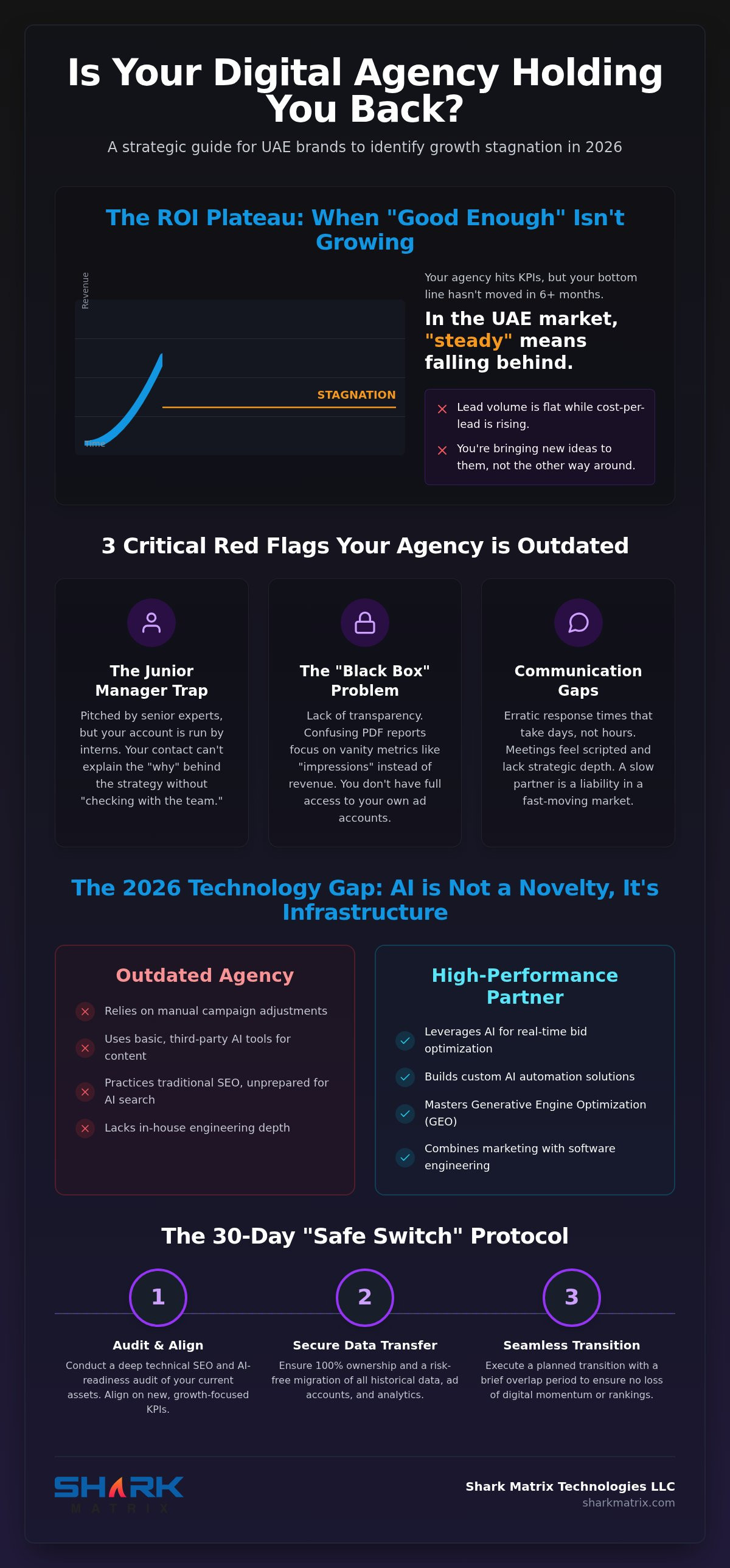
Your monthly report might look perfect, but your bank account tells a different story. Many UAE business owners feel a sense of unease even when their dashboard shows green arrows. If your agency hits its specific KPIs but your bottom line hasn’t moved in six months, you’re experiencing a growth disconnect. In the high-speed Dubai market, “steady” is just another word for falling behind. The most dangerous red flag isn’t a sudden drop in traffic; it’s the slow, quiet stagnation of your ROI.

A major red flag is the absence of proactive strategy. If you’re the one bringing new ideas, trends, or AI automation services to the table, the relationship is already inverted. You’re paying for leadership, not just a pair of hands to execute tasks. When your agency stops asking “what’s next?” and starts coasting on what worked in 2024, they’ve developed agency fatigue. This lack of innovation is a clear signal for when to switch digital marketing agencies to a more technical partner.

You might also be stuck in the Junior Account Manager trap. Many agencies pitch with their senior directors but hand the actual work to interns or entry-level staff once the contract is signed. These juniors often lack the deep understanding of regional nuances or the technical depth required for complex campaigns. If your contact person can’t explain the “why” behind a strategy without “checking with the team,” you’re paying expert rates for amateur execution.

The ROI Plateau: When Results Stop Scaling

Analyzing year-on-year growth is far more revealing than looking at month-on-month fluctuations. If your lead volume is flat while your cost per lead is rising, your agency’s tactics have likely hit a ceiling. In 2026, ad costs across the Emirates are climbing. Agencies that rely on old-school PPC management without integrating machine learning or SEO company Dubai strategies that adapt to generative search will see your margins shrink. High-performance partners should be finding efficiencies to offset these rising costs, not just asking for more budget.

Communication Gaps and Lack of Transparency

Transparency isn’t just about showing where the money went; it’s about explaining the methodology. The “Black Box” problem occurs when an agency hides its process, making it impossible for you to audit their work. This often goes hand-in-hand with confusing reports that focus on vanity metrics like “impressions” or “reach” rather than actual revenue.

Common communication red flags include:

  • Erratic response times that take days instead of hours.
  • Meetings that feel like a rehearsed script rather than a strategic discussion.
  • A lack of access to your own ad accounts or data ownership.

In a market where opportunities move at light speed, a slow or secretive partner is a liability. Deciding when to switch digital marketing agencies often comes down to this fundamental trust. If you don’t have full visibility into your data or a partner who communicates with agility, your business cannot pivot when the market demands it.

The Technical Gap: Has Your Agency Fallen Behind the AI Revolution?

In 2026, the line between a marketing agency and a software engineering firm has blurred. If your current partner still treats AI as a novelty rather than core infrastructure, they’re likely falling behind. Many agencies use third-party AI tools for basic content, but few have the in-house engineering depth to build custom solutions. This is a primary indicator for when to switch digital marketing agencies. Without technical depth, your brand cannot compete in an era where Generative Engine Optimization (GEO) determines visibility. GEO is no longer optional; it’s how you ensure your brand is the primary “cited source” in AI-driven search results across the UAE.

Leveraging AI for Marketing Automation

Efficiency in 2026 is driven by AI automation services that eliminate manual bottlenecks. Traditional agencies often struggle with human error in data entry or slow campaign adjustments. By contrast, automated systems can process vast amounts of data to optimize bids or personalize content in real-time. For businesses in Dubai or Abu Dhabi, AI chatbot development is a crucial tool for 24/7 lead capture. These aren’t simple “if-then” bots. They use Natural Language Processing to understand customer intent, answer complex queries in Arabic or English, and qualify leads while your team sleeps. If your agency isn’t deploying these technologies, your customer acquisition costs will remain unnecessarily high.

Technical SEO and Scalability Requirements

Basic keyword optimization is a relic of the past. National-level competition in the Emirates requires a deep integration of web development and marketing strategy. Your site’s architecture must be built specifically to support AI-driven search crawlers that prioritize schema markup and lightning-fast performance. If your agency doesn’t understand how to optimize for Answer Engine Optimization (AEO), your rankings will suffer as search engines evolve. Technical scalability means your website can handle sudden traffic spikes during major regional events while maintaining the performance metrics that AI search engines demand.

Marketing is now a technical race. When you realize your current partner can’t bridge the gap between creative copy and machine learning, it’s time to find an agency with a dedicated software engineering department. You might want to explore how generative AI development can transform your specific industry workflows to stay ahead of the competition.

When to Switch Digital Marketing Agencies: The 2026 Strategic Guide

Transparency and Reporting: Are You Getting Insights or Just Data?

A common frustration for UAE marketing managers is receiving a monthly data dump that requires a translator to understand. If your agency sends a 40-page PDF filled with charts but fails to explain how those numbers translate into AED, they aren’t providing insights. They’re hiding behind noise. Real-time dashboards have replaced static reports in 2026. You shouldn’t have to wait until the 5th of the month to see how your campaigns performed yesterday. If you’re still getting manual reports that feel like homework, it’s a strong indicator for when to switch digital marketing agencies.

Transparency also means having full administrative access to your own ad accounts and analytics. Some agencies in the region still try to hold data hostage by running ads through their own master accounts. This is a massive risk. You should own your data, your pixel history, and your audience lists. If your partner refuses to grant you primary ownership, they’re creating a lock-in effect that makes it harder for you to leave. True partners don’t fear their clients having access; they welcome the accountability.

The Attribution Challenge

Modern buyer journeys in the Emirates are rarely linear. A customer might see a social media ad while in Dubai Mall, search for your brand on a mobile device, and finally convert on a desktop at home. Your agency must be able to prove revenue impact across these touchpoints. If they’re only reporting on last-click conversions or simple click counts, they’re missing the bigger picture. High-performance partners use data-driven lead generation models to show exactly how much revenue every dirham spent is generating across the entire funnel.

Ownership of Digital Assets

Beyond ad accounts, you must secure your domain, hosting, and website code. Beware of agencies that insist on using proprietary platforms that only they can manage. These are often traps designed to make switching impossible. When you transition, you should be able to take your content, your web development assets, and your historical data with you without paying exit fees. A transparent partner will ensure your digital assets are portable and secure from day one. If you don’t own the keys to your digital kingdom, you don’t truly own your business growth.

The Transition Roadmap: How to Switch Without Losing Your Momentum

Switching agencies in the middle of a fiscal year can feel like changing an engine while the car is moving at 120 km/h on Sheikh Zayed Road. You don’t want to lose speed, and you certainly don’t want to crash. A 30-day “Safe Switch” protocol is the gold standard for UAE brands. This overlap period allows your new partner to perform a deep-tissue audit of your existing campaigns while the outgoing team handles daily maintenance. It’s the only way to ensure your lead volume doesn’t drop off a cliff during the handover.

Before you cut ties, conduct a final performance audit. This document acts as your baseline, recording exactly where your metrics stood at the moment of departure. It helps you identify when to switch digital marketing agencies by highlighting the missed opportunities your previous partner failed to capture. Clear communication with your internal stakeholders is also vital; they need to know that while there’s a change in the cockpit, the flight path remains stable and focused on hitting those year-end revenue targets.

Asset and Data Migration

Securing your digital property is the most critical step of the offboarding process. You must have a rigid checklist for password and access handover to prevent any service interruptions. Don’t just settle for a casual email with login details; you need full administrative ownership of every platform.

  • Revoke old access only after the new team confirms full functionality and security.
  • Export all historical data from PPC and SEO tools to preserve your machine learning history.
  • Maintain continuity for your online reputation management efforts across regional directories.
  • Verify that all web development documentation and source codes are handed over in full.

The Onboarding Phase

The first 90 days with your new partner represent a critical “trust-building” window. This is when your new digital marketing strategy is stress-tested against the reality of the Emirates market. Focus on technical alignment and business goals rather than just vanity metrics like impressions or clicks. Establish a reporting cadence that works for your team from day one. Whether you prefer a real-time dashboard or a weekly video sync, ensure the new agency understands that you expect technical insights, not just data dumps. This phase is your chance to reset the culture of the partnership and demand the technical depth your business deserves.

If you’re tired of stagnant growth and ready for a technical-first approach, explore how our SEO company Dubai experts can manage your transition without losing a single lead.

Finding a Partner for 2026: Scaling with Shark Matrix

Deciding when to switch digital marketing agencies is a strategic move to upgrade your business infrastructure. Shark Matrix isn’t just a marketing firm; we’re a technical-first partner that has spent over a decade mastering the intersection of software engineering and digital growth. Founded in 2010, we bridge the gap between creative execution and technical engineering. This depth is vital for UAE brands that have outgrown standard agencies and need a partner capable of managing complex, data-heavy environments. Our team doesn’t just manage your spend; we build the machine learning models that optimize it.

National Strategy with Local Precision

Most agencies in the Emirates treat Arabic content as a simple translation task. We treat it as a technical and cultural necessity. Our specialists in Arabic digital marketing ensure your brand resonates across the region while maintaining a national reach. We protect your authority through advanced brand reputation management, navigating the unique nuances of the UAE market. We understand the regulatory environment in Dubai and Abu Dhabi, ensuring your campaigns remain compliant while pushing the boundaries of digital outreach. This localized precision ensures your search presence is authoritative in both English and Arabic, which is essential for dominating regional search results in 2026.

Custom Solutions for Complex Growth

Off-the-shelf strategies often fail because they ignore the specific technical requirements of your business funnel. We don’t believe in one-size-fits-all packages. Our in-house AI and software engineering department allows us to integrate custom mobile app development directly into your marketing ecosystem. By future-proofing your brand with generative AI development, we ensure you stay ahead of the technical curve. This integrated approach turns your digital assets into high-performance revenue drivers rather than just cost centers.

A technical-first approach is the only way to maintain a competitive edge when every competitor has access to basic AI tools. Knowing when to switch digital marketing agencies is the difference between following the market and leading it. Request a comprehensive digital audit from Shark Matrix today to see how we can close your innovation gap and scale your revenue.

Future-Proof Your Growth in the UAE Market

The digital landscape in 2026 demands more than just basic ad management or standard SEO. It requires a partner that understands the technical nuances of AI automation and the cultural specifics of the Arabic market. Deciding when to switch digital marketing agencies is often the catalyst for moving from a growth plateau to a market-leading position. By prioritizing transparency, demanding real-time insights, and following a structured transition roadmap, you can protect your digital assets while accelerating your ROI.

Shark Matrix brings over 15 years of digital excellence to the table, supported by a specialized in-house AI and software engineering team. We don’t just provide marketing; we build technical solutions that scale national brands. As a leader in Arabic digital marketing, we ensure your message resonates across every emirate with precision. You won’t just be meeting KPIs; you’ll be redefining them for your entire industry.

Upgrade your strategy with a technical-first agency; contact Shark Matrix today. Your next phase of growth is just one strategic decision away.

Frequently Asked Questions

How long does it take to see results after switching marketing agencies?

You’ll typically see shifts in PPC performance within the first 30 days as a new team optimizes your ad spend. However, technical SEO and organic growth usually require 3 to 6 months to stabilize. This timeframe allows your new partner to audit existing technical debt and implement fresh strategies. Rushing this process often leads to missed optimization opportunities in the competitive UAE market.

Will my SEO rankings drop if I change my digital marketing partner?

Your rankings shouldn’t drop if you follow a rigorous technical handover protocol. A temporary plateau is possible while search engines crawl new site architectures or content updates. By using a 30-day overlap period, your new agency can ensure all tracking pixels and schema markups remain intact. This prevents the data blackout that often triggers ranking fluctuations during a partner change.

What is the average notice period for terminating an agency contract?

Notice periods in the Emirates digital sector usually range from 30 to 90 days. Most standard contracts require written notice sent one full month in advance. It’s vital to review your specific terms to avoid exit fees. Use this notice period to secure your administrative logins and export historical campaign data before the final offboarding date arrives.

Should I switch agencies if I am happy with the relationship but not the results?

Yes. A positive relationship doesn’t pay the bills if your ROI has plateaued for several months. Knowing when to switch digital marketing agencies is a decision that must be driven by data rather than personal rapport. If your current partner is friendly but lacks the technical depth to integrate AI or scale your lead generation, they’re hindering your business growth.

How do I know if a new agency is actually using AI or just using it as a buzzword?

Ask for a live demonstration of their in-house AI workflows or custom-built scripts. Agencies merely using buzzwords will rely on generic third-party prompts that anyone can access. A technical partner should show you how they use machine learning to automate bid adjustments or personalize content. If they can’t explain the specific logic behind their tech, it’s likely just a sales pitch.

What are the most common mistakes businesses make when switching agencies?

The biggest mistake is failing to conduct a baseline performance audit before leaving. Without this data, you can’t hold your new agency accountable for measurable improvements. Other errors include not revoking old access permissions and ignoring the importance of Arabic localization for the regional market. Rushing the transition without a clear 90-day onboarding plan often leads to wasted ad spend.

How do I ensure I maintain ownership of all my marketing data during a move?

You must hold primary administrative ownership of all accounts, including Google Ads and Meta Business Suite. Never let an agency run your ads through their own master account. Before terminating your current contract, verify that you have full access to your GA4 property and all historical tracking data. This ensures you aren’t starting from scratch with a new partner.

Is it better to have one agency for everything or multiple specialized partners?

In 2026, a single technical-first agency is often superior to multiple specialized partners. Managing several agencies creates data silos and communication bottlenecks that slow your growth. One partner with an in-house software engineering department can ensure your web development, AI automation, and SEO work in perfect sync. This unified approach provides better data attribution and a higher overall ROI.

Categories
Social Media Marketing

How to Conduct a Professional Social Media Audit: The 2026 Guide for UAE Brands

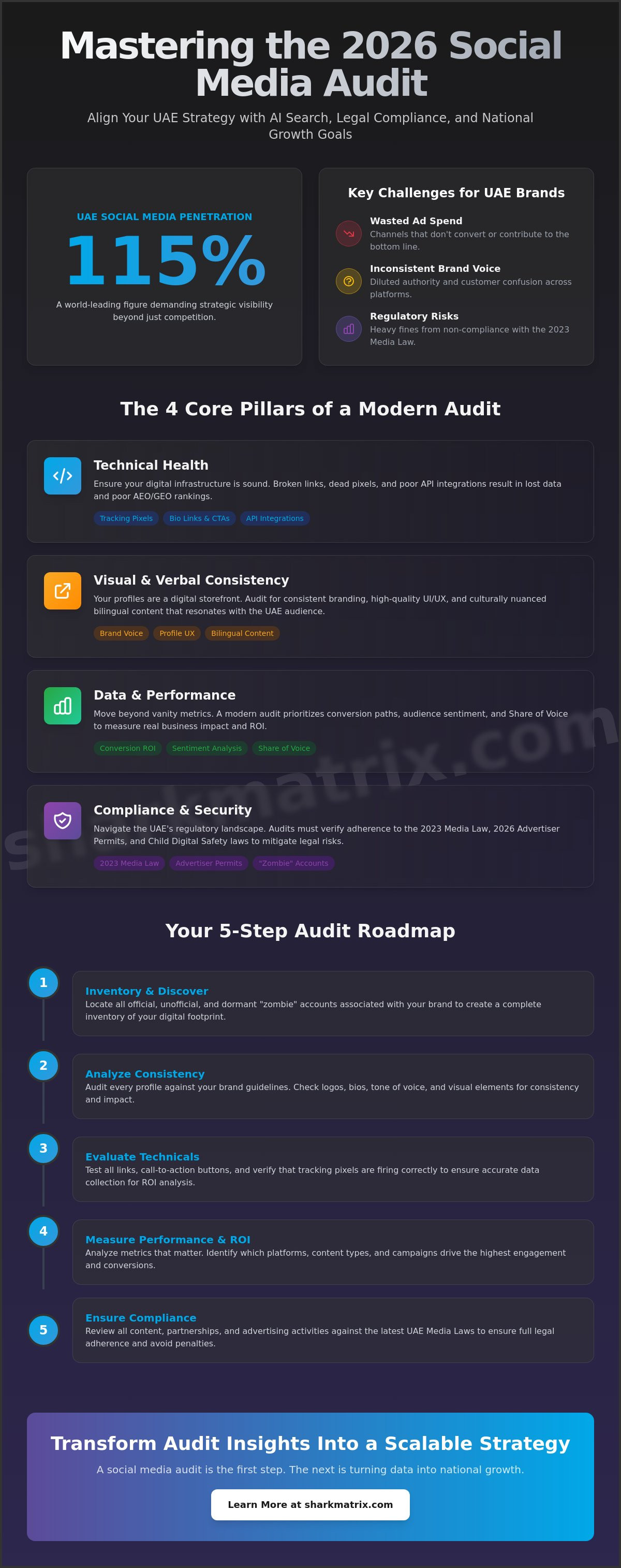
With the UAE reaching a world-leading social media penetration of 115%, your brand isn’t just competing with rivals; it’s fighting for visibility in a space now strictly governed by the 2023 Media Law and mandatory 2026 advertiser permits. You’ve likely felt the frustration of wasted ad spend on channels that don’t convert or the difficulty of maintaining a consistent brand voice across platforms. It’s a common challenge to wonder if your social efforts are actually contributing to your bottom line, which is why performing a comprehensive social media audit has become a non-negotiable part of your annual strategy.

This guide will show you how to master the auditing process to ensure your strategy is AI-ready and fully compliant with the latest UAE regulations, including the Child Digital Safety Law. We’ll provide a step-by-step roadmap to align your social presence with generative engine optimization (GEO) and turn your profiles into high-performing lead generation machines that support your national growth goals. By the end of this article, you’ll have a clear framework for measuring ROI and optimizing content for the search-first social era.

Key Takeaways

  • Learn how your social signals directly impact your visibility in Answer Engine Optimization (AEO) and AI-driven search results.
  • Master a five-step process for conducting a professional social media audit to inventory accounts and standardize your brand authority.
  • Identify which platforms drive the highest ROI for your specific national growth goals and when it’s time to exit underperforming channels.
  • Move beyond basic demographics to uncover deep audience intent and sentiment for better content resonance across the UAE.
  • Discover how to use AI automation services to turn your audit data into a scalable and consistent content strategy.

What is a Social Media Audit and Why Does it Matter in 2026?

A social media audit is a comprehensive evaluation of your brand’s digital footprint across every social platform where you maintain a presence. It isn’t just about counting likes or followers. In 2026, it’s a diagnostic tool that examines your compliance with UAE media laws, your engagement quality, and your alignment with broader business objectives. By conducting this review, you ensure that every profile reflects your current brand identity while adhering to the latest regulatory frameworks.

The biggest shift this year involves how social signals feed into social media measurement and Answer Engine Optimization (AEO). AI models now prioritize real-time social data to provide answers to user queries. If your profiles are outdated, you aren’t just losing social followers; you’re losing visibility on AI-driven search results. Effective auditing distinguishes between vanity metrics and actual growth indicators that feed these generative engines.

You might have “zombie accounts” lingering on your books. These are dormant profiles on platforms like X or Facebook that dilute your brand authority. These accounts often host outdated contact information or old logos, which confuses both customers and search algorithms. In the UAE’s competitive market, these gaps can lead to serious reputation risks. With the 2023 Media Law and the mandatory 2026 Advertiser Permit for influencers now in full effect, a lack of oversight can also lead to heavy fines. An audit ensures every post and partnership meets these legal standards.

The Strategic Benefits of Regular Auditing

Performing a regular social media audit helps you stop wasting money. By aligning your social spend with lead generation data, you can pivot away from low-performing channels and focus on what actually converts. It ensures your brand voice remains consistent for the UAE’s diverse audience, whether they’re looking at your LinkedIn page or your TikTok feed. You’ll also spot untapped opportunities, such as emerging niche communities or new platform features, before your competitors realize they exist.

Social Media as a Search Engine

In 2026, users often bypass traditional engines entirely. They use TikTok to find restaurant reviews or LinkedIn to research B2B solutions. Your audit must evaluate “discoverability,” which is how easily people find your content through platform-specific search bars. This directly links your social activity to your overall SEO and content marketing success. Social searchability is the new benchmark for 2026 audits.

The Core Pillars of a Modern Social Media Audit

A professional social media audit rests on four foundational pillars that bridge the gap between creative expression and technical precision. In the past, brands could focus solely on aesthetics. In 2026, your audit must account for data integrity and AI alignment. If your social data is fragmented, your business won’t just lose followers; it’ll lose visibility in an increasingly automated search environment.

One critical pillar is technical health. This involves a deep dive into your bio links, tracking pixels, and API integrations. You need to ensure your tracking pixels are firing correctly across all platforms to feed accurate data into your CRM. Without this technical foundation, you can’t measure the true ROI of your social efforts or provide the clean data sets required for generative engine optimization (GEO) and AEO. AI search models use your social frequency and sentiment to gauge your brand’s authority. If your technical setup is broken, your AEO rankings will suffer.

Visual and Verbal Brand Consistency

Your social profiles are often the first touchpoint for potential leads. Auditing for high quality UI/UX principles ensures that your profile layouts, highlights, and pinned posts guide users toward a conversion. In the UAE market, you must evaluate the effectiveness of your bilingual content. It’s not enough to simply translate English to Arabic; the tone and cultural nuance must remain consistent. Aligning these visual and verbal elements ensures your social presence supports your broader strategic content marketing agency uae goals for national growth.

The Data Pillar: Beyond Vanity Metrics

Stop looking at likes as a primary success metric. A modern social media audit prioritizes conversion paths and “Share of Voice” against your local competitors. You should use AI tools to scrape and interpret sentiment from comments, moving beyond simple demographics to understand the “why” behind user behavior. Here are the key data points to review:

  • Click-Through Rates (CTR): Are users actually moving from your social content to your e-commerce or lead generation pages?
  • Sentiment Analysis: Is the conversation around your brand positive, neutral, or negative?
  • Conversion Attribution: Which specific posts led to a measurable business outcome?

If you’re unsure where to start with your data collection, researching how to perform a social media audit can provide a structured framework for your first review. Once you have this data, you can better allocate your budget toward high-performing channels. Aligning these pillars is the first step toward a high-performing digital ecosystem, ensuring your social presence supports your long-term growth.

How to Conduct a Professional Social Media Audit: The 2026 Guide for UAE Brands

Evaluating Channel Performance for National Growth

A successful social media audit doesn’t treat every platform equally. Your performance on LinkedIn serves a different purpose than your presence on TikTok or Instagram. In 2026, UAE brands must evaluate each channel based on its contribution to specific national growth goals. This means looking past surface-level engagement to see how each platform drives actual business value. You shouldn’t stay on a platform just because it’s popular; if the data shows it doesn’t reach your target audience or convert leads, it’s time to exit.

Benchmarking is essential here. You need to know how you stack up against others in your industry within the local market. Using social media data for competitive analysis allows you to see where competitors are winning and where they’re leaving gaps. For instance, if your rivals are ignoring WhatsApp as a commercial tool despite its high usage in the UAE, your audit might reveal a massive opportunity for your brand to dominate that space. This data driven approach ensures your budget is allocated to the channels with the highest potential ROI.

Instagram and Visual Storytelling

Instagram remains a powerhouse for visual brands, but success in 2026 is measured by the impact of Reels and Stories rather than static posts. Your audit should examine whether your video content effectively captures attention within the first three seconds. It’s also the time to review your influencer partnerships. Ensure all collaborators hold the mandatory 2026 Advertiser Permit to avoid legal risks. If you’re struggling to hit your engagement targets, consulting an instagram marketing agency in dubai can provide the specific benchmarks needed to refine your visual strategy.

Professional Platforms and B2B Lead Gen

LinkedIn is where your executive branding and thought leadership live. During your social media audit, focus on the quality of leads generated rather than just the number of connections. Are you reaching decision-makers in Abu Dhabi and Dubai? Professional networking channels are vital for establishing the authority that AI search engines look for. By integrating these social insights into your search engine optimization seo services, you create a feedback loop that boosts your visibility across both social feeds and search results. This synergy ensures that your B2B efforts aren’t siloed but contribute to a unified digital ecosystem.

How to Perform a Social Media Audit in 5 Steps

Moving from theory to practice requires a structured approach. A social media audit isn’t a one-time task but a repeatable process that ensures your brand remains competitive in the UAE’s fast-moving digital market. By following these five steps, you’ll transform raw data into a clear strategy for the coming quarter.

  • Step 1: Inventory all active and dormant accounts across the national digital landscape.
  • Step 2: Standardize branding, bios, and verification status for trust and authority.
  • Step 3: Analyze content performance using the 80/20 rule to identify the 20% of posts driving 80% of your engagement.
  • Step 4: Audit for searchability and AI-readiness by reviewing keywords and metadata.
  • Step 5: Define actionable goals and KPIs for the next quarter based on your findings.

Step 1 & 2: The Foundation

Start by listing every account associated with your brand. You’ll likely find “impersonator” profiles or forgotten accounts from old campaigns that harm your online reputation. These must be reclaimed or closed to prevent customer confusion. Ensure all profiles use current branding and high-resolution assets that reflect your modern identity. Securing official account verification acts as a digital seal of authenticity that builds immediate trust for national enterprises operating in the UAE.

Step 3 & 4: The Deep Dive

Next, look at your content ROI. Identify which specific formats, like short-form video or carousel posts, lead to the most website visits. This is where you integrate social signals with Answer Engine Optimization (AEO). AI models look for consistent, authoritative data across your social bios and captions. You should optimize these elements for generative engine optimization (geo) to ensure your brand appears in AI-generated summaries. Don’t forget to check the technical health of your tracking tags and conversion pixels. If your pixels aren’t firing, you can’t accurately measure lead generation from your social channels.

Finally, use your audit insights to set realistic KPIs. If you discovered that LinkedIn drives higher quality B2B leads than Instagram, shift your resources accordingly. Success in 2026 depends on your ability to pivot based on hard data rather than following generic trends. Once your goals are set, you can begin building a social media content calendar that addresses the specific gaps you’ve identified, ensuring every post serves a measurable purpose.

Transforming Audit Insights into a Scalable Strategy

A completed social media audit shouldn’t sit in a digital folder. It serves as the blueprint for a content calendar that addresses the specific gaps you’ve identified. If your audit revealed that your video content lacks engagement in the Abu Dhabi market, your new strategy must prioritize localized, high-impact storytelling. Scalability isn’t just about posting more often; it’s about building a system where every piece of content serves a measurable purpose in your sales funnel. By mapping your findings to a dynamic schedule, you ensure that your team stops guessing and starts executing based on hard data.

Your audit data should also flow directly into your broader digital ecosystem. Social signals provide a wealth of information that can refine your Search Engine Optimization (SEO) and content marketing efforts. When you identify high-performing keywords on social platforms, you can immediately integrate them into your web copy or blog strategy. This cross-channel synergy ensures that your brand remains visible and authoritative across all touchpoints, from social feeds to AI-driven search results.

AI and Automation in Social Strategy

Modern scalability requires more than manual effort. You can use ai automation services to monitor your social performance in real-time, turning your audit into a living document that updates as trends shift. Custom machine learning models can scrape sentiment from thousands of comments, providing a deeper understanding of audience intent than any manual review could offer. Integrating these insights into your ppc agency dubai strategy allows for more precise ad targeting and lower acquisition costs. Automation doesn’t replace the human touch; it frees your team to focus on high-level creative strategy while the tech handles the repetitive data processing.

The Shark Matrix Technologies LLC Advantage

At Shark Matrix Technologies LLC, we specialize in end-to-end digital transformation tailored for national growth. We understand the unique challenges of the UAE market, from navigating the latest media regulations to mastering the bilingual English and Arabic digital landscape. Our expertise spans generative engine optimization (GEO), mobile app development, and advanced AI solutions, ensuring your brand stays ahead of the curve. We don’t just provide reports; we build scalable engines for lead generation and brand authority. Contact Shark Matrix Technologies LLC today for a professional social media audit that drives measurable results and aligns your digital presence with your long-term business goals.

Future-Proof Your Brand with Data-Driven Insights

The UAE’s digital landscape moves at a relentless pace. Between the 2026 advertiser permit requirements and the rise of AI-driven search, your online presence requires more than just regular posting. It demands a rigorous social media audit to ensure every channel contributes to your bottom line. By standardizing your branding and optimizing for generative engine optimization (GEO), you turn social platforms into powerful tools for national growth rather than just expense centers. It’s no longer enough to look good; you have to be discoverable by the algorithms that define the modern search experience.

Since 2010, Shark Matrix Technologies LLC has helped brands navigate the complexities of both Arabic and English digital marketing. Our expertise in AI automation and lead generation ensures your social strategy isn’t just compliant but highly competitive. We bridge the gap between social engagement and technical SEO to drive measurable results. Ready to transform your digital footprint? Book a Professional Social Media Audit with Shark Matrix Technologies LLC today to secure your brand’s authority in the 2026 search-first landscape. Your journey toward a more efficient, high-performing social presence starts with one clear, data-backed roadmap.

Frequently Asked Questions

How often should a business conduct a social media audit?

A business should conduct a social media audit at least once every quarter to stay aligned with the fast-moving UAE market. While a monthly report tracks short-term wins, a quarterly audit allows you to spot broader trends and adjust your budget before resources are wasted. High-growth brands often perform a deeper review every six months to ensure full compliance with evolving media laws.

What are the most important KPIs to track during an audit in 2026?

The most critical KPIs in 2026 focus on conversion attribution and sentiment analysis rather than vanity metrics like likes. You should track your brand’s Share of Voice against national competitors and monitor click-through rates to your lead generation pages. Additionally, measuring your search visibility within social platforms is now essential for understanding how well your content feeds into AI-driven search models.

Do I need professional tools to perform a social media audit?

You don’t strictly need expensive software for a basic review, but professional tools are necessary for advanced sentiment analysis and competitive benchmarking. Manual data collection is prone to errors and often misses the technical nuances of API integrations or pixel health. Using ai automation services can streamline the data scraping process, making your audit more accurate and easier to scale across multiple platforms.

How does a social media audit help with SEO and AEO?

A social media audit helps by ensuring your profiles and content are optimized for discoverability. AI search engines use social signals to verify your brand’s authority and expertise. By standardizing your keywords and metadata across all platforms, you make it easier for generative engines to pull your content into their answers. This alignment directly supports your broader SEO and Answer Engine Optimization (AEO) efforts.

What is the difference between a social media audit and a monthly report?

A monthly report is a snapshot of performance that tracks whether you hit specific targets like follower growth or reach. In contrast, an audit is a strategic health check that examines your entire digital footprint for consistency, legal compliance, and long-term ROI. While reports tell you what happened, an audit explains why it happened and provides a roadmap for structural improvements.

Can a social media audit help in identifying fake followers or bots?

Yes, identifying bots is a core component of a professional audit. By analyzing the ratio of engagement to follower count, you can spot suspicious patterns that suggest non-human activity. Auditing your audience quality is vital in the UAE, especially when verifying influencer partnerships. This process protects your ad spend and ensures your content reaches real potential customers who can actually convert.

How long does a comprehensive social media audit typically take?

A comprehensive audit typically takes between two and four weeks to complete. This timeframe allows for thorough data collection, sentiment analysis, and a technical review of your tracking pixels and API connections. The exact duration depends on the number of active channels you manage and the complexity of your competitive landscape. Taking this time ensures the final strategy is based on verified data rather than assumptions.