

The best recommendation isn’t the one that uses the most customer data; it’s the one that helps someone take a useful next step. AI for personalizing customer experience uses relevant signals, such as current activity and past interactions, to tailor recommendations, offers, or service guidance to a customer’s needs. The aim is to make each interaction more helpful, not simply more targeted.
That distinction matters: a recommendation can feel relevant when it reflects what a customer is trying to do, but intrusive or frustrating when it misses the mark. This article explains AI personalization, how recommendation systems use customer context to suggest products or actions, and what businesses should consider when applying it. It also covers how to measure its impact on customer experience, from task completion and conversion to customer effort and retention. The focus is on practical ways to make personalization useful, accurate, and respectful of customer preferences.
Key Takeaways
- Use customer data that’s relevant to the interaction and permitted by applicable policies, consent and regulation.
- Recommendations work best when they reflect a customer’s interests, behavior and current journey stage, not just popular items.
- Measure personalization against a meaningful baseline using outcomes such as task completion, conversion, customer effort or retention.
- Monitor accuracy and outcomes across customer groups so a more engaging experience doesn’t come at the cost of relevance or fairness.
- Connect AI recommendations with governed data, approved content and clear customer preferences to make interactions more useful.
What is AI-driven customer experience?
AI-driven customer experience uses customer data and machine-learning models to tailor recommendations, offers, and service guidance. For example, a shopping site can use a visitor’s recent product views to suggest relevant items.
Customer Data Collection and Unified Profiles
A unified customer profile brings permitted information from sources such as CRM records, website activity, and previous interactions into one usable view. This helps analytics connect a customer’s preferences with their current goal instead of treating each visit as unrelated. For example, a returning visitor’s browsing history can inform a recommendation, while their latest activity shows what they need now.
Data Readiness for Personalization Models
Data readiness means information is accurate, relevant, accessible, and governed for the model’s intended task. A recommendation model needs signals about products and interactions, while a service model needs approved answers and customer intent. Teams should map each model to its data inputs, remove irrelevant fields, and check that records are current before using them.
AI personalization can draw on customer identity, preferences, behavior, interaction history, and journey stage. Real-time intent and interaction signals can distinguish someone comparing options from someone seeking support. A platform also needs permission-aware access to CRM and journey data, plus governed content for customer-facing answers. AI for personalizing customer experience should help people complete a goal, not display how much information a business has collected.
How do AI personalization tools compare? Assess the data sources they can access, the models and channels they support, and their controls for permissions and content. A recommendation engine using recent product activity serves a different purpose from a service tool that retrieves approved guidance.
How much do AI personalization platforms cost? Costs depend on factors such as platform capabilities, data integrations, implementation scope, and ongoing support needs. Project pricing depends on the specific requirements and is provided after a quote request.
Risks include inaccurate suggestions, irrelevant data use, and outcomes that disadvantage some customer groups. A more engaging experience is not better if recommendations are inaccurate. Businesses should use only data relevant to the service goal and permitted by policy, consent, and regulation. They should also make it easy for customers to opt out of data sharing and monitor whether personalization improves the intended outcome.
Trust is part of the experience: only 51% of customers trust organizations to keep personal data secure and use it responsibly. Clear preferences, careful data access, and useful recommendations can make personalization more understandable. For example, a customer who can adjust communication preferences has more control over how interactions are tailored.
Personalized product recommendations
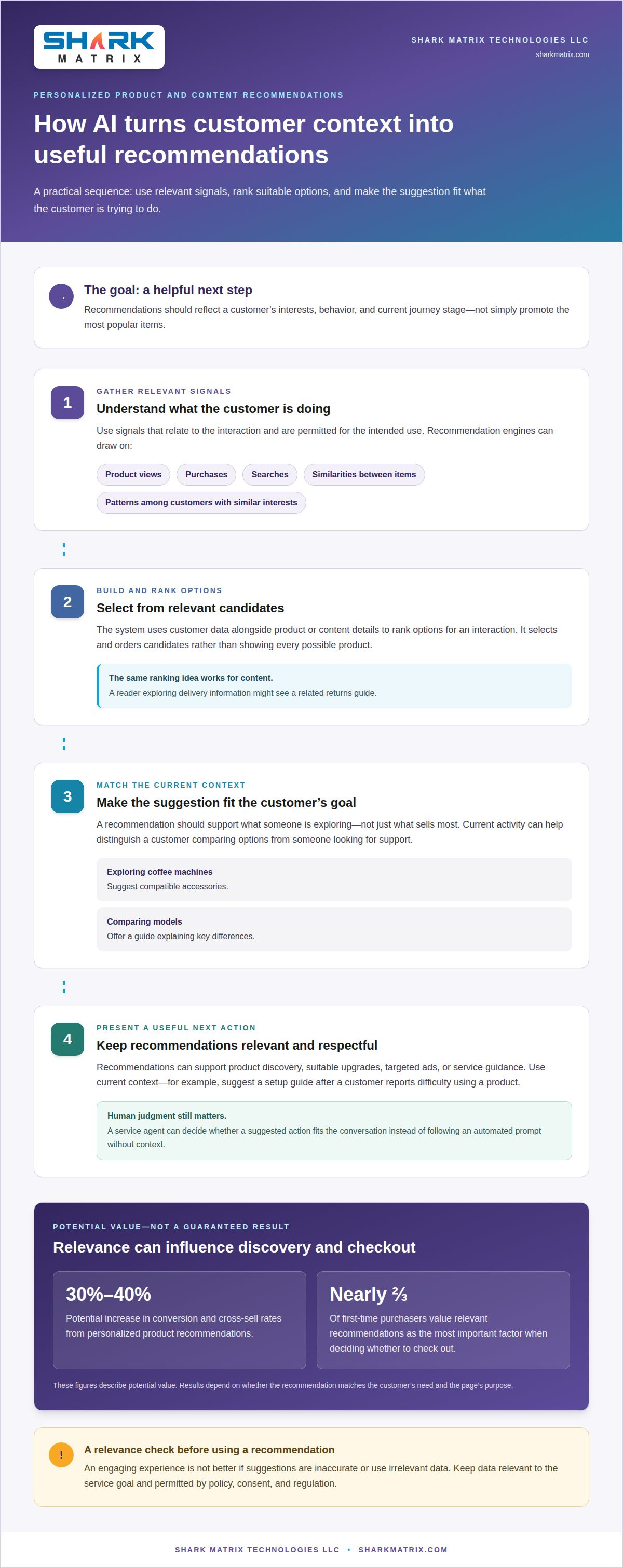
AI-powered recommendations match products, content, or useful next actions to a customer’s context. Their value depends on relevance: a suggestion should fit what someone is exploring, not merely promote what sells most.
Product and Content Recommendations
Personalized recommendations use customer data and product or content details to rank options for each interaction. They matter because a relevant suggestion can help shoppers find a suitable item or discover information that supports a decision. A visitor viewing coffee machines, for example, might see compatible accessories, while someone comparing models could receive a guide explaining key differences.
Recommendation engines can use signals such as product views, purchases, searches, and similarities between items. They may also learn from patterns among customers with similar interests. The system selects and orders candidates rather than showing every possible product. Content can be ranked in the same way: a reader exploring delivery information might see a related returns guide.
Personalized product recommendations can increase conversion and cross-sell rates by 30% to 40%. Nearly two-thirds of first-time purchasers value relevant recommendations as the most important factor when deciding whether to check out. These figures describe potential value, not a result every business will achieve. Relevance depends on matching the recommendation to the customer’s need and the page’s purpose.
Upselling and Ad Targeting
Upselling recommendations present a higher-value option that fits a customer’s stated needs, while ad targeting uses relevant signals to choose which products or messages to show. Both are more useful when they help people compare suitable choices instead of repeating the same promotion across every channel.
For example, a customer comparing entry-level and premium headphones could see a premium model when its added features relate to their browsing. An ad campaign could prioritize products viewed but not purchased, while suppressing irrelevant items after an order is completed. Clear frequency limits and attention to current context help keep these actions useful.
Recommendations can also support customer-service agents. A next-best-action prompt might suggest sharing a setup guide after a customer reports difficulty using a product. The agent can judge whether that action fits the conversation instead of following an automated suggestion without context. This lets AI assist service decisions without replacing human judgment.
Twilio Segment reports that 92% of surveyed companies use AI-driven personalization to drive growth. That adoption alone doesn’t show whether recommendations are helpful. Teams need to assess relevance, customer response, and business outcomes together, including whether an offer leads to a completed purchase or simply adds friction.
For text-heavy catalogues, natural language processing can help interpret product descriptions and customer queries. Explore natural language processing services when language understanding is central to recommendation relevance.
Measuring AI’s impact on customer experience
Measure personalization by the customer outcome it is meant to improve, not by how many recommendations the system serves. For a product suggestion, that might mean completed purchases; for a service interaction, it could mean faster resolution or less effort. Define the intended outcome first, then compare results with a meaningful baseline from the same journey.
Testing helps separate personalization’s effect from other changes, such as pricing, promotions, or seasonal demand. Compare a personalized experience with a suitable non-personalized version, keeping the audience and measurement period consistent. For example, an online retailer could test whether tailored category suggestions increase completed purchases without increasing abandoned carts. Track both outcomes so a short-term conversion lift doesn’t hide added customer friction.
Choose performance measures that match the feature’s purpose. A dashboard for a recommendation on a product page might include:
- Engagement: clicks or interactions with the recommendation.
- Conversion: completed purchases after exposure.
- Customer effort: whether people can find an appropriate option more easily.
- Loyalty: repeat visits or purchases over time.
- Accuracy: whether suggested products or guidance fit the customer’s need.
These measures work together. A click shows interest, but a completed task provides stronger evidence of usefulness. For a support journey, record whether the recommendation resolved the issue or led to escalation.
Customer satisfaction adds a direct view of the experience. Ask customers whether a recommendation matched their preferences or whether the information helped them complete their task. Companies integrating AI into customer experience strategies have seen a 40% improvement in customer satisfaction. Treat that as a reported outcome, not a forecast for every implementation.
Use journey-specific measures to identify where personalization helps or harms. Businesses using AI to enhance customer journey mapping see a 20% improvement in customer satisfaction. Voice-of-customer programs can also help teams respond to feedback: companies integrating AI into these programs see a 30% improvement in their ability to respond. These findings make feedback handling and journey analysis useful measures alongside sales.
Review results across customer groups, channels, and journey stages. A strong average can conceal systematically worse outcomes for a particular group. If recommendations increase engagement but reduce accuracy, the experience has not improved. Combine quantitative analytics with customer feedback, then refine the model, content, or placement to address the gap. Recheck performance after each change using the same baseline and outcome definitions.
AI-powered personalization and customer experience
AI can use customer behavior and interaction signals to tailor experiences across channels. Its value depends on matching each suggestion to a customer’s current goal, not simply making every message feel personal.
AI-Powered Customer Segmentation
AI-powered segmentation groups customers by relevant patterns in their behavior, preferences, or journey stage. A useful message for a first-time visitor may not suit a returning customer seeking support. For example, an online retailer can tailor product content for browsing customers and provide order guidance to people checking delivery information.
Segments can update as new activity changes a customer’s likely intent. This lets teams adapt communications across email, websites, and service channels. Still, a segment is a signal, not a complete picture of a person. Combining it with the immediate interaction helps prevent a past purchase from driving irrelevant recommendations.
Personalized Commerce Experiences
AI-powered personalized commerce adapts product discovery and shopping content to a customer’s interests and actions. This is useful when a large catalogue makes it difficult to find a suitable item. For example, a visitor comparing outdoor equipment could see related products and buying guidance, while a returning shopper might see recommendations informed by recent browsing.
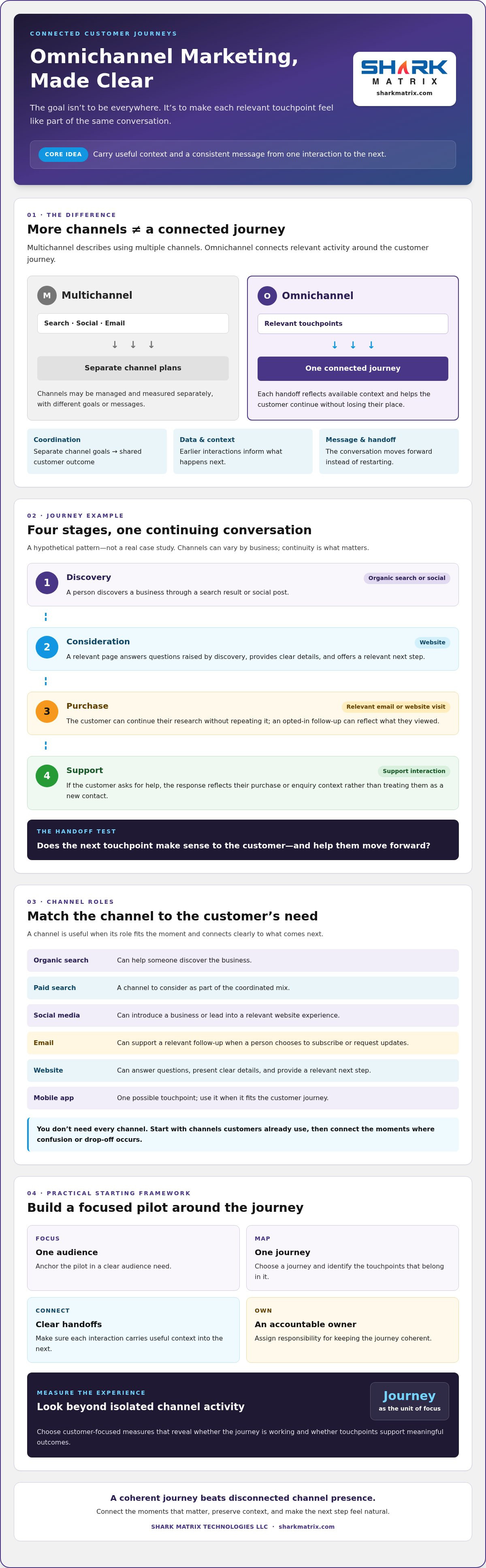
Personalization can also shape the path between channels. A customer who saves an item in a mobile app could receive relevant content during a later website visit. Each touchpoint should support the same shopping goal instead of restarting discovery or showing conflicting offers. Useful personalization takes context into account, including the customer’s current actions.
Personalization Across Industries
Examples span retail, travel, financial services, and customer support. A retailer can surface products based on browsing, while a travel service can tailor destination content to a customer’s stated interests. A financial service can present relevant guidance, and a support team can suggest approved help content based on the issue described.
Across industries, AI personalization uses relevant context to make the next interaction more useful. The signals and appropriate actions vary by customer goal, so a travel recommendation should not be treated like financial guidance. In every case, the information shown should fit the service and its purpose.
Customer expectations underline the opportunity and the execution gap. A reported 76% of consumers become frustrated without personalized interactions, and 71% expect companies to offer them. Yet only 24% of customer experience practitioners rate their efforts as highly personalized, while 26% of consumers rate their last company interaction that way.
Those figures point to a practical challenge: personalization must feel relevant within the interaction itself. For example, an email that reflects a customer’s recent interest may still disappoint if its link leads to unrelated content. Teams can use customer insights to align the message, destination, and next step across channels. This makes tailored experiences more coherent without treating every customer as identical.
AI and machine learning for customer experience personalization
Machine learning identifies patterns in customer interactions and uses them to shape relevant experiences. The key is connecting each prediction to a useful action, such as a product recommendation or timely service guidance.
AI Tools for Customer Experience
Common tools include recommendation engines, customer analytics, natural language processing, and AI-assisted service systems. They matter because each supports a different task, from ranking products to interpreting a support request. For example, a recommendation engine can rank products from browsing behavior, while language processing can identify whether a customer needs help with delivery or product setup.
These tools work best as connected parts of a decision process. Analytics can identify patterns, a model can predict a likely need, and a website or agent interface can present the next action. A service tool might use interaction context to suggest approved guidance or route a complex issue to a specialist.
Common AI tools for personalization include recommendation engines, predictive analytics, and natural language processing systems. They turn customer signals into product recommendations, tailored content, or context-aware service actions.
Implementing Personalized Customer Experiences
Implementation connects a defined customer goal, suitable data, a model, and the channel where its output appears. A useful prediction has little value if it arrives too late or in the wrong interaction. For example, a retailer can begin with product discovery, then show relevant recommendations on category pages.
A practical implementation sequence is:
- Choose a use case: Define a goal, such as helping shoppers find relevant products.
- Map the inputs: Identify the interaction signals and approved content needed for that task.
- Connect the output: Place recommendations in the website, app, or service workflow.
- Review results: Compare outcomes with a baseline and refine the model or experience.
Businesses can implement personalized experiences by starting with one journey, connecting relevant data, and testing the model’s output. They can expand to other channels after assessing accuracy, customer response, and operational fit.
Machine-learning models should reflect the decision they support. A product-ranking model learns from product interactions, while a service model needs customer intent and governed knowledge. Combining unrelated signals can obscure useful patterns, so teams should match each input to a specific task. For example, a model recommending accessories needs product relationships as well as customer activity.
Operational design matters too. Teams need a way to update product details, review recommendations, and handle cases where the model lacks enough context. A customer asking about a complicated account issue should reach suitable human support rather than receive an unrelated automated offer. This helps keep AI-driven interactions useful without treating every situation alike.
Organizations taking a strategic approach to AI implementation and addressing challenges upfront see a 25% higher success rate in their AI-driven customer experience initiatives. To develop models for tailored customer interactions, explore machine learning development services.
Shark Matrix Technologies
Shark Matrix Technologies LLC can help businesses improve the digital touchpoints where personalized experiences appear. When recommendations need a clearer place in the customer journey, Web Design and Development can shape how website content and shopping paths are presented. Mobile App Development can support a more coherent experience for customers using an app.
Turn to Shark Matrix Technologies LLC when your website or mobile app needs to make customer journeys easier to navigate. The next step may be refining page structure, improving the shopping experience, or aligning digital content with customer needs. These foundations help customers act on relevant recommendations without unnecessary friction.
Contact Shark Matrix Technologies LLC to discuss your website or mobile app needs.
Turn Personalization Into a Better Digital Journey
Start by choosing one customer journey where a more relevant experience could make progress easier. Define what customers should be able to do, then connect recommendations to that purpose. This keeps AI for personalizing customer experience grounded in real customer needs rather than technology for its own sake.
Shark Matrix Technologies LLC can support the wider digital journey through Search Engine Optimization (SEO), Pay Per Click (PPC) Management, and Web Design and Development. These services can help align how customers discover a business, arrive at its digital channels, and interact with its pages. A considered approach connects those touchpoints instead of treating each as a separate campaign.
If you’re ready to explore how your digital experience can better support customer journeys, start a conversation with Shark Matrix Technologies LLC. A clear use case gives the discussion a practical starting point and helps shape a useful next step.
Frequently Asked Questions
What Is AI Personalization?
AI personalization uses algorithms to adapt digital content or interactions to an individual’s context. For example, a learning platform could suggest a lesson based on topics a learner has completed instead of showing every user the same course list. The system identifies patterns in available information and selects a relevant response. Its usefulness depends on whether the tailored experience helps the person make progress.
What’s the best way to balance automation and human input when personalizing CX with AI?
Automate predictable, low-risk tasks and keep people involved when a situation requires judgment or empathy. For instance, AI can help classify a routine delivery question, while a support agent handles a complaint involving several unresolved issues. Give agents a way to correct unsuitable suggestions and record why they changed them. Those corrections can reveal where workflows or model decisions need refinement.
How does AI personalize the customer experience?
AI uses patterns in available customer signals to choose what content, recommendation, or interaction appears next. For example, a travel booking service might show a saved itinerary when a returning customer resumes planning instead of starting with generic destination pages. The system can adjust its response as the customer takes new actions, making the experience more relevant to the current task.
What data is needed for AI-powered personalization?
The data required depends on the intended experience. Product suggestions may use a structured catalogue, item attributes, and customer interactions such as searches or purchases. A support assistant needs the customer’s question and accurate, approved help content. Data quality matters: inconsistent product names or outdated instructions can lead to poor matches. Avoid collecting fields that do not contribute to the specific personalization task.
What are the benefits and measurable results of AI personalization?
AI personalization can make discovery easier, reduce repeated steps, and help customers find relevant information. Measure these benefits against the goal: for a product finder, track completed selections and abandoned searches; for a help experience, track whether customers resolve their issue without restarting. Compare results with the experience before the change, and review customer feedback to see whether the measured improvement also feels useful.

 OpenAI
 Codex
 Vertex AI
 Cloud Vision
 OpenCV
 TensorFlow
 IBM Watson
 Cloud Natural Language
 Cognitive Services
 Bot Framework
 Mistral
 LLama
 Gemini
 Anthropic
 N8N