

Yes, AI workflows can connect with the tools your business already uses, so you may not need to replace them. As a trusted provider of AI automation services in Dubai and across the UAE, Shark Matrix Technologies LLC can link compatible systems and move information between tasks, while keeping people involved wherever decisions need review. The key is to design the workflow around your existing processes, data, and access controls.
It’s reasonable to be cautious: automation should reduce friction, not add a disconnected system or make errors harder to spot. A sound setup starts by identifying repetitive work, mapping how information moves between tools, and deciding where staff review is needed. That groundwork keeps implementation practical and risks manageable.
This guide explains how integrations work, what implementation involves, and which factors shape costs and productivity gains. You’ll also learn how to approach privacy and oversight, and how to assess whether a workflow is a good candidate for automation.
Key Takeaways
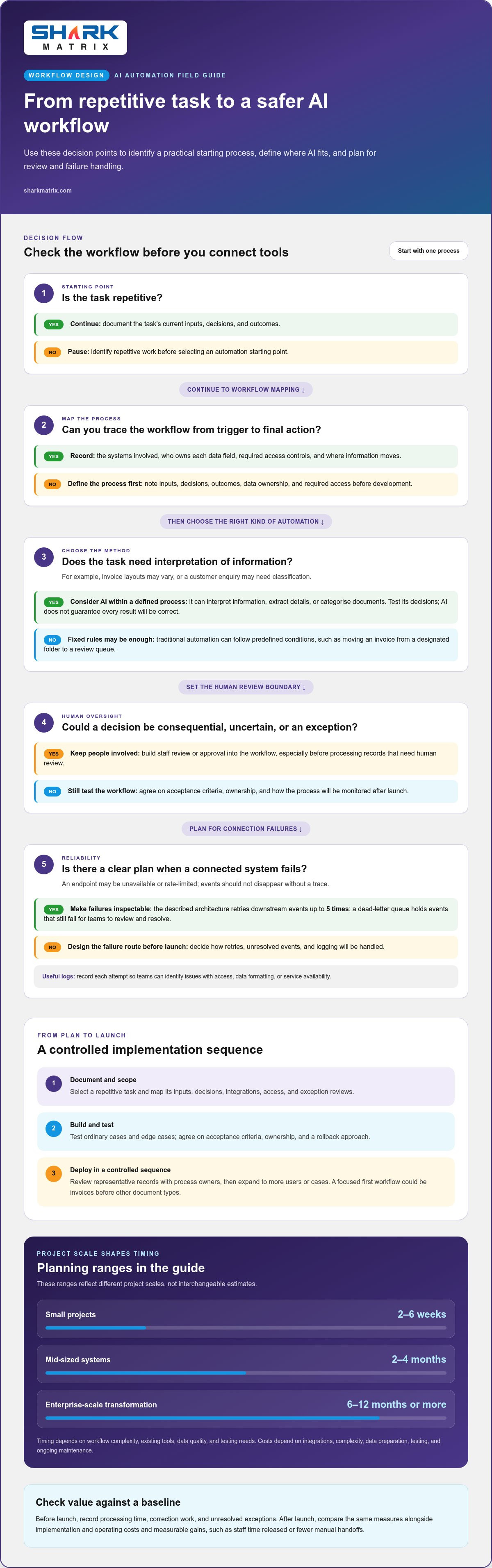
- Map each workflow from its starting trigger to its final action, including what should happen when a connected system is unavailable.
- Use project scope to set realistic timing: small projects may take 2-6 weeks, mid-sized systems 2-4 months, and enterprise transformations 6-12 months or more.
- Build privacy controls and staff approval points into workflows, especially for records that need human review before processing.
- Choose a starting point that fits your business, such as automating repetitive invoice tasks before expanding to broader workflows.
- Compare productivity and operating costs against a clear baseline so you can assess whether automation is delivering practical value.
What is AI Workflow Automation?
AI workflow automation connects business applications and uses AI to interpret information or determine what happens next. For example, a customer enquiry can be classified, routed to the right team, and logged in a customer management system. The workflow links these steps, while AI handles tasks that require interpretation rather than fixed rules alone.
Traditional automation follows predefined conditions: if an invoice arrives in a designated folder, it moves to a review queue. AI-driven automation can extract invoice details from different layouts, categorise the document, and send exceptions for human review. The difference is that AI can interpret information within a defined process, but that does not guarantee every decision will be correct.
An AI agent can manage a bounded task, such as reading a service request and assigning a category. Intelligent orchestration coordinates that agent with other steps, including updating records and requesting staff approval. Predictive workflows use available patterns to anticipate a next action, such as flagging an order that may need attention. People should retain oversight of consequential or uncertain decisions.
Reliable design also plans for failed connections. If an endpoint is unavailable or rate-limited, the described architecture retries downstream events up to 5 times. A dead-letter queue provides a separate holding place for events that still fail, so teams can inspect and resolve them rather than silently losing work. Logging each attempt helps identify whether the issue came from access, data formatting, or service availability.
For a practical assessment, map one process from trigger to outcome. Record which system owns each data field, what the AI needs to interpret, and where staff approval belongs. Then define how failures will be handled and test ordinary cases alongside exceptions. This gives providers a concrete basis for choosing platforms and connecting them to existing tools, rather than proposing automation before understanding the workflow.
Automation implementation timelines
Implementation time depends on workflow complexity, existing tools, data quality, and testing needs. A staged plan makes dependencies visible before teams deploy process automation.
Implementation Stages
Start by selecting repetitive tasks and documenting their current inputs, decisions, and outcomes. Then map the required integrations, assign data access, and define how staff will review exceptions. These steps clarify what the system must do before development begins.
Next, build and test the workflow against ordinary cases and edge cases. A deployment framework can span 4 to 6 weeks, with integration work in weeks 2-3 and human-gate implementation and review in weeks 4-5. Treat those stages as a planning example, not a fixed schedule for every project.
Before launch, agree on acceptance criteria, ownership, and a rollback approach. This gives the implementation team a clear way to assess whether the workflow behaves as intended.
Timeline and Cost Planning
For planning, small AI automation projects may take 2-6 weeks, while mid-sized AI workflow systems may take 2-4 months. Enterprise-scale AI transformation may take 6-12 months or more, especially when the scope spans systems, departments, and complex decisions. These ranges reflect different project scales, not interchangeable estimates.
Costs depend on the number of integrations, workflow complexity, data preparation, testing, and ongoing maintenance needs. Pricing is based on the project scope and provided after a quote request. To keep scope manageable, identify the process, systems, users, and expected outcome before planning implementation. Clear requirements help distinguish essential work from later enhancements.
Deployment and Expected ROI
Deploy in a controlled sequence: test with representative records, review results with process owners, then expand to more users or cases. For example, a team could begin with one invoice workflow before extending automation to other document types. Compare processing time, correction work, and unresolved exceptions with a baseline recorded before launch.
Estimate expected return by comparing implementation and operating costs with measurable gains, such as staff time released or fewer manual handoffs. Set a review point after launch and use the same measures over time. A scoped workflow automation plan can help connect the project scope to deployment needs.
Keep the first release focused. Changes to data formats, permissions, or connected platforms can affect integration and testing, so record dependencies early. A written deployment plan should identify who approves the release, who monitors performance, and how teams will handle issues after the workflow goes live.
Security, governance, and compliance considerations
Businesses in the UAE should weigh privacy exposure, inaccurate outputs, misuse of access, and integration failures before automating decisions. The United Nations Statistics Division identifies data privacy, ethical AI practices, and cross-domain integration as critical challenges in AI adoption. For example, an automation that copies customer details between platforms needs clear access limits and an accountable owner.
Start with a data map: list what each workflow collects, where information moves, and who can view it. Use encryption as a security measure and restrict permissions to the systems and tasks each role needs. For example, an HR workflow should separate employee records from general requests instead of exposing all files to every connected tool.
Align data governance with the UAE Personal Data Protection Law (PDPL) as part of the automation design. Document the purpose of each data flow, its access rules, retention handling, and escalation owner. Enterprises can also assign a business owner to review changes when a workflow adds a platform or begins using a different data category.
AI adds decision risk because a model can misread documents or classify unusual cases incorrectly. Automated invoice processing offers a clear example: a confidence score below 90% can trigger staff approval. Keep that review step for exceptions, and record corrections so teams can identify recurring errors before expanding the workflow.
Ethical oversight matters when automation affects customers, employees, or access to services. Define which decisions the system may recommend and which require human approval. For a customer-support classifier, staff can review sensitive complaints rather than letting an automated category determine the final response without oversight.
UAE invoicing and VAT-related workflows need careful accounting review. Configure invoice fields, tax information, approval routing, and record transfers to match your business’s accounting process. Reconcile automated entries against the accounting system, then route missing or inconsistent fields to a person. This operational control helps prevent a repetitive data-entry error from spreading across records.
Complex connections between platforms can also create security gaps. Before launch, test each connection with realistic cases, including revoked access, incomplete records, and unavailable services. Confirm that failed tasks are logged and assigned for review rather than silently skipped. Testing helps reveal whether an error stems from permissions, data mapping, or the connected platform.
For a practical governance review, document the workflow’s purpose, data sources, access roles, human decision points, and incident owner. Then test changes in a controlled environment before deployment. These steps help teams judge whether the workflow’s benefits outweigh its privacy, accuracy, and operational risks.
Enterprise, mid-market, and SME automation solutions
The best workflow to start with depends on team size, process complexity, and existing platforms. A small business might automate lead follow-up, while an enterprise may coordinate campaign data across departments. In either case, define the task, owner, and outcome before choosing a workflow.
For SMEs, focus on one manual task with a clear trigger and result. For example, a new website enquiry can enter a customer relationship management (CRM) system, receive a tailored acknowledgement, and create a follow-up task. This reduces repeated data entry while keeping a person responsible for sales conversations.
Mid-market teams often need connected marketing and sales workflows. A CRM can record an enquiry’s source, assign it to a representative, and update its status after a meeting. Set rules for duplicate records and incomplete details. This makes handoffs smoother without asking staff to maintain separate spreadsheets.
Enterprises may coordinate campaigns across business units, customer segments, and platforms. A project could standardise how campaign responses reach regional sales teams, while preserving the fields each team needs. Map data ownership and approval points first. That preparation helps teams avoid inconsistent customer records and fragmented engagement.
Email marketing automation can respond to defined customer actions. For example, a prospect who downloads a product guide could receive a relevant follow-up sequence, while a sales representative sees the activity in the CRM. Automated nurture sequences have a reported 26% increase in conversions. Treat that as a reported outcome, not a forecast for every campaign.
Personalisation should rely on information that makes each message relevant. A retailer could tailor follow-up content to a customer’s selected product category, while a service firm could send information based on enquiry type. Set clear audience rules and review message content before launch. These steps help maintain useful engagement rather than sending irrelevant messages.
Choose measures that match the workflow. A marketing team might track response time, qualified enquiries, and follow-up completion. An agency reports saving more than 18 hours per week on manual communication through automation. A local team should compare its own baseline and workload to understand whether similar process changes offer value.
A practical rollout can begin with one campaign or customer segment. Document the trigger, message, CRM update, and staff handoff, then test each path with sample records. Review errors and customer responses before expanding. This staged approach keeps an SME project focused, while mid-market and enterprise teams can plan broader adoption around workflows that have been tested.
Business productivity and operational cost benefits
Automation can improve operations by reducing repetitive handling and making business process steps easier to measure. For Dubai companies, readiness starts with a documented task, reliable inputs, and a clear owner.
Dubai businesses should assess any government support against eligibility, project scope, and measurable outcomes. Build the case around operational value, rather than treating a grant or incentive as assured funding.
Productivity Benefits
Start by identifying where staff spend time copying data, sorting requests, or preparing routine updates. An AI agent can handle a defined step, while employees focus on decisions that need context. For example, a service team could route incoming requests by topic, then track how quickly each request reaches the right specialist.
An illustrative scoping model estimates about 292 hours per month of addressable operational capacity. That figure describes potential capacity in the model, not a result every business should expect. Measure the current process first, including handling time, correction work, and backlogs, then compare the same measures after deployment.
Automation can also streamline handoffs between sales, finance, and customer support. A completed order could trigger an account update and an internal notification, reducing manual follow-up. The useful question is whether staff gain time for customer work or analysis, not simply whether AI performs more tasks.
A reported productivity increase from automated tasks is 32%. Use it as a reference point, not a forecast: workflow design, data quality, and staff adoption affect outcomes. Set a baseline for one process and review the same productivity measure after the workflow is in use.
Operational Cost Benefits
Operational savings come from work a process no longer requires, balanced against the cost of building and maintaining automation. For invoice handling, compare the time staff spend entering and correcting records with the time spent reviewing exceptions. Include software, integration, monitoring, and support in the business case.
Readiness depends on whether a process is stable enough to automate. If teams use different definitions for the same customer field, an automated workflow can reproduce that inconsistency at scale. Document the business process, assign data ownership, and remove unnecessary steps before implementation.
Review direct costs alongside service effects. Faster request routing, for example, could reduce delays, but only if teams can handle the incoming work. Track processing time, error corrections, and service backlogs together, so a lower manual workload doesn’t hide new operational problems.
To assess where automation fits, outline one process, its inputs, and its measurable outcome. Explore AI automation services to connect that operational review with a focused project plan.
Shark Matrix Technologies: Search Engine Optimization (SEO)
Shark Matrix Technologies LLC offers Search Engine Optimization (SEO) to help businesses strengthen their online visibility. SEO is a relevant next step when customers need to find your services through search, complementing workflow improvements behind the scenes.
SEO can help create a clearer path from discovery to enquiry by improving how your website presents useful information. Shark Matrix Technologies LLC also offers Pay Per Click (PPC) Management, Web Design and Development, and Mobile App Development to support different digital growth needs. The right focus depends on your business goals and the role your website or app plays in customer engagement.
Contact Shark Matrix Technologies LLC to discuss how SEO could support your business.
Choose a Practical Next Step for Your Business
Turn your automation ideas into a focused business decision by identifying one process that creates avoidable friction. Define what a better outcome would look like for your team, then consider how connected digital systems can help achieve it. The right AI automation services in Dubai should fit your operations, customer needs, and approach to responsible oversight.
Automation works best as part of a coherent digital experience. Shark Matrix Technologies offers Search Engine Optimization (SEO), Pay Per Click (PPC) Management, and Web Design and Development to help businesses build and improve their digital presence. Consider how these capabilities relate to your customers’ journeys, from discovering your business to making an enquiry.
Your next step can be a conversation about the business process you want to improve and the outcome you need. Contact Shark Matrix Technologies to discuss your digital priorities and explore a suitable direction. A clear starting point can help your team move forward with purpose and confidence.
Frequently Asked Questions
Can AI automation integrate with my existing tools?
Yes. AI can connect with existing systems such as CRMs, ERPs, cloud platforms, mobile apps, and enterprise software. For example, a customer enquiry could move from a website form into a CRM, where an AI workflow categorises it for follow-up. The integration plan should identify which system owns each record and how updates are handled, helping teams avoid conflicting versions of customer information.
How can AI chatbots help my business?
AI chatbots can answer common customer questions, collect enquiry details, and direct people to the next step. A retail business, for instance, could use a chatbot to respond to product questions and capture a request for staff follow-up. Shark Matrix Technologies offers AI chatbot development services, including chatbot solutions for customer support and WhatsApp. A strong use case has clear information and a defined handoff when a person is needed.
What AI automation services do companies in Dubai offer?
Which Dubai AI automation agencies are highly rated, and what industries do they serve?
Ratings alone don’t show whether an agency fits your workflow. Assess relevant project experience, clear communication, and evidence tied to business outcomes. Shark Matrix Technologies serves sectors including healthcare, real estate, finance, retail, hospitality, government, education, and logistics. Compare an agency’s industry knowledge with your process and data needs, then assess how it explains implementation, oversight, and ongoing system management.
How much do AI automation services cost in Dubai?
Costs depend on project scope, complexity, required technologies, and integration needs. Separate initial development from ongoing platform, monitoring, and maintenance expenses when building a budget. Also account for data preparation and staff training. For a tailored estimate, project requirements are assessed and pricing is provided after a quote request.
How do AI automation services in Dubai compare with traditional automation and outsourcing?
Traditional automation follows set rules, making it suitable for stable, repeatable tasks with predictable inputs. AI automation can interpret varied information, such as customer messages, but needs review processes for uncertain outputs. Outsourcing assigns work to people outside the business, while automation changes how a process is performed. Compare the options by considering how often the task changes, how much judgment it needs, and who remains accountable for the results.
What are the steps to implement AI automation for a Dubai business?
First, choose a business process with a clear owner and outcome. Document its inputs, exceptions, and systems, then decide which decisions need human approval. Next, set acceptance criteria and test representative cases, including unusual records. After deployment, assign someone to monitor results and route issues. This sequence helps teams avoid automating an unclear process and provides a practical basis for improvement.
How do Dubai businesses choose a reliable AI automation provider?
Choose a provider whose technical experience matches your systems and business process. Look for a clear explanation of proposed integrations, data handling, testing, and human oversight. Review relevant case studies for the problem solved and outcome measured, rather than relying on broad claims. A useful proposal should define responsibilities, project boundaries, and how the workflow will be monitored after launch.
 OpenAI
 Codex
 Vertex AI
 Cloud Vision
 OpenCV
 TensorFlow
 IBM Watson
 Cloud Natural Language
 Cognitive Services
 Bot Framework
 Mistral
 LLama
 Gemini
 Anthropic
 N8N