

Categories
Uncategorized

AI Automation Services in Dubai for Tool Integration and Business Efficiency

Yes, AI workflows can connect with the tools your business already uses, so you may not need to replace them. As a trusted provider of AI automation services in Dubai and across the UAE, Shark Matrix Technologies LLC can link compatible systems and move information between tasks, while keeping people involved wherever decisions need review. The key is to design the workflow around your existing processes, data, and access controls.

It’s reasonable to be cautious: automation should reduce friction, not add a disconnected system or make errors harder to spot. A sound setup starts by identifying repetitive work, mapping how information moves between tools, and deciding where staff review is needed. That groundwork keeps implementation practical and risks manageable.

This guide explains how integrations work, what implementation involves, and which factors shape costs and productivity gains. You’ll also learn how to approach privacy and oversight, and how to assess whether a workflow is a good candidate for automation.

Key Takeaways

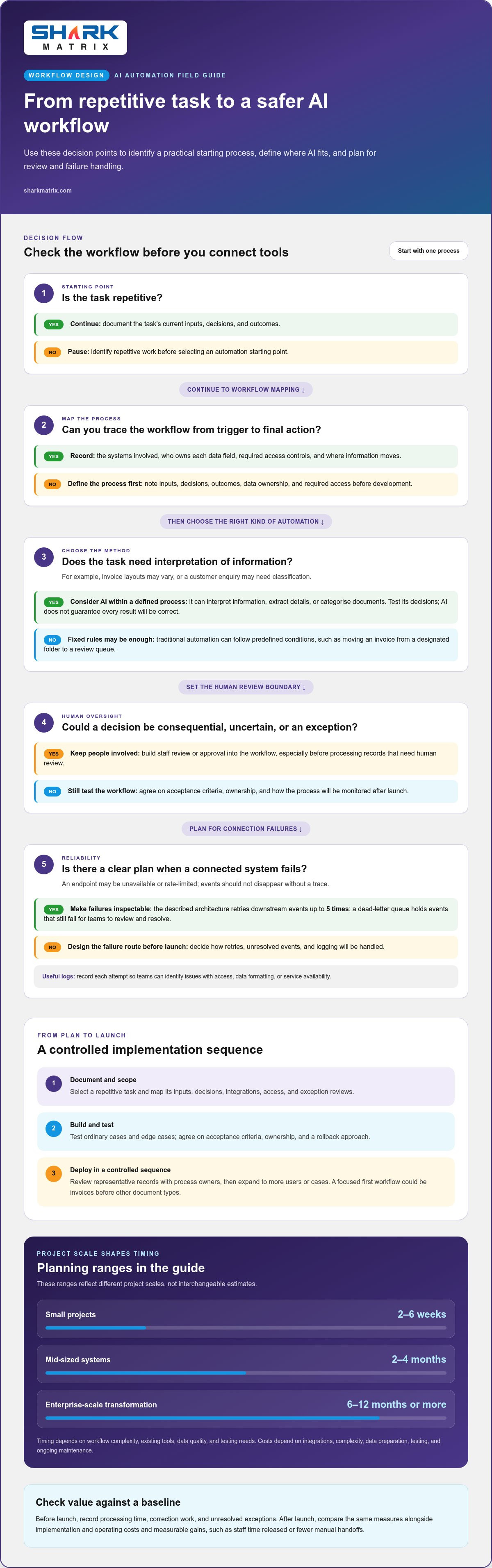
  • Map each workflow from its starting trigger to its final action, including what should happen when a connected system is unavailable.
  • Use project scope to set realistic timing: small projects may take 2-6 weeks, mid-sized systems 2-4 months, and enterprise transformations 6-12 months or more.
  • Build privacy controls and staff approval points into workflows, especially for records that need human review before processing.
  • Choose a starting point that fits your business, such as automating repetitive invoice tasks before expanding to broader workflows.
  • Compare productivity and operating costs against a clear baseline so you can assess whether automation is delivering practical value.

What is AI Workflow Automation?

AI workflow automation connects business applications and uses AI to interpret information or determine what happens next. For example, a customer enquiry can be classified, routed to the right team, and logged in a customer management system. The workflow links these steps, while AI handles tasks that require interpretation rather than fixed rules alone.

Traditional automation follows predefined conditions: if an invoice arrives in a designated folder, it moves to a review queue. AI-driven automation can extract invoice details from different layouts, categorise the document, and send exceptions for human review. The difference is that AI can interpret information within a defined process, but that does not guarantee every decision will be correct.

An AI agent can manage a bounded task, such as reading a service request and assigning a category. Intelligent orchestration coordinates that agent with other steps, including updating records and requesting staff approval. Predictive workflows use available patterns to anticipate a next action, such as flagging an order that may need attention. People should retain oversight of consequential or uncertain decisions.

Reliable design also plans for failed connections. If an endpoint is unavailable or rate-limited, the described architecture retries downstream events up to 5 times. A dead-letter queue provides a separate holding place for events that still fail, so teams can inspect and resolve them rather than silently losing work. Logging each attempt helps identify whether the issue came from access, data formatting, or service availability.

For a practical assessment, map one process from trigger to outcome. Record which system owns each data field, what the AI needs to interpret, and where staff approval belongs. Then define how failures will be handled and test ordinary cases alongside exceptions. This gives providers a concrete basis for choosing platforms and connecting them to existing tools, rather than proposing automation before understanding the workflow.

Automation implementation timelines

Implementation time depends on workflow complexity, existing tools, data quality, and testing needs. A staged plan makes dependencies visible before teams deploy process automation.

Implementation Stages

Start by selecting repetitive tasks and documenting their current inputs, decisions, and outcomes. Then map the required integrations, assign data access, and define how staff will review exceptions. These steps clarify what the system must do before development begins.

Next, build and test the workflow against ordinary cases and edge cases. A deployment framework can span 4 to 6 weeks, with integration work in weeks 2-3 and human-gate implementation and review in weeks 4-5. Treat those stages as a planning example, not a fixed schedule for every project.

Before launch, agree on acceptance criteria, ownership, and a rollback approach. This gives the implementation team a clear way to assess whether the workflow behaves as intended.

Timeline and Cost Planning

For planning, small AI automation projects may take 2-6 weeks, while mid-sized AI workflow systems may take 2-4 months. Enterprise-scale AI transformation may take 6-12 months or more, especially when the scope spans systems, departments, and complex decisions. These ranges reflect different project scales, not interchangeable estimates.

Costs depend on the number of integrations, workflow complexity, data preparation, testing, and ongoing maintenance needs. Pricing is based on the project scope and provided after a quote request. To keep scope manageable, identify the process, systems, users, and expected outcome before planning implementation. Clear requirements help distinguish essential work from later enhancements.

Deployment and Expected ROI

Deploy in a controlled sequence: test with representative records, review results with process owners, then expand to more users or cases. For example, a team could begin with one invoice workflow before extending automation to other document types. Compare processing time, correction work, and unresolved exceptions with a baseline recorded before launch.

Estimate expected return by comparing implementation and operating costs with measurable gains, such as staff time released or fewer manual handoffs. Set a review point after launch and use the same measures over time. A scoped workflow automation plan can help connect the project scope to deployment needs.

Keep the first release focused. Changes to data formats, permissions, or connected platforms can affect integration and testing, so record dependencies early. A written deployment plan should identify who approves the release, who monitors performance, and how teams will handle issues after the workflow goes live.

Security, governance, and compliance considerations

Businesses in the UAE should weigh privacy exposure, inaccurate outputs, misuse of access, and integration failures before automating decisions. The United Nations Statistics Division identifies data privacy, ethical AI practices, and cross-domain integration as critical challenges in AI adoption. For example, an automation that copies customer details between platforms needs clear access limits and an accountable owner.

Start with a data map: list what each workflow collects, where information moves, and who can view it. Use encryption as a security measure and restrict permissions to the systems and tasks each role needs. For example, an HR workflow should separate employee records from general requests instead of exposing all files to every connected tool.

Align data governance with the UAE Personal Data Protection Law (PDPL) as part of the automation design. Document the purpose of each data flow, its access rules, retention handling, and escalation owner. Enterprises can also assign a business owner to review changes when a workflow adds a platform or begins using a different data category.

AI adds decision risk because a model can misread documents or classify unusual cases incorrectly. Automated invoice processing offers a clear example: a confidence score below 90% can trigger staff approval. Keep that review step for exceptions, and record corrections so teams can identify recurring errors before expanding the workflow.

Ethical oversight matters when automation affects customers, employees, or access to services. Define which decisions the system may recommend and which require human approval. For a customer-support classifier, staff can review sensitive complaints rather than letting an automated category determine the final response without oversight.

UAE invoicing and VAT-related workflows need careful accounting review. Configure invoice fields, tax information, approval routing, and record transfers to match your business’s accounting process. Reconcile automated entries against the accounting system, then route missing or inconsistent fields to a person. This operational control helps prevent a repetitive data-entry error from spreading across records.

Complex connections between platforms can also create security gaps. Before launch, test each connection with realistic cases, including revoked access, incomplete records, and unavailable services. Confirm that failed tasks are logged and assigned for review rather than silently skipped. Testing helps reveal whether an error stems from permissions, data mapping, or the connected platform.

For a practical governance review, document the workflow’s purpose, data sources, access roles, human decision points, and incident owner. Then test changes in a controlled environment before deployment. These steps help teams judge whether the workflow’s benefits outweigh its privacy, accuracy, and operational risks.
AI Automation Services in Dubai for Tool Integration and Business Efficiency

Enterprise, mid-market, and SME automation solutions

The best workflow to start with depends on team size, process complexity, and existing platforms. A small business might automate lead follow-up, while an enterprise may coordinate campaign data across departments. In either case, define the task, owner, and outcome before choosing a workflow.

For SMEs, focus on one manual task with a clear trigger and result. For example, a new website enquiry can enter a customer relationship management (CRM) system, receive a tailored acknowledgement, and create a follow-up task. This reduces repeated data entry while keeping a person responsible for sales conversations.

Mid-market teams often need connected marketing and sales workflows. A CRM can record an enquiry’s source, assign it to a representative, and update its status after a meeting. Set rules for duplicate records and incomplete details. This makes handoffs smoother without asking staff to maintain separate spreadsheets.

Enterprises may coordinate campaigns across business units, customer segments, and platforms. A project could standardise how campaign responses reach regional sales teams, while preserving the fields each team needs. Map data ownership and approval points first. That preparation helps teams avoid inconsistent customer records and fragmented engagement.

Email marketing automation can respond to defined customer actions. For example, a prospect who downloads a product guide could receive a relevant follow-up sequence, while a sales representative sees the activity in the CRM. Automated nurture sequences have a reported 26% increase in conversions. Treat that as a reported outcome, not a forecast for every campaign.

Personalisation should rely on information that makes each message relevant. A retailer could tailor follow-up content to a customer’s selected product category, while a service firm could send information based on enquiry type. Set clear audience rules and review message content before launch. These steps help maintain useful engagement rather than sending irrelevant messages.

Choose measures that match the workflow. A marketing team might track response time, qualified enquiries, and follow-up completion. An agency reports saving more than 18 hours per week on manual communication through automation. A local team should compare its own baseline and workload to understand whether similar process changes offer value.

A practical rollout can begin with one campaign or customer segment. Document the trigger, message, CRM update, and staff handoff, then test each path with sample records. Review errors and customer responses before expanding. This staged approach keeps an SME project focused, while mid-market and enterprise teams can plan broader adoption around workflows that have been tested.

Business productivity and operational cost benefits

Automation can improve operations by reducing repetitive handling and making business process steps easier to measure. For Dubai companies, readiness starts with a documented task, reliable inputs, and a clear owner.

Dubai businesses should assess any government support against eligibility, project scope, and measurable outcomes. Build the case around operational value, rather than treating a grant or incentive as assured funding.

Productivity Benefits

Start by identifying where staff spend time copying data, sorting requests, or preparing routine updates. An AI agent can handle a defined step, while employees focus on decisions that need context. For example, a service team could route incoming requests by topic, then track how quickly each request reaches the right specialist.

An illustrative scoping model estimates about 292 hours per month of addressable operational capacity. That figure describes potential capacity in the model, not a result every business should expect. Measure the current process first, including handling time, correction work, and backlogs, then compare the same measures after deployment.

Automation can also streamline handoffs between sales, finance, and customer support. A completed order could trigger an account update and an internal notification, reducing manual follow-up. The useful question is whether staff gain time for customer work or analysis, not simply whether AI performs more tasks.

A reported productivity increase from automated tasks is 32%. Use it as a reference point, not a forecast: workflow design, data quality, and staff adoption affect outcomes. Set a baseline for one process and review the same productivity measure after the workflow is in use.

Operational Cost Benefits

Operational savings come from work a process no longer requires, balanced against the cost of building and maintaining automation. For invoice handling, compare the time staff spend entering and correcting records with the time spent reviewing exceptions. Include software, integration, monitoring, and support in the business case.

Readiness depends on whether a process is stable enough to automate. If teams use different definitions for the same customer field, an automated workflow can reproduce that inconsistency at scale. Document the business process, assign data ownership, and remove unnecessary steps before implementation.

Review direct costs alongside service effects. Faster request routing, for example, could reduce delays, but only if teams can handle the incoming work. Track processing time, error corrections, and service backlogs together, so a lower manual workload doesn’t hide new operational problems.

To assess where automation fits, outline one process, its inputs, and its measurable outcome. Explore AI automation services to connect that operational review with a focused project plan.

Shark Matrix Technologies: Search Engine Optimization (SEO)

Shark Matrix Technologies LLC offers Search Engine Optimization (SEO) to help businesses strengthen their online visibility. SEO is a relevant next step when customers need to find your services through search, complementing workflow improvements behind the scenes.

SEO can help create a clearer path from discovery to enquiry by improving how your website presents useful information. Shark Matrix Technologies LLC also offers Pay Per Click (PPC) Management, Web Design and Development, and Mobile App Development to support different digital growth needs. The right focus depends on your business goals and the role your website or app plays in customer engagement.

Contact Shark Matrix Technologies LLC to discuss how SEO could support your business.

Choose a Practical Next Step for Your Business

Turn your automation ideas into a focused business decision by identifying one process that creates avoidable friction. Define what a better outcome would look like for your team, then consider how connected digital systems can help achieve it. The right AI automation services in Dubai should fit your operations, customer needs, and approach to responsible oversight.

Automation works best as part of a coherent digital experience. Shark Matrix Technologies offers Search Engine Optimization (SEO), Pay Per Click (PPC) Management, and Web Design and Development to help businesses build and improve their digital presence. Consider how these capabilities relate to your customers’ journeys, from discovering your business to making an enquiry.

Your next step can be a conversation about the business process you want to improve and the outcome you need. Contact Shark Matrix Technologies to discuss your digital priorities and explore a suitable direction. A clear starting point can help your team move forward with purpose and confidence.

Frequently Asked Questions

Can AI automation integrate with my existing tools?

Yes. AI can connect with existing systems such as CRMs, ERPs, cloud platforms, mobile apps, and enterprise software. For example, a customer enquiry could move from a website form into a CRM, where an AI workflow categorises it for follow-up. The integration plan should identify which system owns each record and how updates are handled, helping teams avoid conflicting versions of customer information.

How can AI chatbots help my business?

AI chatbots can answer common customer questions, collect enquiry details, and direct people to the next step. A retail business, for instance, could use a chatbot to respond to product questions and capture a request for staff follow-up. Shark Matrix Technologies offers AI chatbot development services, including chatbot solutions for customer support and WhatsApp. A strong use case has clear information and a defined handoff when a person is needed.

What AI automation services do companies in Dubai offer?

Which Dubai AI automation agencies are highly rated, and what industries do they serve?

Ratings alone don’t show whether an agency fits your workflow. Assess relevant project experience, clear communication, and evidence tied to business outcomes. Shark Matrix Technologies serves sectors including healthcare, real estate, finance, retail, hospitality, government, education, and logistics. Compare an agency’s industry knowledge with your process and data needs, then assess how it explains implementation, oversight, and ongoing system management.

How much do AI automation services cost in Dubai?

Costs depend on project scope, complexity, required technologies, and integration needs. Separate initial development from ongoing platform, monitoring, and maintenance expenses when building a budget. Also account for data preparation and staff training. For a tailored estimate, project requirements are assessed and pricing is provided after a quote request.

How do AI automation services in Dubai compare with traditional automation and outsourcing?

Traditional automation follows set rules, making it suitable for stable, repeatable tasks with predictable inputs. AI automation can interpret varied information, such as customer messages, but needs review processes for uncertain outputs. Outsourcing assigns work to people outside the business, while automation changes how a process is performed. Compare the options by considering how often the task changes, how much judgment it needs, and who remains accountable for the results.

What are the steps to implement AI automation for a Dubai business?

First, choose a business process with a clear owner and outcome. Document its inputs, exceptions, and systems, then decide which decisions need human approval. Next, set acceptance criteria and test representative cases, including unusual records. After deployment, assign someone to monitor results and route issues. This sequence helps teams avoid automating an unclear process and provides a practical basis for improvement.

How do Dubai businesses choose a reliable AI automation provider?

Choose a provider whose technical experience matches your systems and business process. Look for a clear explanation of proposed integrations, data handling, testing, and human oversight. Review relevant case studies for the problem solved and outcome measured, rather than relying on broad claims. A useful proposal should define responsibilities, project boundaries, and how the workflow will be monitored after launch.

Categories
Digital Marketing

Choosing a SaaS Marketing Agency in 2026: The Strategic Guide to Pipeline Growth

Why is your customer acquisition cost climbing while your lead quality feels stuck in the past? For software companies operating across the UAE, the old strategy of simple search ads and generic blogs is no longer enough to move the needle. You’ve likely felt the frustration of hiring a saas marketing agency that doesn’t actually understand your software’s technical architecture or how to scale your reach beyond basic campaigns. It’s a common trap that leads to wasted AED and a pipeline full of prospects who aren’t ready to buy.

We agree that your marketing should be a predictable revenue engine, not a black hole for your budget. This guide will show you how to identify a partner that integrates AI automation, technical SEO, and Generative Engine Optimization (GEO) to secure your spot in the future of search. You’ll discover how to build a Technical Authority Architecture that reduces your payback period and drives high-intent growth. We’ll break down the specific criteria for choosing an agency that bridges the gap between global SaaS standards and the unique requirements of the regional Arabic market.

Key Takeaways

  • Learn why traditional MQL metrics are failing software brands and how to pivot toward a revenue-focused pipeline model.
  • Understand the framework for building technical authority by merging your product’s UI/UX with advanced search strategies.
  • Discover how to vet a saas marketing agency based on their ability to handle complex technical integrations and AI automation.
  • Gain insights into dominating 2026 search landscapes through Generative Engine Optimization (GEO) and high-intent demand generation.
  • Explore the strategic importance of Arabic localization for scaling your software across the UAE and the wider GCC region.

Beyond Lead Generation: The 2026 SaaS Marketing Paradigm

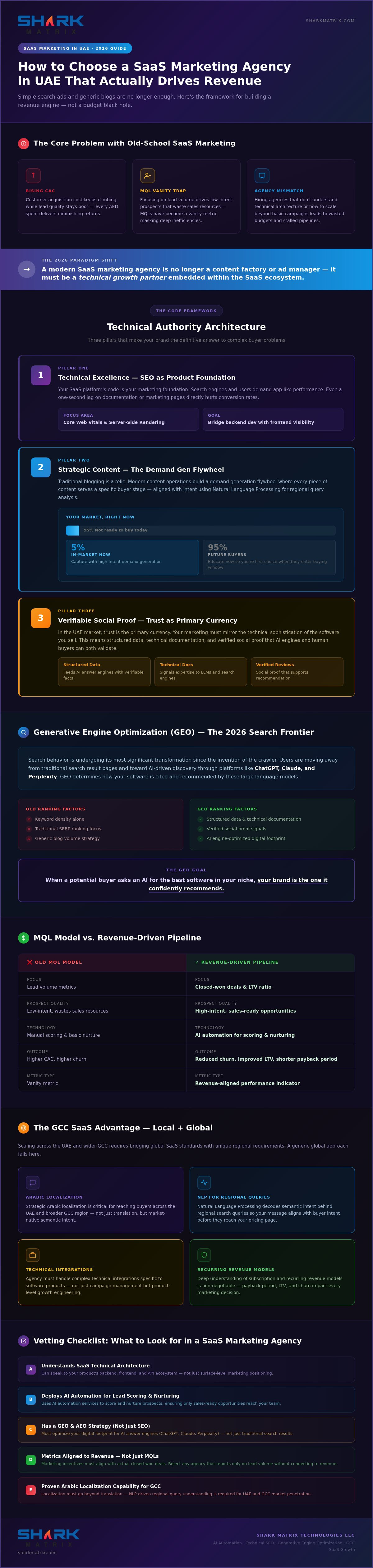
The SaaS market in the UAE has reached a state of maturity where simple visibility isn’t enough to sustain growth. A modern saas marketing agency no longer functions as a mere content factory or ad manager. Instead, it serves as a technical growth partner embedded within the Software as a Service (SaaS) ecosystem. This shift requires a deep understanding of recurring revenue models and the technical nuances of software products. In 2026, the goal isn’t just to fill a database with names; it’s to build an Authority Architecture that proves your software is the definitive solution in its category.

From MQLs to Revenue-Driven Pipeline

The traditional Marketing Qualified Lead (MQL) has become a vanity metric that often masks deep inefficiencies. When a marketing team focuses solely on lead volume, they frequently drive up the Customer Acquisition Cost (CAC) by delivering low-intent prospects that waste sales resources. In the competitive UAE landscape, where every AED counts toward your payback period, this disconnect is fatal. A revenue-driven pipeline focuses on capturing high-intent signals and aligning marketing incentives with actual closed-won deals. By utilizing ai automation services to score and nurture prospects, brands can ensure they only pass sales-ready opportunities to their teams, significantly reducing churn and improving the Lifetime Value (LTV) ratio.

The Rise of Generative Engine Optimization (GEO)

Search behavior is undergoing its most significant transformation since the invention of the crawler. Users are moving away from traditional search result pages and toward AI-driven discovery through platforms like ChatGPT, Claude, and Perplexity. Generative Engine Optimization (GEO) is the critical search frontier for 2026 SaaS brands, focusing on how your software is cited and recommended by these large language models.

Ranking in these AI-generated recommendations requires more than just keyword density. It demands a strategy that feeds these engines with structured data, technical documentation, and verified social proof. Shark Matrix leverages specialized generative ai development techniques to help brands optimize their digital footprint for these new “answer engines.” This transition ensures that when a potential buyer asks an AI for the best software in your niche, your brand is the one it confidently recommends.

Building a Technical Authority Architecture for SaaS

Establishing authority in the software space requires more than just high-volume publishing. It demands a Technical Authority Architecture built on three specific pillars: Technical Excellence, Strategic Content, and Verifiable Social Proof. For a saas marketing agency operating across the Emirates, this means ensuring your brand isn’t just seen, but trusted as the definitive answer to complex user problems. In a market where trust is the primary currency, your marketing must mirror the technical sophistication of the software you sell.

Technical SEO as a Product Foundation

Your SaaS platform’s code is actually your marketing foundation. Search engines and human users both demand app-like performance, especially in the high-speed business environment of the UAE. If your documentation pages or marketing site lag by even a second, your conversion rates will suffer. We focus on Core Web Vitals and server-side rendering to ensure seamless experiences across all devices. Partnering with an SEO company serving the UAE market allows you to bridge the gap between backend development and frontend visibility without compromising on speed or security.

Content Operations and the Demand Gen Flywheel

Traditional blogging is a relic; modern content operations are the future of pipeline growth. This involves building a demand generation flywheel where every piece of content serves a specific buyer stage. Industry research suggests that the vast majority of your market, roughly 95%, isn’t ready to purchase today. Your strategy must focus on educating these future buyers so you are the first choice when they enter the buying window. Using natural language processing helps us decode the semantic intent behind regional search queries. This data ensures your message aligns with buyer intent before they ever reach your pricing page. While many leading marketing software platforms provide the tools to track this, the strategy itself must be rooted in regional market nuances.

Answer Engine Optimization (AEO) is the final layer of this architecture. It’s about structuring your technical data so AI assistants can pull direct, authoritative answers from your website. When this technical precision is paired with a UI/UX that mirrors your product’s sophistication, you create a frictionless path from discovery to demo. This holistic approach ensures that your marketing isn’t just a cost center, but a self-sustaining engine for growth. If your current growth setup feels disjointed or lacks this technical depth, you can explore how AI automation can unify your growth architecture.

Evaluating SaaS Marketing Agencies: A Strategic Framework

Selecting a saas marketing agency is a high-stakes decision that dictates your growth trajectory for years. Many generalist firms claim to handle software brands, yet they often lack a fundamental grasp of SaaS unit economics. If an agency doesn’t lead with discussions on Lifetime Value (LTV), Customer Acquisition Cost (CAC), and churn rates, they aren’t equipped to scale a recurring revenue model. In the UAE market, where competition for high-value enterprise contracts is fierce, you need a partner that understands how to optimize every AED spent to ensure a healthy CAC payback period. For B2B software companies that need experienced senior guidance to steer these high-level initiatives alongside agency execution, you can explore Fractional CMO options to maintain disciplined growth.

Generalist vs. SaaS Specialist Agencies

The core difference lies in how an agency views the customer journey. A generalist often focuses on one-off conversions, whereas a SaaS specialist understands that the real work begins after the sign-up. They treat the trial-to-paid transition as a critical marketing milestone rather than an afterthought. Hiring an agency that treats your software like a traditional B2B service risks filling your pipeline with low-intent leads that never convert into long-term subscribers. To avoid this, look for technical synergy with a web development agency serving the UAE that software companies trust to align their frontend marketing with backend product reality.

The Advantage of Integrated Software Engineering

Modern marketing is increasingly a software engineering problem. A dev-integrated agency provides a massive competitive edge because they bridge the gap between your marketing stack and your product’s code. Whether it’s implementing complex event tracking or building custom calculators to drive lead generation, your agency should have the technical chops to touch your code without breaking it. This level of integration is what separates a standard vendor from a true strategic partner capable of building a sustainable growth engine.

Integrating custom ai automation services into your marketing workflow can significantly reduce operational friction. This allows for real-time personalization that simple plugins can’t achieve on their own. When your marketing team understands the underlying architecture, they can optimize UI/UX design for higher conversion rates on landing pages. They should also demonstrate a clear understanding of the national regulatory environment and the necessity of Arabic localization for truly wide-scale reach. Asking an agency how they use machine learning to predict churn or automate lead scoring will quickly separate the technical partners from the traditional ad managers.

Choosing a SaaS Marketing Agency in 2026: The Strategic Guide to Pipeline Growth

Strategic Implementation: Capturing the 5% and Educating the 95%

Capturing demand is only half the battle. A sophisticated saas marketing agency understands that at any given time, only about 5% of your total addressable market is actively looking to buy. The remaining 95% are future buyers who need to be educated and nurtured. To win in the UAE’s competitive software sector, your strategy must balance immediate capture with long-term brand equity—often supported by strategic communication partners like EQ4 Brand Architects that blend emotional intelligence with intentional positioning. This requires identifying Category Entry Points (CEPs); the specific situations or triggers that cause a buyer to realize they have a problem your software can solve. Whether it’s a legacy system failing or a team expansion, being present at the moment of realization is vital for high-ticket enterprise SaaS.

Reputation management also plays a massive role in the final stages of the software buying cycle. Buyers in the GCC region heavily weight peer reviews and technical case studies before committing to a demo. If your digital footprint doesn’t reflect the technical authority we discussed in previous sections, even the best lead generation efforts will stall at the finish line.

Identifying High-Intent Triggers and ICP

Moving beyond basic firmographics like company size or industry is essential for modern SaaS growth. We focus on behavioral triggers that signal a high intent to purchase. This might include a company hiring for a specific role that uses your software or a change in their underlying tech stack. By using data-driven lead generation, we can find these ready-to-buy signals before your competitors do. Refining your Ideal Customer Profile (ICP) for the national UAE market involves understanding local business cycles and decision-making hierarchies. It’s not just about who they are, but what they’re doing right now that makes them a perfect fit for your platform.

Multi-Channel Paid Media Strategy

Your paid media shouldn’t just be about buying clicks; it should be about building a pipeline. This requires a delicate balance between Google Ads, which captures existing search intent, and LinkedIn or social platforms, which create new demand. In 2026, simply bidding on keywords is a race to the bottom that inflates your CAC. Instead, we optimize PPC campaigns for high-quality pipeline outcomes. This involves deep integration with your CRM to track which ads actually result in closed-won deals. For a detailed breakdown of how to structure these campaigns, see our guide on choosing the right PPC agency for national growth.

If you want to move beyond basic lead capture and build a comprehensive demand generation engine, optimize your marketing stack with our AI automation solutions.

Scaling Globally and Locally: The GCC SaaS Advantage

The UAE serves as the definitive strategic hub for any software company looking to dominate the GCC. While global standards provide a foundation, regional success depends on your ability to adapt to the unique business culture of the Middle East. A specialized saas marketing agency acts as the bridge, ensuring your product resonates with local decision-makers while maintaining high technical standards. By establishing a presence here, you gain access to a market that prioritizes digital transformation and sophisticated tech integrations. This regional advantage isn’t just about geography; it’s about being at the center of a mature recurring revenue economy that rewards technical authority.

Arabic Localization and Regional Market Entry

Many brands make the mistake of thinking translation is the same as localization. For the GCC market, true localization involves adapting your messaging, UI/UX, and even your value proposition to reflect regional cultural nuances. It’s about building brand authority through Arabic digital marketing that feels native, not translated. This depth of localization is what allows a software brand to move from being a foreign tool to an essential regional solution. It requires a partner who understands the “code” behind the language, ensuring that right-to-left (RTL) layouts and local business idioms are handled with technical precision. Without this level of detail, your CAC will remain high as regional users struggle to connect with your brand’s core message.

Leveraging AI for Sustainable Growth

Future-proofing your growth engine requires moving beyond manual processes and embracing technical automation. Using generative AI development allows for personalized outreach at a scale that was previously impossible. Instead of generic cold emails, you can deliver highly relevant, data-backed messages that address specific regional pain points. Similarly, implementing AI chatbots can drastically improve your trial-to-paid conversion rates by providing instant, localized support to users during their most critical decision-making moments. These tools ensure that your technical authority architecture remains active even when your team is offline.

By leveraging industry-specific AI solutions, software brands can automate the friction out of their acquisition funnel. This ensures that your marketing efforts are not just effective today, but resilient against the shifts in search behavior and AI discovery we’ve discussed throughout this guide. Scaling across the UAE and the wider GCC isn’t just about spending more; it’s about building a smarter, more integrated system. If you’re ready to build a predictable revenue engine that dominates the regional landscape, partner with Shark Matrix for national SaaS growth.

Mastering the New Era of Software Growth

The landscape of 2026 demands more than just traffic. It requires a Technical Authority Architecture that bridges the gap between your product’s code and its market presence. By focusing on revenue-driven pipelines and Generative Engine Optimization (GEO), you can move beyond the vanity metrics of the past to build a predictable growth engine. Choosing a specialized saas marketing agency that understands the nuances of the UAE market is the final piece of the puzzle for national dominance.

Shark Matrix Technologies LLC has been at the forefront of digital growth since 2010. With deep expertise in AI and software engineering, Shark Matrix Technologies LLC helps brands scale with technical precision across the entire UAE. Don’t let high acquisition costs stall your expansion. Scale Your SaaS Pipeline with Shark Matrix Technologies LLC and turn your software into a market leader. Your next stage of growth starts with a partner that speaks your language and understands your code.

Frequently Asked Questions

What does a SaaS marketing agency actually do in 2026?

A modern saas marketing agency in 2026 functions as a technical growth partner. They go beyond simple advertising to manage your entire technical authority architecture. This includes integrating AI automation services, managing technical SEO, and optimizing for Generative Engine Optimization (GEO). Their primary goal is building a predictable revenue engine by aligning your software’s technical foundation with high-intent buyer behavior and modern AI-driven search discovery platforms.

How is SaaS marketing different from traditional B2B marketing?

SaaS marketing focuses on recurring revenue and long-term retention rather than a single transaction. Unlike traditional B2B marketing, it requires deep knowledge of unit economics like Lifetime Value (LTV) and Customer Acquisition Cost (CAC). Success depends on managing the entire customer lifecycle, including the trial-to-paid conversion and reducing churn. It’s a continuous process of product-led growth where technical performance and user experience are just as important as the initial lead capture.

What metrics should I use to measure my SaaS agency performance?

You should move beyond vanity metrics like clicks and impressions to focus on pipeline health. Key performance indicators include your CAC payback period, the LTV/CAC ratio, and pipeline velocity. A high-performing saas marketing agency will track how marketing efforts impact actual revenue and churn rates. Measuring the quality of Sales Qualified Leads (SQLs) and their conversion rate into paid subscribers provides a much clearer picture of ROI than simple lead volume.

How much does a SaaS marketing agency cost in the UAE?

Costs for marketing services in the UAE vary based on the technical complexity and scope of your requirements. Most specialized agencies operate on a monthly retainer model; while specific technical integrations or AI development projects might be priced separately. You should evaluate the cost against your expected reduction in CAC and improvements in pipeline value. It’s best to request a tailored quote that reflects your specific growth targets and technical needs within the national market.

Why is GEO (Generative Engine Optimization) important for software companies?

GEO ensures your software is cited and recommended by AI search engines like ChatGPT and Perplexity. As users shift from traditional search results to AI-generated answers, software brands must optimize their technical documentation and digital footprint for these platforms. This strategy involves using structured data and natural language processing to prove your authority. Without GEO, your SaaS brand risks becoming invisible in the increasingly dominant AI-driven discovery landscape of 2026.

How long does it take to see results from a SaaS demand gen system?

Building a sustainable demand generation flywheel typically takes between three to six months to show significant momentum. While paid media can drive immediate traffic, the technical SEO and authority building required for organic growth take time to mature. You’ll likely see initial technical improvements and lead quality shifts within the first 90 days. The long-term goal is to lower your payback period on customer acquisition, which requires consistent optimization and data-driven adjustments.

Should I hire a local UAE agency for my global SaaS brand?

Hiring a local partner like Shark Matrix is essential for successful GCC market entry. A national UAE agency provides the Arabic localization and cultural context that global firms often miss. They understand the regional business regulations and decision-making hierarchies unique to the Middle East. This local expertise allows you to bridge the gap between global software standards and the specific needs of regional buyers, ensuring your messaging resonates across the national audience.

Can a marketing agency help with my SaaS product’s UI/UX?

Yes, a technical agency that offers web development and mobile app development can significantly improve your product’s UI/UX. Marketing and product design are deeply linked in the SaaS world. Improving your platform’s user interface and experience directly impacts your conversion rates and customer retention. Shark Matrix integrates UI/UX excellence into our growth strategies to ensure that once a prospect reaches your platform, the experience is seamless, professional, and optimized for conversion.

Categories
Development Digital Marketing

AI Automation Roadmap for UAE Businesses: A 2026 Strategic Guide

AI is projected to contribute up to 14% of the UAE’s GDP by 2030, yet many enterprises still struggle to mo

Categories
Digital Marketing

Building a Business Case for AI Automation in the UAE: The 2026 Executive Guide

For the 2026 budget cycle, any proposal for building a business case for ai automation in uae must demonstr

Categories
Digital Marketing

B2B Lead Generation in the UAE: Top Strategies and Agencies for 2026

Did you know that 80% of UAE executives check LinkedIn every single day? If you’re currently struggling with low-quality leads that don’t convert, you’re likely missing the mark on where and how your audience actually engages. Dominating b2b lead generation uae in 2026 requires more than just a basic ad spend; it demands a sophisticated blend of AI-driven automation and localized authority. We understand the frustration of seeing your cost-per-acquisition skyrocket on generic platforms while C-suite decision-makers remain out of reach. It’s exhausting to chase leads that lack the intent or budget to move the needle for your business.

This article promises to reveal the exact frameworks and partnerships you need to build a high-velocity sales pipeline across the Emirates. You’ll learn why LinkedIn leads convert two times better than other social platforms and how WhatsApp has become the primary channel for closing deals across the Emirates. We’ll preview the top-performing strategies, from Account-Based Marketing (ABM) to advanced AI chatbot integration, that turn cold prospects into predictable revenue and brand authority.

Key Takeaways

  • Learn why traditional cold outreach is failing and how to pivot your strategy to the UAE’s 2026 digital ecosystem.
  • Master the use of high-impact SEO and precision LinkedIn ads to dominate b2b lead generation uae and capture C-suite attention.
  • Explore how AI automation services and bilingual content qualify leads automatically to ensure your sales team only handles high-intent prospects.
  • Find out how to evaluate potential partners based on their technical stack, AI capabilities, and local market experience.
  • Discover how to build a high-velocity sales pipeline by integrating localized content marketing with advanced search engine optimization.

The State of B2B Lead Generation in the UAE for 2026

In the Emirates, lead generation has evolved into a high-stakes game of relevance and relationship building. Traditional cold calling and generic email blasts are failing. By 2026, decision-makers in Dubai and Abu Dhabi have grown weary of impersonal outreach. Success in b2b lead generation uae now relies on surgical precision rather than volume. It’s no longer about how many people you reach, but how many of the right people actually trust your brand before the first meeting.

The landscape is shifting toward Account-Based Marketing (ABM) for national enterprises. Instead of casting a wide net, businesses are identifying high-value accounts and tailoring their Search Engine Optimization (SEO) and content strategies to speak directly to those stakeholders. This shift is partly driven by the UAE’s strict data privacy regulations, such as the Federal Decree Law on the Protection of Personal Data. Compliance is a necessity, making opt-in, value-driven marketing the only sustainable path forward.

Why the UAE Market Requires a Unique Approach

The UAE is a multi-national business hub where global standards meet local traditions. You’re often dealing with a mix of expatriate executives and local decision-makers within government-linked entities (GLEs). These entities play a massive role in the B2B sector, often guided by the UAE’s D33 economic agenda. To win here, your procurement strategy must align with national goals of innovation and digital transformation. It’s a market that rewards those who demonstrate long-term commitment to the region’s growth rather than those looking for a quick transaction.

The Move from Quantity to Lead Quality

Many firms are tired of “junk leads” from generic social media campaigns that never convert. There’s a clear distinction between a Marketing Qualified Lead (MQL) who just downloaded a PDF and a Sales Qualified Lead (SQL) ready for a proposal. In 2026, the benchmark for success isn’t just a low cost-per-click. It’s the conversion rate from lead to contract. Research shows that LinkedIn leads in the UAE convert two times better than other social platforms. Achieving this requires ai automation services to qualify prospects instantly, ensuring your sales team doesn’t waste time on entries that lack the budget or authority to buy. High-ticket B2B success now demands a predictable pipeline of SQLs built on authority and localized trust.

Top B2B Lead Generation Strategies for National Growth

Effective b2b lead generation uae isn’t a single-channel effort anymore. It’s an ecosystem. To build a pipeline that survives the competitive Dubai market, you’ll need to combine long-term authority with short-term precision. Many firms fail because they only look at the top of the funnel. A true growth strategy connects the first click to the final signature in a CRM. Scaling b2b lead generation uae requires a technical stack that supports your creative efforts while respecting local business etiquette.

SEO and Content: The Authority Engine

Organic search remains the foundation of sustainable growth. By investing in comprehensive search engine optimization seo services, companies target high-intent B2B keywords that lower acquisition costs over time. In the Emirates, decision-makers often look for proof of expertise before reaching out. This is where whitepapers and localized case studies come in. They aren’t just reading your blog; they’re looking for evidence that you understand the regulatory and economic nuances of the GCC. High-quality content turns your website into a 24/7 lead magnet that builds trust before your sales team even says hello.

Paid Media: Scaling ROI with Precision

Paid media offers the speed that organic growth sometimes lacks. LinkedIn Ads are particularly powerful because 80% of UAE executives use the platform daily. While Google Search captures immediate intent, LinkedIn allows for surgical targeting of C-suite roles. Understanding B2B buyer behavior shows that prospects often need multiple touchpoints before they trust a sales rep. This is why partnering with a specialized ppc agency dubai is vital. By 2026, trends like Generative Engine Optimization (GEO) are also changing how ads appear in AI-driven search results. You’ll need a technical approach to copy that satisfies both human readers and AI algorithms.

The biggest mistake UAE businesses make is letting leads go cold. AI-driven outreach and automated nurturing sequences ensure no prospect is ignored. Use AI chatbots to qualify traffic instantly and NLP to personalize follow-up emails based on specific industry pain points. This isn’t just about sending more emails; it’s about using ai automation services to maintain a human-like presence at scale. Strategic networking and virtual B2B events round out this approach. They provide the face-to-face interaction that remains central to doing business in the Middle East. If you’re ready to modernize your pipeline, exploring industry specific ai solutions can help bridge the gap between traffic and revenue.

B2B Lead Generation in the UAE: Top Strategies and Agencies for 2026

The Competitive Edge: AI Automation and Arabic Localization

In a market where expatriates and locals collaborate on massive infrastructure and tech projects, relying solely on English is a strategic oversight. While English is the lingua franca of Dubai’s private sector, Arabic remains the language of trust and formal business for many national enterprises. Integrating bilingual strategies into your b2b lead generation uae efforts doesn’t just expand your reach; it builds a bridge to decision-makers who value cultural alignment. By 2026, the businesses winning high-ticket contracts are those that combine this human touch with the cold efficiency of artificial intelligence. Understanding the latest ai for marketing dubai trends is essential for staying ahead of competitors who are rapidly adopting predictive analytics and generative engine optimization.

Arabic Digital Marketing for the B2B Sector

Direct translation is often a recipe for failure in the Emirates. Professional Arabic digital marketing requires cultural localization that understands the nuances of regional business etiquette. This is especially critical when dealing with semi-government sectors and government-linked entities (GLEs), where formal Arabic is the standard for procurement and official correspondence. Shark Matrix Technologies LLC specializes in creating localized content marketing and SEO strategies that resonate with these stakeholders. We ensure your brand doesn’t just sound like a translated version of a Western company, but like a local authority that understands the UAE’s unique economic vision.

Leveraging AI for Predictive Lead Scoring

The speed of business in Dubai doesn’t allow for manual lead sorting. Using ai chatbot-development services and natural language processing services allows you to qualify prospects the moment they land on your site. These tools don’t just answer questions; they perform predictive lead scoring by identifying “ready-to-buy” signals in a user’s behavior. For instance, if a visitor from a specific government IP address repeatedly views your case studies and pricing pages, AI can flag them as a high-priority Sales Qualified Lead (SQL) before they even fill out a form.

Automating the follow-up is where most B2B deals are actually won. We know that following up within 24 hours can increase conversion rates by 3 to 5 times. By integrating ai automation services with your CRM, you can trigger personalized nurturing sequences that keep your brand top-of-mind. This reduces the burden of manual data entry for your sales team, allowing them to focus on closing deals rather than chasing cold prospects. If you want to refine your technical stack, our machine learning development services can help create custom workflows that predict customer churn and identify upsell opportunities within your existing pipeline. Building a predictable sales engine requires this fusion of localized authority and industry specific ai solutions.

How to Evaluate and Choose a Lead Gen Partner

Selecting a partner for b2b lead generation uae is a high-stakes decision that dictates your revenue trajectory for the year. In a market as competitive as Dubai, you can’t afford an agency that simply “buys traffic.” You need a collaborator that understands the UAE national market and possesses the technical infrastructure to handle complex B2B sales cycles. A proven track record in the region is essential, as local business nuances significantly impact how decision-makers respond to outreach. Don’t settle for a team that delivers a high volume of leads without verifying their quality or intent.

The Importance of Technical Integration

A lead generation strategy often fails because the technical foundation is weak. Your partner must understand how Web Design and Development affects conversion rates. If your landing pages are slow or poorly structured, you’re throwing your ad budget away. Ask potential agencies about their experience with API integrations and advanced lead tracking. They should be able to connect your marketing efforts directly to your sales CRM. This level of integration provides the data-driven insights needed to see which campaigns are actually driving Sales Qualified Leads (SQLs) rather than just vanity metrics like clicks or impressions.

Transparency and Reporting Standards

Transparency is non-negotiable when managing a marketing budget in the Emirates. You should demand more than just a monthly PDF report. Look for partners that provide real-time dashboards where you can monitor essential KPIs like Cost Per Lead (CPL) and Cost Per Acquisition (CPA). For example, if a qualified enterprise lead in Dubai costs AED 1,500, you need to know exactly which channel produced it. This clarity allows for quick strategy pivots based on actual performance data. If you’re looking for a partner that prioritizes measurable results over fluff, explore how our ai automation services can streamline your reporting and lead qualification processes.

Finally, ensure the agency offers “Full-Funnel” capabilities. They should be able to manage Content Marketing and automated nurturing sequences to keep your brand top-of-mind during long procurement processes. A partner that only handles the top of the funnel leaves your sales team to do the heavy lifting of qualifying cold prospects. By choosing an agency with industry specific ai solutions, you ensure that every lead is vetted and scored before it ever reaches your desk.

Shark Matrix: Your National Partner for B2B Lead Excellence

Success in the Emirates requires more than just a digital presence; it demands a partner that understands the intersection of technology and local culture. Shark Matrix provides a comprehensive fusion of Search Engine Optimization (SEO), localized Content Marketing, and advanced ai automation services. We don’t just stop at generating clicks. Our focus is on building a robust technical infrastructure that captures and qualifies every prospect. By integrating b2b lead generation uae strategies with custom CRM workflows, we ensure that your sales team spends their time closing high-value contracts instead of chasing dead ends.

Most agencies treat lead generation as a simple top-of-funnel activity. We take a different approach by addressing the technical gaps that often lead to lost revenue. Whether it’s through generative engine optimization (geo) or building industry specific ai solutions, our goal is to establish your brand as a national authority. Our commitment to high-impact ROI and transparent reporting means you’ll always know exactly where your leads are coming from and how much they cost to acquire.

Why National Brands Trust Shark Matrix

Since 2010, we’ve spent 15+ years refining our digital marketing and software engineering expertise within the UAE market. This longevity gives us a unique perspective on the regional business landscape that newer agencies simply lack. We aren’t just a marketing firm; we are a technical partner capable of Mobile App Development and Web Design and Development that converts. Our background in software engineering allows us to build custom machine learning development services and natural language processing services that qualify leads with human-like precision. This data-driven approach extends to our orm services uae, ensuring your brand remains a trusted choice for government entities and private enterprises alike.

Start Scaling Your B2B Pipeline Today

Building a predictable sales engine in Dubai or Abu Dhabi shouldn’t be a guessing game. It requires a tailored, multi-channel approach that leverages the latest in ai chatbot-development services and Pay Per Click (PPC) Management. We invite you to explore how a sophisticated lead generation engine can transform your national growth. By combining Arabic localization with high-performance tech, we bridge the gap between initial interest and long-term business partnerships. Don’t let your competition capture the market while you rely on outdated methods. It’s time to modernize your outreach and secure your place in the UAE’s economic future. Partner with Shark Matrix for B2B success and start scaling your pipeline with a team that knows the national market inside and out.

Modernize Your UAE Sales Pipeline for 2026

Winning in the Emirates requires a shift from broad outreach to data-driven precision. We’ve explored how bilingual content and AI automation now define the standard for b2b lead generation uae. It’s clear that the most successful firms are those that integrate their marketing funnel with deep technical development and localized cultural authority. You don’t have to navigate this complex landscape alone. Shark Matrix has been rooted in the UAE market since 2010, specializing in the exact AI automation and Arabic digital marketing strategies that secure high-ticket contracts. From advanced SEO to custom software development, our end-to-end approach ensures your brand growth is transparent and measurable.

Now is the time to turn these insights into a predictable revenue stream. Success comes to those who act on data before the competition catches up. Book Your B2B Strategy Consultation with Shark Matrix to see how a tailored engine can scale your business across the national market. The future of UAE commerce is digital, automated, and deeply local. Let’s build it together.

Frequently Asked Questions

What is the average cost of B2B lead generation in the UAE?

Industry data indicates that a qualified enterprise SaaS lead in Dubai typically ranges between AED 1,200 and AED 3,500. For companies seeking a comprehensive multi-channel program, monthly agency costs often start at AED 30,000 for a serious market effort. These figures fluctuate based on your specific industry’s competitiveness and the seniority of the decision-makers you’re targeting.

Is cold emailing legal under UAE data protection laws?

Cold emailing is strictly governed by the UAE’s Federal Decree Law on the Protection of Personal Data. Explicit consent is generally required for marketing communications, meaning unsolicited blasts can lead to legal complications. Most successful businesses instead focus on opt-in strategies, such as content marketing or LinkedIn outreach, to ensure they remain compliant while building trust with local prospects.

How long does it take to see results from a B2B SEO strategy?

A robust B2B SEO strategy usually takes six to twelve months to produce a consistent flow of organic leads. While paid ads offer immediate visibility, organic search provides a much lower long-term cost for b2b lead generation uae. This timeline allows for technical site optimization, localized content creation, and the steady growth of domain authority within the GCC digital landscape.

Which social media platform is best for B2B leads in the UAE?

LinkedIn is the undisputed leader for B2B engagement in the Emirates. Research shows that 80% of UAE executives check the platform on a daily basis. Because LinkedIn leads convert twice as well as those from other social channels, it remains the most effective tool for reaching C-suite decision-makers and high-value project stakeholders across the country.

Do I need an Arabic website to generate leads in the UAE?

An Arabic website is essential if you’re targeting government-linked entities or national enterprises. While English is the primary language for the private sector, localized content builds immediate credibility and trust with local decision-makers. It also significantly improves your visibility in localized search results, which is a critical factor for successful b2b lead generation uae.

What is the difference between lead generation and demand generation?

Lead generation focuses on capturing specific contact information from prospects who are ready for a sales conversation. Demand generation is a broader strategy designed to build awareness and long-term interest in your brand’s solutions. Both are necessary; demand generation keeps your brand top-of-mind, while lead generation identifies the specific individuals ready to enter the sales cycle.

How does AI improve B2B lead quality?

AI improves quality by scoring leads based on behavioral data and intent signals before a human rep ever gets involved. Tools like natural language processing services analyze prospect inquiries to determine their urgency and budget. This ensures your sales team focuses only on high-intent prospects, which dramatically reduces the time spent on manual qualification and follow-up.

Can Shark Matrix handle lead generation for niche industrial sectors?

Shark Matrix provides industry specific ai solutions tailored to diverse B2B sectors, including niche industrial and technical markets. Our team uses a combination of technical SEO and custom software engineering to reach highly specialized audiences. We focus on building authority in complex industries where generic marketing strategies often fail to resonate with technical buyers.