

What if the problem with your website isn’t a lack of features, but the effort it takes for users to find what they need? When visitors struggle to complete key tasks, it can be hard to tell whether the answer is better design, new development, or both. Effective UI/UX design starts by understanding those frustrations and connecting design decisions to clear business goals.
It’s reasonable to expect a digital experience to look polished, but appearance alone won’t make it easy to use. For businesses serving audiences across the UAE, clear navigation, accessible interactions, and thoughtful Arabic right-to-left layouts can all shape how customers experience a website or app. Design choices shouldn’t rely on opinion alone; they should respond to user needs and be tested against real tasks.
This guide explains the difference between user experience (UX) and user interface (UI) design, what a structured design process should include, and how research, interface design, and usability testing fit together. You’ll also learn how to assess design work against user and business outcomes, and how to connect it with web or mobile development so the experience works as well as it looks.
Key Takeaways
- Separate UX, which shapes the overall experience, from UI, which covers the visible, interactive interface.
- See how a structured design process uses user needs and business priorities to guide decisions from discovery through testing and iteration.
- Assess design beyond appearance by looking at task clarity, accessibility, consistency, and usability.
- Build a more useful design brief by defining your users, the problem to solve, and the tasks that matter most.
- Learn how UI/UX design can connect interface decisions with web and mobile development for businesses across the UAE.
What UI/UX Design Services Do for a Digital Product
A polished interface can still frustrate users if they can’t tell where to go, what information to provide, or how to finish a task. UI/UX design services address more than appearance: they connect user research, content structure, interaction patterns, and visual design so a digital product is easier to understand and use.
UX design shapes the overall experience of using a product, while UI design shapes the visible, interactive interface people use to move through it. UX considers user goals, task flows, information architecture, and usability. UI brings those decisions to life through layout, typography, colour, buttons, forms, and visual hierarchy. The disciplines overlap, but they solve different parts of the same problem.
A useful introduction to the field is this overview of user experience design, which describes UX as a discipline that draws on research and related areas of design. In practice, research helps uncover what users need; information architecture arranges content around those needs; interaction patterns guide actions; and visual design makes the next step easy to recognise.
What is the difference between UI design and UX design?
Consider a customer booking an appointment on a website. UX determines how they find the right service, choose a time, enter their details, and understand what happens next. UI determines how the service options, calendar, form fields, and confirmation are presented. If the flow is confusing, attractive buttons won’t fix it; if the controls are unclear, a sound flow can still feel difficult.
Both roles need to work together. A booking journey should make sense from the user’s first question to the final confirmation, with each screen supporting the next action.
When does a business need UI/UX design services?
For an existing product, research should establish what’s causing friction before anyone proposes a redesign. Reviewing user feedback, support questions, and how people move through key tasks can help distinguish a design issue from a content, technical, or development problem. That evidence gives UAE businesses a clearer basis for prioritising improvements.
Because design decisions affect how a product is built, connecting them with implementation can help keep the intended experience intact. Explore how website development services can bring interface and website decisions together.
How the UI/UX Design Process Turns User Needs into Usable Experiences
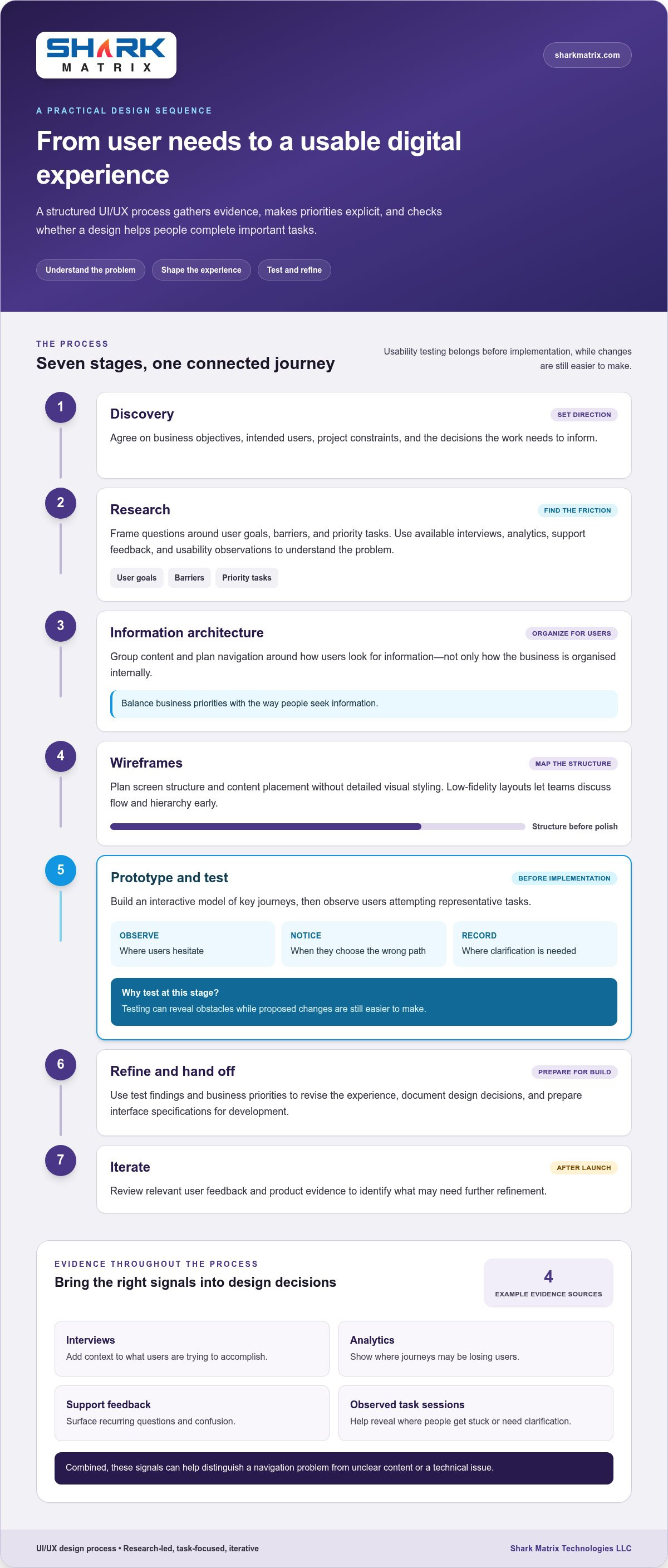
A reliable design process doesn’t jump from a business idea straight to polished screens. It gathers evidence, makes priorities explicit, and checks whether proposed solutions help users complete important tasks. For businesses investing in ui ux design services dubai, that sequence can reduce guesswork and give design and development teams a shared direction.
Usability testing should happen before implementation because observing users interact with a design can reveal obstacles while changes are still easier to make. The process typically moves through these stages:
- Discovery: Agree on business objectives, intended users, project constraints, and the decisions the work needs to inform.
- Research: Set questions about user goals, barriers, and priority tasks. Use available interviews, analytics, support feedback, and usability observations to understand the problem.
- Information architecture: Group content and plan navigation around how users look for information, not just how the business is organised internally.
- Wireframes: Map screen structure and content placement without detailed visual styling. These low-fidelity layouts help teams discuss flow and hierarchy early.
- Prototype and test: Build an interactive model of key journeys, then observe users attempting representative tasks. Record where they hesitate, choose the wrong path, or need clarification.
- Refine and hand off: Use test findings and business priorities to revise the experience, document design decisions, and prepare interface specifications for development.
- Iterate: After launch, review relevant user feedback and product evidence to identify what may need further refinement.
What happens during UX research and information architecture?
Research starts with focused questions: What are users trying to accomplish? Where do they get stuck? Which tasks matter most to the business? Existing analytics can show where journeys lose users, while support feedback may expose recurring confusion. Interviews and observed task sessions can add context, helping distinguish a navigation problem from unclear content or a technical issue.
Those findings inform information architecture. For example, if users search for a service by need rather than by the company’s internal department names, navigation and page labels should reflect that behaviour. Business priorities still matter, but they’re balanced against how people seek information.
How do wireframes, prototypes, and usability tests work together?
A wireframe establishes structure; it isn’t a finished interface. A prototype adds clickable interactions so a team can explore a journey before full development. In a test, users might try to locate a service or submit a request while a facilitator observes their choices and sticking points. The goal is to learn, not to prove the design right.
Digital.gov’s Evaluate UI/UX Design Quality resources offer guidance on usability evaluation. Teams can use test observations to revise labels, screen order, or interaction details, then validate those changes before handing designs to developers. Connecting design decisions with web development in Dubai can help carry the tested experience into implementation.
How to Evaluate UI/UX Design Quality Beyond Visual Appeal
An attractive interface can still leave users unsure what to do next. Judge design by how well it supports real tasks, not by visual polish alone. For ui ux design services dubai businesses assess, separate five dimensions: visual quality, task clarity, accessibility, consistency, and usability. Each answers a different question, so strength in one area shouldn’t be treated as proof of success across the others.
- Visual quality: Is the layout readable, organised, and suited to the product’s purpose?
- Task clarity: Can users identify the next step and understand what information a form requires?
- Accessibility: Can people with different needs perceive and operate the interface?
- Consistency: Do similar controls and interactions behave predictably across screens?
- Usability: Can intended users complete priority tasks without avoidable confusion?
Assess outcomes against the project’s goals and a relevant baseline, such as the current experience or an agreed task flow. If a redesign aims to make appointment requests clearer, observe whether users can find the form, understand its fields, and submit it. Don’t claim an improvement based on an attractive mock-up or an invented industry benchmark. Record what was tested, what users did, and what changed as a result.
Which design deliverables help make a project tangible?
Useful deliverables make both the user journey and the intended interface clear. User flows map steps between tasks; wireframes show screen structure; prototypes let teams explore interactions; and interface screens show the designed visual details. Reusable components, such as buttons and form fields, help developers apply consistent patterns across the product.
Design-system documentation can explain how components should look and behave, reducing ambiguity as screens are built or updated. The right set of deliverables depends on product scope and development needs: a small site and a complex app may require different levels of detail. A practical review can pair each item with its evidence and intended outcome: “Prototype, tested task flow, users can identify the next step.”
How can a business assess usability and accessibility?
Give intended users priority tasks and observe whether they can complete them without avoidable confusion. Note unclear labels, missed controls, difficult form steps, and points where users need help. Repeat the same task after revisions so the team can compare observations against the original baseline.
WCAG is a recognized framework for assessing digital accessibility, but referencing it doesn’t automatically make a design compliant. Review readable content, clear focus and interaction cues, and whether controls can be understood and operated. For UAE audiences, consider Arabic right-to-left direction as part of the interface design, including reading order and navigation, rather than treating it as a text-only adjustment.
How to Prepare a Useful Brief for UI/UX Design Services
A useful design brief describes the product, the people it serves, and the problem the project should solve. “Make the site look modern” is a preference, not a design goal. A clearer brief might explain that customers have trouble finding a service or completing a key request, then identify what the business wants the redesigned experience to help them do.
For businesses considering ui ux design services dubai, the brief doesn’t need to prescribe every screen or feature. Instead, rank the essential user tasks. A short list of high-priority journeys helps the design team focus on what matters before exploring possible solutions.
What should a UI/UX design brief include?
Give the team enough context to understand both user needs and practical boundaries. Include:
- Business objectives: What should the product support, and what would a useful outcome look like?
- Audience and product context: Who will use the website or app, and what are they trying to accomplish?
- Priority journeys: Which tasks matter most, such as finding information, submitting a request, or completing a purchase?
- Known concerns and evidence: Note confusing pages, recurring support questions, user feedback, or available analytics. Separate observed problems from assumptions.
- Project inputs: Share existing content, brand guidelines, platform requirements, and technical dependencies that may affect design or development.
Keep the scope realistic. Listing every possible feature as equally important can obscure the core problem and make decisions harder. Label essential tasks separately from ideas that can be considered later.
How should design goals connect to business outcomes?
Choose measures that reflect the intended task. For a form journey, a team might review completion and error patterns; for navigation, it could examine whether users reach the intended information. Where suitable, record a baseline from the current experience before changes begin. Then agree on when and how the team will review progress, so the assessment compares evidence rather than personal preferences.
Design goals should also fit the product’s development context. Sharing platform constraints and dependencies early helps connect interface decisions to implementation. Shark Matrix brings UI/UX design together with web development, so design choices can be considered alongside how the website will be built. Explore website design and development to see how those capabilities connect.
Before kickoff, check that your brief includes:
- The product, its intended users, and the problem to address.
- Priority tasks, known usability concerns, and evidence behind them.
- Relevant content, brand assets, platform needs, and technical constraints.
- A suitable baseline and a plan for reviewing progress against the project goals.
How Shark Matrix Connects UI/UX Design with Web and Mobile Development
Good design needs to survive the move from concept to a working product. Shark Matrix Technologies LLC connects UI/UX design with web and mobile development, helping teams consider user needs and implementation together rather than treating interface design as a layer added at the end.
For ui ux design services dubai businesses, a project-fit discussion can clarify who the product serves, which tasks matter most, what the project includes, and what outcomes the business wants to support. That context helps align priorities before design and development decisions take shape. It also helps teams distinguish essential user journeys from features that can wait.
How does connected design and development support product delivery?
Shared context helps developers understand the purpose behind a user flow, not just the appearance of its screens. During handoff, clear interface designs, interaction details, and reusable component guidance can help developers build screens consistently. Development feedback can also reveal technical constraints early, allowing the team to discuss adjustments while keeping the user’s task in view.
This connection is useful for websites that combine content, forms, and interactive features. Explore web development services in Dubai to see how design and implementation can fit into a connected project.
When should a project include mobile app UX?
Mobile app UX deserves focused attention when users need to complete important tasks frequently, use the product in varied situations, or rely on capabilities and patterns specific to a mobile platform. The decision should follow the audience and product needs, not a blanket assumption that every website needs an app.
An app journey isn’t simply a desktop layout made smaller. Designers need to consider how people move between screens, interact with controls on touch devices, and complete tasks in the context where the app will be used. A service request flow, for example, may need a concise sequence and clear progress cues on mobile. See mobile app development in Dubai for more on building mobile products.
Bring your user needs, project scope, and intended outcomes into the conversation, then explore a tailored digital project that connects design with the right web or mobile development approach.
Turn Better Design Decisions into a Clear Next Step
Effective digital design starts with understanding what users need to accomplish, then shaping and testing an experience around those tasks. A structured process helps businesses move beyond subjective opinions, while clear project goals make it easier to assess whether design supports both user needs and business priorities.
For companies considering ui ux design services dubai, it helps to define the product, prioritise essential user journeys, and consider how design decisions will carry through development. The strongest interface is more than attractive: it should make important actions understandable and usable.
Shark Matrix connects UI/UX design with web and mobile development, bringing design and implementation into the same digital project conversation. The company has operated since 2010, supporting businesses as they shape connected digital experiences.
Explore digital solutions tailored to your project and take a considered next step toward a clearer experience for your users. A focused brief and a commitment to learning from users can give your digital product a stronger direction.
Frequently Asked Questions
What is the difference between UI and UX design?
UX design shapes the overall experience of using a website or app, while UI design covers the visible, interactive elements. UX work considers user goals, task flows, content structure, and usability. UI work applies that structure through layouts, typography, colours, buttons, and forms. For example, UX maps how a customer completes a booking, while UI determines how the steps and controls appear on screen.
What do UI/UX design services typically include?
UI/UX design services often include research into user needs, information architecture, user flows, wireframes, prototypes, interface design, and usability testing. The exact work depends on the product and project goals. A website redesign may focus on navigation and key forms, while a mobile product may need detailed app journeys and reusable components. Shark Matrix connects UI/UX design with its web and mobile development capabilities.
Can UI/UX design improve website conversions?
Yes. By streamlining user journeys, reducing friction in key interactions, and clarifying calls to action, thoughtful UI/UX design directly supports higher conversion rates. Modern digital agencies such as Nexient focus on combining intuitive web design with performance marketing strategies to help businesses turn site visitors into active customers.
How long does a UI/UX design project take?
Project duration depends on scope, product complexity, research needs, stakeholder feedback, and how many screens or user journeys require design. A focused improvement to one flow differs from designing a new digital product across several platforms. A structured process usually includes discovery, design exploration, prototyping, testing, refinement, and handoff. Define the intended scope and decision-making process early to build a realistic project schedule.
How much do UI/UX design services cost?
There isn’t one standard fee for UI/UX design because the work depends on the project’s scope and requirements. Cost factors can include research depth, the number of user journeys and screens, prototype detail, usability testing, and whether the work connects with web or mobile development. A focused brief helps clarify priorities and define the work involved, so the project can be scoped around its objectives.
Is UI/UX design important for mobile apps?
Yes, mobile app design matters because users interact with apps on smaller screens and often in different contexts than desktop users. App UX should account for frequent tasks, touch interactions, navigation between screens, and the needs of the intended audience. Simply shrinking a desktop layout can make controls and journeys awkward. Start by identifying what users need to do on mobile and design those key flows for that setting.
How can I measure whether a UI/UX redesign is successful?
Measure success against the redesign’s goals and a relevant baseline, rather than relying on opinions about appearance. Choose indicators that match the task, such as whether users complete a form, where errors occur, or whether they can find key information. Combine product data with usability observations and user feedback. Review results after implementation, then use what you learn to identify further improvements.
 OpenAI
 Codex
Codex
 Vertex AI
 Cloud Vision
 OpenCV
 TensorFlow
 IBM Watson
 Cloud Natural Language
 Cognitive Services
 Bot Framework
 Mistral
 LLama
LLama
 Gemini
 Anthropic
 N8N
N8N