Categories
SEO

JavaScript SEO Best Practices: 2026 Technical Guide

Did you know that 69% of AI crawlers are currently unable to execute JavaScript, leaving your dynamic content completely invisible to the engines powering ChatGPT and Claude? It’s a common frustration for modern developers and marketers. You build a sophisticated, lightning-fast web application, yet your most valuable information fails to appear in search results. Balancing the high rendering costs of client-side frameworks with the need for rapid indexation is one of the toughest technical challenges in the industry today.

We’re here to help you solve that puzzle. By implementing the latest javascript seo best practices, you’ll ensure your site is fully accessible to both Googlebot’s evergreen renderer and the more limited crawlers used by generative AI platforms. This guide provides a clear roadmap for navigating the complexities of SSR, SSG, and hybrid rendering. You’ll learn how to future-proof your digital presence, improve indexation rates, and leverage custom web development to turn your JavaScript architecture into a powerful asset for your digital reputation. We’ll break down everything from initial HTML consistency to the latest interaction to next paint thresholds for 2026.

Key Takeaways

  • Understand the “two-wave” indexing problem to prevent critical content from being delayed in search results for days or weeks.
  • Master essential javascript seo best practices by selecting the right rendering strategy, such as SSR or SSG, based on your site’s specific performance needs.
  • Learn how to optimise for generative engines by providing raw HTML that AI crawlers like GPTBot can process without rendering JavaScript.
  • Discover technical fixes for managing the Shadow DOM and ensuring all internal links use standard HTML tags for better crawlability.
  • Identify whether your enterprise platform requires a full architectural migration or a targeted middleware solution through a comprehensive technical audit.

What is JavaScript SEO and Why Does it Matter in 2026?

JavaScript SEO is the technical discipline of making dynamic, script-heavy websites understandable for both search engines and the new wave of generative AI bots. While JavaScript is a core technology of the Web, its implementation often creates a barrier between your content and the index. In 2026, failing to follow javascript seo best practices doesn’t just mean lower rankings; it means your digital reputation is invisible to the very systems consumers use to find information.

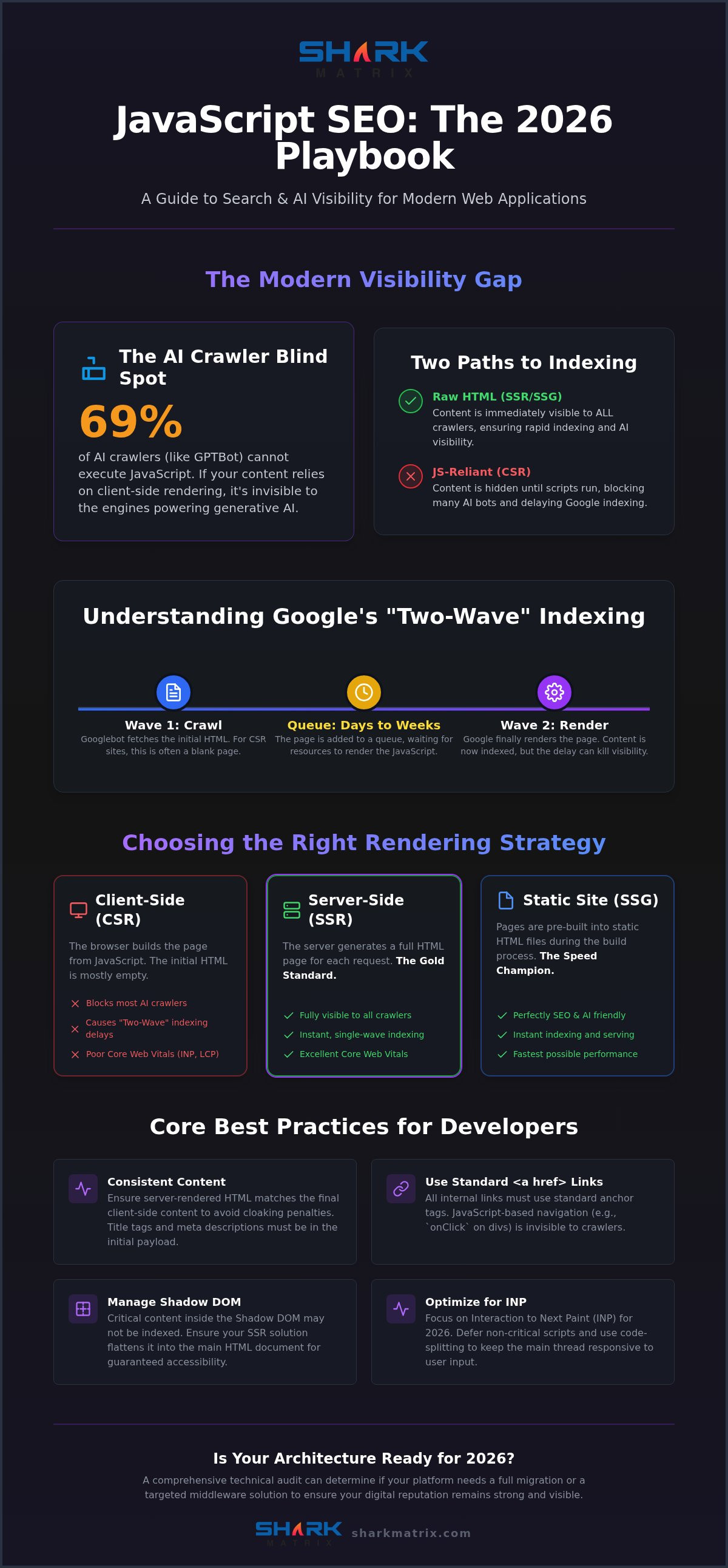
The biggest hurdle remains the “Two-Wave” indexing problem. When Googlebot visits a site, it first scrapes the raw HTML. If your content is tucked away inside a JavaScript framework like React or Vue without server-side support, the bot sees a blank page. It must then queue that page for a second wave of processing where it renders the scripts. This secondary phase can take days or even weeks. For national enterprises, this delay is a silent killer of search visibility, especially for time-sensitive promotions or inventory updates.

The 2026 Rendering Landscape

Modern search engines have evolved, but they are still prioritising efficiency. Every millisecond Google spends executing your scripts is a drain on its crawl budget. If your site relies heavily on client-side rendering (CSR), you’re essentially asking search engines to pay for your page’s processing power. In a competitive national market, bots will simply move on to a competitor with a more efficient, pre-rendered architecture. This is why AI automation services are now frequently used to audit these complex JS structures, identifying where rendering bottlenecks are stifling growth.

Common Myths About JavaScript and Search

One persistent myth is that Googlebot’s “evergreen” status means it sees everything exactly like a human user. While it’s true Googlebot uses the latest Chromium engine, it doesn’t mean rendering is guaranteed or immediate. Another dangerous misconception is that being “crawlable” is the same as being “rankable.” If your content is only available after a complex chain of JS executions, it lacks the technical authority required for high-competition niches. Relying on CSR for national lead generation is a high-stakes gamble. As AI crawlers continue to struggle with script execution, javascript seo best practices now demand a shift toward hybrid or server-side rendering to ensure your brand remains visible across the entire digital ecosystem.

Choosing the Right Rendering Strategy for Search Visibility

Selecting a rendering method determines how efficiently search engines process your site. In the context of javascript seo best practices, the choice usually falls between four main architectures: Server-Side Rendering (SSR), Static Site Generation (SSG), Incremental Static Regeneration (ISR), and Dynamic Rendering. Each has a specific impact on how quickly your content moves through Google’s two-wave indexing process.

SSR remains the gold standard for dynamic, real-time content. It generates HTML on the server for every request, ensuring that crawlers receive a fully rendered page instantly. For national content hubs where speed is the primary driver, SSG is often superior because it pre-renders pages during the build process. If you need to update static content without a full redeploy, ISR offers a middle ground by re-validating specific pages in the background. Dynamic rendering serves as a useful workaround for legacy systems, but it’s rarely the first choice for new web design and development projects due to its inherent complexity.

Server-Side Rendering (SSR) vs. Client-Side Rendering (CSR)

The performance gap between SSR and CSR is most evident in Core Web Vitals. CSR relies on the user’s browser to build the page, which often spikes Interaction to Next Paint (INP) and Largest Contentful Paint (LCP). When the browser is busy executing heavy scripts, it can’t respond to user inputs, leading to a poor experience. You can identify these bottlenecks by using the ‘Performance’ tab in Chrome DevTools to look for long tasks that block the main thread. Shifting to SSR mitigates these risks by offloading the heavy lifting to the server, providing a stable foundation for your digital reputation.

Framework-Specific Optimisation: Next.js and Nuxt.js

Modern frameworks like Next.js and Nuxt.js have built-in features that simplify javascript seo best practices. These tools handle hydration, the process where the browser takes the static HTML and makes it interactive, more efficiently than custom-built solutions. However, poor hydration can still trigger INP issues if not managed correctly. It’s vital to ensure that metadata and canonical tags are present in the initial HTML response rather than being injected later via script. For a deeper look at these fundamentals, Google’s JavaScript SEO basics provides the essential groundwork for ensuring your framework of choice doesn’t hinder your visibility. If you’re struggling with complex architecture, our ai automation services can help streamline technical audits to find the perfect rendering balance.
JavaScript SEO Best Practices: 2026 Technical Guide

Optimising for Generative Engines and AI Crawlers

Googlebot’s ability to render JavaScript is well-documented, but a 2025 study revealed a stark reality for modern brands: 69% of AI crawlers, including GPTBot and ClaudeBot, are currently unable to execute JavaScript. This creates a massive visibility gap. While your site might look perfect in Google Search, it remains a blank canvas for the Large Language Models (LLMs) that power AI search engines. Adhering to javascript seo best practices now requires a dual-pronged approach. You must serve the evergreen Googlebot while simultaneously providing raw HTML to AI scrapers that ignore client-side scripts.

AI engines prioritise raw HTML because it’s computationally cheaper to process. If your dynamic content only appears after a script runs, these bots won’t see your pricing, product descriptions, or unique insights. Structured data, specifically JSON-LD, acts as a bridge here. It provides a machine-readable summary that AI can digest without needing to render the entire DOM. This is a cornerstone of generative engine optimization (geo), ensuring your brand is cited as a source in AI-generated answers.

Making Dynamic Content Accessible to LLMs

To reach LLMs, you should consider using server-side fragments. This involves serving key data points as static HTML while keeping the interactive elements for the user’s browser. This ensures that when an AI bot scrapes your site, it finds the “meat” of the content immediately. It’s particularly vital for data-heavy sites where accuracy is non-negotiable. If an AI chatbot can’t find your data in the initial HTML, it might hallucinate or simply ignore your brand. Ensuring your site is ready for natural language processing means prioritising text-based content over script-injected components.

The Future of Answer Engine Optimisation (AEO)

JavaScript-heavy architectures often prevent sites from appearing in ‘AI Overviews’ or appearing as a recommended source in AI chatbot development interfaces. When the content is locked behind a script, the “answer engine” can’t extract the specific sentences it needs to satisfy a user’s query. Shark Matrix focuses on making every technical audit machine-readable from the first byte. As noted in the official Google documentation, Googlebot is capable of rendering, but relying on that second wave is a risk for AEO. Clean, server-delivered content is the only way to guarantee your brand stays relevant in an AI-first search environment.

Technical Implementation: Core Best Practices for Developers

Translating high-level strategy into functional code requires a meticulous approach to how scripts interact with the browser. At the heart of javascript seo best practices is the humble anchor tag. You must ensure all internal links use standard HTML <a> tags with valid href attributes. Googlebot often ignores links that rely solely on JavaScript event listeners like “onclick” because it doesn’t always trigger those interactions during the crawl phase. Without a clear URL path, your site’s architecture remains invisible to the index.

Managing the Shadow DOM is another critical hurdle. While modern rendering engines can see into encapsulated components, relying on them for critical content is risky. It’s often safer to keep essential text and links in the Light DOM. Similarly, error handling in single-page applications is frequently overlooked. Since SPAs don’t naturally refresh the page, a missing resource might still return a 200 OK status code. You must implement logic that explicitly tells the server to return a 404 or 5xx error to prevent “soft 404” issues that waste your crawl budget and confuse search engines.

On-Page Technical Essentials

Every piece of content needs a unique, permanent URL. Avoid using hash fragments (#) for navigation, as search engines generally ignore everything after the hash. Use the History API to manage clean URLs during client-side transitions. You also need to synchronise meta titles and descriptions in real-time. If the metadata doesn’t update when a user navigates between views, search engines will see duplicate titles across your entire app. Following a strict on page seo checklist ensures that your dynamic components don’t accidentally break foundational SEO rules.

Performance and Core Web Vitals

Reducing JavaScript execution time is paramount for improving Largest Contentful Paint (LCP). In 2026, the threshold for Interaction to Next Paint (INP) has become a primary ranking factor, meaning you must minimise main-thread work. Heavy scripts that block the browser from responding to clicks will tank your rankings. Optimising lazy-loading is equally vital; use native browser attributes rather than custom scripts that might hide images from crawlers. Many national brands now use ai automation services to monitor these performance metrics at scale, catching regressions before they impact the bottom line. If your current architecture is dragging down your scores, a technical SEO audit can help identify the specific scripts causing the lag.

Managing a national enterprise platform requires a sophisticated understanding of how code interacts with crawl budgets. When your site serves thousands of dynamic pages, a simple technical checklist isn’t enough. You need a comprehensive technical audit that looks beyond surface-level errors. This process involves deciding whether a full architectural migration to a framework like Next.js is necessary or if a middleware fix can bridge the gap. While migrations are resource-intensive, they often provide the best long-term foundation for javascript seo best practices by eliminating the “two-wave” indexing delay entirely.

Monitoring is the next pillar of a successful strategy. You should regularly use the URL Inspection tool within Search Console to verify how Googlebot renders your content. If the “Tested Page” screenshot shows a blank area where your main content should be, you have a rendering failure. Investing in a technical seo consultant can help you decipher these logs and implement fixes that protect your digital reputation. The ROI of this expertise is found in improved indexation rates and the prevention of costly traffic drops during framework updates.

Auditing and Monitoring JS Health

A vital part of your audit is comparing the “View Source” output with the “Inspected HTML” in your browser. The former shows what non-rendering bots see, while the latter shows the final rendered state. If critical SEO elements like canonical tags or H1s are missing from the raw source, you’re likely invisible to AI crawlers. Many teams now leverage machine learning development services to build predictive auditing tools. These systems can scan millions of pages and flag rendering anomalies before they impact your rankings, allowing for automated alerts on critical landing pages.

Conclusion: Building for the 2026 Web

The web has shifted from a focus on simple crawlability to a requirement for AI-readiness. In 2026, technical excellence is no longer optional; it’s a competitive advantage that separates national leaders from the rest of the market. By prioritising clean, server-delivered content and robust script management, you ensure your brand remains visible across both traditional search engines and emerging generative platforms. If you’re ready to future-proof your architecture, Partner with Shark Matrix for advanced Technical SEO to turn your complex JavaScript environment into a growth engine.

Future-Proofing Your Dynamic Digital Presence

Mastering the intersection of modern frameworks and search visibility is no longer a luxury for national enterprises. By aligning your architecture with javascript seo best practices, you transition from a site that’s merely functional to one that’s strategically visible. You’ve learned that success in 2026 hinges on choosing the right rendering balance and ensuring your data is accessible to the next generation of AI-driven crawlers. Technical excellence isn’t just about fixing errors; it’s about building a resilient foundation for your digital reputation.

Expertise matters when the stakes for your indexation are high. Shark Matrix offers 15+ years of digital experience, specialising in end-to-end technical SEO and custom web development. Whether you need to navigate complex migrations or implement advanced generative engine optimisation, our team provides the national coverage required for high-stakes projects. Scale your national visibility with expert SEO services from Shark Matrix and ensure your dynamic content reaches its full potential. Your journey toward a faster, more searchable web starts with a single technical shift. We’re ready to help you lead the way.

Frequently Asked Questions

Is JavaScript bad for SEO in 2026?

JavaScript isn’t inherently bad for search, but it adds a layer of technical complexity that requires careful management. While Googlebot’s rendering engine is evergreen, many AI bots still only process raw HTML. Following javascript seo best practices ensures that your content is accessible to all crawlers. Without proper implementation, you risk long indexing delays and high rendering costs that can drain your crawl budget and impact your overall digital reputation.

What is the best rendering method for a large e-commerce website?

For large-scale e-commerce platforms, Server-Side Rendering (SSR) or Incremental Static Regeneration (ISR) are the most effective methods. These strategies ensure that product descriptions and pricing are available in the initial HTML response. This is crucial for both traditional search engines and generative AI crawlers. To implement these complex solutions, Fraai Agency provides the specialized development expertise needed for result-oriented webshops. Avoid relying solely on client-side rendering, as it can lead to slow page speeds and fragmented indexation across your massive product catalogue.

You can verify rendering by using the URL Inspection tool in Google Search Console. After entering a URL, click “Test Live URL” and then “View Tested Page.” This allows you to see the rendered HTML and a screenshot of how Googlebot sees your site. If critical content is missing from the screenshot or the code, your JavaScript architecture might be blocking the crawler from seeing your full page.

Do AI search engines like ChatGPT crawl JavaScript differently than Google?

Yes, AI search engines crawl differently because most currently lack the resources to execute JavaScript. While Googlebot uses a full rendering engine, bots like GPTBot and ClaudeBot typically only read the raw HTML. If your site relies on client-side scripts to display content, it will likely be invisible to these generative engines. This makes server-side delivery essential for any brand prioritising generative engine optimisation (GEO).

Will using a JavaScript framework like React or Vue hurt my rankings?

Frameworks like React or Vue won’t hurt your rankings if you use them correctly with a meta-framework like Next.js or Nuxt.js. These tools allow for server-side rendering, which solves the crawlability issues associated with standard single-page applications. The danger lies in using vanilla client-side rendering, which often results in poor Core Web Vitals and delayed indexing. Custom web development should always prioritise search-friendly architecture from the start. For companies looking to build such high-performance applications, Agami Technologies offers expert custom software and SaaS development services that ensure technical SEO is baked into the foundation.

The ‘Two-Wave’ indexing problem occurs when Google indexes your raw HTML first and then returns later to render the JavaScript. This delay can range from a few hours to several weeks, leaving your content out of search results in the interim. You can fix this by implementing server-side rendering or static site generation. These methods provide the full content during the first wave, ensuring immediate and accurate indexation.

How much does a technical SEO audit for a JS site cost in the UAE?

The cost of a technical SEO audit for a JavaScript-heavy site varies based on the complexity of your architecture and the size of your platform. National enterprise sites often require a more deep-dive analysis compared to smaller applications. Instead of looking for a flat fee, you should evaluate the scope of the audit, including rendering checks and performance profiling. Shark Matrix provides comprehensive technical audits that identify specific bottlenecks in your JS environment.

Can I use dynamic rendering as a permanent solution for SEO?

Dynamic rendering is no longer recommended as a long-term solution for modern websites. While it was once a popular workaround for legacy systems, Google now prefers that sites use server-side rendering or static site generation. AI crawlers also benefit more from a consistent HTML structure rather than a bifurcated system. Moving toward a hybrid or SSR architecture is the best way to future-proof your site for the evolving search landscape.
Categories
Development

Freelance vs Agency for Web Development: The 2026 Strategic Guide

By early 2026, 41% of all code is AI-generated, which has completely changed the stakes for your next digital project. Choosing between a freelance vs agency for web development is no longer just about comparing hourly rates. It’s about deciding who will protect your brand from project abandonment and technical debt. You’ve probably felt the anxiety of wondering if a solo developer can handle the complexity of modern security. Managing multiple specialists is exhausting.

You deserve a high-performance website that converts and grows with your business. This strategic guide will help you discover whether a freelance developer or a full-service agency is the right choice for your digital growth and long-term security. We’ll explore the latest UAE market trends, the impact of AI automation, and how to build a reliable technical partnership that ensures your site integrates perfectly with your SEO and marketing goals from day one.

Key Takeaways

  • Understand the fundamental differences between execution-focused individuals and strategy-driven multidisciplinary teams in the 2026 digital market.
  • Evaluate the critical trade-offs of freelance vs agency for web development, focusing on project risk, communication speed, and execution complexity.
  • Learn why integrating SEO, PPC, and UI/UX design from the initial development phase is essential for long-term conversion and search visibility.
  • Identify your specific project triggers, such as technical complexity and internal management capacity, to determine the right partnership model.
  • Discover how a strategic partnership provides the AI automation and scalability required to future-proof your digital presence against rapid technological shifts.

The Web Development Landscape in 2026: Freelance vs Agency

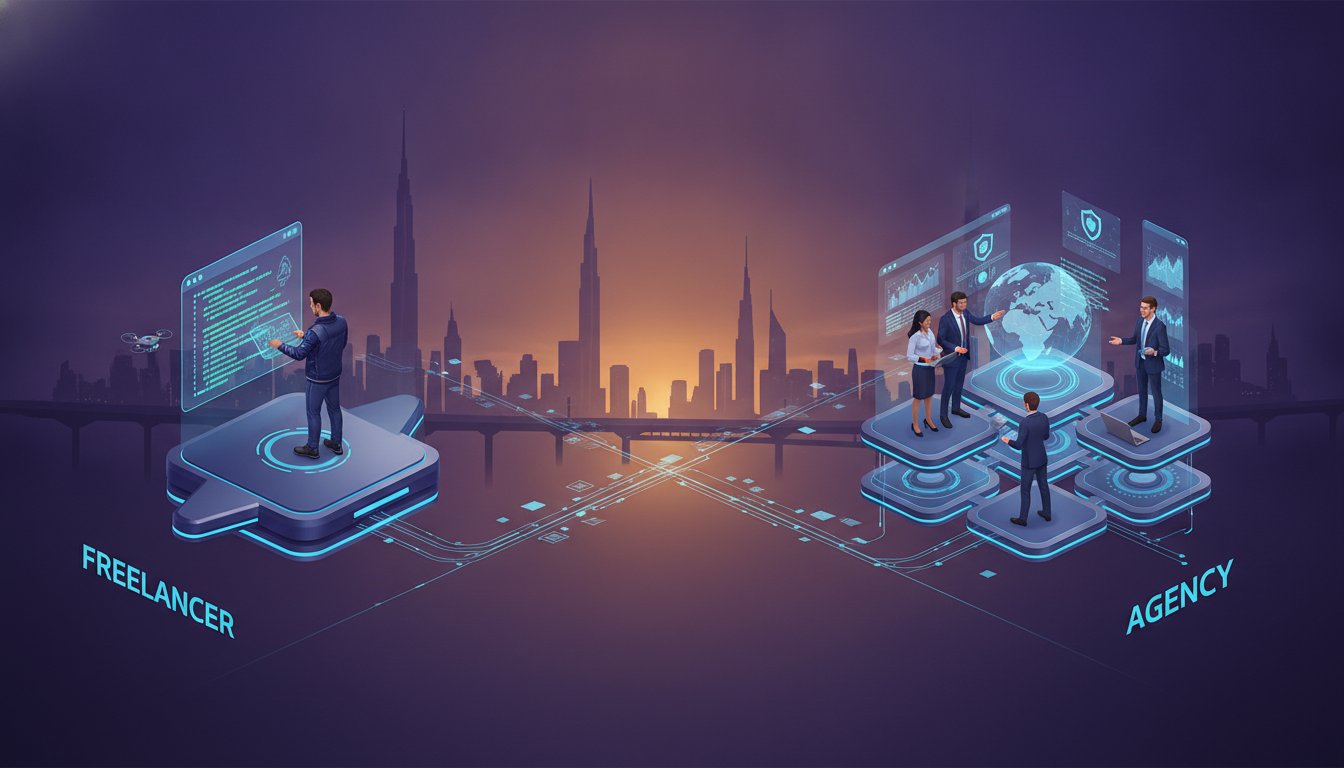
The 2026 digital environment is vastly different from the simple “brochureware” era. Today, Web development involves complex integrations of AI, real-time data, and strict accessibility standards. When you weigh the choice of a freelance vs agency for web development, you’re choosing the structural foundation of your business. A freelancer is typically an individual specialist who focuses on specific execution tasks. They’re the “hands” that build the features you request. An agency acts as a multidisciplinary team. They provide end-to-end digital strategy, ensuring your site doesn’t just exist but actually performs.

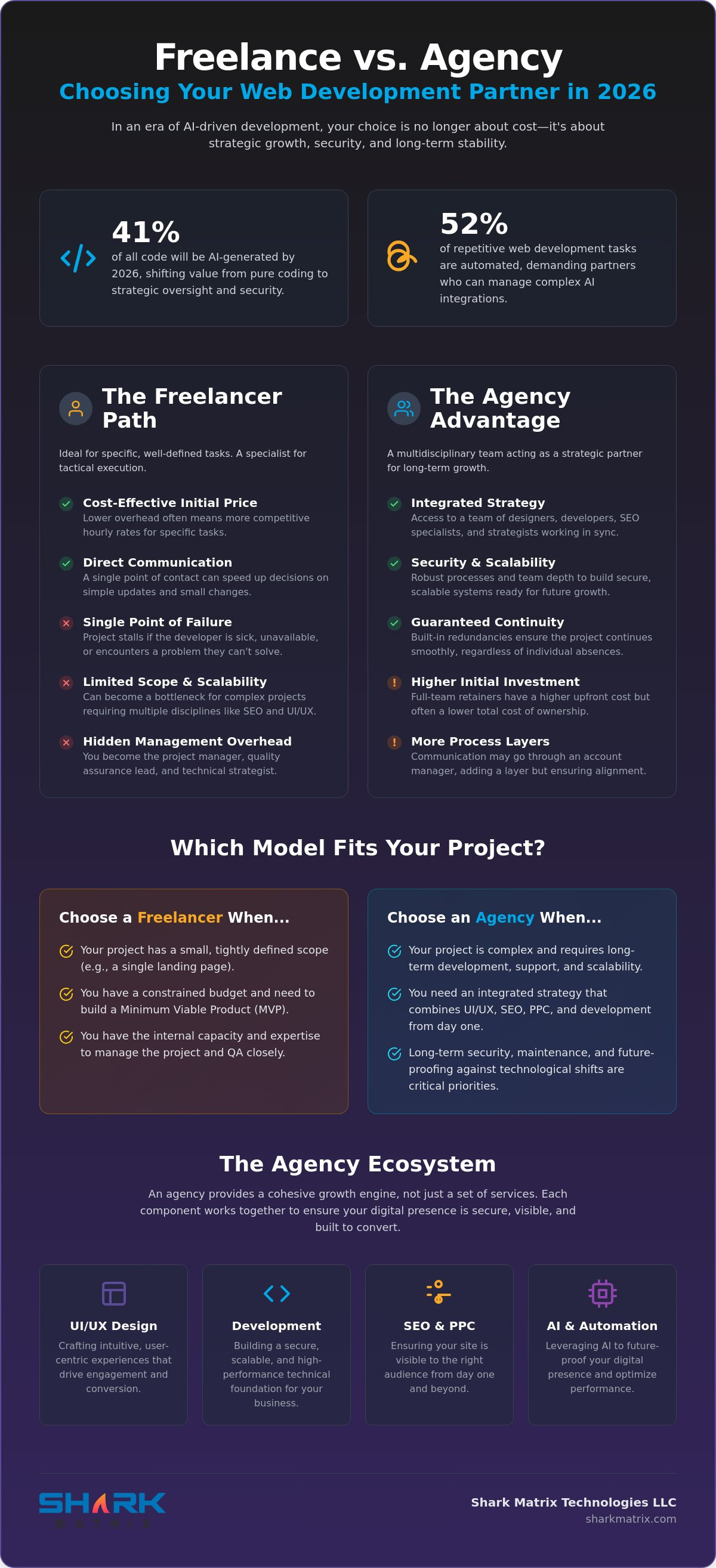
This decision impacts your business far beyond the initial launch. In 2026, where AI automates roughly 52% of repetitive coding tasks, the value of a partner has shifted from “how fast can you code” to “how well can you architect a secure ecosystem.” With 41% of all code now being AI-generated, the real work lies in strategic oversight and security. If your site breaks three months after launch, a solo freelancer might be unavailable or busy with another client. An agency offers the infrastructure to handle long-term maintenance, ensuring your digital assets remain secure and scalable.

The Freelance Developer: Agile and Specialized

Freelancers are ideal for niche tasks or small-scale, short-term project executions where the scope is tightly defined. You get direct access to the technician without navigating through account management layers. This direct line can speed up communication for simple updates. Since they have lower overheads, their initial pricing is often more competitive. It’s a viable path for a startup needing a basic landing page. However, you’re reliant on a single point of failure. If that individual is sick or moves on to a higher-paying project, your development pipeline stops immediately.

The Digital Agency: A Multidisciplinary Growth Partner

Agencies provide access to a collective brain trust. You aren’t just hiring a coder; you’re hiring designers, SEO specialists, and marketing strategists who work in sync. They view website design and development services as one piece of a larger brand strategy. With built-in redundancies, project continuity is guaranteed regardless of individual absences. Since its founding in 2010, Shark Matrix has seen how this multidisciplinary approach prevents the fragmentation that often ruins freelance projects. Agencies are better equipped to handle the 2026 shift toward integrated AI and automation, providing a level of long-term security that individuals rarely can match.

Evaluating the Freelance Path: Cost, Speed, and Risk

Hiring a freelancer often feels like the most direct route to launching a project. In the UAE market for 2026, freelance rates vary significantly based on seniority and technical specialization. On paper, these rates look attractive compared to full-team retainers. However, when deciding between a freelance vs agency for web development, you have to look at the total cost of ownership. A lower hourly rate doesn’t account for the hours you’ll spend acting as a project manager, quality assurance lead, and technical translator.

Speed is another double-edged sword. Communication with a solo developer is usually instant. You have their direct WhatsApp or Slack, which works well for minor tweaks. But complex execution often hits a wall. A single person, even one using AI tools to automate 52% of repetitive web development tasks, only has so many hours in a day. If your project requires custom AI integrations or advanced agency for web design expertise to scale, a solo freelancer becomes a bottleneck rather than a catalyst.

When Freelancing Wins: Small Scopes and Tight Budgets

Freelancers are excellent choices for projects with a finite end and low technical risk. If you need a simple landing page or basic maintenance on a standard CMS, an independent contractor is efficient. This model works best when you have the internal capacity to manage them closely. For budget-constrained startups building a Minimum Viable Product (MVP), a freelancer provides the agility needed to test a concept without the commitment of a full-service contract. It’s about matching the tool to the task.

The Hidden Costs of Managing Individuals

The real risk in the freelance model is the “single point of failure.” If your developer faces a personal emergency or a technical hurdle they can’t solve, your entire project stalls. Managing multiple freelancers to create a cohesive platform often results in “spaghetti code” and fragmented documentation. You might save money upfront, but you’ll spend it later on refactoring. If you’re tired of juggling separate vendors, exploring integrated web development solutions can save you dozens of management hours every month.

  • Vetting Time: Expect to spend 10 to 15 hours interviewing and checking portfolios for every reliable hire.
  • Inconsistent Quality: Without agency-level peer reviews, code quality depends entirely on one person’s discipline.
  • Onboarding Friction: Every new freelancer requires a fresh round of briefings and access management.

Freelance vs Agency for Web Development: The 2026 Strategic Guide

The Agency Advantage: Security, Scalability, and AI

While freelancers offer agility for isolated tasks, the true agency advantage lies in treating your website as a living ecosystem rather than a static digital brochure. In 2026, a successful platform requires more than just clean code; it demands a synergy between security, user experience, and growth marketing. When you evaluate the freelance vs agency for web development debate, you must consider the value of a multi-specialist team. An agency provides a holistic approach to search engine optimization seo services, ensuring that your site is visible to your target audience the moment it goes live. This integrated perspective prevents the common pitfall of building a beautiful site that no one can find.

Beyond visibility, agencies prioritize UI/UX design to drive actual conversions. It isn’t enough for a site to “look good” in 2026. It must be accessible, following standards like the UAE’s National Digital Accessibility Policy, and optimized for the 52.8% of global traffic coming from mobile devices. Agencies implement rigorous security protocols and long-term maintenance agreements. These protect your business assets from evolving cyber threats. By leveraging ai automation and development, agencies can also streamline user journeys, making your platform faster and more intuitive than a solo developer could achieve alone.

Integrating SEO and PPC from Day One

Launching a website without consulting an seo agency often leads to expensive reworks six months down the line. Agencies build technical foundations, such as schema markup and optimized site speed, into the core architecture. This proactive approach ensures your web structure aligns with future ppc agency dubai landing page requirements. When your development and marketing teams work under one roof, your paid campaigns and organic search efforts benefit from a unified data strategy. This creates a seamless transition from click to conversion.

Custom AI and Machine Learning Capabilities

The shift from static pages to intelligent platforms is the hallmark of 2026 web development. Agencies implement generative AI and advanced chatbots to enhance user engagement in real-time. While AI now automates 52% of repetitive coding tasks, the agency’s role is to architect how these tools interact with your customers. We use AI for predictive analytics and lead generation, turning your website into a tool that anticipates user needs. This level of technical depth allows your business to scale rapidly while maintaining a personalized experience for every visitor.

Selection Framework: Choosing the Right Partner for Your UAE Project

Making the right choice between a freelance vs agency for web development starts with an honest assessment of your project’s technical DNA. If you’re building a standard business site with five pages, a freelancer is a viable tool. However, if your roadmap includes custom e-commerce or a complex SaaS platform, you need the architectural foresight that only a team provides. You must also evaluate your internal capacity. Do you have 10 hours a week to manage a developer? Most business owners don’t. An agency includes dedicated project management in its delivery, which frees you to focus on your core operations.

Your long-term goals should dictate your partnership model. A one-off build might suit a solo contractor, but a growing digital brand requires a partner that can scale. When comparing costs, look at the total cost of ownership (TCO) over a 24-month period. A freelancer might offer a lower initial quote, but an agency’s structured maintenance and security protocols prevent the expensive technical debt that often follows fragmented development. If you’re ready to move beyond temporary fixes, consult with our web development team to build a scalable digital foundation.

A Checklist for Vetting Web Development Partners

Success depends on due diligence. When reviewing portfolios, look for specific industry experience and technical complexity that matches your own needs. Don’t just look at the design; ask about the backend architecture. You should also assess their communication protocols. Professional teams use established project management tools like Jira or Asana to track progress. Finally, verify their references for reliability. You need to know how they handle deadlines and whether they provide consistent support after the site goes live.

Strategic Considerations for National Growth

In the UAE, local context is a major competitive advantage. You need a partner with deep expertise in professional Arabic digital marketing to reach your target audience effectively. Compliance with national data protection laws and TDRA hosting standards is non-negotiable for 2026. Your site architecture should also be designed to support online reputation management dubai. This ensures that as your brand grows, your digital presence remains protected and your search results remain positive across the region.

Shark Matrix: Your Strategic Partner for Scalable Digital Growth

Deciding between a freelance vs agency for web development is ultimately a choice about the future of your business. Since 2010, Shark Matrix Technologies LLC has functioned as a high-impact technology firm that replaces fragmented vendor management with a unified strategy. Our 15-year legacy in delivering mobile app development services and custom software allows us to build platforms that last. We bridge the critical gap between technical engineering and marketing performance. This ensures every line of code supports your long-term lead generation and brand authority.

We understand the specific requirements of the UAE national market. From professional Arabic digital marketing expertise to compliance with local hosting standards, our team ensures your digital presence is culturally and technically relevant. We don’t just provide a vendor relationship; we act as a strategic growth partner. This means your website is designed to integrate seamlessly with your sales funnel and customer service tools from the moment of launch. We focus on protecting your brand authority while expanding your digital footprint across the region.

End-to-End Digital Transformation

Our methodology covers every touchpoint of the user journey. We transition your brand from a basic web presence to a sophisticated digital ecosystem through expert UI/UX design and custom AI chatbot implementation. These tools automate engagement without sacrificing the personal touch your customers expect. For national enterprises, we develop custom software solutions tailored to specific industry needs. We maintain this momentum through continuous optimization, using integrated SEO and PPC strategies to keep your platform at the top of search results in an increasingly competitive market.

Ready to Scale Your Digital Presence?

Established businesses choose the security and depth of an agency because they can’t afford the risks of project abandonment or technical debt. We provide the multi-specialist team needed to navigate the complexities of 2026 web standards. Our experts are ready to audit your current digital assets and plan a roadmap for your national expansion. Don’t leave your digital security to chance. Partner with Shark Matrix for High-Impact Web Development and build a foundation that scales with your ambition.

Secure Your Digital Future in 2026

The choice between a freelance vs agency for web development ultimately dictates how well your business survives rapid technical shifts. You’ve seen that while solo developers offer quick execution for small tasks, they often lack the long-term support and cross-functional expertise required for complex growth. A professional agency ensures that security, scalability, and AI automation are part of your site’s DNA, not just an afterthought. This holistic approach prevents technical debt and protects your brand authority as you expand.

Shark Matrix has been a trusted technology partner since 2010. We specialize in custom AI and machine learning, helping you build intelligent platforms that anticipate user needs. With our deep expertise in Arabic digital marketing, we ensure your message resonates across the UAE market. Don’t leave your digital security to chance. Build Your Scalable Digital Ecosystem with Shark Matrix and start your journey toward sustainable digital success today.

Frequently Asked Questions

Is it cheaper to hire a freelance web developer than an agency?

Freelancers usually offer lower upfront costs because they don’t have office overhead or large teams. However, when you weigh the choice of a freelance vs agency for web development, you’ve got to consider your own time. Managing an individual takes hours away from your core business. Agencies provide a project manager who handles all technical coordination, often making the agency more cost-effective over a full 24-month cycle.

What are the main risks of hiring a freelance developer for a corporate project?

The biggest risk is a single point of failure. If a solo developer becomes ill or takes another job, your project hits a dead end. Corporate projects require high security and consistent documentation. Freelancers often lack the peer-review systems that agencies use to ensure code quality. This can lead to technical debt that costs more to fix later than the original build.

Can a web development agency handle small business websites?

Many agencies offer specialized services for small businesses that need a professional edge. While a freelancer might build a basic site, an agency builds a scalable foundation. This means you won’t have to start from scratch when your business grows. You get access to the same expert designers and SEO specialists who work on larger accounts, ensuring high performance from day one.

How does an agency integrate SEO into the web development process?

Integration begins during the site mapping phase. Agencies ensure that technical elements like site speed, core web vitals, and schema markup are part of the initial build. This prevents the need for expensive reworks after the site is live. By aligning development with SEO from the start, your platform is built to rank and convert immediately rather than waiting months for post-launch optimization.

What happens if my freelance developer stops responding mid-project?

Project abandonment is a common pain point when working with individuals. If a freelancer stops responding, you’re often left with fragmented code and locked out of your own hosting. Agencies operate under corporate contracts and maintain multi-specialist teams. This structure guarantees that someone is always available to manage your project, providing a level of security and accountability that a solo contractor simply can’t match.

Why is UI/UX design more important in 2026 than in previous years?

In 2026, UI/UX isn’t just about aesthetics; it’s about compliance and conversion. New standards like the UAE’s National Digital Accessibility Policy make inclusive design a legal necessity for many entities. Additionally, users now expect instant, personalized experiences. High-quality design reduces friction and ensures your site performs across all devices, which is critical since mobile traffic now dominates the global web landscape.

Do agencies provide better long-term support than freelancers?

Agencies are built for long-term partnerships. They offer structured Annual Maintenance Contracts (AMCs) that cover security patches, updates, and performance monitoring. Freelancers often prioritize new project builds over maintenance tasks. When you choose a freelance vs agency for web development, remember that an agency has the staff redundancy to provide consistent support even during peak periods or individual staff changes.

How can AI automation improve my business website?

AI automation transforms your site from a static page into an active sales tool. It can power intelligent chatbots that handle lead generation 24/7 and use machine learning to personalize the user journey. By automating repetitive tasks, AI allows your site to load faster and respond more accurately to customer queries. This technology helps your business scale without significantly increasing your manual workload.

Categories
Development

The 2026 Guide to Website Design and Development Services for UAE Enterprises

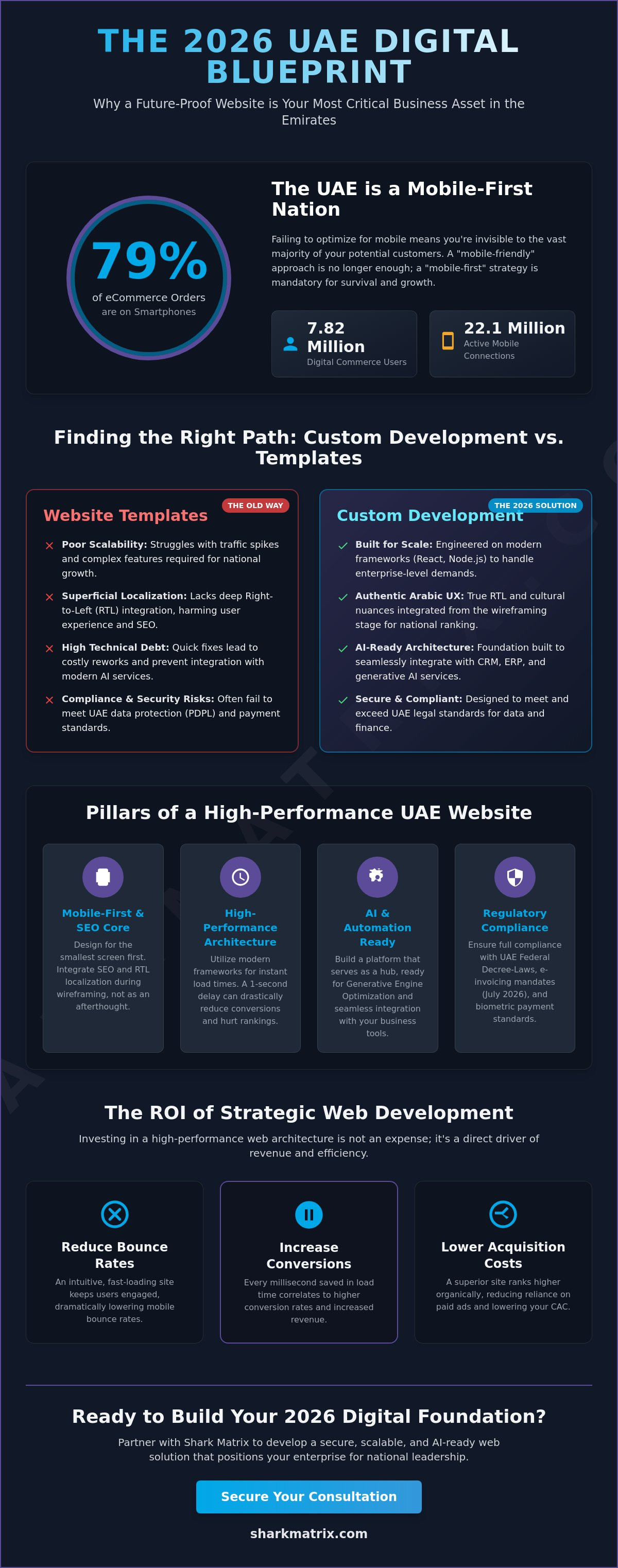
Did you know that smartphones processed nearly 79% of all e-commerce orders in the UAE last year? If your current platform suffers from high mobile bounce rates or lacks authentic Arabic localization, you’re likely losing a massive share of the 7.82 million digital commerce users active across the Emirates. Investing in professional website design and development services is no longer about having a digital business card. It’s about building a localized, AI-ready engine that complies with Federal Decree-Law No. 14 of 2023 and the latest biometric payment mandates.

You probably realize that keeping pace with rapid shifts like mandatory e-invoicing starting July 1, 2026, and the 9% corporate tax on profits over AED 375,000 requires more than just a template. This guide will show you how to evaluate and implement high-performance web solutions that drive national growth and seamless AI integration. We’ll explore the critical role of custom UX, data protection compliance under PDPL, and the strategies needed to scale a site that ranks for the UAE’s most competitive keywords.

Key Takeaways

  • Learn why shifting from mobile-friendly to mobile-first is essential for capturing the UAE’s high smartphone penetration.
  • Discover how to evaluate website design and development services based on technical frameworks and AI-ready architectures.
  • Understand the specific scenarios where custom development outperforms templates to provide better scalability for your enterprise.
  • See why integrating SEO and Right-to-Left (RTL) Arabic localization during the wireframing stage is non-negotiable for national rankings.
  • Explore how AI-powered development can transform your site from a static page into a high-converting growth engine.

Why Strategic Website Design and Development Services are Critical in 2026

Professional web development in 2026 is no longer a luxury; it’s the core of your business infrastructure. Many enterprises mistake a website for a static brochure, but modern strategic website design integrates user experience (UI/UX), robust technical architecture, and a clear commercial strategy. With over 22.1 million active mobile connections in the UAE, the market has shifted entirely to a mobile-first model. If your platform isn’t optimized for the 79% of shoppers using smartphones, you’re invisible to the majority of the 7.82 million digital commerce users projected by the end of this year.

A website serves as the foundation for all national digital marketing efforts. Whether you’re running PPC campaigns or focusing on content marketing, every lead eventually lands on your site. Relying on professional website design and development services ensures your site meets 2026 Core Web Vitals. Google’s ranking standards now prioritize page experience more than ever. Sites that fail to load instantly or provide a seamless mobile journey will see their organic visibility vanish in the face of local competition.

The ROI of High-Performance Web Architecture

Site speed isn’t just a technical metric. It’s a revenue driver. For national e-commerce brands, every millisecond of latency can lead to a drop in conversions. By investing in high-quality website design and development services, you reduce your customer acquisition costs (CAC). A faster, more intuitive site ranks higher organically and keeps users engaged longer, meaning you spend less on ads to get the same result. Technical debt represents the eventual cost of reworking a website because you chose a fast and easy solution during initial development instead of a scalable one. High-performance architecture avoids this trap by building for the future from day one.

Digital Transformation and UAE Vision 2031

Aligning your digital presence with the UAE Vision 2031 means building for innovation and national growth. High-growth sectors like fintech and logistics require platforms that are secure and compliant with Federal Decree-Law No. 45 of 2021 regarding personal data protection. As we move into an era of Generative Engine Optimization (GEO) and AI-driven search, your site must be structured to feed these systems accurate, high-quality data. Future-proofing your business involves:

  • Implementing secure, scalable platforms that handle rapid traffic spikes.
  • Integrating AI automation services to streamline customer interactions.
  • Ensuring full compliance with the July 1, 2026 e-invoicing mandates.
  • Adopting biometric payment authentication to meet UAE Central Bank standards.

By moving beyond city-level digital strategies and focusing on national scalability, UAE enterprises can secure a dominant position in a market projected to reach over USD 21 billion by 2031.

Essential Evaluation Criteria for Professional Web Services

Selecting a partner for website design and development services involves more than reviewing a portfolio of attractive homepages. You need to verify their proficiency in modern frameworks like React, Vue.js, or Node.js. These technologies ensure your site remains fast and responsive under heavy traffic. National-level projects demand a technical architecture that supports complex integrations with your existing CRM, ERP, or custom AI automation services. A partner who can’t demonstrate deep technical knowledge will likely struggle as your business scales across the Emirates.

Demand transparency regarding their integration capabilities. Your web solution should serve as a hub for your business operations. If an agency can’t explain how they’ll connect your front-end to back-office tools or generative AI development services, they aren’t the right fit for a 2026 enterprise. Checking a partner’s history with large-scale UAE projects provides proof they can handle local regulatory requirements and high-volume user data. Don’t settle for simple landing page experience when your goal is national growth.

UI/UX Design: More Than Just a Pretty Interface

Effective UI/UX design starts long before a single pixel is colored. It begins with user research and journey mapping to understand how your customers navigate. By integrating SEO and trust-based design choices into your wireframes, you ensure that the site isn’t just visually appealing but also functional. Accessibility standards are also vital. Your site must be usable for all members of the UAE’s diverse population; this directly impacts your long-term user engagement and conversion rates. Working with a specialized ui/ux design agency dubai enterprises trust ensures these principles are embedded from the earliest stages of your project, transforming your digital products into high-conversion assets.

Security, Compliance, and Data Protection

Security is a non-negotiable pillar of professional website design and development services. With the Federal Decree-Law No. 45 of 2021 (PDPL) in effect, your site must adhere to strict data residency and processing rules. This includes implementing SSL certificates, advanced encryption protocols, and regular security audits. Protecting your brand’s online reputation requires a proactive stance against data breaches. If you’re unsure where to start, looking at how a professional development team handles these compliance hurdles can save you from significant legal penalties later.

Beyond the code, look for a partner who understands the local culture. A site that looks great in London might fail in Riyadh or Dubai if it ignores the nuances of Right-to-Left (RTL) layouts or local consumer behavior. The right agency bridges this gap by blending global technical standards with local market insights. This ensures your platform isn’t just a digital asset but a localized engine for revenue.

The 2026 Guide to Website Design and Development Services for UAE Enterprises

Custom Development vs. Templates: Finding the Right Path

Choosing between a pre-built template and a custom-coded solution is the most significant financial decision you’ll make for your digital presence. Templates offer a fast route to market, which works for small businesses with limited budgets. However, for an enterprise aiming for national growth, a template often becomes a bottleneck. Custom website design and development services provide the flexibility to build features that don’t exist in off-the-shelf themes. This is particularly vital when you need deep AI automation to handle complex customer queries or automate back-end logistics.

The total cost of ownership (TCO) over a three-year period often reveals a surprising truth. While a template site is cheaper on day one, the costs of premium plugin subscriptions, security patches, and eventual “technical debt” rework can exceed the price of a custom build. Custom code is an investment in a permanent asset. It allows your platform to evolve without the constraints of a third-party developer’s update schedule or the risk of a theme becoming obsolete. Enterprises looking to extend their digital reach beyond the browser should also explore dedicated mobile app development services to complement their web presence and capture the UAE’s smartphone-first audience across every touchpoint.

The Custom Development Advantage for National Brands

Templates rely on generic plugins to add functionality. This creates “code bloat” that kills site speed and hurts your SEO rankings. Custom web development is the gold standard because it allows for a clean, purpose-built codebase. Academic research on effective website design highlights that user engagement and trust are directly tied to high-speed, intuitive interfaces. A custom CMS can be tailored to your specific internal workflows. This means your team spends less time fighting the software and more time managing growth.

E-commerce Considerations: Shopify vs. Magento vs. Custom

Your platform choice should depend on your SKU count and transaction volume. A small brand might thrive on Shopify, but a national enterprise with thousands of products and complex inventory needs the power of Magento or a custom headless solution. Headless commerce is gaining traction in the UAE. It decouples the front-end design from the back-end commerce engine, allowing for a seamless multi-channel experience across apps and web. You must also ensure your build supports local payment gateways like Telr or PayTabs. These integrations are smoother in custom environments, providing the frictionless checkout experience that modern UAE shoppers expect. Ensuring your storefront delivers a consistent experience on every screen size is equally critical, which is why investing in responsive web design Dubai enterprises rely on can directly reduce cart abandonment and boost conversions across mobile and desktop alike.

Integrating SEO and Arabic Localization into Your Web Project

Waiting until after launch to think about search rankings is a recipe for expensive reworks. High-performance website design and development services must prioritize search engine optimization during the wireframing phase. This ensures that site architecture, internal linking, and content hierarchies are built to satisfy both users and search engines from the start. In the UAE’s competitive national market, your strategy should map out keywords that capture intent across all seven emirates, not just localized pockets in Dubai or Abu Dhabi.

Localization goes far beyond translating text. It’s about building trust. A site that speaks naturally to an Arabic-speaking audience through professional transcreation will always outperform a generic English site. This cultural resonance directly impacts your conversion rates. When users see a platform that respects their language and cultural nuances, they’re more likely to engage with your brand and complete a purchase. It shows you’re committed to the local market. A strong web presence also forms the foundation of how your brand appears in search results, which is why pairing your development strategy with a robust approach to SEO for brand reputation management Dubai is essential for protecting your digital narrative across the Emirates.

Arabic Digital Marketing: Beyond Simple Translation

Transcreation involves adapting your brand’s voice and message to fit the GCC cultural context while maintaining its original intent. One of the biggest hurdles is Right-to-Left (RTL) design. You can’t just flip the layout. Icons, navigation menus, and form fields must be mirrored to match the natural eye-tracking patterns of Arabic readers. If you break this logic, you frustrate users and drive up bounce rates. Your design team must understand these linguistic variations to ensure the UX feels native rather than forced.

Technical SEO Best Practices for New Builds

Clean URL structures and XML sitemaps are the basics. For 2026, you also need robust schema markup to help search engines understand your products, reviews, and corporate data. If you’re migrating an old site, managing redirects is critical to preserving your hard-earned link equity. Losing authority during a launch can set your national growth back by months. You should refer to our how to choose a web design agency guide to ensure your partner has the technical depth to handle these requirements.

To ensure your brand captures the full potential of the UAE market, professional website design and development services are essential; reach out to Shark Matrix Technologies LLC to begin your national digital transformation. We focus on building sites that don’t just look good but dominate the local search landscape.

Partnering with Shark Matrix: Your National Web Development Solution

Shark Matrix provides more than just code. We deliver a comprehensive digital strategy that turns your online presence into a high-performance growth engine. Our end-to-end approach begins with strategic consulting to ensure your platform aligns with the UAE’s specific market conditions and national objectives. By bridging the gap between global technical standards and Middle Eastern cultural nuances, we ensure your brand resonates from Abu Dhabi to Ras Al Khaimah. We specialize in website design and development services that incorporate generative AI development services, turning a standard site into an intelligent business tool that understands your customers.

Launching your site is only the first step toward digital dominance. We provide dedicated post-launch support to keep your platform secure, fast, and fully optimized for performance. In a market where the e-commerce sector is projected to reach over USD 21 billion by 2031, staying stagnant is a risk you can’t afford. Our commitment to data-driven results means you receive transparent reporting that tracks your ROI. This helps you navigate the local business landscape, including the 9% corporate tax threshold and VAT requirements, with clear financial insights and a site that actually converts.

The Shark Matrix Development Lifecycle

  • Discovery and Strategy: we begin by aligning the build with your national business goals. This involves analyzing competitor gaps and identifying how to leverage machine learning development services to personalize the user journey.
  • Agile Development: our process ensures transparency through iterative feedback loops. You’ll see the project evolve in real-time, allowing for adjustments as market conditions or regulations shift.
  • Rigorous QA and Testing: we launch with zero-defect confidence. Every site undergoes stress testing to handle the traffic spikes common in high-growth UAE sectors like fintech and logistics.

Ready to Scale Your Digital Presence?

Our website design and development services don’t exist in a vacuum. They integrate seamlessly with our broader ecosystem of AI automation services and content marketing. Whether you need an e-commerce platform that handles thousands of SKUs or a corporate site designed to dominate national search engine optimization rankings, we have the technical depth to deliver. We invite you to book a consultation for your national-scale project to see how we can future-proof your digital assets.

Choosing a partner that understands the 2026 UAE landscape is the difference between a site that merely exists and one that leads. We focus on building secure, scalable, and localized solutions that drive national growth. Let’s build a platform that meets the high expectations of the UAE’s 7.82 million digital commerce users.

Future-Proof Your National Growth Today

The digital landscape across the Emirates is moving faster than ever. Succeeding in 2026 requires more than a functional site; it demands a localized, AI-ready architecture that complies with evolving data laws and payment standards. Transitioning from generic templates to high-performance website design and development services ensures your business remains scalable and secure. This approach allows you to capture a larger share of the country’s multi-billion dirham e-commerce market while maintaining a seamless user experience for the 7.82 million digital users active today.

Shark Matrix has been helping enterprises navigate these complexities since 2010. Our deep UAE market expertise and specialists in AI-integrated web development provide a significant competitive edge. With our comprehensive Arabic digital marketing capabilities, we ensure your brand speaks directly to the local audience. It’s time to stop reacting to digital trends and start leading them. Scale Your Brand with Shark Matrix Web Services and secure your place in the UAE’s digital future. Your journey toward a high-converting, national-scale platform starts here.

Frequently Asked Questions

How much do professional website design and development services cost in the UAE?

Project costs depend on the scope of work, technical complexity, and specific feature requirements. A custom enterprise solution involves various factors like the number of pages, e-commerce capabilities, and the depth of AI integrations. Rather than looking for a flat rate, businesses should evaluate the total cost of ownership, including hosting, security, and long-term maintenance needs.

What is the typical timeline for a custom enterprise web development project?

A custom enterprise project usually takes between 12 and 24 weeks to complete. This timeline allows for a thorough discovery phase, strategic UI/UX design, and complex coding requirements. Projects that require custom ai automation services or extensive third-party integrations may fall on the longer end of this spectrum to ensure every system works perfectly before the national launch.

Do I need a separate agency for Arabic localization and SEO?

You don’t need multiple partners if you choose an agency that provides integrated website design and development services. A single, full-service partner ensures that Right-to-Left (RTL) layouts and search engine optimization are built into the site’s foundation. This unified approach prevents technical errors that often occur when different teams handle development and localization separately.

Can you integrate AI chatbots and automation into my existing website?

Yes, we can integrate ai chatbot-development services and advanced automation into most modern websites. These tools are often connected via custom APIs or specialized modules, allowing your business to automate customer support and lead capture. This enhancement improves your site’s functionality without the need for a complete rebuild, provided your current platform’s architecture is flexible enough.

What is the difference between a web design agency and a web development company?

Web design focuses on the visual elements, branding, and user journey of your site. Web development involves the back-end coding, database management, and technical architecture that make those designs functional. Most successful UAE enterprises look for a partner that combines both disciplines to ensure their site is both visually compelling and technically superior.

How often should a business update its website design for optimal performance?

Enterprises should consider a major design refresh every two to three years. With the UAE’s rapid digital shift and new 2026 regulations like biometric payment mandates, staying updated is a matter of compliance as much as aesthetics. Regular technical audits should happen more frequently to ensure your site continues to meet Google’s Core Web Vitals and performance benchmarks.

Will my new website be mobile-responsive and SEO-friendly by default?

A professional build in 2026 must be mobile-responsive and SEO-friendly by default. Since smartphones process nearly 79% of e-commerce orders in the UAE, a mobile-first approach is the industry standard. You should verify that your development partner includes technical SEO features like schema markup and clean URL structures as part of their core delivery process. For enterprises ready to go beyond the browser, investing in dedicated mobile app development services ensures your brand maintains a high-performance presence across every device your customers use.

What kind of ongoing maintenance is required after the website launch?

Ongoing maintenance includes regular security patches, server monitoring, and software updates to protect against vulnerabilities. You’ll also need to manage domain renewals, SSL certificates, and periodic content updates to keep the site relevant. Regular performance checks are vital to ensure your platform remains compliant with Federal Decree-Law No. 45 of 2021 regarding personal data protection.