

What if your busiest marketing dashboard is hiding the one decision your team needs to make? A digital marketing reporting framework should do more than list clicks, impressions and leads. It should show whether SEO, paid media, social and content are helping the business move towards its goals, and where the team should act next.
If your reports feel busy but inconclusive, you’re facing a common challenge: channel data can’t guide decisions when teams define metrics differently, compare mismatched reporting periods or rely on unstated attribution assumptions. Add a long list of KPIs, and it becomes harder to see what matters.
This guide explains how to build a practical framework around business objectives, choose meaningful measures for each channel, and connect performance to outcomes such as qualified leads. You’ll also learn how to compare channels without treating unlike metrics as interchangeable, set shared reporting rules, and turn review meetings into clear actions with owners and follow-up measures. The result is reporting that helps marketing teams across the UAE decide what to continue, improve or investigate, rather than simply documenting what happened.
Key Takeaways
- Build your digital marketing reporting framework around a business objective and the decision you need to make, not a long list of available metrics.
- Separate leading indicators, such as qualified visits, from lagging outcomes, such as completed leads, to understand both progress and results.
- Compare SEO, paid media and social against shared goals, while noting each channel’s role, data source and measurement limitations.
- Use a consistent review flow to explain performance changes, agree on an action, assign an owner and set a follow-up date.
- Improve reporting by addressing broken tracking, outdated KPIs and unclear ownership before adding dashboards or automated summaries.
What Is a Digital Marketing Reporting Framework, and What Should It Help You Decide?
A digital marketing reporting framework is a repeatable system that connects business goals to measures, data, interpretation and action. A dashboard displays selected data, while a one-off report captures performance for a particular period. The framework sits behind both: it defines what to track, where the information comes from, who interprets it, when it is reviewed and which decisions the evidence can inform.
That distinction matters when SEO, paid campaigns, social media and content all contribute to the same growth objective. These channels are different parts of digital marketing, but separate platform summaries won’t automatically explain their combined contribution to qualified leads. A useful framework gives channel owners enough detail to diagnose performance, while helping business leaders and client-facing teams understand progress and agree on priorities.
Start with the business decision, not the dashboard
Before opening an analytics tool, name the decision the report should support. You might need to reallocate effort between channels, refine a campaign that attracts visits but few enquiries, or investigate why lead quality has changed. Connect that decision to a business objective, such as generating more qualified leads, before choosing metrics. This prevents available dashboard figures from dictating what the team pays attention to.
Separate routine optimization from strategic planning. A channel owner may use campaign-level signals to adjust targeting or content. Leadership may need to decide whether the current channel mix supports broader growth priorities. The first calls for timely diagnostic information; the second needs a wider view of outcomes and trends. Both can draw on related data without being forced into the same level of detail or decision cycle.
Set the scope and audience for each report
Define the report’s boundaries so readers know what they’re looking at. Record which channels, campaigns and objectives are included, the reporting period, and any important exclusions. For example, a report might cover SEO, paid media and social activity for lead generation over a stated period. Keep the scope consistent when comparing periods, or explain any changes that affect the comparison.
Then tailor the view to its reader. Leadership usually needs outcomes and implications; channel owners need diagnostic measures that help them locate a change. Client-facing teams need a clear explanation of what the findings mean and what happens next. One shared framework can serve these audiences without giving everyone the same crowded dashboard.
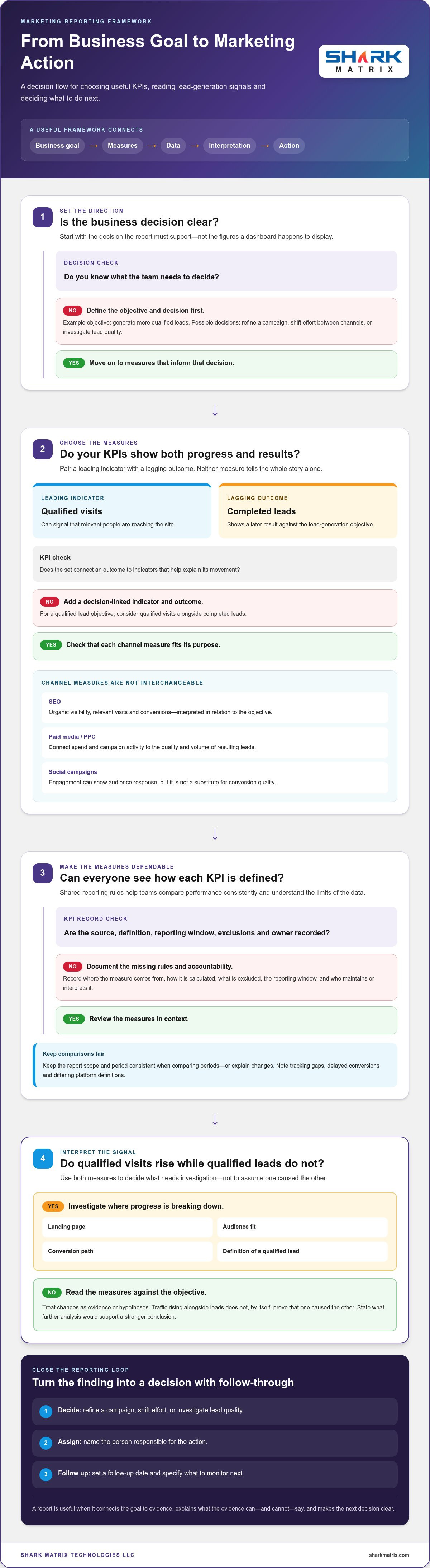
Finally, state limitations alongside conclusions. Tracking gaps, delayed conversions or differing platform definitions can affect what the data shows. A rise in traffic alongside an increase in leads does not, by itself, prove that one caused the other. Label observations as evidence or hypotheses, and state what further analysis would support a stronger conclusion. Clear limits build trust and keep the next decision grounded in what the report can actually tell you.
Digital Marketing Reporting Framework: Goals to KPIs
Once the business objective is clear, translate it into measures in a deliberate order. A useful digital marketing reporting framework prevents teams from choosing KPIs simply because a platform makes them easy to export. A KPI is useful only when it informs a defined objective or decision.
- Choose an objective: for example, generate more qualified leads.
- Define the decision: decide whether to refine a campaign, shift effort or investigate lead quality.
- Select KPIs: pair an outcome measure with indicators that help explain it.
- Assign sources and owners: record where each measure comes from and who maintains or interprets it.
- Review: use the findings to make a decision and specify what to monitor next.
This sequence separates leading indicators from lagging outcomes. Qualified visits may signal that relevant people are reaching the site, while completed leads show a later result. Neither tells the whole story on its own. If visits rise but qualified leads do not, investigate the landing page, audience fit, conversion path or definition of a qualified lead.
Choose a small, decision-linked set of KPIs
Pair outcomes, such as completed conversions or qualified leads, with channel measures that help diagnose movement. For SEO, a team could track organic visibility, relevant visits and conversions, using consistent definitions for each. Interpret SEO measures in relation to the objective they support, rather than treating a search metric on its own as a business result.
For PPC, connect spend and campaign activity to the quality and volume of resulting leads. For social campaigns, engagement can show how audiences respond, but it shouldn’t stand in for conversion quality. These channels play different roles and use different platform definitions. Compare each against its purpose and a shared business outcome, not as if a click, impression and engagement were interchangeable units.
Document data sources, definitions, and owners
Create a simple KPI record with the calculation, source, reporting window, exclusions and accountable owner. For example, define whether a “lead” means a form submission or a lead accepted as qualified in the CRM. Name the system of record and the person responsible for investigating differences between analytics and CRM figures. Digital.gov’s guidance on analytics strategy and reporting also connects performance goals and KPIs with data-informed decisions.
Use UTM parameters consistently to identify campaign traffic across analytics and CRM records. Agree on campaign naming conventions before launches, and document how missing or incorrectly tagged visits are handled. This makes channel comparisons more interpretable without implying that tracking captures every interaction or proves causation.
When SEO, paid media and social all contribute to lead generation, structured reporting can connect channel findings to shared priorities. Keep the KPI record accessible to everyone who contributes data or acts on the results, so definitions don’t drift as campaigns change.
How to Compare Channel Performance Without Misreading Marketing Data
Cross-channel comparison works only when everyone agrees on what the numbers mean. A click in a paid platform, an organic visit in analytics and an engagement in a social account describe different behaviours. Compare each channel with the same business objective, such as qualified lead generation, but don’t treat platform metrics as equivalent units. A digital marketing report definition and importance can provide useful context for how reporting supports performance review and strategic changes.
Platform-reported conversions may overlap, so don’t simply add them together and treat the total as unique leads. A person may interact with more than one channel before converting, and each platform may claim credit according to its own settings. Attribution is a model for assigning conversion credit across touchpoints, not definitive proof that a particular channel caused the outcome.
Separate channel contribution from channel efficiency
Read performance in layers: traffic, engagement, lead volume, lead quality and business outcomes. Each layer answers a different question. SEO may contribute relevant visits over time; PPC may capture active search demand; social activity may introduce or re-engage audiences. Compare each channel’s contribution to a shared outcome, while preserving its role and context.
Efficiency comparisons need aligned definitions, reporting periods and included costs. If one channel’s conversion count includes every form submission while another counts only qualified leads, a cost-per-conversion comparison will mislead. Where available, use CRM records to see whether leads progress beyond their initial conversion. Paid-search results also make more sense alongside campaign intent and management context, as discussed in Choosing the Right PPC Agency: A Guide to National Growth.
Use a consistent comparison view
A compact channel comparison keeps important context next to each result. Include these fields for every channel:
- Channel and journey role: for example, SEO supporting discovery or PPC capturing active search demand.
- Key KPI and source: name the measure and the platform, analytics system or CRM record behind it.
- Limitation: note any tracking gap, differing definition or delayed conversion window.
- Next decision: state whether to maintain, investigate or adjust the activity, and what evidence would guide that choice.
This view gives leadership a consistent way to discuss outcomes while letting channel owners interpret their own diagnostic measures. It also prevents a high engagement count from being mistaken for stronger lead quality.
Interpret attribution and data gaps responsibly
Observed data can be affected by consent choices, cross-device journeys and platform settings. A conversion may not be connected to an earlier interaction, or reporting systems may assign credit differently. Record those limits beside the result. If tags are missing or campaign names are inconsistent, flag the gap and investigate it rather than filling it with an assumption.
Use attribution to guide questions, not to declare a channel the sole cause of growth. Compare trends using consistent definitions, check CRM outcomes where possible, and be explicit about what the available data supports. That discipline helps a digital marketing reporting framework inform sound channel decisions without claiming more certainty than the evidence provides.
How to Run a Reporting Cycle That Turns Findings into Action
A report creates value only when someone uses it to make a decision and follows through. Build a recurring cycle into your digital marketing reporting framework so findings don’t stop at discussion. Move from the objective to a performance variance, its possible explanation, a decision, an accountable owner and a date to review the result.
Separate evidence from interpretation. A confirmed finding might be that recorded qualified leads declined during the reporting period. A possible explanation, such as a landing-page change or weaker audience fit, is still a hypothesis until the team checks supporting data or runs a suitable test. Label the difference clearly so the team doesn’t mistake a plausible story for a proven cause.
Choose a cadence that matches the decision
Review active campaign issues often enough to act while the information is useful. Strategic outcomes may need a longer observation period before a meaningful trend emerges. Weekly or monthly reviews can work when the decision and data support that rhythm, but neither should be automatic. Don’t spend each meeting reviewing every available metric. Bring forward only the measures relevant to decisions due now, and reserve deeper analysis for questions that need it.
Make every insight testable and accountable
Start with a specific question about a variance, rather than jumping straight to a recommendation. If an SEO page is receiving relevant visits but producing fewer enquiries, ask whether the page’s message, search intent or conversion path has changed. If the cause remains uncertain, agree on what to investigate before making a wider campaign change. A deeper SEO diagnostic, such as How to Conduct a Comprehensive SEO Audit for Your Business, can help structure that investigation.
Record the decision in a simple action log. For example:
- Finding: Relevant organic visits continue, but enquiries from a key page have declined.
- Proposed response: Review the page’s content and conversion path before changing broader SEO priorities.
- Accountable owner: The assigned SEO or web team member.
- Success measure: The agreed enquiry measure, interpreted alongside relevant visits.
- Follow-up: A specific review date after the investigation or change.
For paid campaigns, the same log might capture a lead-quality concern, the audience or search terms to investigate, the person responsible and the CRM measure to check at follow-up. Keep the expected signal observable, and note whether it would confirm the hypothesis or prompt another question. If data quality is too weak to judge the result, make improving measurement the action.
Close each review by reading back decisions, owners and follow-up dates. Shark Matrix provides SEO and broader digital marketing services that can support campaign priorities and lead generation.
How to Improve Your Digital Marketing Reporting Framework Over Time
A reporting framework should evolve as business priorities, campaigns and data systems change. Review it periodically to catch KPIs that no longer guide decisions, broken tracking, duplicate reports and measures without a clear owner. A useful audit asks more than whether each dashboard still works: does every report help someone decide what to do next?
Start by checking whether each measure still supports an active objective. Remove or replace metrics that no longer influence a decision, and investigate duplicated reporting that creates competing versions of performance. Check that campaign tracking works as intended and that responsibility for maintaining definitions and sources is clear. Fix these foundations before adding dashboards or automated summaries. More output won’t correct inconsistent inputs.
Keep definitions and measurement governance current
Set a regular review point for metric definitions, data sources, campaign naming conventions and tracking implementation. Revisit them when a platform, analytics setup or campaign process changes. Keep a short change log: note what changed, when it took effect and which reports it affects. That context helps readers distinguish a genuine shift in performance from a change in how it was measured.
Automation can reduce repetitive collection and formatting, but it shouldn’t make decisions on the team’s behalf. Assign a person to review unusual results, check whether definitions remain consistent and interpret what the numbers mean for the objective. Treat automated summaries as a starting point for analysis, not a substitute for accountable judgment.
Get support when reporting spans channels and teams
SEO, PPC, social media and lead-generation activity often sit across different platforms and teams. Coordinated reporting can bring them into one view tied to shared business goals, while preserving each channel’s role, definitions and measurement limits. Explore SEO services as part of your search and reporting priorities.
For a practical framework audit, use a short checklist:
- Relevance: Does every KPI still support a current objective or decision?
- Reliability: Are tracking, sources, calculations and reporting windows consistent?
- Ownership: Is someone accountable for each definition, data check and follow-up?
- Use: Do reports lead to decisions, or are they repeated without changing priorities?
Shark Matrix supports SEO, PPC, social media campaigns and data-driven lead generation. If reporting across channels makes it difficult to see what should happen next, explore how Shark Matrix’s digital marketing services can support your growth priorities.
Make Your Next Reporting Review the Starting Point
Your next step doesn’t need to be a complete reporting overhaul. Pick one upcoming business decision and use it to test whether your current reporting gives the team enough evidence to act. If it doesn’t, identify the missing definition, data source or owner, then improve that piece before expanding the system.
Over time, this steady approach can turn a digital marketing reporting framework into a practical learning loop. Each review can sharpen what the team measures, how it interprets results and which questions deserve further investigation. The aim isn’t a perfect dashboard; it’s clearer, more confident decisions that support sustainable growth.
Shark Matrix brings digital marketing services across SEO, PPC management, social media campaigns and content marketing, with a focus on data-driven lead generation. Explore Shark Matrix’s digital marketing services to align your marketing activity with your growth goals.
Frequently Asked Questions
What should a digital marketing reporting framework include?
It should include the information and responsibilities needed to move from a marketing goal to a follow-up decision. For example, if the goal is to generate qualified enquiries, document how an enquiry is classified, where that information is recorded, who checks it, and how the team will assess progress. Include the reporting period and any known data limitations so readers can interpret results consistently as campaigns or systems change.
How often should a business review digital marketing reports?
Set the review rhythm according to how quickly a decision needs to be made and how soon reliable data is available. An active campaign may warrant frequent checks for issues requiring prompt attention, while a longer-term initiative needs enough time to produce a meaningful signal. If conversions usually take time to mature, reviewing them too early can prompt unnecessary changes. Choose a cadence, then adjust it when the decision cycle changes.
Which digital marketing metrics should executives see?
Executives generally need a concise view of business outcomes and progress towards agreed targets, rather than every channel’s operational detail. Depending on the organisation, that could include qualified leads, lead-to-customer progression, conversion rate or cost per qualified lead. Show the trend and explain notable changes in plain language. Include only measures with clear definitions, and flag when incomplete data limits what the figures can support.
Can a digital marketing report prove which channel caused a sale?
No. A report can show recorded interactions and how an attribution model assigns credit, but that doesn’t by itself prove what caused a sale. For stronger evidence, teams can run a controlled test, such as comparing outcomes between a group exposed to a campaign and a suitable comparison group. The test design matters, so state what was tested, what other factors may have changed and how confidently the result can be interpreted.
What is the difference between a digital marketing dashboard and a reporting framework?
A dashboard is a display for selected data; a reporting framework is the operating structure that determines what should be measured, how figures are defined, who reviews them and what actions follow. The same dashboard could serve different teams, but the framework clarifies how each audience should use it. For example, a channel specialist may inspect campaign details, while an executive view focuses on progress towards business targets.
How can a small team create a reporting framework without too many tools?
Start with tools the team already uses, such as its analytics platform, customer records and a shared spreadsheet for metric definitions and actions. Choose one business objective, record a small set of measures, name each data source and assign responsibility for checking the figures. Use consistent campaign tags and a simple review note to capture decisions. Add another tool only when a specific reporting task can’t be handled reliably with the current setup.
 OpenAI
 Codex
Codex
 Vertex AI
 Cloud Vision
 OpenCV
 TensorFlow
 IBM Watson
 Cloud Natural Language
 Cognitive Services
 Bot Framework
 Mistral
 LLama
LLama
 Gemini
 Anthropic
 N8N
N8N