IOS vs Android App Development: 2026 Strategic Guide
Categories
Development

IOS vs Android App Development: 2026 Strategic Guide

Did you know that the average iOS user in 2026 spends nearly $10.40 per month on apps, while Android users average just $1.40? This massive spending…
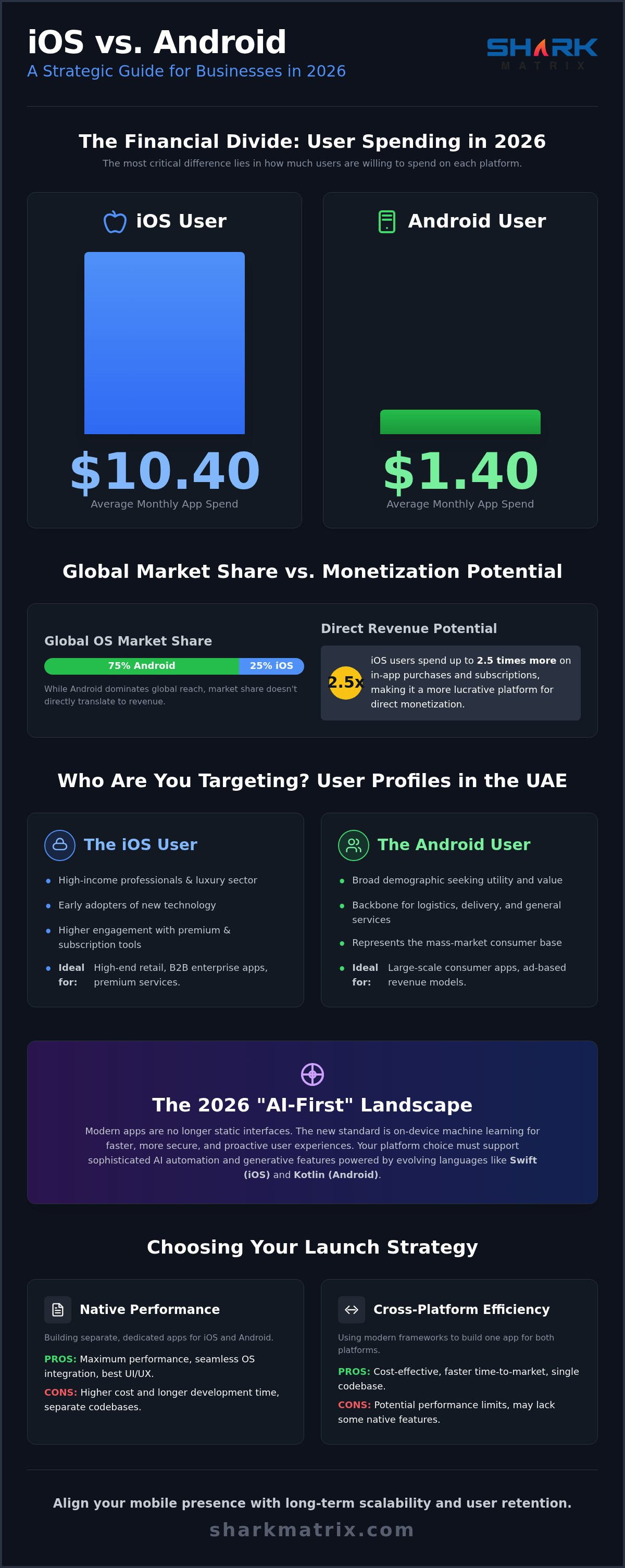
Did you know that the average iOS user in 2026 spends nearly $10.40 per month on apps, while Android users average just $1.40? This massive spending gap means that deciding on ios vs android app development for businesses isn’t just a technical choice; it’s a high-stakes financial strategy. You’re likely feeling the pressure of rising development costs and the headache of managing fragmented device markets while searching for platform-specific experts. We understand that choosing the wrong path can drain your budget without reaching your target audience.

This strategic guide will help you discover the critical differences between these ecosystems to maximize your ROI and market reach in 2026. We’ll provide a clear roadmap for platform selection, break down the cost-to-value ratio of each OS, and show how AI automation is fundamentally changing the development timeline. By the end, you’ll know exactly where to invest your resources for the greatest impact.

Key Takeaways

  • Learn how to evaluate ios vs android app development for businesses by comparing user demographics and high-value spending habits in the UAE market.
  • Understand how Swift and Kotlin integrations are evolving in 2026 to support sophisticated AI automation and generative features.
  • Discover the ROI benefits of choosing between native performance and the cross-platform efficiency offered by modern frameworks.
  • Gain insights into navigating the latest 2026 privacy regulations to ensure your enterprise app remains secure and compliant across all devices.
  • Identify the specific roadmap that aligns your mobile presence with long-term scalability and user retention through UI/UX excellence.

The 2026 Mobile Ecosystem: Why the Choice Still Matters for Businesses

Mobile apps have evolved from optional extras to the central nervous system of modern commerce. In 2026, they serve as the primary gateway for gathering customer data and facilitating real-time AI interactions. Choosing between ios vs android app development for businesses isn’t merely a technical preference; it’s a strategic decision between Apple’s tightly controlled, premium ecosystem and Google’s flexible, open-source platform. A “one-size-fits-all” mentality often results in wasted marketing budgets and high churn rates because it ignores the distinct behaviors of each user base.

The 2026 landscape is defined by an “AI-First” shift. Modern Mobile app development now prioritizes on-device machine learning, allowing apps to process complex data locally for faster, more secure results. This evolution makes mobile platforms the ultimate vehicle for ai development services, turning standard utilities into proactive business assistants. If your app doesn’t leverage these capabilities, it’s already falling behind the competition.

The State of Mobile in 2026

We’ve moved past the era of general-purpose apps. The market is now saturated with niche business applications designed for specific enterprise workflows. With 5G and edge computing now standard across the UAE, user expectations for performance have skyrocketed. Apps aren’t just static interfaces anymore; they’ve become integrated AI assistants that predict user needs before they’re even expressed. This shift requires a deep understanding of how each OS handles background processing and data latency to maintain a seamless experience. For specialized support in these areas, you can discover Vast Edge Services for high-end software development and professional training.

Selecting the right path for ios vs android app development for businesses impacts everything from your security protocols to your long-term scalability. While iOS users often perceive apps as more “premium,” which can elevate your brand’s status, Android offers a “universal” reach that’s essential for capturing a broader demographic. Regardless of your front-end choice, your back-end architecture must be robust enough to support both ecosystems. This is where professional mobile app development expertise becomes vital, ensuring that technical robustness translates directly into user retention and high ROI.

User Demographics and Market Share: Who Are You Targeting?

Identifying your target audience is the most critical phase of ios vs android app development for businesses. While the latest mobile OS market share shows Android holding roughly 75 percent of the global market, the UAE national landscape tells a more nuanced story. Here, the choice isn’t just about reach; it’s about the economic profile of the person holding the device and how they intend to use your service.

The UAE User Profile

Psychographic profiles also reveal distinct behaviors. iOS users in the UAE tend to be early adopters of new technology and are more likely to engage with premium, subscription-based business tools. Android users represent a broader demographic, often seeking utility and value. This split means a logistics company might prioritize Android for its workforce, while a boutique investment firm would likely lead with an iOS-first strategy to match its clients’ hardware preferences.

In-app purchase (IAP) trends in 2026 confirm that iOS remains the king of direct revenue. Research indicates that iOS users spend between 2.1 and 2.5 times more than Android users on digital services. For businesses relying on subscription models or premium content, the Apple App Store provides a more lucrative environment. Android’s strength lies in ad-based revenue models. The sheer number of impressions available on Android can often outweigh the lower individual user spend, especially in high-volume consumer sectors.

Subscription models in 2026 show a growing appetite for integrated services. National consumer spending is shifting toward “all-in-one” apps that handle everything from scheduling to payments. Because of this, your revenue strategy must account for the platform’s native payment ecosystem and user willingness to pay. Navigating these demographic shifts requires a data-driven approach to ensure your investment pays off. If you’re ready to define your platform strategy, exploring professional mobile app development can provide the technical and market insights needed to succeed.

IOS vs Android App Development: 2026 Strategic Guide

Development Speed and Technical Complexity: iOS vs Android Stacks

Choosing the right stack for ios vs android app development for businesses requires looking beyond the programming language. Swift for iOS and Kotlin for Android are the modern standards, both offering high efficiency for complex business logic. However, the environments where these languages live differ significantly. Xcode, Apple’s proprietary IDE, provides a seamless but rigid experience, while Android Studio offers more flexibility at the cost of increased configuration complexity. In 2026, AI-assisted coding has leveled the playing field, helping developers write cleaner code faster on both platforms.

The iOS “Walled Garden” Advantage

Apple’s ecosystem is built on uniformity. Because developers only need to account for a limited range of hardware, testing is faster and bugs are less frequent. This consistency is a major factor in maintaining a high-quality UI/UX design standard that users expect from premium brands. The primary hurdle here is the App Store review process. Apple typically takes between 24 and 72 hours to approve an app, and their strict guidelines mean your business app must be technically flawless to avoid rejection.

The Android Flexibility Factor

Android’s open-source nature is its greatest strength, allowing for deeper hardware integration and highly customized features. This is ideal for businesses needing specialized functionalities like custom camera controls or specific sensor data. The tradeoff is “OS Fragmentation.” With thousands of screen sizes and varying OS versions in use, testing becomes a significant expense. On the bright side, Google Play offers much faster deployment. Updates are often live within a few hours, allowing for rapid iterative improvements based on real user feedback.

Maintenance and Long-Term Support

The “Maintenance Gap” is often the most overlooked cost in ios vs android app development for businesses. Maintaining two native codebases creates technical debt that accumulates over time. Every yearly OS update from Apple or Google forces businesses to evolve their software to stay compatible. Leveraging AI automation services is now essential for streamlining this process. Automated testing tools can scan for bugs across multiple device types simultaneously, significantly reducing the manual labor required to keep your app running smoothly year after year.

Revenue Models and Security: Maximizing Your Mobile ROI

Security isn’t just a technical requirement; it’s a core business pillar. In 2026, navigating App Tracking Transparency (ATT) on iOS and the Android Privacy Sandbox is mandatory for any strategy involving ios vs android app development for businesses. These privacy-first frameworks have fundamentally changed how we collect user data, shifting the focus toward first-party data and zero-knowledge architectures. Protecting sensitive corporate information requires a deep understanding of how each operating system isolates data at the hardware level.

Enterprise Security Standards

iOS uses a strict “sandboxing” approach, where every application operates in a restricted environment to prevent unauthorized data leaks. Its “Secure Enclave” provides a dedicated hardware component for biometric data, which is why financial and healthcare apps often prefer the iOS baseline. Android has evolved significantly, offering robust enterprise features like secure “work profiles.” These profiles allow employees to use their personal devices while keeping corporate data encrypted and entirely separate from personal apps. For businesses with strict compliance needs, the choice depends on whether you value Apple’s standardized security or Android’s customizable enterprise controls.

Calculating ROI: Beyond the Download

Measuring success requires looking past simple install counts to the lifetime value (LTV) of a user. The financial logic of ios vs android app development for businesses often boils down to the cost per acquisition versus the total revenue generated over time. iOS users generally exhibit higher brand loyalty and engagement rates, which can lower the long-term cost of user acquisition (UA). On the other hand, Android’s massive scale provides the volume needed for ad-supported models to thrive. Your Search Engine Optimization strategy for app stores (ASO) must also adapt to these differences; Google Play prioritizes keyword relevance and app performance, while the Apple App Store places more weight on visual assets and conversion rates.

Scalability is the ultimate objective for any modern enterprise. Professional mobile app development services ensure your initial investment doesn’t become a technical bottleneck as your user base grows. By integrating secure APIs and scalable cloud backends, you can future-proof your application against shifting market demands. If you’re ready to build a secure, high-ROI mobile presence, explore our mobile app development services to start your journey.

Choosing Your Launch Strategy: Native, Cross-Platform, or AI-Enhanced?

The final stage of ios vs android app development for businesses is selecting the technical architecture that supports your long-term goals. Native development remains the gold standard for high-performance applications that require immediate access to the latest OS features, such as advanced biometric sensors or augmented reality capabilities. However, cross-platform frameworks like Flutter and React Native have become the default for many enterprises in 2026. These tools allow for a single codebase, which can reduce initial development costs by 30 to 40 percent compared to building two separate native apps. Hybrid apps are largely losing ground because they often lack the technical robustness needed to handle the sophisticated AI integrations modern users demand.

At Shark Matrix, we go beyond simple coding by integrating Generative AI into the core of the mobile experience. This approach transforms a standard interface into a smart ecosystem that learns from user interactions. By positioning mobile apps as the gateway to AI automation, we help businesses bridge the gap between technical robustness and high user retention. It’s about creating a tool that evolves alongside your users’ needs.

A Decision Framework for UAE Businesses

Success in the national market requires a methodical approach to platform selection. You can’t afford to guess which path will yield the best ROI. Follow these four steps to clarify your strategy:

  • Step 1: Define your “Must-Have” features and hardware requirements to see if native performance is non-negotiable for your specific use case.
  • Step 2: Map your target audience demographics to national market share data to prioritize your launch platform based on where your most profitable users are.
  • Step 3: Evaluate your long-term budget for maintenance, ensuring you can support recurring AI updates and yearly OS shifts.
  • Step 4: Consult with a mobile app development company to build a prototype and test your value proposition before a full-scale rollout.

Future-Proofing Your App with AI

In 2026, a static app is a failing app. Integrating AI chatbot development is now essential for providing instant customer support that feels human and helpful. We also utilize Natural Language Processing to enhance accessibility, allowing users to navigate your services via voice commands or intuitive text inputs. This level of sophistication ensures your app isn’t just a tool, but a proactive partner in your customer’s digital life. Our expertise in AI automation and generative services allows us to create mobile solutions that are both scalable and future-proof across the entire UAE.

Future-Proofing Your Mobile Strategy

Selecting the right path for ios vs android app development for businesses is no longer a binary choice between two operating systems. It’s a strategic move to align your digital presence with specific user behaviors and enterprise-grade security. By balancing the high spending power of iOS users with the massive reach of the Android ecosystem, you can build a roadmap that ensures long-term growth and high retention. Success in 2026 requires more than just code; it requires a deep understanding of how these platforms interact with your specific business goals.

Integrating AI automation into your mobile strategy is now a necessity for staying competitive. Whether you choose a native approach for maximum performance or a cross-platform codebase for efficient scaling, your software must serve as a smart assistant for your users. Shark Matrix brings over 15 years of digital innovation and expert AI-mobile integration to every project, focusing on national UAE enterprise scalability. Ready to build your next high-performance app? Contact Shark Matrix today for a strategic consultation. We’re here to help you turn technical robustness into market leadership.

Frequently Asked Questions

Which is cheaper to develop: iOS or Android?

iOS is often cheaper initially due to less device fragmentation, which reduces testing hours. Android development can involve higher costs because of the vast range of screen sizes and hardware specs that require optimization. However, cross-platform tools can bridge this gap. Businesses should look at the total cost of ownership, including long-term maintenance, rather than just the initial build price.

Should I build for iOS or Android first in the UAE?

iOS is generally the preferred starting point for premium or corporate-focused apps in the UAE due to high iPhone penetration in these sectors. If your target audience includes logistics or high-volume consumer services, Android might be the better lead. Most national enterprises eventually launch on both to ensure total market coverage, but starting with the platform that matches your highest-value demographic is the most efficient strategy.

Is cross-platform development better than native for small businesses?

Cross-platform development is often the best choice for small businesses because it allows for a single codebase that runs on both systems. This approach significantly reduces development time and ongoing maintenance costs. While native apps offer the absolute peak of performance, modern frameworks like Flutter provide a near-native experience that is more than sufficient for most business applications, allowing smaller teams to maximize their digital reach.

How long does it take to get an app approved on the Apple App Store in 2026?

Apple typically approves apps within 24 to 72 hours in 2026, provided they meet all technical and design guidelines. This process remains more stringent than Google’s automated checks, which often take only a few hours. To avoid delays, ensure your app complies with the latest privacy regulations and doesn’t have broken links or placeholder content. Planning for a three-day review window is a safe bet for launch timelines.

Can Android apps be as secure as iOS apps for enterprise use?

Yes, Android apps can reach enterprise-grade security levels through specialized features like secure work profiles and encrypted hardware-backed storage. While iOS provides a robust baseline security model by default, Android offers more granular control for IT administrators to manage sensitive corporate data. Choosing ios vs android app development for businesses often depends on whether your organization prioritizes Apple’s standardized sandboxing or Android’s flexible, customizable security configurations.

What are the main differences between Swift and Kotlin for business apps?

Swift is Apple’s native language designed for performance and safety, while Kotlin is the modern standard for Android apps. Both languages are highly efficient and share similar syntax, making it easier for developers to work across both platforms. Swift excels in UI responsiveness and memory management on Apple hardware. Kotlin is praised for its interoperability with Java and its concise structure, which helps reduce common coding errors in complex business logic.

How does AI automation reduce app development costs?

AI automation reduces costs by speeding up repetitive tasks like code generation, automated testing, and bug detection. By catching errors early in the development cycle, these tools prevent expensive fixes later. In 2026, AI is also used to optimize UI/UX design based on user data, ensuring that ios vs android app development for businesses stays focused on high-retention features. This efficiency allows developers to spend more time on unique business logic.

What is the average maintenance cost for a mobile app after launch?

Maintenance costs typically range from 15% to 20% of the original development cost per year. These expenses cover essential updates for new OS versions, security patches, and server hosting fees. Neglecting maintenance can lead to technical debt and security vulnerabilities. Regular updates are vital to ensure your app remains compatible with the latest hardware and continues to provide a smooth experience for your national user base in the UAE.

Modern Technologies for Scalable
Digital and AI Solutions

Technologies we work with

We work with reliable development frameworks, cloud platforms, artificial
intelligence models, and automation technologies to build secure, future-ready solutions.

OpenAI
Codex
Vertex AI
Cloud Vision
OpenCV
TensorFlow
IBM Watson
Cloud Natural Language
Cognitive Services
Bot Framework
Mistral
LLama
Gemini
Anthropic
N8N

iOS

Android

React Native

Flutter

Ionic

Swift

Kotlin

ObjectiveC

Titanium

Angular JS

React JS

TypeScript

Vue

WPF

HTML 5

Mongo DB

MySQL

MsSQL

Firebase

Realm

DyanamoDB

Oracle

PostgreSQL

Redis

PHP

java

.NET

Node.JS

Rails

Python

Drupal

Joomla

WordPress

Magento

Shopify

AWS

Selenium

Appium

Jekins

Gradle

Google Cloud

Contact Us

Let’s Build Something Intelligent Together

Whether you need a website, mobile application, digital marketing strategy, AI chatbot, voice agent, or workflow automation platform, our team is ready to help.

Contact Map

Start Your Digital or AI Project