
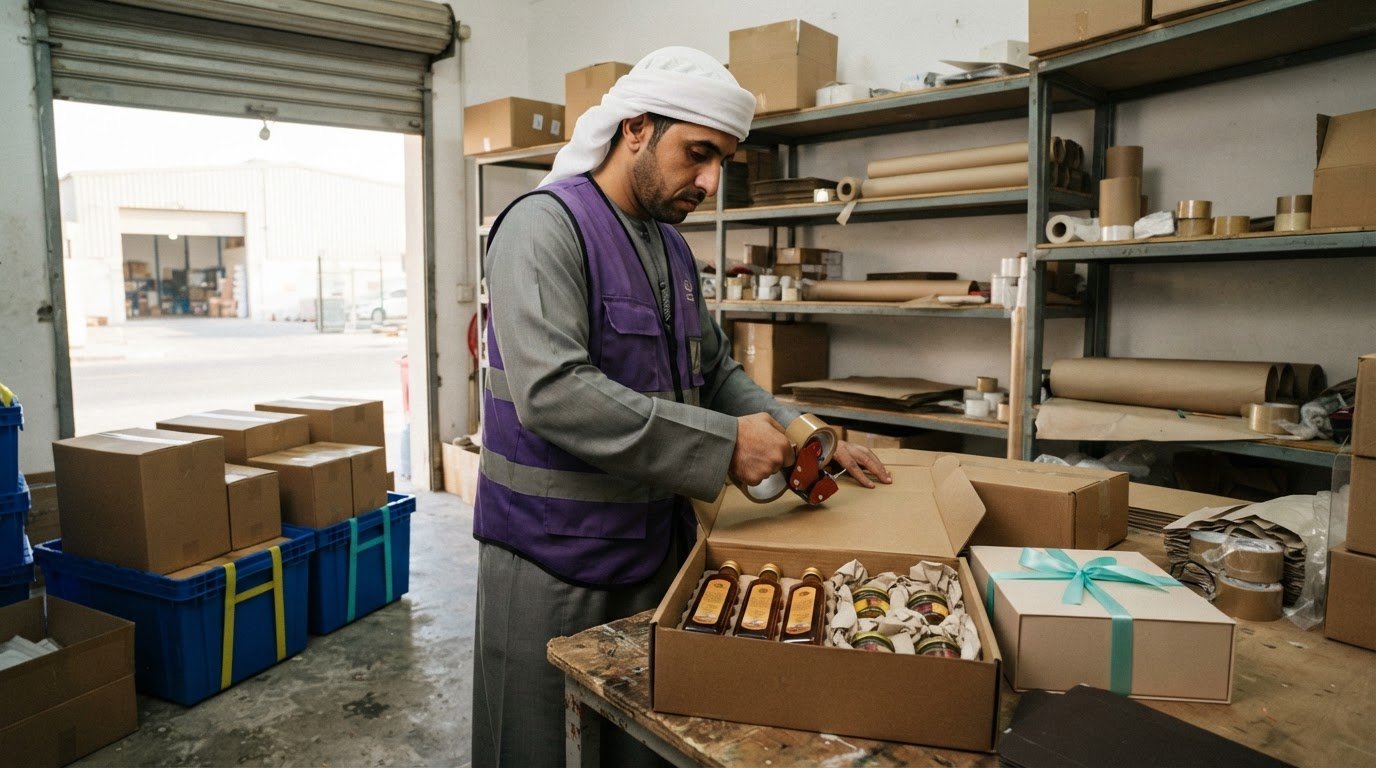
A UAE online store needs more than an attractive design: its product browsing, payment options, and checkout must work smoothly for the customers it serves. An ecommerce development company in the UAE can build custom storefronts and shopping carts, integrate payment gateways, and support multi-currency requirements. The right approach connects these elements to the store’s products, operations, and customer needs.
If you’re looking for an ecommerce development company in the UAE, consider how your store will serve customers across the country, not just how it will look on launch day. A well-planned build brings together clear navigation, mobile-friendly design, and a checkout flow suited to your business.
This guide explains what custom ecommerce development can include, how design, payments, carts, and currencies fit together, and what shapes project timelines and costs. You’ll also learn how regional needs can influence the build and what to expect from the development process.
Key Takeaways
- Match your platform to your store’s complexity and the integrations it needs, rather than choosing by name alone.
- See how custom design and development can shape product discovery, checkout and the overall shopping experience.
- Learn which shopping cart and multi-currency decisions affect how customers browse and pay.
- Consider how development needs can vary across Dubai, Abu Dhabi and Sharjah, and what to look for when assessing a provider.
- Find out how Shark Matrix Technologies’ web design and development, SEO, PPC management and mobile app development can support your digital plans.
Custom e-commerce website design and development
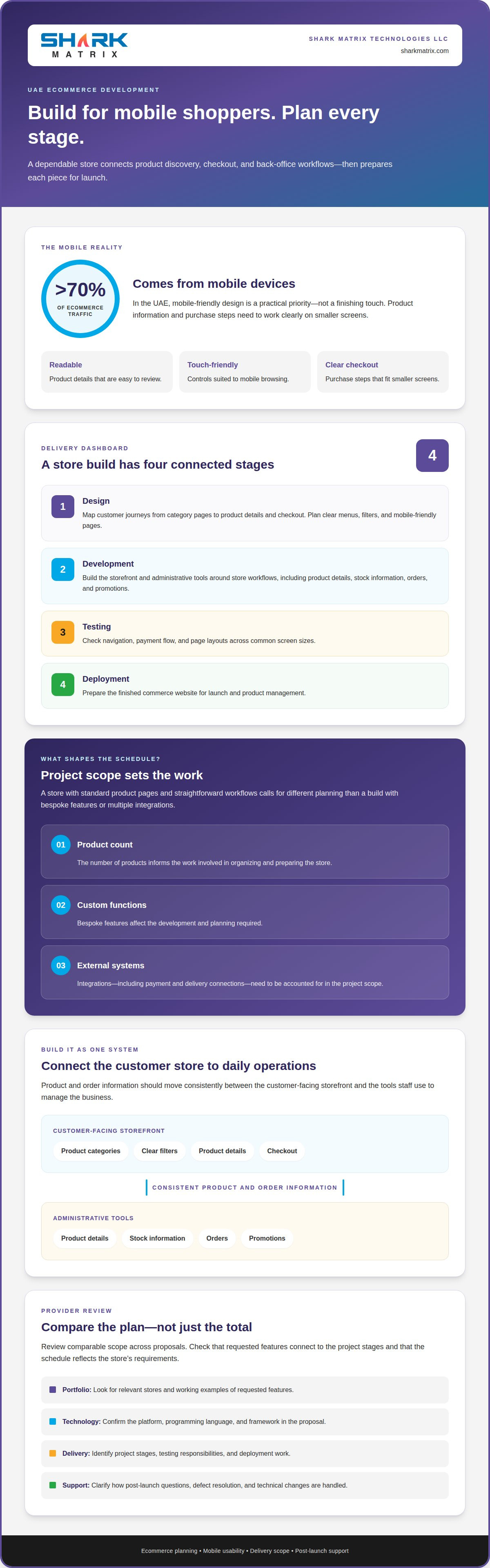
Custom ecommerce website development shapes the storefront around products, customers, and fulfilment needs. A UAE commerce website may need distinct product categories, clear filters, mobile-friendly pages, and a checkout that keeps purchase steps easy to follow. Development also covers the back end, where staff manage product details, stock information, orders, and promotions. These elements should work as one system, with product and order information moving consistently between the customer-facing store and its management tools.
To compare UAE ecommerce development agencies by portfolio, pricing, and support, review examples for navigation, mobile usability, and checkout clarity. Compare quotations by their stated features, integrations, delivery stages, and support arrangements, rather than by the total alone.
Project scope shapes the delivery schedule. A store with standard product pages and straightforward workflows requires different work from one with bespoke features or multiple integrations. Product count, custom functions, and external systems all affect planning. A useful project schedule accounts for design, development, content entry, testing, and deployment, so launch preparation is included rather than left until the end.
Mobile design deserves particular attention in the UAE: more than 70% of ecommerce traffic comes from mobile devices. That makes readable product details, touch-friendly controls, and a checkout that fits smaller screens practical priorities. Clear menus and filters also help customers reach relevant products without working through unrelated categories.
- Design: Map customer journeys from category pages to product details and checkout.
- Development: Build the storefront and administrative tools around the store’s workflows.
- Testing: Check navigation, payment flow, and page layouts across common screen sizes.
- Deployment: Prepare the finished commerce website for launch and product management.
An in-house development team can coordinate design, coding, and technical decisions within one delivery process. That can make it easier to resolve issues such as a product option not appearing correctly in the cart. Customer support is a separate part of the relationship: it may cover technical questions, defect resolution, or future changes. Clear responsibilities and response processes help your team understand how support works after deployment.
Scalability starts with decisions about the store’s structure. A business adding product categories, integrations, or app features needs a foundation that can accommodate those changes without rebuilding every page. Custom ecommerce website and app development can connect shopping experiences across web and mobile, with features planned around the business’s workflows. For product questions during browsing, AI chatbot development can be considered as a related digital capability.
Looking for an in-house eCommerce development company?
Before hiring, review relevant portfolio examples, platform experience, quotation scope, and post-launch support. Ask how the team will handle your store’s integrations, requested changes, and ongoing technical needs.
E-Commerce Platform Development
Shopify, WooCommerce, Magento, and OpenCart are distinct commerce platforms, so development should match your store’s requirements. Ask how the team will configure product categories, checkout steps, and administrative workflows on your chosen platform. Review portfolio examples for comparable store features, not just visual style. A clear project plan should identify custom development, platform configuration, testing, and deployment responsibilities.
Platform and Technology Options
Platform choices can include Shopify, WooCommerce, Magento, Adobe Commerce, and BigCommerce. Python and PHP are programming languages, while Laravel is a PHP framework used for custom ecommerce builds. These options aren’t interchangeable labels. Ask the development team to explain which platform and technologies fit your integrations, workflows, and planned changes. The proposal should name the intended stack and describe its role in the project.
Checks Before Hiring an Agency
Check who handles design, development, testing, deployment, and customer support. Clarify whether the people presenting the project will also deliver it, and how the in-house team manages questions or change requests. Ask for a schedule based on your store’s scope. The timeline depends on store size, complexity, and integrations, so confirm that the schedule accounts for those requirements.
Then review the quotation line by line. It should connect requested features to project stages, including payment gateway, delivery, and other integrations. The price depends on the platform and required features, with the project cost set out after a quote request. Compare proposals on equivalent scope, rather than treating a lower total as the only deciding factor.
- Portfolio: Look for relevant stores and working examples of requested features.
- Technology: Confirm the platform, programming language, and framework in the proposal.
- Delivery: Identify project stages, testing responsibilities, and deployment work.
- Support: Clarify how post-launch questions and technical changes are handled.
For an in-house team, understand how ecommerce website development decisions move between design, engineering, and support. A defined process can keep platform configuration, custom features, and testing aligned. Ask how the team documents decisions and communicates project progress. This gives your business a clearer view of who owns each deliverable and how planned changes fit the agreed scope. For stores combining commerce pages with other web features, web development support can be part of the wider project conversation.
Shopping carts and multi-currency support
A shopping cart connects product selection to order completion. In ecommerce website development, its flow should account for product options, quantities, delivery details, payment selection, and order confirmation. For example, a customer adding a size or colour should see that selection reflected in the cart and final order. A clear flow also makes it easier to identify where customers encounter friction.
Currency handling needs deliberate planning for an online store serving regional customers. The UAE dirham (AED) can be the store’s main display currency, while GCC-focused commerce may require prices in currencies such as the Saudi riyal, Qatari riyal, or Omani rial. The chosen platforms and payment setup shape how prices are displayed and processed. The project should define which currencies appear, how customers select them, and what currency appears at checkout.
Display and payment are separate considerations. A store might show a product price in a shopper’s selected currency, while the payment process uses the currency supported by its gateway configuration. The checkout should make the amount and selected currency easy to understand before the customer confirms an order. Clear currency rules help keep product pages, carts, and order records consistent.
Scalable cart design also considers what happens as an online store grows. More products, customer account features, promotions, or enterprise integrations can affect cart workflows. Development planning should map these requirements before implementation. That gives the team a basis for testing key paths, such as changing quantities, removing an item, applying a promotion, and returning to checkout.
- Cart flow: Test product selection, quantity changes, delivery details, and order confirmation.
- Currency display: Define where AED and any selected GCC currencies appear.
- Payment: Align checkout currency presentation with the configured gateway.
- Monitoring: Track cart errors, payment failures, and checkout completion.
After launch, performance monitoring can help identify issues that affect transactions. For example, repeated payment failures or cart errors may point to a problem in checkout configuration. Maintenance can cover planned updates, defect handling, and changes to integrations. These tasks should be distinguished from a warranty, which concerns the terms for correcting defects in delivered work. A project scope can state the applicable support process, coverage, and responsibilities without treating ongoing maintenance and warranty as the same service.
For stores planning regional growth, ecommerce development should treat currency selection, cart behavior, and order records as connected requirements. Defining those details early helps create a more consistent shopping experience across platforms and gives the development team clear scenarios to test before deployment.
Ecommerce development across Dubai, Abu Dhabi and Sharjah
A store serving customers in different locations needs a clear operating plan, not separate websites by default. The useful questions are where customers are, what the business sells, and how it fulfils orders. One ecommerce website can serve customers across multiple locations, with delivery details, product availability, or customer communications tailored to the business’s operations.
Start by mapping the customer journey for each location. Customers may use the same product pages, while the business handles delivery timing or service coverage differently. Those details should be reflected in checkout and order confirmation. A WooCommerce store, for example, can be planned around the business’s product catalogue and the delivery choices it actually provides.
Payment setup also needs a defined role. The development team can connect the selected payment gateway and test the path from cart to confirmation. The business should decide how prices appear in AED, which payment methods it intends to offer, and what customers see when a transaction succeeds or fails. Testing these scenarios helps make the payment experience consistent across the three emirates.
- Dubai: Map the main product categories, checkout steps, and order information.
- Abu Dhabi: Define how delivery options and availability appear to customers.
- Sharjah: Plan the same storefront experience while reflecting actual fulfilment choices.
- All locations: Test payment, order confirmation, and customer notifications as one flow.
These are planning prompts, not assumptions about how businesses operate in different locations. The store’s own inventory, delivery coverage, and customer service process should determine what changes by location. A development partner documents those rules before building them into product pages, checkout, and order management. That prevents location labels from appearing without a clear purpose in the customer journey.
For a business expanding from Dubai into Abu Dhabi and Sharjah, the build should account for growth without creating duplicate administration. One product catalogue and a consistent checkout can simplify management, while location-specific options can appear where they matter. The project team can define which settings are shared and which vary, then test sample orders for each location before deployment.
Regional development also involves coordination. The business supplies its product information, service areas, and payment preferences; the development team translates those decisions into store behavior. Whether the platform is WooCommerce or another option, the project should document who updates products, handles order changes, and manages technical issues. This gives teams across Dubai, Abu Dhabi, and Sharjah a shared process and gives customers a coherent route from browsing to purchase.
Which ecommerce development companies in the UAE are highly rated?
A rating alone can’t show whether a development team fits your store. Look for detailed, relevant client feedback alongside examples of completed ecommerce work. A review describing a payment integration or product catalogue is more useful than a brief rating without project context. Also consider whether the feedback discusses delivery, communication, and support after launch.
Review evidence in context. On Google Business Profile or Clutch, read the written comments, their dates, and the services they describe. A collection of reviews for unrelated marketing work doesn’t necessarily demonstrate ecommerce capability. Look for repeated, specific feedback about website development, platform implementation, project communication, and resolving technical issues. Ratings can help narrow your options, but they shouldn’t replace a review of the work itself.
Portfolio examples offer another way to assess fit. Open the stores and examine how customers browse categories, view product details, and reach checkout. If your project needs WooCommerce, for example, seek examples that show relevant store features, not just attractive landing pages. Ask how the team handled the project’s requirements and what responsibilities its developers held. These details help connect portfolio evidence to the work you need.
Compare quotations using the same scope. One proposal may include custom features, payment gateway integration, testing, deployment, and post-launch support; another may cover only the storefront build. Review each deliverable, its assumptions, and the support process. The project price depends on the platform and required features, including integrations and delivery options; the cost is provided after a quote request. Don’t compare totals without understanding what each covers.
- Client feedback: Look for detailed comments about ecommerce projects and delivery.
- Portfolio: Review working stores and features similar to your requirements.
- Scope: Match proposal deliverables, integrations, testing, and support.
- Communication: Understand how project updates, questions, and changes are handled.
A useful final step is to discuss your project with the team responsible for delivery. Share your platform preference, store workflows, and required integrations, then assess whether the proposed scope addresses them clearly. A practical conversation should connect your needs with defined deliverables, rather than rely on broad promises or ratings alone. For a tailored store project, discuss your website development requirements.
Shark Matrix Technologies
Shark Matrix Technologies LLC can help businesses planning an online store bring its website and related digital needs into focus. Turn to the team when you’re mapping a custom build, considering how a mobile app could support the shopping experience, or planning how customers will find the store. Web Design and Development and Mobile App Development address the digital product, while Search Engine Optimization (SEO) and Pay Per Click (PPC) Management support visibility and promotion.
Share your platform preferences, essential store features, and growth plans to start a focused conversation about the project’s needs. The next step is to align the store’s requirements with a practical development plan.
Contact Shark Matrix Technologies to discuss your ecommerce project.
Turn your store plans into a clear next step
Your next move is to turn business priorities into a focused project brief. Define what the store must help customers accomplish, which internal workflows it should support, and how you’ll judge a successful launch. With those priorities in view, conversations with an ecommerce development company in the UAE can focus on practical decisions rather than broad promises.
Shark Matrix Technologies LLC brings together Web Design and Development with Search Engine Optimization (SEO) and Pay Per Click (PPC) Management, connecting the online store with ways to attract and reach customers. That combination can be relevant when you’re planning both the storefront and its digital visibility. The project discussion can begin with your goals, platform preferences, and the features your business needs, then shape a suitable direction for development.
A well-planned store gives your team a foundation to refine as customer needs and business priorities evolve. Take the next step by sharing what you want your online experience to achieve. Discuss your ecommerce plans with Shark Matrix Technologies, and move forward with a clearer direction for your store.
Frequently Asked Questions
How much does an e-commerce website design cost in the UAE?
The cost depends on the store’s design scope and required functionality, so there isn’t one price that fits every project. A tailored quotation can account for page layouts, product catalogue needs, checkout design, and any connections with payment or delivery services. These factors shape the work involved. To compare proposals fairly, look at the design deliverables and included features alongside the quoted amount.
How much does ecommerce website development cost in the UAE?
Ecommerce development costs depend on the chosen platform and required features, including payment gateways, delivery options, and integrations. A store with standard workflows has a different scope from one requiring custom functions or enterprise connections. The price depends on the case and is given after a quote request from Shark Matrix Technologies LLC. Compare quotations by checking which features, development stages, testing, and deployment work each one includes.
What features should a successful ecommerce website in the UAE include?
A practical store should make products easy to find and buying steps easy to follow. Consider mobile-friendly pages, clear categories, useful product filters, a shopping cart, and a checkout that presents payment details clearly. If the business serves customers using different currencies, plan how currency appears across product pages and checkout. Product images, transparent store policies, and customer reviews can also help shoppers assess items and make informed decisions.
What services do ecommerce development companies in the UAE offer?
Services can include custom storefront design and development, product management tools, shopping cart setup, and payment gateway integration. A project may also cover deployment, testing, and connections with delivery or other business systems. Scope varies with the store’s needs, so clarify which stages are included in the proposal. For example, a business adding a mobile shopping experience may also need app development alongside its ecommerce website.
How long does it take to build an ecommerce website in the UAE?
A standard ecommerce website project in the UAE can take 6 to 10 weeks. An enterprise or custom-integrated project can take 3 to 6 months. The schedule depends on the store’s size and complexity, including its required features and integrations. Work can involve design, development, product setup, testing, and deployment. A project timeline should show how these stages fit together and what the business needs to provide.
Which ecommerce platforms do UAE development companies specialize in?
Platform experience commonly includes Shopify, WooCommerce, Magento, and OpenCart; some projects also use Adobe Commerce or BigCommerce. The suitable option depends on the store’s workflows, preferred management experience, and integrations. Ask how the proposed platform supports your specific requirements, such as product variations or custom checkout steps. If a bespoke build is needed, discuss the development technologies and how they fit the project’s intended functionality.
 OpenAI
 Codex
 Vertex AI
 Cloud Vision
 OpenCV
 TensorFlow
 IBM Watson
 Cloud Natural Language
 Cognitive Services
 Bot Framework
 Mistral
 LLama
 Gemini
 Anthropic
 N8N