

Categories
GEO

What is Generative Engine Optimization (GEO)? The 2026 Guide to AI Search

What if ranking #1 on Google is actually the least important part of your marketing strategy in 2026? Across the UAE, businesses are watching their organic traffic vanish as AI-driven answer engines provide instant solutions that keep users from ever clicking a link. You’ve likely felt the frustration of declining click-through rates while feeling confused about how models like Gemini or ChatGPT choose which brands to cite. You might even fear that your current digital investment is becoming obsolete. Understanding what is generative engine optimization is no longer optional if you want to survive this shift.

We agree that the old playbook is breaking, but this transition offers a chance to secure your place as a primary source for AI reasoning engines. This guide will help you master the evolution of search and show you exactly how to optimize your brand for platforms like Perplexity and Google Gemini. You’ll get a clear definition of GEO, actionable steps to boost your visibility in AI-generated answers, and the technical requirements needed to make your content AI-friendly for the year ahead.

Key Takeaways

  • Understand what is generative engine optimization and how to move your strategy from ranking on pages to becoming the primary source for AI engines.
  • Learn how Retrieval-Augmented Generation (RAG) impacts which specific snippets AI models select as high-quality evidence for their answers.
  • Discover the shift from traditional ranking to “inclusion” and why authority now matters more than simple link volume in the UAE market.
  • Identify technical steps like Information Gain audits and advanced Schema markup to boost visibility in tools like Google Gemini and Perplexity.
  • See how professional AI automation services can help your business scale its content to meet the complex demands of generative search.

Defining Generative Engine Optimization in the AI Era

The digital landscape in the UAE is undergoing a massive transformation. For years, the goal was simple: rank on the first page of Google. Now, that’s not enough. As users increasingly rely on AI to summarize information, the focus has shifted toward being the source that the AI chooses to mention. Generative Engine Optimization (GEO) represents this new frontier. It isn’t just about keywords anymore. It’s about ensuring that Large Language Models (LLMs) like Gemini, GPT-4, and Claude recognize your content as the most authoritative answer to a specific query.

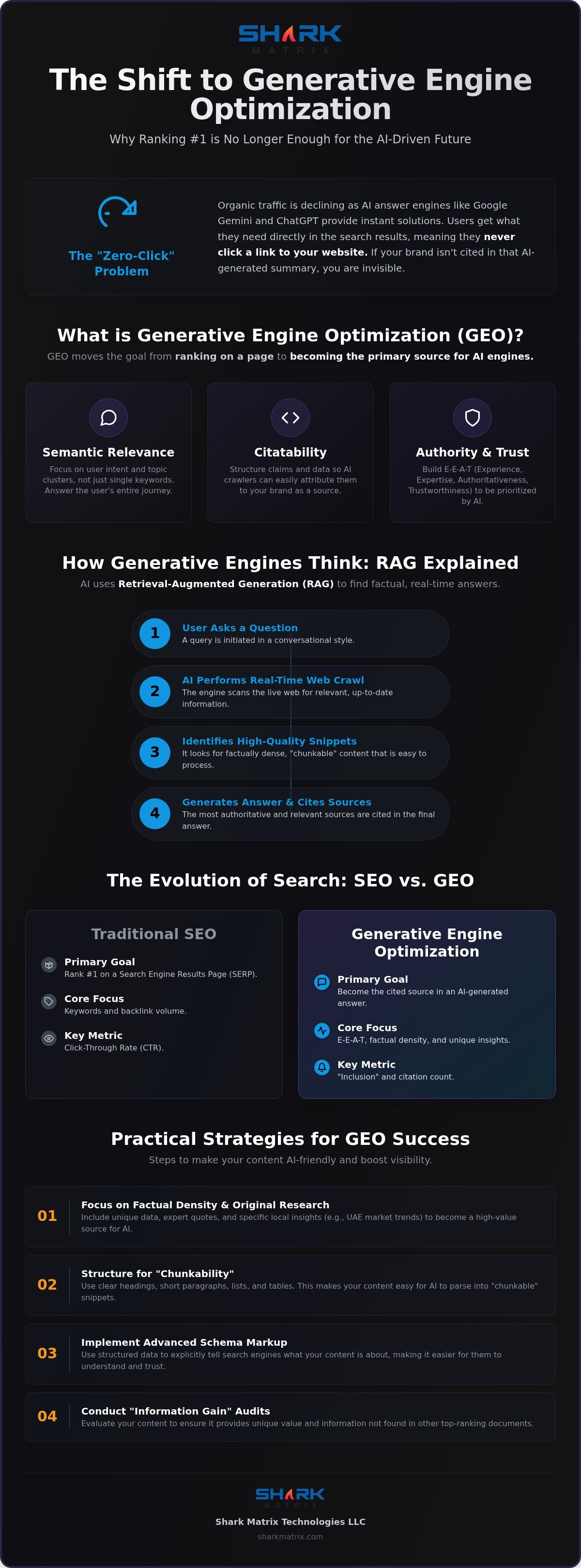
When exploring what is generative engine optimization, it’s helpful to view it as the bridge between traditional search engine results pages (SERPs) and the new “Answer Engine” results. In the past, a user might click through three different websites to find a price for a service anywhere in the UAE. Today, they get a direct answer from an AI Overview. If your brand isn’t cited in that summary, you essentially don’t exist for that user. This shift targets the “Zero-Click” phenomenon, where users find everything they need without ever leaving the search interface.

The Core Components of GEO

Success in this new era relies on three pillars. First, semantic relevance is vital. You can’t just target a single keyword; you must build content around intent-based clusters that answer a user’s broader journey. Second, citatability is a technical requirement. You need to structure your claims and data in a way that makes it easy for an AI crawler to attribute them to your brand. Finally, authority and trust have become the ultimate currency. With the rise of AI-generated noise, engines prioritize sources with high E-E-A-T (Experience, Expertise, Authoritativeness, and Trustworthiness) to avoid spreading hallucinations.

Why 2026 is the Year of the Generative Shift

By 2026, AI Overviews have stabilized across global markets, including the UAE. We’ve moved past the experimental phase into a reality where conversational commerce and voice-activated search are standard. Businesses across the UAE are already seeing the impact of these changes on their bottom line. To stay ahead, you need a strategy that balances technical excellence with high-value content. You can explore our comprehensive SEO services to see how we integrate these new requirements into traditional growth models. This isn’t a temporary trend; it’s a fundamental change in how the internet functions.

How Generative Engines Process and Cite Content

Understanding what is generative engine optimization requires a look under the hood of how modern AI models actually work. Unlike traditional search, which ranks pages based on popularity and keywords, generative search uses a process called Retrieval-Augmented Generation. Retrieval-Augmented Generation is a technique that grants LLMs access to live web data to ensure answers are factual and current. When a user in the UAE asks about local market trends, the engine doesn’t just rely on its training data. It crawls the web in real-time to find high-quality snippets that support its response.

AI crawlers are now trained to identify factual density. They look for “chunkable” content that fits neatly into their context window. This context window is essentially the brain’s “active memory” during a query. If your website provides long, rambling paragraphs without clear structure, the AI will likely skip over your site in favor of a competitor who provides concise, data-rich segments. Structuring your content for these engines is the core of any modern AI automation strategy.

Natural Language Processing and Content Understanding

Generative engines rely heavily on Natural Language Processing (NLP) to determine the sentiment and reliability of your writing. They assess how well a sentence answers a specific intent. In the UAE, where users value precise information, the AI evaluates whether your content provides unique value or simply repeats common knowledge. Retrieval-Augmented Generation is a technique that grants LLMs access to live web data to ensure answers are factual and current. By focusing on factual density, you increase the chances of your site being selected as a primary source.

The Citation Algorithm: Who Gets the Link?

The question of who gets cited isn’t random. AI engines prioritize brand prominence, expert quotes, and unique data sets. If your content includes original research or specific local insights about the UAE economy, you become a “high-value target” for the citation algorithm. “Average” content that lacks depth is increasingly ignored because it doesn’t help the LLM provide a better answer than its competitors. This is the practical reality of what is generative engine optimization in 2026. Implementing advanced Schema markup helps bridge this gap, acting as a direct signal to the AI about what your data represents. This technical precision ensures your brand remains visible as the search landscape evolves.
What is Generative Engine Optimization (GEO)? The 2026 Guide to AI Search

GEO vs. Traditional SEO: Understanding the Shift

Traditional SEO lives and dies by the search engine results page. GEO lives in the response. Understanding what is generative engine optimization requires moving past the idea of “Position 1.” In the old world, you fought for a blue link. In the new world, you fight for inclusion in the AI’s reasoning process. This isn’t just about traffic; it’s about authority. You aren’t just ranking. You’re being cited. The shift from “Position 1” to “Share of Voice in AI Answers” is the most significant change search marketers have faced in a decade.

Backlinks haven’t lost their value, but their purpose has changed. Previously, links were “votes” that passed ranking juice to help you climb the SERP. Now, for generative engines, a backlink from a high-authority UAE source acts as a verification stamp. It tells the LLM that your data is reputable enough to be synthesized into an answer. We’ve also seen the death of keyword stuffing. Generative models prioritize “Information Gain.” They look for content that adds new, unique value rather than just repeating what’s already in the top ten results for a Dubai-based query.

The Evolution of Search Metrics

Success used to be measured by organic traffic, bounce rates, and average position. While these still matter for your site’s health, GEO introduces new KPIs. You now need to track citation frequency and your brand’s sentiment score within AI chat interfaces. If a user asks Gemini for the best service in the Emirates, does your brand appear? If it does, is the context positive? Using professional AI automation services allows you to monitor these mentions at scale, providing a real-time view of your share of voice in the generative ecosystem.

Content Structure: Lists vs. Narratives

The way you present information directly affects how an AI bot consumes it. AI models prefer structured lists for “how-to” queries because they’re easier to “chunk” into a response. Adding a concise “Summary” section at the top of your long-form articles gives the crawler a ready-made snippet to use. This is where technical web design and development becomes critical. A site’s architecture must be clean enough for a bot to distinguish between a primary claim and supporting evidence. If your UI makes it hard for a human to read, it’s likely making it impossible for an AI to cite.

Practical Strategies for GEO Success

Moving from theory to execution requires a structured approach. If you’ve been asking what is generative engine optimization, the answer lies in these four practical steps tailored for the competitive UAE market. First, conduct an Information Gain audit. This means reviewing your content to ensure it provides unique value that isn’t already widespread across the web. If you’re a real estate firm in Dubai, don’t just explain how to buy a house; provide specific, proprietary data on neighborhood appreciation rates that an AI can’t find elsewhere.

For B2B organizations, Arokia IT LLC offers specialized expertise in aligning these practical GEO strategies with Account-Based Marketing to ensure your brand becomes the authoritative source for your most valuable prospects.

  • Step 1: Information Gain. Audit existing content to add unique insights, original data, or expert opinions that distinguish your site from competitors.
  • Step 2: Advanced Schema. Implement “Speakable” and “Dataset” Schema markup. This helps AI models identify which parts of your page are factual data points or suitable for voice-activated responses.
  • Step 3: Conversational Keywords. Optimize for long-tail questions. Instead of “Dubai car rental,” target “What are the requirements for a resident to rent a luxury SUV in Dubai?”
  • Step 4: Brand Authority. Build trust through high-quality PR and expert interviews. AI engines prioritize sources that are frequently mentioned by other authoritative entities. To strengthen your authority, learn more about BCM Public Relations and their strategic framework for B2B leaders.

Optimizing for Specific AI Platforms

Each AI engine has its own “personality” and sourcing preferences. Google Gemini prioritizes content that integrates well with the broader Google ecosystem, such as Maps and Workspace. In contrast, Perplexity functions more like a research assistant, favoring academic-style sourcing and clearly stated claims. To win across both, you need a strategy that balances technical data structure with narrative depth. Many businesses are now turning to specialized generative ai development services to create the custom assets and data pipelines needed to feed these engines effectively.

Brand Protection in AI Search

AI search introduces a new risk: hallucinations. Sometimes, an LLM might misrepresent your services or quote incorrect prices for your Dubai-based business. You can’t “re-train” GPT-4 or Gemini directly, but you can influence their output by maintaining an AI-first content governance policy. This involves ensuring your most critical brand facts are consistently stated across all platforms, from your website to your social profiles. If you’re concerned about how AI perceives your brand, working with a professional SEO company in Dubai can help you monitor and correct these digital narratives before they impact your reputation.

Future-Proofing Your Strategy with Professional AI SEO Services

Relying on manual updates for your digital presence is a recipe for irrelevance in 2026. The sheer scale of generative search means that a small team can no longer keep up with how LLMs interpret data in real-time. When you consider what is generative engine optimization at an enterprise level, it becomes clear that automation is the only path forward. Successful brands in the UAE are moving away from static content calendars toward dynamic systems. This requires a deep synergy between Custom AI Development and organic growth strategies. Shark Matrix Technologies LLC sits at this intersection, integrating technical engineering with creative marketing to ensure your brand remains a primary source for AI engines.

The next wave of discovery isn’t limited to text. Multi-modal search is already here, meaning GEO now encompasses how AI models interpret images, video, and voice commands. If a user in Dubai uses a voice assistant to find a service, the engine’s ability to “hear” and verify your brand’s authority depends on the underlying data architecture you’ve built today. Preparing for this multi-modal future requires a shift in how you view your website. It’s no longer just a digital brochure; it’s a structured database designed for AI consumption.

Leveraging Machine Learning for Content Gaps

Predicting where search is going is just as important as knowing where it is now. By utilizing ML Development Services, businesses can identify content gaps before they become visible in traditional SEO tools. These systems can automate the creation of AI-optimized metadata and ensure that every page on your site is “chunked” correctly for LLM processing. This proactive approach separates market leaders from those who are constantly playing catch-up with algorithm changes. National brands are already pivoting to these automated models to maintain their citation rates in AI Overviews.

Partnering with an Expert Agency

A technical-first approach is essential for any business operating in the competitive UAE landscape. You need more than just a content writer; you need a partner who understands the nuances of NLP and RAG. Shark Matrix Technologies LLC provides Industry-Specific AI Solutions designed to tackle the unique challenges of GEO. We help you move beyond the basics of what is generative engine optimization and into the realm of measurable results and brand protection. If you’re ready to see how your site performs in the eyes of an AI, it’s time to take action. Contact Shark Matrix Technologies LLC to Audit Your GEO Readiness Today and secure your brand’s future in the age of answer engines.

Securing Your Brand’s Voice in the Age of Answer Engines

The shift from traditional search results to AI-driven answers is the most profound change in digital marketing since the birth of Google. By now, you understand that what is generative engine optimization isn’t just a technical buzzword; it’s a survival strategy for the modern UAE enterprise. Success in 2026 requires moving beyond simple keyword matching to focus on semantic relevance and factual density. You need to ensure your brand isn’t just found but cited as a trusted authority by engines like Gemini and Perplexity.

Shark Matrix Technologies LLC stands at the intersection of marketing and machine learning. As pioneers in UAE AI-driven SEO strategies, we bring end-to-end technical AI development capabilities and expertise in high-stakes brand reputation management to every project. Don’t let your organic traffic disappear as answer engines take over the results page.

Take the first step toward future-proofing your digital footprint. Request a Generative Engine Optimization Audit from Shark Matrix today. The search landscape is changing fast, but with the right technical partner, your brand can lead the conversation.

Frequently Asked Questions

What is the main difference between SEO and GEO?

SEO focuses on ranking a URL in a list of results, while GEO focuses on getting your content cited within an AI’s generated response. Traditional search aims for clicks; GEO aims for inclusion in the AI’s reasoning process. Understanding what is generative engine optimization means shifting from “Position 1” to “Share of Voice” within a conversational interface. It’s the difference between being a link on a page and being the source of an answer.

Will GEO replace traditional SEO in 2026?

GEO won’t replace traditional SEO but will exist as a critical layer on top of it. While users in the UAE still use standard search for navigation and shopping, they increasingly rely on AI for complex queries. You still need technical SEO for crawling, but you need GEO to ensure models like Gemini synthesize your data. The two strategies work together to capture both “Zero-Click” users and traditional searchers.

How do I track my website visibility in AI search engines?

Tracking visibility requires moving beyond standard rank trackers to tools that monitor citation frequency and sentiment. You should look for how often your brand is mentioned as a source in AI Overviews or Perplexity responses. Since traditional click-through data is declining, measuring your “Share of Model” becomes the new standard. Professional AI automation services can help you scrape and analyze these mentions across different LLMs at scale.

Does structured data help with Generative Engine Optimization?

Structured data is essential because it provides a clear roadmap for AI crawlers to understand your site’s facts. By using Schema markup for datasets, speakable content, and FAQs, you make it easier for an engine to “chunk” your information. This technical precision increases the likelihood of being cited. It’s one of the most effective ways to bridge the gap between your raw content and an AI’s context window.

Can I optimize my site for specific AI models like Gemini or ChatGPT?

Yes, you can tailor content based on the sourcing habits of different models. Google Gemini favors integration with the Google ecosystem and high E-E-A-T signals. ChatGPT and Perplexity often prioritize academic-style citations and unique data sets. When you ask what is generative engine optimization, part of the answer is diversifying your content structure to meet the varied technical requirements of these specific LLMs.

Is Information Gain a ranking factor for GEO?

Information Gain is a primary factor because AI engines prioritize unique insights over repetitive content. If your article just summarizes what’s already on the web, an LLM has no reason to cite you. You must provide original data, expert interviews, or specific local UAE market insights. Adding value that doesn’t exist elsewhere makes your site an indispensable source for the AI’s retrieval process.

How long does it take to see results from a GEO strategy?

Results typically appear within three to six months, depending on how often AI engines re-crawl and update their indices. Unlike traditional SEO, where you might see incremental rank changes, GEO often results in a “citation surge” once a model identifies you as an authority. Consistent updates and high factual density are required to maintain these citations as the models’ training data and retrieval algorithms evolve.

Categories
GEO

Measuring Generative Engine Optimization Success: The 2026 KPI Framework

What if your brand’s most valuable traffic in 2026 doesn’t show up in a keyword ranking report? You’ve likely noticed that traditional organic click-through rates are sliding as AI-generated overviews take center stage. It’s frustrating to watch your hard-earned visibility vanish into a black box where “Share of Model” feels more like a theory than a trackable metric. You aren’t alone in the struggle to explain these shifts to executives who still demand to see a page-one position. Mastering the art of measuring generative engine optimization success is the only way to prove your digital strategy is actually working in this new era.

This guide provides a concrete set of KPIs designed to quantify your brand’s presence within LLM-generated responses. We’ll show you how to move past the “black box” of AI search by establishing a dashboard for tracking AI-driven referrals and improving your authority within AI knowledge graphs. By the end, you’ll have a clear framework to report on brand visibility that traditional tools simply can’t see. You’ll gain the specific metrics needed to demonstrate how your content influences the final synthesis of the world’s most powerful AI models.

Key Takeaways

  • Understand why traditional SERP tracking is evolving into a model that measures brand presence within AI-synthesized responses.
  • Master the four essential metrics for measuring generative engine optimization success, including citation frequency and your physical “Answer Share.”
  • Learn to configure GA4 and Google Search Console to identify and track referral traffic from AI engines like ChatGPT and Perplexity.
  • Identify the “Authority Gap” by benchmarking your brand’s citation profile against competitors within major AI knowledge pools.
  • Discover how to integrate real-time AI visibility dashboards with reputation management for a unified, future-proof digital strategy.

The Shift from SERPs to Synthesis: Why 2026 Measurement is Different

The search landscape has fundamentally fractured. For decades, success meant climbing a linear list of blue links. In 2026, the game is about synthesis. Measuring generative engine optimization success now requires tracking how often and how prominently your brand appears within the narrative outputs of Large Language Models (LLMs). This isn’t just about rankings; it’s about being the data that powers the answer. While SEO was about visibility, GEO is about influence.

We’ve entered a “Zero-Click” reality. Users no longer need to visit your website to find what they need because the AI provides the solution directly. While this might seem like a loss for traffic, it’s a massive win for brand authority if you are the cited expert. The battlefield for national brands has moved into the Knowledge Pool, which is the vast dataset where AI models pull their facts. If your brand isn’t in the pool, you don’t exist in the answer. You aren’t just competing against other websites anymore; you’re competing to be the most trusted data point in a model’s training set or retrieval window.

SEO vs. GEO: A Comparative Framework

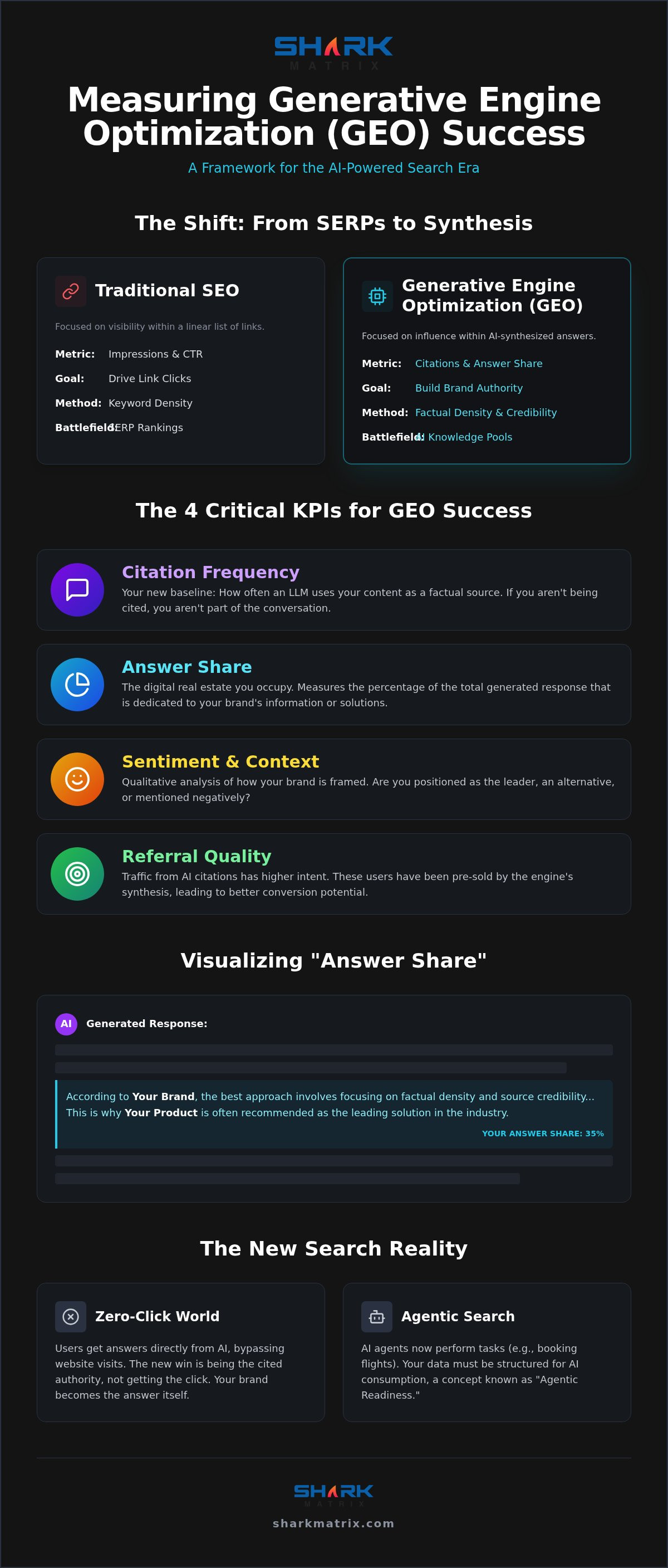
Traditional SEO metrics focus on impressions and click-through rates (CTR). GEO shifts the focus to citations and “Answer Share.” Instead of fighting for a click, you’re fighting for the AI to mention your brand as the definitive source. Success is no longer measured by how many people landed on your blog post, but by how many AI-generated recommendations included your product. This requires a psychological shift in how marketing teams report value to stakeholders.

  • Metrics: SEO tracks impressions; GEO tracks citations.
  • Goal: SEO seeks link clicks; GEO builds brand authority in AI-generated advice.
  • Method: SEO relies on keyword density; GEO relies on factual density and source credibility.

Answer Share is the percentage of an LLM response dedicated to your brand’s data.

The Rise of Agentic Search in the UAE Market

The UAE is a global leader in AI adoption, and we’re seeing a rapid shift toward agentic search. Tools like Gemini and ChatGPT aren’t just summarizing text; they’re performing tasks. They book flights, compare insurance policies, and draft business plans. Measuring “Agentic Readiness” is now the first step in a modern strategy. It determines if your data is structured so that an AI agent can actually use it to complete a task for a user.

Integrating your brand into these workflows requires sophisticated AI automation services to ensure your data remains accessible and accurate for these agents. Measuring generative engine optimization success in this context means tracking how often your brand is the “actionable” choice in an agent’s workflow. If an agent can’t verify your pricing or availability, it will simply move to a competitor that has prioritized AI-readable data structures.

The 4 Critical KPIs for Measuring GEO Success

Success in the generative era isn’t a single data point. It’s a composite of how AI models perceive, prioritize, and present your brand. When measuring generative engine optimization success, you must look beyond the click to understand your brand’s footprint within the AI’s logic. These four KPIs provide the foundation for a 2026 reporting framework that executives can actually understand.

  • Citation Frequency: This is your new baseline. It tracks how often an LLM uses your content as a factual source. If you aren’t being cited, you aren’t part of the conversation.
  • Answer Share: Think of this as the digital real estate you occupy. It measures the percentage of the total generated response dedicated to your brand’s specific information or solutions.
  • Sentiment and Context: Being mentioned isn’t enough. You need to know if the AI frames your brand as the industry leader or merely a secondary alternative. This qualitative data is often more valuable than raw volume.
  • Referral Quality: While volume may be lower than traditional search, the intent is higher. Users who click through from an AI citation have already been “pre-sold” by the engine’s synthesis.

Tracking these metrics allows you to see the direct impact of your content strategy on AI outputs. It’s a shift from counting visitors to counting influence. If you’re struggling to track these nuances, our team at Shark Matrix can help you implement the ai automation services needed to monitor these shifts in real time.

Measuring Citation Order and Authority

The order of citations matters immensely. Being the “Primary Source,” or the first link provided, signals the highest level of LLM trust. Models often lean on one authoritative source for the bulk of an answer while using others for minor details. You can improve your chances of becoming the primary source by utilizing robust structured data. This makes your facts easier for the model to verify. Diversity also plays a role. You should track whether you’re being cited for top-of-funnel informational queries or bottom-of-funnel commercial comparisons.

Brand Sentiment in AI Synthesis

The way an AI describes your brand can define your market position. We use advanced natural language processing services to analyze the tone of AI responses. This helps identify “Trust Signals” within a synthesized paragraph. For instance, does the AI use authoritative verbs when discussing your services? Or does it use hedging language? Quantifying these signals allows you to adjust your content to ensure the AI views your brand as a definitive leader rather than a budget-friendly backup.

Measuring Generative Engine Optimization Success: The 2026 KPI Framework

Technical Implementation: Tracking AI Referrals and Mentions

One of the first steps involves refining your view in Google Search Console. While Google has integrated “AI Overviews” into standard reporting, you should specifically monitor the “Search Appearance” tab to isolate impressions coming from synthesized responses. Simultaneously, you must track unlinked brand mentions across the web. LLMs treat these mentions as “trust signals” during their training and retrieval phases. Even if a user doesn’t click a link, the AI’s awareness of your brand grows every time your name appears in a high-authority context. This makes digital PR a core component of modern technical SEO reporting.

GA4 Configuration for the AI Era

Standard GA4 settings often bucket AI traffic into “Direct” or “Referral” without distinction. To fix this, you should create a custom Channel Group specifically for “AI Search.” By using a regex-based filter in your Data Settings, you can capture traffic from sources like openai.com, perplexity.ai, and anthropic.com. This allows you to track “Conversational Clicks” as a distinct metric. Once separated, you can analyze how these users behave compared to traditional searchers. You’ll likely find that AI-referred users have higher engagement rates because they’ve already received a tailored recommendation before landing on your site.

Using Custom AI Monitors for Share of Model (SoM)

Standard SEO tools are designed for crawlers, not LLMs. They often fail to capture how Perplexity or Gemini synthesizes information in real time. To bridge this gap, national brands are turning to custom monitoring tools. Our expertise in generative AI development allows us to build scrapers that query LLMs at scale for specific keyword sets. These tools aggregate data into a “GEO Scorecard.” This dashboard tracks your Share of Model (SoM) across different platforms, giving you a unified view of your brand’s authority. By identifying where your competitors are being cited instead of you, you can pinpoint the exact “Knowledge Gaps” in your content strategy and fix them before the next model update.

Benchmarking Success Against Competitors in AI Knowledge Pools

Understanding your position in the generative landscape requires a shift in how you view competition. In traditional search, you competed for a spot on a list. In 2026, you’re competing for a spot in the AI’s “Knowledge Pool.” Measuring generative engine optimization success involves identifying the “Authority Gap,” which is the distance between your brand’s perceived expertise and that of your top competitors. If an LLM consistently omits your brand when answering industry queries, it’s likely because your competitor’s citation profile is more robust across the third-party datasets the AI trusts.

Analyzing these citation profiles within models like ChatGPT and Gemini reveals the sources the AI relies on most. Often, these aren’t just high-ranking websites. They’re niche directories, industry-specific forums, and deep technical documentation. By quantifying how often competitors are mentioned in these “seed sources,” you can see exactly where your visibility is lacking. There is a significant first-mover advantage here. National brands that secure their place in these knowledge pools now will be harder to dislodge as the models become more entrenched in their training data.

The AI Competitor Audit

You can perform a manual audit by prompting LLMs to identify the “top providers” or “industry leaders” in your specific niche. Pay close attention to the justifications the AI provides. Does it cite a specific review site or a white paper? Reverse-engineering these responses allows you to identify content gaps. If the AI frames a competitor as the “best value” option while ignoring your premium features, your content strategy needs to feed the model more data points regarding your specific value proposition. This is a critical step in measuring generative engine optimization success and refining your brand’s narrative.

Tracking Conversion in Agentic Commerce

The next frontier is “Agentic Commerce,” where AI agents move beyond answering questions to actually performing tasks. Success in this phase is measured by “Agentic ROI.” This includes metrics like how many demos were booked or how many transactions were initiated entirely through an AI interface. Reporting these figures to stakeholders requires a new type of attribution model that tracks the agent’s path from synthesis to execution. If your data isn’t structured to allow an agent to complete a task, you’re losing revenue to competitors who have prioritized agentic readiness.

Ready to close the authority gap? Explore our AI automation services to see how we can build custom monitors for your brand’s AI visibility.

Future-Proofing Your Strategy with Shark Matrix AI Analytics

Static SEO reports have become relics. In the fast-moving world of LLMs and real-time data retrieval, a monthly PDF showing keyword movements is no longer sufficient. Measuring generative engine optimization success requires a live, real-time visibility dashboard that reflects how AI models are currently synthesizing your brand’s information. Because AI models update their weights and retrieval windows frequently, your visibility can shift overnight. You need a monitoring system that alerts you to these changes as they happen, not weeks after the fact.

We believe that GEO cannot exist in a vacuum. It must be integrated with Online Reputation Management (ORM) to create a unified national brand image. AI models are highly sensitive to sentiment and factual consistency across the web. If your brand has conflicting information or negative sentiment in its primary “seed sources,” the AI will likely deprioritize you in its final response. By aligning your GEO efforts with a robust ORM strategy, you ensure that the “Knowledge Pool” the AI drinks from is clean, authoritative, and consistently positive.

Our approach goes beyond simple tracking. We use custom machine learning models to predict the likelihood of a specific piece of content being cited by an LLM. By analyzing the structural and semantic markers that models like Gemini and Claude prefer, we help you build content that is “pre-optimized” for synthesis. This moves your strategy from reactive measurement to proactive dominance, ensuring you aren’t just watching the results but actively shaping them.

Advanced Monitoring with Custom AI Solutions

Our technical department specializes in building proprietary tools that track “Answer Share” across multiple generative engines simultaneously. These aren’t standard SEO tools; they are custom-built monitors developed through our ML development services. We also leverage custom chatbots to gather granular data on user intent. By analyzing the questions users ask your brand’s own AI interfaces, we can identify emerging trends and knowledge gaps before they appear in mainstream search data. This data is then used to refine your broader content strategy.

The Shark Matrix GEO Roadmap

A national-scale strategy requires a partner with deep technical and SEO roots. Our roadmap is designed to take you from uncertainty to automated visibility in three clear phases. We start with a baseline visibility audit to see where you currently stand in the AI knowledge pool. Next, we move into content optimization, where we restructure your data for maximum citation potential. Finally, we implement automated monitoring to protect your “Answer Share” against competitors. This end-to-end approach ensures your brand remains the definitive answer in an AI-driven world. Contact Shark Matrix for a comprehensive GEO audit and start securing your brand’s future in the age of synthesis.

Owning the Answer in a Synthesized Future

The search landscape won’t return to the simple days of blue links. Success now depends on your brand’s ability to influence the Knowledge Pool and secure a dominant Answer Share. By focusing on citation frequency and technical attribution, you move from guessing to knowing. Measuring generative engine optimization success is the bridge between traditional SEO and the era of agentic commerce. It ensures your brand remains the primary source for AI models and the users who rely on them.

At Shark Matrix, we combine 15+ years of search expertise with a specialized custom AI and ML development team. As national UAE strategy specialists, we build the proprietary tools needed to track these elusive metrics. It’s time to stop reacting to AI shifts and start directing them. Ready to dominate AI search? Get your custom GEO success roadmap from Shark Matrix today.

The transition to AI search is a massive opportunity for brands that act now. Your future visibility starts with the metrics you track today. Don’t wait for the models to update; start building your authority now.

Frequently Asked Questions

What is the most important metric for GEO success in 2026?

Citation frequency is the most critical metric. It measures how often an LLM uses your brand as a primary source for its synthesis. Without citations, your brand doesn’t exist in the final answer share. This metric is the cornerstone of measuring generative engine optimization success because it proves your content is authoritative enough to be the foundation of an AI’s response. It’s the new version of the top organic spot.

How can I track traffic coming specifically from ChatGPT or Gemini in GA4?

You can track this traffic by setting up custom referral channels in GA4. By using a regex filter to isolate traffic from domains like chatgpt.com or gemini.google.com, you can create a dedicated “AI Search” bucket. This allows you to distinguish conversational referrals from standard organic traffic. It’s essential for understanding the high-intent users who click through after receiving a tailored AI recommendation. Most standard configurations bucket this under direct traffic, which obscures your ROI.

Does traditional SEO still matter if I’m focusing on Generative Engine Optimization?

Traditional SEO remains vital because it ensures your site is discoverable by the crawlers that feed AI models. LLMs rely on indexed data for both their initial training and their real-time retrieval windows. If your technical SEO is poor, the models won’t be able to access or verify your information. Think of traditional SEO as the ticket to entry for the knowledge pool. You can’t be cited if the engine can’t crawl your facts.

Why is my brand not appearing in Google’s Search Generative Experience (SGE)?

Failure to appear in SGE usually stems from a lack of clear, structured data or a missing presence in trusted third-party datasets. Google’s model looks for verified facts and authoritative sources to build its answers. If your content is buried in complex layouts or lacks clear trust signals like expert reviews, the engine will favor competitors whose data is easier to synthesize. It’s often an authority gap rather than a ranking issue.

How do unlinked brand mentions impact my visibility in AI search engines?

Unlinked brand mentions are significantly more powerful in the age of AI. Large Language Models don’t just follow links; they analyze the relationship between entities. When high-authority sites mention your brand in a specific context, it strengthens your authority in that knowledge pool. This helps the AI associate your brand with relevant queries, even if there isn’t a direct backlink. It’s a fundamental shift in how trust is calculated by generative engines.

Can I use standard keyword tracking tools to measure GEO performance?

Standard keyword tracking tools are largely ineffective for GEO. They are designed to monitor static lists of blue links, while GEO is about narrative synthesis. To truly track performance, you need custom scrapers that query LLMs directly and analyze the resulting text for brand presence. Measuring generative engine optimization success requires tools that can quantify answer share and sentiment rather than just position numbers. Standard tools simply don’t see what the AI is saying.

What is ‘Share of Model’ and how do I calculate it for my business?

Share of Model (SoM) is the percentage of an LLM’s response that is dedicated to your brand’s data or solutions. To calculate it, you must query an AI model for a specific set of keywords and use natural language processing to measure your brand’s real estate in the output. This metric provides a clear picture of your dominance within the AI’s final synthesized answer compared to your competitors. It’s the most accurate way to measure AI visibility.

How does sentiment analysis affect my ranking in AI-generated answers?

Sentiment analysis is a primary filter for AI engines. If LLMs detect negative sentiment or conflicting information about your brand in their training data, they are less likely to recommend you as a definitive solution. The models prioritize sources that appear reliable, authoritative, and helpful. Maintaining a positive sentiment across the web is now a core requirement for appearing in synthesized recommendations. Negative mentions can effectively de-index you from AI answers.