

What if your organic traffic is rising, but the right accounts still aren’t entering your pipeline? More visits don’t automatically mean more qualified opportunities. A b2b seo agency needs to understand who’s searching, what buying roles need to know, and how organic activity supports a long decision-making journey.
It’s reasonable to be cautious: rankings can look impressive while reports leave the link to business growth unclear. Effective B2B SEO connects buyer intent with useful content, website improvements, and measurement that helps you understand whether organic search is attracting relevant prospects.
This guide explains what a capable B2B SEO partner should deliver and how to evaluate a strategy. You’ll learn which research, content, and technical capabilities matter, how to assess reporting beyond traffic and rankings, and how to set practical expectations for collaboration and ongoing optimisation. It also explores how SEO can work alongside content marketing and website development as part of a connected growth strategy, rather than a standalone promise of higher rankings.
Key Takeaways
- Effective B2B SEO accounts for multiple stakeholders, specialist questions, and the different stages of a longer buying journey.
- Choose a b2b seo agency based on its ability to connect buyer intent with research, technical SEO, useful content, authority, and measurement.
- Compare partners by their strategy, deliverables, reporting, and collaboration approach, not by ranking guarantees or traffic promises.
- Build a practical optimisation cycle: set a baseline, prioritise work, publish and improve, then review visibility alongside qualified enquiries.
- Coordinated SEO, content marketing, and website improvements can support a connected growth strategy.
Why B2B SEO Needs an Agency That Understands Complex Buying Journeys
A B2B SEO agency aligns a company’s organic visibility with the needs of business buyers at different stages of a purchase. The goal isn’t simply to appear for more searches. It’s to help the right people find clear, credible information as they investigate a problem, compare approaches, and decide what to do next.
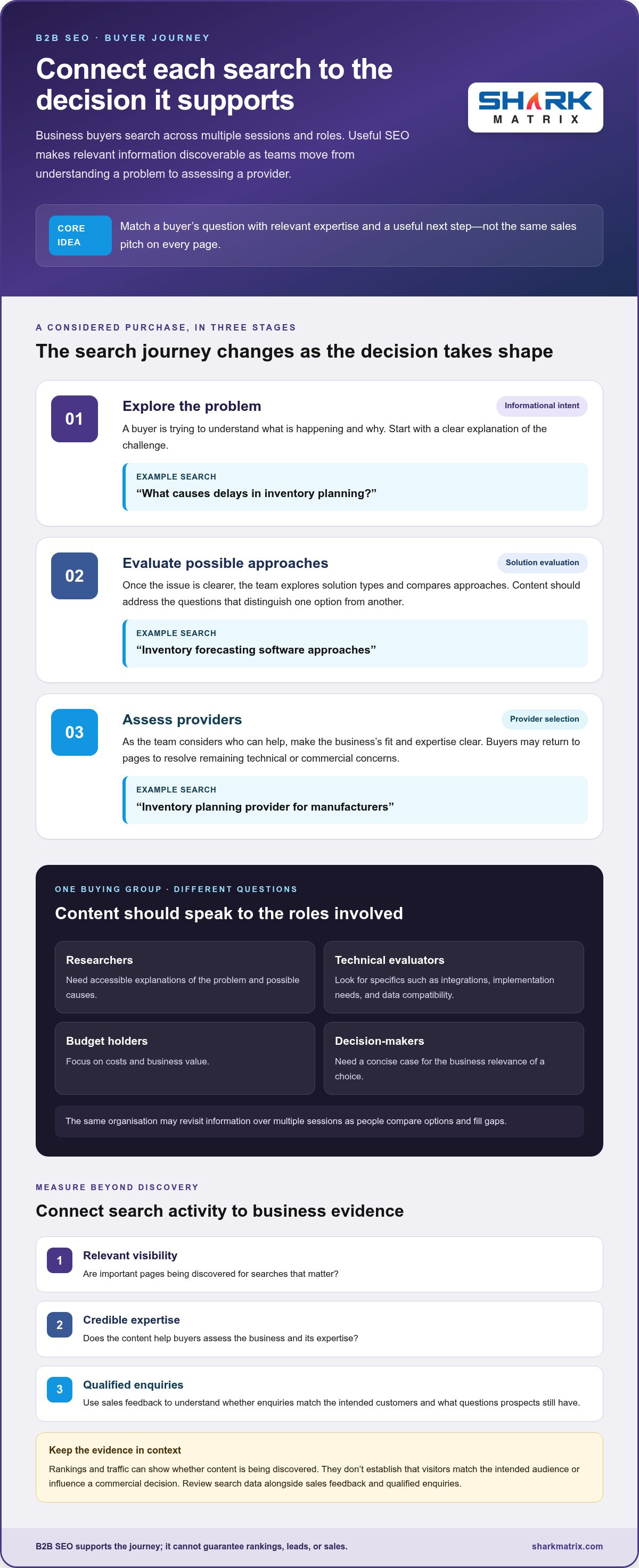
Put simply, B2B SEO connects business buyers’ search questions with relevant expertise and useful next steps throughout a considered purchase. That distinction matters because one organisation’s buying journey can involve researchers, technical evaluators, budget holders, and final decision-makers, each searching with different priorities. A researcher may look for possible causes of a problem, while a technical evaluator examines integrations or implementation needs. A budget holder may focus on costs and business value.
These searches can happen across multiple sessions, with buyers returning to compare options or fill information gaps before contacting a provider. A company may first search for ways to reduce a process bottleneck, then explore possible solutions, and later assess whether a particular service fits its requirements. A useful foundation in understanding B2B marketing helps explain why business audiences, buying processes, and decision criteria shape the content that deserves to rank.
How B2B search differs from a simple online purchase
A consumer purchase may involve one person choosing a familiar item, but business purchases often require agreement across roles. Search content should answer distinct questions without treating every visitor as if they have the same knowledge or authority. An early-stage researcher may need an accessible explanation; a technical evaluator may want specifics; a decision-maker may need a concise case for business relevance.
For example, a business researching a recurring operational problem might begin with an informational query. After understanding the issue, the team could search for solution types, compare providers, and revisit pages to resolve technical or commercial concerns. SEO should make useful resources discoverable and connected, rather than relying on a single page to serve every role and stage.
What a B2B SEO agency should help a business achieve
A considered strategy connects three objectives: relevant visibility for searches that matter, credible expertise that helps buyers assess a business, and clear next steps that support further research or contact. Rankings and traffic can indicate whether content is being discovered, but they don’t establish that visitors match the intended audience or influence a commercial decision.
That’s why business context and sales feedback belong alongside search data. Teams can share which enquiries match their target customers, what questions arise during sales conversations, and where prospects need more information. An agency can use those insights to refine topic priorities and content. SEO can support demand generation, but it can’t guarantee rankings, leads, or sales. Its contribution is best understood through ongoing evidence connecting search visibility, relevant engagement, and qualified enquiries.
Which B2B SEO Agency Capabilities Turn Search Intent into Useful Content?
A capable b2b seo agency doesn’t treat keyword volume as a content plan. It connects research, technical foundations, content, authority, and measurement so each activity helps the right audience find and assess useful information. Research identifies buyer questions, site improvements make answers accessible, and measurement shows which topics merit further investment.
Research that maps search demand to B2B buyer intent
Strong research separates searches by purpose. Someone asking “what causes delays in inventory planning?” is exploring a problem. A person comparing “inventory forecasting software approaches” is evaluating solutions. A search for “inventory planning provider for manufacturers” signals provider selection. Each query calls for a different answer, not a page that repeats the same sales pitch.
Map topics by problem, search intent, buyer role, and decision stage, then consider the language each audience uses. Technical users may search for integration requirements or data compatibility; commercial stakeholders may look for implementation considerations and business value. Sales conversations, support questions, and recurring objections can reveal terms and concerns that keyword tools don’t capture. Use that input to fill gaps, clarify terminology, and prioritise topics connected to the business’s actual offer.
Content and website improvements that support evaluation
Different page types serve different needs. Expert articles explain challenges and approaches; service pages describe what the business does and who it helps; case evidence can show how a solution addressed a specific business problem. Together, they give buyers a path from learning to evaluation, without forcing every page to act as a thin landing page. Useful content answers the question fully, states its limits clearly, and gives readers a relevant next step.
Technical foundations matter because valuable information can’t help if search engines or people struggle to reach it. A clear site structure, crawlable pages, descriptive headings, and accessible mobile layouts support discovery and navigation. Rather than chasing every technical task, prioritise changes that remove barriers to important content and pages.
Some improvements require coordination between SEO and development, particularly when a recommendation affects templates, navigation, or page performance. Working with web development services can help bring those changes into the site rather than leaving them as items in a report.
Authority also grows from consistency: publish well-supported material in areas the business knows, and make related resources easy to find. Review performance by topic and intent, not just by individual keywords. If a page attracts visitors but doesn’t help relevant prospects evaluate the offer, improve its substance or connection to the next useful page. For broader context on how search strategy can support business goals, explore Shark Matrix’s SEO services.
How to Compare B2B SEO Agencies Without Choosing on Rankings Alone
A proposal can promise visibility, but a sound comparison looks at how the work will connect to your business priorities. Use the same criteria to review each approach: what the agency learns, what it plans to deliver, how it reports progress, and how your team will contribute. A useful b2b seo agency plan explains its reasoning instead of relying on ranking guarantees or traffic forecasts.
Strategic fit: Does the proposed plan reflect your business goals, target accounts, and the questions buyers need answered?
B2B experience: Does the approach account for specialist audiences, multiple buying roles, and considered decisions?
Deliverables: Are the planned research, technical work, content, and optimisation activities specific enough to understand and act on?
Reporting: Does the plan distinguish search visibility and engagement from lead quality and sales feedback?
Collaboration: Are responsibilities, decision points, and the process for adapting priorities clearly explained?
Look closely at the reasoning behind each recommendation. If a plan proposes content around a broad, high-volume topic, it should explain how that topic relates to your offer and the people you want to reach. For businesses in vertical markets like construction, specialised partners such as H&A Marketing build campaigns around trade-specific procurement processes rather than generic industry traffic. Review how the agency incorporates target accounts, buying roles, and sales objections into its research. Strong planning draws on customer questions and business priorities, explains its assumptions, and shows how new evidence may change the plan.
Assess proof, reporting, and commercial fit
Case evidence is most useful when it gives enough context to judge relevance. Look for the starting situation, the work completed, the period or conditions involved when stated, and the outcome measured. A traffic increase alone doesn’t show whether the audience was commercially relevant. Clear evidence distinguishes what changed from what the agency can reasonably attribute to its work.
Reporting should connect leading indicators, such as organic visibility and engagement with priority pages, to downstream signals like qualified enquiries and sales feedback. These measures help teams make informed decisions; they don’t guarantee a specific business result. Rankings and leads depend on factors beyond an agency’s direct control, including competition, the offer, website experience, and how sales enquiries are handled.
Shark Matrix reports 250+ Projects Successfully Completed and 20+ Industries Served. These figures provide context about project and industry breadth, not a promise of a particular outcome for every business. When evaluating a plan, consider whether the agency explains how its experience informs the proposed work and how success will be assessed together.
A good commercial fit also means an understandable working rhythm: who provides subject-matter input, who approves content, and how findings influence the next priorities. For a practical view of how Shark Matrix approaches SEO, explore its SEO services.
What a Practical B2B SEO Engagement Should Measure and Improve
A useful measurement plan starts with your business context, not a generic traffic target. Before work begins, agree on what organic search should support, what information is available, and how marketing and sales will recognise a relevant enquiry. A b2b seo agency can then use a repeatable cycle to turn evidence into priorities, instead of treating a monthly report as the finish line.
Agree on goals, baseline, and meaningful indicators
Set a baseline for current organic visibility, priority-page engagement, and enquiries attributed to organic search. Define a qualified organic enquiry with sales: agree on the business fit and information that make an enquiry worth follow-up. The exact definition depends on your offer and sales process, so document it before comparing performance over time.
Also agree on reporting cadence, who owns each data source, and how questions will be investigated. If a change in enquiries coincides with a change in rankings, that’s a useful signal, not proof that SEO alone caused the result. Seasonality, sales activity, website changes, and other marketing can affect outcomes. Shared definitions help teams discuss these influences rather than overstate attribution.
Turn performance reviews into the next round of improvements
Use reviews to decide what to do next. A practical sequence keeps the work focused:
- Establish the baseline: Record agreed visibility, page, and enquiry measures, noting gaps in tracking or data.
- Prioritise work: Choose improvements based on buyer relevance, business value, and what the team can implement.
- Publish and improve: Update or create useful pages, then make sure changes are live and accessible.
- Review the evidence: Compare results with the baseline, add sales feedback, and refine the next priorities.
Search queries can show how people describe their needs; landing-page behaviour can suggest whether a page helps them continue their research. Sales feedback adds context: did recent enquiries match the intended audience, and what questions or concerns surfaced? If visitors arrive for an unrelated query, the content may need clearer scope. If relevant prospects repeatedly ask for information a page lacks, that’s a useful candidate for improvement.
B2B SEO measurement is strongest when search signals show who finds your content and sales signals help explain whether those visitors become relevant opportunities. Neither signal tells the whole story alone. Organic growth takes ongoing work, and results vary with the market, website, competition, and sales process. Keep expectations grounded, document what changed, and treat each review as a chance to make the next decision better informed.
To connect search priorities with a practical measurement plan, discuss your B2B SEO strategy with Shark Matrix.
How Shark Matrix Can Support a B2B SEO Growth Strategy
Once you’ve defined what a useful partner should do and how you’ll assess progress, the next step is finding an approach that fits your business. Shark Matrix brings SEO together with content marketing, web development, and related digital capabilities, so organic search can be considered alongside the website and content changes that support it. The work is shaped around your audience, priorities, and current challenges, not a fixed ranking or pipeline promise.
Shark Matrix’s mission is Your Growth, Our Mission – AI-Powered Digital Solutions That Accelerate Business Growth. The company reports 5+ Years of Digital and Technology Experience and 250+ Projects Successfully Completed. These figures offer context for its digital and technology work; your strategy and measures should still reflect your own market, buyer journey, and sales process.
A connected team for SEO strategy and implementation
A B2B SEO plan may involve more than keyword and content decisions. Strategists can shape priorities around business goals; digital marketers can connect search research with content planning; designers can help make key pages clearer to navigate; and developers can implement relevant site improvements. AI specialists add another discipline to the team’s broader capabilities. Shark Matrix reports 20+ Industries Served, reflecting experience across a range of industry contexts.
Coordination helps connect recommendations to practical changes. For example, if research points to a gap in information for technical evaluators, the response might involve developing expert content and ensuring the relevant page is easy to find. If site structure makes important resources difficult to navigate, design or development work may be part of the plan. The scope depends on your needs, and better visibility or a particular business result should never be presented as guaranteed.
Choose a next step based on your business priorities
Start with the information that can make a strategy more relevant: who you want to reach, what growth priorities matter, what questions your sales team hears, and where organic search currently falls short. Sharing these details helps frame a discussion around useful priorities rather than a generic list of SEO tasks. It also gives both teams a basis for discussing scope, responsibilities, and how progress might be evaluated.
A conversation is an opportunity to explore an appropriate approach, not a promise of leads, rankings, or sales. You can discuss how search research, content, and website improvements may fit together, and what evidence can guide ongoing optimisation. If your business is ready to consider a B2B SEO strategy grounded in its goals, Discuss your B2B SEO goals with Shark Matrix.
Make Your Next SEO Decision Count
The most useful next step isn’t to chase every keyword or launch a larger content calendar. Start with one business priority your team can clearly define, then identify how organic search could help the right buyers explore it. That focus gives marketing, sales, and your SEO partner a practical way to align the work and learn from what happens.
A strong b2b seo agency relationship should make decisions easier over time: what to prioritise, what evidence to review, and where to adjust when buyer needs or business goals shift. Treat the strategy as an evolving part of growth, with room to connect search, content, and website improvements as your understanding develops.
If you’re ready to turn your priorities into a considered SEO approach, explore a strategy tailored to your business goals with Shark Matrix. Your next step can be focused, collaborative, and grounded in the outcomes that matter to your business.
Frequently Asked Questions
How long does B2B SEO take to show results?
There’s no dependable deadline for B2B SEO results because timing depends on competition, website condition, available resources, and how consistently the plan is carried out. A technically sound site in a less competitive niche may respond differently from a large site with longstanding issues. Track progress against an agreed baseline, and review trends in visibility and relevant enquiries rather than judging the work on a single ranking change.
Is B2B SEO suitable for a small or highly specialised company?
Yes, B2B SEO can suit a small or specialised company if its buyers use search to research relevant needs. A focused business may prioritise a small set of important topics, such as a specific technical problem or service application, instead of trying to cover a broad market. This principle also applies across niche sectors; for instance, specialised directories like uppercervicalcare.com focus strictly on connecting patients with specialized upper cervical chiropractic doctors rather than competing for broad, generic healthcare terms. A b2b seo agency can help assess which opportunities fit the business and its resources, without guaranteeing demand or results.
Can B2B SEO support a business where referrals drive most new customers?
Yes. Search can complement referrals by helping prospects validate a recommendation, understand a service, or compare approaches before they make contact. For example, a referred buyer might search for a provider’s expertise or read a detailed explanation of a challenge their team faces. Useful, findable information can support that research. SEO doesn’t need to replace referrals; it can strengthen the information available during the buyer’s evaluation.
What should a B2B company prepare before working with an SEO agency?
Prepare a concise account of your business goals, priority audiences, sales insights, site access, and capacity to review work. Useful background might include your best-fit customer profiles, services to prioritise, common reasons prospects hesitate, and examples of enquiries that weren’t a fit. Identify who can provide subject expertise and approve content or website changes. This helps the agency plan around real business constraints, not assumptions.
How can a B2B company tell whether organic enquiries are qualified?
Agree on qualification criteria with sales, then apply them consistently to organic enquiries. Criteria could include whether the organisation fits your target market, whether the person has a relevant need, and whether the enquiry concerns a service you provide. Record outcomes in your CRM, including reasons an enquiry is unsuitable. Sales feedback can reveal whether search is attracting prospective buyers or people seeking unrelated information.
Should B2B SEO focus on high-volume keywords or specialist search terms?
Prioritise intent and buyer relevance over volume alone. A broad phrase may attract a large audience with varied needs, while a specialist query can signal a problem closely related to your expertise. Assess whether a term reaches a meaningful buyer, matches your offer, and presents a realistic opportunity to create a useful answer. A balanced plan can include broad educational topics and more specific evaluation searches.
 OpenAI
 Codex
 Vertex AI
 Cloud Vision
 OpenCV
 TensorFlow
 IBM Watson
 Cloud Natural Language
 Cognitive Services
 Bot Framework
 Mistral
 LLama
 Gemini
 Anthropic
 N8N