Categories
Uncategorized

Improving PPC Conversion Rates Through Stronger Campaign Structure

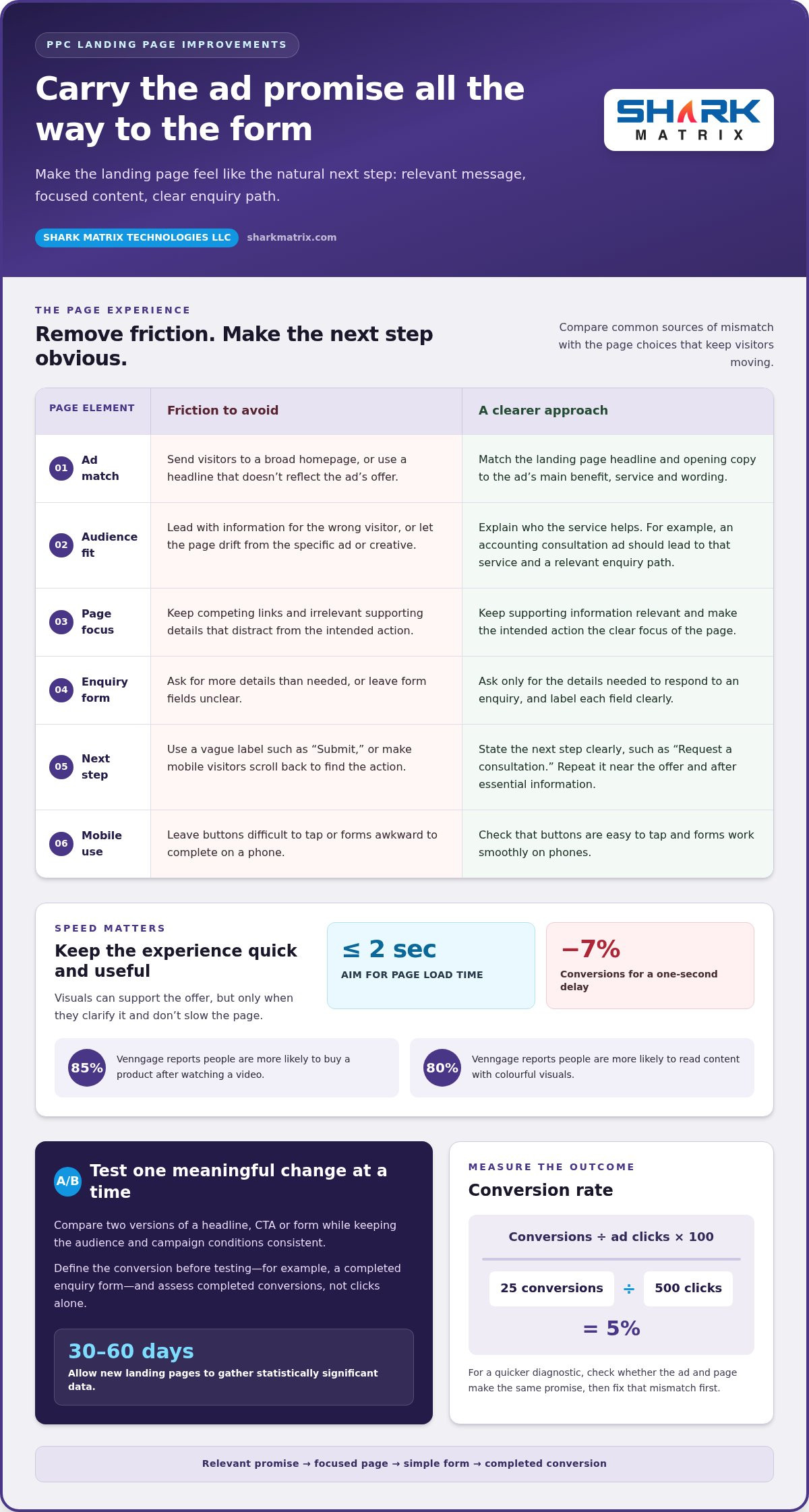
More clicks won’t fix a form that visitors abandon. Improving PPC conversion rates starts with matching each ad to a focused landing page, the right audience and a simple form; the conversion rate is calculated by dividing conversions by ad clicks and multiplying by 100. For example, 25 conversions from 500 clicks equals a 5% conversion rate.

It’s frustrating to pay for traffic that doesn’t turn into enquiries, especially when the problem may be what happens after the click. This guide explains how to improve PPC conversion rates by reducing form abandonment, making landing pages more relevant and usable, refining audience targeting, and organising campaigns around clear goals. You’ll also learn how to read conversion data and choose tests based on visitor behaviour rather than guesswork. From matching ads to landing pages to structuring campaigns, each improvement can make the next step clearer for potential customers across the UAE.

Key Takeaways

  • Make each landing page reflect the ad’s promise, keep its form focused, and make the next step clear on mobile.
  • Separate audiences by intent and tailor ad messages and landing pages to what each group needs.
  • Organise campaigns around distinct goals and relevant keywords so performance data can guide specific changes.
  • Track completed conversions alongside clicks to identify where visitors drop off and which adjustments improve results.
  • Use industry and platform benchmarks as context, then judge performance against your own campaign goals and lead quality.

1. Landing page improvements

A landing page should deliver on the promise made in its ad. If a Google ad promotes an accounting consultation, the page should lead with that service, explain who it helps, and present a clear enquiry form. Sending visitors to a broad homepage makes them search again, adding effort that can interrupt the path from interest to action.

Start by aligning the message. Match the ad’s main benefit, service, and wording to the landing page headline and opening copy. Then check that the content fits the intended audience: a page for business owners seeking support shouldn’t lead with information for job seekers. For Facebook campaigns, make sure the page reflects the specific offer or creative that brought visitors there. Keep supporting details relevant and remove competing links that distract from the intended action.

Use a focused form and a visible call to action (CTA). Ask only for the details needed to respond to an enquiry, and label each field clearly. Describe the next step in the CTA, for example, “Request a consultation,” rather than using a vague “Submit.” Repeat the CTA near the offer and after essential supporting information, so mobile visitors don’t have to scroll back to find it. Check that buttons are easy to tap and forms work smoothly on phones.

Test one meaningful change at a time. Compare two versions of a headline, CTA or form, while keeping the audience and campaign conditions consistent. Define the conversion before the test begins, such as a completed enquiry form, and assess completed conversions rather than clicks alone. Allow new landing pages 30-60 days to gather statistically significant data. For a quicker diagnostic, check whether the ad and page make the same promise, then fix that mismatch first.

Page speed and useful content also shape the experience. Aim for a load time of two seconds or less; a one-second delay can reduce conversions by 7%. Venngage reports that people are 85% more likely to buy a product after watching a video, and 80% more likely to read content with colourful visuals. Use video or visuals only when they clarify the offer, and keep them from slowing the page. A practical route to improving PPC conversion rates is to make every element support the same action, from the ad’s first claim to the form’s final button.

2. Audience targeting

Relevant targeting starts with what a person wants to do, not just who they are. Separate searches for “buy office chairs” from “office chair repair,” because they signal different needs. Match each keyword group to its own ad and conversion goal. Review search terms regularly, then exclude irrelevant queries that use budget without attracting suitable visitors.

Keyword targeting and search intent can improve conversions by connecting each query to an ad that addresses its underlying need. Someone comparing providers needs different information from someone ready to request a quote. Use search-term reports and conversion analytics to group queries by intent, refine ad messages, and direct each group to a relevant next step.

Build audience segments around meaningful differences, such as past enquiries, existing customers, or first-time visitors. Tailor retargeting for existing customers to their purchase history, product lifecycle, and needs between purchases. PPC retargeting of existing customers typically generates conversion rates three to five times higher than cold traffic. Keep each offer relevant to its segment instead of showing every visitor the same message.

Micro-moment targeting addresses a need when it arises. For example, someone searching for an urgent service on a mobile device may need a direct way to get in touch, while a researcher may need clear comparisons. Use the query, device, location targeting, and time context available in campaign analytics to shape the message. Make the ad’s next step fit the person’s immediate task to reduce friction.

Remarketing can reconnect with people who visited a key page but didn’t complete an enquiry. In a Mazda retargeting example, retargeted customers converted at a 53% higher rate and spent 98% more. Treat those figures as an example, not a forecast for every campaign. Create audience lists based on useful actions, such as viewing a service page, and exclude people who have already completed the intended conversion.

Email list targeting can help campaigns reach known customers or leads with messages suited to their relationship with the business. Segment lists by previous purchase, enquiry topic, or lifecycle stage, then tailor the ad and landing-page offer accordingly. Keep the goal consistent across channels: an existing customer may need a related service, while an unconverted lead may need a clear answer to a previous concern.

Audit conversion tracking by testing a real form submission and confirming that the intended conversion records once in campaign analytics. Compare ad-platform totals with website records, check that tags fire on the correct completion event, and review attribution settings for duplicate or missing credit. These checks help reveal whether a targeting change attracts qualified leads or simply shifts reported conversions. For stronger keyword planning across paid and organic search, explore SEO and keyword strategy.

3. Account structure and campaign strategy

Organise Google Ads campaigns around distinct business goals rather than using a catch-all account structure. A UAE firm could separate campaigns for service enquiries, branded searches, and competitor comparisons. Within each campaign, group closely related keywords so the ad clearly answers the search. This structure makes it easier to see which intent, message, or audience brings useful leads, then adjust that area without changing unrelated campaigns.

Keep each ad group focused. If a campaign targets “commercial cleaning” and “office cleaning,” separate the themes when their search intent or landing pages differ. Align keywords, ad messaging, and destination pages. Google’s Quality Score considers click-through rate, ad relevance, the landing page, and overall AdWords performance. Improving these connected elements gives account reviews a practical focus instead of treating each metric in isolation.

Kevin Brkal reported an 81% lift in conversion rate for a client after optimizing its advertising account. That result illustrates why structure deserves attention, but it isn’t a forecast for every account. Review campaign and ad-group performance together: a high-click ad with few qualified enquiries may need tighter targeting, while a relevant ad with low traffic may need broader keyword coverage or revised messaging.

Bidding strategies and campaign budgets affect conversions by shaping which auctions an account can enter and how consistently its ads appear. Choose a bidding approach that fits the measured goal, such as completed enquiries, and make sure conversion tracking reflects that action. Prioritise budgets according to campaign value and lead quality, then review spend alongside completed conversions. Increasing the budget alone won’t fix a weak match between searches, ads, and offers.

Separate campaigns when they need different goals, audiences, or budget decisions. For example, campaigns targeting distinct customer groups may need different settings and locally relevant messaging across the UAE. Keep campaigns together when their keywords, conversion goals, and landing-page experiences genuinely match. This balance gives account managers enough control without scattering similar data across numerous small campaigns.

Review performance regularly and make changes to answer a specific question. Compare search terms, conversion actions, device performance, and campaign results before changing bids or budgets. For LinkedIn campaigns, assess whether professional audience criteria fit the offer; for Google Ads, examine query intent and keyword relevance. Record each change and its result so the next strategy decision builds on evidence rather than guesswork.
Improving PPC Conversion Rates Through Stronger Campaign Structure

4. Reasons to optimize PPC conversion rates

Clicks measure attention, but completed actions show whether paid traffic supports a business goal. A campaign can attract visitors who leave without calling, enquiring, booking, or downloading a guide. Reviewing the conversion rate helps distinguish useful traffic from visits that use budget without producing the intended result. That distinction matters when deciding whether to change targeting, messaging, or the offer.

Optimization can also reveal friction between the ad and the next step. For example, a visitor who clicks an offer for a service may abandon a form that asks for unnecessary details. Review the journey from ad click to completed action and find where people stop. Addressing that specific barrier makes campaign decisions more practical than simply trying to generate more clicks.

Common PPC tracking mistakes include counting button clicks as completed leads, firing a conversion tag more than once, or overlooking broken tracking after a website change. These errors can distort bidding decisions and make weak traffic appear successful. Test the full action, such as submitting a form, and confirm that the recorded event represents a genuine completion.

Conversion data can also help prioritise campaigns. Compare lead quality alongside recorded actions: a campaign producing many low-value enquiries may matter less than one generating fewer suitable prospects. In Google’s cited data, the average advertiser doubles their return. Treat return as a business measure, not a substitute for checking whether leads progress to meaningful outcomes.

For context, a typical PPC conversion rate is between 2% and 5%, while exceptionally strong campaigns can exceed 10%. These are broad benchmarks, not a UAE-specific target or a promise for an individual account. In the UAE, compare campaigns with similar goals, platforms, audiences, and conversion definitions. A search campaign for urgent services should not be judged against a social campaign promoting a guide download.

Best practice starts with a reliable baseline. Define the conversion clearly, confirm the tracking event, and review results by campaign and device. Then change one factor at a time, such as the bid strategy, keyword focus, or form requirements. Record what changed and whether qualified conversions shifted. This makes each optimization easier to assess and prevents simultaneous edits from obscuring the cause.

Running PPC without reviewing completed actions can hide wasted spend and missed opportunities. Use conversion evidence to decide whether to refine the audience, improve the offer, or shift campaign priorities. If clicks rise while qualified conversions remain flat, investigate relevance and tracking before increasing traffic. A measured approach keeps optimization tied to business outcomes rather than surface-level activity.

5. What is a good PPC conversion rate by industry and platform?

A useful benchmark depends on the campaign’s industry, platform, audience, and conversion definition. For context, WordStream reported an average PPC conversion rate of 7.52% in its November 2025 update, while Ruler Analytics reported 5.4% in May 2026. These figures differ, so treat them as reference points, not interchangeable targets for UAE campaigns.

Industry differences matter, too. The reported median paid search conversion rate for ecommerce is about 3.5%, while SaaS averages about 2%. Agencies have a 2.4% benchmark, and business services have a 3.5% benchmark. These distinctions show why a UAE retailer should compare like with like, rather than judging its campaign against an unrelated service business.

Legal figures also vary by source and date. WordStream’s 2025 benchmark reports 5.09% for Attorneys & Legal Services, while Ruler Analytics reported 7.8% for Legal in May 2026. The gap underlines the importance of matching geography, campaign type, and conversion measurement before using a benchmark to set expectations.

Platform averages offer another reference, but they don’t remove the need for context. Reported averages are 2.85% for Google Ads and 2.94% for Bing across sectors. Facebook Ads range from 9% to 10%, LinkedIn Ads from 5% to 15%, and Instagram averages 1.08%. Compare the same objective and conversion action, since platforms can attract visitors at different stages of decision-making.

Some platform figures also shift by industry. Facebook Ads conversion rates are reported at 14.29% for fitness products and services, compared with 2.31% for technology. A UAE fitness campaign and a technology lead campaign therefore need different comparison sets. Look for benchmarks that resemble the campaign’s offer and audience, then use internal results to assess whether leads are relevant.

For a practical evaluation, calculate conversions using the same action and reporting period across campaigns. Separate enquiry submissions from calls, purchases, or downloads, then compare each category with its closest benchmark. Review the source, date, industry, and platform behind every reference. If definitions differ, treat the figure as broad context rather than a direct performance comparison.

A “good” rate is one that supports the campaign’s commercial goal and attracts suitable prospects. A higher percentage can still mislead if it counts low-quality actions, while a lower rate may bring more valuable enquiries. In the UAE, assess lead quality and campaign outcomes alongside the conversion rate, then use relevant benchmarks to guide, not replace, decisions. For a broader search visibility strategy, explore SEO strategy.

Shark Matrix Technologies: Search Engine Optimization (SEO)

Shark Matrix Technologies LLC can help when paid campaigns attract clicks but campaign management, organic visibility, or website experience needs attention. Its Pay Per Click (PPC) Management supports campaign planning and optimization, while Search Engine Optimization (SEO) helps strengthen visibility beyond paid ads. If the landing page creates friction, Web Design and Development can improve the site experience that contributes to conversion.

These services can work together to support the same business goals: relevant traffic, clear messaging, and meaningful actions. Consider this next step when your campaign data points to issues across targeting, search visibility, or the website rather than one isolated ad. To discuss your marketing needs, contact Shark Matrix Technologies LLC or visit sharkmatrix.com.

Build Your Next Campaign Around What You Learn

Make the next campaign decision deliberately. Choose a clear business outcome, then use incoming results to decide what needs attention. This keeps improving PPC conversion rates focused on meaningful progress, not change for its own sake. A useful review asks whether the campaign attracts the right prospects and whether the website supports their next step.

When paid campaigns, search visibility, and website experience need to work together, Shark Matrix Technologies offers Pay Per Click (PPC) Management, Search Engine Optimization (SEO), and Web Design and Development. These services can address connected parts of the visitor journey, from campaign traffic to the pages where prospects take action.

Bring your campaign goals and priorities into the next planning conversation. Contact Shark Matrix Technologies to discuss a practical next step for your digital marketing. Clear goals make it easier to keep learning, refine your approach, and move forward with confidence.

Frequently Asked Questions

How can I reduce form abandonment in PPC campaigns?

Reduce abandonment by making the form easy to complete and fixing errors that interrupt submission. On a UAE service enquiry form, label required fields clearly and show an understandable message beside any field needing correction. If the form has several steps, explain what comes next and show visitors their progress. Review analytics for the last completed field to find where people stop, then test a focused adjustment.

Should I create separate PPC campaigns for existing customers?

Create a separate campaign when existing customers need a different message, offer, or conversion goal from new prospects. For example, a business could separate a campaign encouraging repeat purchases from one focused on first-time enquiries. This makes each group’s results easier to interpret and helps avoid showing acquisition ads to people who have already converted. Keep campaigns together if their goals and audience treatment are genuinely the same.

What is a PPC conversion rate?

A PPC conversion rate is the percentage of ad clicks that result in a defined conversion. Depending on the campaign’s goal, a conversion might be a completed purchase, a submitted enquiry, or a completed download. Define the action before comparing campaigns: a rate based on form submissions cannot be compared directly with one based on purchases. Consistent definitions make performance reporting more meaningful.

What is the fastest way to improve PPC conversion rates?

Fix the clearest disconnect between a search, its ad, and the action visitors are asked to take. A message-match correction can show results in 7-14 days. For example, if an ad promotes a specific service but the destination discusses several services, make the relevant offer prominent. Then monitor completed conversions and lead quality to see whether the change improved the campaign’s outcome.

Why is call-to-action placement important for PPC conversions?

CTA placement matters because visitors need a clear next step when they’re ready to act. Place an action near the main offer, then consider another after supporting details for readers who need more information first. Keep the page’s primary action consistent, so a consultation button and a download button don’t compete. Track each CTA separately to learn which placement leads to completed conversions.

How do you calculate PPC conversion rate and conversion value?

Calculate conversion rate by dividing conversions by ad clicks and multiplying by 100. Conversion value is the total value assigned to the recorded conversions, such as transaction revenue for purchases. For lead campaigns, use a consistent internal valuation method rather than treating every form submission as equal. Keep conversion value distinct from conversion count, so reporting shows both how often people act and the business value attributed to those actions.

Which PPC landing page changes improve conversion rates?

Prioritise changes that remove uncertainty or help visitors assess the offer. Make service eligibility, included details, and the next step easy to find. Add relevant proof, such as customer reviews, where it supports the decision, and answer common objections near the enquiry form. For a UAE campaign, make sure the service wording on the page matches the audience and offer in the ad instead of relying on generic copy.

What A/B tests should you run to improve PPC conversion rates?

Test a specific decision point, such as whether a short form or one with an additional qualifying question produces more suitable leads. Other useful tests include different offer framing, the order of supporting information, or customer proof near the CTA. Keep the audience, campaign goal, and measurement consistent when comparing versions. Judge the winner by completed conversions and lead relevance, not clicks alone.
Categories
Uncategorized

Landing Page Design for Dubai Campaigns

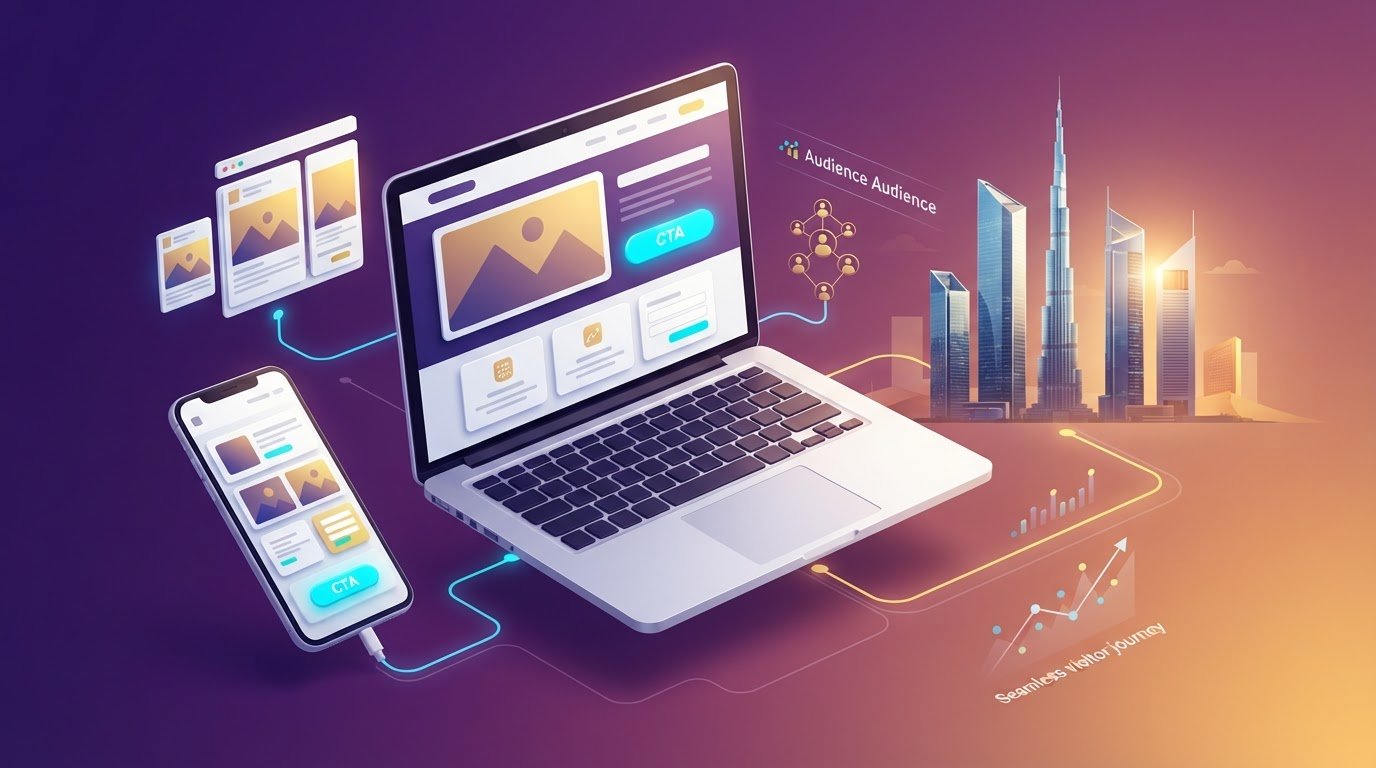
A clear call to action gives a landing page its purpose: it tells visitors what to do next and connects that action to the campaign’s goal. Effective landing page design services by Shark Matrix Technologies LLC bring the message, page layout and CTA together, so visitors across the UAE can move from an ad or search result to a relevant next step.

If you’re investing in a campaign, a general website page may not give each audience the focused experience they need. A well-designed landing page should match the campaign, make its offer easy to understand and guide visitors towards one clear action, whether that’s enquiring, signing up or exploring a service.

This article explains how custom, mobile-responsive landing pages support lead generation and click-throughs. You’ll learn what to consider when shaping the content, choosing a CTA and building a campaign-specific layout, and how a well-designed page fits into a wider digital marketing effort.

Key Takeaways

  • Match the page layout and message to the campaign, and make sure the experience works smoothly on mobile.
  • Give visitors one clear next step, with CTA wording that reflects the action they’re being asked to take.
  • Focus the content on the audience’s needs and the offer’s distinct value, rather than trying to cover everything.
  • Keep the journey consistent from ad to landing page so visitors can quickly find what the campaign promised.
  • Choose a design approach that connects page development with the campaign’s wider marketing goals.

Custom, mobile-responsive landing page design

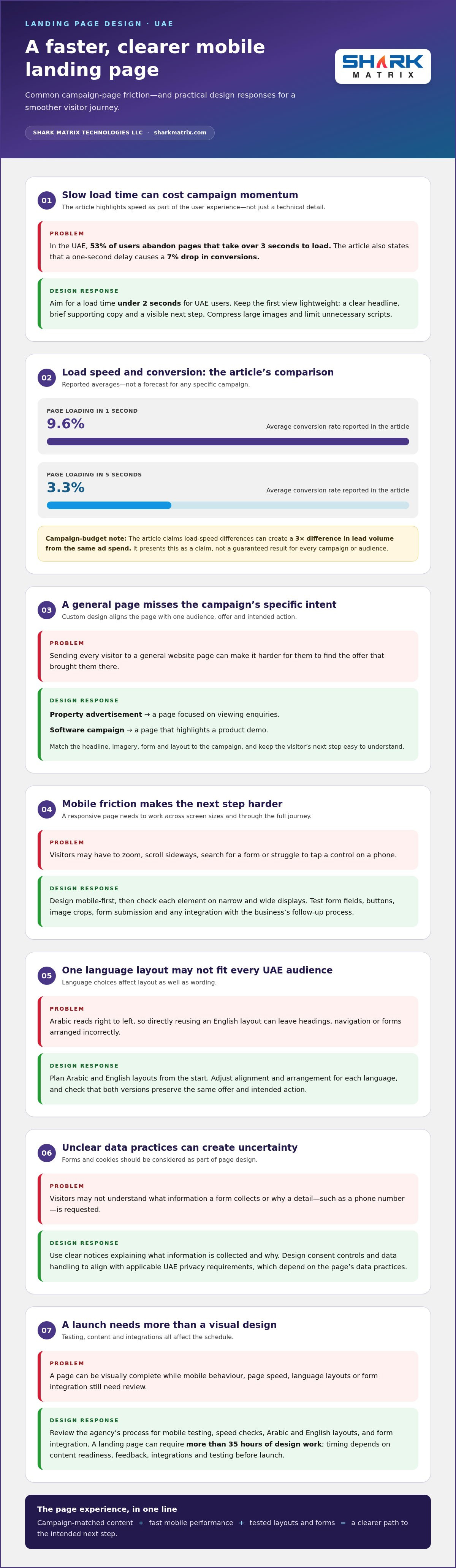
A campaign in Dubai needs a page built around its audience, offer and intended action. Custom design lets a business align its headline, imagery, form and layout with one campaign, rather than sending every visitor to a general website page. For example, a property advertisement can lead to a page focused on viewing enquiries, while a software campaign can highlight a product demo.

Start with mobile-first design. The page should fit a small screen without forcing visitors to zoom, scroll sideways or hunt for the form. In the UAE, 53% of users abandon pages that take over 3 seconds to load. A one-second delay in load time causes a 7% drop in conversions, making page speed part of the user experience, not just a technical detail.

Build a lightweight first view: a clear headline, brief supporting copy and visible next step. Compress large images, limit unnecessary scripts and test the page on mobile connections. Aim for a load time under 2 seconds for UAE users. Landing pages loading in 1 second convert at an average rate of 9.6%, compared with 3.3% for pages loading in 5 seconds. These are averages, not a forecast for a specific campaign.

Responsive design means checking how each element behaves at different screen sizes. Test form fields, buttons, Arabic text and image crops on narrow and wide displays. A button that works on desktop may be difficult to tap on a phone. Test the full journey, including form submission and any integration with the business’s follow-up process.

For UAE audiences, consider language at the layout stage. Arabic reads right to left, so headings, navigation and form alignment may need a different arrangement from an English version. Treat Arabic and English as tailored experiences, not merely translated text, and check that both versions preserve the same offer and action.

For UAE landing pages with forms or cookies, use clear notices explaining what information is collected and why. Design consent controls and data handling to align with applicable UAE privacy requirements, which depend on the page’s data practices.

How long does design and launch take in Dubai? A landing page can require more than 35 hours of design work. The schedule depends on content readiness, feedback, integrations and testing before launch.

Before hiring an agency, review its process for mobile testing, page-speed checks, Arabic and English layouts, and form integration. Ask how its design decisions connect the campaign message to the visitor’s next step. These checks help businesses compare landing page design services in Dubai against practical campaign needs.

Page speed can affect how much a campaign gets from its existing media budget: the page claims that a difference in load speed can create a 3x difference in lead volume from the same ad spend. That makes speed comparisons useful when reviewing a landing page, alongside its mobile layout and conversion path. Keep the comparison tied to the same ad spend, and treat the stated relationship as a claim rather than a guaranteed result for every campaign or audience.

Clear calls to action

A call to action should make the visitor’s next step unmistakable. For a Dubai property campaign, “Book a viewing” is more direct than “Learn more.” For a business software page, “Request a demo” sets a clearer expectation than “Submit.” Personalised calls to action generate 202% more conversions than generic ones, so match the wording to the audience and offer.

Give each landing page one primary action. A secondary link can help visitors who aren’t ready, but buttons with equal visual weight create competing choices. If the campaign seeks enquiries, make form submission the main action. Keep other options, such as browsing services, visually quieter so they don’t distract from the page’s purpose.

Write button copy around the value or action, not the interface. “Get the pricing guide” tells visitors what happens after a click; “Click here” doesn’t. Use the same promise in the headline, supporting copy and button. If an ad offers a consultation, the landing page should repeat that offer rather than introduce a different next step.

Reduce uncertainty around the action. Place a short explanation beside the CTA, such as what information the form requests or what visitors receive next. If a form asks for a phone number, explain how that detail supports the enquiry. Clear expectations help people decide whether to proceed, while unclear requests can create hesitation.

Creative choices also affect visibility. Use contrast to distinguish the primary button from surrounding content, and leave enough space around it to make the action easy to find. Check the button against the page background and nearby links. On mobile, ensure the CTA is easy to tap and doesn’t overlap other controls.

Testing helps establish which wording and placement best support the campaign. Compare versions that change one element at a time, such as “Request a quote” versus “Discuss your project.” Keep the audience, offer and traffic source consistent during the comparison. Track completed actions, not just button clicks, because clicks alone don’t show whether visitors finished the intended step.

Review results by campaign source and audience. A CTA that works for visitors arriving from a branded search may not suit people seeing an introductory social ad. Use those differences to refine the message, form and follow-up experience. For campaign teams shaping both ad copy and landing-page language, search campaign planning in Dubai can help connect visitor intent with the next action.

Focused content and unique selling points

A focused landing page serves one audience, one offer and one campaign goal. A clinic promoting dental consultations in Dubai should lead with that service, not a catalogue of unrelated treatments. Visitors can then see how the offer addresses their need and what action to take. This alignment makes the page easier to understand and supports lead generation.

Identify the unique selling point before drafting. List the offer’s practical benefits, the audience problem it solves and the reasons to choose it. For a business software page, the differentiator might be a feature that simplifies a specific workflow. Explain that benefit in everyday language, then support it with a relevant example rather than broad claims.

Audience context shapes which details deserve space. A Dubai property campaign aimed at first-time buyers may need clear information about the buying journey. A page for corporate tenants could instead foreground location, workspace suitability and enquiry options. Target each version to its intended visitor rather than squeezing both audiences into one message.

Organise the content in a deliberate order: state the offer, explain its value, address a likely concern and show the next step. For example, a training provider might open with a course outcome, describe who the course suits, explain the format and invite an enquiry. Each section should help visitors make the same decision.

  • Headline: Name the offer and its audience.
  • Benefits: Connect each feature to a practical outcome.
  • Evidence: Use accurate examples, testimonials or relevant credentials.
  • Objections: Address a real concern, such as delivery format or service scope.

Evidence should reinforce the unique selling point, not distract from it. A Dubai-based service business could explain its project process or show a representative work example. Keep statements precise and supportable. Avoid claims such as “the best” unless the page can substantiate them; specific descriptions help visitors assess whether the offer fits.

Content also needs to match the campaign’s promise. If an advertisement promotes a consultation, the landing page should explain what the consultation concerns. If it promotes a downloadable guide, describe its subject and intended reader. This consistency helps visitors connect the message they clicked with the page they reach.

Review every sentence against the target audience and campaign objective. Remove details that don’t help visitors understand the offer, assess its relevance or proceed. For bilingual UAE campaigns, adapt the message for Arabic and English readers rather than translating word for word. Preserve the same value while fitting each language’s reading flow.

Landing Page Design for Dubai Campaigns

Landing page design for digital marketing campaigns

A landing page should continue the promise made by its campaign. If a Dubai search ad promotes a particular service, its destination should explain that service, not send visitors to a general homepage. This message match helps people recognise they’ve reached the right place and understand the next step.

Plan the page around its traffic source. A visitor arriving from a branded search may already know the business, while someone seeing a social post may need more context. For a campaign promoting a property viewing, keep the ad, headline, supporting details and enquiry action focused on that viewing.

Match the layout to the campaign’s channel and audience. A mobile visitor from a social campaign may need a short explanation and an easy way to enquire. WhatsApp is a relevant contact option for UAE campaigns: 85.8% of UAE residents actively use it, and 76% of Middle East consumers prefer contacting brands through it.

Choose the page’s conversion path before launch. A campaign can invite visitors to submit a form, call, request a demo or continue a conversation. If the next step is WhatsApp, make the button’s purpose clear and ensure its message relates to the offer. If it’s a form, collect details that support the enquiry rather than adding unrelated fields.

Connect the landing page to the campaign’s follow-up process. For example, an enquiry form should deliver the right information to the people handling responses. Email marketing can also integrate with landing pages, allowing a campaign to continue with relevant follow-up content after sign-up. Keep that communication consistent with the original offer.

Before launch, review each part of the visitor journey:

  • Confirm the ad and page describe the same offer.
  • Test the main action from a mobile device.
  • Submit a test enquiry and check its delivery.
  • Review page links, form messages and follow-up content.

After launch, assess completed actions alongside traffic. If a campaign attracts visitors but few enquiries, examine whether the page addresses their intent and whether its next step feels relevant. If visitors start forms but don’t complete them, review the questions and submission experience.

Keep campaign reporting tied to the page’s goal. A lead-generation campaign should track qualified enquiries, while a campaign seeking sign-ups should measure completed registrations. Compare performance by traffic source and creative, then adjust one meaningful element at a time. This makes each change easier to evaluate and helps the page support the wider digital marketing plan.

Planning also means deciding whether a focused splash page fits the campaign or whether a fuller destination is needed. Industry insights show that splash pages can be used for both B2C and B2B markets, making them an option across audience types. When partnering with Shark Matrix Technologies LLC for professional landing page design services dubai, teams estimate that site design takes between 15 and 80 hours, so allow room for content, review and testing rather than treating the page as a last-minute add-on. Experienced marketing specialists bring valuable perspectives when shaping campaign experiences around clear goals.

Which Dubai agencies specialize in landing page design?

Dubai businesses can find landing page work through digital marketing agencies and web design agencies. Some focus on campaign strategy and conversion, while others emphasise page design, development and integrations. A directory lists 111 landing page design agencies for Dubai. That number offers a starting point, not a measure of which agency best suits a particular campaign.

Look for an agency whose work connects the page to its marketing purpose. For example, a paid search campaign for a Dubai training provider needs a landing page that carries the same course offer and audience promise. A provider should be able to explain how it approaches campaign goals, page structure, content, mobile layouts and the visitor’s next step.

Review relevant examples, not just general website designs. A landing page has a narrower job than a multi-page company site. Check whether sample pages make the offer clear, keep the main action visible and support the campaign’s intended audience. If your campaign serves Arabic and English readers, examine how the agency adapts layout and content for both languages.

Discuss the work process before choosing. Ask how the team gathers campaign requirements, plans the page, reviews content and handles testing before launch. A property campaign, for instance, may need enquiry-form testing and a clear route for those enquiries. Confirm who provides copy, who approves revisions and how page changes are handled after launch.

Compare proposals against the same practical criteria, rather than judging by design style alone:

  • Campaign fit: Does the approach reflect your offer and traffic source?
  • Mobile experience: Does the work show considered layouts for phone screens?
  • Measurement: Can the agency explain what actions the page will track?
  • Delivery: Are responsibilities, review stages and launch tasks clear?

For landing page design services in Dubai, distinguish a page build from broader campaign support. Some businesses need only a designed page; others need content, campaign planning or integration with existing systems. Define the scope around your goal and current setup, then compare how each proposal addresses those needs.

Finally, assess communication through the proposal itself. A useful plan should explain the audience, offer, page structure and intended action in plain language. If a proposed design doesn’t show how a visitor moves from the campaign message to the next step, ask for that journey to be made explicit before work begins. Clear responsibilities and a shared campaign objective make agency collaboration more focused.

Shark Matrix Technologies: Search Engine Optimization (SEO)

Shark Matrix Technologies LLC can help when your landing page needs to work alongside a wider campaign. Its Search Engine Optimization (SEO) and Pay Per Click (PPC) Management offerings connect organic and paid traffic strategies with the page visitors reach. Web Design and Development can support businesses planning a custom campaign page or refining an existing digital experience.

Consider this next step when your campaign needs a clearer connection between search intent, page content and visitor action. A focused discussion about your campaign goals can help identify where SEO, PPC or web development fits.

Contact Shark Matrix Technologies LLC to discuss your landing page needs, or visit sharkmatrix.com.

Turn your campaign plan into a clear next step

Your next move is to define what the page should help your campaign achieve. Decide which audience it serves, what action matters most and how you’ll judge whether the page is doing its job. That brief gives design and marketing decisions a shared direction from the outset.

When you’re considering landing page design services in Dubai, think about how the page connects with the rest of your digital marketing. Shark Matrix Technologies LLC offers Search Engine Optimization (SEO), Pay Per Click (PPC) Management and Web Design and Development to support those needs.

Share your campaign goals and discuss an approach that fits your business. Contact Shark Matrix Technologies LLC to take the next step and put your campaign plans into action.

Frequently Asked Questions

How important is a clear call-to-action (CTA) on a landing page?

A clear CTA helps visitors understand the specific action the page invites them to take. Use wording that describes the next step, such as “Download the guide” or “Request a product demo,” instead of a vague label like “Submit.” Make the action easy to spot, then check that the destination or confirmation message matches what the button promised.

Should a landing page have navigation menus?

Usually, keep navigation limited when the page supports one campaign goal. A full menu can send visitors to unrelated pages before they act. A campaign-specific page might retain a logo link and essential utility links while removing the main site menu. If visitors need supporting details, include only links that help them assess the offer or complete the intended action.

What elements should be included in the header of a landing page?

Include a brand mark, a concise headline that identifies the offer and a short supporting line explaining its relevance. Add a primary action near the headline if visitors can respond immediately. For example, a software demo page might name the product, clarify who the demo suits and show a “Request a demo” button. Keep promotional details accurate and consistent with the rest of the page.

What do landing page design services in Dubai include?

Landing page design services can cover page planning, wireframes, visual design, user experience and development. The scope may also include responsive layouts, campaign-focused content and connections to relevant marketing activity. Shark Matrix Technologies LLC offers Web Design and Development, alongside Search Engine Optimization (SEO) and Pay Per Click (PPC) Management. Businesses can align the page’s build with their campaign needs and broader digital strategy.

Categories
Uncategorized

B2B SEO Agency: How to Choose a Partner That Builds Qualified Pipeline

What if your organic traffic is rising, but the right accounts still aren’t entering your pipeline? More visits don’t automatically mean more qualified opportunities. A b2b seo agency needs to understand who’s searching, what buying roles need to know, and how organic activity supports a long decision-making journey.

It’s reasonable to be cautious: rankings can look impressive while reports leave the link to business growth unclear. Effective B2B SEO connects buyer intent with useful content, website improvements, and measurement that helps you understand whether organic search is attracting relevant prospects.

This guide explains what a capable B2B SEO partner should deliver and how to evaluate a strategy. You’ll learn which research, content, and technical capabilities matter, how to assess reporting beyond traffic and rankings, and how to set practical expectations for collaboration and ongoing optimisation. It also explores how SEO can work alongside content marketing and website development as part of a connected growth strategy, rather than a standalone promise of higher rankings.

Key Takeaways

  • Effective B2B SEO accounts for multiple stakeholders, specialist questions, and the different stages of a longer buying journey.
  • Choose a b2b seo agency based on its ability to connect buyer intent with research, technical SEO, useful content, authority, and measurement.
  • Compare partners by their strategy, deliverables, reporting, and collaboration approach, not by ranking guarantees or traffic promises.
  • Build a practical optimisation cycle: set a baseline, prioritise work, publish and improve, then review visibility alongside qualified enquiries.
  • Coordinated SEO, content marketing, and website improvements can support a connected growth strategy.

Why B2B SEO Needs an Agency That Understands Complex Buying Journeys

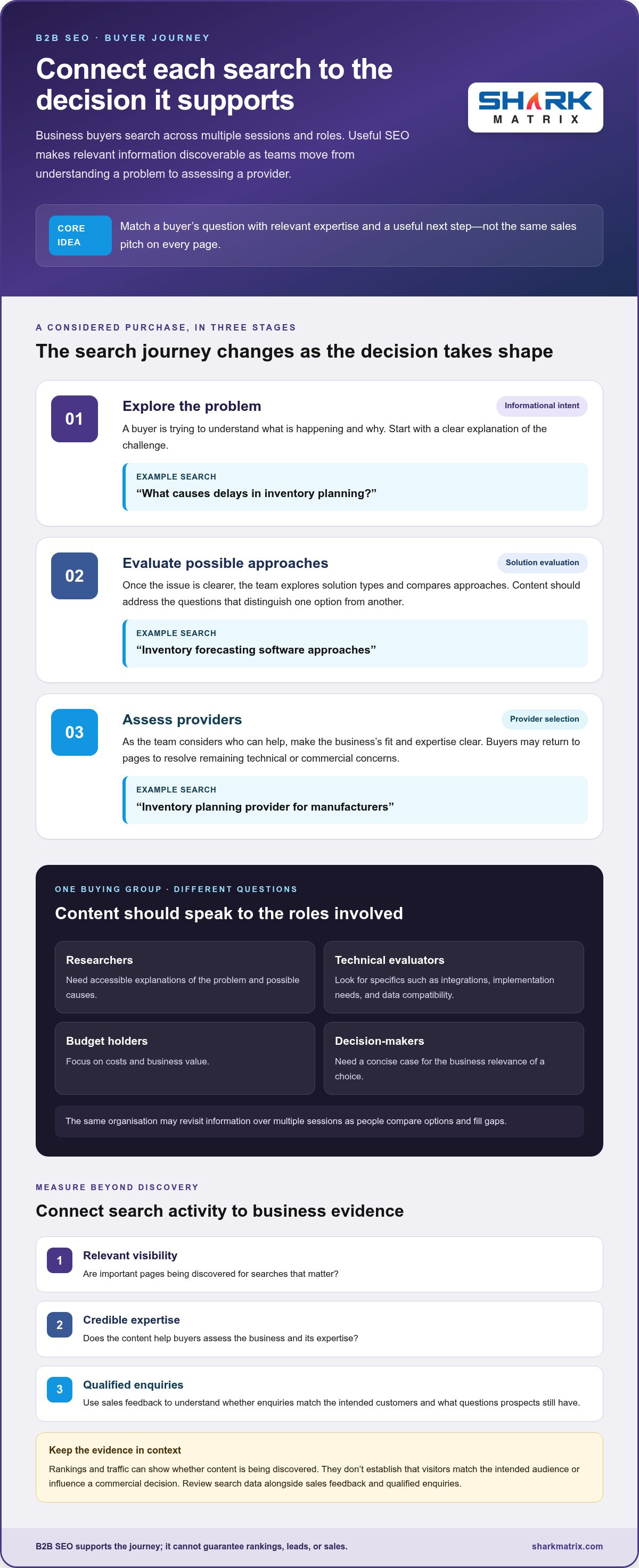
A B2B SEO agency aligns a company’s organic visibility with the needs of business buyers at different stages of a purchase. The goal isn’t simply to appear for more searches. It’s to help the right people find clear, credible information as they investigate a problem, compare approaches, and decide what to do next.

Put simply, B2B SEO connects business buyers’ search questions with relevant expertise and useful next steps throughout a considered purchase. That distinction matters because one organisation’s buying journey can involve researchers, technical evaluators, budget holders, and final decision-makers, each searching with different priorities. A researcher may look for possible causes of a problem, while a technical evaluator examines integrations or implementation needs. A budget holder may focus on costs and business value.

These searches can happen across multiple sessions, with buyers returning to compare options or fill information gaps before contacting a provider. A company may first search for ways to reduce a process bottleneck, then explore possible solutions, and later assess whether a particular service fits its requirements. A useful foundation in understanding B2B marketing helps explain why business audiences, buying processes, and decision criteria shape the content that deserves to rank.

How B2B search differs from a simple online purchase

A consumer purchase may involve one person choosing a familiar item, but business purchases often require agreement across roles. Search content should answer distinct questions without treating every visitor as if they have the same knowledge or authority. An early-stage researcher may need an accessible explanation; a technical evaluator may want specifics; a decision-maker may need a concise case for business relevance.

For example, a business researching a recurring operational problem might begin with an informational query. After understanding the issue, the team could search for solution types, compare providers, and revisit pages to resolve technical or commercial concerns. SEO should make useful resources discoverable and connected, rather than relying on a single page to serve every role and stage.

What a B2B SEO agency should help a business achieve

A considered strategy connects three objectives: relevant visibility for searches that matter, credible expertise that helps buyers assess a business, and clear next steps that support further research or contact. Rankings and traffic can indicate whether content is being discovered, but they don’t establish that visitors match the intended audience or influence a commercial decision.

That’s why business context and sales feedback belong alongside search data. Teams can share which enquiries match their target customers, what questions arise during sales conversations, and where prospects need more information. An agency can use those insights to refine topic priorities and content. SEO can support demand generation, but it can’t guarantee rankings, leads, or sales. Its contribution is best understood through ongoing evidence connecting search visibility, relevant engagement, and qualified enquiries.

Which B2B SEO Agency Capabilities Turn Search Intent into Useful Content?

A capable b2b seo agency doesn’t treat keyword volume as a content plan. It connects research, technical foundations, content, authority, and measurement so each activity helps the right audience find and assess useful information. Research identifies buyer questions, site improvements make answers accessible, and measurement shows which topics merit further investment.

Research that maps search demand to B2B buyer intent

Strong research separates searches by purpose. Someone asking “what causes delays in inventory planning?” is exploring a problem. A person comparing “inventory forecasting software approaches” is evaluating solutions. A search for “inventory planning provider for manufacturers” signals provider selection. Each query calls for a different answer, not a page that repeats the same sales pitch.

Map topics by problem, search intent, buyer role, and decision stage, then consider the language each audience uses. Technical users may search for integration requirements or data compatibility; commercial stakeholders may look for implementation considerations and business value. Sales conversations, support questions, and recurring objections can reveal terms and concerns that keyword tools don’t capture. Use that input to fill gaps, clarify terminology, and prioritise topics connected to the business’s actual offer.

Content and website improvements that support evaluation

Different page types serve different needs. Expert articles explain challenges and approaches; service pages describe what the business does and who it helps; case evidence can show how a solution addressed a specific business problem. Together, they give buyers a path from learning to evaluation, without forcing every page to act as a thin landing page. Useful content answers the question fully, states its limits clearly, and gives readers a relevant next step.

Technical foundations matter because valuable information can’t help if search engines or people struggle to reach it. A clear site structure, crawlable pages, descriptive headings, and accessible mobile layouts support discovery and navigation. Rather than chasing every technical task, prioritise changes that remove barriers to important content and pages.

Some improvements require coordination between SEO and development, particularly when a recommendation affects templates, navigation, or page performance. Working with web development services can help bring those changes into the site rather than leaving them as items in a report.

Authority also grows from consistency: publish well-supported material in areas the business knows, and make related resources easy to find. Review performance by topic and intent, not just by individual keywords. If a page attracts visitors but doesn’t help relevant prospects evaluate the offer, improve its substance or connection to the next useful page. For broader context on how search strategy can support business goals, explore Shark Matrix’s SEO services.

How to Compare B2B SEO Agencies Without Choosing on Rankings Alone

A proposal can promise visibility, but a sound comparison looks at how the work will connect to your business priorities. Use the same criteria to review each approach: what the agency learns, what it plans to deliver, how it reports progress, and how your team will contribute. A useful b2b seo agency plan explains its reasoning instead of relying on ranking guarantees or traffic forecasts.

Strategic fit: Does the proposed plan reflect your business goals, target accounts, and the questions buyers need answered?

B2B experience: Does the approach account for specialist audiences, multiple buying roles, and considered decisions?

Deliverables: Are the planned research, technical work, content, and optimisation activities specific enough to understand and act on?

Reporting: Does the plan distinguish search visibility and engagement from lead quality and sales feedback?

Collaboration: Are responsibilities, decision points, and the process for adapting priorities clearly explained?

Look closely at the reasoning behind each recommendation. If a plan proposes content around a broad, high-volume topic, it should explain how that topic relates to your offer and the people you want to reach. For businesses in vertical markets like construction, specialised partners such as H&A Marketing build campaigns around trade-specific procurement processes rather than generic industry traffic. Review how the agency incorporates target accounts, buying roles, and sales objections into its research. Strong planning draws on customer questions and business priorities, explains its assumptions, and shows how new evidence may change the plan.

Assess proof, reporting, and commercial fit

Case evidence is most useful when it gives enough context to judge relevance. Look for the starting situation, the work completed, the period or conditions involved when stated, and the outcome measured. A traffic increase alone doesn’t show whether the audience was commercially relevant. Clear evidence distinguishes what changed from what the agency can reasonably attribute to its work.

Reporting should connect leading indicators, such as organic visibility and engagement with priority pages, to downstream signals like qualified enquiries and sales feedback. These measures help teams make informed decisions; they don’t guarantee a specific business result. Rankings and leads depend on factors beyond an agency’s direct control, including competition, the offer, website experience, and how sales enquiries are handled.

Shark Matrix reports 250+ Projects Successfully Completed and 20+ Industries Served. These figures provide context about project and industry breadth, not a promise of a particular outcome for every business. When evaluating a plan, consider whether the agency explains how its experience informs the proposed work and how success will be assessed together.

A good commercial fit also means an understandable working rhythm: who provides subject-matter input, who approves content, and how findings influence the next priorities. For a practical view of how Shark Matrix approaches SEO, explore its SEO services.

B2B SEO Agency: How to Choose a Partner That Builds Qualified Pipeline

What a Practical B2B SEO Engagement Should Measure and Improve

A useful measurement plan starts with your business context, not a generic traffic target. Before work begins, agree on what organic search should support, what information is available, and how marketing and sales will recognise a relevant enquiry. A b2b seo agency can then use a repeatable cycle to turn evidence into priorities, instead of treating a monthly report as the finish line.

Agree on goals, baseline, and meaningful indicators

Set a baseline for current organic visibility, priority-page engagement, and enquiries attributed to organic search. Define a qualified organic enquiry with sales: agree on the business fit and information that make an enquiry worth follow-up. The exact definition depends on your offer and sales process, so document it before comparing performance over time.

Also agree on reporting cadence, who owns each data source, and how questions will be investigated. If a change in enquiries coincides with a change in rankings, that’s a useful signal, not proof that SEO alone caused the result. Seasonality, sales activity, website changes, and other marketing can affect outcomes. Shared definitions help teams discuss these influences rather than overstate attribution.

Turn performance reviews into the next round of improvements

Use reviews to decide what to do next. A practical sequence keeps the work focused:

  1. Establish the baseline: Record agreed visibility, page, and enquiry measures, noting gaps in tracking or data.
  2. Prioritise work: Choose improvements based on buyer relevance, business value, and what the team can implement.
  3. Publish and improve: Update or create useful pages, then make sure changes are live and accessible.
  4. Review the evidence: Compare results with the baseline, add sales feedback, and refine the next priorities.

Search queries can show how people describe their needs; landing-page behaviour can suggest whether a page helps them continue their research. Sales feedback adds context: did recent enquiries match the intended audience, and what questions or concerns surfaced? If visitors arrive for an unrelated query, the content may need clearer scope. If relevant prospects repeatedly ask for information a page lacks, that’s a useful candidate for improvement.

B2B SEO measurement is strongest when search signals show who finds your content and sales signals help explain whether those visitors become relevant opportunities. Neither signal tells the whole story alone. Organic growth takes ongoing work, and results vary with the market, website, competition, and sales process. Keep expectations grounded, document what changed, and treat each review as a chance to make the next decision better informed.

To connect search priorities with a practical measurement plan, discuss your B2B SEO strategy with Shark Matrix.

How Shark Matrix Can Support a B2B SEO Growth Strategy

Once you’ve defined what a useful partner should do and how you’ll assess progress, the next step is finding an approach that fits your business. Shark Matrix brings SEO together with content marketing, web development, and related digital capabilities, so organic search can be considered alongside the website and content changes that support it. The work is shaped around your audience, priorities, and current challenges, not a fixed ranking or pipeline promise.

Shark Matrix’s mission is Your Growth, Our Mission – AI-Powered Digital Solutions That Accelerate Business Growth. The company reports 5+ Years of Digital and Technology Experience and 250+ Projects Successfully Completed. These figures offer context for its digital and technology work; your strategy and measures should still reflect your own market, buyer journey, and sales process.

A connected team for SEO strategy and implementation

A B2B SEO plan may involve more than keyword and content decisions. Strategists can shape priorities around business goals; digital marketers can connect search research with content planning; designers can help make key pages clearer to navigate; and developers can implement relevant site improvements. AI specialists add another discipline to the team’s broader capabilities. Shark Matrix reports 20+ Industries Served, reflecting experience across a range of industry contexts.

Coordination helps connect recommendations to practical changes. For example, if research points to a gap in information for technical evaluators, the response might involve developing expert content and ensuring the relevant page is easy to find. If site structure makes important resources difficult to navigate, design or development work may be part of the plan. The scope depends on your needs, and better visibility or a particular business result should never be presented as guaranteed.

Choose a next step based on your business priorities

Start with the information that can make a strategy more relevant: who you want to reach, what growth priorities matter, what questions your sales team hears, and where organic search currently falls short. Sharing these details helps frame a discussion around useful priorities rather than a generic list of SEO tasks. It also gives both teams a basis for discussing scope, responsibilities, and how progress might be evaluated.

A conversation is an opportunity to explore an appropriate approach, not a promise of leads, rankings, or sales. You can discuss how search research, content, and website improvements may fit together, and what evidence can guide ongoing optimisation. If your business is ready to consider a B2B SEO strategy grounded in its goals, Discuss your B2B SEO goals with Shark Matrix.

Make Your Next SEO Decision Count

The most useful next step isn’t to chase every keyword or launch a larger content calendar. Start with one business priority your team can clearly define, then identify how organic search could help the right buyers explore it. That focus gives marketing, sales, and your SEO partner a practical way to align the work and learn from what happens.

A strong b2b seo agency relationship should make decisions easier over time: what to prioritise, what evidence to review, and where to adjust when buyer needs or business goals shift. Treat the strategy as an evolving part of growth, with room to connect search, content, and website improvements as your understanding develops.

If you’re ready to turn your priorities into a considered SEO approach, explore a strategy tailored to your business goals with Shark Matrix. Your next step can be focused, collaborative, and grounded in the outcomes that matter to your business.

Frequently Asked Questions

How long does B2B SEO take to show results?

There’s no dependable deadline for B2B SEO results because timing depends on competition, website condition, available resources, and how consistently the plan is carried out. A technically sound site in a less competitive niche may respond differently from a large site with longstanding issues. Track progress against an agreed baseline, and review trends in visibility and relevant enquiries rather than judging the work on a single ranking change.

Is B2B SEO suitable for a small or highly specialised company?

Yes, B2B SEO can suit a small or specialised company if its buyers use search to research relevant needs. A focused business may prioritise a small set of important topics, such as a specific technical problem or service application, instead of trying to cover a broad market. This principle also applies across niche sectors; for instance, specialised directories like uppercervicalcare.com focus strictly on connecting patients with specialized upper cervical chiropractic doctors rather than competing for broad, generic healthcare terms. A b2b seo agency can help assess which opportunities fit the business and its resources, without guaranteeing demand or results.

Can B2B SEO support a business where referrals drive most new customers?

Yes. Search can complement referrals by helping prospects validate a recommendation, understand a service, or compare approaches before they make contact. For example, a referred buyer might search for a provider’s expertise or read a detailed explanation of a challenge their team faces. Useful, findable information can support that research. SEO doesn’t need to replace referrals; it can strengthen the information available during the buyer’s evaluation.

What should a B2B company prepare before working with an SEO agency?

Prepare a concise account of your business goals, priority audiences, sales insights, site access, and capacity to review work. Useful background might include your best-fit customer profiles, services to prioritise, common reasons prospects hesitate, and examples of enquiries that weren’t a fit. Identify who can provide subject expertise and approve content or website changes. This helps the agency plan around real business constraints, not assumptions.

How can a B2B company tell whether organic enquiries are qualified?

Agree on qualification criteria with sales, then apply them consistently to organic enquiries. Criteria could include whether the organisation fits your target market, whether the person has a relevant need, and whether the enquiry concerns a service you provide. Record outcomes in your CRM, including reasons an enquiry is unsuitable. Sales feedback can reveal whether search is attracting prospective buyers or people seeking unrelated information.

Should B2B SEO focus on high-volume keywords or specialist search terms?

Prioritise intent and buyer relevance over volume alone. A broad phrase may attract a large audience with varied needs, while a specialist query can signal a problem closely related to your expertise. Assess whether a term reaches a meaningful buyer, matches your offer, and presents a realistic opportunity to create a useful answer. A balanced plan can include broad educational topics and more specific evaluation searches.

Can a B2B SEO agency work with an in-house marketing team?

Categories
SEO

B2B SEO Strategy UAE: The 2026 Enterprise Growth Blueprint

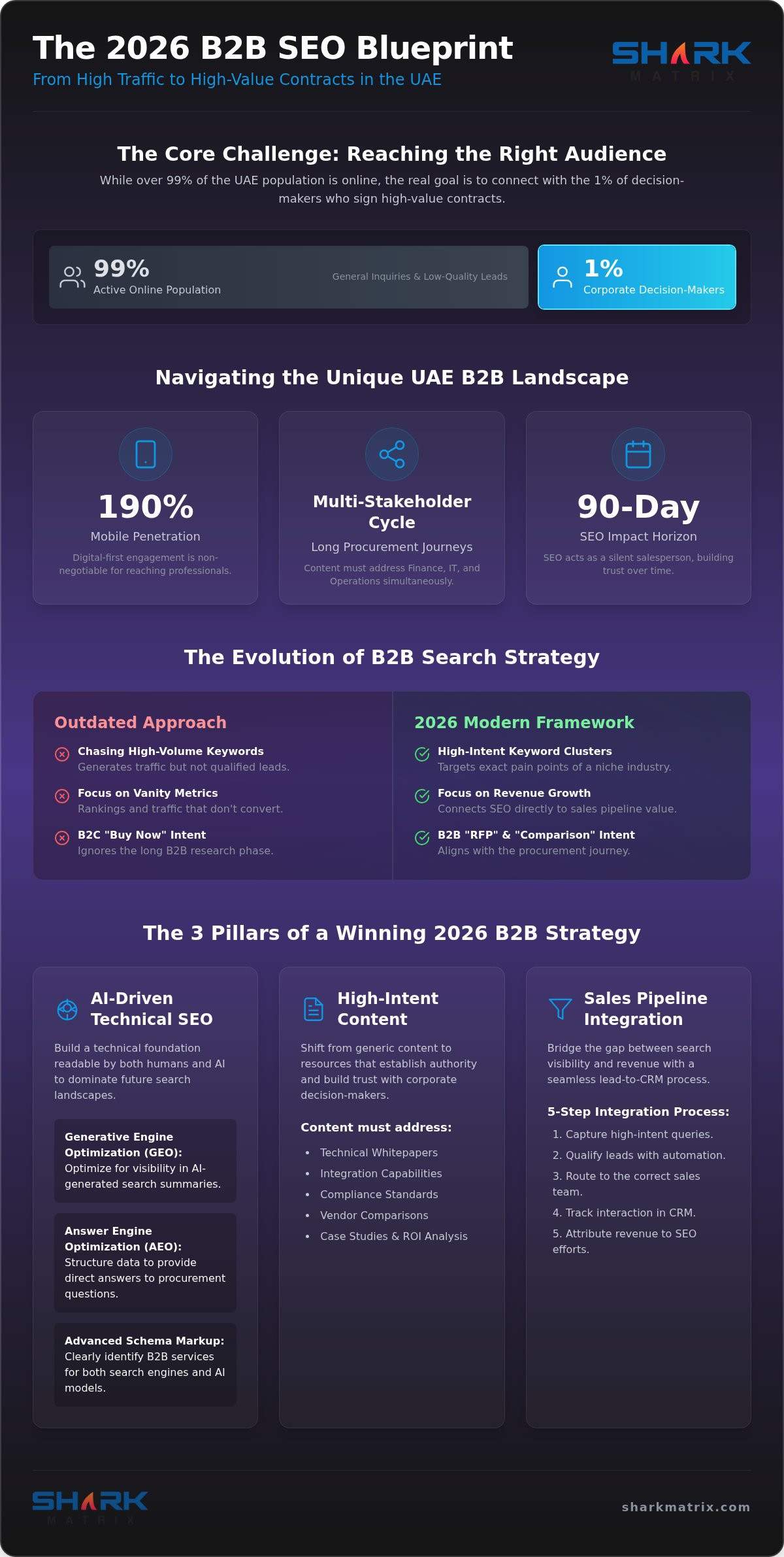
Over 99% of the UAE population is now actively online, yet many national enterprises still struggle to capture the specific 1% of decision-makers who actually sign high-value contracts. If you’ve spent months ranking for industry keywords only to find your inbox filled with low-quality inquiries that don’t match your ideal customer profile, you’re not alone. The national procurement cycle is a complex, multi-stakeholder journey that traditional search tactics often ignore.

It’s frustrating to watch competitors dominate high-intent search queries while your own pipeline remains inconsistent. This guide provides the definitive 2026 b2b seo strategy uae to help you master the technical, content, and AI-driven frameworks required to generate high-quality corporate leads. You’ll learn how to integrate SEO with your sales CRM, leverage bilingual optimization, and adapt to the rise of Answer Engine Optimization (AEO) to ensure your brand remains the primary choice for national corporate buyers. We’ll explore how to bridge the gap between search visibility and revenue growth in a market defined by 190% mobile penetration and rapid digital transformation.

Key Takeaways

  • Understand the unique characteristics of the national B2B search landscape and how to align your content with complex multi-stakeholder procurement cycles.
  • Implement a modern b2b seo strategy uae that leverages Generative Engine Optimization (GEO) to stay visible in AI-generated search summaries.
  • Shift your focus from vanity metrics to high-intent commercial queries that establish authority and build trust with corporate decision-makers.
  • Learn the 5-step process for integrating SEO leads into your sales pipeline to ensure accurate CRM attribution for every inquiry.
  • Explore how the synergy between technical software engineering and SEO performance can accelerate your national digital transformation.

Understanding the National B2B Search Landscape in the UAE

The B2B search environment in the UAE is fundamentally different from the consumer market. While B2C SEO often focuses on immediate gratification and high-volume transactional terms, a successful b2b seo strategy uae requires a deep understanding of the professional buyer’s psychology. In 2026, national enterprises don’t just search for products; they search for solutions that align with the strategic goals of the UAE’s AI and Digital Economy Ministry and broader digital transformation initiatives. This landscape demands a shift from broad visibility to targeted authority.

B2B vs. B2C Search Intent in the UAE

The Impact of National Procurement Norms on SEO

The national procurement cycle often spans several months, involving multiple stakeholders from finance, operations, and IT. Your digital presence must address the concerns of each party simultaneously. Search visibility acts as a silent salesperson, building trust during the lengthy evaluation phase before a vendor even makes the shortlist. Research indicates that for most B2B companies, the impact of SEO on the sales pipeline becomes visible within a 90-day horizon. This timeline reflects the deliberate nature of national corporate buying where trust is the primary currency. B2B SEO is a long-term trust-building engine for national enterprises.

Technical SEO and AI-Driven Pipeline Engineering

A robust b2b seo strategy uae in 2026 requires more than just optimized meta descriptions. It demands a technical infrastructure that acts as a lead generation engine. As the Digital Economy in the UAE continues to expand, national enterprises must build websites that prioritize speed, scalability, and seamless data flow. Your site architecture shouldn’t just exist to host content; it must support complex B2B service hierarchies that guide procurement officers toward high-value conversions. Technical fixes are typically implemented within 2-4 weeks, but the foundation you build today determines your competitive edge for the next decade.

The rise of Generative Engine Optimization (GEO) has fundamentally changed how search engines interpret business data. Traditional search is merging with AI-driven summaries, meaning your technical setup must be readable by both humans and large language models. By integrating AI automation services, you can streamline lead capture and ensure that every interaction is tracked within your sales pipeline. This synergy between software engineering and SEO performance is no longer optional for national brands aiming for digital dominance.

Answer Engine Optimization (AEO) for 2026

Search has become conversational. To rank in 2026, you must optimize for featured snippets and AI-generated answers. This involves implementing advanced schema markup that specifically identifies your national B2B service offerings. How natural language processing influences technical content delivery is now a primary factor in visibility. If your data isn’t structured to answer specific procurement questions directly, you’ll lose out to competitors who have pivoted to an AEO-first approach. It’s about providing the direct, factual answers that AI engines crave.

Technical Audits for Complex Enterprise Sites

Large-scale national directories often suffer from crawl budget inefficiencies. If search engines can’t find your high-intent pages, they can’t rank them. Regular technical audits are essential to identify these bottlenecks. Additionally, with mobile penetration in the UAE exceeding 190%, mobile-first excellence is non-negotiable. Decision-makers are researching vendors on the go, making site speed and responsive design critical trust signals. When refining your b2b seo strategy uae, prioritize server-side tracking to ensure no lead goes uncounted in your CRM. This overcomes the limitations of browser-based pixels and ensures your sales team receives accurate data. If you’re looking to enhance your technical foundation, exploring custom AI automation services can bridge the gap between technical performance and lead generation.

High-Intent Keyword Strategy and Content Authority

Chasing high search volume is a common pitfall in a national b2b seo strategy uae. In 2026, success comes from dominating commercial intent keywords that signal a readiness to engage in a procurement discussion. Establishing E-E-A-T (Experience, Expertise, Authoritativeness, and Trustworthiness) is essential because corporate buyers aren’t just looking for features; they’re looking for stable, long-term partners. This alignment with the UAE’s Digital Economy Strategy ensures your content reflects the national ambition for high-value digital growth.

Mapping Keywords to the Corporate Sales Funnel

Effective keyword mapping follows the buyer’s journey through three distinct phases:

  • TOFU (Top of Funnel): Educational guides providing solutions to common industry problems.
  • MOFU (Middle of Funnel): Technical whitepapers and comparison articles that narrow down vendor options.
  • BOFU (Bottom of Funnel): Service-specific pages optimized for terms like “enterprise solutions” and “national providers.”

This structured approach ensures you’re visible when a buyer is just identifying a problem and remains their top choice when they’re ready to sign a contract.

Leveraging AI for Content Strategy

Scaling your content output doesn’t mean sacrificing the human touch. By utilizing generative AI development, you can accelerate research and outline creation while keeping your senior experts focused on high-level strategy. It’s vital to maintain a human-centric brand voice so your content doesn’t feel robotic or generic in an AI-heavy search environment. Data-driven case studies remain the ultimate B2B trust signal. They provide the concrete social proof needed to move a lead from a search result into your sales CRM. When your strategy combines AI efficiency with human expertise, you create a content engine that drives consistent enterprise growth.

B2B SEO Strategy UAE: The 2026 Enterprise Growth Blueprint

Aligning Search with the National B2B Sales Funnel

Generating traffic is a vanity metric if those visitors don’t eventually become clients. In a national B2B environment, a successful b2b seo strategy uae must bridge the gap between the search bar and the sales CRM. This requires a shift in mindset from measuring “Traffic Volume” to “Pipeline Value.” By 2026, the most successful enterprises will be those that treat search as the first step in a highly engineered sales journey rather than an isolated marketing activity.

To achieve this, you need a structured 5-step process for lead integration. First, use high-intent landing pages to capture interest. Second, implement AI chatbot development to qualify leads 24/7, filtering prospects based on their authority and budget before they ever reach a human agent. Third, use server-side tracking to attribute the lead source accurately. Fourth, automate lead distribution to the correct industry specialist within your sales team. Finally, use automated email sequences to nurture leads that aren’t ready for an immediate contract. This end-to-end alignment ensures no high-value inquiry falls through the cracks.

Lead Qualification and Nurturing

Differentiating between Marketing Qualified Leads (MQLs) and Sales Qualified Leads (SQLs) is vital for maintaining a healthy pipeline. SEO content shouldn’t stop at the awareness stage. Technical whitepapers and comparison guides act as sales enablement tools, supporting your team during the complex closing phase of a multi-month procurement cycle. When a prospect searches for specific technical specifications, your site should provide the exact data they need to justify a purchase to their internal board. Automated email sequences tailored to these search-sourced leads keep your brand top-of-mind throughout the evaluation period.

Advanced Analytics for National Campaigns

National B2B campaigns involve committees, not just individual buyers. This means you must track cross-device journeys where a researcher might find you on mobile while a CFO reviews the final proposal on a desktop. Using heatmap data allows you to see which sections of your service pages are holding attention and which are causing friction. This data-driven approach allows for constant refinement of your conversion paths. Integrating your CRM with search data allows you to attribute specific revenue figures to your organic search efforts, proving the absolute ROI of your national SEO campaigns. To see how these frameworks can be applied to your specific industry, consider exploring custom AI automation services to streamline your lead management.

Scaling Your National B2B Presence with Shark Matrix

Scaling a national enterprise in 2026 requires a partner who understands that search visibility is a software engineering challenge as much as a marketing one. Shark Matrix Technologies LLC stands at this intersection, where technical engineering meets digital marketing to deliver a high-impact b2b seo strategy uae. We don’t just optimize for keywords; we build the digital infrastructure that allows your business to dominate the national search landscape. Our focus is on creating a sustainable lead generation engine that scales with your corporate ambitions.

We provide industry-specific AI solutions designed to give you a competitive edge in complex niches. These tools go beyond standard optimization, leveraging machine learning to predict search trends and buyer behavior within the national procurement cycle. By building organic authority through a data-driven lens, we ensure your brand remains the authoritative voice that procurement committees trust during their multi-month evaluation process. This approach moves you beyond chasing traffic and toward capturing market share.

A Holistic Approach to Digital Growth

Peak performance isn’t achieved through isolated tactics. It’s the result of a unified strategy. We integrate our SEO expertise with our web-development-agency services to ensure your site architecture is fast, responsive, and technically sound. This foundation is critical for maintaining high rankings and converting professional visitors into qualified leads. With over 15 years of national market experience since our founding in 2010, we’ve refined our methods to include comprehensive reputation management, ensuring your brand’s digital footprint remains untarnished as you grow.

Partnering for 2026 and Beyond

The future of search is AI-driven, and we’ve already built the frameworks to help you navigate it. Our technical department specializes in the synergy between custom software and search performance, preparing your business for the shift toward AEO and GEO. We don’t just follow trends; we develop the technology that defines them. It’s time to move beyond city-level tactics and embrace a national growth blueprint that delivers measurable ROI. Contact our national strategy team today for a comprehensive technical audit and take the first step toward national market leadership. Your b2b seo strategy uae deserves a partner that can bridge the gap between technical complexity and commercial success.

Future-Proof Your National Enterprise Growth

Dominating the national B2B market in 2026 requires moving beyond basic search visibility. You must embrace a framework that aligns technical engineering with the complex corporate procurement cycle. By integrating AI-driven Answer Engine Optimization and high-intent content, you ensure your brand remains the primary choice for decision-makers across the country. A successful b2b seo strategy uae isn’t just about traffic; it’s about building a consistent pipeline of qualified inquiries that integrate seamlessly with your sales CRM.

Shark Matrix brings over 15 years of national SEO expertise and specialized AI and AEO integration to the table. We have a proven track record with national B2B enterprises, helping them bridge the gap between technical complexity and commercial success. It’s time to stop chasing vanity metrics and start engineering for revenue growth. Book a National B2B SEO Strategy Consultation with Shark Matrix to begin your digital transformation today. Your journey toward national market leadership starts with a single strategic shift.

Frequently Asked Questions

What is the primary difference between B2B and B2C SEO in the UAE?

B2B SEO in the national market prioritizes the complex multi-stakeholder procurement journey over quick consumer transactions. While B2C focuses on emotional triggers and high-volume sales, a successful b2b seo strategy uae targets informational intent and technical authority. It addresses the specific pain points of C-suite executives and procurement officers who require whitepapers and case studies to justify a long-term partnership. Trust and compliance are the primary currencies in this landscape.

How long does it take to see measurable lead generation from a B2B SEO strategy?

For most national enterprises, the impact of SEO on the sales pipeline becomes visible within a 90-day horizon. While technical fixes are usually implemented within 2-4 weeks, noticeable ranking improvements often take 3-6 months. In highly competitive industries, establishing strong dominance may require 6-12 months. This timeline reflects the deliberate nature of national corporate buying and the time needed for search engines to recognize your brand as a niche authority.

Why is Answer Engine Optimization (AEO) critical for B2B brands in 2026?

Answer Engine Optimization is critical because AI-generated summaries now dominate the top of search results. In 2026, many B2B decision-makers use conversational AI to shortlist vendors. If your content isn’t structured to provide direct, factual answers that AI engines can easily cite, you’ll lose visibility to competitors who have optimized for these platforms. AEO ensures your expertise is featured in the summaries where procurement research begins.

How do you measure the ROI of SEO for long B2B sales cycles?

Measuring ROI during a multi-month sales cycle requires moving beyond vanity metrics like total visits. You should measure success through Pipeline Value and CRM-attributed keyword targeting. By integrating your search data with your sales CRM, you can see exactly which organic queries led to high-value contracts. This allows you to calculate the precise return on investment by comparing the cost of your SEO efforts against the actual revenue generated.

Is bilingual (English and Arabic) SEO necessary for national B2B companies?

Bilingual content is absolutely necessary for national B2B companies aiming for comprehensive market coverage. English-only websites frequently miss significant search volume from government-related entities and regional corporate leaders that search in Arabic. Implementing a bilingual b2b seo strategy uae ensures that you capture the full range of national intent. It demonstrates cultural competence and respect for local business norms, which are essential for building trust with senior regional stakeholders.

Can AI automation improve the quality of leads coming from organic search?

What technical SEO factors are most important for national enterprise websites?

Mobile-first indexing is paramount given the national mobile penetration rate of over 190%. Enterprise websites must be optimized for speed and responsive performance across multiple devices. Other critical factors include server-side tracking to overcome browser-based privacy limitations and advanced schema markup to help search engines understand complex service hierarchies. Ensuring your technical foundation is scalable allows your site to handle the growing data demands of a national digital transformation.

How does Shark Matrix integrate CRM data with SEO performance tracking?

Shark Matrix leverages custom software engineering to create a seamless link between search performance and your internal sales data. We use server-side tracking to accurately attribute leads and conversions that browser-based pixels might miss. This technical integration allows us to show the direct correlation between specific SEO activities and closed deals in your CRM. Our approach ensures that every marketing dollar is backed by verifiable revenue data.

Categories
SEO

Local SEO Services Dubai: The 2026 Guide to Dominating UAE Search Results

Did you know that over 65% of Google searches now end without a single click? In 2026, the UAE digital space is more competitive than ever, making it harder for national brands to maintain visibility across multiple locations. You’ve likely felt the pressure of managing complex Arabic search queries while trying to outpace rivals who seem to own the local map pack. It’s a common struggle to bridge the gap between national reach and local relevance without getting lost in the noise.

This guide reveals how to utilize professional local seo services dubai to capture high-intent traffic and scale your operations effectively. You’ll discover how to secure Top 3-Pack rankings and increase lead volume from mobile searches using a data-driven approach. We’ll walk through the essentials of Arabic localization, AI-powered citation management, and the specific strategies needed to dominate UAE search results this year. From leveraging AI automation to navigating the latest search engine shifts, you’ll gain a scalable roadmap for national growth that turns local searches into measurable business results.

Key Takeaways

  • Learn how to transition your strategy toward mobile-first, “near me” intent to capture high-intent traffic across the entire UAE.
  • Identify the core pillars of local search, including Google Business Profile optimization and strict NAP consistency across national directories.
  • Discover how expert local seo services dubai allow national brands to scale their presence while overcoming language barriers and multi-location management issues.
  • Master the transition to Answer Engine Optimization (AEO) to ensure your business data is accurately pulled by AI chatbots and voice assistants.
  • Leverage data-driven AI automation to manage local citations and lead generation, ensuring a measurable return on your digital marketing investment.

What are Local SEO Services and Why Do They Matter in 2026?

Understanding What is Local SEO helps clarify why it’s the backbone of modern digital growth. In 2026, local SEO is the practice of optimizing your brand to appear for location-specific queries. It’s no longer just about keywords; it’s about physical presence and digital relevance. With the UAE’s internet penetration reaching over 99%, the shift from broad, traditional search to hyper-local “near me” intent is complete. The digital ecosystem has evolved. High-speed 5G networks and near-universal mobile adoption mean users expect instant answers tailored to their exact coordinates. If a customer searches for a service, they want results within a few kilometers. This is where professional local seo services dubai become essential. They bridge the gap between a brand’s existence and its discoverability at the precise moment a user is ready to buy.

The Anatomy of the Local 3-Pack

Google uses a specific algorithm to choose which three businesses appear in the coveted map results. Three main factors drive this selection: proximity, relevance, and prominence. Proximity measures how close the business is to the searcher’s location. Relevance determines how well a business profile matches the specific query. Prominence looks at the brand’s overall digital authority, including reviews and backlinks. The Local 3-Pack is the prime real estate of 2026 search, capturing the majority of high-intent mobile clicks before a user even scrolls down.

Why National Brands Need a Local Strategy

National brands often make the mistake of ignoring local signals. This allows smaller, agile competitors to steal market share. To stay competitive, large organizations must adopt a “local-national” hybrid strategy. This involves maintaining a strong national identity while optimizing individual location pages to satisfy local search intent. By doing so, brands capture high-intent traffic that’s ready to convert immediately. Implementing these strategies requires a deep understanding of the market. Many firms partner with an experienced seo company dubai to manage their national footprint across local results. These specialized local seo services dubai ensure that a brand remains visible whether a user is searching from a residential district or a commercial hub across the country.

The Core Pillars of a High-Impact Local Search Strategy

A successful local presence requires more than just a map pin. It demands a structured approach that signals trust to both users and search engines. Your Google Business Profile (GBP) serves as the digital foundation. In 2026, an optimized profile includes high-resolution imagery, updated service hours, and precise categories that match user intent. This profile is often the first interaction a customer has with your brand, making it a critical component of professional local seo services dubai. Accuracy here isn’t optional; it’s the baseline for entry into the Local 3-Pack.

Consistency across the web is equally vital. Your Name, Address, and Phone number (NAP) must be identical across every UAE-based directory and social platform. Discrepancies in this data confuse search algorithms and erode consumer trust. Beyond basic listings, building local authority through UAE-specific backlinks is essential. Links from local news outlets, industry associations, or regional business hubs tell search engines that your business is a legitimate part of the national economy. Additionally, user engagement signals, such as review frequency and your response time to queries, now carry significant weight in determining your rank. Active management of these signals shows that your business is reliable and responsive to the market’s needs.

Arabic Localization and Cultural Relevance

Direct translation is a common pitfall for brands entering the GCC market. To truly dominate, you need Arabic SEO and localization excellence that accounts for cultural nuances and local search behaviors. Users in the UAE often search using specific regional dialects or phrasing that automated translation tools miss. By localizing your content, you demonstrate respect for the local culture and improve your visibility among Arabic-speaking audiences. This specialized focus within local seo services dubai ensures your brand feels native rather than like an outsider, which is essential for building long-term brand loyalty in the region.

Technical Foundations for Local Search

Technical precision ensures search engines can parse your location data accurately. Implementing Local Business Schema markup is a non-negotiable step. This structured data provides search engines with clear details about your physical locations, operating hours, and service offerings. Mobile performance is another pillar. Since most local searches happen on the go, your site must load instantly on UAE mobile networks. A seamless UI/UX on location-specific landing pages also helps retain high-intent visitors. If your site’s performance is lagging, consulting with a web development agency dubai can help optimize these technical foundations for better local visibility.

Local SEO Services Dubai: The 2026 Guide to Dominating UAE Search Results

Scaling Local Visibility for National Brands: A Comparison

Managing a single physical location differs significantly from overseeing a national enterprise with dozens of touchpoints across the UAE. For a single-location business, success often comes from deep, community-level engagement. National brands, however, face the challenge of maintaining a unified brand voice while remaining relevant to diverse regional audiences. Without a structured approach, a national brand’s digital presence can become diluted, losing ground to smaller, hyper-local competitors who appear more “authentic” to search algorithms. This is why enterprise-level local seo services dubai focus on systems that scale without sacrificing the personal touch of a local business.

Centralized data management is the secret to efficiency in 2026. When you manage location data from a single source of truth, you eliminate the risk of conflicting information that triggers search engine penalties. It’s about creating a “local-national” hybrid where the corporate office sets the standards, but individual locations have the flexibility to highlight regional offers or specific services. By treating local SEO as a data-driven lead generation tool, national brands can track performance across their entire footprint. This allows for precise adjustments based on which regions are underperforming, ensuring every marketing dirham contributes to the bottom line.

Managing Multi-Location GBP Profiles

For national brands, verifying and updating hundreds of Google Business Profiles manually is impossible. Bulk verification strategies are essential for maintaining control over a national location set. In 2026, top-tier agencies utilize AI automation services for business efficiency to synchronize location data across the web instantly. These tools ensure that if a national brand changes its operating hours or adds a new service, every digital citation is updated in real-time. This level of automation prevents customer frustration and maintains the ranking signals necessary for dominating the Local 3-Pack nationwide.

National vs. Hyper-Local Keyword Strategy

A balanced ROI requires a dual-track keyword strategy. National keywords build brand awareness, while geo-modified terms capture users at the point of purchase. You can’t rely on broad terms alone to win local searches. The following table illustrates how intent shifts as keywords become more localized:

Strategy Keyword Example User Intent
National Reach Digital Marketing UAE Research & Awareness
Local Intent local seo services dubai Immediate Conversion

National brands must optimize for both. Broad terms fill the top of your funnel, but local keywords ensure you’re the chosen provider when a user is ready to visit a physical location or book a service. Balancing these two ensures your brand is visible throughout the entire customer journey.

Beyond Search: Mastering AEO and AI for Local Dominance

By 2026, the search experience has moved far beyond a simple list of websites. Answer Engine Optimization (AEO) is now the standard for brands wanting to stay relevant in a conversational world. Instead of browsing “ten blue links,” users receive direct, synthesized answers from AI models. This shift means your business information must be instantly accessible and perfectly structured for these engines to find you. When a potential client uses a chatbot or voice assistant to find local seo services dubai, the AI isn’t just looking for keywords; it’s looking for the most authoritative, direct answer to the user’s specific problem.

AI chatbots and voice assistants like Siri and Alexa pull data from a variety of sources, including your Google Business Profile and local directories. If your data is fragmented or unstructured, these agents will simply skip your brand in favor of a competitor with clearer signals. As a pioneer in the UAE market, Shark Matrix helps brands adapt through Generative Engine Optimization (GEO). This ensures your national brand isn’t just listed, but is actively recommended by AI as the top solution for local queries.

Steps to Optimize for Local Voice Search

Voice search is inherently conversational. People don’t speak in short, disjointed keywords; they ask full questions. To capture this traffic, you must optimize for natural language and “near me” queries that reflect real human speech. Focus on long-tail keywords that mimic these interactions. For example, instead of “SEO Dubai,” target phrases like “where can I find the best local seo services dubai for my business?” Ensure your GBP data is formatted in a way that AI engines can extract quickly, providing the immediate answers voice searchers demand.

Leveraging AI for Local Content Creation

Scaling content across a national footprint used to be a manual, expensive process. Today, we use Natural Language Processing to analyze local sentiment and create content that resonates with specific regional audiences. This allows national brands to generate hyper-localized landing pages and blog posts at a scale previously impossible. AI automation reduces the cost of local content by up to 40% while maintaining the high quality search engines require. If you’re ready to modernize your strategy, explore our ai automation services to see how we can streamline your local growth.

Shark Matrix: Your Partner for National Market Dominance

Shark Matrix has been a fixture of the UAE digital ecosystem since 2010. With over 15 years of experience, we’ve seen the market evolve from basic directory listings to the AI-driven landscape of 2026. Dominating the search results requires more than just standard optimizations; it demands a sophisticated blend of technical SEO and custom AI engineering. We don’t just optimize for search engines; we build systems that capture high-intent traffic across the nation. As a national partner, we provide the local seo services dubai businesses need to bridge the gap between global standards and local cultural nuances. Our deep expertise in professional Arabic digital marketing ensures your brand speaks the language of the GCC market with absolute precision. This isn’t just about translation. It’s about cultural resonance and understanding the specific search behaviors of a national audience.

Custom SEO Solutions for the UAE Market

Every brand has unique ROI targets and national business goals. We develop tailored strategies that align with these objectives, ensuring every campaign is a data-driven lead generation engine. Beyond rankings, we integrate Online Reputation Management to protect your national brand equity from negative sentiment or misinformation. For a deeper look at our broader methodology, explore The Ultimate Guide to Search Engine Optimization in the UAE. This holistic approach ensures that your local visibility supports your overarching national growth strategy rather than operating in a silo. We position your brand as a leader in its field, ensuring that your digital footprint is both expansive and authoritative.

Data-Driven Reporting and Transparency

National brand managers need more than just monthly PDFs. They need real-time insights into how their locations are performing across the UAE. Shark Matrix utilizes advanced analytics to track local lead generation with surgical precision. Our real-time dashboards provide a transparent view of your rankings, engagement signals, and conversion rates for every physical location. This level of transparency is a hallmark of our local seo services dubai, giving you the confidence to make informed decisions about your marketing spend. We believe in total accountability, which is why we provide granular data that proves the value of your SEO investment. By monitoring these metrics daily, we can pivot strategies quickly to address shifting competition or algorithm updates. If you’re ready to see where your brand stands in the local market, contact Shark Matrix for a comprehensive local SEO audit today.

Future-Proof Your National Presence in the UAE

Dominating the digital landscape in 2026 requires more than just traditional tactics; it demands a synergy between hyper-local relevance and advanced AI integration. We’ve explored how professional local seo services dubai bridge this gap by combining cultural localization with technical precision. By prioritizing Answer Engine Optimization and maintaining a consistent national footprint, your business can turn high-intent search queries into loyal customers across the country. It’s about being visible where your customers are, exactly when they’re ready to engage.

Shark Matrix brings over 15 years of UAE market expertise to your growth strategy. As specialists in Arabic localization and AI-driven SEO, we have a proven track record in national lead generation. We help you navigate the complexities of multi-location management while ensuring your brand remains authoritative and highly visible across all search engines. Ready to dominate the UAE market? Get a free local SEO consultation from Shark Matrix today. Your brand’s journey to the top of the search results starts with a data-driven plan and the right partner to execute it.

Frequently Asked Questions

What is the difference between general SEO and local SEO?

Local SEO focuses on capturing location-based intent, while general SEO targets broader, non-geographic queries. General SEO aims for global or national visibility on information-based keywords. Local SEO optimizes for the “near me” intent and the Local 3-Pack, prioritizing proximity and physical relevance. It’s the difference between ranking for “how to do marketing” versus specialized local seo services dubai to find a nearby partner for your national brand.

How long does it take to see results from local SEO services in Dubai?

You can typically expect to see measurable movement in local rankings within three to six months. Initial technical fixes and citation cleanups often show early signs of progress within weeks. However, building the necessary authority and prominence to stay in the Top 3-Pack consistently requires ongoing optimization. Factors like competition levels and your current domain authority will influence the exact timeline for achieving national growth across the UAE.

Can a national brand rank for local keywords without a physical office in every city?

It’s possible to rank for local keywords without a physical office in every location by using service area pages and localized content. While a Google Business Profile requires a physical address for a map pin, national brands can still capture local intent through geo-targeted landing pages. These pages should focus on regional customer needs and specific local service offerings to signal relevance to search engines without needing a storefront.

How does Arabic localization affect my local search rankings in the UAE?

Arabic localization significantly boosts your rankings because search engines prioritize content that matches the user’s linguistic and cultural context. In the UAE, many high-intent searches occur in Arabic or regional dialects. By localizing your metadata, reviews, and site content, you tap into a massive segment of the market that competitors might overlook. It signals to algorithms that your business is deeply rooted in the national community and its specific needs.

What is the role of Google Business Profile in 2026 local SEO?

In 2026, your Google Business Profile acts as the primary data source for AI answer engines and traditional map results. It’s no longer just a listing; it’s a dynamic hub for customer interaction, real-time updates, and service menus. AI assistants pull directly from your GBP to answer questions about your availability and location. Maintaining an optimized profile is the single most effective way to secure visibility in the Local 3-Pack today.

How much do local SEO services typically cost for a national brand?

The cost of local SEO for a national brand depends on the number of locations managed and the competitive landscape of your industry. National strategies require more resources for multi-location citation management and localized content creation at scale. Instead of a one-size-fits-all price, professional local seo services dubai are usually structured as monthly retainers that reflect the complexity of maintaining national visibility and lead generation across various regional markets in the UAE.

How does voice search impact local SEO strategies in the Middle East?

Voice search has shifted local strategies toward natural language and conversational phrasing. Users in the Middle East increasingly use voice assistants to find immediate solutions while on the move. This requires optimizing for long-tail, question-based keywords rather than short, disjointed terms. Your content must provide direct, concise answers that AI can easily parse and read aloud to users looking for fast, local information while navigating their daily routines.

What are the most important local SEO ranking factors for 2026?

The most important ranking factors for 2026 include proximity, prominence, and user engagement signals. Beyond these, the accuracy of your structured data and the quality of your Arabic localization play critical roles. Search engines also heavily weigh “prominence” factors like the frequency and sentiment of local reviews. Having a robust strategy for managing these signals is essential for any brand aiming to dominate the UAE search results and maintain authority.

Categories
Digital Marketing

LinkedIn PPC Management: 2026 UAE Business Guide

LinkedIn is responsible for 80% of all B2B leads from social media, yet many UAE firms still see their budgets vanish into high costs without a single decision-maker calling back. It’s a common frustration in a market where the average click can cost between AED 18 and AED 40. Effective ppc campaign management for linkedin isn’t about casting a wide net anymore. In 2026, it’s about surgical precision and navigating the UAE Media Council’s mandatory Advertiser Permit regulations to ensure your brand stays visible and compliant.

We understand that watching your Cost Per Lead climb toward AED 300 feels unsustainable when the quality doesn’t match the price tag. This guide will show you how to master high-precision LinkedIn strategies that leverage AI-driven optimization to lower your CPL and build a predictable pipeline of C-suite leads. You’ll learn how to use LinkedIn’s “Accelerate” AI tools, localize your messaging for the GCC’s 10 million active professionals, and scale your B2B growth with certainty.

Key Takeaways

  • Learn how to transition from manual bidding to algorithmic ppc campaign management for linkedin to leverage 2026’s AI-driven targeting features.
  • Discover how to implement advanced technical architecture like the Insight Tag to track high-value intent signals across the UAE business landscape.
  • Find out why “edutainment” and interactive video content are the gold standard for capturing the attention of modern C-suite executives.
  • Uncover the “Bilingual Advantage” and how professional Arabic localization can significantly improve your lead quality and conversion rates.
  • Explore how AI automation can stabilize your B2B pipeline and reduce the friction between high-cost clicks and qualified sales meetings.

What is PPC Campaign Management for LinkedIn in 2026?

Professional Pay-per-click (PPC) management for LinkedIn is the data-driven discipline of overseeing a brand’s paid advertising presence to acquire high-quality B2B leads. By 2026, this role has evolved from simple manual bidding into a sophisticated algorithmic oversight. Traditional manual adjustments can’t keep pace with LinkedIn’s “Accelerate” AI, which now automates campaign creation and placement optimization in real-time. It’s no longer about just “running ads”; it’s about managing a complex ecosystem of data signals and creative variants.

Effective ppc campaign management for linkedin requires a move away from the basic “boosted post” mentality. While hitting a “Sponsor” button might increase visibility, strategic architecture uses the LinkedIn Insight Tag to track deep behavioral signals across your website. This ensures you aren’t just buying vanity clicks. Instead, you’re building a funnel that converts traffic into Marketing Qualified Leads (MQLs). In a market where average CPCs hit AED 40, professional oversight is the only way to prevent rapid budget bleed.

The Strategic Advantage for UAE Enterprises

The United Arab Emirates currently hosts over 10 million registered LinkedIn members. For national enterprises in the tech and professional services sectors, this represents a unique opportunity to reach high-net-worth decision-makers directly. Unlike other platforms, LinkedIn allows UAE businesses to align their ad spend with national B2B growth goals by targeting specific career trajectories. The 2026 “Career Journey” targeting feature lets advertisers reach professionals exactly when they’re stepping into new leadership roles. This makes it the primary channel for high-stakes B2B acquisition in the GCC.

PPC vs. Organic Social: Why Management is Mandatory

Organic reach has declined to the point where it’s no longer a viable growth strategy for brands. It’s now a “pay-to-play” environment. Without expert management, UAE firms risk wasting significant capital on generic targeting that ignores local nuances. Since February 1, 2026, all advertisers must also hold a UAE Media Council permit under Federal Decree-Law No. 55 of 2023. Professional management ensures your campaigns remain compliant while navigating these regulatory hurdles. It bridges the gap between technical AI automation and a localized B2B strategy that resonates with the GCC’s professional elite.

Technical Architecture: Targeting and AI Integration

Modern ppc campaign management for linkedin relies on a robust technical foundation that goes far beyond selecting basic job titles. The cornerstone of this architecture is the LinkedIn Insight Tag. This lightweight piece of code tracks how professionals interact with your website after clicking an ad, allowing you to capture high-intent signals. For a UAE enterprise, this means identifying when a decision-maker from a major free zone or national entity visits your service pages, enabling you to retarget them with surgical precision. By layering job function, company size, and seniority, you create a targeting stack that ensures your budget only reaches those with the authority to sign off on AED 100,000+ contracts.

To maximize efficiency, leading firms are now integrating AI automation services to bridge the gap between ad clicks and lead nurturing. Instead of manual data entry, AI-driven workflows can instantly categorize leads based on their LinkedIn profile data and trigger personalized follow-up sequences. This technical synergy reduces the friction in the sales cycle, turning a high-cost click into a warm sales conversation before the lead loses interest. When you choose from the official LinkedIn ad formats, having this backend automation in place is what separates a profitable campaign from an expensive experiment.

Advanced Audience Segmentation in the UAE

Success in the GCC market requires targeting specific national entities and industry associations. Account-Based Marketing (ABM) allows you to upload lists of target companies, such as those within the Dubai International Financial Centre (DIFC) or Abu Dhabi Global Market (ADGM). Professional ppc campaign management for linkedin also involves aggressive exclusion strategies. By excluding job seekers, students, and entry-level staff, you stop paying for irrelevant clicks that often plague generic campaigns. This ensures every Dirham spent is focused on the C-suite and senior management layers of the UAE’s most influential organizations.

Harnessing AI for Creative and Bid Optimization

Creative fatigue is a major cause of rising costs. We utilize Generative AI to develop and test hundreds of ad copy variants simultaneously, identifying which professional hooks resonate best with the local market. On the bidding side, 2026’s predictive analytics tools allow for more accurate budget forecasting. While “maximum delivery” bidding works for high-volume awareness, manual bidding often yields better results for niche B2B services where lead quality is paramount. If you want to see how these technical layers can transform your pipeline, consider exploring our tailored AI automation solutions for B2B growth.

LinkedIn PPC Management: 2026 UAE Business Guide

How to Launch a High-ROI LinkedIn Campaign

Launching a campaign requires more than just a creative asset and a budget. Professional ppc campaign management for linkedin starts with aligning your objective to the platform’s algorithm. If your goal is high-value B2B acquisition, selecting “Lead Generation” allows the algorithm to prioritize users most likely to fill out a form. By 2026, the creative landscape has shifted toward “edutainment,” which is content that provides educational value while remaining engaging. Video ads with embedded polls or clickable CTAs are now the standard for capturing the attention of busy UAE executives who are tired of generic corporate messaging.

Choosing the Right Ad Formats

Selecting the right format depends on where your prospect is in the buyer’s journey. Carousel ads work well for showcasing a suite of professional services, while Single Image ads are perfect for punchy, direct offers. For lead magnet distribution, Document Ads allow users to read your whitepaper directly in the feed, which often results in a lower Cost Per Lead (CPL). If you’re looking for a deeper dive into the planning phase, this comprehensive guide to LinkedIn advertising offers a detailed breakdown of how to structure these campaigns for maximum impact across different business goals.

The Crucial Role of Lead Gen Forms

In the UAE’s mobile-first market, native Lead Gen Forms are essential. These forms pre-fill with a user’s profile data, reducing the friction that typically causes high bounce rates on external landing pages. LinkedIn Lead Gen Forms in the UAE see completion rates between 12% and 18%, far outperforming the 2% to 5% average seen on standard web forms. To ensure these leads don’t go cold, we use AI automation to sync form data directly to your CRM in real-time. This immediate response is critical when the average CPL in the region ranges from AED 100 to AED 300. You can’t afford to let a high-value decision-maker wait for a manual follow-up.

Once your campaign is live, it enters a “Learning Phase.” It’s tempting to make changes in the first 48 hours, but the algorithm needs at least 7 to 10 days of data to stabilize. Effective ppc campaign management for linkedin involves monitoring performance weekly and making iterative adjustments. This might involve pausing underperforming creative variants or shifting budget toward the audience segments showing the highest conversion rates. By treating your campaign as a living architecture rather than a “set and forget” task, you ensure your ROI remains high in the competitive UAE landscape.

Solving the Lead Quality Gap: Localization and Nurturing

Many UAE businesses hesitate when they see LinkedIn’s higher price tags compared to other platforms. While a Cost Per Lead (CPL) between AED 100 and AED 300 might seem steep, it’s the price of admission to the region’s most exclusive professional boardroom. The real issue isn’t the cost; it’s the lead quality gap. High-precision ppc campaign management for linkedin solves this by moving beyond generic targeting to include sophisticated lead scoring and localization. By filtering for specific seniority levels and company sizes within the UAE, you ensure your budget isn’t wasted on entry-level staff or job seekers who can’t sign off on major contracts.

Arabic Digital Marketing Nuances

Localization in the UAE goes far beyond simple word-for-word translation. Professional Arabic for the GCC market requires a specific tone that balances modern business terminology with traditional cultural etiquette. Using “street” Arabic or poor automated translations can instantly damage your brand’s authority among local Emirati and Arab expatriate decision-makers. Visual cues are equally important. Imagery should reflect the local professional environment, featuring recognizable UAE business districts or culturally appropriate attire. Implementing bilingual campaigns significantly increases trust with local stakeholders by demonstrating a deep commitment to the national market.

Post-Click Management: Nurturing the Lead

The journey doesn’t end when a user submits a form. In the fast-paced UAE business environment, the “Speed to Lead” rule is absolute. If a prospect isn’t contacted within minutes, the likelihood of conversion drops significantly. Integrating AI chatbots into your workflow allows for instant lead qualification and engagement, even outside of standard business hours. These bots can ask preliminary lead-scoring questions, such as project budget or implementation timelines, ensuring your sales team only spends time on high-value prospects.

Effective ppc campaign management for linkedin also involves multi-channel retargeting to stay top-of-mind during long B2B sales cycles. If a decision-maker interacts with your ad but doesn’t convert, they should see follow-up content that addresses their specific pain points. This persistent presence builds the authority necessary to close deals in the competitive GCC landscape. If you’re ready to bridge the gap between expensive clicks and qualified sales meetings, explore our comprehensive LinkedIn PPC strategies to start scaling your B2B growth today.

Partnering for Success: Shark Matrix PPC Management

Shark Matrix Technologies LLC has been a fixture in the Dubai business community since 2010. We specialize in bridging the gap between high-level technical development and B2B social strategy. Effective ppc campaign management for linkedin requires constant vigilance. It isn’t enough to set a budget and walk away. Our team provides daily bid optimization to ensure your ads are shown to decision-makers when they are most active. We focus on transparent ROI tracking, providing UAE stakeholders with clear reports that translate clicks into revenue-generating outcomes.

By integrating AI development services, we future-proof your lead generation. We don’t just run ads; we build intelligent systems that qualify leads and automate the nurturing process. This holistic approach ensures that your LinkedIn spend is an investment in a scalable growth engine, not just a recurring monthly expense. Our deep expertise in PPC agency services allows us to navigate the complexities of the national market with ease.

Why UAE Brands Choose Shark Matrix Technologies LLC

With over a decade of experience in the national digital landscape, we understand the nuances of the GCC market. We don’t believe in one-size-fits-all packages. Whether you’re in e-commerce, tech, or professional services, we develop custom solutions that combine SEO, PPC, and technical development. This multi-channel approach ensures that your brand captures intent across every touchpoint of the professional journey. We prioritize Arabic localization to ensure your messaging feels native to the local professional elite, avoiding the generic feel of global templates.

Start Your LinkedIn Growth Journey

The first step toward B2B dominance is a thorough initial audit. During this strategy phase, we analyze your current targeting, creative performance, and technical setup to identify opportunities for immediate improvement. We look at your conversion tracking and lead gen forms to ensure no data is being lost. From there, we scale your campaigns nationally and regionally, ensuring your message resonates from Dubai to Abu Dhabi and beyond. Ready to transform your pipeline? Contact Shark Matrix Technologies LLC for a LinkedIn PPC Audit to see how we can optimize your B2B reach and improve your ppc campaign management for linkedin results.

Elevate Your B2B Strategy for the 2026 UAE Market

The 2026 landscape for LinkedIn advertising in the UAE is defined by surgical precision and deep AI integration. Success requires more than just setting a high budget. It demands a sophisticated understanding of bilingual localization and the technical expertise to navigate the UAE Media Council’s latest advertiser permit regulations. By moving from manual bidding to algorithmic oversight, you can stabilize your cost per lead and ensure your brand reaches the C-suite decision-makers who drive national growth.

Effective ppc campaign management for linkedin is no longer a luxury for B2B brands; it’s a mandatory requirement to stay competitive in the GCC. Shark Matrix has been a Dubai-based leader since 2010, specializing in the professional nuances of Arabic and English B2B marketing. Our team uses advanced AI-driven campaign optimization to ensure your advertising spend delivers a measurable return on investment.

Drive High-Quality B2B Leads with Shark Matrix LinkedIn PPC Management

It’s time to transform your professional social presence into a predictable revenue engine for the years ahead.

Frequently Asked Questions

Is LinkedIn PPC management worth the cost for small businesses in the UAE?

LinkedIn is worth the investment for small UAE firms targeting niche B2B sectors because it drives 80% of B2B social leads. While the average CPC is higher than Meta, the precision targeting reaches decision-makers directly. Professional ppc campaign management for linkedin ensures you don’t waste your budget on broad, irrelevant audiences. Small businesses often find that a single high-value contract from a LinkedIn lead covers their entire annual ad spend.

How much should I budget for a national LinkedIn PPC campaign in 2026?

You should budget for a minimum daily spend of AED 40 to keep your campaign active. In the UAE, average CPCs range from AED 18 to AED 40, while CPMs sit between AED 120 and AED 200. For a national campaign, most B2B advertisers plan for a Cost Per Lead (CPL) between AED 100 and AED 300. These figures help you forecast the investment needed to meet your monthly lead targets.

What is the average lead quality on LinkedIn compared to Google Ads?

Lead quality on LinkedIn is generally higher for B2B than Google Ads because of professional profile data. In the UAE market, LinkedIn advertising delivers an average Return on Ad Spend (ROAS) of 121%, compared to 67% for Google Search. While Google captures intent, LinkedIn allows you to target specific job titles and company sizes. This ensures you’re only paying to reach individuals with actual purchasing authority.

Can I run bilingual English and Arabic ads in the same campaign?

You can run both English and Arabic ads, but it’s best to use separate ad sets for accurate tracking. Professional Arabic localization is essential for the GCC market to build trust with local stakeholders. Bilingual campaigns allow you to reach both the expatriate C-suite and Emirati decision-makers. This dual approach maximizes your reach across the UAE’s 10 million registered members while maintaining cultural professional etiquette.

How long does it take to see results from professional LinkedIn PPC management?

You’ll typically see initial data within the first 7 to 10 days during the platform’s “Learning Phase.” Professional ppc campaign management for linkedin usually requires at least 30 days of consistent data to perform deep optimization. During this period, we refine targeting and creative variants based on real-time performance. Meaningful scaling and predictable lead flow generally stabilize after the second month of active management.

What are the most effective LinkedIn ad formats for B2B lead generation?

Lead Gen Forms are the most effective format for B2B lead generation in the UAE. They offer completion rates between 12% and 18%, which is significantly higher than standard landing pages. Video ads with interactive polls and clickable CTAs are also growing rapidly in 2026. Document ads are another strong choice for distributing whitepapers directly to high-value prospects without forcing them to leave the platform.

How does Shark Matrix integrate AI into LinkedIn campaign management?

Shark Matrix uses end-to-end AI automation and development capabilities to streamline your funnel. We leverage generative AI to create and test multiple ad copy variants for better engagement. Our team also integrates AI chatbots to qualify leads instantly, ensuring “speed to lead” is maintained. These tools bridge the gap between technical AI automation and localized B2B social strategy for superior results.

Do I need a LinkedIn Sales Navigator account to run PPC ads?

You don’t need a Sales Navigator account to run ads on LinkedIn. Advertising is handled through the LinkedIn Campaign Manager platform, which is accessible to anyone with a business page. While Sales Navigator is a powerful tool for manual outreach, it’s a separate subscription from the PPC ecosystem. However, all advertisers in the UAE must now hold a mandatory Advertiser Permit from the UAE Media Council.

Categories
Digital Marketing

When to Switch Digital Marketing Agencies: The 2026 Strategic Guide

What if the agency that helped your business reach its first 5 million AED in revenue is the exact reason you can’t hit 20 million AED? It’s a common realization for UAE brands that find themselves stuck in a cycle of stagnant lead generation despite increasing their monthly spend. You might feel like a small fish in a big pond, relegated to junior account managers while your competitors leverage advanced AI automation to dominate the search results.

It’s natural to feel hesitant about walking away from a long-term partnership, but loyalty shouldn’t come at the cost of your growth. Knowing when to switch digital marketing agencies is about recognizing the gap between “good enough” and the technical innovation required in 2026. If your current partner lacks deep AI integration or struggles with the nuances of the Arabic-speaking market, you’re leaving money on the table every month.

This strategic guide identifies the critical red flags in your current relationship and provides a risk-free framework to transition to a high-performance partner. You’ll learn how to audit your technical SEO, evaluate AI-driven lead generation, and switch providers without losing your hard-earned digital momentum in the competitive Emirates landscape.

Key Takeaways

  • Identify why meeting KPIs isn’t enough if your business growth has stalled. Learn to spot the difference between maintenance mode and proactive strategy.
  • Discover how to evaluate your agency’s technical depth, specifically regarding AI automation and Generative Engine Optimization (GEO).
  • Master the criteria for when to switch digital marketing agencies to ensure you don’t fall behind more innovative competitors in the UAE market.
  • Follow a proven 30-day “Safe Switch” protocol to protect your SEO rankings and data during an agency transition.
  • Move beyond raw data dumping by demanding real-time dashboards that provide actionable insights instead of static PDF reports.

Recognizing the Red Flags: Why Stagnation is Your First Warning Sign

Your monthly report might look perfect, but your bank account tells a different story. Many UAE business owners feel a sense of unease even when their dashboard shows green arrows. If your agency hits its specific KPIs but your bottom line hasn’t moved in six months, you’re experiencing a growth disconnect. In the high-speed Dubai market, “steady” is just another word for falling behind. The most dangerous red flag isn’t a sudden drop in traffic; it’s the slow, quiet stagnation of your ROI.

A major red flag is the absence of proactive strategy. If you’re the one bringing new ideas, trends, or AI automation services to the table, the relationship is already inverted. You’re paying for leadership, not just a pair of hands to execute tasks. When your agency stops asking “what’s next?” and starts coasting on what worked in 2024, they’ve developed agency fatigue. This lack of innovation is a clear signal for when to switch digital marketing agencies to a more technical partner.

You might also be stuck in the Junior Account Manager trap. Many agencies pitch with their senior directors but hand the actual work to interns or entry-level staff once the contract is signed. These juniors often lack the deep understanding of regional nuances or the technical depth required for complex campaigns. If your contact person can’t explain the “why” behind a strategy without “checking with the team,” you’re paying expert rates for amateur execution.

The ROI Plateau: When Results Stop Scaling

Analyzing year-on-year growth is far more revealing than looking at month-on-month fluctuations. If your lead volume is flat while your cost per lead is rising, your agency’s tactics have likely hit a ceiling. In 2026, ad costs across the Emirates are climbing. Agencies that rely on old-school PPC management without integrating machine learning or SEO company Dubai strategies that adapt to generative search will see your margins shrink. High-performance partners should be finding efficiencies to offset these rising costs, not just asking for more budget.

Communication Gaps and Lack of Transparency

Transparency isn’t just about showing where the money went; it’s about explaining the methodology. The “Black Box” problem occurs when an agency hides its process, making it impossible for you to audit their work. This often goes hand-in-hand with confusing reports that focus on vanity metrics like “impressions” or “reach” rather than actual revenue.

Common communication red flags include:

  • Erratic response times that take days instead of hours.
  • Meetings that feel like a rehearsed script rather than a strategic discussion.
  • A lack of access to your own ad accounts or data ownership.

In a market where opportunities move at light speed, a slow or secretive partner is a liability. Deciding when to switch digital marketing agencies often comes down to this fundamental trust. If you don’t have full visibility into your data or a partner who communicates with agility, your business cannot pivot when the market demands it.

The Technical Gap: Has Your Agency Fallen Behind the AI Revolution?

In 2026, the line between a marketing agency and a software engineering firm has blurred. If your current partner still treats AI as a novelty rather than core infrastructure, they’re likely falling behind. Many agencies use third-party AI tools for basic content, but few have the in-house engineering depth to build custom solutions. This is a primary indicator for when to switch digital marketing agencies. Without technical depth, your brand cannot compete in an era where Generative Engine Optimization (GEO) determines visibility. GEO is no longer optional; it’s how you ensure your brand is the primary “cited source” in AI-driven search results across the UAE.

Leveraging AI for Marketing Automation

Efficiency in 2026 is driven by AI automation services that eliminate manual bottlenecks. Traditional agencies often struggle with human error in data entry or slow campaign adjustments. By contrast, automated systems can process vast amounts of data to optimize bids or personalize content in real-time. For businesses in Dubai or Abu Dhabi, AI chatbot development is a crucial tool for 24/7 lead capture. These aren’t simple “if-then” bots. They use Natural Language Processing to understand customer intent, answer complex queries in Arabic or English, and qualify leads while your team sleeps. If your agency isn’t deploying these technologies, your customer acquisition costs will remain unnecessarily high.

Technical SEO and Scalability Requirements

Basic keyword optimization is a relic of the past. National-level competition in the Emirates requires a deep integration of web development and marketing strategy. Your site’s architecture must be built specifically to support AI-driven search crawlers that prioritize schema markup and lightning-fast performance. If your agency doesn’t understand how to optimize for Answer Engine Optimization (AEO), your rankings will suffer as search engines evolve. Technical scalability means your website can handle sudden traffic spikes during major regional events while maintaining the performance metrics that AI search engines demand.

Marketing is now a technical race. When you realize your current partner can’t bridge the gap between creative copy and machine learning, it’s time to find an agency with a dedicated software engineering department. You might want to explore how generative AI development can transform your specific industry workflows to stay ahead of the competition.

When to Switch Digital Marketing Agencies: The 2026 Strategic Guide

Transparency and Reporting: Are You Getting Insights or Just Data?

A common frustration for UAE marketing managers is receiving a monthly data dump that requires a translator to understand. If your agency sends a 40-page PDF filled with charts but fails to explain how those numbers translate into AED, they aren’t providing insights. They’re hiding behind noise. Real-time dashboards have replaced static reports in 2026. You shouldn’t have to wait until the 5th of the month to see how your campaigns performed yesterday. If you’re still getting manual reports that feel like homework, it’s a strong indicator for when to switch digital marketing agencies.

Transparency also means having full administrative access to your own ad accounts and analytics. Some agencies in the region still try to hold data hostage by running ads through their own master accounts. This is a massive risk. You should own your data, your pixel history, and your audience lists. If your partner refuses to grant you primary ownership, they’re creating a lock-in effect that makes it harder for you to leave. True partners don’t fear their clients having access; they welcome the accountability.

The Attribution Challenge

Modern buyer journeys in the Emirates are rarely linear. A customer might see a social media ad while in Dubai Mall, search for your brand on a mobile device, and finally convert on a desktop at home. Your agency must be able to prove revenue impact across these touchpoints. If they’re only reporting on last-click conversions or simple click counts, they’re missing the bigger picture. High-performance partners use data-driven lead generation models to show exactly how much revenue every dirham spent is generating across the entire funnel.

Ownership of Digital Assets

Beyond ad accounts, you must secure your domain, hosting, and website code. Beware of agencies that insist on using proprietary platforms that only they can manage. These are often traps designed to make switching impossible. When you transition, you should be able to take your content, your web development assets, and your historical data with you without paying exit fees. A transparent partner will ensure your digital assets are portable and secure from day one. If you don’t own the keys to your digital kingdom, you don’t truly own your business growth.

The Transition Roadmap: How to Switch Without Losing Your Momentum

Switching agencies in the middle of a fiscal year can feel like changing an engine while the car is moving at 120 km/h on Sheikh Zayed Road. You don’t want to lose speed, and you certainly don’t want to crash. A 30-day “Safe Switch” protocol is the gold standard for UAE brands. This overlap period allows your new partner to perform a deep-tissue audit of your existing campaigns while the outgoing team handles daily maintenance. It’s the only way to ensure your lead volume doesn’t drop off a cliff during the handover.

Before you cut ties, conduct a final performance audit. This document acts as your baseline, recording exactly where your metrics stood at the moment of departure. It helps you identify when to switch digital marketing agencies by highlighting the missed opportunities your previous partner failed to capture. Clear communication with your internal stakeholders is also vital; they need to know that while there’s a change in the cockpit, the flight path remains stable and focused on hitting those year-end revenue targets.

Asset and Data Migration

Securing your digital property is the most critical step of the offboarding process. You must have a rigid checklist for password and access handover to prevent any service interruptions. Don’t just settle for a casual email with login details; you need full administrative ownership of every platform.

  • Revoke old access only after the new team confirms full functionality and security.
  • Export all historical data from PPC and SEO tools to preserve your machine learning history.
  • Maintain continuity for your online reputation management efforts across regional directories.
  • Verify that all web development documentation and source codes are handed over in full.

The Onboarding Phase

The first 90 days with your new partner represent a critical “trust-building” window. This is when your new digital marketing strategy is stress-tested against the reality of the Emirates market. Focus on technical alignment and business goals rather than just vanity metrics like impressions or clicks. Establish a reporting cadence that works for your team from day one. Whether you prefer a real-time dashboard or a weekly video sync, ensure the new agency understands that you expect technical insights, not just data dumps. This phase is your chance to reset the culture of the partnership and demand the technical depth your business deserves.

If you’re tired of stagnant growth and ready for a technical-first approach, explore how our SEO company Dubai experts can manage your transition without losing a single lead.

Finding a Partner for 2026: Scaling with Shark Matrix

Deciding when to switch digital marketing agencies is a strategic move to upgrade your business infrastructure. Shark Matrix isn’t just a marketing firm; we’re a technical-first partner that has spent over a decade mastering the intersection of software engineering and digital growth. Founded in 2010, we bridge the gap between creative execution and technical engineering. This depth is vital for UAE brands that have outgrown standard agencies and need a partner capable of managing complex, data-heavy environments. Our team doesn’t just manage your spend; we build the machine learning models that optimize it.

National Strategy with Local Precision

Most agencies in the Emirates treat Arabic content as a simple translation task. We treat it as a technical and cultural necessity. Our specialists in Arabic digital marketing ensure your brand resonates across the region while maintaining a national reach. We protect your authority through advanced brand reputation management, navigating the unique nuances of the UAE market. We understand the regulatory environment in Dubai and Abu Dhabi, ensuring your campaigns remain compliant while pushing the boundaries of digital outreach. This localized precision ensures your search presence is authoritative in both English and Arabic, which is essential for dominating regional search results in 2026.

Custom Solutions for Complex Growth

Off-the-shelf strategies often fail because they ignore the specific technical requirements of your business funnel. We don’t believe in one-size-fits-all packages. Our in-house AI and software engineering department allows us to integrate custom mobile app development directly into your marketing ecosystem. By future-proofing your brand with generative AI development, we ensure you stay ahead of the technical curve. This integrated approach turns your digital assets into high-performance revenue drivers rather than just cost centers.

A technical-first approach is the only way to maintain a competitive edge when every competitor has access to basic AI tools. Knowing when to switch digital marketing agencies is the difference between following the market and leading it. Request a comprehensive digital audit from Shark Matrix today to see how we can close your innovation gap and scale your revenue.

Future-Proof Your Growth in the UAE Market

The digital landscape in 2026 demands more than just basic ad management or standard SEO. It requires a partner that understands the technical nuances of AI automation and the cultural specifics of the Arabic market. Deciding when to switch digital marketing agencies is often the catalyst for moving from a growth plateau to a market-leading position. By prioritizing transparency, demanding real-time insights, and following a structured transition roadmap, you can protect your digital assets while accelerating your ROI.

Shark Matrix brings over 15 years of digital excellence to the table, supported by a specialized in-house AI and software engineering team. We don’t just provide marketing; we build technical solutions that scale national brands. As a leader in Arabic digital marketing, we ensure your message resonates across every emirate with precision. You won’t just be meeting KPIs; you’ll be redefining them for your entire industry.

Upgrade your strategy with a technical-first agency; contact Shark Matrix today. Your next phase of growth is just one strategic decision away.

Frequently Asked Questions

How long does it take to see results after switching marketing agencies?

You’ll typically see shifts in PPC performance within the first 30 days as a new team optimizes your ad spend. However, technical SEO and organic growth usually require 3 to 6 months to stabilize. This timeframe allows your new partner to audit existing technical debt and implement fresh strategies. Rushing this process often leads to missed optimization opportunities in the competitive UAE market.

Will my SEO rankings drop if I change my digital marketing partner?

Your rankings shouldn’t drop if you follow a rigorous technical handover protocol. A temporary plateau is possible while search engines crawl new site architectures or content updates. By using a 30-day overlap period, your new agency can ensure all tracking pixels and schema markups remain intact. This prevents the data blackout that often triggers ranking fluctuations during a partner change.

What is the average notice period for terminating an agency contract?

Notice periods in the Emirates digital sector usually range from 30 to 90 days. Most standard contracts require written notice sent one full month in advance. It’s vital to review your specific terms to avoid exit fees. Use this notice period to secure your administrative logins and export historical campaign data before the final offboarding date arrives.

Should I switch agencies if I am happy with the relationship but not the results?

Yes. A positive relationship doesn’t pay the bills if your ROI has plateaued for several months. Knowing when to switch digital marketing agencies is a decision that must be driven by data rather than personal rapport. If your current partner is friendly but lacks the technical depth to integrate AI or scale your lead generation, they’re hindering your business growth.

How do I know if a new agency is actually using AI or just using it as a buzzword?

Ask for a live demonstration of their in-house AI workflows or custom-built scripts. Agencies merely using buzzwords will rely on generic third-party prompts that anyone can access. A technical partner should show you how they use machine learning to automate bid adjustments or personalize content. If they can’t explain the specific logic behind their tech, it’s likely just a sales pitch.

What are the most common mistakes businesses make when switching agencies?

The biggest mistake is failing to conduct a baseline performance audit before leaving. Without this data, you can’t hold your new agency accountable for measurable improvements. Other errors include not revoking old access permissions and ignoring the importance of Arabic localization for the regional market. Rushing the transition without a clear 90-day onboarding plan often leads to wasted ad spend.

How do I ensure I maintain ownership of all my marketing data during a move?

You must hold primary administrative ownership of all accounts, including Google Ads and Meta Business Suite. Never let an agency run your ads through their own master account. Before terminating your current contract, verify that you have full access to your GA4 property and all historical tracking data. This ensures you aren’t starting from scratch with a new partner.

Is it better to have one agency for everything or multiple specialized partners?

In 2026, a single technical-first agency is often superior to multiple specialized partners. Managing several agencies creates data silos and communication bottlenecks that slow your growth. One partner with an in-house software engineering department can ensure your web development, AI automation, and SEO work in perfect sync. This unified approach provides better data attribution and a higher overall ROI.

Categories
SEO

SEO vs PPC for UAE Businesses: The 2026 Strategic Growth Guide

By the end of 2026, digital advertising spend in the UAE will hit $2.64 billion, yet many brands will still burn through their budgets without seeing a single qualified lead. The debate of seo vs ppc for uae businesses isn’t just about clicks anymore; it’s about survival in a hyper-competitive, AI-driven market. You’ve likely felt the sting of rising customer acquisition costs or the frustration of waiting months for traditional SEO to move the needle. It’s exhausting to watch your competitors dominate search results while your own strategy feels like guesswork.

We understand that every dirham needs to work harder in a landscape where mobile speeds are the fastest in the world and consumer expectations are even higher. This guide provides the definitive framework you need to choose between these two powerhouses to maximize your growth across the Emirates. We’ll explore a roadmap for smart budget allocation, the impact of the mandatory 2026 Advertiser Permit regulations, and how to integrate AI to dominate both organic and paid search results.

Key Takeaways

  • Learn how to balance the immediate lead generation of paid ads with the long-term, sustainable brand equity built through organic search.
  • Discover the definitive decision matrix for seo vs ppc for uae businesses to determine which channel best suits your current growth stage and budget.
  • Understand why professional Arabic digital marketing and cultural localization are critical for capturing the full national demographic in 2026.
  • Explore how emerging technologies like Answer Engine Optimization (AEO) and generative AI are shifting search behaviors across the Emirates.
  • Identify how a unified search strategy, supported by high-performance web and mobile assets, can significantly lower your overall customer acquisition costs.

The Core Debate: Defining SEO and PPC in the Modern UAE Landscape

Deciding on the right mix of seo vs ppc for uae businesses isn’t just about choosing between organic growth and paid ads. It’s a strategic calculation within the broader framework of Search Engine Marketing (SEM). In a region where internet penetration has hit 99%, how you appear on a search results page determines your brand’s authority. By 2026, the debate over seo vs ppc for uae businesses has shifted; it’s no longer a question of one or the other, but rather how to balance both for total market dominance. AI-driven results and “zero-click” searches mean that being visible is only half the battle; being the most relevant answer is what wins the lead.

For UAE enterprises, viewing these channels as mere expenses is a mistake. They’re investments in digital real estate. While one builds equity over time, the other buys immediate access to a crowded marketplace. Shark Matrix Technologies LLC emphasizes that success in the Emirates requires understanding how these two pillars support each other in a mobile-first economy. This isn’t just about traffic; it’s about owning the search landscape across every national touchpoint.

Search Engine Optimization (SEO) Explained

SEO is the art of earning your place at the top of search results through technical health, content authority, and superior user experience. When you invest in search engine optimization seo services, you’re playing the long game. You’re telling search engines that your business is the most trusted source for a specific query. In the Middle East, this trust is vital. Organic visibility acts as a digital seal of approval. It signals to local customers that your brand is established and reliable, rather than just a temporary advertiser passing through their feed. It’s the foundation of long-term brand equity.

Pay-Per-Click (PPC) Advertising Explained

PPC offers a shortcut to the front of the line. By bidding on high-intent keywords, you gain instant traffic and visibility. This is particularly effective for new product launches or seasonal promotions where time is of the essence. Working with an experienced ppc agency dubai ensures that your ad spend isn’t wasted on irrelevant clicks. The beauty of PPC lies in its precision. You can track every single dirham spent against the leads generated, allowing for real-time adjustments. It’s a high-speed engine for growth that provides the data needed to refine your broader marketing strategy. Shark Matrix Technologies LLC uses this data to identify which keywords deserve a heavier long-term SEO investment.

By 2026, the UAE market has become hyper-competitive. With digital ad spend projected to reach $2.64 billion, simply “doing” SEO or PPC isn’t enough. You need a strategy that recognizes how they overlap. Organic rankings now influence ad quality scores, and paid data reveals which keywords are worth the long-term SEO effort. They’re two halves of a single, unified search strategy designed for national dominance.

Performance Comparison: Speed, Cost, and Sustainability

Speed is the most immediate differentiator when evaluating seo vs ppc for uae businesses. If you launch a Google Ads campaign today, you can expect traffic to hit your site by sunset. SEO is a slower burn. It’s a strategic marathon that usually requires three to six months to achieve meaningful national traction, especially in competitive UAE sectors like real estate or professional services. However, this speed comes with a trade-off in control. PPC offers granular targeting that lets you reach users on specific devices at precise times. This is crucial in a market where mobile connections represent 202% of the population. SEO, while powerful, remains subject to the unpredictable shifts of search engine algorithms.

As highlighted in Google’s guide to SEO vs. PPC, both channels are vital components of a modern digital strategy. They shouldn’t be viewed in isolation, as the data from one often fuels the success of the other.

Calculating the Real Cost of Acquisition

Many business owners view PPC as the more expensive option due to the direct, daily ad spend. In reality, SEO carries significant fixed costs related to strategy, content creation, and technical optimization. You can’t expect to rank for high-value terms without a flawless digital foundation, which is why investing in website design and development services is an essential precursor to organic success. Customer Acquisition Cost (CAC) in the UAE market is the total monetary investment in marketing and sales efforts required to convert a single prospect into a paying customer. Smart brands use PPC to validate their assumptions. By bidding on specific keywords, you can see which terms actually drive conversions before you commit to a long-term SEO roadmap for those same phrases.

Sustainability and Brand Equity

PPC traffic is essentially a lease. Once you stop paying for clicks, your visibility vanishes. SEO traffic is a compounding asset that builds equity over time. As your organic authority grows, your cost per lead often drops because you aren’t paying for every individual visitor. UAE consumers are increasingly discerning. They often skip past “Sponsored” labels to find organic results, which they treat as a “trust signal.” They assume that if a brand ranks at the top naturally, it has earned its place through relevance and quality.

This organic presence helps you bypass “ad blindness,” a common phenomenon where users ignore paid placements entirely. Utilizing seo for brand reputation management dubai allows you to own the search results for your brand name and key industry terms. It ensures you’re controlling the narrative rather than leaving it to chance. If you’re unsure how to balance these two investments, discussing your goals with a growth strategist can help you find the right equilibrium.

SEO vs PPC for UAE Businesses: The 2026 Strategic Growth Guide

The 2026 “UAE Factor”: Arabic Localization and AEO

Success in the Emirates depends on more than just high bids or keyword density. By 2026, the specific “UAE Factor” has become the deciding factor in the seo vs ppc for uae businesses debate. It’s no longer enough to translate an English campaign and hope for the best. The market has matured. Users expect a digital experience that feels culturally and linguistically native. According to a recent UAE digital advertising market report, the region’s growth is increasingly driven by localized, high-intent queries that generic strategies simply cannot capture.

The rise of AI search has also shifted the goalposts. Whether you’re running paid ads or building organic authority, your content must now satisfy both human readers and AI algorithms. This dual requirement means that simple translation is a relic of the past; sophisticated localization and technical optimization are the new standards for national dominance.

The Power of Professional Arabic SEO

Professional Arabic digital marketing goes far beyond swapping English words for Arabic ones. It involves understanding the unique search intent of the local population. For example, an English-speaking expatriate might search for “luxury villas with high ROI,” while a local Emirati might prioritize “villas with traditional privacy features.” If your SEO or PPC strategy doesn’t account for these cultural nuances, you’re invisible to a massive segment of the market. Some industry professionals report that national brands lose up to 40% of their potential reach by neglecting dedicated Arabic SEO. Localization ensures your brand resonates with the values and expectations of the UAE’s diverse demographic.

AEO and GEO: The New SEO Frontier

Search Generative Experience (SGE) has fundamentally changed how users interact with search engines. Instead of a list of links, users now receive AI-generated summaries that provide direct answers. This has birthed Answer Engine Optimization (AEO) and Generative Engine Optimization (GEO). To win in 2026, your content must be structured to serve as the “source of truth” for these AI models. This requires a technical approach that integrates AI automation to identify and capitalize on emerging search trends across the UAE in real-time. By positioning your brand as the primary reference for AI chatbots, you secure a level of authority that traditional search methods can’t match. This integration of AI into your search strategy is what separates national leaders from the rest of the pack.

Strategic Decision Matrix: When to Invest in SEO, PPC, or Both

Choosing the right balance of seo vs ppc for uae businesses requires a clear understanding of your current growth stage. There’s no single formula that works for every enterprise. Instead, your allocation should shift based on your immediate goals, whether that’s capturing quick market share or building a sustainable digital asset. By aligning your search strategy with your business lifecycle, you ensure that every dirham spent contributes to a measurable return. We see three primary scenarios that dictate this split.

  • Scenario A: New Product Launch. When speed is the priority, weight your budget heavily toward PPC. You need immediate traffic to test your value proposition and gather data on user behavior.
  • Scenario B: Established Brand Building. For market leaders, the focus shifts to SEO. This protects your brand reputation and reduces reliance on increasingly expensive ad auctions.
  • Scenario C: Highly Competitive Niches. In sectors like legal or finance, you need the “Double-Dip” effect. Occupying both the top ad slot and the first organic position increases trust and significantly boosts your total click-through rate.

Industry-Specific Recommendations

The nature of your industry often dictates the most effective path. In Real Estate and Tourism, lead velocity is everything. Aggressive PPC campaigns are essential to capture travelers and investors the moment they express interest. Conversely, B2B services and custom software development rely on professional authority. These buyers perform deep research, making long-form SEO content and technical whitepapers the primary drivers of high-value leads. E-commerce brands should use a split approach: PPC for individual product sales and SEO for dominating broad category terms. If you’re ready to refine your approach, consult with our growth strategists to build a tailored plan.

The Hybrid Growth Framework

The most successful national brands don’t treat these as separate silos. They use a hybrid framework where PPC data informs the SEO content calendar. If a specific keyword shows a high conversion rate in your paid campaigns, it becomes a priority for your organic strategy. This eliminates the guesswork from content creation. You can also increase your overall conversion rates by retargeting visitors who first found you through organic search with specific PPC ads. For national market leaders, a 70/30 split, favoring long-term SEO while maintaining a tactical PPC presence, often provides the best balance of sustainability and agility. This integrated approach ensures you aren’t just buying traffic; you’re building a dominant market presence.

Executing a Unified Search Strategy with Shark Matrix Technologies LLC

Navigating the complexities of seo vs ppc for uae businesses requires more than just a marketing agency; it requires a technical partner. Since our founding in 2010, Shark Matrix Technologies LLC has evolved alongside the UAE’s digital landscape, moving beyond simple keyword management to engineer search dominance. We integrate technical SEO with high-performance PPC management to ensure your brand isn’t just visible but authoritative across all search touchpoints. This unified approach eliminates the silos that often lead to budget wastage and missed opportunities.

In a mobile-first nation where internet penetration is nearly universal, your search strategy is only as strong as your mobile experience. Our mobile app development services play a critical role in this ecosystem. By bridging the gap between a search query and a seamless app interface, Shark Matrix Technologies LLC helps businesses convert high-intent traffic into loyal customers through deep linking and optimized user journeys. This technical synergy ensures that the traffic you buy or earn actually results in measurable revenue growth.

Why a Technical Partner Matters

Success in the 2026 market demands a deep understanding of the synergy between web development and search visibility. Shark Matrix Technologies LLC uses AI automation to streamline campaign optimization, allowing us to react to market shifts in real-time. Whether it’s adjusting bids based on the latest CPC trends or updating site architecture for better crawlability, our technical focus gives you a competitive edge. Our commitment to national brand growth is reflected in our end-to-end digital engineering. We don’t just look at search engines; we look at the entire digital footprint to ensure every piece of code supports your visibility goals.

Ready to Scale Nationally?

Your growth in the UAE shouldn’t be left to chance or outdated strategies. As new regulations like the mandatory Advertiser Permit take full effect in 2026, having a compliant and professional partner is more important than ever. We invite you to take the next step toward search dominance by requesting a comprehensive audit of your current SEO and PPC performance. Shark Matrix Technologies LLC will identify the gaps in your current strategy and customize a roadmap that aligns with your specific 2026 revenue goals. Contact Shark Matrix Technologies LLC today for a consultation and discover how a unified, AI-driven search strategy can transform your business trajectory across the Emirates.

Dominate the UAE Search Landscape in 2026

Winning in the UAE’s digital arena requires a departure from siloed marketing. The most successful brands bridge the gap between immediate results and long-term authority. By embracing a hybrid approach, you’ll leverage the speed of paid ads to fuel the data-driven growth of your organic rankings. This strategy ensures you stay ahead of the curve as Answer Engine Optimization and generative search continue to redefine how consumers find solutions across the Emirates.

Deciding on the perfect balance of seo vs ppc for uae businesses is a high-stakes choice. You need a partner who understands the cultural nuances of the local market and the technical demands of modern AI automation. Since 2010, Shark Matrix Technologies LLC has helped enterprises navigate these shifts through professional Arabic digital marketing and leading-edge technology integration. We’re ready to help you turn these search insights into a sustainable competitive advantage.

Scale Your National Reach with a Tailored SEO & PPC Strategy

The opportunity to dominate your niche is waiting. Take the first step toward a more integrated, high-impact digital presence today.

Frequently Asked Questions

Is SEO or PPC better for generating leads in the UAE?

Both channels are effective, but PPC generates leads faster while SEO provides a lower cost-per-lead over time. When evaluating seo vs ppc for uae businesses, consider your urgency. PPC captures high-intent users instantly. SEO builds a steady stream of inquiries that doesn’t disappear when your daily budget runs out. Most national leaders use a combination to ensure both immediate sales and long-term market presence.

How much should a UAE business spend on PPC monthly?

Monthly ad spend typically ranges from AED 5,000 for small businesses to over AED 75,000 for large enterprises. These figures represent the direct payment to platforms like Google Ads. Medium-sized companies often allocate between AED 25,000 and AED 75,000 to remain competitive in high-traffic sectors. Your specific budget should align with your industry’s average cost-per-click and your target revenue goals.

Can I do SEO for my UAE business without an agency?

You can manage basic SEO internally, but the technical demands of the 2026 landscape often require professional expertise. Competitive search results now require advanced knowledge of AI automation, schema markup, and localized content strategies. Small businesses might handle initial on-page updates. However, scaling nationally usually requires a specialized team to manage algorithm shifts and complex technical health audits.

How does Arabic SEO impact my rankings in the national market?

Arabic SEO allows you to rank for queries that English-only strategies miss entirely. Since a significant portion of the UAE population searches in their native language, cultural localization is a major competitive advantage. It improves your visibility among local consumers and signals to search engines that your brand is a relevant authority for the entire national demographic, not just the expatriate community.

What is the difference between SEO and SEM for UAE companies?

SEM is the total category of search marketing, while SEO is just one component. Think of SEM as the parent strategy that uses both organic SEO and paid PPC to drive traffic. For UAE companies, a complete SEM plan ensures you occupy as much digital real estate as possible on the search results page, rather than limiting your visibility to just one method.

How long does it take to see ROI from PPC in the UAE?

You can often measure ROI from PPC within the first month of launching a campaign. Because paid ads provide instant data, you can quickly identify which keywords convert and which are wasting your budget. This fast feedback loop allows for rapid optimization. While initial weeks involve testing, most businesses see positive returns once the campaign reaches a steady state of performance.

Does having a mobile app help with my SEO strategy?

A mobile app supports your search strategy by increasing brand engagement and appearing in mobile-specific search results. Through app indexing, search engines can display content from your app directly in results. Since the UAE has the fastest mobile internet speeds globally, providing a high-performance app experience improves your overall digital authority and can indirectly boost your organic rankings.

What is Answer Engine Optimization (AEO) and do I need it?

Answer Engine Optimization is the process of structuring content so AI models can use it to provide direct answers. You definitely need it in 2026 because more users are getting information from AI summaries rather than clicking on traditional links. By optimizing for AEO, you ensure your brand is cited as the primary source of truth in generative search results across the Emirates.

Categories
Digital Marketing

Building a Marketing Tech Stack 2026: The Strategic Ecosystem Guide

Did you know that while the number of available marketing tools has finally plateaued at 15,505 products, 61% of marketers still believe AI is causing the biggest industry disruption in 20 years? It’s a confusing time to be an architect of growth. You’re likely feeling the weight of data silos that prevent a true 360-degree customer view, all while paying for software seats that your team doesn’t even touch. Building a marketing tech stack 2026 isn’t about adding the newest shiny object anymore. It’s about creating a unified, strategic ecosystem that can handle complex data governance across 20 different state privacy laws and the rapid rise of AI agents.

We understand that integrating AI into your existing workflows feels like trying to change a tire while the car is moving at sixty miles per hour. This article will help you move past the friction. You’ll learn how to architect a high-performance ecosystem that leverages AI automation to improve lead generation and ensures compliance with new regulations like the California Delete Act. We’ll provide a streamlined list of essential 2026 tools and a clear roadmap for AI implementation so you can stop managing software and start driving national growth.

Key Takeaways

  • Understand the shift from passive software to “Agentic AI” that executes marketing workflows autonomously and efficiently.
  • Evaluate the pros and cons of monolithic suites versus composable architectures to ensure your ecosystem remains flexible as technology evolves.
  • Master the step-by-step process of building a marketing tech stack 2026 by auditing underutilized licenses and defining your data “North Star.”
  • Establish a robust data foundation with centralized CRM and governance to eliminate silos and power unified brand messaging across all channels.
  • Discover why custom AI development is essential for a competitive advantage and how to integrate industry-specific automation into your ecosystem.

What is a Marketing Tech Stack in 2026?

A marketing tech stack in 2026 is no longer just a collection of disconnected software subscriptions. It has matured into a unified, integrated ecosystem where software and AI agents work in tandem to execute complex marketing strategies. In previous years, stacks were often bloated with redundant tools. Today, the focus has shifted toward consolidation and high-performance orchestration. With the global landscape reaching over 15,505 products, the challenge isn’t finding a tool; it’s ensuring those tools talk to each other to create a single source of truth.

The most significant shift we see in 2026 is the transition from passive tools to “Agentic AI.” While older software required constant human input to move data from point A to point B, modern stacks use autonomous agents to execute workflows. For businesses targeting growth in the UAE market, this consolidation is vital. It reduces the high costs of unused software seats and ensures data accuracy across every customer touchpoint. Central to this is the “Control Plane,” a specialized AI layer that acts as the brain of your ecosystem, coordinating actions across your CRM, ad platforms, and email systems without manual intervention.

The Evolution from Integrated to Agentic Stacks

Modern stacks bridge the gap between your data and your execution. This shift moves beyond traditional Marketing automation where tools simply follow “if-then” rules. Instead, AI-coordinated workflows now predict customer needs and adjust campaigns in real-time. This sophisticated level of operation requires a solid foundation. High-quality website design and development services are the bedrock of this infrastructure, as your site must be capable of feeding clean, structured data into your AI agents. When building a marketing tech stack 2026, you’re moving away from managing individual tools and toward supervising an intelligent, self-optimizing system.

Core Benefits of a Modernized Tech Infrastructure

Upgrading your stack provides immediate competitive advantages for national and international campaigns. You’ll see a dramatic improvement in lead scoring and predictive analytics, allowing your team to focus only on high-value prospects. By implementing custom AI automation, you can virtually eliminate manual data entry, which reduces human error and frees up your creative talent. Perhaps most importantly, a modernized stack gives you the agility to pivot. When you have real-time data insights flowing through a unified ecosystem, you can adjust your strategy in minutes rather than weeks. Building a marketing tech stack 2026 ensures your business remains resilient in a fast-paced digital economy.

The 5 Core Pillars of a 2026 Marketing Tech Stack

Building a marketing tech stack 2026 involves more than selecting the most popular software subscriptions. It requires a structural blueprint that balances data integrity with rapid, automated execution. A strategic framework, similar to the concepts found in the CMO’s guide to marketing tech stacks, focuses on five core pillars: a centralized data foundation, robust asset management, intelligent automation, precision execution, and real-time analytics. Each pillar must be interconnected to ensure data flows freely without manual exports.

Your data foundation is the most critical layer. Without a centralized CRM and strict data governance, your AI will struggle with inaccurate insights. Content and asset management systems (DAM and PIM) follow closely, ensuring your brand messaging remains consistent across every digital touchpoint. For the automation layer, businesses are increasingly relying on specialized ai automation services to orchestrate complex workflows that human teams can’t manage at scale. Finally, your execution tools for SEO and PPC must feed directly into an analytics engine that tracks national ROI in real-time; partnering with experts like Tools N Tactics | Local SEO & Digital Marketing Solutions can help ensure these components are perfectly tuned for search engine dominance.

Data Governance and the Unified Customer Profile

In 2026, data governance is the prerequisite for effective AI scaling. With 144 countries now enforcing national data privacy laws, your stack must handle complex compliance rules automatically. Without “shared semantics,” where every tool in your stack defines a “customer” or “lead” the same way, your AI agents will inevitably suffer from hallucinations. Identity resolution has also become vital in our cookieless environment. You need systems that can stitch together fragmented data points into a single, unified customer profile while respecting the latest privacy regulations.

Localized Execution: Arabic Digital Marketing Integration

Many global platforms still struggle with the specific nuances of the Middle Eastern market. When building a marketing tech stack 2026, you must prioritize tools that offer native right-to-left (RTL) support and sophisticated Arabic sentiment analysis. This isn’t just about simple translation. It’s about integrating search engine optimization seo services with content engines that understand regional dialects and cultural context. If you’re looking to refine your regional digital presence, the specialists at Shark Matrix can help you integrate these localized tools effectively.

Reputation and Trust Layers

Trust is the primary currency of the digital economy. Your stack should include dedicated layers for seo for brand reputation management dubai to monitor brand health across the country. These tools use AI to detect subtle shifts in public sentiment before they escalate into larger issues. By automating social proof and monitoring mentions in real-time, you protect your brand’s integrity while streamlining the buyer journey for your customers.

Building a Marketing Tech Stack 2026: The Strategic Ecosystem Guide

Composable vs. Monolithic: Choosing Your Architecture

Deciding between a monolithic and a composable architecture is the most consequential choice you’ll make when building a marketing tech stack 2026. Monolithic stacks, such as all-in-one suites from Salesforce or Adobe, offer a unified interface and lower initial integration complexity. They’re often the preferred choice for teams with limited technical resources who need a reliable solution that works out of the box. However, these suites can sometimes feel like a walled garden, limiting your ability to adopt specialized AI tools that emerge mid-year.

Composable stacks, on the other hand, represent a best-of-breed approach. This architecture allows you to swap individual tools as AI technology evolves throughout 2026 without tearing down your entire infrastructure. While this provides maximum flexibility, it demands high-level technical expertise to maintain clean data flows. In the UAE market, we’re seeing a hybrid reality emerge. Most businesses choose a core monolith for their CRM and email while plugging in composable AI add-ons for specific tasks like predictive lead scoring or generative content creation.

Evaluating the Total Cost of Ownership (TCO)

Don’t let a low sticker price fool you. Many cheap tools carry significant hidden costs because they require expensive custom integration to function within your ecosystem. When you calculate ROI, you must look beyond license fees to the cost of manual data management and potential downtime. A well-integrated stack ensures that your external partnerships, such as those with a ppc agency dubai, are optimized. When your agency can access real-time data without friction, your ad spend works harder, and your reporting becomes more accurate.

Scalability for National Growth

As your business expands nationally, your tech stack must handle exponential increases in data volume without performance lag. Choosing tools with an API-first architecture is non-negotiable for future-proofing your operations. This ensures that as new data sources or AI agents are introduced, they can connect seamlessly to your existing pillars. API connectivity is the nervous system of the 2026 stack. Without robust integration points, your data becomes stagnant, and your AI agents will fail to deliver the real-time personalization that modern consumers expect. Building a marketing tech stack 2026 requires this focus on connectivity to ensure every new tool adds value rather than friction.

Step-by-Step: Building and Integrating Your Stack

Execution begins with a ruthless audit of your existing infrastructure. You can’t build a high-performance ecosystem on a foundation of redundant subscriptions and siloed data. When building a marketing tech stack 2026, the first goal is to identify overlapping tools and underutilized licenses that drain your budget without adding value. Once the waste is cleared, you can define your “North Star” metric. This is the single most important data point that guides your growth. Every tool you select from that point forward must contribute directly to tracking or improving that specific metric.

The selection process in 2026 requires a more rigorous RFP than in previous years. You must prioritize AI compatibility and native Arabic support to ensure your stack can handle the nuances of the regional market. After selection, focus on integration. Map your data flows meticulously and don’t settle for “good enough” native connectors. If a standard integration fails to move data accurately, build custom APIs to bridge the gap. Finally, prioritize enablement. Your team needs specific training to work alongside autonomous AI agents, shifting their focus from manual execution to strategic supervision.

Conducting a Technical Marketing Audit

Successful audits reveal “shadow IT,” which are those unauthorized software subscriptions purchased by individual teams without central oversight. These hidden tools often create security vulnerabilities and fragmented customer data. You should map your entire “Lead-to-Revenue” journey to see exactly where data drops off or becomes corrupted between platforms. This phase is also the time to evaluate your regional compliance. Ensure every tool in your stack meets the data handling requirements for the 20 states in the US with active privacy laws, as well as local regulations in the UAE.

Building the Integration Map

Your integration map defines your “Sources of Truth” for customer, product, and content data. In a modern ecosystem, you’ll likely use middleware or an Integration Platform as a Service (iPaaS) to connect these pillars. This middle layer ensures that data captured from your mobile app development services feeds directly into your central CRM without delay. When your mobile interactions, web behavior, and ad responses all flow into one place, your AI agents can make better decisions. If you need help architecting these complex data flows, contact Shark Matrix to speak with an integration specialist today.

Effective integration isn’t just about moving data; it’s about maintaining its integrity. You need to establish clear rules for which system “wins” if there is a data conflict. For example, your CRM should typically be the master for customer contact info, while your e-commerce platform remains the master for purchase history. By establishing these rules early, you prevent the data corruption that leads to AI hallucinations and poor customer experiences. Building a marketing tech stack 2026 is a technical challenge that requires a disciplined, step-by-step approach to ensure long-term scalability.

Future-Proofing with Shark Matrix: Custom AI and Integration

Buying the same software as your competitors won’t give you a market advantage. With the global martech landscape growing by a mere 0.79% to 15,505 products in 2026, the industry has reached a plateau of “off-the-shelf” capabilities. True differentiation in the UAE and beyond now comes from how you customize and connect these tools. Building a marketing tech stack 2026 requires moving past generic plugins and toward proprietary systems that reflect your unique business logic. Shark Matrix bridges the gap between high-level marketing strategy and the deep technical execution needed to turn a collection of apps into a high-performance ecosystem.

Generic tools often struggle with the specific data governance needs of national brands, especially when navigating the 144 countries that now have national data privacy laws. We focus on end-to-end digital transformation that prioritizes data integrity and autonomous execution. By building a custom “Control Plane” for your stack, we ensure your tools don’t just sit in silos but actually work together to drive growth. This strategic approach transforms your technology from a cost center into a scalable asset that adapts as fast as the market does.

Custom AI Development for National Brands

Proprietary AI models are the secret weapon for brands that have outgrown standard automation. While generic AI can draft basic copy, our custom AI development services focus on automating lead generation and high-context Arabic content that resonates with regional audiences. These bespoke models outperform generic plugins because they’re trained on your specific customer data and brand voice. For example, streamlining operations through AI-driven UI/UX ensures that your customer journey is frictionless, leading to a higher long-term ROI than any “one-size-fits-all” software could provide.

Strategic Partnership for Stack Management

The work doesn’t end once your tools are connected. Ongoing stack optimization is just as critical as the initial build to prevent “software rot” and ensure you aren’t paying for unused seats. Shark Matrix provides the technical backbone for national marketing teams, offering the expertise needed to manage complex integrations and API connections. We help you stay ahead of the curve, ensuring your infrastructure is always ready for the next shift in machine learning or data regulation. To ensure your business isn’t left behind by the rapid pace of change, partner with Shark Matrix to build your 2026 AI-ready tech stack and secure your competitive edge.

Mastering Your Marketing Architecture

We’ve explored how the martech landscape is shifting from fragmented tools to intelligent, integrated ecosystems. You now know that a solid data foundation and localized Arabic integration are non-negotiable for national growth in the coming years. Success in building a marketing tech stack 2026 requires balancing this technical precision with a clear strategy for AI orchestration and autonomous workflows. It’s about moving beyond simple software subscriptions to create a self-optimizing engine that drives measurable ROI.

Shark Matrix has been helping brands bridge the gap between high-level strategy and software engineering since 2010. Our deep technical expertise in Arabic digital marketing and AI automation ensures your infrastructure is built for regional dominance. We provide the end-to-end capabilities needed to transform complex data into actionable customer insights and streamlined operations. Architect your future-ready marketing stack with Shark Matrix. Your technology should empower your team rather than complicating their daily workflows. With a unified, future-proof architecture, you’re ready to lead your industry into a more automated and data-driven future.

Frequently Asked Questions

What is the most important tool in a marketing tech stack for 2026?

The Customer Relationship Management (CRM) platform remains the most critical tool in your ecosystem. It serves as the central source of truth for all customer interactions and provides the essential data that fuels your AI agents. Without a robust CRM, your automation efforts will lack the context needed to deliver personalized experiences across different digital touchpoints.

How much should a company spend on its MarTech stack?

Marketing technology spending typically fits within your broader marketing budget, which the U.S. Small Business Administration suggests should be 7% to 8% of gross revenue for businesses earning under $5 million annually. When building a marketing tech stack 2026, you must also factor in the rising costs of enterprise software. For example, some top-tier sales platforms now cost between $330 and $350 per user each month.

Can AI completely replace human marketing managers in 2026?

AI isn’t replacing managers, but it’s fundamentally shifting their roles from manual execution to strategic supervision. While 80% of marketers currently use AI for content creation, human oversight is still necessary to manage ethical data handling and brand voice. Managers now spend more time training AI agents and interpreting complex data insights rather than performing repetitive administrative tasks.

How do I integrate my tech stack with Arabic language requirements?

Integration requires choosing software that offers native right-to-left (RTL) support and specialized natural language processing services. It’s vital to use tools that can handle regional dialects and cultural nuances rather than relying on simple machine translation. Custom API connectors are often needed to ensure that localized data flows correctly between your global CRM and regional execution platforms.

What is a composable marketing tech stack?

A composable stack is a modular architecture where you select “best-of-breed” tools for specific functions instead of using one all-in-one suite. This approach allows you to swap individual components as technology evolves without disrupting your entire system. It’s an ideal strategy for businesses that want to integrate specialized AI automation services that monolithic platforms might not yet support.

How does data governance impact my marketing ROI?

Data governance directly impacts ROI by reducing the waste caused by inaccurate analytics and AI hallucinations. With 144 countries now enforcing national data privacy laws, strict governance also protects you from the heavy fines associated with non-compliance. Clean, well-governed data ensures that your lead scoring and predictive models are based on facts, leading to much higher conversion rates.

Is it better to use an all-in-one marketing suite or individual tools?

All-in-one suites are better for teams with limited technical resources who need a simplified, unified interface. However, when building a marketing tech stack 2026 for a larger organization, individual tools often provide a competitive edge through specialized features. The right choice depends on your internal technical expertise and the specific complexity of your data integration needs.

How often should I audit my marketing technology stack?

You should conduct a comprehensive technical audit at least every six months. Regular audits help you identify “shadow IT” and redundant software seats that drain your budget without providing value. Because 61% of marketers believe AI is the biggest industry disruption in 20 years, frequent reviews are necessary to ensure your stack remains compatible with the latest automation standards.

Categories
Digital Marketing

Automating Lead Generation for SMBs in the UAE: The 2026 Growth Blueprint

Did you know that 72% of UAE small businesses using AI-driven marketing tools have already seen a 35% surge