

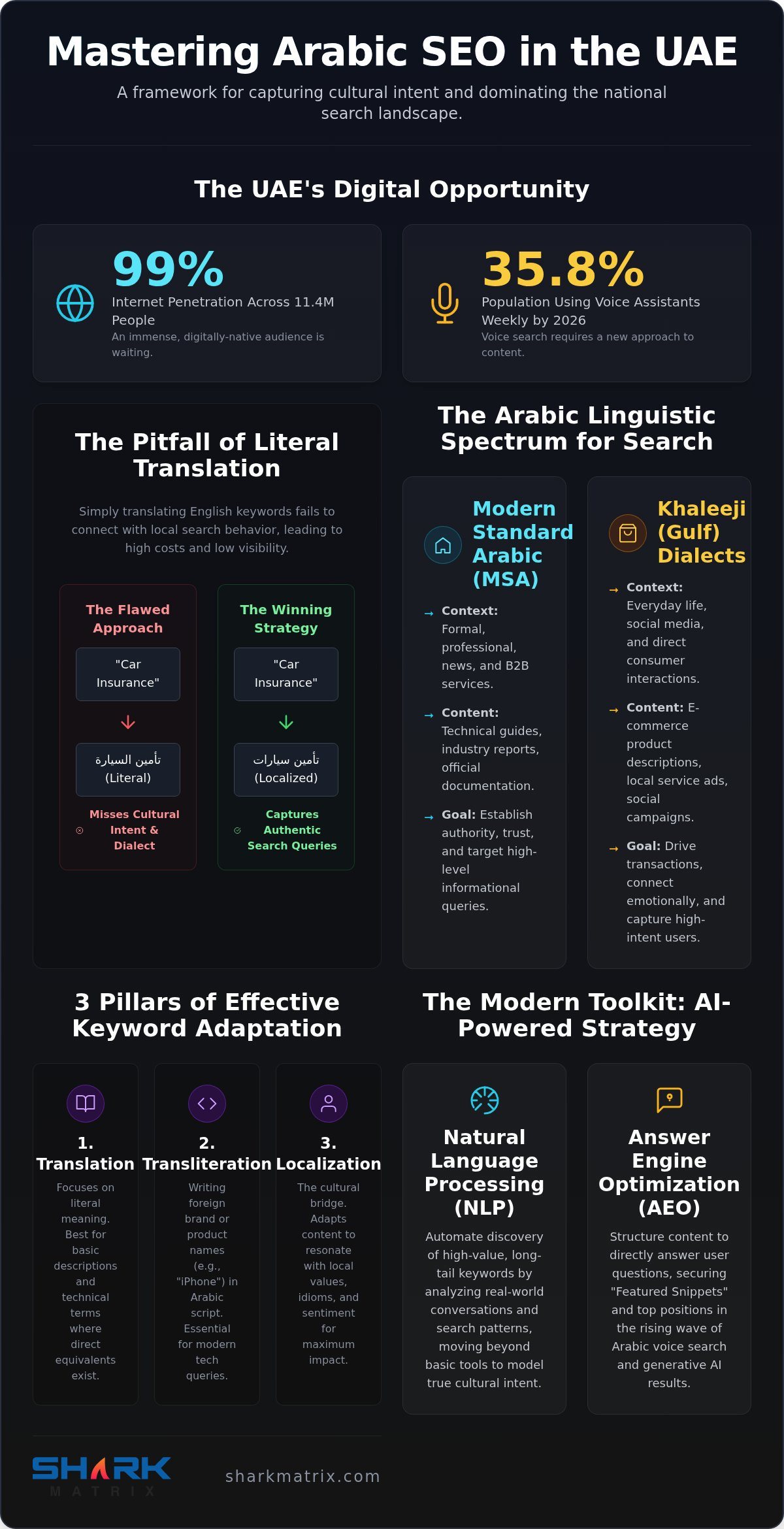
With 35.8% of the UAE population using voice assistants weekly in 2026, your traditional keyword list is likely missing over a third of your potential customers. This shift highlights why a generic approach to arabic keyword research for uae market often leads to high PPC costs and poor organic visibility. You’ve likely realized that simply translating English terms doesn’t capture how people actually speak or search, especially when balancing Modern Standard Arabic with local dialects.
It’s a common struggle, but 2026 technology offers a way out. We’ll show you how to move beyond basic translation to model cultural intent using Natural Language Processing and AI-driven discovery. You’ll learn a clear framework for keyword discovery that improves your ROI and aligns with the latest generative engine optimization trends. We’re diving into the technical strategies needed to bridge the gap between AI-driven search and human behavior, ensuring your brand stands out across the entire nation.
Key Takeaways
- Discover why direct translation fails and how to model cultural intent to capture authentic search behavior across the UAE.
- Learn to distinguish between Modern Standard Arabic for formal B2B queries and Khaleeji dialects for social-driven searches.
- Master the use of Natural Language Processing and AI to automate arabic keyword research for uae market and discover high-value long-tail terms.
- Secure the “Featured Snippet” by structuring your content for the rising trend of Arabic voice search and Answer Engine Optimization.
- Build a cohesive national strategy that balances Arabic and English content to maximize your ROI and organic visibility.
The Evolution of Arabic Keyword Research in the UAE
Arabic keyword research for the UAE market has transformed from a simple linguistic task into a complex exercise in cultural intent modeling. In the past, marketers relied on literal translations of high-volume English terms, but this approach failed because it ignored how local users actually phrase their needs. By 2026, search algorithms have evolved to prioritize semantic clusters and topical authority over simple word frequency. Modern Search engine optimization (SEO) now requires a deep understanding of how Natural Language Processing (NLP) interprets Arabic queries across different contexts.
Direct translation often misses the mark because Arabic is a high-context language. A word that makes sense in a dictionary might never be used by a consumer looking for a service. Instead of focusing on exact matches, national brands now build content around semantic topics. This shift ensures that your digital presence aligns with the intent of the user, whether they are looking for technical specifications in formal language or seeking a quick service using a local expression. Mastering arabic keyword research for uae market involves moving beyond these literal meanings to capture the underlying sentiment of the searcher.
Why National Brands Must Prioritize Arabic SEO
With internet penetration reaching 99% of the 11.4 million people in the UAE, the digital landscape is more crowded than ever. However, many businesses still focus exclusively on English keywords, leaving the Arabic search space significantly less competitive. This creates a massive opportunity for brands to gain visibility with lower acquisition costs. Targeting Arabic phrases isn’t just about traffic; it’s about trust. When a brand provides high-quality Arabic content, it signals a commitment to the local culture, which builds long-term authority and national brand loyalty.
Translation vs. Transliteration vs. Localization
Successful keyword strategies distinguish between three distinct methods of adaptation. Translation focuses on literal meaning, which is useful for basic descriptions but often lacks emotional resonance. Transliteration involves writing foreign brand names or technical terms using Arabic script, such as “software” or “smartphone,” which is essential for modern tech queries. Localization acts as a cultural bridge, ensuring that content resonates with local values and idioms rather than just being linguistically accurate. Integrating these approaches into a broader Search Engine Optimization (SEO) strategy allows brands to capture the full spectrum of national search behavior.
Navigating the Arabic Linguistic Spectrum for Search
Search behavior in the UAE isn’t a monolith. With a population of 11.4 million people, the way users query search engines varies wildly based on their intent and the platform they’re using. This linguistic fluidity makes arabic keyword research for uae market a multidimensional challenge. While English remains a major player, the UAE’s Digital Economy Strategy highlights a significant push toward localized digital services, making it vital to master the nuances of the Arabic script to reach a wider national audience.
Mapping intent correctly requires a deep look at how language shifts across the spectrum. Generally, informational queries lean toward formal language, while transactional or social searches dive deep into local dialects. You can’t just pick one version of a word and hope it ranks; you have to understand where that word sits on the scale of formality to capture the right traffic at the right time.
MSA for Authority and Educational Content
Modern Standard Arabic (MSA) serves as the foundation for formal communication across the country. It’s the language of news, government portals, and professional B2B services. If your goal is to target informational keywords or establish authority in technical sectors, MSA is your primary tool. It offers high search volume across the GCC, ensuring your technical terms align with regional professional standards. However, relying purely on MSA for consumer products can make your brand feel distant. It’s best used for long-form guides and industry-specific terms that require a tone of expertise.
Dialect and Intent: Capturing the UAE Consumer
When users move from research to action, they often switch to the Khaleeji dialect. This is the language of daily life and social media. Capturing these terms requires analyzing real-world conversations rather than just using a dictionary. Local idioms and specific phrasing for consumer products can unlock high-converting long-tail keywords that competitors often overlook. If you’re struggling to identify these subtle shifts, our natural language processing services can help you decode complex dialect patterns for better targeting.
| MSA Term (Formal) | UAE Dialect (Informal) | English Meaning |
|---|---|---|
| هاتف ذكي (Hatif Thaki) | موبايل (Mobile) | Smartphone |
| سيارة مستعملة (Sayara Musta’mala) | موتر مستعمل (Motar Musta’mal) | Used Car |
| حذاء رياضي (Hitha’ Riyadi) | جوتي (Jooti) | Sneakers |
| منزل للبيع (Manzil lil-bay’) | بيت للبيع (Bayt lil-bay’) | House for sale |
Arabizi still plays a role in national search patterns, particularly among younger demographics and in mobile-first environments. This system uses Latin characters and numbers to represent Arabic sounds. While it’s less common for formal B2B queries, it remains a factor for brand names and trendy consumer services. Understanding these mixed-language patterns allows you to capture intent that standard tools might miss, providing a more comprehensive approach to your national SEO strategy.
Advanced AI and NLP Methodologies for Discovery
Traditional keyword tools often struggle with the morphological complexity of Arabic. While standard platforms might treat two similar words as separate entities, arabic keyword research for uae market in 2026 relies on sophisticated algorithms that understand root-word relationships and semantic intent. By leveraging custom software, brands can move beyond simple volume metrics to predict how a keyword will perform within the evolving Search Generative Experience (SGE). This transition from word-matching to intent-modeling is critical for maintaining visibility as search engines become more conversational; to see this in practice, explore ارائه خدمات تخصصی طراحی سایت، سئو و هوش تجاری and discover how تابرد (Tabord) applies these advanced methodologies to regional digital growth.
Using natural language processing (NLP) allows us to categorize search terms by sentiment and cultural context. This technical approach identifies semantic gaps in national competitor strategies that manual research would miss. For instance, an NLP model can group dozens of dialect variations under a single intent cluster, ensuring your content covers the entire topic rather than just a few high-volume phrases. Additionally, ai automation services now streamline the clustering process, allowing for real-time adjustments as search trends shift across the country. This ensures your strategy stays agile in a fast-moving digital economy.
The 2026 Arabic Research Workflow
Modern discovery follows a structured, machine-learning-enhanced path to ensure accuracy and relevance. This process removes the guesswork from traditional SEO by using data-backed cultural insights.
- Step 1: Seed Generation: Use Generative AI and LLMs trained specifically on regional datasets to brainstorm long-tail variations that reflect current cultural trends and local slang.
- Step 2: National Data Validation: Cross-reference these AI-generated ideas with actual national search volume to refine your arabic keyword research for uae market and filter out low-value terms.
- Step 3: Sensitivity Filtering: Apply a final layer of dialect and cultural sensitivity analysis to ensure the selected keywords resonate with the target audience without causing linguistic friction.
This workflow helps predict keyword difficulty more accurately. Instead of just looking at backlink profiles, AI evaluates how well existing content satisfies the complex linguistic requirements of Arabic users. As voice search usage grows among the population, these methodologies become essential for capturing conversational queries that don’t follow traditional keyword patterns. By focusing on how users speak rather than just how they type, you can dominate the national landscape with content that feels authentically local.
Optimizing for Arabic Answer Engines (AEO)
As of 2026, 35.8% of the UAE population uses voice assistants weekly. This shift has fundamentally changed how we approach arabic keyword research for uae market. Users are no longer just typing short phrases into a search bar; they’re asking complete questions to their mobile devices and smart home assistants. This rise in conversational search means that your strategy must evolve from targeting isolated keywords to optimizing for entire answers. Traditional search results are increasingly sharing space with AI-generated responses, making Answer Engine Optimization (AEO) a critical component of national digital visibility.
Preparing for generative engine optimization (geo) in Arabic requires a shift in how you structure your data. AI models prioritize content that provides direct, authoritative answers to specific user intents. If your content doesn’t clearly answer the “Who, What, Where, and Why” of a topic in a way that aligns with regional linguistic patterns, you risk losing the most prominent positions on the search results page. Winning in this environment means modeling your content to satisfy both human readers and the algorithms that power these new answer engines.
Conversational Keywords and Voice Search
Spoken Arabic differs significantly from typed queries. While a user might type “best used cars UAE” in a search engine, they’re more likely to ask their phone, “Where can I find a reliable used car nearby?” using local Khaleeji phrasing. Identifying these question-based keywords is the first step in capturing voice traffic. These queries often trigger AI assistants to read out a single, authoritative result. Integrating ai chatbot development into your platform can further help you capture this conversational intent, as chatbots provide a wealth of data on the exact questions your customers are asking in real time.
Winning the Arabic Zero-Click Search
To win the “Featured Snippet” or the “People Also Ask” block in Arabic, you must format your content for immediate consumption. This involves using clear headings, concise paragraphs, and structured lists that search engines can easily parse. Formatting your data with Arabic schema markup is also essential, as it helps search engines understand the context of your information. By creating Q&A style content that addresses common national search concerns, you increase your chances of appearing in the zero-click position, where your brand provides the answer without the user needing to leave the search page.
If you’re ready to modernize your search strategy for the AI era, explore how our comprehensive SEO services can help you dominate Arabic answer engines across the nation.
Executing Your National Arabic SEO Strategy
Execution is the bridge between data and revenue. Once you’ve completed your arabic keyword research for uae market, the next step involves weaving those insights into a comprehensive search engine optimization plan. This isn’t just about adding a few translated words to your footer. It requires a structural commitment to bilingual excellence. Most successful brands in the country maintain a delicate balance between English and Arabic content to serve a diverse national audience. You must ensure that both versions of your site offer the same level of depth and technical precision to avoid alienating either segment.
Measuring the ROI of your Arabic efforts is essential for long-term growth. By focusing on data-driven lead generation, you can track how specific dialect-based queries convert compared to their formal counterparts. This level of granularity allows you to allocate budgets more effectively, moving away from high-cost PPC terms toward high-value organic clusters. Future-proofing your strategy means staying ahead of the linguistic shifts we’ve discussed, such as the rising influence of voice search and the integration of AI-driven answer engines.
Content Localization and On-Page Integration
Right-to-left (RTL) languages present unique technical challenges for search visibility. Proper keyword placement in Arabic requires an understanding of how both users and bots scan RTL pages. You should place your primary terms in the first paragraph and headers, but avoid “keyword stuffing” at all costs. Arabic searchers are highly sensitive to linguistic quality; awkward phrasing to force a keyword will hurt your brand trust. Our web development agency expertise ensures that your site’s architecture supports RTL SEO without compromising on load speeds or mobile responsiveness.
Monitoring National Performance
Ranking for a keyword once isn’t enough. You need localized tracking that accounts for how Arabic search results fluctuate across the nation. Seasonal trends, such as shifts in behavior during major national holidays or shopping festivals, can drastically change search volumes. Continuous refinement is the only way to stay relevant. By analyzing real-time user data, you can identify when certain terms lose popularity and when new dialect variations emerge. This agile approach to arabic keyword research for uae market ensures your content remains culturally relevant and technically optimized as the digital landscape evolves.
Dominating the Future of UAE Search
Mastering the linguistic nuances of the region is no longer optional for brands seeking national growth. By moving beyond literal translations and embracing AI-driven discovery, you can capture the growing volume of conversational and dialect-based queries. This approach ensures your strategy remains resilient as search engines transition into sophisticated answer engines. Implementing a robust framework for arabic keyword research for uae market allows you to connect with users through their preferred language, whether it’s formal Modern Standard Arabic or local Khaleeji phrasing.
Success in this landscape requires a technical edge and deep regional expertise. Since 2010, Shark Matrix Technologies LLC has delivered proven national SEO success through expert Arabic digital marketing strategies and AI-powered keyword discovery. We help you navigate the complexities of Natural Language Processing to ensure your content resonates with every searcher. Don’t let your brand get lost in translation; maximize your national reach with professional Arabic SEO services from Shark Matrix Technologies LLC and stay ahead of the linguistic shifts shaping the UAE’s digital economy. Your brand is ready to lead the conversation in one of the world’s most digitally engaged markets.
Frequently Asked Questions
Is Arabic keyword research necessary if most people in the UAE speak English?
Yes, it’s essential for capturing the full national market. While English is widely used, a significant portion of the population searches in Arabic for cultural, personal, and government-related queries. Arabic keywords typically face much lower competition than English terms. This allows brands to secure high rankings faster and more cost-effectively. Ignoring Arabic means missing out on millions of high-intent searches that happen every day across the country.
What is the difference between MSA and dialect for SEO purposes?
Modern Standard Arabic (MSA) is the standard for formal, B2B, and informational content. In contrast, the Khaleeji dialect is more common in social media and transactional consumer searches. Effective arabic keyword research for uae market must distinguish between these two. Using MSA for a casual retail product might feel too distant, while using dialect for a legal service could undermine your brand’s professional authority.
How do I track the performance of Arabic keywords specifically?
You should use localized SEO tracking platforms that fully support the Arabic script and regional search engine variations. It’s helpful to categorize your keywords into MSA and dialect groups within your tracking software. This allows you to see which linguistic style drives more conversions. Monitoring these segments separately helps you understand which part of your content strategy resonates most with the national audience and where to allocate your budget.
Can AI tools like ChatGPT accurately perform Arabic keyword research?
AI tools are excellent for brainstorming culturally relevant long-tail variations and understanding sentiment. However, they shouldn’t be used in isolation. They often lack real-time search volume data and can occasionally struggle with the nuances of specific regional dialects. The most effective approach uses AI for initial discovery followed by validation through specialized Natural Language Processing tools and verified national search data to ensure accuracy and relevance.
What are the most common mistakes in Arabic keyword localization?
The most frequent error is relying on literal translation from English. Many businesses assume a direct translation will work, but searchers often use entirely different idioms or transliterated terms. Other common mistakes include ignoring the “Arabizi” search patterns used by younger demographics and failing to account for common spelling variations in the Arabic script. These oversights result in missed opportunities and poor ROI on your digital marketing campaigns.
How does right-to-left (RTL) text affect keyword optimization?
RTL text requires a specific technical setup to ensure that search engine crawlers and users see a seamless layout. From an SEO perspective, keywords must be placed naturally within the RTL flow, especially in prominent areas like H1 tags and the first paragraph. If your website’s code doesn’t properly support RTL, it can lead to display issues that increase bounce rates and negatively impact your organic rankings across the UAE.
Is it better to have a separate Arabic website or a multilingual one for the UAE?
A multilingual website using a subdirectory structure is usually the best choice for national SEO. This approach allows you to build authority on a single domain while serving both Arabic and English speakers. It also simplifies the implementation of hreflang tags, which are crucial for telling search engines which language version to show to specific users. This consolidated strategy often results in better overall visibility and easier site management.
How often should I update my Arabic keyword list?
You should review and refresh your keyword list at least every quarter to stay aligned with evolving search behaviors. Digital language is highly fluid, with new terms and transliterations emerging constantly. Regular updates to your arabic keyword research for uae market help you capture rising trends, such as the 35.8% of the population now using voice assistants weekly. Staying current ensures your content remains relevant as search technology and user habits shift.
 OpenAI
 Codex
Codex
 Vertex AI
 Cloud Vision
 OpenCV
 TensorFlow
 IBM Watson
 Cloud Natural Language
 Cognitive Services
 Bot Framework
 Mistral
 LLama
LLama
 Gemini
 Anthropic
 N8N
N8N