
Did you know that over 80% of Google searches in 2026 now end without a single click to a website? This zero-click reality, fueled by the dominance of AI Overviews and models like GPT-5.5 Pro, has left many brands feeling invisible. It’s frustrating to watch your organic traffic dip while global search volume actually grows by 26%. To survive, your brand must evolve beyond traditional rankings. Implementing a robust generative engine optimization strategy 2026 is no longer optional. It’s the only way to ensure your expertise is the one ChatGPT, Gemini, and Claude Fable 5 cite as the ultimate authority.
You probably feel the pressure to adapt but aren’t sure which AI engines deserve your limited resources. We understand that uncertainty. This guide promises to clear the fog by helping you master the transition from traditional search to generative AI discovery. You’ll gain a clear framework for increasing your AI citations and understand the specific ROI of GEO compared to traditional SEO. We’re breaking down the practical tactics you need to turn AI platforms into your most powerful brand advocates.
Key Takeaways
- Learn why the “Answer Engine” is replacing traditional blue links and how to position your brand as a primary citation source.
- Understand the Retrieval-Augmented Generation (RAG) process to align your content with how frontier AI models select authoritative data.
- Develop a comprehensive generative engine optimization strategy 2026 that balances traditional SEO foundations with the specific requirements of AI discovery.
- Discover how to audit your brand’s visibility across ChatGPT, Perplexity, and Gemini to identify and close citation gaps.
- Master content restructuring techniques that make your data easily extractable for AI agents while preserving your brand’s unique authority.
The 2026 Search Tipping Point: Why Traditional SEO is No Longer Enough
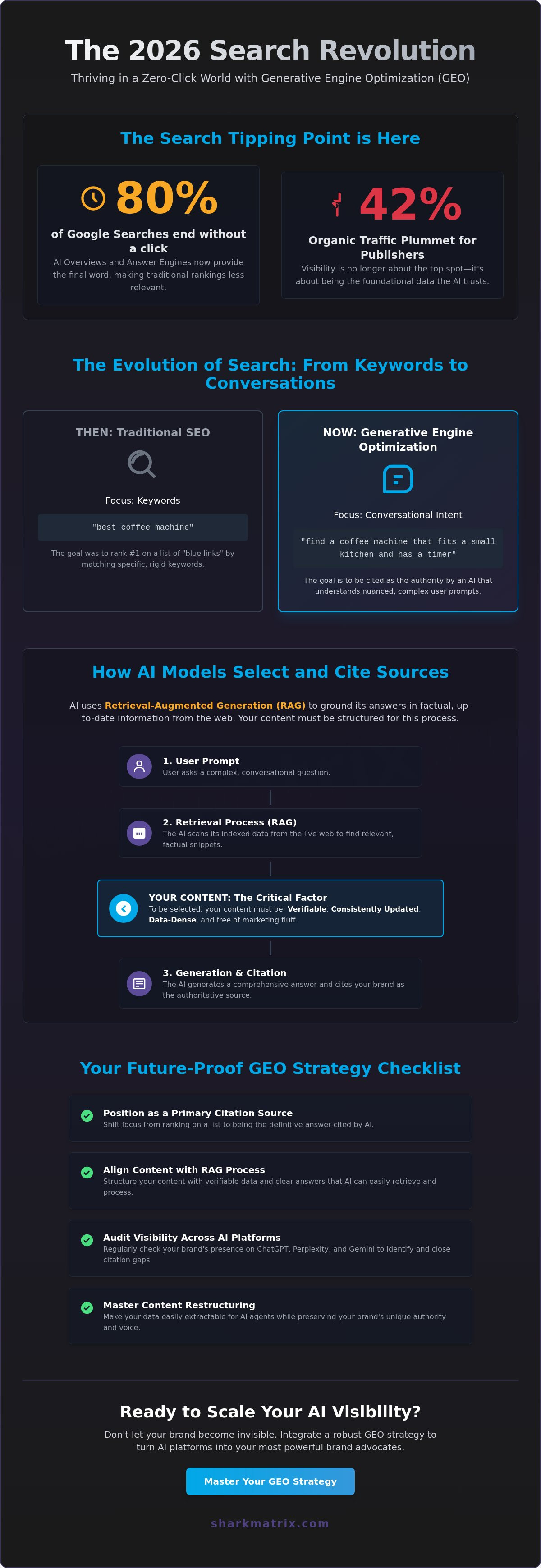
The search landscape has reached a definitive tipping point. By June 2026, the traditional list of blue links has started to feel like a digital relic. Users no longer “search” through pages of results; they “ask” for immediate solutions. This behavioral shift has transformed Google from a directory into a sophisticated “Answer Engine,” where AI Overviews provide the final word. To remain visible, brands are rapidly shifting toward Generative engine optimization (GEO). This practice focuses on ensuring your brand is the primary source cited by AI models when they generate these answers.
The impact of this shift is measurable and stark. Recent data indicates that over 80% of Google searches now end without a single click to an external website. For many professional publishers, organic traffic has plummeted by 42% since the full integration of generative AI into search results. A modern generative engine optimization strategy 2026 acknowledges that visibility is no longer about occupying the top spot on a list. It’s about being the foundational data that the AI trusts enough to repeat to the user.
From Keywords to Conversational Intent
User queries have evolved from rigid keywords into complex, multi-step prompts. In 2026, a consumer doesn’t just type “best coffee machine.” Instead, they enter a detailed prompt like “find me a coffee machine that fits a small kitchen and has a timer.” Traditional keyword density is irrelevant for Large Language Models (LLMs). These engines prioritize semantic depth and the ability of your content to resolve a specific, nuanced intent. If your content doesn’t mirror this conversational complexity, the AI will simply look elsewhere for its citations. Success now requires understanding the logic behind the prompt rather than just the words within it.
The Economic Reality of Zero-Click Search
The rise of zero-click search has forced a total redefinition of marketing success. When clicks are no longer the primary driver of top-of-funnel awareness, the value of a brand citation becomes paramount. Being the named authority in a ChatGPT or Gemini response carries immense weight. It builds brand provenance within the AI’s knowledge graph. Your generative engine optimization strategy 2026 should treat a high-quality citation as equal to, or even more valuable than, a traditional website visit. It’s about securing your brand’s place in the digital ecosystem where the actual conversation is happening, ensuring you aren’t left behind as the “blue link” era fades.
Decoding the Generative Engine: How AI Models Select and Cite Sources
Understanding the internal logic of Large Language Models (LLMs) is the foundation of any successful generative engine optimization strategy 2026. Modern engines like GPT-5.5 and Gemini 3.1 don’t simply “search” for your website; they utilize a process called Retrieval-Augmented Generation (RAG). This system allows the AI to pull specific, factual snippets from a curated index of the live web to ground its answers in reality. If your content isn’t structured to be easily “retrievable,” it effectively doesn’t exist to the AI, regardless of your traditional search rankings.
AI models prioritize content based on a strict hierarchy of trust and data density. They favor information that is verifiable, consistently updated, and free from excessive marketing fluff. By following established best practices for GEO, you move away from trying to “game” an algorithm and toward building “Brand Provenance.” This involves creating a digital footprint so authoritative that the LLM views your brand as the primary source of truth for your niche. Content that provides direct answers supported by raw data or unique insights will always outperform vague, adjective-heavy prose.
The Third-Party Validation Loop
LLMs don’t operate in a vacuum. They cross-reference your website’s claims against community platforms like Reddit, Quora, and specialized industry forums. If your brand is cited as an authority on these third-party sites, the AI is much more likely to include you in its generated responses. This makes online reputation management dubai a vital pillar of your search visibility. The AI looks for a consensus across the web; it wants to see that other humans and platforms trust your expertise before it risks citing you to a user.
Technical Signals: Crawlability and LLM Accessibility
Technical SEO in 2026 requires optimizing specifically for AI agents like GPTBot and OAI-SearchBot. Your robots.txt must be configured to allow these agents full access to your most data-dense pages. Furthermore, the use of Schema.org has become essential for building a “knowledge graph” that AI can digest instantly. Server-side rendering (SSR) is also critical. While traditional search bots have improved at rendering JavaScript, many AI crawlers still prefer flat HTML for faster data extraction. If your site’s technical foundation is weak, your generative engine optimization strategy 2026 will fail before it even begins. If you’re unsure if your current infrastructure is AI-ready, our team provides comprehensive ai development services to ensure your data is always accessible to frontier models.
SEO vs. GEO vs. AEO: Navigating the 2026 Alphabet Soup
By mid-2026, marketing leaders face a complex alphabet soup of optimization disciplines. While these terms often overlap in casual conversation, the tactical execution for each has diverged. Traditional Search Engine Optimization (SEO) still focuses on the “destination,” aiming to drive users to your website for deep-funnel conversions. In contrast, your generative engine optimization strategy 2026 focuses on the “citation.” It prioritizes becoming the foundational data that AI models use to construct their answers. Understanding how GEO differs from traditional SEO is essential for capturing “Share of Model” in an environment where 80% of searches don’t result in a click.
The Strategic Comparison Framework
To allocate your resources effectively, you must distinguish between the three primary pillars of modern visibility. SEO remains the engine for long-form engagement, tracking metrics like session duration and bounce rates. Answer Engine Optimization (AEO) is a specialized subset that targets immediate, factual resolutions, often delivered through voice search or smart assistants. Generative Engine Optimization (GEO) is the broadest and most influential layer. It manages how Large Language Models (LLMs) perceive and mention your brand. While SEO asks “how do we rank?”, GEO asks “how do we become the cited authority?” and AEO asks “how do we provide the quickest answer?”
When to Prioritize GEO Over Traditional SEO
The decision to shift focus depends heavily on the user’s intent. For broad informational research, GEO is now the primary battlefield. Because AI Overviews dominate the top of the search results page, traditional organic links for these queries have seen a 42% decrease in traffic. In these “winner takes all” scenarios, appearing in the AI’s cited sources is your only path to visibility. Conversely, for high-intent commercial queries where a user needs to interact with a specific tool or checkout process, traditional SEO and Web Development remain the priority.
Industry data shows that 20% to 30% of traditional SEO budgets have already shifted toward AI search optimization. This isn’t about abandoning your website; it’s about diversifying your presence. You’re no longer just building a site for humans. You’re building a knowledge base for machines. A balanced generative engine optimization strategy 2026 ensures you’re visible in the AI-generated summary while maintaining a high-performing site for those users who still choose to click through for the full experience.
Building a Future-Proof Generative Engine Optimization Strategy
Transitioning from theory to execution requires a tactical roadmap. You can’t just hope an LLM finds your site; you have to build a path for it. A successful generative engine optimization strategy 2026 begins with a comprehensive audit of your current visibility across frontier models like GPT-5.5 Pro, Gemini 3.1, and Perplexity. By querying these models directly about your brand and industry, you’ll identify exactly where the AI lacks data or provides outdated information. This audit forms the basis for restructuring your site into “snippetable” content that AI agents can digest and cite with high confidence.
Beyond your own domain, you must build an off-site authority footprint. AI models don’t just trust what you say about yourself; they look for third-party validation. This involves a deliberate citation strategy where your expertise is mentioned on high-authority industry platforms and community forums. When multiple trusted sources point to the same factual claim on your site, the AI’s “confidence score” in your brand increases. This creates a virtuous cycle of citations that keeps your brand at the center of the generative response.
This is especially true for niche industries where topical authority is highly concentrated. If you operate in the maritime sector, you can explore Digital Marketing for Marine Contractors to learn how to align your industry expertise with the technical requirements of generative search.
Content Engineering for 2026
The era of the 2,000-word wall of text is over. Modern AI engines prefer “Modular Content Blocks” designed for easy extraction. Each block should follow a strict “Claim-Evidence-Citation” structure. You make a specific claim, provide the supporting data, and cite the primary source. This format mirrors how Retrieval-Augmented Generation (RAG) systems retrieve information. When you integrate our search engine optimization seo services with this modular approach, you ensure your site serves both human readers and machine crawlers. This dual-purpose engineering is what separates temporary traffic spikes from long-term brand authority.
Bilingual GEO: Dominating the National Market
For brands operating in the UAE, a bilingual approach is the ultimate competitive advantage. AI engines in 2026 are incredibly adept at cross-referencing data between English and Arabic. If your English website claims one thing, but regional Arabic forums or news outlets suggest another, the AI’s trust in your brand provenance drops. To win national citations, your data must be consistent across both languages. This involves localized technical data and ensuring your Arabic content is as “snippetable” as your English version. By aligning your regional nuances with global LLM requirements, you secure a dominant share of the national AI search market.
Success in this new landscape requires a blend of technical expertise and strategic foresight. If you’re ready to secure your brand’s future, our team can help you build a custom generative engine optimization strategy 2026 that keeps you at the top of every AI response. Explore our AI development services today and start your transition to a citation-first digital presence.
Scaling AI Visibility with Shark Matrix Technologies LLC: Integrating GEO into Your Growth Engine
Implementing a generative engine optimization strategy 2026 at scale requires moving beyond manual workflows. While earlier stages of the process focus on auditing and restructuring, the final phase is about industrializing your authority. Shark Matrix Technologies LLC provides the technical framework necessary to maintain high citation rates across thousands of enterprise pages. We don’t just optimize for current models; we build systems that adapt as GPT-5.5 or Gemini 3.1 refine their retrieval logic. By treating your digital presence as a live data feed rather than a static site, you ensure that AI agents always have access to your latest insights.
Our approach moves beyond basic monitoring to utilize machine learning for real-time citation tracking. Traditional rank tracking is binary, but GEO is nuanced. Shark Matrix Technologies LLC uses proprietary AI automation services to analyze the sentiment and accuracy of how Large Language Models (LLMs) represent your brand. If an engine begins to hallucinate about your services or omits your key data points, our systems identify the source of the friction. This allows for rapid content adjustments that realign the AI’s understanding with your actual brand provenance, ensuring your reputation remains untarnished in zero-click environments.
AI-Driven Content and Development
We integrate website design and development services to build architectures designed specifically for machine consumption. This involves more than just page speed; it’s about creating a “Knowledge Vault” within your site structure. Shark Matrix Technologies LLC automates the deployment of complex JSON-LD Schema across enterprise-level domains, ensuring every product, service, and expert bio is properly indexed in the global AI knowledge graph. This technical precision makes your data the path of least resistance for AI agents looking for a verified source to cite.
The Future of National Brand Discovery
The shift from a “Search Strategy” to a “Discovery Strategy” means being present wherever the user’s AI assistant lives. Shark Matrix Technologies LLC bridges the gap between your web presence and user-facing tools through mobile app development services. By embedding AI-ready data layers within your mobile ecosystem, we ensure in-app assistants provide the same high-authority citations as global search engines. This creates a unified front for your brand across the UAE digital landscape, regardless of which device or platform the consumer chooses.
Ready to dominate the AI era? Partner with Shark Matrix Technologies LLC for your 2026 GEO strategy and secure your brand’s role as the top-cited authority in the age of generative discovery. We’re here to help you navigate this transition with confidence and technical excellence, ensuring your brand remains visible as the “blue link” era fades.
Seize Your Place in the Future of AI-First Discovery
The search landscape has fundamentally shifted from a list of links to a network of verified answers. Throughout this guide, we’ve explored how prioritizing RAG-friendly content and ensuring your technical architecture supports machine-first discovery are the new prerequisites for digital survival. By implementing a robust generative engine optimization strategy 2026, you move beyond chasing clicks and start building deep brand provenance within the global knowledge graph.
As pioneers in AI automation and development, Shark Matrix Technologies LLC is uniquely positioned to handle the complexities of national-scale technical SEO and bilingual growth. We help you transition from being a bystander in the AI revolution to becoming the primary source that frontier models trust and cite. Your brand’s authority in 2026 depends on the actions you take today to align your data with the logic of machine intelligence.
Future-proof your brand visibility with Shark Matrix Technologies LLC’s 2026 GEO Strategy. While the era of the traditional blue link is ending, the era of the cited authority is just beginning. Stay proactive, stay authoritative, and lead the conversation in the age of generative discovery.
Frequently Asked Questions
What is the main difference between SEO and GEO in 2026?
The primary difference lies in the end goal: SEO focuses on ranking pages to drive website clicks, while GEO focuses on securing citations within AI-generated responses. Traditional SEO optimizes for a search engine’s results page. GEO optimizes for the Large Language Model’s internal knowledge base and its ability to retrieve your data as a primary source of truth.
How do I track my brand’s performance in AI search engines like ChatGPT?
You track performance by measuring “Share of Model” through direct prompt testing and specialized visibility software. Instead of tracking keyword rankings, you analyze how often your brand is cited as a primary authority. This involves manual auditing of frontier models like GPT-5.5 and using automated tools that simulate user queries across different AI platforms to identify citation gaps.
Is traditional SEO dead because of Generative Engine Optimization?
No, traditional SEO is not dead, but it has evolved to support high-intent transactional queries rather than broad informational ones. While informational traffic has moved to AI Overviews, users still click through to websites for complex tools, purchases, and deep research. A modern generative engine optimization strategy 2026 incorporates traditional SEO as the technical foundation for these deeper, conversion-focused interactions.
How does structured data (Schema) help with GEO?
Schema provides a clear, machine-readable map that helps AI agents identify specific facts, prices, and entities on your site instantly. It removes the guesswork for the LLM during the retrieval phase. By using JSON-LD structured data, you ensure that AI crawlers can verify your brand’s claims and include them in their knowledge graphs with a high confidence score.
Which AI search engines should national brands prioritize first?
National brands should prioritize ChatGPT, Gemini, and Perplexity because they hold the largest share of the AI search market. ChatGPT remains a dominant force, holding nearly 90% of global AI sessions as of 2026. However, Gemini is critical for visibility within the Google ecosystem, making it a mandatory focus for any brand seeking to capture reach through AI Overviews.
Can I block AI engines from using my content while still ranking in Google?
You can block specific AI agents like GPTBot via your robots.txt file, but this will prevent your brand from being cited in generative answers. While your site might still appear in the traditional index, you’ll be invisible in the AI Overviews that occupy the top of the search results. This is usually a strategic mistake for brands seeking maximum digital visibility.
How does bilingual content affect AI citations in the UAE?
Bilingual content strengthens your brand’s authority because AI models cross-reference data across English and Arabic to verify facts. If your information is consistent in both languages, the model’s trust in your brand increases. This consistency is vital in the UAE market, where generative engines frequently pull from both linguistic sources to provide a comprehensive answer to local users.
What are the most common GEO mistakes brands make?
The most common mistake is prioritizing marketing fluff over factual, data-dense content that LLMs can easily extract and use. Brands often fail to structure their information in a modular format, making it difficult for AI agents to identify clear answers. Another error is neglecting off-site reputation, which serves as a critical validation signal for your generative engine optimization strategy 2026.
 OpenAI
 Codex
Codex
 Vertex AI
 Cloud Vision
 OpenCV
 TensorFlow
 IBM Watson
 Cloud Natural Language
 Cognitive Services
 Bot Framework
 Mistral
 LLama
LLama
 Gemini
 Anthropic
 N8N
N8N