
Categories
GEO

How to Get Cited by ChatGPT: A 2026 Generative Engine Optimization Strategy

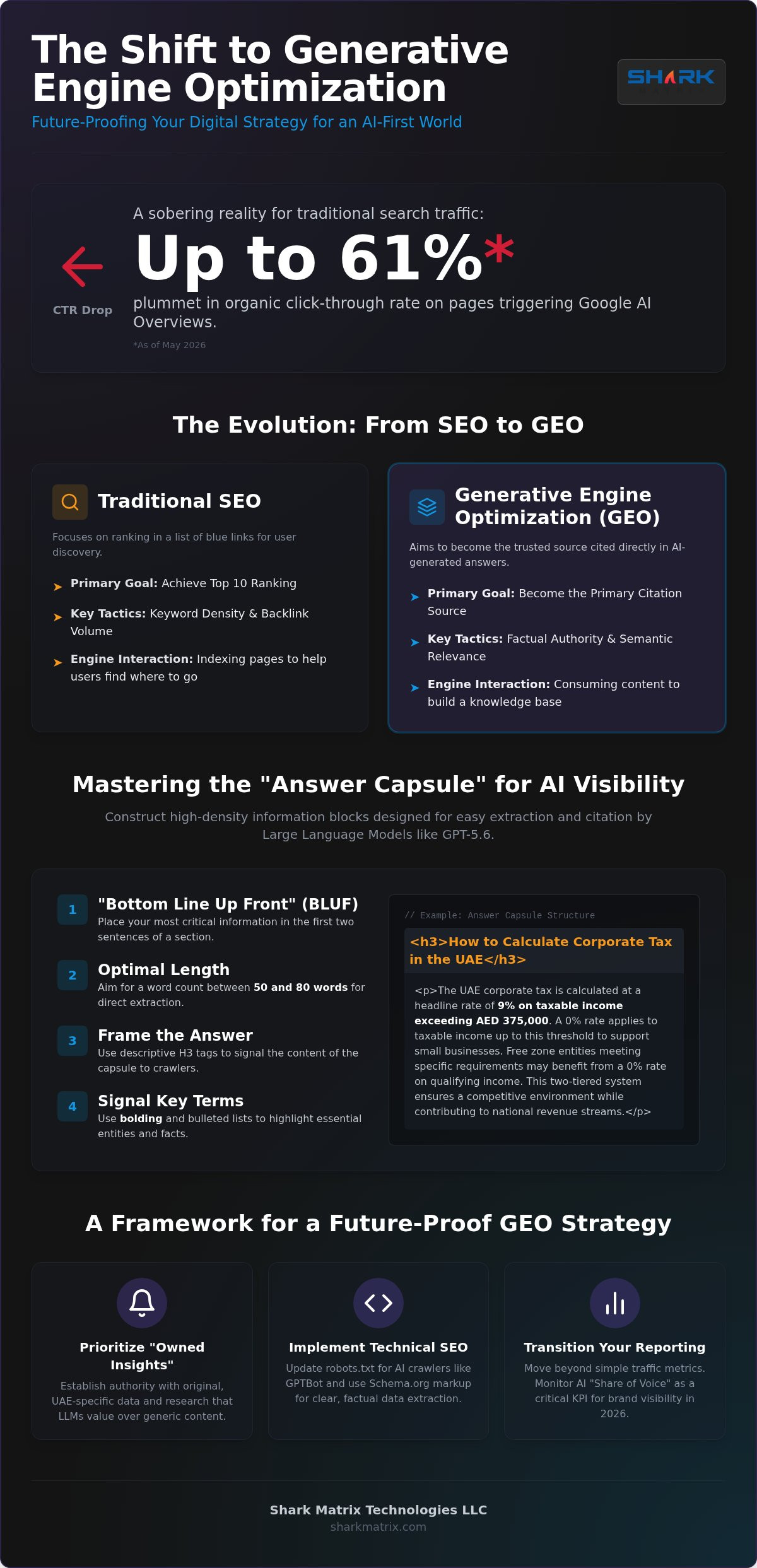
Did you know that the organic click-through rate on pages triggering a Google AI Overview has plummeted by as much as 61% as of May 2026? It’s a sobering reality for many businesses across the United Arab Emirates that relied on traditional search traffic. You’ve likely noticed that even when you rank first, a generative answer often pushes your link out of sight. It’s frustrating to see your expertise used to train models while your website visits stall. This shift requires a pivot toward a comprehensive generative engine optimization strategy that prioritizes being cited as a primary source rather than just a blue link.

We’ll help you master the specific content structures and technical SEO tactics required to earn citations and traffic from ChatGPT’s GPT-5.6 and other generative engines. You’ll learn how to build “Answer Capsules” that minimize friction for LLM synthesis and ensure your brand remains visible in an AI-first world. This article provides a clear framework for content formatting and the metrics you need to track AI visibility. By the end, you’ll have a future-proofed national digital strategy designed to dominate the evolving UAE search market.

Key Takeaways

  • Shift your focus from traditional ranking to becoming the primary citation source by aligning your content with Large Language Model synthesis patterns.
  • Learn to construct “Answer Capsules,” which are high-density information blocks designed for easy extraction and citation by engines like ChatGPT.
  • Prioritize “Owned Insights” and original UAE-specific data to establish national authority that LLMs value over generic, repurposed content.
  • Implement a robust generative engine optimization strategy by updating technical elements like robots.txt for GPTBot and using Schema.org markup for factual extraction.
  • Transition your reporting from simple traffic metrics to monitoring AI “Share of Voice” as a critical KPI for maintaining brand reputation in 2026.

What is Generative Engine Optimization (GEO)?

As we move through 2026, the digital landscape in the United Arab Emirates has shifted from a list of links to a conversational interface. What is Generative Engine Optimization (GEO) exactly? It represents the strategic evolution of search, moving beyond traditional ranking factors to focus on how Large Language Models (LLMs) perceive and synthesize information. While traditional SEO helps you rank in the top ten, a generative engine optimization strategy aims to make your brand the definitive source that ChatGPT or Perplexity cites within their generated answers.

Engines like ChatGPT (using the GPT-5.6 Sol model) and Claude don’t just “index” pages; they consume them to build a knowledge base. To be selected for a citation, your content must offer high factual density and clear structural markers that these models can easily parse. Shark Matrix Technologies LLC helps national enterprises bridge this gap by leveraging natural language processing expertise to ensure content is not just readable by humans, but digestible by AI. Traditional SEO remains the foundation, as technical health and domain authority still signal trust to AI crawlers, but the goal has shifted toward becoming the “knowledge provider” for the engine’s response.

The Evolution from SERPs to Generative Answers

The “Zero-Click” reality has become a dominant force for UAE brands. With Gartner predicting that traditional search volume will decrease by 25% by the end of 2026, the competition for visibility has intensified. Traditional search engines index pages to help users find where to go, but LLMs aggregate data to tell users what they need to know immediately. For national brands, this means visibility is no longer about the click alone; it’s about being the footnote that validates the AI’s answer. These citation links are now the primary drivers of high-intent referral traffic, as users only click through when they require deeper, authoritative detail beyond the initial summary.

Key Differences Between SEO and GEO

The transition from SEO to GEO requires a fundamental change in how we produce content. Traditional SEO often prioritized keyword density and backlink volume. In contrast, GEO prioritizes semantic relevance and factual authority. AI engines look for context and the relationship between entities rather than just matching a search term. GEO is the tactical alignment of content with LLM synthesis patterns. While a high backlink count still matters for general authority, LLMs are increasingly sensitive to the accuracy of the information provided. Using generative AI development tools to audit your own content for factual clarity is now a standard part of a modern digital strategy.

Mastering the Answer Capsule for AI Visibility

To succeed with a generative engine optimization strategy, you must rethink your content as a series of “Answer Capsules.” These are standalone, high-density blocks of information designed specifically for extraction by Large Language Models. Unlike traditional blog paragraphs that build context slowly, a capsule provides immediate, factual value. Research has shown that structural adjustments are often more important than word count alone. According to foundational research on GEO, these high-density blocks significantly increase the likelihood of your content being cited as a primary source in engines like ChatGPT and Claude.

Clarity and brevity are your primary tools. An LLM’s goal is to synthesize an answer with minimal computational “noise.” If your content is buried in flowery prose or unnecessary filler, the model will likely skip your page in favor of a more direct competitor. Using bolding for key terms and concise bulleted lists signals to the AI crawler that this specific section contains the definitive answer to a user’s query. It’s a shift in mindset. You’re no longer just writing for a human reader; you’re providing the raw data for an AI’s summary.

Structural Requirements of a Cited Capsule

Implementing the “Bottom Line Up Front” (BLUF) approach is essential for AI visibility in 2026. Your most important information should appear in the first two sentences of a section. Optimal word counts for these summaries usually fall between 50 and 80 words. This length is short enough for an LLM to extract in full but long enough to provide the necessary semantic depth. You should also use H3 tags to “frame” the answer. For example, an H3 titled “How to Calculate Corporate Tax in the UAE” followed immediately by a 60-word summary is much more likely to be cited than a long, unformatted guide.

The “No-Link” Paradox in GEO

Clean text is often more attractive to AI models than link-heavy paragraphs. While internal linking is a staple of traditional SEO, high link density within an Answer Capsule can actually reduce your citation rate. LLMs may perceive excessive links as “internal friction” that complicates the synthesis of a clean answer. To combat this, place your strategic citations and internal links outside the core answer block. This keeps the capsule “pure” for the AI while maintaining a good experience for human users. If you’re struggling to structure your technical data for these models, Shark Matrix provides specialized natural language processing services to help national brands audit and refine their content for 2026 standards.
How to Get Cited by ChatGPT: A 2026 Generative Engine Optimization Strategy

Leveraging Original Data and National Authority

Large Language Models are increasingly sophisticated in 2026. They’ve moved past simple pattern matching and now actively seek out “Owned Insights” to differentiate their answers from generic summaries. If your content merely repurposes what’s already found on common knowledge sites, ChatGPT has no reason to cite you. It already knows that information. To win with a generative engine optimization strategy, you must provide the raw data the AI lacks. This involves publishing original surveys, national whitepapers, and proprietary case studies that offer fresh perspectives on the UAE market.

Authoritativeness is built through the E-E-A-T (Experience, Expertise, Authoritativeness, and Trustworthiness) framework. Google and AI engines alike look for signals that your brand is a legitimate leader. Shark Matrix utilizes specialized Natural Language Processing services to audit your content’s sentiment and factual density. This ensures your brand sounds like the expert the AI wants to quote. When your content is verified as high-density and factually unique, it moves to the top of the AI’s synthesis queue.

Building National-Level Authority in the UAE

National authority requires a deep dive into regional specifics. AI models prioritize sources that provide localized context, such as national economic trends or specific UAE regulatory updates. Accuracy in the Arabic language is another critical factor. Regional LLMs are designed to serve the local population, and they favor content that demonstrates linguistic precision. By leveraging Arabic digital marketing, you can ensure your content is correctly indexed and cited by localized AI models that cater to the UAE’s unique demographic. This isn’t just about translation; it’s about cultural and contextual relevance that AI engines recognize as authoritative.

Owned Insights: The GEO Gold Mine

Proprietary data is the most valuable asset in GEO. When you publish unique national statistics, you create a source that the AI cannot ignore. Structure this data using tables and Schema markup to make it “quotable.” LLMs are more likely to extract data from a well-organized table than from a dense paragraph. Original data acts as a fingerprint that LLMs must credit to maintain accuracy. When an AI agent needs to provide a specific percentage or a unique trend, it will look for the originator of that data. Providing these unique data points ensures your brand becomes an essential part of the AI’s knowledge graph across the country.

Technical Optimization for LLM Crawlers and Indexing

Content structure is only half the battle. To solidify your generative engine optimization strategy, you must ensure the technical foundation of your website is accessible to AI agents. In 2026, robots.txt management has evolved beyond simply blocking unwanted bots. You now need to provide explicit permissions and pathways for agents like GPTBot, ClaudeBot, and specialized regional crawlers. Managing these permissions ensures that your most authoritative “Answer Capsules” are prioritized during the training or real-time retrieval process. If your technical architecture is cluttered, AI engines may struggle to parse your data, leading to hallucinations or, worse, complete omission from citations.

Site speed and clean HTML are more critical than ever. LLMs don’t “view” your site like a human; they parse the underlying code to extract semantic meaning. Messy JavaScript or excessive nested divs create “extraction friction.” By maintaining a lean DOM (Document Object Model), you make it easier for AI models to identify the relationships between your data points. Shark Matrix leverages generative AI development tools to simulate how different LLMs view and weight your site’s technical structure. This allows national brands to identify and fix parsing errors before they impact visibility.

Schema Markup for the AI Era

Standard SEO schema is no longer enough to win in 2026. You must implement advanced JSON-LD markup that specifically targets factual extraction. Using Speakable, FactCheck, and Dataset schema provides a clear roadmap for LLMs to follow. These tags act as a secondary layer of verification, confirming that your data is structured for accuracy. For UAE enterprises, national entity tagging is essential. By explicitly defining the relationships between your brand, national regulations, and regional market data in your schema, you ensure that AI models recognize your brand as a primary authority for UAE-specific queries. This technical clarity reduces the risk of being overshadowed by generic global competitors.

API and Feed Integration

Static indexing is often too slow for the fast-paced 2026 market. To ensure real-time accuracy in AI answers, many national brands are exploring direct data feeds and API integrations. This allows AI models to pull the latest UAE market statistics or pricing directly from your verified source. Implementing AI automation services can help streamline this distribution, ensuring your brand messaging remains consistent across all AI-accessible endpoints. This proactive approach prevents AI engines from relying on outdated or cached data, which is vital for maintaining trust in sectors like finance or real estate. If you need to upgrade your technical infrastructure for the AI era, contact Shark Matrix for a technical GEO audit to ensure your site is fully optimized for 2026 crawlers.

Future-Proofing Your Brand with AI-Driven SEO

In 2026, protecting your brand requires more than monitoring social media or reviews. It involves a proactive Online Reputation Management strategy that accounts for how LLMs represent your business to the public. If an AI engine provides a summary of your services without citing your website, you lose both traffic and the ability to verify the information. A robust generative engine optimization strategy acts as a safeguard. It ensures that when users ask about your industry, the AI pulls from your verified knowledge base rather than relying on outdated or competitor-led content.

This visibility doesn’t happen in a vacuum. There’s a powerful synergy between comprehensive SEO services and AI-driven results. While GEO focuses on citation patterns, traditional SEO provides the domain trust and technical health that AI engines use to filter for quality. Shark Matrix helps national enterprises bridge this gap. We combine over a decade of national SEO experience with cutting-edge AI development to ensure your brand dominates the generative landscape across the country.

Measuring Success in a Citation-Based World

Success in this new era is measured by AI “Share of Voice.” This KPI tracks how often your brand is cited compared to others in your sector across different models. You need specialized tools to monitor mentions in ChatGPT, Claude, and Perplexity. Analyzing referral traffic patterns from these sources is also vital. When you see a spike in traffic from an AI agent, you can trace it back to a specific “Answer Capsule” and replicate that success across other topics. This allows you to adjust your content strategy in real-time as AI models update their citation preferences.

The Role of AI Chatbots in GEO

Internal tools are equally important for future-proofing your digital presence. By investing in AI chatbot development, you can simulate national user intent and test how your content performs before it’s indexed by external models. These internal chatbots act as a sandbox. They help you predict which pieces of content are most likely to earn a citation based on current LLM synthesis patterns. This predictive approach saves time and ensures your resources are spent on the most impactful content. Contact Shark Matrix today to audit your GEO readiness and secure your spot in the answers that define the UAE market.

Dominating the UAE Knowledge Graph in 2026

The transition from traditional search results to AI-generated answers isn’t just a minor shift; it’s the new standard for national digital visibility. By mastering “Answer Capsules” and technical schema, your brand can move from a hidden link to a primary cited source. Succeeding with a generative engine optimization strategy requires a deep understanding of how Large Language Models synthesize data and the technical agility to adapt to 2026 standards. You’ve seen how original data and national authority act as the fingerprints that LLMs must credit to maintain accuracy across the country.

Shark Matrix has been a leader in national UAE digital strategy since 2010. With sixteen years of expertise and a specialized AI and Machine Learning department, we bridge the gap between traditional search and generative visibility for enterprise-level brands. We help you transform your content into the authoritative data that models like ChatGPT rely on for regional accuracy. Secure Your AI Visibility with Shark Matrix GEO Services and ensure your brand remains the definitive voice. The future of search is conversational; it’s time your business leads the conversation.

Frequently Asked Questions

How does ChatGPT decide which websites to cite in 2026?

ChatGPT’s latest models, including GPT-5.6, prioritize factual density, semantic relevance, and authority. The engine selects sources that provide direct, “quotable” information fitting its synthesis patterns. It looks for technical markers like Schema.org markup and high-quality “Owned Insights” that haven’t been genericized across the web. National authority in the UAE market also plays a significant role in its selection process for regional queries. It’s about accuracy.

Is GEO different from traditional Search Engine Optimization?

Yes. While traditional SEO focuses on ranking in the top ten search results, GEO targets being the cited source within an AI’s generated answer. Traditional SEO prioritizes keywords and backlinks for visibility. In contrast, a generative engine optimization strategy prioritizes information structure and semantic clarity. It’s about making your content easy for Large Language Models to extract and summarize rather than just helping a human find a link.

Will ChatGPT cite my website if I have a low Domain Authority?

Domain Authority still signals trust, but it’s no longer the only factor. In 2026, AI engines often prioritize the most accurate and well-structured answer over the most popular site. If your content provides unique, high-density data that a high-authority site lacks, you can still earn citations. Technical precision and “Answer Capsules” allow smaller national brands to compete effectively with larger enterprises for AI visibility.

How long does it take to see results from a generative engine optimization strategy?

Results typically appear within four to eight weeks. This depends on the crawl frequency of AI agents like GPTBot. Unlike traditional SEO, which can take months to move rankings, AI models can update their citation preferences as soon as they re-parse your site’s new structure. Implementing a consistent generative engine optimization strategy ensures that your technical updates and data feeds are recognized quickly by the latest models like GPT-5.6 Sol.

Can I block ChatGPT from scraping my site but still get cited?

No. If you block GPTBot in your robots.txt file, the engine cannot access your content to synthesize or cite it. To be included in generative answers, you must grant permission for AI crawlers to parse your data. However, you can use technical optimization to guide the bots toward specific sections of your site. This ensures they only focus on your most authoritative and “citeworthy” information blocks. It’s a trade-off.

What is an “Answer Capsule” in the context of GEO?

An “Answer Capsule” is a standalone block of high-density information specifically formatted for AI extraction. It usually consists of 50 to 80 words that provide a direct answer to a specific question. These capsules use bolding and lists to signal their importance to AI crawlers. By minimizing flowery language, these blocks become the preferred “building blocks” for AI-generated summaries and footnotes. They are essential for 2026 visibility.

How do I track if ChatGPT is actually citing my content?

Tracking requires monitoring AI “Share of Voice” through specialized digital tools that simulate user prompts across models like ChatGPT and Claude. You should also analyze referral traffic in your analytics platform. Look for traffic sources identified as AI agents or “Answer Engines.” Shark Matrix provides custom dashboards that help national brands visualize their citation frequency and the specific content blocks driving the most AI-led traffic across the country.

Does Arabic content have a different citation rate in ChatGPT?

Arabic content often sees higher citation rates for regional queries because there is less high-quality, semantically clear data available compared to English. Regional LLMs prioritize linguistically accurate and culturally relevant Arabic sources to serve the UAE population. Using specialized Arabic digital marketing ensures your content is indexed correctly. This makes it the primary choice for AI engines when answering localized questions about the national UAE market and regulations.

Categories
AEO GEO

How to Optimise Content for AI Search: The 2026 GEO & AEO Guide

What if your number one ranking on Google suddenly resulted in zero clicks because an AI agent answered the query before the user even scrolled? It’s a reality many brands face as generative summaries begin to dominate the top of search results. You’ve likely felt the pressure of declining organic traffic and the frustration of trying to decode shifting technical standards. It’s clear that traditional SEO rules are evolving, and maintaining visibility now requires a more sophisticated approach.

This guide will show you exactly how to optimize content for ai search to ensure your brand remains a cited authority in 2026. By mastering Generative Engine Optimisation (GEO) and Answer Engine Optimization (AEO), you’ll learn to bridge the gap between traditional search and AI-driven synthesis. We’ll explore the specific technical requirements for AI citations and provide a clear roadmap to future-proof your content strategy against the next wave of digital transformation.

Key Takeaways

  • Understand the fundamental shift from traditional SERPs to Generative Engine Optimisation to capture visibility in zero-click environments.
  • Discover how to optimize content for ai search by leveraging Retrieval-Augmented Generation (RAG) and establishing high domain authority for LLM citations.
  • Master the Answer Engine Optimization (AEO) framework to produce the data-dense, definitive statements that AI tools require for direct responses.
  • Execute a 2026 technical audit that integrates multi-modal elements like voice and video to future-proof your national brand presence.
  • Learn how custom AI development and natural language processing services provide a competitive edge in the evolving generative search landscape.

Understanding the Shift: From Traditional SERPs to AI Search Engines

The digital landscape has crossed a threshold. Discovery is no longer a simple matter of matching a keyword to a URL. Instead, we’ve moved From Traditional SERPs to AI Search Engines, where the goal is synthesis rather than indexing. In 2026, search engines don’t just show you where information lives; they process it for you. This shift has birthed Generative Engine Optimization (GEO), a discipline that focuses on how your brand’s data is ingested and repeated by Large Language Models (LLMs).

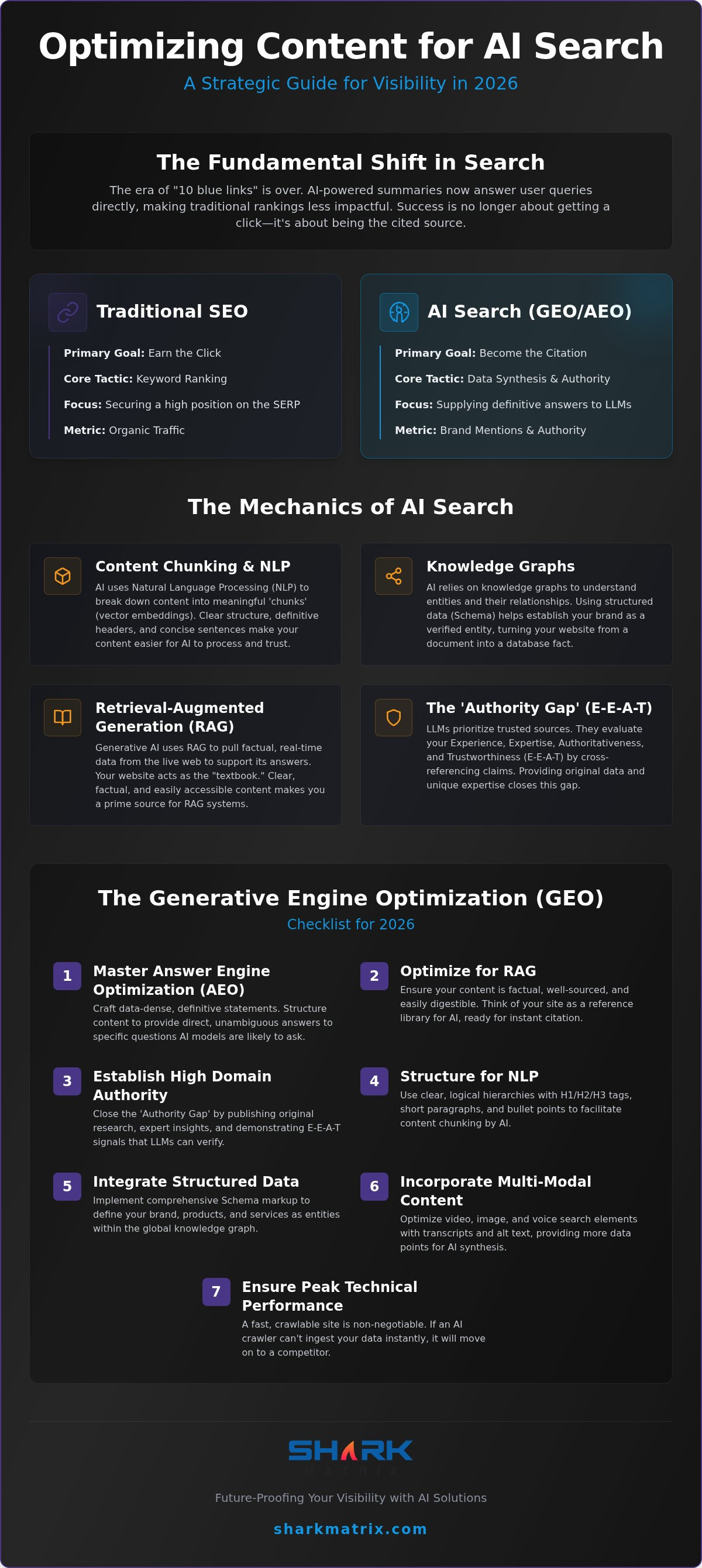
Traditional SEO was built on the foundation of the “blue link.” You optimized for a high ranking to earn a click. The rise of zero-click searches has disrupted this model. National brands in the UAE now face a reality where the search engine provides the full answer directly on the results page. If your site isn’t the primary source for that answer, you lose visibility. Learning how to optimize content for ai search is no longer optional. It’s the only way to ensure your brand is cited rather than ignored. LLMs prioritize synthesis, which means your ranking matters less than your status as a trusted citation.

The Evolution of Search Intent in 2026

Search intent has matured into something far more complex than transactional or informational buckets. Users now engage in multi-step conversational queries that reflect specific “need states.” An AI doesn’t just look for “best logistics software.” It interprets a request for “a scalable logistics solution for a national retail chain that integrates with existing ERPs.” This requires content that addresses the nuance of a conversation. At Shark Matrix, our generative AI development services help brands build the technical infrastructure needed to feed these models high-quality, authoritative data that shapes brand sentiment within training sets.

Key Players in the AI Search Ecosystem

The ecosystem is no longer a Google monopoly. While Google’s Search Generative Experience (SGE) has completed its national rollout, other players like Perplexity, Claude, and ChatGPT have changed how users source real-time data. These platforms use Retrieval-Augmented Generation (RAG) to pull from the live web. In the B2B sector, specialized answer engines are also emerging, prioritizing technical accuracy over broad popularity. Winning in this environment means appearing across these diverse platforms as a consistent, reliable source of truth.

The Mechanics of AI Search: How LLMs Process and Cite Content

Understanding the underlying mechanics of Large Language Models (LLMs) is the first step for anyone learning how to optimize content for ai search. Unlike traditional bots that simply index pages, modern AI uses Retrieval-Augmented Generation (RAG). This process allows the model to pull specific data from the live web to anchor its responses in fact. It’s essentially an open-book test where your website is the textbook. If your content is clear and factual, the AI is more likely to cite you as the definitive source.

The ‘Authority Gap’ defines why AI prefers certain domains over others. In 2026, LLMs evaluate E-E-A-T by cross-referencing your claims against other trusted entities in their training data. If your site provides original data or unique expertise, you close this gap. High-speed technical performance also plays a role. If a crawler can’t ingest your data instantly, it will simply move to a faster competitor. Consistent, high-performance delivery ensures your content is always available for real-time synthesis.

NLP and Content Chunking

AI models don’t read sentences the way humans do. They use Natural Language Processing (NLP) to break your content into chunks or vector embeddings. These are mathematical representations of meaning. To help this process, your content should be structured with clear, logical paragraphing and definitive headers. Short, punchy sentences often perform better because they are easier for models to vectorize. If you need to refine how your site communicates with these machines, our Natural Language Processing Services provide the technical expertise to bridge this gap.

The Role of Knowledge Graphs

Your brand needs to exist as an Entity within a global knowledge base. AI uses knowledge graphs to understand how your services relate to specific industry problems. Using structured data helps define these relationships clearly for the LLM. When your brand is part of a knowledge graph, you aren’t just a search result; you’re a verified fact. This level of technical integration is a core part of our Generative AI Development strategies. For national brands looking to solidify their presence, investing in ai automation services can streamline the creation of this structured data at scale.

How to Optimise Content for AI Search: The 2026 GEO & AEO Guide

Answer Engine Optimisation (AEO): Designing Content for Direct Responses

Answer Engine Optimisation (AEO) is the tactical side of showing up in AI summaries. While GEO focuses on the engine’s synthesis, AEO focuses on the answer itself. To master how to optimize content for ai search, you must prioritize directness and data-density. “Fuzzy” content, which relies on vague adjectives and marketing fluff, fails in 2026. AI models are trained to find the most efficient answer. If your content is buried under layers of storytelling without clear data points, the engine will skip you. It’s no longer enough to be “good”; you must be the most mathematically relevant response to a specific prompt.

Balancing human-centric storytelling with machine-centric clarity is the secret. You don’t have to write like a robot, but you do need to provide quote-dense sentences. These are definitive statements that an AI can easily extract and cite. For national brands, this means moving away from generic claims to specific, verifiable facts. If you’re looking for a partner to manage this transition, our Comprehensive SEO Services Guide details how we integrate these strategies into national campaigns. We focus on the technical bridge between what humans want to read and what machines need to ingest.

Structuring Content for the ‘Answer’ Format

The inverted pyramid is your best friend. Start each section with the most critical information. AI search tools often scan the first paragraph for a summary. If the answer is there, you’re more likely to be cited. Use H3 headings as specific questions. For example, instead of “Our Process,” use “How Does Our National SEO Process Work?” This mirrors the conversational queries users type into LLMs. It’s about making the machine’s job as easy as possible. When the AI finds a direct answer immediately following a relevant question, the probability of becoming a featured citation increases significantly.

Optimizing for Conversational ROI

Winning the AI snippet requires identifying low-competition, high-intent questions. These are the specific “how-to” or “why” queries that competitors often ignore. FAQ sections are a goldmine for this. They provide a clear structure for the AI to ingest. To truly understand what your audience is asking, you can use AI Chatbot Development to capture real-time search intent data. This allows you to feed your content strategy with the exact phrases and problems your customers face daily. By integrating this data back into your content, you create a feedback loop that keeps your brand relevant across all generative platforms.

The Generative Engine Optimisation (GEO) Checklist for 2026

Winning in generative search requires more than just good writing. It demands a technical foundation that allows Large Language Models to ingest your data without friction. A comprehensive technical audit is the first step in learning how to optimize content for ai search. In 2026, this means moving beyond the traditional crawl-and-index cycle. Instead, brands must prioritize multi-modal optimization. AI agents now synthesize information from video transcripts, image metadata, and voice snippets simultaneously. If your brand’s video content doesn’t have structured transcripts, you’re invisible to a significant portion of the generative ecosystem.

Consistency is your greatest asset. LLMs prioritize ‘Brand Source’ status for domains that provide regular, high-velocity updates. Stale data is discarded in favor of real-time accuracy. Our AI Automation Services help national brands maintain this consistency by automating the technical updates required to stay relevant. By ensuring your data is always fresh, you reinforce your position as a primary source for AI synthesis. It’s about being the most reliable version of the truth at any given moment.

Technical GEO Requirements

Your schema markup needs to evolve. While basic article tags are still necessary, 2026 standards require ‘Dataset’ and ‘ClaimReview’ schema to provide the granular detail LLMs crave. This structured data acts as a translator between your website and the model’s training set. API-first content delivery is another critical requirement. LLMs often bypass traditional HTML scraping in favor of direct data feeds to ensure real-time accuracy. Finally, zero-latency mobile performance is non-negotiable. If an AI-integrated browser experiences a delay while fetching your site’s data, it’ll pivot to a faster source to maintain the conversational flow.

Content Verification and Fact-Checking

AI search engines are increasingly sensitive to conflicting information. If your website claims one fact while your national press releases claim another, the LLM will flag your domain as unreliable. Fact-checking is now a core SEO function. You must anchor your claims with external citations to high-authority national sources. This creates a web of trust that the AI can verify. For brands managing complex narratives, our national SEO services ensure that your digital footprint remains consistent and authoritative across all platforms. To secure your visibility across generative engines, explore our generative AI development services to automate your technical readiness.

Future-Proofing Your Visibility with Shark Matrix AI Solutions

Shark Matrix positions itself as the technical bridge between legacy search and the generative future. We integrate Custom AI Development with modern SEO to build a resilient digital presence. In 2026, national brands require more than just basic keyword targeting. They need a sophisticated system that updates data and citations in real-time. This hybrid approach pairs human creativity with deep technical optimization. Our proprietary workflows automate complex GEO tasks, allowing your team to focus on high-level narrative while our machines handle the granular citation management.

National expertise serves as a critical advantage in the generative search landscape. LLMs increasingly value localized accuracy and verified national data. When you understand the specific nuances of the UAE market, you can provide the data-dense responses that generative engines prioritize. We help brands scale their organic visibility through automated GEO workflows that align with evolving national search trends. Mastering how to optimize content for ai search is a continuous process of technical refinement and strategic adaptation.

Tailored AI Strategies for National Brands

We develop Industry-Specific AI Solutions designed for search dominance. Every sector faces unique citation requirements. A financial institution needs different technical markers than a retail group. By leveraging ML Development Services, we predict shifts in how generative engines prioritize different types of data. This proactive stance ensures your brand isn’t just reacting to algorithm changes but staying ahead of them.

Get Started with an AI Search Audit

Success in the current era is measured by ‘Citation Share.’ This metric quantifies how often AI tools recommend your brand as a primary source compared to your competitors. Our audit provides a comprehensive roadmap for transitioning from a legacy SEO mindset to a GEO-first strategy. We identify technical gaps in your current setup and provide a clear path to visibility. If you’re ready to secure your digital future, Contact Shark Matrix for a 2026 AI Search Strategy and ensure your brand remains at the center of every AI-generated answer.

Securing Your Brand’s Authority in the Age of AI

The transition to generative search isn’t just a trend; it’s a fundamental change in how information is consumed. You’ve learned that winning in 2026 requires a move from simple keyword density to deep citation optimization. By mastering the frameworks of Answer Engine Optimization and Generative Engine Optimization, you ensure your brand isn’t just found but cited as a definitive source. Understanding how to optimize content for ai search is the key to maintaining your national reach as Large Language Models take center stage.

Shark Matrix stands as a pioneer in these evolving GEO and AEO frameworks. Our expertise in custom AI and machine learning development allows us to bridge the gap between traditional SEO and the technical demands of modern LLMs. With a proven track record in national UAE campaigns, we provide the technical mastery needed to scale your visibility. Future-proof your brand with Shark Matrix AI & SEO services. The future of search belongs to those who adapt early. Start your transition today and lead your industry into the generative era.

Frequently Asked Questions

What is the difference between SEO and GEO in 2026?

SEO focuses on ranking in traditional search engine result pages using keywords and backlinks. GEO, or Generative Engine Optimization, prioritizes how Large Language Models synthesize and cite your content within their generated answers. While SEO targets clicks, GEO targets being the authoritative source that the AI mentions. It’s a fundamental shift from being a simple link to becoming a verified fact in a model’s output.

How can I check if my website is being cited by AI search engines?

You can check for citations by using AI-specific search tools like Perplexity or the generative overviews in Google. Look for footnote links or “Sources” sections at the bottom of the AI response. Tools that track Citation Share are becoming essential for national brands in the UAE. Monitoring these citations helps you understand how to optimize content for ai search by seeing which data points the models find most useful.

Will AI search replace traditional Google Search entirely?

AI search won’t replace traditional search entirely, but it has transformed it. By 2026, most searches are hybrid, where an AI summary appears above the traditional list of links. Users still rely on traditional search for deep research or transactional tasks. However, the top-of-page real estate is now dominated by generative answers. This makes it vital to adapt your visibility strategy to accommodate both formats simultaneously.

Does structured data still matter for AI search optimization?

Structured data is more important than ever because it acts as a direct translator for AI agents. Using Schema markup like Dataset or ClaimReview helps LLMs understand the relationship between your content and specific entities. This technical clarity reduces the hallucination risk for the AI. It makes the model much more likely to trust and cite your website as a verified source of information across the national landscape.

How do I optimize my content for Perplexity and ChatGPT search?

Optimizing for Perplexity and ChatGPT requires a focus on data-density and factual accuracy. These engines use Retrieval-Augmented Generation to pull real-time data. You should provide clear, definitive statements and cite high-authority national sources. Providing original research or unique data sets makes your content more attractive to these models. They prioritize original information over repeated general knowledge that exists elsewhere in their training data.

Can AI-generated content rank well in AI search engines?

AI-generated content can rank if it provides unique value or original insight. However, AI search engines prioritize experience and expertise. Simply recycling existing AI outputs often leads to a race to the bottom where the content lacks the specific nuance needed for a citation. High-quality, human-led content that incorporates technical SEO and machine learning development insights typically performs significantly better in these new generative environments.

How often should I update my content for AI search engines?

Content should be updated frequently to maintain Brand Source status. AI models prioritize real-time accuracy and fresh data. If your information is outdated, models will pivot to competitors who provide current stats. National brands often use AI automation services to ensure their most critical data points are updated across their digital footprint. This keeps them relevant for every new model training cycle and real-time query.

What is Answer Engine Optimization (AEO)?

Answer Engine Optimization (AEO) is a specific branch of digital marketing focused on providing direct, concise answers to user queries. While GEO deals with broader synthesis, AEO focuses on the format. It involves structuring content to fit the answer boxes used by voice assistants and AI summaries. Learning how to optimize content for ai search through AEO means prioritizing technical precision and clarity over long-form marketing fluff.

Categories
SEO

The Ultimate E-A-T SEO Checklist for UAE Sites in 2026

With the UAE Media Council now enforcing a mandatory Advertiser Permit for all online promotional content as of February 2026, the bar for digital credibility has never been higher. If you’re wondering why your rankings are stalling despite perfect technical scores, it’s likely because your e-a-t seo checklist for uae sites hasn’t adapted to these new regulatory and cultural benchmarks. Google now demands more than just keywords; it requires verifiable proof of local expertise and transparency.

We understand the frustration of competing against global giants while navigating the Middle East’s unique search landscape. It’s tough to prove “Expertise” when the rules feel like a moving target. This article promises to provide a clear, actionable roadmap to rebuild your site’s trust and reclaim your spot at the top of the search results. You’ll learn how to align with 2026 helpful content standards, leverage Arabic marketing nuances, and integrate the technical transparency required by the UAE Media Council to win in a mobile-first economy where 53% of all orders now happen on smartphones.

Key Takeaways

  • Learn how the addition of ‘Experience’ to E-E-A-T requires UAE brands to showcase local project portfolios and first-hand cultural knowledge to satisfy Google’s 2026 standards.
  • Understand why linking every piece of content to a verified expert entity is essential for maintaining authority in the bilingual Middle Eastern search market.
  • Discover how to leverage national trust signals, such as mentions on local news outlets and .gov.ae portals, to significantly boost your site’s credibility.
  • Get a practical e-a-t seo checklist for uae sites designed to audit your author credentials and update your digital transparency to meet the latest TDRA guidelines.
  • Find out how specialized SEO strategies that respect local nuances can help your brand outrank global competitors for high-value commercial keywords.

Why E-A-T is the Deciding Ranking Factor for UAE Websites in 2026

By mid-2026, the UAE’s digital landscape has transformed into a high-stakes arena where technical perfection is merely the entry fee. With e-commerce spending reaching USD 12.30 billion this year, competition for the top spot on Google is fierce. Success no longer depends solely on how many backlinks you have. Instead, it hinges on your ability to prove your site’s credibility through Google’s E-E-A-T framework. Implementing a localized e-a-t seo checklist for uae sites is now the only way to signal to search engines that your brand is a legitimate, trusted authority in the region.

Google’s Search Generative Experience (SGE) has fundamentally changed how local businesses are discovered. When users search for services in Dubai or Abu Dhabi, Google’s AI synthesizes answers based on the most trustworthy sources available. If your site lacks strong reputation signals, you’ll be left out of these AI-generated summaries. For national brands, the link between site reputation and conversion is undeniable. High trust scores lead to higher click-through rates because UAE consumers, who are highly mobile-centric, prioritize brands that demonstrate transparent business practices and regulatory compliance.

The Evolution from E-A-T to E-E-A-T

The addition of “Experience” to the traditional E-A-T acronym has shifted the goalposts for local Search Engine Optimization. Google now prioritizes content that shows first-hand knowledge of the UAE market. This means a generic global site can’t easily outrank a local entity that showcases real-world projects in the Emirates. Google differentiates between generic advice and local authority by looking for specific regional identifiers and case studies. In 2026, E-E-A-T for UAE businesses is defined as the verified demonstration of local market immersion, bilingual proficiency, and adherence to national media standards.

E-A-T as a Shield Against AI-Generated Spam

As AI-generated content saturates the web, “Expertise” has become the primary filter for quality. Search engines are getting better at spotting generic, thin content that lacks human insight. In the UAE’s bilingual market, this is even more critical. Generic AI often fails to capture the cultural nuances of Arabic search intent or the specific legal requirements of the UAE Media Council. Shark Matrix Technologies LLC leverages sophisticated Natural Language Processing to align your content with the specific vocabulary and intent used by regional experts. By using human-verified data and expert-led insights, your brand can build a defensive wall against low-quality competitors, ensuring your rankings remain stable even as algorithms evolve.

Experience & Expertise: Demonstrating Authority in the UAE Market

While many competitors suggest that meta tags are the ultimate solution for search engine ranking, the current reality in the Emirates is far more nuanced. To truly understand What is SEO? in 2026, you must look at how Google evaluates the “Experience” behind your brand. It’s no longer enough to claim you’re an expert. You have to prove it through tangible local evidence. This means moving beyond generic service descriptions and focusing on detailed case studies and project portfolios that reflect your work across Dubai, Abu Dhabi, and the Northern Emirates.

Localized expertise also involves addressing UAE-specific challenges. Content that discusses VAT compliance, local labor law updates, or TDRA regulations shows a level of “Expertise” that generic global sites simply can’t match. If you’re struggling to showcase this depth, our experts can help you refine your SEO strategy in Dubai to better reflect your market leadership.

Author Entities and Schema Markup

Every piece of content on your site needs a face and a history. Anonymous blog posts are a significant ranking risk in 2026, especially for YMYL (Your Money Your Life) sectors like finance or healthcare. You must implement Person Schema to link your authors to their professional credentials, social profiles, and previous publications. Verified Author signals are now a baseline requirement for any UAE site aiming for commercial dominance in 2026. This technical layer tells Google exactly who is responsible for the information provided and why they’re qualified to speak on the topic.

Bilingual Expertise: English and Arabic Synergy

Expertise must be demonstrated equally across all language versions of your website. A high-quality English site paired with a poorly translated Arabic version will damage your overall trust score. High-quality Arabic content isn’t just about translation; it’s about cultural resonance and technical accuracy. While we leverage Generative AI Development to streamline content drafts, expert human oversight is essential to ensure your Arabic content meets the sophisticated standards of the UAE audience. Google’s algorithms are now advanced enough to detect when Arabic content lacks the nuance of a native professional, making expert-led bilingual strategy a non-negotiable part of your authority building.

Authoritativeness & Trust: Building National Credibility

Trust isn’t just about who links to your website; it’s about who vouches for your brand within the local ecosystem. In the UAE’s high-stakes digital market, Google’s 2026 algorithms have evolved to prioritize national signals over generic global metrics. A single mention on a .gov.ae portal or a reputable local news outlet carries more weight than dozens of international backlinks. Your e-a-t seo checklist for uae sites must prioritize these high-authority national connections to signal that your business is a legitimate part of the country’s economic fabric.

Your “About Us” page serves as the digital heart of your brand’s trustworthiness. For UAE brands, this page must go beyond a simple mission statement. It needs to act as a transparency engine, displaying your physical office address, VAT registration details, and trade license information. According to Google’s Search Quality Rater Guidelines, trustworthiness is the most critical component of the E-E-A-T framework. If a user or a search engine cannot easily verify who is behind the site and how to contact them, your rankings will inevitably suffer. Technical trust signals like HTTPS and secure, locally-recognized payment gateways are no longer optional. They’re essential benchmarks for maintaining a competitive digital footprint.

Local Link Building and National Mentions

Effective link building in the Middle East requires a strategic focus on industry associations and regional chambers of commerce. These entities provide the “National Mentions” that search engines use to verify your authority within the UAE. Search engines now use sophisticated Natural Language Processing to analyze the context of these mentions in both English and Arabic. They look for consistency across your bilingual profiles to ensure your brand reputation is solid. We help clients monitor these signals through proactive Online Reputation Management, ensuring that your brand’s narrative remains authoritative across all platforms.

Transparency and Regulatory Compliance

Compliance with the Telecommunications and Digital Government Regulatory Authority (TDRA) guidelines is a major trust signal in 2026. Your site must feature clear Terms & Conditions and Privacy Policies that are specifically tailored to UAE laws, including data protection regulations. Google’s AI-driven crawlers now audit sites for these transparency markers. To stay ahead, many businesses are turning to AI Automation Services to perform regular site audits. These tools ensure that every page on your site meets the latest regulatory standards and maintains the high level of transparency that both Google and UAE consumers demand.

The Definitive 2026 E-A-T SEO Checklist for UAE Sites

Implementing a robust e-a-t seo checklist for uae sites requires a dual focus on human-centric authority and technical transparency. While many agencies focus solely on sitemaps and URL structures, the 2026 standard demands a deeper layer of verification. If your site doesn’t clearly communicate who you are and why you’re qualified to serve the UAE market, even the best technical SEO won’t save your rankings. You need to provide clear signals that both users and algorithms can trust.

  • Step 1: Audit all author bios. Don’t just list a name. Link every author to their professional credentials, LinkedIn profiles, and previous industry contributions. Google needs to see a verified “Person” entity behind every claim to establish true expertise.
  • Step 2: Update ‘Contact’ and ‘About’ pages. Ensure these pages feature your verifiable national business data, including your UAE trade license number and VAT registration. This alignment with TDRA guidelines is a non-negotiable trust signal for local brands.
  • Step 3: Implement Organization and Review Schema. Use structured data to showcase social proof directly in search results. This helps Google’s AI quickly identify your brand’s reputation and customer satisfaction levels across the Emirates.
  • Step 4: Review Arabic content for cultural accuracy. Professionalism in Arabic is a key component of ‘Expertise’ in this region. Ensure your tone is appropriate for the local business environment and free from generic translation errors that erode authority.
  • Step 5: Secure all data entry points. Update your privacy disclosures to reflect current UAE data protection laws. Every form and checkout page must be secured with modern encryption to maintain user trust and site integrity.

Content Quality and ‘Helpfulness’ Audit

A helpfulness audit is about more than just word count. You must remove or consolidate ‘thin’ content that doesn’t provide unique value to UAE users. If a page doesn’t answer specific questions relevant to the local market, it’s likely dragging down your overall authority. Use regional “People Also Ask” queries to identify what your audience actually needs. Every paragraph should reinforce your position as a local leader who understands the specific needs of Emirates-based consumers, from logistics in Jebel Ali to retail trends in Abu Dhabi.

Technical Trust Signals Verification

Technical flaws are trust killers. Core Web Vitals must meet the ‘Good’ threshold for mobile users across the UAE to ensure a seamless experience on high-speed 5G networks. Fix 404 errors and redirect loops immediately; these signal poor site maintenance and erode your perceived authoritativeness. Finally, verify your HTTPS certificates and security headers like HSTS to protect user data. If you’re unsure where to start with these technical requirements, our SEO company in Dubai can provide a comprehensive audit to secure your site’s reputation and ranking potential.

Scaling Your National Brand Authority with Shark Matrix Technologies LLC

Building a dominant online presence in the Emirates requires more than just following a generic template. At Shark Matrix Technologies LLC, our SEO services in the UAE are built on the foundational principles of E-E-A-T, ensuring your brand isn’t just visible, but genuinely trusted by both users and algorithms. We’ve spent over 15 years refining our approach to the Middle Eastern market, specializing in the bilingual marketing and technical excellence required to succeed in 2026. By integrating the e-a-t seo checklist for uae sites into every stage of our strategy, we help national brands navigate the complexities of local search and regulatory standards.

Our team understands that cultural nuances matter. Whether it’s ensuring your Arabic content resonates with local business values or verifying that your site meets the latest transparency guidelines, we provide a level of regional insight that global agencies often miss. We don’t just optimize for search engines; we optimize for the people of the UAE, building the long-term authority that drives sustainable commercial growth. This human-centric approach, backed by technical precision, is what allows our clients to outrank global competitors in highly competitive local niches.

AI-Powered SEO Strategy

We stay ahead of the curve by using Machine Learning to identify hidden authority gaps and predict shifts in search intent before they impact your rankings. Our custom-built AI tools are specifically designed to automate the trust audit process for large-scale e-commerce platforms. These tools scan thousands of pages to ensure that every product description, author bio, and privacy disclosure aligns with 2026 helpful content standards. This ensures that your site remains compliant with the high-trust requirements Google now demands.

In one recent project, we helped a national retail brand recover from a significant decline in visibility by focusing strictly on E-A-T optimization. By restructuring their author entities and securing mentions from high-authority national portals, we didn’t just restore their rankings; we significantly increased their conversion rate. This combination of AI-driven data and human expert insight is what sets Shark Matrix Technologies LLC apart in a crowded digital marketplace, allowing us to turn technical data into actionable growth.

Your Partner for Long-Term Growth

Establishing authority is never a one-time task. It’s an ongoing commitment to quality and transparency. As search engines continue to refine how they evaluate experience and trust in 2026, your brand needs a partner that provides continuous monitoring of your digital reputation. Shark Matrix Technologies LLC tracks your brand mentions across the UAE’s business directories and news outlets to ensure your authority signals remain strong and consistent over time. This proactive approach prevents ranking drops and keeps your brand at the forefront of your industry.

The first step toward securing your digital future is understanding where you stand today. Contact Shark Matrix Technologies LLC to book a comprehensive E-A-T and Technical SEO audit. We’ll provide a tailored roadmap to help your business master Google’s requirements and achieve the rankings your brand deserves.

Mastering Your Digital Reputation in the Emirates

The search landscape in 2026 is no longer about volume; it’s about the integrity of your digital footprint. As discussed, your e-a-t seo checklist for uae sites should now be fully integrated with national regulatory standards and cultural nuances to maintain visibility. By prioritizing verified author entities and secure, transparent business data, you’re not just ranking higher; you’re building a brand that the UAE’s sophisticated mobile audience can rely on. Success in this region depends on proving that your expertise is both authentic and locally relevant.

Shark Matrix Technologies LLC has been at the forefront of this evolution since 2010. We blend deep expertise in Arabic and English SEO with AI-driven technical optimization to ensure your brand stands as a pillar of authority. Don’t let shifting algorithms undermine your hard work or stall your commercial growth. Secure your brand’s authority with a professional SEO audit from Shark Matrix Technologies LLC. Take the final step toward building a sustainable, trustworthy presence that resonates across the Emirates today.

Frequently Asked Questions

What is the most important part of E-A-T for a UAE business?

Trustworthiness is the most critical element for businesses in the Emirates. In 2026, this means proving your legitimacy through transparent business data, such as your trade license number and VAT registration. Adhering to the UAE Media Council’s permit requirements for online promotional content is also a major signal that your brand is a compliant and reliable entity.

Does having an office in the UAE help with E-A-T?

Yes, a physical office provides a powerful trust signal that search engines use to verify your local “Experience.” Listing a verifiable UAE address and local phone number helps Google connect your website to a real-world entity. This physical presence distinguishes you from global content farms and reinforces your commitment to the national market.

How do I prove my expertise if I don’t have a famous CEO?

You don’t need a celebrity figurehead to establish authority. Instead, focus on the collective credentials of your team by using detailed author bios and Person Schema. Linking to the LinkedIn profiles and professional certifications of your staff proves that your content is written by qualified individuals who possess genuine industry knowledge.

Can AI-generated content pass Google’s E-A-T standards in 2026?

Purely AI-generated content rarely passes these standards because it lacks first-hand “Experience.” While you can use AI to draft content, it must be refined by human experts who add local nuances and unique insights; for instance, the expert-led resource Meghna’s Food Magic demonstrates how a specialized recipe database provides the depth and trust that automated tools cannot replicate. Google’s 2026 algorithms are highly sophisticated at identifying generic text that doesn’t provide real-world value to UAE users.

How long does it take to see results from an E-A-T optimization strategy?

E-A-T is a long-term investment rather than a quick technical fix. Most businesses begin to see a positive impact on their rankings within three to six months of consistent optimization. Building a reputation for authority and trust takes time, as search engines need to crawl and verify multiple signals across the web before adjusting your site’s credibility score.

Is Arabic content necessary for E-A-T on UAE websites?

Arabic content is essential for establishing national expertise in a bilingual market. Providing high-quality, culturally accurate Arabic versions of your pages signals to Google that you understand the local audience’s specific needs. It’s a key requirement on any comprehensive e-a-t seo checklist for uae sites aiming for market dominance.

How do I get my business mentioned on authoritative UAE sites?

Earning mentions requires active engagement with the local ecosystem. You should pursue guest posting opportunities on national news platforms, join industry associations, and seek features on government-affiliated portals like .gov.ae. These national-level mentions act as digital votes of confidence that significantly boost your brand’s authoritativeness in regional search results.

What are YMYL sites and why do they need more E-A-T?

YMYL stands for “Your Money or Your Life” and refers to websites covering sensitive topics like finance, health, and legal advice. Because this information can significantly impact a person’s well-being or financial stability, Google applies much stricter E-A-T standards to these sites. If you operate in these sectors, your proof of expertise and technical transparency must be beyond reproach.

Categories
AEO

Mastering AEO Marketing Strategy: The 2026 Guide to Answer Engine Optimization

When a Google AI Overview appears, the top-ranking organic result doesn’t just lose a few visitors; it lose

Categories
GEO

How to Get Cited by ChatGPT: The 2026 Guide to Generative Engine Optimization (GEO)

Did you know that 40% of B2B research queries that used to start on Google now begin directly in ChatGPT, C

Categories
GEO

Preparing Your Website for AI Overviews: The 2026 SEO Checklist

Did you know that organic click-through rates drop by as much as 61% when an AI Overview appears at the top

Categories
GEO

Generative Engine Optimization Strategy 2026: The Complete Guide to AI Search Visibility

Did you know that over 80% of Google searches in 2026 now end without a single click to a website? This zer

Categories
GEO

How to Optimize Content for AI Search: The 2026 Strategy Guide

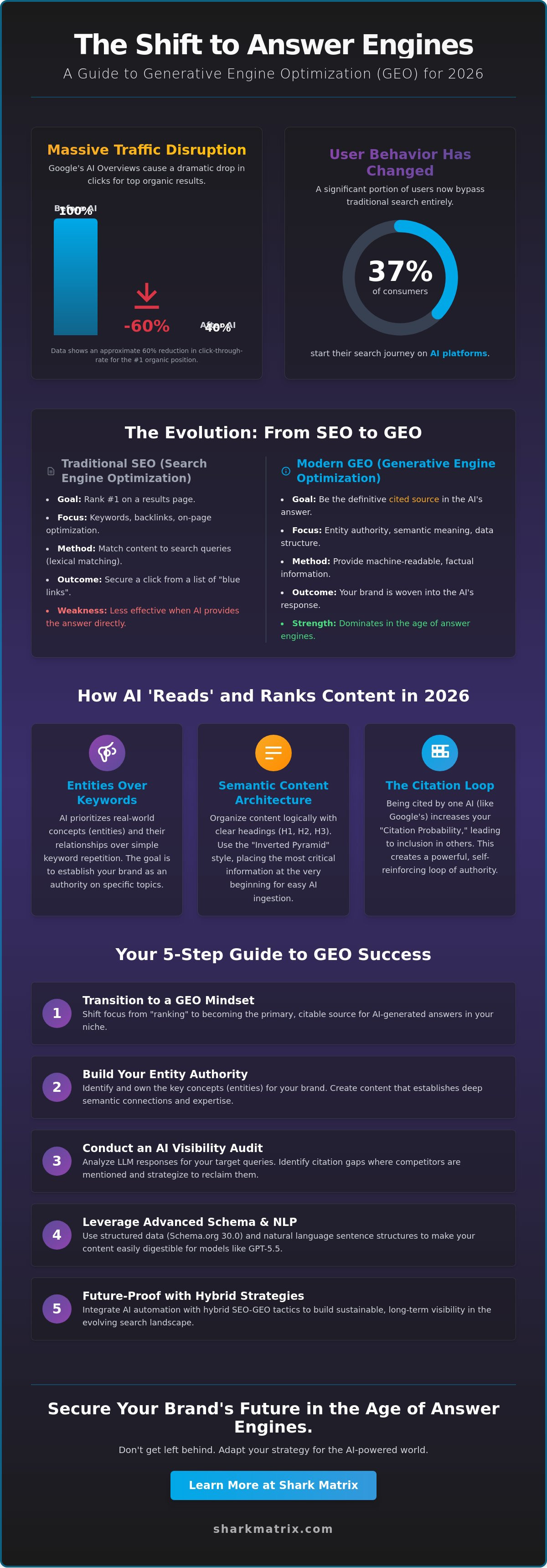
Did you know that the presence of a Google AI Overview now reduces the click-through rate of the top organic result by approximately 60%? With 37% of consumers now starting their searches on AI platforms, the traditional search landscape has fundamentally shifted. Learning how to optimize content for ai search is the only way to ensure your brand remains visible as Gemini 3.5 Flash and GPT-5.5 become the primary tools for discovery.

You’re likely worried about your content being summarized without receiving the traffic you deserve. It’s a common fear in this era of Generative Engine Optimization (GEO), but you don’t have to be left behind. This guide promises to teach you how to become the definitive source that AI models cite and recommend. We’ll preview the essential tactics for 2026, including leveraging Schema.org 30.0 and navigating the latest Google Core Updates to secure your brand’s future in the age of answer engines.

Key Takeaways

  • Transition from traditional ranking to Generative Engine Optimization (GEO) to ensure your brand is the primary source for answer engines.
  • Discover how to optimize content for ai search by focusing on semantic meaning and building entity authority within your niche.
  • Conduct an AI visibility audit to find citation gaps and reclaim mentions from competitors in LLM responses.
  • Use advanced Schema.org 30.0 markup and natural language structures to make your data easily digestible for models like GPT-5.5 and Gemini 3.5 Flash.
  • Future-proof your marketing by integrating AI automation and hybrid SEO-GEO strategies for long-term national visibility.

The Shift from Search Engines to Answer Engines: Why GEO is the New SEO

For decades, the goal of digital marketing was simple: rank on page one. By June 2026, that goal has become obsolete. We’ve moved into the era of the “Answer Engine,” where platforms like Perplexity, with its 100 million monthly active users, provide direct answers instead of a list of websites. This shift marks the rise of Generative Engine Optimization (GEO). Unlike traditional SEO, GEO focuses on making your brand the primary source for the AI’s synthesized response. The era of the “blue link” is ending. In its place, we have synthesized summaries that pull from the most authoritative nodes in the digital landscape.

AI models don’t just scan for keywords; they analyze context and authority. If you’re still using old-school keyword stuffing, you’re likely hurting your visibility. Modern LLMs like GPT-5.5 and Gemini 3.5 Flash prioritize content that is modular and machine-readable. Understanding how to optimize content for ai search requires a move away from lexical matching toward semantic depth. You aren’t just trying to “rank” anymore. You’re trying to be the “source” that the AI trusts enough to cite.

Understanding the Mechanics of Generative Engine Optimization (GEO)

Large Language Models process content through retrieval-augmented generation. They don’t just “find” your page. They extract specific facts to build a response. To win here, your content must have high “Citation Probability.” This is the likelihood that an AI will credit your site as the source of its information. While AEO (Answer Engine Optimization) focuses on providing a single direct answer, GEO is a broader strategy. It ensures your brand’s expertise is woven into the AI’s entire reasoning process. It’s about being the most helpful, cited expert in the room.

Why 2026 is the Tipping Point for AI Search Adoption

User behavior has changed. As of early 2026, AI Overviews appear in 57% of long-tail, high-intent queries. This has led to a massive 60% drop in click-through rates for the top organic results. National brands can’t afford to ignore this. You must pivot your search engine optimization seo services to include generative strategies. Learning how to optimize content for ai search is no longer an optional upgrade. It’s the foundation of market dominance in a world where the traditional search result is fading into the background.

How AI Search Engines ‘Read’ and Rank Content in 2026

In 2026, search algorithms have evolved beyond simple keyword matching. They now utilize advanced semantic analysis to understand the intent behind a query. This shift means that how to optimize content for ai search is no longer about repeating phrases. Instead, it’s about providing clear, accurate information that matches the meaning of a user’s question. AI models look for “entities,” which are specific people, places, things, or concepts, and how they relate to one another. Understanding these relationships allows LLMs to synthesize answers that are both relevant and factually sound.

Once an AI model identifies your content as a reliable source, you enter a “Citation Loop.” Being cited in a Google AI Overview often leads to inclusion in other LLM responses as these systems cross-reference data. Focusing on optimizing for AI content ranking ensures your brand remains a trusted node in the knowledge graph. If you’re looking to refine your digital presence for these new systems, our content marketing experts can help align your brand with these evolving ranking signals.

Entities over Keywords: Building Your Digital Identity

Entities are the building blocks of the global knowledge graph. They represent real-world concepts that AI models use to map information. To dominate your niche, you must identify which entities your brand should own. For example, a fintech company should be inextricably linked to “secure digital payments” and “blockchain transparency,” while a sustainability-focused organization might use Anthropogenic to align its data with global climate commitments. Entity Authority is the primary ranking signal for 2026, representing the strength of the connection between your brand and a specific topic in the eyes of an LLM.

Semantic Content Architecture: Organizing for LLM Ingestion

Structure is now more critical than word count. AI crawlers use hierarchical heading structures to parse topical relevance quickly. When learning how to optimize content for ai search, you’ll find that the “Inverted Pyramid” style is essential. Place the most important facts at the beginning of each section. This makes it easier for models like Gemini 3.5 Flash to summarize your work. Use clear, declarative statements. Instead of saying “Our services might help you grow,” say “Our services increase revenue by 20%.” This directness makes your content highly “quotable” for AI-generated answers.

How to Optimize Content for AI Search: The 2026 Strategy Guide

Auditing Your Content for AI Discoverability and Citation Gaps

Traditional SEO audits often stop at technical health and keyword rankings. In 2026, these metrics only tell half the story. You need a comprehensive AI Visibility Audit to understand how LLMs perceive your brand. This audit identifies where you’re being cited and, more importantly, where you’re being left out of the conversation. If you want to master how to optimize content for ai search, you have to find the “Citation Gaps” where competitors are mentioned as the primary authority while your brand remains invisible. It’s about moving from “ranking” to “being the source.”

A critical part of this process is evaluating your content for “Extraction Readiness.” AI models don’t read like humans; they extract. If your Unique Selling Proposition (USP) is buried in flowery prose or complex metaphors, models like GPT-5.5 might skip it entirely. You should also analyze the sentiment of current AI mentions. Since LLMs can mirror the sentiment of their training data, managing how these models describe your brand is vital for long-term reputation. If a model consistently summarizes your service with a neutral or negative tone, it’s a signal that your underlying content needs a strategic pivot.

Tools and Techniques for AI Visibility Analysis

You don’t need complex software to start your audit. Use direct prompts in GPT-5.5 or Gemini 3.5 Flash to ask specific industry questions. Analyze which sites the models use as grounding data. If you aren’t appearing in the citations for your core topics, your content likely lacks the structured clarity required for modern LLM ingestion. Monitoring your presence in major training sets is now a standard part of generative engine optimization, ensuring your brand is part of the model’s foundational knowledge rather than just a real-time retrieval afterthought.

Closing the Gap: Turning Missing Mentions into Citations

Once you’ve identified the gaps, you must fill them with high-value, declarative content. Address the specific, unanswered user questions your audit revealed. Improving your internal linking is also essential; it builds a semantic web that helps AI bots understand the relationship between different pages on your site. For national brands, leveraging seo for brand reputation management dubai can help improve the trust signals that AI models prioritize. Learning how to optimize content for ai search means constantly refining these signals to ensure your brand remains the most cited expert in your field.

How to Optimize Content for AI Search: A Practical 5-Step Guide

Turning theoretical knowledge into a functional strategy requires a systematic approach. If you want to master how to optimize content for ai search, you must move beyond traditional metadata. The following five steps provide a roadmap for ensuring your brand is the primary answer in AI-driven search results. By focusing on how machines ingest data, you can secure a permanent spot in the knowledge graphs of the future.

Step 1 & 2: Technical Foundations and Language Processing

Start with the technical architecture of your data. Implementing “SameAs” schema allows you to link your website to verified entity databases like Wikidata or official industry registries. This provides the “Entity Clarity” that models like GPT-5.5 require to distinguish your brand from competitors. While 2024 schema focused on basic categorization, the 2026 requirements under Schema.org version 30.0 demand deep relational mapping that connects your content to the global knowledge graph. Once your technical foundation is set, focus on your phrasing. Writing in a “Question-Answer” format that mirrors common conversational prompts helps LLMs identify your text as the direct solution to a user’s query.

Step 3 & 4: Extraction and External Validation

AI models prefer modular data. You should create “Fact-Dense” content blocks by using bulleted lists and tables. These structures provide the organized data that RAG (Retrieval-Augmented Generation) systems can easily extract and summarize. If you’re researching how to optimize content for ai search, you’ll find that external validation is just as important. In the AI era, high-authority PR and third-party mentions have replaced traditional backlinks as the primary trust signal. When reputable news sites or industry journals cite your brand, AI models view you as a verified authority. Our website design and development services ensure your site remains technically optimized for these AI crawlers, maintaining the speed and structure they need to index your data efficiently.

Step 5: Maintaining Freshness for RAG Systems

The final step is consistency. AI systems reward content that is recently published or updated. This signals to the models that your information is current and relevant for real-time retrieval. If your data is outdated, models like Gemini 3.5 Flash will likely deprioritize it in favor of fresher sources. Content that was accurate six months ago might be ignored by a model looking for the latest industry trends. To keep your brand at the forefront of this evolution, you can explore our generative engine optimization services to automate these updates and ensure your brand remains the definitive answer in 2026.

National market dominance in 2026 requires a sophisticated hybrid strategy. You can’t simply choose between traditional SEO and Generative Engine Optimization (GEO); you must master both. While Google still maintains a global search market share of nearly 90%, the way users interact with those results has changed. With AI search adoption reaching 37% of consumers by early 2026, your brand’s visibility depends on being both a top organic result and the primary cited source in an AI summary. This dual approach ensures you capture traffic from users who still click links and those who rely on synthesized answers.

The next wave of digital discovery is already here: multimodal AI and voice search. Users are no longer just typing keywords; they’re uploading images and asking complex, conversational questions via wearable AI devices. Learning how to optimize content for ai search now includes preparing your assets for these non-textual queries. Your strategy must evolve to include “Entity Authority” across all formats, ensuring that whether a user speaks a question or points a camera at a product, your brand is the definitive answer provided by the underlying model.

Scaling with AI Automation and Development

Managing GEO across thousands of pages is impossible without high-level technical support. Large enterprises are now using custom LLMs to predict which content pieces are most likely to be featured in AI Overviews before they even go live. At Shark Matrix, we utilize ai automation services to implement complex Schema.org 30.0 markup at scale, ensuring every piece of data is machine-readable and ready for ingestion by GPT-5.5 or Gemini 3.5 Flash. Additionally, as search moves into proprietary platforms, our mobile app development services help brands integrate custom AI search interfaces directly into their own ecosystems, bypassing the “blue link” entirely.

Future-Proofing Your Brand with Shark Matrix

The AI search landscape shifts weekly. With Google’s March 2026 Core Update and the rapid retirement of older models like GPT-4o, staying relevant requires continuous monitoring. We don’t just “set and forget” your content. Our team uses generative ai development services to track your citation frequency and the sentiment of brand mentions within LLM responses. This data-driven approach allows us to pivot your strategy in real time, closing citation gaps before competitors can claim your space in the knowledge graph. If you’re ready to secure your brand’s position as the primary answer in 2026, contact Shark Matrix to optimize your AI search strategy today. We’ll help you master how to optimize content for ai search and ensure your digital presence is built for the era of the answer engine.

Dominating the Answer Engine Era

The search landscape is no longer just about ranking; it’s about becoming the definitive source for the world’s most powerful AI models. By prioritizing entity authority over simple keywords and utilizing advanced schema, you can ensure your brand isn’t just indexed, but cited. We’ve explored how a proactive visibility audit and a technical roadmap can turn potential traffic losses into citation wins. Mastering how to optimize content for ai search is the single most important move your brand can make to stay relevant in 2026.

Since 2010, Shark Matrix has been at the forefront of digital innovation. We combine over a decade of experience with cutting-edge expertise in AI automation and development to deliver leading SEO and GEO strategies for national brands. Don’t let your content get lost in the shuffle of synthesized summaries. Secure Your Brand’s Future in AI Search with Shark Matrix and lead the transition to the answer engine era. The future of search is conversational, and your brand deserves to be the primary answer.

Frequently Asked Questions

What is the difference between SEO and Generative Engine Optimization (GEO)?

SEO focuses on ranking in traditional search result lists, while GEO focuses on being cited within AI-generated summaries. While SEO prioritizes keywords and backlinks to drive clicks, GEO emphasizes entity authority and extraction readiness. You want your brand to be the primary source that LLMs use to build their synthesized answers.

How do I know if my content is being used by AI search engines?

You can monitor citation links in Google AI Overviews or platforms like Perplexity and SearchGPT. Another method is prompting models like GPT-5.5 directly with industry questions to see if they credit your site. Tracking referral traffic from these AI platforms in your analytics also provides concrete evidence of your visibility in these systems.

Will optimizing for AI search hurt my traditional Google rankings?

It won’t hurt your rankings; instead, it often improves them. The techniques used in how to optimize content for ai search, such as implementing Schema.org 30.0 and improving content clarity, align perfectly with Google’s E-E-A-T standards. Both systems reward authoritative, well-structured information that provides genuine value to the user.

What is the most important schema type for AI search in 2026?

The “SameAs” and “About” properties are critical for establishing your brand as a verified entity. These tags link your website to authoritative databases like Wikidata, helping AI models understand exactly who you are and what you expert in. Using these properties correctly ensures you’re a recognized node in the global knowledge graph.

How can I increase the chances of my brand being cited in ChatGPT or Perplexity?

Focus on creating fact-dense content blocks that are easy for models to extract. When you learn how to optimize content for ai search, you’ll see that third-party validation from reputable news sites is also vital. LLMs look for consensus across multiple authoritative sources before they decide to cite a specific brand in their responses.

Does content length still matter for AI search optimization?

Structure is now more important than raw word count. While long-form content provides more data for an AI to learn from, the model needs that information to be modular. Use clear headings and bulleted lists so the AI can quickly find and summarize the specific facts it needs to answer a user query.

How often should I update my content to stay relevant for AI crawlers?

You should aim for regular updates, at least quarterly, to maintain content freshness. AI models prioritize recent information to ensure their answers aren’t outdated. If your data is old, models like Gemini 3.5 Flash may skip your site in favor of a competitor who provides more current industry insights or statistics.

Can AI search optimization help with brand reputation management?

Yes, it’s a powerful tool for managing how your brand is perceived. By providing clear, authoritative content, you influence the data LLMs use to summarize your business. This helps ensure that AI-generated responses reflect your brand values and maintain a positive sentiment when users ask about your services or reputation.

Categories
GEO

What is Generative Engine Optimization? The 2026 Guide to GEO

Organic click-through rates have plummeted by 61% for queries where AI Overviews appear, leaving many brand

Categories
Social Media Marketing

The 2026 Guide to Creating a Social Media Content Calendar for UAE Brands

With 99% of the UAE population now active on social media, standing out among 11 million users requires more than just luck. It’s frustrating to deal with inconsistent posting or the stress of missing a major cultural event. You’ve probably realized that a haphazard approach leads to content fatigue and wasted effort. Building a professional social media content calendar is the only way to transform that chaos into a repeatable, high-impact workflow.

This guide helps you master organized storytelling by aligning your brand voice with the latest 2026 regulations, including the mandatory UAE Media Council Advertiser Permit. You’ll learn how to synchronize your social efforts with SEO goals to drive better visibility across all platforms. We’ll walk through a strategic framework that covers everything from short-form video trends on TikTok to using AI automation for real-time engagement and strategic timing.

Key Takeaways

  • Learn why a strategic social media content calendar is the essential bridge between high-level marketing goals and daily execution in the UAE.
  • Discover how to optimize your publication schedule and platform selection to better engage with the unique habits of the national audience.
  • Evaluate the differences between manual spreadsheets and AI automation tools to choose the most efficient infrastructure for your content workflow.
  • Follow a step-by-step framework to audit your current social performance and define clear objectives for brand growth and lead generation.
  • Understand the importance of aligning your social media presence with search engine optimization and professional content marketing to build long-term authority.

What is a Social Media Content Calendar and Why Does Your Brand Need One?

Think of your social media presence as a digital storefront. You wouldn’t leave the lights off for weeks at a time or change your signage every day without a plan. A social media content calendar is a strategic document that maps out every post, video, and story across your national channels. It acts as the vital bridge between your high-level marketing strategy and the daily execution that keeps your brand relevant. In the UAE, where competition for attention is intense, this document ensures your brand voice remains professional and helpful across LinkedIn, TikTok, and Instagram simultaneously. It’s also a powerful visibility tool. It ensures your entire marketing team sees upcoming campaigns well in advance, so no department misses out on high-impact national marketing opportunities.

The Core Benefits of Strategic Planning

Planning ahead kills the “what should we post today?” panic that often leads to low-quality, rushed content at the eleventh hour. By looking at the month ahead, you can create cross-platform synergy that boosts your overall impact. For example, a single high-quality video produced for YouTube can be intelligently repurposed into TikTok clips, Instagram Reels, and LinkedIn snippets. This approach doesn’t just save time; it significantly increases your ROI by making your creative assets work harder. This organized approach also makes it easier to conduct a professional social media audit. Having a clear, historical record of your activity allows you to identify patterns in engagement and use that data to refine your future content marketing efforts.

Why National Brands Fail Without a Calendar

Without a structured social media content calendar, inconsistency becomes inevitable. Modern algorithms on platforms like Instagram and TikTok are designed to prioritize accounts that post regularly and predictably. When your brand goes silent for days or weeks, your reach drops, and you begin to lose the hard-earned trust of your audience. Beyond these technical penalties, you risk missing critical topical engagement windows. The UAE has a rich, fast-paced calendar of cultural and national events. Missing a major holiday or a trending local topic because your team was unorganized looks out of touch to a local audience. Finally, a lack of a central plan leads to accountability gaps within your marketing team. When there’s no clear schedule, content gaps appear, and your brand’s authority begins to slip.

The Anatomy of a High-Performing Social Media Calendar

A successful social media content calendar is much more than a simple list of dates. It’s a sophisticated data set that ensures every piece of content serves a specific business purpose. To build one that actually converts, you must first account for the unique digital habits of the UAE audience. For instance, with residents spending an average of 2 hours and 58 minutes daily on social media, timing your posts to hit peak engagement windows is critical. This means tailoring your schedule to platform-specific peaks across LinkedIn, Instagram, TikTok, and X, ensuring your message reaches the right eyes at the right moment.

Your calendar should also categorize posts into distinct content pillars to maintain a balanced feed. Educational content establishes your brand as a thought leader by providing value without asking for anything in return. Promotional posts should be used strategically to drive direct action for your products or services. Behind-the-scenes content humanizes your business, which is essential for building trust in the UAE’s relationship-driven market. Every entry must include a clearly defined Call to Action (CTA) that aligns with your broader business goals. Whether you’re driving users toward a specific landing page or encouraging them to explore your content marketing services, the desired user journey should be explicit from the start.

Technical Metadata and Tracking

Advanced social media content calendar frameworks incorporate technical fields that bridge the gap between social engagement and website conversions. This includes UTM parameters for every link, allowing you to track exactly which posts drive traffic back to your site. High-performing teams also use status and approval stages to maintain brand safety and comply with UAE Media Council regulations. Managing these visual assets often requires coordination with specialised visual storytelling partners to ensure every image, video, and UI/UX design meets premium national standards.

The Content Repository

Efficiency comes from having a centralized content repository. This database stores evergreen assets that can be updated and reshared, ensuring your feed never goes dark. By categorizing assets by funnel stage, you ensure that you always have a mix of content that attracts new followers (TOFU), nurtures existing ones (MOFU), and drives final conversions (BOFU). Systematising your hashtag strategy and integrating keyword research allows you to optimize for social search. This ensures your content is discoverable not just through feeds, but through generative engine optimization and traditional search queries as well.

The 2026 Guide to Creating a Social Media Content Calendar for UAE Brands

Choosing Your Infrastructure: Spreadsheets vs. AI Automation

Selecting the right foundation for your social media content calendar determines how effectively your team can execute your brand’s vision. For smaller national teams or startups, manual spreadsheets offer a low-cost, high-flexibility starting point. These templates allow for complete customization without the learning curve of complex software. However, as your post volume increases to match the demands of the UAE’s 11 million active users, manual systems often become a bottleneck. Scalability is essential; your chosen infrastructure must grow alongside your national market share without collapsing under the weight of increased coordination.

Dedicated management tools like Notion, Trello, or HubSpot provide a middle ground for teams requiring more robust collaboration features. These platforms offer Kanban boards and calendar views that make it easier to visualize the content pipeline. They’re particularly helpful for managing the approval process across different departments, ensuring that every post aligns with your professional brand voice before it reaches the public.

The Pros and Cons of Manual Templates

Spreadsheets are easy to set up and provide a clear overview of upcoming posts. They’re often the best choice for brands just beginning their journey because they require zero financial investment. The downside is that they require strict manual oversight to avoid human error, such as duplicate posts or incorrect dates. As you expand your presence across TikTok, LinkedIn, and Instagram, maintaining a spreadsheet becomes difficult. Without automated notifications or integrated approval workflows, content gaps can easily occur, leading to the inconsistency issues discussed in previous sections.

Leveraging AI Automation in 2026

By 2026, the most successful UAE brands have moved beyond static documents toward dynamic, AI-driven systems. Modern ai automation services now allow businesses to predict engagement levels by analyzing historical national data. Instead of guessing when to post, these tools suggest optimal times based on real-time user behavior in the region. Generative AI can also draft initial copy for various platforms, ensuring your message is tailored to each specific audience while maintaining a unified brand voice.

Automating the approval workflow is another significant advantage. It ensures that all promotional content meets the UAE Media Council’s 2026 Advertiser Permit requirements before it goes live. Integrating your social media content calendar with your broader content strategy development ensures that social posts support your SEO and PPC goals. This level of technical integration transforms your calendar from a simple schedule into a high-performance engine for growth.

Step-by-Step: Building Your National Social Media Calendar

Building a robust social media content calendar starts with an honest look at your historical data. Conduct an audit to see which posts resonated most with your UAE audience over the last quarter. Once you’ve identified winning patterns, define your primary goals. Whether you’re focused on brand awareness, lead generation, or driving traffic to your website, every entry in your calendar must support these objectives. This clarity prevents the creative direction issues that often lead to inconsistent engagement.

Next, select your platforms based on current national demographics. In 2026, TikTok leads the market with 15.5 million users, while LinkedIn remains a powerhouse for B2B engagement with 10 million users. Drafting your content in batches is the most efficient way to maintain a consistent creative flow. It allows your team to focus on storytelling for several hours at a time, rather than dealing with the daily distraction of ad-hoc posting. This method ensures that your brand voice remains professional and steady across all channels.

Integrating National Market Dynamics

Successful calendars in this region account for the Monday to Friday work week and the specific peak engagement times of UAE residents. Most users are active for nearly 3 hours daily, with significant spikes occurring during evening hours. You must also map out key national dates like National Day, Eid Al Fitr, and Eid Al Adha well in advance. Cultural sensitivity is non-negotiable. Ensure your visual assets and written copy respect local traditions while still feeling modern and engaging. This prevents the content fatigue mentioned earlier by ensuring your posts feel timely, respectful, and relevant to the local experience.

The Review and Approval Cycle

A professional workflow requires clear internal deadlines for both copy and design completion. Establishing a “Final Eye” protocol is essential for protecting your brand’s reputation and ensuring compliance with the 2026 Advertiser Permit regulations. This step ensures that every promotional claim is verified before it hits the public feed. Once approved, use automated scheduling tools to maintain a consistent presence across all platforms. If you’re looking to scale your digital presence further, consider how professional content marketing can integrate your social efforts with broader search goals. This structured approach ensures your brand remains active and relevant without overwhelming your internal resources.

Scaling Social Success with Shark Matrix

Social media doesn’t exist in a vacuum. A well-maintained social media content calendar should do more than just fill a feed; it must serve as a catalyst for your brand’s national authority. Shark Matrix helps you move beyond basic scheduling by integrating your social presence with a comprehensive search strategy. By layering your social efforts with technical SEO, you create a unified digital footprint that captures attention across both search engines and social feeds. This integration ensures that your brand remains visible to the UAE’s 11 million active users, regardless of where they start their journey.

Shark Matrix utilizes advanced generative ai development services to refine your strategy in real-time. Instead of sticking to a static plan, our approach uses data-driven insights to adjust your calendar based on shifting national trends and engagement patterns. We also prioritize reputation-aware content planning. In a highly regulated market, protecting your digital reputation requires a proactive approach to every post, story, and comment. We ensure your brand’s voice remains professional, helpful, and fully compliant with national standards.

From Social Engagement to Lead Generation

Moving followers through the marketing funnel requires a shift in focus from vanity metrics to tangible ROI. Measuring success isn’t just about “likes” or “shares.” It’s about how those interactions convert into high-quality B2B or B2C leads. We achieve this by aligning your social copy with search engine optimization seo services. This holistic strategy ensures that the keywords driving your search rankings are the same themes engaging your social audience. This synergy builds a stronger brand narrative and improves your performance across all digital touchpoints.

The Shark Matrix Advantage

Our team provides the technical expertise and creative vision needed to dominate the UAE’s digital landscape. We offer specialized ai automation services that are tailored for national marketing efficiency, allowing your team to focus on high-level strategy while we handle the technical heavy lifting. From mobile app development to e-commerce solutions, we provide an end-to-end digital strategy that ensures your social media content calendar is a revenue-generating asset rather than a simple administrative task.

Ready to elevate your brand’s digital authority? Optimise your national social media presence with Shark Matrix and transform your social strategy into a powerful engine for growth.

Mastering Your National Digital Narrative

A strategic social media content calendar is more than a simple schedule. It’s the roadmap that ensures your brand remains relevant and authoritative across the UAE’s diverse digital landscape. You’ve learned how to balance platform-specific engagement with cultural nuances and why shifting toward AI-driven automation is essential for scaling your impact in 2026. By aligning your social strategy with technical SEO and national market dynamics, you create a cohesive digital presence that drives real business results.

Shark Matrix has been at the forefront of this evolution since 2010. Our deep national market expertise allows us to offer specialized AI automation and technical SEO services that most providers overlook. We provide end-to-end digital marketing and software engineering solutions designed to elevate your brand’s authority. Drive your national brand growth with expert social media strategy from Shark Matrix. It’s time to transform your social presence into a high-performance engine for growth. Success in the UAE market belongs to those who plan with precision and execute with confidence.

Frequently Asked Questions

How far in advance should I plan my social media content calendar?

Aim for a lead time of four to six weeks for standard posts. This window allows your creative team to batch produce assets without rushing. For major national events or product launches, planning should begin three months in advance. This ensures your social media content calendar remains a strategic asset rather than a reactive list of tasks that causes team stress.

What is the best free tool for a social media content calendar in 2026?

Google Sheets and Microsoft Excel remain the most reliable free options for basic organization. They offer high flexibility for small teams to build custom grids. For those needing visual task management, the free tiers of Notion or Trello are excellent alternatives. While these tools lack advanced ai automation services, they provide a solid foundation for manual scheduling and collaboration.

How often should I post on social media for a national UAE brand?

Consistency matters more than high frequency. Most national brands find success posting once daily on TikTok and Instagram, while LinkedIn performs best with two to three high-quality updates per week. Avoid over-posting, as it can lead to audience fatigue and lower engagement. Focus on delivering professional, helpful content that solves specific problems for your followers rather than just filling space.

Can I use AI to write all the posts in my content calendar?

You shouldn’t rely on AI for every post. While generative ai development services are excellent for brainstorming and drafting, human oversight is vital for maintaining cultural sensitivity. UAE regulations and specific brand nuances require a professional touch that pure automation can’t yet replicate. Use AI to speed up your workflow, but always review the final output for accuracy and brand alignment.

What are the most important metrics to track in my social calendar?

Track engagement rate and conversion rate to measure real impact. Use UTM parameters in your social media content calendar to see exactly how much traffic flows to your website. Reach and impressions are helpful for brand awareness, but lead generation and sales are the ultimate indicators of success. Focus on metrics that align with your broader business goals and long-term growth.

How do I handle unplanned or breaking news in a pre-scheduled calendar?

Leave “flex slots” in your schedule for spontaneous updates. If a major national news event occurs, pause your automated posting to ensure your brand doesn’t appear out of touch or insensitive. A pre-scheduled calendar should be a guide, not a rigid cage. This flexibility allows you to pivot quickly while maintaining the core pillars of your overall content marketing strategy.

What should a content calendar include for B2B vs B2C brands?

B2B calendars should prioritize thought leadership, case studies, and industry insights on LinkedIn. B2C brands should focus more on visual storytelling, social commerce, and influencer collaborations on TikTok or Instagram. Both require a mix of educational and promotional content, but the tone and platform choice must match the specific audience’s buying journey and preferred digital habits.

How does a social media calendar improve my SEO?

Consistency sends positive signals to search engines about your brand’s authority and relevance. Aligning your social copy with your search engine optimization goals helps your content appear in social search results. When your social posts drive high-quality traffic to your website, it improves your site’s overall visibility. This synergy turns your calendar into a tool for both social growth and search engine rankings.