Categories
Uncategorized

Headless CMS Development Services and Project Costs

The biggest driver of a headless CMS project’s cost isn’t the platform name; it’s the work needed to shape content, build frontends, connect systems and migrate existing material. A headless CMS development company scopes these factors around your requirements, and the price depends on the project and is provided after a quote request. The approach separates content management from the frontend, delivering content through APIs to different platforms.

If your team needs to publish across a website and mobile app, a headless CMS can offer valuable flexibility. But it also requires the frontend to be planned and built separately, so it is not automatically the simpler or lower-cost option for every project.

This guide explains what affects project costs in the UAE, how a headless CMS compares with a traditional CMS, and which development services can support your team. It also covers platform selection, content migration, integrations and implementation scope to help you choose an approach that fits your needs.

Key Takeaways

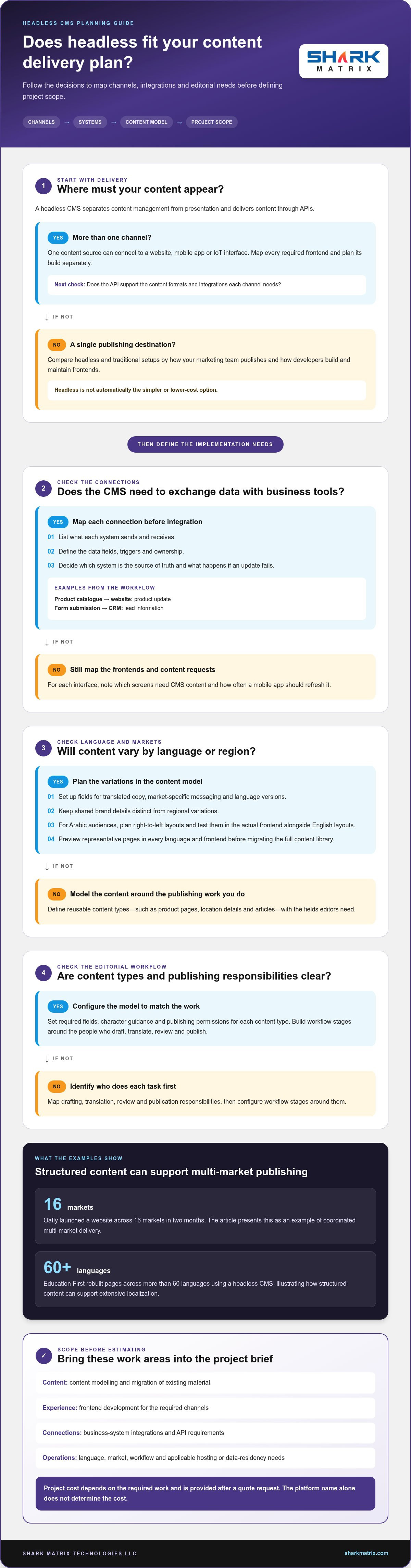
  • Map where content needs to appear, then assess whether API-based delivery across those channels suits your architecture.
  • List the business tools and systems a CMS must connect to, since integration scope shapes implementation work.
  • Compare headless and traditional setups by considering how your marketing team publishes and how developers build and maintain frontends.
  • Define the project scope around content modelling, migration, integrations and frontend development before requesting a cost estimate.
  • Consider web design, development, SEO and mobile app needs together when planning how your content experience will reach users.

What are the advantages of headless Content Management Systems?

Headless architecture separates content management from presentation, allowing teams to publish across websites, apps and other connected platforms. UAE businesses should assess hosting and data residency in light of their sector, data types and applicable obligations. For Arabic audiences, right-to-left support is also an important design requirement.

API-Based Content Delivery

A headless CMS stores content separately from the frontend and delivers it through APIs. Developers can connect one content source to a website, mobile app or IoT interface without rebuilding the editorial layer for each channel. When comparing options, map each required frontend and business system, then check whether the API supports the content formats and integrations you need.

This architecture can support multi-market publishing from shared content structures. For example, Oatly launched a website across 16 markets in two months, showing how coordinated delivery can support a multi-market rollout. The practical advantage depends on planning market-specific pages, translation needs and approval steps before content reaches each frontend.

For UAE audiences, define language and direction requirements early. Arabic pages need right-to-left layouts, while English pages typically use left-to-right layouts; test both in the actual frontend. Set up fields for translated copy, market-specific calls to action and language versions, then preview each combination before publication. A content API can deliver the appropriate version to each channel.

Content Modeling and Editorial Workflows

Content modelling defines reusable types such as product pages, location details and articles. Editors can assemble pages from approved fields instead of formatting each one from scratch. Set required fields, character guidance and publishing permissions for each type. For example, a UAE location page might share contact and opening-information fields while allowing market-specific descriptions.

Reusable components help keep content consistent across channels, but the model should match real editorial work. Identify who drafts, translates, reviews and publishes each item, then configure workflow stages around those responsibilities. Education First rebuilt pages across more than 60 languages using a headless CMS, illustrating how structured content can support extensive localization. If approved content also feeds an AI chatbot, define which fields are suitable for reuse.

For a multi-market setup, separate shared elements from local variations before migration. Keep global brand details in common fields, and let regional editors manage local messaging and translations. This makes updates easier to coordinate while preserving relevant market differences. Test a representative page in every language and frontend before applying the model to the full content library.

How does a headless CMS work?

A headless CMS makes managed content available through APIs, allowing separate interfaces to request and display it. For UAE teams, map each business tool, frontend and access requirement before integration begins.

CMS API Integration with Business Tools

Define the data fields, triggers and ownership for each connection. Decide which system is the source of truth for product descriptions and what happens if an update fails. This interface map helps prevent duplicate records and mismatched content. For a mobile app, specify which screens need CMS content and how often they should refresh.

API Capabilities and Integrations

Review how the CMS API retrieves, filters and updates content. A listing page may need category filters, while an article view needs a title, body, image reference and publication status. Match API capabilities to those requirements before selecting an integration approach. This keeps frontend development aligned with the content and user journeys the business needs.

Plan how systems will handle changes, too. If a field name changes, dependent website and app interfaces may need updating. Document the API contract, test sample responses and establish versioning practices before launch. For content distributed across several channels, check that each frontend can request the correct language, market and publication state from the same structured source.

Security and Scalability

Separating the backend from the frontend can reduce exposure by limiting the risk of system attacks, but it does not remove the need for careful access controls. Assign permissions by role, protect credentials and limit each integration to the data it needs. For example, an editorial account can manage drafts without changing API settings.

Plan capacity around actual usage patterns, such as a campaign launch or busy product release. Test how the interface behaves when several frontends request content at once. Separate delivery and editing permissions, and monitor failed requests to identify integration issues. These steps make growth easier to manage without assuming every channel has identical traffic.

Plugins and Integrations

Plugins can add features, while API integrations connect the CMS to external tools. Assess each plugin against a specific need, such as search, analytics or media handling. Check its data access, maintenance requirements and compatibility with the chosen frontend. A brief inventory helps distinguish essential capabilities from optional additions.

For each connection, document its purpose, the data exchanged and the fallback process. A search integration, for instance, needs to index published pages and remove outdated results. Test this flow with draft, published and withdrawn content. Where relevant, include Arabic and English examples for UAE audiences, so search and display work across both language experiences.

Benefits for marketing and development teams

For marketing teams, structured content can make campaign updates easier to coordinate. A UAE retailer, for example, could prepare product copy, campaign messages and calls to action as separate content elements. Editors can then use them on a landing page and in a mobile app. This helps teams adapt a campaign without rewriting every asset for each channel. Clear ownership of each field also makes review responsibilities easier to assign.

Reusable content gives marketers room to build new experiences from approved material. A campaign team might combine an existing product description, customer guidance and promotional copy on a seasonal page. The same structure can support a different page layout without changing the original content. Before launch, map which elements can be reused and which need market-specific wording. This avoids treating every campaign page as a separate content project.

Development teams can choose a frontend framework to suit each experience. For example, a company could build its main website and mobile app with different interfaces while drawing on the same content source. Developers can update app navigation without asking editors to recreate product information. This separation also lets teams plan frontend changes independently from editorial updates, provided they document how each interface expects content to be structured.

For commerce, a headless setup can connect product storytelling with the shopping journey. A product page might combine editorial details, usage guidance and related content with catalogue information from another system. Teams should define which system owns each field, especially where descriptions meet transactional data. This structure can support dynamic page layouts while keeping the responsibilities of content editors and commerce systems clear.

Marketing and development teams can coordinate launches around a shared content plan. For a new service rollout, marketers can prepare copy and supporting pages while developers build the required frontend components. Agree on content requirements, review stages and launch dependencies before work begins. A release checklist can show whether copy, design, integration testing and publishing are ready together, rather than leaving a team to discover gaps late.

These benefits depend on a genuine need for channel flexibility and ongoing frontend work. An organization publishing a few stable pages may prefer a simpler setup its team can manage easily. Before choosing, compare the number of experiences you need, how often they change and who will maintain them. If developers cannot support separate frontends, the added flexibility may create operational work instead of reducing it.
Headless CMS Development Services and Project Costs

Headless CMS development services

A headless CMS project involves more than connecting a content platform to a website. A practical scope can include platform assessment, content architecture, migration, frontend development, integrations and launch support. For a UAE retailer, the work might cover an English and Arabic storefront, product content and a mobile app. Define the channels and editorial needs first, then match each project activity to them.

Platform assessment compares CMS capabilities with your publishing and technical requirements. Document who will manage content, what types they publish and which systems must receive it. For example, a publisher may need article scheduling and translation workflows, while an online retailer may prioritize product information and catalogue connections. This requirements map helps prevent choosing a platform for features the team will not use.

Content architecture and migration prepare existing material for structured publishing. Start by auditing current pages, files and duplicated fields. Then define reusable content types, such as articles, location pages or product descriptions. A migration plan maps each old field to its new structure and identifies material that needs review. Testing sample pages in the new CMS helps reveal missing information before migration expands.

Integration work connects the CMS with tools such as search, analytics, ecommerce systems or a CRM. Start with a data-flow diagram that names the sending system, receiving system and content involved. For a product page, catalogue data might provide product details while the CMS supplies editorial copy. Agree on field ownership and test updates, errors and removed content before launch.

Quality assurance checks the complete publishing journey, not just whether pages load. Test a draft, approval, publication and correction in each relevant language and frontend. Verify links, images, metadata and API responses with representative content. For ecommerce, also test how product details appear after catalogue changes. Record defects, assign owners and retest fixes before deployment.

After launch, teams may need technical maintenance, editor guidance and planned improvements. Document how to add a page, correct a translation and report a broken integration. Review publishing feedback and support requests to prioritize changes. A clear handover helps editors manage content confidently and gives developers a practical record of architecture decisions and integration behaviour.

What does a headless CMS development company do?

A headless CMS development company plans and builds the systems that connect content management with digital experiences. Its work can span discovery, platform configuration, content architecture, frontend development, integrations and testing. For a UAE business, the scope might include an Arabic and English website, a mobile app, or both. The team turns those needs into a technical plan, then delivers and tests each part.

Discovery turns business goals into a defined project scope. The team maps audiences, publishing tasks, channels and existing systems. For example, a retailer may need product stories managed separately from inventory data. The project team documents which system owns each field, who updates it and where it appears. This sets practical boundaries before development begins.

Next, developers configure the CMS and create a content model. They define types such as articles, product pages and location pages, then set fields and editorial permissions. For an Arabic service page, the model can account for translated text and right-to-left presentation. Editors can review representative content before the team applies the structure to the wider library.

Frontend work builds the website or app that presents CMS content. A team may create page templates, navigation and reusable interface elements for each channel. It also connects business systems through APIs, such as a search service or ecommerce catalogue. A clear integration map identifies the data exchanged and how teams handle errors or changes.

Testing checks technical behaviour and everyday publishing tasks. The team can test a draft moving through review and publication, then verify its display on desktop and mobile screens. For bilingual projects, check Arabic and English layouts separately. Integration tests should also confirm that updated catalogue details or removed pages appear correctly across connected experiences.

Launch work includes deployment planning, editor guidance and handover documentation. Editors need clear steps for creating, reviewing and updating content. Developers need records of the content model, API behaviour and frontend decisions. For example, a handover guide can show how to create a location page and what happens when its translation changes.

Shark Matrix Technologies LLC: Search Engine Optimization (SEO)

Shark Matrix Technologies LLC helps UAE businesses strengthen the search visibility of a headless CMS website through Search Engine Optimization (SEO). This can be valuable when a new frontend launches, pages move during migration, or Arabic and English content need clear search targeting.

SEO planning can align page structure, metadata and internal navigation with the content model. For example, a business can organize service and location pages so visitors and search engines understand their purpose. Reviewing both language versions also helps keep page titles and content relevant to each audience. Search performance depends on the site, its content and its market.

Contact Shark Matrix Technologies LLC to discuss SEO for your headless CMS website.

Make Your Next Digital Move With a Clear Goal

Before choosing a headless CMS development company, decide what your digital experience needs to do next. You might need to help customers find key pages, make a new website easier to use, or attract a more relevant audience. A clear priority helps shape decisions about design, content and promotion, rather than adding technology without a defined purpose.

Once your CMS and frontend plans are set, consider how people will discover and navigate the finished experience. Shark Matrix Technologies LLC offers Web Design and Development, Search Engine Optimization (SEO), and Pay Per Click (PPC) Management to support those goals. The right next step may be refining your website, strengthening organic visibility or planning paid campaigns around your audience.

Choose one priority to move forward, then align your website and marketing plans around it. Contact Shark Matrix Technologies LLC to discuss the next step for your digital presence. A thoughtful plan can turn your CMS decision into a more useful experience for customers.

Frequently Asked Questions

How much does a headless CMS project cost?

There is no single project cost because scope varies with the frontend, integrations and migration work. A site using an existing content model has different requirements from a multi-channel rebuild with new workflows. For a useful estimate, define the platforms, content types, required connections, languages and migration volume. Also separate initial implementation from ongoing hosting, maintenance and content operations in the project plan.

What are the benefits of a headless CMS for marketing and development teams?

Marketing teams can organize content into reusable pieces, while developers build frontend experiences around separate technical needs. For example, a campaign team can update a promotion without asking developers to change unrelated page components. Before adopting this approach, agree on who owns content fields, approvals and release decisions. The benefits are strongest when both teams have clear processes and can support their responsibilities.

Why “Headless CMS” Is Becoming So Popular?

Interest is growing because businesses want content to serve more than one digital experience. A company may publish core information to a website, app and other connected interfaces, while its teams update content centrally. This can suit organizations planning new channels or redesigns. It also introduces more frontend decisions, so popularity alone is not a reason to migrate a stable site.

How do I choose a headless CMS development agency in the UAE?

Choose an agency by matching its proposed scope to your publishing and technical needs. A headless CMS development company should explain how it will handle content architecture, frontend delivery, integrations, testing and handover. Ask for a clear project plan identifying dependencies and responsibilities. For UAE audiences, include Arabic and right-to-left requirements in the design and testing scope if your site will serve Arabic readers.

What headless CMS platforms do development companies work with?

Platform choices vary by project, but CMS technologies in the documented technical stack include Drupal, WordPress, Magento and Shopify. Their suitability depends on content structure, API needs, editorial workflows and connected systems. Start by listing what your team needs to publish and where it must appear. Then compare platform capabilities against those requirements, rather than choosing solely because a platform is familiar.

How much does headless CMS development cost in the UAE?

In the UAE, plan the budget around the defined project scope and express the estimate in AED. Cost drivers include frontend complexity, content migration, integrations, language requirements and testing. Request an itemized estimate that separates implementation from recurring platform or infrastructure expenses. This makes it easier to compare project options and decide which features belong in the initial release.

How long does a headless CMS implementation take?

Implementation timing depends on the work involved, not a universal schedule. A project with an approved content model and a single frontend has fewer dependencies than a migration involving several systems and languages. Build the schedule around discovery, architecture, development, migration, testing and launch. Delays in content approval, integration access or translation can affect later tasks, so assign owners before development starts.

What services should a headless CMS development company provide?

A project scope commonly covers requirements discovery, CMS configuration, content modelling, frontend development, migration, integrations, quality assurance and launch handover. For example, a retailer may need product data mapped from its catalogue and editorial pages migrated into reusable templates. Include editor guidance and technical documentation in the handover plan. These deliverables help teams operate the new setup after deployment and manage future changes.
Categories
Development

Custom Web Development Dubai: The 2026 Enterprise Reference Guide

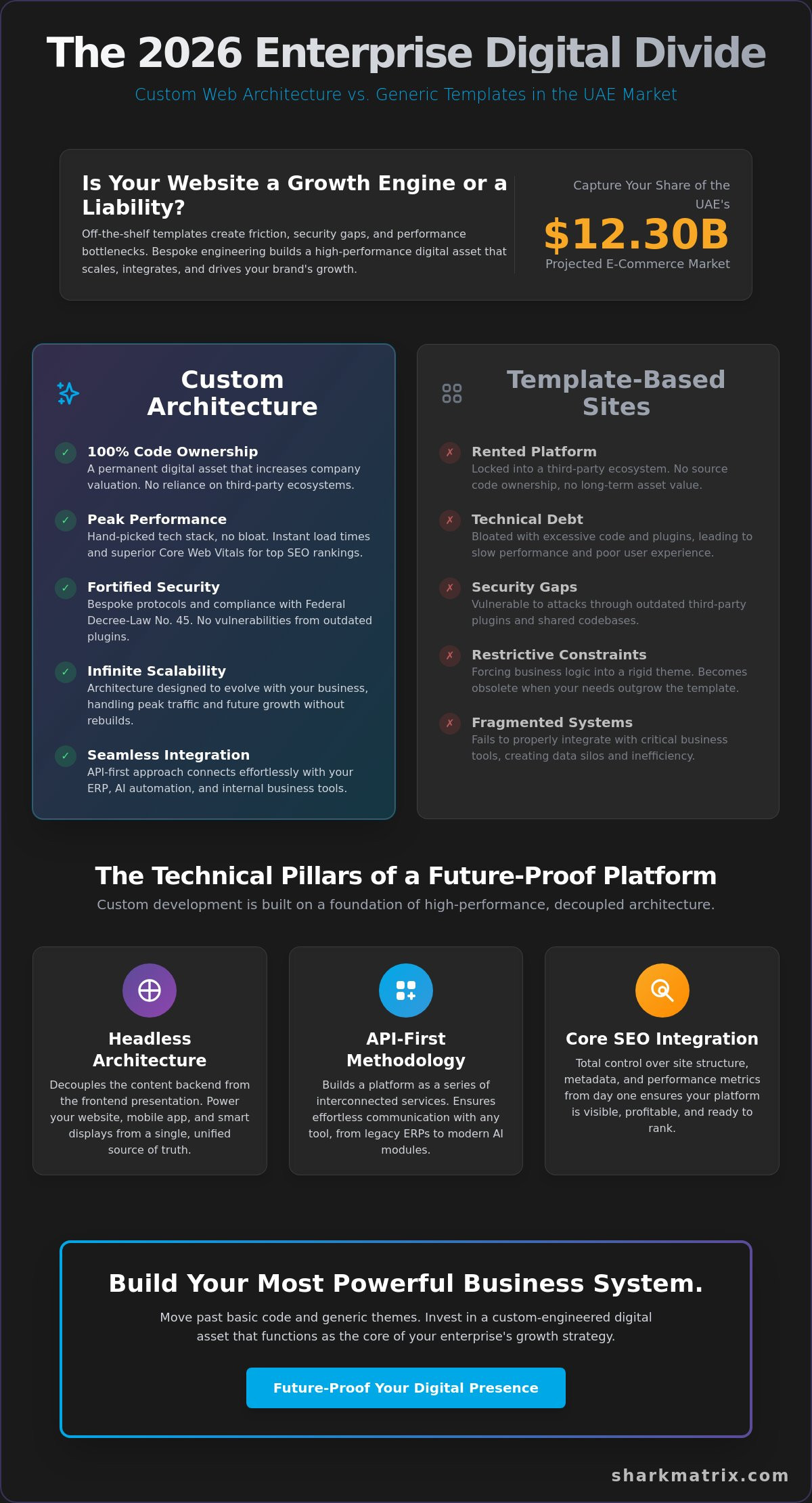
In 2026, a website that merely acts as a digital brochure is a liability for your enterprise’s growth. If your brand is struggling with a fragmented digital presence or security gaps, you’re likely realizing that off-the-shelf templates can’t handle the complexities of the UAE’s evolving market. Investing in custom web development dubai is no longer just about aesthetic appeal; it’s about engineering a high-performance engine that owns its data and scales indefinitely.

You probably feel the friction when your site fails to integrate with internal business tools or lags during peak traffic. It’s a common pain point for leaders who need their digital assets to do more than just look good. This guide will help you master the complexities of bespoke digital architecture so you can drive national brand growth. We’ll show you how to achieve a secure, scalable platform that integrates seamlessly with AI automation and ERP systems while meeting the strict requirements of Federal Decree-Law No. 45.

We’ll dive into the technical standards required for the 2026 landscape, from headless CMS architecture to advanced cybersecurity protocols. You’ll learn how to position your brand to capture a share of the UAE’s projected 12.30 billion dollar e-commerce market through superior SEO and user experience. It’s time to move past basic code and build a digital asset that functions as your most powerful business system.

Key Takeaways

  • Learn why engineering unique software from the ground up provides a distinct competitive advantage over generic, themed website builds.
  • Understand how 2026 standards like Headless CMS and API-first architecture create a flexible, future-proof foundation for your entire business ecosystem.
  • Evaluate the long-term total cost of ownership and performance benefits of custom web development dubai compared to plugin-heavy templates.
  • Master the strategic roadmap from discovery to deployment to ensure your digital asset aligns perfectly with your specific operational requirements.
  • Discover how integrating SEO and digital marketing directly into the development phase ensures your new platform is visible and profitable from day one.

Understanding Custom Web Development Dubai: More Than Just Code

Custom web development dubai is fundamentally about engineering software solutions from the ground up rather than assembling pre-built components. While many agencies offer “web design,” there’s a massive technical gap between skinning a theme and architecting a bespoke platform. To grasp the full scope of What is Web Development?, you have to look beyond the surface. It involves deep logic, database structuring, and specific business workflows that templates simply can’t replicate. It’s the difference between buying a suit off the rack and having one tailored to your exact measurements.

National brands in the UAE are rapidly moving away from restrictive, “themed” website builds. These platforms often come with “technical debt,” which refers to the excessive code and unnecessary plugins that slow down performance and create security vulnerabilities. When you choose a custom build, you gain 100% ownership of your source code. You aren’t leasing a platform or relying on a third-party provider’s ecosystem. You’re owning a digital asset that increases your company’s valuation and ensures you have total control over your digital destiny.

The Core Philosophy of Bespoke Engineering

Bespoke engineering starts with a clean slate. Instead of forcing your business logic into the constraints of a pre-existing CMS, developers build the system to mirror your exact operations. This approach allows for a hand-picked tech stack, whether you need Python for data-heavy tasks or React for a dynamic user interface. Selecting tools based on your specific goals prevents the bloat associated with multi-purpose platforms. Custom development is a strategic investment in intellectual property. It ensures your software evolves alongside your business instead of becoming obsolete when a third-party provider stops supporting a critical plugin.

Why National Brands Prioritize Custom Solutions in 2026

In 2026, the UAE’s digital market is more sophisticated than ever. With mobile commerce accounting for over 78% of transaction volume, a “mobile-friendly” template isn’t enough. Brands need high-performance, mobile-first experiences that load instantly and provide a unique UI/UX that reflects their specific brand identity. Sophisticated identities require a look and feel that can’t be found in a generic theme. A truly effective mobile-first strategy goes hand in hand with a robust responsive web design dubai approach that ensures seamless experiences across every device UAE consumers use. Additionally, custom architecture allows for deeper integration of search engine optimization seo services. It provides total control over site structure, metadata, and Core Web Vitals, which are essential for ranking in highly competitive local markets.

The Technical Pillars of High-Performance Custom Architecture

Building a high-performance digital asset requires moving beyond monolithic structures. In the current 2026 landscape, custom web development dubai focuses on decoupled architecture. This approach separates the frontend user experience from the backend data management. Understanding the core Web Architecture Principles is vital for building systems that don’t just work but excel under enterprise-level pressure. By adopting an API-first methodology, businesses ensure their web platform can communicate effortlessly with any internal or external tool, from legacy ERPs to modern AI modules.

It’s a shift in mindset. Instead of a single block of code, think of your platform as a series of interconnected services. This flexibility allows your business to swap out or upgrade specific components without rebuilding the entire system. If you’re looking to modernize your stack, exploring specialized web design and development can bridge the gap between legacy limitations and future-proof performance.

Headless Architecture and Multi-Channel Delivery

Headless architecture is the gold standard for enterprises that need to push content to multiple places at once. By separating the content repository from the presentation layer, one backend can power your website, mobile app, and even smart displays in a physical showroom. This setup significantly improves loading speeds. Using modern frontend frameworks like Next.js or Nuxt.js allows for static site generation and server-side rendering. These technologies ensure your site is lightning-fast, which is a critical factor for both user retention and search engine rankings.

Data Security and National Compliance Standards

Security isn’t a feature you can bolt on later; it must be baked into the code. Custom builds offer a significant advantage over common CMS platforms because they aren’t targets for “mass-exploit” attacks that scan for known vulnerabilities in popular plugins. In the UAE, compliance with Federal Decree-Law No. 45 of 2021 is mandatory. Custom development allows for precise control over data residency and encryption. You can ensure that sensitive citizen data is stored domestically and handled according to the strict 72-hour takedown timelines required by local law.

AI and Automation Integration

In 2026, AI integration is a foundational requirement rather than an optional add-on. Custom backends allow for the native processing of generative AI and chatbot logic, meaning these tools aren’t just “widgets” but core parts of the business workflow. Whether it’s using natural language processing to categorize customer inquiries or machine learning to personalize product recommendations, a bespoke backend makes it possible. This level of automation streamlines operations and reduces the manual workload on your team, turning your website into an active participant in your business growth.

Custom Web Development Dubai: The 2026 Enterprise Reference Guide

Custom Web Development vs. CMS Templates: Navigating the Choice

Deciding between a pre-built template and custom web development dubai often feels like a choice between speed and quality. While templates offer a fast path to going live, they frequently hide long-term costs that can cripple a growing enterprise. It’s vital to look past the initial price tag and evaluate the Total Cost of Ownership (TCO). A template might seem cost-effective today, but the constant need for third-party plugin subscriptions and the technical debt created by bloated code can make it more expensive over a three-year period. Bespoke systems, by contrast, are built for efficiency, ensuring your infrastructure stays lean as your traffic grows.

Performance benchmarks reveal the starkest differences. Templates are designed to be “all-in-one” solutions, meaning they load hundreds of lines of CSS and JavaScript that your specific site never actually uses. This bloat negatively impacts your Core Web Vitals and search rankings. Custom code allows for granular control over every asset, enabling your team to implement enterprise web development best practices from day one. You can optimize server-side rendering and asset delivery to ensure your platform remains competitive in a market where every millisecond of load time directly correlates to conversion rates.

The “Plugin Trap” is another significant concern for UAE brands. Off-the-shelf systems rely on a patchwork of external tools to add basic functionality like bilingual support or regional payment gateways. When one plugin updates, it can break another, leading to downtime and security gaps. Custom development eliminates this dependency by building features natively into the core architecture. This results in a stable environment where you don’t have to worry about a third-party developer abandoning a critical component of your business engine. For a deeper look at how professional website design and development services address these challenges for UAE enterprises, including Arabic localization and biometric payment compliance, it’s worth reviewing the full landscape of available solutions.

When to Choose a Template-Based System

Templates aren’t without their uses. They’re excellent for small businesses with limited operational complexity or startups looking to launch a rapid Minimum Viable Product (MVP). If you just need a basic digital footprint to test a concept, a theme can get you there quickly. However, you’ll still need to know how to choose a web design agency to ensure the setup is secure and the theme is properly optimized. Just be aware that once you hit the limits of the template’s design, pivoting or scaling usually requires a complete rebuild.

When Custom Development is the Only Option

For national brands handling complex e-commerce, proprietary algorithms, or high-security government portals, custom builds are the only viable path. If your business model relies on unique user journeys that don’t fit into a standard “checkout” or “contact” flow, forcing that logic into a rigid CMS will only lead to frustration. Custom solutions are essential for seamless integration with internal ERPs and AI automation tools. They provide the flexibility to build a truly unique digital experience that scales alongside your brand’s ambitions without the baggage of legacy code. Ensuring that experience is equally flawless on mobile requires pairing your custom build with a comprehensive responsive web design dubai strategy built for the UAE’s 5G and 6G-connected consumer base.

The Strategic Roadmap: From Discovery to Deployment

Successful custom web development dubai isn’t a black box process. It’s a highly structured engineering journey that transforms abstract business goals into a functional digital engine. Unlike off-the-shelf setups where you simply flip a switch, a bespoke project requires a meticulous roadmap to ensure every line of code serves a specific operational purpose. This path ensures that the final product isn’t just a website, but a core business system that integrates with your existing workflows and scales as your brand expands across the region.

Discovery and Strategic Planning

Every project begins with an intensive discovery phase. This is where technical documentation and site mapping serve as the project’s foundation. Instead of jumping straight into code, teams define Key Performance Indicators (KPIs) like target load times, conversion paths, and data throughput requirements. This phase is critical because discovery prevents scope creep and ensures budget adherence by identifying potential technical hurdles before they become expensive mid-project changes. It’s during this stage that the logic for complex integrations, such as AI automation or ERP syncing, is mapped out to ensure a frictionless build.

Agile Development and Continuous Integration

The build phase follows an Agile methodology, breaking the project into manageable “sprints.” This approach offers total transparency, allowing stakeholders to review progress every few weeks and pivot if business requirements shift. In 2026, professional teams utilize CI/CD (Continuous Integration and Continuous Deployment) pipelines. These pipelines automate the integration of new code, ensuring that updates are tested and deployed without disrupting the live environment. Regular stakeholder reviews during these sprints ensure the project never drifts from its original vision, keeping the development aligned with real-world user needs.

QA, Security Audits, and Performance Testing

Before any platform goes live, it must pass a battery of rigorous tests. This includes functional testing to ensure every button works, cross-browser testing for compatibility, and deep security audits to protect against vulnerabilities. For national brands, load testing is non-negotiable during the custom web development dubai process. Your system must remain stable during high-traffic periods like major regional shopping festivals or government announcement windows. Finally, a pre-launch checklist ensures technical SEO readiness, confirming that search engines can crawl and index the new architecture efficiently from the moment it launches. Ready to build your digital engine? Explore our web design and development services to start your strategic roadmap.

Future-Proofing Your Digital Presence with Shark Matrix Technologies LLC

Shark Matrix Technologies LLC operates as a strategic technology partner rather than a simple service provider. When you invest in custom web development dubai, you’re building a foundation for long-term national growth. We view your digital presence as a dynamic, evolving business tool that requires constant refinement to stay ahead of shifting consumer behaviors. This partnership approach ensures your platform doesn’t become a static relic but remains a high-performance engine for your enterprise. We focus on creating assets that you own entirely, giving you the freedom to innovate without the constraints of third-party platform limitations.

Our philosophy is built on the idea that your website should be your hardest-working employee. It isn’t enough to have a beautiful interface if the underlying architecture can’t support your business goals. By aligning our technical expertise with your specific commercial objectives, we transform your digital footprint into a scalable system. This ensures that as your business expands, your infrastructure is already prepared to handle increased load and complexity. We’re here to help you turn technical challenges into competitive advantages.

The Synergy of Search and Software

Technical excellence is meaningless if your target audience can’t find you. Our developers work side-by-side with SEO experts from the very first discovery session to ensure the architecture is optimized for search visibility. In the competitive UAE market, high-speed performance is a prerequisite for ranking, and our custom builds are engineered to exceed these benchmarks. Beyond organic reach, we integrate Search Engine Optimization (SEO) and ppc agency dubai strategies to ensure your new platform generates immediate ROI through targeted traffic. This holistic approach means your site is built to convert from the moment it goes live.

Scalability and Long-Term Partnership

A successful launch is only the beginning of the journey. Shark Matrix Technologies LLC provides ongoing technical support and maintenance to ensure your system remains secure and efficient as your user base grows. Our development philosophy centers on scalability, preparing your infrastructure for future ai automation and development or advanced machine learning integration. As your business needs change, we’re here to implement feature updates that keep you at the forefront of your industry. Whether you need to integrate ai chatbot-development services or expand your e-commerce development capabilities, our team ensures your software evolves with the market. If you’re ready to transform your digital strategy, contact us for a consultation to discuss how custom web development dubai can drive your brand’s future.

Transform Your Digital Vision into National Growth

The move toward decoupled architecture and bespoke engineering is no longer optional for enterprises seeking a competitive edge. By prioritizing a clean slate approach, you ensure your platform maintains the security and performance standards required by the UAE’s evolving legal landscape. You’ve seen how custom systems eliminate technical debt and provide the flexibility to integrate advanced AI automation directly into your core business workflows. Owning your source code is the ultimate way to protect your intellectual property while scaling without the friction of third-party templates.

Shark Matrix Technologies LLC has been a cornerstone of the regional tech scene since 2010. With over a decade of UAE market expertise, we specialize in custom web development dubai that bridges the gap between complex software engineering and high-impact digital marketing. Our team provides a comprehensive strategy that spans SEO, PPC management, and sophisticated UI/UX design to ensure your asset is both functional and visible. It’s time to stop settling for restrictive platforms and start building an engine that drives your brand forward.

Build Your Future-Ready Digital Asset with Shark Matrix Technologies LLC

Your digital infrastructure should be your most valuable asset. We look forward to helping you architect a solution that meets the demands of tomorrow’s market today.

Frequently Asked Questions

What is the primary difference between custom web development and using a CMS like WordPress?

Custom development involves engineering a unique software solution from the ground up to match specific business logic, whereas a CMS like WordPress relies on a pre-existing framework and templates. This clean-slate approach eliminates the “code bloat” often found in themes, providing better performance and 100% ownership of the source code. It allows your digital asset to function as a specialized business tool rather than a generic website.

How much does custom web development cost for a business in the UAE?

Market data for 2026 shows that professional website development in Dubai typically ranges from AED 3,500 for basic sites to over AED 145,000 for fully custom enterprise platforms. For complex web applications with high security requirements, costs can exceed AED 500,000. These figures reflect market averages for various complexities, and you should check with a technology partner for a specific quote tailored to your project goals.

How long does it typically take to build a fully custom website from scratch?

A bespoke project generally requires 12 to 24 weeks to move from the initial discovery phase to final deployment. This timeline covers strategic planning, UI/UX design, agile development sprints, and rigorous security audits. Projects involving extensive AI automation or complex ERP integrations may fall on the longer end of this spectrum to ensure every component functions seamlessly under enterprise-level traffic.

Is custom web development better for SEO compared to using templates?

Yes, custom web development dubai offers a significant advantage for search visibility because it provides total control over technical SEO factors and Core Web Vitals. Unlike templates that often load unnecessary scripts and slow down your site, custom code is lean and optimized for speed. This architectural precision ensures search engines can crawl your site efficiently, helping you rank higher in the competitive UAE market.

What technical stack should I choose for my custom web development project in 2026?

For most enterprise projects in 2026, a stack involving TypeScript and React or Next.js is the standard for high-performance frontends. On the backend, Node.js is excellent for scalability, while Python with Django is the preferred choice for data-intensive applications or those requiring AI and machine learning integration. These technologies provide the end-to-end type safety and flexibility needed for modern, future-proof platforms.

Does my business really need a custom website or is a template enough?

If your business is a small startup or you’re testing a simple concept, a template might be sufficient for a rapid launch. However, national brands with complex workflows, unique user journeys, or high scalability needs will find templates restrictive. If you plan to integrate advanced AI tools or require a specific digital identity that stands out in the UAE, a custom build is a necessary investment for long-term growth. Understanding the full scope of website design and development services available to UAE enterprises can help you make a more informed decision about the right path forward for your brand.

How do you ensure the security of a custom-built website?

Security is baked into the architecture through a “cybersecurity-first” approach that includes the use of Web Application Firewalls (WAF), security headers, and active HTTPS/SSL certificates. Custom builds are inherently less prone to the mass-exploit attacks that target common CMS plugins. Additionally, bespoke systems allow for precise control over data residency to ensure full compliance with UAE Federal Decree-Law No. 45 regarding data protection.

Can I integrate my existing CRM or ERP system into a custom website?

Seamless integration with internal business tools is a hallmark of bespoke development. By using an API-first methodology, developers can connect your website directly to existing CRM or ERP systems like SAP, Oracle, or Microsoft Dynamics. This ensures that data flows smoothly between your digital presence and your back-office operations, turning your website into a real-time extension of your business engine.