
Categories
Uncategorized

Improving PPC Conversion Rates Through Stronger Campaign Structure

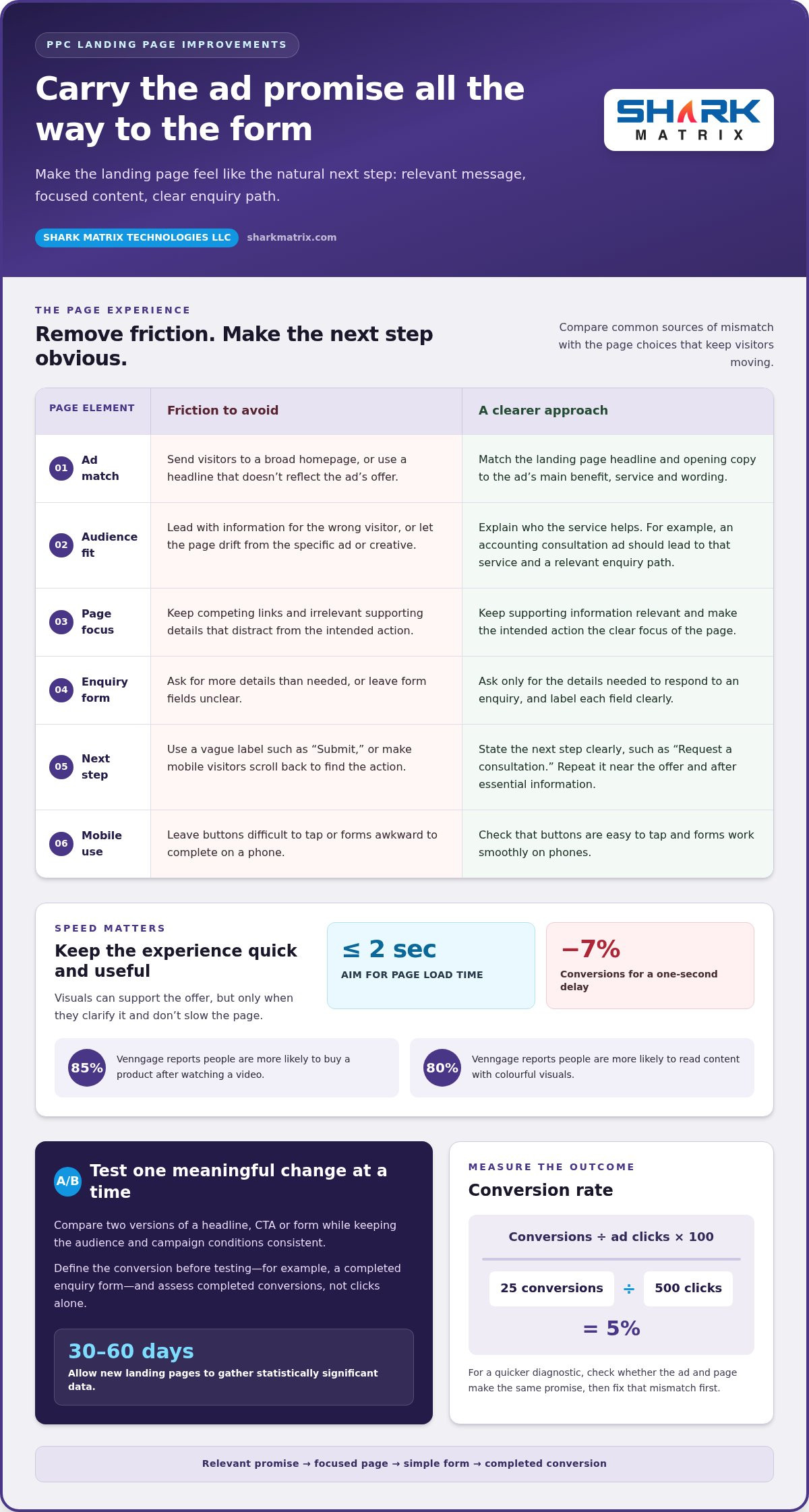
More clicks won’t fix a form that visitors abandon. Improving PPC conversion rates starts with matching each ad to a focused landing page, the right audience and a simple form; the conversion rate is calculated by dividing conversions by ad clicks and multiplying by 100. For example, 25 conversions from 500 clicks equals a 5% conversion rate.

It’s frustrating to pay for traffic that doesn’t turn into enquiries, especially when the problem may be what happens after the click. This guide explains how to improve PPC conversion rates by reducing form abandonment, making landing pages more relevant and usable, refining audience targeting, and organising campaigns around clear goals. You’ll also learn how to read conversion data and choose tests based on visitor behaviour rather than guesswork. From matching ads to landing pages to structuring campaigns, each improvement can make the next step clearer for potential customers across the UAE.

Key Takeaways

  • Make each landing page reflect the ad’s promise, keep its form focused, and make the next step clear on mobile.
  • Separate audiences by intent and tailor ad messages and landing pages to what each group needs.
  • Organise campaigns around distinct goals and relevant keywords so performance data can guide specific changes.
  • Track completed conversions alongside clicks to identify where visitors drop off and which adjustments improve results.
  • Use industry and platform benchmarks as context, then judge performance against your own campaign goals and lead quality.

1. Landing page improvements

A landing page should deliver on the promise made in its ad. If a Google ad promotes an accounting consultation, the page should lead with that service, explain who it helps, and present a clear enquiry form. Sending visitors to a broad homepage makes them search again, adding effort that can interrupt the path from interest to action.

Start by aligning the message. Match the ad’s main benefit, service, and wording to the landing page headline and opening copy. Then check that the content fits the intended audience: a page for business owners seeking support shouldn’t lead with information for job seekers. For Facebook campaigns, make sure the page reflects the specific offer or creative that brought visitors there. Keep supporting details relevant and remove competing links that distract from the intended action.

Use a focused form and a visible call to action (CTA). Ask only for the details needed to respond to an enquiry, and label each field clearly. Describe the next step in the CTA, for example, “Request a consultation,” rather than using a vague “Submit.” Repeat the CTA near the offer and after essential supporting information, so mobile visitors don’t have to scroll back to find it. Check that buttons are easy to tap and forms work smoothly on phones.

Test one meaningful change at a time. Compare two versions of a headline, CTA or form, while keeping the audience and campaign conditions consistent. Define the conversion before the test begins, such as a completed enquiry form, and assess completed conversions rather than clicks alone. Allow new landing pages 30-60 days to gather statistically significant data. For a quicker diagnostic, check whether the ad and page make the same promise, then fix that mismatch first.

Page speed and useful content also shape the experience. Aim for a load time of two seconds or less; a one-second delay can reduce conversions by 7%. Venngage reports that people are 85% more likely to buy a product after watching a video, and 80% more likely to read content with colourful visuals. Use video or visuals only when they clarify the offer, and keep them from slowing the page. A practical route to improving PPC conversion rates is to make every element support the same action, from the ad’s first claim to the form’s final button.

2. Audience targeting

Relevant targeting starts with what a person wants to do, not just who they are. Separate searches for “buy office chairs” from “office chair repair,” because they signal different needs. Match each keyword group to its own ad and conversion goal. Review search terms regularly, then exclude irrelevant queries that use budget without attracting suitable visitors.

Keyword targeting and search intent can improve conversions by connecting each query to an ad that addresses its underlying need. Someone comparing providers needs different information from someone ready to request a quote. Use search-term reports and conversion analytics to group queries by intent, refine ad messages, and direct each group to a relevant next step.

Build audience segments around meaningful differences, such as past enquiries, existing customers, or first-time visitors. Tailor retargeting for existing customers to their purchase history, product lifecycle, and needs between purchases. PPC retargeting of existing customers typically generates conversion rates three to five times higher than cold traffic. Keep each offer relevant to its segment instead of showing every visitor the same message.

Micro-moment targeting addresses a need when it arises. For example, someone searching for an urgent service on a mobile device may need a direct way to get in touch, while a researcher may need clear comparisons. Use the query, device, location targeting, and time context available in campaign analytics to shape the message. Make the ad’s next step fit the person’s immediate task to reduce friction.

Remarketing can reconnect with people who visited a key page but didn’t complete an enquiry. In a Mazda retargeting example, retargeted customers converted at a 53% higher rate and spent 98% more. Treat those figures as an example, not a forecast for every campaign. Create audience lists based on useful actions, such as viewing a service page, and exclude people who have already completed the intended conversion.

Email list targeting can help campaigns reach known customers or leads with messages suited to their relationship with the business. Segment lists by previous purchase, enquiry topic, or lifecycle stage, then tailor the ad and landing-page offer accordingly. Keep the goal consistent across channels: an existing customer may need a related service, while an unconverted lead may need a clear answer to a previous concern.

Audit conversion tracking by testing a real form submission and confirming that the intended conversion records once in campaign analytics. Compare ad-platform totals with website records, check that tags fire on the correct completion event, and review attribution settings for duplicate or missing credit. These checks help reveal whether a targeting change attracts qualified leads or simply shifts reported conversions. For stronger keyword planning across paid and organic search, explore SEO and keyword strategy.

3. Account structure and campaign strategy

Organise Google Ads campaigns around distinct business goals rather than using a catch-all account structure. A UAE firm could separate campaigns for service enquiries, branded searches, and competitor comparisons. Within each campaign, group closely related keywords so the ad clearly answers the search. This structure makes it easier to see which intent, message, or audience brings useful leads, then adjust that area without changing unrelated campaigns.

Keep each ad group focused. If a campaign targets “commercial cleaning” and “office cleaning,” separate the themes when their search intent or landing pages differ. Align keywords, ad messaging, and destination pages. Google’s Quality Score considers click-through rate, ad relevance, the landing page, and overall AdWords performance. Improving these connected elements gives account reviews a practical focus instead of treating each metric in isolation.

Kevin Brkal reported an 81% lift in conversion rate for a client after optimizing its advertising account. That result illustrates why structure deserves attention, but it isn’t a forecast for every account. Review campaign and ad-group performance together: a high-click ad with few qualified enquiries may need tighter targeting, while a relevant ad with low traffic may need broader keyword coverage or revised messaging.

Bidding strategies and campaign budgets affect conversions by shaping which auctions an account can enter and how consistently its ads appear. Choose a bidding approach that fits the measured goal, such as completed enquiries, and make sure conversion tracking reflects that action. Prioritise budgets according to campaign value and lead quality, then review spend alongside completed conversions. Increasing the budget alone won’t fix a weak match between searches, ads, and offers.

Separate campaigns when they need different goals, audiences, or budget decisions. For example, campaigns targeting distinct customer groups may need different settings and locally relevant messaging across the UAE. Keep campaigns together when their keywords, conversion goals, and landing-page experiences genuinely match. This balance gives account managers enough control without scattering similar data across numerous small campaigns.

Review performance regularly and make changes to answer a specific question. Compare search terms, conversion actions, device performance, and campaign results before changing bids or budgets. For LinkedIn campaigns, assess whether professional audience criteria fit the offer; for Google Ads, examine query intent and keyword relevance. Record each change and its result so the next strategy decision builds on evidence rather than guesswork.
Improving PPC Conversion Rates Through Stronger Campaign Structure

4. Reasons to optimize PPC conversion rates

Clicks measure attention, but completed actions show whether paid traffic supports a business goal. A campaign can attract visitors who leave without calling, enquiring, booking, or downloading a guide. Reviewing the conversion rate helps distinguish useful traffic from visits that use budget without producing the intended result. That distinction matters when deciding whether to change targeting, messaging, or the offer.

Optimization can also reveal friction between the ad and the next step. For example, a visitor who clicks an offer for a service may abandon a form that asks for unnecessary details. Review the journey from ad click to completed action and find where people stop. Addressing that specific barrier makes campaign decisions more practical than simply trying to generate more clicks.

Common PPC tracking mistakes include counting button clicks as completed leads, firing a conversion tag more than once, or overlooking broken tracking after a website change. These errors can distort bidding decisions and make weak traffic appear successful. Test the full action, such as submitting a form, and confirm that the recorded event represents a genuine completion.

Conversion data can also help prioritise campaigns. Compare lead quality alongside recorded actions: a campaign producing many low-value enquiries may matter less than one generating fewer suitable prospects. In Google’s cited data, the average advertiser doubles their return. Treat return as a business measure, not a substitute for checking whether leads progress to meaningful outcomes.

For context, a typical PPC conversion rate is between 2% and 5%, while exceptionally strong campaigns can exceed 10%. These are broad benchmarks, not a UAE-specific target or a promise for an individual account. In the UAE, compare campaigns with similar goals, platforms, audiences, and conversion definitions. A search campaign for urgent services should not be judged against a social campaign promoting a guide download.

Best practice starts with a reliable baseline. Define the conversion clearly, confirm the tracking event, and review results by campaign and device. Then change one factor at a time, such as the bid strategy, keyword focus, or form requirements. Record what changed and whether qualified conversions shifted. This makes each optimization easier to assess and prevents simultaneous edits from obscuring the cause.

Running PPC without reviewing completed actions can hide wasted spend and missed opportunities. Use conversion evidence to decide whether to refine the audience, improve the offer, or shift campaign priorities. If clicks rise while qualified conversions remain flat, investigate relevance and tracking before increasing traffic. A measured approach keeps optimization tied to business outcomes rather than surface-level activity.

5. What is a good PPC conversion rate by industry and platform?

A useful benchmark depends on the campaign’s industry, platform, audience, and conversion definition. For context, WordStream reported an average PPC conversion rate of 7.52% in its November 2025 update, while Ruler Analytics reported 5.4% in May 2026. These figures differ, so treat them as reference points, not interchangeable targets for UAE campaigns.

Industry differences matter, too. The reported median paid search conversion rate for ecommerce is about 3.5%, while SaaS averages about 2%. Agencies have a 2.4% benchmark, and business services have a 3.5% benchmark. These distinctions show why a UAE retailer should compare like with like, rather than judging its campaign against an unrelated service business.

Legal figures also vary by source and date. WordStream’s 2025 benchmark reports 5.09% for Attorneys & Legal Services, while Ruler Analytics reported 7.8% for Legal in May 2026. The gap underlines the importance of matching geography, campaign type, and conversion measurement before using a benchmark to set expectations.

Platform averages offer another reference, but they don’t remove the need for context. Reported averages are 2.85% for Google Ads and 2.94% for Bing across sectors. Facebook Ads range from 9% to 10%, LinkedIn Ads from 5% to 15%, and Instagram averages 1.08%. Compare the same objective and conversion action, since platforms can attract visitors at different stages of decision-making.

Some platform figures also shift by industry. Facebook Ads conversion rates are reported at 14.29% for fitness products and services, compared with 2.31% for technology. A UAE fitness campaign and a technology lead campaign therefore need different comparison sets. Look for benchmarks that resemble the campaign’s offer and audience, then use internal results to assess whether leads are relevant.

For a practical evaluation, calculate conversions using the same action and reporting period across campaigns. Separate enquiry submissions from calls, purchases, or downloads, then compare each category with its closest benchmark. Review the source, date, industry, and platform behind every reference. If definitions differ, treat the figure as broad context rather than a direct performance comparison.

A “good” rate is one that supports the campaign’s commercial goal and attracts suitable prospects. A higher percentage can still mislead if it counts low-quality actions, while a lower rate may bring more valuable enquiries. In the UAE, assess lead quality and campaign outcomes alongside the conversion rate, then use relevant benchmarks to guide, not replace, decisions. For a broader search visibility strategy, explore SEO strategy.

Shark Matrix Technologies: Search Engine Optimization (SEO)

Shark Matrix Technologies LLC can help when paid campaigns attract clicks but campaign management, organic visibility, or website experience needs attention. Its Pay Per Click (PPC) Management supports campaign planning and optimization, while Search Engine Optimization (SEO) helps strengthen visibility beyond paid ads. If the landing page creates friction, Web Design and Development can improve the site experience that contributes to conversion.

These services can work together to support the same business goals: relevant traffic, clear messaging, and meaningful actions. Consider this next step when your campaign data points to issues across targeting, search visibility, or the website rather than one isolated ad. To discuss your marketing needs, contact Shark Matrix Technologies LLC or visit sharkmatrix.com.

Build Your Next Campaign Around What You Learn

Make the next campaign decision deliberately. Choose a clear business outcome, then use incoming results to decide what needs attention. This keeps improving PPC conversion rates focused on meaningful progress, not change for its own sake. A useful review asks whether the campaign attracts the right prospects and whether the website supports their next step.

When paid campaigns, search visibility, and website experience need to work together, Shark Matrix Technologies offers Pay Per Click (PPC) Management, Search Engine Optimization (SEO), and Web Design and Development. These services can address connected parts of the visitor journey, from campaign traffic to the pages where prospects take action.

Bring your campaign goals and priorities into the next planning conversation. Contact Shark Matrix Technologies to discuss a practical next step for your digital marketing. Clear goals make it easier to keep learning, refine your approach, and move forward with confidence.

Frequently Asked Questions

How can I reduce form abandonment in PPC campaigns?

Reduce abandonment by making the form easy to complete and fixing errors that interrupt submission. On a UAE service enquiry form, label required fields clearly and show an understandable message beside any field needing correction. If the form has several steps, explain what comes next and show visitors their progress. Review analytics for the last completed field to find where people stop, then test a focused adjustment.

Should I create separate PPC campaigns for existing customers?

Create a separate campaign when existing customers need a different message, offer, or conversion goal from new prospects. For example, a business could separate a campaign encouraging repeat purchases from one focused on first-time enquiries. This makes each group’s results easier to interpret and helps avoid showing acquisition ads to people who have already converted. Keep campaigns together if their goals and audience treatment are genuinely the same.

What is a PPC conversion rate?

A PPC conversion rate is the percentage of ad clicks that result in a defined conversion. Depending on the campaign’s goal, a conversion might be a completed purchase, a submitted enquiry, or a completed download. Define the action before comparing campaigns: a rate based on form submissions cannot be compared directly with one based on purchases. Consistent definitions make performance reporting more meaningful.

What is the fastest way to improve PPC conversion rates?

Fix the clearest disconnect between a search, its ad, and the action visitors are asked to take. A message-match correction can show results in 7-14 days. For example, if an ad promotes a specific service but the destination discusses several services, make the relevant offer prominent. Then monitor completed conversions and lead quality to see whether the change improved the campaign’s outcome.

Why is call-to-action placement important for PPC conversions?

CTA placement matters because visitors need a clear next step when they’re ready to act. Place an action near the main offer, then consider another after supporting details for readers who need more information first. Keep the page’s primary action consistent, so a consultation button and a download button don’t compete. Track each CTA separately to learn which placement leads to completed conversions.

How do you calculate PPC conversion rate and conversion value?

Calculate conversion rate by dividing conversions by ad clicks and multiplying by 100. Conversion value is the total value assigned to the recorded conversions, such as transaction revenue for purchases. For lead campaigns, use a consistent internal valuation method rather than treating every form submission as equal. Keep conversion value distinct from conversion count, so reporting shows both how often people act and the business value attributed to those actions.

Which PPC landing page changes improve conversion rates?

Prioritise changes that remove uncertainty or help visitors assess the offer. Make service eligibility, included details, and the next step easy to find. Add relevant proof, such as customer reviews, where it supports the decision, and answer common objections near the enquiry form. For a UAE campaign, make sure the service wording on the page matches the audience and offer in the ad instead of relying on generic copy.

What A/B tests should you run to improve PPC conversion rates?

Test a specific decision point, such as whether a short form or one with an additional qualifying question produces more suitable leads. Other useful tests include different offer framing, the order of supporting information, or customer proof near the CTA. Keep the audience, campaign goal, and measurement consistent when comparing versions. Judge the winner by completed conversions and lead relevance, not clicks alone.

Categories
Uncategorized

Paid Media Campaign Management: Set Budgets and Plan Campaigns

Paid visibility is a choice, not a blank cheque. Paid media is promotion a business funds to reach a selected audience. Effective paid media campaign management connects that spend to a clear goal, such as awareness, leads or sales. Search ads, for example, can appear when someone searches for a relevant phrase, and advertisers often pay when a person clicks.

It’s understandable to want more control over advertising spend and a clearer sense of what it can achieve. You can set and adjust a campaign budget, while performance data shows which ads and keywords are attracting attention and which need refinement. The right approach depends on your objective, audience and platform, not on spending for its own sake.

This guide explains what paid media includes, how search advertising works and how to plan campaigns around flexible budgets. You’ll learn how to define a useful goal, choose relevant targeting, match ads with suitable landing pages and assess results using clicks, conversions and cost per acquisition.

Key Takeaways

  • Match social platforms and audience targeting to the people you want to reach, using relevant attributes such as interests, location and behaviour.
  • Choose search terms for relevance and intent, then make sure each landing page delivers on the ad’s message.
  • Compare paid placements by how they charge, such as per click or per thousand impressions, and select a format that fits your campaign goal.
  • Set a spending limit and use performance data to adjust bids, targeting and creative as the campaign runs.
  • Define the outcome you want before launch, then track meaningful measures such as conversions and cost per acquisition.

What is paid media?

Paid media is promotion a business funds to reach a selected audience through advertising placements. In the UAE, campaigns must comply with applicable advertising and privacy requirements, as well as the policies of each platform.

Audience Targeting Across Platforms

Audience targeting means choosing who sees an ad and where it appears, using platform options such as location, interests, demographics and behaviour. A retailer serving customers across the UAE, for example, needs different targeting from a business focused on one audience segment. Paid media campaign management links those choices to the campaign objective instead of treating every platform user as a potential customer.

For example, Facebook Ads can target customers using demographics and purchase history. A UAE-wide retailer could focus on people interested in its product category, while a business promoting a specialist service might target audiences based on relevant professional interests. Choose platforms that match the audience’s habits, and tailor the creative to the format, such as an image or video ad.

Reach and Brand Awareness

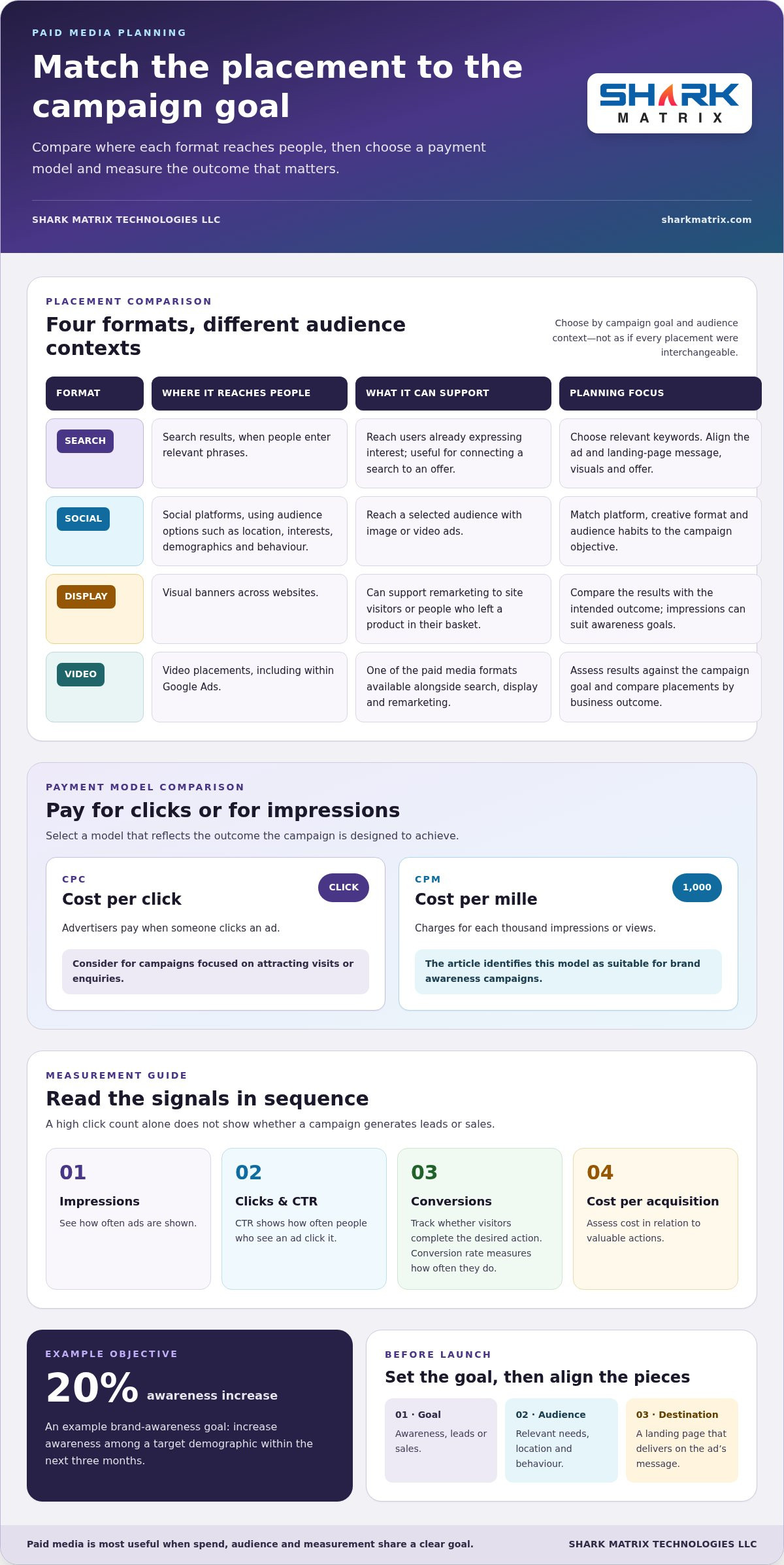
Paid media can increase visibility by placing promotional content in front of people who may not find a business through organic efforts. A brand awareness campaign, for example, could aim to increase awareness by 20% among a target demographic within the next three months. That specific objective gives the business a clear audience, outcome and timeframe to assess.

Reach alone doesn’t show whether an ad is relevant. A UAE business can compare audience responses across platforms and formats, then refine targeting or creative to better fit the people it wants to reach. Paid placements can also complement organic marketing: advertising amplifies a message, while SEO and useful content support visibility through unpaid channels.

Start with the desired outcome, then research the audience. Awareness, lead generation and sales each call for a different message and measurement approach. For awareness, track whether the campaign reaches the intended audience. For leads, focus on actions that show interest, such as a completed enquiry form. A clear goal makes subsequent campaign decisions more useful.

Audience research should identify the people a business wants to reach and the problem its offer addresses. A UAE business might distinguish between customers seeking a service available nationwide and decision-makers evaluating a business solution. Those groups may use different platforms and respond to different messages. Define the target audience by relevant needs, location and behaviour, not assumptions about the whole market.

Choose platforms and formats that fit audience habits. Social media ads can use images or videos, with advertisers selecting an audience and budget. A professional offer may need a different context from a consumer product, while a nationwide promotion benefits from relevant location targeting. Matching platform, format and audience keeps digital marketing focused on the campaign goal.

Search engine advertising

Search ads place paid messages on search engine results pages when people enter relevant phrases. Other formats, including display and social media ads, reach audiences in different contexts.

Search Ads and Captured Intent

Search advertising shows keyword-based ads to people searching for specific phrases, making it useful for reaching users already expressing interest. For example, a UAE customer searching for a particular service may see a related Google Ads placement. Choose relevant keywords that connect search intent with the offer, rather than pursuing unrelated traffic.

Build each ad around its selected keywords, then align the landing page’s message, visuals and offer with the ad. If an ad promises information about a service, its destination should explain that service clearly. Sitelink, call and location extensions can add useful information or options to eligible search ads. Conversion tracking shows which campaigns and keywords lead to valuable actions.

Evaluate search advertising through impressions, clicks, conversions and cost per acquisition. Click-through rate shows how often people who see an ad click it; conversion rate shows how often visitors complete the desired action. These measures answer different questions. A high click count alone doesn’t show whether a campaign is generating leads or sales.

Paid Media Advertising Formats

Paid media formats include search ads, social media ads, display banners and video placements. The format determines where people encounter the message and what action they can take. Choose based on the campaign goal and audience context, rather than treating every placement as interchangeable.

Social media advertising can use image or video ads, with advertisers selecting an audience and budget. Display advertising places visual ads across websites and can support remarketing to people who visited a site or left a product in their basket. These formats let a business reconnect with interested visitors after their original search.

Pricing varies by format and payment model. With cost per click, advertisers pay for ad clicks. Cost per mille charges for each thousand impressions or views, making it suitable for brand awareness campaigns. Choose a model that reflects the outcome the campaign is designed to achieve.

For example, a business focused on visibility may use display placements priced by impressions, while a campaign seeking enquiries may prioritize search ads and conversion tracking. Google Ads can include search, display, remarketing and video placements. Compare results by format to see which placements support the intended business outcome.

Definition and forms of paid marketing

Paid media is promotional content a business funds to reach a chosen audience. It can attract attention, generate traffic, build awareness or encourage conversions. For example, a UAE retailer might promote a seasonal offer to people interested in its product category. Payment buys an advertising placement; campaign strategy determines its audience, message and intended outcome.

Paid marketing can appear across search engines, social media, websites, newsletters and other channels. Formats include sponsored posts, banner ads, video ads, pop-ups and promoted articles. A business might use a sponsored social post to introduce a new service, then show a display banner to people who previously visited its website. Each format gives the message a different context.

Payment models also vary. With cost-per-click advertising, charges depend on how often people click an ad. Cost-per-mille pricing charges for each thousand impressions or views, making it suitable for brand awareness goals. Campaigns can also be structured around conversions. The model affects what the business pays for, so it should match the outcome being measured.

Paid media differs from owned media, which uses a company’s own channels. A business website, social media pages and email newsletter are examples of owned media. These channels give the business space to publish messages, while paid placements can extend their visibility. For instance, an ad can direct an audience to a product page on the company website.

Earned media is exposure gained through public relations or word of mouth. Online reviews, articles and search rankings can all contribute. Unlike a paid placement, a review is not an ad purchased by the business. A practical strategy can combine all three: promote an offer through paid media, explain it on an owned page, and attract attention through useful coverage or customer recommendations.

Organic marketing uses unpaid methods such as SEO, content marketing and social media engagement. Paid advertising can create immediate visibility, while organic efforts help build a lasting presence. For example, a UAE service business could publish an informative guide, then promote it to an audience likely to need that service. The paid placement attracts relevant visitors, and the guide provides useful detail.

Choose the mix by identifying the desired action and audience behaviour. Awareness may call for broad visibility and impression-based measurement; lead generation needs a clear next step and conversion tracking. If a campaign brings traffic but no enquiries, the message or destination may need improvement. Separating paid, owned and earned activity makes it easier to see how each contributes to the marketing objective.

Paid Media Campaign Management: Set Budgets and Plan Campaigns

Budget and campaign flexibility

Paid campaigns let businesses set spending limits and adjust delivery as performance data comes in. Budget decisions work best when tied to a clear goal, such as visibility, leads or sales.

In the UAE, paid media campaign management costs depend on campaign scope and are provided after a quote request. Factors include the platforms, campaign complexity, targeting and level of management required.

Campaign Budget Flexibility

A flexible campaign budget lets a business control spending and adapt campaigns to results. This matters when audience response or market conditions shift: budgets and placements can be adjusted instead of left unchanged.

Set a spending limit that reflects the campaign objective and the amount the business can allocate to advertising. Then monitor delivery and performance. For example, a UAE retailer promoting a seasonal offer can review which placements engage relevant shoppers and adjust the campaign as demand changes.

Flexibility doesn’t mean changing direction without evidence. Review the campaign objective alongside impressions, clicks and conversions. If visibility is the goal, impressions help show delivery; if enquiries matter, conversion tracking provides a more useful signal. These measures distinguish a campaign that is spending from one contributing to growth.

Bid and Budget Optimization

Bid and budget optimization means adjusting bids and spending based on campaign data to improve delivery against the chosen goal. It matters because a placement that attracts clicks without valuable outcomes may need different targeting or a lower bid.

Review audience, location and keyword performance before making adjustments. On LinkedIn, manual cost-per-click bidding is described as the cheapest way to pay for traffic 90% of the time. Advertisers using this approach can start with a lower bid, then raise it only enough to spend their daily budget by day’s end.

Across platforms such as Google, compare clicks with conversions and cost per acquisition. Remove search terms that spend without converting, and shift budget toward placements that produce meaningful actions. Regular monitoring helps businesses respond to campaign performance instead of relying on initial bid settings.

Paid Media Management Costs in the UAE

Paid media management costs in the UAE vary according to the work required, so the campaign’s scope is the key consideration. The management fee and the advertising budget are distinct parts of planning: one covers campaign work, while the other funds ad placements.

Platforms, campaign formats, targeting requirements and ongoing optimization all shape the work involved. A focused search campaign and a program spanning search, display and social placements have different management needs. Keep advertising budget separate from management costs when assessing overall spend.

Track both areas against the campaign objective. A business seeking brand visibility can assess impressions and reach, while one seeking leads can focus on conversions and acquisition costs. This makes budget reviews more useful: evaluate spending against the outcome it was intended to support, not just the number of ads shown.

Paid media campaign management includes setting objectives, selecting channels, defining audiences, allocating budgets and improving campaigns using performance data. Strong planning links each decision to a specific outcome, from brand awareness to qualified leads or sales.

Common risks include paying for irrelevant clicks, reaching the wrong audience and sending visitors to a mismatched landing page. Reduce them with relevant targeting, conversion tracking, consistent ad-to-page messaging and regular optimization.

Paid Media Management Components

Campaign management is the coordinated work of planning, launching, measuring and optimizing paid placements. Each part affects whether the budget supports the intended outcome.

Begin with a defined objective, such as lead generation, then select channels that fit the audience. LinkedIn can target professional attributes such as company, role, seniority and industry when reaching business buyers. Search ads can target relevant keywords, while social placements can support audience discovery. Conversion tracking connects campaign activity to valuable outcomes.

Planning also covers ad creative, destination pages, budget allocation and reporting. For example, an ad promising a product demonstration should lead to a page where visitors can take that action. Review clicks, conversions and cost per acquisition together, rather than treating traffic alone as success. A 90-day strategic plan can provide a framework for reviewing objectives and optimization over time.

Organic marketing can complement paid channels. SEO and useful content can build visibility beyond advertising placements, while paid promotion brings a message to selected audiences. Choose the combination according to the campaign goal and available resources, then assess each channel’s contribution separately.

Campaign Risks and Risk Reduction

Campaign risks are problems that waste spend or distort performance, such as irrelevant traffic, weak tracking or an ad that doesn’t match its landing page. Reducing these risks keeps campaign decisions tied to meaningful results.

For search campaigns, review keyword relevance and exclude terms that spend without converting. For social campaigns, refine targeting when audience response suggests the selected group is too broad. A 1% lookalike audience based on previous customers is one targeting approach described for campaign testing, but it should still be assessed against the campaign’s own conversion data.

Measurement gaps create another risk: without conversion tracking, clicks may look successful even when they produce no enquiries or sales. Track the action that matters, then compare outcomes across campaigns and keywords. Test creative in a controlled sequence: start with the image or video, then headlines, and finally the primary ad text.

Check that mobile users can read the ad and use its landing page easily. A responsive page with matching copy helps maintain continuity from placement to action. Paid media programs typically take about three months to complete their foundation phase, so build time for measurement and refinement into the plan rather than judging performance on clicks alone.

Shark Matrix Technologies: Search Engine Optimization (SEO)

Shark Matrix Technologies LLC helps businesses connect paid campaigns with longer-term visibility through Search Engine Optimization (SEO) and Pay Per Click (PPC) Management. This combination can suit businesses across the UAE that need search ads while building organic presence over time.

Campaign results also depend on what happens after someone clicks. If a landing page doesn’t support the ad’s message or next step, Web Design and Development can help improve the experience. The right focus depends on your goals, channels and website needs.

For support aligning search advertising with organic visibility or improving the pages behind your campaigns, contact Shark Matrix Technologies LLC to discuss your needs.

Make Your Next Campaign a Measured Step Forward

Give your next campaign a clear role in your wider business strategy. Decide what you want advertising to contribute, who needs to act and how the experience should continue after a click. This keeps paid media campaign management connected to customer needs, rather than treating each campaign as an isolated activity.

Shark Matrix offers Pay Per Click (PPC) Management for paid campaigns, Search Engine Optimization (SEO) to support organic visibility, and Web Design and Development for the pages visitors land on. These services address different parts of your digital presence, depending on your priorities.

If you’re ready to plan your next step, contact Shark Matrix Technologies to discuss your campaign goals and digital marketing needs. A focused conversation can help you decide where to put your attention next. Move forward with a plan that gives every campaign a clear purpose.

Frequently Asked Questions

How do you keep ad spend efficient?

Keep ad spend efficient by judging campaigns against valuable actions, not clicks alone. For example, a service business can compare which audience segments produce completed enquiry forms, then prioritize the stronger-performing segments. Review search terms and landing-page behaviour together: irrelevant searches or pages that fail to guide visitors can consume budget without supporting the campaign objective. Use those findings to refine where ads appear and what they communicate.

What is paid marketing?

Paid marketing is the use of purchased advertising placements to promote a business, product or service. A company might pay to show an ad to a selected audience, then direct interested people to a page or offer. It differs from publishing on the company’s own channels, where the business controls the content but does not buy that specific placement. The campaign may aim to build awareness, generate enquiries or drive sales.

Which platforms and campaign types do you manage?

Shark Matrix offers Pay Per Click (PPC) Management and social media campaigns. Formats can include paid search and social advertising, selected to suit the audience and business goal. Platform choice shapes targeting and placement, so campaign plans should link the channel to the intended result. For a UAE business, consider whether the audience and message fit the platform, not simply how many platforms are included.

What are the steps for managing a paid media campaign?

Managing a campaign involves setting its objective, choosing an audience and channel, preparing ads and landing pages, launching, then measuring and refining performance. Before launch, define a useful result, such as a qualified enquiry rather than any form submission. After launch, review whether the audience takes that action and whether the landing page supports it. Use those findings to guide adjustments.

What are typical paid media management fees and ad spend budgets?

Management fees and advertising budgets are separate costs, and both depend on the campaign’s scope. In the UAE, management pricing is provided after a quote request; relevant factors include platform mix, campaign complexity, targeting and ongoing optimization needs. Ad spend is the amount allocated to placements, and businesses can set spending limits. Decide that allocation according to campaign goals, audience size and the channels selected.

How do you set goals, KPIs, and budgets for paid media campaigns?

Start with the business outcome, then choose a KPI that measures it directly. For example, a lead-generation campaign can prioritize qualified enquiries, while an awareness campaign can assess reach and impressions. Set a budget around the goal and the platforms needed to reach the intended audience. Review the KPI alongside spend, so budget changes reflect progress toward the outcome rather than activity alone.

How do you choose between Google Ads, Meta Ads, LinkedIn Ads, and TikTok Ads?

Choose the platform that best fits the audience and campaign intent. Google Ads can reach people searching for specific phrases; Meta advertising can use audience attributes such as demographics and interests. LinkedIn suits campaigns where professional details, such as role or industry, matter. For TikTok, assess whether its audience and ad formats fit your campaign. Compare each option with the desired action and available performance data.

What tools are used to manage and measure paid media campaigns?

Campaign teams use advertising-platform analytics and reporting tools to review delivery and outcomes. Pair those reports with conversion tracking that records meaningful actions, such as a submitted enquiry or completed purchase. This connects campaign activity to business results instead of relying on impressions or clicks alone. A consistent reporting view also makes it easier to compare platforms, audiences and campaign periods using the same outcome definitions.

Categories
Digital Marketing

How to Measure PPC Campaign Success: The 2026 Performance Guide

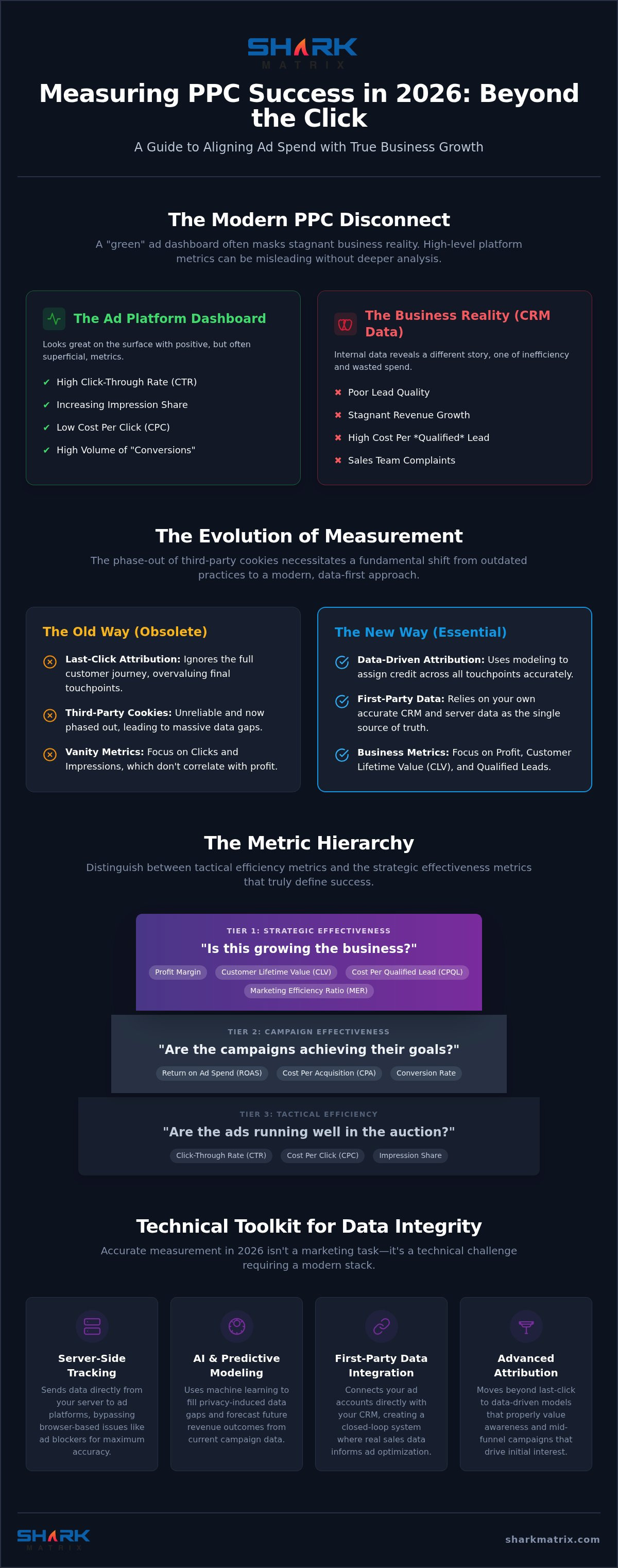
A “green” dashboard in Google Ads doesn’t mean your business is actually growing. In 2026, relying solely on platform-reported conversions is a strategy that often leads to inflated budgets and stagnant revenue. You’ve likely felt the frustration of seeing high click-through rates while your sales team complains about poor lead quality. Learning how to measure ppc campaign success is no longer about counting clicks; it’s about technical precision. It’s a common struggle to explain to stakeholders why a significant ad spend isn’t reflecting in the company’s internal CRM data. You aren’t alone in feeling that traditional tracking has become obsolete in an AI-saturated market.

This guide will teach you how to align machine learning insights with genuine business growth. We’ll move past vanity metrics to focus on technical accuracy and lead quality. You’ll learn how to implement custom tracking solutions that bridge the gap between your ads and your bottom line. We’ll also break down the specific KPIs and attribution models that provide a clear, honest view of your marketing impact. By the end, you’ll have the framework needed to scale your spend with total confidence in your data.

Key Takeaways

  • Move beyond basic reporting by adopting predictive modeling to align ad spend with long-term business growth.
  • Discover how to measure ppc campaign success by separating tactical efficiency metrics from strategic effectiveness indicators like ROAS.
  • Learn how machine learning development services help bridge the data gap between Google Ads and your internal CRM.
  • Audit your technical tracking infrastructure to ensure your data remains accurate in an increasingly automated advertising landscape.
  • Focus on lead quality rather than just volume by implementing industry-specific AI solutions that target high-value customers.

Beyond the Click: Why Measuring PPC Success is Evolving in 2026

The metric for success isn’t a static number on a spreadsheet anymore. Understanding how to measure ppc campaign success requires a fundamental shift in perspective. True success is the measurable alignment of your ad spend with specific business growth objectives, such as net profit or lifetime customer value, rather than just platform-level conversions. We’ve moved beyond the era of reactive reporting, where marketers simply looked at what happened last month. Today, performance is defined by predictive modeling that uses current data to forecast future revenue outcomes. This transition turns measurement into a technical challenge that requires sophisticated integration between your ads and your backend systems.

Traditional third-party cookies have finally been phased out, making old tracking methods unreliable for any serious brand. This shift has forced a total reliance on first-party data to establish a single source of truth for ad performance. Data doesn’t lie. Without the crutch of browser-based cookies, your internal data from CRM systems and web servers becomes the most valuable asset in your marketing stack. It’s the only way to ensure that your lead quality remains high while you scale your reach across the national market.

The Death of the Last-Click Era

Last-click attribution provides a distorted view of the customer journey because it ignores every interaction that occurred before the final purchase. In the current UAE market, users often interact with ten or more touchpoints across different devices and platforms before converting. If you only credit the final click, you’ll likely cut budgets for the very awareness campaigns that started the journey. Modern attribution in a cookieless 2026 environment relies on probabilistic modeling and data-driven weightings to assign value across the entire funnel. This approach prevents you from overvaluing branded search while undervaluing the top-of-funnel discovery phases that fuel growth. Balance is key.

Privacy-Centric Tracking Challenges

Navigating enhanced privacy regulations requires a technical approach to data integrity. Privacy is now a priority. Relying on traditional browser-based pixels often results in data loss due to ad blockers or privacy settings. Moving to server-side tracking allows for more control and accuracy by sending data directly from your server to the ad platform. When data gaps occur, AI automation services help bridge the missing points by using machine learning to fill in the blanks without compromising user privacy. This technical evolution ensures that your understanding of how to measure ppc campaign success remains rooted in reality, not guesswork. It also allows for custom web development to ensure that every tracking point is fired correctly, regardless of the user’s browser configuration.

The Metric Hierarchy: Distinguishing Efficiency from Effectiveness

Data points aren’t created equal. When you’re determining how to measure ppc campaign success, you must distinguish between tactical efficiency and strategic effectiveness. Efficiency metrics like Click-Through Rate (CTR), Cost Per Click (CPC), and Impression Share tell you how well your ads are performing within the platform’s auction. They are diagnostic tools. Effectiveness metrics, such as Return on Ad Spend (ROAS), CPA, and Conversion Rate, reveal whether those ads are actually growing your business. Many national brands fall into the “Vanity Metric Trap,” where they celebrate a high impression share while their bottom line remains stagnant. True success requires a “North Star” metric like Customer Lifetime Value (CLV) or total pipeline contribution to ensure every dirham spent is an investment, not just an expense.

Tier 1: Business Growth Metrics

Strategic metrics focus on the financial impact of your campaigns. While ROAS is the industry standard, the Marketing Efficiency Ratio (MER) is often a more holistic indicator of health. It compares your total ad spend against total revenue across all channels. In lead generation, you should prioritize Cost Per Qualified Lead (CPQL) over a generic Cost Per Lead (CPL). High lead volume is useless if the quality is low. Tracking profit margins rather than just revenue ensures your PPC efforts are sustainable for the long term. Achieving this level of visibility often requires ai automation services to bridge the gap between your CRM and your ad accounts, ensuring only high-quality data informs your bidding strategies.

Tier 2: Platform Health Indicators

Tactical metrics serve as the engine room of your account. Quality Score remains a critical lever in 2026 because it directly influences your CPC and ad rank. A high score means you’re winning the auction at a lower cost than your competitors. CTR acts as a primary signal of creative resonance; if it’s low, your messaging isn’t connecting with the national UAE audience. Monitoring Impression Share helps you identify missed opportunities. If you’re losing share due to budget, you’re leaving potential revenue on the table. These indicators don’t prove success on their own, but they show you exactly where to optimize to improve your overall effectiveness.

How to Measure PPC Campaign Success: The 2026 Performance Guide

Advanced Attribution and the Role of AI in Measurement

Native attribution models within Google Ads or Meta are helpful but often biased toward their own ecosystems. In 2026, understanding how to measure ppc campaign success requires a cross-channel approach that accounts for every touchpoint in the national market. AI helps identify incrementality, which is the measure of whether an ad actually caused a sale or if the customer would’ve purchased anyway. This is vital for brands that want to avoid wasting budget on customers who are already at the bottom of the funnel. Additionally, as Answer Engine Optimization (AEO) becomes a standard part of the search experience, you need to measure how often your brand is cited as the primary answer in AI-generated results. This shift moves measurement from a simple click-count to a broader view of brand authority and influence.

Integrating machine learning development services into your measurement stack allows for predictive ROI analysis. Instead of looking backward, these models analyze historical patterns to forecast which campaigns will drive the most profit in the coming quarter. This technical evolution moves PPC from a guessing game to a precise financial instrument. It’s about using data to outmaneuver competitors who are still stuck in reactive reporting modes.

Predictive Analytics for PPC

Predictive analytics goes beyond simple trend lines by identifying high-value customer segments before they even convert. This allows you to bid more aggressively on the users most likely to have a high lifetime value, ensuring your budget is always allocated to the highest potential returns. By analyzing real-time conversations, AI chatbots serve as a sophisticated tracking mechanism that identifies lead intent long before a form is ever submitted. This provides an early-warning system for campaign performance that traditional conversion tracking simply can’t match. You get a head start on optimizing your creative and targeting based on what users are actually asking for.

Bridging the Gap with Custom AI Solutions

Standard platform integrations often fail to capture the full picture of a complex national campaign. Through custom AI development, you can bridge the gap between your ad platforms and your CRM. This integration automates the deduplication of leads across multiple channels, ensuring that your data remains clean and actionable. It also allows you to feed offline conversion data back into your ad accounts, which trains the platform’s bidding algorithms on lead quality rather than just lead volume. Mastering how to measure ppc campaign success in this era requires a technical strategy that prioritizes data accuracy over platform defaults.

Building Your Success Framework: A 5-Step Measurement Roadmap

Scaling your ad spend without a roadmap is a recipe for wasted budget. Understanding how to measure ppc campaign success requires a repeatable framework that connects technical tracking with business outcomes. This process ensures that every decision is backed by data rather than intuition. By following a structured roadmap, you can identify which campaigns are driving profit and which are simply burning cash. This is especially critical in the 2026 national market where competition for high-quality leads is fiercer than ever.

  • Step 1: Define clear business objectives. Distinguish between leads, direct sales, and brand awareness to set the right benchmarks.
  • Step 2: Audit your technical tracking infrastructure. Ensure your pixels, GTM tags, and server-side tracking are firing correctly across all platforms.
  • Step 3: Establish a baseline for key performance indicators. Use historical data to set realistic targets for CPA and ROAS.
  • Step 4: Implement a multi-touch attribution model. Move beyond last-click to understand the full customer journey across multiple devices.
  • Step 5: Create a real-time visualization dashboard. Use automated reporting to provide stakeholders with a clear view of marketing impact.

Defining Your PPC Goals

Success looks different depending on your campaign’s purpose. Awareness campaigns should be measured by reach, frequency, and brand lift, while direct response campaigns focus on immediate conversions and CPA. Setting SMART goals for national reach ensures your team remains focused on outcomes that matter. This clarity is essential when determining how to measure ppc campaign success for different business units. You shouldn’t treat a video discovery ad the same way you treat a high-intent search ad. Each requires a unique set of KPIs to prove its value to the C-suite.

Technical Infrastructure Requirements

Accuracy starts with a solid foundation. Partnering with a professional web development agency is often necessary to ensure your tracking infrastructure is airtight. They can help implement server-side tracking and custom event triggers that standard plugins might miss. Your UI/UX design must also support these goals; for instance, clear thank-you pages and intuitive form placements make conversion tracking much simpler. Additionally, using natural language processing services helps qualify leads by analyzing intent within ad-driven chats, ensuring your sales team only spends time on high-value prospects. If you want to refine your technical measurement, consider how ai automation services can streamline your data collection and reporting.

Driving Measurable Growth with Shark Matrix PPC Management

Managing the complexities of 2026 digital marketing requires more than just a basic ad manager. It demands a partner who understands how to measure ppc campaign success through a technical lens. Shark Matrix bridges the gap between high-performance PPC and technical Search Engine Optimization to create a unified growth engine. We don’t just look at platform data; we look at your entire business ecosystem. By leveraging industry-specific AI solutions, we’ve moved past generic reporting to provide deep, predictive insights that matter to your stakeholders. A national strategy shouldn’t rely on guesswork. We focus on lead quality and revenue correlation above all else to ensure every dirham spent drives your business forward.

Transparency is at the heart of our reporting process. We’ve replaced confusing data dumps with actionable insights that show exactly where your money is going. You’ll see which keywords are driving actual sales, not just clicks. This level of detail is essential for any business operating at a national level. We understand that your C-suite stakeholders need clear answers, not technical jargon. We provide the clarity needed to justify and scale your marketing investments.

A Technical Approach to Marketing

Our background in software engineering allows us to solve the tracking discrepancies that plague most marketing departments. We build custom dashboards that pull data directly from your CRM, giving you real-time visibility into your ROI. This technical foundation ensures that your data is clean, deduplicated, and ready for scaling. When combined with our expertise as a leading SEO Company, you get a holistic view of your entire search presence. We ensure that your paid and organic strategies work in harmony rather than in silos.

Ready to Prove Your PPC ROI?

A professional PPC audit is the first step toward identifying the measurement gaps that are draining your budget. We analyze your current infrastructure and provide a clear roadmap for improvement. Our audits provide a baseline for how to measure ppc campaign success within your specific industry. We help national brands scale by making data-driven decisions that prioritize profit over vanity metrics. If you’re ready to see the true impact of your ad spend, contact Shark Matrix for a comprehensive PPC performance analysis. Don’t let unclear data hold back your business growth in 2026.

Mastering Performance Data for National Growth

The transition from counting clicks to calculating genuine business revenue is the hallmark of a successful 2026 marketing strategy. You’ve learned that how to measure ppc campaign success requires a blend of technical tracking, AI-driven attribution, and a focus on lead quality over sheer volume. By moving away from vanity metrics and adopting a multi-touch framework, you can finally align your ad spend with your company’s bottom line. The complexity of the modern UAE market means that technical accuracy isn’t optional; it’s the foundation of every scaling decision you make.

Shark Matrix has been at the forefront of this evolution since 2010. With 15 years of digital expertise, we specialize in bridging the gap between platform data and internal CRM results through AI-driven marketing automation. Our team provides a comprehensive national strategy that ensures your campaigns thrive across the entire UAE. If you’re ready to stop guessing and start growing with precision, maximize your PPC ROI with Shark Matrix’s data-driven management. Your data holds the key to your next phase of growth; it’s time to unlock its full potential.

Frequently Asked Questions

What is the most important metric for PPC success in 2026?

Profitability and Customer Lifetime Value (CLV) are the most important metrics for PPC success in 2026. While platform-level ROAS provides a quick snapshot, true growth is measured by how much net profit a campaign generates over its entire lifecycle. This requires integrating your ad data with your internal CRM to track backend sales. Focusing on these strategic outcomes ensures that your budget is an investment in sustainable growth rather than just a tactical expense.

How long does it take to accurately measure a new PPC campaign?

You should typically allow two to four weeks to gather enough data for an accurate measurement of a new campaign. This timeframe allows the platform’s machine learning algorithms to exit the learning phase and optimize for your target audience. If your business has a longer sales cycle, you might need several months to see the full impact of your spend. Patience is essential to avoid making premature changes based on incomplete or fluctuating data sets.

Why does my Google Ads data not match my Google Analytics 4 (GA4) data?

Data discrepancies between Google Ads and GA4 often occur because they use different attribution models and tracking methods. Google Ads credits a conversion to the day of the last ad click, while GA4 may attribute it to the day the conversion actually happened. Additionally, browser privacy settings and cookie consent can block one platform while allowing the other. This technical challenge is a primary reason why learning how to measure ppc campaign success requires server-side tracking.

Can AI really predict the ROI of my future ad spend?

AI can predict the ROI of your future ad spend by analyzing historical performance patterns and current market trends. By using machine learning development services, businesses can build models that forecast revenue based on various budget scenarios. These tools identify which customer segments are likely to convert before they even click an ad. This shift from reactive reporting to predictive analytics allows you to allocate your national marketing budget with much higher precision.

What is a good ROAS for a national campaign in the UAE?

A good ROAS for a national campaign in the UAE typically starts at 4:1, meaning you earn four dirhams for every one dirham spent. However, this benchmark varies significantly depending on your industry and profit margins. High-ticket services might thrive on a 2:1 ratio if the lead value is substantial, while e-commerce brands often aim for 6:1 or higher. It’s more important to focus on your specific break-even point than on generic industry averages.

Is CTR still relevant if my conversion rate is high?

CTR remains a vital health indicator even if your conversion rate is high. A strong CTR signals to the ad platform that your creative is relevant to the audience, which helps maintain a high Quality Score. This relevance reduces your Cost Per Click and improves your ad rank over time. If your CTR drops, you might eventually see your costs rise, making it harder to sustain your high conversion rates profitably in the national market.

How do I measure the success of a PPC campaign with a long sales cycle?

Measuring success with a long sales cycle requires tracking micro-conversions and top-of-funnel engagement metrics. You should monitor indicators like whitepaper downloads, webinar registrations, or time spent on key pages to gauge lead intent. Understanding how to measure ppc campaign success in this context involves assigning a value to these early touchpoints. This approach provides a clear picture of how your ads are moving prospects through the funnel long before the final sale occurs.

What are the best tools for tracking cross-channel PPC performance?

The best tools for tracking cross-channel performance include advanced analytics platforms like GA4 and custom-built visualization dashboards. Integrating your CRM with your ad accounts is also essential for closing the loop between clicks and revenue. Many national brands use AI automation services to aggregate data from multiple platforms into a single source of truth. This technical integration provides the transparency needed to compare performance across search, social, and display channels without manual data entry.