Categories
Digital Marketing

How to Calculate Digital Marketing ROI: The 2026 Guide to Measuring Performance

Your current ROI reports might be lying to you. In an era of fragmented touchpoints and AI-driven search, relying on last-click attribution is like trying to navigate a city with a decade-old map. You’ve likely felt the frustration of seeing high engagement numbers that don’t seem to translate to the bottom line, leaving you wondering how to calculate digital marketing roi with actual precision. It’s a common pain point for even the most seasoned marketing teams when stakeholders demand proof of profitability for every dollar spent.

We’re here to bridge that gap by providing a masterclass on measuring performance for the 2026 landscape. You’ll master the precise formulas needed to track success across SEO, PPC, and generative engine optimization. We’ll also dive into the critical differences between ROAS and ROI while providing a technical framework to help you use AI automation to track every conversion accurately. By the end of this guide, you’ll have a clear strategy to turn your historical data into a predictive tool for future growth.

Key Takeaways

  • Adapt to the 2026 landscape by shifting your focus from traditional search metrics to the emerging value of Answer Engine Optimization (AEO).
  • Master how to calculate digital marketing roi using comprehensive formulas that accurately isolate organic growth from your paid campaign efforts.
  • Build a robust technical infrastructure using GA4 and closed-loop reporting to ensure every marketing lead is tracked through to the final sale.
  • Learn how strategic investments in mobile app development and landing page A/B testing can lower your acquisition costs while boosting retention.
  • Move beyond basic historical reporting by implementing AI-driven strategies that turn your data into a predictive tool for future profitability.

What is Digital Marketing ROI and Why is it Changing in 2026?

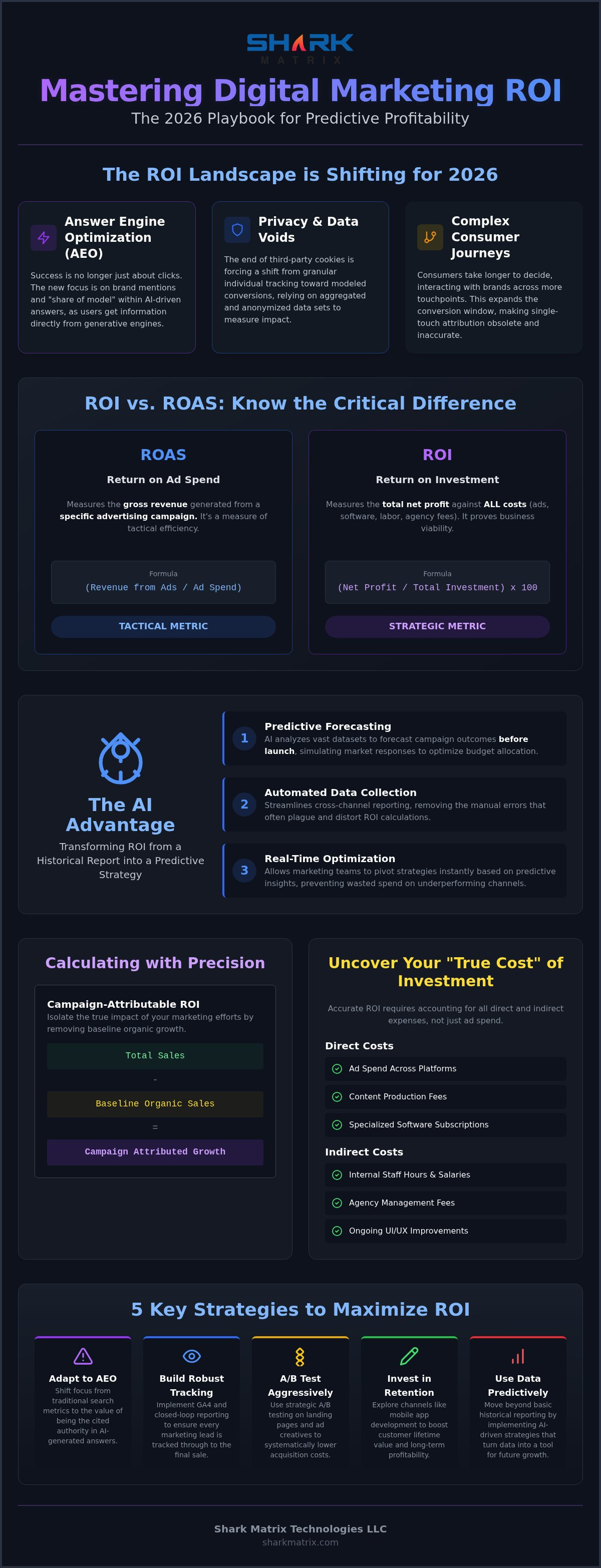
Digital marketing ROI is the percentage of profit gained relative to the total investment across your digital channels. It’s the ultimate metric that tells you if your marketing spend is actually growing your business or just keeping it afloat. Understanding Return on marketing investment (ROMI) is essential for any modern brand. As we look toward 2026, the complexity of this calculation is increasing because the digital ecosystem is no longer just about clicks and sessions. It’s about the entire ecosystem of influence.

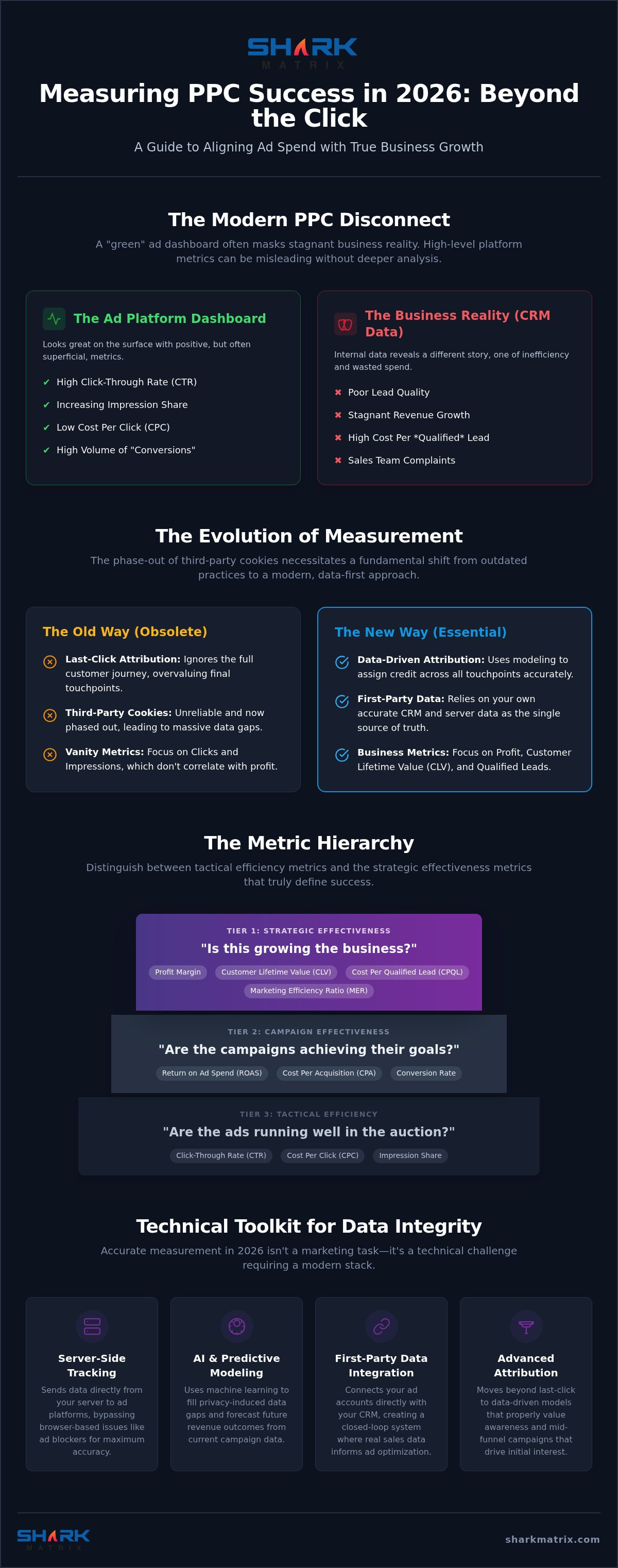
The shift from traditional search engines to Answer Engine Optimization (AEO) has fundamentally changed how we track success. Instead of users clicking through to a website, they often get their answers directly from an AI interface. This means traditional traffic metrics are losing their weight. To understand how to calculate digital marketing roi in this new environment, you have to account for brand mentions and “share of model” alongside standard lead generation. Measuring performance now requires looking at how often your brand is cited as the preferred solution by generative engines.

Privacy regulations and the death of third-party cookies have also forced a change in how we collect data. We’re moving away from granular individual tracking toward modeled conversions. Additionally, consumer behavior has shifted. People are taking longer to decide, interacting with brands across more touchpoints before converting. This expands the conversion window, making it harder to attribute a sale to a single campaign without sophisticated tracking. National consumer behavior now reflects a deeper skepticism, requiring more trust-building interactions before the final purchase happens.

ROI vs. ROAS: Knowing the Difference

Return on Ad Spend (ROAS) is often confused with ROI, but they serve different purposes. ROAS measures the gross revenue generated from a specific advertising spend; it’s a great metric for campaign-level efficiency. However, it doesn’t account for your total overhead. Genuine ROI factors in everything: software costs, agency fees, and internal labor. When reporting to national stakeholders, use ROAS for tactical adjustments and ROI to prove long-term business viability and overall profitability.

The Impact of AI on ROI Forecasting

Machine learning is transforming ROI from a historical report into a forward-looking strategy. By analyzing vast datasets, AI can now predict the potential outcome of a campaign before you even launch it. Our ai automation services streamline this data collection, removing the manual errors that often plague cross-channel reporting. Predictive ROI in 2026 utilizes real-time generative engine data to simulate market responses and optimize budget allocation instantly. This allows marketing teams to pivot strategies before a single dollar is wasted on underperforming channels.

The Essential Formulas: Calculating Simple vs. Comprehensive ROI

To move from guesswork to precision, you need a solid mathematical foundation. The most basic way to understand how to calculate digital marketing roi is the simple formula: (Net Profit / Total Investment) x 100. While this provides a quick snapshot, it often paints an incomplete picture. For a truly realistic view of how to calculate digital marketing roi, you must use your Gross Profit Margin rather than total revenue. If you’re calculating ROI based on top-line sales without accounting for the cost of goods sold, you’re overestimating your success.

Campaign-attributable ROI takes this further by isolating the impact of specific marketing efforts. To do this, you subtract your baseline organic growth from the total sales generated during a campaign period. This helps you see what your paid efforts actually contributed versus what would have happened anyway. It’s a vital step for brands that already have a strong organic presence. If you need assistance setting up these complex tracking parameters, our team at Shark Matrix can help you build a technical framework that captures every nuance of your data.

Defining Your “True Cost” Checklist

Most marketers forget that “Total Investment” includes much more than just your monthly ad spend. You need to account for both direct and indirect costs to get an honest figure. Your checklist should include:

  • Direct costs: Ad spend across all platforms, content production fees, and specialized software subscriptions.
  • Indirect costs: Internal staff hours, agency management fees, and ongoing UI/UX improvements.

You should also integrate the initial costs from your web development agency into your ROI model. The performance and speed of your site directly dictate your conversion rate, meaning your technical infrastructure is a core part of your marketing investment.

The CLV-Based ROI Model

Measuring success based on a single transaction is a short-sighted approach that often devalues your marketing efforts. The CLV-based model looks at the long-term value of a customer rather than just the initial acquisition. To calculate this, use the formula: (Average Purchase Value x Purchase Frequency) x Customer Lifespan. By adjusting your ROI based on retention rates and brand loyalty, you gain a clearer understanding of how much you can afford to spend on acquiring a new customer today. This perspective shifts marketing from a simple cost center to a long-term strategy for sustainable growth.

How to Calculate Digital Marketing ROI: The 2026 Guide to Measuring Performance

Measuring ROI Across Diverse Digital Channels

Each digital channel requires a unique lens to determine its true contribution to your profit margins. While the core formulas remain the same, the way you gather data changes depending on whether you’re looking at a long-term asset or an immediate lead generator. Understanding these nuances is the only way to master how to calculate digital marketing roi with accuracy across a multi-channel strategy. Without this granular view, you risk over-investing in high-volume, low-margin channels that don’t support your long-term growth.

Organic Search and SEO ROI

SEO isn’t a one-off expense; it’s a compounding asset that builds equity over time. When tracking ROI for search engine optimization seo services, you must look beyond keyword rankings. In 2026, Answer Engine visibility is paramount. If your content is the source for a generative AI’s response, that visibility carries high conversion intent. Calculate this by comparing content costs against the lifetime value of organic leads, using a rolling 6 to 12-month window to capture the full impact of your investment.

Social Media and Engagement ROI

Vanity metrics like likes and shares are misleading. To find the real value of a social media agency campaign, track users through the entire funnel using UTM parameters. This attributes revenue directly to social interactions. In the UAE market, localized Arabic digital marketing acts as a unique ROI booster, building deeper cultural trust and significantly improving engagement rates compared to generic English campaigns. This cultural alignment turns your social presence into a measurable profit driver.

Pay Per Click (PPC) offers the most direct path to real-time tracking. When you’re refining how to calculate digital marketing roi for paid campaigns, monitoring conversion efficiency and lead generation costs daily is essential. This allows for rapid budget reallocation to the highest-performing ad sets. However, the real innovation in 2026 comes from ai chatbot development. These tools don’t just provide 24/7 support; they act as high-performance sales agents that qualify leads before they ever reach your CRM. You calculate the ROI of an AI chatbot based on:

  • Cost Reduction: Decreased reliance on human support for repetitive, top-of-funnel queries.
  • Conversion Lift: Higher lead capture rates through instant, personalized engagement that prevents bounce.
  • Data Accuracy: Automated tracking of user intent and interaction history for better attribution.

This dual impact on both cost-savings and revenue makes AI integration one of the most measurable ROI boosters available today. By connecting these technical tools to your broader marketing strategy, you ensure that every interaction is accounted for in your final profitability reports.

Practical Steps to Implementing a Robust Tracking System

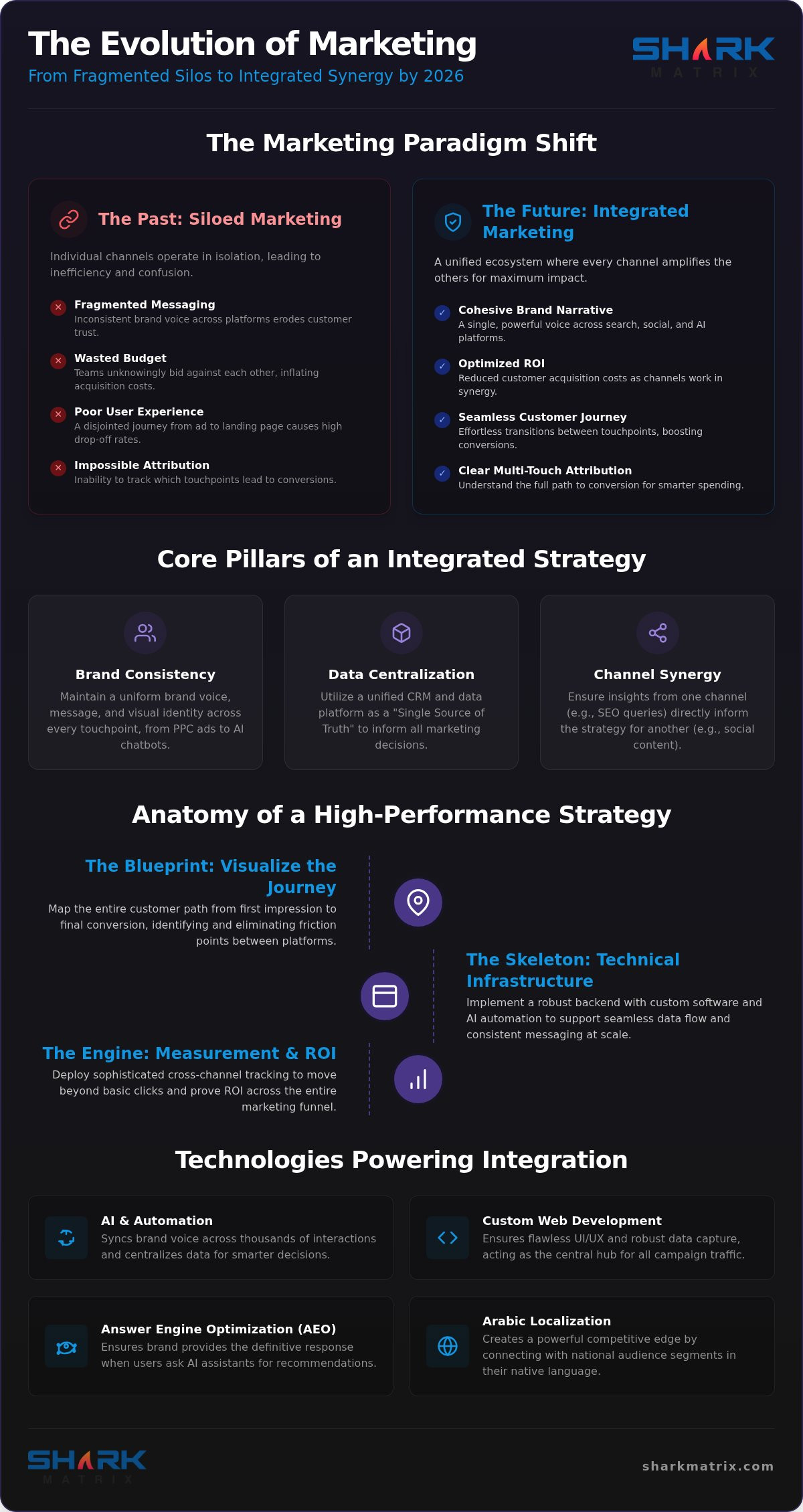
Precision in measurement requires a technical foundation that captures data at every stage of the funnel. You can’t master how to calculate digital marketing roi if your data is siloed or incomplete. The first step is a comprehensive GA4 setup that prioritizes cross-platform event tracking. This allows you to see how a user moves from a mobile app interaction to a desktop conversion. When combined with consistent UTM tagging across every campaign, you create a transparent trail that links specific marketing dollars to individual user actions.

Implementing closed-loop reporting is what truly separates high-performance teams from the rest. This process involves connecting your marketing platforms directly to your CRM to track a lead until the final sale is closed. Without this connection, you’re only measuring potential, not actual profit. To identify where ROI is being lost, utilize heatmaps and UI/UX data. These tools reveal friction points in your funnel, such as a confusing checkout process or a slow-loading landing page, that might be killing your conversion rates despite high-quality traffic.

Attribution Modeling: Who Gets the Credit?

Choosing the right attribution model is critical for national campaigns where customer journeys are often complex. While first-touch and last-touch models offer simplicity, they’re often too narrow for the 2026 landscape. Data-driven attribution has become the gold standard because it uses machine learning to distribute credit based on how each touchpoint actually influenced the conversion. This model helps account for dark social and offline conversions by analyzing patterns that traditional tracking might miss. If your current tracking feels fragmented, Shark Matrix can implement the technical infrastructure needed to unify your data streams.

Leveraging AI for Data Accuracy

AI doesn’t just predict outcomes; it cleans and analyzes the data you already have. By using natural language processing, you can analyze customer feedback and sentiment as a qualitative ROI metric, giving you insight into brand health that numbers alone can’t provide. Automating your report generation also removes the risk of human error in cost tracking, ensuring your stakeholders see the most accurate figures possible. By integrating these tools, AI significantly reduces the time-to-insight for marketing teams, allowing you to make budget adjustments in hours rather than weeks. This agility is essential when you’re refining how to calculate digital marketing roi for fast-moving markets.

Maximizing ROI with Strategic Growth and Optimization

Calculating your returns is only half the battle. Once you understand how to calculate digital marketing roi, your focus must shift toward protecting and expanding those margins. Strategic optimization ensures that you aren’t just measuring performance but actively improving it through data-driven decisions. This involves identifying your highest-performing segments and doubling down on what works while trimming the fat from underperforming channels. It’s about moving from a reactive stance to a proactive growth strategy.

A/B testing your landing pages is a fundamental step in this process. By testing different headlines, layouts, or calls-to-action, you can systematically improve your conversion rate, which directly lowers your Cost Per Acquisition (CPA). Additionally, investing in mobile app development can significantly increase customer retention and Lifetime Value (CLV). An app provides a direct, high-engagement channel that keeps your brand top-of-mind, turning one-time buyers into loyal advocates through personalized push notifications and seamless user experiences.

Scaling your efforts requires real-time data. When you see a campaign delivering exceptional returns, you need the agility to reallocate your budget instantly. In the UAE market, localized Arabic digital marketing acts as a unique ROI booster, allowing you to capture specific search intent that generic campaigns often miss. However, even the best campaigns can suffer from ROI leakage caused by a poor online reputation. Negative reviews or unresolved customer complaints can act as a silent killer for your conversion rates, making Online Reputation Management essential for protecting your investment.

Technical Optimization for Higher Returns

Technical excellence is the bedrock of marketing profitability. Every second of delay in site speed or a lack of mobile responsiveness can chip away at the ROI of every dirham you spend. There’s also a powerful synergy between generative ai development and content scaling. Using AI to produce high-quality, intent-focused content allows you to cover more ground without a proportional increase in costs. When you align your UI/UX design with specific user intent, you shorten the sales cycle and maximize the efficiency of your funnel.

Next Steps: From Calculation to Execution

Turning data into action requires a structured approach. Conduct a quarterly ROI audit to review your performance and reallocate budgets based on the latest market trends and internal data. When pitching budget increases to executive leadership, focus on the predictive models you’ve built rather than just historical wins. Show them how to calculate digital marketing roi for future scenarios to prove that marketing is a revenue engine, not a cost center. To further support high-level financial oversight, you can discover Swiss Alpha Matrix for specialized due diligence on complex investment programs. Partnering with a full-service agency like Shark Matrix allows you to manage both the technical infrastructure and the strategic execution needed to maintain long-term growth.

Future-Proof Your Marketing Profitability

Mastering the shift toward Answer Engine Optimization and predictive analytics is no longer optional for brands aiming to lead. You now have the technical foundation to move beyond basic reporting by integrating hidden costs and long-term customer value into your financial models. Understanding how to calculate digital marketing roi with this level of precision allows you to stop guessing and start scaling your budget with absolute confidence. By combining technical excellence in web development with advanced AI automation, you can finally close the loop between initial clicks and final sales across every channel.

Ready to transform your data into a high-performance growth engine? Get a Data-Driven Strategy to Boost Your ROI with Shark Matrix. Our specialists provide 2026-ready AI and SEO strategies backed by deep national expertise in UAE brand growth. We offer end-to-end technical and marketing integration to ensure your measurement systems are as sophisticated as your execution. It’s time to take control of your margins and build a more profitable future for your business.

Frequently Asked Questions

What is a good ROI for digital marketing in 2026?

A 5:1 ratio is generally considered a strong benchmark for most industries, meaning you earn five dollars for every one dollar spent. An exceptional ROI would be 10:1 or higher. However, these figures vary depending on your business stage and industry. In 2026, you should also consider your brand’s visibility in generative search results as a key indicator of long-term value alongside immediate revenue.

How do I calculate the ROI of a brand awareness campaign?

Track “brand lift” metrics such as branded search volume, direct website traffic, and social media mentions. You can assign a monetary value to these by comparing the cost of acquiring that same traffic through paid search. While awareness doesn’t always result in an instant sale, it significantly shortens future conversion windows and improves the efficiency of your direct-response campaigns over time.

Which digital marketing channel typically has the highest ROI?

SEO and email marketing consistently deliver the highest long-term returns. SEO is especially powerful because it’s a compounding asset that drives traffic long after the initial investment is made. In the current landscape, Answer Engine Optimization (AEO) is a vital part of this success. While PPC offers faster results, its ROI is always limited by your ongoing ad spend and rising bid costs.

How long does it take to see a positive ROI from SEO?

It usually takes four to nine months to see a positive ROI from SEO efforts. This timeline depends on your website’s current authority, the level of competition in your niche, and your technical health. You might notice early improvements in rankings within two months, but the compounding nature of organic growth means the most significant financial returns typically happen after the first year of consistent optimization.

Can AI help in improving my marketing ROI?

Yes, AI improves ROI by automating data analysis and optimizing budget allocation in real-time. Our ai automation services help identify high-performing audience segments much faster than manual processes. By using machine learning to predict customer behavior, you can shift your budget toward the channels and creatives most likely to convert, which reduces wasted spend and boosts your overall profitability.

What are the most common mistakes when calculating marketing ROI?

The most frequent error when learning how to calculate digital marketing roi is failing to include all costs, such as internal staff hours and software subscriptions. Many marketers also rely too heavily on last-click attribution, which ignores early touchpoints that influenced the buyer. Another mistake is treating ROAS and ROI as the same metric, which leads to a skewed understanding of actual business profit.

How do I account for agency fees in my ROI formula?

Include all agency fees as part of your “Total Investment” in the formula. When you’re determining how to calculate digital marketing roi for a specific project, divide the agency’s retainer by the number of campaigns they manage. This ensures your profit figures reflect the true cost of outsourcing your marketing and technical development, providing a more honest view of your campaign’s success. For instance, when evaluating costs from an AI digital marketing agency NYC, ensure you factor in the specific tiers of their maintenance packages to see the full impact on your bottom line.

Is ROAS more important than ROI for e-commerce businesses?

ROAS is useful for daily tactical adjustments, but ROI is the ultimate measure of your business’s health. E-commerce brands often focus on ROAS because it’s easy to track within ad platforms. However, if your margins are thin, a high ROAS could still result in a net loss after you factor in shipping, returns, and management fees. Always use ROI for long-term strategic planning.

Categories
Digital Marketing SEO

20 Essential Questions to Ask a Potential PPC Agency in 2026

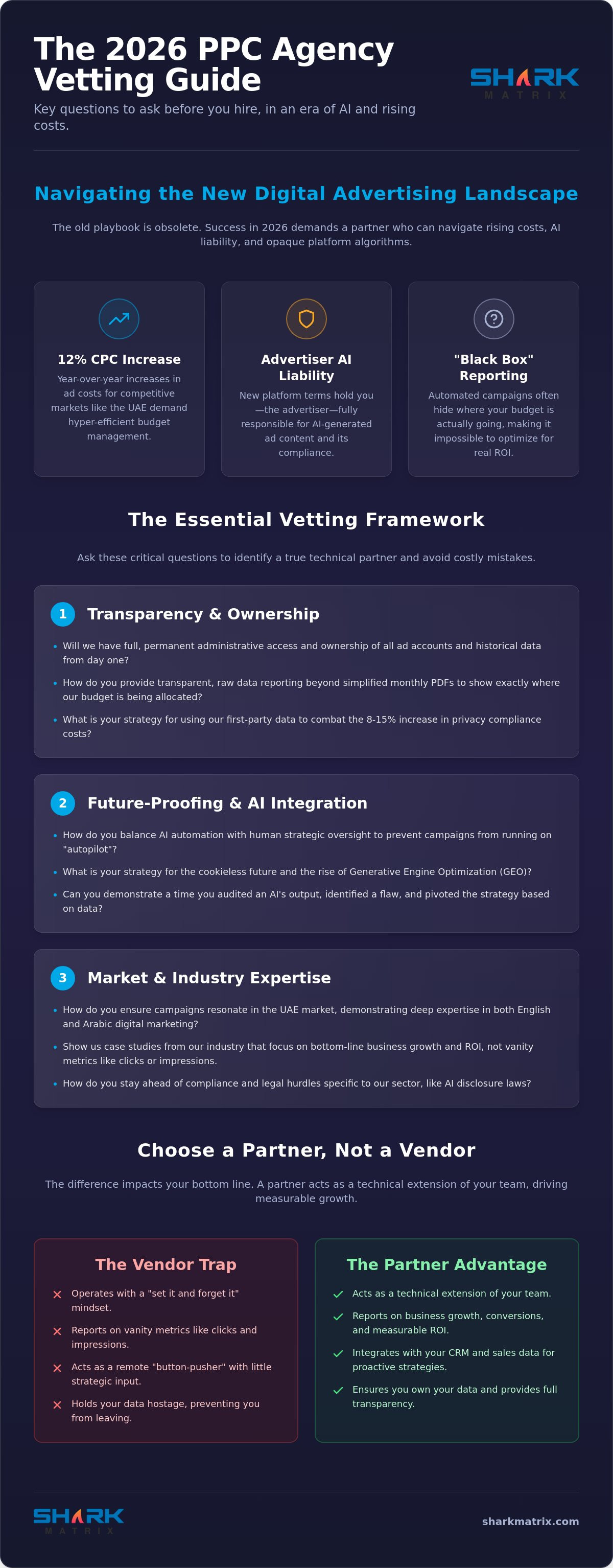
With Google Ads CPCs climbing by 12% in 2026 and new platform terms holding advertisers fully liable for AI-generated content, the margin for error in your digital strategy has vanished. You likely feel the pressure of rising costs and the frustration of “black box” reporting that hides where your money actually goes. It’s exhausting to worry about being locked out of your own accounts or hiring a firm that doesn’t grasp the linguistic and cultural nuances of the Middle Eastern market. Knowing the right questions to ask a potential ppc agency is no longer just a best practice; it’s a survival tactic for your marketing budget.

This article equips you with a rigorous vetting framework to identify a partner that acts as a technical extension of your team. You’ll learn how to spot agencies that leverage AI and automation for growth while maintaining the human strategic touch required for high-ROI results. We’ll preview the essential benchmarks for data ownership, privacy compliance, and future-proof strategies that ensure your brand thrives in an increasingly automated and cookieless world.

Key Takeaways

  • Learn the specific questions to ask a potential ppc agency to avoid budget hemorrhage in an era of automated, “black box” algorithms.
  • Discover how to protect your business by securing full administrative access and permanent ownership of your historical ad data.
  • Understand how to evaluate an agency’s ability to integrate Generative Engine Optimization (GEO) and AI automation without losing human strategic oversight.
  • Identify partners that offer technical depth in both English and Arabic digital marketing to ensure your campaigns resonate within the UAE market.
  • Gain a framework for selecting a partner that acts as a technical extension of your team, prioritizing data transparency and high-ROI growth.

Why Vetting Your PPC Partner is Critical for 2026 Success

The digital advertising space has moved far beyond simple bid adjustments. Google’s 2026 transition to AI-driven algorithms means the “black box” now makes most tactical decisions. If an agency still operates with a “set it and forget it” mindset, your budget will likely hemorrhage into low-intent traffic. Vetting your partner is no longer about checking their certifications; it’s about identifying a strategic consultant who understands the data layer. When building your foundation by understanding the fundamentals of PPC, you must look for a team that can audit AI outputs rather than just blindly accepting them.

A bad hire doesn’t just waste ad spend. It can lead to permanent brand damage through poorly generated AI ad copy and the loss of vital historical data if you don’t own your account. You need a partner that acts as a technical extension of your business, not a remote button-pusher who sends a monthly PDF report you don’t understand. One of the primary questions to ask a potential ppc agency is how they manage the liability of AI-generated content, especially since platform terms now place that burden entirely on the advertiser.

The Evolution of Paid Search in a National Market

National competition in the UAE has intensified, with CPCs rising 12% year-over-year. Standard Google Ads management is no longer sufficient when your competitors are using custom scripts and localized linguistic nuances. Success in 2026 requires more than just high bids. It requires a deep understanding of the local market context to ensure AI-driven campaigns don’t miss the mark. A high-performing agency must navigate both English and Arabic digital marketing with precision to capture high-value leads across diverse demographics.

What to Expect from a High-Tier Agency Relationship

A professional relationship should be proactive. Instead of reacting to a drop in conversions, a top-tier agency integrates with your internal sales data and CRM to predict shifts in the market. They don’t just report on clicks; they report on business growth. This level of technical depth is what separates a vendor from a partner. A modern PPC partnership is a data-first collaboration that prioritizes transparency and technical agility over manual maintenance.

Core Questions on Strategy, Industry Expertise, and ROI

To move beyond surface-level metrics, you must probe how an agency actually constructs a campaign. One of the most telling questions to ask a potential ppc agency is how they select platforms for your specific vertical. A cookie-cutter approach that puts every business on Google Search is a red flag. In 2026, high-performing strategies often involve a mix of visual formats on YouTube Shorts and intent-based targeting on Microsoft Ads, especially as 72% of agencies now utilize AI for management tasks. You need to know if they are following a trend or following your data.

Keyword research has also fundamentally changed. With the rise of generative search and AI-driven answer engines, you need to know how they plan for conversational queries rather than just static terms. Ask them to demonstrate a specific instance where they pivoted a failing campaign by analyzing the data layer. If they can’t explain the logic behind a strategy shift, they’re likely just letting the algorithm run on autopilot. Your goals must align with bottom-line revenue. Clicks are a vanity metric; actual growth comes from high-intent conversions and measurable ROI.

Vetting Their Strategic Depth

Depth is found in the details of audience segmentation. Ask how they use your first-party data to combat the 8-15% increase in privacy compliance costs seen across mid-market budgets. A strategic partner should have a clear roadmap for A/B testing and a rigorous process for negative keyword management to prevent budget waste. If you want a team that prioritizes these technical PPC strategies, look for those who understand the data layer behind every ad.

Industry Experience and Case Study Validation

Don’t take case studies at face value. Many agencies use “vanity metrics” like impressions or reach to hide a lack of actual sales. One of the vital questions to ask a potential ppc agency involves their experience with national-scale campaigns in your specific sector. This is particularly important in the UAE, where understanding the linguistic nuances of Arabic digital marketing is essential for resonance. A partner who understands your industry’s specific legal hurdles, such as the New York AI Disclosure Law or local privacy mandates, will protect your brand from costly compliance errors.

20 Essential Questions to Ask a Potential PPC Agency in 2026

The Transparency Test: Account Ownership and Data Privacy

Transparency is the bedrock of any successful digital partnership; yet, it remains the most common point of failure. When compiling your list of questions to ask a potential ppc agency, ownership of your digital assets should sit at the very top. Many businesses discover too late that their agency actually owns the Google Ads account. If the relationship ends, the business loses years of historical data and optimization history. You must insist on 100% account ownership and “Admin” level access from day one. It’s your brand and your budget. You should never be locked out of your own data.

Data privacy and compliance have also become significantly more complex in 2026. With privacy compliance costs now accounting for 8-15% of digital marketing budgets for many mid-market companies, you need to know how an agency handles GDPR, CCPA, and regional UAE data laws. Ask them specifically about their data handling protocols and how they secure your first-party data. You should also clarify their fee structure. Whether they charge a flat monthly retainer, a percentage of ad spend, or a performance-based fee, the model should be transparent and aligned with your growth.

Red Flags in PPC Contracts

Watch out for long-term lock-in clauses that don’t offer performance-based exits. A confident agency doesn’t need to trap you in a twelve-month contract. Another major red flag is the use of proprietary “black box” software that hides the actual work being done in your account. One of the essential questions to ask a potential ppc agency is whether you can see every change, bid adjustment, and AI-generated headline in real-time. Finally, ask who is actually managing your account. You don’t want to be sold by a senior strategist only to have your budget managed by a junior staff member with limited experience.

Reporting and Communication Cadence

Static PDF reports sent once a month are relics of the past. In 2026, you should expect a real-time data dashboard that allows you to see performance at any moment. Your strategic deep-dive meetings should focus on how technical metrics like CTR or CPC translate into actual business outcomes. If an agency can’t explain how a 12% increase in CPC inflation is being mitigated by better conversion quality, they aren’t looking at the big picture. Clear, frequent communication ensures your PPC partner remains a true extension of your internal team.

Future-Proofing: AI Integration and Cross-Channel Synergy

By 2026, 72% of agencies have adopted AI for at least one management task. However, the real differentiator is how they use it. You should prioritize questions to ask a potential ppc agency that reveal their “human-in-the-loop” strategy. With Google’s July 2026 terms of service holding you fully liable for AI-generated outputs, you cannot afford an agency that lets the machines run unsupervised. A high-tier partner uses machine learning for bid management and lead scoring while human experts vet the creative for brand safety and compliance with laws like New York’s AI disclosure mandate for synthetic performers.

Generative Engine Optimization (GEO) and AI search ads are the new frontiers of digital growth. Ask if they have a specific strategy for appearing in AI-generated search summaries and how they adapt ad copy for conversational search queries. This isn’t just about static keywords anymore; it’s about context, intent, and technical agility. You also need to know if they provide the creative assets or if your team must supply them. A technical agency should at least offer landing page optimization to ensure the traffic they buy actually converts into revenue.

The PPC and SEO Connection

PPC and SEO should never exist in silos. Your paid search data provides a gold mine of information on high-converting keywords that can inform your long-term organic strategy. Check out our Comprehensive Search Engine Optimization (SEO) Services: The 2026 Business Guide to see how these channels amplify each other. This integration is also vital for Online Reputation Management, where paid ads can protect your brand equity against competitors during sensitive periods. Ask how they plan to sync these departments to maximize your total search real estate.

Technical and Creative Capabilities

A partner must understand the technical layer of your campaigns. In the UAE, this means having the expertise to run sophisticated multi-language campaigns in both Arabic and English. One of the specific questions to ask a potential ppc agency is how they handle custom AI automation for bid adjustments based on your specific business cycles. They should also be able to audit your UI/UX design to ensure landing pages are optimized for the 2026 mobile-first user. If you are looking for a team that understands this technical depth, explore our AI-driven PPC solutions to see how we integrate data with creativity.

Making the Final Choice: Why Shark Matrix is Your Strategic Partner

Choosing a partner involves more than just checking a box on a list of requirements. It’s about finding a team that respects your data and understands the technical nuances of the 2026 market. When you use the questions to ask a potential ppc agency we’ve provided, you’ll find that many firms stumble on issues of ownership and AI liability. Shark Matrix stands apart by offering 100% account transparency and full administrative ownership from day one. We don’t just manage ads; we build the technical infrastructure, including AI automation and custom software integration, that ensures your campaigns remain profitable as CPCs continue to rise.

Our “Technical First” philosophy means we dive deep into the data layer. We understand that success in the UAE requires bilingual excellence. Our team navigates both Arabic and English digital marketing with a level of precision that generic, global agencies often lack. We treat your budget with professional care, focusing on high-impact lead generation rather than vanity metrics that don’t impact your bottom line. By positioning ourselves as a technical extension of your team, we ensure your marketing stack is fully integrated and ready for the generative search era.

The Shark Matrix Advantage

We provide direct access to senior strategists who understand the intersection of PPC, SEO, and machine learning development services. Our track record includes helping national brands scale by choosing the right PPC agency in Dubai that prioritizes long-term growth over short-term wins. We don’t hide behind automated reports. Instead, we offer clear, data-driven insights that help you make informed business decisions. This approach eliminates the fear of being locked out of your accounts or wasting spend on unoptimized traffic that doesn’t convert.

Your Next Steps

Ready to see the difference a technical approach makes? Start by preparing your current campaign data for a discovery call with our team. We’ll walk through our AI-driven PPC framework and show you exactly where your current strategy might be leaking budget. You can also download our comprehensive PPC vetting checklist to ensure you never miss the critical questions to ask a potential ppc agency during your search. Book a consultation today to secure a risk-free audit of your current performance and take the first step toward future-proof growth.

Take Control of Your Digital Growth in 2026

Navigating the complexities of modern advertising requires more than just a vendor; it requires a technical partner. By prioritizing data ownership and AI transparency, you protect your brand from the risks of “black box” management. These essential questions to ask a potential ppc agency serve as your shield against budget waste and data loss in an increasingly automated landscape. You now have the framework needed to distinguish strategic experts from simple button-pushers who don’t understand your bottom line.

Shark Matrix has been a national digital leader since 2010, bringing over a decade of expertise in AI-driven lead generation and Arabic digital marketing to every campaign. We believe in 100% transparency and client account ownership, ensuring you always have the keys to your own success. Don’t let your growth be limited by outdated strategies or restrictive contracts that hide your own data from you. The right partner acts as a technical extension of your team, not a barrier to your insights.

Ready to scale your ROI? Book a Strategic PPC Consultation with Shark Matrix and see how our technical-first approach can future-proof your business today. Your path to measurable, high-ROI results starts with asking the right questions.

Frequently Asked Questions

Should I hire a freelancer or a PPC agency?

The choice depends on your budget and the complexity of your campaigns. Freelancers are often suitable for small, local projects with limited budgets, but they lack the technical depth of a full team. A professional agency provides senior strategists, AI automation expertise, and the ability to manage complex, bilingual campaigns in both Arabic and English.

Agencies also offer better continuity and integrated strategies. While a freelancer might focus only on tactical execution, an agency acts as a technical extension of your team, ensuring your PPC data informs your broader SEO and web development efforts.

How much should a PPC agency charge for management fees?

Agencies typically use a flat monthly retainer or a percentage of your total monthly ad spend. Some firms also offer performance-based models where fees are tied to specific growth targets. These models ensure that the agency’s incentives align with your business outcomes.

When you prepare your list of questions to ask a potential ppc agency, make sure to clarify if there are any hidden setup fees or additional costs for creative assets. Transparency in the billing model is a key indicator of a trustworthy partner.

What is a good ROAS (Return on Ad Spend) for a national campaign?

A “good” ROAS is highly dependent on your industry and profit margins, though many businesses aim for a 4:1 ratio as a healthy baseline. E-commerce brands with high margins might target 6:1 or higher, whereas lead-generation campaigns focus more on the quality and cost of each acquisition.

Your agency should help you determine a realistic target based on your specific vertical. They’ll analyze your lifetime customer value and conversion rates to ensure your ad spend remains profitable as CPCs fluctuate in the national market.

How long does it take to see results from a new PPC agency?

You’ll see an immediate increase in traffic once campaigns go live, but it generally takes three months to see fully optimized results. This initial period allows the agency to gather enough data for AI algorithms to learn and for human strategists to refine targeting based on actual user behavior.

PPC is an iterative process. During the first 90 days, your partner will focus on identifying high-performing keywords and eliminating budget waste. This phase is essential for building a foundation that delivers sustainable, long-term ROI.

Do I need a separate agency for Google Ads and Meta Ads?

Hiring separate agencies often leads to fragmented data and inconsistent brand messaging across platforms. An integrated agency manages cross-channel synergy, allowing your Google Search data to inform your social media retargeting. This unified approach provides a more accurate view of the customer journey.

Managing all channels under one roof also simplifies reporting. It allows your strategists to shift budgets dynamically between platforms based on real-time performance, ensuring your money always goes where it works hardest.

What happens to my data if I cancel my PPC contract?

Your historical data should remain your property if you maintain 100% account ownership. If an agency insists on running ads through their own account, you’ll lose years of valuable optimization data if you decide to part ways. This is why administrative access is a non-negotiable requirement.

One of the vital questions to ask a potential ppc agency is whether they guarantee data portability. A transparent partner will ensure that all campaign history, audience lists, and conversion data stay with your business regardless of the contract status.

Can a PPC agency help with my website’s conversion rate (CRO)?

Technical PPC agencies often provide CRO services because buying traffic is useless if your website fails to convert visitors. They analyze landing page UI/UX, mobile responsiveness, and load speeds to identify friction points in the user journey. Improving these elements is the fastest way to lower your cost-per-acquisition.

By optimizing your landing pages, an agency ensures that the high-intent traffic they generate actually results in sales or leads. This end-to-end focus on the data layer is what separates a high-tier partner from a basic service provider.

Categories
Digital Marketing

Google Ads Management in the UAE: The 2026 National Business Guide

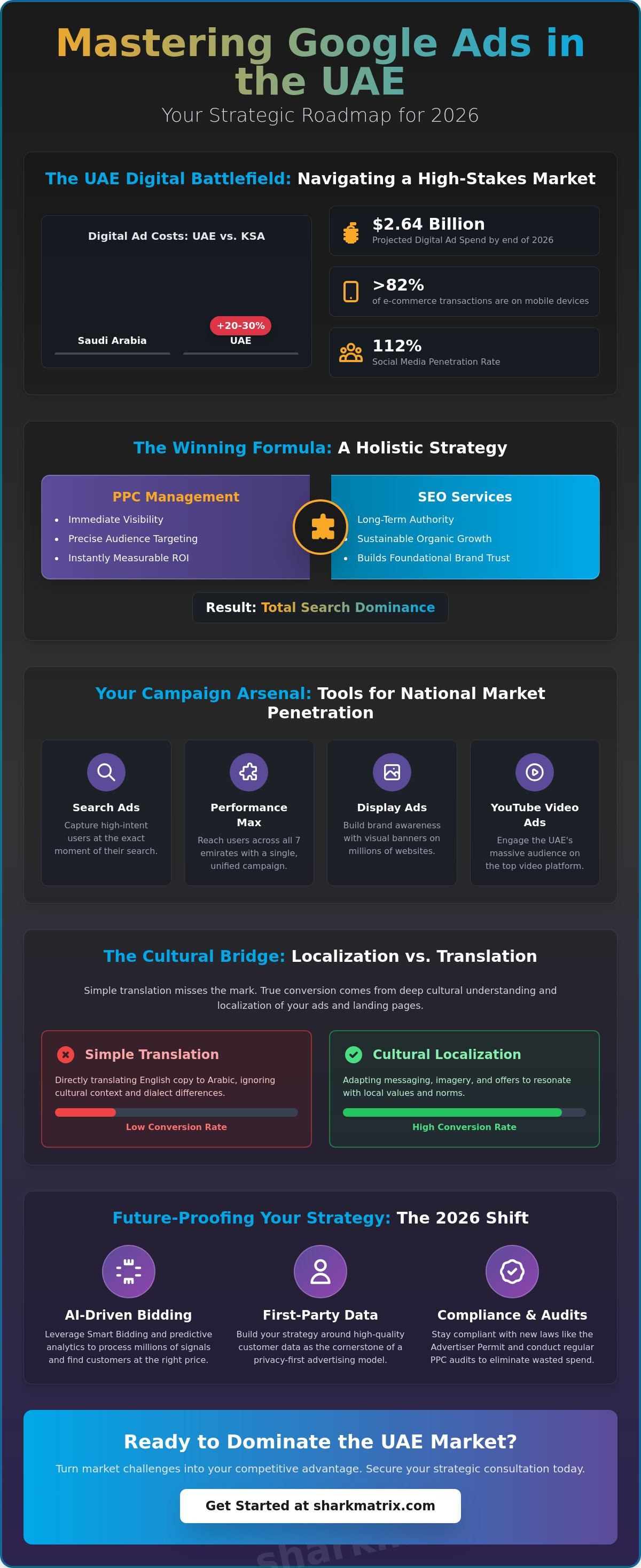
Did you know that digital advertising costs in the UAE are now 20% to 30% higher than in neighboring Saudi Arabia? With the UAE Media Council’s mandatory Advertiser Permit now in full effect as of February 2026, the stakes for your marketing budget have never been higher. It’s a common struggle to face rising costs while trying to reach a diverse population that switches between English and Arabic seamlessly. You aren’t alone if you feel that traditional reporting lacks the transparency needed to justify your marketing spend.

This guide provides a comprehensive roadmap for professional google ads management uae, designed to help you master these complexities and secure a lower cost-per-lead. We’ll show you how to turn these market challenges into a competitive advantage for your business. You’ll learn how to integrate AI-driven bidding with deep cultural nuance, stay compliant with the latest Federal Decree-Laws, and use data-driven insights to boost your brand visibility across all seven emirates. From mobile-first strategies to generative engine optimization, we’re covering the essential tactics to ensure your PPC management delivers measurable growth in 2026.

Key Takeaways

  • Understand why professional google ads management uae is vital for navigating a high-cost market with unique multi-lingual and mobile-first requirements.
  • Learn how to leverage Performance Max and Search Ads to capture high-intent users across all seven emirates simultaneously.
  • Discover the importance of cultural localization over simple translation to ensure your Arabic landing pages drive actual conversions.
  • Identify how regular PPC audits and clear KPI setting can eliminate wasted budget and drive tangible business growth.
  • Explore how integrating custom AI automation and predictive analytics can future-proof your advertising strategy against evolving market trends.

Understanding the Google Ads Landscape in the UAE for 2026

Professional google ads management uae involves the strategic coordination of paid search, display, and video campaigns across Google’s entire network. In a market where digital ad spend is projected to reach US$2.64 billion by the end of 2026, a fragmented approach no longer works. Businesses need a national strategy that reaches users from Abu Dhabi to Fujairah with equal precision. This high-stakes environment is a key part of the larger global online advertising ecosystem, where the ability to interpret data and user intent determines who wins the auction.

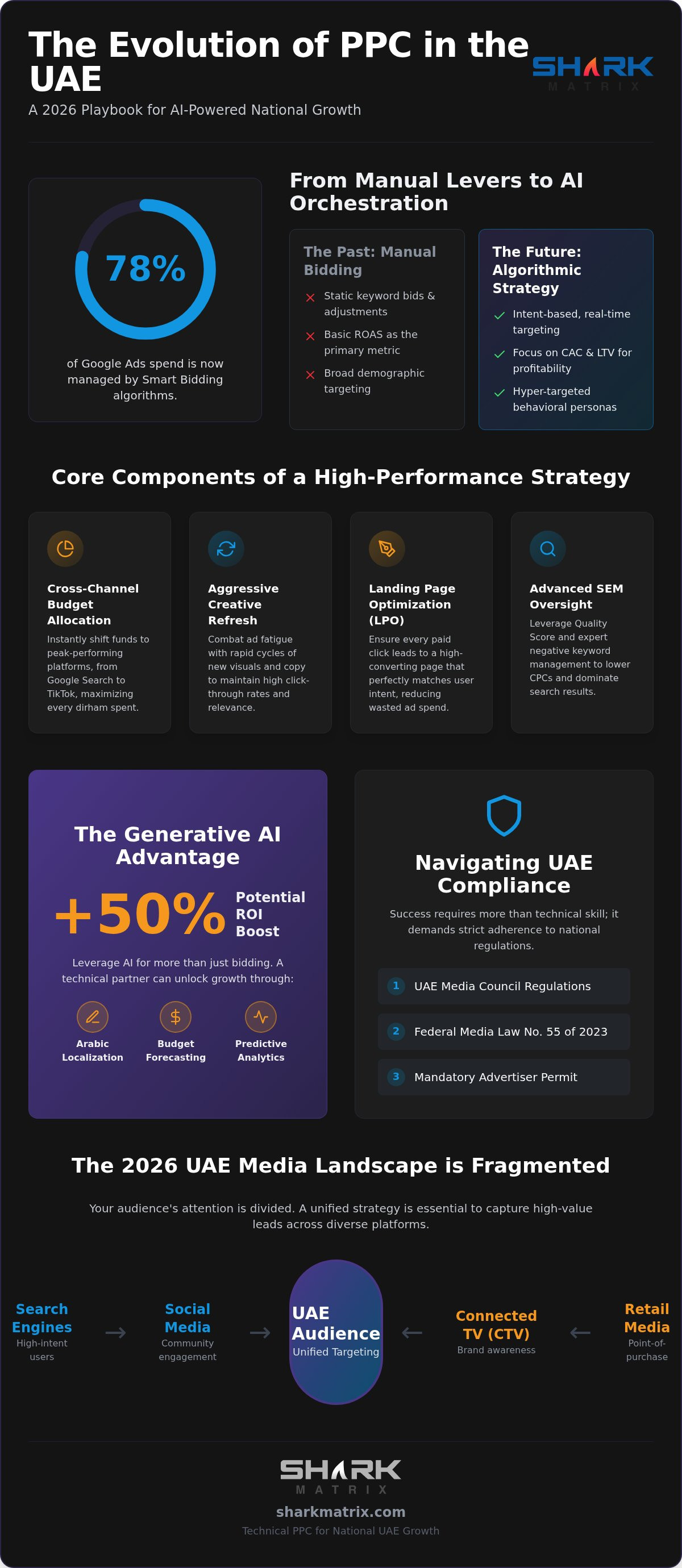
The UAE market presents unique challenges that set it apart from other regions. With social media penetration at 112% and more than 82% of e-commerce transactions completed on mobile devices, your campaigns must be mobile-first to survive. You aren’t just targeting one demographic; you’re communicating with a diverse, multi-lingual population. This requires a nuanced understanding of how different audience segments interact with technology. We’ve also seen a definitive shift from manual bidding to AI-driven ‘Smart Bidding’ this year. These algorithms process millions of signals in milliseconds to find the right customer at the right price.

To achieve true market dominance, google ads management uae shouldn’t exist in a vacuum. It works most effectively when it complements search engine optimization seo services. While PPC delivers immediate traffic and visibility for specific keywords, SEO builds the long-term organic authority your brand needs. Together, they create a holistic digital strategy that ensures your business appears at the top of the results page, regardless of whether a user clicks a paid ad or an organic link.

Why National Businesses Prioritise Google Ads

National brands across the Emirates rely on Google Ads because it offers immediate market entry. Unlike traditional channels, you get instant visibility for new product launches or seasonal promotions. The platform’s precise targeting allows you to filter audiences by intent, interest, and specific national demographics. Most importantly, the ROI is entirely measurable. This transparency lets you reallocate budgets quickly to the highest-performing campaigns, ensuring no marketing spend is wasted on low-intent traffic.

The 2026 Shift: Automation and Privacy

The advertising landscape has evolved toward a privacy-first model. With the decline of traditional tracking, the use of first-party data is now a cornerstone of uae digital marketing trends 2026. Successful advertisers are those who can feed high-quality data into Google’s automated systems. However, balancing these automated algorithms with human strategic oversight is vital. Machines are excellent at bidding, but they still require human experts to set the creative direction and ensure the brand’s voice remains consistent across all seven emirates.

Key Campaign Types for National Market Penetration

To achieve a dominant presence across all seven emirates, businesses must look beyond basic keyword targeting. Effective google ads management uae now requires a multi-layered approach that addresses every stage of the customer journey. While Search Ads remain the gold standard for capturing high-intent users at the exact moment they search for your services, they’re only one piece of the puzzle. Display Advertising builds brand awareness through visual banners on millions of partner websites, while YouTube Video Ads engage the UAE’s massive video-consuming audience. With social media penetration at 112% and digital ad spend growing at an annual rate of 15.2%, skippable and non-skippable video formats are essential for staying top-of-mind.

Aligning your digital presence with the UAE’s Digital Economy Strategy allows you to tap into a highly connected and digitally savvy population. As programmatic advertising is projected to generate 76% of digital advertising revenue in the UAE by 2028, your strategy needs to be as agile as the market itself. If you’re unsure if your current setup is capturing this growth, conducting regular ppc audit services can help you identify wasted spend and refine your targeting for better national reach. The key is knowing which campaign type to deploy based on your specific business goals, whether that’s immediate lead generation or long-term brand equity.

Harnessing Performance Max for National Reach

Performance Max, or P-Max, has become the primary driver for cross-channel conversion in the UAE. It uses advanced machine learning to serve ads across Search, YouTube, Display, and Maps simultaneously from a single campaign. In 2026, the success of P-Max depends heavily on the quality of your ‘Creative Assets.’ You can’t rely on generic images; you need high-resolution videos and headlines that resonate with local culture to help the algorithm find your ideal customers across all Google channels. This automated approach ensures your brand stays visible exactly where your audience spends their time.

Shopping Ads for E-commerce Growth

For businesses in the retail sector, Shopping Ads are indispensable for driving direct sales. By integrating product feeds, you can showcase your inventory directly within search results, complete with prices and images. This is particularly effective during seasonal peaks like Ramadan or national shopping festivals when consumer spending surges across the country. Since over 82% of GCC e-commerce transactions happen on mobile devices, your product pages and ad feeds must be optimized for mobile-first shoppers to prevent abandoned carts and maximize your return on ad spend.

Google Ads Management in the UAE: The 2026 National Business Guide

The Critical Role of Arabic Localization in PPC Performance

In a market where more than 10 million people are active on social media and digital platforms, simply translating your English ads into Arabic isn’t enough. Direct translation often misses the mark because it fails to account for the linguistic diversity of the Emirates. While Modern Standard Arabic is used for formal communication, your potential customers often use regional dialects or colloquialisms when performing searches. If your google ads management uae strategy treats Arabic as a secondary task, you’re likely overpaying for clicks that won’t convert. True localization requires a deep understanding of how language affects user intent and trust.

One of the most overlooked technical aspects of Arabic campaigns is the impact of Right-to-Left (RTL) design. When a user clicks an Arabic ad and lands on a page designed for English (Left-to-Right), the visual disconnect is jarring. It creates a poor user experience that can slash your conversion rates. Your landing pages, buttons, and even the placement of your images must be mirrored to align with the natural reading flow of an Arabic speaker. This attention to detail signals to the local audience that your brand is culturally invested in the region, which is essential for building long-term credibility.

Keyword research for Arabic requires a different methodology than English. Users might use formal terms for high-value services but switch to local Khaleeji phrases for everyday products. Effective google ads management uae involves identifying these specific search patterns to capture traffic that competitors might be ignoring. By targeting these nuanced terms, you can often find lower competition levels and a more engaged audience, directly addressing the pain of high cost-per-click in the broader market.

Bilingual Campaign Management

Success in the UAE requires managing separate campaign structures for English and Arabic. This isn’t just about language; it’s about budget efficiency. You’ll often find that the cost-per-lead and search volume vary significantly between the two. Understanding how mastering ppc for lead generation requires dual-language expertise allows you to allocate spend where it performs best. By analyzing performance differences between these segments, you can refine your bidding strategies to maximize ROI across the entire national population.

Cultural Nuance in Ad Creative

Your ad creative must align with national values and sensibilities to be effective. Using generic stock imagery that doesn’t reflect the local environment can make your brand seem out of touch. Professional Arabic copywriters play a vital role here, ensuring your messaging resonates emotionally while avoiding the pitfalls of automated translation. These tools often produce grammatically correct but culturally hollow text that can damage your reputation. High-quality, culturally resonant copy ensures your brand feels like a local authority rather than an outsider.

Maximising ROI: A Framework for National Campaign Optimization

Launching a campaign is only the first step. To achieve a sustainable return on investment, your strategy must move from implementation to aggressive optimization. Effective google ads management uae requires a shift in focus from vanity metrics, like impressions or clicks, to actual business growth indicators. High traffic numbers mean little if they don’t translate into a lower cost-per-lead or increased sales volume. By setting clear Key Performance Indicators (KPIs) that align with your national business objectives, you can ensure every dirham spent contributes to your bottom line.

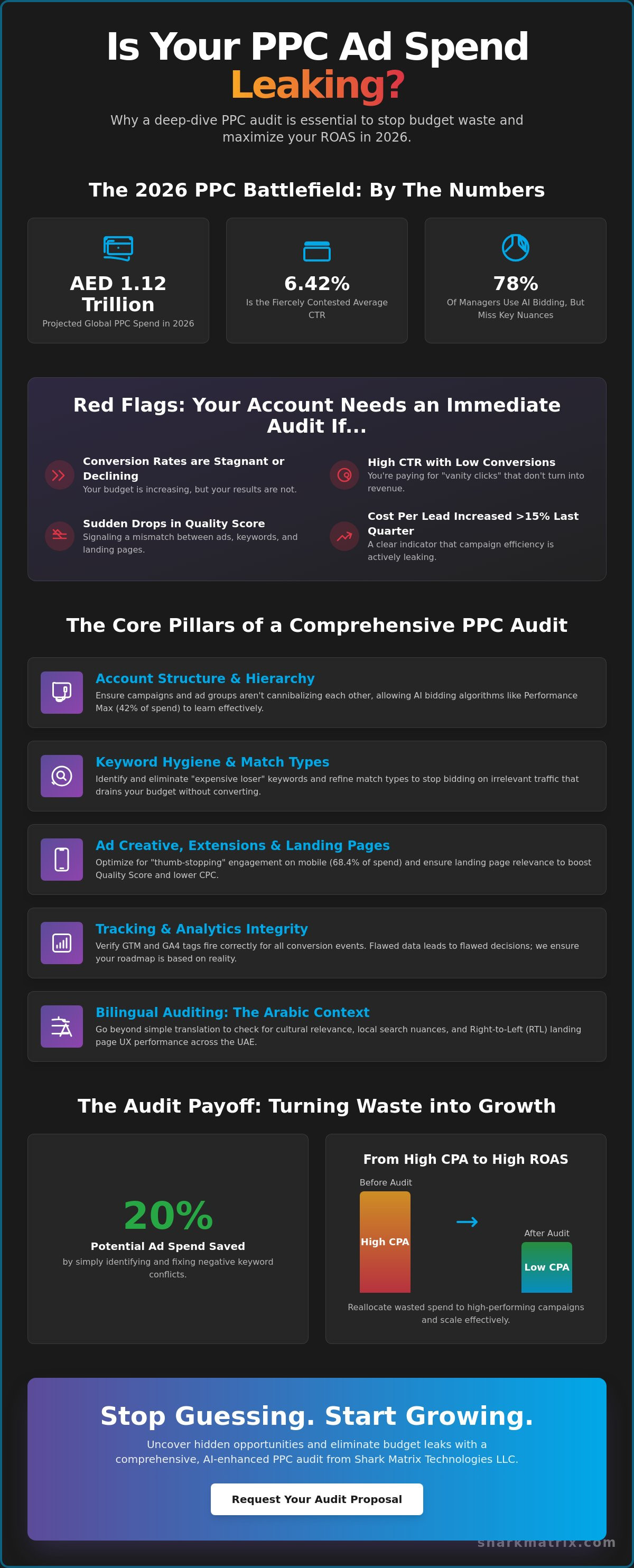
The competitive nature of the Emirates’ market means that even small inefficiencies can lead to massive budget waste over time. This is why the necessity of regular ppc audit services cannot be overstated. An audit helps you identify underperforming keywords, poorly matched search terms, and technical errors that drain your resources. Beyond the ads themselves, you must prioritise Conversion Rate Optimization (CRO). If your landing page doesn’t deliver on the promise made in your ad copy, your conversion rates will suffer regardless of how much you spend on clicks. A/B testing everything from your headlines to the colour of your call-to-action buttons is the only way to find the highest-performing combinations for a national audience. If you want to refine your current strategy, exploring professional PPC management can provide the technical oversight needed to maintain peak performance.

Data-Driven Decision Making

In 2026, Google Analytics 4 (GA4) is essential for tracking the full customer journey across different touchpoints. It allows you to see how users from different emirates interact with your site before converting. A vital part of this data-driven approach is the rigorous use of ‘Negative Keywords.’ By excluding irrelevant search terms, you prevent your ads from showing to users who have no intention of buying. Daily budget pacing ensures your campaigns don’t exhaust their funds prematurely during high-traffic periods, maintaining a consistent presence throughout the day across the entire country.

Scaling Successful Campaigns

Scaling requires more than just increasing your daily spend. You must do it without degrading your Return on Ad Spend (ROAS). This involves identifying ‘winning’ ad groups that consistently deliver high-quality leads and gradually expanding their reach to a broader national audience. Remarketing also plays a critical role here. Since many users won’t convert on their first visit, staying visible through targeted remarketing ads helps pull them back into the sales funnel. This multi-touch approach is a hallmark of sophisticated google ads management uae, ensuring you capture the full value of your initial advertising spend.

Future-Proofing Your Strategy with AI-Driven Google Ads Management

As the UAE continues to lead the world in AI adoption, with 64% of the working population actively using these tools, the standard for google ads management uae has fundamentally changed. Relying on Google’s default automation is no longer a competitive advantage; it’s the bare minimum. Shark Matrix goes beyond standard settings by integrating custom ai automation services to enhance standard algorithms. This approach allows us to find efficiencies that generic setups miss. By layering proprietary machine learning models over your campaigns, we help your business stay ahead of the 15.2% annual growth in digital ad spend across the region.

Predictive analytics now plays a central role in forecasting campaign performance. Instead of only reacting to past data, we use machine learning development services to anticipate market shifts and consumer demand. This foresight is critical in a market where programmatic advertising is expected to dominate 76% of all digital revenue by 2028. To maintain full transparency, we use automated reporting systems that provide real-time data to our national clients. You’ll always know exactly how your budget is being utilized across the seven emirates without waiting for end-of-month manual updates.

While technology drives the data, human strategic oversight remains more important than ever. AI can calculate bids and process vast datasets, but it can’t understand the cultural heartbeat of the UAE or the specific nuances of Federal Decree-Law No. 55. Our specialists ensure that every automated decision aligns with your broader brand values and the latest regulatory requirements. We balance the speed of algorithms with the strategic thinking necessary to navigate a complex, multi-lingual market.

Shark Matrix AI Integration

We leverage ai development services to identify emerging search trends before they become competitive and expensive. Our team utilizes custom scripts for automated bid adjustments based on external factors like inventory levels or local events. By integrating your PPC data directly with your CRM systems, we provide closed-loop reporting. This ensures that every dirham spent is tracked from the initial click to the final sale, giving you a clear picture of your actual business growth.

The Path to National Leadership

Success in 2026 requires moving from basic ad management to a full performance marketing partnership. Shark Matrix supports long-term brand growth by aligning your paid search goals with your overall business trajectory. We don’t just look for clicks; we look for market leadership across the UAE’s entire digital landscape. Ready to scale? Consult with our Google Ads specialists today and discover how a data-driven approach can transform your national presence.

Securing Your National Market Lead in 2026

The landscape of digital advertising in the Emirates moves fast. Success now depends on your ability to blend cultural expertise with advanced technical automation. You’ve seen how localized Arabic content and mobile-first strategies aren’t just options; they’re requirements for survival in a competitive market. Moving forward, the businesses that thrive will be those that use data-driven insights to justify every dirham of marketing spend. Professional google ads management uae serves as the bridge between complex data and sustainable business growth.

As a Certified Google Partner with in-house Arabic marketing specialists, Shark Matrix provides the advanced AI-driven optimization tools your brand needs to stay ahead. We help you navigate regulatory changes while maximizing your return on ad spend across all seven emirates. Maximise your national reach with Shark Matrix Google Ads Management and turn these market challenges into your biggest opportunities. Your path to national leadership starts with a strategy that evolves alongside the market. It’s time to take the lead.

Frequently Asked Questions

What is the typical cost of Google Ads management in the UAE?

Agency fees for managing campaigns usually depend on the complexity of your account and the total ad spend being managed. Most providers charge either a flat monthly retainer or a percentage of your monthly advertising budget. It’s best to request a custom quote to understand specific fee structures, as these aren’t standardized across the local market.

How long does it take to see results from a new Google Ads campaign?

You’ll often see initial traffic and lead data within the first 48 hours of a campaign launch. However, it typically takes three to four months of consistent data collection for Google’s machine learning tools to fully optimize. This learning phase is necessary for the system to identify which audience segments and bidding strategies produce the best results.

Do I need a separate budget for Arabic and English campaigns?

Yes, maintaining separate budgets for different languages is a strategic way to ensure your spend is allocated where it performs best. Professional google ads management uae involves monitoring how conversion costs differ between language segments. Since search volumes and competition levels vary between English and Arabic keywords, independent budgets give you better control over your national ROI.

What is the difference between a Google Partner and a standard agency?

A Google Partner is an agency that has met specific performance requirements and demonstrated advanced expertise in the platform. This status confirms the agency manages a significant level of ad spend and follows the latest best practices. While standard agencies offer similar services, Partners have verified access to specialized training and direct support from Google’s own teams.

Can Google Ads help with B2B lead generation in the UAE?

Google Ads is an excellent tool for B2B lead generation because it targets users searching for specific professional services or industrial equipment. By focusing on intent-based keywords, you can reach decision-makers at the exact moment they’re looking for a solution. This precision often results in higher quality leads than broader advertising methods that don’t account for specific search intent.

How often should a PPC audit be performed on my account?

You should conduct a comprehensive PPC audit at least once every quarter to identify wasted spend and technical errors. The UAE market moves quickly, and competitor strategies or cost-per-click rates can shift in a matter of weeks. Regular reviews ensure your account settings stay aligned with your business goals and take advantage of new platform features.

What is a good conversion rate for UAE-based Google Ads?

A good conversion rate usually falls between 2% and 5%, though this varies heavily by industry and the type of offer you’re promoting. High-value services like real estate often see different benchmarks compared to fast-moving e-commerce products. You should focus on improving your own historical performance and industry-specific data rather than comparing yourself to a single national average.

How does Google Ads work with my existing SEO strategy?

Google Ads provides instant visibility for keywords that your search engine optimization efforts may still be working to rank for organically. Integrating google ads management uae with your SEO strategy allows you to occupy more real estate on the search results page. Data from your paid ads, such as high-performing headlines, can also help you refine your organic content for better engagement.

Categories
Digital Marketing

Mastering PPC for Lead Generation: A Comprehensive 2026 Guide

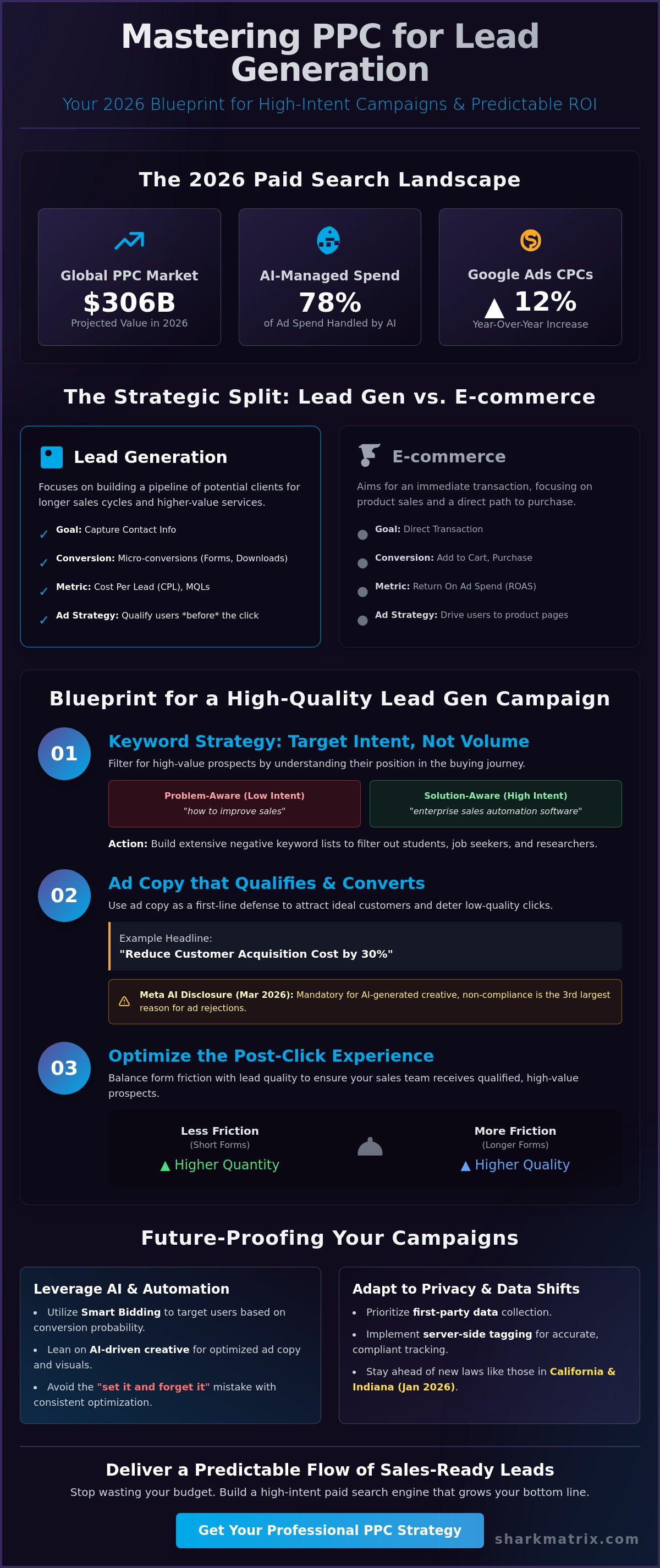
With the global PPC market projected to reach $306 billion in 2026, why are so many businesses still struggling with a high cost-per-lead and zero conversions? It’s frustrating to watch your budget disappear into clicks that never turn into sales. You’ve likely dealt with poor quality leads that frustrate your sales team or felt the sting of the 12% year-over-year increase in Google Ads CPCs. Mastering ppc for lead generation in 2026 requires more than just bidding on keywords. It’s about engineering a journey that prioritizes high-intent users while operating within a landscape where AI handles 78% of all spend and privacy regulations in states like California and Indiana have tightened.

You deserve a marketing strategy that delivers a predictable flow of sales-ready leads and clear visibility into your ROI. This guide will show you how to build, optimize, and scale high-intent paid search campaigns that actually grow your bottom line. We’ll explore how to leverage first-party data, adapt to the phase-out of standalone call ads, and use professional PPC management to lower your customer acquisition costs.

Key Takeaways

  • Understand the fundamental differences between lead acquisition and e-commerce models to ensure your strategy aligns with high-intent business goals.
  • Learn how to structure your account and conduct keyword research that prioritizes commercial intent for more effective ppc for lead generation.
  • Master the post-click experience by balancing form friction and lead quality to ensure your sales team receives only the most qualified prospects.
  • Identify and avoid common pitfalls like the “set it and forget it” mistake by implementing a consistent optimization routine.
  • Future-proof your campaigns by leveraging Smart Bidding and AI-driven creative to reach users based on their probability of conversion.

What is PPC for Lead Generation and Why Does it Matter?

At its core, understanding What is PPC in the context of lead acquisition involves paying for advertising space to capture contact information rather than immediate sales. Unlike e-commerce, where the goal is a direct transaction, ppc for lead generation focuses on building a pipeline of potential clients. It’s the fastest way to achieve national market visibility, allowing your brand to appear at the top of search results the moment a campaign goes live. This speed is essential in 2026, especially as organic search becomes increasingly crowded with AI-generated content.

Success in this field is measured by two primary metrics: Cost Per Lead (CPL) and Marketing Qualified Leads (MQLs). While the average CPL across all industries has reached approximately $198 this year, focusing solely on the lowest cost can be a mistake. High-quality ppc for lead generation prioritizes the value of the lead over the quantity. You want prospects who are ready to engage with your sales team, not just people looking for free information. With Google Ads CPCs rising by 12% in competitive verticals, every click must be strategic.

Lead Generation vs. E-commerce: The Strategic Split

The fundamental difference lies in the conversion goal. E-commerce campaigns look for an immediate “add to cart” action. Lead generation, however, focuses on micro-conversions. These are smaller steps, such as downloading a whitepaper, signing up for a webinar, or completing a contact form. Because lead-based business models often involve longer sales cycles and higher price points, the ad copy must qualify the user before they even click. Effective PPC management ensures that your messaging filters out low-intent users, protecting your budget for high-value prospects.

The 2026 Paid Search Landscape

The current environment is defined by a shift toward privacy and intent. New state-level data privacy laws in California and Indiana, effective as of January 2026, have changed how we track and attribute conversions. We’ve moved away from simple keyword matching toward sophisticated intent-based signals. Advertisers now rely on first-party data and AI-driven audience insights to find the right users. Staying ahead of these uae digital marketing trends is vital for any business looking to scale. In 2026, the focus isn’t just on where people are searching, but why they are searching and what they intend to do next.

Step-by-Step: How to Build a High-Quality Lead Gen Campaign

Building a successful campaign requires a precise architectural blueprint. You can’t simply select a few keywords and hope for the best. In a landscape where 78% of Google Ads spend is now managed through Smart Bidding, the quality of the data you feed the algorithm determines your success. High-quality ppc for lead generation starts with a structure that prioritizes relevance and data integrity. This means moving beyond basic tracking to implement server-side tagging. This approach ensures you remain compliant with the 2026 data privacy laws in California and Indiana while maintaining clear visibility into your marketing ROI.

Keyword Strategy: Beyond High-Volume Terms

Effective keyword research in 2026 focuses on intent rather than just volume. You must distinguish between “problem-aware” searchers who are just starting their journey and “solution-aware” prospects ready to buy. For example, someone searching for “how to improve sales” is in a different stage than someone searching for “enterprise sales automation software.” To protect your budget, you should also build an extensive negative keyword list. This filters out students, job seekers, and researchers who drive up your CPL without any intention of becoming a lead. Using long-tail phrases allows you to capture high-intent national traffic at a lower cost than broad, competitive terms.

Ad Copy that Qualifies and Converts

Your ad copy acts as your first line of defense. It needs to attract the right people and discourage the wrong ones. Headlines should speak directly to the searcher’s end goal, such as “Reduce Customer Acquisition Cost by 30%.” Since March 2026, Meta has required a mandatory AI disclosure for any ad creative generated or modified by AI. Non-compliance is now the third-largest reason for ad rejections, so transparency is essential. Use ad assets to provide immediate value, such as site links to case studies or lead forms that integrate directly with your CRM. For brands looking to scale quickly, professional PPC Management can help navigate these policy shifts while maintaining a high Quality Score.

Once your campaign is live, adopt a “test and learn” mindset. With Google now retaining granular performance data for 37 months, you have more historical insight than ever before. Use this data to refine your bidding strategies and creative assets. Don’t just chase the lowest CPL; instead, track which keywords and ads result in MQLs that actually close. This holistic approach ensures your spend is always directed toward the most profitable segments of your market. For businesses operating in the region, understanding the nuances of google ads management uae is essential to navigating higher advertising costs and local compliance requirements effectively.

Mastering PPC for Lead Generation: A Comprehensive 2026 Guide

Optimising the Post-Click Experience for Maximum ROI

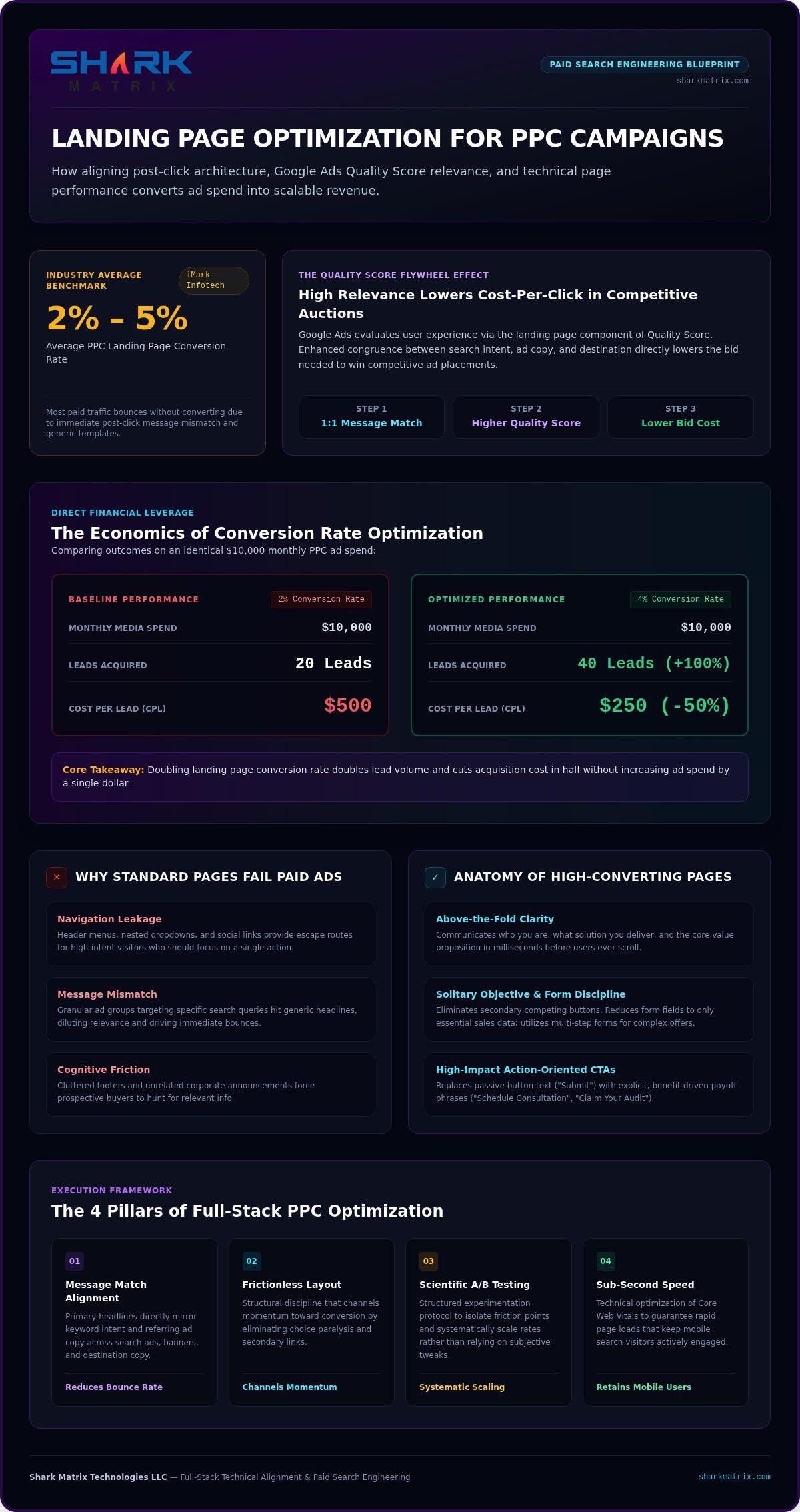
The moment a user clicks your ad, the clock starts ticking. If your page takes more than a few seconds to load or doesn’t immediately answer their query, you’ve wasted your budget. High-intent ppc for lead generation depends on a seamless transition from the search result to the conversion point. In a market where Google Ads CPCs have seen a 12% year-over-year increase, every bounce is a costly mistake. You aren’t just paying for a click; you’re paying for the opportunity to start a conversation.

While some competitors suggest keeping forms as short as possible to lower CPL, this often results in a flood of low-quality spam. Instead, find a balance between friction and quality. Ask one or two qualifying questions that filter out casual browsers who aren’t ready to buy. This ensures your sales team spends their time on prospects with genuine intent. Trust signals, such as client reviews and industry certifications, must be placed above the fold to build immediate credibility for national users who might be unfamiliar with your brand.

Landing Page Essentials for Lead Capture

Message match is non-negotiable for maintaining a high Quality Score. If your ad promised a “Detailed Industry Report,” the landing page shouldn’t pivot to a “Book a Demo” button immediately. Stick to the “One Goal” rule by removing all external navigation links that might lead a user away from the form. The Hero Section is the area of the page visible without scrolling that must communicate your value proposition and primary call-to-action within seconds. By narrowing the user’s focus, you significantly reduce lead leakage and improve your conversion rate.

Advanced Lead Form Strategy

For complex services, multi-step forms often outperform long, single-page versions. They reduce the perceived effort by breaking questions into logical chunks, which keeps the user engaged without feeling overwhelmed. Implement real-time validation to catch typos in phone numbers and emails before the user hits submit. This improves your data hygiene and ensures your sales team isn’t chasing dead ends. Finally, use your “Thank You” page to keep the momentum going. Instead of a generic message, offer an immediate consultation or a link to a high-value resource from your content marketing efforts.

Since video ads now account for 42% of total digital ad spend, ensure your landing pages can handle rich media without slowing down on mobile devices. A mobile-first design is essential for national campaigns where users often switch between devices. Professional Web Design and Development ensures your site is optimized for speed and conversion, providing a stable foundation for your paid search investments.

Common Pitfalls: Why Most PPC Lead Gen Campaigns Fail

Many businesses treat their campaigns like a slow cooker. They set them up and walk away. But in 2026, the auction environment changes hourly. With CPCs rising 12% in competitive sectors, a single week of neglect can drain thousands from your budget. Successful ppc for lead generation requires active management. If you aren’t reviewing search terms and adjusting bid strategies daily, you’re likely subsidizing your competitors’ growth. You need to leverage the fact that Google Ads now retains granular performance data for 37 months to make informed, data-driven adjustments.

Chasing the lowest possible CPL is a race to the bottom. While the average CPL across all industries is $198, a $50 lead that never answers the phone is more expensive than a $300 lead that closes a deal. Marketing can’t fix a slow sales response, but it can ensure the leads arriving are worth the effort. Identifying these budget leaks is difficult without an outside perspective. Using ppc audit services can uncover where your money is being wasted on low-intent traffic before it ruins your ROI.

The Lead Quality Trap

Broad match keywords often cause the “lead quality trap.” They cast a wide net that fills your CRM with junk data. Instead, focus on Value-Based Bidding. This guides the AI to find prospects who mirror your highest-paying clients rather than just anyone who clicks. You must differentiate between a “contact,” which is just a name in a database, and a “qualified prospect,” which represents a future revenue stream. By feeding conversion values back into the system, you train the algorithm to prioritize quality over volume.

Tracking and Attribution Gaps

Relying on “Last-Click” attribution is a dangerous gamble. Most B2B journeys involve multiple touchpoints across search, social, and video. Since Meta updated its attribution model in March 2026 to exclude non-link interactions like video views from click-through counts, your data might be missing the full picture. You must also account for the phase-out of standalone call ads that began in February 2026. By using call assets within responsive search ads and connecting your CRM to Google Ads via API, you gain visibility into offline conversions. This data is what fuels the Smart Bidding algorithms that now manage 78% of all spend.

If you’re tired of seeing your budget disappear into low-quality clicks, it’s time to refine your strategy. Our team provides professional PPC Management to help you navigate these technical gaps and ensure every dollar works toward a qualified sale.

Future-Proofing Lead Gen with AI and Automation

By 2026, the AI-powered search advertising market has surged to over $500 million. This shift means that successful ppc for lead generation is no longer just about manual adjustments; it’s about guiding machine learning models with high-quality data. Smart Bidding now uses thousands of signals to predict the probability of a conversion in real time. Instead of bidding on a broad keyword, the system evaluates the user’s past behavior, device, and time of day to decide if they are likely to become a high-value lead. This predictive approach allows you to scale your growth without manually managing every single bid.

The rise of generative search has also introduced Answer Engine Optimization (AEO) and Generative Engine Optimization (GEO) into the paid landscape. Users are moving toward conversational queries, asking complex questions rather than typing short phrases. To stay visible, your ad creative must adapt. AI-driven dynamic ads now use Large Language Models (LLMs) to test hundreds of variations of headlines and descriptions. This ensures the message matches the searcher’s specific intent perfectly. Combining these paid efforts with search engine optimization seo services creates a total market approach that captures intent across both organic and paid channels.

Harnessing AI-Driven Automation

Performance Max (PMax) for lead generation has evolved significantly from its early iterations. Unlike traditional search-only campaigns, PMax uses your first-party data to find prospects across YouTube, Gmail, and Display. To make this work, you must automate your lead scoring. By tagging leads in your CRM based on their quality and feeding that data back into Google Ads, you train the AI to ignore “tire-kickers” and focus on buyers. This automation frees up your team to focus on high-level strategy rather than administrative tasks.

The Shark Matrix Edge

We provide more than just standard campaign management. Our team specializes in ai automation services and industry specific ai solutions designed to give national enterprises a competitive advantage. We build custom machine learning development services that integrate directly with your sales pipeline to predict lead value before a human even reviews the contact form. In the competitive UAE market, this data-driven precision is the difference between a stagnant campaign and explosive growth.

Whether you need natural language processing services to analyze customer sentiment or generative ai development services to scale your content marketing, we align every tool with your commercial goals. Our approach to ppc for lead generation ensures your business isn’t just reacting to the market but leading it. By combining ai chatbot-development services with advanced ppc management, we create a high-friction-for-quality journey that delivers the sales-ready leads your business needs to thrive in 2026.

Scaling Your Lead Pipeline in 2026

Success in the current landscape requires moving beyond simple keyword matching to understand deep user intent. By prioritizing the post-click experience and leveraging first-party data, you can turn expensive clicks into a predictable flow of sales-ready prospects. Mastering ppc for lead generation is no longer just a technical task; it’s a strategic necessity for national growth. The shift toward privacy-first tracking and automated bidding means your strategy must be as dynamic as the platforms themselves to stay ahead of rising costs.

As a Premier Google Partner with over 15 years of national marketing expertise, Shark Matrix specializes in high-impact performance marketing and AI-driven lead automation. We help you navigate complex policy changes and technical attribution gaps so your marketing spend delivers measurable growth. Start generating high-quality leads with Shark Matrix today and take control of your customer acquisition costs. Your next phase of growth is just one well-optimized campaign away. With the right data and a proactive approach, you can build a sustainable lead engine that thrives in any market condition.

Frequently Asked Questions

How much does PPC lead generation cost in 2026?

Costs vary significantly by sector, but the average cost per lead (CPL) across all industries is approximately $198. For example, B2B SaaS ranges from $63 to $237, while legal services can reach $132 on Google. These figures depend on competition and your chosen platform’s bidding environment. You should monitor your specific industry benchmarks to ensure your spend remains efficient.

How long does it take to see results from a new PPC campaign?

You can see initial traffic immediately, but a campaign usually requires 30 to 90 days to stabilize and provide meaningful lead data. This period allows the AI to move past its initial learning phase. Since 78% of spend is managed via Smart Bidding, the system needs consistent conversion data to optimize performance effectively and lower your CPL over time.

Which is better for lead generation: Google Ads or Meta Ads?

The better platform depends on your audience’s intent and your specific industry. Google Ads excels at capturing high-intent searchers, while Meta Ads often provides a lower CPL for visual or interest-based services. For instance, e-commerce leads cost about $27 on Meta compared to $48 on Google. Many businesses find that an omnichannel approach delivers the best results. Businesses operating in the region should also review the specific considerations outlined in our guide to google ads management uae to account for local compliance requirements and higher advertising costs.

What is a good conversion rate for a lead generation landing page?

A healthy conversion rate for lead generation typically falls between 5% and 15% depending on the offer’s complexity. High-performing hero sections and multi-step forms can push these numbers higher. It’s best to benchmark against your specific industry averages rather than general digital marketing stats to get an accurate picture of your performance.

How do I improve the quality of the leads I get from PPC?

Improving lead quality involves tightening your keyword intent and adding qualifying questions to your forms. Use negative keywords to filter out non-commercial searches and leverage first-party CRM data to guide your ppc for lead generation strategy. This ensures the AI targets prospects who mirror your existing high-value customers rather than just chasing the lowest cost.

Can I do PPC for lead generation without a website?

Yes, you can use native lead forms on platforms like Meta or LinkedIn to capture information without a traditional website. However, a dedicated landing page usually offers better long-term ROI and more control over the user experience. For national campaigns, professional Web Design and Development helps build the trust necessary for high-ticket conversions.

What are the best keywords to target for B2B lead generation?

The best keywords are those that indicate high commercial intent, such as “enterprise software solutions” or “professional consultation.” Avoid broad, educational terms that attract researchers rather than buyers. Focus on long-tail phrases that describe the specific problem your business solves to keep your CPL manageable and attract qualified prospects.

How do I track phone calls from my PPC ads?

You should use call assets within your responsive search ads since standalone call ads were phased out in February 2026. Implementing dynamic number insertion (DNI) on your landing pages also allows you to attribute calls back to specific keywords. This setup provides a clear view of how ppc for lead generation contributes to your offline sales and overall ROI.

Categories
Digital Marketing

Maximising ROI: The Definitive Guide to PPC Audit Services in 2026

Why is your monthly ad spend climbing while your lead quality hits an all-time low? With global PPC spending projected to reach AED 1.12 trillion in 2026, the battle for the average 6.42% click-through rate is fiercer than ever. If you’re seeing “bleeding” campaigns or irrelevant clicks draining your budget, you’re not alone. Many UAE businesses struggle to bridge the gap between automated Performance Max campaigns and actual revenue. Professional ppc audit services are no longer just a luxury health check; they’re a technical necessity to ensure your human strategy isn’t being overruled by aggressive AI bidding algorithms.

You likely feel that your current Google Ads setup should be performing better, especially since 78% of managers have now adopted smart bidding. It’s frustrating to watch your Cost Per Acquisition (CPA) rise while competitors dominate the local market. This guide provides a clear, data-driven roadmap to stop the waste. You’ll learn how a comprehensive audit, which typically costs between AED 1,100 and AED 9,200 in 2026, identifies tracking gaps and improves Quality Scores. We’ll explore the exact steps to turn your underperforming accounts into high-ROAS machines that scale effectively across the Emirates.

Key Takeaways

  • Learn why deep-dive audits are essential to stop budget leakage that routine monthly optimizations often miss.
  • Discover how professional ppc audit services evaluate account hierarchy and eliminate “expensive loser” keywords to improve Quality Scores.
  • Understand the shift to AI-enhanced auditing in 2026, using predictive analytics to forecast the impact of changes before you spend a single Dirham.
  • Get a clear framework for categorizing audit findings into immediate “Quick Wins” and long-term strategic shifts to lower your CPA.
  • Explore the Shark Matrix Technologies LLC methodology, a proprietary system designed to scale UAE national campaigns through local expertise and AI automation.

Understanding PPC Audit Services: Why Your Ad Spend Might Be Leaking

A PPC audit is a diagnostic tool that identifies technical gaps and strategic opportunities to improve ROAS. While routine optimization focuses on daily bid adjustments and minor copy tweaks, professional ppc audit services provide a comprehensive health check of your entire paid strategy. Think of it as an engine overhaul rather than a simple oil change; routine management keeps the car running, but an audit ensures the engine is actually capable of winning the race. Before diving into the technicalities, it’s helpful to have a solid foundation in Understanding Pay-Per-Click mechanics to see how small errors compound into massive losses.

Even successful campaigns need a “fresh eyes” review every six months. In 2026, the digital landscape moves too fast for a “set it and forget it” mentality. With 92% of managers now using AI for ad copy and 78% adopting smart bidding, your account can drift into inefficiency without you noticing. An external audit breaks the “echo chamber” of internal management. It uncovers where automation might be overspending on low-intent traffic or where your Arabic digital marketing efforts aren’t aligning with local search nuances across the country. Staying informed about the latest UAE digital marketing trends is essential to understanding how shifting consumer behaviors and new platform regulations directly impact your paid search performance.

Red Flags: When to Request an External Review

If your conversion rates have remained stagnant or declined while your monthly budget increases, you’re likely facing diminishing returns. A high click-through rate (CTR) above the 6.42% industry average is usually a positive sign, but if that traffic doesn’t convert, you’re just paying for “vanity” clicks. Sudden drops in Quality Score across your primary keyword clusters are another major trigger. These drops often signal that your landing page relevance has slipped or your ad relevance no longer matches user intent. Don’t wait for your ROAS to hit zero before seeking professional ppc audit services; if your cost per lead has climbed by more than 15% in a single quarter, the leak is already active.

The ROI of Auditing: Turning Waste into Growth

The financial impact of a deep-dive audit is immediate. Identifying and fixing negative keyword conflicts can save up to 20% of your total ad spend. That’s money that can be instantly reallocated to high-performing campaigns. Furthermore, improving landing page relevance lowers your cost per click, making every Dirham work harder. With mobile devices accounting for 68.4% of search spend in 2026, an audit often reveals missed opportunities in mobile-specific audience segments. By identifying these “expensive losers” and untapped pockets of demand, you transform wasted spend into a scalable roadmap for national UAE growth. To ensure those recovered budgets are channeled effectively, understanding the full mechanics of PPC for lead generation is essential for building campaigns that convert clicks into sales-ready prospects.

The Core Pillars of a Comprehensive PPC Performance Review

A professional review starts with the skeletal frame of your account. We evaluate the hierarchy of campaigns and ad groups to ensure they aren’t competing against each other. In 2026, with Performance Max accounting for 42% of all Google Ads spend, your structure must allow AI to learn without being constrained by overlapping targets. Keyword hygiene is equally vital. We identify “expensive losers,” keywords that eat up your budget without delivering the average 7.04% conversion rate seen across industries today. Auditing match types ensures you aren’t bidding on broad terms that attract irrelevant traffic. If your current ppc audit services don’t look at the structural integrity of your account, you’re likely missing the root cause of high CPAs.

Ad creative and extensions need to resonate with current trends. In a market where mobile devices account for 68.4% of total global search ad spend, your ad extensions must be optimized for thumb-stopping engagement. If your tracking isn’t 100% accurate, your audit will be based on flawed data. We verify that GTM and GA4 tags fire correctly for every event, from button clicks to form submissions. This ensures you’re making decisions based on reality, not assumptions. This technical foundation is what allows for a truly data-driven roadmap to scale your UAE campaigns.

Bilingual Auditing: The Arabic Context

The UAE is a melting pot, and English-only audits often miss significant revenue streams. We check the cultural relevance and translation accuracy of your Arabic ad copy. It’s not just about translation; it’s about resonance. We also audit right-to-left (RTL) landing page performance. A UX flaw on an Arabic page can drive up bounce rates, even if the ad itself is perfect. Ensuring your Arabic digital marketing strategy is technically sound is a key part of our review process.

Technical Tracking and Attribution

With the total phase-out of third-party cookies, server-side tracking is no longer optional. We audit your attribution models to see if you’re over-valuing “Last Click” and ignoring the “Data-driven” insights that reflect how users actually convert. Our audit ensures lead-to-sale data loops back into the ad platform. This allows smart bidding to optimize for actual revenue rather than just lead volume. Without this loop, your ppc audit services are only seeing half the picture, leading to skewed ROI calculations.

Maximising ROI: The Definitive Guide to PPC Audit Services in 2026

AI-Enhanced Auditing vs. Traditional Methods: Navigating the 2026 Landscape

In 2026, the gap between traditional manual reviews and AI-enhanced ppc audit services has widened significantly. Traditional methods often rely on a human auditor scanning spreadsheets for obvious errors, but AI tools now identify micro-patterns in bidding that the human eye simply misses. These tools can analyze thousands of variables simultaneously, such as how humidity levels in Dubai or public holidays in Abu Dhabi affect specific search behaviors. Predictive analytics goes a step further by forecasting the outcome of audit recommendations. Instead of guessing, we can project that adjusting a specific bidding threshold will likely improve your ROAS before you commit a single Dirham of your budget.

While AI identifies patterns, human specialists provide the strategic context for the UAE business environment. You can’t rely solely on a machine to understand the nuances of the local market or the competitive landscape of the Emirates. Human expertise is required to interpret AI-generated data points and filter them through a lens of business reality. Understanding the broader UAE digital marketing trends for 2026, including the rise of Generative Engine Optimization and new advertiser regulations, is critical context for interpreting what your audit data truly means. Our ppc audit services combine these high-speed calculations with the tactical oversight needed to ensure your account doesn’t just look good on paper but actually drives profit.

Auditing Automated Bidding Strategies

Automation is a double-edged sword. We examine whether “Target ROAS” or “Maximize Conversions” strategies are truly aligned with your bottom line. It’s common to find “Algorithm Drift,” where the AI begins to over-optimize for low-value traffic just to hit a numerical target. With Performance Max campaigns now accounting for 42% of all Google Ads spend, setting the right guardrails is essential. We audit your asset groups and audience signals to ensure the machine isn’t wasting your AED on placements that don’t convert. Our review ensures that the 78% of managers using smart bidding are actually seeing a return on that automation.

The Human Element: Strategic Interpretation

The final stage of any audit is translating technical data into growth strategies. We look at how your PPC findings can bolster your broader Search Engine Optimization (SEO) and Social Media Marketing efforts. For instance, if a specific keyword converts at a high rate in paid search, it should become a priority for your organic content strategy. We prioritize audit findings based on immediate impact versus long-term effort, ensuring you tackle the “bleeding” campaigns first. This holistic approach ensures your digital ecosystem works as a single, cohesive unit, turning technical audit points into a roadmap for national expansion.

Step-by-Step: Implementing Findings from Your PPC Audit

Receiving your audit report is only the beginning. To transform those insights into actual revenue, you must categorize findings into three distinct buckets: “Quick Wins,” “Structural Changes,” and “Strategic Shifts.” Before you change a single bid, establish a clear baseline using your current metrics, such as your existing Cost Per Acquisition (CPA) and the average 7.04% conversion rate benchmark for 2026. This allows you to measure the precise impact of every adjustment. Avoid the temptation to make bulk changes across the entire account. Instead, use incremental A/B testing to ensure that each optimization actually moves the needle in the right direction.

Professional ppc audit services often reveal that the most significant gains come from disciplined execution rather than radical pivots. By focusing on one variable at a time, you isolate what works. This methodical approach is especially important for UAE businesses targeting high-competition areas like Dubai and Abu Dhabi, where ad space is expensive. Once the initial round of fixes is complete, schedule follow-up reviews every 90 days to ensure that “algorithm drift” hasn’t pulled your campaigns off course again.

Phase 1: Immediate Efficiency Gains

Your first priority is to stop the bleeding. Start by removing conflicting negative keywords that might be blocking your best-performing ads. It’s a common error that can stifle reach and drive up costs. Next, fix any broken tracking links or landing page errors that result in a poor user experience. If your audit shows that certain geographic segments are underperforming, reallocate that budget toward higher-converting regions within the Emirates. These immediate fixes can often recover a significant portion of the 20% spend typically wasted on keyword conflicts. If you’re unsure where to start, a professional PPC management partner can help prioritize these tasks.

Phase 2: Structural and Strategic Overhauls

After the quick fixes, move toward deeper structural changes. This involves restructuring ad groups to achieve better Quality Score alignment, which directly lowers your CPC. Refresh your ad copy to reflect 2026 market sentiments, ensuring your messaging resonates with a post-AI consumer base that values transparency and speed. For your Performance Max campaigns, update your audience signals with fresh first-party data. Since mobile devices now account for 68.4% of search spend, ensure every structural change is optimized for a mobile-first user journey. This phase turns the technical data from your ppc audit services into a long-term engine for growth. Pairing these structural improvements with a robust high-intent PPC for lead generation strategy ensures your restructured campaigns are engineered to attract and convert the right prospects at every stage of the funnel.

Shark Matrix: Advanced PPC Auditing for National Growth

Shark Matrix delivers a proprietary audit framework that merges high-speed AI automation with deep local insights. This combination is critical for UAE brands because generic algorithms often miss the cultural nuances of the Dubai and Abu Dhabi markets. Our ppc audit services focus on high-quality lead generation and transparent ROI reporting. We don’t just hand you a static PDF and walk away. We’re a full-service partner. We find the leaks. Then we plug them. This proactive approach ensures your campaigns aren’t just theoretically better but are actively driving more profit into your business.

Optimizing for the UAE requires a bilingual strategy that most global tools can’t handle effectively. We specialize in Arabic digital marketing and English campaign optimization, ensuring your ads resonate with the diverse demographic of the Emirates. Whether it’s adjusting for right-to-left UX or refining Arabic ad copy for local dialects, our audits cover the technical and cultural details that others overlook. We turn complex data points into a clear, actionable roadmap that scales your performance across the entire country.

Why National Brands Trust Our Performance Experts

National brands choose us because of our decade-long track record. We’ve navigated the UAE’s digital shifts for over 10 years, managing accounts through every major algorithm update. Our team consists of certified experts across Google Ads, Meta, LinkedIn, and TikTok. We don’t look at PPC in a vacuum. We strategically integrate findings from our ppc audit services with your Search Engine Optimization (SEO) and Social Media Marketing to create a unified growth engine. This holistic view ensures that a win in paid search becomes a win for your entire digital ecosystem.

Request Your Comprehensive PPC Health Check

Ready to stop the budget drain? Our health check process is rigorous and transparent. During your initial consultation, we’ll walk you through a report that highlights exactly where your budget is “bleeding.” We prioritize data security and account integrity above all else, ensuring your first-party data remains protected under the latest UAE regulations. You’ll receive a prioritized list of fixes, from immediate technical repairs to long-term strategic overhauls. Don’t let another month of ad spend go to waste on irrelevant clicks. Get a detailed PPC audit to scale your performance today and start seeing the ROI your business deserves.

Secure Your Competitive Edge in the 2026 UAE Market

The digital landscape in the Emirates is evolving faster than ever. By now, you understand that professional ppc audit services are the only way to stop budget leakage and align your campaigns with the AI-driven realities of 2026. You’ve seen how identifying “expensive losers” and fixing technical tracking gaps can turn stagnant accounts into high-performance engines. Transitioning from a basic manual review to an AI-enhanced framework ensures your strategy remains resilient against algorithm shifts and rising competition across the Seven Emirates.

Shark Matrix has been deeply rooted in the UAE market since 2010. We specialize in the complex intersection of Arabic Digital Marketing and AI automation to deliver high-quality lead generation for national brands. We don’t just identify technical flaws; we provide the local expertise needed to fix them. Your ad spend should be a measurable investment, not a mysterious expense. Take control of your ROI and ensure your brand dominates search results from Dubai to Fujairah.

Book Your Expert PPC Audit with Shark Matrix and start scaling your national campaigns with confidence today.

Frequently Asked Questions

How long does a professional PPC audit take to complete?

A professional audit typically takes between 5 and 10 business days to complete. This timeline depends on the complexity of your account and the volume of data generated over the last 12 months. Large-scale national campaigns with multiple ad groups require more time for deep-dive analysis compared to smaller, local lead generation setups.

Will a PPC audit interfere with my live campaigns?

No, an audit doesn’t interfere with your live campaigns or day-to-day operations. We conduct the review using “read-only” access to evaluate your current settings, keyword bids, and historical performance. This ensures your active ads continue to run in the UAE market without interruption while we identify opportunities for improvement.

What is the difference between a PPC audit and monthly management?

An audit is a one-time diagnostic snapshot designed to find hidden technical gaps and strategic flaws. Monthly management involves the ongoing execution of bid adjustments, ad copy testing, and budget shifts. While management keeps the engine running, our ppc audit services provide the overhaul needed to ensure that engine is actually efficient.

Can you audit platforms other than Google Ads, such as LinkedIn or TikTok?

Yes, we audit all major paid platforms including Meta, LinkedIn, and TikTok. Each platform requires a specific lens; for instance, a LinkedIn audit focuses on professional targeting accuracy, while a TikTok review prioritizes creative fatigue and engagement rates. This multi-platform approach ensures your entire social media marketing ecosystem is optimized for the UAE’s unique user behavior.

How often should my business conduct a full PPC audit?

You should conduct a full audit every six months to stay ahead of platform updates and competitor shifts. In a fast-moving market like Dubai, waiting longer can lead to budget waste as AI bidding models drift. Regular reviews catch these inefficiencies before they impact your quarterly ROI.

Do I need to give you full access to my ad accounts for an audit?

You only need to provide “Read-only” or “Standard” access to your ad accounts and GA4 property. We don’t require administrative control to perform a comprehensive review. This level of access allows our team to export data and analyze settings securely without having the ability to make changes to your billing or user permissions.

What specific documents or data will I receive at the end of the audit?

You’ll receive a detailed PDF report containing a prioritized checklist of immediate fixes and long-term structural recommendations. This document includes a breakdown of wasted spend, Quality Score analysis, and tracking verification results. We also provide a data-driven roadmap that outlines the exact steps needed to lower your CPA across the Emirates.

Is a PPC audit worth it if my campaigns are already profitable?

Yes, because being profitable doesn’t mean you’re maximizing your potential. Even high-performing accounts often harbor “expensive loser” keywords or tracking errors that inflate costs. Utilizing ppc audit services can reveal how to squeeze more value from your existing budget, potentially turning a good ROAS into an industry-leading one.