
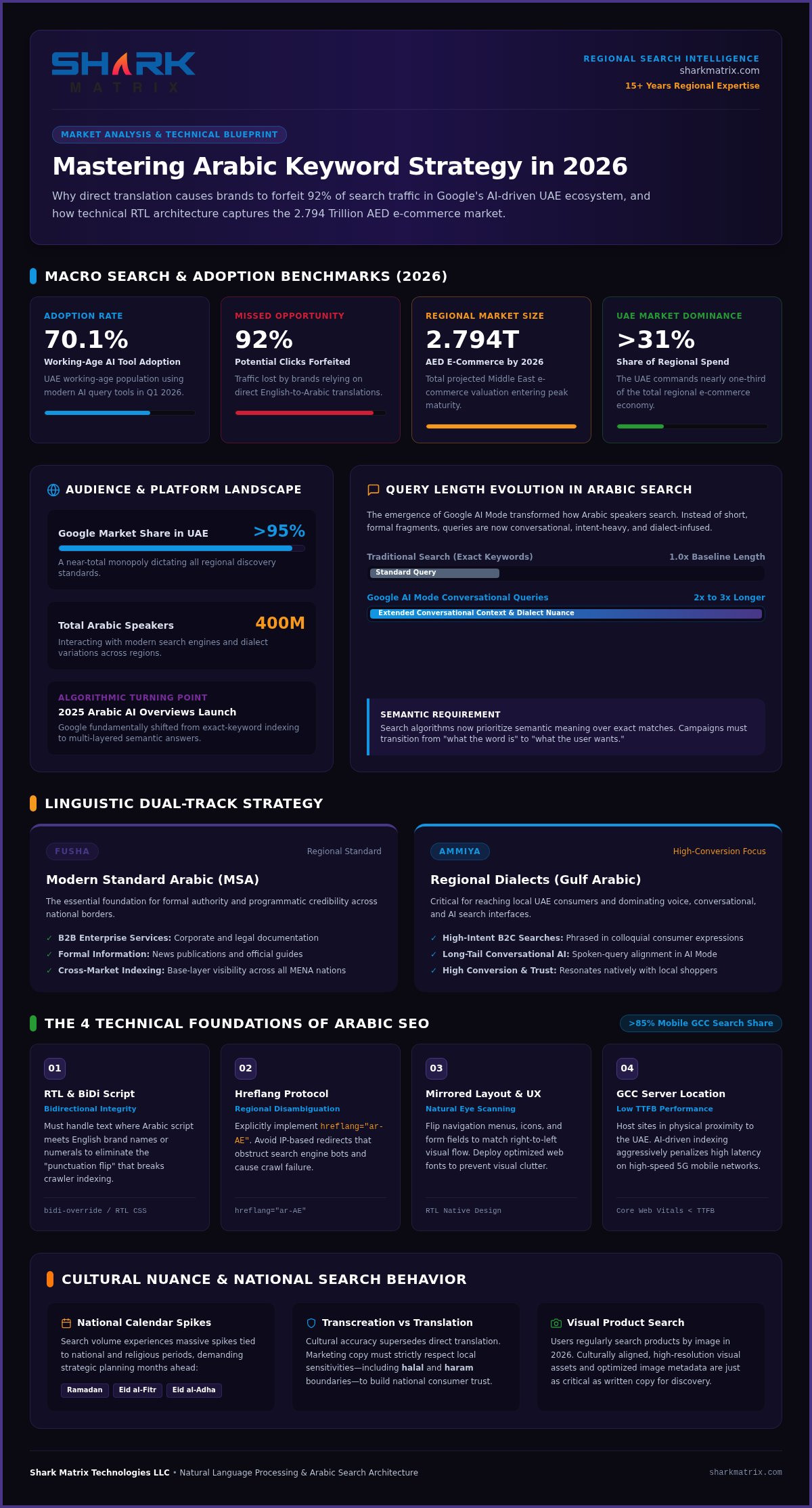
In the UAE, working-age AI tool adoption hit 70.1% in the first quarter of 2026, yet most brands are still losing 92% of potential clicks because they don’t understand how to rank for arabic keywords in Google’s AI-driven landscape. You’ve probably noticed that simply translating your English content doesn’t work. It often leads to high bounce rates and a total lack of visibility in GCC search results. It’s frustrating to see your competitors capture the market while your site struggles to bridge the gap between Modern Standard Arabic and local dialects.
This article provides the master plan to dominate search by mastering the technical, linguistic, and cultural layers of the region. Drawing on over 15 years of regional experience, we’ll show you why traditional translation fails and how to leverage advanced NLP to secure your spot. We’ll provide a clear roadmap for keyword selection, technical RTL implementation, and the specific strategies needed to improve your rankings and conversion rates across the national UAE market.
Key Takeaways
- Learn why the 2026 search market requires a shift from simple keywords to intent-heavy queries that align with Google’s Arabic AI Overviews.
- Master the technical requirements of RTL script architecture and Hreflang implementation to ensure your site appears for the right national audiences.
- Discover how to rank for arabic keywords by moving beyond direct translation and using local tools to identify dialect-specific search terms.
- Understand why transcreation is essential for building authority and trust with a national audience that values cultural accuracy over automated translation.
- Leverage AI and Natural Language Processing to solve the technical challenges of Arabic script variations and improve your content’s semantic relevance.
Understanding the Arabic Search Landscape in 2026
The Middle East digital economy is experiencing an unprecedented surge. By 2026, the regional e-commerce market is projected to reach 2.794 trillion AED, with the UAE commanding over 31% of that market share. If you want to capture your share of this growth, you need a strategy that goes deeper than a simple dictionary. Understanding how to rank for arabic keywords requires a sophisticated grasp of how 400 million speakers interact with modern search technology. Google holds a near-monopoly in the UAE with over 95% market share, and its 2025 rollout of AI Overviews in Arabic has fundamentally changed how users discover information.
Literal translation is the primary reason most Arabic SEO campaigns fail. When you translate English keywords directly into Arabic, you often lose the cultural intent and the specific phrasing used by local shoppers. Search engines have evolved to prioritize semantic meaning over exact matches. Shark Matrix Technologies LLC uses advanced natural language processing to bridge this gap, ensuring your content resonates with both the algorithm and the human reader. It’s about moving from “what the word is” to “what the user wants.”
Modern Standard Arabic vs. Regional Dialects
Modern Standard Arabic (MSA), or Fusha, is the foundation for formal authority. It’s essential for B2B services, legal content, and news. However, 2026 search trends show that high-intent B2C queries and conversational AI searches increasingly utilize regional Arabic dialects. In the UAE, Gulf Arabic nuances are critical for reaching local consumers. Since queries in Google’s AI Mode are now two to three times longer than traditional searches, your strategy for how to rank for arabic keywords must include these colloquial, long-tail phrases to capture conversational traffic.
The Role of Cultural Context in Search Behavior
Search patterns in the UAE are deeply tied to the national calendar. You’ll see massive seasonal spikes during Ramadan, Eid al-Fitr, and Eid al-Adha that require content planning months in advance. Beyond timing, your marketing copy must respect local cultural nuances. This includes understanding “halal” and “haram” sensitivities and ensuring visual content aligns with regional expectations. Visual search is also a major factor in 2026. Users often search for products using images, making high-quality, culturally relevant photography just as important as your written metadata.
The Technical Foundations of Arabic SEO
Technical SEO remains the silent engine behind how to rank for arabic keywords in 2026. Without a solid Right-to-Left (RTL) architecture, your content won’t just look broken to users; it’ll be uninterpretable to crawlers. You must implement bidirectional (BiDi) support to handle pages where Arabic script meets English brand names or numbers. This prevents the “punctuation flip” that plagues poorly coded sites and ensures that your technical signals are clear to search engines.
Correct Hreflang implementation is your primary tool for regional targeting. For the UAE market, you should specifically use hreflang="ar-AE". Following Google’s multi-regional site guidelines ensures you don’t confuse search engines with IP-based redirects that might block crawlers or lead to indexing errors. Since over 85% of GCC searches happen on mobile devices, your technical foundation must prioritize responsive RTL frameworks that load instantly on 5G networks.
RTL Layout and User Experience (UX)
Mirroring your layout involves more than just moving the sidebar. Navigation menus, icons, and even form fields must flip to match the natural eye-scanning pattern of Arabic readers. Font selection is equally vital for performance. Standard system fonts can look cluttered in Arabic script, so choosing optimized web fonts improves both readability and dwell time. If your current site feels clunky or unoptimized, our web development agency can help you rebuild with a “native-first” RTL approach that satisfies both users and search bots.
Server Location and Page Speed for the GCC
Latency is a silent killer for rankings. Hosting your site on servers physically close to the UAE reduces Time to First Byte (TTFB), which is a critical signal for Core Web Vitals. In 2026, Google’s AI-driven indexing penalizes sites that lag, especially in high-speed markets like the Middle East. Fast-loading pages aren’t just a luxury; they’re a requirement for staying competitive in national search results.
Handling Arabic URLs presents another unique challenge. While UTF-8 slugs are great for SEO, they often turn into long strings of “percent-encoding” when shared on social platforms. It’s often best to use clean, short slugs or carefully managed transliterated versions to keep your site structure manageable. For a technical audit that covers these nuances, consider looking into our SEO company services to ensure your backend isn’t holding your visibility back.
Arabic Keyword Research: Beyond Simple Translation
Mastering how to rank for arabic keywords starts with abandoning your translation software. Direct translations often target words with zero search volume or, worse, the wrong intent. Your research should begin with English core concepts to establish a baseline, but the actual data gathering must happen in Arabic. This allows you to uncover regional nuances that automated tools miss. For instance, a search for “home insurance” in the UAE might yield entirely different results when using formal terms versus colloquial phrasing used by residents.
Effective research follows a structured, five step process that respects linguistic diversity. First, identify your core English concepts. Second, use local tools to find dialect synonyms. UAE users often blend Modern Standard Arabic with Gulf Arabic, creating unique search patterns. Third, analyze Arabizi volume. Even in 2026, younger demographics use Latin letters and numbers, like 3 for ‘Ain’, in casual searches. Fourth, map these keywords to buyer journey stages. Awareness queries are usually in formal script, while high intent purchase queries might use local slang. Finally, ensure your technical setup follows W3C structural markup standards for right-to-left text so your chosen keywords are indexed correctly within the RTL layout.
Identifying High-Value Long-Tail Keywords
Many brands ignore long-tail Arabic queries because individual volumes look low. However, these phrases are significantly less competitive and often signal a higher intent to buy. In 2026, Google’s AI Overviews favor these specific, question-based queries. You’ll find that answering “how do I renew my…” in localized Arabic captures traffic that broader, one-word terms miss. Tracking these national trends requires tools that specifically parse UAE search behavior rather than global averages. It’s about finding the specific questions your audience is asking their AI assistants.
Analyzing Competitor Keyword Gaps
Most competitors in the region are still stuck on surface-level formal terms. By using our SEO company services, you can identify semantic clusters they’ve overlooked. Semantic search in 2026 focuses on the relationship between concepts rather than just keyword strings. If your competitors only target “luxury cars,” you can gain an edge by targeting the semantic neighborhood around “certified pre-owned premium vehicles” in both formal and regional variations. This strategic gap is where your fastest growth lives.
Content Strategy: Localizing for the National Audience
Transcreation is the secret to winning in 2026. While translation changes words, transcreation adapts the message to fit the cultural context of the UAE. If you’re wondering how to rank for arabic keywords, you must realize that Google’s AI models now evaluate the cultural relevance and expertise of your content. Thinly translated pages often result in high bounce rates because they lack the linguistic flow and nuance that a national audience expects. It’s not just about what you say, but how you say it within the local cultural framework.
Building authority requires localized expert content. This means using native speakers who understand the specific industry landscape in the Middle East. Understanding how to rank for arabic keywords involves more than just text; it’s about building a reputation for reliability. Social proof is also vital. In the Arabic market, detailed testimonials and case studies from regional brands carry significant weight. To capture Google’s Featured Snippets, structure your content with clear, direct answers to common questions. Use bulleted lists and concise definitions that the AI can easily pull into the zero-click results. This structured approach helps search engines identify your site as a primary source for “what is” and “how to” queries.
Visual and Video Content Localization
Imagery speaks as loudly as text. Using culturally relevant icons and photos that reflect regional values builds immediate trust. Video SEO is another massive opportunity. Platforms like YouTube and TikTok are primary search engines in the GCC. Optimizing your video titles and descriptions with regional keywords can drive significant traffic back to your site. To integrate these elements into a broader growth plan, you should consult a professional social media strategy team to align your visual brand with your SEO goals.
Link Building in the Middle Eastern Market
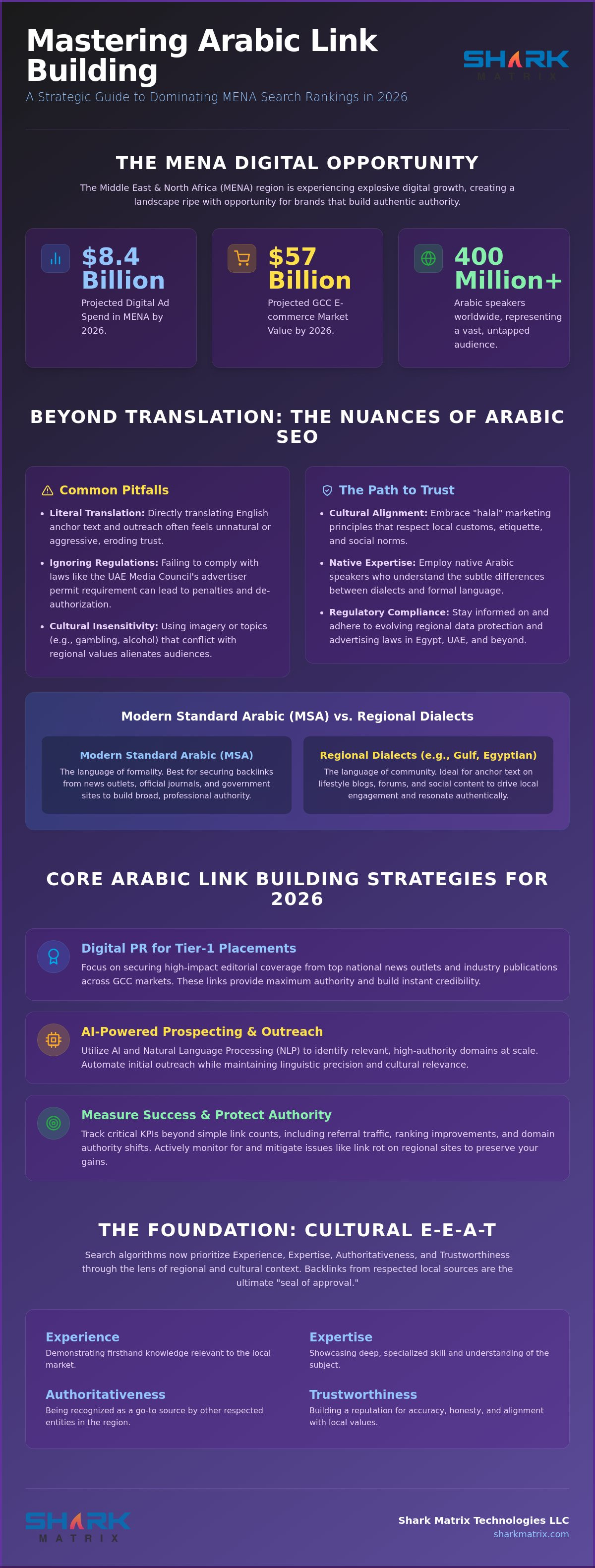
Acquiring high-authority backlinks from national domains, specifically those ending in `.ae`, provides the strongest ranking signal for the UAE. Digital PR is the most effective way to earn these links. By creating data-driven stories, national surveys, or reports that regional news outlets want to cover, you build a natural backlink profile that competitors can’t easily replicate. Avoid the low-quality link farms that are common in the region; they’ll only result in penalties from modern algorithms. Quality links from established Middle Eastern media houses will always outperform hundreds of low-tier directory submissions.
Ready to transform your digital presence? Start your Arabic SEO journey with Shark Matrix today.
Leveraging AI and NLP for Arabic Search Dominance
By 2026, the volume of search data in the Middle Eastern digital market has made manual keyword management nearly impossible for large-scale enterprises. If you want to master how to rank for arabic keywords at scale, you must move beyond spreadsheets and embrace advanced technology. Natural Language Processing (NLP) allows you to decode the complex sentiment behind Arabic search queries. Because Arabic is a high-context language where a single word can have multiple meanings depending on its surroundings, sentiment analysis is the only way to ensure your content matches the user’s emotional or commercial intent.
Automating keyword clustering is another area where technology provides a competitive edge. Large e-commerce sites often deal with thousands of variations of the same product term across different dialects. Our natural language processing services enable businesses to group these terms into semantic clusters automatically. This ensures that your site architecture remains clean and your internal linking strategy stays focused on high-value topics. AI-driven content auditing also helps maintain linguistic accuracy by identifying orthographic inconsistencies that might confuse search engine crawlers or frustrate users.
Generative AI and Arabic Content Creation
Generative AI has transformed content production, but it’s not a “set and forget” solution for the UAE market. While you can use AI for drafting initial copies, maintaining cultural nuance requires a human-in-the-loop approach. When figuring out how to rank for arabic keywords in a generative era, the focus shifts from volume to semantic relevance. Modern generative AI development focuses on creating models that respect regional sensitivities and linguistic flow. You’ll find that AI-drafted content works best when it’s refined by native experts who can add the “transcreation” layer we discussed. This hybrid approach ensures your content remains authoritative in a landscape where users are increasingly wary of generic, bot-generated text.
Predictive Analytics for Search Trends
Predictive analytics allows you to move from reactive to proactive SEO. By using machine learning to analyze historical search data, you can forecast volume changes in the national UAE market months before they happen. This is particularly useful for religious holidays or shopping events where search patterns shift rapidly. Using ai automation services to refine your keyword targeting based on these predictions means you’ll have content ready and indexed before the competition even starts their research. It’s the most effective way to secure long-term dominance in a fast-moving search environment.
Dominating the National Arabic Search Market
The shift toward AI-driven search in the UAE means your digital strategy must be as sophisticated as the technology users are holding in their hands. Success in 2026 relies on a foundation of technical RTL excellence and a deep understanding of how to rank for arabic keywords through transcreation rather than just translation. By integrating advanced Natural Language Processing with culturally resonant content, you can bridge the gap between user intent and final conversion.
Shark Matrix brings over 15 years of Middle Eastern market experience to every campaign. Our specialized expertise in Arabic NLP ensures your brand speaks with authority across the national market. We don’t just optimize for search engines; we optimize for the culture that drives them. This technical precision is what allows your business to scale across the UAE without losing its voice or its relevance.
Ready to lead the region? Partner with a leading Arabic SEO agency to dominate the national market and secure your future in the Middle East. The opportunity for growth in the national market is massive, and the right technical partner makes all the difference in your journey to the top.
Frequently Asked Questions
Can I use Google Translate for my Arabic SEO keywords?
You shouldn’t rely on Google Translate for your Arabic SEO strategy. While the tool has improved, it often fails to capture the specific search intent and cultural nuances of the UAE market. Literal translations usually result in keywords with zero search volume or the wrong meaning. Using native experts or sophisticated natural language processing services ensures your terms align with how local users actually search, which is a key part of learning how to rank for arabic keywords effectively.
What is the difference between MSA and regional dialects for SEO?
Modern Standard Arabic (MSA) is the formal script used for B2B, legal, and news content across the Middle East. Regional dialects, or Ammiya, are the conversational variations used in daily life and high-intent B2C searches. In 2026, Google’s AI Overviews increasingly recognize these colloquial phrases. Successful strategies balance both, using MSA for broad authority and dialects for capturing specific, long-tail conversational traffic from the national UAE audience.
Do I need a separate domain for my Arabic website?
You don’t strictly need a separate domain, but it can be beneficial for building local trust. Many brands use subdirectories like /ar/ to consolidate backlink equity across their global site. However, using a country-code top-level domain (ccTLD) like .ae provides a very strong ranking signal for the national market. It signals local relevance to both search engines and users, which often leads to better visibility in UAE-specific search results.
How long does it take to rank for competitive Arabic keywords?
Ranking for competitive terms typically takes between four and eight months of consistent effort. This timeline depends on your site’s current authority, technical health, and the quality of your localized content. Because Arabic SEO is a technical challenge, using AI and NLP expertise can sometimes accelerate this process. It’s a marathon, not a sprint, requiring regular updates and high-quality backlink acquisition from authoritative national domains to sustain your position.
Is “Arabizi” still relevant for keyword research in 2026?
Arabizi remains highly relevant for specific niches like gaming, tech, and youth-focused industries. Even as AI tools become more adept at parsing formal script, many users still use Latin letters and numbers to represent unique Arabic sounds in casual searches. Including Arabizi in your keyword research helps you capture a segment of the market that competitors often ignore. It’s a powerful way to find hidden opportunities in conversational search.
What technical issues are unique to Arabic websites?
Right-to-Left (RTL) script architecture is the most significant technical hurdle. You must ensure your entire layout, from navigation menus to form fields, mirrors correctly for a native experience. Bidirectional (BiDi) support is also essential for handling mixed Arabic and English text without breaking punctuation. Additionally, managing UTF-8 URL encoding is vital to prevent long, unreadable strings when your links are shared on social platforms or through mobile messaging apps.
How does Google handle different Arabic dialects in its search algorithm?
Google uses advanced models like Gemini and BERT to understand the semantic relationship between different dialects. The algorithm has evolved to recognize that a user searching in Gulf Arabic might have the same intent as someone using a more formal term. By mapping these variations to core concepts, Google provides relevant results regardless of the specific dialect used. This is why understanding how to rank for arabic keywords now requires a focus on intent rather than exact matches.
Why is my Arabic traffic high but my conversion rate low?
High traffic with low conversions usually points to a gap in transcreation or user experience. If your landing pages feel like they were cheaply translated, users won’t trust your brand enough to buy. It could also be a technical issue where your RTL layout is frustrating to navigate on mobile devices. Ensuring your content is culturally resonant and your site is technically sound is the only way to turn national traffic into actual revenue.

 OpenAI
 Codex
Codex
 Vertex AI
 Cloud Vision
 OpenCV
 TensorFlow
 IBM Watson
 Cloud Natural Language
 Cognitive Services
 Bot Framework
 Mistral
 LLama
LLama
 Gemini
 Anthropic
 N8N
N8N