
Categories
SEO

Rank for Arabic Keywords: 2026 Middle East SEO Guide

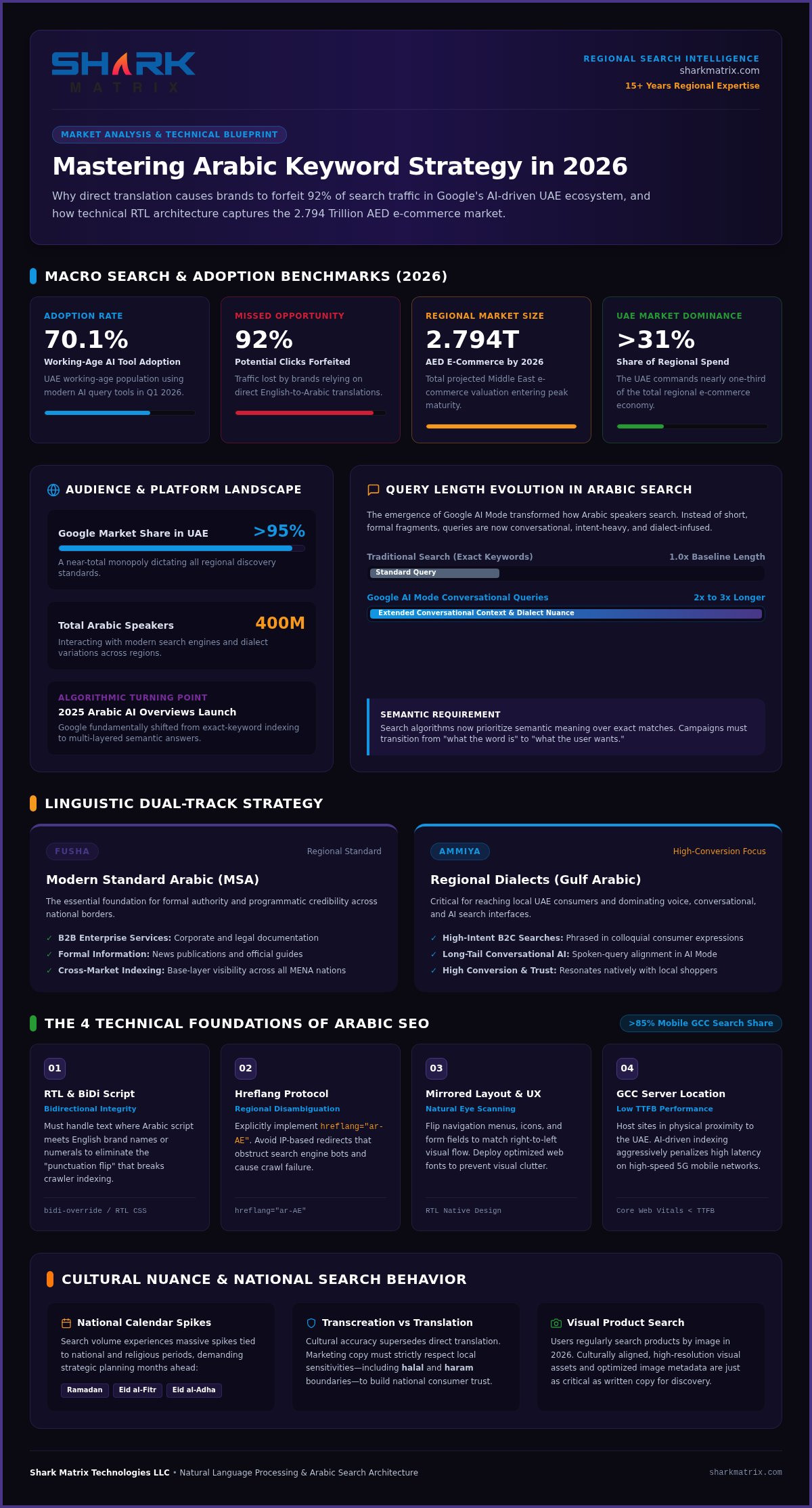
In the UAE, working-age AI tool adoption hit 70.1% in the first quarter of 2026, yet most brands are still losing 92% of potential clicks because they don’t understand how to rank for arabic keywords in Google’s AI-driven landscape. You’ve probably noticed that simply translating your English content doesn’t work. It often leads to high bounce rates and a total lack of visibility in GCC search results. It’s frustrating to see your competitors capture the market while your site struggles to bridge the gap between Modern Standard Arabic and local dialects.

This article provides the master plan to dominate search by mastering the technical, linguistic, and cultural layers of the region. Drawing on over 15 years of regional experience, we’ll show you why traditional translation fails and how to leverage advanced NLP to secure your spot. We’ll provide a clear roadmap for keyword selection, technical RTL implementation, and the specific strategies needed to improve your rankings and conversion rates across the national UAE market.

Key Takeaways

  • Learn why the 2026 search market requires a shift from simple keywords to intent-heavy queries that align with Google’s Arabic AI Overviews.
  • Master the technical requirements of RTL script architecture and Hreflang implementation to ensure your site appears for the right national audiences.
  • Discover how to rank for arabic keywords by moving beyond direct translation and using local tools to identify dialect-specific search terms.
  • Understand why transcreation is essential for building authority and trust with a national audience that values cultural accuracy over automated translation.
  • Leverage AI and Natural Language Processing to solve the technical challenges of Arabic script variations and improve your content’s semantic relevance.

Understanding the Arabic Search Landscape in 2026

The Middle East digital economy is experiencing an unprecedented surge. By 2026, the regional e-commerce market is projected to reach 2.794 trillion AED, with the UAE commanding over 31% of that market share. If you want to capture your share of this growth, you need a strategy that goes deeper than a simple dictionary. Understanding how to rank for arabic keywords requires a sophisticated grasp of how 400 million speakers interact with modern search technology. Google holds a near-monopoly in the UAE with over 95% market share, and its 2025 rollout of AI Overviews in Arabic has fundamentally changed how users discover information.

Literal translation is the primary reason most Arabic SEO campaigns fail. When you translate English keywords directly into Arabic, you often lose the cultural intent and the specific phrasing used by local shoppers. Search engines have evolved to prioritize semantic meaning over exact matches. Shark Matrix Technologies LLC uses advanced natural language processing to bridge this gap, ensuring your content resonates with both the algorithm and the human reader. It’s about moving from “what the word is” to “what the user wants.”

Modern Standard Arabic vs. Regional Dialects

Modern Standard Arabic (MSA), or Fusha, is the foundation for formal authority. It’s essential for B2B services, legal content, and news. However, 2026 search trends show that high-intent B2C queries and conversational AI searches increasingly utilize regional Arabic dialects. In the UAE, Gulf Arabic nuances are critical for reaching local consumers. Since queries in Google’s AI Mode are now two to three times longer than traditional searches, your strategy for how to rank for arabic keywords must include these colloquial, long-tail phrases to capture conversational traffic.

The Role of Cultural Context in Search Behavior

Search patterns in the UAE are deeply tied to the national calendar. You’ll see massive seasonal spikes during Ramadan, Eid al-Fitr, and Eid al-Adha that require content planning months in advance. Beyond timing, your marketing copy must respect local cultural nuances. This includes understanding “halal” and “haram” sensitivities and ensuring visual content aligns with regional expectations. Visual search is also a major factor in 2026. Users often search for products using images, making high-quality, culturally relevant photography just as important as your written metadata.

The Technical Foundations of Arabic SEO

Technical SEO remains the silent engine behind how to rank for arabic keywords in 2026. Without a solid Right-to-Left (RTL) architecture, your content won’t just look broken to users; it’ll be uninterpretable to crawlers. You must implement bidirectional (BiDi) support to handle pages where Arabic script meets English brand names or numbers. This prevents the “punctuation flip” that plagues poorly coded sites and ensures that your technical signals are clear to search engines.

Correct Hreflang implementation is your primary tool for regional targeting. For the UAE market, you should specifically use hreflang="ar-AE". Following Google’s multi-regional site guidelines ensures you don’t confuse search engines with IP-based redirects that might block crawlers or lead to indexing errors. Since over 85% of GCC searches happen on mobile devices, your technical foundation must prioritize responsive RTL frameworks that load instantly on 5G networks.

RTL Layout and User Experience (UX)

Mirroring your layout involves more than just moving the sidebar. Navigation menus, icons, and even form fields must flip to match the natural eye-scanning pattern of Arabic readers. Font selection is equally vital for performance. Standard system fonts can look cluttered in Arabic script, so choosing optimized web fonts improves both readability and dwell time. If your current site feels clunky or unoptimized, our web development agency can help you rebuild with a “native-first” RTL approach that satisfies both users and search bots.

Server Location and Page Speed for the GCC

Latency is a silent killer for rankings. Hosting your site on servers physically close to the UAE reduces Time to First Byte (TTFB), which is a critical signal for Core Web Vitals. In 2026, Google’s AI-driven indexing penalizes sites that lag, especially in high-speed markets like the Middle East. Fast-loading pages aren’t just a luxury; they’re a requirement for staying competitive in national search results.

Handling Arabic URLs presents another unique challenge. While UTF-8 slugs are great for SEO, they often turn into long strings of “percent-encoding” when shared on social platforms. It’s often best to use clean, short slugs or carefully managed transliterated versions to keep your site structure manageable. For a technical audit that covers these nuances, consider looking into our SEO company services to ensure your backend isn’t holding your visibility back.
Rank for Arabic Keywords: 2026 Middle East SEO Guide

Arabic Keyword Research: Beyond Simple Translation

Mastering how to rank for arabic keywords starts with abandoning your translation software. Direct translations often target words with zero search volume or, worse, the wrong intent. Your research should begin with English core concepts to establish a baseline, but the actual data gathering must happen in Arabic. This allows you to uncover regional nuances that automated tools miss. For instance, a search for “home insurance” in the UAE might yield entirely different results when using formal terms versus colloquial phrasing used by residents.

Effective research follows a structured, five step process that respects linguistic diversity. First, identify your core English concepts. Second, use local tools to find dialect synonyms. UAE users often blend Modern Standard Arabic with Gulf Arabic, creating unique search patterns. Third, analyze Arabizi volume. Even in 2026, younger demographics use Latin letters and numbers, like 3 for ‘Ain’, in casual searches. Fourth, map these keywords to buyer journey stages. Awareness queries are usually in formal script, while high intent purchase queries might use local slang. Finally, ensure your technical setup follows W3C structural markup standards for right-to-left text so your chosen keywords are indexed correctly within the RTL layout.

Identifying High-Value Long-Tail Keywords

Many brands ignore long-tail Arabic queries because individual volumes look low. However, these phrases are significantly less competitive and often signal a higher intent to buy. In 2026, Google’s AI Overviews favor these specific, question-based queries. You’ll find that answering “how do I renew my…” in localized Arabic captures traffic that broader, one-word terms miss. Tracking these national trends requires tools that specifically parse UAE search behavior rather than global averages. It’s about finding the specific questions your audience is asking their AI assistants.

Analyzing Competitor Keyword Gaps

Most competitors in the region are still stuck on surface-level formal terms. By using our SEO company services, you can identify semantic clusters they’ve overlooked. Semantic search in 2026 focuses on the relationship between concepts rather than just keyword strings. If your competitors only target “luxury cars,” you can gain an edge by targeting the semantic neighborhood around “certified pre-owned premium vehicles” in both formal and regional variations. This strategic gap is where your fastest growth lives.

Content Strategy: Localizing for the National Audience

Transcreation is the secret to winning in 2026. While translation changes words, transcreation adapts the message to fit the cultural context of the UAE. If you’re wondering how to rank for arabic keywords, you must realize that Google’s AI models now evaluate the cultural relevance and expertise of your content. Thinly translated pages often result in high bounce rates because they lack the linguistic flow and nuance that a national audience expects. It’s not just about what you say, but how you say it within the local cultural framework.

Building authority requires localized expert content. This means using native speakers who understand the specific industry landscape in the Middle East. Understanding how to rank for arabic keywords involves more than just text; it’s about building a reputation for reliability. Social proof is also vital. In the Arabic market, detailed testimonials and case studies from regional brands carry significant weight. To capture Google’s Featured Snippets, structure your content with clear, direct answers to common questions. Use bulleted lists and concise definitions that the AI can easily pull into the zero-click results. This structured approach helps search engines identify your site as a primary source for “what is” and “how to” queries.

Visual and Video Content Localization

Imagery speaks as loudly as text. Using culturally relevant icons and photos that reflect regional values builds immediate trust. Video SEO is another massive opportunity. Platforms like YouTube and TikTok are primary search engines in the GCC. Optimizing your video titles and descriptions with regional keywords can drive significant traffic back to your site. To integrate these elements into a broader growth plan, you should consult a professional social media strategy team to align your visual brand with your SEO goals.

Link Building in the Middle Eastern Market

Acquiring high-authority backlinks from national domains, specifically those ending in `.ae`, provides the strongest ranking signal for the UAE. Digital PR is the most effective way to earn these links. By creating data-driven stories, national surveys, or reports that regional news outlets want to cover, you build a natural backlink profile that competitors can’t easily replicate. Avoid the low-quality link farms that are common in the region; they’ll only result in penalties from modern algorithms. Quality links from established Middle Eastern media houses will always outperform hundreds of low-tier directory submissions.

Ready to transform your digital presence? Start your Arabic SEO journey with Shark Matrix today.

Leveraging AI and NLP for Arabic Search Dominance

By 2026, the volume of search data in the Middle Eastern digital market has made manual keyword management nearly impossible for large-scale enterprises. If you want to master how to rank for arabic keywords at scale, you must move beyond spreadsheets and embrace advanced technology. Natural Language Processing (NLP) allows you to decode the complex sentiment behind Arabic search queries. Because Arabic is a high-context language where a single word can have multiple meanings depending on its surroundings, sentiment analysis is the only way to ensure your content matches the user’s emotional or commercial intent.

Automating keyword clustering is another area where technology provides a competitive edge. Large e-commerce sites often deal with thousands of variations of the same product term across different dialects. Our natural language processing services enable businesses to group these terms into semantic clusters automatically. This ensures that your site architecture remains clean and your internal linking strategy stays focused on high-value topics. AI-driven content auditing also helps maintain linguistic accuracy by identifying orthographic inconsistencies that might confuse search engine crawlers or frustrate users.

Generative AI and Arabic Content Creation

Generative AI has transformed content production, but it’s not a “set and forget” solution for the UAE market. While you can use AI for drafting initial copies, maintaining cultural nuance requires a human-in-the-loop approach. When figuring out how to rank for arabic keywords in a generative era, the focus shifts from volume to semantic relevance. Modern generative AI development focuses on creating models that respect regional sensitivities and linguistic flow. You’ll find that AI-drafted content works best when it’s refined by native experts who can add the “transcreation” layer we discussed. This hybrid approach ensures your content remains authoritative in a landscape where users are increasingly wary of generic, bot-generated text.

Predictive Analytics for Search Trends

Predictive analytics allows you to move from reactive to proactive SEO. By using machine learning to analyze historical search data, you can forecast volume changes in the national UAE market months before they happen. This is particularly useful for religious holidays or shopping events where search patterns shift rapidly. Using ai automation services to refine your keyword targeting based on these predictions means you’ll have content ready and indexed before the competition even starts their research. It’s the most effective way to secure long-term dominance in a fast-moving search environment.

Dominating the National Arabic Search Market

The shift toward AI-driven search in the UAE means your digital strategy must be as sophisticated as the technology users are holding in their hands. Success in 2026 relies on a foundation of technical RTL excellence and a deep understanding of how to rank for arabic keywords through transcreation rather than just translation. By integrating advanced Natural Language Processing with culturally resonant content, you can bridge the gap between user intent and final conversion.

Shark Matrix brings over 15 years of Middle Eastern market experience to every campaign. Our specialized expertise in Arabic NLP ensures your brand speaks with authority across the national market. We don’t just optimize for search engines; we optimize for the culture that drives them. This technical precision is what allows your business to scale across the UAE without losing its voice or its relevance.

Ready to lead the region? Partner with a leading Arabic SEO agency to dominate the national market and secure your future in the Middle East. The opportunity for growth in the national market is massive, and the right technical partner makes all the difference in your journey to the top.

Frequently Asked Questions

Can I use Google Translate for my Arabic SEO keywords?

You shouldn’t rely on Google Translate for your Arabic SEO strategy. While the tool has improved, it often fails to capture the specific search intent and cultural nuances of the UAE market. Literal translations usually result in keywords with zero search volume or the wrong meaning. Using native experts or sophisticated natural language processing services ensures your terms align with how local users actually search, which is a key part of learning how to rank for arabic keywords effectively.

What is the difference between MSA and regional dialects for SEO?

Modern Standard Arabic (MSA) is the formal script used for B2B, legal, and news content across the Middle East. Regional dialects, or Ammiya, are the conversational variations used in daily life and high-intent B2C searches. In 2026, Google’s AI Overviews increasingly recognize these colloquial phrases. Successful strategies balance both, using MSA for broad authority and dialects for capturing specific, long-tail conversational traffic from the national UAE audience.

Do I need a separate domain for my Arabic website?

You don’t strictly need a separate domain, but it can be beneficial for building local trust. Many brands use subdirectories like /ar/ to consolidate backlink equity across their global site. However, using a country-code top-level domain (ccTLD) like .ae provides a very strong ranking signal for the national market. It signals local relevance to both search engines and users, which often leads to better visibility in UAE-specific search results.

How long does it take to rank for competitive Arabic keywords?

Ranking for competitive terms typically takes between four and eight months of consistent effort. This timeline depends on your site’s current authority, technical health, and the quality of your localized content. Because Arabic SEO is a technical challenge, using AI and NLP expertise can sometimes accelerate this process. It’s a marathon, not a sprint, requiring regular updates and high-quality backlink acquisition from authoritative national domains to sustain your position.

Is “Arabizi” still relevant for keyword research in 2026?

Arabizi remains highly relevant for specific niches like gaming, tech, and youth-focused industries. Even as AI tools become more adept at parsing formal script, many users still use Latin letters and numbers to represent unique Arabic sounds in casual searches. Including Arabizi in your keyword research helps you capture a segment of the market that competitors often ignore. It’s a powerful way to find hidden opportunities in conversational search.

What technical issues are unique to Arabic websites?

Right-to-Left (RTL) script architecture is the most significant technical hurdle. You must ensure your entire layout, from navigation menus to form fields, mirrors correctly for a native experience. Bidirectional (BiDi) support is also essential for handling mixed Arabic and English text without breaking punctuation. Additionally, managing UTF-8 URL encoding is vital to prevent long, unreadable strings when your links are shared on social platforms or through mobile messaging apps.

How does Google handle different Arabic dialects in its search algorithm?

Google uses advanced models like Gemini and BERT to understand the semantic relationship between different dialects. The algorithm has evolved to recognize that a user searching in Gulf Arabic might have the same intent as someone using a more formal term. By mapping these variations to core concepts, Google provides relevant results regardless of the specific dialect used. This is why understanding how to rank for arabic keywords now requires a focus on intent rather than exact matches.

Why is my Arabic traffic high but my conversion rate low?

High traffic with low conversions usually points to a gap in transcreation or user experience. If your landing pages feel like they were cheaply translated, users won’t trust your brand enough to buy. It could also be a technical issue where your RTL layout is frustrating to navigate on mobile devices. Ensuring your content is culturally resonant and your site is technically sound is the only way to turn national traffic into actual revenue.

Categories
SEO

The Definitive Multilingual SEO Strategy for Middle East Markets in 2026

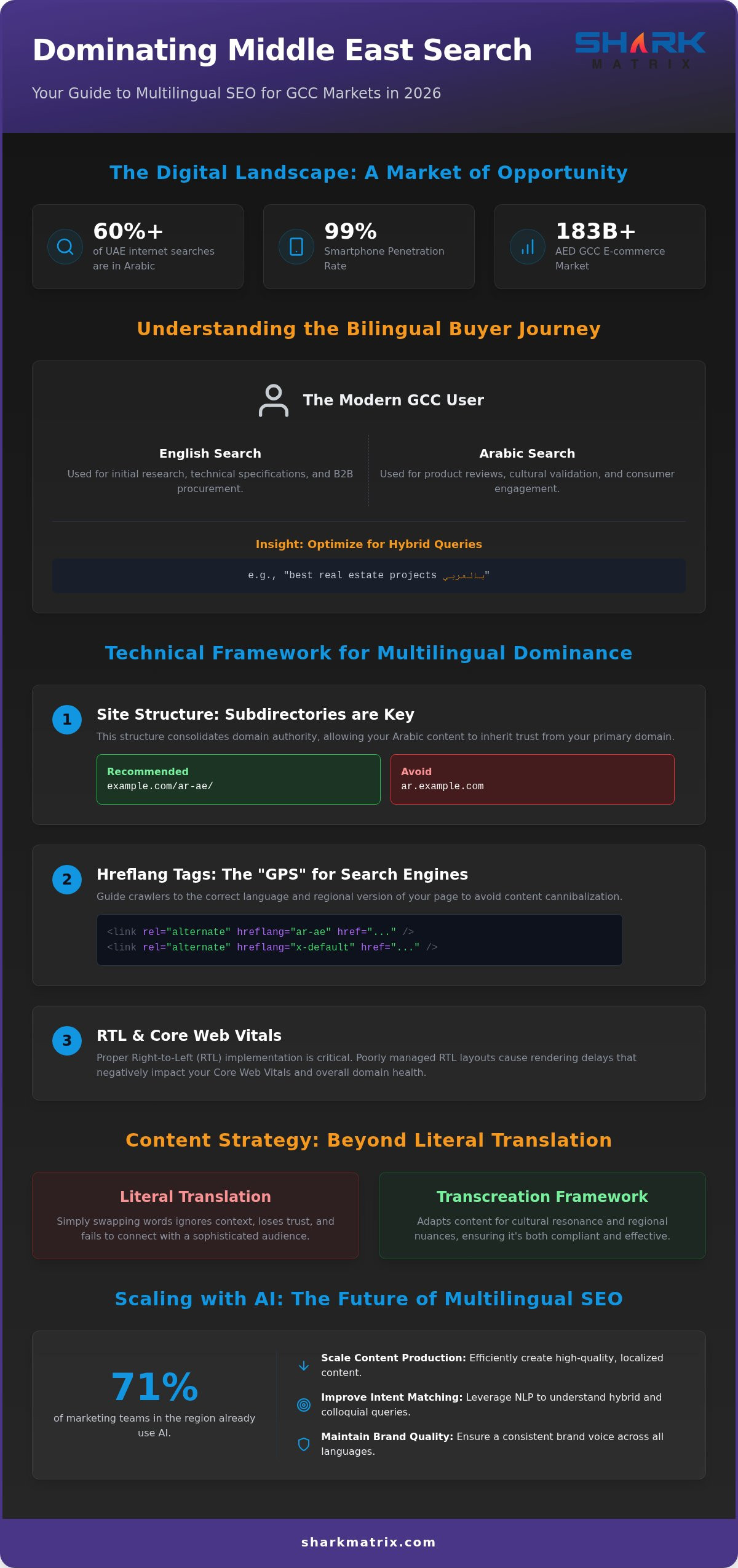
Did you know that over 60% of internet searches in the UAE are now conducted in Arabic, even as smartphone penetration hits a staggering 99%? If you’re seeing low conversion rates from poorly translated content or fighting technical errors in RTL site indexing, you’re likely missing out on a massive portion of the market. Implementing a robust multilingual seo strategy for middle east markets is no longer optional. It’s the difference between regional dominance and digital invisibility in a GCC e-commerce market projected to exceed AED 183 billion this year.

It’s exhausting to manage separate campaigns for every GCC country only to find your visibility stalling at the border. You’ll learn how to master the complexities of Modern Standard Arabic and English search landscapes to dominate regional rankings in 2026. This guide provides a scalable technical framework for high-ranking visibility in both languages. We’ll explore how to fix indexing issues, leverage Natural Language Processing for better intent matching, and build a digital ecosystem that commands authority across the entire region.

Key Takeaways

  • Learn how to balance Modern Standard Arabic for B2B authority with English for technical reach across the diverse GCC landscape.
  • Implement a robust multilingual seo strategy for middle east markets by mastering RTL site architecture and localized URL subdirectories.
  • Discover the transcreation framework to ensure your content resonates culturally while remaining compliant with regional data protection regulations.
  • Understand how to tailor your approach for distinct markets like Saudi Arabia and Qatar to drive high-ranking visibility across the entire region.
  • Leverage AI automation and Natural Language Processing to scale your localized content production efficiently without losing brand quality.

The Linguistic Landscape of Middle Eastern Search in 2026

As of March 2026, over 60% of internet searches in the UAE are performed in Arabic. This represents a significant shift in how regional audiences engage with digital content. A successful multilingual seo strategy for middle east markets can’t treat English and Arabic as isolated silos. Users here move fluidly between languages, often starting a query in English for technical specifications and switching to Arabic for reviews or cultural validation. With 71% of marketing teams in the region already adopting AI by early 2026, the competition for linguistic accuracy has never been higher.

Literal 1:1 translation strategies fail because they ignore the nuances of internationalization and localization. If you simply swap words without adapting the context, you’ll lose the trust of a highly sophisticated audience. We’re also seeing a surge in visual and voice search driven by a 99% smartphone penetration rate. Users often use colloquial terms or hybrid phrasing that standard dictionaries don’t recognize, making traditional keyword matching obsolete.

Modern Standard Arabic vs. Regional Dialects

Modern Standard Arabic (MSA) remains the gold standard for B2B SEO and formal procurement. It’s what decision makers use when they want authority and professional clarity. However, consumer engagement often thrives on regional dialects or “Arabizi”, the use of Latin characters and numbers to represent Arabic sounds. Mapping search intent requires understanding these layers. For example, a user might use MSA to research “digital transformation” but switch to informal phrasing when looking for an ai chatbot-development solution that speaks their local dialect. Brands must balance formal authority with the relatable phrasing that drives social sharing and community trust.

The Bilingual Search Duality

The buyer journey in the region is rarely monolingual. Users often toggle between languages during a single session. You might see mixed-language queries like “best real estate projects بالعربي” (in Arabic). Brands that fail to optimize for these hybrid searches lose visibility at the most critical conversion points. Maintaining a consistent brand voice across these linguistic divides is a technical challenge. It requires sophisticated natural language processing services to ensure that your multilingual seo strategy for middle east scales without losing the specific cultural resonance that drives results. By 2026, the most successful brands are those that treat bilingualism as a unified experience rather than two separate websites.

Technical Architecture for RTL and Multilingual SEO

Designing a robust technical foundation is the cornerstone of any effective multilingual seo strategy for middle east markets. By 2026, the debate between subdomains and subdirectories has largely settled in favor of subdirectories (e.g., example.com/ar-ae/). This structure consolidates domain authority, which is vital for competing in the high-growth UAE e-commerce sector. A unified subdirectory approach allows your Arabic content to inherit the “trust” of your English pages, rather than forcing search engines to treat them as entirely separate entities.

Technical SEO in this region requires more than just flipping a CSS switch. Search engine crawlers must understand the relationship between your English and Arabic versions without getting lost in “Right-to-Left” (RTL) layout complexities. The Google March 2026 core update introduced holistic Core Web Vitals scoring, which means your Arabic site’s performance now directly impacts your aggregate domain health. Poorly managed RTL layouts often trigger rendering delays that hurt these composite scores. If you’re building a complex site, partnering with a team that offers specialized web development services ensures your code is clean and crawler-friendly from day one.

Hreflang Implementation for Regional Accuracy

Correct hreflang tags are the “GPS” for search engines. In the Middle East, it’s not enough to target the language (ar); you must target the region (ar-ae) to align with specific MENA consumer insights and purchasing behaviors. A common pitfall is failing to implement the x-default tag on your homepage, which tells Google which version to show users from unspecified regions. Without these precise signals, your English and Arabic pages may end up competing against each other in the search results, a phenomenon known as content cannibalization that dilutes your rankings.

RTL UI/UX and Core Web Vitals

RTL optimization is a critical performance factor. Arabic typography often uses complex scripts that require larger font files, which can slow down your Largest Contentful Paint (LCP) and Interaction to Next Paint (INP). Furthermore, “Cumulative Layout Shift” (CLS) is a major risk when elements flip from left-to-right to right-to-left. If your buttons or images jump during the loading process, your rankings will suffer under 2026’s strict performance standards. You must ensure mobile-first indexing parity; your Arabic mobile site must contain the exact same structured data and high-quality assets as its English counterpart. Neglecting this parity is one of the fastest ways to lose visibility in a market where smartphone penetration exceeds 99%.

The Definitive Multilingual SEO Strategy for Middle East Markets in 2026

Content Localization Strategy: Beyond Literal Translation

Success in 2026 requires a shift from translation to transcreation. It’s about adapting the core message to fit local values rather than just swapping words. For instance, a global campaign focusing on “individual independence” might need to pivot toward “family legacy” or “community growth” to resonate within the UAE. This conceptual shift is vital for a high-performing multilingual seo strategy for middle east markets. Cultural compliance is also a legal necessity; the UAE Federal Personal Data Protection Law and regional consumer rights decrees require transparent, localized communication that feels native, not imported.

Visuals are just as important as text. Images should reflect local attire and architecture, and layouts must account for the way eyes scan Right-to-Left content. In a market where the GCC e-commerce sector is projected to exceed AED 183 billion by the end of 2026, getting the aesthetic right can make or break your conversion rates. While Modern Standard Arabic (MSA) is essential for B2B procurement and ranking for high-volume head terms, regional dialects are winning the battle for engagement and voice search accuracy among younger demographics.

Keyword Research for the Arabic Web

Standard keyword tools often struggle with the complexity of Arabic script and its many variations. You need to look beyond direct translations of English terms. Effective research involves uncovering long-tail keywords used during seasonal peaks like Ramadan and Eid, where search behavior shifts toward gifting and travel. Integrating natural language processing services helps identify semantic entities that search engines now use to understand topical authority in Arabic, moving beyond simple keyword density to grasp true user intent.

Localized Link Building and Authority

Authority isn’t just about the number of links; it’s about regional relevance. Earning mentions from high-authority UAE news portals or industry-specific regional journals provides a much stronger ranking signal than generic global links. This local PR effort validates your brand within the regional digital ecosystem. Social signals also play a massive role here, given the 99% smartphone penetration. A well-rounded multilingual seo strategy for middle east integrates influencer collaborations and community engagement to build a diverse backlink profile. Scaling these efforts often requires advanced SEO strategies that use AI to identify trending regional topics before the competition catches on.

Cross-border SEO is more than just technical configuration; it’s about respecting national digital borders. A successful multilingual seo strategy for middle east markets must account for the specific legal and cultural requirements of each GCC state. For instance, Kuwait’s Decree 10/2026 now mandates Arabic-language invoicing and specific 14-day return windows for digital commerce. Failure to comply can lead to penalties and a loss of search visibility as localized algorithms increasingly prioritize businesses that meet national standards. Managing multi-regional inventory and pricing also requires precision to ensure users see costs in AED or their local currency directly in the search results.

Data privacy is another critical pillar. Saudi Arabia’s Personal Data Protection Law (PDPL) has been strictly enforced since 2024, and Oman’s data protection law becomes fully enforceable in 2026. Your technical architecture must handle data localization requirements without sacrificing site speed. This balance between compliance and performance is where technical engineering meets regional marketing expertise. If you’re looking to scale across these borders, Shark Matrix Technologies LLC provides comprehensive national SEO services that help you align your technical foundation with regional regulations.

Market-Specific Content Nuances

Terminology often shifts at the border. While Modern Standard Arabic acts as a bridge, consumer queries for the same product can vary significantly between markets. In the UAE, you might optimize for “smartphones,” whereas specific local terms carry more weight in neighboring countries. National holidays like UAE National Day or Saudi National Day create massive localized search spikes that require pre-planned content calendars. Building regional trust also involves localized contact signals. Providing customer support numbers with the correct country code and local physical addresses signals to search engines that your brand is truly invested in that specific market.

The Role of Online Reputation Management

Expanding across the GCC brings the challenge of managing brand sentiment across different linguistic nuances. A review written in Kuwait might use different slang or idioms than one from Qatar. Monitoring these signals is essential for maintaining topical authority and consumer trust. You can use SEO for brand reputation management to protect your regional growth and ensure that localized feedback doesn’t negatively impact your rankings in new markets. Handling cross-border customer reviews effectively requires a native understanding of regional etiquette to turn potential friction into brand loyalty.

Scaling with AI: The Future of Multilingual SEO

By 2026, the volume of digital content required to maintain a presence across the GCC has reached a point where manual localization is no longer sustainable. Scaling a multilingual seo strategy for middle east markets now requires a transition from traditional translation to AI-driven content engineering. The global AI marketing market has reached approximately AED 213 billion, and businesses that don’t integrate these technologies risk falling behind in search visibility. Shark Matrix Technologies LLC has moved beyond simple automation to focus on high-impact digital marketing that maintains brand integrity while managing thousands of localized pages across different linguistic registers.

AI-Driven Natural Language Processing

Arabic syntax presents unique challenges for standard search algorithms due to its morphological richness and root-based structure. We leverage natural language processing services to decode these complexities, ensuring that both formal Modern Standard Arabic and regional dialects are accurately indexed. This technology allows for automated entity extraction, which is essential for building the multilingual knowledge graphs that search engines now prioritize over simple keyword density. Beyond search rankings, integrating ai chatbot-development services ensures that your bilingual users receive instant, culturally relevant support; this boosts the engagement signals that search engines use to determine topical authority.

Generative Engine Optimization (GEO) for 2026

Search has evolved into a conversational experience where AI models summarize answers for users instantly. Preparing your content for these AI-driven search snapshots in Arabic is the new frontier of technical SEO. This process, known as Generative Engine Optimization (GEO), focuses on making your data digestible for the Large Language Models (LLMs) that power modern search interfaces. By integrating generative ai development services into your workflow, you can create structured, authoritative content that dominates Answer Engines (AEO). It’s about ensuring your brand remains the primary source for the bilingual answers generated by AI search assistants.

Our approach at Shark Matrix Technologies LLC bridges the gap between technical software engineering and regional marketing expertise. We don’t just generate content; we engineer it to resonate with the specific cultural nuances of the UAE and the wider GCC. By using AI to handle high-volume production while our linguistic experts refine the cultural soul of the message, we provide a framework where your multilingual seo strategy for middle east thrives. This balance ensures your brand gains visibility without sacrificing the quality that builds long-term regional authority in the 2026 digital ecosystem.

Future-Proof Your Middle Eastern Digital Authority

The path to regional dominance requires a unified approach that respects both technical standards and cultural nuances. Success in 2026 isn’t just about ranking; it’s about building a digital ecosystem that speaks the language of your customers while navigating the complex regulatory landscape of the GCC. By implementing a robust multilingual seo strategy for middle east, your brand can move beyond simple visibility to establish lasting authority across the region.

Shark Matrix Technologies LLC provides the specialized technical engineering and Arabic marketing expertise needed to thrive in this competitive environment. With over 15 years of experience in national brand growth and AI automation, we help you transform linguistic challenges into scalable opportunities. Partner with a leading SEO company to scale your Middle East presence and secure your place at the top of the search results. The digital frontier is shifting, and now is the time to lead.

Frequently Asked Questions

What is the best URL structure for a multilingual website in the Middle East?

Subdirectories are the most effective URL structure for a multilingual seo strategy for middle east. This approach, such as using example.com/ar-ae/, allows your website to consolidate domain authority across all languages. Unlike subdomains, subdirectories ensure that the SEO trust earned by your English pages directly benefits your Arabic content. It’s a scalable framework that simplifies tracking and management for enterprise sites operating across the diverse GCC digital landscape.

How does RTL (Right-to-Left) design affect my SEO rankings?

RTL design affects your rankings primarily through Core Web Vitals performance metrics. If your layout flips from left-to-right to right-to-left incorrectly, it causes Cumulative Layout Shift (CLS) issues. Search engines in 2026 use composite performance scores that penalize sites with unstable UI elements. Ensuring that your Arabic typography and navigation are optimized for mobile-first indexing is crucial. Proper RTL implementation prevents rendering delays that could otherwise hurt your visibility in competitive regional markets.

Should I use Modern Standard Arabic or a dialect for my SEO content?

The choice depends on your target audience and search intent. Modern Standard Arabic (MSA) is the gold standard for B2B procurement and formal brand authority because it resonates across all Arab countries. However, regional dialects are increasingly important for B2C engagement and voice search accuracy. A high-performing multilingual seo strategy for middle east often uses MSA for core service pages while leveraging localized dialects for blog content and social media interaction to build community trust.

How do I manage Hreflang tags for different GCC countries?

Managing hreflang tags requires precise language and region codes to avoid content cannibalization. You should use “ar-ae” for the UAE and “ar-sa” for Saudi Arabia to signal specific regional targeting to search engines. Don’t forget to implement the “x-default” tag for your global homepage to guide users from unspecified regions. Correct implementation ensures that Google serves the right language version to the right audience, maximizing your conversion potential across the GCC.

Is machine translation good enough for Arabic SEO in 2026?

Machine translation has improved, but it isn’t sufficient for high-stakes Arabic SEO in 2026. While AI can handle initial drafts, it often misses cultural nuances and specific regional idioms. Successful brands use a transcreation approach that combines AI efficiency with human expertise. This ensures your content isn’t just linguistically correct but also culturally resonant. Relying solely on raw machine output can lead to low conversion rates and potential brand reputation risks.

What are the most important SEO ranking factors for the Middle East market?

The most critical factors include mobile-first optimization, linguistic accuracy, and topical authority. With smartphone penetration exceeding 99% in the UAE, your site must perform flawlessly on mobile devices. Search engines also prioritize content that demonstrates deep regional expertise through Natural Language Processing (NLP). Building high-quality backlinks from authoritative regional news portals and maintaining a stable RTL architecture are equally vital for dominating the Middle Eastern search landscape in 2026.

How can AI help scale my multilingual SEO strategy?

AI is essential for scaling high-volume localized content without losing quality. You can use advanced natural language processing services to understand complex Arabic syntax and automate entity extraction. AI also supports Generative Engine Optimization (GEO), helping your brand appear in AI-driven search snapshots. By blending AI automation with human refinement, you can manage complex multilingual requirements across multiple GCC markets while maintaining a consistent and authoritative brand voice.

How do search trends change during Ramadan and other regional holidays?

Search behavior shifts significantly during Ramadan and Eid. Users prioritize queries related to gifting, festive recipes, travel, and religious activities. There is also a notable change in active search hours, with peak activity often occurring late at night or before dawn. To capture this traffic, you must develop seasonal content calendars that align with these cultural peaks. Optimizing for these trends allows you to build brand loyalty during the most important consumer periods in the region.

Categories
SEO

Advanced Link Building Techniques 2026: The Definitive SEO Strategy

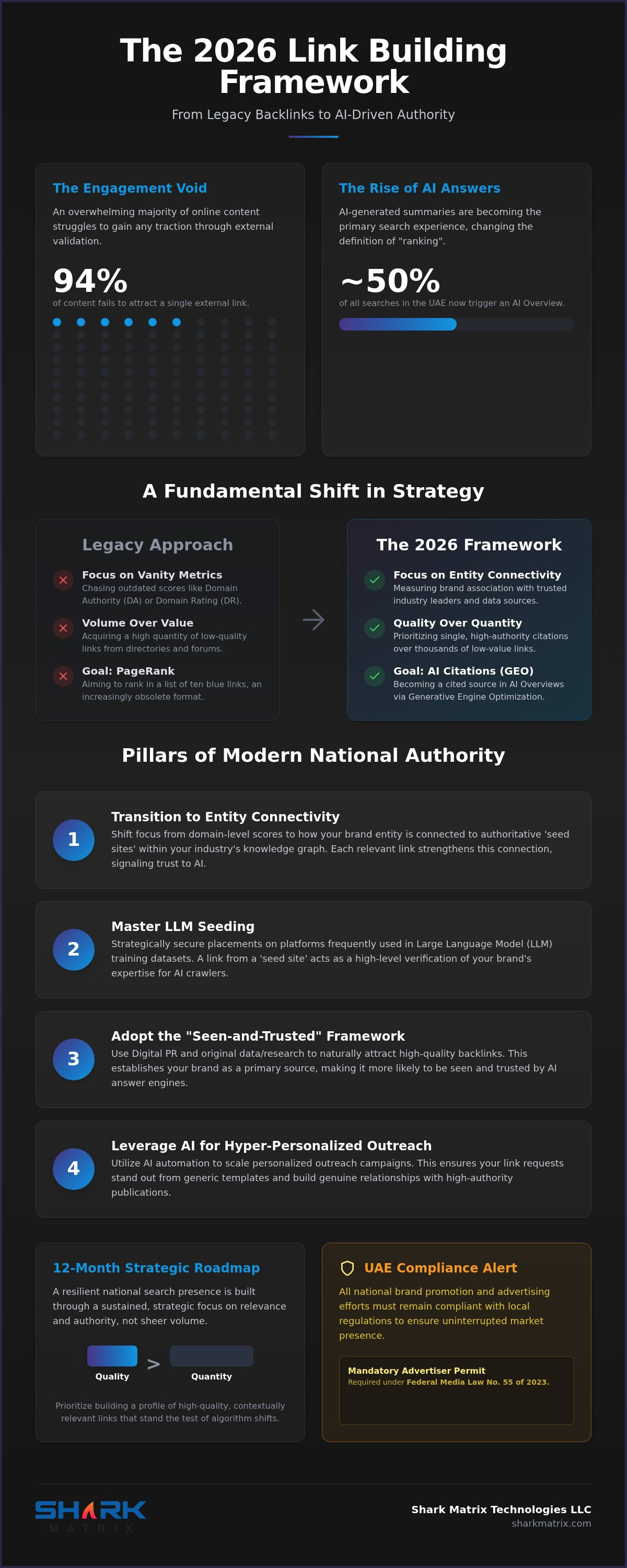
Did you know that 94% of all online content fails to attract a single external link, yet nearly half of all searches in the UAE now trigger an AI Overview citation? If you feel like your traditional guest posts are shouting into a void, you aren’t alone. Many national brands find that manual outreach costs are climbing while their influence on AI engine results remains stagnant. It’s a common pain point in an era where links are no longer just votes of confidence; they’re the training signals that teach AI which entities to trust.

We’ll show you exactly how to master the shift from legacy backlinks to AI-driven authority using 2026’s most sophisticated link building framework. By integrating national link building services with advanced Generative Engine Optimization (GEO), Shark Matrix Technologies LLC helps you secure the citations that matter. You’ll learn to automate link vetting and build a footprint that survives the latest algorithm shifts. We will also cover how to stay compliant with the UAE’s mandatory Advertiser Permit under Federal Media Law No. 55 of 2023. This article provides a clear roadmap for scaling national brand authority through automation and strategic entity-based growth.

Key Takeaways

  • Transition from outdated metrics like Domain Authority to Entity Connectivity to ensure your brand is cited accurately by generative AI engines.
  • Master LLM seeding techniques that connect your national brand to industry-leading seed sites for maximum authority in AI-driven search results.
  • Leverage AI automation to scale hyper-personalized outreach, ensuring your efforts stand out from the generic templates often used by standard link building services dubai.
  • Adopt the Seen-and-Trusted framework by using original data and Digital PR to attract high-quality, sustainable backlinks that establish market leadership.
  • Establish a 12-month strategic roadmap that prioritizes quality and relevance over quantity to build a resilient national search presence.

Link building isn’t what it used to be. In 2026, the focus has shifted from simple referral traffic to becoming a cited source in AI-generated answers. Understanding what is link building in the current era involves recognizing that every backlink serves as a training signal for Large Language Models (LLMs). These models don’t just count links; they analyze the relationship between digital entities. Traditional metrics like Domain Authority (DA) or Domain Rating (DR) have become secondary. Instead, search engines and AI agents prioritize Entity Connectivity, which measures how closely your brand is associated with established industry leaders and trusted data sources.

When utilizing link building services dubai, the goal is no longer just about ranking in a list of ten blue links. It’s about Generative Engine Optimization (GEO). AI agents use complex link graphs to determine national brand trustworthiness. If a trusted seed site links to you, the AI perceives your brand as part of a reliable knowledge cluster. This shift means that a single link from a highly relevant, authoritative source is worth more than a thousand low-quality directory placements. AI agents don’t just crawl; they reason. They look for patterns in how information is connected across the web. When a reputable industry publication links to your research, it’s a data point that confirms your entity’s role in a specific niche. This is why link building services dubai must now focus on the quality of the digital neighborhood your brand inhabits.

Understanding Answer Engine Optimization (AEO)

AI models operate on a Seen and Trusted framework. To appear in AI Overviews, your content must be supported by high-authority backlinks that demonstrate semantic similarity at the paragraph level. This means the context surrounding the link must be as relevant as the link itself. Pairing these links with robust structured data helps AI crawlers map your brand’s expertise accurately. Our ai automation services help identify these semantic gaps, ensuring your link profile supports direct answerability. It’s about more than the link; it’s about the proximity of keywords and the sentiment of the surrounding text. AI engines use these nuances to decide if your brand is the definitive answer to a user’s query.

The Death of Low-Value Link Volume

The era of high-volume, low-quality outreach is over. AI-powered search filters are now incredibly aggressive toward link farm patterns and non-contextual forum links. These outdated tactics often lead to immediate devaluation. Instead, the focus has shifted to Seed Sites. These are the primary sources that AI crawlers prioritize for fact-checking. Securing a mention on these platforms acts as a high-level verification of your brand’s data. For national brands, this means investing in deep, research-driven content that naturally earns these premium citations rather than chasing empty metrics.

Securing a spot in the Knowledge Graph requires a deliberate shift in how your brand acquires digital endorsements. In 2026, the algorithm values the semantic distance between your website and established industry leaders. Identifying entity-relevant link targets starts with auditing the sources your target AI agents cite most frequently. Professional link building services dubai now focus on bridging the gap between your brand and these industry Seed Sites. These are the authoritative domains that act as the primary nodes of truth for AI crawlers. By earning a link from a Seed Site, you effectively vouch for your entity’s relevance within a specific topic.

Mapping your link profile to the Knowledge Graph is essential for visibility in AI-driven search results. It helps to understand how search engines work today; they no longer just index pages, they build relationships between concepts. If your brand is linked from a high-authority site in a related niche, the AI engine strengthens the weight of your entity in that category. This niche-specific authority is the cornerstone of the 2026 algorithm, making broad, non-specific link acquisition strategies largely obsolete.

The Mechanics of LLM Seeding

LLM Seeding is a specialized technique that targets platforms frequently used in AI training datasets. These platforms include academic journals, high-tier news outlets, and specialized industry repositories. LLM Seeding is the strategic placement of brand mentions to influence AI model weights. When your brand appears consistently across these high-authority datasets, AI models are more likely to include you in their generated answers. This process requires high-authority link placement because AI models weigh data from trusted sources more heavily during training and inference phases.

Building Entity-Based Link Clusters

Creating content hubs that attract links from diverse but related sub-niches is the most effective way to build authority. You should use natural language processing to analyze the link context of your competitors. This allows you to identify the specific sentiment and keywords that trigger a connection in the AI’s mind. Prioritize links from sites with high Topical Authority scores rather than just high traffic. When evaluating link building services dubai, check if they use these entity-based clusters to reinforce your brand’s position as a subject matter expert. If you want to refine your technical approach, our SEO company dubai team can help you map out an entity-first strategy.

Advanced Link Building Techniques 2026: The Definitive SEO Strategy

AI-Enhanced Outreach: Scaling Personalization for National Authority

Traditional outreach often feels like a numbers game that most brands are losing. Sending hundreds of generic emails doesn’t work when editors are flooded with low-quality requests. To scale effectively, national brands are turning to ai automation services to handle the heavy lifting. This shift isn’t just about sending more emails; it’s about making every interaction count. By integrating link building services dubai into a wider AI-driven strategy, you can identify high-value targets that manual research would miss. This approach ensures your brand remains visible in a competitive national market without the high overhead of a massive manual outreach team.

We use custom scripts to filter for quality and relevance, ensuring that every backlink aligns with the strict standards of the UAE’s digital regulations. These automated vetting systems look for more than just traffic; they analyze the site’s link graph and historical stability. By removing the guesswork, we maintain outreach integrity and protect your brand’s reputation. Human-in-the-loop systems remain vital here. Our experts review the AI’s findings to ensure the final outreach feels personal and authentic, bridging the gap between automation and genuine relationship building.

Automating the Prospecting Pipeline

Finding the right targets is the most time-consuming part of any campaign. We use ai development services to build custom scrapers that vet potential sites in real-time. These tools check for technical health, topical relevance, and even the sentiment of existing content. Machine learning models now help us identify broken link opportunities by scanning millions of pages for 404 errors on high-authority sites. By integrating your CRM data with AI, we can predict outreach success rates based on historical interaction patterns. This data-driven approach allows us to focus our energy on the prospects most likely to convert, saving both time and resources.

Generative Outreach Strategies

Generative AI has moved far beyond simple templates. Instead of a one-size-fits-all pitch, AI analyzes the target editor’s recent work to identify specific content gaps. We craft pitches that offer a unique perspective or a value-add addition to their existing high-ranking articles. AI-driven personalization increases outreach conversion rates by up to 300%. While the AI handles the initial drafting and data analysis, we maintain a human-in-the-loop system. This ensures every email keeps its integrity and matches the specific tone of the publication. It’s a synergy of machine speed and human nuance that defines modern link building services dubai.

Digital PR and the Seen-and-Trusted Framework

In 2026, the criteria for a “good” link have evolved past simple domain metrics. AI engines now use a Seen-and-Trusted framework to decide which brands deserve a citation in generative answers. To be “seen,” your brand must appear in high-traffic, authoritative environments. To be “trusted,” those appearances must come from third-party editorial gatekeepers who verify your information. This is why modern link building services dubai have pivoted toward Digital PR. It’s no longer about buying placements; it’s about earning them through newsworthy contributions that national media outlets can’t ignore. When a major UAE news platform links to your brand, it signals to both humans and AI models that your entity is a verified authority.

Building this trust requires a shift away from recycled content. AI search filters are now sophisticated enough to identify and devalue unoriginal articles that offer no new information. Instead, national brands must focus on becoming primary sources. By providing original data that journalists can cite, you create a natural magnet for high-authority backlinks. This strategy doesn’t just improve your rankings. It builds a foundation of brand trust that protects you against future algorithm updates. It’s a sustainable way to ensure your brand remains a fixture in the national digital conversation.

Data-Driven Storytelling for Links

Original research is the most effective link magnet available today. We help brands conduct proprietary surveys and analyze the results using machine learning to uncover hidden industry trends. These insights are then transformed into linkable assets, such as interactive reports or infographics. By leveraging generative ai development, we can create complex data visualizations that make your findings easy for journalists to digest and share. These primary source links are gold for Generative Engine rankings because they provide the “ground truth” data that AI models crave for fact-checking. When you provide the data that others cite, you become the definitive node in the Knowledge Graph.

Reputation Management Through Link Building

Link building is also a powerful tool for protecting your brand’s image. By securing placements on high-authority platforms, you can build a “link moat” around your brand name. This involves highlighting positive brand pillars and ensuring that search results for your company are dominated by trusted, authoritative sources. High-quality link building services dubai focus on suppressing negative sentiment by outranking it with superior, high-trust content. This proactive approach to reputation management ensures that when potential customers or AI agents look for your brand, they find a consistent story of leadership and expertise. If you’re ready to secure your brand’s digital future, our seo company dubai team can design a custom PR and link strategy for you.

Implementing a high-level strategy isn’t a one-time task. It requires a disciplined, 12-month link-building roadmap that aligns with your broader business goals. In the first quarter, you should focus on cleaning legacy link debt and establishing foundational entity signals. By the second half of the year, your efforts should shift toward securing high-authority citations that influence Generative Engine Optimization (GEO). When selecting link building services dubai, national brands must look beyond simple placements. Balancing quantity and quality is different in 2026. AI search filters now prioritize Seed Sites and contextual relevance over raw link counts. One endorsement from a national industry leader is far more valuable than dozens of irrelevant placements. Integrating these efforts with search engine optimization seo services ensures that your technical on-page SEO supports the authority you’re building off-page.

Measuring Success in 2026

Measuring ROI has moved beyond tracking simple keyword rankings. You’ll need to monitor your Share of Voice in AI overviews and Answer Engines to see how often your brand is cited as the definitive source. There’s a strong correlation between high-quality backlink growth and increases in branded search volume. When authoritative sites vouch for you, users naturally search for your brand directly. We use advanced AI tools to audit the link health of your national competitors, identifying where they’re winning and where your brand can fill the gap. This data-driven approach turns link building services dubai from a speculative expense into a measurable growth engine. You’ll see the impact not just in traffic, but in how reliably AI models recommend your services.

The Shark Matrix Approach to Link Authority

Our approach thrives at the intersection of custom software engineering and digital marketing. We don’t just find links; we build the technical infrastructure to earn them. By collaborating with our seo company dubai experts, you gain access to a team that understands how to navigate the UAE’s specific regulatory environment while scaling national authority. We leverage our deep expertise in AI and machine learning to ensure every link serves as a positive weight in your brand’s favor within LLM training data. Future-proof your digital presence by moving away from legacy tactics. Partner with us to build a link profile that isn’t just seen, but trusted by the engines of tomorrow.

Future-Proofing Your National Authority in the AI Era

The shift from traditional backlinks to a Seen-and-Trusted entity framework is no longer optional for national brands. Mastering LLM seeding and bridge-building to industry seed sites ensures your brand is cited, not just indexed. By adopting a 12-month roadmap that prioritizes semantic relevance over raw volume, you can build a resilient digital presence that survives future algorithm shifts. Integrating these sophisticated strategies with professional link building services dubai allows you to scale hyper-personalized outreach while maintaining the technical integrity required for high-authority placements.

Shark Matrix Technologies LLC has been pioneering AI-integrated SEO since 2010. Our specialized GEO frameworks and expert technical team for custom automation provide the synergy needed to secure national brand authority. We don’t just build links; we engineer the entity signals that AI engines trust. Elevate your brand authority with our advanced SEO services today. Your digital legacy depends on the strategic trust you cultivate now.

Frequently Asked Questions

Is link building still relevant for SEO in 2026?

Link building remains a critical pillar of SEO in 2026, though its role has evolved. Instead of just passing authority, links now serve as vital training signals that help Large Language Models verify your brand’s trustworthiness. High-quality endorsements from industry-leading sites act as a trust signal for both traditional search algorithms and modern AI engines. Without a strong link profile, your content is less likely to be considered a definitive source by AI agents.

What is Generative Engine Optimization (GEO) and how do links help?

Generative Engine Optimization focuses on making your content the primary citation in AI-generated responses. Links assist this process by establishing Entity Connectivity, which maps the relationship between your brand and other trusted organizations. When reputable sites link to your research, AI engines recognize your site as a credible node in the Knowledge Graph. This increases the probability of your brand being cited as a factual source in generative answers across the national market.

How many backlinks do I need to rank for national keywords?

There isn’t a fixed number of backlinks required to rank for national keywords because the focus has shifted to topical authority. A single high-authority link from a national industry leader often outweighs hundreds of low-quality placements. Effective link building services dubai focus on securing a diverse mix of Seed Site mentions and niche-specific endorsements. We recommend building a consistent, natural link velocity rather than chasing an arbitrary count that doesn’t reflect true authority.

Can AI automate the entire link-building process?

AI can automate data-heavy tasks like link vetting and personalized drafting, but it cannot replace the human-in-the-loop required for high-level relationship building. While we use advanced automation to filter for relevance and quality, our experts manage the final outreach to ensure brand integrity. Total automation often leads to generic patterns that AI search filters easily detect and devalue. A hybrid approach ensures efficiency without sacrificing the nuance needed for premium editorial placements.

What makes a high-quality backlink in the age of AI search?

A high-quality backlink in 2026 is defined by its contextual relevance and the semantic similarity of the surrounding text. AI engines look for links placed within paragraphs that offer deep, expert analysis rather than just a simple mention. The linking site must also be a Seen-and-Trusted entity with its own robust digital footprint. Links from sites that are frequently used as training data for LLMs provide the highest value for national brand authority.

How do I get my brand cited in ChatGPT or Google AI Overviews?

To get cited in AI Overviews or ChatGPT, your brand must act as a primary source of information. This involves publishing original data and earning links from established news or academic platforms. AI models prioritize information that is verified by multiple trusted third parties. Using structured data alongside these links helps AI agents map your expertise accurately. Consistent mentions across high-authority datasets are the most reliable way to secure these prominent citations for your brand.

What are the risks of using automated link-building tools?

Using fully automated link-building tools carries significant risks, including the potential for immediate devaluation by AI search filters. These tools often leave predictable footprints that lead to manual penalties or a total loss of trust in the Knowledge Graph. Low-quality, non-contextual links can also damage your brand’s reputation among human readers. It’s vital to ensure any automation is overseen by experts who understand the national digital marketing regulations and quality standards.

How long does it take to see results from an advanced link-building campaign?

Most advanced link-building campaigns show initial technical improvements within three months, but full authority maturity typically takes six to twelve months. This timeline allows AI engines to crawl, index, and re-evaluate your brand’s position within the Knowledge Graph. Sustainable growth requires a consistent roadmap rather than a short-term burst. Our link building services dubai focus on long-term authority that compounds over time, providing a stable foundation for your national search presence and visibility.

Categories
SEO

The Enterprise Replatforming SEO Strategy: Protecting Revenue in 2026

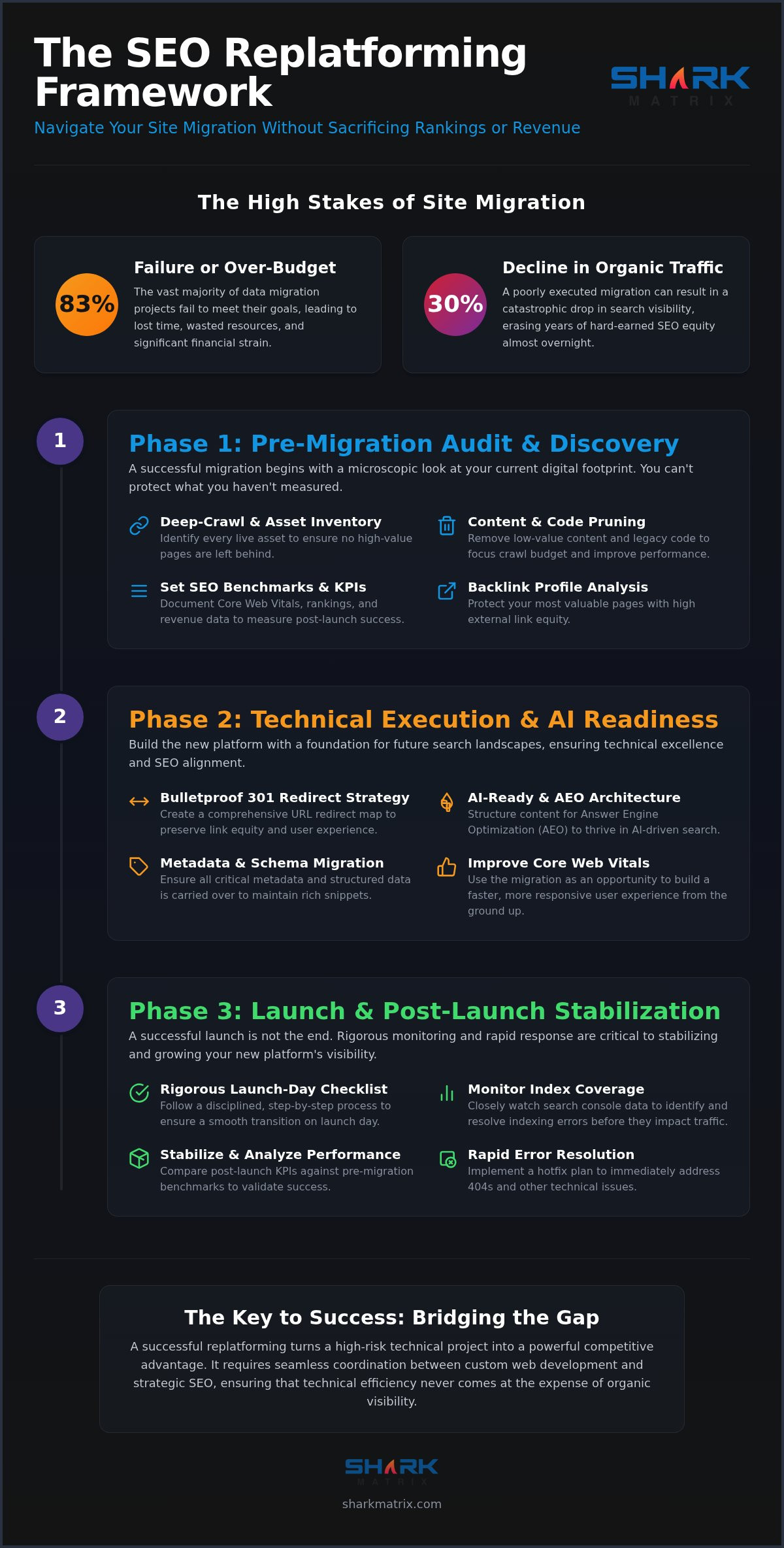
83% of data migration projects either fail or exceed their budgets, often leaving a trail of 404 errors and lost revenue in their wake. It’s a terrifying reality for enterprise leaders who know that a single month of tanking rankings can erase years of hard-earned search equity. You’ve likely felt that anxiety during planning meetings where technical developers and search specialists don’t always align, making a cohesive replatforming seo strategy feel out of reach.

This guide provides the framework to ensure your move to a modern tech stack is a growth engine rather than a recovery project. You’ll learn how to master the complex process of migrating your platform without sacrificing your organic traffic or revenue. We’ll explore how to protect your rankings, improve Core Web Vitals, and position your brand to thrive in the era of AI-driven search and answer engines. By bridging the gap between software engineering and search strategy, you can turn a risky migration into a powerful competitive advantage.

Key Takeaways

  • Learn how to conduct a deep-crawl audit to identify every live asset, ensuring no legacy code or high-value pages are left behind during the move.
  • Discover a bulletproof replatforming seo strategy that uses 301 redirects to preserve link equity and prevent post-launch ranking drops.
  • Prepare your new site for the 2026 search landscape by integrating Answer Engine Optimization (AEO) and AI-ready architectural shifts.
  • Follow a rigorous launch-day checklist to monitor index coverage and resolve technical errors before they impact your bottom line.
  • Understand how bridging the gap between custom web development and strategic SEO creates a high-performance e-commerce ecosystem.

The High Stakes of Replatforming: Why Your SEO Strategy Matters

Replatforming is more than a digital facelift. It’s a fundamental software modernization process that rewrites how search engines interact with your business. While many teams treat a move to a new CMS as a simple checklist of URL updates, a truly effective replatforming seo strategy accounts for deep architectural shifts. If you ignore how your site hierarchy changes, you risk “invisible” disasters like crawl budget depletion or carrying over legacy code bloat that slows down your new, expensive platform from day one.

In 2026, the stakes have shifted. We’re no longer just optimizing for traditional blue links. The rise of Generative Engine Optimization (GEO) means your new site must be structured so AI “answer engines” can easily parse and cite your content. This requires seamless coordination between your web developers and SEO team. Shark Matrix acts as the bridge between these departments. We ensure that technical efficiency never comes at the expense of organic visibility, helping your team speak the same language from discovery to launch.

The Financial Impact of Migration Errors

The cost of failure is high. Research indicates that 83% of data migration projects either fail or exceed their budgets. For an enterprise, a poorly executed launch can lead to a 30% decline in organic traffic. If your site generates significant monthly revenue, even a temporary 20% dip over six months represents a massive financial hit that’s difficult to recover. Beyond the numbers, a spike in 404 errors and broken internal links erodes customer trust. In competitive national markets, once you lose that hard-earned authority, competitors are ready to fill the vacuum immediately.

Setting SEO Benchmarks and KPIs

You can’t protect what you haven’t measured. Before the first line of code is moved, you must identify your “Must-Win” keywords and high-revenue pages. These are the assets that sustain your business. Establishing clear metrics early prevents finger-pointing if issues arise post-launch.

  • Capture Baselines: Document current Core Web Vitals. With 42% of sites failing the Interaction to Next Paint (INP) metric in 2026, you need a clear starting point to prove the new platform is an upgrade.
  • Define Failure Thresholds: Establish a “red line” for post-launch monitoring. If organic sessions drop below a specific percentage, your team should have an immediate hotfix plan ready.
  • Revenue Mapping: Connect your most valuable SEO pages to direct sales data. This allows you to prioritize technical fixes based on fiscal impact rather than just traffic volume.

Phase 1: The Pre-Migration SEO Audit & Discovery

Successful migrations don’t start with code. They start with a microscopic look at what you already own. A robust replatforming seo strategy begins with a comprehensive audit of your current digital ecosystem. You must conduct a deep crawl to identify every live asset, from legacy landing pages to forgotten PDF resources. This isn’t just about making a list. It’s about evaluating whether your current site hierarchy is actually ready for a modern platform. If your architecture is messy now, moving it to a faster tech stack won’t fix the underlying structural issues that confuse search engines.

Pruning is equally vital. Moving every single page is often a waste of resources. By identifying and removing low-value content, you streamline the migration and focus your crawl budget on pages that drive revenue. At the same time, you must analyze your backlink profile. High-authority pages with significant external equity need the most protection. If these aren’t prioritized, you risk losing the trust search engines have built in your brand since your site was first indexed. Using ai automation services can help streamline these discovery workflows, identifying patterns in your data that human audits might miss.

Mapping the Current SEO Footprint

Modern audits in 2026 leverage AI to categorize pages by search intent rather than just keywords. This ensures that your new site structure aligns with how users actually search in an “answer engine” environment. You need to identify critical metadata and Schema markup that must be preserved to maintain your rich snippet visibility. For those needing expert guidance on these technical requirements, our comprehensive SEO audit guide ensures no technical detail is overlooked during this discovery phase. We help you map out exactly which elements of your current success must be carried over to the new environment.

Platform Selection from an SEO Perspective

Your choice between a SaaS platform and a custom-built solution impacts your technical SEO flexibility for years. SaaS options offer speed but sometimes limit your control over server-side rendering or deep file structures. Custom builds, often supported by web development experts, allow for granular control over robots.txt and sitemaps. Your replatforming seo strategy must also account for CDN integration and 2026 Core Web Vitals standards, specifically the Interaction to Next Paint (INP) metric. With 42% of sites still struggling with INP, your choice of platform could be the difference between ranking and disappearing from the first page.

The Enterprise Replatforming SEO Strategy: Protecting Revenue in 2026

Phase 2: Technical Execution, Redirects, and AI Readiness

Technical execution is where your strategy meets the server. Precision is everything. Implementing a robust replatforming seo strategy during this phase ensures that your 301 redirect map is more than just a list of links. It is a signal to search engines that your brand authority has a new, permanent home. Without meticulous execution, you aren’t just changing addresses; you’re throwing away years of digital trust. Equity is fragile. A single broken link in a high-authority path can cause a ripple effect that tank rankings across your entire catalog.

Enterprise sites often manage tens of thousands of URLs, making manual mapping a recipe for disaster. Using ai automation services allows for precise, automated matching based on content similarity and metadata. This ensures that users and crawlers always find the most relevant new page. Beyond basic redirects, you must update your Schema.org markup. In 2026, search engines rely on structured data to verify your expertise and trustworthiness (E-E-A-T), especially when generating AI-led answers.

Meticulous URL Mapping and Redirect Chains

Choosing the right mapping approach depends on your scale and resources. While 1-to-1 mapping is the gold standard for preserving equity, it can be resource-intensive for massive catalogs. Category mapping is faster but risks diluting the specific relevance of deep pages. You must also guard against redirect loops and excessive chains. If a crawler has to pass through three or more redirects to find a page, it wastes your crawl budget and slows down the user experience. Don’t forget your assets. Managing redirects for images and PDFs is essential to preserve traffic from visual and document-based searches.

1-to-1 Mapping

  • Pros: Full transfer of link equity; best for high-revenue pages.
  • Cons: Extremely time-consuming for large sites; high technical overhead.

Category Mapping

  • Pros: Rapid execution; simplifies the site structure.
  • Cons: Potential loss of specific keyword rankings; less precise for users.

Optimizing for Generative Engine Optimization (GEO)

A successful replatforming seo strategy in 2026 requires a deeper understanding of how AI crawlers digest your site architecture. You must structure data so Large Language Models (LLMs) can easily parse and cite your content. This involves ensuring your new architecture supports fast, semantic content delivery. Integrating natural language processing elements into your new content strategy helps search engines understand the context of your offerings. By aligning your technical structure with these generative search requirements, you position your brand as a primary source for the “answer engines” that now dominate the search landscape.

Phase 3: Launch Day and Post-Launch Stabilization

Launch day is the most critical window for your replatforming seo strategy. It’s the moment months of planning meet the reality of live traffic. You must have a rigid checklist ready to execute the second the DNS switch occurs. First, verify that your robots.txt file isn’t still blocking crawlers from the staging phase. Update your XML sitemaps and submit them to Google Search Console immediately to trigger a re-crawl of your new URL structure. Don’t forget to validate that all tracking codes, including GA4 and GSC verification tags, are firing correctly on the new production environment.

Once the site is live, monitor your server logs in real-time. This allows you to spot and fix 404 errors before they impact your bounce rate or crawl budget. You should also watch the “Index Coverage” report in Search Console for any sudden spikes in excluded pages. Validating Core Web Vitals under a real-world load is also essential. Since 42% of sites still fail the Interaction to Next Paint (INP) metric in 2026, you need to ensure your new platform delivers on its performance promises when thousands of users hit the server at once.

Immediate Post-Launch Technical Checks

Check your canonical tags first. They must point to the new URL structure, not the old legacy paths or the staging subdomain. It’s a common, costly mistake to leave “Noindex” tags active after moving from staging to production. Perform a quick crawl of your top 100 revenue-generating pages to ensure they’re indexable and returning a 200 OK status. Finally, test site speed and mobile-friendliness on the actual production server. Server response times often differ significantly from staging environments; real-world testing is non-negotiable for maintaining ranking stability. To ensure your business platform is built for this level of performance, you can learn more about ProGroup.

Expect some turbulence. Minor ranking fluctuations are normal as search engines re-crawl your new architecture and process your 301 redirects. However, you must distinguish between this “normal” volatility and a catastrophic loss of traffic. If your sessions drop by more than 30% and don’t stabilize within 72 hours, you likely have a technical blockage. Use heatmaps and session recordings to see how users interact with the new interface. UX friction often mimics SEO issues in data reports, as poor engagement signals can negatively impact your rankings. For deeper insights into creating high-performance interfaces that convert, explore our guide on website design and development.

If your post-launch traffic isn’t recovering as expected, our specialists can perform a deep-dive analysis to find the root cause. Reach out to our SEO company to stabilize your organic visibility and protect your revenue.

Future-Proofing Your Migration with Shark Matrix

Shark Matrix stands at the intersection of technical excellence and strategic visibility. Precision matters. While most firms treat migration as either a coding task or a marketing project, we treat it as a unified engineering challenge. A successful replatforming seo strategy requires more than just 301 redirects; it demands a deep understanding of how your new backend infrastructure interacts with search engine crawlers. Since our founding in 2010, we’ve specialized in high-impact migrations that protect your organic equity while modernizing your tech stack.

Our approach integrates ai development services to automate the most complex parts of the transition. Instead of manual mapping that leads to human error, we use machine learning to ensure data integrity across thousands of URLs. We understand the UAE digital landscape and the national-level competition your brand faces. We don’t just help you survive the move. We build the foundation for your brand to dominate in the era of answer engines and generative search.

Custom Software Solutions for Complex Migrations

Enterprise migrations often involve legacy databases that don’t play well with modern SaaS platforms. We build custom middleware to ensure your data syncs perfectly without losing metadata or product history. To maintain customer satisfaction during the switch, we can deploy bespoke ai chatbots to guide users through the new interface. This technical layer ensures that even if your UI changes, your user experience remains seamless. We design scalable infrastructure that can handle the traffic spikes common in the national market, ensuring your site stays fast and responsive under any load.

Your Strategic Partner for Long-Term Growth

Once the technical hurdles are cleared and the redirects are stable, we shift from migration mode to growth mode. Your new platform is a powerful tool; we help you use it. By leveraging data-driven lead generation and advanced SEO management, we turn your high-performance site into a revenue engine. We focus on ongoing optimization that capitalizes on your new site’s speed and semantic structure. This ensures you aren’t just recovering lost ground but actively taking market share from less agile competitors.

Ready to protect your search equity? Schedule a replatforming SEO consultation with Shark Matrix today to start planning your seamless transition.

Dominating the 2026 Search Landscape After Your Move

Replatforming shouldn’t be a period of damage control. It’s a strategic pivot toward a faster, more intelligent digital presence. By prioritizing a deep pre-migration audit and aligning your technical execution with the requirements of modern answer engines, you turn a risky technical chore into a massive competitive advantage. A robust replatforming seo strategy ensures that your brand authority remains intact while your infrastructure evolves to meet the latest performance standards. Success lies in the details of your redirect mapping and the readiness of your schema for generative search.

Shark Matrix provides the technical bridge between custom software engineering and strategic search visibility. Our team brings a proven track record in national-scale website migrations and deep expertise in AI automation. We don’t just move your data; we future-proof your revenue by ensuring your new site is optimized for both users and AI crawlers from the moment it goes live.

Protect your rankings—consult with Shark Matrix for your enterprise replatforming strategy.

The transition to a new platform is a major milestone for any enterprise. With the right planning and a focus on technical precision, your business will emerge stronger, faster, and more visible than ever before.

Frequently Asked Questions

How long does SEO traffic take to recover after replatforming?

Traffic usually stabilizes within 4 to 12 weeks if your technical foundation is solid. Most sites experience minor fluctuations as search engines re-crawl the new architecture and process redirects. If your replatforming seo strategy includes a flawless redirect map, you might see a performance boost shortly after launch. Persistent traffic loss beyond the three month mark usually indicates deeper issues like crawl errors or lost internal link equity that require immediate technical intervention.

Is it possible to replatform without changing any URLs?

You can keep your URLs identical if your new platform supports custom slug structures that match your legacy site. This is often the safest path for SEO because it bypasses the need for 301 redirects entirely. However, many enterprise platforms enforce specific folder hierarchies that make this difficult. When identical URLs aren’t an option, you must prioritize a 1-to-1 redirect strategy to ensure search engines can still find and rank your most valuable content assets.

What is the most common SEO mistake during a website migration?

The most frequent mistake is using catch-all redirects that send all old traffic to the new homepage. This approach erases the specific keyword relevance and authority built into your deep product or service pages. Another critical error involves leaving technical blocks like robots.txt disallow rules or noindex tags active on the live site. These oversights can lead to a total loss of organic visibility within days if they aren’t caught during your immediate post-launch technical checks.

How does replatforming affect my existing backlinks?

Backlinks remain effective as long as a permanent 301 redirect connects the old URL to the new one. These redirects act as a bridge, passing authority and trust signals to the new platform. While redirects are powerful, they aren’t a perfect substitute for a direct link. For your most valuable referral sources, it’s worth contacting the site owners to request a direct update to your new URL, ensuring the fastest possible load times for your visitors.

Should I redesign my website at the same time I replatform?

Should I redesign my website at the same time I replatform?

Redesigning during a migration is a double-edged sword. It allows you to fix UX issues and improve Core Web Vitals, but it makes troubleshooting traffic drops more difficult. If your current design is mobile-friendly and fast, consider a staged approach. However, if your site fails the Interaction to Next Paint metric, a redesign is likely essential for 2026 growth. You can discover ThinkTank Creative to see how professional development can be integrated into your new platform. Just ensure your replatforming seo strategy balances technical migration with these significant on-page and architectural changes.

Multilingual sites require careful management of hreflang tags to ensure search engines serve the correct language version. For the national UAE market, this means mapping English and Arabic pages in pairs to maintain their relationship. Every redirected URL must have its hreflang attributes updated to point to the new structure. Failing to do this can lead to cross-language errors where searchers see the English page when they need the Arabic one, hurting your local conversion rates.

Can AI automation help with the 301 redirect mapping process?

AI automation significantly speeds up the redirect mapping process for enterprise sites with thousands of pages. These tools use natural language processing to match old pages with their most relevant new counterparts based on content and intent. Shark Matrix integrates these automated workflows to eliminate the manual errors that often plague large-scale migrations. This technology ensures that your link equity is preserved accurately, allowing your team to focus on growth rather than fixing thousands of broken links.

Categories
SEO

JavaScript SEO Best Practices: 2026 Technical Guide

Did you know that 69% of AI crawlers are currently unable to execute JavaScript, leaving your dynamic content completely invisible to the engines powering ChatGPT and Claude? It’s a common frustration for modern developers and marketers. You build a sophisticated, lightning-fast web application, yet your most valuable information fails to appear in search results. Balancing the high rendering costs of client-side frameworks with the need for rapid indexation is one of the toughest technical challenges in the industry today.

We’re here to help you solve that puzzle. By implementing the latest javascript seo best practices, you’ll ensure your site is fully accessible to both Googlebot’s evergreen renderer and the more limited crawlers used by generative AI platforms. This guide provides a clear roadmap for navigating the complexities of SSR, SSG, and hybrid rendering. You’ll learn how to future-proof your digital presence, improve indexation rates, and leverage custom web development to turn your JavaScript architecture into a powerful asset for your digital reputation. We’ll break down everything from initial HTML consistency to the latest interaction to next paint thresholds for 2026.

Key Takeaways

  • Understand the “two-wave” indexing problem to prevent critical content from being delayed in search results for days or weeks.
  • Master essential javascript seo best practices by selecting the right rendering strategy, such as SSR or SSG, based on your site’s specific performance needs.
  • Learn how to optimise for generative engines by providing raw HTML that AI crawlers like GPTBot can process without rendering JavaScript.
  • Discover technical fixes for managing the Shadow DOM and ensuring all internal links use standard HTML tags for better crawlability.
  • Identify whether your enterprise platform requires a full architectural migration or a targeted middleware solution through a comprehensive technical audit.

What is JavaScript SEO and Why Does it Matter in 2026?

JavaScript SEO is the technical discipline of making dynamic, script-heavy websites understandable for both search engines and the new wave of generative AI bots. While JavaScript is a core technology of the Web, its implementation often creates a barrier between your content and the index. In 2026, failing to follow javascript seo best practices doesn’t just mean lower rankings; it means your digital reputation is invisible to the very systems consumers use to find information.

The biggest hurdle remains the “Two-Wave” indexing problem. When Googlebot visits a site, it first scrapes the raw HTML. If your content is tucked away inside a JavaScript framework like React or Vue without server-side support, the bot sees a blank page. It must then queue that page for a second wave of processing where it renders the scripts. This secondary phase can take days or even weeks. For national enterprises, this delay is a silent killer of search visibility, especially for time-sensitive promotions or inventory updates.

The 2026 Rendering Landscape

Modern search engines have evolved, but they are still prioritising efficiency. Every millisecond Google spends executing your scripts is a drain on its crawl budget. If your site relies heavily on client-side rendering (CSR), you’re essentially asking search engines to pay for your page’s processing power. In a competitive national market, bots will simply move on to a competitor with a more efficient, pre-rendered architecture. This is why AI automation services are now frequently used to audit these complex JS structures, identifying where rendering bottlenecks are stifling growth.

Common Myths About JavaScript and Search

One persistent myth is that Googlebot’s “evergreen” status means it sees everything exactly like a human user. While it’s true Googlebot uses the latest Chromium engine, it doesn’t mean rendering is guaranteed or immediate. Another dangerous misconception is that being “crawlable” is the same as being “rankable.” If your content is only available after a complex chain of JS executions, it lacks the technical authority required for high-competition niches. Relying on CSR for national lead generation is a high-stakes gamble. As AI crawlers continue to struggle with script execution, javascript seo best practices now demand a shift toward hybrid or server-side rendering to ensure your brand remains visible across the entire digital ecosystem.

Choosing the Right Rendering Strategy for Search Visibility

Selecting a rendering method determines how efficiently search engines process your site. In the context of javascript seo best practices, the choice usually falls between four main architectures: Server-Side Rendering (SSR), Static Site Generation (SSG), Incremental Static Regeneration (ISR), and Dynamic Rendering. Each has a specific impact on how quickly your content moves through Google’s two-wave indexing process.

SSR remains the gold standard for dynamic, real-time content. It generates HTML on the server for every request, ensuring that crawlers receive a fully rendered page instantly. For national content hubs where speed is the primary driver, SSG is often superior because it pre-renders pages during the build process. If you need to update static content without a full redeploy, ISR offers a middle ground by re-validating specific pages in the background. Dynamic rendering serves as a useful workaround for legacy systems, but it’s rarely the first choice for new web design and development projects due to its inherent complexity.

Server-Side Rendering (SSR) vs. Client-Side Rendering (CSR)

The performance gap between SSR and CSR is most evident in Core Web Vitals. CSR relies on the user’s browser to build the page, which often spikes Interaction to Next Paint (INP) and Largest Contentful Paint (LCP). When the browser is busy executing heavy scripts, it can’t respond to user inputs, leading to a poor experience. You can identify these bottlenecks by using the ‘Performance’ tab in Chrome DevTools to look for long tasks that block the main thread. Shifting to SSR mitigates these risks by offloading the heavy lifting to the server, providing a stable foundation for your digital reputation.

Framework-Specific Optimisation: Next.js and Nuxt.js

Modern frameworks like Next.js and Nuxt.js have built-in features that simplify javascript seo best practices. These tools handle hydration, the process where the browser takes the static HTML and makes it interactive, more efficiently than custom-built solutions. However, poor hydration can still trigger INP issues if not managed correctly. It’s vital to ensure that metadata and canonical tags are present in the initial HTML response rather than being injected later via script. For a deeper look at these fundamentals, Google’s JavaScript SEO basics provides the essential groundwork for ensuring your framework of choice doesn’t hinder your visibility. If you’re struggling with complex architecture, our ai automation services can help streamline technical audits to find the perfect rendering balance.

JavaScript SEO Best Practices: 2026 Technical Guide

Optimising for Generative Engines and AI Crawlers

Googlebot’s ability to render JavaScript is well-documented, but a 2025 study revealed a stark reality for modern brands: 69% of AI crawlers, including GPTBot and ClaudeBot, are currently unable to execute JavaScript. This creates a massive visibility gap. While your site might look perfect in Google Search, it remains a blank canvas for the Large Language Models (LLMs) that power AI search engines. Adhering to javascript seo best practices now requires a dual-pronged approach. You must serve the evergreen Googlebot while simultaneously providing raw HTML to AI scrapers that ignore client-side scripts.

AI engines prioritise raw HTML because it’s computationally cheaper to process. If your dynamic content only appears after a script runs, these bots won’t see your pricing, product descriptions, or unique insights. Structured data, specifically JSON-LD, acts as a bridge here. It provides a machine-readable summary that AI can digest without needing to render the entire DOM. This is a cornerstone of generative engine optimization (geo), ensuring your brand is cited as a source in AI-generated answers.

Making Dynamic Content Accessible to LLMs

To reach LLMs, you should consider using server-side fragments. This involves serving key data points as static HTML while keeping the interactive elements for the user’s browser. This ensures that when an AI bot scrapes your site, it finds the “meat” of the content immediately. It’s particularly vital for data-heavy sites where accuracy is non-negotiable. If an AI chatbot can’t find your data in the initial HTML, it might hallucinate or simply ignore your brand. Ensuring your site is ready for natural language processing means prioritising text-based content over script-injected components.

The Future of Answer Engine Optimisation (AEO)

JavaScript-heavy architectures often prevent sites from appearing in ‘AI Overviews’ or appearing as a recommended source in AI chatbot development interfaces. When the content is locked behind a script, the “answer engine” can’t extract the specific sentences it needs to satisfy a user’s query. Shark Matrix focuses on making every technical audit machine-readable from the first byte. As noted in the official Google documentation, Googlebot is capable of rendering, but relying on that second wave is a risk for AEO. Clean, server-delivered content is the only way to guarantee your brand stays relevant in an AI-first search environment.

Technical Implementation: Core Best Practices for Developers

Translating high-level strategy into functional code requires a meticulous approach to how scripts interact with the browser. At the heart of javascript seo best practices is the humble anchor tag. You must ensure all internal links use standard HTML <a> tags with valid href attributes. Googlebot often ignores links that rely solely on JavaScript event listeners like “onclick” because it doesn’t always trigger those interactions during the crawl phase. Without a clear URL path, your site’s architecture remains invisible to the index.

Managing the Shadow DOM is another critical hurdle. While modern rendering engines can see into encapsulated components, relying on them for critical content is risky. It’s often safer to keep essential text and links in the Light DOM. Similarly, error handling in single-page applications is frequently overlooked. Since SPAs don’t naturally refresh the page, a missing resource might still return a 200 OK status code. You must implement logic that explicitly tells the server to return a 404 or 5xx error to prevent “soft 404” issues that waste your crawl budget and confuse search engines.

On-Page Technical Essentials

Every piece of content needs a unique, permanent URL. Avoid using hash fragments (#) for navigation, as search engines generally ignore everything after the hash. Use the History API to manage clean URLs during client-side transitions. You also need to synchronise meta titles and descriptions in real-time. If the metadata doesn’t update when a user navigates between views, search engines will see duplicate titles across your entire app. Following a strict on page seo checklist ensures that your dynamic components don’t accidentally break foundational SEO rules.

Performance and Core Web Vitals

Reducing JavaScript execution time is paramount for improving Largest Contentful Paint (LCP). In 2026, the threshold for Interaction to Next Paint (INP) has become a primary ranking factor, meaning you must minimise main-thread work. Heavy scripts that block the browser from responding to clicks will tank your rankings. Optimising lazy-loading is equally vital; use native browser attributes rather than custom scripts that might hide images from crawlers. Many national brands now use ai automation services to monitor these performance metrics at scale, catching regressions before they impact the bottom line. If your current architecture is dragging down your scores, a technical SEO audit can help identify the specific scripts causing the lag.

Managing a national enterprise platform requires a sophisticated understanding of how code interacts with crawl budgets. When your site serves thousands of dynamic pages, a simple technical checklist isn’t enough. You need a comprehensive technical audit that looks beyond surface-level errors. This process involves deciding whether a full architectural migration to a framework like Next.js is necessary or if a middleware fix can bridge the gap. While migrations are resource-intensive, they often provide the best long-term foundation for javascript seo best practices by eliminating the “two-wave” indexing delay entirely.

Monitoring is the next pillar of a successful strategy. You should regularly use the URL Inspection tool within Search Console to verify how Googlebot renders your content. If the “Tested Page” screenshot shows a blank area where your main content should be, you have a rendering failure. Investing in a technical seo consultant can help you decipher these logs and implement fixes that protect your digital reputation. The ROI of this expertise is found in improved indexation rates and the prevention of costly traffic drops during framework updates.

Auditing and Monitoring JS Health

A vital part of your audit is comparing the “View Source” output with the “Inspected HTML” in your browser. The former shows what non-rendering bots see, while the latter shows the final rendered state. If critical SEO elements like canonical tags or H1s are missing from the raw source, you’re likely invisible to AI crawlers. Many teams now leverage machine learning development services to build predictive auditing tools. These systems can scan millions of pages and flag rendering anomalies before they impact your rankings, allowing for automated alerts on critical landing pages.

Conclusion: Building for the 2026 Web

The web has shifted from a focus on simple crawlability to a requirement for AI-readiness. In 2026, technical excellence is no longer optional; it’s a competitive advantage that separates national leaders from the rest of the market. By prioritising clean, server-delivered content and robust script management, you ensure your brand remains visible across both traditional search engines and emerging generative platforms. If you’re ready to future-proof your architecture, Partner with Shark Matrix for advanced Technical SEO to turn your complex JavaScript environment into a growth engine.

Future-Proofing Your Dynamic Digital Presence

Mastering the intersection of modern frameworks and search visibility is no longer a luxury for national enterprises. By aligning your architecture with javascript seo best practices, you transition from a site that’s merely functional to one that’s strategically visible. You’ve learned that success in 2026 hinges on choosing the right rendering balance and ensuring your data is accessible to the next generation of AI-driven crawlers. Technical excellence isn’t just about fixing errors; it’s about building a resilient foundation for your digital reputation.

Expertise matters when the stakes for your indexation are high. Shark Matrix offers 15+ years of digital experience, specialising in end-to-end technical SEO and custom web development. Whether you need to navigate complex migrations or implement advanced generative engine optimisation, our team provides the national coverage required for high-stakes projects. Scale your national visibility with expert SEO services from Shark Matrix and ensure your dynamic content reaches its full potential. Your journey toward a faster, more searchable web starts with a single technical shift. We’re ready to help you lead the way.

Frequently Asked Questions

Is JavaScript bad for SEO in 2026?

JavaScript isn’t inherently bad for search, but it adds a layer of technical complexity that requires careful management. While Googlebot’s rendering engine is evergreen, many AI bots still only process raw HTML. Following javascript seo best practices ensures that your content is accessible to all crawlers. Without proper implementation, you risk long indexing delays and high rendering costs that can drain your crawl budget and impact your overall digital reputation.

What is the best rendering method for a large e-commerce website?

For large-scale e-commerce platforms, Server-Side Rendering (SSR) or Incremental Static Regeneration (ISR) are the most effective methods. These strategies ensure that product descriptions and pricing are available in the initial HTML response. This is crucial for both traditional search engines and generative AI crawlers. To implement these complex solutions, Fraai Agency provides the specialized development expertise needed for result-oriented webshops. Avoid relying solely on client-side rendering, as it can lead to slow page speeds and fragmented indexation across your massive product catalogue.

You can verify rendering by using the URL Inspection tool in Google Search Console. After entering a URL, click “Test Live URL” and then “View Tested Page.” This allows you to see the rendered HTML and a screenshot of how Googlebot sees your site. If critical content is missing from the screenshot or the code, your JavaScript architecture might be blocking the crawler from seeing your full page.

Do AI search engines like ChatGPT crawl JavaScript differently than Google?

Yes, AI search engines crawl differently because most currently lack the resources to execute JavaScript. While Googlebot uses a full rendering engine, bots like GPTBot and ClaudeBot typically only read the raw HTML. If your site relies on client-side scripts to display content, it will likely be invisible to these generative engines. This makes server-side delivery essential for any brand prioritising generative engine optimisation (GEO).

Will using a JavaScript framework like React or Vue hurt my rankings?

Frameworks like React or Vue won’t hurt your rankings if you use them correctly with a meta-framework like Next.js or Nuxt.js. These tools allow for server-side rendering, which solves the crawlability issues associated with standard single-page applications. The danger lies in using vanilla client-side rendering, which often results in poor Core Web Vitals and delayed indexing. Custom web development should always prioritise search-friendly architecture from the start. For companies looking to build such high-performance applications, Agami Technologies offers expert custom software and SaaS development services that ensure technical SEO is baked into the foundation.

The ‘Two-Wave’ indexing problem occurs when Google indexes your raw HTML first and then returns later to render the JavaScript. This delay can range from a few hours to several weeks, leaving your content out of search results in the interim. You can fix this by implementing server-side rendering or static site generation. These methods provide the full content during the first wave, ensuring immediate and accurate indexation.

How much does a technical SEO audit for a JS site cost in the UAE?

The cost of a technical SEO audit for a JavaScript-heavy site varies based on the complexity of your architecture and the size of your platform. National enterprise sites often require a more deep-dive analysis compared to smaller applications. Instead of looking for a flat fee, you should evaluate the scope of the audit, including rendering checks and performance profiling. Shark Matrix provides comprehensive technical audits that identify specific bottlenecks in your JS environment.

Can I use dynamic rendering as a permanent solution for SEO?

Dynamic rendering is no longer recommended as a long-term solution for modern websites. While it was once a popular workaround for legacy systems, Google now prefers that sites use server-side rendering or static site generation. AI crawlers also benefit more from a consistent HTML structure rather than a bifurcated system. Moving toward a hybrid or SSR architecture is the best way to future-proof your site for the evolving search landscape.

Categories
SEO

SEO KPIs for Business Growth: Measuring Success in the 2026 Search Landscape

When 60% of searches result in no click to a website, the traditional “rank #1” goal feels like chasing a ghost. You’ve likely felt the frustration of seeing high keyword rankings on a monthly report while your actual revenue stays flat. It’s exhausting to justify marketing spend when the metrics don’t translate to the bottom line. To fix this, you need to identify the right seo kpis for business growth that reflect how people actually search in 2026.

You aren’t alone in feeling confused as AI Overviews now appear on 86.7% of business-intent searches, fundamentally changing how users find your brand. This article will show you how to move beyond vanity metrics and track the specific data points that directly fuel national revenue. You’ll discover a clear framework for measuring ROI in an era of generative engine optimization and zero-click results. We’ll look at how to track discovery within AI answer engines and provide the data you need to improve decision-making for your marketing spend across the UAE.

Key Takeaways

  • Learn why 2026 requires a shift from tracking simple keyword positions to measuring discovery across both traditional and generative search engines.
  • Identify the essential seo kpis for business growth, focusing on organic conversion rates and customer acquisition costs rather than vanity metrics.
  • Understand how to measure your “Share of Model” by tracking brand citations and sentiment analysis within AI-driven search results.
  • Follow a scalable framework to audit your data integrity and establish national benchmarks that drive better marketing spend decisions across the UAE.
  • Discover how technical excellence in web development and generative AI development creates the foundation for sustainable organic visibility.

In 2026, the search environment is more fragmented than ever. Relying on a single ranking number doesn’t tell the full story of your market presence. SEO KPIs are measurable values used by marketing teams to track the effectiveness of search strategies in driving revenue. We’ve moved away from simply chasing “Position 1” because discovery now happens in AI summaries, chat interfaces, and traditional results simultaneously. If your brand isn’t visible in the AI Overview, you’re missing out on the majority of high-intent searchers.

A hybrid approach is mandatory for national brands. You have to monitor how traditional Google search interacts with generative engines. Many teams get trapped by vanity metrics like total impressions, but these don’t always lead to profit. True seo kpis for business growth focus on qualified leads and revenue attribution. It’s better to have 100 visitors who are ready to buy than 10,000 who just want a quick definition. Shifting your focus toward user intent ensures that your marketing spend is working to build a sustainable lead generation engine. This philosophy of measurable scaling is a core component of the performance marketing approach advocated by Peter Montoya.

Why Traditional Rankings Aren’t Enough Anymore

The impact of zero-click searches has fundamentally changed the value of a “ranking.” With 60% of searches ending without a click to a website, your visibility strategy must evolve. AI Overviews now appear on 86.7% of business-intent searches, which means the user often gets the information they need directly on the results page. This shift requires you to measure Share of Voice within those AI summaries. If an AI engine synthesizes your content to answer a query, your brand authority grows even if the user doesn’t land on your page immediately. Tracking how often your brand is cited as a source is now more important than just checking your position in the blue links.

Aligning SEO with National Business Objectives

Your SEO strategy must mirror your sales funnel to be effective. Top-of-funnel activities should focus on broad discovery, while bottom-of-funnel efforts need to target high-intent conversion keywords. This alignment ensures that your SEO strategies drive national market penetration across the UAE. Strong brand authority acts as a catalyst for this growth. When generative engines recognize your brand as a primary source of truth, they’re more likely to cite your business in their answers. This builds a virtuous cycle of trust and discovery that supports long-term seo kpis for business growth and revenue goals.

Primary Metrics: Aligning Organic Performance with Revenue Goals

Organic traffic is a vanity metric if it doesn’t pay the bills. In 2026, the real value of search lies in how it moves the needle on your profit margins. The organic conversion rate is the most critical of all seo kpis for business growth because it filters out the noise of casual browsers. Data from March 2026 shows that AI-referred visitors to retail sites converted at a 42% higher rate than non-AI traffic. This proves that search intent is becoming more precise as generative engines refine the user path to purchase.

While paid channels offer immediate visibility, the Customer Acquisition Cost (CAC) for organic search remains significantly lower over time. You should also track Average Order Value (AOV). Organic visitors often spend more because they’ve found your brand through authoritative content rather than a disruptive advertisement. Don’t ignore assisted conversions either. SEO often acts as the initial discovery point in a multi-touch journey, even if the final click comes from a direct or email link. Understanding this helps you value the full search funnel.

Tracking Qualified Lead Generation

Success requires more than just counting form fills. You must set up custom events in GA4 to track high-value actions like demo requests, consultation bookings, or whitepaper downloads. It’s vital to differentiate between informational visitors looking for “how-to” guides and transactional buyers searching for specific services. High-impact SEO services focus on capturing these transactional users while nurturing informational traffic through the funnel. This approach ensures your lead generation remains sustainable even as market competition increases across the UAE.

Revenue Per Organic Visit (RPOV)

Calculating Revenue Per Organic Visit (RPOV) allows you to put a direct monetary value on every user. To find this, divide your total organic revenue by the total number of organic sessions. This metric is a powerful tool for justifying marketing spend to stakeholders. When you can prove that a specific keyword cluster generates a higher RPOV, you can confidently scale your national efforts. Identifying these high-revenue clusters helps you prioritize content that drives actual growth rather than just high traffic volume. If you want to refine your data strategy, consider exploring our advanced search engine optimization solutions.

SEO KPIs for Business Growth: Measuring Success in the 2026 Search Landscape

Generative Engine Optimization (GEO): The New Frontier of Discovery

Discovery in 2026 happens inside the chat box as much as the search bar. With ChatGPT reaching 900 million weekly active users in February 2026, brands can no longer rely solely on traditional click-through rates. The U.S. Generative Engine Optimization (GEO) market is projected to reach $365.4 million this year, reflecting a massive shift in how national brands allocate their budgets. Success now requires tracking “Share of Model,” a metric that measures how often an LLM cites your brand compared to your competitors. This is a foundational element of seo kpis for business growth because it determines your visibility in the answers users trust most.

Tracking inbound AI traffic from sources like Perplexity or Gemini is the new standard for measuring reach. Unlike traditional referral traffic, these visitors arrive with extremely high intent because an AI engine has already “vetted” your site as a credible source. You must also monitor Answer Engine Optimization (AEO) metrics to capture the growing volume of voice-driven queries. If your content isn’t structured to be easily parsed by these engines, your brand effectively disappears from the generative conversation.

Measuring Brand Mentions and Sentiment

To learn how Digitalix applies these generative search principles to international markets, read more.

In a generative landscape, what the AI says about you matters as much as where you rank. Using natural language processing services allows you to monitor brand health at scale across millions of data points. AI engines don’t just look for keywords; they evaluate the sentiment and context of every mention. There’s a direct correlation between positive brand citations and organic trust. High-impact SEO strategies now include managing how these models perceive your expertise. If the sentiment is negative or the data is outdated, the AI will simply stop recommending your business to users.

Optimizing for AI Overviews (AIOs)

Winning a spot in Google’s AI Overviews is the primary goal for high-intent keywords. Since AIOs appear on 86.7% of business searches, your visibility percentage in these summaries is a non-negotiable KPI. To win these citations, you must structure your content with clear, authoritative headers and data-rich tables that AI crawlers can easily digest. Technical excellence remains the backbone of this process. Without superior crawlability and clean site architecture, generative engines will struggle to index your most valuable insights. Focusing on these technical seo kpis for business growth ensures your brand remains the primary source of truth for AI-generated answers across the UAE.

How to Implement a Scalable SEO KPI Framework for Your Business

Building a reporting framework that scales requires moving beyond basic spreadsheets. For national brands, the challenge lies in aggregating data from various search touchpoints into a single source of truth. You must start with a rigorous audit of your data integrity. Ensure your GA4 property correctly identifies traffic from generative engines and that your conversion pixels fire accurately across all subdomains. Without clean data, your seo kpis for business growth will lead to flawed investment decisions.

A successful implementation follows a structured five-step process:

  • Step 1: Audit Data Integrity. Verify that tracking for AI-referred traffic and traditional organic clicks is segmented correctly.
  • Step 2: Establish National Benchmarks. Use your historical performance from 2025 to set realistic growth targets for the current year.
  • Step 3: Define North Star Metrics. Align departments by setting goals that matter to them. Sales needs qualified leads, while Marketing needs a higher Share of Search.
  • Step 4: Automate Dashboards. Remove manual entry by connecting your data sources to real-time visualization tools.
  • Step 5: Review and Pivot. Conduct a deep-dive ROI analysis every quarter to adjust your keyword targeting based on actual revenue performance.

Setting Realistic Benchmarks for National Growth

National growth across the UAE requires an understanding of how search behavior shifts throughout the year. You can’t set flat monthly goals. You have to account for seasonality, such as the surge in search activity during Ramadan or the shift in intent during the summer months. Analyzing competitor performance on a national level helps you set SMART goals for keyword expansion. Instead of trying to rank for everything, focus on building authority in specific high-value clusters that your competitors are neglecting. This targeted approach ensures your seo kpis for business growth remain achievable and impactful.

Data Visualization and Stakeholder Reporting

Stakeholders don’t want to see rows of keywords; they want to see the trajectory of their investment. Moving from static spreadsheets to interactive Looker Studio reports allows you to tailor the data to the viewer. A CEO needs a high-level view of organic revenue and market share, while an SEO Manager needs granular data on technical crawlability and click-through rates. Leveraging AI automation services can streamline this process by automatically pulling data from multiple APIs and highlighting significant trends. This ensures your reporting is always up to date and ready for executive review. If you’re ready to modernize your data strategy, contact our SEO specialists to build a custom growth framework for your brand.

Strategic SEO and AI Integration with Shark Matrix

Success in 2026 requires a partner who understands that search isn’t a silo. Shark Matrix Technologies LLC bridges the gap between technical execution and national market leadership by treating search as a data-driven lead generation engine. We recognize that the most effective seo kpis for business growth are built on a foundation of technical excellence. High-performance web development is the first step. If your site architecture isn’t optimized for both humans and AI crawlers, your organic visibility will always hit a ceiling regardless of your content quality.

We leverage generative AI development to help brands scale their content production while maintaining high authority. This isn’t about mass-producing text; it’s about creating structured, expert-led insights that generative engines prioritize. By integrating AI into the content workflow, we ensure your brand remains the primary source for AI Overviews and LLM citations. This holistic approach ensures every technical update directly serves your revenue goals across the UAE.

Beyond Search: A Multi-Channel Growth Engine

A truly modern strategy looks past the search bar. We integrate SEO with PPC management and social media to create a unified growth engine that captures intent at every stage of the funnel. For many national brands, mobile app development plays a crucial role in this ecosystem. Apps provide a direct channel for user retention and generate powerful engagement signals that reinforce your brand’s authority. By using custom AI solutions for predictive analysis, we identify emerging search trends before they become competitive. This allows you to capture market share early and maximize your marketing spend.

Partnering for Long-Term Scalability

Founded in 2010, Shark Matrix has spent over a decade specializing in end-to-end digital transformation for the GCC market. Our expertise in Arabic digital marketing ensures your brand connects with the local audience while maintaining a strong national presence. We provide the infrastructure needed to navigate the 2026 search landscape, from machine learning integration to advanced GEO strategies. To ensure your business is ready for the next evolution of search, we invite you to request a comprehensive SEO and growth audit. Our team will analyze your current performance and provide a roadmap for scaling your seo kpis for business growth over the coming quarters.

Future-Proof Your National Search Strategy

The search landscape of 2026 requires a departure from simple ranking reports. You’ve seen how tracking “Share of Model” and organic revenue provides a much clearer picture of success than vanity metrics ever could. By focusing on seo kpis for business growth that align with your bottom line, you can turn search into a predictable lead generation engine. Technical excellence in web development and a deep understanding of generative engines are now the non-negotiables for national market leaders across the UAE.

Shark Matrix Technologies LLC has a proven track record in national SEO growth since 2010. We specialize in AI-driven digital transformation and provide custom data dashboards for transparent ROI tracking. Scale your business with Shark Matrix’s expert SEO services to ensure your brand remains the primary source of truth in an evolving digital landscape. Your growth doesn’t have to be a guessing game. With the right framework and a focus on revenue-driven metrics, you’re ready to dominate the new frontier of search.

Frequently Asked Questions

What are the most important SEO KPIs for business owners in 2026?

The most critical seo kpis for business growth in 2026 include organic conversion rate, Customer Acquisition Cost (CAC), and Share of Model in AI results. Traditional rankings matter less than how often your brand is cited as a source in generative engines. You should prioritize metrics that link directly to revenue and lead quality. This shift ensures your marketing spend drives national market penetration rather than just generating empty traffic numbers.

How do I measure the ROI of my SEO campaign?

You measure SEO ROI by comparing the total revenue generated from organic search against your total investment in strategy and execution. It’s essential to include assisted conversions in this calculation. Many users discover your brand through a search query but convert later via direct or email channels. Tracking these multi-touch journeys provides a more accurate view of how search contributes to your bottom line across the UAE.

Is organic traffic still a reliable metric with the rise of AI search?

Total organic traffic is no longer a reliable standalone metric. With 60% of searches resulting in no click, focusing on raw session counts can be misleading. You should instead measure “qualified” traffic that interacts with high-value pages. High traffic volume is useless if it doesn’t lead to conversions. Successful brands now prioritize traffic quality and brand visibility within AI Overviews over total visitor counts.

How can I track my brand’s visibility in AI Overviews and LLMs?

Tracking brand visibility in LLMs requires monitoring your “Share of Model” and brand citation frequency. You can use specialized tools to see how often AI engines like Perplexity or Gemini cite your website as a primary source. Monitoring the sentiment of these mentions is also vital. If generative engines perceive your brand as an authority, they’re more likely to recommend your services to users during conversational search sessions.

What is the difference between vanity metrics and actionable SEO KPIs?

Vanity metrics like keyword positions and total impressions look good on paper but don’t guarantee revenue. Actionable seo kpis for business growth are data points that drive decision-making, such as organic lead volume and revenue per visit. If a metric doesn’t help you decide where to allocate your budget, it’s likely a vanity metric. Focus on indicators that prove the financial impact of your digital marketing efforts.

How often should my business review its SEO KPI reports?

Most businesses should review their detailed reports monthly to track short-term trends and technical health. However, a deep-dive ROI analysis is best performed quarterly. SEO is a long-term investment, and three months provide enough data to see the impact of strategy shifts. Regular reviews help you pivot your content and technical focus based on how national search patterns and AI algorithms are evolving in real-time.

Can SEO KPIs help me predict future business growth?

Yes, seo kpis for business growth are powerful predictors of future revenue. By analyzing the growth rate of non-branded search traffic and lead quality trends, you can forecast future earnings. Predictive SEO tools can also identify rising search demand in specific industries before your competitors notice. This allows you to build authority in new niches early, securing a larger share of the national market as demand peaks.

Why is technical SEO considered a critical KPI for national brands?

Technical SEO is a critical KPI because it determines how effectively AI engines and traditional crawlers can index your content. For national brands, technical excellence ensures that your digital infrastructure is robust enough to handle high traffic volumes and complex site architectures. Clean code and fast load times improve user retention and send positive signals to search engines. Without a solid technical foundation, even the best content will fail to rank.

Categories
SEO

Mastering the UAE Market: Choosing the Right Ecommerce SEO Agency in Dubai

Did you know that e-commerce platforms with full Arabic-language interfaces see conversion rates up to 35% higher than English-only sites across the region? It’s a staggering figure that highlights why many brands fail to capture the full potential of the national market. Most retailers realize that simply having a website isn’t enough when organic sales plateau despite healthy traffic. You’re likely facing complex technical hurdles in your product catalogue or find it nearly impossible to rank for both English and Arabic search terms. Finding a specialized ecommerce seo agency dubai that understands these nuances is the difference between a stagnant store and a market leader.

You deserve an end-to-end strategy that goes beyond basic keywords to deliver measurable transactions. This guide helps you master the 2026 digital landscape, showing you how to scale your online store across the UAE using AI-driven search strategies and advanced technical SEO. We’ll explore how to dominate search results for high-intent product keywords and build a data-driven roadmap for national growth. By the end, you’ll understand how to ensure seamless performance across all devices while leveraging generative engine optimization to stay ahead of the competition.

Key Takeaways

  • Learn why a national UAE growth strategy requires technical SEO foundations like schema markup and crawl budget management to support large product catalogues.
  • Discover why literal translation fails and how to implement authentic Arabic localization that targets both Modern Standard Arabic and local dialects for higher conversions.
  • Partnering with a specialized ecommerce seo agency dubai allows you to leverage AI-driven metadata generation and machine learning to predict search trends.
  • Transition from simple marketing to a technology-first approach that integrates custom AI automation to fix technical issues and streamline internal linking.
  • Identify the critical criteria for selecting an agency partner that understands your specific e-commerce architecture and can deliver a clear roadmap for national expansion.

The Evolving Landscape of Ecommerce SEO in the UAE for 2026

E-commerce SEO is the technical and creative process of increasing organic revenue by ensuring your products appear exactly when and where customers are ready to buy. Within the global e-commerce landscape, the UAE stands out as a unique environment with high smartphone penetration and a digitally savvy population. This environment requires a far more sophisticated approach than standard global models. You can’t just chase high-volume keywords anymore. Search engines in 2026 prioritize intent satisfaction, meaning your site must provide the exact solution a user seeks, regardless of the language they use. A top-tier ecommerce seo agency dubai focuses on building a high-performance technical infrastructure that serves as the foundation for all search rankings.

Why National Retailers are Prioritizing Organic Search

National retailers are shifting budgets toward organic search as the costs of Pay Per Click (PPC) continue to climb. While paid ads offer immediate visibility, they don’t build the long-term brand authority needed for sustained growth across the seven emirates. SEO acts as a compounding asset. The work you do today continues to drive traffic years later without a per-click fee. Organic search builds trust with UAE consumers who often skip past sponsored results in favor of high-ranking, authoritative brands. The ROI of SEO is significantly higher than paid acquisition because it lowers your customer acquisition costs over time. To complement these efforts, brands often explore Featured Listing Placement on marketplaces like AutoDream to maintain visibility for international assets, ultimately increasing the lifetime value of their organic traffic.

The 2026 Multi-Platform Challenge

Managing search visibility across Shopify, Magento, or custom-built headless platforms presents unique hurdles for large-scale retailers. Search engines evaluate site speed and Core Web Vitals with extreme scrutiny, particularly for stores with expansive product catalogues that can bloat crawl budgets. A slow-loading category page or a broken filter system can tank your rankings across the country. This is why responsive web design is essential for mobile-first shoppers who expect instant results on their phones. An experienced ecommerce seo agency dubai will ensure your technical architecture is lean, fast, and accessible across every device. This technical focus ensures that your storefront isn’t just visible, but fully functional for every visitor.

Core Pillars of a High-Impact E-commerce SEO Strategy

Scaling an online store across the national market requires more than just basic optimizations. It demands a holistic approach where technical precision meets user-centric design. High-performing retailers understand that traffic is essentially useless without a seamless UI/UX. Conversion Rate Optimization (CRO) ensures that every visitor has a clear path to purchase, reducing friction at checkout. According to UAE e-commerce market data, consumer expectations for digital speed and reliability are at an all-time high. Working with a specialized ecommerce seo agency dubai helps bridge the gap between technical back-end requirements and the front-end experience customers demand.

Technical SEO for Massive Product Catalogues

Managing an inventory of thousands of items brings unique challenges, specifically regarding faceted navigation and duplicate content. When users filter products, search engines can get lost in a maze of similar URLs. You need a clean site architecture that manages crawl budgets efficiently. Implementing Schema.org markup is essential for 2026, as it allows search engines to display rich snippets including price, availability, and customer reviews. This data increases your click-through rate before a user even visits your site. Often, these technical flaws are invisible until you conduct a thorough SEO audit to find and fix hidden bottlenecks that stifle your national rankings.

On-Page Optimization for Search Intent

On-page strategy has moved far beyond simple keyword density. It’s now about mapping content to the buyer journey. You must categorize your keywords into Top-of-Funnel (TOFU), Middle-of-Funnel (MOFU), and Bottom-of-Funnel (BOFU) segments. While broad terms bring volume, long-tail queries often signal much higher purchase intent. For example, a shopper searching for a specific brand or feature is much closer to buying than someone browsing general categories. Every product and category page should serve as a dedicated landing page for national searchers. If you want to ensure your store captures this high-intent traffic, consider how professional search engine optimization can align your content with actual consumer behavior.

Mastering the UAE Market: Choosing the Right Ecommerce SEO Agency in Dubai

Arabic Localization: The Key to Unlocking the UAE Market

Many retailers think a simple translation plugin is enough to reach a local audience. It isn’t. Statistics show that e-commerce platforms with full Arabic-language interfaces see conversion rates between 20% and 35% higher than English-only platforms in the MENA region. This isn’t just about swapping words; it’s about cultural resonance and trust. The UAE ecommerce market overview indicates the sector reached a value of USD 12.30 billion in 2026. To capture a significant share of this growth, an ecommerce seo agency dubai must look beyond basic translation to provide true localization that speaks to the heart of the national audience.

RTL layouts aren’t just a visual preference; they’re a fundamental SEO factor. If your site structure breaks or becomes difficult to navigate when switching to Arabic, your bounce rate will inevitably spike. Search engines monitor these user signals to determine your site’s quality. A seamless right-to-left experience ensures that your store remains accessible and professional, positioning your brand as a serious player in the national market rather than an afterthought.

Linguistic Nuance in E-commerce Search

Local shoppers don’t always use the formal dictionary version of a word when searching for products. While Modern Standard Arabic is essential for formal content, your keyword strategy must also account for Gulf dialects and regional variations. Global English terms might attract a broad audience, but high-converting local terms reflect how people actually speak and shop in the UAE. Content that respects these cultural values builds immediate credibility. Consider these factors when localizing your product pages:

  • Targeting Gulf-specific terminology for everyday items and household goods.
  • Optimizing for regional search intent during major cultural events and holidays.
  • Adapting product descriptions to align with local sensitivities and preferences.

Technical Considerations for Multilingual SEO

Technical precision is non-negotiable when managing two versions of a large e-commerce store. You must implement hreflang tags correctly to ensure search engines serve the right language version to the right user. Failure to do this can result in duplicate content penalties or users landing on the wrong language page. Speed is another critical hurdle because loading complex Arabic fonts can sometimes slow down your site. Utilizing specialized Arabic digital marketing services ensures that your technical architecture remains lean and fast across both language versions. This balance of aesthetics and performance is what allows a store to dominate search results nationally.

AI and Automation: The Future of Ecommerce SEO Services

AI is the current standard for scaling high-growth retailers across the country. Manual optimization for thousands of SKUs is no longer viable; machine learning now handles the heavy lifting of technical fixes and metadata generation. For a modern ecommerce seo agency dubai, these tools aren’t just luxuries but essential components of a high-performance workflow. Automation ensures that internal linking structures and product attributes remain optimized in real-time, allowing your team to focus on high-level strategy rather than repetitive data entry.

As search behavior shifts toward voice and AI-powered assistants, Answer Engine Optimization (AEO) becomes the primary way to secure brand authority. Shark Matrix Technologies LLC integrates AI automation into every layer of the search strategy to ensure your products appear in these direct responses. This technological integration allows your store to remain visible on platforms that bypass traditional search results entirely, reaching customers exactly where they ask questions.

Generative Engine Optimization (GEO)

Generative Engine Optimization (GEO) focuses on making your product data easily digestible for Large Language Models. Instead of just ranking for a keyword, your goal is now to become a cited source within AI-generated summaries. By structuring your facts and benefits clearly, you increase the likelihood that LLMs will recommend your brand during a user’s research phase. This shift from blue links to brand citations is the next frontier of national search dominance.

Predictive Analytics for Inventory and Search

Predictive analytics uses historical data to forecast search volume spikes before they occur, particularly around national shopping events. This allows you to adjust your strategy well in advance of peak traffic. Additionally, integrating Machine Learning can automate ‘Out of Stock’ management, preserving your link equity by dynamically suggesting alternatives to shoppers. These proactive measures prevent the loss of authority that often plagues large-scale e-commerce platforms during inventory fluctuations.

Ready to modernize your search strategy with custom technology? Explore how our AI automation services can scale your online store.

Evaluating an Ecommerce SEO Agency Dubai for National Growth

Selecting a partner for your digital expansion requires moving past standard marketing metrics to focus on technical depth. For retailers looking to scale, a technology-first mindset is essential because e-commerce search visibility is fundamentally tied to how engines interact with your site’s database. Whether your store operates on Shopify, Magento, or a custom headless setup, your ecommerce seo agency dubai must understand the technical architecture of your specific platform. Your technical infrastructure must be resilient enough to handle high-traffic events like national shopping festivals without performance degradation. They should be able to explain how they’ll manage complex hierarchies and crawl budgets without compromising the user experience across the country.

Localization capability is another critical benchmark. Beyond simple translation, you need a partner that understands the technical nuances of right-to-left (RTL) design and its impact on performance metrics. Shark Matrix Technologies LLC emphasizes a data-driven approach where reporting is focused on revenue rather than vanity metrics like broad keyword rankings. Transparent reporting should include a clear breakdown of how organic traffic moves through your sales funnel. Ranking for a term is only valuable if it converts into a completed transaction, contributing directly to your national growth.

Questions to Ask During a Technical SEO Consultation

During your initial consultation, dive deep into the agency’s operational workflows. You need to know how they handle the unique pressures of the national market. Consider asking the following:

  • How do you manage crawl budgets for platforms with 10,000+ SKUs to ensure your most profitable products are always indexed?
  • What is your experience with Answer Engine Optimization (AEO) and how do you plan to position our products in AI-driven summaries?
  • Can you provide evidence of success in ranking national brands for high-intent Arabic terms?
  • What is your process for integrating custom software engineering with search strategies?

If an agency can’t coordinate effectively with your development team, technical fixes will likely stall, hindering your ability to compete at a national level.

Red Flags to Avoid in the UAE Market

Avoid any agency that guarantees #1 rankings within a short timeframe; this often indicates “black hat” tactics that risk long-term penalties. Another major red flag is a lack of transparency regarding technical audits or documentation. If a firm is unwilling to explain their methodology or share their findings, they likely lack the technical expertise required for complex e-commerce environments. Be cautious of agencies that don’t prioritize mobile-first indexing, as the vast majority of shoppers in the country use smartphones for their purchases. Finally, steer clear of providers that treat SEO as a one-time project. Sustained success across the UAE requires an ongoing strategy that adapts to shifting search algorithms and technological advancements.

Future-Proofing Your E-commerce Growth Across the UAE

Dominating the national market in 2026 requires a shift from basic keyword chasing to a technology-first mindset. Success hinges on a robust technical foundation that manages massive product catalogues while delivering a seamless, culturally resonant experience for every shopper. You’ve seen how integrating machine learning and advanced Arabic localization can transform your store into a market leader. By focusing on intent satisfaction and technical precision, you ensure that your platform isn’t just visible, but highly profitable. Choosing the right ecommerce seo agency dubai is the most critical decision you’ll make for your brand’s long-term authority. You need a partner that offers more than just marketing; you need a team with a proven track record in end-to-end digital transformation and custom AI integration. It’s time to stop settling for plateauing sales and start building a scalable roadmap for national success. Partner with a technical Ecommerce SEO Agency in Dubai for national growth and unlock your store’s full potential today. Your journey to market dominance starts with a single, strategic step.

Frequently Asked Questions

Why is e-commerce SEO more complex than standard SEO?

E-commerce SEO is more complex because it requires managing thousands of dynamic URLs and complex faceted navigation. Unlike standard sites, online stores must balance crawl budgets across massive catalogues while preventing duplicate content from product filters. An ecommerce seo agency dubai focuses on transactional intent to ensure that every SKU is discoverable. This technical depth is necessary to help search engines understand the relationship between categories, brands, and individual product pages.

How long does it take to see organic revenue growth in the UAE market?

You can generally expect to see measurable organic revenue growth within four to six months. This timeline depends on your store’s initial technical state and the competitive landscape of your product categories. While some technical fixes provide immediate boosts, sustainable national growth requires long-term content and authority building. Most UAE brands see their most significant ROI after nine to twelve months of consistent optimization and strategic technical improvements across their platform.

Do I need a separate agency for Arabic SEO?

You don’t need a separate firm if your partner specializes in both technical SEO and Arabic digital marketing. Splitting these services often results in technical errors, such as misconfigured hreflang tags or inconsistent site architecture. A unified strategy ensures that your English and Arabic versions work together to build national brand authority. This cohesive approach allows for better data tracking and a more seamless user experience for shoppers across the entire country.

How does site speed affect my e-commerce rankings?

Site speed is a critical ranking factor that directly impacts your bounce rate and total sales. Search engines prioritize fast-loading stores because they offer a better experience for mobile shoppers. For a store with a large catalogue, even minor delays in page load times can result in lost customers and lower search positions. Technical optimization, such as image compression and script management, is essential to keep your rankings high and your conversion rates healthy.

What is the role of AI in e-commerce SEO for 2026?

AI is used to automate large-scale metadata generation and predict seasonal search spikes before they happen. By 2026, an ecommerce seo agency dubai uses machine learning to optimize for generative search summaries and voice queries. This technology allows for hyper-personalization and faster technical fixes across thousands of pages. AI-driven strategies ensure your store remains visible as consumers shift toward using AI assistants and smart devices to discover and compare products online.

Can an SEO agency help with my Shopify or Magento technical issues?

Yes, a technology-first agency can resolve specific technical issues within Shopify, Magento, or custom headless platforms. They work directly with your site’s code to optimize theme performance, fix crawl errors, and manage complex database structures. This end-to-end capability ensures that your platform’s technical limitations don’t hold back your search rankings. By integrating custom software engineering with SEO, they can implement advanced features like schema markup and automated internal linking more effectively.

Is mobile-first indexing really that important for UAE shoppers?

Mobile-first indexing is vital because over 78% of the UAE population engages in online shopping, mostly via mobile devices. Search engines use the mobile version of your site as the primary source for ranking. If your mobile experience is slow or difficult to navigate, your overall visibility will decline regardless of your desktop performance. Prioritizing a responsive, fast-loading mobile interface is the only way to capture the growing number of smartphone shoppers.

How do you measure the ROI of an e-commerce SEO campaign?

You measure ROI by tracking organic conversions, average order value, and the total increase in organic revenue. Moving beyond vanity metrics like keyword rankings allows you to see the direct impact of SEO on your bottom line. A successful campaign should show a steady decrease in customer acquisition costs over time. Transparent reporting links specific technical and creative tasks to measurable sales growth, providing a clear roadmap for your national expansion.

Categories
SEO

Strategic SaaS SEO Services for National Growth in the UAE (2026)

Did you know that 60% of search queries in 2026 end without a single click because AI summaries provide the answers instantly? For SaaS platforms across the UAE, the old playbook of chasing high-volume keywords is no longer enough to drive signups. You’re likely facing rising customer acquisition costs through PPC and finding it difficult to compete with global software giants. This is why specialized saas seo services dubai are evolving to focus on authority rather than just volume. It’s a common struggle to see your rankings climb without a corresponding increase in your monthly recurring revenue.

This article shows you how to transform your organic acquisition through technical precision and AI integration. We’ll explore how to dominate Answer Engine Optimization (AEO) and ensure your platform is cited in Generative Engine Optimization (GEO) results. You’ll also learn how to navigate the 2026 regulatory environment, including the mandatory UAE Media Council advertiser permit effective since February. By leveraging the synergy between Shark Matrix’s expertise since 2010 and advanced AI development, you can lower your CAC and build a sustainable, high-intent lead engine that thrives in an AI-first search environment.

Key Takeaways

  • Shift your focus from vanity metrics like traffic volume to high-intent strategies that directly impact your platform’s Monthly Recurring Revenue (MRR).
  • Learn how specialized saas seo services dubai integrate Answer Engine Optimization (AEO) to ensure your software is the primary citation in AI-generated search summaries.
  • Explore the necessity of Generative Engine Optimization (GEO) to maintain visibility as traditional search traffic shifts toward AI-powered answer engines in 2026.
  • Understand the strategic advantage of partnering with a technical agency that combines SEO with custom AI automation and machine learning development.
  • Master the transition from traditional search tactics to a “Solution Ecosystem” approach that builds long-term authority across the national UAE market.

The Evolution of SaaS SEO Services for the UAE National Market

SaaS SEO isn’t just about ranking for “software.” It’s about capturing intent that leads directly to subscriptions. In the UAE’s 2026 digital economy, Software as a Service (SaaS) providers must pivot from basic visibility to platform authority. Traditional SEO often targets a single conversion; SaaS SEO targets the entire lifecycle of a user. It requires a deep understanding of how organic acquisition feeds into Monthly Recurring Revenue (MRR). While traditional service-based SEO focuses on lead volume, SaaS SEO prioritizes lead quality and product-market fit. Content must transition from transactional terms like “buy software” to educational, product-led queries such as “how to automate VAT filing in the UAE,” positioning your platform as the inherent solution.

The UAE national market is uniquely tech-forward. With 87% of software buyers reporting that answer engines have redefined their search process, a tech-first approach is mandatory. This means optimizing for how search engines crawl complex JavaScript frameworks and how AI models interpret your software’s utility. Partnering with professional saas seo services dubai ensures your strategy accounts for these technical nuances while maintaining compliance with the UAE Media Council’s 2026 advertiser permit regulations.

Why SaaS Platforms Face Unique Search Challenges

SaaS platforms face steep hurdles in the organic space. You aren’t just competing with local rivals; you’re often up against global giants with massive domain authority. National players in the UAE must leverage high-frequency feature updates as SEO opportunities rather than technical burdens. Balancing rapid-fire code deployments with consistent site performance is critical. Building trust in the enterprise sector requires more than just blogs; it demands technical documentation and case studies that search engines recognize as authoritative and reliable.

The 2026 Landscape: From Search Engines to Answer Engines

In 2026, the technical foundation of SaaS growth relies on two emerging pillars: Answer Engine Optimization (AEO) and Generative Engine Optimization (GEO). While traditional saas seo services dubai often focus on keyword density, modern strategies prioritize being the primary citation for Large Language Models (LLMs). Research shows that 89% of brands now appear in Google AI Overviews for their target queries. If your SaaS platform isn’t among them, you’re missing the majority of high-intent traffic. This shift requires a move away from standard page rankings toward owning the “Solution Ecosystem” where AI summaries provide immediate answers to user problems.

AEO involves creating structured data blocks, often called “Answer Capsules,” which AI models can easily extract and present. GEO takes this further by optimizing your platform’s presence across generative search engines like Perplexity and ChatGPT. This requires a shift from writing for humans alone to writing for the algorithms that summarize information for users. Shark Matrix integrates these strategies with natural language processing to ensure your content matches the semantic intent of complex enterprise queries. By focusing on entity relationships, we help your platform become a recognized authority in the national UAE knowledge graph.

Optimizing for AI Overviews and LLMs

Capturing the “zero-click” searcher requires content that is inherently citation-worthy. Search Generative Experience (SGE) prioritizes platforms that provide clear, authoritative answers to specific pain points. When evaluating SaaS SEO efforts, visibility within these AI summaries is now a key performance indicator. We focus on technical schema markup and entity-based content structures that help LLMs recognize your software as a leader in the national UAE market. This ensures your platform remains visible even as 60% of searches result in no traditional clicks.

Automating SEO Workflows with Custom AI Tools

Scaling a SaaS platform’s organic footprint shouldn’t mean ballooning your marketing budget. By utilizing ai-automation-services, you can perform technical audits at scale and forecast keyword trends with predictive analytics. This automation allows for the rapid production of high-quality, technical content that addresses evolving user needs across the UAE. We use machine learning to identify emerging search patterns before they become competitive. Our approach to saas seo services dubai ensures that your technical infrastructure remains robust as your platform scales nationally. If you want to see how these technologies can streamline your growth, exploring our ai development services might provide the technical edge your platform needs.

Comparing Traditional SEO with SaaS-Specific Performance Metrics

For most businesses, traffic is the ultimate goal. For a SaaS platform, traffic volume is often a vanity metric that masks deeper inefficiencies. It doesn’t matter if you attract 50,000 visitors monthly if your Monthly Recurring Revenue (MRR) remains stagnant. High-impact saas seo services dubai must pivot from broad visibility to revenue-aligned growth. This strategy is vital as the UAE’s Digital Economy Strategy continues to drive national digital transformation. Success in the national market requires a focus on high-intent users who are ready to integrate your software into their workflow, rather than casual browsers seeking general information.

The real power of SEO for software platforms lies in its ability to lower Customer Acquisition Cost (CAC). While PPC provides immediate results, it’s a “pay-to-play” model where costs often scale linearly with growth. In contrast, organic search builds a compounding asset. By creating educational content that solves specific technical problems, you can also improve user retention. When users find the answers to their implementation questions through your organic resources, it reduces friction and lowers churn, directly supporting long-term platform stability across the UAE.

The SaaS SEO Funnel: From Awareness to Signup

A successful SaaS funnel mirrors the user’s journey from problem identification to solution adoption. Top-of-funnel (TOFU) content should address broad challenges faced by the national UAE enterprise sector. Middle-of-funnel (MOFU) content focuses on “Alternative To” pages or software comparisons, capturing users who are actively evaluating their options. Finally, bottom-of-funnel (BOFU) content uses product-led storytelling to drive demos and free trials. This layered approach ensures that saas seo services dubai capture users at every touchpoint, turning curiosity into commitment.

Measuring What Matters: SEO ROI in the UAE

Tracking the right data is essential for justifying your organic spend. You should move beyond keyword rankings to monitor organic-assisted conversions and trial-to-paid ratios. Calculating the long-term value (LTV) of a user acquired through search often reveals that organic leads stay longer and spend more than those from other channels. Understanding these deeper metrics is part of building a sustainable growth engine. For those looking for broader ROI frameworks, exploring specialized SEO services can provide the analytical depth needed to measure true performance in the 2026 landscape.

Strategic SaaS SEO Services for National Growth in the UAE (2026)

Building an End-to-End SaaS SEO Roadmap

Transitioning from theoretical metrics to tangible growth requires a structured execution plan. A robust roadmap for 2026 begins with a technical infrastructure audit designed for SaaS scalability. Many platforms struggle with dynamic app pages and complex subdomains that search engines find difficult to crawl. Ensuring that your platform’s core architecture is visible to both traditional bots and AI crawlers is the first step in any successful strategy. By partnering with specialized saas seo services dubai, you can identify these technical bottlenecks before they hinder your national expansion.

The second stage involves intent-based keyword and entity research. Instead of simply targeting high-volume terms, we focus on the entities that define your software’s niche within the UAE’s enterprise market. This feeds directly into Step 3: content architecture and thematic clustering. By organizing your site into topic clusters, you signal to search engines that your platform is a comprehensive authority on specific technical solutions. The final stages of the roadmap focus on product-led link building and continuous AI-visibility monitoring. We don’t just chase any links; we earn citations from national tech publications that reinforce your brand’s relevance in the solution ecosystem.

Technical Optimization for SaaS Platforms

Authority Building in the National UAE Ecosystem

Link building for SaaS isn’t about quantity; it’s about product-led authority. This means earning mentions from national directories and tech journals that your target audience trusts. Your online reputation is equally vital. Negative sentiment can tank your visibility in AI-generated summaries. Managing how your software is perceived across the web is a core component of modern saas seo services dubai. Building a sustainable moat requires consistent monitoring of how your platform is cited across the national digital landscape. If you are ready to build a scalable organic engine, contact Shark Matrix for a comprehensive SEO strategy tailored to your platform’s engineering needs.

Shark Matrix: Driving SaaS Authority Through Technical Excellence

Since 2010, Shark Matrix has operated at the intersection of platform engineering and organic growth. For a SaaS business, your website isn’t just a marketing tool; it’s a technical extension of your product, which is why partnering with a CX/UX specialist like KJDesignz is vital for maintaining a cohesive user journey. Traditional agencies often struggle with the code-heavy nature of modern software platforms, but our approach treats SEO as a full-stack discipline. Our saas seo services dubai are specifically designed for the national UAE enterprise landscape, where technical authority and regulatory compliance are non-negotiable. We don’t just aim for visibility; we build a technical moat that protects your platform’s market share against global competitors.

Scaling a SaaS platform across the UAE in 2026 requires more than just content. It demands a partner that understands how AI models crawl your documentation and how your technical infrastructure impacts your presence in answer engines. We’ve helped platforms transition from high-CAC dependency to sustainable organic acquisition by focusing on the metrics that actually drive valuation: MRR and LTV. Our strategies are rooted in data, ensuring that every technical optimization contributes to a lower cost per signup while maintaining alignment with the UAE Media Council’s latest digital standards.

Full-Stack SEO and AI Integration

Success in the national market comes from the synergy between our seo-company-dubai expertise and our ai-development-services. We provide UAE-based enterprises with custom dashboards that track SaaS-specific metrics in real time, moving beyond simple ranking reports. This integration allows us to automate technical audits and monitor AI-generated summaries for your brand mentions. Our strategic consulting ensures your platform isn’t just “searchable” but is actively recommended by the generative engines that 87% of software buyers now use to find solutions.

Future-Proofing Your SaaS Platform

The search landscape is volatile, but your growth shouldn’t be. Proactive AI-visibility management is the only way to adapt to the algorithmic shifts expected throughout 2026. By building deep organic authority, you create a sustainable competitive advantage that doesn’t disappear when you turn off your ad spend. We focus on long-term platform health, ensuring your technical SEO and content architecture are ready for whatever comes next in the national tech ecosystem. If you’re ready to move beyond vanity metrics and start driving real revenue growth, contact our team today for a data-driven SaaS SEO audit tailored to your national goals.

Securing Your Platform’s Organic Future in the UAE

The transition from traditional search to an AI-driven “Solution Ecosystem” is the 2026 reality for every software provider in the national market. Success depends on moving beyond vanity metrics to focus on Monthly Recurring Revenue and lower customer acquisition costs. By mastering Answer Engine Optimization and technical infrastructure, your platform can bypass the high costs of PPC and build a sustainable moat against global competitors. It’s about ensuring your software is the inherent answer to the complex problems your users face daily.

Shark Matrix has been at the forefront of this technical evolution since 2010. We bring specialized national UAE tech expertise to every campaign, ensuring your platform is the primary citation for high-intent enterprise queries. Our deep focus on AEO and GEO means your brand doesn’t just rank; it leads the conversation in generative search results. If you’re ready to align your organic strategy with your business goals, it’s time to leverage professional saas seo services dubai that understand the intersection of engineering and marketing.

Scale Your SaaS Platform with Shark Matrix SEO Services and start building your national authority today. The opportunity to own your niche in the digital economy is waiting for those who act now.

Frequently Asked Questions

What makes SaaS SEO services different from traditional SEO in the UAE?

SaaS SEO focuses on the recurring revenue model rather than one-time sales. It targets specific user intents like “how to automate VAT filing” or “best CRM for UAE enterprises.” While traditional SEO prioritizes broad traffic, our approach targets the entire user lifecycle. We optimize your technical documentation and comparison pages to move users from awareness to a long-term subscription, ensuring every visit has the potential to impact your MRR.

How long does it typically take to see MRR growth from SaaS SEO?

You’ll typically see a shift in organic visibility within 3 to 6 months, but sustainable MRR growth usually takes 6 to 9 months of consistent effort. Compounding results happen as your content clusters gain authority and your technical foundation stabilizes. It’s a marathon that replaces the high cost of paid ads with a permanent digital asset that continues to drive signups long after the initial work is completed.

What is Answer Engine Optimization (AEO) and why is it critical for SaaS in 2026?

Answer Engine Optimization is the process of structuring your content so AI models can easily summarize and cite it. In 2026, many users get their answers directly from AI summaries without clicking a link. For a SaaS platform, being the cited authority for a technical solution is critical. We use structured data and clear “Answer Capsules” to ensure your platform remains the top choice in this new conversational search environment.

Can SEO help reduce my SaaS platform’s customer acquisition cost (CAC)?

Organic search is one of the most effective ways to lower your CAC. While PPC costs per click continue to rise, the cost of acquiring a user through SEO decreases as your authority grows. By providing high-value, educational content, you attract users who are actively looking for solutions. These users are often more loyal and have a higher lifetime value, making SEO a vital tool for sustainable platform scaling.

Do you provide technical SEO audits for complex SaaS architectures?

Yes, our team handles deep technical audits for complex SaaS platforms, including those built on React, Angular, or Vue frameworks. We focus on ensuring that your dynamic app pages are fully crawlable and that your site architecture supports rapid feature updates. Our audits also cover 2026 performance benchmarks, such as advanced Core Web Vitals, to ensure your technical infrastructure doesn’t hinder your platform’s national growth or user experience.

How does Shark Matrix integrate AI automation into the SEO process?

We use custom machine learning models to identify emerging search patterns and automate repetitive technical monitoring. This allows our saas seo services dubai to scale content production while maintaining technical accuracy. By integrating AI automation, we can perform large-scale keyword gap analyses and predict which topics will drive the most revenue for your platform. This data-driven approach ensures your strategy remains proactive and ahead of traditional competitors in the UAE market.

Is national SEO coverage better than local SEO for a UAE-based SaaS?

National coverage is the superior choice for software platforms because SaaS utility isn’t limited by location. You want to be the preferred solution for every enterprise across the UAE. While local SEO targets specific physical areas, national SEO builds the broad authority needed to compete with global software giants. This national focus ensures your platform is recognized as a leader in the entire UAE tech ecosystem, driving higher-value enterprise contracts.

What are the most important SEO metrics for a B2B SaaS platform?

The most critical metrics for a SaaS platform are organic MRR, Trial-to-Paid conversion rates, and Customer Lifetime Value (LTV) from organic channels. While keyword rankings and traffic volume provide a baseline, they don’t always correlate with revenue. You should also track your citation share in AI search summaries. This ensures your platform is maintaining visibility in the 2026 “Solution Ecosystem” where users seek direct answers rather than just a list of links.

Categories
SEO

SEO for Dubai Tech Companies: 2026 UAE Growth Guide

By the end of 2026, the traditional search engine results page won’t be the primary way your customers find your software. With the UAE digital media market projected to reach over USD 27 billion by 2033, the stakes for visibility have never been higher. You’ve likely noticed that ranking for seo for tech companies in dubai is no longer just about keywords. It’s about surviving the shift toward generative engines like ChatGPT and Perplexity. Competition is fierce; technical scaling for complex platforms often feels like an uphill battle against global giants and local incumbents alike.

As a technical partner specializing in both software development and growth, we understand the frustration of building a world-class product only to have it buried in AI-generated summaries. This guide promises to help you master the technical and AI-driven SEO strategies required to scale your tech enterprise across the national market. We’ll explore how to align with the new UAE AI Act of 2026, optimize for Generative Engine Optimization (GEO), and leverage the 47% growth in Arabic-language searches to ensure your platform dominates B2B lead generation.

Key Takeaways

  • Adapt to the fundamental shift in search by implementing Generative Engine Optimization (GEO) to ensure your brand remains a primary source for AI-generated answers.
  • Master technical infrastructure requirements for SaaS platforms, including crawl budget management and indexing for JavaScript-heavy frameworks like React and Angular.
  • Learn why effective seo for tech companies in dubai now requires a bilingual approach to capture the significant growth in Arabic-language search queries across the UAE.
  • Build authority with B2B tech buyers by deploying “Pillar and Cluster” content models that address the specific regulatory and technical needs of the national market.
  • Discover how combining SEO with machine learning development services creates a scalable, AI-first foundation for long-term organic dominance in the Emirates.

The Evolution of Search for Tech Enterprises in the UAE

The search environment for technology firms in the Emirates underwent a seismic shift in 2026. Higher search volatility is now the standard rather than the exception. This instability stems from the integration of generative engines into the core search experience and the introduction of the UAE AI Act in March 2026. Tech enterprises are caught between competing with global SaaS giants for broad terms and capturing high-intent national traffic. Success requires a strategy that balances global technical standards with local relevance. Tech SEO is the optimization of complex digital ecosystems for discovery.

Traditional search engine results pages (SERPs) have evolved into interactive, AI-driven summaries. For a tech brand, this means your visibility depends on how well AI models understand your software’s utility. You aren’t just competing for a blue link anymore; you’re competing to be the primary citation in a generative answer. This is why being featured on authoritative industry platforms like RobotAIGeek is essential for providing the verified data points AI models use to establish brand authority. This intersection of global competition and national intent creates a unique challenge. You must prove your technical superiority on a global scale while adhering to the specific cultural and linguistic nuances of the UAE market.

Why Generic SEO Fails UAE Tech Brands

Standard agencies often focus on surface-level content, but technology platforms require deep architectural knowledge. If an agency doesn’t understand how to optimize a JavaScript-heavy framework or manage documentation for a complex API, your organic visibility will suffer. Effective seo for tech companies in dubai requires a partner capable of handling the underlying code. It’s about building national market authority through technical excellence. This involves working with experts in ai development services to ensure your platform’s data is structured for the next generation of search. Generic strategies don’t account for the high-intent B2B buyer journey typical of the tech sector.

The 2026 Search Landscape: UAE Market Dynamics

The UAE’s digital transformation initiatives have accelerated, and search behavior reflects this progress. With the consolidation of the Federal Authority for Artificial Intelligence and Data in June 2026, there’s a renewed focus on data integrity. Keyword difficulty has spiked as more international firms enter the regional market. Additionally, the Telecommunications and Digital Government Regulatory Authority (TDRA) has established high standards for digital presence. These standards require businesses to prioritize security, accessibility, and transparency. Navigating seo for tech companies in dubai means aligning with these national standards while maintaining a competitive edge through ai automation services. You must demonstrate compliance and technical reliability to win the trust of both search engines and local enterprises.

Technical SEO Infrastructure for National SaaS and AI Platforms

The technical foundation of a SaaS platform determines its organic ceiling. Implementing effective seo for tech companies in dubai starts with building a crawl-resilient architecture. Optimizing JavaScript-heavy frameworks like React or Angular is the first hurdle. Search crawlers often struggle with client-side rendering, so implementing Server-Side Rendering (SSR) or static pre-rendering is essential to ensure your content is visible at the first byte. Crawl budget management is equally vital for large-scale platforms. If your documentation contains thousands of pages, you must guide bots to the most valuable content using strategic robots.txt configurations and XML sitemaps. Schema.org markup serves as a critical translator, allowing search engines to identify your platform as a SoftwareApplication with specific features and pricing models.

With over 80% of users in the UAE accessing the web via mobile devices, performance across the national mobile network isn’t optional. It’s a core requirement for retention and ranking. This is why seo for tech companies in dubai must be integrated directly into the development sprint rather than treated as an afterthought.

Optimizing Complex Tech Architectures

Managing subdomains versus subdirectories is a frequent debate for growing tech brands. For most national enterprises, subdirectories preserve backlink equity better than subdomains. Developer portals and API documentation should be treated as high-value assets. Ensure these are not blocked by accidental no-index tags during deployment. Your internal link strategy should focus on depth-first logic, connecting complex product pages to relevant documentation. This helps search engines understand the relationship between your features and their technical implementation.

Security and Scalability in Tech SEO

Core Web Vitals are a primary ranking signal for high-traffic platforms. Largest Contentful Paint (LCP) and Cumulative Layout Shift (CLS) are particularly sensitive on the UAE’s mobile-heavy network. Integrating custom web development with SEO performance ensures that security protocols like HTTPS and HSTS are standard from day one. These aren’t just technical requirements; they are trust signals for UAE enterprises that prioritize data security. Citing the International Trade Administration’s report on the Digital Economy in the UAE highlights how the region’s focus on smart infrastructure makes technical reliability a competitive necessity. If you’re looking to audit your platform’s technical health, our SEO experts can help bridge the gap between code and visibility.

SEO for Dubai Tech Companies: 2026 UAE Growth Guide

Implementing AEO and GEO for UAE Tech Brands

The search landscape in 2026 demands a shift from ranking for keywords to ranking for answers. Answer Engine Optimization (AEO) focuses on providing immediate, structured responses to specific tech queries. In contrast, Generative Engine Optimization (GEO) is the practice of making your brand a primary source for Large Language Models (LLMs). When a CTO asks Perplexity or ChatGPT for the best fintech solutions, your platform needs to be the cited expert. This isn’t just about visibility; it’s about credibility in an era where AI synthesizes information. Effective seo for tech companies in dubai now relies heavily on how well your content aligns with natural language processing models that prioritize context over simple word matching.

Optimizing for Generative AI Search

LLMs like ChatGPT and Perplexity value factual accuracy and authoritative citations. To ensure your tech brand is cited, your content must be structured as “knowledge nuggets” that these engines can easily digest. We use generative AI development to analyze how LLMs interpret technical documentation. This helps us refine content structures to meet the high standards of AI-driven search. Factual accuracy is non-negotiable; if an LLM detects conflicting data about your software’s capabilities, it won’t risk citing you. Building this trust requires a technical partner who understands the relationship between structured data and generative summaries.

Voice and Conversational Search in the UAE

Specialized agencies like Jack & James Creative focus on this intersection of AI Search Optimization and website design, helping tech firms ensure their platforms are correctly interpreted and cited by generative engines.

Voice search is no longer a niche tool. With Arabic-language search queries growing by 47% since 2024, your strategy must be bilingual. Users in the Emirates often use conversational queries, asking their devices complex questions about software integration or cloud security. Optimizing for these long-tail, natural language phrases is critical. Integrating ai chatbot development into your site provides a dual benefit: it improves user experience and creates a repository of conversational data that informs your SEO. Structuring your FAQ data with specific schema allows voice assistants to pull your answers directly. This ensures your brand remains the first point of contact, whether the user is typing a query or speaking to a smart device.

Data-Driven Content Strategies for the UAE Tech Ecosystem

Content for technology firms in the Emirates shouldn’t just exist to fill a blog; it must function as a map for both search engines and AI models. Building topical authority requires a “Pillar and Cluster” model where a central, comprehensive page links to specific, deep-dive technical articles. This structure proves to search crawlers that your platform owns a specific knowledge domain. For the B2B tech buyer journey, high-intent content is vital. Decision-makers in the UAE look for proof of scalability and security before they ever request a demo. Integrating content marketing with your technical SEO ensures that your platform’s architectural strengths are clearly articulated and indexed. It’s a method that transforms passive readers into qualified leads by answering complex questions at every stage of the funnel.

Establishing Thought Leadership

Backlink acquisition for tech brands requires more than just outreach; it requires original data. Whitepapers and technical case studies that analyze regional trends provide the “linkable assets” other industry leaders want to cite. You can’t rely on generic advice when targeting high-level executives. Technical guest posting on reputable UAE platforms helps cement your authority while building a clean backlink profile. Managing your brand’s digital footprint is equally important. Using specialized tools for industry specific ai solutions helps you monitor how your technical expertise is perceived across the national market. This proactive approach to authority building ensures that when people search for seo for tech companies in dubai, your brand is associated with technical excellence and market leadership.

Arabic SEO for the National Tech Market

Direct translation is a common mistake that alienates local professionals. Arabic-language search queries in the UAE have grown by 47% since 2024, but the terminology used by tech professionals is highly specialized. You need to use culturally and technically relevant terms that resonate with a bilingual workforce. Effective seo for tech companies in dubai involves conducting keyword research specifically for the Arabic-speaking developer and CTO. This includes implementing correct hreflang tags to ensure search engines serve the right language version to the right user. Without this technical layer, your localized content won’t reach its intended audience. If you’re ready to scale your reach across the Emirates, our team can help you optimize your content strategy for maximum national impact.

Shark Matrix Technologies LLC: Driving National Tech Growth Through AI-First SEO

Since 2010, Shark Matrix Technologies LLC has operated at the intersection of advanced engineering and digital growth. We don’t view search as a separate marketing silo; we treat it as a fundamental component of your product’s architecture. Our team combines ai automation services with traditional SEO strategy to create a high-velocity growth engine. This allows us to process vast amounts of search data and identify emerging trends before they become competitive. For tech enterprises, this means your strategy isn’t just reactive. It’s predictive. We use internal data models to forecast which technical topics will gain traction, ensuring your brand stays ahead of the curve.

The primary advantage of working with a partner like Shark Matrix Technologies LLC that provides machine learning development services is our ability to speak the same language as your engineering team. We understand how to optimize for the algorithms that govern modern search because we build similar systems ourselves. Our end-to-end approach begins with a deep technical audit that goes far beyond surface-level checks. We analyze your API documentation, JavaScript execution, and server-side rendering to eliminate bottlenecks. This technical rigor is what makes our seo for tech companies in dubai truly effective on a national scale. We provide custom reporting and data visualization that translates complex SEO metrics into actionable business insights for your stakeholders.

Shark Matrix Technologies LLC: A Technical Partner for Technical Companies

Our background in mobile app development gives us a unique perspective on the user experience. We know that a slow-loading app or a clunky web interface will kill your rankings as quickly as poor content. The Shark Matrix Technologies LLC methodology is built on three pillars: clean data, robust tech, and AI-driven growth. We don’t just optimize for today’s Google; we prepare your platform for the generative engines of 2026. This technical fluency ensures that when we recommend a change to your site’s architecture, it’s grounded in both SEO best practices and sound engineering principles.

Designing your 2026 national search roadmap requires more than just a list of keywords. It requires a partner who can handle the underlying technical development while maintaining a focus on high-quality B2B lead generation. Shark Matrix Technologies LLC helps you navigate the complexities of seo for tech companies in dubai by aligning your digital presence with the UAE’s evolving regulatory landscape. Whether you’re scaling a SaaS platform or launching a new AI tool, our national expertise ensures your brand remains visible, authoritative, and trusted. Let’s build a foundation that turns search into your most reliable growth channel.

Securing Your Technical Advantage in the Emirates

The landscape of 2026 has redefined success for the Emirates’ technology sector. To thrive, your brand must move beyond traditional keyword rankings and embrace a technically resilient, AI-first infrastructure. You’ve learned how Answer Engine Optimization and specialized Arabic localization are now essential for capturing national market share. Implementing effective seo for tech companies in dubai requires a deep understanding of both code and culture. It’s about ensuring your platform is the first choice for both human users and generative search engines.

Founded in 2010, Shark Matrix Technologies LLC bridges the gap between software engineering and digital growth. As experts in AI and machine learning development, we provide comprehensive national UAE coverage to ensure your platform dominates the search results. Don’t let your technical innovations get lost in a crowded market. Partner with a specialized SEO company in Dubai to scale your tech brand today and secure your place at the forefront of the region’s digital economy. The future of search is here. It’s time to lead it.

Frequently Asked Questions

Is SEO still relevant for tech companies in 2026?

SEO remains a cornerstone of B2B lead generation in 2026, especially as the UAE digital media market targets a USD 27 billion valuation. While algorithms have shifted toward AI-driven summaries, the need for organic authority hasn’t diminished. Tech firms must adapt to capture traffic from both traditional search and generative answers. It’s about establishing a multi-channel presence that ensures your software is visible wherever your potential enterprise clients are searching.

What is the difference between SEO and GEO (Generative Engine Optimization)?

Traditional SEO focuses on optimizing your site for high rankings on search engine results pages. In contrast, GEO aims to make your content the primary citation for AI models like ChatGPT or Perplexity. Implementing effective seo for tech companies in dubai now requires a dual approach. You must maintain technical health for traditional crawlers while formatting your data into clear, factual “knowledge nuggets” that generative engines can easily synthesize and credit.

How long does it take for a tech company to see results from SEO in the UAE?

Most technology enterprises observe measurable growth in organic traffic within four to eight months of a strategic launch. Technical optimizations, such as fixing JavaScript rendering or improving API documentation indexing, often show results faster than content-driven authority building. However, dominating competitive national keywords requires sustained effort. Consistency in technical maintenance and high-quality content production is vital to securing and holding top positions in the evolving 2026 landscape.

Do tech companies in the UAE need Arabic SEO?

Arabic SEO is essential for full market penetration, as Arabic-language queries in the UAE have grown by 47% since 2024. Many regional decision-makers use bilingual search patterns when evaluating high-value software solutions. A bilingual strategy isn’t just about direct translation; it requires using culturally relevant technical terminology. Ignoring this segment means ceding a massive portion of the national market to competitors who prioritize localized, high-intent technical content.

How does AI automation affect search engine rankings for tech brands?

AI automation streamlines data analysis and helps identify keyword gaps with much higher precision than manual audits. When you deploy seo for tech companies in dubai backed by automation, you can respond to algorithm shifts in real-time. This technology allows your team to focus on complex engineering and strategic thought leadership. While automation improves efficiency, rankings still depend on the expertise and trustworthiness of the content your technical experts provide.

What are the most important technical SEO metrics for B2B tech firms?

B2B tech firms should prioritize Core Web Vitals, specifically Largest Contentful Paint and Cumulative Layout Shift, given the UAE’s high mobile internet usage. Other critical metrics include the indexing rate of documentation subdirectories and crawl budget efficiency for large-scale platforms. Tracking the conversion rate from organic documentation visits to demo requests is also vital. These metrics provide a clear view of how your technical infrastructure supports the broader sales funnel.

How does Shark Matrix Technologies LLC handle SEO for complex SaaS platforms?

Shark Matrix Technologies LLC treats SaaS SEO as a technical partnership rather than a standard marketing service. We begin with a comprehensive audit of your platform’s architecture, focusing on how bots interact with your code. Our team manages JavaScript execution and ensures your developer portals are fully indexed. By integrating with your existing development sprints, we ensure that new feature launches are optimized for discovery from day one, supporting national market dominance.

Can SEO help with brand reputation management for national tech companies?

SEO is a powerful tool for reputation management because it allows you to control the narrative on the first page of search results. By optimizing for branded terms and securing citations on authoritative UAE platforms, you ensure potential clients see credible, positive information. This is particularly important for tech firms navigating the 2026 regulatory environment, where trust and transparency are critical for securing long-term enterprise contracts and government partnerships.

Categories
SEO

Financial Services SEO Agency: The 2026 Guide to National Growth

Could a single compliance oversight cost your firm millions in fines? With evolving national regulatory requirements for 2026 advertiser permits now in full effect, the margin for error in national SEO for financial services has vanished. You already know that ranking for high-value keywords like personal loans or wealth management is a battleground. It’s frustrating when stringent national compliance updates slow down your content pipeline while competitors seem to leapfrog you using AI.

We understand that in the financial sector, a digital footprint isn’t just about traffic; it’s about a bulletproof reputation that satisfies both regulators and sophisticated investors. This guide reveals how to build a compliance-first strategy that doesn’t just play defense. You’ll learn how to integrate Generative Engine Optimization (GEO) and Arabic-first content to dominate national search results. We’re moving beyond traditional rankings to future-proof your visibility against AI search engines, ensuring your ROI is as clear as your compliance record.

Key Takeaways

  • Learn how to align your digital strategy with the 2026 UAE Media Council permit regulations and Central Bank guidelines to avoid heavy fines.
  • Identify the technical SEO foundations required to support high-stakes financial content and ensure mobile-first performance across the country.
  • Discover how to use AI automation services to scale compliant content without losing the expert authority required for YMYL industries.
  • Capture visibility in AI-driven search summaries by adopting generative engine optimization (GEO) and tailored seo for financial services dubai.
  • Recognize the essential technical and regulatory benchmarks your SEO partner must meet to drive national growth in the financial sector.

The High Stakes of SEO for Financial Services in 2026

Google and other major search engines categorize financial content under the “Your Money or Your Life” (YMYL) umbrella. This classification means the algorithms apply a much higher standard of scrutiny to your website than they would to a lifestyle blog. In the United Arab Emirates, this digital gatekeeping is compounded by a complex regulatory environment. Search engine optimization (SEO) for the financial sector isn’t just about appearing at the top of a results page; it’s about proving to both the algorithm and the national regulators that your information is safe, accurate, and legally sound.

Generic SEO strategies often fail in this sector because they prioritize traffic volume over regulatory safety. A standard agency might suggest aggressive headlines to capture clicks, but in the finance world, an unverified claim can lead to a Dh1 million fine from the UAE Media Council. You need a strategy that understands the intersection of search intent and the strict guidelines set by the UAE Central Bank and the Securities and Commodities Authority (SCA). Financial SEO is the balance between algorithm compliance and user trust. To further solidify this trust, many firms explore Integrated Report Design to ensure their corporate disclosures are as professional and transparent as their digital presence.

Navigating Regulatory Compliance in Search

Successful seo for financial services dubai starts with a compliance-first content workflow. This approach ensures that every page, blog post, and meta-description is audited for legal friction before it ever reaches the search index. You don’t have to sacrifice your search visibility to stay compliant. By integrating mandatory disclosure requirements directly into your technical schema and using “Safe Harbor” language in your meta-descriptions, you can satisfy regulators while still capturing high-intent traffic. This prevents the common bottleneck where legal teams veto content that search engines would have loved, allowing for a faster production cycle without the risk of non-compliance penalties.

Trust as a Ranking Factor

In 2026, E-E-A-T (Experience, Expertise, Authoritativeness, and Trustworthiness) is the most critical metric for any financial brand. Search engines now use advanced seo for financial services dubai techniques to verify the credentials of your content creators. If your market insights aren’t linked to verifiable experts or cited by authoritative national entities, your rankings will suffer. Building authority requires more than just good writing; it demands a digital reputation management strategy that highlights your licensing and professional history. Your organic search performance is now a direct reflection of your institutional trust. A single lapse in transparency or a lack of expert citations can cause a significant drop in visibility, as search engines move to protect users from unverified financial advice.

Core Pillars of a National Financial SEO Strategy

A national digital presence in the UAE requires more than just chasing high-volume keywords. It demands a robust operational framework that bridges technical excellence with cultural relevance. For firms investing in seo for financial services dubai, the strategy must move beyond surface-level optimization to address the specific demands of the local market. This involves a shift from broad visibility to capturing users at the exact moment they’re ready to make a high-stakes financial decision.

One critical pillar is the bilingual content strategy. With over 99% of the population active online, capturing the full national market means creating localized content that resonates with both expatriates and Emirati nationals. Arabic search intent often differs from English queries in the finance sector, requiring separate keyword mapping and cultural nuance. Link building also shifts in 2026. Search algorithms now prioritize quality over quantity, valuing links from authoritative regional news outlets and government-backed portals over generic global directories.

Technical Infrastructure and Security

Financial institutions often manage massive, complex websites with thousands of pages. Effective site architecture ensures that search engines can crawl these pages efficiently without getting lost. Implementing specific Schema markup for products like personal loans, credit cards, or insurance is no longer optional; it’s the standard for appearing in rich search results. Ensuring Technical SEO for Scalability provides the bedrock for your digital growth, ensuring site speed and HTTPS security meet the high expectations of both users and algorithms. If your technical foundation is weak, even the best content won’t rank.

High-Intent Content Production

Ranking for broad terms like “banking” is expensive and often yields low-quality leads. Instead, your focus should be on high-intent commercial queries. A well-defined content strategy focuses on educational resources that solve specific user pain points, such as calculating mortgage repayments under new interest rates or understanding DFSA rulebook updates. Case studies and whitepapers are essential for B2B lead generation, providing the social proof needed to build trust. You can explore how to integrate these elements in our Comprehensive SEO Services Guide. To truly lead the market, your content must be as secure as it is persuasive, which is why our team offers specialized seo for financial services dubai tailored to high-compliance environments.

Financial Services SEO Agency: The 2026 Guide to National Growth

Leveraging AI and Automation for Financial Content Velocity

The speed of the financial market often clashes with the slow pace of manual compliance reviews. To maintain a competitive edge in seo for financial services dubai, firms are turning to intelligent systems to bridge this gap. You don’t have to choose between publishing quickly and staying safe. By deploying ai automation services, your team can monitor thousands of data points simultaneously. This ensures that every piece of content remains accurate as interest rates fluctuate or new UAE Central Bank regulations emerge.

Automated Compliance Monitoring

Financial offers move fast. An expired mortgage rate or an outdated investment disclaimer on your site isn’t just bad for search visibility; it’s a legal liability that could lead to significant fines. AI tools now act as a 24/7 digital sentry, flagging outdated information before it causes friction with the Media Council or the SCA. Our specialized ai development services streamline financial marketing workflows by creating custom agents that verify content against the latest regulatory updates in real-time. This automation significantly reduces the manual burden on your legal department, allowing them to focus on high-level strategy rather than proofreading every meta-description.

Predictive Search Analytics

Waiting for a trend to appear in your search console means you’re already late. Modern financial SEO uses machine learning development services to analyze vast datasets and predict market shifts before they happen. These systems identify competitor gaps in real-time by spotting keywords they’ve neglected or topics where their expertise is lacking. Whether it’s a sudden interest in green bonds or a shift in retail banking habits, predictive analytics help you capture early-stage search intent. By integrating these insights with your existing CRM, you can turn search data into a powerful lead-generation engine. This proactive approach ensures your brand is the first answer users find when national market conditions change.

The Future of Search: GEO and AEO for Financial Brands

Traditional search engines are no longer the only gatekeepers of financial information. By 2026, the rise of AI-driven search summaries has forced a shift in how seo for financial services dubai is executed. Generative Engine Optimization (GEO) is now the standard for brands wanting to appear in the synthesized answers provided by Large Language Models (LLMs). If your site isn’t optimized for these models, you risk becoming invisible to a generation of users who prefer AI summaries over scrolling through lists of links.

Structuring your data for AI isn’t just about keywords; it’s about context and authority. LLMs look for consensus across the web. This means your brand needs to be cited by authoritative national sources and government portals to be considered a reliable source for an AI answer. Leveraging generative ai development services allows you to create a content ecosystem that these engines can easily digest and recommend to users. It’s about moving from being a “search result” to being the “answer.”

Winning the AI Answer Box

Answer Engine Optimization (AEO) focuses on winning the “Zero Click” search result. This happens when a search engine provides a direct, concise answer at the top of the page, often pulling from a single trusted source. In the high-stakes world of finance, being that source is a massive trust signal. To win these boxes, you must use natural language processing services to ensure your content matches the way people actually ask questions about loans, investments, or UAE Media Council regulations. You can learn more about protecting your institutional image in our guide on SEO for Brand Reputation Management.

Preparing for Generative Search

The new era of search values brand mentions on authoritative finance sites as the primary indicator of trust, effectively replacing the old “backlink” model for AI agents. When an AI agent scans the web to answer a user’s query, it looks for the most cited and reputable expert in the national market. This is why seo for financial services dubai now requires a heavy focus on digital PR and authority building. Once a user is directed to your site by an AI, the conversion shouldn’t stop there. Integrating ai chatbot-development services can help guide that organic traffic through the sales funnel in real-time, providing instant answers that satisfy both the user and the regulator.

If you’re ready to lead the shift toward AI-driven visibility, explore our generative engine optimization solutions to future-proof your brand today.

Selecting a Financial SEO Partner for National Dominance

When vetting a potential partner, ask specific questions about their legal review workflow. How do they ensure content stays updated as regulations change? You should inquire about their experience with the 2026 Media Council permit requirements and how they manage disclosures for sensitive financial products. Evaluate their proprietary tech stack to see if they offer industry specific ai solutions that automate compliance monitoring. A specialist agency won’t just promise traffic; they’ll treat SEO as a high-performance lead-generation engine designed to convert searchers into long-term clients while protecting your digital reputation.

Next Steps: Scaling Your National Presence

The path to market leadership begins with a deep dive into your current digital health. A comprehensive initial SEO Audit is essential to identify technical bottlenecks and compliance gaps that might be holding you back. From there, you can set realistic 2026 growth targets that account for the increasing complexity of organic search. Partnering with Shark Matrix gives you access to over a decade of expertise in the Middle Eastern market. We combine technical AI mastery with a deep understanding of the national financial landscape to ensure your brand doesn’t just rank, but dominates the conversation. We’re here to help you navigate the high stakes of seo for financial services dubai with confidence.

Dominating the National Financial Landscape in 2026

The era of simple keyword stuffing is over. Winning in 2026 requires a sophisticated blend of regulatory compliance and technical innovation. You’ve seen how integrating AI automation and Generative Engine Optimization protects your brand from Dh1 million fines while capturing high-intent leads that competitors miss. It’s about building a digital reputation that both the UAE Central Bank and modern AI search engines trust implicitly. Success in seo for financial services dubai now depends on your ability to pivot from traditional rankings to becoming the definitive answer for your clients’ most complex fiscal questions.

Shark Matrix brings over 15 years of UAE digital marketing expertise to your growth strategy. We specialize in AI and GEO integration to ensure your firm thrives in the evolving search landscape. With full-service Arabic and English capabilities, we’re ready to scale your reach across the country. Partner with Shark Matrix for National Financial SEO Excellence and secure your market leadership today. Your journey toward a bulletproof digital reputation starts with a single strategic shift.

Frequently Asked Questions

Why is SEO for financial services more expensive than other industries?

Financial SEO carries higher costs because of the rigorous compliance standards and the competitive nature of the sector. Unlike lifestyle niches, finance falls under “Your Money or Your Life” (YMYL) rules. This means search engines require higher levels of trust and authority. You’re also paying for specialized legal reviews to ensure content adheres to UAE Central Bank guidelines. Avoiding a Dh1 million fine from the Media Council requires a level of precision that generalist agencies can’t provide.

How long does it take to see results from a financial SEO campaign in 2026?

You should expect to see measurable movement in 6 to 12 months for high-value keywords. While technical fixes can yield quick wins in site speed or indexing, building the authority required for seo for financial services dubai is a long-term investment. Search engines need time to verify your institutional E-E-A-T. In a market with over 5,500 active firms in the DIFC alone, standing out requires consistent, high-quality output that compounds over several quarters.

Can AI content be used for financial services SEO without hurting rankings?

AI can be used effectively if it’s integrated as a tool for data analysis and content velocity rather than a total replacement for experts. Google’s algorithms prioritize experience and expertise. While ai automation services can flag compliance issues or draft technical reports, a human financial analyst must verify the final output. Purely synthetic content often lacks the nuance required to meet DFSA conduct of business rules, which can eventually lead to ranking penalties.

What is the difference between traditional SEO and Generative Engine Optimization (GEO)?

Traditional SEO focuses on ranking your website in the standard list of search engine results. Generative Engine Optimization (GEO) aims to make your brand the primary source for AI-generated summaries and chatbot answers. Instead of just optimizing for keywords, GEO focuses on structured data and brand mentions across authoritative finance portals. This ensures your institutional knowledge is the answer provided when a user asks an AI agent for financial advice or market insights.

How does a financial SEO agency handle regulatory compliance?

A specialized agency integrates a compliance-first workflow into every stage of content production. This includes verifying that all activities have the mandatory UAE Media Council Advertiser Permit required as of February 2026. We check content against the latest DFSA rulebook updates regarding AML and Conduct of Business. By automating audits, we ensure that interest rates, disclaimers, and risk warnings remain accurate across thousands of pages, protecting you from reputational and legal damage.

Does our financial brand need bilingual Arabic and English SEO?

Bilingual capabilities are essential for capturing the full scope of the national market. While English is the primary language for international business, Arabic search intent is critical for reaching Emirati nationals and regional investors. A successful strategy for seo for financial services dubai must account for these cultural and linguistic nuances. Direct translation isn’t enough. You need localized content that resonates with the specific financial goals and search habits of each demographic to maximize your organic reach.

What are the most important KPIs for a financial services SEO agency?

You should focus on revenue-driven KPIs rather than just traffic volume. Key metrics include the conversion rate of high-intent leads, the cost per acquisition for specific financial products, and your share of voice in AI answer boxes. Compliance health is also a vital KPI. This tracks the percentage of your live content that meets current 2026 regulatory standards. Ultimately, the goal is to measure how organic search contributes to your firm’s assets under management or loan volume.

How does online reputation management integrate with financial SEO?

Trust is a direct ranking factor in the financial sector. Online reputation management ensures that when search engines scan the web for your brand, they find positive sentiment and authoritative mentions. This includes managing professional reviews and ensuring your executive team’s credentials are cited on reputable finance sites. A strong reputation acts as a shield, helping your pages rank higher while protecting your brand from the volatility of negative search results or unverified claims.