
Most brands treat Arabic backlinks as a simple translation of their English outreach; in 2026, that’s the fastest way to get flagged by AI-driven search engines. You’ve likely spent thousands of AED on native content that feels robotic or waded through lists of spammy prospects that offer zero real authority. It’s frustrating when you’re trying to implement arabic link building strategies while watching your competitors climb the rankings. We understand that building a presence across the UAE requires more than just a few guest posts on generic sites.
This article will show you how to master these techniques by blending technical RTL compliance with cultural precision to build a scalable authority engine. You’ll learn how to secure high-value GCC placements and future-proof your domain for the era of Generative Engine Optimization (GEO). We’re diving into the technical and linguistic nuances that turn a standard backlink profile into a powerhouse of national search dominance.
Key Takeaways
- Learn why literal translations trigger spam filters and how to use the Arabic root system to capture genuine search intent across the UAE.
- Identify the critical technical adjustments needed for Right-to-Left (RTL) site architecture to prevent link equity loss and improve crawlability.
- Master high-impact arabic link building strategies that prioritize cultural trust and regional domain authority over generic outreach.
- Explore how Natural Language Processing (NLP) and AI-driven search engines interpret Arabic syntax to future-proof your national rankings in 2026.
- Implement a data-driven roadmap involving national SEO audits and content gap analyses to systematically outpace competitors.
Why Traditional Translation Fails Arabic Keyword Rankings
Many brands think clicking ‘translate’ on their English content is enough. In 2026, search engines see through this immediately. Direct translations often result in “clunky” phrasing that lacks the nuanced flow of native speech. These robotic patterns act as a red flag for quality filters. Effective arabic link building strategies require content that resonates with the soul of the language, not just a mirror of English syntax. If your landing pages or guest posts feel unnatural, your link equity won’t stick. Modern AI-driven algorithms now distinguish between ‘thin’ machine translations and natively written authority by analyzing semantic clusters and cultural idioms. This makes “Localization SEO” the non-negotiable prerequisite for any successful outreach campaign. It’s about building a foundation where every link carries maximum weight because the destination content is indistinguishable from a native publication.
The Intent Gap Between English and Arabic Searchers
Search triggers aren’t universal. A case study in national search behavior shows that while an English searcher might look for “best luxury watch”, an Arabic searcher often uses terms implying “timeless elegance” or “investment grade”. 2026 national standards demand ‘Intent-Based Localization’. Your outreach content must align with these cultural nuances to earn clicks. Without this local “vibe” of authority, you’ll struggle to secure links from reputable national news outlets. This shift in intent means your backlink profile must reflect the specific linguistic desires of the UAE market to remain competitive.
Why Modern Standard Arabic (MSA) Isn’t Always the Answer
There’s a constant tension between formal MSA and the regional dialects or ‘Arabizi’ used in daily life. Using strict MSA for a lifestyle blog makes you look out of touch, while too much slang on a financial site destroys trust. Modern search engines use Natural Language Processing to reward sites that find the right balance. Technical success also requires bidirectional text support to display scripts correctly across all devices. Choosing the wrong tone undermines your arabic link building strategies because high-authority sites won’t link to content that feels like a poorly translated afterthought.
Strategic Arabic Keyword Research: MSA, Dialects, and Arabizi
Effective arabic link building strategies start with a deep understanding of the language’s triliteral root system. Unlike English, where words are often distinct, Arabic words grow from a core three-letter root. For example, the root ‘K-T-B’ (related to writing) links terms for ‘book’, ‘office’, and ‘writer’. By 2026, standard planners are no longer enough. You need AI-driven discovery tools that can map these semantic relationships to find high-value, related keywords that your competitors are missing. This approach ensures your content covers an entire topic, which is essential for building a national “Authority Engine.”
Mobile search in the UAE has also seen a massive surge in ‘Arabizi’. This writing style uses Latin characters and numbers to represent Arabic sounds. It’s not just for social media anymore; it’s a legitimate search trend that national brands must optimize for. If your keyword research ignores these patterns, you’re effectively invisible to a large segment of the mobile-first national audience. Capturing this traffic requires a strategy that acknowledges how people actually type on their devices, not just how they speak in formal settings.
Categorizing Arabic Keywords for National Reach
Transactional keywords in the UAE often involve specific regional terminology. While a broad search might use Modern Standard Arabic (MSA), someone ready to buy often switches to local phrasing. Focusing on long-tail Arabic phrases allows you to capture this high-intent traffic with much lower acquisition costs. These phrases are less competitive than broad terms but carry more weight in 2026 search algorithms. Building semantic clusters around these terms provides the context search engines need to rank you for broader, more competitive national keywords.
Navigating Dialectal Variations in National Campaigns
Navigating the linguistic diversity of the UAE requires a balanced approach. “White Arabic” serves as a bridge, maintaining professional authority while remaining accessible to speakers of various dialects. You must also be vigilant about “negative keywords.” Linguistic nuances can change the meaning of a word entirely across different regions. Using natural language processing tools helps filter out these anomalies, ensuring your brand message remains clear and respectful across the entire country. Identifying these gaps is a key part of building a future-proof national footprint that avoids unintended cultural friction.
Technical Optimization for Right-to-Left (RTL) and AI Search
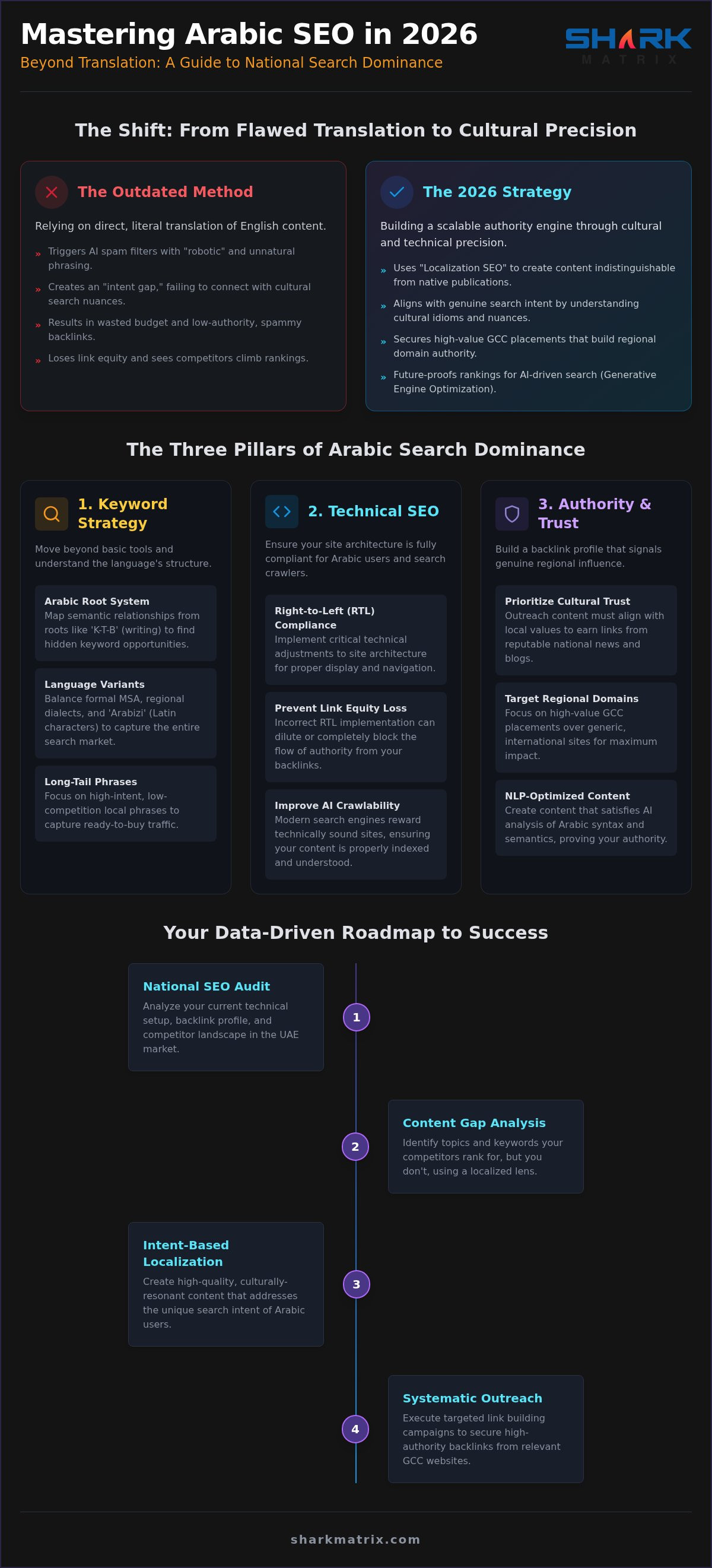
Technical foundations are the silent engine behind successful arabic link building strategies. If your website architecture doesn’t natively support Right-to-Left (RTL) reading patterns, you’re bleeding link equity. Search engine crawlers in 2026 are highly sensitive to how bidirectional text is handled. If the underlying code is messy, the authority passed from high-quality Arabic backlinks won’t translate into higher national rankings. It’s not enough to simply flip the text; the entire DOM structure must respect the linguistic flow. This ensures search engines correctly index your semantic clusters and attribute value to your internal link structure.
Advanced natural language processing now allows search engines to dissect complex Arabic syntax with extreme precision. Algorithms can distinguish between a natural link within a contextually relevant sentence and a forced placement. To stay ahead, national UAE brands must focus on Generative Engine Optimization (GEO). This involves structuring your data so AI models can easily cite your site as a primary source in search summaries. Proper implementation of hreflang tags is also vital. It tells search engines exactly which version of your site to serve to the UAE’s bilingual audience, preventing internal competition between your Arabic and English assets.
RTL Design and Its Impact on SEO Performance
User behavior is a massive ranking signal. When an Arabic user lands on a page with broken RTL elements, they bounce immediately. This high bounce rate signals to search engines that your site isn’t a top-tier authority. Common mistakes like mirrored images that look awkward or navigation bars that don’t flip correctly can break your mobile indexing. Professional web development services ensure that your site’s CSS and HTML are perfectly aligned with RTL requirements. This technical polish ensures that every bit of authority you build through outreach is preserved and recognized by regional search algorithms.
Optimizing for Arabic Voice Search and AI Chatbots
Voice search has transformed how people in the UAE interact with technology. In 2026, conversational queries are often longer and more dialect-heavy than typed searches. You need content that answers these specific questions to win the “position zero” in Answer Engine Optimization (AEO). Integrating AI chatbot development can significantly boost your on-page engagement. These bots interact with users in their preferred dialect, keeping them on the site longer. This increased dwell time acts as a powerful secondary signal, proving to search engines that your site is a trusted national resource worthy of high-authority links.
Building Authority: Regional Link Building and Cultural Trust
E-E-A-T for the Arabic Web
Establishing Experience, Expertise, Authoritativeness, and Trustworthiness (E-E-A-T) requires more than just high-quality writing. Search engines now track Author Entities across the Arabic web with clinical precision. This means your content should be attributed to real professionals with documented expertise in the national market. Verified bios and links to national certifications or industry awards act as powerful ranking signals. When a recognized expert writes for you, the link equity from their citations carries significantly more weight. It’s about building a legacy of authority that search engines can verify through multiple national touchpoints.
Content Marketing as a Link Magnet
Creating assets that people actually want to link to is the most sustainable way to grow. In the UAE, this means producing data-driven studies or infographics that reflect national trends and cultural values. For instance, a report on national e-commerce growth using specific regional data points becomes a primary source for journalists and other bloggers. You can boost this reach through strategic social media management to ensure your assets are seen by key industry influencers. This creates a virtuous cycle where social signals and backlinks work together to solidify your brand presence.
As your authority grows, protecting your search presence becomes vital. Implementing Online Reputation Management within your SEO framework ensures that your hard-earned rankings remain secure. Our arabic link building strategies focus on long-term authority rather than quick, spammy wins. If you’re ready to transition from basic outreach to a high-authority national presence, our team can help you build an Authority Engine that lasts. Contact Shark Matrix Technologies LLC today to design a custom link building roadmap for the national market.
Executing a Data-Driven Arabic SEO Roadmap
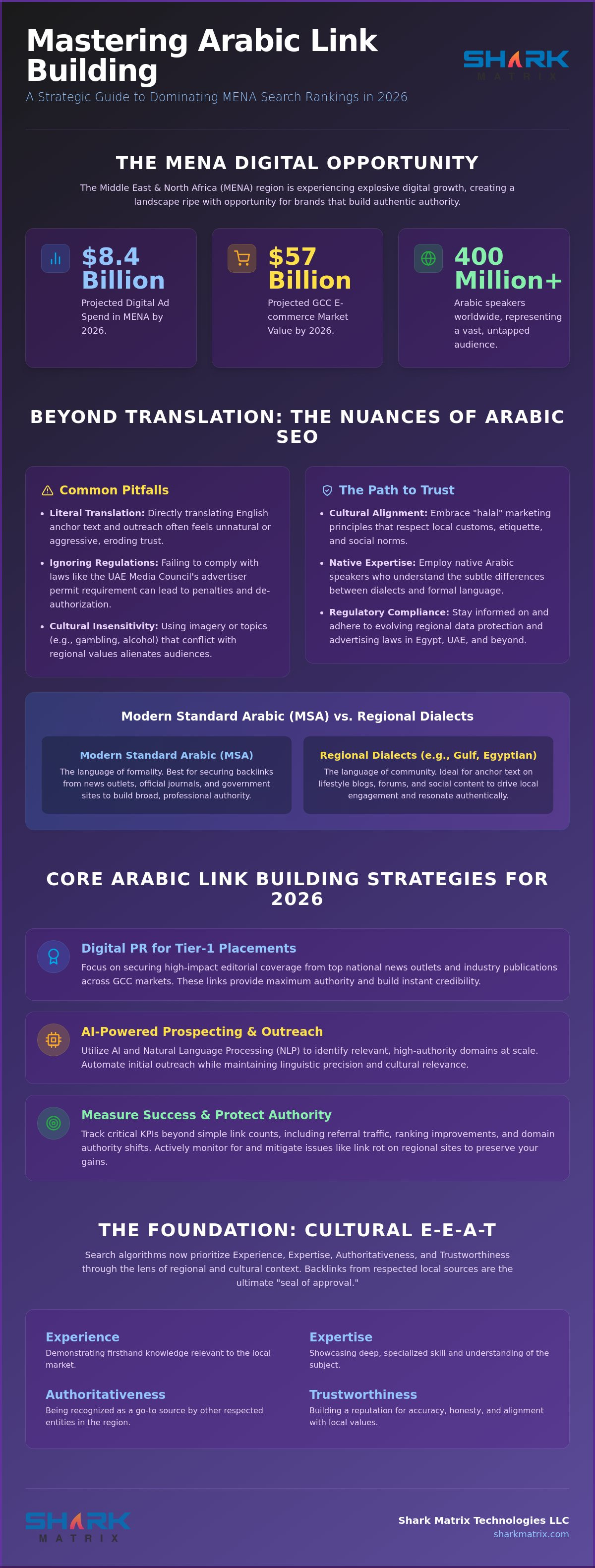
Success in 2026 isn’t accidental; it’s the result of a structured, data-driven approach. Your first move is a National SEO Audit. This goes beyond basic site health to identify where your Arabic footprint lacks authority. You’ll then move to a Content Gap Analysis. By comparing your site against the top Arabic competitors in the UAE, you can see exactly which topics and keywords are driving their growth. This isn’t just about matching them; it’s about finding the linguistic white space they’ve ignored. A robust roadmap ensures your arabic link building strategies are backed by data rather than guesswork.
- Large-Scale Localization: Use ai automation services to translate intent, not just words. This ensures your outreach is supported by a library of high-quality, relevant landing pages that search engines trust.
- Share of Voice Monitoring: Track how often your brand appears in national search results compared to your rivals. Continuous monitoring allows you to pivot your outreach as search trends shift across the country.
Measuring Success Beyond Rankings
Rankings are a vanity metric if they don’t lead to growth. In the national market, you must track the conversion rates of your Arabic landing pages. If a page ranks but doesn’t convert, the cultural intent is likely mismatched. Analyze how your Arabic backlinks improve your overall domain authority over time. Set realistic KPIs for 2026 that focus on national brand dominance and revenue growth in AED. High-quality links should lower your customer acquisition costs by providing a steady stream of organic, high-intent traffic that trusts your brand’s local authority.
Partnering for Long-Term Arabic Dominance
Siloed SEO efforts rarely work in a market as complex as the UAE. An integrated approach that combines technical excellence with native linguistic patterns is essential. Shark Matrix Technologies LLC delivers custom SEO strategies that treat link building as part of a broader authority engine. We don’t just build links; we build a sustainable roadmap for national market leadership. By aligning your technical foundation with cultural precision, you ensure your brand stays ahead of AI-driven search changes. It’s time to stop guessing and start dominating the national Arabic landscape with a partner who understands the intersection of AI and language.
Future-Proof Your National Authority Today
Success in the national market hinges on the technical and cultural harmony we’ve explored. From mastering the Arabic root system to ensuring RTL-compliant code, every element feeds into a broader authority engine. Implementing advanced arabic link building strategies isn’t just a 2026 trend; it’s a structural necessity for brands that want to survive AI-driven search shifts and the rise of Answer Engine Optimization (AEO). By prioritizing cultural trust over simple translation, you build a domain that search engines and users across the UAE can rely on.
Ready to lead the market? Scale your national reach with professional Arabic SEO services from Shark Matrix Technologies LLC. With over 15 years of experience in Middle Eastern digital markets and specialized NLP expertise, we help brands integrate AI-driven content with technical excellence. Our proven track record in national UAE brand growth ensures your roadmap is built for long-term success. The national landscape is ready for brands that prioritize linguistic precision. Take the first step toward search dominance and watch your authority grow.
Frequently Asked Questions
Is it better to use a subdomain or a subdirectory for Arabic content?
Subdirectories are generally better for SEO. They consolidate domain authority rather than splitting it. It’s easier for link equity to flow across the entire site when your Arabic content sits at a subdirectory like /ar/. This structure helps search engines see your site as a single, powerful entity. Subdomains are often treated as separate sites, which can dilute your arabic link building strategies and make it harder to rank nationally for competitive terms.
How long does it take to rank for competitive Arabic keywords in 2026?
You can expect to see initial movement within three to six months. Competitive Arabic keywords in the UAE require a sustained effort because search engines now prioritize long-term authority and technical precision. High-competition terms might take up to a year of consistent content publishing and strategic outreach. Factors like your current domain authority and the technical health of your RTL architecture play a massive role in these specific ranking timelines across the country.
Do I need a separate hosting provider in the UAE for better Arabic rankings?
Local hosting isn’t strictly necessary if you use a high-quality Content Delivery Network (CDN) with regional nodes. While having a server physically in the UAE can provide a slight latency advantage, search engines care more about the actual page load speed for national users. Focus on optimizing your core web vitals and ensuring your site is responsive. A fast, well-optimized site hosted globally often outperforms a slow site hosted locally in the UAE.
Can AI translation tools like ChatGPT rank well for Arabic SEO?
Raw AI translation usually fails because it lacks cultural nuance and native flow. In 2026, search engines use advanced NLP to detect and de-prioritize “thin” or robotic content. You can use AI for initial drafts, but a native speaker must review and localize it to ensure it meets national authority standards. High-quality arabic link building strategies rely on content that resonates with humans, not just algorithms, to earn lasting search engine trust and engagement.
How does Google handle different Arabic dialects in search results?
Google uses semantic clusters to understand the relationship between Modern Standard Arabic (MSA) and regional dialects. It tries to match the user’s specific intent based on their phrasing and location. If a user types in a local dialect, the engine prioritizes results that use similar terminology. This is why “White Arabic” is so effective. It bridges the gap between formal language and the way people actually search in their daily lives across the UAE.
What is the role of Arabizi in modern keyword research?
Arabizi is a critical part of keyword research for the mobile-first UAE market. Many users type Arabic sounds using Latin characters and numbers on their phones. Ignoring these terms means you’re missing a significant portion of national search volume. You should incorporate Arabizi into your metadata and long-tail content strategies to capture this high-intent traffic. It’s especially useful for targeting younger demographics and informal lifestyle queries where standard Arabic isn’t the primary search choice.
Is Right-to-Left (RTL) design a direct ranking factor for Google?
RTL design is an indirect but powerful ranking factor. While there isn’t a single “RTL toggle” in the algorithm, poor design leads to high bounce rates and low engagement. If your site doesn’t display correctly, users leave immediately. These negative signals tell search engines your site isn’t a quality result. Correct RTL implementation ensures that your content is readable, which keeps users on the page and improves your rankings for national search results in 2026.
How much does a professional Arabic SEO campaign cost on a national level?
National SEO campaigns in the UAE vary based on your industry and specific goals. You should check with providers for quotes tailored to your business needs. Costs typically reflect the complexity of native content creation, technical RTL optimization, and high-authority outreach. Investing in a professional strategy ensures you avoid the long-term costs of fixing a penalized domain or recovering from a failed, low-quality link building attempt that didn’t respect regional nuances or regulations.

 OpenAI
 Codex
Codex
 Vertex AI
 Cloud Vision
 OpenCV
 TensorFlow
 IBM Watson
 Cloud Natural Language
 Cognitive Services
 Bot Framework
 Mistral
 LLama
LLama
 Gemini
 Anthropic
 N8N
N8N