
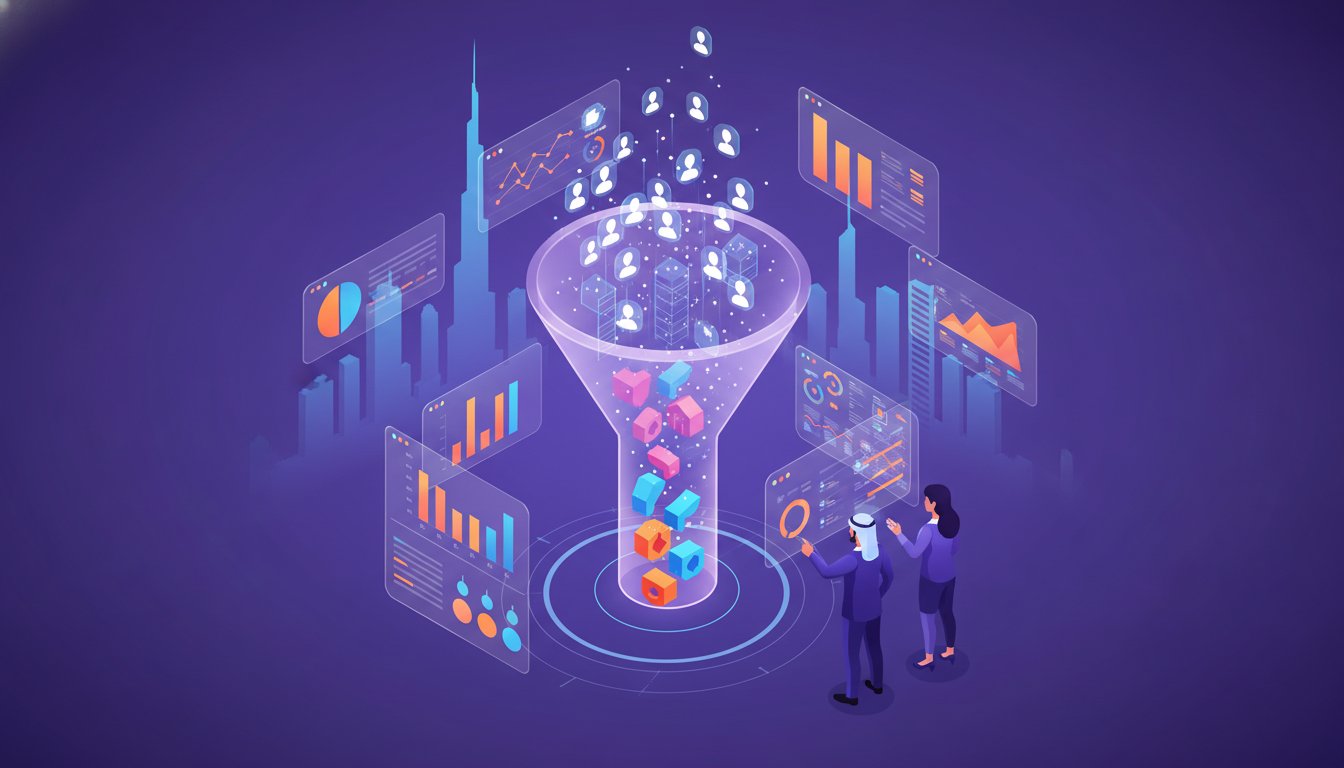
With the global PPC market projected to reach $306 billion in 2026, why are so many businesses still struggling with a high cost-per-lead and zero conversions? It’s frustrating to watch your budget disappear into clicks that never turn into sales. You’ve likely dealt with poor quality leads that frustrate your sales team or felt the sting of the 12% year-over-year increase in Google Ads CPCs. Mastering ppc for lead generation in 2026 requires more than just bidding on keywords. It’s about engineering a journey that prioritizes high-intent users while operating within a landscape where AI handles 78% of all spend and privacy regulations in states like California and Indiana have tightened.
You deserve a marketing strategy that delivers a predictable flow of sales-ready leads and clear visibility into your ROI. This guide will show you how to build, optimize, and scale high-intent paid search campaigns that actually grow your bottom line. We’ll explore how to leverage first-party data, adapt to the phase-out of standalone call ads, and use professional PPC management to lower your customer acquisition costs.
Key Takeaways
- Understand the fundamental differences between lead acquisition and e-commerce models to ensure your strategy aligns with high-intent business goals.
- Learn how to structure your account and conduct keyword research that prioritizes commercial intent for more effective ppc for lead generation.
- Master the post-click experience by balancing form friction and lead quality to ensure your sales team receives only the most qualified prospects.
- Identify and avoid common pitfalls like the “set it and forget it” mistake by implementing a consistent optimization routine.
- Future-proof your campaigns by leveraging Smart Bidding and AI-driven creative to reach users based on their probability of conversion.
What is PPC for Lead Generation and Why Does it Matter?
At its core, understanding What is PPC in the context of lead acquisition involves paying for advertising space to capture contact information rather than immediate sales. Unlike e-commerce, where the goal is a direct transaction, ppc for lead generation focuses on building a pipeline of potential clients. It’s the fastest way to achieve national market visibility, allowing your brand to appear at the top of search results the moment a campaign goes live. This speed is essential in 2026, especially as organic search becomes increasingly crowded with AI-generated content.
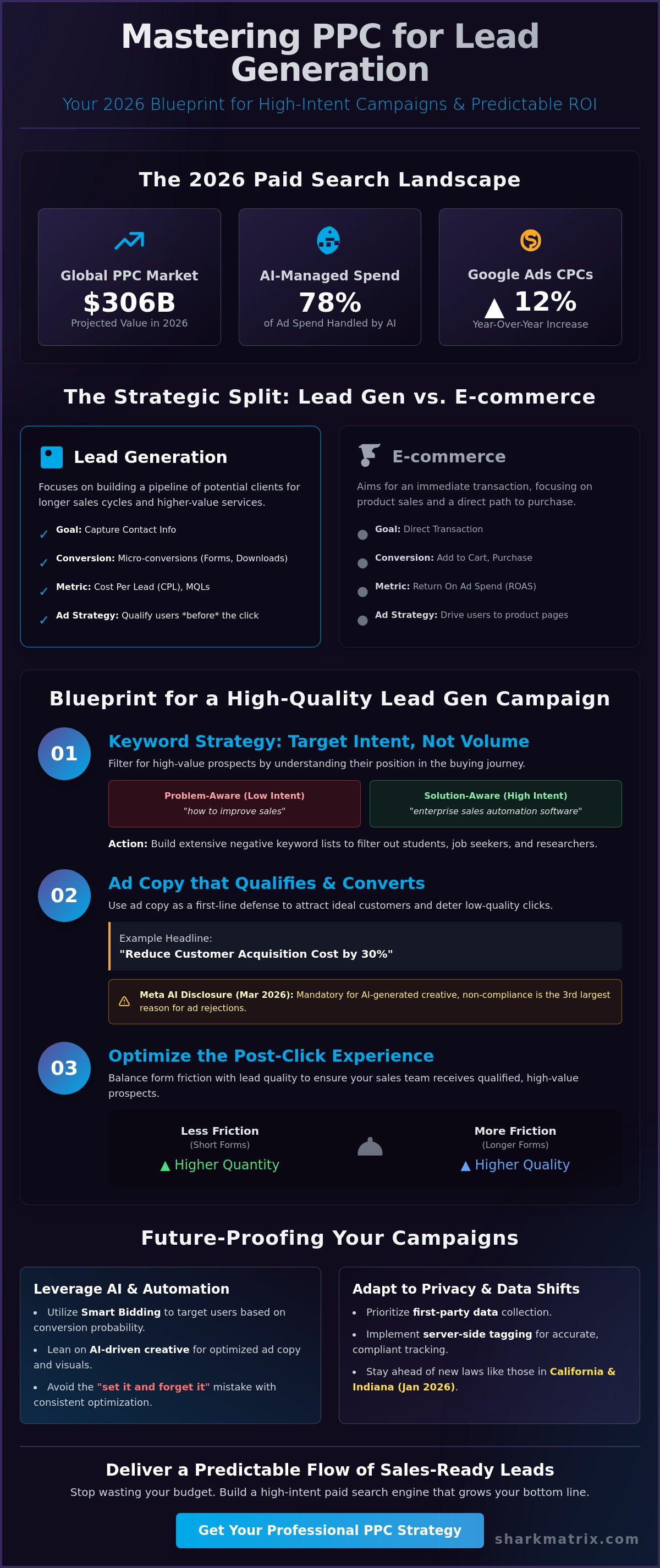
Success in this field is measured by two primary metrics: Cost Per Lead (CPL) and Marketing Qualified Leads (MQLs). While the average CPL across all industries has reached approximately $198 this year, focusing solely on the lowest cost can be a mistake. High-quality ppc for lead generation prioritizes the value of the lead over the quantity. You want prospects who are ready to engage with your sales team, not just people looking for free information. With Google Ads CPCs rising by 12% in competitive verticals, every click must be strategic.
Lead Generation vs. E-commerce: The Strategic Split
The fundamental difference lies in the conversion goal. E-commerce campaigns look for an immediate “add to cart” action. Lead generation, however, focuses on micro-conversions. These are smaller steps, such as downloading a whitepaper, signing up for a webinar, or completing a contact form. Because lead-based business models often involve longer sales cycles and higher price points, the ad copy must qualify the user before they even click. Effective PPC management ensures that your messaging filters out low-intent users, protecting your budget for high-value prospects.
The 2026 Paid Search Landscape
The current environment is defined by a shift toward privacy and intent. New state-level data privacy laws in California and Indiana, effective as of January 2026, have changed how we track and attribute conversions. We’ve moved away from simple keyword matching toward sophisticated intent-based signals. Advertisers now rely on first-party data and AI-driven audience insights to find the right users. Staying ahead of these uae digital marketing trends is vital for any business looking to scale. In 2026, the focus isn’t just on where people are searching, but why they are searching and what they intend to do next.
Step-by-Step: How to Build a High-Quality Lead Gen Campaign
Building a successful campaign requires a precise architectural blueprint. You can’t simply select a few keywords and hope for the best. In a landscape where 78% of Google Ads spend is now managed through Smart Bidding, the quality of the data you feed the algorithm determines your success. High-quality ppc for lead generation starts with a structure that prioritizes relevance and data integrity. This means moving beyond basic tracking to implement server-side tagging. This approach ensures you remain compliant with the 2026 data privacy laws in California and Indiana while maintaining clear visibility into your marketing ROI.
Keyword Strategy: Beyond High-Volume Terms
Effective keyword research in 2026 focuses on intent rather than just volume. You must distinguish between “problem-aware” searchers who are just starting their journey and “solution-aware” prospects ready to buy. For example, someone searching for “how to improve sales” is in a different stage than someone searching for “enterprise sales automation software.” To protect your budget, you should also build an extensive negative keyword list. This filters out students, job seekers, and researchers who drive up your CPL without any intention of becoming a lead. Using long-tail phrases allows you to capture high-intent national traffic at a lower cost than broad, competitive terms.
Ad Copy that Qualifies and Converts
Your ad copy acts as your first line of defense. It needs to attract the right people and discourage the wrong ones. Headlines should speak directly to the searcher’s end goal, such as “Reduce Customer Acquisition Cost by 30%.” Since March 2026, Meta has required a mandatory AI disclosure for any ad creative generated or modified by AI. Non-compliance is now the third-largest reason for ad rejections, so transparency is essential. Use ad assets to provide immediate value, such as site links to case studies or lead forms that integrate directly with your CRM. For brands looking to scale quickly, professional PPC Management can help navigate these policy shifts while maintaining a high Quality Score.
Once your campaign is live, adopt a “test and learn” mindset. With Google now retaining granular performance data for 37 months, you have more historical insight than ever before. Use this data to refine your bidding strategies and creative assets. Don’t just chase the lowest CPL; instead, track which keywords and ads result in MQLs that actually close. This holistic approach ensures your spend is always directed toward the most profitable segments of your market. For businesses operating in the region, understanding the nuances of google ads management uae is essential to navigating higher advertising costs and local compliance requirements effectively.
Optimising the Post-Click Experience for Maximum ROI
The moment a user clicks your ad, the clock starts ticking. If your page takes more than a few seconds to load or doesn’t immediately answer their query, you’ve wasted your budget. High-intent ppc for lead generation depends on a seamless transition from the search result to the conversion point. In a market where Google Ads CPCs have seen a 12% year-over-year increase, every bounce is a costly mistake. You aren’t just paying for a click; you’re paying for the opportunity to start a conversation.
While some competitors suggest keeping forms as short as possible to lower CPL, this often results in a flood of low-quality spam. Instead, find a balance between friction and quality. Ask one or two qualifying questions that filter out casual browsers who aren’t ready to buy. This ensures your sales team spends their time on prospects with genuine intent. Trust signals, such as client reviews and industry certifications, must be placed above the fold to build immediate credibility for national users who might be unfamiliar with your brand.
Landing Page Essentials for Lead Capture
Message match is non-negotiable for maintaining a high Quality Score. If your ad promised a “Detailed Industry Report,” the landing page shouldn’t pivot to a “Book a Demo” button immediately. Stick to the “One Goal” rule by removing all external navigation links that might lead a user away from the form. The Hero Section is the area of the page visible without scrolling that must communicate your value proposition and primary call-to-action within seconds. By narrowing the user’s focus, you significantly reduce lead leakage and improve your conversion rate.
Advanced Lead Form Strategy
For complex services, multi-step forms often outperform long, single-page versions. They reduce the perceived effort by breaking questions into logical chunks, which keeps the user engaged without feeling overwhelmed. Implement real-time validation to catch typos in phone numbers and emails before the user hits submit. This improves your data hygiene and ensures your sales team isn’t chasing dead ends. Finally, use your “Thank You” page to keep the momentum going. Instead of a generic message, offer an immediate consultation or a link to a high-value resource from your content marketing efforts.
Since video ads now account for 42% of total digital ad spend, ensure your landing pages can handle rich media without slowing down on mobile devices. A mobile-first design is essential for national campaigns where users often switch between devices. Professional Web Design and Development ensures your site is optimized for speed and conversion, providing a stable foundation for your paid search investments.
Common Pitfalls: Why Most PPC Lead Gen Campaigns Fail
Many businesses treat their campaigns like a slow cooker. They set them up and walk away. But in 2026, the auction environment changes hourly. With CPCs rising 12% in competitive sectors, a single week of neglect can drain thousands from your budget. Successful ppc for lead generation requires active management. If you aren’t reviewing search terms and adjusting bid strategies daily, you’re likely subsidizing your competitors’ growth. You need to leverage the fact that Google Ads now retains granular performance data for 37 months to make informed, data-driven adjustments.
Chasing the lowest possible CPL is a race to the bottom. While the average CPL across all industries is $198, a $50 lead that never answers the phone is more expensive than a $300 lead that closes a deal. Marketing can’t fix a slow sales response, but it can ensure the leads arriving are worth the effort. Identifying these budget leaks is difficult without an outside perspective. Using ppc audit services can uncover where your money is being wasted on low-intent traffic before it ruins your ROI.
The Lead Quality Trap
Broad match keywords often cause the “lead quality trap.” They cast a wide net that fills your CRM with junk data. Instead, focus on Value-Based Bidding. This guides the AI to find prospects who mirror your highest-paying clients rather than just anyone who clicks. You must differentiate between a “contact,” which is just a name in a database, and a “qualified prospect,” which represents a future revenue stream. By feeding conversion values back into the system, you train the algorithm to prioritize quality over volume.
Tracking and Attribution Gaps
Relying on “Last-Click” attribution is a dangerous gamble. Most B2B journeys involve multiple touchpoints across search, social, and video. Since Meta updated its attribution model in March 2026 to exclude non-link interactions like video views from click-through counts, your data might be missing the full picture. You must also account for the phase-out of standalone call ads that began in February 2026. By using call assets within responsive search ads and connecting your CRM to Google Ads via API, you gain visibility into offline conversions. This data is what fuels the Smart Bidding algorithms that now manage 78% of all spend.
If you’re tired of seeing your budget disappear into low-quality clicks, it’s time to refine your strategy. Our team provides professional PPC Management to help you navigate these technical gaps and ensure every dollar works toward a qualified sale.
Future-Proofing Lead Gen with AI and Automation
By 2026, the AI-powered search advertising market has surged to over $500 million. This shift means that successful ppc for lead generation is no longer just about manual adjustments; it’s about guiding machine learning models with high-quality data. Smart Bidding now uses thousands of signals to predict the probability of a conversion in real time. Instead of bidding on a broad keyword, the system evaluates the user’s past behavior, device, and time of day to decide if they are likely to become a high-value lead. This predictive approach allows you to scale your growth without manually managing every single bid.
The rise of generative search has also introduced Answer Engine Optimization (AEO) and Generative Engine Optimization (GEO) into the paid landscape. Users are moving toward conversational queries, asking complex questions rather than typing short phrases. To stay visible, your ad creative must adapt. AI-driven dynamic ads now use Large Language Models (LLMs) to test hundreds of variations of headlines and descriptions. This ensures the message matches the searcher’s specific intent perfectly. Combining these paid efforts with search engine optimization seo services creates a total market approach that captures intent across both organic and paid channels.
Harnessing AI-Driven Automation
Performance Max (PMax) for lead generation has evolved significantly from its early iterations. Unlike traditional search-only campaigns, PMax uses your first-party data to find prospects across YouTube, Gmail, and Display. To make this work, you must automate your lead scoring. By tagging leads in your CRM based on their quality and feeding that data back into Google Ads, you train the AI to ignore “tire-kickers” and focus on buyers. This automation frees up your team to focus on high-level strategy rather than administrative tasks.
The Shark Matrix Edge
We provide more than just standard campaign management. Our team specializes in ai automation services and industry specific ai solutions designed to give national enterprises a competitive advantage. We build custom machine learning development services that integrate directly with your sales pipeline to predict lead value before a human even reviews the contact form. In the competitive UAE market, this data-driven precision is the difference between a stagnant campaign and explosive growth.
Whether you need natural language processing services to analyze customer sentiment or generative ai development services to scale your content marketing, we align every tool with your commercial goals. Our approach to ppc for lead generation ensures your business isn’t just reacting to the market but leading it. By combining ai chatbot-development services with advanced ppc management, we create a high-friction-for-quality journey that delivers the sales-ready leads your business needs to thrive in 2026.
Scaling Your Lead Pipeline in 2026
Success in the current landscape requires moving beyond simple keyword matching to understand deep user intent. By prioritizing the post-click experience and leveraging first-party data, you can turn expensive clicks into a predictable flow of sales-ready prospects. Mastering ppc for lead generation is no longer just a technical task; it’s a strategic necessity for national growth. The shift toward privacy-first tracking and automated bidding means your strategy must be as dynamic as the platforms themselves to stay ahead of rising costs.
As a Premier Google Partner with over 15 years of national marketing expertise, Shark Matrix specializes in high-impact performance marketing and AI-driven lead automation. We help you navigate complex policy changes and technical attribution gaps so your marketing spend delivers measurable growth. Start generating high-quality leads with Shark Matrix today and take control of your customer acquisition costs. Your next phase of growth is just one well-optimized campaign away. With the right data and a proactive approach, you can build a sustainable lead engine that thrives in any market condition.
Frequently Asked Questions
How much does PPC lead generation cost in 2026?
Costs vary significantly by sector, but the average cost per lead (CPL) across all industries is approximately $198. For example, B2B SaaS ranges from $63 to $237, while legal services can reach $132 on Google. These figures depend on competition and your chosen platform’s bidding environment. You should monitor your specific industry benchmarks to ensure your spend remains efficient.
How long does it take to see results from a new PPC campaign?
You can see initial traffic immediately, but a campaign usually requires 30 to 90 days to stabilize and provide meaningful lead data. This period allows the AI to move past its initial learning phase. Since 78% of spend is managed via Smart Bidding, the system needs consistent conversion data to optimize performance effectively and lower your CPL over time.
Which is better for lead generation: Google Ads or Meta Ads?
The better platform depends on your audience’s intent and your specific industry. Google Ads excels at capturing high-intent searchers, while Meta Ads often provides a lower CPL for visual or interest-based services. For instance, e-commerce leads cost about $27 on Meta compared to $48 on Google. Many businesses find that an omnichannel approach delivers the best results. Businesses operating in the region should also review the specific considerations outlined in our guide to google ads management uae to account for local compliance requirements and higher advertising costs.
What is a good conversion rate for a lead generation landing page?
A healthy conversion rate for lead generation typically falls between 5% and 15% depending on the offer’s complexity. High-performing hero sections and multi-step forms can push these numbers higher. It’s best to benchmark against your specific industry averages rather than general digital marketing stats to get an accurate picture of your performance.
How do I improve the quality of the leads I get from PPC?
Improving lead quality involves tightening your keyword intent and adding qualifying questions to your forms. Use negative keywords to filter out non-commercial searches and leverage first-party CRM data to guide your ppc for lead generation strategy. This ensures the AI targets prospects who mirror your existing high-value customers rather than just chasing the lowest cost.
Can I do PPC for lead generation without a website?
Yes, you can use native lead forms on platforms like Meta or LinkedIn to capture information without a traditional website. However, a dedicated landing page usually offers better long-term ROI and more control over the user experience. For national campaigns, professional Web Design and Development helps build the trust necessary for high-ticket conversions.
What are the best keywords to target for B2B lead generation?
The best keywords are those that indicate high commercial intent, such as “enterprise software solutions” or “professional consultation.” Avoid broad, educational terms that attract researchers rather than buyers. Focus on long-tail phrases that describe the specific problem your business solves to keep your CPL manageable and attract qualified prospects.
How do I track phone calls from my PPC ads?
You should use call assets within your responsive search ads since standalone call ads were phased out in February 2026. Implementing dynamic number insertion (DNI) on your landing pages also allows you to attribute calls back to specific keywords. This setup provides a clear view of how ppc for lead generation contributes to your offline sales and overall ROI.
 OpenAI
 Codex
Codex
 Vertex AI
 Cloud Vision
 OpenCV
 TensorFlow
 IBM Watson
 Cloud Natural Language
 Cognitive Services
 Bot Framework
 Mistral
 LLama
LLama
 Gemini
 Anthropic
 N8N
N8N