

The last click isn’t always the reason a customer converts. Marketing attribution models help businesses understand which interactions contributed to an outcome by assigning credit across the customer journey. A first-touch model gives all credit to the first marketing interaction, while a last-touch model gives it to the final interaction before conversion.
It makes sense to want a clear answer about which campaigns work. The challenge is that customers may encounter several channels before taking action, so crediting just one touchpoint can overlook part of the journey. Marketing attribution helps assess those contributions, but each model tells a different story.
This guide explains what marketing attribution is, how common models distribute credit, and how to choose an approach that fits your goals, sales cycle and available data. It also covers the role of attribution in measuring conversion rate, customer acquisition cost (CAC) and return on investment (ROI), including why those measures matter when evaluating marketing activity in the UAE.
Key Takeaways
- Single-touch approaches credit one interaction, while multi-touch models spread credit across the customer journey; each highlights a different part of how conversions happen.
- First-party data collected with user consent can help connect marketing interactions to conversions while supporting privacy-conscious measurement.
- Choose a model based on your goals, sales cycle and available data, and reassess it when your strategy or customer journey changes.
- Use conversion rate, customer acquisition cost and return on investment together to understand performance across channels.
- Attribution shows patterns in observed journeys, but it doesn’t prove that a touchpoint caused a conversion; experiments can help assess causal impact.
What is marketing attribution?
Marketing attribution connects customer actions with outcomes, then assigns credit to the touchpoints along the way. The main marketing attribution models include first-touch, last-touch, last non-direct, and multi-touch approaches; each answers a different question about how marketing channels contribute to a conversion.
Single-Touch Attribution Models
Single-touch attribution assigns 100% of conversion credit to one interaction, making it straightforward to see which point in a journey receives recognition. First-touch credits the first marketing interaction, while last-touch credits the final interaction before conversion. Last non-direct attribution instead credits the last channel interaction that wasn’t direct, so a later direct visit doesn’t replace an earlier trackable source.
Imagine someone discovers a service through a Google ad, returns through email, then visits directly and converts. First-touch credits Google, last-touch credits the direct visit, and last non-direct credits email. The difference matters: relying on one model can lead teams to optimize for the first or final interaction while overlooking other contributions.
Offline Touchpoints and Attribution Windows
Offline touchpoints are interactions outside digital channels, such as a conversation at an event or a phone call. An attribution window is the period during which earlier interactions can receive credit for a conversion. Including a recorded event conversation alongside a later online enquiry can give a more complete view of the customer journey than digital tracking alone.
The attribution window affects which interactions count. If someone sees an ad, speaks with a team member at an event, then converts later, a window that excludes the earlier ad won’t credit it. Choose a period that reflects how customers move from discovery to action, rather than assuming every conversion happens immediately.
Multi-Touch Attribution
Multi-touch attribution shares conversion credit across several interactions. Single-touch models assign all credit to one. For a journey involving a social post, search ad, and email, multi-touch attribution can recognize each interaction instead of letting one channel stand for the entire path.
This broader view can help teams assess how channels work together and decide what to optimize. It depends, however, on recorded touchpoints: if an interaction isn’t captured, the model can’t allocate credit to it. Compare model outputs using the same conversion definition and attribution window to understand why channel credit changes.
U-Shaped Attribution
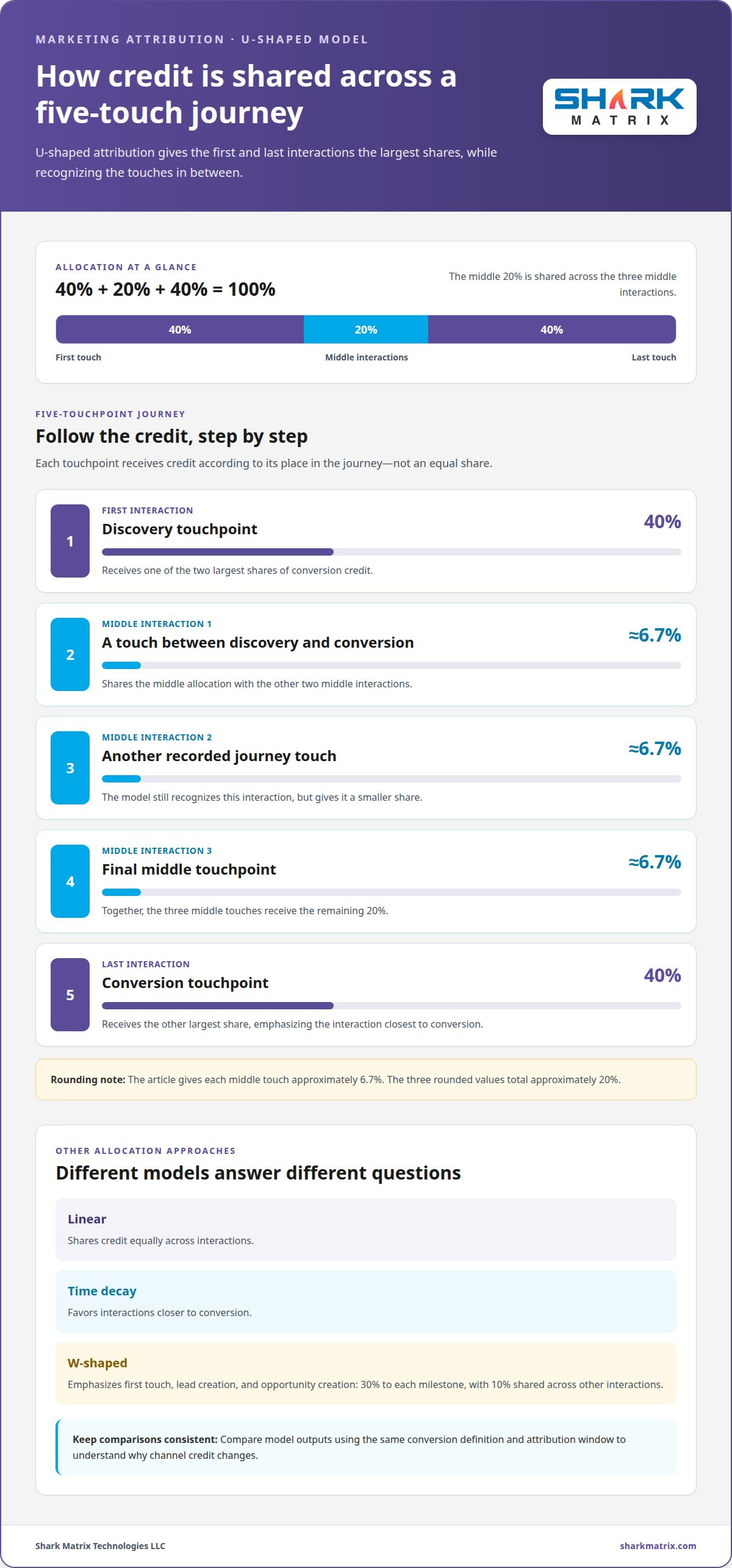
U-shaped attribution gives 40% of credit to the first touchpoint and 40% to the last, then divides the remaining 20% among middle interactions. In a five-touchpoint journey, each of the three middle interactions receives approximately 6.7%. This model emphasizes discovery and conversion while still recognizing interactions between them.
Other approaches answer different questions: linear attribution shares credit equally, time decay favors interactions closer to conversion, and W-shaped attribution emphasizes first touch, lead creation, and opportunity creation. A W-shaped model assigns 30% to each milestone and shares 10% across other interactions. Compare these allocations to see which view best supports the decision you need to make.
What is an attribution model?
A data-driven attribution model analyzes customer paths that convert and those that don’t, then estimates how recorded interactions relate to conversions. Statistical models or machine learning assign credit based on these paths rather than applying the same fixed allocation to every journey. Comparing converting and non-converting paths helps identify patterns associated with outcomes, but the result is an estimate, not proof of cause.
These estimates depend on the records being analyzed. If a customer sees an online ad, attends an event, then calls, disconnected systems may treat these interactions as separate people or journeys. Bringing campaign, website, customer relationship management, and offline records into a shared view can help reveal which interactions appear in converting paths. Consistent interpretation of sources makes the reporting more useful.
Data quality affects what a model can learn. Inconsistent campaign names can split one source into several report entries, while missing timestamps can scramble the order of interactions. Shared naming conventions and a clear conversion definition help teams determine whether records describe comparable activity. These practices improve analysis, but they don’t prove that a recorded touchpoint caused a conversion.
For example, people already likely to purchase may also be more likely to click a particular ad. An observational model can associate that click with conversions even if the ad had little influence on the decision. Incrementality testing addresses causation differently: it compares a group exposed to marketing with an unexposed control group to estimate marketing’s effect.
First-party data collected with user consent can support audience targeting and conversion tracking. Identity stitching connects records that appear to belong to the same customer, such as a website visit and a later enquiry. Consistent identifiers and documented matching rules help teams understand how records were joined, while governance clarifies how the data informs reporting.
Measurement plans should account for consent choices and the information available from each channel. A person may decline tracking or use a platform that provides limited reporting, leaving gaps in the recorded path. Build analysis around appropriately collected data, and don’t assume every visit can be identified or every conversion path is complete.
Offline interactions can add useful context. A sales conversation or event visit may shape a decision even when web analytics can’t record it. Connecting such activity with online records can provide a fuller view of the sales cycle when matching is reliable and handled appropriately. A unified approach to marketing measurement can help organize fragmented campaign and customer data.
Choosing an attribution model
Choose a model by matching the decision you need to make with your goals, customer journey, sales cycle, and available data. There’s no universally best method, and different stakeholders may need different views.
Aligning Models With Business Goals
Choose a model that reflects whether you’re evaluating awareness, lead generation, or completed sales. First-touch can help assess which channels introduce people to a brand, while last-touch focuses on the interaction closest to conversion. Multi-touch can show how digital channels work together across a longer journey.
Start with the outcome you want to understand, then select a model that fits the question. A team focused on discovery, for example, may examine first-touch credit, while a team reviewing conversions may look at the final interaction. If stakeholders need different answers, compare model views instead of forcing one method to serve every decision.
The customer journey matters as much as the goal. A short path from a search ad to a purchase may be easier to interpret with a simple model. A journey involving content, email, paid campaigns, and several return visits needs a view that recognizes more than one interaction. Check whether your data captures those steps before relying on the results.
Consider what the model leaves out. First-touch can understate later interactions, while last-touch can overlook earlier awareness activity. A position-based model emphasizes the opening and closing interactions; equal-weight attribution gives each recorded touchpoint the same share. Comparing these views can show how the chosen method shapes reported channel performance.
Accounting for Sales-Cycle Length
Sales-cycle length indicates how much time and how many interactions may separate initial awareness from a decision. A short journey may suit a simpler model, while a longer one may benefit from an approach that recognizes meaningful steps over time. The choice affects which channels appear influential and how teams interpret campaign contribution.
For example, B2B SaaS with a 6-month sales cycle and multiple decision-makers may gain useful insights from time-decay or W-shaped attribution. Time decay gives more credit to interactions closer to conversion; W-shaped attribution emphasizes first touch, lead creation, and opportunity creation. The suitable view depends on which milestones matter to the sales process.
Review model fit when your strategy, campaigns, or customer journey changes. Reassess at least quarterly, or when these changes occur, so the method continues to reflect how customers convert. A model selected six months ago may no longer describe today’s journey. Keep the conversion definition and measurement window consistent when comparing results across periods.
Treat the model as a decision aid, not a permanent verdict on a channel’s value. Use its findings to identify questions, such as whether awareness campaigns assist later conversions. Then compare your interpretation with other evidence, including controlled experiments, when you need to assess marketing’s causal effect.
Attribution KPIs including conversion rate, CAC, and ROI
Attribution KPIs connect recorded customer actions with business outcomes, helping you assess campaign performance across sources. For cross-channel measurement, conversion rate, customer acquisition cost (CAC), and return on investment (ROI) are useful indicators, but each answers a different question.
Set up tracking by defining the conversion event first, such as a completed purchase or submitted enquiry. Configure analytics to record that event and its relevant campaign sources, using consistent names for channels and campaigns. Test the event with a sample journey to confirm that the recorded interaction matches the outcome you intend to measure.
Conversion rate measures how often eligible interactions result in the defined conversion. Keep the denominator consistent: a rate based on website sessions answers a different question from one based on ad clicks. CAC compares acquisition costs with the number of new customers attributed to those efforts. ROI compares the return associated with marketing against its cost.
Use conversion paths to interpret these figures. An analytics report, for example, might show someone discovering a business through organic search, returning through a paid ad, then submitting an enquiry. The model assigns credit to those recorded sources, while conversion rate shows the share of eligible interactions that led to enquiries. CAC and ROI connect attributed outcomes with acquisition spending and returns.
Compare channels using the same conversion definition, reporting period, and attribution method. Otherwise, a paid campaign measured by completed purchases may look different from an organic campaign measured by enquiries. Return on ad spend and cost per lead can also help assess media placement costs and performance, but they don’t replace broader ROI or CAC analysis.
Read the KPIs together rather than treating any one as a verdict. A channel with a strong conversion rate may still have a high CAC, while a channel with fewer immediate conversions may appear in paths that later produce sales. Break results down by campaign and source, then look for consistent movement across conversion rate, CAC, and ROI.
Attribution makes comparisons more structured, but its credit reflects recorded interactions and the selected model. It doesn’t establish, by itself, that an interaction caused a conversion. If a report shows a sudden shift in ROI, examine campaign changes, conversion-event tracking, and channel mix before changing investment decisions.
Purpose of marketing attribution modeling
Attribution helps teams connect marketing activity with customer actions and business outcomes. Its purpose is not simply to assign credit, but to inform decisions about campaigns, channel roles, and measurement. Used carefully, it can show how paid and organic search, email, affiliate marketing, display advertising, and social media appear across converting journeys.
This view supports channel comparisons. A customer might discover a brand through organic search, return after seeing a display ad, then respond to an email. A model can show how each recorded source receives credit under its rules. Comparing that result with last-touch reporting may reveal whether a campaign mainly introduces customers or assists later decisions.
These insights can guide campaign planning and budget discussions. If a channel often appears early in converting paths, its value may be missed by reports focused only on final interactions. Conversely, a channel receiving substantial credit may be capturing demand created elsewhere. Attribution gives teams a structured way to investigate these patterns, not an automatic instruction to increase or cut spending.
It can also align marketing and sales around shared outcomes. Teams can agree on what counts as a lead, opportunity, or completed sale, then use consistent campaign tracking to connect activity with those milestones. In a B2B journey, for instance, reports can compare the channels associated with lead creation and opportunity creation. Clear definitions reduce confusion when teams interpret campaign performance.
Attribution supports learning when teams treat it as a working measurement method. Reassess the model at least quarterly, or when strategy, campaigns, or the customer journey changes. Keep objectives and assumptions visible across teams; transparent governance helps identify attribution bias, such as giving too much credit to interactions that correlate with conversion.
For a stronger causal answer, pair observational attribution with incrementality testing. Compare a group exposed to marketing with an unexposed control group to estimate marketing’s effect. Randomized controlled trials, geo-experiments, and holdout testing are methods for this purpose. Attribution describes observed paths; experiments help determine whether exposure contributed to a change in outcomes.
Use these findings to set campaign goals and create content tied to measurable customer actions. Plan content marketing around clear campaign objectives, then assess its role alongside other channels.
Shark Matrix Technologies: Content Marketing
Shark Matrix Technologies can connect attribution insights with practical campaign work. Its Content Marketing, Search Engine Optimization (SEO), and Pay Per Click (PPC) Management offerings support campaigns across organic and paid channels. Web Design and Development can also shape the pages customers reach from those campaigns.
Consider this next step when your reporting shows a gap between campaign activity and the actions your business wants customers to take. Insights about which sources introduce visitors, for example, can inform content priorities, while conversion-path findings can guide landing-page improvements and paid campaign decisions. Aligning these activities around defined goals gives teams a clearer basis for evaluating performance.
To discuss how these services could support your marketing goals, contact Shark Matrix Technologies.
Turn measurement into your next decision
Let your measurement approach evolve alongside your campaigns. As priorities shift, use attribution to frame the next question: which customer action should your team encourage, and what evidence would show that the change helped? This keeps reporting connected to decisions instead of treating a dashboard as the final answer.
Make the next review practical. Choose a business outcome, agree on how to recognize it, and note which assumptions shape your interpretation. Then use marketing attribution models to guide what you investigate, not as a substitute for judgment. When a result is unclear, a focused test can help distinguish a useful signal from a pattern that merely appears alongside conversions.
Shark Matrix Technologies can help translate measurement priorities into digital marketing and website work. If you’re ready to discuss your goals and the next steps for your campaigns, contact Shark Matrix Technologies.
Clearer questions support better-informed decisions. Take the next step with a measurement plan your team can continue learning from.
Frequently Asked Questions
How to measure attribution results?
Measure results by comparing attributed conversions with the business outcomes they represent. Calculate conversion rate by dividing conversions by eligible visits or interactions; calculate CAC by dividing acquisition spend by new customers. ROI compares the return attributed to marketing with its cost. Keep the conversion definition and reporting period consistent, then assess whether changes in attributed performance align with actual customer and sales outcomes.
What is cross-channel attribution?
Cross-channel attribution evaluates how interactions across different marketing channels appear in customer paths leading to an outcome. It can bring together digital sources, such as search and email, with offline interactions, such as an event conversation. A report might show, for example, that a customer encountered a social campaign before visiting through search. Consistent channel labels help teams interpret the combined view without confusing similar campaigns.
Where does attribution data come from?
Attribution data comes from records of marketing interactions and conversion events. Common inputs include website analytics, advertising platforms, campaign links, customer relationship management records, and transaction systems. Offline sources, such as recorded sales enquiries, can add context when connected appropriately. Timestamps, campaign identifiers, and consistent customer or event records help analysts assemble a usable path instead of treating each data source as a separate story.
What is marketing attribution and how does it work?
Marketing attribution associates customer interactions with an outcome and distributes credit according to a chosen method. A prospective customer might read an article, return through a search result, and later complete an enquiry form. The attribution approach determines how those recorded actions appear in reporting. Teams use the resulting view to investigate campaign contribution, not as automatic proof that an interaction caused the enquiry.
How do first-touch, last-touch, and linear attribution compare?
First-touch highlights the interaction that introduced a customer, while last-touch emphasizes the interaction nearest the conversion. Linear attribution gives equal credit to every recorded touchpoint in the path. Imagine a customer who discovers a service through search, reads an email, and later converts through a direct visit. Each approach presents a different account of that journey, so the useful comparison depends on whether you’re assessing discovery, closing activity, or the full path.
How do you choose the right attribution model for a business?
Choose a model by identifying the decision it needs to support, then consider the sales process and available data. A team evaluating discovery may prioritize how customers first encounter the brand; a team assessing the closing process may focus on later interactions. If sales and marketing need different perspectives, compare reports using clearly defined outcomes. Revisit the choice when campaigns or customer behaviour changes.
How do attribution windows and lookback periods affect results?
An attribution window determines how far back interactions can be considered when crediting a conversion. A shorter window may exclude an earlier campaign interaction, while a longer one can include more of the journey. Someone who first encounters a campaign and converts after an extended decision process, for example, may appear differently across windows. Keep the selected period consistent when comparing campaigns, and choose one that reflects how customers typically decide.
How do privacy rules and cookie restrictions impact marketing attribution in the UAE?
Privacy requirements, consent choices, and browser or platform cookie settings can limit which interactions are recorded or connected. That can leave gaps in a customer path, making channel reports less complete. In the UAE, build measurement around data collected and used appropriately, and avoid assuming every visit can be linked to a person. Consent-based first-party data and clear event definitions can help make available reporting more useful.
 OpenAI
 Codex
 Vertex AI
 Cloud Vision
 OpenCV
 TensorFlow
 IBM Watson
 Cloud Natural Language
 Cognitive Services
 Bot Framework
 Mistral
 LLama
 Gemini
 Anthropic
 N8N