
Categories
Digital Marketing

How to Calculate Digital Marketing ROI: The 2026 Guide to Measuring Performance

Your current ROI reports might be lying to you. In an era of fragmented touchpoints and AI-driven search, relying on last-click attribution is like trying to navigate a city with a decade-old map. You’ve likely felt the frustration of seeing high engagement numbers that don’t seem to translate to the bottom line, leaving you wondering how to calculate digital marketing roi with actual precision. It’s a common pain point for even the most seasoned marketing teams when stakeholders demand proof of profitability for every dollar spent.

We’re here to bridge that gap by providing a masterclass on measuring performance for the 2026 landscape. You’ll master the precise formulas needed to track success across SEO, PPC, and generative engine optimization. We’ll also dive into the critical differences between ROAS and ROI while providing a technical framework to help you use AI automation to track every conversion accurately. By the end of this guide, you’ll have a clear strategy to turn your historical data into a predictive tool for future growth.

Key Takeaways

  • Adapt to the 2026 landscape by shifting your focus from traditional search metrics to the emerging value of Answer Engine Optimization (AEO).
  • Master how to calculate digital marketing roi using comprehensive formulas that accurately isolate organic growth from your paid campaign efforts.
  • Build a robust technical infrastructure using GA4 and closed-loop reporting to ensure every marketing lead is tracked through to the final sale.
  • Learn how strategic investments in mobile app development and landing page A/B testing can lower your acquisition costs while boosting retention.
  • Move beyond basic historical reporting by implementing AI-driven strategies that turn your data into a predictive tool for future profitability.

What is Digital Marketing ROI and Why is it Changing in 2026?

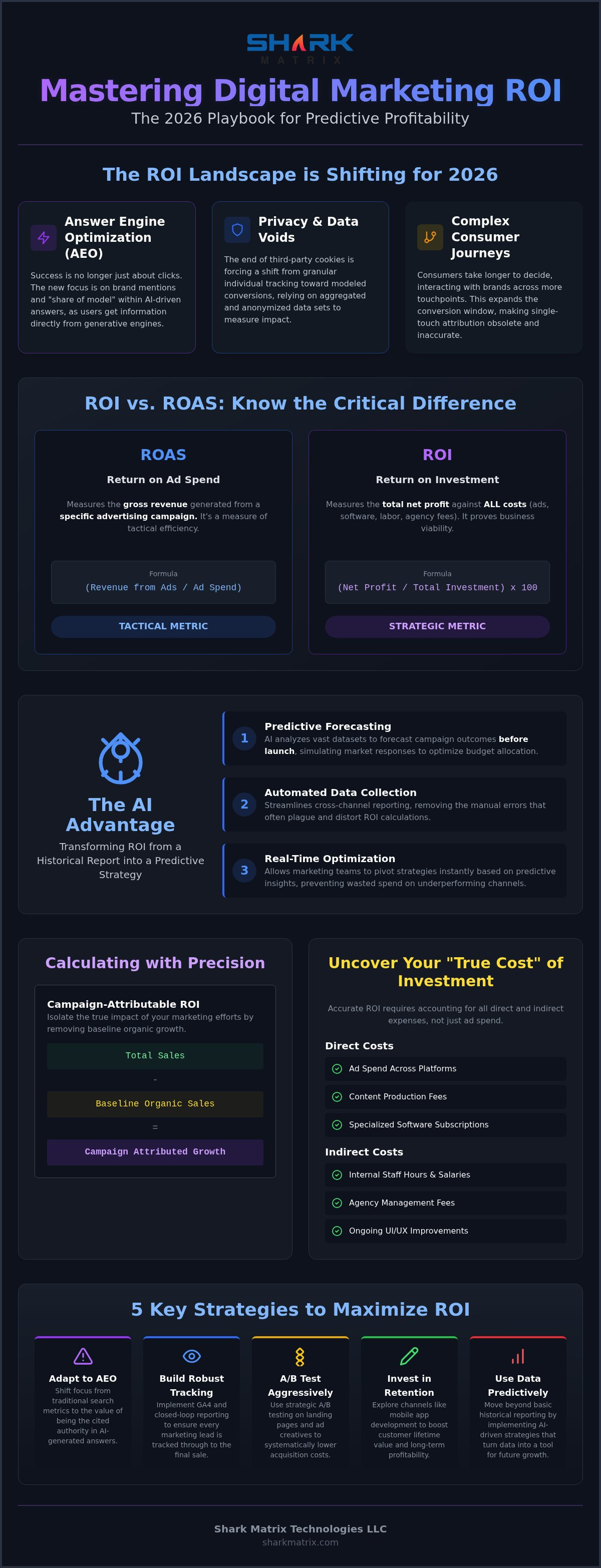
Digital marketing ROI is the percentage of profit gained relative to the total investment across your digital channels. It’s the ultimate metric that tells you if your marketing spend is actually growing your business or just keeping it afloat. Understanding Return on marketing investment (ROMI) is essential for any modern brand. As we look toward 2026, the complexity of this calculation is increasing because the digital ecosystem is no longer just about clicks and sessions. It’s about the entire ecosystem of influence.

The shift from traditional search engines to Answer Engine Optimization (AEO) has fundamentally changed how we track success. Instead of users clicking through to a website, they often get their answers directly from an AI interface. This means traditional traffic metrics are losing their weight. To understand how to calculate digital marketing roi in this new environment, you have to account for brand mentions and “share of model” alongside standard lead generation. Measuring performance now requires looking at how often your brand is cited as the preferred solution by generative engines.

Privacy regulations and the death of third-party cookies have also forced a change in how we collect data. We’re moving away from granular individual tracking toward modeled conversions. Additionally, consumer behavior has shifted. People are taking longer to decide, interacting with brands across more touchpoints before converting. This expands the conversion window, making it harder to attribute a sale to a single campaign without sophisticated tracking. National consumer behavior now reflects a deeper skepticism, requiring more trust-building interactions before the final purchase happens.

ROI vs. ROAS: Knowing the Difference

Return on Ad Spend (ROAS) is often confused with ROI, but they serve different purposes. ROAS measures the gross revenue generated from a specific advertising spend; it’s a great metric for campaign-level efficiency. However, it doesn’t account for your total overhead. Genuine ROI factors in everything: software costs, agency fees, and internal labor. When reporting to national stakeholders, use ROAS for tactical adjustments and ROI to prove long-term business viability and overall profitability.

The Impact of AI on ROI Forecasting

Machine learning is transforming ROI from a historical report into a forward-looking strategy. By analyzing vast datasets, AI can now predict the potential outcome of a campaign before you even launch it. Our ai automation services streamline this data collection, removing the manual errors that often plague cross-channel reporting. Predictive ROI in 2026 utilizes real-time generative engine data to simulate market responses and optimize budget allocation instantly. This allows marketing teams to pivot strategies before a single dollar is wasted on underperforming channels.

The Essential Formulas: Calculating Simple vs. Comprehensive ROI

To move from guesswork to precision, you need a solid mathematical foundation. The most basic way to understand how to calculate digital marketing roi is the simple formula: (Net Profit / Total Investment) x 100. While this provides a quick snapshot, it often paints an incomplete picture. For a truly realistic view of how to calculate digital marketing roi, you must use your Gross Profit Margin rather than total revenue. If you’re calculating ROI based on top-line sales without accounting for the cost of goods sold, you’re overestimating your success.

Campaign-attributable ROI takes this further by isolating the impact of specific marketing efforts. To do this, you subtract your baseline organic growth from the total sales generated during a campaign period. This helps you see what your paid efforts actually contributed versus what would have happened anyway. It’s a vital step for brands that already have a strong organic presence. If you need assistance setting up these complex tracking parameters, our team at Shark Matrix can help you build a technical framework that captures every nuance of your data.

Defining Your “True Cost” Checklist

Most marketers forget that “Total Investment” includes much more than just your monthly ad spend. You need to account for both direct and indirect costs to get an honest figure. Your checklist should include:

  • Direct costs: Ad spend across all platforms, content production fees, and specialized software subscriptions.
  • Indirect costs: Internal staff hours, agency management fees, and ongoing UI/UX improvements.

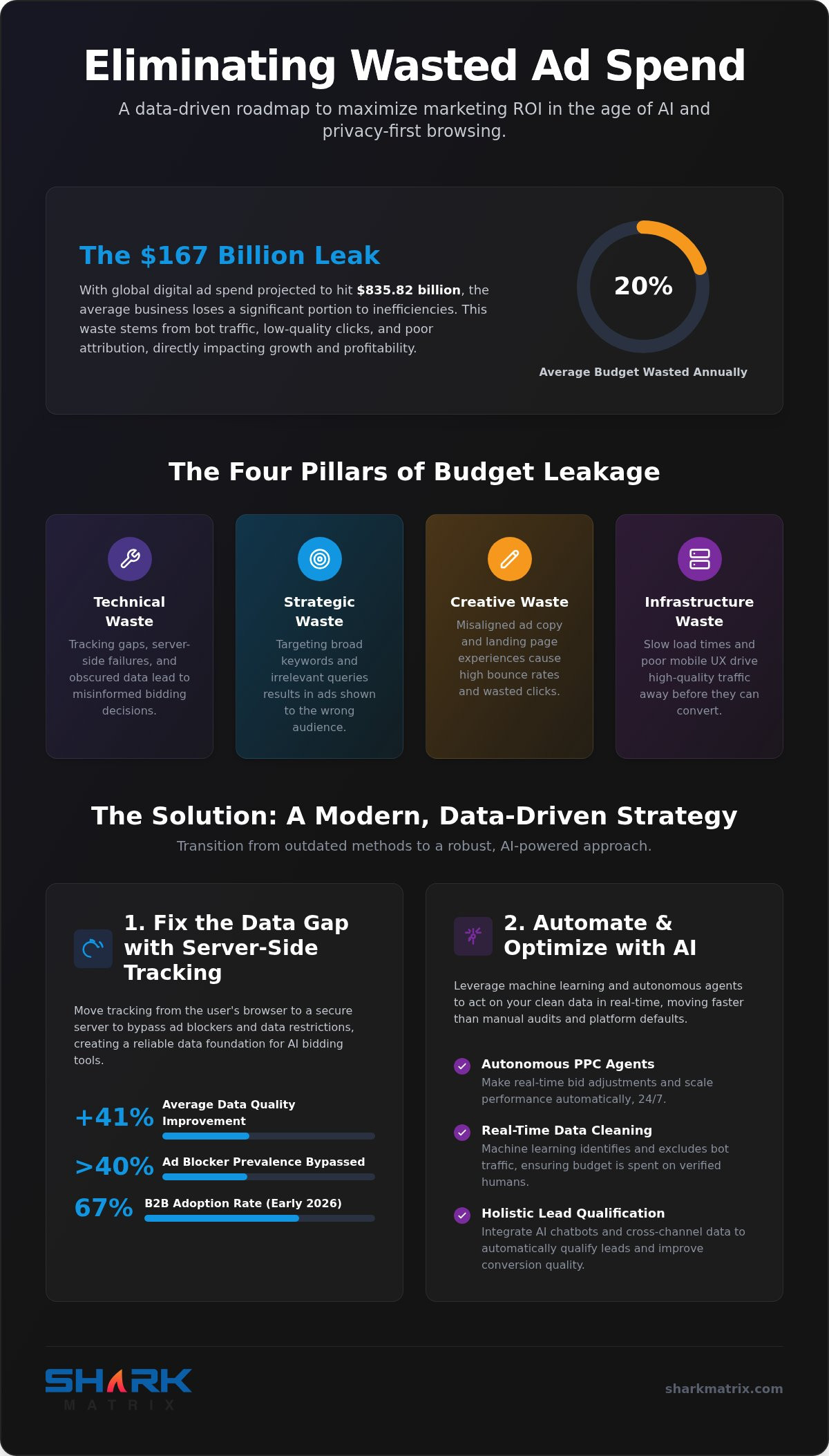
You should also integrate the initial costs from your web development agency into your ROI model. The performance and speed of your site directly dictate your conversion rate, meaning your technical infrastructure is a core part of your marketing investment.

The CLV-Based ROI Model

Measuring success based on a single transaction is a short-sighted approach that often devalues your marketing efforts. The CLV-based model looks at the long-term value of a customer rather than just the initial acquisition. To calculate this, use the formula: (Average Purchase Value x Purchase Frequency) x Customer Lifespan. By adjusting your ROI based on retention rates and brand loyalty, you gain a clearer understanding of how much you can afford to spend on acquiring a new customer today. This perspective shifts marketing from a simple cost center to a long-term strategy for sustainable growth.

How to Calculate Digital Marketing ROI: The 2026 Guide to Measuring Performance

Measuring ROI Across Diverse Digital Channels

Each digital channel requires a unique lens to determine its true contribution to your profit margins. While the core formulas remain the same, the way you gather data changes depending on whether you’re looking at a long-term asset or an immediate lead generator. Understanding these nuances is the only way to master how to calculate digital marketing roi with accuracy across a multi-channel strategy. Without this granular view, you risk over-investing in high-volume, low-margin channels that don’t support your long-term growth.

Organic Search and SEO ROI

SEO isn’t a one-off expense; it’s a compounding asset that builds equity over time. When tracking ROI for search engine optimization seo services, you must look beyond keyword rankings. In 2026, Answer Engine visibility is paramount. If your content is the source for a generative AI’s response, that visibility carries high conversion intent. Calculate this by comparing content costs against the lifetime value of organic leads, using a rolling 6 to 12-month window to capture the full impact of your investment.

Social Media and Engagement ROI

Vanity metrics like likes and shares are misleading. To find the real value of a social media agency campaign, track users through the entire funnel using UTM parameters. This attributes revenue directly to social interactions. In the UAE market, localized Arabic digital marketing acts as a unique ROI booster, building deeper cultural trust and significantly improving engagement rates compared to generic English campaigns. This cultural alignment turns your social presence into a measurable profit driver.

Pay Per Click (PPC) offers the most direct path to real-time tracking. When you’re refining how to calculate digital marketing roi for paid campaigns, monitoring conversion efficiency and lead generation costs daily is essential. This allows for rapid budget reallocation to the highest-performing ad sets. However, the real innovation in 2026 comes from ai chatbot development. These tools don’t just provide 24/7 support; they act as high-performance sales agents that qualify leads before they ever reach your CRM. You calculate the ROI of an AI chatbot based on:

  • Cost Reduction: Decreased reliance on human support for repetitive, top-of-funnel queries.
  • Conversion Lift: Higher lead capture rates through instant, personalized engagement that prevents bounce.
  • Data Accuracy: Automated tracking of user intent and interaction history for better attribution.

This dual impact on both cost-savings and revenue makes AI integration one of the most measurable ROI boosters available today. By connecting these technical tools to your broader marketing strategy, you ensure that every interaction is accounted for in your final profitability reports.

Practical Steps to Implementing a Robust Tracking System

Precision in measurement requires a technical foundation that captures data at every stage of the funnel. You can’t master how to calculate digital marketing roi if your data is siloed or incomplete. The first step is a comprehensive GA4 setup that prioritizes cross-platform event tracking. This allows you to see how a user moves from a mobile app interaction to a desktop conversion. When combined with consistent UTM tagging across every campaign, you create a transparent trail that links specific marketing dollars to individual user actions.

Implementing closed-loop reporting is what truly separates high-performance teams from the rest. This process involves connecting your marketing platforms directly to your CRM to track a lead until the final sale is closed. Without this connection, you’re only measuring potential, not actual profit. To identify where ROI is being lost, utilize heatmaps and UI/UX data. These tools reveal friction points in your funnel, such as a confusing checkout process or a slow-loading landing page, that might be killing your conversion rates despite high-quality traffic.

Attribution Modeling: Who Gets the Credit?

Choosing the right attribution model is critical for national campaigns where customer journeys are often complex. While first-touch and last-touch models offer simplicity, they’re often too narrow for the 2026 landscape. Data-driven attribution has become the gold standard because it uses machine learning to distribute credit based on how each touchpoint actually influenced the conversion. This model helps account for dark social and offline conversions by analyzing patterns that traditional tracking might miss. If your current tracking feels fragmented, Shark Matrix can implement the technical infrastructure needed to unify your data streams.

Leveraging AI for Data Accuracy

AI doesn’t just predict outcomes; it cleans and analyzes the data you already have. By using natural language processing, you can analyze customer feedback and sentiment as a qualitative ROI metric, giving you insight into brand health that numbers alone can’t provide. Automating your report generation also removes the risk of human error in cost tracking, ensuring your stakeholders see the most accurate figures possible. By integrating these tools, AI significantly reduces the time-to-insight for marketing teams, allowing you to make budget adjustments in hours rather than weeks. This agility is essential when you’re refining how to calculate digital marketing roi for fast-moving markets.

Maximizing ROI with Strategic Growth and Optimization

Calculating your returns is only half the battle. Once you understand how to calculate digital marketing roi, your focus must shift toward protecting and expanding those margins. Strategic optimization ensures that you aren’t just measuring performance but actively improving it through data-driven decisions. This involves identifying your highest-performing segments and doubling down on what works while trimming the fat from underperforming channels. It’s about moving from a reactive stance to a proactive growth strategy.

A/B testing your landing pages is a fundamental step in this process. By testing different headlines, layouts, or calls-to-action, you can systematically improve your conversion rate, which directly lowers your Cost Per Acquisition (CPA). Additionally, investing in mobile app development can significantly increase customer retention and Lifetime Value (CLV). An app provides a direct, high-engagement channel that keeps your brand top-of-mind, turning one-time buyers into loyal advocates through personalized push notifications and seamless user experiences.

Scaling your efforts requires real-time data. When you see a campaign delivering exceptional returns, you need the agility to reallocate your budget instantly. In the UAE market, localized Arabic digital marketing acts as a unique ROI booster, allowing you to capture specific search intent that generic campaigns often miss. However, even the best campaigns can suffer from ROI leakage caused by a poor online reputation. Negative reviews or unresolved customer complaints can act as a silent killer for your conversion rates, making Online Reputation Management essential for protecting your investment.

Technical Optimization for Higher Returns

Technical excellence is the bedrock of marketing profitability. Every second of delay in site speed or a lack of mobile responsiveness can chip away at the ROI of every dirham you spend. There’s also a powerful synergy between generative ai development and content scaling. Using AI to produce high-quality, intent-focused content allows you to cover more ground without a proportional increase in costs. When you align your UI/UX design with specific user intent, you shorten the sales cycle and maximize the efficiency of your funnel.

Next Steps: From Calculation to Execution

Turning data into action requires a structured approach. Conduct a quarterly ROI audit to review your performance and reallocate budgets based on the latest market trends and internal data. When pitching budget increases to executive leadership, focus on the predictive models you’ve built rather than just historical wins. Show them how to calculate digital marketing roi for future scenarios to prove that marketing is a revenue engine, not a cost center. To further support high-level financial oversight, you can discover Swiss Alpha Matrix for specialized due diligence on complex investment programs. Partnering with a full-service agency like Shark Matrix allows you to manage both the technical infrastructure and the strategic execution needed to maintain long-term growth.

Future-Proof Your Marketing Profitability

Mastering the shift toward Answer Engine Optimization and predictive analytics is no longer optional for brands aiming to lead. You now have the technical foundation to move beyond basic reporting by integrating hidden costs and long-term customer value into your financial models. Understanding how to calculate digital marketing roi with this level of precision allows you to stop guessing and start scaling your budget with absolute confidence. By combining technical excellence in web development with advanced AI automation, you can finally close the loop between initial clicks and final sales across every channel.

Ready to transform your data into a high-performance growth engine? Get a Data-Driven Strategy to Boost Your ROI with Shark Matrix. Our specialists provide 2026-ready AI and SEO strategies backed by deep national expertise in UAE brand growth. We offer end-to-end technical and marketing integration to ensure your measurement systems are as sophisticated as your execution. It’s time to take control of your margins and build a more profitable future for your business.

Frequently Asked Questions

What is a good ROI for digital marketing in 2026?

A 5:1 ratio is generally considered a strong benchmark for most industries, meaning you earn five dollars for every one dollar spent. An exceptional ROI would be 10:1 or higher. However, these figures vary depending on your business stage and industry. In 2026, you should also consider your brand’s visibility in generative search results as a key indicator of long-term value alongside immediate revenue.

How do I calculate the ROI of a brand awareness campaign?

Track “brand lift” metrics such as branded search volume, direct website traffic, and social media mentions. You can assign a monetary value to these by comparing the cost of acquiring that same traffic through paid search. While awareness doesn’t always result in an instant sale, it significantly shortens future conversion windows and improves the efficiency of your direct-response campaigns over time.

Which digital marketing channel typically has the highest ROI?

SEO and email marketing consistently deliver the highest long-term returns. SEO is especially powerful because it’s a compounding asset that drives traffic long after the initial investment is made. In the current landscape, Answer Engine Optimization (AEO) is a vital part of this success. While PPC offers faster results, its ROI is always limited by your ongoing ad spend and rising bid costs.

How long does it take to see a positive ROI from SEO?

It usually takes four to nine months to see a positive ROI from SEO efforts. This timeline depends on your website’s current authority, the level of competition in your niche, and your technical health. You might notice early improvements in rankings within two months, but the compounding nature of organic growth means the most significant financial returns typically happen after the first year of consistent optimization.

Can AI help in improving my marketing ROI?

Yes, AI improves ROI by automating data analysis and optimizing budget allocation in real-time. Our ai automation services help identify high-performing audience segments much faster than manual processes. By using machine learning to predict customer behavior, you can shift your budget toward the channels and creatives most likely to convert, which reduces wasted spend and boosts your overall profitability.

What are the most common mistakes when calculating marketing ROI?

The most frequent error when learning how to calculate digital marketing roi is failing to include all costs, such as internal staff hours and software subscriptions. Many marketers also rely too heavily on last-click attribution, which ignores early touchpoints that influenced the buyer. Another mistake is treating ROAS and ROI as the same metric, which leads to a skewed understanding of actual business profit.

How do I account for agency fees in my ROI formula?

Include all agency fees as part of your “Total Investment” in the formula. When you’re determining how to calculate digital marketing roi for a specific project, divide the agency’s retainer by the number of campaigns they manage. This ensures your profit figures reflect the true cost of outsourcing your marketing and technical development, providing a more honest view of your campaign’s success. For instance, when evaluating costs from an AI digital marketing agency NYC, ensure you factor in the specific tiers of their maintenance packages to see the full impact on your bottom line.

Is ROAS more important than ROI for e-commerce businesses?

ROAS is useful for daily tactical adjustments, but ROI is the ultimate measure of your business’s health. E-commerce brands often focus on ROAS because it’s easy to track within ad platforms. However, if your margins are thin, a high ROAS could still result in a net loss after you factor in shipping, returns, and management fees. Always use ROI for long-term strategic planning.

Categories
Digital Marketing

In-House Marketing vs Agency in the UAE: The 2026 ROI & Strategy Guide

Did you know that a mid-level digital marketing manager in the UAE now commands a salary of up to AED 18,000 per month, excluding the rising costs of 2026 visa renewals and end-of-service gratuity? Recruitment is just the start. When deciding between in-house marketing vs agency uae models, the financial commitment often extends far beyond the base paycheck. You’re likely feeling the pressure of a hyper-competitive market where finding specialists in Arabic SEO or AI automation feels like searching for a needle in a haystack.

It’s exhausting to manage the overhead of an internal team while trying to keep up with new regulations like the 2026 Advertiser Permit mandate. We understand that you need a strategy that balances control with technical excellence. This guide promises to clarify the technical trade-offs and real-world costs associated with both paths. You’ll get a 5-point decision framework to help you determine which strategy will deliver the highest ROI for your specific business goals this year.

Key Takeaways

  • Learn how to calculate the true UAE Employment Multiplier, accounting for 2026 visa costs, medical insurance, and updated end-of-service gratuity requirements.
  • Use our 5-point decision framework to settle the in-house marketing vs agency uae debate based on your specific technical complexity and time-to-market needs.
  • Discover why specialized agencies offer a distinct advantage in 2026 through immediate access to elite AI automation and professional Arabic digital marketing expertise.
  • Identify the hidden management overheads of internal teams and how to avoid the “generalist trap” that often stalls ROI in the competitive UAE market.

The 2026 UAE Marketing Landscape: Why the Choice is Harder Than Ever

The digital scene in the Emirates has transformed into one of the most competitive environments in the world. With smartphone penetration exceeding 97% in 2026, brands are no longer just fighting for clicks; they’re fighting for relevance in an AI-saturated market. Deciding between in-house marketing vs agency uae models has become a high-stakes calculation. Generalist marketers who once handled everything from social media to basic ads are now struggling to deliver ROI. The market now demands deep technical expertise in digital marketing ecosystems that involve predictive analytics and real-time data processing.

The central conflict lies between “Brand DNA” and “Technical Edge.” An internal team knows your business inside out, but they often lack the specialized tools required for 2026’s performance standards. Over 80% of regional marketing leaders now report that AI tools are fully embedded in their daily workflows. If your internal team is still manually performing tasks that could be handled by AI automation, you’re essentially paying a premium for slower results. This technical gap is often the primary reason why UAE businesses are re-evaluating their organizational structures.

The Rise of Technical Marketing in the Emirates

Simple social media posting hasn’t moved the needle for years. In 2026, the focus has shifted toward data-driven lead generation and technical visibility. High-competition industries in Dubai and Abu Dhabi now prioritize generative engine optimization (GEO) and Answer Engine Optimization (AEO). These strategies ensure your brand appears in AI-generated summaries and voice search results. Without a team that understands the technical nuances of these new search behaviors, your brand risks becoming invisible to a digitally savvy population.

Cultural Nuances and the Arabic Advantage

Hiring for the UAE market presents a unique hurdle: finding talent that is both technically elite and culturally fluent. Many brands fail because they treat the region as a simple translation of global campaigns. True brand authority requires nuanced localization that resonates with 12.5 million social media users. It’s incredibly difficult to find a single in-house hire who masters technical algorithms while also producing high-level Arabic copy. This is exactly why many companies turn to Arabic SEO agency services. Specialized agencies provide the cultural depth and technical precision needed to navigate local regulations, such as the 2026 Child Digital Safety Law, while maintaining a strong national presence.

The True Cost of Building an In-House Team in the UAE

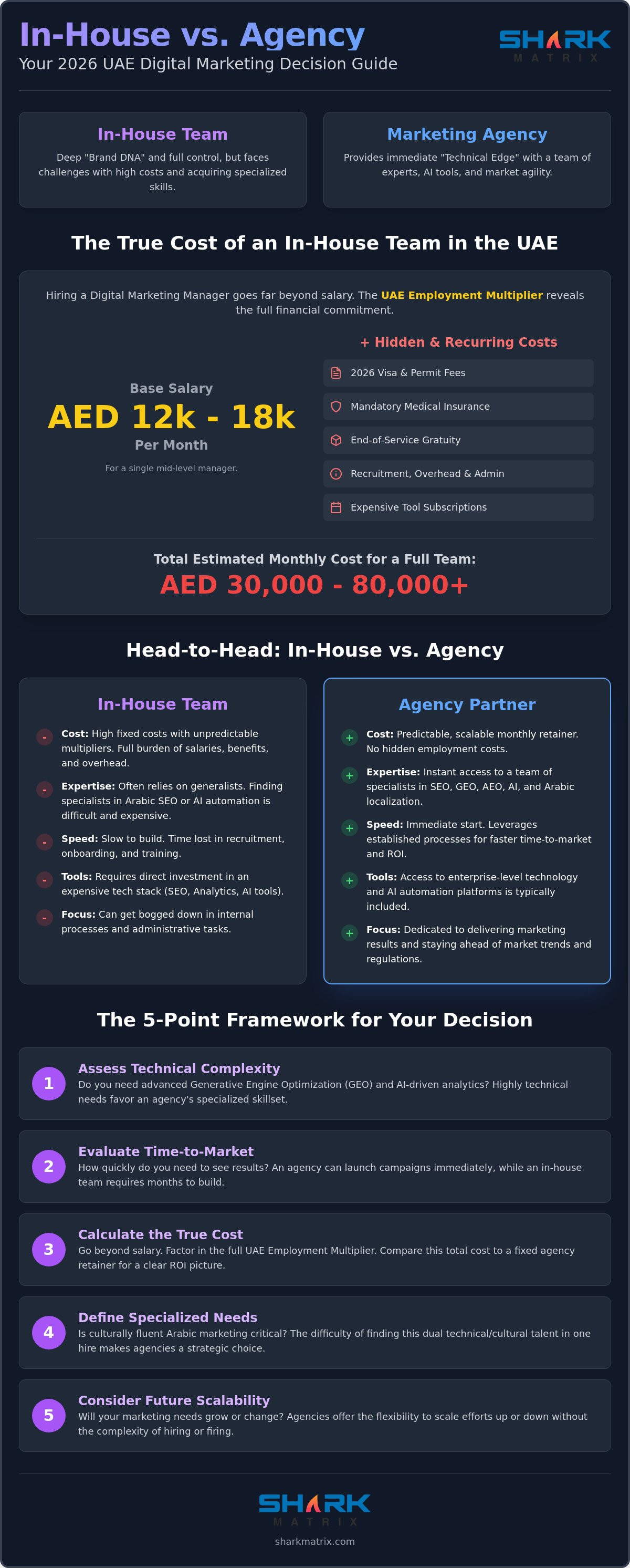
When evaluating in-house marketing vs agency uae, most decision-makers start with a basic salary spreadsheet. This approach is fundamentally flawed because it ignores the UAE Employment Multiplier. In the Emirates, the cost of an employee isn’t just their gross pay. It’s a combination of statutory obligations, recruitment fees, and operational overhead that can quickly double your initial estimate. Understanding the pros and cons of in-house vs. agency models requires looking at the long-term financial commitment beyond the monthly paycheck.

Hiring an internal team isn’t as simple as posting a job on LinkedIn. You’re responsible for 2026 visa processing costs, mandatory medical insurance, and the newly updated 2026 End of Service Gratuity calculations. There’s also the administrative burden of the July 2026 e-invoicing mandate, which adds complexity to payroll and vendor management. If you’re building a full department, research indicates a comprehensive in-house team in the UAE can cost between AED 30,000 to over AED 80,000 per month. This doesn’t even account for the office space premiums in business hubs like Dubai or Abu Dhabi.

To mitigate the risks of bad hires and high turnover in this expensive landscape, many firms learn more about HR Consultancy and Talent Acquisition to build a more sustainable and strategic workforce.

Salary Benchmarks for Marketing Roles (2026 Estimates)

Expect to pay a premium for specialized talent. A mid-level digital marketing manager’s salary currently ranges from AED 12,000 to AED 18,000 per month. If you need someone who understands both technical SEO and Arabic localization, those figures climb significantly. Hiring a single “all-rounder” to save money usually backfires. One person cannot realistically master generative engine optimization, manage complex PPC budgets, and handle high-level content strategy simultaneously. You’ll likely end up with mediocre results across the board while still paying top-tier salary rates.

The Infrastructure and Tooling Burden

Modern marketing requires an expensive tech stack. Enterprise-level SEO tools, AI automation platforms, and data analytics software can cost thousands of dollars in annual licensing fees. Agencies can amortize these costs across dozens of clients, but an in-house team bears the full weight of the bill. You also have to factor in continuous training. With AI integration becoming a fundamental component of marketing in 2026, your team needs constant upskilling to remain effective. If you’d rather focus your budget on results instead of overhead, consider how specialized SEO services can provide elite execution without the recruitment headache.

In-House Marketing vs Agency in the UAE: The 2026 ROI & Strategy Guide

The Agency Advantage: Technical Depth and AI Innovation

Agencies provide an immediate solution to the talent gap mentioned earlier. Instead of one manager juggling five roles, you get instant access to a specialized squad. This includes SEO experts, PPC specialists, and AI developers. One of the biggest perks is scalability. You can dial your efforts up for a major product launch or scale back during seasonal lulls without the trauma of hiring or firing. Agencies also benefit from a cross-industry learning effect. Because they work with various national brands, they see shifts in the UAE market before they become mainstream trends.

Most internal teams are too busy with daily operations to build custom technical solutions. Agencies invest heavily in AI automation and development to streamline workflows. This technical infrastructure allows for a level of precision that manual internal teams simply can’t match. When you compare in-house marketing vs agency uae, the ability to pivot quickly is often the deciding factor for high-growth companies. An agency isn’t just a service provider; it’s a technical laboratory where the latest UAE marketing strategies are tested and refined in real-time.

Mastering the Technical Stack

A professional PPC agency uses advanced machine learning for bid optimization, ensuring your budget isn’t wasted on low-intent traffic. This technical depth extends to mobile app development services, where dedicated engineers build high-performance interfaces. Technical SEO is another area where agencies shine. It requires deep developer knowledge to optimize site architecture and core web vitals. Most in-house marketers don’t have the coding background to execute these high-level technical changes effectively.

Objectivity and Reputation Management

Internal teams often fall into the trap of groupthink. They’re too close to the brand to see its flaws. An agency provides a necessary third-party perspective to identify strategy blind spots. This objectivity is vital for reputation management. When a crisis hits or negative sentiment grows, an agency maintains an unbiased brand image while executing a professional recovery plan. This external safeguard ensures your marketing remains grounded in data rather than internal bias. It’s a critical component for any brand navigating the in-house marketing vs agency uae landscape in 2026.

Choosing the Right Model: A 5-Point Decision Framework

Selecting the right path for your brand shouldn’t be a guessing game. The decision between in-house marketing vs agency uae should be based on objective operational needs rather than just your current revenue. As the UAE’s non-oil sector continues to expand at 5.3% annually, the speed of your marketing execution determines your market share. Use this framework to evaluate your position.

  • Technical Complexity: With the MENA generative AI market projected to surpass $1.5 billion by 2027, ask yourself if your team can build custom industry-specific AI solutions or if they’re limited to basic content prompts.
  • Time to Market: Agencies can typically deploy a multi-channel campaign in weeks. Hiring, onboarding, and training an internal team in the Emirates often takes three to six months.
  • Talent Availability: Highly specialized skills, such as Answer Engine Optimization (AEO) or technical Arabic SEO, are scarce. If you can’t find these experts locally, an agency is your only immediate option.
  • Management Bandwidth: Internal teams require constant leadership. If your current management is already stretched thin, adding the overhead of a marketing department will lead to burnout.
  • Total Cost of Ownership (TCO): Compare the all-in cost of salaries, 2026 visa fees, and software licenses against a flat agency retainer. The results often favor the agency model for high-growth firms.

If you’re still unsure which model fits your current growth stage, speak with our technical consultants to get a clear breakdown of your execution needs.

The Hybrid Model: The Best of Both Worlds

Many national brands now opt for a middle ground. They keep brand strategy and “voice” in-house while outsourcing technical execution. This allows your internal manager to focus on the brand DNA while leveraging an agency for specialized social media advertising and PPC management. This integration ensures that your high-level goals are met with elite technical precision without the burden of managing a massive internal headcount.

When to Stay 100% In-House

Staying fully in-house makes sense when your product requires 24/7 “boots on the ground” content creation. In the era of TikTok and Reels, having internal creators who can capture immediate office culture is a major asset. This model works best for brands where immersion is more valuable than technical scale. Just remember that even the most successful internal teams eventually need external audits. A third-party review ensures your team isn’t falling behind on 2026’s rapidly evolving data protection updates or search algorithms.

Partnering with Shark Matrix: Your National Growth Engine

Choosing between in-house marketing vs agency uae models isn’t just about picking a side; it’s about selecting a partner that can handle the technical heavy lifting while you focus on your core business. Shark Matrix Technologies LLC acts as the technical backbone for brands that have the vision but need elite execution. We bridge the gap between complex software engineering and high-performance marketing. By integrating AI automation services directly into your workflow, we help you bypass the massive overhead costs of building a similar infrastructure from scratch.

Our approach centers on the unique requirements of the Middle Eastern market. While an internal team might struggle to find the right balance between technical precision and cultural nuance, our specialization in Arabic digital marketing ensures your brand speaks with authority across the Emirates. We don’t just translate content; we localize the entire digital experience. This includes leveraging generative engine optimization (GEO) and answer engine optimization (AEO) to ensure your brand remains visible as search behaviors shift toward AI-driven results in 2026.

The ROI of a fractured in-house team often dwindles when you factor in the high recruitment costs and the “Talent Gap” risk we discussed earlier. Shark Matrix provides a more stable financial model. Instead of paying for individual salaries, visas, and specialized software licenses, you gain an entire department of experts for a fraction of the cost. This end-to-end service model eliminates the inefficiencies of managing multiple vendors or struggling with internal churn, allowing your marketing budget to work harder for your bottom line.

A Strategic Extension of Your Team

We view our role as more than just a service provider. We’re a strategic partner committed to data transparency and lead generation performance. You’ll have full visibility into how your campaigns are performing without the management headache of overseeing daily tasks. Our team brings deep national market experience to the table, having been founded in 2010 with over 15 years of experience navigating the UAE’s evolving digital regulations and consumer expectations. This longevity ensures that your strategy is built on a foundation of proven success rather than experimental guesswork.

Ready to Scale Your National Presence?

Transitioning from an inefficient internal setup to an agency-led model doesn’t have to be disruptive. We specialize in creating custom software and web solutions that support your specific marketing goals, ensuring that your technical infrastructure scales alongside your brand. Whether you need machine learning development services to optimize your ad spend or a complete e-commerce overhaul, we provide the tools necessary for national growth. If you’re ready to stop managing overhead and start driving results, Book a consultation with Shark Matrix today to see how we can transform your 2026 marketing strategy.

Future-Proofing Your UAE Growth Strategy

The choice between in-house marketing vs agency uae models shouldn’t be based on tradition, but on your need for technical scale. We’ve seen how rising 2026 employment costs and the scarcity of specialized talent make a purely internal team difficult to sustain. By shifting the technical burden to a specialized partner, you gain immediate access to the AI automation and Arabic localization expertise required to stay competitive in the Emirates. This approach allows your leadership to focus on high-level strategy while ensuring your execution remains elite.

Don’t let management overhead or recruitment delays stall your national growth. With 15+ years of UAE experience since 2010, Shark Matrix provides the expert Arabic digital marketing and AI-powered lead generation your brand needs to thrive. It’s time to stop managing processes and start driving results. Scale your brand with the UAE’s leading technical marketing agency today. We’re excited to help you navigate the future of digital performance.

Frequently Asked Questions

Is it cheaper to hire a marketing agency or an in-house team in the UAE?

Working with an agency is generally more cost-effective for small to medium-sized businesses. An in-house team in the UAE can cost between AED 30,000 to AED 80,000 per month when you include salaries, benefits, and overhead. Agency retainers typically offer access to a full team of specialists for a fraction of that total monthly expenditure.

What are the hidden costs of hiring marketing staff in the Emirates?

Beyond the monthly salary, you must budget for 2026 visa processing, mandatory medical insurance, and updated end-of-service gratuity calculations. Recruitment fees, office space premiums, and the annual cost of specialized software licenses also add up. These operational expenses often increase the base salary cost by 20% to 30% per employee.

Can a marketing agency manage my Arabic digital marketing better than an internal hire?

Agencies usually provide better results for Arabic digital marketing because they employ dedicated teams of native linguists and technical SEO experts. It’s difficult for a single internal hire to master both the cultural nuances of the UAE market and the technical requirements of generative engine optimization (GEO) that are standard in 2026.

What marketing roles should I hire in-house first?

Focus on hiring a Brand Manager or a Content Strategist first. These roles require deep immersion in your company’s daily operations and brand DNA to be effective. Once you have a strategist who understands your internal “voice,” you can partner with an external agency to handle technical execution like PPC or AI automation.

How do I measure the ROI of a marketing agency vs. an internal team?

Measure ROI by comparing the Total Cost of Ownership (TCO) against the net revenue generated from leads. For an agency, track specific metrics like cost-per-acquisition (CPA). For an internal team, you must also factor in management time, recruitment costs, and training hours to see if the performance justifies the high overhead.

What is the hybrid marketing model, and is it right for my UAE business?

The hybrid model keeps high-level strategy in-house while outsourcing technical execution to specialists. This approach is perfect for UAE businesses that want to maintain control over their brand direction but don’t want to manage a large internal department. It offers the best balance of brand immersion and technical excellence.

How has AI automation changed the in-house vs. agency debate in 2026?

AI automation has shifted the in-house marketing vs agency uae debate toward technical capability. Agencies now use proprietary AI development services to optimize campaigns in ways that manual internal teams can’t replicate. Unless your company can afford to build its own AI infrastructure, an agency is the only way to access these elite performance tools.

Do I need an agency for SEO and PPC if I have a marketing manager?

Most marketing managers are generalists who oversee strategy rather than technical execution. An agency provides the deep technical knowledge needed for complex search engine optimization and machine learning-driven PPC. Relying on one manager to handle these specialized fields often leads to wasted budget and missed opportunities in the competitive UAE market.

Categories
Digital Marketing

Marketing KPIs for Executive Reporting: The 2026 Strategic Framework

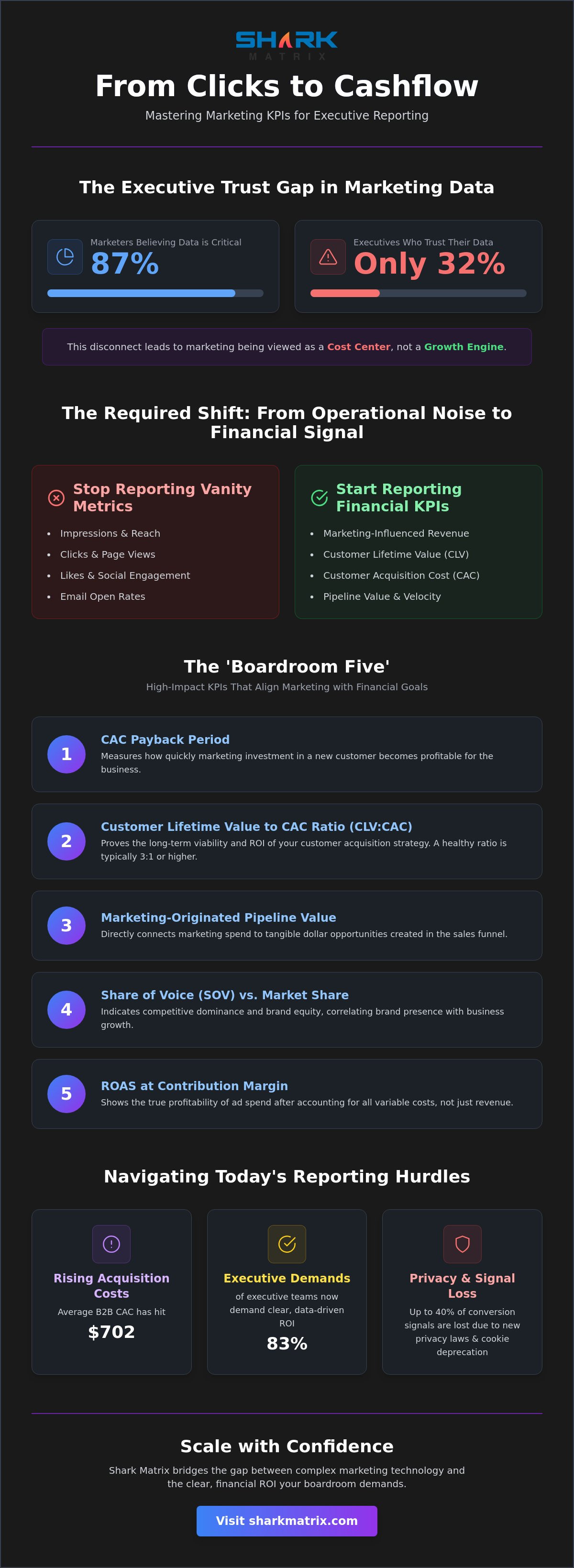
87% of marketers believe a data-driven strategy is critical, yet only 32% report actually trusting their own data. It’s a staggering gap that leaves you vulnerable in the boardroom, especially when executives dismiss marketing as a cost center rather than a growth engine. You’ve likely felt the pressure of rising B2B acquisition costs, which hit an average of $702 this year. Proving a healthy 3:1 LTV:CAC ratio is harder than ever when fragmented silos and new privacy laws in 20 states make your data feel unreliable. Mastering marketing kpis for executive reporting is no longer about tracking clicks; it’s about translating marketing activity into financial velocity.

We’ll help you bridge this trust gap by moving beyond vanity metrics and into high-level financial narratives that secure boardroom buy-in. You’ll learn how to build dashboards that satisfy the 83% of executive teams demanding clear ROI while staying compliant with the latest FTC and EU AI transparency mandates. This framework provides a streamlined path to align your marketing spend directly with revenue growth, ensuring your department is recognized as the strategic asset it truly is.

Key Takeaways

  • Move beyond operational noise by replacing vanity metrics like impressions with high-level financial indicators that speak the language of the C-suite.
  • Identify the ‘Boardroom Five’ metrics to streamline your marketing kpis for executive reporting and prove the long-term viability of your growth strategy.
  • Harness AI and machine learning to shift from reporting historical data to providing predictive insights and automated anomaly detection.
  • Implement the ’10-Second Rule’ for dashboard architecture to ensure your executives can visualize the funnel from awareness to revenue at a glance.
  • Learn how building unified decision engines can help you scale with confidence by aligning technical development with core business outcomes.

The 2026 Shift: Why Traditional Marketing Reporting Fails at the Executive Level

The era of reporting impressions as a primary success metric is over. In 2026, C-suite executives view clicks and likes as operational noise that clutters the decision-making process. They don’t care about “reach” if it doesn’t reach the bottom line. This shift is driven by a massive confidence gap. While 87% of marketers believe a data-driven strategy is critical, only 32% of executives actually trust the numbers they see. This distrust stems from fragmented data silos and a failure to connect marketing kpis for executive reporting to actual financial outcomes.

Privacy laws have fundamentally changed the reporting landscape. With 20 U.S. states now enforcing comprehensive privacy mandates and the deprecation of third-party cookies, marketers are losing up to 40% of their conversion signals. This makes first-party data more than just a strategic asset; it’s a survival mechanism for accurate measurement. Relying on “best guesses” won’t survive a boardroom audit when 83% of executive teams now expect marketing to demonstrate clear ROI and business impact through data-driven dashboards. You must move from a reactive reporting cycle to a proactive growth narrative that justifies every dollar spent.

Marketing Metrics vs. Executive KPIs

Your marketing team might track 50 different data points to optimize a campaign, but your CEO only needs five. An effective executive performance indicator must directly influence a line item on the P&L. If you can’t explain how a metric affects net present value (NPV) or cash flow, it’s an operational metric, not an executive KPI. Successful leaders use “North Star” metrics, such as Marketing-Influenced Revenue, to align every department toward a single growth goal. This clarity stops the boardroom from dismissing marketing as a cost center.

The Cost of Misalignment in the UAE Market

In high-interest economies like the UAE, capital is expensive and scrutiny is high. Executives aren’t just looking for growth; they’re looking for efficient, sustainable growth. Fragmented reporting that fails to speak the language of finance leads to swift budget cuts. National brands are moving toward unified measurement models that integrate everything from SEO to mobile app development services into a single source of truth. By speaking in terms of IRR and revenue velocity, you transform marketing kpis for executive reporting from a discretionary expense into a core engine of the business.

The ‘Boardroom Five’: High-Impact KPIs That Align Marketing with Financial Goals

The board doesn’t want to hear about your latest viral post or email open rates. They want to know how marketing activity translates into cash flow and long-term enterprise value. While your department might track dozens of key marketing KPIs, the executive suite only cares about the ones that signal financial health. These metrics bridge the gap between creative execution and fiscal responsibility. By narrowing your focus to these five indicators, you ensure your marketing kpis for executive reporting stay relevant to the CEO and CFO.

  • CAC Payback Period: Measures how quickly a customer becomes profitable.
  • CLV to CAC Ratio: Proves the long-term viability of your acquisition strategy.
  • Marketing-Originated Pipeline Value: Connects marketing spend to actual dollar opportunities in the sales funnel.
  • Share of Voice (SOV) vs. Market Share: Indicates competitive dominance and brand equity.
  • ROAS at Contribution Margin: Shows the true profitability of ad spend after accounting for variable costs.

The Efficiency Pillar: CAC and Payback

Efficiency is the top priority for any CFO. To report this accurately, you must use a fully-loaded Customer Acquisition Cost (CAC) that includes ad spend, marketing salaries, and the cost of your technology stack. In 2026, the average B2B SaaS CAC has reached $702, making efficiency more critical than ever. CFOs prioritize the payback period because it directly impacts the company’s liquidity. CAC Payback Period is the time required to recover the investment made to acquire a customer. If your payback period is stretching beyond 12 months, it’s a signal that your growth may be unsustainable.

The Growth Pillar: CLV and Pipeline

Growth isn’t just about getting more customers; it’s about getting the right ones. A healthy business should maintain a Customer Lifetime Value (CLV) to CAC ratio of at least 3:1. You can improve this ratio by investing in Search Engine Optimization (SEO) services to build a foundation of organic traffic that lowers long-term acquisition costs. Predictive AI models now allow us to forecast CLV by analyzing historical purchase patterns and potential churn before it happens. This data allows you to report on “Pipeline Value” rather than just “Leads.” It shifts the conversation from volume to velocity, aligning your marketing wins with the sales department’s closing reality. If you need help translating these technical wins into financial narratives, our experts can assist in aligning your digital strategy with core business outcomes.

Marketing KPIs for Executive Reporting: The 2026 Strategic Framework

Beyond Historical Data: Leveraging AI for Predictive Marketing Performance

Traditional reporting is often a post-mortem. It tells you where you spent money last month, but it doesn’t tell you where you should commit your budget tomorrow. This reactive approach is why many executives view marketing as a discretionary expense. AI is fundamentally shifting the narrative. By leveraging machine learning, we can move from reporting what happened to forecasting what will happen. This transition is a core requirement for marketing kpis for executive reporting in a high-growth environment.

In a world where privacy laws have limited conversion signals, Attribution 3.0 has emerged. Marketers are moving toward Media Mix Modelling (MMM) to understand how different channels interact without relying on third-party cookies. This provides a holistic view of the customer journey that aligns with the long-term financial goals of the C-suite.

AI Automation in Performance Tracking

Efficiency in reporting is just as important as efficiency in spending. Integrating ai automation and development allows you to unify data from fragmented sources like PPC and SEO into a single source of truth. The real value lies in automating the insight layer. Modern AI tools don’t just generate charts; they explain the “why” behind the “what.” They can pinpoint exactly which campaign drove a spike in pipeline value. This automation reduces manual reporting hours, letting your team focus on strategic pivots that drive revenue velocity.

Forecasting the National Market Landscape

Generative AI now allows brands to simulate market responses to new campaign angles before they go live. This is a vital tool for national brands looking to protect their equity. For instance, using SEO for brand reputation management ensures your message remains consistent across all digital touchpoints. When choosing the right PPC agency, you should prioritize partners who use these predictive models. They don’t just manage ads; they use historical data to predict the ROI of every campaign, ensuring your marketing kpis for executive reporting always reflect a path toward sustainable growth.

Architecting the Executive Dashboard: Filtering Noise into Strategic Signal

Executives don’t have time to dig through complex spreadsheets or pivot tables. Your marketing kpis for executive reporting must pass the “10-Second Rule.” This means a leader should look at your dashboard and immediately grasp the health of the business. If the screen is a cluttered wall of numbers, it’s just noise. A successful dashboard filters that noise into a clear signal that drives decision-making. It transforms marketing from a mysterious “black box” into a transparent engine of growth.

Visualization is your most powerful tool in the boardroom. You need to map the entire funnel, showing how top-of-funnel awareness flows into bottom-of-funnel revenue. This visual journey proves that your brand building isn’t just a vanity project; it’s the necessary fuel for future sales. To make this even clearer, use a “Traffic Light” system. Green indicates targets are met. Amber suggests a trend to watch. Red signals that executive intervention or a budget pivot is required. This system respects executive time by focusing their attention exactly where it’s needed most.

We often see brands ignore how their technical infrastructure dictates their marketing success. It’s vital to connect digital performance to your website design and development services. A slow-loading landing page or a broken checkout flow is a technical failure that often looks like a marketing failure in the reporting. By highlighting these connections, you show the board that you understand the holistic nature of the business.

Step-by-Step Dashboard Construction

Building a high-impact dashboard requires a disciplined approach. Start by identifying your “North Star” metric for the current quarter, such as total revenue influenced by marketing. Next, layer in the “Boardroom Five” supporting metrics we identified earlier, like CAC and Pipeline Value. Finally, integrate real-time AI-driven forecasting widgets. These widgets move the conversation from what happened last month to what we expect to happen next month, providing the predictive clarity that CEOs crave.

Communication Strategy for the Boardroom

The best data in the world fails if it’s wrapped in jargon. Stop using “Marketing-Speak” when presenting to the board. Translate “CTR” into “Customer Interest” and “CPC” into “Acquisition Cost.” This simple shift in vocabulary builds immediate trust with the CFO. Every chart you present must pass the “So What?” test. If a data point doesn’t explain why the business is healthier or how it will grow, it doesn’t belong in the presentation. Be prepared for the inevitable question regarding sustainability. Use your LTV:CAC ratios to prove that your growth isn’t just fast, but profitable. If you want to ensure your reporting is as sharp as your strategy, consult with our experts to build a dashboard that wins the boardroom.

Scaling with Confidence: How Shark Matrix Bridges the Gap Between Tech and ROI

Bridging the gap between technical execution and financial reporting is the final hurdle for most marketing leaders. It’s one thing to have a dashboard; it’s another to have a unified decision engine that provides a single source of truth for the board. Shark Matrix specializes in custom software engineering that pulls data from every corner of your organization. This ensures that your marketing kpis for executive reporting aren’t just estimates, but verified financial facts. We move beyond simple platform metrics to show how every digital touchpoint contributes to the company’s net value.

Our approach integrates an end-to-end digital strategy with your core business goals. For example, our mobile app development services aren’t just about building an interface; they’re about creating a data-rich environment that fuels your marketing funnel. By ensuring your apps and websites are built with measurement in mind, we create a measurable financial footprint for every campaign. This is particularly vital in the UAE business landscape, where consumer behavior is unique and national brands require high-precision data to maintain competitive dominance.

The Shark Matrix Advantage

We’ve spent over 15 years, since our founding in 2010, fusing technical engineering with high-impact digital marketing. This legacy gives us a deep understanding of the regional market that many global agencies lack. Our proprietary ai automation services and machine learning development services eliminate the data silos that typically frustrate CMOs. We don’t just report on what happened; we build the infrastructure that allows you to predict what’s next. This fusion of engineering and marketing is why national enterprises trust us to handle their most complex growth challenges.

Securing Your Next Budget Cycle

The ultimate goal of any reporting framework is to secure the resources you need to grow. We help CMOs build a bulletproof case for increased digital investment by providing the data-driven narratives that CFOs respect. Our reporting models have been tested in boardrooms across the country, consistently proving the ROI of integrated campaigns. When you can show that marketing spend is a growth engine rather than a cost, budget approvals become a formality. Partner with Shark Matrix to elevate your executive reporting and turn your data into a strategic asset that drives national growth.

Elevating Marketing from Cost Center to Growth Engine

Success requires a fusion of technical engineering and high-impact strategy. Since 2010, we’ve helped national brands navigate the UAE market by bridging the gap between fragmented data and boardroom-ready results. Our expertise in custom software engineering and AI development ensures your data remains a trusted asset rather than a source of confusion. Our end-to-end digital marketing and strategy services ensure your campaigns have a measurable financial footprint that executives trust. It’s time to stop reporting on the past and start forecasting your future.

Transform your marketing data into a strategic growth engine with Shark Matrix. You have the tools and the framework to lead with confidence; now it’s time to build the engine that drives your business forward.

Frequently Asked Questions

What is the most important marketing KPI for a CEO to track?

Customer Acquisition Cost (CAC) Payback Period is arguably the most vital metric for a CEO. It measures the time required to recover the marketing investment spent to acquire a single customer. This directly impacts company liquidity and cash flow, making it a favorite in the boardroom. While other metrics show growth, this one proves the speed and efficiency of that growth’s profitability.

How do I distinguish between marketing metrics and executive KPIs?

Distinguish them by their direct impact on the P&L statement. Executive KPIs influence financial line items like revenue, net profit, or customer equity. Operational metrics, like click-through rates or cost-per-click, are useful for your team’s daily optimizations but don’t belong in high-level reports. If a metric doesn’t pass the “So What?” test regarding overall business health, it’s a metric, not a KPI.

Can AI really predict the ROI of future marketing campaigns?

Machine learning models can accurately forecast outcomes by analyzing historical data alongside current market trends. These tools provide Predictive ROAS, which helps you present a budget with a projected return rather than a hopeful guess. Using AI for marketing kpis for executive reporting shifts your narrative from reactive history to proactive strategy, allowing for real-time pivots before budgets are wasted.

How do I report on brand reputation without using vanity metrics?

Move away from “reach” and focus on Sentiment Analysis or Share of Voice (SOV) compared to market share. These indicators reveal your competitive dominance and brand equity in a way that correlates with future revenue velocity. By tracking these as leading indicators, you can prove that brand health is a driver of long-term business viability rather than just operational noise.

What is a ‘good’ CLV to CAC ratio for a national enterprise in 2026?

A healthy business should maintain a Customer Lifetime Value to Customer Acquisition Cost (LTV:CAC) ratio of at least 3:1. In 2026, with the average B2B SaaS CAC reaching $702, maintaining this efficiency is critical for long-term survival. If your ratio falls below this threshold, it signals that your growth strategy might be unsustainable or that your acquisition costs are outstripping your customer value.

How often should I present marketing KPI reports to the board?

You should present high-level dashboard summaries monthly and perform deep-dive strategic reviews quarterly. Monthly reports keep the board informed on the “Traffic Light” status of major goals. Quarterly presentations allow for a more detailed analysis of marketing kpis for executive reporting, such as LTV trends and pipeline velocity, which require more time to show meaningful shifts.

How do I handle data gaps caused by privacy regulations in my reporting?

Address these gaps by prioritizing first-party data collection and utilizing Media Mix Modelling (MMM). Marketers are currently losing up to 40% of conversion signals due to privacy laws in 20 states and the deprecation of third-party cookies. MMM allows you to understand channel performance holistically without relying on individual user tracking, ensuring your reporting remains accurate and legally compliant.

What are the best tools for building executive-level marketing dashboards?

The best tools are those that create a “single source of truth” by unifying data from your CRM, ad networks, and analytics platforms. Custom software engineering solutions or unified decision engines are often superior to off-the-shelf tools because they eliminate fragmented data silos. Your dashboard must pass the “10-Second Rule,” allowing any executive to grasp the business’s health and trajectory instantly.

Categories
Digital Marketing

Strategic Content Marketing Agency UAE: Driving National Growth in 2026

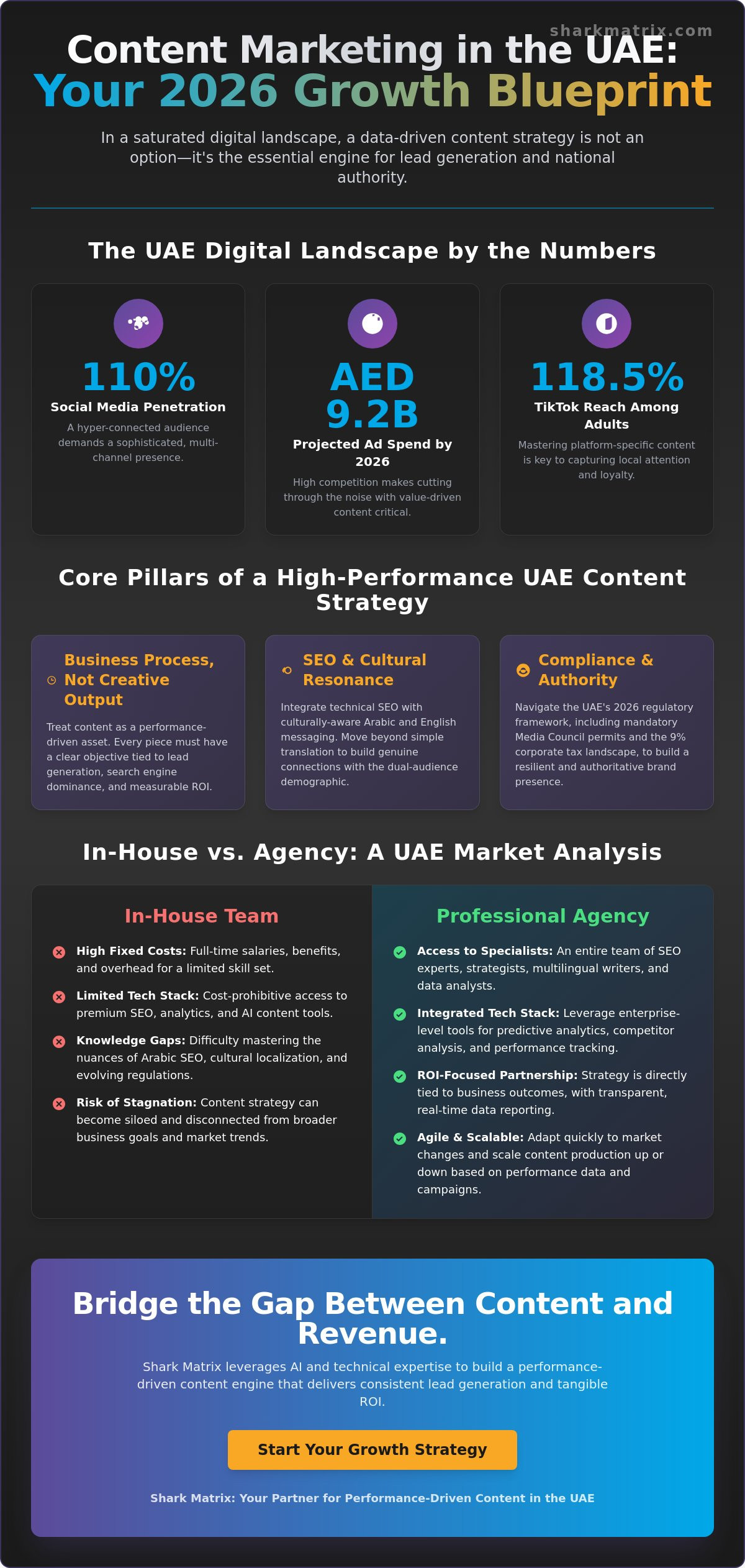
Did you know that social media penetration in the Emirates has reached a staggering 110% while digital advertising spend is projected to hit AED 9.2 billion by the end of 2026? In such a saturated environment, simply posting content isn’t a viable strategy for business growth. You likely feel the weight of high competition and the struggle to bridge the cultural gap between English and Arabic audiences. It’s frustrating when organic traffic stays flat despite your team’s hard work. Partnering with a professional content marketing agency uae is the essential step to transform your brand storytelling into a high performing engine for measurable ROI and national authority.

You deserve a strategy that connects your content production directly to lead generation and search engine dominance. We’ll show you how to build a data driven infrastructure that thrives under the UAE’s 2026 regulatory framework, including the mandatory Media Council permits and the 9% corporate tax landscape. You’ll discover the exact steps to create culturally resonant content that captures the 118.5% TikTok reach and converts local attention into long term market loyalty.

Key Takeaways

  • Understand why content is a strategic business process rather than just creative output to effectively reach the UAE’s unique dual-audience demographic.
  • Learn how a professional content marketing agency uae integrates SEO with culturally resonant Arabic messaging to move far beyond simple linguistic translation.
  • Compare the total cost of ownership for in-house teams versus agencies, including the high-value tech stacks and specialized tools that agencies provide.
  • Identify the essential criteria for selecting a partner that prioritizes strategic depth and transparent, real-time data reporting over surface-level aesthetics.
  • Discover how Shark Matrix leverages AI and technical expertise to bridge the gap between content production and consistent lead generation.

What is a Content Marketing Agency and Why Does Your UAE Business Need One?

Content marketing isn’t just about writing blogs or filming reels. It’s a structured business process designed to attract and retain a clearly defined audience. To understand the foundations of this discipline, you can look at What is Content Marketing? as a starting point. In the Emirates, this process becomes even more critical due to the 110% social media penetration rate recorded in early 2026. A professional content marketing agency uae helps you move past the phase of sporadic posting and into a cycle of data-driven growth.

The UAE market presents a unique “dual-audience” challenge. You aren’t just speaking to one demographic; you’re balancing the cultural nuances of Emirati nationals with a massive, diverse expat population. By February 1, 2026, the UAE Media Council made it mandatory for all digital advertisers to hold a permit. This regulation means your content must be compliant, professional, and strategically sound to avoid heavy penalties. Failure to obtain the required permit can result in fines of AED 10,000 for a first offense and up to AED 40,000 for repeat violations.

The Shift from Interruption to Information

With digital ad spending hitting AED 9.2 billion in 2026, consumers are drowning in noise. They’ve learned to ignore traditional banners and intrusive pop-ups. Instead of interrupting their day, high-performance content answers their specific search intent. Whether your audience is looking for luxury real estate or corporate tax advice, providing educational assets builds long-term brand equity. This value-first approach captures high-value leads by positioning your business as a trusted authority before a sales pitch even occurs.

Content as the Foundation of Digital Ecosystems

Content is the fuel for your entire digital presence. It powers your SEO rankings, gives your Social Media Marketing substance, and improves the quality score of your PPC campaigns. When you provide value first, you naturally lower your customer acquisition costs (CAC). A specialized content marketing agency uae understands that a national strategy requires more than just translating English into Arabic. It requires cultural resonance that respects local traditions while leveraging the UAE’s 99% internet penetration rate. This technical approach ensures your brand is discovered by AI-led search tools and human users alike.

Core Pillars of a High-Performance Content Strategy in the UAE

In the 2026 digital economy, “content is king” is an oversimplification that ignores the technical infrastructure required for visibility. A top tier content marketing agency uae treats every piece of content as a performance driven asset rather than a creative vanity project. High performance strategies now rely on the seamless integration of technical SEO and high quality storytelling. If your content isn’t optimized for search, it won’t be found; if your SEO lacks quality content, it won’t convert. To effectively build a content marketing strategy, brands must prioritize audience definition and multi channel distribution across the Emirates’ unique digital landscape.

Data driven ideation has replaced guesswork. With WhatsApp and Facebook used by 85.8% and 80.3% of the population respectively, your distribution must be as strategic as the production itself. We use predictive analytics to determine what your audience is searching for before your competitors do. This ensures your budget focuses on topics with high search intent and lead generation potential. Before scaling your distribution efforts, conducting a thorough social media audit for your UAE brand ensures your channels are optimized, compliant, and aligned with your content goals. If you’re looking to scale your reach while maintaining cultural integrity, exploring a bespoke content strategy can help align your brand with these national trends.

Arabic Localization and Cultural Nuance

Arabic Digital Marketing is the largest untapped growth lever for national brands in 2026. Many businesses make the mistake of using machine translation or “Modern Standard Arabic” that feels clinical and disconnected. Localized GCC preferences require a native touch that understands regional dialects and cultural sensitivities. Arabic SEO represents a massive opportunity because competition for Arabic keywords is significantly lower than for English ones, despite the high demand for local language content. Moving beyond simple translation to native led creation ensures your brand builds authentic trust with Emirati nationals and the wider Arab community.

AI-Enhanced Content Production and Optimization

The rise of Generative Search (SGE) means that content must now satisfy both human readers and AI discovery engines. We utilize AI automation to handle repetitive tasks like data sorting and basic formatting, which allows our creative teams to focus on high level strategy and brand voice. This technology also helps us optimize content for voice search, a growing trend as more UAE residents adopt smart home devices. AI-content synergy is the balance between efficiency and expertise. By leveraging these tools, a content marketing agency uae can produce hyper personalized content at a scale that was previously impossible, ensuring every touchpoint feels relevant to the individual user.

Strategic Content Marketing Agency UAE: Driving National Growth in 2026

In-House vs. Content Marketing Agency: A UAE Market Analysis

Deciding between building an internal team or hiring a content marketing agency uae often comes down to the total cost of ownership (TCO). While an in-house team offers direct control, the financial burden in the Emirates is substantial. Beyond basic salaries, you must account for employee work visas, which range from AED 3,500 to AED 7,000 per person. When you add the 9% corporate tax on profits exceeding AED 375,000, every additional overhead expense must justify its existence through high performance. Many businesses find that the cost of a single senior hire covers a full agency retainer that provides a whole team of specialists.

Agencies offer a significant “Tech Stack” advantage that internal departments rarely match. Professional tools for SEO, sentiment analysis, and AI content optimization can cost thousands of Dirhams every month. A specialized agency absorbs these costs, providing you with enterprise grade data as part of your monthly fee. This access allows for faster speed to market, which is vital in a country where internet penetration sits at 99%. In the 2026 landscape, being slow to react to a trend means losing visibility to more agile competitors.

The Hidden Costs of In-House Teams

Recruiting “T-shaped” marketers who master SEO, Arabic copywriting, and UI/UX design is a major challenge in the current labor market. Even if you find them, the training and retention costs are high. If a key team member leaves, your content production grinds to a halt. Scalability is another issue. When your business needs to ramp up for a seasonal event, an internal team often lacks the bandwidth to handle the surge without burnout. An agency provides the elasticity to scale production up or down based on your specific campaign needs.

The Agency Advantage: Specialized Expertise

A content marketing agency uae brings a “Fresh Eyes” perspective that prevents brand stagnation. Agencies work across multiple industries, allowing them to cross pollinate successful tactics from finance to retail. You gain immediate access to a full department of experts for a predictable monthly cost. This includes:

  • Service continuity: No downtime during annual leave or employee turnover.
  • Direct accountability: Agencies are contractually obligated to hit specific lead generation and ROI targets.
  • Strategic depth: Access to diverse creative talent ensures your Arabic and English content remains culturally relevant and compliant with Media Council regulations.

Outsourcing provides a level of strategic depth and technical agility that is difficult to replicate internally without a massive budget. In the fast paced 2026 market, the ability to pivot based on real time data is the difference between leading the market and falling behind.

How to Evaluate and Choose the Right Agency for National Growth

Selecting a content marketing agency uae requires looking past flashy reels and aesthetic portfolios. In 2026, with digital ad spend reaching AED 9.2 billion, you need a partner who understands the technical underpinnings of search and the legal requirements of the UAE Media Council. A great agency doesn’t just show you “pretty” posts. They show you a roadmap for moving users from Top-of-Funnel (TOFU) awareness to Bottom-of-Funnel (BOFU) conversion. This transition is critical in the local B2B and B2C markets where the journey from discovery to purchase is often multi-layered.

Demand transparency. If an agency hides behind static monthly PDF reports, they likely aren’t tracking the data that actually impacts your revenue. You deserve real-time access to dashboards that connect specific content pieces to lead generation forms. Look at the agency’s own digital presence. If their blog hasn’t been updated in months or their own search visibility is poor, they aren’t practicing the strategies they’re selling. Their internal success should prove their capability to be the right content marketing agency uae for your brand.

Critical Metrics to Demand from Your Agency

Stop focusing on vanity metrics like likes and shares. While these show reach, they don’t always reflect revenue. Instead, prioritize growth metrics such as lead quality, conversion rates, and your ‘Share of Voice’ within the UAE market. Share of Voice measures how much of the digital conversation your brand owns compared to your direct competitors. This data is essential for brands aiming for national dominance. Content ROI must be measured over a 6-12 month horizon to account for the compounding nature of organic search and brand authority.

Cultural and Technical Alignment

Verify their track record with Arabic digital marketing. In a market where 85.8% of people use WhatsApp and 80.3% use Facebook, your content must be optimized for mobile consumption and cultural resonance. Ask how they handle UI/UX integration for content-heavy sites. A blog post is useless if the page takes too long to load on a mobile connection in Dubai. You need a partner mindset rather than a vendor relationship. A partner challenges your assumptions and brings data-backed solutions. A key part of that partnership is ensuring your social channels are performing at their peak; a comprehensive social media audit aligned with 2026 UAE regulations is an essential step before committing to any long-term content strategy. Beyond your website content, social platforms like Instagram demand their own specialized approach; understanding how to select a dedicated instagram marketing agency in dubai can further strengthen your overall digital presence. If you want to see how a strategic approach transforms brand authority, book a consultation with our performance team.

Shark Matrix: Your Partner for Performance-Driven Content in the UAE

Shark Matrix operates at the intersection of technical precision and creative storytelling. As a premier content marketing agency uae, we don’t just produce words; we build digital infrastructures that survive the high competition of 2026. Our approach integrates Search Engine Optimization (SEO) with advanced AI automation and development to ensure your brand is discovered by both human users and generative search engines. We recognize that with the UAE’s 110% social media penetration rate, your content must be hyper-personalized and data-driven to cut through the noise.

The “Shark Matrix Method” moves beyond simple production. We start with a deep dive into your current digital footprint, analyzing how your content aligns with the 2026 Media Council regulations. We ensure every piece of advertising content complies with the mandatory Advertiser Permit requirements, protecting you from the AED 10,000 fines that non-compliant businesses face. By merging Arabic Digital Marketing with technical performance, we turn your brand into a national authority that resonates with both Emirati nationals and the diverse expat community.

Beyond Copywriting: A Full-Service Digital Powerhouse

Our team provides more than just a standard content marketing agency uae experience. We leverage our in-house expertise in Web Design and Development and UI/UX Design to ensure your content lives on a high-performing platform. A slow website or poor mobile experience can destroy the value of great content, especially when 118.5% of the population aged 18 and older is active on TikTok. We use AI to scale content production while maintaining a human brand voice, helping you lower your customer acquisition costs. Our focus on Online Reputation Management (ORM) ensures that as your visibility grows, your brand’s credibility remains untarnished.

Start Your Journey to Market Authority

Partnering with Shark Matrix means moving away from stagnant traffic and towards predictable lead generation. We begin every partnership with a comprehensive strategy that accounts for the 9% corporate tax environment and the need for high-efficiency marketing spend. Our team will audit your existing assets, identify gaps in your Arabic SEO, and create a roadmap for national growth. We’ve already helped partners navigate the 2026 landscape by bridging the gap between English and Arabic search intent with measurable results.

If you’re ready to transform your digital presence into a measurable revenue driver, the time to act is now. Scale your brand authority with Shark Matrix and secure your place at the top of the UAE’s digital economy.

Secure Your Brand’s Future in the UAE Digital Economy

The 2026 digital economy in the Emirates doesn’t reward passive participation. With internet penetration at 99.0% and social media usage reaching 110%, your brand must move beyond generic posting. You’ve seen how a technical approach to storytelling, cultural resonance in Arabic, and AI-driven efficiency create a foundation for long-term ROI. Transitioning from stagnant traffic to market dominance requires a partner that understands the nuances of the UAE Media Council’s regulations and the 9% corporate tax landscape.

Choosing a specialized content marketing agency uae ensures you have the expertise to bridge the gap between English and Arabic audiences while maintaining technical SEO excellence. Shark Matrix, founded in 2010, brings over a decade of deep market expertise to your strategy. We are pioneers in AI-driven marketing automation and specialists in Arabic Digital Marketing. Our methods transform content from an expense into a performance-driven asset that generates high-quality leads.

Ready to outpace the competition? Drive National Growth with a Tailored Content Strategy today. Your brand’s journey to national authority starts with a single, data-backed decision. Build your legacy in the UAE market with confidence.

Frequently Asked Questions

How much does a content marketing agency in the UAE cost?

Professional fees for a content marketing agency uae generally range between AED 4,000 and AED 20,000 per month as of May 2026. This investment covers strategy, production, and distribution across multiple channels. You should also account for the mandatory UAE Media Council Advertiser Permit, which is free for residents for the first three years but costs AED 500 for a three-month visitor permit if your creators are non-residents.

How long does it take to see results from content marketing?

Measurable results in organic traffic and lead quality typically appear between 6 and 9 months of consistent activity. While social media provides faster engagement, search engine visibility requires time to build authority. By the 12-month mark, companies usually see a compounding effect where the cost per lead decreases significantly compared to traditional paid advertising channels.

Do I need both English and Arabic content for my UAE business?

A dual-language strategy is vital because the Emirates has a unique population split between Emirati nationals and a diverse expat community. While internet penetration is at 99.0%, cultural resonance differs between demographics. Native-led Arabic content is a major growth lever in 2026, as it allows brands to tap into the high demand for local language search results that many competitors ignore.

Can content marketing help with my company’s online reputation?

Content marketing is the most effective way to manage your brand’s digital narrative. By publishing high-quality, authoritative assets, you ensure that positive, educational information dominates search results for your brand name. This proactive approach to Online Reputation Management (ORM) helps mitigate the impact of negative feedback and builds long-term trust with 85.8% of the population using platforms like WhatsApp for recommendations.

How does AI impact content marketing in 2026?

AI has transformed the industry by enabling hyper-personalization and predictive analytics. In 2026, agencies use AI to analyze vast datasets and predict which topics will trend before they hit peak search volume. It also plays a critical role in optimizing content for Generative Search (SGE), ensuring your brand provides the definitive answer when AI-driven search engines summarize information for users.

What is the difference between social media management and content marketing?

Social media management focuses on the day-to-day engagement and distribution on platforms like Facebook or TikTok. Content marketing is the overarching strategy that creates the high-value assets used across those platforms. A content marketing agency uae builds the foundation of blogs, videos, and whitepapers that social media then amplifies to drive users back to your owned website for conversion.

Is content marketing effective for B2B companies in the UAE?

B2B companies benefit immensely from content marketing because their sales cycles are typically longer and require multiple touchpoints. Decision-makers in the UAE corporate sector rely on technical whitepapers and case studies to justify budgets. Providing this educational value positions your business as a subject matter expert, which is essential for winning contracts in a market where corporate tax is now 9%.

How do you measure the ROI of a content strategy?

ROI is measured by tracking lead generation, conversion rates, and the total revenue generated from organic search traffic. Instead of looking at likes or shares, we focus on the cost of acquiring a customer through content versus paid ads. Most successful brands in 2026 find that content-driven leads have a 30% higher lifetime value because they were acquired through trust and education rather than interruption.