

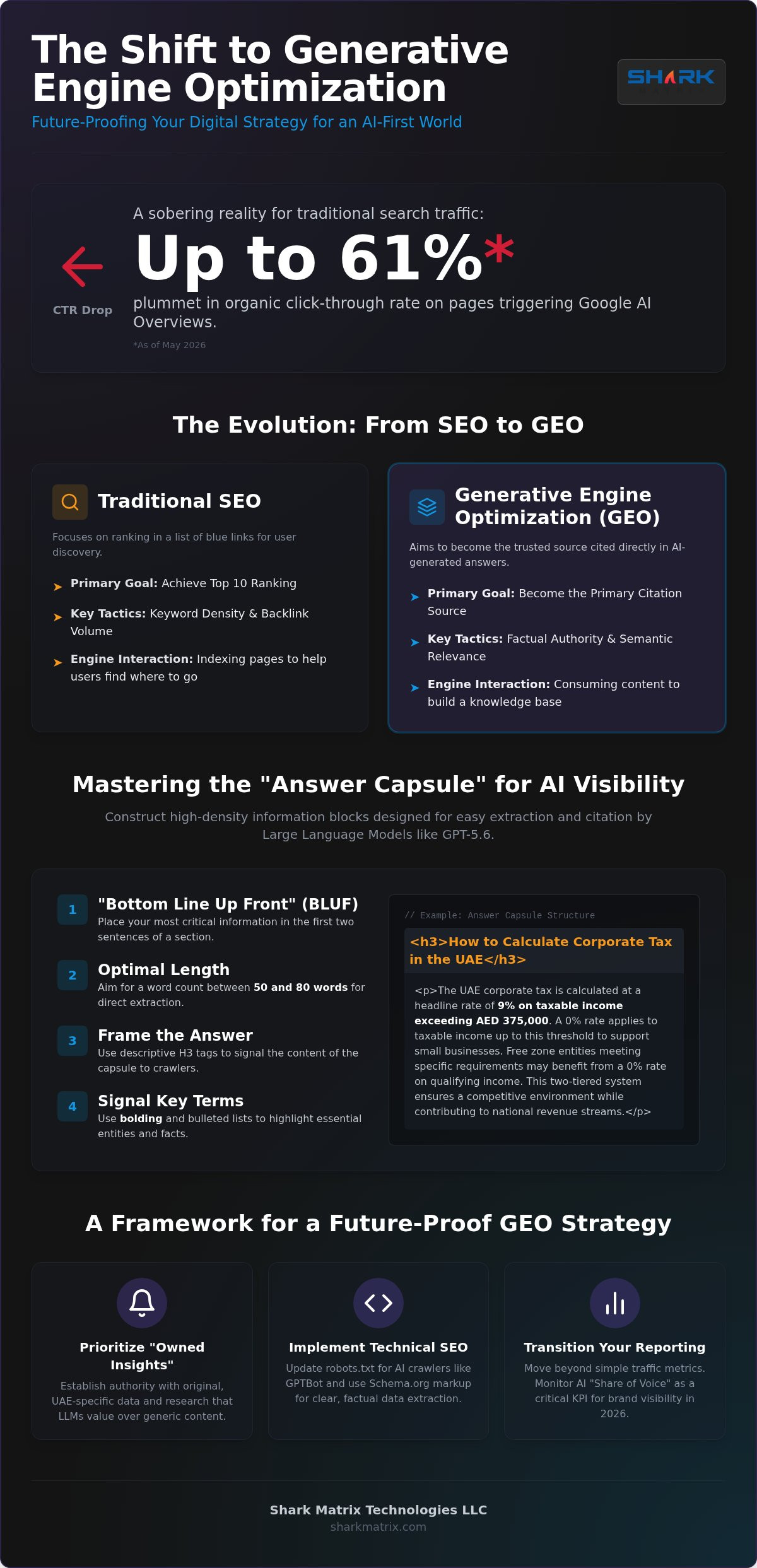
Did you know that the organic click-through rate on pages triggering a Google AI Overview has plummeted by as much as 61% as of May 2026? It’s a sobering reality for many businesses across the United Arab Emirates that relied on traditional search traffic. You’ve likely noticed that even when you rank first, a generative answer often pushes your link out of sight. It’s frustrating to see your expertise used to train models while your website visits stall. This shift requires a pivot toward a comprehensive generative engine optimization strategy that prioritizes being cited as a primary source rather than just a blue link.
We’ll help you master the specific content structures and technical SEO tactics required to earn citations and traffic from ChatGPT’s GPT-5.6 and other generative engines. You’ll learn how to build “Answer Capsules” that minimize friction for LLM synthesis and ensure your brand remains visible in an AI-first world. This article provides a clear framework for content formatting and the metrics you need to track AI visibility. By the end, you’ll have a future-proofed national digital strategy designed to dominate the evolving UAE search market.
Key Takeaways
- Shift your focus from traditional ranking to becoming the primary citation source by aligning your content with Large Language Model synthesis patterns.
- Learn to construct “Answer Capsules,” which are high-density information blocks designed for easy extraction and citation by engines like ChatGPT.
- Prioritize “Owned Insights” and original UAE-specific data to establish national authority that LLMs value over generic, repurposed content.
- Implement a robust generative engine optimization strategy by updating technical elements like robots.txt for GPTBot and using Schema.org markup for factual extraction.
- Transition your reporting from simple traffic metrics to monitoring AI “Share of Voice” as a critical KPI for maintaining brand reputation in 2026.
What is Generative Engine Optimization (GEO)?
As we move through 2026, the digital landscape in the United Arab Emirates has shifted from a list of links to a conversational interface. What is Generative Engine Optimization (GEO) exactly? It represents the strategic evolution of search, moving beyond traditional ranking factors to focus on how Large Language Models (LLMs) perceive and synthesize information. While traditional SEO helps you rank in the top ten, a generative engine optimization strategy aims to make your brand the definitive source that ChatGPT or Perplexity cites within their generated answers.
Engines like ChatGPT (using the GPT-5.6 Sol model) and Claude don’t just “index” pages; they consume them to build a knowledge base. To be selected for a citation, your content must offer high factual density and clear structural markers that these models can easily parse. Shark Matrix Technologies LLC helps national enterprises bridge this gap by leveraging natural language processing expertise to ensure content is not just readable by humans, but digestible by AI. Traditional SEO remains the foundation, as technical health and domain authority still signal trust to AI crawlers, but the goal has shifted toward becoming the “knowledge provider” for the engine’s response.
The Evolution from SERPs to Generative Answers
The “Zero-Click” reality has become a dominant force for UAE brands. With Gartner predicting that traditional search volume will decrease by 25% by the end of 2026, the competition for visibility has intensified. Traditional search engines index pages to help users find where to go, but LLMs aggregate data to tell users what they need to know immediately. For national brands, this means visibility is no longer about the click alone; it’s about being the footnote that validates the AI’s answer. These citation links are now the primary drivers of high-intent referral traffic, as users only click through when they require deeper, authoritative detail beyond the initial summary.
Key Differences Between SEO and GEO
The transition from SEO to GEO requires a fundamental change in how we produce content. Traditional SEO often prioritized keyword density and backlink volume. In contrast, GEO prioritizes semantic relevance and factual authority. AI engines look for context and the relationship between entities rather than just matching a search term. GEO is the tactical alignment of content with LLM synthesis patterns. While a high backlink count still matters for general authority, LLMs are increasingly sensitive to the accuracy of the information provided. Using generative AI development tools to audit your own content for factual clarity is now a standard part of a modern digital strategy.
Mastering the Answer Capsule for AI Visibility
To succeed with a generative engine optimization strategy, you must rethink your content as a series of “Answer Capsules.” These are standalone, high-density blocks of information designed specifically for extraction by Large Language Models. Unlike traditional blog paragraphs that build context slowly, a capsule provides immediate, factual value. Research has shown that structural adjustments are often more important than word count alone. According to foundational research on GEO, these high-density blocks significantly increase the likelihood of your content being cited as a primary source in engines like ChatGPT and Claude.
Clarity and brevity are your primary tools. An LLM’s goal is to synthesize an answer with minimal computational “noise.” If your content is buried in flowery prose or unnecessary filler, the model will likely skip your page in favor of a more direct competitor. Using bolding for key terms and concise bulleted lists signals to the AI crawler that this specific section contains the definitive answer to a user’s query. It’s a shift in mindset. You’re no longer just writing for a human reader; you’re providing the raw data for an AI’s summary.
Structural Requirements of a Cited Capsule
Implementing the “Bottom Line Up Front” (BLUF) approach is essential for AI visibility in 2026. Your most important information should appear in the first two sentences of a section. Optimal word counts for these summaries usually fall between 50 and 80 words. This length is short enough for an LLM to extract in full but long enough to provide the necessary semantic depth. You should also use H3 tags to “frame” the answer. For example, an H3 titled “How to Calculate Corporate Tax in the UAE” followed immediately by a 60-word summary is much more likely to be cited than a long, unformatted guide.
The “No-Link” Paradox in GEO
Clean text is often more attractive to AI models than link-heavy paragraphs. While internal linking is a staple of traditional SEO, high link density within an Answer Capsule can actually reduce your citation rate. LLMs may perceive excessive links as “internal friction” that complicates the synthesis of a clean answer. To combat this, place your strategic citations and internal links outside the core answer block. This keeps the capsule “pure” for the AI while maintaining a good experience for human users. If you’re struggling to structure your technical data for these models, Shark Matrix provides specialized natural language processing services to help national brands audit and refine their content for 2026 standards.
Leveraging Original Data and National Authority
Large Language Models are increasingly sophisticated in 2026. They’ve moved past simple pattern matching and now actively seek out “Owned Insights” to differentiate their answers from generic summaries. If your content merely repurposes what’s already found on common knowledge sites, ChatGPT has no reason to cite you. It already knows that information. To win with a generative engine optimization strategy, you must provide the raw data the AI lacks. This involves publishing original surveys, national whitepapers, and proprietary case studies that offer fresh perspectives on the UAE market.
Authoritativeness is built through the E-E-A-T (Experience, Expertise, Authoritativeness, and Trustworthiness) framework. Google and AI engines alike look for signals that your brand is a legitimate leader. Shark Matrix utilizes specialized Natural Language Processing services to audit your content’s sentiment and factual density. This ensures your brand sounds like the expert the AI wants to quote. When your content is verified as high-density and factually unique, it moves to the top of the AI’s synthesis queue.
Building National-Level Authority in the UAE
National authority requires a deep dive into regional specifics. AI models prioritize sources that provide localized context, such as national economic trends or specific UAE regulatory updates. Accuracy in the Arabic language is another critical factor. Regional LLMs are designed to serve the local population, and they favor content that demonstrates linguistic precision. By leveraging Arabic digital marketing, you can ensure your content is correctly indexed and cited by localized AI models that cater to the UAE’s unique demographic. This isn’t just about translation; it’s about cultural and contextual relevance that AI engines recognize as authoritative.
Owned Insights: The GEO Gold Mine
Proprietary data is the most valuable asset in GEO. When you publish unique national statistics, you create a source that the AI cannot ignore. Structure this data using tables and Schema markup to make it “quotable.” LLMs are more likely to extract data from a well-organized table than from a dense paragraph. Original data acts as a fingerprint that LLMs must credit to maintain accuracy. When an AI agent needs to provide a specific percentage or a unique trend, it will look for the originator of that data. Providing these unique data points ensures your brand becomes an essential part of the AI’s knowledge graph across the country.
Technical Optimization for LLM Crawlers and Indexing
Content structure is only half the battle. To solidify your generative engine optimization strategy, you must ensure the technical foundation of your website is accessible to AI agents. In 2026, robots.txt management has evolved beyond simply blocking unwanted bots. You now need to provide explicit permissions and pathways for agents like GPTBot, ClaudeBot, and specialized regional crawlers. Managing these permissions ensures that your most authoritative “Answer Capsules” are prioritized during the training or real-time retrieval process. If your technical architecture is cluttered, AI engines may struggle to parse your data, leading to hallucinations or, worse, complete omission from citations.
Site speed and clean HTML are more critical than ever. LLMs don’t “view” your site like a human; they parse the underlying code to extract semantic meaning. Messy JavaScript or excessive nested divs create “extraction friction.” By maintaining a lean DOM (Document Object Model), you make it easier for AI models to identify the relationships between your data points. Shark Matrix leverages generative AI development tools to simulate how different LLMs view and weight your site’s technical structure. This allows national brands to identify and fix parsing errors before they impact visibility.
Schema Markup for the AI Era
Standard SEO schema is no longer enough to win in 2026. You must implement advanced JSON-LD markup that specifically targets factual extraction. Using Speakable, FactCheck, and Dataset schema provides a clear roadmap for LLMs to follow. These tags act as a secondary layer of verification, confirming that your data is structured for accuracy. For UAE enterprises, national entity tagging is essential. By explicitly defining the relationships between your brand, national regulations, and regional market data in your schema, you ensure that AI models recognize your brand as a primary authority for UAE-specific queries. This technical clarity reduces the risk of being overshadowed by generic global competitors.
API and Feed Integration
Static indexing is often too slow for the fast-paced 2026 market. To ensure real-time accuracy in AI answers, many national brands are exploring direct data feeds and API integrations. This allows AI models to pull the latest UAE market statistics or pricing directly from your verified source. Implementing AI automation services can help streamline this distribution, ensuring your brand messaging remains consistent across all AI-accessible endpoints. This proactive approach prevents AI engines from relying on outdated or cached data, which is vital for maintaining trust in sectors like finance or real estate. If you need to upgrade your technical infrastructure for the AI era, contact Shark Matrix for a technical GEO audit to ensure your site is fully optimized for 2026 crawlers.
Future-Proofing Your Brand with AI-Driven SEO
In 2026, protecting your brand requires more than monitoring social media or reviews. It involves a proactive Online Reputation Management strategy that accounts for how LLMs represent your business to the public. If an AI engine provides a summary of your services without citing your website, you lose both traffic and the ability to verify the information. A robust generative engine optimization strategy acts as a safeguard. It ensures that when users ask about your industry, the AI pulls from your verified knowledge base rather than relying on outdated or competitor-led content.
This visibility doesn’t happen in a vacuum. There’s a powerful synergy between comprehensive SEO services and AI-driven results. While GEO focuses on citation patterns, traditional SEO provides the domain trust and technical health that AI engines use to filter for quality. Shark Matrix helps national enterprises bridge this gap. We combine over a decade of national SEO experience with cutting-edge AI development to ensure your brand dominates the generative landscape across the country.
Measuring Success in a Citation-Based World
Success in this new era is measured by AI “Share of Voice.” This KPI tracks how often your brand is cited compared to others in your sector across different models. You need specialized tools to monitor mentions in ChatGPT, Claude, and Perplexity. Analyzing referral traffic patterns from these sources is also vital. When you see a spike in traffic from an AI agent, you can trace it back to a specific “Answer Capsule” and replicate that success across other topics. This allows you to adjust your content strategy in real-time as AI models update their citation preferences.
The Role of AI Chatbots in GEO
Internal tools are equally important for future-proofing your digital presence. By investing in AI chatbot development, you can simulate national user intent and test how your content performs before it’s indexed by external models. These internal chatbots act as a sandbox. They help you predict which pieces of content are most likely to earn a citation based on current LLM synthesis patterns. This predictive approach saves time and ensures your resources are spent on the most impactful content. Contact Shark Matrix today to audit your GEO readiness and secure your spot in the answers that define the UAE market.
Dominating the UAE Knowledge Graph in 2026
The transition from traditional search results to AI-generated answers isn’t just a minor shift; it’s the new standard for national digital visibility. By mastering “Answer Capsules” and technical schema, your brand can move from a hidden link to a primary cited source. Succeeding with a generative engine optimization strategy requires a deep understanding of how Large Language Models synthesize data and the technical agility to adapt to 2026 standards. You’ve seen how original data and national authority act as the fingerprints that LLMs must credit to maintain accuracy across the country.
Shark Matrix has been a leader in national UAE digital strategy since 2010. With sixteen years of expertise and a specialized AI and Machine Learning department, we bridge the gap between traditional search and generative visibility for enterprise-level brands. We help you transform your content into the authoritative data that models like ChatGPT rely on for regional accuracy. Secure Your AI Visibility with Shark Matrix GEO Services and ensure your brand remains the definitive voice. The future of search is conversational; it’s time your business leads the conversation.
Frequently Asked Questions
How does ChatGPT decide which websites to cite in 2026?
ChatGPT’s latest models, including GPT-5.6, prioritize factual density, semantic relevance, and authority. The engine selects sources that provide direct, “quotable” information fitting its synthesis patterns. It looks for technical markers like Schema.org markup and high-quality “Owned Insights” that haven’t been genericized across the web. National authority in the UAE market also plays a significant role in its selection process for regional queries. It’s about accuracy.
Is GEO different from traditional Search Engine Optimization?
Yes. While traditional SEO focuses on ranking in the top ten search results, GEO targets being the cited source within an AI’s generated answer. Traditional SEO prioritizes keywords and backlinks for visibility. In contrast, a generative engine optimization strategy prioritizes information structure and semantic clarity. It’s about making your content easy for Large Language Models to extract and summarize rather than just helping a human find a link.
Will ChatGPT cite my website if I have a low Domain Authority?
Domain Authority still signals trust, but it’s no longer the only factor. In 2026, AI engines often prioritize the most accurate and well-structured answer over the most popular site. If your content provides unique, high-density data that a high-authority site lacks, you can still earn citations. Technical precision and “Answer Capsules” allow smaller national brands to compete effectively with larger enterprises for AI visibility.
How long does it take to see results from a generative engine optimization strategy?
Results typically appear within four to eight weeks. This depends on the crawl frequency of AI agents like GPTBot. Unlike traditional SEO, which can take months to move rankings, AI models can update their citation preferences as soon as they re-parse your site’s new structure. Implementing a consistent generative engine optimization strategy ensures that your technical updates and data feeds are recognized quickly by the latest models like GPT-5.6 Sol.
Can I block ChatGPT from scraping my site but still get cited?
No. If you block GPTBot in your robots.txt file, the engine cannot access your content to synthesize or cite it. To be included in generative answers, you must grant permission for AI crawlers to parse your data. However, you can use technical optimization to guide the bots toward specific sections of your site. This ensures they only focus on your most authoritative and “citeworthy” information blocks. It’s a trade-off.
What is an “Answer Capsule” in the context of GEO?
An “Answer Capsule” is a standalone block of high-density information specifically formatted for AI extraction. It usually consists of 50 to 80 words that provide a direct answer to a specific question. These capsules use bolding and lists to signal their importance to AI crawlers. By minimizing flowery language, these blocks become the preferred “building blocks” for AI-generated summaries and footnotes. They are essential for 2026 visibility.
How do I track if ChatGPT is actually citing my content?
Tracking requires monitoring AI “Share of Voice” through specialized digital tools that simulate user prompts across models like ChatGPT and Claude. You should also analyze referral traffic in your analytics platform. Look for traffic sources identified as AI agents or “Answer Engines.” Shark Matrix provides custom dashboards that help national brands visualize their citation frequency and the specific content blocks driving the most AI-led traffic across the country.
Does Arabic content have a different citation rate in ChatGPT?
Arabic content often sees higher citation rates for regional queries because there is less high-quality, semantically clear data available compared to English. Regional LLMs prioritize linguistically accurate and culturally relevant Arabic sources to serve the UAE population. Using specialized Arabic digital marketing ensures your content is indexed correctly. This makes it the primary choice for AI engines when answering localized questions about the national UAE market and regulations.
 OpenAI
 Codex
Codex
 Vertex AI
 Cloud Vision
 OpenCV
 TensorFlow
 IBM Watson
 Cloud Natural Language
 Cognitive Services
 Bot Framework
 Mistral
 LLama
LLama
 Gemini
 Anthropic
 N8N
N8N