Categories
Development

Native App Development in 2026: The Definitive Comparison for Modern Enterprises

What if the decision to save 40% on initial development costs today costs your business millions in lost performance and security breaches by 2027? For modern enterprises, the question isn’t just about choosing a coding language. It’s about deciding if your digital foundation can handle the heavy lifting of modern hardware. While cross-platform frameworks now claim a 46% market share, native app development remains the gold standard for organizations that refuse to compromise on deep hardware integration or the latest AI capabilities.

You likely feel the pressure of high dual-platform costs and the need for a faster time-to-market in today’s fiercely competitive market. It’s a difficult balance to strike. We promise to provide a clear framework for choosing your path, helping you understand the long-term ROI of native performance. You’ll learn how to leverage Swift 6.3.2 and Xcode 26.5 to build AI-ready apps that comply with the latest iOS 26 SDK requirements. We’ll also explore how native architecture simplifies compliance with relevant industry regulations and data privacy standards and integrates seamlessly with advanced generative AI services, ensuring your annual Apple developer fee is a strategic investment rather than a sunk cost.

Key Takeaways

  • Identify the 2026 technical standards for iOS and Android, focusing on why Swift and Kotlin remain the foundation for enterprise-grade mobile architecture.
  • Evaluate the performance gap between architectures and why native app development is essential for apps requiring 120Hz scrolling and zero-latency interfaces.
  • Uncover the strategic “bridge problem” in cross-platform frameworks and how it affects the long-term ROI of your mobile investment in the UAE market.
  • Apply a professional decision framework to choose between native and cross-platform paths based on your specific hardware integration and security needs.
  • Learn how native development provides the necessary hardware acceleration to power advanced AI automation and generative AI services within your mobile ecosystem.

Defining Native App Development in the 2026 Tech Landscape

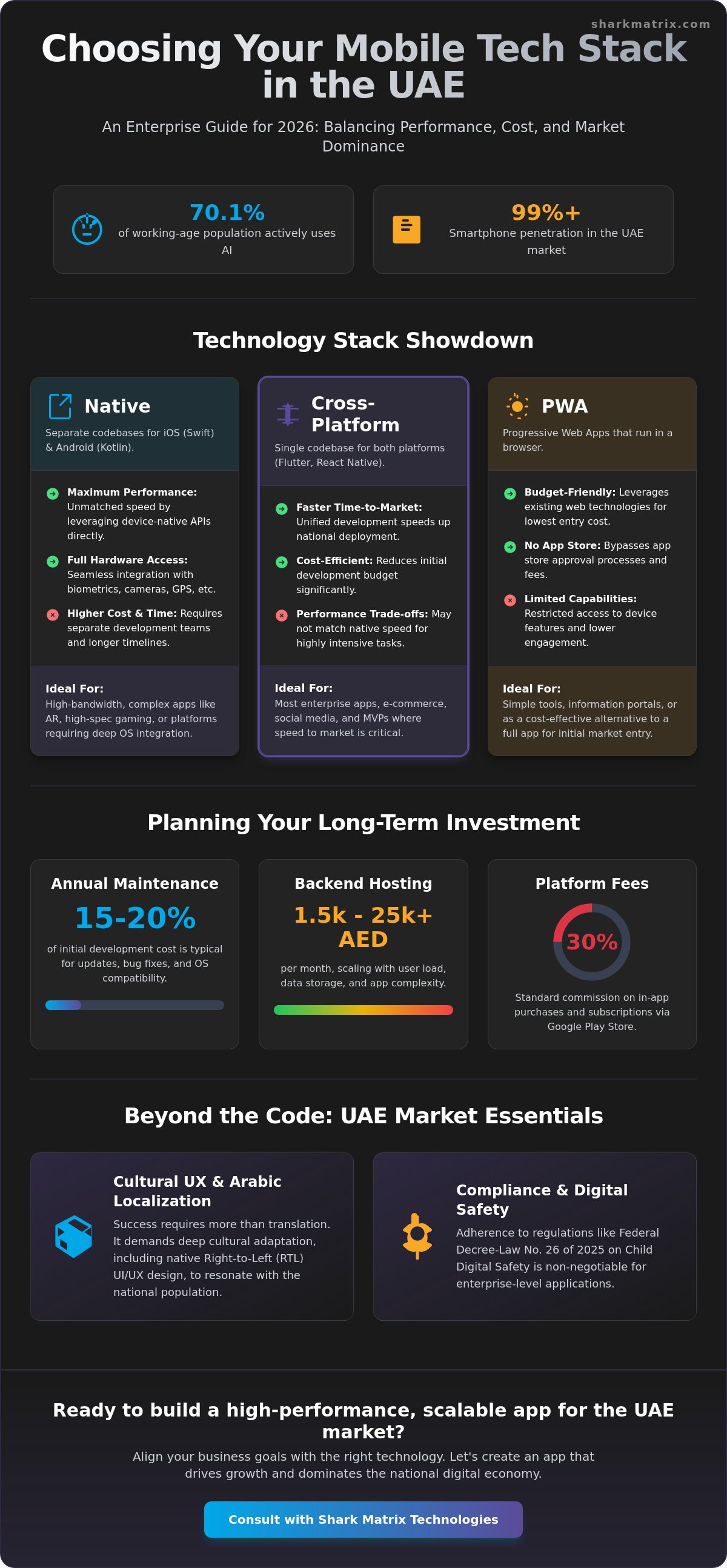
In the current digital environment, the definition of mobile excellence has shifted from simply “working on all devices” to “optimizing for every device.” To grasp the current technical shift, one must first define What is Native App Development in a world where hardware and software are more unified than ever. This approach involves building applications using the platform’s primary programming languages and tools, ensuring the software speaks the same language as the device hardware. For UAE enterprises, choosing native app development means moving away from generic, “good enough” experiences and toward high-performance solutions tailored for the sophisticated user base in Dubai and Abu Dhabi.

As of June 2026, the industry has standardized on Swift 6.3.2 for iOS and Kotlin 2.4.0 for Android. These languages allow developers to bypass the “middleman” layers found in hybrid frameworks. By providing direct access to the underlying operating system APIs, native apps remain the absolute benchmark for fluidity, responsiveness, and deep system integration. This direct connection is why native apps feel more “alive” than their cross-platform counterparts.

The Core Architecture of Native Applications

Native code doesn’t need a translator. It uses binary execution to run directly on the device’s processor, which leads to maximum efficiency and lower battery consumption. While hybrid apps often struggle with memory management because they rely on web views or complex bridges, native apps manage resources with surgical precision. This is vital for complex tasks like real-time data processing or high-fidelity graphics. Platform SDKs, such as the iOS 26 SDK, provide immediate access to the latest OS features. When a new system update drops, native developers can implement new features instantly without waiting for third-party framework maintainers to catch up.

Swift vs. Kotlin: The 2026 Ecosystem Overview

The current ecosystem is dominated by two powerhouses that have fully embraced declarative UI. SwiftUI has evolved into a mature, high-performance tool for creating interfaces across the entire Apple ecosystem. On the Android side, Jetpack Compose offers a similar modern approach, allowing for rapid iteration without sacrificing speed. While Kotlin Multiplatform (KMP) is often used to share business logic, the UI remains distinctively native to ensure a flawless user experience. Using specialized IDEs like Xcode 26.5 or Android Studio is essential. These tools offer deep debugging and profiling features that generic cross-platform editors simply can’t match. Choosing native app development ensures that your software can leverage every bit of power from the latest mobile processors.

Unrivalled Performance: Why Native Remains the Choice for Power Users

Performance in 2026 isn’t just a luxury; it’s a baseline requirement for user retention. Native apps operate by communicating directly with the device’s GPU and CPU, ensuring that intensive tasks don’t experience the lag often found in interpreted code. While cross-platform frameworks have improved, they still struggle to maintain a consistent 120Hz refresh rate on modern ProMotion and high-refresh displays. For a premium brand in Dubai, a stuttering interface is a reputation risk. Native app development ensures that every scroll, transition, and animation feels fluid and instantaneous, meeting the high expectations of the UAE’s tech-savvy population.

Efficiency extends beyond just visual speed. Native applications offer superior battery management because they don’t require an abstraction layer to translate commands to the hardware. This optimized resource management is critical for users who rely on their devices throughout a long workday. When choosing a development approach, enterprises must also consider how the app behaves when connectivity drops. Native apps handle local data storage and background synchronization with a level of reliability that hybrid wrappers can’t match, making them the superior choice for field operations or high-stakes financial tools.

Direct Hardware Access and On-Device AI

Modern mobile strategy in the UAE increasingly relies on real-time data. By using Apple’s CoreML and Google’s ML Kit, native apps process complex data on-device rather than sending it to a remote server. This is essential for low-latency AR experiences in real estate or secure biometric authentication in banking. Native apps access the Neural Engine directly to execute complex 2026 AI tasks with sub-millisecond latency, bypassing the overhead of cloud-based processing. For organizations looking to lead, integrating mobile app development with on-device intelligence provides a significant competitive edge.

Enhanced Security for National Enterprises

Security is a non-negotiable pillar for government-linked entities and large-scale enterprises across the Emirates. Native development allows teams to leverage hardware-level encryption and secure enclaves, which isolate sensitive user data from the rest of the operating system. This architecture significantly reduces the attack surface by eliminating the vulnerabilities often found in third-party cross-platform bridges. By using platform-specific security APIs, businesses can ensure strict compliance with national data protection standards. This level of protection is why native app development remains the preferred path for any application handling confidential information or high-value transactions.

Native vs. Cross-Platform: A Strategic Comparison for Modern Businesses

Choosing the right architecture requires looking far beyond the first launch. While cross-platform tools like React Native and Flutter promise to “write once, run anywhere,” they introduce a technical layer known as the “bridge.” This bridge acts as a translator between the app’s code and the device’s operating system. In high-stakes environments, this translation creates micro-delays that users can feel during complex interactions. Understanding the nuances of Mobile web vs. Native vs. Hybrid models is essential for any business leader before committing significant capital to a project.

Native apps avoid the “uncanny valley” where UI components look almost correct but behave unexpectedly. When a new OS version launches, native apps are ready on day one. Cross-platform developers often find themselves stuck waiting for third-party libraries to update, which can lead to broken features or security gaps. Native app development eliminates this dependency, providing a direct line to the latest platform innovations without the need for a middleman.

Performance and UX Benchmarks

Frame rate stability is where native code truly shines. Touch response times in native environments are measured in milliseconds, providing the tactile feedback users expect from high-end devices. Native apps also inherit system-wide features like Dark Mode and advanced accessibility settings automatically. By following Apple’s Human Interface Guidelines or Android’s Material Design natively, your app feels like a natural extension of the phone. This consistency builds trust and reduces the learning curve for your customers.

Total Cost of Ownership (TCO) and Scalability

Many UAE firms prioritize initial savings, but the Total Cost of Ownership (TCO) over a five-year period often tells a different story. Cross-platform projects can accumulate “technical debt” as teams spend hundreds of hours writing custom native modules to fix performance bugs the framework cannot handle. When you look at the app development cost uae enterprises face over a multi-year lifecycle, native often proves more economical. The lack of third-party library bloat and the ease of scaling make native app development a more sustainable long-term investment for growing brands.

Decision Framework: When to Invest in Native Development

Choosing the right path isn’t just about your current budget; it’s about your long-term vision. Enterprises in Dubai and Abu Dhabi often face a choice between speed and sustainability. If your app’s core value proposition relies on high-speed data processing or intricate hardware interactions, native app development is the only logical choice. You should ask yourself: Is performance a feature? For a banking app or a high-end retail experience, even a fraction of a second in latency can lead to significant user churn.

A “Platform-First” strategy can also be a powerful move. Instead of launching a mediocre version on two platforms simultaneously, many successful UAE brands perfect their iOS experience first. This allows you to gather deep user insights and refine your UI/UX before expanding to Android. It’s a strategic way to manage initial costs while ensuring that when you do scale, you’re building on a stable, high-performance foundation. You’ll also need to evaluate your internal team’s expertise. Hiring for native roles requires a focus on specialized Swift or Kotlin engineers, which ensures a deeper understanding of platform-specific nuances.

Assessing Complexity and Feature Requirements

The complexity of your feature set dictates your tech stack. You should choose native for:

  • AI-First Products: Apps requiring on-device machine learning for real-time translation or image recognition.
  • Graphic-Intensive Tools: Real estate apps using LiDAR for 3D room mapping or complex AR overlays.
  • High-Security Solutions: Fintech or government services that need hardware-level biometric integration and secure enclaves.

However, if you’re building a content-heavy app or a simple internal dashboard, cross platform app development might suffice for your initial launch. The key is to match the technology to the user’s ultimate goal without over-engineering simple solutions.

Evaluating Time-to-Market vs. Long-term Quality

While cross-platform tools might get you to market faster initially, they often lead to the “refactoring trap.” As your user base grows and features become more complex, you’ll likely spend more time fixing framework-specific bugs than building new features. Native app development avoids this by using the tools the OS was designed for, ensuring your app remains stable as it scales. For national-scale deployment across the diverse device landscape of the Emirates, starting with native ensures long-term stability and easier maintenance. If you’re ready to define your technical roadmap, our team specializing in mobile app development can help you navigate these strategic choices.

Building High-Impact Native Solutions with Shark Matrix

Success in the competitive UAE digital market requires more than just a functional application. It demands a solution that feels premium and performs flawlessly under pressure. At Shark Matrix Technologies LLC, we move beyond the basic build and launch cycle. Our engineering-first approach to mobile app development services prioritizes long-term stability and hardware optimization. We don’t just write code; we build digital assets that represent your brand’s commitment to quality in Dubai and across the Emirates.

As a leading ios app development company in dubai, Shark Matrix Technologies LLC specializes in navigating the specific technical requirements of the Apple ecosystem while maintaining a robust presence on Android. Our strategy integrates advanced AI automation and machine learning development services directly into the native core. This ensures your app isn’t just a static tool but an intelligent platform capable of real-time data processing and personalized user experiences. We manage the entire lifecycle from initial UI/UX design to national-scale deployment.

Our Native Engineering Philosophy

We build for reliability. Our engineering philosophy centers on creating quality-first codebases designed to maintain 99.9% crash-free sessions. This level of stability is achieved through rigorous testing on physical devices, not just simulators, to ensure platform-perfect performance across varying hardware specifications. By utilizing native-specific frameworks, Shark Matrix Technologies LLC integrates generative ai development services and ai chatbot-development services that run with minimal latency. This approach ensures that your native app development project delivers a smooth, uninterrupted journey for every user.

Future-Proofing Your Mobile Investment

Digital landscapes shift rapidly. Apple and Google frequently update their store policies and SDK requirements, such as the mandatory iOS 26 SDK transition discussed earlier. Shark Matrix Technologies LLC manages these updates proactively so your application never breaks on launch day. Our scalable architectures are designed to grow alongside your national user base, ensuring that a surge in traffic doesn’t compromise speed. Whether you need industry specific ai solutions or a high-performance e-commerce platform, we provide the technical foundation required for sustained growth. Contact Shark Matrix Technologies LLC for a strategic consultation on your next mobile project and discover how native app development can transform your enterprise’s digital footprint.

Future-Proofing Your Enterprise Mobile Strategy

The decision between platforms in 2026 is no longer a simple debate about initial budget. It’s a strategic choice about whether your brand can afford to lag behind in security, hardware integration, and AI readiness. Choosing native app development ensures your business isn’t just keeping pace with the UAE’s rapid digital transformation but leading it. You’ve seen how native architecture eliminates the bridge lag and provides the secure enclave necessary for sensitive national-scale operations. Investing in a platform-specific foundation today prevents the costly refactoring traps that often haunt cross-platform projects as they scale.

Shark Matrix Technologies LLC brings a specialized engineering team to your project, focusing on Swift and Kotlin to deliver 99.9% crash-free sessions. Our expertise in AI-driven mobile solutions and our proven track record with national-scale enterprise apps make us the ideal partner for your next digital milestone. Scale your business with high-performance native app development from Shark Matrix Technologies LLC. Your path to a high-performance, secure, and AI-ready mobile future starts with a clear technical roadmap tailored for the Emirates market.

Frequently Asked Questions

What is the main difference between native and cross-platform app development?

The fundamental difference lies in how the code communicates with the device’s hardware. Native development uses platform-specific languages like Swift or Kotlin to speak directly to the operating system. Cross-platform options use a shared codebase that requires an abstraction layer or “bridge” to translate commands. This distinction affects how smoothly the app interacts with specific hardware features and system-level APIs.

Is native app development more expensive than hybrid development in 2026?

Initial investment for native app development is generally higher because it requires separate codebases and specialized teams for iOS and Android. While cross-platform tools can reduce early effort by 30% to 40%, those savings often vanish during the maintenance phase. Native apps avoid the hidden costs of debugging third-party framework issues, making the total cost of ownership more predictable for UAE enterprises over a long-term lifecycle.

How long does it typically take to develop a native mobile application?

A standard enterprise-grade native app typically takes four to nine months to move from concept to launch. This timeline includes rigorous testing phases and compliance checks. For instance, Google now requires a mandatory 14-day closed testing period with at least 12 testers for new developer accounts. While building two separate apps takes more time upfront, the resulting stability often leads to a faster approval process during strict app store reviews.

Can native apps work offline better than cross-platform apps?

Native apps handle offline functionality more reliably because they have direct, unmediated access to local database systems and background synchronization protocols. This architecture allows the app to cache large amounts of data securely on the device without the performance bottlenecks seen in web-view-based hybrid apps. For field workers or users in Dubai’s high-rise elevators, native performance ensures the interface remains responsive even without an active internet connection.

Which programming languages are used for native app development today?

As of June 2026, the industry standards are Swift 6.3.2 for the Apple ecosystem and Kotlin 2.4.0 for Android development. These languages have matured to support declarative UI frameworks like SwiftUI and Jetpack Compose. Using these official languages ensures your app is fully compatible with the latest system requirements. This includes the iOS 26 SDK, which is now mandatory for all new submissions and updates to the App Store.

Should I build an iOS or Android app first for the national market?

The choice depends on your target demographic, but many UAE businesses prioritize iOS due to its high market share among affluent consumer segments. Starting with a single platform allows you to refine the user experience and validate your business model before investing in the second platform. If your service targets a broad, national-scale audience, a staggered release starting with the platform your core users prefer is often the most strategic approach.

How does native development improve app security for enterprises?

Native development enhances security by providing direct access to hardware-level encryption and secure enclaves on the device. This setup isolates sensitive data from potential software vulnerabilities. By removing the third-party “bridge” used in cross-platform frameworks, you eliminate a common attack vector. This level of protection is essential for meeting the strict data privacy and AI consent regulations currently enforced across the Emirates.

Do native apps perform better for AI and machine learning features?

Native apps significantly outperform other architectures for AI tasks because they tap directly into the device’s Neural Engine and GPU. This direct hardware access is vital for real-time generative AI services and on-device machine learning models that require low latency. By processing data locally rather than relying on cloud-based responses, native app development provides a faster and more secure experience for users interacting with intelligent features.
Categories
Development

Cross-Platform App Development in 2026: The Comprehensive Guide for Modern Enterprises

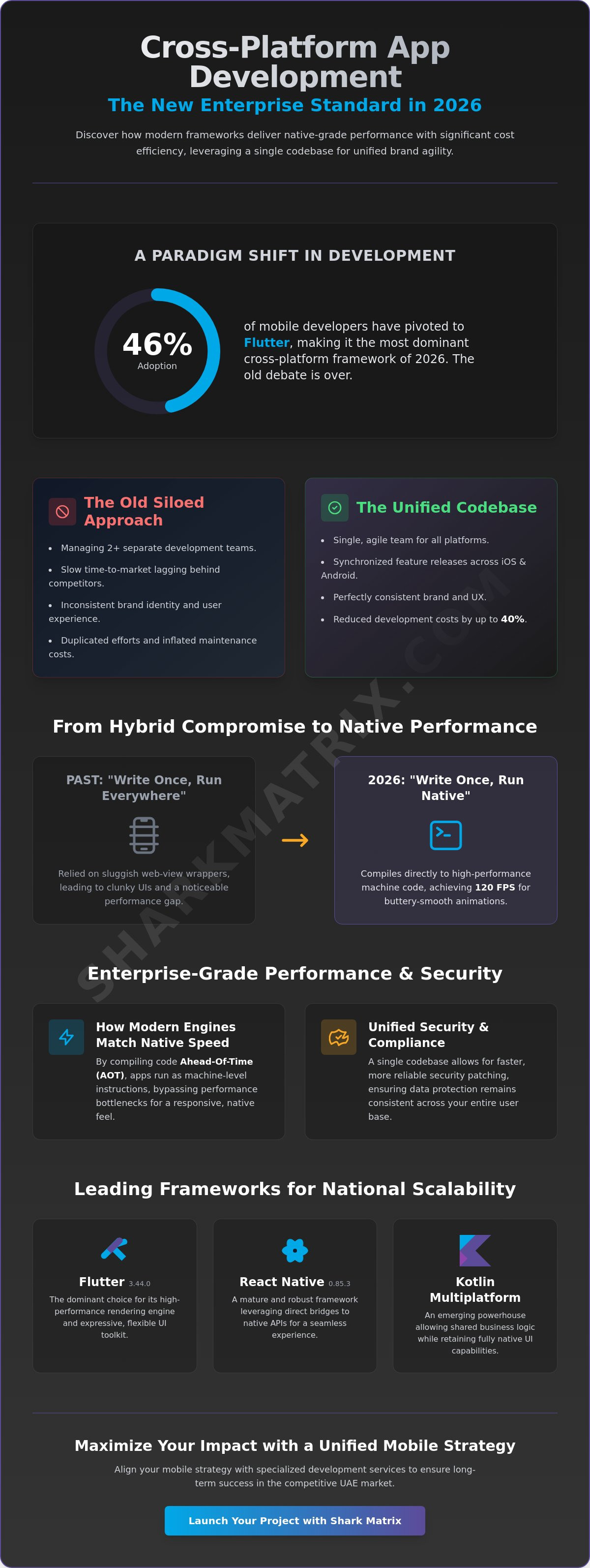
Did you know that 46% of mobile developers have now pivoted to Flutter, making it the most dominant framework of 2026? For modern enterprises in the UAE, the old debate between native and hybrid is officially over. Choosing cross platform app development is no longer a compromise on quality. It’s a strategic move toward unified brand agility. With stable tools like Flutter 3.44.0 and React Native 0.85.3, the performance gap has vanished for almost every business application.

You likely feel the frustration of managing two separate development teams while watching your time-to-market lag behind competitors. It’s difficult to maintain a consistent brand identity when iOS and Android versions don’t look or feel the same. Discover how modern frameworks deliver native-grade performance with significant cost efficiency for national brands. We’ll break down how to leverage a single codebase to reduce development costs by up to 40% and prepare your mobile strategy for an AI-native future.

Key Takeaways

  • Understand how the “Write Once, Run Everywhere” philosophy has evolved into a high-performance standard for modern enterprise SDKs.
  • Learn how JIT and AOT compilation have closed the performance gap, making cross platform app development a viable choice for high-demand applications.
  • Compare the maturity of Flutter, React Native, and Kotlin Multiplatform to determine which framework best supports your national scalability goals.
  • Discover a strategic framework to audit your feature requirements and developer expertise before choosing a tech stack.
  • Explore how aligning your mobile strategy with specialized development services ensures long-term success in the competitive UAE market.

What is Cross-Platform App Development in 2026?

The definition of cross platform app development has undergone a radical transformation over the last decade. In 2026, it refers to the practice of building high-performance applications for multiple operating systems using a single, shared codebase. This approach has moved far beyond the clunky, browser-based shells of the past. Today’s SDKs allow developers to tap into the broader ecosystem of Mobile app development while maintaining native-level fluidity. National brands in the UAE are leading this shift, moving away from platform-specific silos that once required separate teams for iOS and Android. By consolidating their efforts, these enterprises ensure that every user receives the same premium experience regardless of their device choice.

The core philosophy of “Write Once, Run Everywhere” (WORE) has evolved into a “Write Once, Run Native” reality. Early hybrid attempts often felt sluggish because they relied on web-view wrappers that couldn’t handle complex animations or heavy processing. By 2026, tools like Flutter and React Native have matured to the point where they bypass these limitations entirely. They use specialized rendering engines and direct bridges to native APIs; this ensures that business logic remains consistent while performance stays lightning-fast. For a modern enterprise, this means cross platform app development is no longer about settling for less. It’s about choosing the most efficient path to a high-quality product.

The Evolution from Hybrid to Unified Codebases

Technology has finally moved past the “web-view” limitations that plagued the 2010s. Modern rendering engines now enable 120 FPS performance, making scrolls and transitions feel as smooth as any native application. A unified codebase represents a single source of truth for business logic and UI styling that compiles directly into high-performance machine code for every target platform. This eliminates the “uncanny valley” effect where cross-platform apps felt slightly “off” compared to their native counterparts. By using a single source of truth, developers spend less time fixing platform-specific bugs and more time innovating on core features.

Why Modern Enterprises Prioritize Multi-Platform Strategies

Speed to market is the ultimate competitive advantage in the UAE digital landscape. When a national brand launches a new feature, they can’t afford to tell half their audience that the update is “coming soon” for their specific device. Synchronized feature releases across iOS, Android, and even the web are now the standard expectation. This strategy also simplifies the DevOps pipeline for national-scale applications. Instead of managing two distinct testing and deployment cycles, teams focus on a single, streamlined path to production. It’s a more efficient way to maintain a consistent brand identity while scaling rapidly across the region.

Performance vs. Cost: Debunking the Native-Only Myth

For years, the primary argument against choosing cross platform app development was a perceived lack of speed. Critics often claimed that non-native apps felt sluggish or couldn’t handle complex interactions. In 2026, these performance concerns are largely historical artifacts. Modern frameworks utilize Just-In-Time (JIT) compilation during development for fast iteration and Ahead-Of-Time (AOT) compilation for production. This means code is converted into machine-level instructions before the user even opens the app. The result is a smooth interface that matches the responsiveness of native Swift or Kotlin. For the vast majority of enterprise applications, the difference is now indistinguishable.

Security has also reached enterprise-grade standards. Frameworks like Flutter 3.44.0 and React Native 0.85.3 now include robust, built-in protections that meet the strict compliance requirements of UAE financial and government sectors. Because you’re managing a single codebase, applying security patches becomes a faster, more reliable process. You don’t have to worry about a vulnerability being fixed on iOS while remaining open on Android for several weeks. This unified approach ensures that your data protection remains consistent across the entire user base.

How Modern Engines Match Native Speed

Modern frameworks have evolved to bypass the CPU-intensive bridges that used to cause lag. By compiling directly to machine code, applications can now access GPU-accelerated graphics for complex UI animations without a performance hit. This shift is documented in a recent comparative study of cross-platform frameworks, which highlights how these tools achieve near-native execution speeds. Whether you’re building a data-heavy dashboard or a high-fidelity e-commerce platform, the rendering engines in 2026 handle 120 FPS transitions with ease. This level of fluidity is essential for maintaining the premium brand standards expected by UAE consumers.

The Economic Impact: ROI and Long-Term Maintenance

The financial logic for multi-platform strategies is hard to ignore. Research indicates that cross platform app development can reduce initial build costs by 30-40% compared to maintaining two separate native teams. When you analyze the app development cost uae, the savings extend far beyond the launch date. Managing a single source of truth significantly reduces technical debt and simplifies long-term maintenance. Instead of paying two teams to fix the same bug, one update solves the issue for everyone. Many enterprises choose to reallocate these saved funds into high-impact search engine optimization seo services to drive user acquisition. If you’re ready to streamline your digital presence, exploring professional mobile app development can provide the balance of performance and value your business needs.

Cross-Platform App Development in 2026: The Comprehensive Guide for Modern Enterprises

Leading Frameworks for National Scalability in 2026

Selecting a framework for cross platform app development requires balancing technical capabilities with your team’s existing expertise. By May 2026, three major players have emerged as the standard for enterprise-grade applications. Flutter, React Native, and Kotlin Multiplatform each offer unique advantages for national brands aiming to scale. These ecosystems have matured significantly; they now provide seamless access to device hardware like biometrics, Bluetooth low energy, and even AR/VR sensors without the friction seen in earlier years. Choosing between them often comes down to the specific user experience you want to deliver and the speed at which you need to deploy.

Flutter: The King of UI Consistency

Google’s toolkit has secured its spot as the most popular framework, holding over 40% of the global market share in 2026. Flutter 3.44.0 allows developers to build visually stunning interfaces that look identical on every screen. This is particularly valuable for UAE brands that prioritize a premium, high-fidelity aesthetic across their digital touchpoints. Because Flutter controls every pixel on the screen, it ensures that your brand’s identity remains intact regardless of OS updates. Additionally, Flutter’s structured metadata handling makes it easier to optimize app content for Answer Engine Optimization (AEO), ensuring your services are easily discoverable by AI-driven search tools.

React Native: The Power of the JavaScript Ecosystem

For enterprises with strong web development roots, React Native remains a powerhouse. The latest version, 0.85.3, fully leverages the “New Architecture” to provide high-speed interactions. It excels in complex, data-driven environments where you need to integrate with a headless CMS or existing web infrastructure. By using the vast library of React components, teams can achieve rapid development cycles without reinventing the wheel. It’s an ideal choice for businesses that want to share talent between their web and mobile divisions while maintaining a robust DevOps pipeline. This framework’s ability to handle complex data flows makes it a favorite for large-scale e-commerce and social platforms.

Kotlin Multiplatform (KMP): The New Frontier

Kotlin Multiplatform has transitioned from a niche tool to a production-ready enterprise solution with the release of Kotlin 2.3.21. Unlike other frameworks, KMP focuses on sharing business logic while allowing developers to build truly native UIs where necessary. This approach is becoming a preferred choice for high-security fintech apps that require deep integration with platform-specific security protocols. It offers a unique balance; you get the efficiency of a shared codebase for your core logic while retaining the absolute performance of native interface components. This ensures that your app feels 100% native to the user while your backend logic remains synchronized and easy to maintain.

A Strategic Framework for Choosing Your Tech Stack

Choosing the right path isn’t just about code; it’s about aligning technical choices with long-term commercial objectives in a market that moves at lightning speed. In 2026, cross platform app development has become the standard for most enterprises, but a structured audit is still necessary to ensure your choice supports future growth. A rushed decision here can lead to technical debt that slows down innovation for years. To avoid this, Shark Matrix Technologies LLC recommends a weighted decision matrix that considers more than just the initial launch.

  • Step 1: Audit your core feature requirements. Determine if your app needs heavy 3D rendering or if it primarily handles data entry and user interactions.
  • Step 2: Evaluate internal developer expertise. Assess whether your team is more comfortable with JavaScript, Dart, or Kotlin to minimize the learning curve.
  • Step 3: Analyze your scaling roadmap. Consider how quickly you plan to expand your feature set and user base across the GCC region.
  • Step 4: Assess the need for AI integration. Plan for the inclusion of machine learning models or automated chatbots from the start.
  • Step 5: Compare the total cost of ownership. Factor in both the initial development and the maintenance costs over a three-year period.

Assessing Project Complexity and Hardware Needs

Native development remains a niche requirement for applications that demand low-level Bluetooth communication or highly complex OS-level background tasks. However, for 90% of business use cases in the UAE, cross-platform frameworks are the superior option. They provide the UI/UX consistency required for a professional brand image across varied device screen sizes. Whether your customers are using a high-end tablet or a standard smartphone, the interface remains pixel-perfect. This consistency is vital for maintaining trust and brand authority in a competitive digital landscape. For brands that do require a dedicated Apple-first experience, working with a specialized iOS app development company in Dubai can complement your broader multi-platform strategy.

Future-Proofing with AI and Automation

With a vast majority of new app projects in 2026 featuring at least one AI-powered component, your tech stack must be flexible enough to handle rapid updates. Integrating cloud-based features like natural language processing or predictive analytics is often simpler within a unified codebase. Shark Matrix Technologies LLC leverages advanced ai automation and development to streamline the entire lifecycle, utilizing tools that can significantly reduce development time. This forward-thinking approach also prepares your brand for the era of Generative Engine Optimization (GEO), ensuring your content is ready for AI-driven discovery. If you’re ready to build a resilient and intelligent digital product, our team offers specialized ai development services to help you stay ahead of the curve.

Maximizing Impact with Shark Matrix Technologies LLC Development Services

Building a successful application requires more than just picking a framework. While cross platform app development provides the technical foundation, your app’s actual success depends on how well it integrates with your broader business goals. A high-performance app is useless if users can’t find it or if the experience doesn’t lead to conversions. At Shark Matrix Technologies LLC, we believe that high-performance code must meet data-driven marketing to achieve national-scale success. We don’t just write code; we build digital assets designed for growth and scalability in the competitive Middle Eastern market.

Our comprehensive mobile app development services go beyond the initial launch. We focus on creating a cohesive ecosystem where your mobile presence supports your e-commerce and lead generation efforts. By choosing a unified approach, you ensure that your brand remains agile and ready to adapt to new market trends without the friction of managing disconnected platforms. This strategic alignment is what separates a standard app from a market-leading digital product.

Beyond the Code: Integrating SEO and Digital Strategy

App visibility is just as critical as web visibility in 2026. National brand visibility relies heavily on app indexing, which allows your mobile content to appear directly in search engine results. This is why we connect your mobile strategy to our professional website design and development services. A seamless link between your site and your app improves user retention and boosts your overall authority. Additionally, the data gathered from your cross-platform app can be used to fuel hyper-targeted campaigns through a specialized ppc agency dubai. This integrated approach ensures that every dirham spent on development and marketing works toward a single, unified goal.

Launching for the National UAE Market

Success in the UAE requires a deep understanding of local user expectations and regulatory requirements. Arabic localization isn’t just about translating text; it’s about mirroring the entire UI to support right-to-left (RTL) reading patterns. Modern cross platform app development tools make this process more efficient, but it still requires a keen eye for cultural nuance. Shark Matrix Technologies LLC helps you navigate these complexities while ensuring your app remains compliant with local data privacy standards. Whether you’re a startup or an established enterprise, we’re here to help you scale your vision with precision. Contact our experts today to start your journey toward a more efficient and impactful mobile presence.

Secure Your Competitive Edge with Unified App Strategies

The shift toward unified codebases has fundamentally changed the digital landscape for UAE enterprises. Performance parity is no longer a distant goal but a current reality, leaving businesses with a clear path to operational efficiency. You can now deliver a consistent brand experience across all devices without the heavy overhead of maintaining separate development teams. Adopting cross platform app development allows your brand to stay agile and responsive to market changes while keeping technical debt to a minimum. It’s about building for today while remaining flexible enough for the innovations of tomorrow.

Success in this space requires a partner who understands the intersection of high-performance code and national-scale growth. With 14 years of digital innovation and a specialization in AI-driven mobile solutions, Shark Matrix Technologies LLC provides the end-to-end national UAE support your brand needs to thrive. We help you integrate advanced features that resonate with local users while ensuring your infrastructure is built to scale. Partner with Shark Matrix Technologies LLC for High-Performance App Development and transform your mobile vision into a market-leading reality. The digital future is unified, and your brand is ready to lead the way.

Frequently Asked Questions

Is cross-platform app development cheaper than native development?

Yes, choosing cross platform app development is generally 30% to 40% more cost-effective than building separate native apps. By maintaining a single codebase, you eliminate the need for two distinct development teams and streamline the testing process. This efficiency allows enterprises to reallocate their saved budget toward high-impact marketing or AI-driven feature enhancements.

Can cross-platform apps access device hardware like the camera or GPS?

Modern frameworks provide full, high-speed access to device hardware including cameras, GPS, and biometrics. In 2026, stable plugins and direct bridges ensure that these apps interact with hardware just as fluidly as native versions. You won’t face performance limitations when building apps that require real-time location tracking or advanced sensor integration.

Which framework is better in 2026: Flutter or React Native?

Neither framework is objectively superior; the right choice depends on your team’s existing skills and your specific project goals. Flutter is the leading choice for brands that prioritize pixel-perfect UI consistency across all devices. React Native remains a powerhouse for data-heavy applications that need to leverage the vast JavaScript ecosystem and existing web infrastructure.

Do cross-platform apps work offline?

Yes, these applications function perfectly without an active internet connection by utilizing local storage solutions. Developers use local databases like SQLite or Hive to store data on the device, which then syncs with the server once connectivity is restored. This capability is essential for enterprise tools used in environments with intermittent network access.

How long does it take to develop a cross-platform mobile app?

Development time is typically reduced by up to 40% when compared to native projects, with most enterprise MVPs launching within three to six months. This accelerated timeline is a primary reason why cross platform app development has become the standard for UAE brands. It allows companies to respond to market trends and competitor moves much faster than before.

Are cross-platform apps secure enough for banking and fintech?

Cross-platform frameworks are robust enough to meet the strict security standards of the banking and fintech sectors. They support advanced encryption, secure key storage, and multi-factor authentication out of the box. Since security patches are applied to a single codebase, your team can respond to emerging threats across all platforms simultaneously.

Can I convert an existing native app to a cross-platform one?

While you can’t automatically convert code with a single click, you can strategically migrate your business logic to a shared codebase. The UI usually requires a rewrite to match the framework’s architecture, but the backend integrations can often be adapted. This migration is a common strategy for brands looking to reduce long-term maintenance costs and technical debt. To understand the full performance and security trade-offs involved in this decision, reviewing a detailed breakdown of native app development versus cross-platform approaches can help you make the most informed choice.

Does cross-platform development affect my SEO ranking?

It doesn’t negatively impact your ranking; in fact, a well-structured app can significantly improve your overall digital visibility. Unified apps support app indexing, which allows your mobile content to appear directly in Google search results. When combined with professional Search Engine Optimization (SEO), your app becomes a vital tool for driving organic traffic and user acquisition.

Categories
Development

Strategic Mobile App Development Services for UAE Enterprises: The 2026 Guide

Did you know that 70.1% of the UAE’s working-age population is actively using AI technologies as of early 2026? In a market where smartphone penetration sits at over 99%, simply having a presence on a user’s home screen isn’t enough to guarantee success. To truly compete, enterprises require specialized mobile app development services that balance technical performance with the strict cultural and legal requirements of the Emirates. You’re likely looking for a way to maximize ROI while avoiding the technical debt that often comes from choosing the wrong framework or ignoring the nuances of the local market.

We understand the pressure of building a platform that resonates with Arabic-speaking users while staying compliant with the new Federal Decree-Law No. 26 of 2025 on Child Digital Safety. This guide will show you how to leverage cutting-edge mobile technologies and strategic Arabic localization to scale your brand across the national market. We’ll examine how to integrate AI for seamless user experiences, navigate the latest data privacy laws, and select the right cross-platform tools to ensure your app remains high-performing and scalable for years to come.

Key Takeaways

  • Understand the shift from basic web wrappers to AI-first mobile ecosystems to meet the demands of the UAE’s tech-forward market.
  • Evaluate the trade-offs between native performance and cross-platform speed to select the right mobile app development services for your scalability needs.
  • Discover how generative AI and machine learning personalization can drive higher user retention and engagement across the national population.
  • Learn why effective Arabic localization must go beyond simple translation to include deep cultural UX adaptations and Right-to-Left design.
  • Follow a structured development roadmap that prioritizes business alignment and iterative feedback to ensure a high-performance launch.

The Evolution of Mobile App Development Services in the UAE

The UAE has moved past the era of simple digital presence. By 2026, the evolution of mobile app development has reached a critical tipping point where national enterprises are abandoning basic web wrappers for sophisticated, AI-first ecosystems. This shift aligns with the UAE National AI Strategy 2031, which aims to position the country as a global leader in artificial intelligence. Enterprise leaders now understand that a basic mobile site cannot match the deep integration and processing power required by a population where 70.1% of working-age adults already use AI technologies daily.

Professional mobile app development services in the Emirates have transformed to meet these demands. It’s no longer just about having an app; it’s about owning a high-performance touchpoint that functions as a core driver of the national digital economy. Businesses that rely on generic solutions often find themselves struggling with technical debt and poor user retention. In contrast, custom-built applications offer the stability needed to integrate with complex national infrastructure and local payment gateways.

Mobile Apps as a Catalyst for National Brand Growth

Expanding a brand across the seven emirates requires more than just physical locations. High-performance mobile tools allow enterprises to transcend geographical boundaries, reaching users from Abu Dhabi to Ras Al Khaimah with equal precision. These platforms serve as powerful engines for data-driven lead generation, capturing user preferences that inform broader business strategies. In 2026, the UAE mobile landscape is defined by intelligent, hyper-localized ecosystems that prioritize user safety and cultural relevance.

Addressing the “App vs. Responsive Web” Debate

While responsive websites are essential for SEO and initial discovery, they often fall short when it comes to long-term ROI and customer loyalty. Mobile apps offer superior performance by leveraging native device features that a browser simply can’t access efficiently. Consider the impact of biometric security, real-time push notifications, and robust offline access on user trust. These features create a frictionless experience that keeps users coming back to your brand rather than searching for a competitor.

Enterprises should consider investing in dedicated mobile app development services when they identify specific business triggers:

  • Users require frequent, high-speed interactions that exceed browser capabilities.
  • The business needs to collect and process complex data securely on-device.
  • Personalization through machine learning is required to maintain a competitive edge.
  • Compliance with the latest Federal Decree-Law No. 26 of 2025 necessitates advanced parental controls and age verification.

Choosing a dedicated app over a web-only approach ensures that your brand remains an authoritative presence in a market with over 99% smartphone penetration. It’s a strategic move that secures your place in the user’s daily digital routine while providing the scalability needed for future growth.

Selecting the Right Technology Stack: Native vs. Cross-Platform

Deciding on a technology stack is one of the most significant hurdles for UAE enterprises. Native development involves building separate codebases for iOS and Android using Swift and Kotlin. This approach ensures maximum performance and seamless integration with hardware, which is vital for complex, high-bandwidth apps. However, it often requires a larger budget and longer timelines. For many, professional mobile app development services now lean toward cross-platform frameworks to achieve faster national deployment without sacrificing quality.

Cross platform app development tools like Flutter and React Native have become the leading technologies in 2026. They allow developers to maintain a single codebase that runs on both major operating systems. While this reduces initial development time, businesses must plan for ongoing costs. Typical annual app maintenance and updates usually range from 15% to 20% of the initial development cost. You also need to account for backend hosting, which can range from AED 1,500 to over AED 25,000 per month depending on complexity. Third-party SDKs and Google’s 30% commission on in-app purchases are other vital factors for your long-term budget.

For businesses with tighter budgets, Progressive Web Apps (PWAs) offer a middle ground. They work through a browser but mimic app functionality. However, they lack the deep integration required for 5G-enabled experiences or advanced AI features. Before committing, it’s wise to evaluate how your choice aligns with the broader Mobile Economy in the Middle East, where user expectations for speed and reliability are at an all-time high.

iOS and Android: Navigating the Dual-Platform Reality

The UAE market is unique because of its high-income demographic and diverse population, leading to significant user bases on both major platforms. You can’t afford to ignore either group. Achieving feature parity is essential so that an Android user in Sharjah has the same premium experience as an iPhone user in Abu Dhabi. If your strategy prioritizes Apple’s ecosystem, working with a qualified iOS app development company in Dubai ensures your application is built to the latest Swift and SDK standards while meeting local regulatory requirements. To better understand how these choices impact your budget, you should review our guide on App Development Cost in the UAE 2026.

Framework Selection for Enterprise Scalability

Flutter has emerged as a dominant force for enterprise applications in 2026. Its ability to deliver high-end UI/UX with a single codebase makes it ideal for the rapid pace of the UAE market. However, the “Write Once, Run Anywhere” promise has its limits. You’ll still need platform-specific tweaks to handle things like the new Child Digital Safety Law requirements or specific Right-to-Left (RTL) layout adjustments for Arabic users. If you’re ready to build a scalable solution, exploring specialized mobile app development services can help you navigate these technical nuances efficiently. For a deeper dive into how modern frameworks like Flutter and React Native can reduce your development costs by up to 40%, our comprehensive guide to cross platform app development in 2026 covers everything UAE enterprises need to know.

Strategic Mobile App Development Services for UAE Enterprises: The 2026 Guide

Integrating AI and Automation into Modern Mobile Applications

With 70.1% of the UAE’s working-age population already using AI technologies, the expectation for intelligent digital experiences has never been higher. Modern mobile app development services have shifted away from static interfaces toward dynamic, AI-first ecosystems. This transition means moving beyond simple buttons and menus to incorporate generative AI as a core feature. Whether it’s generating personalized travel itineraries or creating custom shopping lookbooks on the fly, generative AI allows your app to provide unique value to every individual user in real time.

Machine learning personalization engines are now the primary drivers of user engagement for national enterprises. These engines analyze user behavior to predict what a customer wants before they even search for it. In the B2B and e-commerce sectors, predictive analytics help streamline interfaces by surfacing relevant tools and products based on historical data. Beyond the user interface, AI automation works silently in the backend to reduce operational costs. By automating data entry, inventory tracking, and order processing, businesses can redirect their human capital toward higher-level strategic goals.

Custom AI Development for Mobile Ecosystems

Building a custom AI layer within your mobile app is essential for maintaining a competitive edge in the Emirates. Integrating Natural Language Processing (NLP) allows your application to understand the nuances of user search intent, including the various Arabic dialects common across the UAE. This level of sophistication significantly improves the user experience and builds brand authority. Furthermore, AI plays a critical role in security. AI-driven fraud detection systems can identify suspicious patterns in milliseconds, protecting both your business and your customers. Industry data shows that AI-driven apps can reduce churn rates by up to 20% by consistently delivering relevant, secure content.

AI Chatbots and Virtual Assistants

The days of frustrating, rule-based chatbots are over. In 2026, intelligent virtual assistants use generative models to provide context-aware support that feels natural and helpful. These assistants can handle complex queries, process returns, and even provide technical guidance without the need for human intervention. This shift improves customer support efficiency and ensures that your brand is available to assist users at any time of day. For enterprises looking to maintain a consistent AI strategy across all platforms, it’s helpful to see how these technologies align with web-based systems in The 2026 Guide to Website Design and Development. By choosing comprehensive mobile app development services that prioritize these automations, you ensure your platform is built for the future of the UAE’s digital economy.

Cultural UX and Arabic Localization: Dominating the National Market

Localization in the UAE is often misunderstood as a simple translation task. For national enterprises, true localization is a comprehensive UX strategy that respects cultural identity and user behavior. While English is widely spoken, Arabic remains the language of trust and cultural connection for the local population. High-quality mobile app development services must go beyond swapping text strings to create an environment that feels native to the user’s worldview. This includes everything from the way images are framed to the specific tone of voice used in push notifications.

Building trust within the app also depends on seamless integration with regional payment gateways like Network International or Telr. Users in the Emirates expect secure, familiar checkout experiences that support local cards and digital wallets. When your app reflects the local culture through high-quality digital marketing and localized content, it creates a sense of authority that generic, English-only platforms can’t match. This strategic approach ensures your brand isn’t just another icon on a screen but a trusted part of the user’s daily life. To amplify this cultural resonance beyond the app itself, partnering with a specialist social media advertising agency in Dubai can help you extend your localized messaging across TikTok, Instagram, and other high-traffic platforms where UAE audiences are most active.

RTL Design Mastery for Arabic Users

Right-to-Left (RTL) design is the foundation of any successful UAE mobile application. It’s not just about aligning text to the right; it’s about mirroring the entire user interface. Common pitfalls include failing to mirror icons that indicate direction, such as back arrows or progress bars. However, some elements like clocks and media playback controls should generally remain in their standard format to avoid confusing the user. Typography also requires careful attention. Arabic characters are more complex than Latin ones, requiring specialized font selection and increased line height to maintain legibility on mobile screens. A seamless bilingual switch allows users to toggle between English and Arabic without losing their place or breaking the layout.

Cultural Sensitivity in Mobile Interface Design

Visual storytelling must resonate with the UAE national audience to be effective. This means using imagery, icons, and color palettes that reflect regional preferences and social norms. For example, using local landmarks or culturally appropriate attire in your graphics can significantly boost brand affinity. Some businesses argue that “English is enough” because of the country’s large expat population. However, statistics consistently show that local engagement is higher when brands speak to users in their native language. While Modern Standard Arabic is ideal for formal banking or government apps, using local dialects can be far more effective for social engagement or marketing. If you want to build a platform that truly resonates with the national market, you need a partner who understands these nuances. Explore our specialized mobile app development services to start your localization journey.

From Discovery to Deployment: Your Strategic Development Roadmap

Launching a successful application in the Emirates requires more than just clean code. It demands a structured roadmap that bridges the gap between a conceptual idea and a high-performance digital asset. The process begins with a rigorous discovery phase. Here, we align your app’s core features with national business goals and the specific regulatory requirements of the UAE market. This stage ensures that every functional requirement serves a purpose, whether it’s driving lead generation or improving internal enterprise workflows.

Agile methodology is at the heart of modern mobile app development services. This iterative approach prioritizes transparency and regular feedback, allowing you to see progress in real time through scheduled sprints. It’s during this phase that we refine the user experience based on actual data rather than assumptions. Once the build is stable, our quality assurance team conducts rigorous testing across the diverse device market found in the UAE. From the latest flagship iPhones to high-end Android devices, we ensure your app performs flawlessly under various network conditions, particularly within the country’s extensive 5G infrastructure.

The Shark Matrix Technologies LLC End-to-End Delivery Model

Our approach is unique because we don’t treat development as an isolated silo. We integrate SEO and PPC strategy into the initial app architecture from day one. This proactive planning ensures that your platform is discoverable and ready for high-intent traffic the moment it hits the store. We also prioritize robust API and backend integration to ensure the app communicates perfectly with your existing enterprise CRM or ERP tools. To learn more about how we drive visibility for national brands, explore our Comprehensive SEO Services 2026.

Continuous Improvement and Maintenance

Deployment is just the beginning of your app’s lifecycle. Success in 2026 depends on continuous improvement through active monitoring of user behavior. This data allows us to drive meaningful feature updates that keep users engaged and prevent churn. We also manage the technical complexities of staying compliant with evolving App Store and Google Play guidelines. Remember that annual maintenance costs typically range from 15% to 20% of the initial development spend. This investment covers security patches, OS updates, and the integration of new technologies like Answer Engine Optimization (AEO) to stay ahead of generative search trends. If you’re ready to build a market-leading platform, you can partner with Shark Matrix Technologies LLC for your national mobile app strategy today.

Securing Your Digital Future in the UAE Market

Success in the Emirates isn’t just about launching a product; it’s about sustaining a high-performance ecosystem that evolves with its users. You’ve explored how technical framework choices, AI-driven personalization, and deep cultural UX form the pillars of a dominant mobile presence. When these elements align, your brand moves beyond being a simple utility to becoming a core part of your customers’ daily digital routines. Choosing professional mobile app development services is the most critical decision in this journey, ensuring your infrastructure is ready for the high-speed demands of the national market.

Shark Matrix Technologies LLC has spent over 15 years refining this balance for national enterprises. Since our founding in 2010, we’ve focused on the intersection of custom engineering and Arabic market dynamics. As experts in generative engine optimization (GEO) and AI automation, we ensure your platform remains visible and relevant in an increasingly intelligent search landscape. Our team brings the regional insight necessary to navigate local regulations while pushing the boundaries of what’s possible with modern mobile technology.

We’re ready to help you build a scalable, culturally resonant app that drives real growth across the UAE. Start Your Strategic Mobile App Project with Shark Matrix Technologies LLC and position your brand at the forefront of the national digital economy. Let’s create a mobile experience that truly resonates with your audience and delivers lasting value.

Frequently Asked Questions

How much do mobile app development services cost in the UAE?

Development costs vary based on the complexity and feature set of your application. Simple apps typically range from AED 20,000 to AED 50,000, while medium complexity projects with third-party integrations cost between AED 50,000 and AED 150,000. Complex, AI-powered enterprise solutions often start at AED 150,000 and can exceed AED 400,000. These figures reflect the specialized engineering required for secure, high-performance mobile app development services in the national market.

What is the difference between native and cross-platform app development?

Native development involves building separate applications for iOS and Android using platform-specific languages like Swift or Kotlin. This ensures maximum performance and hardware integration. Cross platform app development uses frameworks like Flutter or React Native to create a single codebase for both platforms. This approach is increasingly popular for UAE enterprises because it reduces development time and costs while maintaining a high-quality user experience across all devices.

How long does it take to develop a custom mobile application?

A standard timeline for a custom enterprise app usually spans three to nine months. Simple applications can reach deployment in approximately 12 weeks, while complex platforms with AI features or extensive backend integrations often require six months or more. This schedule includes the critical discovery phase, UI/UX design, development sprints, and rigorous testing to ensure the app meets local regulatory standards and performance expectations.

Do I need a separate app for iOS and Android devices?

You don’t need two separate codebases if you choose cross-platform mobile app development services. Modern frameworks allow you to build one application that runs seamlessly on both iOS and Android. This strategy is highly effective in the UAE, where smartphone penetration is over 99% and users are split between both operating systems. It ensures feature parity while simplifying your long-term maintenance and update cycles.

How does Arabic localization affect my app’s performance in the UAE?

Localization is a primary driver of user retention and brand trust. Apps that implement high-quality Arabic translation and Right-to-Left (RTL) layout adjustments see significantly higher engagement from the local population. Beyond mere translation, cultural localization involves adapting imagery and icons to regional preferences. This creates a more intuitive experience for users, helping your brand stand out in a competitive national market where cultural relevance is a key differentiator.

Can I integrate my existing AI or CRM tools into a new mobile app?

Yes, modern mobile architectures are built to integrate with existing enterprise ecosystems through secure APIs. You can connect your app to CRM systems like Salesforce or custom AI models to ensure real-time data synchronization. This integration allows your mobile platform to serve as a powerful extension of your current workflows, providing users with personalized content and allowing your business to maintain a single source of truth for customer data.

What are the ongoing costs for mobile app maintenance?

Annual maintenance costs generally range from 15% to 20% of the initial development investment. These costs cover essential security updates, hosting fees, and compatibility patches for new iOS and Android versions. Regular maintenance ensures your app remains compliant with the latest UAE data privacy laws and continues to perform at peak levels. Neglecting this aspect can lead to technical debt and a decline in user satisfaction over time.

Why should a UAE business choose a national agency over offshore developers?

National agencies provide essential expertise in the UAE’s specific regulatory and cultural landscape. They understand the nuances of the 2026 Child Digital Safety Law and have direct experience integrating with regional payment gateways. Working with a local partner ensures better communication during the discovery phase and guarantees that your app is optimized for the high-bandwidth 5G networks prevalent across the Emirates, which offshore teams may not fully account for. For businesses specifically targeting Apple device users, our detailed comparison of how to select the right iOS app development company in Dubai can help you identify a partner with the precise technical and cultural expertise your project demands.