

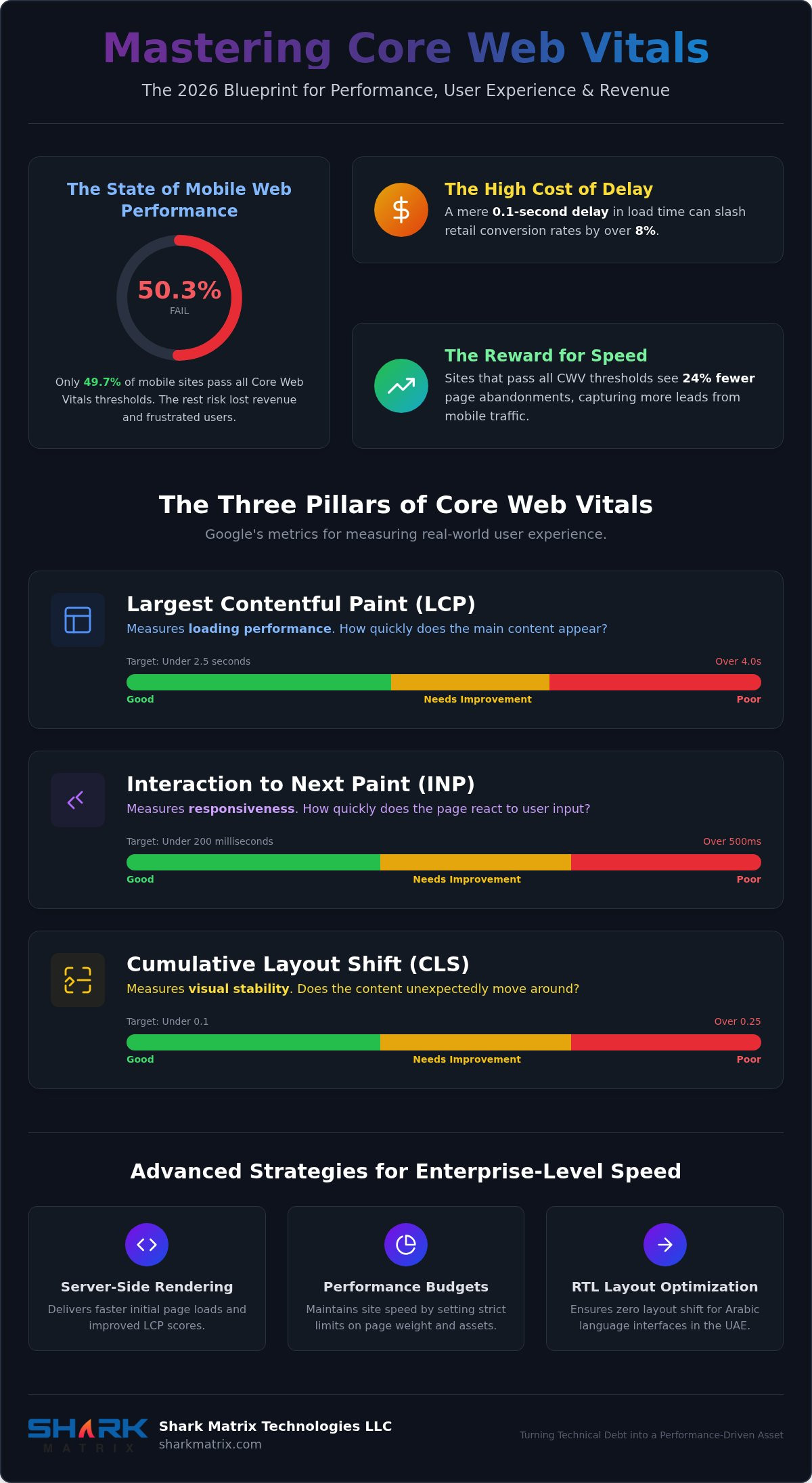
Did you know that only 49.7% of mobile websites currently pass all Core Web Vitals thresholds? Even with high-quality content, a 0.1-second delay in load time can slash your retail conversion rates by over 8%. For UAE enterprises, these technical “red” scores in Search Console aren’t just numbers; they represent lost revenue and frustrated users. Investing in a professional core web vitals optimization service is no longer optional if you want to maintain a competitive edge in 2026.
You likely recognize that a fast, responsive site is the backbone of your digital presence, but the technical complexity of metrics like Interaction to Next Paint (INP) can be overwhelming. We’ll show you how to master these Google ranking signals to transform your site’s performance and lower bounce rates. This article covers the essential steps to achieve consistent green scores, improve search visibility, and build an AI-ready infrastructure that converts visitors into loyal customers. It’s time to turn technical debt into a performance-driven asset for your brand.
Key Takeaways
- Understand how Google’s technical signals impact your brand’s authority and why visual stability is crucial for the 2026 digital landscape.
- Learn why a dedicated core web vitals optimization service is essential for mastering metrics like LCP, CLS, and the responsiveness-focused INP.
- Discover a 5-step framework that uses real-user data to prioritize technical fixes based on their actual impact on your business model.
- Explore advanced methods like Server-Side Rendering and performance budgets to maintain enterprise-level speed during content updates.
- Gain insights into optimizing Right-to-Left (RTL) layouts for UAE audiences to ensure zero layout shift across Arabic language interfaces.
What is a Core Web Vitals Optimization Service and Why Does it Matter?
In the UAE’s competitive digital landscape, national brand authority depends on a seamless mobile experience. Users here operate on some of the fastest mobile networks in the world, which has raised the bar for what they consider “fast.” If a site jitters or lags, users don’t wait. They leave. A dedicated core web vitals optimization service ensures your infrastructure meets these evolving expectations, preventing the “technical red” scores that often plague enterprise-level sites with heavy scripts or complex designs.
The Direct Link Between CWV and Search Rankings
Google’s Page Experience signals directly influence your position in search results. While content quality remains vital, technical performance often acts as the tiebreaker between two high-quality pages. This creates a powerful synergy between technical health and search engine optimization SEO services. For national brands, achieving “Green” scores in Search Console isn’t just about vanity; it’s a prerequisite for competing in high-stakes industries like real estate, finance, or retail. If your metrics are in the “Needs Improvement” or “Poor” categories, your search visibility will likely suffer, regardless of how much you spend on marketing.
Business ROI: Beyond the Technical Scores
The impact of performance on your bottom line is quantifiable. Research indicates that just a 0.1-second improvement in load time can result in an 8.4% boost in retail conversions. This ROI is especially evident when looking at bounce rates. Websites that pass all three Core Web Vitals thresholds see 24% fewer page abandonments. For a UAE enterprise, reducing this friction means capturing more leads from mobile traffic. Protecting your brand reputation is equally important. A glitch-free digital experience signals professionalism and reliability, whereas a layout that shifts unexpectedly can lead to accidental clicks and user frustration. Investing in technical performance is a direct investment in your conversion funnel.
The Three Pillars of Core Web Vitals: LCP, CLS, and the Rise of INP
Core Web Vitals aren’t just technical jargon. They’re the metrics that define how a user perceives your site’s health and speed. In 2026, Google focuses on three specific pillars to judge page experience: Largest Contentful Paint (LCP), Cumulative Layout Shift (CLS), and Interaction to Next Paint (INP). Understanding these is the first step in any effective core web vitals optimization service. These metrics align with Google’s Web Vitals initiative, which provides unified guidance for quality signals that are essential to delivering a great user experience on the web.
To achieve a “Good” status in Google Search Console, your site must meet specific thresholds for each metric:
- LCP: Under 2.5 seconds.
- CLS: Under 0.1.
- INP: Under 200 milliseconds.
A professional core web vitals optimization service addresses these three areas simultaneously to ensure no single metric drags down your overall score. If your site falls into the “Needs Improvement” or “Poor” categories, you’re likely losing traffic to faster competitors.
Mastering LCP for Instant Brand Presence
LCP measures how quickly the largest visible element on the screen loads, such as a hero image or a primary heading. If it takes too long, users feel the site is sluggish and may bounce before your value proposition even appears. High-performance website design and development services are essential here to optimize server response times and eliminate resource load delays. Strategic image optimization and the use of a global Content Delivery Network (CDN) are critical for meeting national LCP benchmarks in the UAE. By reducing the distance between your data and your user, you ensure that your brand presence is felt instantly.
INP: The Evolution of Interactivity
Interaction to Next Paint officially replaced First Input Delay (FID) in March 2024. While the old FID metric only measured the very first interaction, INP tracks the latency of all interactions throughout a user’s entire visit. It’s a much more holistic view of site responsiveness. Common culprits for poor INP include heavy, unoptimized JavaScript and overly complex DOM structures that bog down the browser. Our AI automation services can help streamline code execution, ensuring that your site remains snappy even during high traffic periods. If you’re unsure where your site stands, a technical audit from Shark Matrix Technologies LLC can pinpoint exactly which pillar is holding back your rankings.
Visual stability is the final piece of the puzzle. Cumulative Layout Shift (CLS) measures how much elements move around as the page loads. We’ve all experienced the frustration of trying to click a button, only for the page to shift and cause an accidental click on an ad. To maintain a “Good” score of under 0.1, developers must define size attributes for images and video elements. This ensures the browser reserves the correct amount of space while the content is still downloading, creating a smooth, professional experience.
Our 5-Step Process for Core Web Vitals Optimization
Implementing a professional core web vitals optimization service requires more than just running a tool and fixing errors. It’s a structured approach that balances technical precision with user experience. We use a rigorous 5-step process to ensure your site doesn’t just pass the test once but stays fast and stable as you grow. With only 55.7% of websites globally passing all three thresholds as of January 2026, following a proven framework gives your brand a significant competitive advantage in the UAE market.
Step 1: Data-Driven Diagnostics
We start by analyzing field data from the Chrome User Experience Report (CrUX) alongside lab data from Lighthouse. Field data is vital because it reflects what your actual UAE users experience on their specific devices and networks. Lab data helps us debug issues in a controlled environment. By integrating a detailed SEO audit report, we map performance bottlenecks directly to your keyword rankings. This reveals exactly which slow-loading pages are actively hurting your national domain authority.
Step 2: Prioritization Matrix
Not every technical fix is equal. We rank issues based on a matrix of business impact versus development effort. For example, fixing a high Cumulative Layout Shift (CLS) on a high-traffic checkout page takes priority over minor CSS tweaks on a low-traffic archived post. This ensures your budget is spent where it generates the most immediate ROI and conversion lift.
Step 3: Technical Implementation
This is where the heavy lifting happens. We focus on critical CSS extraction and minifying JavaScript to reduce main-thread work. Third-party scripts, such as heavy chatbots or tracking pixels, are often the biggest culprits for poor Interaction to Next Paint (INP) scores. We leverage our expertise in web development agency Dubai services to rebuild legacy elements that are too heavy for modern standards. This often involves deferring non-essential scripts so they don’t block the initial page load or user interactions.
Step 4: UI/UX Alignment
Performance fixes should never compromise your brand’s visual identity. If we need to change how a hero image loads to improve LCP, our UI/UX teams work alongside developers to ensure the transition is seamless. We maintain the aesthetic quality while ensuring the technical foundations are rock solid, preventing the “glitchy” feel that drives users away.
Step 5: Validation & Monitoring
Once fixes are live, we validate them using Google Search Console and Real User Monitoring (RUM) tools. Performance can degrade quickly when new content or features are added. We implement advanced strategies for maintaining performance through continuous tracking. This prevents regression and ensures your core web vitals optimization service delivers long-term value for your enterprise.
Advanced Strategies for Maintaining Performance at Scale
Maintaining peak performance isn’t a one-time event; it’s a constant discipline. Many enterprises see their scores slip months after an initial cleanup because they lack a performance culture. A sustainable core web vitals optimization service integrates these metrics into the daily development workflow to prevent “bloat” from new features or content updates. By implementing strict performance budgets, you set clear limits on JavaScript and CSS weight. If a new deployment exceeds these limits, the system flags it immediately, keeping your site lean and fast.
Technical architecture plays a massive role in long-term stability. Server-Side Rendering (SSR) and Static Site Generation (SSG) offer enterprise-level speed by delivering pre-rendered content to the browser. This approach minimizes the work the user’s device has to do, which is critical for maintaining a low Interaction to Next Paint (INP). Coupling this with Edge Computing ensures your brand’s digital assets are served from the closest possible node within the national infrastructure. Integrating automated testing directly into your CI/CD pipeline ensures that every code change is validated against CWV benchmarks before it ever reaches a live user.
AI-Driven Performance Optimization
Modern performance management relies heavily on advanced ai technologies to predict and mitigate issues. AI models can now analyze code changes to forecast potential layout shifts before production. Automated compression tools use machine learning to select the best format, like WebP or Avif, based on the specific device and connection speed of the visitor. We also use dynamic resource pre-fetching. This predicts user behavior to load assets just before they’re needed, creating a feeling of instant interactivity.
Mobile-First Excellence for National Brands
The UAE has a mobile-first population with access to cutting-edge 5G networks. However, performance must remain consistent even when users are on varying connectivity speeds. Our mobile app development services focus on cross-platform consistency to ensure the web experience feels as fluid as a native application. Responsive design is a standard, but it often introduces Cumulative Layout Shift (CLS) on unconventional screen sizes. We solve this by using precise aspect ratio boxes and CSS grid layouts that reserve space for elements before they load.
Ready to build a site that stays fast? Contact Shark Matrix Technologies LLC to audit your current infrastructure and implement a performance-first strategy today.
Why Shark Matrix Technologies LLC is the Premier Choice for CWV Services
Shark Matrix Technologies LLC approaches performance as a foundational element of your brand’s digital authority. While many providers focus solely on passing a lab test, our core web vitals optimization service looks at the bigger picture. We understand that for a UAE enterprise, a “Good” score is only useful if it translates into higher engagement and lower acquisition costs. Our team bridges the gap between complex backend engineering and the frontend user satisfaction that keeps customers coming back. We don’t just treat speed as a metric; we treat it as a competitive advantage.
One of our unique advantages is our deep expertise in Arabic language environments. Right-to-Left (RTL) layouts often introduce unique Cumulative Layout Shift (CLS) issues that standard optimization tools might miss. Shark Matrix Technologies LLC ensures that your site remains visually stable for regional audiences, regardless of the language they choose. This localized precision is why national leaders trust us to manage their complex digital ecosystems. Our core web vitals optimization service is designed to handle the nuances of the UAE market, ensuring your site performs flawlessly on the high-speed networks your users expect.
We move beyond basic scores to provide transparent reporting that connects technical health to business outcomes. You’ll see exactly how technical improvements correlate with your lead generation and overall ROI. By reducing page abandonments, we help you maximize the value of every visitor. We align every performance fix with your broader digital marketing & strategy to ensure your growth is sustainable.
Technical Mastery Meets Strategic Marketing
Performance isn’t just a developer’s job. Our technical SEO consultants work side-by-side with our engineering teams to ensure every optimization supports your visibility goals. We also integrate performance with online reputation management strategies. A fast, glitch-free site protects your premium brand image, especially in high-stakes sectors like real estate and finance. Shark Matrix Technologies LLC provides customized solutions that address the specific data-heavy requirements of these industries without sacrificing the speed that Google demands in 2026.
Ready to Go Green?
Don’t let technical “red” scores hold your brand back from its full potential. Our team is ready to help you navigate the latest performance standards with a clear, actionable roadmap. You can join the ranks of high-performing national brands that prioritize user experience as a core business value. Contact Shark Matrix Technologies LLC for a professional Core Web Vitals audit and start your journey toward a faster, more profitable digital future today.
Securing Your Brand’s Digital Future in the UAE
By now, it’s clear that technical performance isn’t just a backend concern; it’s a vital part of your brand’s authority and search visibility. Mastering the three pillars of LCP, CLS, and INP ensures your site meets Google’s 2026 standards while providing the seamless experience UAE users demand. Integrating a professional core web vitals optimization service into your workflow transforms technical debt into a powerful engine for conversion and growth. You’ve seen how even a minor 0.1-second improvement can drive revenue, making technical health a non-negotiable asset for any national enterprise.
Shark Matrix offers the specialized technical SEO team and national UAE market expertise needed to navigate these complex requirements. Our end-to-end development and marketing integration means your performance goals always align with your business objectives. We focus on the nuances of the regional market to ensure your site remains stable and fast across all devices and languages. Ready to lead your industry with a faster, more responsive site? Boost Your Site Performance: Get a Core Web Vitals Audit from Shark Matrix. Your journey to a high-performing digital presence starts with a single, data-driven step.
Frequently Asked Questions
What is a good score for Core Web Vitals in 2026?
A “Good” score requires meeting three specific thresholds: LCP under 2.5 seconds, CLS under 0.1, and INP under 200 milliseconds. These metrics must be maintained for at least 75% of your total page views to pass Google’s assessment. Achieving these targets ensures your site provides the visual stability and responsiveness necessary to compete in the UAE’s high-speed digital market.
How long does it take to see results from a Core Web Vitals optimization service?
You’ll see technical improvements in lab tools like Lighthouse immediately after deployment, but field data from Google Search Console takes 28 days to update. This delay occurs because Google aggregates real-user data over a rolling four-week window. A professional core web vitals optimization service ensures that these changes are sustainable so your scores remain green as more user data is collected.
Can I fix Core Web Vitals without changing my website design?
Yes, most optimizations happen at the code level without altering your site’s visual appearance. We focus on backend tasks like minifying JavaScript, compressing images, and optimizing server response times. While some layout shifts might require minor CSS adjustments to reserve space for elements, your brand’s core aesthetic and UI/UX design generally remain intact throughout the process.
Why did Google replace FID with INP (Interaction to Next Paint)?
Google replaced FID with INP in March 2024 to provide a more holistic view of site responsiveness. While FID only measured the very first interaction, INP tracks the latency of all user interactions throughout their entire visit. This change encourages developers to optimize the responsiveness of every button, menu, and form, ensuring a smooth experience from the moment a user arrives until they leave.
Do Core Web Vitals affect mobile and desktop rankings differently?
Google evaluates mobile and desktop performance separately, and your rankings can vary based on the device used. Given that mobile pass rates are lower at 49.7% compared to 57.1% for desktop, mobile optimization is often the bigger challenge. Since Google uses mobile-first indexing, failing these metrics on mobile devices can have a more significant negative impact on your overall search visibility.
How often should I audit my website’s Core Web Vitals?
You should audit your vitals at least once per quarter or whenever you deploy significant code updates or new content features. Performance can degrade quickly due to heavy third-party scripts or unoptimized assets. Regular monitoring through a core web vitals optimization service helps you catch regressions early, preventing technical “red” scores from lingering in Search Console and damaging your rankings.
Will optimizing Core Web Vitals improve my PPC quality score?
Yes, improving your vitals directly benefits your landing page experience, which is a key component of your Quality Score in Google Ads. Faster, more stable pages lead to lower bounce rates and higher user engagement. By delivering a better experience to paid traffic, you can lower your cost-per-click and improve your overall ad placement across the UAE’s competitive search landscape.
Does my hosting provider affect my Core Web Vitals scores?
Your hosting provider has a massive impact on Largest Contentful Paint (LCP) through its effect on Time to First Byte (TTFB). If your server is slow to respond or located far from your UAE audience, your LCP score will suffer regardless of how well your frontend code is optimized. High-performance hosting and local Content Delivery Networks are essential foundations for achieving green scores.
 OpenAI
 Codex
Codex
 Vertex AI
 Cloud Vision
 OpenCV
 TensorFlow
 IBM Watson
 Cloud Natural Language
 Cognitive Services
 Bot Framework
 Mistral
 LLama
LLama
 Gemini
 Anthropic
 N8N
N8N