Categories
SEO

Core Web Vitals Optimization Service: Elevating Performance for UAE Enterprises in 2026

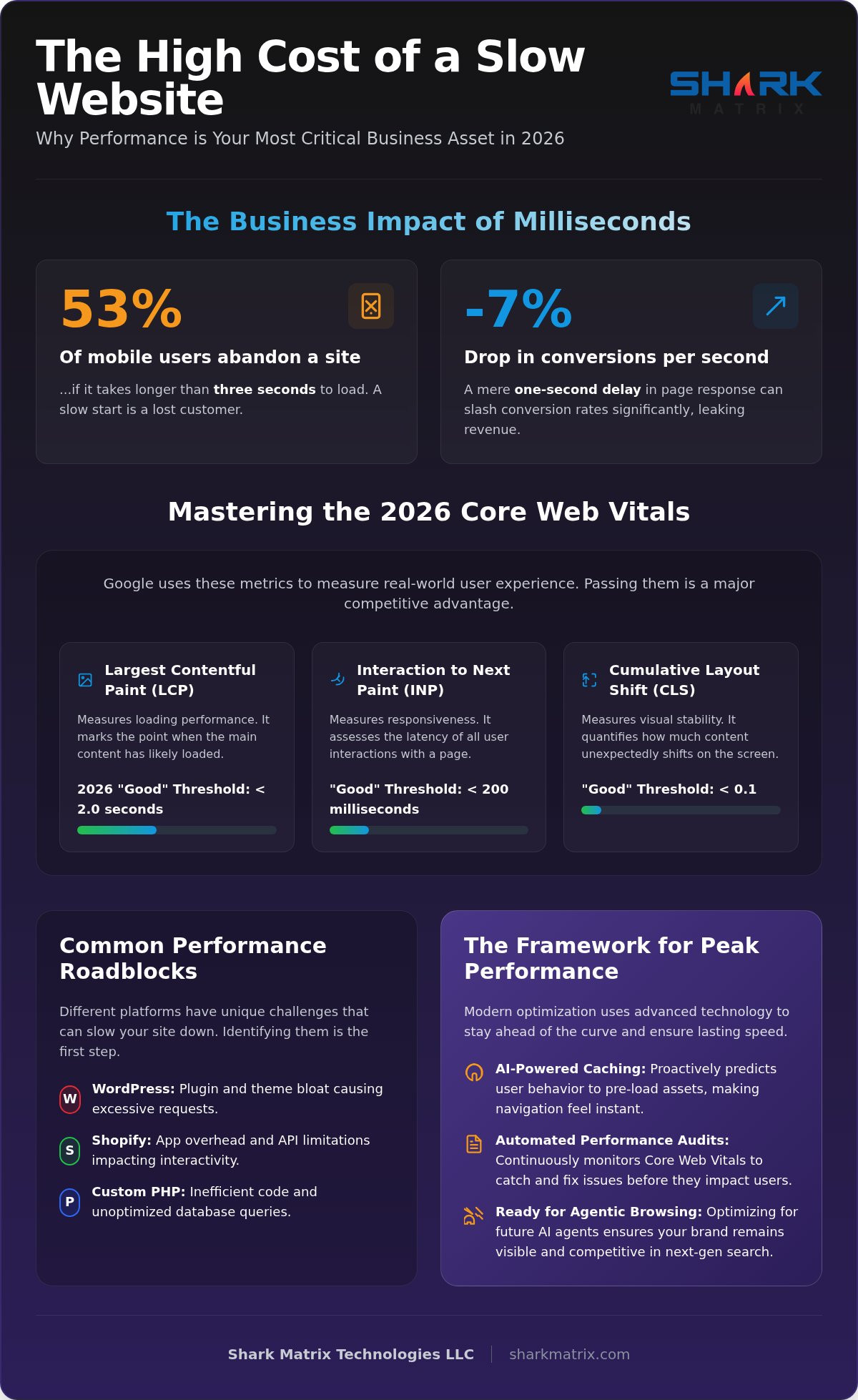
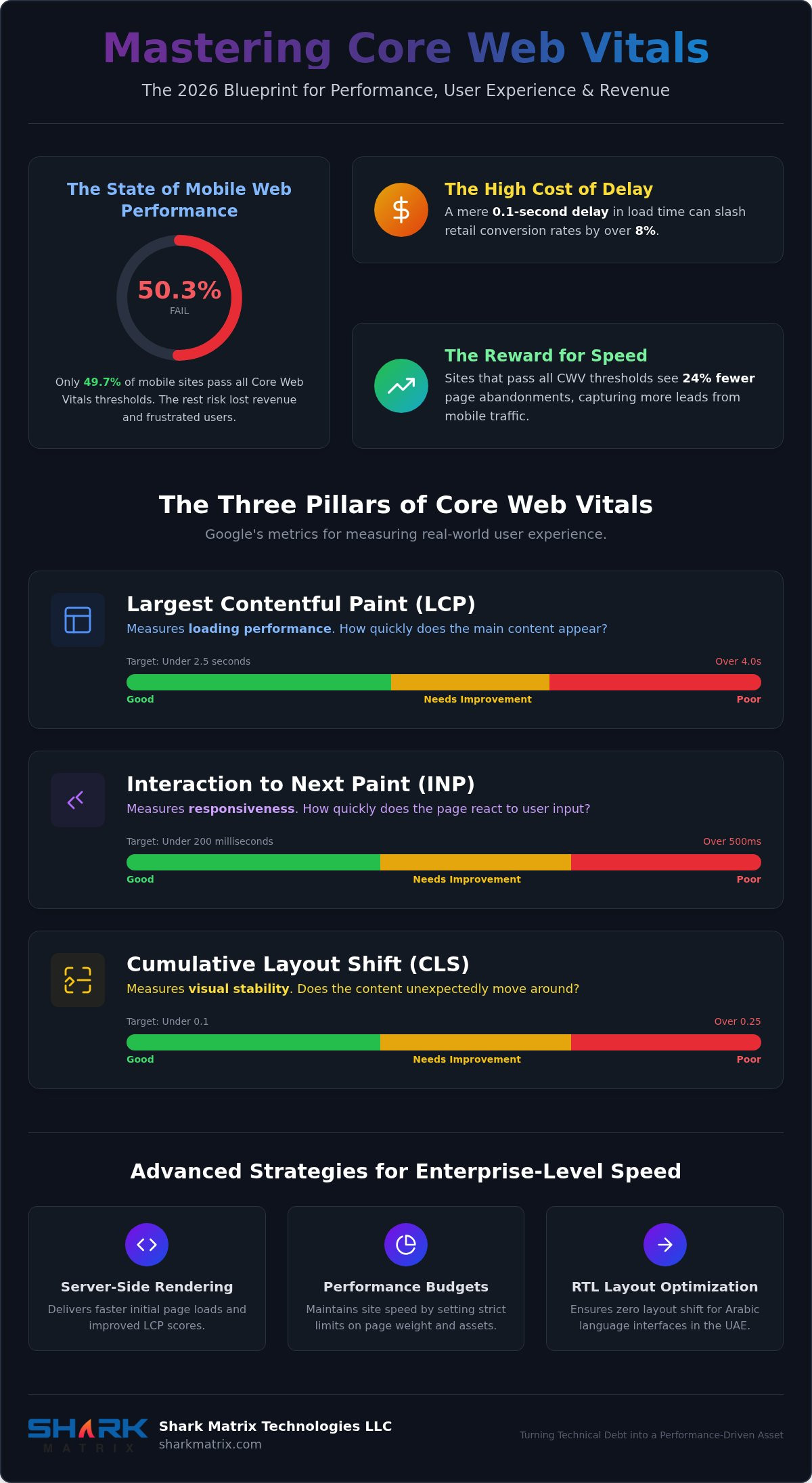
Did you know that only 49.7% of mobile websites currently pass all Core Web Vitals thresholds? Even with high-quality content, a 0.1-second delay in load time can slash your retail conversion rates by over 8%. For UAE enterprises, these technical “red” scores in Search Console aren’t just numbers; they represent lost revenue and frustrated users. Investing in a professional core web vitals optimization service is no longer optional if you want to maintain a competitive edge in 2026.

You likely recognize that a fast, responsive site is the backbone of your digital presence, but the technical complexity of metrics like Interaction to Next Paint (INP) can be overwhelming. We’ll show you how to master these Google ranking signals to transform your site’s performance and lower bounce rates. This article covers the essential steps to achieve consistent green scores, improve search visibility, and build an AI-ready infrastructure that converts visitors into loyal customers. It’s time to turn technical debt into a performance-driven asset for your brand.

Key Takeaways

  • Understand how Google’s technical signals impact your brand’s authority and why visual stability is crucial for the 2026 digital landscape.
  • Learn why a dedicated core web vitals optimization service is essential for mastering metrics like LCP, CLS, and the responsiveness-focused INP.
  • Discover a 5-step framework that uses real-user data to prioritize technical fixes based on their actual impact on your business model.
  • Explore advanced methods like Server-Side Rendering and performance budgets to maintain enterprise-level speed during content updates.
  • Gain insights into optimizing Right-to-Left (RTL) layouts for UAE audiences to ensure zero layout shift across Arabic language interfaces.

What is a Core Web Vitals Optimization Service and Why Does it Matter?

In the UAE’s competitive digital landscape, national brand authority depends on a seamless mobile experience. Users here operate on some of the fastest mobile networks in the world, which has raised the bar for what they consider “fast.” If a site jitters or lags, users don’t wait. They leave. A dedicated core web vitals optimization service ensures your infrastructure meets these evolving expectations, preventing the “technical red” scores that often plague enterprise-level sites with heavy scripts or complex designs.

The Direct Link Between CWV and Search Rankings

Google’s Page Experience signals directly influence your position in search results. While content quality remains vital, technical performance often acts as the tiebreaker between two high-quality pages. This creates a powerful synergy between technical health and search engine optimization SEO services. For national brands, achieving “Green” scores in Search Console isn’t just about vanity; it’s a prerequisite for competing in high-stakes industries like real estate, finance, or retail. If your metrics are in the “Needs Improvement” or “Poor” categories, your search visibility will likely suffer, regardless of how much you spend on marketing.

Business ROI: Beyond the Technical Scores

The impact of performance on your bottom line is quantifiable. Research indicates that just a 0.1-second improvement in load time can result in an 8.4% boost in retail conversions. This ROI is especially evident when looking at bounce rates. Websites that pass all three Core Web Vitals thresholds see 24% fewer page abandonments. For a UAE enterprise, reducing this friction means capturing more leads from mobile traffic. Protecting your brand reputation is equally important. A glitch-free digital experience signals professionalism and reliability, whereas a layout that shifts unexpectedly can lead to accidental clicks and user frustration. Investing in technical performance is a direct investment in your conversion funnel.

The Three Pillars of Core Web Vitals: LCP, CLS, and the Rise of INP

Core Web Vitals aren’t just technical jargon. They’re the metrics that define how a user perceives your site’s health and speed. In 2026, Google focuses on three specific pillars to judge page experience: Largest Contentful Paint (LCP), Cumulative Layout Shift (CLS), and Interaction to Next Paint (INP). Understanding these is the first step in any effective core web vitals optimization service. These metrics align with Google’s Web Vitals initiative, which provides unified guidance for quality signals that are essential to delivering a great user experience on the web.

To achieve a “Good” status in Google Search Console, your site must meet specific thresholds for each metric:

  • LCP: Under 2.5 seconds.
  • CLS: Under 0.1.
  • INP: Under 200 milliseconds.

A professional core web vitals optimization service addresses these three areas simultaneously to ensure no single metric drags down your overall score. If your site falls into the “Needs Improvement” or “Poor” categories, you’re likely losing traffic to faster competitors.

Mastering LCP for Instant Brand Presence

LCP measures how quickly the largest visible element on the screen loads, such as a hero image or a primary heading. If it takes too long, users feel the site is sluggish and may bounce before your value proposition even appears. High-performance website design and development services are essential here to optimize server response times and eliminate resource load delays. Strategic image optimization and the use of a global Content Delivery Network (CDN) are critical for meeting national LCP benchmarks in the UAE. By reducing the distance between your data and your user, you ensure that your brand presence is felt instantly.

INP: The Evolution of Interactivity

Interaction to Next Paint officially replaced First Input Delay (FID) in March 2024. While the old FID metric only measured the very first interaction, INP tracks the latency of all interactions throughout a user’s entire visit. It’s a much more holistic view of site responsiveness. Common culprits for poor INP include heavy, unoptimized JavaScript and overly complex DOM structures that bog down the browser. Our AI automation services can help streamline code execution, ensuring that your site remains snappy even during high traffic periods. If you’re unsure where your site stands, a technical audit from Shark Matrix Technologies LLC can pinpoint exactly which pillar is holding back your rankings.

Visual stability is the final piece of the puzzle. Cumulative Layout Shift (CLS) measures how much elements move around as the page loads. We’ve all experienced the frustration of trying to click a button, only for the page to shift and cause an accidental click on an ad. To maintain a “Good” score of under 0.1, developers must define size attributes for images and video elements. This ensures the browser reserves the correct amount of space while the content is still downloading, creating a smooth, professional experience.

Core Web Vitals Optimization Service: Elevating Performance for UAE Enterprises in 2026

Our 5-Step Process for Core Web Vitals Optimization

Implementing a professional core web vitals optimization service requires more than just running a tool and fixing errors. It’s a structured approach that balances technical precision with user experience. We use a rigorous 5-step process to ensure your site doesn’t just pass the test once but stays fast and stable as you grow. With only 55.7% of websites globally passing all three thresholds as of January 2026, following a proven framework gives your brand a significant competitive advantage in the UAE market.

Step 1: Data-Driven Diagnostics

We start by analyzing field data from the Chrome User Experience Report (CrUX) alongside lab data from Lighthouse. Field data is vital because it reflects what your actual UAE users experience on their specific devices and networks. Lab data helps us debug issues in a controlled environment. By integrating a detailed SEO audit report, we map performance bottlenecks directly to your keyword rankings. This reveals exactly which slow-loading pages are actively hurting your national domain authority.

Step 2: Prioritization Matrix
Not every technical fix is equal. We rank issues based on a matrix of business impact versus development effort. For example, fixing a high Cumulative Layout Shift (CLS) on a high-traffic checkout page takes priority over minor CSS tweaks on a low-traffic archived post. This ensures your budget is spent where it generates the most immediate ROI and conversion lift.

Step 3: Technical Implementation

This is where the heavy lifting happens. We focus on critical CSS extraction and minifying JavaScript to reduce main-thread work. Third-party scripts, such as heavy chatbots or tracking pixels, are often the biggest culprits for poor Interaction to Next Paint (INP) scores. We leverage our expertise in web development agency Dubai services to rebuild legacy elements that are too heavy for modern standards. This often involves deferring non-essential scripts so they don’t block the initial page load or user interactions.

Step 4: UI/UX Alignment
Performance fixes should never compromise your brand’s visual identity. If we need to change how a hero image loads to improve LCP, our UI/UX teams work alongside developers to ensure the transition is seamless. We maintain the aesthetic quality while ensuring the technical foundations are rock solid, preventing the “glitchy” feel that drives users away.

Step 5: Validation & Monitoring
Once fixes are live, we validate them using Google Search Console and Real User Monitoring (RUM) tools. Performance can degrade quickly when new content or features are added. We implement advanced strategies for maintaining performance through continuous tracking. This prevents regression and ensures your core web vitals optimization service delivers long-term value for your enterprise.

Advanced Strategies for Maintaining Performance at Scale

Maintaining peak performance isn’t a one-time event; it’s a constant discipline. Many enterprises see their scores slip months after an initial cleanup because they lack a performance culture. A sustainable core web vitals optimization service integrates these metrics into the daily development workflow to prevent “bloat” from new features or content updates. By implementing strict performance budgets, you set clear limits on JavaScript and CSS weight. If a new deployment exceeds these limits, the system flags it immediately, keeping your site lean and fast.

Technical architecture plays a massive role in long-term stability. Server-Side Rendering (SSR) and Static Site Generation (SSG) offer enterprise-level speed by delivering pre-rendered content to the browser. This approach minimizes the work the user’s device has to do, which is critical for maintaining a low Interaction to Next Paint (INP). Coupling this with Edge Computing ensures your brand’s digital assets are served from the closest possible node within the national infrastructure. Integrating automated testing directly into your CI/CD pipeline ensures that every code change is validated against CWV benchmarks before it ever reaches a live user.

AI-Driven Performance Optimization

Modern performance management relies heavily on advanced ai technologies to predict and mitigate issues. AI models can now analyze code changes to forecast potential layout shifts before production. Automated compression tools use machine learning to select the best format, like WebP or Avif, based on the specific device and connection speed of the visitor. We also use dynamic resource pre-fetching. This predicts user behavior to load assets just before they’re needed, creating a feeling of instant interactivity.

Mobile-First Excellence for National Brands

The UAE has a mobile-first population with access to cutting-edge 5G networks. However, performance must remain consistent even when users are on varying connectivity speeds. Our mobile app development services focus on cross-platform consistency to ensure the web experience feels as fluid as a native application. Responsive design is a standard, but it often introduces Cumulative Layout Shift (CLS) on unconventional screen sizes. We solve this by using precise aspect ratio boxes and CSS grid layouts that reserve space for elements before they load.

Ready to build a site that stays fast? Contact Shark Matrix Technologies LLC to audit your current infrastructure and implement a performance-first strategy today.

Why Shark Matrix Technologies LLC is the Premier Choice for CWV Services

Shark Matrix Technologies LLC approaches performance as a foundational element of your brand’s digital authority. While many providers focus solely on passing a lab test, our core web vitals optimization service looks at the bigger picture. We understand that for a UAE enterprise, a “Good” score is only useful if it translates into higher engagement and lower acquisition costs. Our team bridges the gap between complex backend engineering and the frontend user satisfaction that keeps customers coming back. We don’t just treat speed as a metric; we treat it as a competitive advantage.

One of our unique advantages is our deep expertise in Arabic language environments. Right-to-Left (RTL) layouts often introduce unique Cumulative Layout Shift (CLS) issues that standard optimization tools might miss. Shark Matrix Technologies LLC ensures that your site remains visually stable for regional audiences, regardless of the language they choose. This localized precision is why national leaders trust us to manage their complex digital ecosystems. Our core web vitals optimization service is designed to handle the nuances of the UAE market, ensuring your site performs flawlessly on the high-speed networks your users expect.

We move beyond basic scores to provide transparent reporting that connects technical health to business outcomes. You’ll see exactly how technical improvements correlate with your lead generation and overall ROI. By reducing page abandonments, we help you maximize the value of every visitor. We align every performance fix with your broader digital marketing & strategy to ensure your growth is sustainable.

Technical Mastery Meets Strategic Marketing

Performance isn’t just a developer’s job. Our technical SEO consultants work side-by-side with our engineering teams to ensure every optimization supports your visibility goals. We also integrate performance with online reputation management strategies. A fast, glitch-free site protects your premium brand image, especially in high-stakes sectors like real estate and finance. Shark Matrix Technologies LLC provides customized solutions that address the specific data-heavy requirements of these industries without sacrificing the speed that Google demands in 2026.

Ready to Go Green?

Don’t let technical “red” scores hold your brand back from its full potential. Our team is ready to help you navigate the latest performance standards with a clear, actionable roadmap. You can join the ranks of high-performing national brands that prioritize user experience as a core business value. Contact Shark Matrix Technologies LLC for a professional Core Web Vitals audit and start your journey toward a faster, more profitable digital future today.

Securing Your Brand’s Digital Future in the UAE

By now, it’s clear that technical performance isn’t just a backend concern; it’s a vital part of your brand’s authority and search visibility. Mastering the three pillars of LCP, CLS, and INP ensures your site meets Google’s 2026 standards while providing the seamless experience UAE users demand. Integrating a professional core web vitals optimization service into your workflow transforms technical debt into a powerful engine for conversion and growth. You’ve seen how even a minor 0.1-second improvement can drive revenue, making technical health a non-negotiable asset for any national enterprise.

Shark Matrix offers the specialized technical SEO team and national UAE market expertise needed to navigate these complex requirements. Our end-to-end development and marketing integration means your performance goals always align with your business objectives. We focus on the nuances of the regional market to ensure your site remains stable and fast across all devices and languages. Ready to lead your industry with a faster, more responsive site? Boost Your Site Performance: Get a Core Web Vitals Audit from Shark Matrix. Your journey to a high-performing digital presence starts with a single, data-driven step.

Frequently Asked Questions

What is a good score for Core Web Vitals in 2026?

A “Good” score requires meeting three specific thresholds: LCP under 2.5 seconds, CLS under 0.1, and INP under 200 milliseconds. These metrics must be maintained for at least 75% of your total page views to pass Google’s assessment. Achieving these targets ensures your site provides the visual stability and responsiveness necessary to compete in the UAE’s high-speed digital market.

How long does it take to see results from a Core Web Vitals optimization service?

You’ll see technical improvements in lab tools like Lighthouse immediately after deployment, but field data from Google Search Console takes 28 days to update. This delay occurs because Google aggregates real-user data over a rolling four-week window. A professional core web vitals optimization service ensures that these changes are sustainable so your scores remain green as more user data is collected.

Can I fix Core Web Vitals without changing my website design?

Yes, most optimizations happen at the code level without altering your site’s visual appearance. We focus on backend tasks like minifying JavaScript, compressing images, and optimizing server response times. While some layout shifts might require minor CSS adjustments to reserve space for elements, your brand’s core aesthetic and UI/UX design generally remain intact throughout the process.

Why did Google replace FID with INP (Interaction to Next Paint)?

Google replaced FID with INP in March 2024 to provide a more holistic view of site responsiveness. While FID only measured the very first interaction, INP tracks the latency of all user interactions throughout their entire visit. This change encourages developers to optimize the responsiveness of every button, menu, and form, ensuring a smooth experience from the moment a user arrives until they leave.

Do Core Web Vitals affect mobile and desktop rankings differently?

Google evaluates mobile and desktop performance separately, and your rankings can vary based on the device used. Given that mobile pass rates are lower at 49.7% compared to 57.1% for desktop, mobile optimization is often the bigger challenge. Since Google uses mobile-first indexing, failing these metrics on mobile devices can have a more significant negative impact on your overall search visibility.

How often should I audit my website’s Core Web Vitals?

You should audit your vitals at least once per quarter or whenever you deploy significant code updates or new content features. Performance can degrade quickly due to heavy third-party scripts or unoptimized assets. Regular monitoring through a core web vitals optimization service helps you catch regressions early, preventing technical “red” scores from lingering in Search Console and damaging your rankings.

Will optimizing Core Web Vitals improve my PPC quality score?

Yes, improving your vitals directly benefits your landing page experience, which is a key component of your Quality Score in Google Ads. Faster, more stable pages lead to lower bounce rates and higher user engagement. By delivering a better experience to paid traffic, you can lower your cost-per-click and improve your overall ad placement across the UAE’s competitive search landscape.

Does my hosting provider affect my Core Web Vitals scores?

Your hosting provider has a massive impact on Largest Contentful Paint (LCP) through its effect on Time to First Byte (TTFB). If your server is slow to respond or located far from your UAE audience, your LCP score will suffer regardless of how well your frontend code is optimized. High-performance hosting and local Content Delivery Networks are essential foundations for achieving green scores.

Categories
Development

Building a Compelling Business Case for Website Redesign in 2026: The Executive Guide

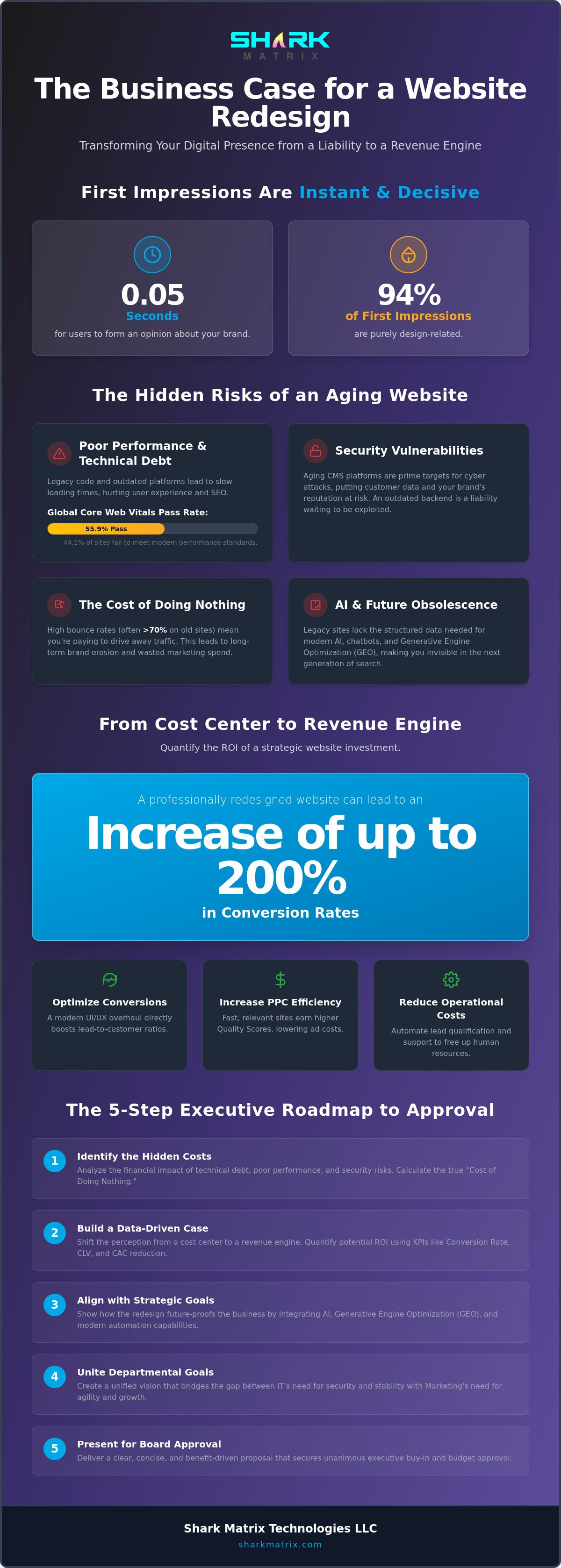
Did you know that users form an opinion about your brand in just 0.05 seconds, and 94% of those first impressions are purely design-related? If your conversion rates are stalling despite high traffic, you’re likely feeling the weight of an aging digital infrastructure. Building a strong business case for website redesign is no longer about aesthetics; it’s about fixing the technical debt that prevents you from integrating modern AI tools or meeting the 55.9% global pass rate for Core Web Vitals.

You probably agree that your website should be a performance asset rather than a cost center. We’ll show you how to quantify the ROI of a total overhaul, align your digital strategy with national growth goals, and secure board-level approval. This guide provides a clear roadmap to move from declining engagement to a high-performing site that meets WCAG 2.2 standards and drives measurable revenue. You’ll learn exactly how to bridge the gap between IT requirements and marketing agility to ensure your brand doesn’t fall behind national competitors.

Key Takeaways

  • Identify the hidden costs of digital stagnation and how technical debt actively limits your team’s marketing flexibility.
  • Shift your project’s perception from a cost center to a revenue engine by building a data-driven business case for website redesign.
  • Learn how to future-proof your digital presence by integrating Generative Engine Optimization (GEO) and modern AI automation directly into your site’s architecture.
  • Follow a proven five-step executive roadmap to align departmental goals and secure unanimous board-level approval for your budget.
  • Discover how to scale your national presence with a partner who understands the intersection of development, marketing, and brand protection.

The Hidden Risks of Digital Stagnation: Why Your Current Site is a Liability

Digital stagnation isn’t just about an old logo or clashing colors. It’s the widening gap between your site’s current capabilities and the rising expectations of modern users. When your digital presence fails to keep pace with innovation, it becomes a liability that drains resources and slows growth. Building a strong business case for website redesign requires identifying these hidden risks before they permanently impact your bottom line.

Technical debt is often the silent killer of marketing agility. Every patch or workaround added to legacy code makes the next update more expensive and time-consuming. This friction directly impacts your national SEO performance and search visibility. With the global pass rate for Core Web Vitals currently at 55.9%, failing to meet loading speed and visual stability standards means you’re losing visibility to more agile competitors. Adhering to foundational web design principles ensures your site remains a functional asset rather than a fragile collection of outdated scripts.

Security is another critical pillar that executives cannot afford to ignore. Aging CMS platforms are prime targets in an increasingly complex cyber landscape. An outdated backend doesn’t just slow down your team; it exposes your customer data to unnecessary risk. If your infrastructure can’t support modern security protocols, your brand reputation is one vulnerability away from a total collapse.

The “Cost of Doing Nothing” (CODN) Analysis

Calculating the CODN helps stakeholders see the financial impact of inaction. If your current bounce rate exceeds 70%, you’re effectively paying to drive traffic that leaves instantly. These abandoned interactions lead to long-term brand erosion, especially when national competitors offer seamless, high-speed experiences. The Cost of Doing Nothing is the cumulative lost opportunity cost of maintaining an obsolete digital interface.

Technical Obsolescence in the Age of AI

Your backend architecture determines your ability to compete in 2026. Legacy sites often lack the structured data required by modern answer engines, which limits your reach in generative search results. If your site can’t integrate with AI automation or real-time chatbots, you’re missing out on critical efficiency gains. “Looking fine” is no longer enough if your site cannot communicate with modern API ecosystems or support generative engine optimization (GEO).

Quantifying ROI: Transforming Your Website from a Cost Center to a Revenue Engine

Presenting a financial argument to the board requires a fundamental shift in perspective. You aren’t just asking for a budget to update graphics. You’re proposing a strategic capital investment (CapEx) designed to drive national brand growth. A compelling business case for website redesign demonstrates how modernizing your infrastructure reduces long-term operational costs while maximizing revenue potential. By treating your site as a performance asset, you move away from the “cost center” trap that keeps many businesses stuck with underperforming digital tools.

Efficiency is a primary driver of ROI. Utilizing professional website design and development services allows you to automate lead qualification and streamline the sales funnel. When your site answers common questions through a superior self-service UI/UX, you significantly reduce the volume of low-value inquiries hitting your customer support desk. This allows your team to focus on high-priority tasks while the website handles the heavy lifting of initial customer education, ultimately lowering your customer acquisition costs (CAC) and increasing average order value (AOV).

Key Performance Indicators (KPIs) for the Board

Executives need hard numbers to justify a project. According to 2026 data from Quickupp Softech, a well-designed website can increase conversion rates by up to 200%. This isn’t just a cosmetic gain; it’s a direct multiplier for your marketing spend. This also impacts your Pay Per Click (PPC) efficiency. Google rewards fast, relevant sites with higher quality scores, which lowers your cost-per-click and stretches your ad spend further. To secure approval, highlight these three metrics:

  • Conversion Rate Optimization (CRO): Focus on the measurable jump in lead-to-customer ratios following a UI/UX overhaul.
  • Customer Lifetime Value (CLV): Use better engagement tools and personalized content to foster long-term loyalty and repeat business.
  • Site Speed Impact: Address the 53% of mobile users who abandon pages taking longer than three seconds to load, as reported by Visual Identity Studio in 2026.

The Arabic Localization Advantage

In a competitive national market, ignoring localization is a massive revenue leak. Moving from an English-only platform to a high-quality, culturally nuanced Arabic interface expands your reachable audience significantly. Regional users convert at much higher rates when they can interact with a brand in their primary language. This builds a layer of trust that generic translation tools simply cannot replicate. By integrating professional Arabic digital marketing into your redesign, you capture a larger slice of the national market share and establish your brand as a local authority. If you’re ready to see how these metrics apply to your specific industry, you can explore our strategic development approach to start your transformation.

Building a Compelling Business Case for Website Redesign in 2026: The Executive Guide

Strategic Alignment: Integrating AI, GEO, and Modern UI/UX into Your Redesign

In 2026, the digital environment has shifted from traditional keyword matching to intent-based discovery. A simple visual refresh won’t suffice when the underlying architecture of your site determines whether you appear in AI-generated search results. Developing a robust business case for website redesign often hinges on your ability to adopt Generative Engine Optimization (GEO). This isn’t just a trend; it’s a fundamental change in how your brand communicates with both humans and machines. A redesign provides the only viable path to implement a modern search engine optimization seo services strategy that accounts for these architectural shifts.

User behavior also demands a nuanced approach to mobile accessibility. With mobile devices accounting for 53% to 64% of global web traffic, your site must be more than just responsive. We’ve moved beyond “Mobile-First” into a “Mobile-Only” reality for many national segments. If your current site was built on a desktop-first legacy system, it likely carries bloated code that slows down mobile load times. Every second of delay erodes trust. Since users form an opinion about your brand in just 0.05 seconds, your technical infrastructure must be optimized for instantaneous, high-relevance interactions across every device type.

From SEO to GEO: Preparing for Answer Engines

Traditional keyword stuffing has been replaced by entity-based architecture. Answer engines now prioritize sites that provide a clean data structure which AI crawlers can easily parse. A redesign allows you to overhaul your schema markup and structured content from the ground up. This ensures your brand is the primary source for AI-generated snippets rather than a buried link on page two. By aligning your backend with these new standards, you secure a competitive edge that legacy sites simply cannot match without a total architectural rebuild.

UI/UX as a Competitive Differentiator

High-end UI design has a profound psychological impact on brand authority. In B2B and E-commerce environments, streamlining the user journey is the most effective way to reduce friction and increase session duration. Modern redesigns also allow for the integration of custom AI development, such as interactive tools or personalized content engines. These features don’t just look impressive; they provide genuine value-add experiences that keep visitors engaged longer. When your site functions as an intuitive partner rather than a static brochure, you transform user relevance into measurable loyalty and higher conversion rates.

The Executive Roadmap: 5 Essential Steps to Secure Board Approval

Securing a budget for a large-scale digital project requires more than a list of technical requirements. You need a structured approach that speaks the language of the boardroom. Following a clear roadmap ensures your business case for website redesign addresses both growth opportunities and operational risks. By breaking the process into these five essential steps, you can transform a complex technical proposal into a compelling strategic initiative.

  • Step 1: Internal Audit & Benchmarking: Don’t just look at your own data. Compare your current metrics, like the high bounce rates mentioned earlier, against national industry leaders. This highlights exactly where you’re losing market share to more agile competitors.
  • Step 2: Stakeholder Interviews: Gather insights from Sales, IT, and Customer Service. Identifying their specific pain points, such as slow lead processing or high support ticket volumes, ensures the project delivers value across the entire organization.
  • Step 3: Solution Prototyping: Define the high-level features that solve these problems. This might include AI-driven automation, advanced e-commerce flows, or full Arabic localization to capture regional demand.
  • Step 4: Financial Modeling: Present a 24-month forecast. Contrast the Cost of Doing Nothing (CODN) with the projected ROI from increased conversion rates and lower acquisition costs.
  • Step 5: Risk Mitigation Plan: Address the board’s fears head-on. Detail your strategy for SEO migration, data security, and meeting project timelines to build confidence in the execution.

Building the “Vision” Document

Abstract technical concepts often fail to resonate with non-technical executives. Use visual mood boards and low-fidelity wireframes to make the redesign feel tangible. Shift the focus from “Design Features” like color palettes to “Business Outcomes” like reduced friction in the checkout process. The project vision is a strategic pivot toward digital leadership. When the board can see how a new interface directly correlates with national growth, approval becomes a logical next step.

Addressing the #1 Objection: SEO Preservation

The fear of losing hard-earned search rankings is the most common reason projects stall. You must demonstrate a rigorous 301 redirect strategy and a comprehensive content mapping process. Partnering with a professional seo agency ensures that your transition is managed with precision to prevent traffic dips. Instead of viewing the move as a risk, position it as an opportunity for a massive post-launch ranking boost through cleaner code and better Core Web Vitals. If you’re ready to start building your roadmap, you can consult with our strategic planning team to refine your vision.

Executing the Vision: Scaling Your National Presence with a Strategic Partner

Scaling a national presence requires more than just a functional site. It demands a digital ecosystem where code, marketing, and artificial intelligence intersect seamlessly. When you finalize your business case for website redesign, the choice of a strategic partner becomes the most critical factor in your project’s success. You need a team that doesn’t just build pages but engineers a high-performance asset capable of handling complex integrations and cultural nuances. A partner who understands the backend as well as the frontend ensures your vision translates into a scalable reality.

Maintaining trust during a major transition is vital. Implementing professional online reputation management dubai ensures your brand’s digital footprint remains protected as you migrate to a new platform. This is especially important for national brands where public perception can shift rapidly during a redesign. A “National-First” strategy accounts for regional cultural nuances, ensuring your messaging resonates across diverse demographics. It’s about more than translation; it’s about cultural alignment that builds lasting trust with your audience.

Your new website serves as the bedrock for all future growth initiatives. It’s the destination for every click from your social media campaigns and the high-converting landing page for your ppc agency dubai efforts. Without a modern, fast, and accessible foundation, your advertising spend won’t reach its full potential. A redesign ensures that every dollar spent on traffic is supported by a site built to convert.

The Shark Matrix Technologies LLC Advantage: End-to-End Digital Engineering

We don’t just design websites. We integrate custom software engineering with advanced digital marketing to ensure every build is a revenue driver. Our approach leverages AI automation to future-proof your asset, making it ready for the next decade of technological shifts. With deep expertise in Arabic digital marketing, Shark Matrix Technologies LLC helps you capture the full national market by speaking directly to your audience. This comprehensive service model eliminates the friction of managing multiple vendors and ensures a cohesive digital strategy from day one.

Next Steps: From Business Case to Kickoff

The path to a successful launch starts with hard data. Initiating a professional site audit is the best way to gather the specific metrics needed to finalize your business case for website redesign. This audit identifies current bottlenecks and provides a clear baseline for measuring future ROI. Setting realistic timelines is also essential. A national-scale project requires careful planning, from initial stakeholder interviews to the final security sweep. Don’t let digital stagnation hold your brand back. Schedule a strategic consultation with Shark Matrix Technologies LLC to build your data-driven business case and take the first step toward a dominant national presence.

Taking the Next Step Toward Digital Leadership

Your website is no longer just a digital business card; it’s the engine that powers your national growth. We’ve explored how moving away from technical debt and embracing Generative Engine Optimization (GEO) turns your site into a high-performance asset. It’s about more than aesthetics. It’s about building a foundation that supports AI-driven discovery and high-velocity lead generation. By following a structured roadmap, you can present a data-driven business case for website redesign that aligns marketing agility with financial performance.

Since 2010, Shark Matrix Technologies LLC has provided over a decade of national market expertise to help brands navigate these complex transitions. We specialize in AI automation and custom software engineering, ensuring your new infrastructure is ready for the demands of 2026. Our deep expertise in professional Arabic digital marketing and localization ensures your message resonates with every segment of the national audience. Ready to build your business case? Contact Shark Matrix Technologies LLC for a comprehensive digital audit. Your brand’s next chapter of growth starts with a foundation built for the future.

Frequently Asked Questions

How much does a website redesign typically cost for a national brand in 2026?

Costs for a national-scale project vary significantly based on the complexity of custom software engineering, AI integrations, and the depth of localization required. While simpler platforms have lower entry points, enterprise projects require a budget that covers high-traffic infrastructure, security protocols, and advanced marketing automation. You should evaluate your investment based on the specific revenue goals and technical debt identified during your initial site audit.

How long does the website redesign process take from business case to launch?

A national redesign project typically requires three to six months to move from the initial discovery phase to a live launch. This timeline accounts for stakeholder interviews, architectural planning, custom development, and rigorous cross-device testing. Planning for this duration ensures your team has enough time to align the new digital infrastructure with your long-term business goals without compromising on quality assurance.

Will a redesign hurt my current search engine rankings?

A redesign won’t hurt your rankings if you implement a precise migration strategy that includes 301 redirects and careful content mapping. In many cases, fixing legacy code and improving Core Web Vitals leads to a measurable ranking boost shortly after launch. Working with specialists ensures your current search visibility is protected while building a foundation that’s optimized for the latest generative search standards.

What is the difference between a website refresh and a full redesign?

A website refresh focuses on cosmetic updates like colors, fonts, and imagery, whereas a full redesign overhauls the site’s underlying architecture and user journey. A redesign is necessary when your current backend can’t support modern AI tools or meet accessibility standards like WCAG 2.2. This deeper structural change is what allows you to build a truly effective business case for website redesign.

How do I measure the success of a website redesign after it launches?

You measure success by tracking key performance indicators like conversion rates, customer acquisition costs, and average session duration. Compare these post-launch metrics against the benchmarks established during your internal audit to quantify the return on investment. A successful project should show a clear reduction in bounce rates and a significant increase in lead quality, proving the site’s value as a revenue-generating asset.

Why is Arabic localization critical for a business case in the UAE market?

Arabic localization is essential because it builds immediate trust and cultural relevance with a massive segment of the regional audience. Simply translating text isn’t enough; you need a localized interface that accounts for regional nuances to drive higher conversion rates. Including this in your business case for website redesign ensures you don’t leave revenue on the table by ignoring the primary language of the UAE market.

What role does AI play in a 2026 website redesign?

AI plays a central role through personalized content delivery, automated customer service chatbots, and backend optimization for generative answer engines. Modern sites use machine learning to adapt the user experience in real-time based on visitor behavior. Integrating these tools during a redesign allows your business to stay ahead of competitors who are still relying on static, non-interactive templates that can’t communicate with modern API ecosystems.

How often should a business redesign its website to stay competitive?

Most industry professionals suggest a major redesign every three to five years to keep up with shifting technical standards and user expectations. However, with the rapid rise of AI and new search behaviors, you might need to update your architecture sooner if your current site fails to pass Core Web Vitals. Regular audits help you determine if your digital presence is still a performance asset or if it’s become a liability to your growth.

Categories
SEO

High-Performance Website Speed Optimization Service: A 2026 Guide for UAE Brands

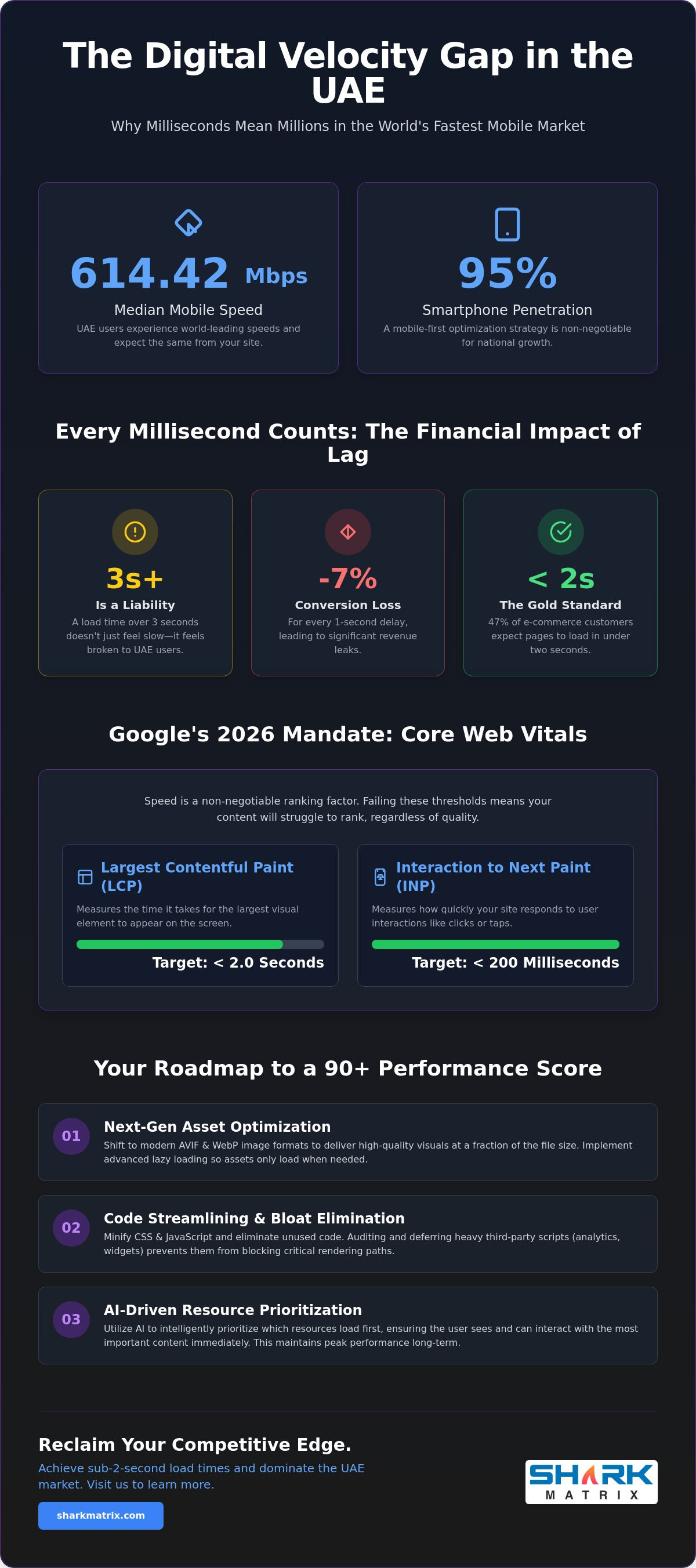
Did you know the UAE now leads the world with a median mobile internet speed of 614.42 Mbps? In an environment where 95% of the population uses a smartphone, a three-second load time is no longer just slow; it’s a liability that drives customers straight to your competitors. If you’re struggling with high bounce rates or losing sleep over complex technical jargon that doesn’t improve your performance, you aren’t alone. Many local brands find themselves trapped by outdated code that can’t keep up with the country’s rapid digital evolution. Finding a reliable website speed optimization service dubai is the first step toward reclaiming your competitive edge and ensuring your site feels as fast as the local 5G network.

If you are looking for a reliable software development partner in Dubai to help implement these advanced technical solutions, click here to see how A3N can support your project.

You deserve a digital presence that converts, and that starts with hitting Google’s 2026 Core Web Vitals thresholds, including the critical sub-200 millisecond Interaction to Next Paint (INP) target. We promise to show you how to achieve sub-2-second load times nationwide through technical precision and AI-driven optimization. This guide covers the essential shift from basic code cleaning to advanced resource prioritization. You’ll learn how to improve your Google Search rankings and boost user engagement while staying compliant with the latest UAE data protection regulations.

Key Takeaways

  • Understand the direct link between millisecond latency and significant revenue loss within the UAE’s high-intent digital sectors.
  • Explore how a professional website speed optimization service dubai utilizes next-gen image formats and code streamlining to eliminate technical bloat.
  • Learn why AI-driven resource prioritization is replacing traditional methods to maintain long-term performance and prevent future bottlenecks.
  • Discover the step-by-step roadmap to achieving a 90+ performance score and meeting Google’s updated 2026 Core Web Vitals thresholds.
  • See how integrating speed enhancements with search engine optimization (SEO) creates a stronger foundation for higher rankings and better user engagement.

The Real Cost of Latency: Why Website Speed Optimization Matters in the UAE

In the UAE, website speed optimization is a holistic technical process that aligns your digital assets with one of the most advanced internet infrastructures on the planet. It’s not just about minifying a few files. A professional website speed optimization service dubai re-engineers how your site interacts with the technical pillars of web performance to ensure seamless delivery across the Emirates. Speed isn’t a luxury. It’s the foundation of your entire digital presence.

UAE users live in an “instant” economy. With median mobile download speeds hitting 614.42 Mbps as of early 2026, the local audience has zero patience for lag. When your site takes three seconds to load, it doesn’t just feel slow; it feels broken. This expectation gap is where national brands lose their competitive edge. Speed has become the primary indicator of brand authority and technical competence in the Dubai market. If your site doesn’t keep up with the country’s 5G speeds, your customers will find a competitor who does.

Impact on Conversion Rates and User Retention

Milliseconds translate directly into revenue. Industry data shows that 47% of e-commerce customers expect a page to load in under two seconds before they consider leaving. Even a one-second delay can slash your conversion rates by 7%. In high-intent sectors like real estate or luxury retail, these tiny delays lead to massive financial leaks. Beyond the numbers, speed has a profound psychological impact. A fast, responsive website signals professionalism and builds immediate trust. Since 95% of the UAE population uses smartphones, mobile-first performance is the only metric that truly drives national growth.

The SEO Connection: Passing Google Core Web Vitals

Google’s March 2026 update made technical speed a non-negotiable ranking factor. Largest Contentful Paint (LCP) must now trigger in under 2.0 seconds to earn a “Good” rating. Interaction to Next Paint (INP) is now a primary signal, demanding that your site responds to user input in under 200 milliseconds. This shift means search engine optimization seo services must now start with a high-performance technical foundation. If you don’t pass these audits, your content will struggle to rank regardless of its quality. Core Web Vitals are the gold standard for technical health in 2026.

Technical Pillars of a Professional Website Speed Optimization Service Dubai

Achieving elite digital performance requires more than just a simple plugin or basic file compression. A professional website speed optimization service dubai treats your site like a high-performance engine, fine-tuning every internal component to ensure it runs at peak efficiency. This involves moving beyond surface-level fixes to address The Real Cost of Latency through structural changes that prioritize the user’s experience. From managing third-party scripts that bloat the main thread to streamlining CSS and JavaScript, every millisecond saved strengthens your brand’s technical authority.

Third-party scripts for analytics and widgets are often the biggest silent offenders. We audit these external resources to ensure they don’t block the initial render. By deferring non-essential scripts, your site remains interactive while background processes load quietly. If your current setup feels sluggish despite your best efforts, our team can help you transition to a cleaner, faster web development framework that supports long-term growth.

Next-Gen Asset Optimization Strategies

High-resolution visuals are essential for luxury UAE brands, but they shouldn’t come at the cost of speed. In 2026, the shift to AVIF and WebP formats is mandatory. These formats provide superior quality at a fraction of the file size of traditional JPEGs. We also implement advanced Lazy Loading, which ensures that images and videos only load as they enter the user’s viewport. For the UAE’s mobile-heavy audience, we optimize video content using adaptive bitrate streaming, preventing buffering even on slower mobile connections and keeping engagement high.

Database and Backend Performance Tuning

Database bloat is the silent killer of enterprise website speed. Over time, unnecessary data, expired transients, and unoptimized tables slow down every query, leading to sluggish server response times. For complex e-commerce platforms, we implement Object Caching and Query Optimization to reduce the load on your server. When dealing with complex web applications, server-side rendering (SSR) can revolutionize load times by delivering fully rendered pages to the browser instantly. This approach ensures that even the most feature-rich sites maintain a sub-2-second Largest Contentful Paint (LCP) score nationwide.

High-Performance Website Speed Optimization Service: A 2026 Guide for UAE Brands

Manual vs. AI-Driven Optimization: The Shark Matrix Technologies LLC Advantage

Many agencies offer a one-time cleanup that quickly becomes outdated as you add new content or features. This fix-and-forget mentality fails in a market as dynamic as the UAE. Shark Matrix Technologies LLC bridges the gap between static code and real-world performance by integrating our ai development services directly into the technical workflow. Instead of reacting to a slow site after your rankings drop, we use machine learning to maintain peak efficiency around the clock. This proactive approach ensures your site stays fast regardless of how many high-resolution images or new pages you add.

Precision is everything when you’re competing for the top spot on local search results. As highlighted in the Milliseconds Make Millions report, even a 0.1-second improvement can boost retail conversion rates by nearly 10%. Achieving that level of refinement requires a website speed optimization service dubai that understands the intersection of predictive technology and clean engineering. We don’t just guess where the bottlenecks are; we use data to eliminate them before they impact your bottom line.

Predictive Performance Monitoring

Our AI-driven approach identifies slow-loading patterns before they reach the end user. The system continuously simulates various UAE network conditions, from high-speed fiber in Dubai Marina to mobile connections in more remote areas. This allows us to spot latency issues that manual testing might miss. During high-traffic events like National Day sales or Ramadan, the system can help predict load spikes, allowing for real-time resource allocation that prevents crashes and maintains sub-2-second load times when you need them most.

Custom Code vs. Plugin Bloat

Generic all-in-one speed plugins are often the biggest contributors to technical debt. They add unnecessary JavaScript and CSS files that increase your total page weight and create new conflicts. Shark Matrix Technologies LLC avoids this trap by prioritizing custom-engineered code that does exactly what it needs to and nothing more. This philosophy is a core part of our website design and development services. By building on a clean foundation, we ensure your site remains lightweight and agile, providing a superior user experience that plugins simply can’t replicate. A professional website speed optimization service dubai shouldn’t rely on shortcuts that eventually slow you down.

Your Roadmap to a 90+ Performance Score Nationwide

Achieving a 90+ performance score isn’t a matter of luck; it’s the result of a deliberate, technical journey. Many brands make the mistake of applying surface-level patches without understanding the underlying bottlenecks. A professional website speed optimization service dubai follows a structured roadmap that transforms your digital presence from a liability into a high-speed asset. This process ensures that every script, image, and server request is tuned for the specific digital landscape of the UAE. By following a clear path, you can eliminate the guesswork and focus on the technical changes that drive the highest ROI.

Phase 1: The Deep Technical Audit

Every successful project begins with a granular look at your current performance. We use a combination of Lighthouse, PageSpeed Insights, and our own proprietary AI tools to dissect your site’s architecture. It’s important to distinguish between “lab data,” which offers a controlled simulation, and “field data,” which captures the real-world experiences of your users on various devices and connections. This data-driven approach allows us to see exactly where your site fails to meet the 2026 Core Web Vitals standards. A comprehensive audit is the foundation of any successful speed strategy.

Phase 2: Regional Infrastructure Optimization

Physical distance remains a primary cause of latency. If your server is in Europe but your customers are in Dubai, you’re losing precious milliseconds before the first byte even arrives. Selecting a UAE-based or regional CDN node is critical for local latency because it caches your content at the edge of the network. This optimization reduces your Time to First Byte (TTFB), ensuring that the initial handshake between the user’s browser and your server happens almost instantly. Shark Matrix Technologies LLC ensures consistent speed for users across all seven emirates by leveraging local infrastructure that matches the UAE’s world-class 5G capabilities.

After the audit and infrastructure setup, we move into priority implementation. We focus on Largest Contentful Paint (LCP) to ensure your main content appears in under two seconds, and Cumulative Layout Shift (CLS) to prevent annoying visual jumps as the page loads. The final stage involves post-optimization testing and validation. We run real-world speed checks across different UAE networks to ensure your site performs flawlessly for every visitor, regardless of their location. If you want to dominate the local search results, you can start your journey with a specialized website speed optimization service dubai that delivers measurable results.

Why Shark Matrix Technologies LLC is the Premier Choice for UAE Speed Optimization

Choosing the right partner for your digital infrastructure is a decision that impacts your bottom line for years. Shark Matrix Technologies LLC has built a reputation as the leading website speed optimization service dubai by focusing on measurable results rather than just technical checklists. We understand that a fast site isn’t the end goal; it’s the vehicle for higher conversions and better visibility. Our team has a proven track record of transforming complex e-commerce platforms and national enterprise sites into streamlined, high-performance assets. We balance aesthetic UI/UX with technical precision, ensuring your brand looks stunning without sacrificing a millisecond of load time.

What sets Shark Matrix Technologies LLC apart is our deep integration with search engine optimization seo services. We don’t just optimize for the sake of speed; we optimize to ensure your technical foundation supports your broader organic growth goals. By aligning our performance tuning with Google’s latest ranking signals, we provide a dual benefit of better user retention and improved search visibility. You receive transparent reporting and dedicated support to maintain long-term stability as your business scales.

Holistic Digital Growth Integration

Speed is a force multiplier for every marketing dirham you spend. When your site loads instantly, your quality scores improve, which is why Shark Matrix Technologies LLC is often cited as a preferred ppc agency dubai partner. Faster landing pages lead to lower costs per click (CPC) and higher conversion rates on paid traffic. Additionally, there’s a powerful synergy between technical speed and seo for brand reputation management dubai. A fast, reliable site protects your brand’s image by providing a professional experience that users trust. We position ourselves as your full-service technology partner, managing the technical complexity so you can focus on your core business.

Get Started with a Performance Audit

The path to a faster digital future begins with understanding your current limitations. Taking the first step is simple. The team at Shark Matrix Technologies LLC works seamlessly with your existing marketing and development departments to identify and resolve performance bottlenecks without disrupting your operations. Don’t let a slow website hold back your growth in the UAE’s competitive market. Now is the time to secure your technical health and outpace the competition. Optimize your website performance with Shark Matrix Technologies LLC today and experience the difference that a professional website speed optimization service dubai can make for your brand.

Dominate the UAE Digital Landscape with Unmatched Speed

In a market defined by the world’s fastest mobile internet, your website’s performance is your strongest competitive advantage. We’ve explored how sub-second improvements directly impact your bottom line and why aligning with national infrastructure is essential for passing Google’s 2026 Core Web Vitals. Moving beyond basic plugins to custom code and AI-driven monitoring ensures your brand remains agile and responsive. By selecting a professional website speed optimization service dubai, you aren’t just cleaning up code; you’re building a foundation for sustainable growth and higher search rankings.

Shark Matrix brings AI-Powered Performance Monitoring and deep Expertise in National UAE Digital Infrastructure to every project. As a partner Trusted by Leading UAE Enterprises, we help you navigate technical complexities without compromising your creative vision. The time to eliminate latency and reclaim lost revenue is now. Book Your Comprehensive Website Performance Audit with Shark Matrix to see exactly how your site can reach its full potential. Let’s transform your digital presence into a high-speed engine that drives results across the Emirates.

Frequently Asked Questions

How long does it take to see results from a website speed optimization service?

Technical improvements show up immediately in testing tools like Lighthouse and PageSpeed Insights as soon as the changes are live. However, seeing the impact on your Google Search rankings or conversion rates usually takes a few weeks as search engines recrawl your updated code. Most brands notice a significant drop in mobile bounce rates within days of implementing a professional website speed optimization service dubai.

Will optimizing my website speed affect its design or layout?

Professional optimization shouldn’t change your visual design or brand identity. We focus on the underlying code, server requests, and asset delivery rather than the aesthetic elements. Techniques like Cumulative Layout Shift (CLS) correction actually make your layout more stable by preventing elements from jumping around as they load. Your site stays exactly as you designed it but becomes significantly more responsive.

Do I need to change my hosting provider to get a faster website?

You don’t always need to switch providers, but your hosting infrastructure plays a massive role in overall performance. If your current server has high latency or slow response times, even the best code won’t reach sub-2-second speeds. We often recommend adding a regional CDN node or upgrading to a managed environment that supports modern protocols like HTTP/3 to ensure your backend isn’t a bottleneck.

What is a good PageSpeed Insights score for a UAE business website?

Aim for a score of 90 or higher on both mobile and desktop to remain competitive in the UAE market. In 2026, Google’s thresholds are stricter than ever, so a score in the “Green” zone is vital for maintaining search authority. While the score is a helpful benchmark, it’s equally important to focus on real-world field data to ensure your actual visitors experience the “instant” load times they expect.

Can speed optimization help my Google Ads (PPC) performance?

Speed directly impacts your Google Ads performance by improving your landing page experience score. Faster load times lead to higher Quality Scores, which can lower your cost-per-click and increase your ad rank. A website speed optimization service dubai ensures that the traffic you pay for doesn’t bounce before your page even loads, maximizing the ROI of your entire digital marketing budget.

Is website speed optimization a one-time service or an ongoing process?

Optimization is most effective as an ongoing process rather than a one-off fix. As you add new content, high-resolution images, or marketing scripts, your site can naturally slow down over time. Continuous monitoring and regular adjustments help maintain your high performance scores and prevent technical debt from accumulating as your digital presence evolves and your business scales.

How does mobile speed optimization differ from desktop optimization?

Mobile optimization is more complex because it accounts for limited processing power and varying network conditions. While desktop users often have stable fiber connections, mobile users rely on cellular data which can fluctuate. We prioritize “critical path” CSS and specific image sizing for smaller screens to ensure the mobile experience is just as fast as the desktop version, even on the move.

What are Core Web Vitals and why should I care about them in 2026?

Core Web Vitals are specific metrics Google uses to measure user experience, focusing on loading speed, interactivity, and visual stability. In 2026, passing these thresholds is a primary ranking signal for all websites. If your site fails these technical tests, you’ll likely see a decline in search visibility and user engagement regardless of how high the quality of your content is.

Categories
SEO

Technical Guide: Hreflang Implementation for Arabic Sites in 2026

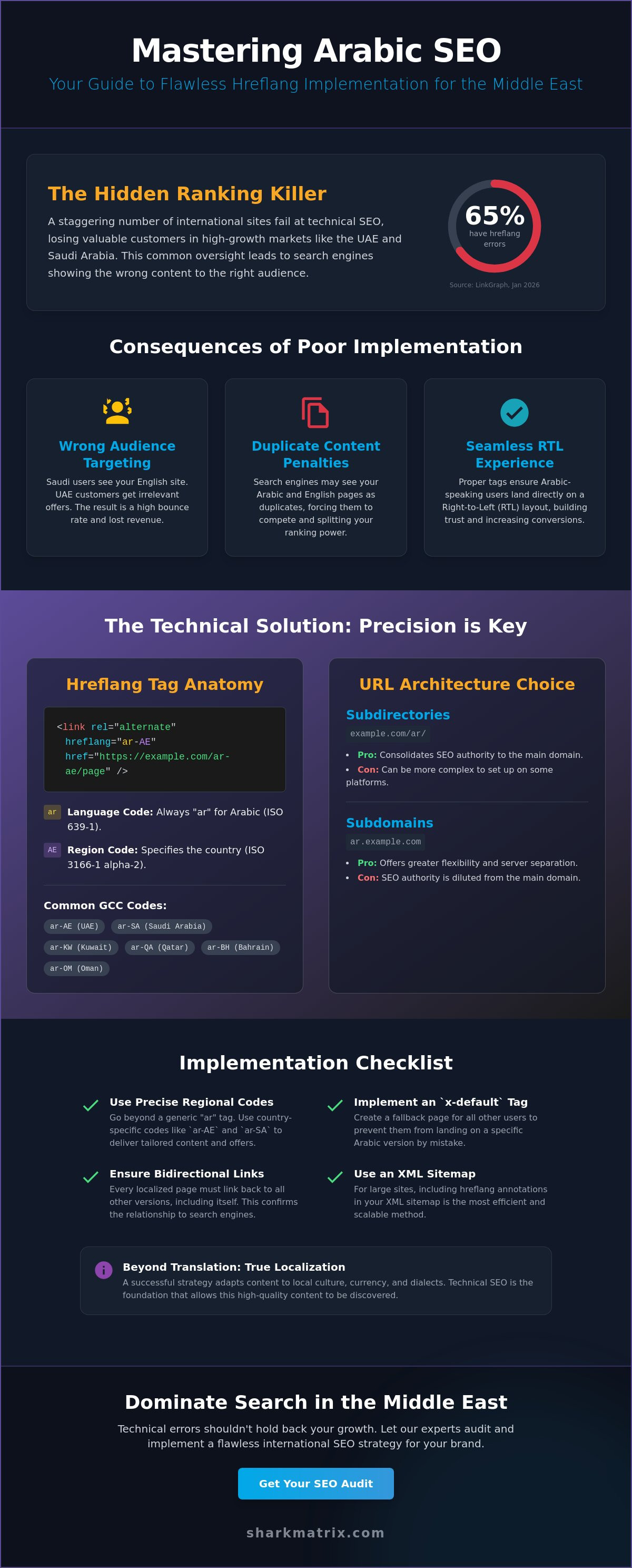
Over 65% of international websites currently struggle with significant errors in their hreflang tags according to January 2026 data from LinkGraph. For businesses targeting the Middle East, a flawed hreflang implementation for arabic sites often means your high-value Saudi audience sees English content while your UAE landing pages fail to rank entirely. It’s frustrating to invest in quality content only to have search engines serve the wrong version. Between the complexities of Right-to-Left (RTL) architecture and the confusion of ISO codes like ar-AE versus ar-SA, the technical barriers can feel overwhelming.

We’re here to help you master these technical nuances so you can dominate search results across the Middle East. You’ll gain a clear roadmap for implementation that ensures your regional targeting is precise and your site avoids duplicate content penalties. We’ll walk through the essential steps for mapping regional codes, managing bidirectional links, and leveraging XML sitemaps to ensure your localized versions perform exactly as intended.

Key Takeaways

  • Identify the correct ISO 639-1 “ar” language codes and regional modifiers to build precise tags that signal your target market to search engines.
  • Evaluate the SEO authority of subdirectories against the flexibility of subdomains to find the ideal URL architecture for your localized Arabic pages.
  • Discover how a proper hreflang implementation for arabic sites protects your brand from duplicate content penalties while supporting Right-to-Left (RTL) layout stability.
  • Understand the impact of Arabic site architecture on Core Web Vitals to ensure your technical SEO supports a seamless mobile experience.
  • Prepare for the future of search by aligning your technical signals with emerging AI and Generative Engine Optimization (GEO) trends in the MENA region.

Why Arabic Hreflang Implementation is Critical for UAE Brands

The hreflang attribute serves as a technical signal that tells search engines exactly which language and geographic region a page is designed for. In a market like the UAE, where internet penetration reached 99.0% by June 2026 according to DataReportal, the stakes for technical precision are incredibly high. Without a robust hreflang implementation for arabic sites, your content might exist, but it won’t be visible to the right people. It’s the difference between a user in Riyadh seeing your Saudi-specific pricing and a user in Dubai seeing your UAE-specific offers.

Localization offers a massive return on investment, yet many brands stop at simple translation. Digital advertising spend in the MENA region reached $8.18 billion in 2025, making it the fastest-growing digital ad region in the world. To capture this growth, you need more than just translated text. You need technical signals that consolidate your ranking power. Hreflang tags help search engines understand that your Arabic and English pages are versions of the same content rather than duplicate pages. This prevents your different regional versions from competing against each other in search results.

User experience is equally vital. When an Arabic-speaking user clicks a link from a search engine, they expect a seamless Right-to-Left (RTL) experience. If they land on an English page or a poorly formatted Arabic version because your technical signals were crossed, they’ll likely leave immediately. Proper implementation ensures they land on the correct version the first time, boosting your conversion rates and building trust with your audience.

The Difference Between Translation and Localisation

Modern search engines prioritize pages that offer a truly localized experience. Translation just changes the words; localization adapts the entire context, including currency, regional dialects, and cultural nuances. Technical SEO provides the foundation for this high-quality content to succeed. At Shark Matrix Technologies LLC, we integrate these signals into our search engine optimization seo services to ensure your brand doesn’t just speak Arabic, but speaks the right version of Arabic for every target market. An “Arabic-first” strategy supported by technical tags consistently outperforms generic translated sites.

Preventing Common Ranking Errors

It’s a common frustration for Middle Eastern brands when their English pages outrank their Arabic versions in local search results. This happens because search engines lack the technical “hint” to prefer the Arabic page for local queries. Data from LinkGraph in early 2026 showed that 65% of international websites have significant implementation errors, often leading to the wrong page appearing in SERPs. A correct hreflang implementation for arabic sites solves this problem. By mapping your pages correctly, you’ll see a significant drop in bounce rates as users are automatically directed to the RTL layout they expect.

Mastering Hreflang Syntax for the Middle Eastern Market

Precision in your code is the difference between a successful expansion and a technical mess. The basic anatomy of an hreflang tag follows a strict pattern: rel="alternate" hreflang="language-country". For any hreflang implementation for arabic sites, the language component always uses the ISO 639-1 code “ar”. While this tells Google the content is in Arabic, it doesn’t specify which version of your site a user in Dubai should see compared to a user in Riyadh. To solve this, you must append the ISO 3166-1 alpha-2 country code to the language tag.

Adhering to W3C internationalization standards ensures your site handles these regional variations correctly. Beyond regional tags, you must include an “x-default” attribute. This acts as a fallback for users whose language or location doesn’t match any of your specific targets. If a user in London searches for your brand, the x-default tag directs them to your global English page or a neutral landing page, preventing them from landing on a regional Arabic version by mistake.

If you’re unsure if your current site architecture supports these complex technical requirements, Shark Matrix Technologies LLC can help through professional SEO services that audit and refine your international targeting.

Regional Code Combinations for the GCC

The Gulf Cooperation Council (GCC) represents some of the most digitally active markets in the world. To target them effectively, you need specific combinations. Use “ar-AE” for the United Arab Emirates, where internet penetration is nearly 100%. For Saudi Arabia, use “ar-SA”, and for Qatar, “ar-QA”. Other essential codes include “ar-KW” (Kuwait) and “ar-BH” (Bahrain). Use a generic “ar” tag only when the content is universal and not tied to specific regional pricing or local laws. This specificity ensures Google serves the most relevant content to users in each distinct market.

The Reciprocal Link Rule

Google requires a bidirectional handshake for hreflang to work. If your UAE page (ar-AE) points to your Saudi page (ar-SA), the Saudi page must point back to the UAE page. If this link is broken or one-way, Google will likely ignore the signal entirely. This rule applies to every single localized version on your site. Every page must also include a self-referencing tag that points to itself. To verify your implementation, use a technical SEO audit tool to identify “return tag” errors where a localized page fails to point back to its source.

Technical Guide: Hreflang Implementation for Arabic Sites in 2026

Choosing Your Arabic URL Architecture

Selecting the right URL structure is a foundational step in your hreflang implementation for arabic sites. The way you organize your localized content dictates how search engines distribute authority and how easily your site can scale across the Middle East. Most businesses choose between subdirectories, subdomains, or country-code top-level domains (ccTLDs). Each approach has distinct technical implications for your SEO performance and long-term maintenance.

Subdirectories, such as example.com/ar/, are often the most effective choice for growing brands. They allow your Arabic pages to inherit the domain authority of your main site, which can lead to faster rankings for new content. However, for large-scale operations with localized logistics or separate server requirements, subdomains like ar.example.com might be necessary. While ccTLDs like .ae or .sa provide the strongest possible geographic signal to search engines, they require significant resources to manage. We often address these complexities within our website design and development services to ensure that technical debt doesn’t hinder your regional growth.

Subdirectory vs. Subdomain: The SEO Debate

The choice between a subdirectory and a subdomain often comes down to authority versus independence. Subdirectories consolidate your backlink profile, making it easier for your Arabic pages to benefit from your global marketing efforts. Subdomains, on the other hand, are treated as semi-independent entities by Google. This can lead to a fragmented crawl budget, where search engine bots spend more time jumping between domains rather than indexing your content efficiently. For most UAE-based enterprises, the subdirectory model offers a more streamlined path to ranking in a competitive market.

Implementing Hreflang via XML Sitemaps

While many sites place hreflang tags directly in the HTML <head>, this can lead to bloated code and slower page load speeds, especially when you’re targeting ten or more regions. Moving your hreflang implementation for arabic sites into an XML sitemap is a cleaner, more professional alternative. This method keeps your front-end code lean while providing a centralized map for search engines to follow.

An internationalized XML sitemap lists every URL and its corresponding localized versions in a structured format. According to Google’s official hreflang guidelines, this is a highly effective way to manage large-scale deployments without impacting the user-facing performance of your site. It simplifies the auditing process, as your technical team can verify all regional handshakes in one file rather than scanning thousands of individual pages. This approach is particularly beneficial for e-commerce platforms where page speed is a critical factor in conversion rates.

Technical Challenges: RTL Layouts and Hreflang

Implementing Right-to-Left (RTL) layouts is often viewed as a simple design choice, but it carries significant technical weight for search performance. Success in hreflang implementation for arabic sites requires more than just translating strings; you must align your site’s physical structure with the signals you’re sending to Google. If your CSS causes layout shifts when switching from LTR to RTL, your Core Web Vitals will suffer. In a region where mobile connections are equivalent to 202% of the population, performance is non-negotiable. Technical SEO for Arabic pages must account for how mirrored layouts impact Cumulative Layout Shift (CLS) and Largest Contentful Paint (LCP).

This technical synergy extends to how your web presence interacts with your mobile platforms. Our mobile app development services often rely on these web-based technical signals to ensure deep-linking and user transitions feel native and localized. When your web hreflang tags are correctly mapped, it creates a predictable environment for mobile crawlers and app indexing bots to understand regional content variations.

Canonical Tags vs. Hreflang

The most frequent error we see is the “master version” trap. Many developers incorrectly set the canonical tag of an Arabic page to point back to the English version, thinking it consolidates authority. This actually tells Google to ignore the Arabic page entirely. On localized sites, each regional page must have a self-referencing canonical tag. A canonical tag tells search engines which single URL is the authoritative master version, while a hreflang tag specifies which localized version of that page should be shown to a user based on their language and region. Using them together correctly ensures that your hreflang implementation for arabic sites doesn’t lead to your localized pages being dropped from the index.

RTL Technical Audit Checklist

Auditing an Arabic site requires a specific lens that standard SEO tools often miss. You need to validate that the bot’s view of the RTL structure matches what the user sees. Use this checklist to ensure your technical foundation is solid:

  • Layout Shift Validation: Test that your mirrored CSS doesn’t cause elements to jump during loading, which can trigger CLS penalties.
  • Font Optimization: Ensure that heavy Arabic web fonts are optimized for fast rendering to maintain high page speed scores.
  • Bot Rendering: Use Google Search Central to “Inspect URL” and verify that the RTL layout renders correctly for mobile crawlers.
  • Bidirectional Integrity: Double-check that every RTL page points back to its LTR counterpart and vice versa.

If your RTL site is experiencing indexing issues or poor ranking, our team can provide a technical deep-dive through our SEO and web development services to fix your regional targeting.

Scaling Your National Brand with Professional Technical SEO

Scaling a brand across the Middle East requires more than just launching new pages. It demands a rigorous commitment to technical excellence. While automated translation plugins might seem like a quick fix, they often create a mess of broken signals and cultural inaccuracies that damage your national reputation. A successful hreflang implementation for arabic sites isn’t a “set and forget” task. It’s a strategic asset that needs continuous monitoring to ensure your Saudi, Emirati, and Qatari audiences always see the content designed specifically for them. In a region where digital competition is intensifying, you can’t afford to let technical errors drain your marketing budget.

Success in this competitive landscape often comes down to choosing the right digital partner who understands both the code and the culture. At Shark Matrix Technologies LLC, we integrate technical SEO with your broader growth strategy to ensure your site remains healthy as you expand. We move beyond basic tags to help you navigate the complexities of regional authority and user intent across the GCC.

Generative Engine Optimization (GEO) for Arabic

AI-driven search is fundamentally changing how users find information in the Middle East. With 88% of UAE organizations now using AI in at least one business function as of June 2026, search engines are becoming more sophisticated in how they verify regional authority. AI search engines don’t just look at keywords; they analyze technical signals like hreflang and structured data to confirm your site is a legitimate local source. Preparing your Arabic site for this shift means ensuring your technical foundation is beyond reproach. High-quality hreflang implementation for arabic sites provides the trust signal that generative engines need to cite your brand as an authority in the region.

Custom Technical SEO Solutions

Off-the-shelf SEO solutions often fail when faced with the unique requirements of the Arabic language and Middle Eastern site architecture. Whether it’s managing complex RTL layout shifts or coordinating content across multiple regions, a custom approach is essential. Working with a national agency provides you with a team that understands the local tech stack and the specific browsing habits of users from Dubai to Riyadh. Generic tools can’t replace the nuanced auditing required to catch the technical errors that typically plague international sites. Your next step should be a comprehensive technical audit to identify where your regional targeting might be leaking authority and to build a roadmap for long-term search dominance.

Securing Your Future in the Arabic Digital Landscape

Dominating the Middle Eastern search market in 2026 requires more than just high-quality content. It demands a flawless technical foundation where your site architecture, RTL layouts, and regional signals work in perfect harmony. By correctly mapping your ISO codes and prioritizing bidirectional links, you ensure that every user from Cairo to Kuwait City lands exactly where they should.

Mastering your hreflang implementation for arabic sites isn’t just about avoiding errors. It’s about building authority in an AI-driven search era. Moving your tags to XML sitemaps and aligning your canonical strategy with your regional goals will protect your site from duplicate content penalties while improving page load speeds.

Shark Matrix has been helping brands navigate the MENA market since 2010. Our team combines deep expertise in Arabic digital marketing with custom software and AI automation capabilities to solve your most complex technical challenges. Ready to ensure your regional targeting is precise? Contact Shark Matrix for a Technical SEO Audit and let’s secure your brand’s place at the top of the search results. Your growth across the Middle East starts with a site that search engines can trust.

Frequently Asked Questions

What is the most common mistake in Arabic hreflang implementation?

The most frequent error is the missing “return tag,” where one page links to a localized version that fails to link back. This breaks the bidirectional handshake Google requires to validate the relationship. Another widespread issue in hreflang implementation for arabic sites is using incorrect regional codes, such as “uae” instead of the standardized “AE,” which causes search engines to ignore the signal entirely.

Do I need hreflang if I only have one version of my site in Arabic?

You don’t need hreflang if your site is only available in a single Arabic version without any other language counterparts. Hreflang is specifically designed to help search engines choose between multiple localized versions of the same content. If no other versions exist, Google will simply use its standard language detection algorithms to index and serve the page correctly for Arabic speakers.

Can I use hreflang for different Arabic dialects like Emirati vs. Egyptian?

Yes, you can and should use hreflang to target specific dialects like Emirati (ar-AE) and Egyptian (ar-EG). This is particularly useful for e-commerce sites where pricing, currency, and local terminology differ significantly between markets. Using these specific regional codes ensures that users in Cairo see your Egyptian offers while users in Dubai see your UAE-specific landing pages and Gulf Arabic content.

How long does it take for Google to recognize hreflang changes?

Google typically takes anywhere from a few days to several weeks to process hreflang changes. The exact timing depends on your site’s crawl frequency and how often Googlebot visits your pages. You can monitor the progress through Google Search Central to ensure the signals are being picked up without errors after your initial hreflang implementation for arabic sites is live.

Is it better to put hreflang in the HTML head or the XML sitemap?

Using an XML sitemap is generally better for large-scale enterprise sites with many language and regional variations. It prevents the HTML head from becoming bloated, which helps maintain faster page load speeds for your users. For smaller sites with only two or three versions, placing the tags directly in the HTML head is often easier to manage and remains highly effective.

How does hreflang affect my SEO for brand reputation management in the UAE?

Hreflang protects your brand reputation in the UAE by ensuring users don’t land on irrelevant regional pages with different pricing or legal terms. If a customer in Dubai lands on a page meant for the North African market, it can lead to confusion and a loss of trust. Correct targeting ensures a professional, localized experience that aligns perfectly with your regional brand identity.

What happens if my Arabic and English pages have different content structures?

Your Arabic and English pages don’t need to be identical in structure, but they must serve the same purpose and offer essentially the same information. While you might adapt the layout for RTL requirements or cultural preferences, the core message should remain consistent. If the content is too different, Google may decide the pages aren’t true alternates and ignore the hreflang signal altogether.

Do I need to implement hreflang for my mobile app as well?

While traditional hreflang tags are for web pages, you should implement similar logic for your mobile app using deep linking and app indexing. This ensures that users searching on mobile are directed to the correct localized version of your app content. Aligning your web signals with your mobile app architecture provides a consistent, professional experience across all digital touchpoints in the MENA region.