
Categories
SEO

Technical Guide: Hreflang Implementation for Arabic Sites in 2026

Over 65% of international websites currently struggle with significant errors in their hreflang tags according to January 2026 data from LinkGraph. For businesses targeting the Middle East, a flawed hreflang implementation for arabic sites often means your high-value Saudi audience sees English content while your UAE landing pages fail to rank entirely. It’s frustrating to invest in quality content only to have search engines serve the wrong version. Between the complexities of Right-to-Left (RTL) architecture and the confusion of ISO codes like ar-AE versus ar-SA, the technical barriers can feel overwhelming.

We’re here to help you master these technical nuances so you can dominate search results across the Middle East. You’ll gain a clear roadmap for implementation that ensures your regional targeting is precise and your site avoids duplicate content penalties. We’ll walk through the essential steps for mapping regional codes, managing bidirectional links, and leveraging XML sitemaps to ensure your localized versions perform exactly as intended.

Key Takeaways

  • Identify the correct ISO 639-1 “ar” language codes and regional modifiers to build precise tags that signal your target market to search engines.
  • Evaluate the SEO authority of subdirectories against the flexibility of subdomains to find the ideal URL architecture for your localized Arabic pages.
  • Discover how a proper hreflang implementation for arabic sites protects your brand from duplicate content penalties while supporting Right-to-Left (RTL) layout stability.
  • Understand the impact of Arabic site architecture on Core Web Vitals to ensure your technical SEO supports a seamless mobile experience.
  • Prepare for the future of search by aligning your technical signals with emerging AI and Generative Engine Optimization (GEO) trends in the MENA region.

Why Arabic Hreflang Implementation is Critical for UAE Brands

The hreflang attribute serves as a technical signal that tells search engines exactly which language and geographic region a page is designed for. In a market like the UAE, where internet penetration reached 99.0% by June 2026 according to DataReportal, the stakes for technical precision are incredibly high. Without a robust hreflang implementation for arabic sites, your content might exist, but it won’t be visible to the right people. It’s the difference between a user in Riyadh seeing your Saudi-specific pricing and a user in Dubai seeing your UAE-specific offers.

Localization offers a massive return on investment, yet many brands stop at simple translation. Digital advertising spend in the MENA region reached $8.18 billion in 2025, making it the fastest-growing digital ad region in the world. To capture this growth, you need more than just translated text. You need technical signals that consolidate your ranking power. Hreflang tags help search engines understand that your Arabic and English pages are versions of the same content rather than duplicate pages. This prevents your different regional versions from competing against each other in search results.

User experience is equally vital. When an Arabic-speaking user clicks a link from a search engine, they expect a seamless Right-to-Left (RTL) experience. If they land on an English page or a poorly formatted Arabic version because your technical signals were crossed, they’ll likely leave immediately. Proper implementation ensures they land on the correct version the first time, boosting your conversion rates and building trust with your audience.

The Difference Between Translation and Localisation

Modern search engines prioritize pages that offer a truly localized experience. Translation just changes the words; localization adapts the entire context, including currency, regional dialects, and cultural nuances. Technical SEO provides the foundation for this high-quality content to succeed. At Shark Matrix Technologies LLC, we integrate these signals into our search engine optimization seo services to ensure your brand doesn’t just speak Arabic, but speaks the right version of Arabic for every target market. An “Arabic-first” strategy supported by technical tags consistently outperforms generic translated sites.

Preventing Common Ranking Errors

It’s a common frustration for Middle Eastern brands when their English pages outrank their Arabic versions in local search results. This happens because search engines lack the technical “hint” to prefer the Arabic page for local queries. Data from LinkGraph in early 2026 showed that 65% of international websites have significant implementation errors, often leading to the wrong page appearing in SERPs. A correct hreflang implementation for arabic sites solves this problem. By mapping your pages correctly, you’ll see a significant drop in bounce rates as users are automatically directed to the RTL layout they expect.

Mastering Hreflang Syntax for the Middle Eastern Market

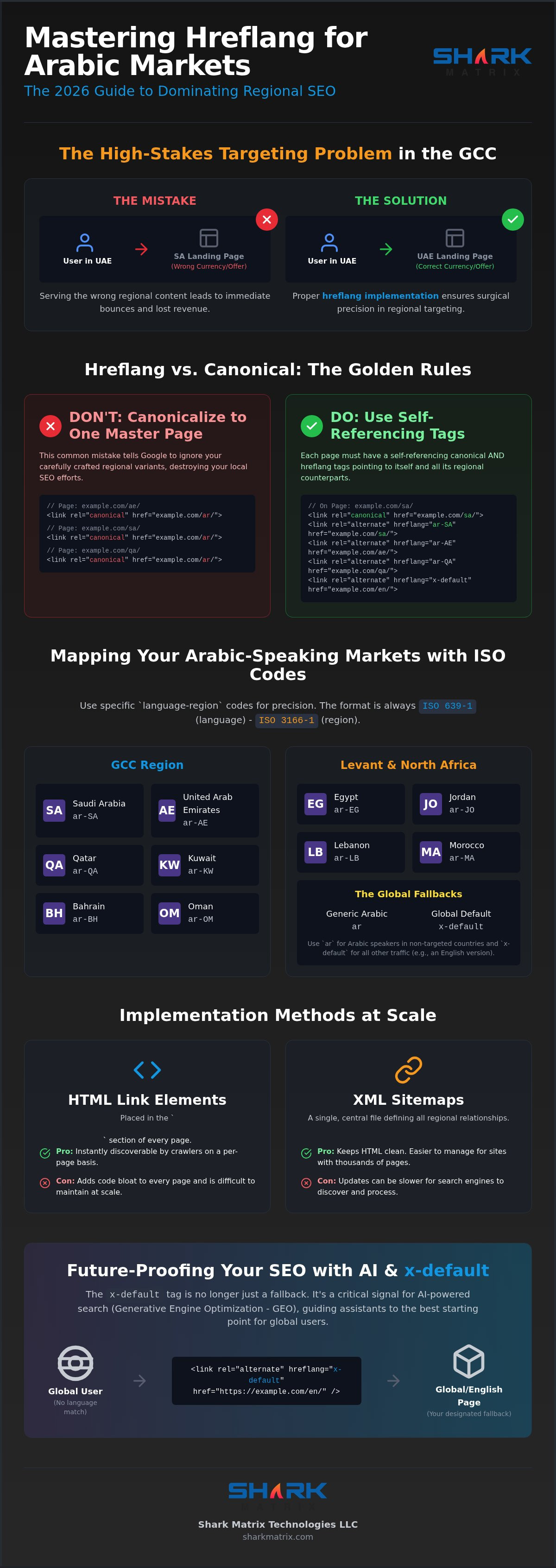
Precision in your code is the difference between a successful expansion and a technical mess. The basic anatomy of an hreflang tag follows a strict pattern: rel="alternate" hreflang="language-country". For any hreflang implementation for arabic sites, the language component always uses the ISO 639-1 code “ar”. While this tells Google the content is in Arabic, it doesn’t specify which version of your site a user in Dubai should see compared to a user in Riyadh. To solve this, you must append the ISO 3166-1 alpha-2 country code to the language tag.

Adhering to W3C internationalization standards ensures your site handles these regional variations correctly. Beyond regional tags, you must include an “x-default” attribute. This acts as a fallback for users whose language or location doesn’t match any of your specific targets. If a user in London searches for your brand, the x-default tag directs them to your global English page or a neutral landing page, preventing them from landing on a regional Arabic version by mistake.

If you’re unsure if your current site architecture supports these complex technical requirements, Shark Matrix Technologies LLC can help through professional SEO services that audit and refine your international targeting.

Regional Code Combinations for the GCC

The Gulf Cooperation Council (GCC) represents some of the most digitally active markets in the world. To target them effectively, you need specific combinations. Use “ar-AE” for the United Arab Emirates, where internet penetration is nearly 100%. For Saudi Arabia, use “ar-SA”, and for Qatar, “ar-QA”. Other essential codes include “ar-KW” (Kuwait) and “ar-BH” (Bahrain). Use a generic “ar” tag only when the content is universal and not tied to specific regional pricing or local laws. This specificity ensures Google serves the most relevant content to users in each distinct market.

The Reciprocal Link Rule

Google requires a bidirectional handshake for hreflang to work. If your UAE page (ar-AE) points to your Saudi page (ar-SA), the Saudi page must point back to the UAE page. If this link is broken or one-way, Google will likely ignore the signal entirely. This rule applies to every single localized version on your site. Every page must also include a self-referencing tag that points to itself. To verify your implementation, use a technical SEO audit tool to identify “return tag” errors where a localized page fails to point back to its source.

Technical Guide: Hreflang Implementation for Arabic Sites in 2026

Choosing Your Arabic URL Architecture

Selecting the right URL structure is a foundational step in your hreflang implementation for arabic sites. The way you organize your localized content dictates how search engines distribute authority and how easily your site can scale across the Middle East. Most businesses choose between subdirectories, subdomains, or country-code top-level domains (ccTLDs). Each approach has distinct technical implications for your SEO performance and long-term maintenance.

Subdirectories, such as example.com/ar/, are often the most effective choice for growing brands. They allow your Arabic pages to inherit the domain authority of your main site, which can lead to faster rankings for new content. However, for large-scale operations with localized logistics or separate server requirements, subdomains like ar.example.com might be necessary. While ccTLDs like .ae or .sa provide the strongest possible geographic signal to search engines, they require significant resources to manage. We often address these complexities within our website design and development services to ensure that technical debt doesn’t hinder your regional growth.

Subdirectory vs. Subdomain: The SEO Debate

The choice between a subdirectory and a subdomain often comes down to authority versus independence. Subdirectories consolidate your backlink profile, making it easier for your Arabic pages to benefit from your global marketing efforts. Subdomains, on the other hand, are treated as semi-independent entities by Google. This can lead to a fragmented crawl budget, where search engine bots spend more time jumping between domains rather than indexing your content efficiently. For most UAE-based enterprises, the subdirectory model offers a more streamlined path to ranking in a competitive market.

Implementing Hreflang via XML Sitemaps

While many sites place hreflang tags directly in the HTML <head>, this can lead to bloated code and slower page load speeds, especially when you’re targeting ten or more regions. Moving your hreflang implementation for arabic sites into an XML sitemap is a cleaner, more professional alternative. This method keeps your front-end code lean while providing a centralized map for search engines to follow.

An internationalized XML sitemap lists every URL and its corresponding localized versions in a structured format. According to Google’s official hreflang guidelines, this is a highly effective way to manage large-scale deployments without impacting the user-facing performance of your site. It simplifies the auditing process, as your technical team can verify all regional handshakes in one file rather than scanning thousands of individual pages. This approach is particularly beneficial for e-commerce platforms where page speed is a critical factor in conversion rates.

Technical Challenges: RTL Layouts and Hreflang

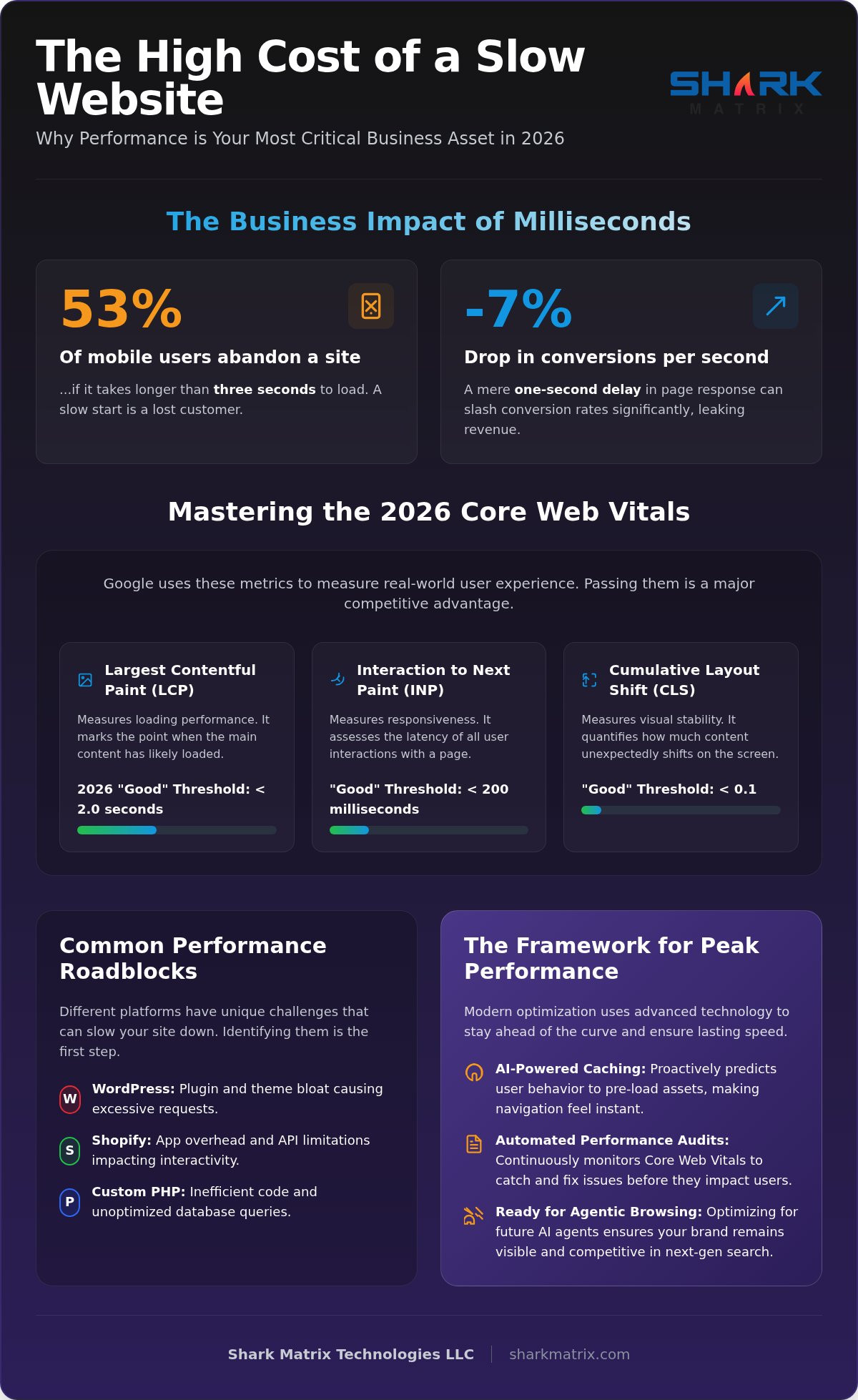
Implementing Right-to-Left (RTL) layouts is often viewed as a simple design choice, but it carries significant technical weight for search performance. Success in hreflang implementation for arabic sites requires more than just translating strings; you must align your site’s physical structure with the signals you’re sending to Google. If your CSS causes layout shifts when switching from LTR to RTL, your Core Web Vitals will suffer. In a region where mobile connections are equivalent to 202% of the population, performance is non-negotiable. Technical SEO for Arabic pages must account for how mirrored layouts impact Cumulative Layout Shift (CLS) and Largest Contentful Paint (LCP).

This technical synergy extends to how your web presence interacts with your mobile platforms. Our mobile app development services often rely on these web-based technical signals to ensure deep-linking and user transitions feel native and localized. When your web hreflang tags are correctly mapped, it creates a predictable environment for mobile crawlers and app indexing bots to understand regional content variations.

Canonical Tags vs. Hreflang

The most frequent error we see is the “master version” trap. Many developers incorrectly set the canonical tag of an Arabic page to point back to the English version, thinking it consolidates authority. This actually tells Google to ignore the Arabic page entirely. On localized sites, each regional page must have a self-referencing canonical tag. A canonical tag tells search engines which single URL is the authoritative master version, while a hreflang tag specifies which localized version of that page should be shown to a user based on their language and region. Using them together correctly ensures that your hreflang implementation for arabic sites doesn’t lead to your localized pages being dropped from the index.

RTL Technical Audit Checklist

Auditing an Arabic site requires a specific lens that standard SEO tools often miss. You need to validate that the bot’s view of the RTL structure matches what the user sees. Use this checklist to ensure your technical foundation is solid:

  • Layout Shift Validation: Test that your mirrored CSS doesn’t cause elements to jump during loading, which can trigger CLS penalties.
  • Font Optimization: Ensure that heavy Arabic web fonts are optimized for fast rendering to maintain high page speed scores.
  • Bot Rendering: Use Google Search Central to “Inspect URL” and verify that the RTL layout renders correctly for mobile crawlers.
  • Bidirectional Integrity: Double-check that every RTL page points back to its LTR counterpart and vice versa.

If your RTL site is experiencing indexing issues or poor ranking, our team can provide a technical deep-dive through our SEO and web development services to fix your regional targeting.

Scaling Your National Brand with Professional Technical SEO

Scaling a brand across the Middle East requires more than just launching new pages. It demands a rigorous commitment to technical excellence. While automated translation plugins might seem like a quick fix, they often create a mess of broken signals and cultural inaccuracies that damage your national reputation. A successful hreflang implementation for arabic sites isn’t a “set and forget” task. It’s a strategic asset that needs continuous monitoring to ensure your Saudi, Emirati, and Qatari audiences always see the content designed specifically for them. In a region where digital competition is intensifying, you can’t afford to let technical errors drain your marketing budget.

Success in this competitive landscape often comes down to choosing the right digital partner who understands both the code and the culture. At Shark Matrix Technologies LLC, we integrate technical SEO with your broader growth strategy to ensure your site remains healthy as you expand. We move beyond basic tags to help you navigate the complexities of regional authority and user intent across the GCC.

Generative Engine Optimization (GEO) for Arabic

AI-driven search is fundamentally changing how users find information in the Middle East. With 88% of UAE organizations now using AI in at least one business function as of June 2026, search engines are becoming more sophisticated in how they verify regional authority. AI search engines don’t just look at keywords; they analyze technical signals like hreflang and structured data to confirm your site is a legitimate local source. Preparing your Arabic site for this shift means ensuring your technical foundation is beyond reproach. High-quality hreflang implementation for arabic sites provides the trust signal that generative engines need to cite your brand as an authority in the region.

Custom Technical SEO Solutions

Off-the-shelf SEO solutions often fail when faced with the unique requirements of the Arabic language and Middle Eastern site architecture. Whether it’s managing complex RTL layout shifts or coordinating content across multiple regions, a custom approach is essential. Working with a national agency provides you with a team that understands the local tech stack and the specific browsing habits of users from Dubai to Riyadh. Generic tools can’t replace the nuanced auditing required to catch the technical errors that typically plague international sites. Your next step should be a comprehensive technical audit to identify where your regional targeting might be leaking authority and to build a roadmap for long-term search dominance.

Securing Your Future in the Arabic Digital Landscape

Dominating the Middle Eastern search market in 2026 requires more than just high-quality content. It demands a flawless technical foundation where your site architecture, RTL layouts, and regional signals work in perfect harmony. By correctly mapping your ISO codes and prioritizing bidirectional links, you ensure that every user from Cairo to Kuwait City lands exactly where they should.

Mastering your hreflang implementation for arabic sites isn’t just about avoiding errors. It’s about building authority in an AI-driven search era. Moving your tags to XML sitemaps and aligning your canonical strategy with your regional goals will protect your site from duplicate content penalties while improving page load speeds.

Shark Matrix has been helping brands navigate the MENA market since 2010. Our team combines deep expertise in Arabic digital marketing with custom software and AI automation capabilities to solve your most complex technical challenges. Ready to ensure your regional targeting is precise? Contact Shark Matrix for a Technical SEO Audit and let’s secure your brand’s place at the top of the search results. Your growth across the Middle East starts with a site that search engines can trust.

Frequently Asked Questions

What is the most common mistake in Arabic hreflang implementation?

The most frequent error is the missing “return tag,” where one page links to a localized version that fails to link back. This breaks the bidirectional handshake Google requires to validate the relationship. Another widespread issue in hreflang implementation for arabic sites is using incorrect regional codes, such as “uae” instead of the standardized “AE,” which causes search engines to ignore the signal entirely.

Do I need hreflang if I only have one version of my site in Arabic?

You don’t need hreflang if your site is only available in a single Arabic version without any other language counterparts. Hreflang is specifically designed to help search engines choose between multiple localized versions of the same content. If no other versions exist, Google will simply use its standard language detection algorithms to index and serve the page correctly for Arabic speakers.

Can I use hreflang for different Arabic dialects like Emirati vs. Egyptian?

Yes, you can and should use hreflang to target specific dialects like Emirati (ar-AE) and Egyptian (ar-EG). This is particularly useful for e-commerce sites where pricing, currency, and local terminology differ significantly between markets. Using these specific regional codes ensures that users in Cairo see your Egyptian offers while users in Dubai see your UAE-specific landing pages and Gulf Arabic content.

How long does it take for Google to recognize hreflang changes?

Google typically takes anywhere from a few days to several weeks to process hreflang changes. The exact timing depends on your site’s crawl frequency and how often Googlebot visits your pages. You can monitor the progress through Google Search Central to ensure the signals are being picked up without errors after your initial hreflang implementation for arabic sites is live.

Is it better to put hreflang in the HTML head or the XML sitemap?

Using an XML sitemap is generally better for large-scale enterprise sites with many language and regional variations. It prevents the HTML head from becoming bloated, which helps maintain faster page load speeds for your users. For smaller sites with only two or three versions, placing the tags directly in the HTML head is often easier to manage and remains highly effective.

How does hreflang affect my SEO for brand reputation management in the UAE?

Hreflang protects your brand reputation in the UAE by ensuring users don’t land on irrelevant regional pages with different pricing or legal terms. If a customer in Dubai lands on a page meant for the North African market, it can lead to confusion and a loss of trust. Correct targeting ensures a professional, localized experience that aligns perfectly with your regional brand identity.

What happens if my Arabic and English pages have different content structures?

Your Arabic and English pages don’t need to be identical in structure, but they must serve the same purpose and offer essentially the same information. While you might adapt the layout for RTL requirements or cultural preferences, the core message should remain consistent. If the content is too different, Google may decide the pages aren’t true alternates and ignore the hreflang signal altogether.

Do I need to implement hreflang for my mobile app as well?

While traditional hreflang tags are for web pages, you should implement similar logic for your mobile app using deep linking and app indexing. This ensures that users searching on mobile are directed to the correct localized version of your app content. Aligning your web signals with your mobile app architecture provides a consistent, professional experience across all digital touchpoints in the MENA region.

Categories
SEO

E-commerce SEO for the Arabic Market: The 2026 UAE National Guide

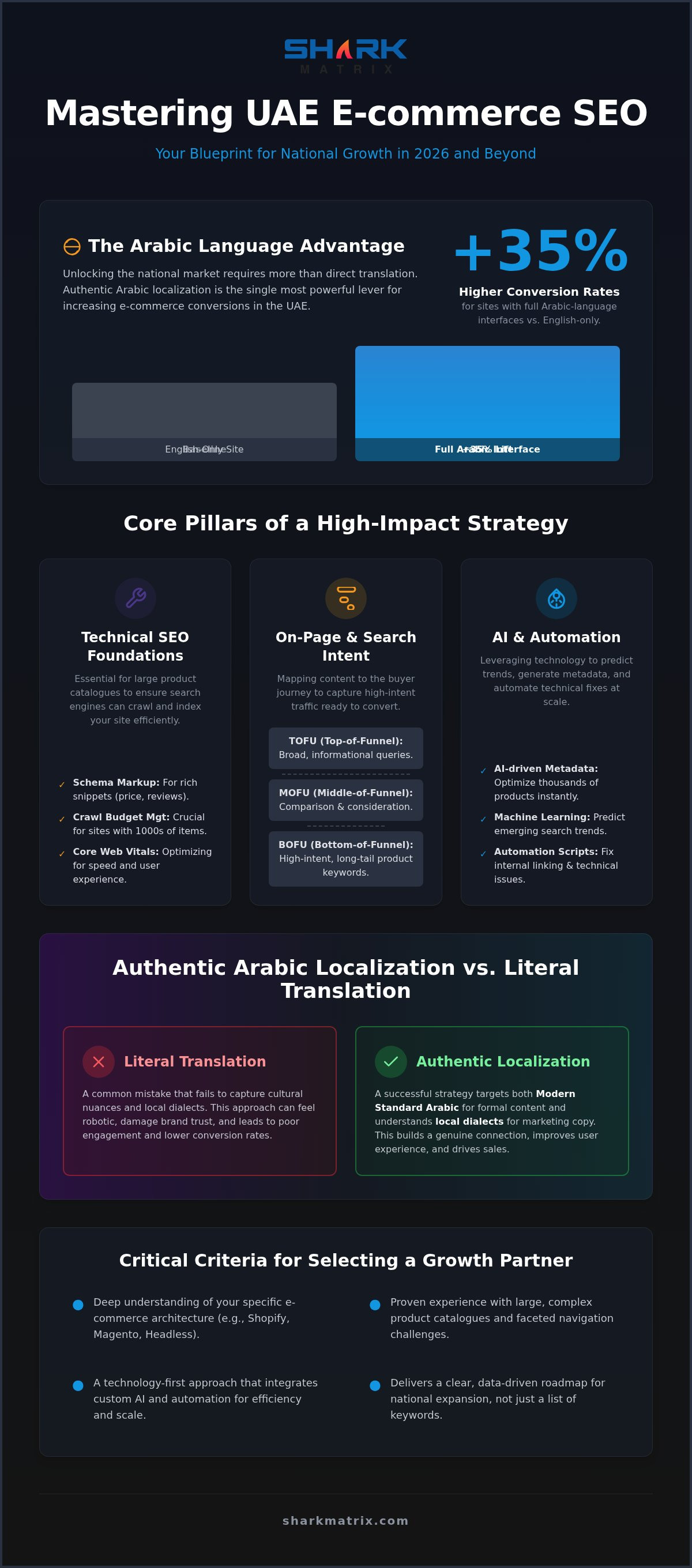
With the UAE e-commerce market surging to over د.إ45.14 billion in 2026, why are so many local brands still losing the battle for search visibility to international platforms? You’ve likely noticed that your bilingual PPC costs are skyrocketing while your organic reach for Arabic queries remains stubbornly low. The truth is that e-commerce seo for arabic market dominance isn’t achieved through simple translation; it requires a deep technical and cultural re-engineering of your digital presence to satisfy both Google’s March 2026 core update and the 11.3 million internet users across the Emirates.

It’s frustrating to see your brand authority diluted by translated content that doesn’t resonate with local sensibilities or capture high-intent search traffic. This guide promises to show you exactly how to master the complexities of RTL technical SEO and Arabic search intent to claim your share of the national market. We’ll explore how to lower your CPA through organic traffic, optimize for the latest Gemini AI search features, and implement AI-driven strategies to stay ahead of the competition in the UAE’s rapidly evolving digital economy.

Key Takeaways

  • Learn to distinguish between Modern Standard Arabic and local dialects to align your content with specific UAE search intent.
  • Move beyond simple translation by using transcreation to identify high-intent synonyms that standard keyword tools often overlook.
  • Master the technical requirements of Right-to-Left (RTL) site architecture and hreflang tags to ensure seamless performance for Arabic users.
  • Execute a specialized strategy for e-commerce seo for arabic market success by building authority through high-quality, national backlinks from UAE-based domains.
  • Prepare for the future of search by integrating AI-driven trend prediction and Generative Engine Optimization (GEO) into your e-commerce framework.

Understanding the Arabic Digital Landscape in the UAE

The UAE’s digital maturity has reached a peak in 2026. With internet penetration at 99%, the way users interact with search engines has fundamentally shifted. Early e-commerce efforts focused on English, but the real growth now lies in capturing the nuances of the local population. Understanding e-commerce seo for arabic market success starts with recognizing that Arabic isn’t a monolith. You’re dealing with Modern Standard Arabic (MSA) for formal documentation and regional dialects, specifically Khaleeji, for everyday shopping queries. While MSA is essential for technical specifications, the conversational heart of UAE commerce beats in dialect.

The opportunity here is massive. While English search results are saturated with international competitors, many high-value Arabic keywords remain surprisingly underserved. By 2026, the UAE e-commerce market has reached د.إ45.14 billion, yet a significant portion of the Arabic digital landscape is still waiting for brands to provide high-quality, localized content. Businesses that bridge this gap don’t just gain visibility; they capture a audience that is often ignored by global giants.

The ROI of Arabic Localization for National Brands

Localized platforms in the Emirates see significant conversion deltas compared to English-only sites. It’s about more than just words; it’s about cultural trust. National stakeholders and local consumers feel a stronger resonance with brands that speak their language fluently. While PPC for bilingual keywords across the UAE can cost a fortune, ranking organically for high-value Arabic terms provides a sustainable path to lower acquisition costs. Investing in e-commerce seo for arabic market visibility allows brands to build a long-term asset rather than perpetually renting space on a results page through expensive ad spend.

Search Intent Nuances: How UAE Users Search

UAE consumers have moved toward a conversational search style. They don’t just type short phrases; they ask questions. This shift is driven by the 23 million mobile connections in the country, where voice search and mobile-first queries are the default. Direct translation often misses the mark because it ignores the informational journey. A user might search for a specific product benefit using a dialect term that a standard translation tool would never suggest. Mapping these conversational paths is the key to dominating local SERPs. You must understand how the UAE consumer moves from curiosity to purchase, ensuring your content answers their specific regional concerns at every step.

Beyond Translation: The Nuances of Arabic Keyword Research

Literal translation is the quickest way to alienate a local audience. In the UAE, search behavior is deeply rooted in cultural context. Transcreation isn’t just swapping words; it’s about re-engineering your brand’s core concepts to fit the local psyche. As the UAE e-commerce market continues its double-digit expansion, the gap between basic translation and true transcreation becomes a competitive moat for national brands. You’re not just translating keywords; you’re translating intent.

Standard SEO tools frequently fail to capture high-intent Arabic synonyms. A user in Dubai might search for a specific product using very different modifiers than a user in another region. If you only target the most obvious terms, you’re missing out on a massive volume of long-tail traffic. Effective e-commerce seo for arabic market growth requires identifying these hidden gems that global tools overlook. Semantic search has become critical since Google’s 2026 updates. Search engines now prioritize the “why” behind a query, moving beyond simple string matching to understand the specific intent of the Arabic shopper.

Successful brands often rely on specialized content marketing experts to bridge this linguistic gap and ensure every piece of content serves a strategic purpose.

Modern Standard Arabic vs. Gulf Dialects

Modern Standard Arabic (MSA) is your foundation for trust. Use it for technical product descriptions, terms of service, and official brand statements. It signals professionalism and corporate authority. However, for lifestyle blogs, social media integration, and consumer engagement, Gulf phrasing is king. Using Khaleeji nuances in your copy makes your brand feel like a local neighbor rather than a foreign entity. This dialectal precision directly impacts how search engines categorize your relevance to UAE-specific results pages, especially as voice search adoption grows among national users who speak naturally to their devices.

Arabic Keyword Mapping Strategy

Don’t treat your Arabic keywords as a separate list. Map them directly to your sales funnel to ensure a cohesive user journey. Start by aligning broad MSA terms with the awareness stage. For the consideration phase, leverage dialect-heavy “how-to” queries and comparison terms. Finally, use specific transactional phrases and long-tail product names for the conversion stage. You must also prevent keyword cannibalization by ensuring your English and Arabic pages have distinct metadata and headers. Integrating these terms into image alt-text is a neglected tactic that can significantly boost your visibility in image search, which remains highly popular among UAE mobile shoppers.

E-commerce SEO for the Arabic Market: The 2026 UAE National Guide

Technical SEO for Arabic: Mastering RTL and Site Architecture

Technical SEO for the Arabic market is often where English-centric strategies crumble. It’s not enough to simply translate your copy; you must re-engineer the digital skeleton of your store. Right-to-Left (RTL) implementation is more than just flipping a CSS property. It requires a total reconfiguration of how your site loads and how users navigate. According to a UAE e-commerce market overview, consumer expectations for seamless digital experiences are at an all-time high, making technical stability a primary ranking factor in 2026.

Hreflang tags are the traffic controllers for your bilingual site. They tell Google exactly which version of a page to serve based on the user’s language settings and location. For national scalability in the UAE, getting this right is non-negotiable. If your tags are misconfigured, you risk keyword cannibalization where your English and Arabic pages fight for the same spot in search results. This technical foundation is essential for e-commerce seo for arabic market success, ensuring that search engines recognize your site as a localized authority rather than a generic global platform.

Google’s March 2026 core update placed heavy emphasis on holistic Core Web Vitals, specifically Interaction to Next Paint (INP). For Arabic sites, complex RTL layouts can sometimes slow down browser rendering. You must optimize your site speed to accommodate diverse connectivity across the Emirates, from high-speed fiber in Dubai to mobile connections on the move. Ensuring that your complex Arabic interface remains responsive and fast is the only way to maintain high rankings in a mobile-first market.

RTL Design and UX Signal Optimization

Layout direction fundamentally changes how users process information. In the UAE, Arabic readers follow a right-to-left scanning pattern, which is the mirror image of the Western “F-pattern.” If your call-to-action buttons or navigation menus aren’t aligned with these reading habits, your bounce rates will climb. High bounce rates send negative signals to search engines, dragging down your rankings. Proper Arabic typography is also critical. Standard fonts often appear cramped or illegible on mobile screens, so choosing a font like “Dubai Font” or “Amiri” can improve dwell time and overall user engagement.

URL Structure and Domain Strategy for the UAE

When targeting the UAE, you must choose between subfolders (example.ae/ar/), subdomains (ar.example.ae), or separate ccTLDs. For most national brands, subfolders are the superior choice as they consolidate link equity into a single domain. While using Arabic script in URLs (Internationalized Domain Names) can look more “local,” they often appear as long strings of gibberish when shared on social media or in emails. This can hurt click-through rates. Before finalizing your architecture, conducting a professional SEO audit report is vital to catch these technical pitfalls before they impact your e-commerce seo for arabic market performance.

Authority in the UAE digital space is earned through local recognition. While international backlinks are useful, Google’s 2026 algorithms prioritize regional relevance for Arabic queries. A backlink from a major UAE-based news portal or a specialized Arabic industry blog carries significantly more weight than a generic global site. This local validation signals to search engines that your store is a trusted entity within the Emirates. Building this trust is a core pillar of e-commerce seo for arabic market success, as it establishes your brand as a national leader rather than a foreign visitor.

To attract these high-value links, you need link-bait content that speaks to the Middle Eastern corporate and consumer landscape. Think about publishing original data reports on local shopping trends or white papers on the UAE’s 2026 digital economy goals. These resources are highly shareable among local journalists and business influencers. Combining these efforts with strategic Arabic PR and guest posting on reputable .ae domains creates a powerful synergy. Many brands find that partnering with a content marketing agency UAE allows them to craft these narratives with the cultural precision required to earn national attention.

Arabic Content Clusters for National Dominance

Topical authority is built through structure, not just volume. Create Arabic pillar pages that cover broad industry topics, then support them with detailed cluster content addressing specific long-tail queries. This approach ensures you capture users at every stage of their search journey. You must maintain a consistent brand voice across both English and Arabic versions of your site to prevent brand dilution. Freshness is also a critical ranking factor in the UAE. Regularly updating your Arabic blog with news about local events or regulatory changes shows search engines that your content is current and relevant to the national audience.

E-commerce SEO for the Arabic Market

Your product pages are where the conversion happens. Optimize your Arabic product descriptions by focusing on high-intent keywords and specific cultural pain points. Don’t forget the power of user-generated content. Arabic reviews provide authentic social proof and inject natural long-tail keywords into your pages, boosting visibility. By integrating national e-commerce SEO strategies with localized Arabic terms, you create a search presence that is both technically sound and culturally resonant. This dual focus is what separates market leaders from those who merely exist online.

Ready to dominate the local search results? Let our team help you build a high-authority content marketing strategy that puts your brand at the center of the UAE’s Arabic digital landscape.

The Shark Matrix Approach: AI-Powered Arabic SEO Services

The UAE’s strategy to increase the digital economy’s contribution to non-oil GDP over the next decade has set a high bar for local businesses. Staying competitive in 2026 requires more than just standard optimization; it demands a shift toward predictive analytics. The Shark Matrix Technologies LLC approach uses machine learning to identify shifting Arabic search trends before they become mainstream. By analyzing data patterns from the 11.3 million internet users across the Emirates, we help you pivot your strategy in real time. This forward-looking methodology is the only way to maintain e-commerce seo for arabic market leadership in a landscape that changes weekly.

Google’s expansion of the Gemini AI search experience to include Arabic in late 2025 has fundamentally changed user behavior. Search is no longer just about a list of links; it’s about being the definitive answer in an AI-generated summary. Our Generative Engine Optimization (GEO) and Answer Engine Optimization (AEO) services ensure your brand remains the primary source for these AI responses. This is why comprehensive search engine optimization (SEO) services have become vital for national brands that want to dominate the new search reality.

Integrating AI and Automation in Arabic SEO

We use Natural Language Processing (NLP) to ensure your Arabic content isn’t just grammatically correct but contextually relevant to UAE dialects. Automation allows us to perform technical audits on massive enterprise sites, catching RTL layout errors or broken hreflang tags instantly. With 8.4 billion active voice assistants worldwide in 2026, we also focus on future-proofing your store for Arabic voice search. This involves optimizing for conversational long-tail queries that UAE shoppers use when speaking to their mobile devices, ensuring your brand is always the first answer they hear.

Protecting Your National Brand Reputation

In a hyper-connected market, your digital reputation is your most valuable asset. There is a critical synergy between national brand reputation management and your Arabic search presence. We monitor Arabic sentiment across social media and search results to ensure your brand name remains untarnished by misinformation or negative trends. By controlling the narrative in both English and Arabic, you build a resilient brand that commands respect across the entire UAE. This holistic approach ensures that your e-commerce seo for arabic market efforts result in both high rankings and high trust.

Don’t let your brand get left behind in the age of generative search. Contact Shark Matrix Technologies LLC for a National Arabic SEO Strategy and start dominating the UAE market today.

Future-Proof Your National E-commerce Strategy

Dominating the Emirates’ digital landscape in 2026 requires a shift from passive translation to active cultural re-engineering. You’ve seen how mastering RTL technical architecture and identifying high-intent dialectal keywords can transform your visibility. By moving beyond basic search tactics and embracing AI-driven Generative Engine Optimization, your brand can provide the definitive answers that local shoppers are looking for. Achieving total e-commerce seo for arabic market success is no longer an optional expansion; it’s the foundation of national brand longevity.

Shark Matrix has been a fixture in the UAE market since 2010, combining deep local expertise with cutting-edge technical capabilities. Our team of native Arabic linguists and senior technical SEO consultants specializes in navigating the complexities of the regional search market. We don’t just optimize for bots; we optimize for the cultural nuances that drive real human conversion. Take the first step toward reclaiming your organic reach and lowering your acquisition costs today. Request a Comprehensive Arabic SEO Audit for Your National Brand and lead your industry into the future of search.

Frequently Asked Questions

Is Arabic SEO different from English SEO in the UAE?

Arabic SEO is fundamentally different because it requires navigating right-to-left (RTL) technical layouts and distinct linguistic variations like Khaleeji dialects. While the underlying search engine principles remain the same, the way UAE users interact with queries is more conversational and mobile-centric. You can’t simply translate English keywords; you must re-engineer content to match the specific cultural intent of the local population.

How long does it take to see results from Arabic SEO services?

Most UAE businesses start seeing measurable organic growth within three to six months of implementing a consistent strategy. Initial gains often appear in long-tail query rankings, while high-competition head terms take longer to secure. Factors like your current domain authority and the technical health of your RTL site architecture will influence how quickly search engines recognize your localized relevance.

Do I need a separate domain for the Arabic version of my website?

You don’t need a separate domain, as subfolders like example.ae/ar/ are typically better for consolidating your site’s link equity. This structure allows your Arabic content to inherit the authority of your primary domain while clearly signaling the language target to Google. While separate ccTLDs can offer a slight local trust signal, they require significantly more resources to manage and build authority from scratch.

Can I use automated translation for my Arabic SEO content?

Raw automated translation is a major risk because it often fails to capture the cultural nuances and dialects essential for e-commerce seo for arabic market success. Machine-translated text frequently results in unnatural phrasing that alienates UAE shoppers and increases bounce rates. For high-converting pages, you need a transcreation process where native speakers adapt the message to resonate with local consumer behavior and search intent.

How do you handle Right-to-Left (RTL) technical issues?

We address RTL issues by mirroring the entire user interface and adjusting the CSS to ensure a seamless right-to-left navigation experience. This isn’t just about text alignment; it involves flipping the placement of logos, menus, and call-to-action buttons. Proper RTL execution ensures that your site meets the March 2026 Core Web Vitals standards, providing a fast and intuitive experience for mobile users across the Emirates.

What is the role of AI in Arabic SEO for 2026?

AI in 2026 is used to power Generative Engine Optimization (GEO) and predict emerging search patterns across the UAE. It helps us understand how generative search models summarize your content for users. By optimizing for these AI-driven summaries, your brand can capture the zero-click traffic that now dominates mobile search results, ensuring you stay ahead of competitors who rely on traditional methods.

How do you measure the success of an Arabic SEO campaign in the UAE?

Campaign success is measured by tracking organic traffic from Arabic-speaking regions, keyword ranking improvements, and the total conversion value in UAE Dirham (د.إ). We also look at the reduction in bilingual PPC spend as your organic visibility grows. These metrics provide a clear picture of your ROI and help us refine your content clusters to target the most profitable search intents.

Can Arabic SEO help with my brand reputation management?

Arabic SEO is a critical component of brand reputation management because it allows you to control the narrative on the first page of search results. By ranking authoritative, positive content for your brand name in Arabic, you push down negative or irrelevant mentions. This proactive approach is a cornerstone of any robust e-commerce seo for arabic market strategy, ensuring your national reputation remains protected and professional.

Categories
GEO

Preparing Your Website for AI Overviews: The 2026 SEO Checklist

Did you know that organic click-through rates drop by as much as 61% when an AI Overview appears at the top of the search results? It’s a sobering reality for digital marketers who see their traditional rankings buried under synthesized answers. If you feel like you’re losing the battle against zero-click searches, you aren’t alone. That’s why preparing website for ai overviews has become the most critical task for any brand wanting to stay visible in 2026.

We’ll help you turn this challenge into an opportunity by showing you how to become a cited, primary source within Gemini-powered summaries. You’ll learn the exact technical and content adjustments needed to satisfy Retrieval-Augmented Generation (RAG) systems and ensure your data is parsed correctly. This article provides a clear roadmap through the confusion of Generative Engine Optimization (GEO) to help you clear technical debt and future-proof your site against the next wave of algorithm shifts.

Key Takeaways

  • Learn why optimizing your technical infrastructure with advanced schema and rapid site speed is essential for AI bot processing.
  • Discover how to structure your content using the “Inverted Pyramid” method to provide the direct answers LLMs look for.
  • Understand the process of preparing website for ai overviews by building semantic depth and topical authority through clustering.
  • Strengthen your brand’s credibility by leveraging E-E-A-T and digital PR to influence the training data of generative models.
  • Explore how integrating traditional SEO with generative engine optimization (GEO) creates a resilient, future-proof digital strategy.

Understanding the Shift from Search Engines to Answer Engines

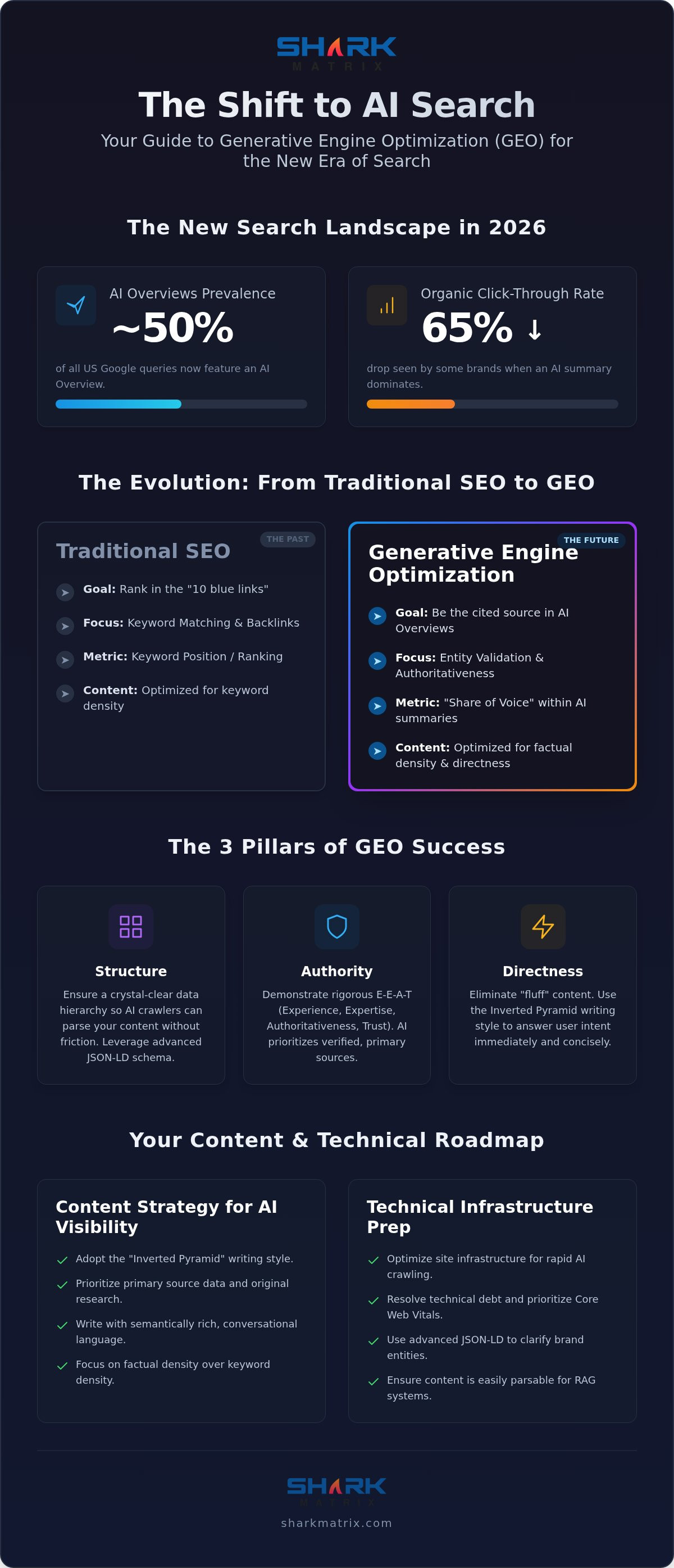
Google search isn’t what it used to be. For decades, the goal was to secure a spot in the “ten blue links” that dominated the first page. Today, that layout is being replaced by synthesized summaries that provide immediate answers. This evolution turns Google from a directory into an answer engine. Because of this, preparing website for ai overviews is now the most important part of a modern digital strategy. Users no longer need to click through to multiple sites when the answer is presented right at the top of their screen.

This shift has a massive impact on click-through rates. In 2026, research shows that organic CTR can drop by as much as 58% when an AI Overview is present. However, there’s a silver lining for those who adapt. Brands cited within these AI summaries often see a 35% increase in clicks compared to those that aren’t. The game has changed from fighting for a rank to fighting for a citation. You’re no longer just trying to be the first link; you’re trying to be the source that the AI trusts most.

The Mechanism of AI Citations

How does Gemini decide which websites to cite? It uses a process called Retrieval-Augmented Generation (RAG). Instead of just relying on its pre-trained data, the AI “fans out” a query to its search index to find the most relevant, up-to-date information. AI Overviews are a synthesis of top-tier authoritative data nodes. To get noticed, your site needs to be one of those nodes. This requires moving beyond traditional keyword density. AI crawlers now look for semantic relevance and clear entity relationships within a knowledge graph to determine which content is truly authoritative.

SEO vs. GEO: What Has Changed?

Traditional Search engine optimization (SEO) is still the foundation, but it’s evolving into Generative Engine Optimization (GEO). While SEO focuses on visibility in a list, GEO focuses on visibility within a generated response. For many national brands, this also includes Answer Engine Optimization (AEO), which specifically targets direct-response queries. You need a strategy that balances both worlds. By leveraging comprehensive search engine optimization seo services, you can ensure your technical foundation is strong enough to support these advanced AI requirements while maintaining your traditional search presence. It’s about being visible where the users are looking, whether that’s a blue link or a Gemini summary.

Technical Optimization: The AI-Ready Infrastructure Checklist

Many site owners make the mistake of treating AI visibility as a content-only problem. In reality, your technical foundation determines whether an AI crawler can even understand your data. If your site is bogged down by technical debt, Gemini or other LLMs might skip your content entirely. Preparing website for ai overviews requires a shift toward “fragment indexing.” This means structuring your site so AI can easily extract specific answers without needing to parse through irrelevant code blocks or messy scripts.

A clean, hierarchical URL structure is the first step in this process. It acts as a map for LLMs, helping them understand the relationship between different topics and subtopics. When your URLs follow a logical path, you’re essentially building a knowledge graph for the search engine. This clarity allows AI to identify your brand as an authority in specific niches much faster than a disorganized structure. It also reduces the risk where AI might misattribute information due to poor site architecture.

Advanced Schema and Structured Data

Schema markup has evolved from a “nice-to-have” feature into a mandatory requirement for AI visibility. By using advanced JSON-LD, you provide the entity recognition that AI models crave. Focus on Speakable, FAQ, and How-To schema to feed directly into AI response blocks. If you publish research or data, implementing Dataset schema is vital for becoming a primary source for statistical queries. You can verify these implementations using the updated 2026 Google Search Console tools to ensure your entities are correctly identified and ready for synthesis.

Backend Readiness for AI Crawlers

AI bots don’t crawl the web like traditional spiders. They are looking for high-quality data nodes they can synthesize quickly. This makes site speed and Core Web Vitals more important than ever. Slow pages consume more “compute” for the AI, making them less attractive as sources for real-time summaries. Your robots.txt and sitemaps must also be optimized for the Google-Extended crawler to ensure your most valuable assets are prioritized. Professional website design and development services play a key role here by creating clean, AI-parsable code. If you want to stay ahead of the curve, it might be time to review your technical SEO performance with an expert team.

Preparing Your Website for AI Overviews: The 2026 SEO Checklist

Semantic Content Strategy: Optimizing for LLM Extraction

Writing for search engines used to mean repeating keywords in strategic places. In 2026, the priority is semantic clarity. AI models like Gemini don’t just scan for words; they parse meaning. This makes preparing website for ai overviews a task of information architecture as much as writing. To succeed, you must adopt the ‘Inverted Pyramid’ of AI writing. This means placing the most important information at the very beginning of your sections. Give the AI the answer it needs immediately, then expand on the details for the human reader who chooses to click through.

Topic clustering is your primary tool for proving niche authority. Instead of writing isolated blog posts, create a web of interconnected content that covers a subject from every angle. This builds semantic depth, signaling to AI crawlers that your site is a definitive source. Use headers and lists that are friendly to Natural Language Processing (NLP). Clear, descriptive headings help the AI map your content more effectively. Most importantly, eliminate fluff. Conversational filler and vague introductory sentences are ignored by AI Overviews. If a sentence doesn’t add factual value, it shouldn’t be there.

Crafting the “Perfect Answer” Block

The key to winning a citation is the “Perfect Answer” block. These are concise 40-60 word summaries placed directly under H2 or H3 headers. Use factual, declarative sentences to increase your citation probability. AI models prioritize content that provides immediate, verifiable utility. By providing a clear, high-level summary at the start of each section, you make it easy for the LLM to extract your data without needing to synthesize it from scratch.

Visual and Multimedia Integration

AI is increasingly multimodal, meaning it processes images and videos alongside text. Optimizing your image alt-text and providing detailed video transcripts is essential. Tables and infographics are particularly valuable because they provide structured data that AI can easily parse into summaries. These elements should be responsive and optimized for cross-platform visibility. For businesses focusing on mobile users, integrating these assets with mobile app development services ensures your content remains accessible and citation-ready across all devices.

Building Brand Authority: The Trust and Citation Checklist

In 2026, E-E-A-T (Experience, Expertise, Authoritativeness, and Trustworthiness) is the primary filter AI uses to separate high-quality sources from mass-produced clutter. Google’s official documentation stresses the importance of content that demonstrates real-world experience. Preparing website for ai overviews means you must prove your brand isn’t just another generic voice. AI models look for “non-commodity” content. These are unique insights and expert-led data that can’t be easily generated by a machine. If your content provides common knowledge, the AI will summarize it without citing you. To win the citation, you must offer something the model can’t replicate on its own.

Your brand’s presence in the Knowledge Graph is crucial for long-term visibility. This is how AI identifies entities and their relationships. If your brand is mentioned across authoritative sources, social media, and third-party review sites, the AI’s trust score for your domain increases. Social proof acts as a validation layer for generative models. Since 70% of consumers report having some level of trust in Google’s generative AI results, you must ensure those results reflect a trustworthy brand image. This requires auditing your digital footprint across national industry databases to ensure consistency and authority.

Digital PR and External Mentions

Digital PR is no longer just about building backlinks for rankings. In the AI era, non-linked brand mentions are equally powerful. LLMs use industry-specific “seed sites” as trusted foundations for their training data. If your brand is mentioned frequently on these platforms, you become part of the AI’s core knowledge base. Leveraging seo for brand reputation management dubai helps you control these narratives and protect your reputation across influential databases. This ensures that when an AI generates a summary, your brand is the one it recommends as a trusted authority.

Author Verification and Transparency

Transparency is the ultimate trust signal for 2026 search. You should implement robust author bios that link to external credentials, LinkedIn profiles, and professional certifications. This provides a “human-in-the-loop” signal. It proves that your content is guided by human expertise rather than being 100% AI-generated. AI crawlers check these signals to verify that the information comes from a reliable source. If you want to strengthen your brand’s authority and secure your place in AI summaries, consult with our SEO experts today to build a custom citation and authority strategy.

Future-Proofing with Generative Engine Optimization (GEO)

Success in the AI era isn’t a one-time achievement. As Google recalibrates its systems, the strategies that work today will need to evolve. Preparing website for ai overviews is a continuous process of monitoring, testing, and refining. At Shark Matrix, we treat Generative Engine Optimization (GEO) as a distinct discipline that goes beyond traditional search. We integrate AI automation with our core SEO workflows to ensure your brand remains the preferred source for Gemini-powered summaries. This proactive approach allows us to stay ahead of algorithm shifts that might otherwise lead to sudden traffic drops.

In a zero-click environment, your metrics for success must shift. If 60% of searches don’t result in a click, you need to find value in the citation itself. This is where data-driven lead generation becomes vital. Even if a user doesn’t visit your site immediately, appearing as the primary authority in an AI Overview builds brand recall and trust. We track citation rates and AI visibility with the same rigor we apply to traditional rankings. By understanding which queries trigger these summaries, you can prioritize content that captures the highest-value citations in your industry.

Shark Matrix’s GEO Framework

Our framework relies on sophisticated technology to keep your brand at the forefront of search. We use our internal ai development services to build custom tools that monitor how AI models perceive your site’s data. These tools use predictive analytics to anticipate which long-tail queries are most likely to trigger an AI response. This allows us to optimize your content before the competition even notices the shift. To bridge the traffic gap caused by zero-click results, we often recommend consulting with a ppc agency dubai to maintain a dominant presence through paid search while your organic AI authority grows.

Next Steps for Your Business

The first step in securing your digital future is conducting a comprehensive AI-Readiness Audit. This audit evaluates your technical infrastructure, semantic depth, and E-E-A-T signals to identify gaps in your current strategy. From there, you can build a multi-channel digital roadmap that survives search disruption. Don’t wait for your organic traffic to decline before you start preparing website for ai overviews. Contact Shark Matrix today to develop a specialized Generative Engine strategy that protects your visibility and ensures your brand is the voice Google trusts most in 2026.

The transition from blue links to synthesized summaries is no longer a distant possibility; it’s the current standard. You’ve seen how a combination of technical precision, semantic content strategy, and robust E-E-A-T signals can turn the threat of zero-click searches into a powerful citation opportunity. By preparing website for ai overviews now, you position your brand as a trusted authority that Google’s Gemini-powered systems will prioritize. Success in this landscape requires moving beyond simple rankings to focus on becoming a primary source for AI synthesis.

Shark Matrix is the leading AI automation and development agency in the UAE, specializing in Generative Engine Optimization (GEO). We provide data-driven SEO strategies designed for national brand protection and long-term growth in a volatile market. Don’t let your traffic disappear as search behavior shifts toward answer engines. It’s time to Book your 2026 AI-Readiness Audit with Shark Matrix and ensure your site is ready for what comes next. The future of search belongs to those who adapt today. Your brand has a story that deserves to be told, and we have the tools to make sure the AI engines tell it correctly.

Frequently Asked Questions

What is the difference between SEO and GEO?

Traditional SEO focuses on optimizing your site to rank in a list of links, while Generative Engine Optimization (GEO) focuses on being cited within an AI-generated answer. SEO builds the technical and content foundation. GEO layers on strategies like semantic depth and entity recognition to ensure LLMs like Gemini retrieve your data during synthesis. Both are necessary to maintain visibility in 2026.

Will AI Overviews stop people from clicking on my website?

AI Overviews do increase zero-click searches, which now account for approximately 60% of Google queries. However, being cited as a source can actually help. Research shows that brands cited within an AI Overview see a 35% increase in clicks compared to those that aren’t. While overall CTR might drop for top links, the citation becomes the new “position zero” for traffic.

How do I know if my website is being cited by Google Gemini?

You can monitor your citations through the updated performance reports in Google Search Console. These reports now distinguish between traditional organic clicks and those originating from generative features. You can also use specialized third-party monitoring tools that track your brand’s appearance and citation rate within AI-generated summaries across different industries and query types.

Is structured data still important for AI Overviews in 2026?

Structured data is more critical than ever because it provides the explicit context that AI models need to identify entities. Preparing website for ai overviews requires advanced JSON-LD to act as a bridge between your content and the AI’s knowledge graph. Without clear schema, an LLM might struggle to verify your data, making it less likely to use your site as a primary source.

Can small businesses compete with national brands in AI summaries?

Small businesses have a unique advantage because AI Overviews pull from a much wider source pool than traditional search results. You don’t always have to be in the top 10 blue links to get cited. By focusing on “non-commodity” content and hyper-local expertise, smaller sites can win citations that national brands might lose by being too general or broad.

How often does Google update the sources for its AI Overviews?

Google updates these sources in real-time or near real-time through its search index. Because the system uses Retrieval-Augmented Generation (RAG), the AI “fans out” to the index to find the most current and authoritative information available at the moment of the search. This means your latest expert insights can be cited almost as soon as they are indexed.

Should I block AI crawlers from my website to protect my content?

Blocking crawlers like Google-Extended prevents your data from being used to train models, but it also removes you from AI Overviews. If you block these bots, your brand will not be cited in the summaries that now appear in up to 60% of searches. For most businesses, the loss of visibility and citations outweighs the benefits of content protection.

What are the most important schema types for AI visibility?

The most effective types are FAQ, How-To, and Speakable schema, as they directly match the answer-based intent of AI queries. Additionally, Dataset schema is vital if you publish original research or statistics. These structured formats help AI crawlers quickly identify your content as a high-value data node, which is essential when preparing website for ai overviews and securing citations.

Categories
Uncategorized

Mastering the SEO Audit Report: A 2026 Guide for National Brand Growth

What if your 50-page seo audit report is actually the reason your national brand is stalling? It’s a common frustration for marketing leaders who feel buried under a mountain of automated tool exports that flag every minor technical glitch but ignore the bottom line. You aren’t alone if you find it difficult to justify search spend to the C-suite when 60% of searches may end without a click due to the latest AI Overviews.

We’ll show you how to filter out the technical noise and transform that data into a high-impact roadmap for national search dominance. This guide provides a clear framework to prioritize the fixes that actually drive revenue while adapting to Google’s May 2026 Core Update. You’ll learn how to align your site’s technical health with your business goals, ensuring your strategy survives the shift toward generative engine optimization and AI-powered search.

Key Takeaways

  • Learn why a comprehensive seo audit report serves as a diagnostic health check for your digital infrastructure instead of just a list of tool-generated errors.
  • Balance technical foundation fixes with advanced on-page strategies like entity optimization to satisfy modern search algorithms.
  • Identify the “Context Gap” where automated tools fail and how expert analysis uncovers strategic flaws that hinder national growth.
  • Master the Impact vs. Effort matrix to prioritize critical blockers and high-value fixes that directly influence your brand’s revenue.
  • Explore how integrating AI automation and generative engine optimization can streamline your performance while future-proofing your search presence.

Beyond the Score: What a 2026 SEO Audit Report Really Reveals

Think of a modern seo audit report as a high-resolution MRI for your brand’s digital health. It’s no longer just a spreadsheet of broken links or missing meta descriptions. In an era where Google releases core updates every few months, like the significant rollout on May 21, 2026, a diagnostic health check must look deeper into your site’s infrastructure. It needs to evaluate how your code, content, and connectivity align with business revenue goals rather than just search engine checkboxes.

While Search engine optimization (SEO) has always required technical precision, the 2026 ecosystem demands more than just checking boxes. Many automated tools hand out “A+” grades like participation trophies. These scores are often misleading for national brands because they don’t account for competitive market dynamics or the nuance of the latest algorithm shifts. A site can have a perfect technical score and still fail to rank if its content lacks the entity depth required to satisfy Gemini-powered search results. Strategic interpretation is what transforms raw data into a roadmap for growth.

We’ve moved beyond keyword-only audits. Today, an effective seo audit report prioritizes entity-based optimization and AI-readiness. It’s about ensuring your brand is recognized as an authority by both human users and machine learning models. This involves analyzing how your site handles structured data and whether your technical foundation can support high-speed, AI-driven interactions.

The Evolution of SEO Auditing in the AI Era

With 60% of searches now ending without a click due to AI Overviews, your audit must address Generative Engine Optimization (GEO). It’s not just about traditional rankings anymore; it’s about being the primary source for Gemini 3.5 Flash. Your report needs to include Answer Engine Optimization (AEO) metrics to track how well your brand answers conversational queries. AI now helps us identify complex patterns in crawl data that human auditors might miss, allowing for faster fixes to deep-seated technical issues.

Why National Brands Cannot Rely on Generic Automated Reports

Generic tools often miss the technical debt that accumulates on enterprise-level sites with thousands of pages. They might flag a missing alt tag but ignore a crawl budget leak that’s costing your company thousands in organic revenue. National competition requires benchmarking against specific industry giants, not a generic checklist. A one-size-fits-all tool cannot tell you how to outmaneuver a specific competitor who is dominating the “zero-click” space in your niche.

The Anatomy of a High-Impact SEO Audit Report

A high-impact seo audit report serves as the structural blueprint for your brand’s digital growth. It breaks down into four essential pillars: technical foundation, on-page architecture, off-page authority, and user experience. This document isn’t just a list of errors. It’s a strategic analysis of how your site’s “plumbing” handles the demands of modern search engines while providing a seamless journey for national customers. By examining these components, you can ensure your digital infrastructure supports the high-speed, AI-driven interactions that define search in 2026.

Technical SEO: The Indexability Pillar

Large national websites often struggle with crawl budget efficiency. If Google’s bots spend too much time on low-value pages, your critical, revenue-driving content remains invisible. This is where technical seo consultant expertise becomes vital. They identify complex JavaScript rendering issues that standard crawlers often miss. Understanding How to Perform a Technical SEO Audit helps your team grasp why deep-level fixes, such as advanced schema markup and structured data, are necessary to stand out in Gemini-powered results.

Content and Entity Auditing

Content auditing in 2026 focuses on E-E-A-T and semantic depth. It’s no longer enough to have high word counts or keyword density. You need to identify “content decay,” where older pages lose relevance and dilute your overall domain authority. By mapping your site against a comprehensive on page seo checklist, you can ensure every piece of content serves a specific entity-based purpose. This process helps your brand maintain relevance even as AI-generated content accounts for over 17% of top search results.

Off-Page and Brand Reputation Analysis

Trust signals are more important than ever in a crowded market. Your comprehensive seo audit report should analyze your backlink profile for toxic patterns or low-quality AI-generated spam that could trigger a penalty. Tracking national brand mentions and sentiment helps gauge your online reputation, which directly influences your search authority. If you need a partner to bridge these technical and strategic gaps, our team at Shark Matrix can help align your SEO goals with high-performance web development and content marketing.

Finally, User Experience (UX) bridges the gap between technical health and business goals. Core Web Vitals and interactivity are no longer optional extras for ranking. If your site is slow or difficult to navigate, you’ll lose traffic regardless of your search positions. A modern audit evaluates how these UX signals influence your national presence and conversion rates.

Mastering the SEO Audit Report: A 2026 Guide for National Brand Growth

Automated Tools vs. Expert Analysis: Addressing the Value Gap

Automated tools like Semrush or AIOSEO are essential for modern data gathering. They process millions of data points faster than any human ever could. But a raw data export isn’t a strategic seo audit report. It’s just a list of observations. The “Context Gap” emerges when these tools flag thousands of technical non-issues, like missing alt text on decorative icons, while missing a critical strategic flaw that’s tanking your national brand’s visibility.

Human strategists act as a filter. They separate the noise from the signal. While a tool might give you a high score for having “correct” title tags, it won’t notice if those titles fail to capture the intent of your national audience. AI-only audits also struggle to understand the nuances of a competitive market. They can’t tell you how your brand’s unique value proposition compares to a rival who’s dominating the AI Overviews or how your site should adapt to the May 2026 Core Update.

When Automated Reports Fail National Brands

We’ve seen cases where a national brand maintained a 95% SEO score while their organic revenue plummeted. The tool saw technical perfection, but it didn’t see that the site architecture had become a labyrinth that blocked search bots from reaching new product launches. The danger of “fixing everything” is real. Without a prioritization framework, your development team could spend weeks on low-impact tasks while your site’s core revenue drivers remain broken. Tools simply can’t audit your brand’s specific business logic or how your site interacts with your internal CRM.

The ROI of Human-Led Strategic Audits

Expert analysis correlates technical findings with your bottom line. A strategist knows that fixing a JavaScript rendering issue on a top-tier landing page is worth more than updating 500 meta descriptions on archived blog posts. This human touch allows you to pivot quickly when Google rolls out updates. By aligning these insights with comprehensive search engine optimization seo services, your brand gains a roadmap that focuses on growth rather than just maintenance. You’ll spend your budget on the 20% of changes that drive 80% of your results.

Expert analysis also ensures your technical health supports your conversion goals. It’s one thing to have a fast site; it’s another to have a site that guides a national user from an AI-generated answer to a completed purchase. Human-led audits bridge that gap, ensuring your seo audit report translates into a roadmap for building a sustainable digital asset.

How to Execute and Prioritize Your SEO Audit Findings

Receiving your seo audit report is only the beginning. The real challenge lies in turning hundreds of data points into a manageable execution plan. Most automated tools just list errors by technical severity, but technical severity doesn’t always equal business impact. You need a strategy that weighs the potential for growth against the resources required to implement a fix. This prevents your team from getting bogged down in minor details while major revenue opportunities slip through the cracks.

Start by categorizing every finding using an Impact vs. Effort matrix. Your first priority must be “Critical Blockers.” These are issues that completely prevent search engines from indexing your site or cause frequent server crashes. Once these are resolved, align your remaining technical fixes with your most profitable pages. For example, ensuring your ecommerce seo services dubai strategy is supported by high-speed product pages will yield a better return than fixing a blog archive from three years ago.

A sustainable approach requires a 90-day implementation roadmap. This prevents developer burnout and allows for consistent progress. Finally, establish a clear baseline. You can’t measure progress if you don’t know where you started. Regular re-auditing ensures that new updates don’t accidentally break previous fixes. If you’re ready to turn your audit data into a high-performance growth plan, partner with Shark Matrix to streamline your implementation.

The “Quick Wins” vs. Long-Term Structural Fixes

Quick wins are the prioritization of fixes that require less than two hours but impact site-wide visibility. These might include optimizing title tags for high-traffic pages or cleaning up simple redirect loops. In contrast, long-term structural fixes, like a full site migration or restructuring your URL hierarchy, require careful planning and significant developer hours. Balancing these two categories ensures you see immediate momentum while building a stronger foundation for the future.

Translating Technical Data for Stakeholders

Presenting an seo audit report to the C-suite requires a shift in language. Executives don’t care about 404 errors; they care about how those errors impact the bottom line. Link your SEO health metrics directly to business KPIs like Customer Acquisition Cost (CAC) and conversion rates. Use data visualization to highlight the “Cost of Inaction,” showing exactly how much potential revenue is lost every month your site remains unoptimized. This helps justify the necessary investment in technical health.

Scaling Your National Brand with Shark Matrix Strategic Audits

A comprehensive seo audit report is more than a list of technical flaws. It’s the starting point for a long-term partnership aimed at achieving market leadership. At Shark Matrix, we take an end-to-end approach to digital marketing, ensuring that your search strategy isn’t siloed from your web development or content marketing efforts. We don’t just hand you a document and walk away. We provide the technical expertise and strategic vision needed to turn those findings into a dominant national presence.

Our integration of ai automation services allows us to solve inefficiencies that traditional audits often overlook. By utilizing machine learning development services, we can process massive datasets to identify patterns in user behavior and search engine shifts. This data-driven approach ensures your brand stays ahead of the competition, especially as search engines move toward generative engine optimization. Our focus on the UAE market gives us a unique edge. We understand the regional nuances that generic global agencies often miss, allowing us to tailor your strategy for maximum local and national impact.

Technical Excellence Meets Custom Software Engineering

One of the biggest hurdles in SEO is the “implementation gap.” You have the audit, but your developers don’t have the time or specialized knowledge to execute the fixes. Shark Matrix bridges this gap by leveraging our in-house web design and development team. Whether it involves fixing complex JavaScript rendering issues or optimizing your site architecture for rapid scaling, our engineers work alongside our SEO strategists. We even deploy custom ai development services to handle automated content auditing and entity mapping, ensuring your site remains perfectly aligned with E-E-A-T guidelines.

Your Next Steps Toward National Dominance

The search landscape of 2026 demands more than basic checklists. If you want to secure the best seo services in dubai, you need a partner who understands the intersection of technical health, AI readiness, and business growth. A generic audit won’t cut it when 60% of searches are ending without a click. You need a strategic roadmap that considers your specific revenue goals and competitive environment. Don’t let technical debt hold your brand back. Schedule your comprehensive 2026 SEO audit with Shark Matrix today. We’ll help you transform your seo audit report into a blueprint for sustained national dominance.

Future-Proof Your National Search Strategy

A 2026 seo audit report is no longer just a technical checklist. It’s a strategic roadmap that bridges the gap between complex digital infrastructure and tangible business growth. By moving beyond vanity scores and prioritizing high-impact technical fixes, you can ensure your brand remains visible in a search landscape increasingly defined by AI Overviews and entity-based relevance. Success in this era requires a balance between technical precision and business logic.

Shark Matrix has been a leader in the industry since 2010, bringing over a decade of national SEO experience to every project. We specialize in AI-driven SEO and custom technical implementations tailored for the unique Middle Eastern market. Our approach ensures your website doesn’t just function but excels in a competitive digital economy. We combine deep market expertise with the latest in machine learning to keep your brand ahead of algorithm shifts.

Ready to turn your data into a blueprint for success? Get Your Strategic SEO Audit Report from Shark Matrix and start your journey toward national dominance. Your brand’s future in search starts with the right insights and an expert partner.

Frequently Asked Questions

What is the most important part of an SEO audit report?

The most critical part is the prioritization matrix that connects technical findings to business revenue. While crawlability is foundational, a report that doesn’t rank issues by effort versus impact is just a list of data. It must highlight critical blockers that stop search engines from reaching your top-performing pages. This ensures your development team spends time on fixes that actually move the needle for your national brand.

How often should a national brand conduct a full SEO audit?

National brands should conduct a comprehensive audit at least twice a year, though quarterly reviews are better for competitive markets. With Google releasing core updates every three to four months in 2026, consistent monitoring is essential. Any major site migration or large-scale content launch should also trigger a deep-dive audit to catch technical debt before it impacts your rankings.

Can I perform an SEO audit myself without professional help?

You can use automated tools for basic data gathering, but they often miss strategic flaws. A professional seo audit report provides the “Context Gap” analysis that a plugin or tool can’t offer. Complex issues like JavaScript rendering or entity mapping usually require specialized technical expertise to identify and resolve correctly. Relying only on automated scores can lead to fixing non-issues while ignoring revenue-draining errors.

How long does it take to see results after implementing audit fixes?

You might see technical improvements in crawl rates within days, but ranking shifts usually take four to twelve weeks. The timeline depends on how quickly search engines re-index your pages and the competitive nature of your industry. Strategic changes, such as restructuring site architecture, often yield the most significant growth after three months of consistent performance. Patience is key as search engines validate your site’s improved health.

Will an SEO audit report help with my AI search visibility?

Yes, modern audits specifically evaluate your site for Generative Engine Optimization (GEO). Your seo audit report will analyze structured data, entity depth, and conversational content relevance. These factors are critical for appearing in AI Overviews and Gemini-powered results. Since a high percentage of searches now end without a traditional click, optimizing for these AI features is essential for maintaining national visibility.

What is the difference between a technical audit and a content audit?

A technical audit focuses on the “plumbing” of your site, like page speed, indexing, and security. A content audit evaluates the quality, relevance, and semantic depth of your messaging. While technical audits ensure search engines can read your site, content audits ensure humans and AI models find your information authoritative. Both are necessary to satisfy Google’s E-E-A-T guidelines and maintain a competitive edge.

How much does a professional SEO audit report cost for a national brand?

Costs vary based on site complexity and the depth of the analysis required. Comprehensive strategic audits for growing enterprises often range from $2,500 to $7,500. Large-scale eCommerce or national sites with thousands of pages can see costs exceeding $20,000 for a deep-dive review. You should check with specific service providers to get a quote that reflects your site’s specific infrastructure and business goals.

Does an SEO audit cover mobile app visibility as well?

Standard SEO audits focus on web visibility, but they often include mobile-friendliness and deep-linking to apps. If your brand needs to improve visibility within app stores, you should look for App Store Optimization (ASO) specifically. While we offer mobile app development and can ensure your web and app ecosystems work together, a web audit primarily targets search engine rankings. It’s important to check that your web and app strategies are aligned for national growth.

Categories
Uncategorized

The Strategic Role of a Technical SEO Consultant for National UAE Brands in 2026

Over 80% of local searches in Dubai now begin on a mobile device, according to Darwaish Technologies. If your site’s infrastructure isn’t flawless, you’re likely losing four out of five potential customers before they even see your homepage. You’ve probably noticed that traditional keyword strategies aren’t enough to sustain growth anymore. It’s common to feel a sense of friction when your development team doesn’t quite grasp SEO requirements, leading to performance bottlenecks that stall your rankings. Hiring a specialized technical seo consultant is the key to breaking through these plateaus. They identify the hidden structural issues that prevent search engines from crawling your site efficiently.

You likely agree that staying ahead of AI-driven search is the biggest challenge for national brands this year. This article promises to show you how a technical expert unlocks enterprise-scale growth and ensures your site is ready for Generative Engine Optimization (GEO). We’ll provide a clear roadmap for infrastructure optimization and explain how to maintain visibility while complying with the UAE Media Council’s mandatory Advertiser Permit regulations which took effect in February 2026.

Key Takeaways

  • Learn why your website’s backend architecture is the foundation for visibility in AI-driven search results like Generative Engine Optimization.
  • Understand how a professional technical seo consultant bridges the gap between your marketing strategy and web development team to eliminate performance bottlenecks.
  • Discover why log file analysis is essential for seeing exactly how modern search engines crawl and render your enterprise-scale content.
  • Gain a clear roadmap for infrastructure optimization that prepares your national brand for the high-speed demands of Answer Engine Optimization.
  • See how integrating custom AI automation and development can accelerate the implementation of complex technical fixes across your digital ecosystem.

What is a Technical SEO Consultant and Why Does a National Brand Need One?

A technical seo consultant serves as the vital link between your high-level marketing goals and the complex world of web engineering. While a content strategist focuses on what you say, the consultant ensures search engines can actually find, understand, and trust your digital assets. This role goes far beyond simple metadata. It’s about optimizing server responses, site architecture, and multilingual signals to ensure your brand remains visible across the entire Emirates. In a competitive market like the UAE, having a site that simply “exists” isn’t enough; it must be built to perform under the pressure of massive traffic and complex data sets.

Think of Search Engine Optimization (SEO) as a two-part system. Content-driven SEO builds the brand’s voice, but technical SEO builds the infrastructure that carries that voice. For national UAE brands, this distinction is critical. When you’re managing tens of thousands of pages across different regions, a single misconfiguration in your robots.txt or a slow-loading JavaScript framework can silence your entire organic presence. Establishing “Digital Health” is the mandatory starting point for all other search engine optimization seo services. Without it, your marketing budget is effectively wasted on a foundation that can’t support growth.

The Evolution of Technical SEO in 2026

By 2026, the landscape has shifted. Search engines aren’t just looking for keywords anymore; they’re feeding data into Large Language Models (LLMs). A technical seo consultant now focuses on data accessibility and semantic clarity. It’s no longer enough to have a site that loads. Your site must be structured so AI agents can extract information instantly. National enterprises can’t afford “set and forget” setups. With search algorithms updating almost weekly, your infrastructure needs constant tuning to ensure your brand stays at the top of AI-generated summaries and local search results.

Signs Your Business Has Outgrown General SEO

Many large UAE businesses find that their organic growth hits a wall despite producing high-quality content. This usually happens because of “Crawl Budget Waste.” If search engine bots are spending their limited time on low-value pages or getting stuck in redirect loops, they’ll never reach your newest product launches. You might also notice that your internal development team’s fixes are inadvertently hurting your rankings. Developer-led SEO often prioritizes code elegance over search visibility, creating technical debt that erodes your brand’s authority. When your site performance starts affecting user trust and conversion rates, a generalist approach is no longer sufficient for your national scale.

Core Pillars of Technical SEO: From Crawlability to GEO

The “Crawl, Index, Render” cycle remains the heartbeat of organic visibility. While many agencies focus only on the first two steps, a technical seo consultant understands that rendering is where modern search engines often stumble. If your site relies heavily on JavaScript, search bots might see a blank page where your content should be. This makes Server-Side Rendering (SSR) a critical requirement for national portals that need to ensure every page is fully visible to crawlers immediately. Without proper rendering, your most valuable content stays invisible to the algorithms that drive traffic.

The importance of technical optimization can’t be overstated when you’re managing thousands of URLs across the UAE. Even items on a standard on page seo checklist, such as title tags and internal links, are useless if the underlying code prevents them from being indexed. By 2026, technical health also dictates your success in Generative Engine Optimization (GEO). AI search engines require clean, structured data to extract your brand’s information accurately and present it in AI-generated overviews.

Optimizing for AI: AEO and GEO Readiness

AI agents don’t browse websites like humans; they consume data. Using Schema.org structured data is no longer optional. It’s the primary language for AI search. To appear in “Answer Boxes” or AI summaries, your data provenance must be clear and verifiable. A technical seo consultant ensures your brand is recognized as a distinct entity, providing the clarity needed for search engines to trust your information as a primary source. This entity-based approach is what separates national leaders from the rest of the market.

Performance and Core Web Vitals at Scale

For large-scale sites, speed is a ranking factor that directly impacts the bottom line. Core Web Vitals serve as the primary metric for user-centric technical health. Issues like Largest Contentful Paint (LCP) or Cumulative Layout Shift (CLS) often plague complex national portals with dynamic content. These performance gaps are especially damaging for ecommerce seo services dubai, where a one-second delay can lead to significant drops in conversion rates. If your site feels sluggish, it’s often a sign that your underlying web design and development needs a technical audit to ensure it supports rapid load times at scale.

The Strategic Role of a Technical SEO Consultant for National UAE Brands in 2026

Technical SEO Consultant vs. Generalist Agency: Why the Distinction Matters

Choosing between a generalist agency and a specialized technical seo consultant often determines whether a national brand scales or stalls. While generalists offer broad packages that cover everything from social media to blog posts, they often lack the forensic capabilities required for complex infrastructure. A consultant doesn’t just look at ranking reports. They dive into server logs and API-driven crawlers to understand exactly how Googlebot interacts with your site. This level of depth is vital for UAE enterprises that manage thousands of dynamic pages across diverse service areas.

A common question from leadership is why their existing development team can’t handle these tasks. Developers are experts at building functional, beautiful websites, but their priority is usually user experience and code stability. They don’t always realize that a perfectly functional feature might be invisible to a search engine. A technical seo consultant acts as the architect, ensuring that new code doesn’t create technical debt. They aren’t there to replace your developers; they’re there to provide the specific search-centric requirements that prevent traffic loss during site updates.

The Specialized Toolset of the Technical SEO Expert

Standard SaaS SEO tools often struggle with the sheer volume of data on a national brand’s website. They provide surface-level audits that miss deep-seated issues like render-blocking scripts or complex redirect chains. Experts use headless browsers to simulate how search engines see JavaScript and log file analyzers to track bot behavior in real-time. At Shark Matrix, we integrate ai automation services to monitor these technical health signals. This allows us to catch infrastructure shifts before they impact your rankings, providing a level of precision that generalist agencies can’t match.

Bridging the Gap Between Marketing and Development

The most effective consultants serve as a bridge between your marketing and engineering departments. They’re “SEO Translators” who understand business KPIs and can turn them into actionable technical specifications. Instead of overwhelming your team with a list of a thousand errors, a consultant prioritizes fixes based on ROI. They understand that fixing a sitewide indexing issue is more valuable than tweaking a few meta descriptions. This collaborative approach ensures that your development resources are spent on the tasks that will actually move the needle for your brand’s organic growth.

The Technical SEO Audit Framework: A Consultant’s Roadmap

A national-scale audit requires more than a standard checklist. It’s a forensic investigation into how search engines interact with your infrastructure. While basic tools provide a snapshot, hiring a technical seo consultant ensures you’re looking at the raw data found in server logs. Log File Analysis is the only way to see exactly how bots behave on your site. It reveals if they’re wasting time on irrelevant pages or if they’re failing to reach your high-priority service areas. This transparency allows you to restructure your internal linking hierarchy to prioritize the pages that actually drive revenue. Understanding how to translate these findings into a prioritized seo audit report that resonates with your C-suite is just as critical as the audit itself.

An effective roadmap moves from the server level up to the data layer. By aligning your site architecture with user intent and search engine requirements, you create a foundation for long-term growth. This process is essential when evaluating the best seo services in dubai, as a provider’s ability to execute a deep technical audit often dictates your brand’s national visibility.

Phase 1: Infrastructure and Server Analysis

The first phase focuses on the physical and virtual environment hosting your brand. We evaluate server response times and the adoption of modern protocols like HTTP/3 to ensure lightning-fast connectivity across the UAE. We also scrutinize SSL configurations and redirect patterns. Eliminating redirect chains is a priority here; these chains drain your crawl budget and frustrate users. For national brands, we specifically look for server-side errors that only trigger during high traffic loads, ensuring your site remains stable during major marketing campaigns.

Phase 2: Content Accessibility and Rendering

Phase two shifts to how search engines “see” your content. Many modern UAE websites use JavaScript-heavy frameworks that can be difficult for bots to render correctly. We test these elements to ensure your content isn’t trapped behind unreadable code. We also identify thin or duplicate content issues that often arise from complex URL parameters in large e-commerce or service directories. Canonical tags serve as a definitive signal to search engines, preventing ranking cannibalization by identifying the primary version of a page across vast national service directories.

Phase 3: Data Structuring and Schema Implementation

The final phase prepares your site for AI-driven search. We audit your existing Schema markup to ensure it’s error-free and comprehensive. By mapping out an entity-based SEO strategy, the expertise of a technical seo consultant allows your brand to be recognized as a topical authority by modern LLMs. We prioritize these technical fixes based on their potential ROI, focusing first on the sections of your site that generate the most business value. To begin optimizing your infrastructure, partner with an expert today.

Future-Proofing Your National Brand with Shark Matrix

Shark Matrix isn’t your typical marketing agency. We’ve built our reputation on a unique blend of custom software engineering and high-level search strategy. When you hire a technical seo consultant from our team, you’re getting someone who understands the code as well as the algorithm. Most agencies hand over a PDF of errors and leave your developers to figure it out. We don’t do that. Because we have deep expertise in engineering, we have the in-house capability to implement the very fixes we recommend. This seamless integration removes the friction that often stalls national growth.

National brands in the UAE face unique challenges. You’re managing data signals across seven emirates while navigating a rapidly changing regulatory environment. Our National Growth mindset focuses on building a digital architecture that isn’t just stable for today but scalable for the next decade. We treat SEO as a core piece of your business infrastructure. It’s the engine that drives your organic discovery; like any high-performance engine, it requires expert tuning from specialists who know how every component works together.

Why Shark Matrix for National Technical SEO?

Our background in custom engineering means we approach every audit with a builder’s perspective. When you work with a technical seo consultant at Shark Matrix, you benefit from our experience managing high-traffic portals for some of the region’s largest enterprises. This gives us deep insight into the specific bottlenecks that affect UAE-based servers. We use a data-first approach to ensure every recommendation is backed by evidence from your own log files and traffic patterns. By combining our specialized tools with traditional search strategies, we provide real-time monitoring that generalist agencies simply can’t offer.

Preparing for the Next Decade of Search

The future of search is conversational and generative. This is why our ai development services are so critical to our technical SEO process. We help you prepare for AEO and GEO by structuring your data for machine learning models to consume. This predictive maintenance approach ensures your brand remains a recognized authority as search engines evolve into answer engines. If you’re ready to stop reacting to algorithm updates and start leading your industry, it’s time to shift your strategy. Partner with Shark Matrix for a Technical SEO Consultation and build the foundation your national brand deserves.

Mastering the Digital Infrastructure of the Emirates

Winning the search landscape in 2026 requires more than high-quality content. It demands a flawless technical foundation that enables AI agents and search bots to navigate your brand’s data at scale. You’ve seen how specialized audits and log file analysis reveal the hidden bottlenecks that stall national growth. By focusing on infrastructure, you ensure your site remains visible in a market increasingly dominated by generative search results. This shift from keyword density to data accessibility is the defining factor for enterprise success this decade.

A professional technical seo consultant acts as the architect of this growth, bridging the gap between your marketing vision and your site’s engineering. Shark Matrix has been at the forefront of this evolution since 2010. With over 15 years of UAE market expertise and an in-house team dedicated to custom software and AI development, we provide the technical depth required for modern success. We specialize in AEO and GEO to keep your brand ahead of the curve as search behavior continues to change.

Elevate your brand’s digital architecture with Shark Matrix’s technical SEO experts.

Investing in your site’s health today ensures a dominant organic presence for years to come. Your journey toward technical excellence starts with a single step toward a more resilient infrastructure.

Frequently Asked Questions

What is the primary difference between a general SEO and a technical SEO consultant?

A generalist typically handles content strategy and keyword research, whereas a technical seo consultant manages the backend infrastructure. They focus on server logs, JavaScript rendering, and site architecture to ensure search engines can access your data. This role is about building the digital foundation that allows your content to rank in a competitive national market. They act as the bridge between your marketing goals and your web engineering team.

How long does it typically take to see results from a technical SEO audit?

Results from a technical audit usually become visible within 3 to 6 months. Some fixes, like repairing server errors, can provide immediate improvements in site stability. However, the full impact on rankings takes time as search engines re-crawl your updated architecture. For national brands with high page counts, the re-indexing process is a gradual phase that eventually leads to sustained organic growth and better performance.

Does a technical SEO consultant need access to my website’s source code?

Yes, a consultant needs access to your backend and source code to perform a thorough audit. They need to see how your server handles requests and how your code renders for bots. This access allows them to find deep-seated issues that surface-level tools can’t detect. By analyzing the raw code, they ensure your site is optimized from the inside out for both users and search engines.

Can technical SEO help my website rank better in AI search results like ChatGPT or Google Gemini?

Absolutely. Technical SEO is the primary driver for ranking in AI search results. By using structured data and clean code, you make it easier for AI agents to extract your information accurately. This readiness for Generative Engine Optimization (GEO) ensures your brand appears in AI-generated answers and summaries across platforms. It’s the best way to future-proof your visibility as search behavior shifts toward answer engines.

Is technical SEO a one-time project or an ongoing service?

It’s best viewed as an ongoing service rather than a one-time fix. Websites are dynamic and change constantly with new updates, content, and features. Regular monitoring ensures that new technical debt doesn’t accumulate over time. Ongoing support also helps your site remain compliant with the latest algorithm shifts and UAE Media Council regulations, such as the mandatory Advertiser Permit requirements introduced in February 2026.

How does technical SEO impact the mobile user experience for my national brand?

Mobile UX is heavily dependent on technical optimization. With over 80% of local searches in Dubai starting on mobile devices, according to Darwaish Technologies, performance is a priority. Technical SEO improves Core Web Vitals, ensuring that your site loads quickly and remains stable on smaller screens. This prevents user frustration and reduces bounce rates, which is essential for maintaining authority in a mobile-first market like the UAE.

What are the most common technical SEO issues found on large national websites in the UAE?

Common issues include crawl budget waste from excessive URL parameters and broken multilingual signals. Many large UAE portals also struggle with slow server response times and unoptimized JavaScript frameworks. A technical seo consultant often finds that these structural flaws prevent high-quality content from reaching its full potential. Fixing these issues allows search engines to prioritize your most important service pages and improve overall site visibility.

How much should a national business expect to invest in technical SEO consultancy?

National businesses should evaluate their investment based on the complexity of their digital infrastructure. While industry rates for specialized consultancy vary, the cost typically reflects the scale of the audit and the depth of ongoing support needed. It’s best to check with a provider for a customized quote that aligns with your specific enterprise requirements. Investing in specialized expertise ensures your national brand can scale without technical bottlenecks.

Categories
Uncategorized

The 2026 On-Page SEO Checklist: Optimizing for Humans and AI Search

Did you know that 43% of websites still fail the 200ms threshold for Interaction to Next Paint (INP) in 2026? It’s frustrating to produce high-quality content only to see it buried because the technical goalposts moved again. With Google now rolling out core updates approximately every 90 days, staying visible requires more than just good writing. You’re likely looking for a way to maintain consistency across your site while ensuring you aren’t left behind by AI search. This comprehensive on page seo checklist provides the exact framework you need to satisfy both traditional algorithms and the latest generative engines.

We’ll show you how to master the essential factors that drive rankings today, from implementing Schema 30.0 to meeting the strict March 2026 spam update requirements. You’ll discover how to optimize for Answer Engine Optimization (AEO) and Generative Engine Optimization (GEO) so your brand becomes the cited authority in AI-generated responses. This guide previews the technical and creative shifts necessary to secure higher organic visibility and long-term search dominance in an AI-first world.

Key Takeaways

  • Learn why shifting from keyword matching to entity-based optimization is essential for ranking in 2026.
  • Use a modern on page seo checklist to verify that your HTML elements are fully optimized for humans and bots.
  • Master the latest image SEO techniques and performance standards to keep users engaged and reduce bounce rates.
  • Discover how Answer Engine Optimization (AEO) helps your content appear in AI-generated overviews.
  • Prioritize Information Gain to ensure your content provides unique value that machines cannot easily replicate.

What is On-Page SEO and Why It Matters in 2026

On-page SEO involves the precise optimization of individual web pages to rank higher and earn more relevant traffic in search engines. By 2026, the definition has expanded. It’s no longer just about where you place a keyword; it’s about how well your content satisfies user intent and maps to specific entities. Following a modern on page seo checklist ensures your site communicates clearly with both human readers and sophisticated AI search agents.

This foundation is critical for national digital marketing strategies, especially in competitive markets like the UAE. High-quality on-page signals act as a trust signal for brand authority. With Google’s March 2026 Core Algorithm Update placing a heavier emphasis on genuine expertise, your on-page elements must prove you aren’t just another generic voice. They must show you’re a leader in your field. This is why optimizing for humans and AI search simultaneously has become the standard for any brand looking to maintain its market share.

The Evolution of On-Page SEO: Traditional vs. Agentic

Search algorithms have evolved from simple pattern matching to deep semantic understanding. Today, AI agents crawl your site to extract facts, not just phrases. This agentic search environment means your content must be structured for machine extractability. If your data isn’t organized using the latest standards, like Schema.org version 30.0 released on March 25, 2026, you risk being invisible to AI answer engines. Static strategies fail because the average time between Google updates has dropped to just 90 days. You need an agile on page seo checklist to stay relevant in this fast-paced environment.

Key Benefits of a Rigorous On-Page Strategy

A disciplined approach to on-page factors delivers measurable business results. When you align your content perfectly with what a user is looking for, your click-through rates (CTR) naturally climb. You’re giving people exactly what they asked for. Beyond just getting the click, a solid strategy improves the actual experience on the page. Research shows that websites passing all three Core Web Vitals thresholds see a 24% lower bounce rate on average. This better alignment between intent and content doesn’t just help rankings; it drives the conversions that grow your business. Key benefits include:

  • Higher CTR: Compelling titles and meta descriptions act as organic ad copy.
  • Enhanced UX: Proper header hierarchy and fast loading times keep users engaged.
  • Better Alignment: Content that answers the user’s specific question reduces immediate exits.

Content Optimization: Beyond Basic Keyword Placement

Ranking in 2026 requires more than just sprinkling terms throughout a blog post. Your on page seo checklist must prioritize “Information Gain.” This concept involves adding unique value that doesn’t exist elsewhere on the web. Since Google’s March 2026 Spam Update specifically targets thin, low-value content, simply rehashing what’s already on page one is a recipe for invisibility. You need to provide fresh data, original case studies, or a unique expert perspective to satisfy both users and modern algorithms.

Identifying keywords still matters, but the focus has shifted toward national search volume and intent mapping. Every piece of content should align with one of the four intent types: Informational, Navigational, Commercial, or Transactional. For instance, if you’re looking to scale a brand, your page must answer the specific commercial or transactional questions a business owner has. This alignment is reinforced by E-E-A-T, where you demonstrate real-world experience and expertise to build trust with your audience. If you need assistance with these complex strategies, our ecommerce seo services provide a tailored approach for national growth.

Writing for Semantic Search and Entities

Modern search engines think in terms of topics and entities, not just strings of text. Instead of repeating a keyword, focus on the “Who, What, Where, and Why” of your subject. Natural language processing allows search engines to understand the relationships between different concepts on your page. By incorporating Latent Semantic Indexing (LSI) keywords naturally, you help search agents categorize your content accurately. If you need a reference for these technical requirements, checking a comprehensive on-page SEO checklist can help ensure you’ve covered all semantic bases.

Structuring Content for Maximum Readability

Engagement is a key ranking signal. Use the “Inverted Pyramid” style by placing your most critical information at the very beginning. This ensures that even if a reader only stays for ten seconds, they get the answer they came for. Keep your paragraphs short and use an active voice to maintain momentum. If you find this level of optimization daunting, our content marketing experts can help you craft high-performing assets. By using clear headings and internal links to related resources, you guide the reader through a logical journey that search engines can easily map and reward.

The 2026 On-Page SEO Checklist: Optimizing for Humans and AI Search

HTML and Structural Elements Checklist

While content is the heart of your page, the HTML structure is the skeleton that holds everything together. Search engines use these structural signals to understand the hierarchy and relevance of your information. A high-performance on page seo checklist must prioritize these elements to ensure that crawlers can easily parse your data and users can navigate your content without friction. In 2026, clarity in your HTML is more important than ever as AI agents look for specific data points to cite in their answers.

Your URL structure is the first thing both a user and a bot see. Keep your slugs short, descriptive, and keyword-rich. Avoid using random strings of numbers or dates that add unnecessary length. A clean URL like “example.com/on-page-seo-checklist” is far more effective than a convoluted path. While many focus on backlinks, a comprehensive SEO checklist reinforces that your on-page structure is the actual foundation of your organic visibility. If your site’s architecture is messy, even the best content will struggle to rank. Working with a technical seo consultant can help you identify and resolve the hidden structural issues that prevent search engines from crawling your site efficiently.

The Anatomy of a Perfect Title and Meta Tag

Title tags remain one of the strongest on-page ranking signals. You should place your primary keyword near the start of the title to give it maximum weight. However, don’t just write for bots. Use power words or numbers to create a compelling hook that improves your click-through rate. Your meta description should act as “ad copy” for your organic listing. While it isn’t a direct ranking factor, a well-crafted description encourages users to choose your link over a competitor’s. To avoid “keyword cannibalization,” ensure every page on your site has a unique title and meta tag tailored to its specific topic.

Header Tag Best Practices

Organization is key to readability. Use a logical H1-H6 hierarchy to guide the reader through your subtopics. The H1 tag serves as the singular core theme of your page, signaling to both readers and crawlers exactly what the content is about. You should only have one H1 per page. From there, use H2 tags for your main sections and H3 tags for supporting details within those sections. This structure doesn’t just help humans skim; it helps search engines understand the relationship between your primary topic and its supporting points. If you’re struggling to implement these structures at scale, our Web Design and Development services can help you build a site that is optimized by default.

Visual Asset SEO and User Experience Factors

Visual content is no longer just a decorative element; it’s a critical component of your on page seo checklist. In 2026, search engines and AI models aren’t just looking at your text. They’re analyzing your images and videos to understand the full context of your page. High-quality visual assets that load quickly are essential for keeping users on your site. When you provide a seamless visual experience, you reduce friction and encourage longer dwell times. This is especially vital as over 60% of web traffic now comes from mobile devices, where visual performance is often the deciding factor between a conversion and an exit.

User experience is now mathematically tied to your rankings through Core Web Vitals. As of May 2026, Google uses a composite score for these metrics. If you fail even one of the three core metrics, your visibility can suffer. Currently, 43% of websites fail the 200ms threshold for Interaction to Next Paint (INP). To stay competitive, your pages must hit the “good” thresholds: Largest Contentful Paint (LCP) under 2.5 seconds, INP under 200 milliseconds, and Cumulative Layout Shift (CLS) under 0.1. Passing these benchmarks isn’t just about technical vanity; websites that meet all three thresholds see a 24% lower bounce rate on average. If your site feels sluggish, our Web Design and Development services can help you build a high-performance platform that satisfies both users and search engines.

Optimizing Images for Search and AI

Every image on your site should be optimized for machine extractability. This starts with descriptive filenames and modern formats like WebP to ensure fast loading. Your alt text should be descriptive and functional, providing clear context for both accessibility and AI search bots. Additionally, using Image Schema helps search engines identify the specific subject matter of your visuals, increasing the chances of your content appearing in rich snippets or AI-generated answers. Always compress your files to maintain high visual quality without bloating your page weight.

Engagement Signals and On-Page UX

A well-optimized page guides the user toward their goal. Clear site navigation allows visitors to find relevant information quickly, which signals to search engines that your site is helpful. Avoid using intrusive pop-ups, particularly on mobile, as they disrupt the user journey and can lead to penalties under the latest spam updates. Instead, use multimedia like infographics or short videos to break up long blocks of text and increase engagement. Finally, integrate clear calls-to-action (CTAs) that lead the user to the next stage of the funnel. This ensures that your SEO efforts translate into actual business results.

Future-Proofing: Optimizing for AI and Answer Engines

The final pillar of a modern on page seo checklist involves preparing for a search environment where AI agents, not just humans, are the primary “readers” of your site. Answer Engine Optimization (AEO) is the practice of structuring your content so these agents can easily extract and cite your information in AI-generated overviews. While traditional rankings still drive significant traffic, appearing as a primary source in a generative answer is the new gold standard for national authority. This requires a shift from writing broad articles to creating precise, data-rich segments that machines can parse with high confidence.

To capture these opportunities, you must integrate “Snippet-Bait” into your layout. These are concise Q&A blocks or summary tables designed specifically for AI extraction. By providing a direct answer to a complex query within the first 50 words of a section, you increase the likelihood of being featured in rich snippets. Our search engine optimization seo services bridge the gap between these human and AI needs, ensuring your content remains readable while serving as a high-quality data source for generative engines.

Schema Markup: The Language of Search Engines

Explicit context is everything in 2026. Implementing JSON-LD structured data is no longer optional; it’s the primary way you tell search engines exactly what your content represents. Whether you’re using FAQ, Article, or Product Schema, you should always align with the latest standards, such as Schema.org version 30.0 released on March 25, 2026. This technical layer acts as a translator for AI agents, converting your creative prose into a structured format that machines can verify and display. Dominating SERP real estate today often depends on how well your FAQ schema answers long-tail conversational queries.

The Shark Matrix Approach to Modern SEO

National brands face the unique challenge of maintaining consistency across thousands of pages. We solve this by integrating ai automation services to audit and update on-page factors at scale, ensuring no page falls behind the 90-day algorithm update cycle. A bespoke on-page framework is necessary to balance brand voice with the technical rigors of generative engine optimization (geo). To ensure your audits translate into actionable growth strategies rather than overwhelming technical reports, review our seo audit report guide for national brand growth before your next site review. If you’re ready to ensure your site is fully optimized for the next generation of search, it’s time to take action. Audit your on-page SEO with the experts at Shark Matrix to secure your rankings and AI visibility.

Securing Your Search Presence in an AI-Driven Future

Success in the modern search landscape requires a dual focus on human engagement and machine readability. You’ve learned that mastering your on page seo checklist means more than just placing keywords; it’s about providing unique Information Gain and ensuring your site meets the strict Core Web Vitals thresholds. By aligning your content with Schema 30.0 and optimizing for Answer Engine Optimization (AEO), you position your brand as a primary source for both Google and generative AI agents.

Shark Matrix has been at the forefront of digital transformation since 2010. With 15+ years of regional expertise, we specialize in helping national UAE enterprises navigate complex algorithm shifts through AI-driven SEO and generative engine optimization. Don’t let your high-quality content go unnoticed by failing to adapt to these technical requirements. Download Our Full 2026 SEO Strategy Guide to stay ahead of the competition. The future of search is here, and with the right strategy, your brand can lead the way.

Frequently Asked Questions

What is the most important on-page SEO factor in 2026?

The most critical factor is satisfying user intent through original “Information Gain.” Search engines now prioritize content that adds unique value or fresh data to the conversation rather than simply rehashing existing information. While technical elements are vital, your ability to demonstrate genuine expertise and provide a clear answer to the user’s specific query is what ultimately drives rankings in a competitive landscape.

How long does it take for on-page SEO changes to reflect in rankings?

Most on-page changes begin to reflect in search results within a few days to several weeks. This timeline depends on your site’s crawl budget and how frequently search engines index your pages. High-authority sites with frequent updates often see changes faster. If you’ve implemented a comprehensive on page seo checklist, you can monitor your progress through search console tools to see how quickly bots pick up your structural improvements.

Can I do on-page SEO without technical knowledge?

You can certainly manage content-level optimizations, such as keyword placement and header organization, without deep technical skills. However, more advanced tasks like implementing JSON-LD Schema or optimizing for Core Web Vitals usually require professional assistance. For these structural elements, our web design and development team can ensure your site’s backend is as optimized as your front-end content.

How does on-page SEO differ for ecommerce websites?

Ecommerce SEO focuses heavily on product-specific data, faceted navigation, and transactional intent. You must ensure that every product page includes unique descriptions, high-quality images with descriptive alt text, and structured data for pricing and availability. This differs from informational content because the goal is to guide the user toward a purchase while helping AI shopping agents identify your inventory as the best match for a buyer’s needs.

Do I need to update my on-page SEO for AI search engines like Perplexity or ChatGPT?

Yes, you should adapt your strategy to include Answer Engine Optimization (AEO) and Generative Engine Optimization (GEO). These platforms look for highly structured, fact-dense content that they can easily extract and summarize. By following a modern on page seo checklist that includes Q&A blocks and clear data tables, you increase the chances of your brand being cited as a primary source in AI-generated answers.

What are the most common on-page SEO mistakes to avoid?

Common errors include keyword stuffing, using duplicate title tags, and neglecting the mobile user experience. Many businesses also forget to optimize their images or fail to use a logical heading hierarchy. These mistakes make it difficult for search engines to understand your page’s purpose and often lead to poor engagement from human visitors, which can negatively impact your long-term organic visibility. A thorough seo audit report can help you systematically identify and prioritize these issues before they compound into larger ranking problems.

Categories
Uncategorized

Ecommerce SEO Services Dubai: The 2026 Resource for Scaling National Brands

With over 65% of all digital transactions nationally now happening on smartphones, simply having an online store isn’t enough to capture a market projected to reach significant value this year. You’ve likely noticed that high ad spend doesn’t always translate to sustainable growth, especially when technical debt or poor multilingual search visibility holds you back. Finding the right specialized ecommerce SEO partners is no longer just about keywords. It’s about building a technical foundation that survives the 2026 shift toward AI-driven discovery and evolving national compliance standards.

We at Shark Matrix Technologies LLC understand that stagnant organic traffic is a major hurdle for national brands trying to scale past critical revenue targets. This guide promises to help you master the technical, linguistic, and AI-driven strategies required to dominate the national landscape. We’ll preview the essential shifts in Generative Engine Optimization (GEO), explain upcoming national compliance requirements, and show you how to align your store with the high expectations of millions of tech-savvy consumers who demand speed and precision.

Key Takeaways

  • Shift from basic keyword targeting to intent-based discovery to maintain high ROI in the increasingly competitive UAE digital landscape.
  • Master technical SEO strategies for large-scale catalogs to ensure thousands of SKUs are correctly indexed and optimized for search bots.
  • Combine Arabic search authority with Generative Engine Optimization (GEO) to capture visibility in AI-driven search results and answer engines.
  • Evaluate potential partners for ecommerce seo services dubai using a 5-step framework that prioritizes revenue-driving technical performance over vanity metrics.
  • Leverage integrated AI automation and software engineering to solve technical debt and create a high-performance shopping experience that converts.

The Evolution of E-commerce SEO for the UAE National Market

Organic search remains the highest ROI channel for UAE retailers in 2026. While PPC costs continue to climb across the region, a well-optimized store captures high-intent traffic without the constant per-click tax. To succeed in this environment, brands must move beyond simple keywords. The shift toward intent-based e-commerce discovery means understanding the specific “why” behind a search. This is exactly why professional ecommerce seo services dubai focus on mapping content to the entire customer journey, from initial curiosity to the final checkout. When your site answers a specific consumer problem, search engines reward you with sustained visibility that paid ads can’t replicate.

Answer Engine Optimization (AEO) is now a critical component of this evolution. When a user asks an AI assistant for the “best eco-friendly home office furniture in Dubai,” your product data must be structured to provide the answer directly. This aligns with broader global e-commerce trends where search engines act as personal concierges rather than just directories. In the UAE, where consumers value efficiency and premium service, being the “featured answer” is often the difference between a conversion and a bounce. It’s about becoming the most trusted source of information for your niche.

The 2026 E-commerce Landscape in the UAE

With 7.82 million digital commerce users across the seven emirates, the competition is fierce. The widespread adoption of 5G has made mobile-first commerce the standard, as over 65% of transactions now happen on smartphones. Consumers no longer just search for “electronics near me.” They expect personalized “best for me” results that account for their past behavior and immediate needs. The UAE government’s push to increase the digital economy’s contribution to non-oil GDP to over 20% has created a tech-savvy consumer base that rewards innovation. If your technical SEO doesn’t support instant load times on 5G networks, you’re losing revenue to more agile competitors who prioritize the mobile experience.

Why Traditional SEO is No Longer Enough

The era of ten blue links is fading fast. Today, AI-generated shopping snapshots dominate the top of the search results page, often pushing traditional organic listings further down. Shark Matrix Technologies LLC integrates search engine optimization seo services with deep brand authority to ensure you appear in these AI summaries. We focus on data-driven lead generation that goes beyond simple traffic metrics. By leveraging ecommerce seo services dubai that include generative engine optimization, we help you navigate a market that’s aiming for 75% cashless payments by the end of the year. You need a strategy that secures your presence in AI-driven snapshots while building the technical debt-free foundation required for long-term growth.

Technical Excellence: Optimising Platforms for National Scale

Scaling an online store with thousands of products across Dubai and the wider UAE demands a rigorous technical framework. Large-scale catalogs often suffer from “zombie pages” and thin content that drain your crawl budget. Effective ecommerce seo services dubai prioritize optimizing internal link structures to ensure search engines find your high-margin products first. When your site architecture is clean, you don’t just rank better; you provide a smoother path to purchase for your customers.

Core Web Vitals have become the definitive benchmark for 2026 rankings. In a region where digital infrastructure is highly advanced, page speed and visual stability are non-negotiable. This UAE e-commerce market overview highlights the rapid growth that makes technical performance a primary ranking factor for national retailers. Managing international and multi-currency SEO also requires precision; using hreflang tags correctly ensures that shoppers in Saudi Arabia or Kuwait don’t land on your AED-specific checkout pages, preserving both authority and user trust. To ensure every page element is properly configured, following a thorough on page seo checklist that covers both human usability and AI search requirements is essential for national-scale stores.

Platform-Specific SEO Strategies

Shopify and Magento remain popular, but they often struggle with faceted navigation, creating thousands of duplicate URLs that confuse search bots. Shark Matrix Technologies LLC’s software engineering expertise allows for the development of custom solutions that handle these technical hurdles effectively. For brands seeking ultimate flexibility, headless commerce offers significant SEO benefits by decoupling the front-end presentation from the back-end logic. This allows for lightning-fast load times and better control over how your data is presented to search engines, though it requires a high level of technical proficiency to manage effectively.

Backend Integrations and SEO Performance

The synergy between your ERP and SEO is often overlooked. If your inventory management system doesn’t sync instantly with your website, you risk ranking for out-of-stock items, leading to high bounce rates and lost authority. By using advanced e-commerce development, you can bridge this gap. Real-time API integrations can automatically redirect or update pages to reduce 404 errors during stock-outs. Additionally, AI automation services now generate unique, SEO-friendly product descriptions for new SKUs in seconds, ensuring your catalog stays fresh without the manual bloat that often slows down national scaling efforts.

Ecommerce SEO Services Dubai: The 2026 Resource for Scaling National Brands

Beyond Traditional Search: Arabic SEO and Generative Engine Optimization (GEO)

Traditional search engines are evolving into interactive AI agents. In the UAE, where over 58% of shoppers frequently purchase from international platforms, local brands must differentiate through hyper-localized content and AI-ready data. Visibility is no longer just about ranking first on a list; it’s about being the cited answer in a generative summary. This shift requires a dual approach: mastering the linguistic nuances of the local market and the technical requirements of Generative Engine Optimization (GEO). When you invest in ecommerce seo services dubai, you’re no longer just buying keywords. You’re building a digital identity that AI models can trust and recommend.

Structured data is the bridge between your product catalog and these AI systems. In 2026, schema markup isn’t just for star ratings; it’s a direct feed into the “reasoning” engines of search assistants. By providing clear, high-fidelity data about your products, you increase the likelihood of being featured in high-intent shopping results. This helps your brand stand out in a market that rewards quality-conscious consumers who value speed and precision. It’s about ensuring every product attribute, from dimensions to local availability, is machine-readable and verifiable.

Arabic SEO: Localization Over Translation

Capturing high-intent search queries in the UAE requires more than a simple translation of your English catalog. Arabic search behavior varies significantly between formal Modern Standard Arabic and the dialects used in daily social commerce on platforms like TikTok or Instagram. Localization involves adjusting your UI/UX for right-to-left (RTL) reading patterns and ensuring your checkout flow respects local cultural norms. Shark Matrix Technologies LLC’s professional Arabic marketing serves as a competitive moat by treating linguistic authority as a primary development pillar rather than an afterthought. This ensures your brand resonates with the local population, who often pay a premium for a consistent and culturally relevant experience.

Mastering Generative Engine Optimization (GEO)

Generative Engine Optimization (GEO) focuses on “Citation Authority.” If an AI assistant recommends a product but doesn’t link to your store, the ranking is worthless. We optimize your structured data so that AI models recognize your brand as the definitive source for your niche. For e-commerce managers in 2026, GEO is the strategic process of optimizing brand visibility within Large Language Models to secure citations in AI-generated shopping snapshots.

By integrating GEO into your digital strategy, you ensure your store remains visible as consumers move away from traditional search bars and toward voice-activated and chat-based shopping assistants. Key components of this strategy include:

  • Entity Building: Establishing your brand as a recognized entity in the global knowledge graph to improve trustworthiness.
  • Structured Schema: Using advanced JSON-LD to feed AI models precise product attributes and local AED pricing.
  • Review Sentiment: Monitoring and improving the qualitative data that AI uses to judge brand “helpfulness” and reliability.

The E-commerce SEO Selection Resource: Evaluating Agency ROI

Evaluating ecommerce seo services dubai requires a shift in perspective. Most agencies report on rankings and traffic, but these are vanity metrics if they don’t impact your bottom line. In a market aiming for a 20% digital economy contribution to non-oil GDP, your SEO partner must prove they can turn clicks into AED. You need a framework that moves beyond surface-level reports to analyze how search visibility actually drives revenue through your specific platform architecture.

Use this 5-step framework to audit a potential SEO partner’s technical stack and strategic approach:

  • Technical Debt Assessment: Can they identify and fix the specific performance bottlenecks in your custom or legacy platform?
  • Arabic Linguistic Authority: Do they offer deep localization that goes beyond simple translation to capture local search intent?
  • AI and GEO Readiness: Are they already implementing Generative Engine Optimization to secure your place in AI-generated shopping snapshots?
  • UI/UX Integration: Does their strategy include optimizing for Core Web Vitals and mobile-first performance for the 78.67% of UAE users on smartphones?
  • Conversion Attribution: Can they track the journey from an organic search query to a completed cashless transaction?

Watch for red flags in proposals, such as “guaranteed” number one rankings or a lack of transparency regarding link-building sources. If an agency can’t explain how they handle the technical complexity of thousands of SKUs or the July 2026 e-invoicing mandate, they aren’t equipped for national scale. You’re looking for a partner that treats SEO as an engineering challenge, not just a content task. To make a more informed decision, reviewing a comprehensive guide to the best SEO services in Dubai for national brand growth can help you benchmark what a truly capable agency should deliver in 2026.

Questions to Ask Your SEO Consultant

Before signing a retainer, ask how they handle technical debt on legacy e-commerce platforms. You need to know their specific strategy for Generative Engine Optimization in 2026. A qualified consultant should demonstrate ROI through data-driven lead generation and sales rather than just showing a rise in keyword positions. If they don’t mention Answer Engine Optimization (AEO), they’re likely using outdated tactics that won’t survive the next search algorithm shift.

Understanding SEO Pricing and Deliverables

In the UAE, you’ll find various models ranging from performance-based fees to monthly retainers. Transparency is vital, especially concerning link building and content strategy. High-quality SEO now includes UI/UX design as a core component because search engines prioritize sites that provide a seamless user experience. If you’re ready to move beyond vanity metrics and focus on real growth, it’s time to partner with a technical SEO agency that understands the nuances of the Dubai market.

Shark Matrix: Integrated SEO and AI Solutions for UAE Enterprises

Shark Matrix Technologies LLC doesn’t view search visibility as a layer added after a website is built. We treat it as a fundamental engineering requirement. By combining deep software engineering expertise with high-impact digital marketing, we eliminate the technical debt that often cripples national brands as they scale toward the AED 33.7 billion market projected for this year. Our ecommerce seo services dubai go beyond simple content updates; we optimize the underlying code to ensure your platform is as fast and efficient as the 5G networks your customers use every day.

The Shark Matrix Technologies LLC advantage lies in our end-to-end digital transformation approach. We’ve proven our success in scaling national UAE brands by aligning their technical infrastructure with the latest search engine requirements. Whether you’re managing a massive catalog or preparing for the July 2026 e-invoicing mandate, our team ensures your store remains compliant, visible, and profitable. We focus on the intersection of user experience and search performance, creating a seamless journey that turns a casual searcher into a loyal customer.

Custom AI and Software Engineering for E-commerce

We build robust platforms that are SEO-optimized from the very first line of code. Our developers utilize machine learning for predictive search and advanced user intent analysis, allowing your store to anticipate shopper needs before they even finish typing their query. This proactive approach to ecommerce seo services dubai ensures your brand stays ahead of the curve. By streamlining business processes with custom AI development, we help you manage everything from automated product tagging to intelligent stock-out redirects, maintaining your authority even when inventory fluctuates.

Start Your National Growth Journey

Every successful brand in the UAE needs a clear roadmap to navigate the 2026 search landscape. We begin our partnership with a comprehensive SEO audit that identifies every bottleneck, from slow-loading scripts to missing schema data. Our team then develops a custom strategy designed to capture high-intent traffic across all seven emirates, ensuring you’re ready for the rise of generative search and AI assistants. Don’t let outdated technical structures limit your revenue potential in a market aiming for 75% cashless payments. Partner with Shark Matrix Technologies LLC for Elite Ecommerce SEO Services and take the first step toward dominating the national market.

Dominate the UAE Digital Marketplace in 2026

The shift toward AI-driven search and Generative Engine Optimization (GEO) isn’t a distant trend; it’s the current reality for every national brand in the Emirates. Success requires more than just ranking for keywords. It demands a technical foundation that handles thousands of SKUs on 5G networks while providing authentic Arabic localization for millions of tech-savvy shoppers. By choosing ecommerce seo services dubai that integrate technical SEO with advanced AI automation, you can transform your organic visibility into a sustainable revenue engine that outlasts rising ad costs.

Shark Matrix has been a leader in this space since 2010. We bring deep UAE market expertise, professional Arabic digital marketing, and custom software engineering to every project. Whether you’re navigating the July 2026 e-invoicing mandate or scaling your catalog across the seven emirates, we have the tools to help you succeed. It’s time to stop chasing vanity metrics and start building a dominant digital presence. Elevate Your Store with Professional Ecommerce SEO Services and secure your brand’s future today. The potential for growth in this market is immense, and your brand is ready to capture it.

Frequently Asked Questions

How long does it take to see results from e-commerce SEO in the UAE?

You should expect to see initial organic traffic improvements within three to six months of starting an optimized campaign. While technical fixes can yield faster indexing, building the authority required to dominate high-intent national keywords typically takes 12 months of consistent effort. This timeline accounts for the high competition in the UAE market where 7.82 million digital commerce users are active and demanding.

What is the difference between traditional SEO and Generative Engine Optimization (GEO)?

Traditional SEO focuses on search engine rankings; GEO focuses on being cited in AI-generated responses. Traditional SEO optimizes your site for search engine result pages, while Generative Engine Optimization (GEO) ensures your brand is cited within AI-generated summaries and chatbots. GEO prioritizes citation authority and structured data over simple keyword density. As search behavior shifts toward conversational AI, GEO becomes essential for maintaining visibility in the automated snapshots that now appear above traditional blue links.

Do I need a separate strategy for Arabic e-commerce SEO?

A dedicated Arabic strategy is vital because direct translation fails to capture local search intent and cultural nuances. Arabic-speaking users often use different dialects for social commerce compared to formal Modern Standard Arabic for high-ticket purchases. By implementing localized ecommerce seo services dubai, you ensure your store respects right-to-left (RTL) design and targets the specific queries used by the local population who value culturally relevant experiences.

How does technical SEO impact my store’s conversion rate?

Technical SEO directly boosts conversion rates by reducing page load times and fixing broken navigation that frustrates users. If a mobile user on a 5G network in Dubai experiences a delay of even a few seconds, they’ll likely bounce to a competitor. A technically sound site provides a frictionless checkout experience, which is critical in a market aiming for 75% cashless transactions by the end of 2026.

Can Shark Matrix help with SEO for custom-built e-commerce platforms?

Shark Matrix specializes in optimizing custom-built e-commerce platforms by addressing technical debt within the underlying code. Unlike agencies that only work with templated builders, we use software engineering expertise to fix indexing issues and crawl budget leaks in complex architectures. Our team ensures your custom site meets the highest performance standards for national scaling and AI-driven search discovery, regardless of the original development framework.

Why is UI/UX design considered part of e-commerce SEO services?

UI/UX design is a core component of ecommerce seo services dubai because search engines prioritize sites that provide a high-quality user experience. Metrics like dwell time and interaction to next paint are now direct ranking factors. If your store’s layout is confusing or difficult to navigate on a smartphone, your rankings will drop regardless of how many keywords you use. Good design keeps users engaged, which signals authority to search bots.

What are the most important Core Web Vitals for e-commerce in 2026?

Interaction to Next Paint (INP) and Largest Contentful Paint (LCP) are the most critical vitals for retailers this year. INP measures how quickly your site responds to user actions, which is vital for interactive product galleries and fast checkouts. LCP ensures your main product imagery loads almost instantly, catering to the 78.67% of UAE shoppers who browse exclusively on mobile devices and expect immediate visual feedback. Reviewing a detailed on page seo checklist for 2026 can help you systematically address INP, LCP, and other critical ranking factors across your entire product catalog.

How does AI automation improve e-commerce SEO efficiency?

AI automation speeds up the generation of unique, SEO-friendly product descriptions and meta-tags for stores with thousands of SKUs. It also manages real-time inventory syncing, which prevents search engines from indexing out-of-stock items and wasting your crawl budget. By automating these repetitive tasks, your team can focus on high-level strategy and brand authority rather than manual data entry, ensuring your catalog remains fresh and relevant.

Categories
Uncategorized

How to Choose a Web Design Agency in 2026: The Ultimate Vetting Checklist

In 2026, if your web design agency can’t explain their Answer Engine Optimization strategy, they aren’t just behind the curve; they’re already obsolete. You’ve likely felt the sting of paying thousands of Dirhams for a sleek site that looks great but fails to attract a single lead from your target audience. It’s frustrating to hear technical jargon about UI/UX and headless CMS when all you want is a platform that actually grows your business. Learning how to choose a web design agency shouldn’t feel like a gamble with your marketing budget.

You deserve a high-performance partner that treats your website as a technical growth engine, not just a digital brochure. We promise to cut through the confusion with a comprehensive, technical vetting checklist designed specifically for the AI-driven era. From ensuring your site meets the latest WCAG 2.1 Level AA accessibility standards to implementing data privacy by design, we’ll show you exactly what to look for. You’ll learn how to identify partners that prioritize generative engine optimization and AI-ready architecture, ensuring your brand stays visible and compliant in an increasingly complex digital landscape across the UAE.

Key Takeaways

  • Learn why aesthetics are secondary to Generative Engine Optimization (GEO) and how to ensure your site doesn’t get lost in AI-driven search results.
  • Master the technical checklist on how to choose a web design agency that prioritizes scalable frameworks over restrictive, outdated templates.
  • Discover why your design and SEO strategies must be built together to lower your cost-per-click and maximize lead generation.
  • Protect your digital assets by identifying the specific contractual clauses that guarantee full ownership of your code and content.
  • Understand the shift toward AI-ready platforms that adapt to the specific regulatory and market conditions of the United Arab Emirates.

The 2026 Web Design Landscape: Why Your Choice Impacts More Than Aesthetics

By 2026, the digital market in the UAE has evolved far beyond simple visual appeal. A sleek interface might win a design award, but it won’t necessarily win a customer in Dubai’s competitive landscape. The shift toward Answer Engine Optimization (AEO) and Generative Engine Optimization (GEO) means your site must be as readable to a machine as it is to a person. When you’re researching how to choose a web design agency, you’re really looking for a technical partner that understands the underlying architecture required to feed Large Language Models (LLMs). A standard creative shop might focus on color palettes; a technical growth agency focuses on how your data maps to the global digital ecosystem.

A deep understanding the web design process is vital because it now encompasses everything from user psychology to machine learning readiness. Your website serves as the single source of truth for your brand. If the foundation is weak, your SEO, PPC, and content marketing efforts will struggle to gain traction. A high-performance site acts as the engine for all national digital marketing, turning traffic from search engines and social media into measurable growth.

Designing for Humans and AI Agents

AI search engines don’t “see” your site like we do. They ingest structured data and schema to provide direct answers to user queries. If your agency doesn’t prioritize this technical layer, you’re invisible to the AI agents that drive modern traffic. Speed is equally critical. With Core Web Vitals remaining a primary ranking factor for national brands, even a one-second delay can cost you thousands in potential revenue. A site built for 2026 must balance immersive 3D elements with lightning-fast load times to satisfy both human users and impatient algorithms.

The Cost of a Wrong Choice

A “cheap” website often results in massive technical debt. You might save a few thousand Dirhams upfront, but the cost of lost leads and broken integrations quickly adds up. We’ve seen many businesses in the Emirates forced to rebuild from scratch because their initial agency used a restrictive template that couldn’t scale. Switching partners mid-project is a common disaster that wastes time and capital. Investing in a custom web development Dubai solution ensures your business remains agile as technology shifts. Don’t let a low initial price tag distract you from the long-term value of a secure, compliant, and high-performing digital asset.

The Essential Vetting Checklist: Portfolio, Tech Stack, and Innovation

Picking a partner based on a pretty gallery is a mistake many UAE business owners make. When you’re figuring out how to choose a web design agency, you need to go beyond the surface. A portfolio should show industry-specific results, not just a collection of attractive images. If an agency built a stunning site for a luxury real estate firm in Dubai but it takes six seconds to load, that site is a failure. You should actively run speed and SEO tests on their previous work using tools like Google PageSpeed Insights. This reveals if they actually follow through on their performance promises and technical standards.

Professional vetting marketing and software agencies requires looking at their technical DNA. Ask them directly about their tech stack. Are they relying on bloated page builders that slow down your server, or are they using modern, scalable frameworks like React or Next.js? A scalable framework ensures your site grows with your business without needing a total rebuild in two years. Understanding the technical side of how to choose a web design agency also means asking about their integration capabilities. Your website shouldn’t exist in a vacuum; it must communicate with your CRM and email marketing platforms seamlessly.

Innovation isn’t just a buzzword in 2026. Ask how they use AI to improve user experience or automate backend tasks. Agencies that incorporate machine learning for personalized content delivery or AI chatbots for customer service are the ones that will keep you ahead of the competition. If they can’t explain their approach to generative engine optimization, they aren’t building for the future. If you need a partner that understands these complexities, checking out the custom development services at Shark Matrix Technologies LLC can provide a benchmark for high-performance builds.

Analyzing Portfolio Depth and Performance

Look for clear conversion paths in their previous work. Every button and form should serve a purpose. In 2026, mobile-first design isn’t a suggestion; it’s the standard. Test their portfolio sites on various devices to see if the experience holds up across different screen sizes. You want to see evidence of custom software engineering rather than simple template installations that look like every other business in the Emirates.

The Technical Stack Audit

Your CMS choice matters. Whether they suggest WordPress, a Headless CMS, or a custom build, they must explain why it fits your specific goals. It needs to sync perfectly with your existing marketing tools to track leads accurately. Don’t forget about security. Ask about their data protection standards to ensure your customer information remains safe under UAE regulations. A technical partner should provide a clear roadmap for maintenance and security patches long after the initial launch.

How to Choose a Web Design Agency in 2026: The Ultimate Vetting Checklist

Evaluating Marketing Integration: SEO, PPC, and Lead Generation

A beautiful website that nobody finds is just an expensive digital ornament. When you’re deciding how to choose a web design agency, you must look for a team that treats SEO as a foundational requirement rather than a final polish. In 2026, search engines and AI agents prioritize sites where the architecture, content, and code are built in unison. This means integrating comprehensive search engine optimization seo services directly into the development phase. If an agency suggests “adding SEO later,” they’re setting you up for a costly rebuild or permanent invisibility in the UAE market.

Performance isn’t limited to organic search. Your site’s design directly influences your Pay Per Click (PPC) success. A PPC-friendly design focuses on landing pages that load instantly and provide immediate relevance to the user’s query. This strategy lowers your cost-per-click by improving your Quality Score. While general SBA guidance on hiring emphasizes verifying competence, in the digital space, that competence must extend to data-driven UI/UX decisions. Using analytics and user behavior data to guide where buttons go ensures your investment drives actual business growth. It’s about how the site performs, not just how it looks on a portfolio.

The Technical SEO Checklist for New Sites

Modern web architecture requires more than just meta tags. Your agency should automate XML sitemaps and ensure a clean, logical URL structure from day one. With the rise of voice search and Natural Language Processing (NLP), your site must be optimized for how people actually speak. This involves using schema markup that helps AI agents understand your business context. They should also implement next-gen image formats like AVIF or WebP to keep load times low across mobile networks in Dubai and the wider Emirates. Knowing how to choose a web design agency means finding one that understands these technical nuances.

Conversion Rate Optimization (CRO) Expertise

High traffic is useless without conversions. A top-tier agency uses heatmaps and A/B testing to see where users click and where they drop off. They don’t guess; they test. This includes optimizing lead capture forms to be as friction-free as possible. Trust is the currency of the web. Your UI should naturally integrate reputation management elements, such as verified client reviews and local UAE industry certifications, to build immediate credibility with new visitors.

Contractual and Operational Due Diligence: Protecting Your Assets

Securing a high-performance website involves more than just approving a design mockup. If you don’t own the underlying code, you don’t truly own your business’s digital future. Many companies in the UAE find themselves trapped in “hostage” situations where an agency retains the rights to the source code or hosting environment. When researching how to choose a web design agency, your first question should focus on asset portability. You need a contract that explicitly states you own every line of code, every custom graphic, and the domain itself upon final payment. Without this, moving to a different provider or scaling your platform becomes a legal and financial nightmare.

Transparency in pricing is another critical pillar of due diligence. While a project might be quoted at 25,000 د.إ, hidden fees for “essential” maintenance, security patches, or third-party API integrations can quickly inflate the total cost of ownership. A reputable partner provides a granular breakdown of costs. They should clearly define what is included in the initial build and what requires a separate monthly retainer. If you want a partner that prioritizes clear terms and absolute transparency, you can review the professional engagement standards at Shark Matrix Technologies LLC to see how a top-tier agency operates.

The operational methodology an agency uses will dictate your daily experience during the build. In 2026, the Agile approach is generally superior to the traditional Waterfall model. Agile allows for iterative updates and constant feedback, which is vital when integrating complex AI features or shifting market strategies. It prevents the “big reveal” disaster where the final product doesn’t match your evolving business needs. Ensure the agency assigns a dedicated project manager who provides regular reporting and keeps the project aligned with your KPIs.

The Ownership and Licensing Framework

Your contract must define the project as a ‘Work for Hire,’ ensuring that all intellectual property created during the engagement belongs solely to your business. Beyond the core code, you must understand the licensing for third-party plugins. Some agencies use proprietary tools that require ongoing monthly fees in AED just to keep the site functional. Verify that all licenses are registered in your company’s name so you aren’t left with a broken site if the agency closes its doors.

Communication and Project Milestones

Success depends on a shared ‘Definition of Done.’ This isn’t just when the site looks finished; it’s when the site is fully tested, optimized for mobile, and compliant with UAE data privacy laws. Set clear milestones for the wireframe, development, and QA phases. Each stage should have specific KPIs, such as meeting a minimum load speed or passing an accessibility audit, before moving to the next. This structured approach ensures the project stays on schedule and within budget.

Making the Final Decision: Why Shark Matrix Technologies LLC is the Strategic Choice

Selecting a partner is the final hurdle in your digital transformation. You’ve navigated the technical checklists, the SEO requirements, and the contractual minefields. Now, you need a team that doesn’t just check boxes but actually drives revenue. Shark Matrix Technologies LLC bridges the gap between pure software engineering and aggressive digital growth. We don’t just build sites; we architect AI-ready platforms designed to dominate the UAE’s competitive search landscape. Understanding how to choose a web design agency eventually leads to a single realization: you need a partner that treats your code and your marketing as a single, unified engine.

Our 2026 strategy centers on Answer Engine Optimization (AEO) and Generative Engine Optimization (GEO). This ensures your brand isn’t just visible on traditional search pages but serves as the primary source for AI-driven answers. Most agencies are still catching up to these shifts. We’ve already integrated these advanced protocols into our core development process. By combining custom web development Dubai expertise with elite SEO and PPC management, we ensure that every Dirham you invest in your platform works toward a measurable return on investment for your national brand.

The Shark Matrix Technologies LLC Advantage

We bring deep expertise in both technical development and national SEO strategy to every project. Our focus remains on ROI-driven design that scales as your business grows from a local Dubai startup to a national leader. We have a proven track record of building sophisticated e-commerce platforms and custom AI tools that solve real business problems. Whether it’s implementing generative AI development services or building industry-specific AI solutions, our builds are future-proof. We don’t use restrictive templates; we engineer custom solutions that give you a distinct competitive edge in the Emirates.

Transitioning to a High-Performance Partnership

Starting a partnership with us is a straightforward, professional process. Before your initial consultation, we recommend preparing your current performance data and a clear list of your commercial objectives. Our strategists will then show you how to choose a web design agency strategy that aligns specifically with your growth targets. We’ll conduct a technical audit of your existing assets to identify gaps in speed, accessibility, and AI readiness. This data-driven approach ensures that the proposal we provide isn’t just a quote, but a roadmap for national brand dominance. Take the first step toward a future-proof digital presence by requesting a comprehensive technical audit today.

Future-Proof Your Digital Presence Today

Your website in 2026 is no longer just a visual asset. It’s a complex intersection of AI-ready architecture, strict data privacy compliance, and conversion-focused engineering. Mastering how to choose a web design agency means prioritizing technical depth over surface-level aesthetics. You need a partner that ensures your code is clean, your SEO is integrated from day one, and your ownership rights are legally protected under UAE standards.

Shark Matrix Technologies LLC has been a leader in the Emirates’ digital space since 2010. Our dedicated custom software engineering department specializes in AI automation and deep SEO integration, ensuring your platform is built for the next decade of growth. We don’t just build pages; we engineer growth engines. Partner with Shark Matrix Technologies LLC for an AI-Ready, High-Performance Website and transform your digital foundation into a lead-generating machine. The right partnership is the most significant investment you’ll make this year. Take the leap and set a new standard for your industry.

Frequently Asked Questions

What is the average cost of hiring a professional web design agency?

Professional web design costs in the UAE vary based on complexity and specific functionality. For a basic small business site, you can expect to invest between 11,000 د.إ and 29,000 د.إ. Larger custom business platforms often range from 18,000 د.إ to 55,000 د.إ, while complex e-commerce solutions can exceed 145,000 د.إ. These figures reflect the technical expertise required for security, speed, and mobile optimization in a competitive market.

Should I choose a custom-built website or a template-based one?

Custom-built websites are the superior choice for businesses looking to scale in 2026. While templates are faster to launch, they often carry heavy technical debt and restrictive code that hinders AI integration. A custom build allows you to implement specific schema for Answer Engine Optimization and ensures your site remains unique. It’s a critical factor when learning how to choose a web design agency that can support long-term growth.

How long does a typical web design and development project take?

A standard professional project usually spans 8 to 16 weeks from the initial kickoff to the final launch. Simple sites might wrap up in 6 weeks, but complex builds involving custom software engineering or AI chatbots require more time for rigorous testing. This timeline includes phases for discovery, wireframing, development, and quality assurance to ensure everything works perfectly across all devices and browsers used in the Emirates.

Will the web design agency also handle my website’s SEO?

Most high-performance agencies include foundational technical SEO as part of the build, but you should always verify this. In 2026, SEO must be baked into the architecture rather than added as an afterthought. This includes optimizing for voice search and ensuring your site structure is readable by AI agents. A partner that offers comprehensive search engine optimization ensures your new site ranks well from the moment it goes live.

What is the difference between UI and UX design in 2026?

UI (User Interface) focuses on the visual and interactive elements, including AI-driven voice interfaces and 3D graphics. UX (User Experience) covers the entire journey a visitor takes and how they feel during the process. In 2026, UX is heavily focused on speed and frictionless paths to conversion. Both are essential when deciding how to choose a web design agency that understands modern user behavior and technical performance requirements.

How do I know if a web design agency is actually using AI correctly?

Look for agencies that demonstrate AI-driven personalization and Generative Engine Optimization (GEO) in their portfolio. They should be able to explain how they use machine learning to improve site performance or automate customer interactions through intelligent chatbots. If they only mention AI as a buzzword without showing technical implementation like dynamic content delivery or NLP-optimized structures, they likely aren’t using it to its full potential.

Can a web design agency help with my online reputation management?

Yes, a skilled agency integrates reputation management directly into the UI/UX. This involves strategically placing verified reviews, case studies, and trust badges where they most influence the user’s decision-making process. They can also set up automated systems to pull in real-time social proof. This builds immediate credibility for your brand among UAE customers who value transparency and verified local expertise before they make a purchase or inquiry.

What happens if I want to move my website to a different host later?

Your ability to move depends entirely on your contract’s code ownership clauses. If you have secured full rights to the source code and assets, you can migrate to any host that supports your tech stack. This is why we emphasize checking for “Work for Hire” language in your agreement. Agencies that use proprietary, closed-source builders often make it impossible to move without rebuilding the entire site from scratch, which wastes your initial investment.