

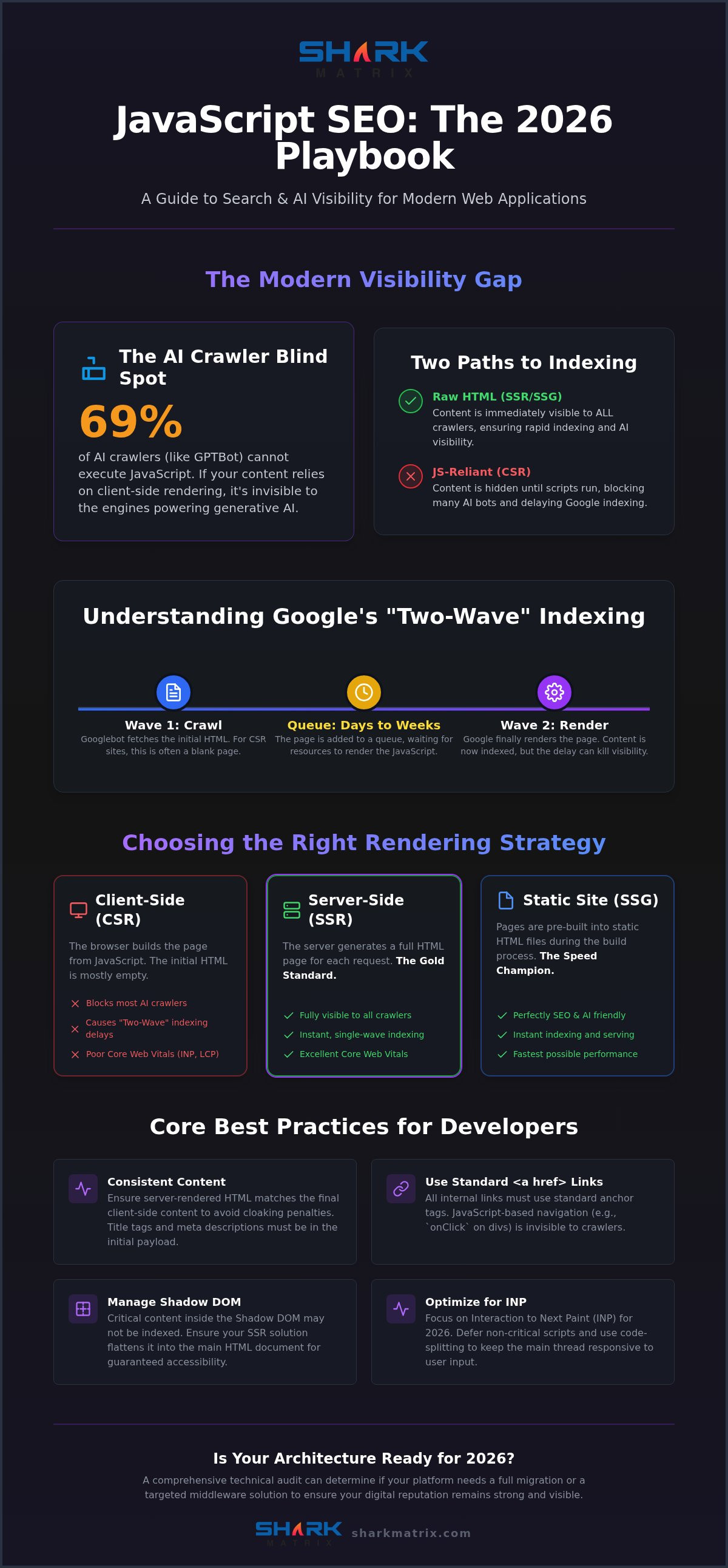
Did you know that 69% of AI crawlers are currently unable to execute JavaScript, leaving your dynamic content completely invisible to the engines powering ChatGPT and Claude? It’s a common frustration for modern developers and marketers. You build a sophisticated, lightning-fast web application, yet your most valuable information fails to appear in search results. Balancing the high rendering costs of client-side frameworks with the need for rapid indexation is one of the toughest technical challenges in the industry today.
We’re here to help you solve that puzzle. By implementing the latest javascript seo best practices, you’ll ensure your site is fully accessible to both Googlebot’s evergreen renderer and the more limited crawlers used by generative AI platforms. This guide provides a clear roadmap for navigating the complexities of SSR, SSG, and hybrid rendering. You’ll learn how to future-proof your digital presence, improve indexation rates, and leverage custom web development to turn your JavaScript architecture into a powerful asset for your digital reputation. We’ll break down everything from initial HTML consistency to the latest interaction to next paint thresholds for 2026.
Key Takeaways
- Understand the “two-wave” indexing problem to prevent critical content from being delayed in search results for days or weeks.
- Master essential javascript seo best practices by selecting the right rendering strategy, such as SSR or SSG, based on your site’s specific performance needs.
- Learn how to optimise for generative engines by providing raw HTML that AI crawlers like GPTBot can process without rendering JavaScript.
- Discover technical fixes for managing the Shadow DOM and ensuring all internal links use standard HTML tags for better crawlability.
- Identify whether your enterprise platform requires a full architectural migration or a targeted middleware solution through a comprehensive technical audit.
What is JavaScript SEO and Why Does it Matter in 2026?
JavaScript SEO is the technical discipline of making dynamic, script-heavy websites understandable for both search engines and the new wave of generative AI bots. While JavaScript is a core technology of the Web, its implementation often creates a barrier between your content and the index. In 2026, failing to follow javascript seo best practices doesn’t just mean lower rankings; it means your digital reputation is invisible to the very systems consumers use to find information.
The biggest hurdle remains the “Two-Wave” indexing problem. When Googlebot visits a site, it first scrapes the raw HTML. If your content is tucked away inside a JavaScript framework like React or Vue without server-side support, the bot sees a blank page. It must then queue that page for a second wave of processing where it renders the scripts. This secondary phase can take days or even weeks. For national enterprises, this delay is a silent killer of search visibility, especially for time-sensitive promotions or inventory updates.
The 2026 Rendering Landscape
Modern search engines have evolved, but they are still prioritising efficiency. Every millisecond Google spends executing your scripts is a drain on its crawl budget. If your site relies heavily on client-side rendering (CSR), you’re essentially asking search engines to pay for your page’s processing power. In a competitive national market, bots will simply move on to a competitor with a more efficient, pre-rendered architecture. This is why AI automation services are now frequently used to audit these complex JS structures, identifying where rendering bottlenecks are stifling growth.
Common Myths About JavaScript and Search
One persistent myth is that Googlebot’s “evergreen” status means it sees everything exactly like a human user. While it’s true Googlebot uses the latest Chromium engine, it doesn’t mean rendering is guaranteed or immediate. Another dangerous misconception is that being “crawlable” is the same as being “rankable.” If your content is only available after a complex chain of JS executions, it lacks the technical authority required for high-competition niches. Relying on CSR for national lead generation is a high-stakes gamble. As AI crawlers continue to struggle with script execution, javascript seo best practices now demand a shift toward hybrid or server-side rendering to ensure your brand remains visible across the entire digital ecosystem.
Choosing the Right Rendering Strategy for Search Visibility
Selecting a rendering method determines how efficiently search engines process your site. In the context of javascript seo best practices, the choice usually falls between four main architectures: Server-Side Rendering (SSR), Static Site Generation (SSG), Incremental Static Regeneration (ISR), and Dynamic Rendering. Each has a specific impact on how quickly your content moves through Google’s two-wave indexing process.
SSR remains the gold standard for dynamic, real-time content. It generates HTML on the server for every request, ensuring that crawlers receive a fully rendered page instantly. For national content hubs where speed is the primary driver, SSG is often superior because it pre-renders pages during the build process. If you need to update static content without a full redeploy, ISR offers a middle ground by re-validating specific pages in the background. Dynamic rendering serves as a useful workaround for legacy systems, but it’s rarely the first choice for new web design and development projects due to its inherent complexity.
Server-Side Rendering (SSR) vs. Client-Side Rendering (CSR)
The performance gap between SSR and CSR is most evident in Core Web Vitals. CSR relies on the user’s browser to build the page, which often spikes Interaction to Next Paint (INP) and Largest Contentful Paint (LCP). When the browser is busy executing heavy scripts, it can’t respond to user inputs, leading to a poor experience. You can identify these bottlenecks by using the ‘Performance’ tab in Chrome DevTools to look for long tasks that block the main thread. Shifting to SSR mitigates these risks by offloading the heavy lifting to the server, providing a stable foundation for your digital reputation.
Framework-Specific Optimisation: Next.js and Nuxt.js
Modern frameworks like Next.js and Nuxt.js have built-in features that simplify javascript seo best practices. These tools handle hydration, the process where the browser takes the static HTML and makes it interactive, more efficiently than custom-built solutions. However, poor hydration can still trigger INP issues if not managed correctly. It’s vital to ensure that metadata and canonical tags are present in the initial HTML response rather than being injected later via script. For a deeper look at these fundamentals, Google’s JavaScript SEO basics provides the essential groundwork for ensuring your framework of choice doesn’t hinder your visibility. If you’re struggling with complex architecture, our ai automation services can help streamline technical audits to find the perfect rendering balance.
Optimising for Generative Engines and AI Crawlers
Googlebot’s ability to render JavaScript is well-documented, but a 2025 study revealed a stark reality for modern brands: 69% of AI crawlers, including GPTBot and ClaudeBot, are currently unable to execute JavaScript. This creates a massive visibility gap. While your site might look perfect in Google Search, it remains a blank canvas for the Large Language Models (LLMs) that power AI search engines. Adhering to javascript seo best practices now requires a dual-pronged approach. You must serve the evergreen Googlebot while simultaneously providing raw HTML to AI scrapers that ignore client-side scripts.
AI engines prioritise raw HTML because it’s computationally cheaper to process. If your dynamic content only appears after a script runs, these bots won’t see your pricing, product descriptions, or unique insights. Structured data, specifically JSON-LD, acts as a bridge here. It provides a machine-readable summary that AI can digest without needing to render the entire DOM. This is a cornerstone of generative engine optimization (geo), ensuring your brand is cited as a source in AI-generated answers.
Making Dynamic Content Accessible to LLMs
To reach LLMs, you should consider using server-side fragments. This involves serving key data points as static HTML while keeping the interactive elements for the user’s browser. This ensures that when an AI bot scrapes your site, it finds the “meat” of the content immediately. It’s particularly vital for data-heavy sites where accuracy is non-negotiable. If an AI chatbot can’t find your data in the initial HTML, it might hallucinate or simply ignore your brand. Ensuring your site is ready for natural language processing means prioritising text-based content over script-injected components.
The Future of Answer Engine Optimisation (AEO)
JavaScript-heavy architectures often prevent sites from appearing in ‘AI Overviews’ or appearing as a recommended source in AI chatbot development interfaces. When the content is locked behind a script, the “answer engine” can’t extract the specific sentences it needs to satisfy a user’s query. Shark Matrix focuses on making every technical audit machine-readable from the first byte. As noted in the official Google documentation, Googlebot is capable of rendering, but relying on that second wave is a risk for AEO. Clean, server-delivered content is the only way to guarantee your brand stays relevant in an AI-first search environment.
Technical Implementation: Core Best Practices for Developers
Translating high-level strategy into functional code requires a meticulous approach to how scripts interact with the browser. At the heart of javascript seo best practices is the humble anchor tag. You must ensure all internal links use standard HTML <a> tags with valid href attributes. Googlebot often ignores links that rely solely on JavaScript event listeners like “onclick” because it doesn’t always trigger those interactions during the crawl phase. Without a clear URL path, your site’s architecture remains invisible to the index.
Managing the Shadow DOM is another critical hurdle. While modern rendering engines can see into encapsulated components, relying on them for critical content is risky. It’s often safer to keep essential text and links in the Light DOM. Similarly, error handling in single-page applications is frequently overlooked. Since SPAs don’t naturally refresh the page, a missing resource might still return a 200 OK status code. You must implement logic that explicitly tells the server to return a 404 or 5xx error to prevent “soft 404” issues that waste your crawl budget and confuse search engines.
On-Page Technical Essentials
Every piece of content needs a unique, permanent URL. Avoid using hash fragments (#) for navigation, as search engines generally ignore everything after the hash. Use the History API to manage clean URLs during client-side transitions. You also need to synchronise meta titles and descriptions in real-time. If the metadata doesn’t update when a user navigates between views, search engines will see duplicate titles across your entire app. Following a strict on page seo checklist ensures that your dynamic components don’t accidentally break foundational SEO rules.
Performance and Core Web Vitals
Reducing JavaScript execution time is paramount for improving Largest Contentful Paint (LCP). In 2026, the threshold for Interaction to Next Paint (INP) has become a primary ranking factor, meaning you must minimise main-thread work. Heavy scripts that block the browser from responding to clicks will tank your rankings. Optimising lazy-loading is equally vital; use native browser attributes rather than custom scripts that might hide images from crawlers. Many national brands now use ai automation services to monitor these performance metrics at scale, catching regressions before they impact the bottom line. If your current architecture is dragging down your scores, a technical SEO audit can help identify the specific scripts causing the lag.
Navigating Complex JS SEO Challenges with Expert Strategy
Managing a national enterprise platform requires a sophisticated understanding of how code interacts with crawl budgets. When your site serves thousands of dynamic pages, a simple technical checklist isn’t enough. You need a comprehensive technical audit that looks beyond surface-level errors. This process involves deciding whether a full architectural migration to a framework like Next.js is necessary or if a middleware fix can bridge the gap. While migrations are resource-intensive, they often provide the best long-term foundation for javascript seo best practices by eliminating the “two-wave” indexing delay entirely.
Monitoring is the next pillar of a successful strategy. You should regularly use the URL Inspection tool within Search Console to verify how Googlebot renders your content. If the “Tested Page” screenshot shows a blank area where your main content should be, you have a rendering failure. Investing in a technical seo consultant can help you decipher these logs and implement fixes that protect your digital reputation. The ROI of this expertise is found in improved indexation rates and the prevention of costly traffic drops during framework updates.
Auditing and Monitoring JS Health
A vital part of your audit is comparing the “View Source” output with the “Inspected HTML” in your browser. The former shows what non-rendering bots see, while the latter shows the final rendered state. If critical SEO elements like canonical tags or H1s are missing from the raw source, you’re likely invisible to AI crawlers. Many teams now leverage machine learning development services to build predictive auditing tools. These systems can scan millions of pages and flag rendering anomalies before they impact your rankings, allowing for automated alerts on critical landing pages.
Conclusion: Building for the 2026 Web
The web has shifted from a focus on simple crawlability to a requirement for AI-readiness. In 2026, technical excellence is no longer optional; it’s a competitive advantage that separates national leaders from the rest of the market. By prioritising clean, server-delivered content and robust script management, you ensure your brand remains visible across both traditional search engines and emerging generative platforms. If you’re ready to future-proof your architecture, Partner with Shark Matrix for advanced Technical SEO to turn your complex JavaScript environment into a growth engine.
Future-Proofing Your Dynamic Digital Presence
Mastering the intersection of modern frameworks and search visibility is no longer a luxury for national enterprises. By aligning your architecture with javascript seo best practices, you transition from a site that’s merely functional to one that’s strategically visible. You’ve learned that success in 2026 hinges on choosing the right rendering balance and ensuring your data is accessible to the next generation of AI-driven crawlers. Technical excellence isn’t just about fixing errors; it’s about building a resilient foundation for your digital reputation.
Expertise matters when the stakes for your indexation are high. Shark Matrix offers 15+ years of digital experience, specialising in end-to-end technical SEO and custom web development. Whether you need to navigate complex migrations or implement advanced generative engine optimisation, our team provides the national coverage required for high-stakes projects. Scale your national visibility with expert SEO services from Shark Matrix and ensure your dynamic content reaches its full potential. Your journey toward a faster, more searchable web starts with a single technical shift. We’re ready to help you lead the way.
Frequently Asked Questions
Is JavaScript bad for SEO in 2026?
JavaScript isn’t inherently bad for search, but it adds a layer of technical complexity that requires careful management. While Googlebot’s rendering engine is evergreen, many AI bots still only process raw HTML. Following javascript seo best practices ensures that your content is accessible to all crawlers. Without proper implementation, you risk long indexing delays and high rendering costs that can drain your crawl budget and impact your overall digital reputation.
What is the best rendering method for a large e-commerce website?
For large-scale e-commerce platforms, Server-Side Rendering (SSR) or Incremental Static Regeneration (ISR) are the most effective methods. These strategies ensure that product descriptions and pricing are available in the initial HTML response. This is crucial for both traditional search engines and generative AI crawlers. To implement these complex solutions, Fraai Agency provides the specialized development expertise needed for result-oriented webshops. Avoid relying solely on client-side rendering, as it can lead to slow page speeds and fragmented indexation across your massive product catalogue.
You can verify rendering by using the URL Inspection tool in Google Search Console. After entering a URL, click “Test Live URL” and then “View Tested Page.” This allows you to see the rendered HTML and a screenshot of how Googlebot sees your site. If critical content is missing from the screenshot or the code, your JavaScript architecture might be blocking the crawler from seeing your full page.
Do AI search engines like ChatGPT crawl JavaScript differently than Google?
Yes, AI search engines crawl differently because most currently lack the resources to execute JavaScript. While Googlebot uses a full rendering engine, bots like GPTBot and ClaudeBot typically only read the raw HTML. If your site relies on client-side scripts to display content, it will likely be invisible to these generative engines. This makes server-side delivery essential for any brand prioritising generative engine optimisation (GEO).
Will using a JavaScript framework like React or Vue hurt my rankings?
Frameworks like React or Vue won’t hurt your rankings if you use them correctly with a meta-framework like Next.js or Nuxt.js. These tools allow for server-side rendering, which solves the crawlability issues associated with standard single-page applications. The danger lies in using vanilla client-side rendering, which often results in poor Core Web Vitals and delayed indexing. Custom web development should always prioritise search-friendly architecture from the start. For companies looking to build such high-performance applications, Agami Technologies offers expert custom software and SaaS development services that ensure technical SEO is baked into the foundation.
The ‘Two-Wave’ indexing problem occurs when Google indexes your raw HTML first and then returns later to render the JavaScript. This delay can range from a few hours to several weeks, leaving your content out of search results in the interim. You can fix this by implementing server-side rendering or static site generation. These methods provide the full content during the first wave, ensuring immediate and accurate indexation.
How much does a technical SEO audit for a JS site cost in the UAE?
The cost of a technical SEO audit for a JavaScript-heavy site varies based on the complexity of your architecture and the size of your platform. National enterprise sites often require a more deep-dive analysis compared to smaller applications. Instead of looking for a flat fee, you should evaluate the scope of the audit, including rendering checks and performance profiling. Shark Matrix provides comprehensive technical audits that identify specific bottlenecks in your JS environment.
Can I use dynamic rendering as a permanent solution for SEO?
Dynamic rendering is no longer recommended as a long-term solution for modern websites. While it was once a popular workaround for legacy systems, Google now prefers that sites use server-side rendering or static site generation. AI crawlers also benefit more from a consistent HTML structure rather than a bifurcated system. Moving toward a hybrid or SSR architecture is the best way to future-proof your site for the evolving search landscape.
 OpenAI
 Codex
Codex
 Vertex AI
 Cloud Vision
 OpenCV
 TensorFlow
 IBM Watson
 Cloud Natural Language
 Cognitive Services
 Bot Framework
 Mistral
 LLama
LLama
 Gemini
 Anthropic
 N8N
N8N